Radiation Physics-2 Al-Mustaqbal University College 3rd Piezoelectric Effect Assistant lecturer: AnsamFadil Ali Showard 3 Note: A transducer is any device that converts one form of energy into another. An ultrasound transducer converts
"Radiation Physics-2 Al-Mustaqbal University" is the property of its rightful owner. Permission is granted to
download and print the materials on this website for personal, non-commercial use only, and to display it
on your personal computer provided you do not modify the materials and that you retain all copyright
notices contained in the materials. By downloading content from our website, you accept the terms of this
agreement.
Presentation Transcript
01
Radiation Physics-2 Al-Mustaqbal University College 3rd Piezoelectric Effect Assistant lecturer:
AnsamFadil Ali Showard 3<br>
02
Note:
A transducer is any device that converts one form of energy into another. An ultrasound transducer converts electrical energy into ultrasound energy and vice versa.
Transducers for ultrasound imaging consist of one or more piezoelectric crystals or elements.
Imaging is often performed with multiple-element “arrays” of piezoelectric crystals.<br>
03
Historical of Piezoelectric Materials
The word piezoelectricity means the ability of some materials (notably crystals and certain ceramics, including bone) to generate an electric charge or of electric polarity in dielectric crystals in response to applied mechanical stress in such crystals subjected to an applied voltage.
The piezoelectric effect is exhibited by certain crystals that, in response to applied pressure, develop a voltage across opposite surfaces. This effect is used to produce an electrical signal in response to incident ultrasound waves.
The piezoelectric effect was first described by Pierre and Jacques Curie in 1880 using natural quartz
Today, it is known that many materials such as quartz, topaz, cane sugar, Rochelle salt, and bone have this effect.<br>
04
Piezoelectric Materials
Materials generate an electrical voltage from separation of positive and negative charges when they are squeezed or stretched.
The charge that accumulates in certain solid materials (notably crystals, certain ceramics, and biological matter such as bone, DNA and various proteins) in response to applied mechanical stress.
Each molecule is polarized since one end is more negatively charged and the other end is positively charged, and is called a dipole as a result of the atoms that make up the molecule and the way the molecules are shaped.<br>
05
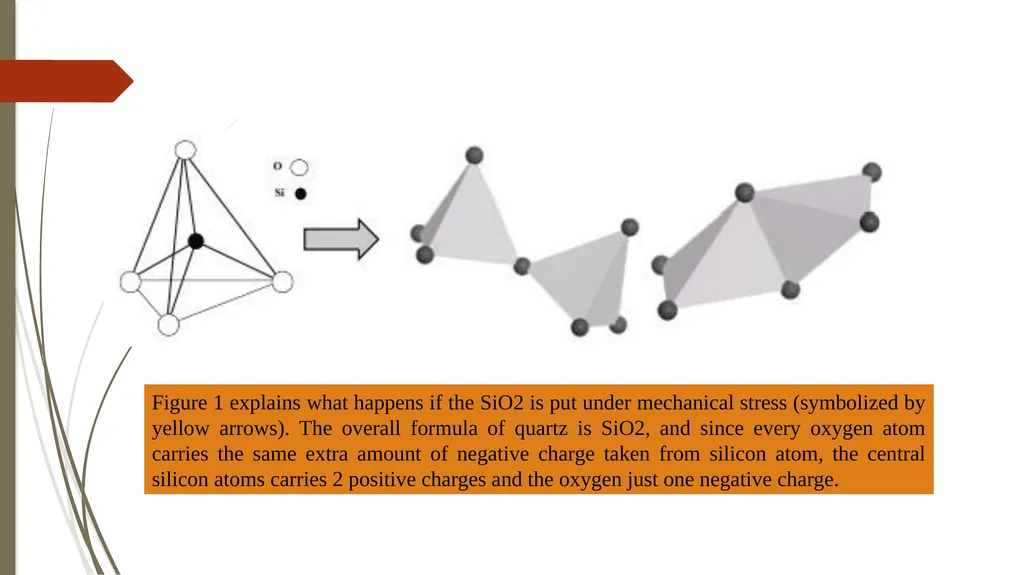
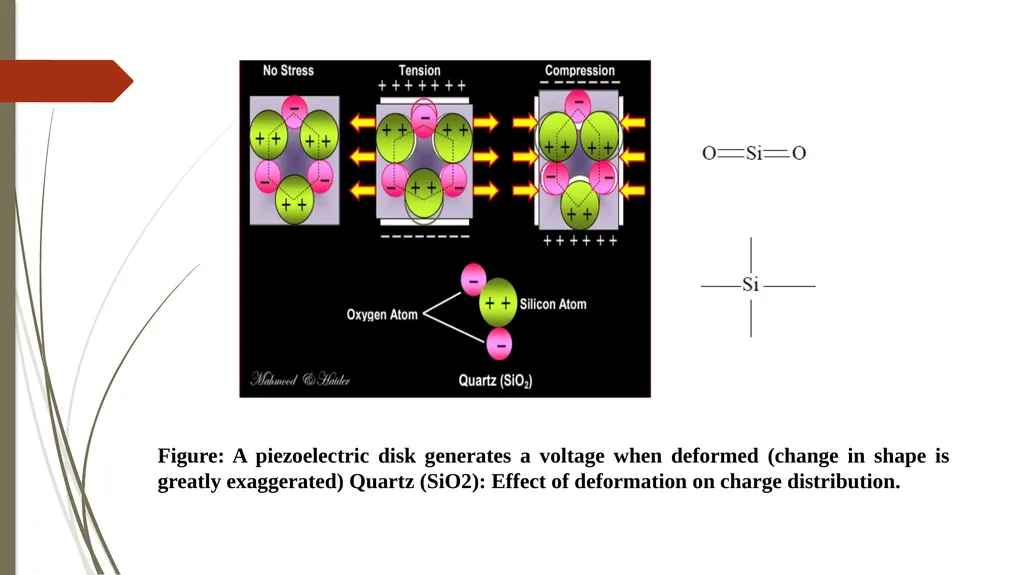
Figure 1 explains what happens if the SiO2 is put under mechanical stress (symbolized by yellow arrows). The overall formula of quartz is SiO2, and since every oxygen atom carries the same extra amount of negative charge taken from silicon atom, the central silicon atoms carries 2 positive charges and the oxygen just one negative charge.<br>
06
Figure: A piezoelectric disk generates a voltage when deformed (change in shape is greatly exaggerated) Quartz (SiO2): Effect of deformation on charge distribution.<br>
07
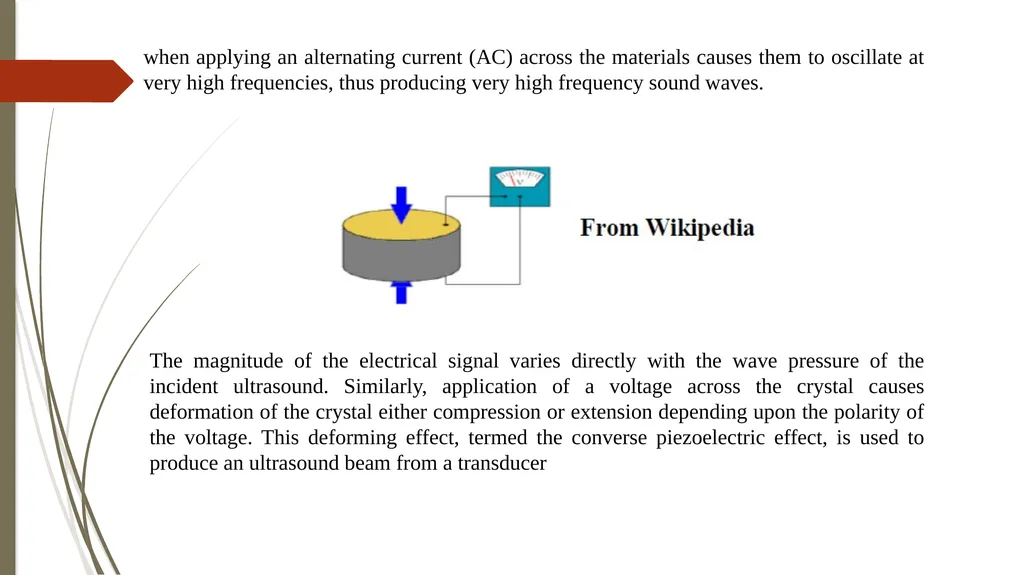
when applying an alternating current (AC) across the materials causes them to oscillate at very high frequencies, thus producing very high frequency sound waves. The magnitude of the electrical signal varies directly with the wave pressure of the incident ultrasound. Similarly, application of a voltage across the crystal causes deformation of the crystal either compression or extension depending upon the polarity of the voltage. This deforming effect, termed the converse piezoelectric effect, is used to produce an ultrasound beam from a transducer<br>
08
Piezoelectric Effect
The piezoelectric effect is the ability of certain non-conducting materials, such as quartz crystals and ceramics, to generate electric current when they are exposed to mechanical stress (such as pressure or vibration).
The piezoelectric effect occurs only in crystals with a special crystal structure which they lack of center of symmetry (see figure 2). Under an applied force the centers of mass for positive and negative ions are shifted which results in a net dipole moment.
In the absence of an applied force, the center of mass of the positive ions coincides with that of the negative ions and there is no resulting dipole moment or polarization.<br>
09
Reverse Piezoelectric Effect
The piezoelectric effect is a reversible process in that materials exhibiting the direct piezoelectric effect (the internal generation of electrical charge resulting from an applied mechanical force)
Also exhibit the reverse piezoelectric effect (the internal generation of a mechanical strain resulting from an applied electrical field). This effect is formed in crystals that have no center of symmetry.
Hence the piezoelectric crystals are both transmitter (small proportion of the time) and receiver (most of the time).<br>
10
Detection of Ultrasound
If ultrasound hits the crystal from outside, it will cause the crystal to vibrate in and out, and this will produce an alternating electric field. The resulting electrical signal can be amplified and processed in a number of ways.
The resulting electrical signal can be amplified and processed in a number of ways. So a second crystal can be used to detect any returning ultrasound which has been reflected from an obstacle.
Normally the transmitting and receiving crystals are built into the same hand-held unit, which is called an ultrasonic transducer what is the material used by doctors and placed on the skin prior to the examination: Ultrasound gel is a type of conductive medium that is used in ultrasound diagnostic techniques and treatment therapies. It is placed on the patient’s skin at the beginning of the ultrasound examination or therapy. The transducer, which is the device used to send and receive sound waves, is then placed on top of it.<br>