RADIOMETRIC DATING CHRONOSTRATIGRAPHY Geochronology is the science of determining the age of rocks, fossils, and sediments Chronostratigraphy is the branch of stratigraphy that studies the age of rock strata in relation to time RADIOACTIVE
"RADIOMETRIC DATING CHRONOSTRATIGRAPHY" is the property of its rightful owner. Permission is granted to
download and print the materials on this website for personal, non-commercial use only, and to display it
on your personal computer provided you do not modify the materials and that you retain all copyright
notices contained in the materials. By downloading content from our website, you accept the terms of this
agreement.
Presentation Transcript
01
RADIOMETRIC DATING CHRONOSTRATIGRAPHY<br>
02
Geochronology is the science of determining the age of rocks, fossils, and sediments
Chronostratigraphy is the branch of stratigraphy that studies the age of rock strata in relation to time<br>
03
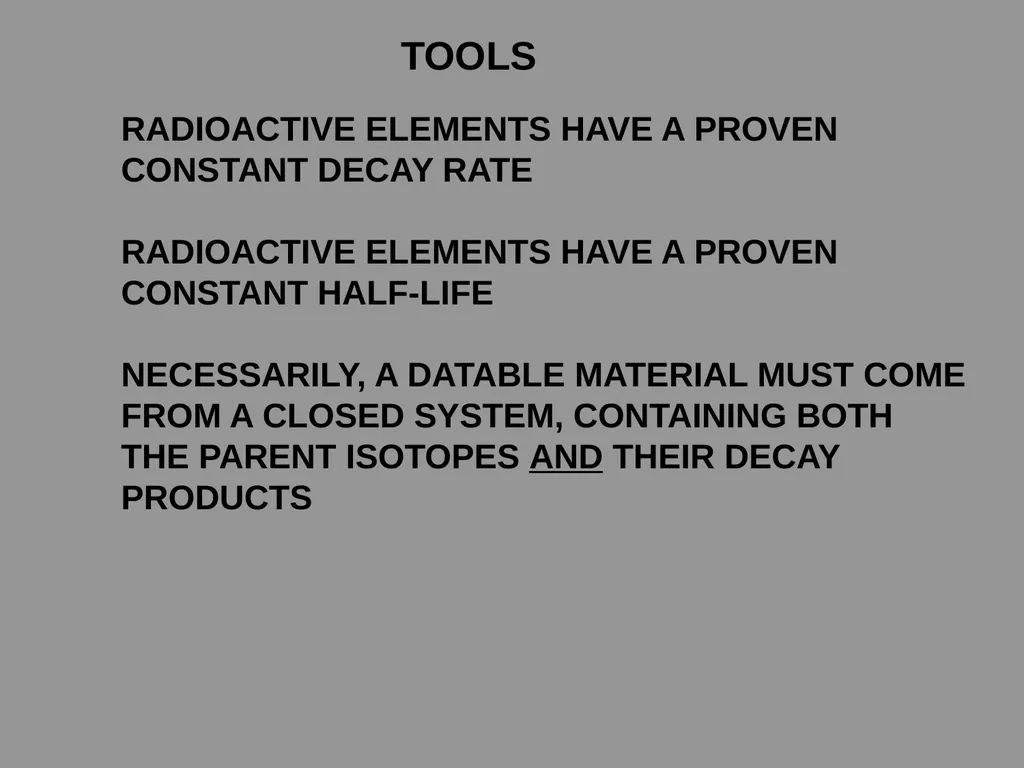
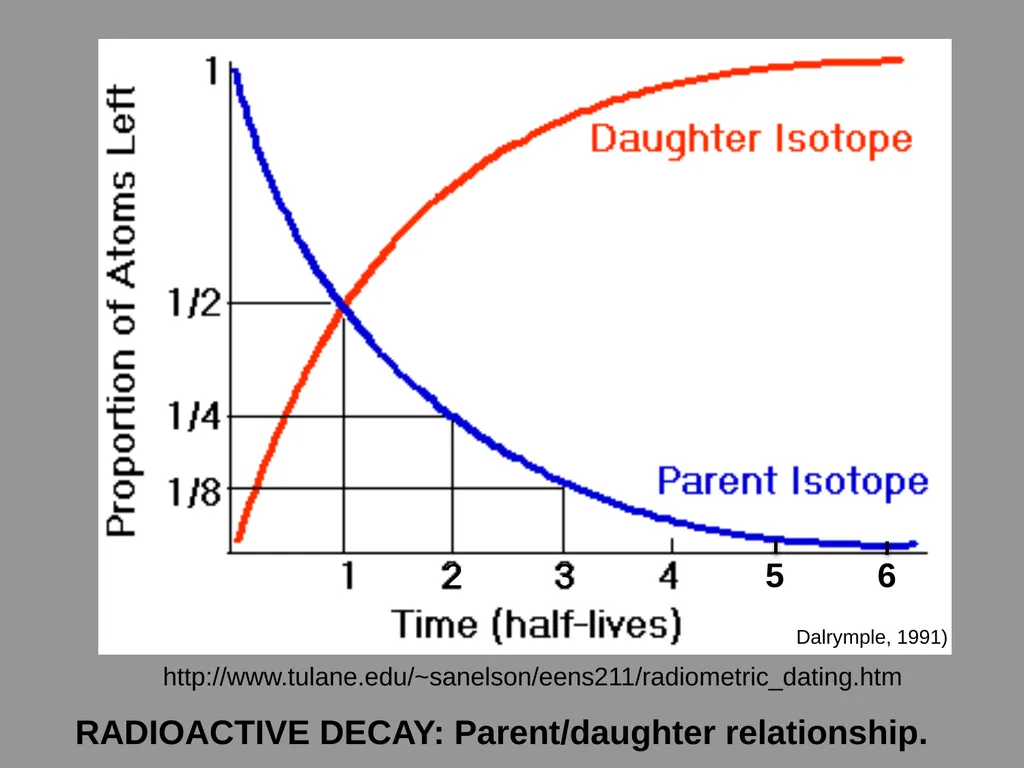
RADIOACTIVE ELEMENTS HAVE A PROVEN
CONSTANT DECAY RATE
RADIOACTIVE ELEMENTS HAVE A PROVEN
CONSTANT HALF-LIFE
NECESSARILY, A DATABLE MATERIAL MUST COME
FROM A CLOSED SYSTEM, CONTAINING BOTH
THE PARENT ISOTOPES AND THEIR DECAY
PRODUCTS TOOLS<br>
04
The idea that radioactivity could be used as a
measure of the age of geologic formations
was first suggested in 1905 by a British physicist,
Lord Rutherford. In 1907 Professor B. B. Boltwood,
a radiochemist at Yale University, made the first
attempt to establish a geologic time scale.
So by the time that Barrell (1917) wrote his important
stratigraphy paper, he already had a pretty good idea
of the true age of the Earth and approximately how
long it took some Earth processes to operate.<br>
05
Chronostratigraphic units are defined as
encompassing all rocks formed within
certain time spans of Earth history
regardless of their compositions or
properties.
SEE REFERENCES-
http://www.tulane.edu/~sanelson/eens211/radiometric_dating.htm<br>
The best-known absolute dating technique is
carbon-14 dating. However, this method cannot
be used for materials older than ca. 50,000 years,
because the half-life of 14C is only 5730 years.
.
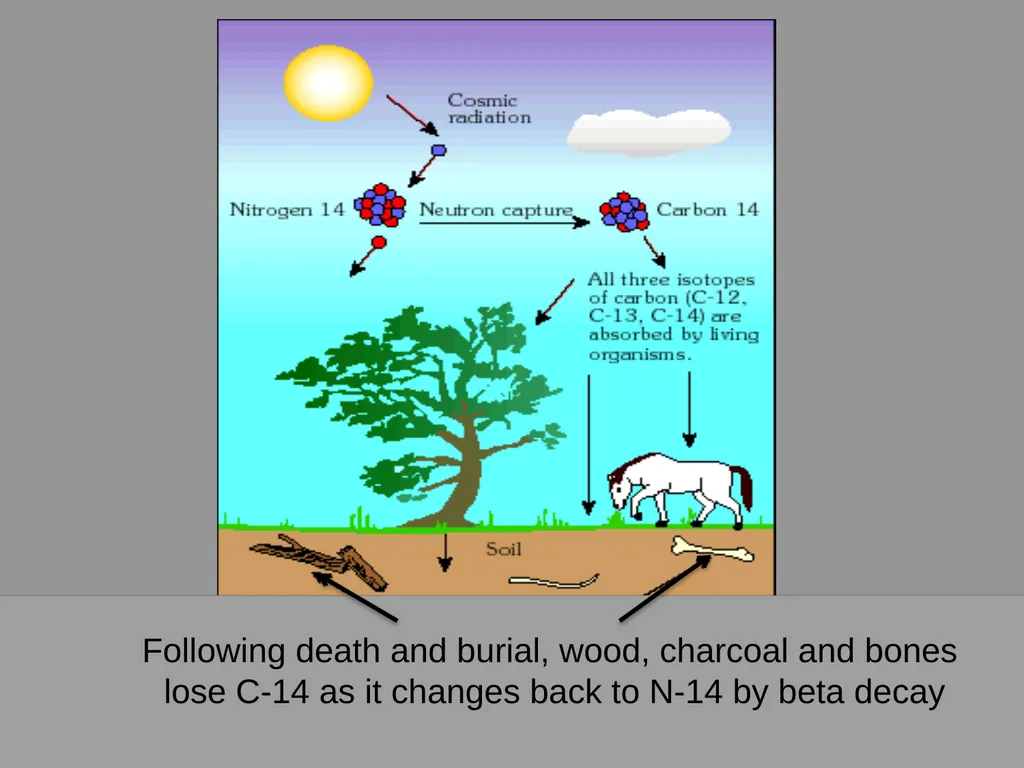
THERE ARE 3 ISOTOPES OF CARBON, 12C, 13C, & 14C CARBON<br>
08
AGE DATING USING CARBON IS NOT ALWAYS CORRECT
BECAUSE OF WEATHERING AND ORGANIC DECAY
LEADING TO LOSS OF PART OF THE ORIGINAL RADIOACTIVE CARBON USEFULNESS
LIMITED
14C IS ONLY FOR WOOD, PEAT, CHARCOAL,
LEATHER, TEXTILES, BONES, SHELLS, & SOMETIMES POTTERY<br>
09
Following death and burial, wood, charcoal and bones
lose C-14 as it changes back to N-14 by beta decay<br>
10
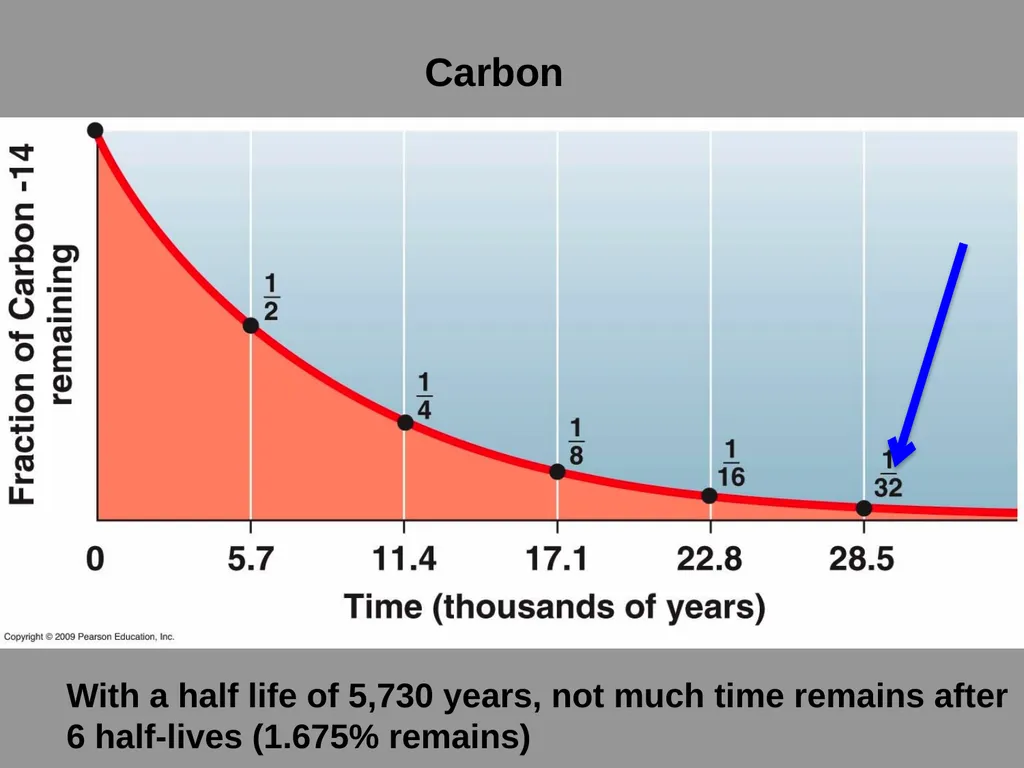
carbon-14 (also written as 14C) has a half-life of 5,730 years breakdown<br>
11
With a half life of 5,730 years, not much time remains after
6 half-lives (1.675% remains) Carbon<br>
12
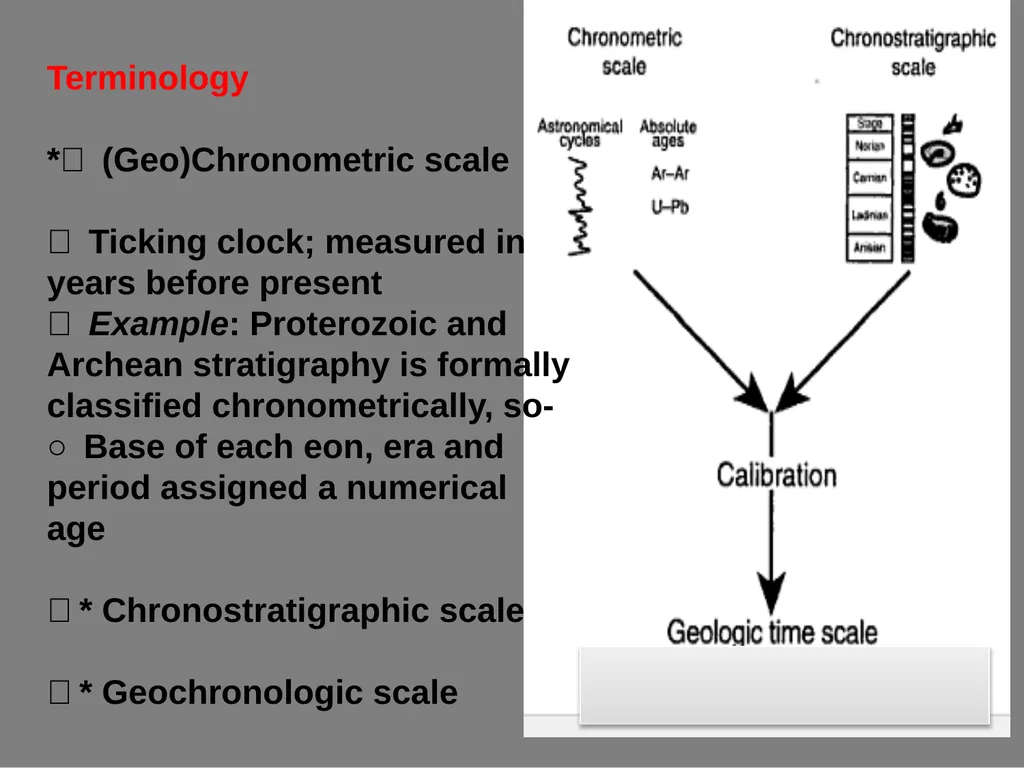
Terminology
* (Geo)Chronometric scale
Ticking clock; measured in
years before present
Example: Proterozoic and
Archean stratigraphy is formally
classified chronometrically, so-
○ Base of each eon, era and
period assigned a numerical
age
* Chronostratigraphic scale
* Geochronologic scale<br>
13
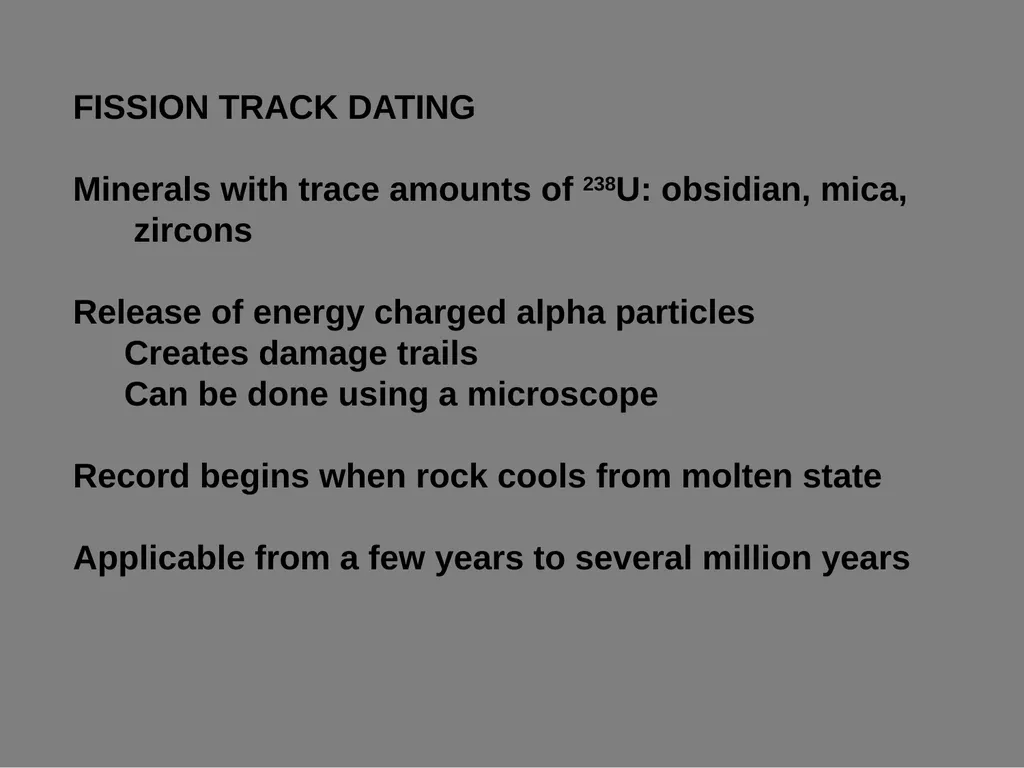
FISSION TRACK DATING
Minerals with trace amounts of 238U: obsidian, mica,
zircons
Release of energy charged alpha particles
Creates damage trails
Can be done using a microscope
Record begins when rock cools from molten state
Applicable from a few years to several million years<br>
14
Radiometric dating: sources of error
"accuracy” [sampling, interpretation, analysis]
decay constant
age of standard
contamination (e.g., atmospheric argon contamination)
character of sample
statistics
accuracy determined by reproducibility
The “precision” of the measurement
isotopic measurement
interference corrections
homogeneity of standard<br>
15
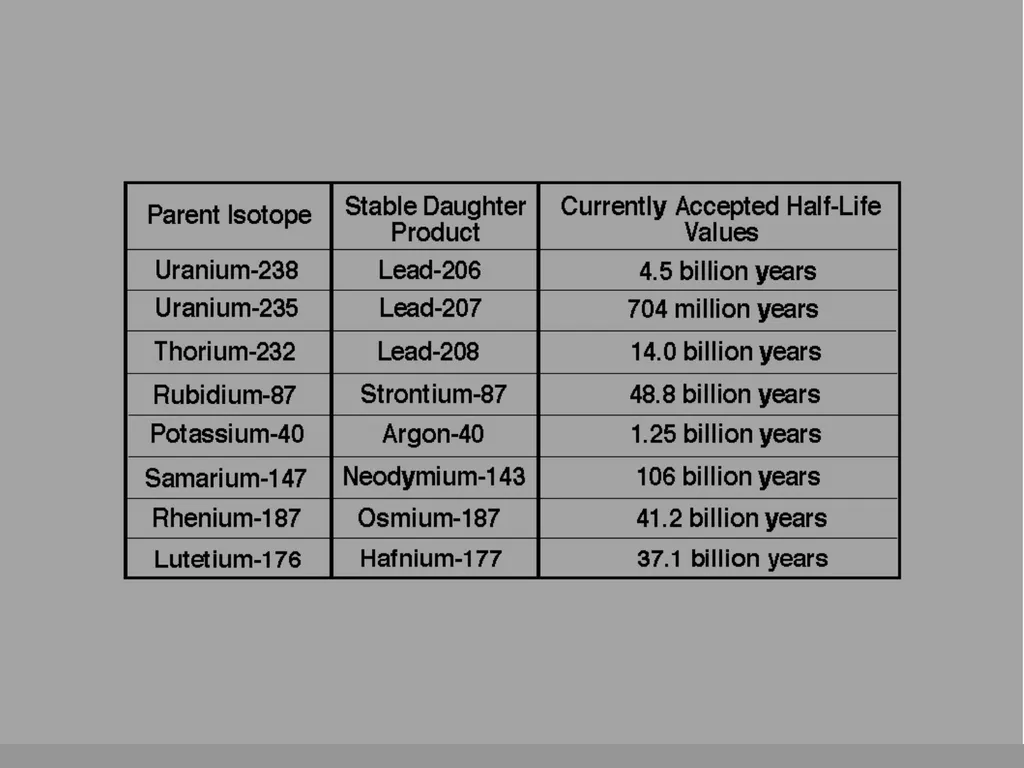
The half-life of Rubidium-87 is 47.5 billion years.
Start with 1000 Rubidium-87 atoms. 47.5 billion years later about one half of them will have decayed into Strontium-87. After one half life you will have about 500 Rubidium-87 atoms and 500 Strontium-87 atoms. In another 47.5 billion years you will have about 250 Rubidium-87 and 750 Strontium-87, and so on.<br>
16
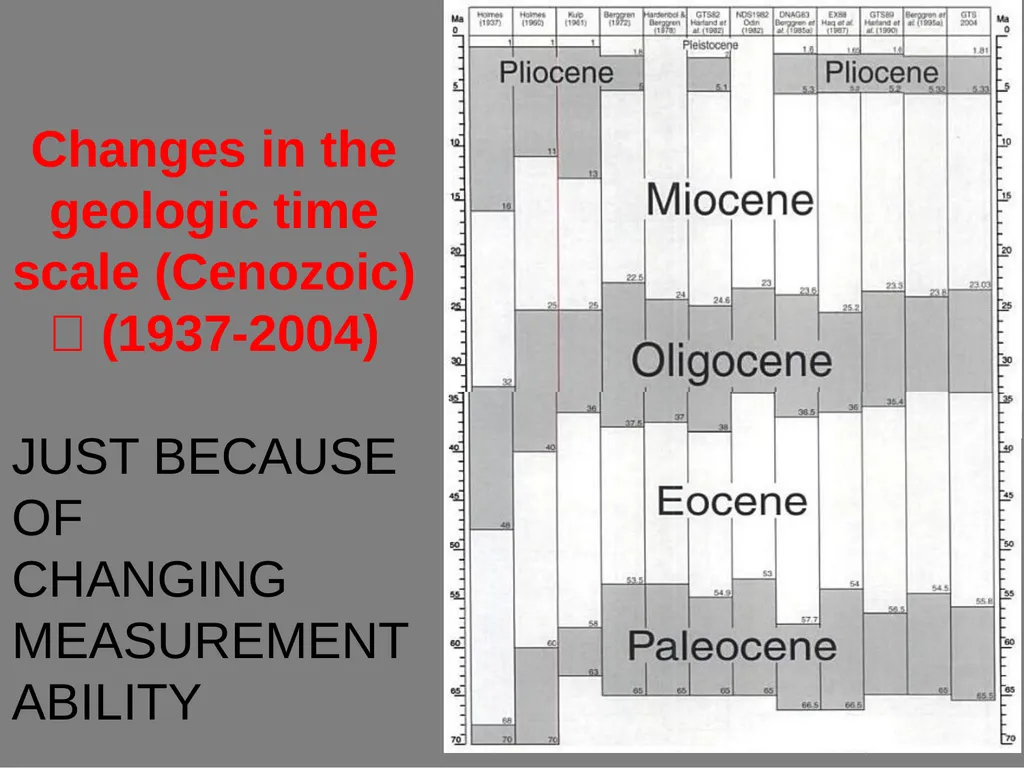
Changes in the
geologic time
scale (Cenozoic)
(1937-2004)
JUST BECAUSE
OF
CHANGING
MEASUREMENT
ABILITY<br>
17
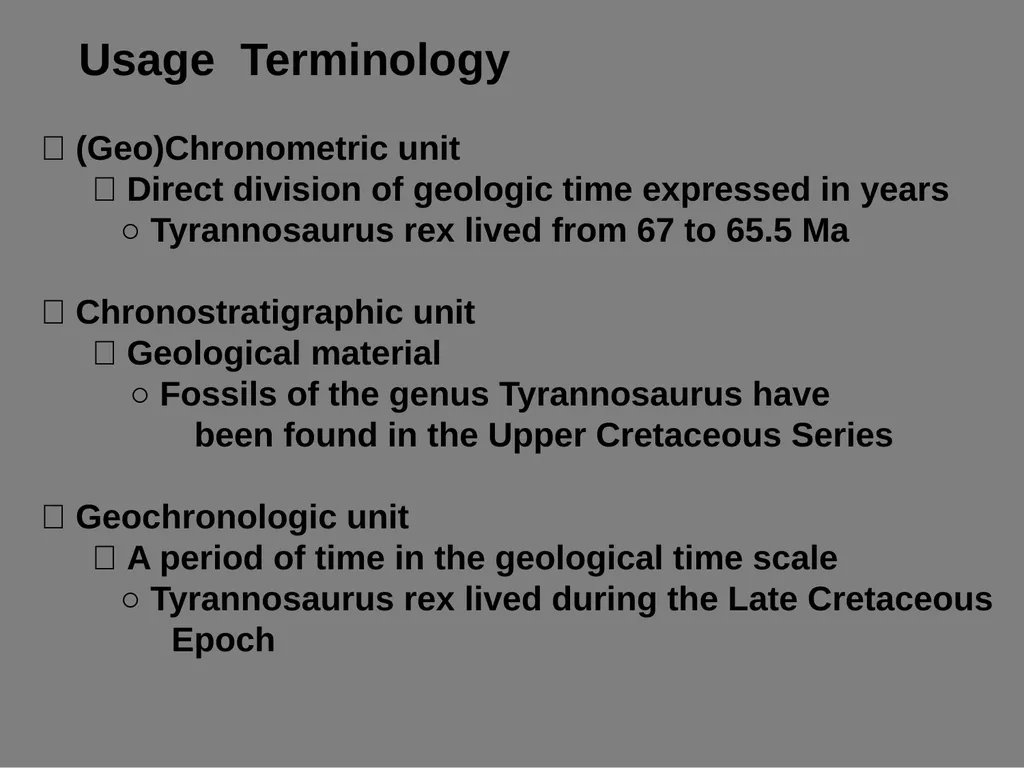
Usage Terminology
(Geo)Chronometric unit
Direct division of geologic time expressed in years
○ Tyrannosaurus rex lived from 67 to 65.5 Ma
Chronostratigraphic unit
Geological material
○ Fossils of the genus Tyrannosaurus have
been found in the Upper Cretaceous Series
Geochronologic unit
A period of time in the geological time scale
○ Tyrannosaurus rex lived during the Late Cretaceous
Epoch<br>