
Ratify and Implement the New Measures of Trade
PC
Published · 11 slides · 0 views

1 / 1

Description
Ratify and Implement the New Measures of Trade Agreements Following Sustainability? The EU-ASEAN FTAs ImprovEUorGlobe Una Europa Bologna, 3-4 July 2023 Written presented: Lien Nguyen Green economy and global governance Key green
Related Topics
Share
Embed code
Download this presentation From Below
"Ratify and Implement the New Measures of Trade" is the property of its rightful owner. Permission is granted to download and print the materials on this website for personal, non-commercial use only, and to display it on your personal computer provided you do not modify the materials and that you retain all copyright notices contained in the materials. By downloading content from our website, you accept the terms of this agreement.
Presentation Transcript
01
Ratify and Implement
the New Measures of Trade Agreements Following Sustainability?
The EU-ASEAN FTAs ImprovEUorGlobe
Una Europa
Bologna, 3-4 July 2023
Written & presented: Lien Nguyen<br>
Una Europa
Bologna, 3-4 July 2023
Written & presented: Lien Nguyen<br>
02
Green economy and global governance
Key green policymaking players and focus Great potential for triple-win possibilities/“triple bottom line” of economic-driven indicators:
job-creating economic growth
environmental protection
social inclusion Channels that free trade could affect the environment
scale
transformation of the input-output matrix
technology Global trade (recorded at $32 trillion for 2022) is a big part of the global economy and economic success of major middle-income countries and some low-income countries. Harmful effects
international transportation
intensive use of resources/pollution-intensive production
detrimental consequences for labour conditions<br>
03
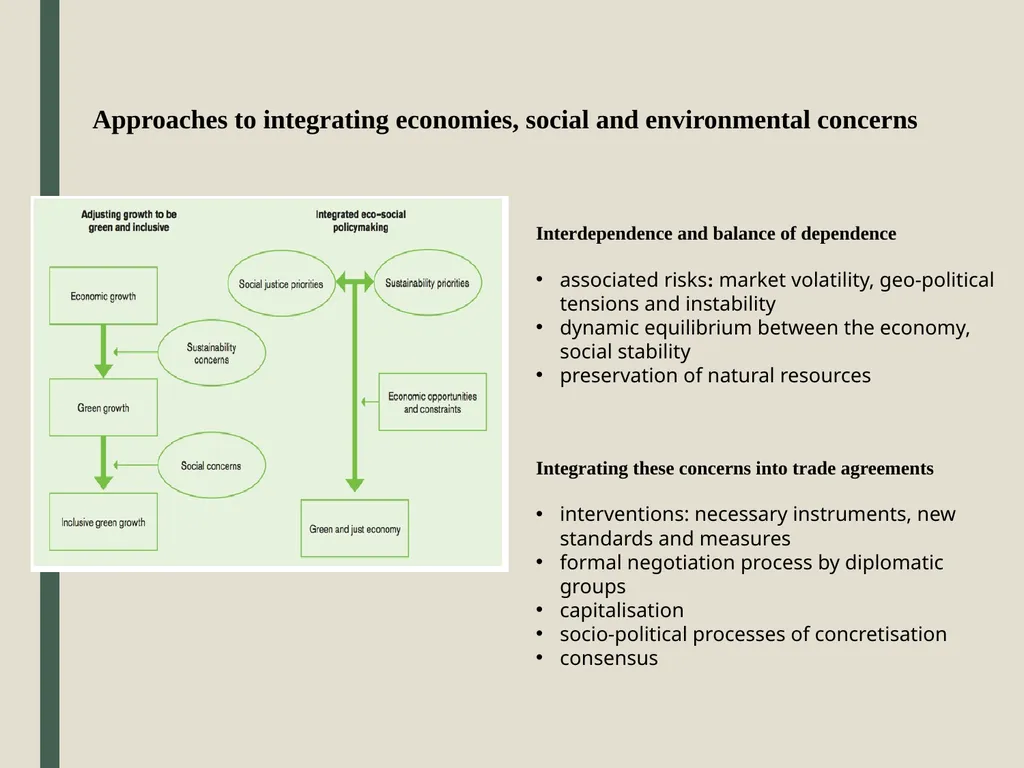
Approaches to integrating economies, social and environmental concerns Interdependence and balance of dependence
associated risks: market volatility, geo-political tensions and instability
dynamic equilibrium between the economy, social stability
preservation of natural resources Integrating these concerns into trade agreements
interventions: necessary instruments, new standards and measures
formal negotiation process by diplomatic groups
capitalisation
socio-political processes of concretisation
consensus<br>
04
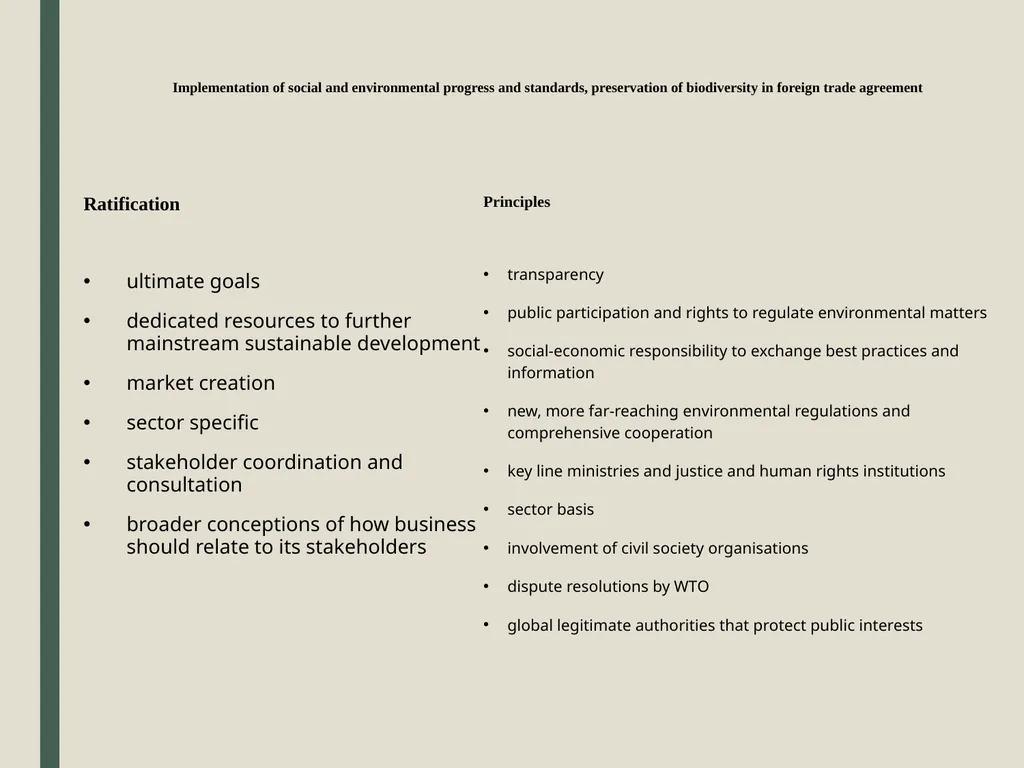
Implementation of social and environmental progress and standards, preservation of biodiversity in foreign trade agreement Ratification
ultimate goals
dedicated resources to further mainstream sustainable development
market creation
sector specific
stakeholder coordination and consultation
broader conceptions of how business should relate to its stakeholders Principles
transparency
public participation and rights to regulate environmental matters
social-economic responsibility to exchange best practices and information
new, more far-reaching environmental regulations and comprehensive cooperation
key line ministries and justice and human rights institutions
sector basis
involvement of civil society organisations
dispute resolutions by WTO
global legitimate authorities that protect public interests<br>
05
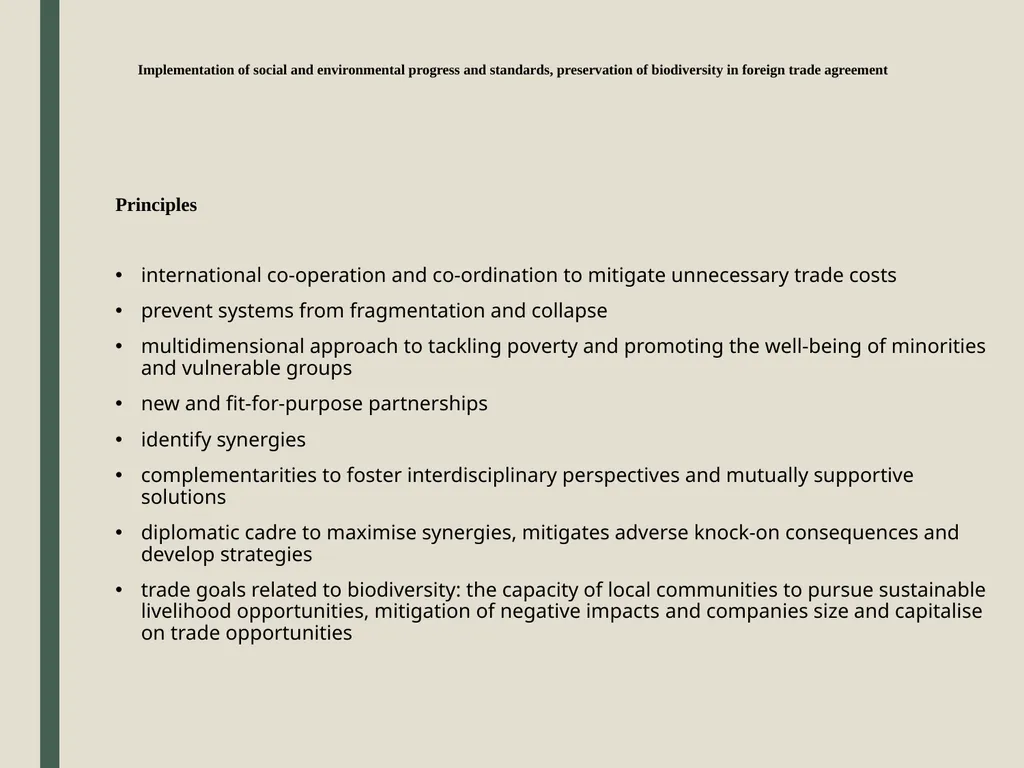
Implementation of social and environmental progress and standards, preservation of biodiversity in foreign trade agreement Principles
international co-operation and co-ordination to mitigate unnecessary trade costs
prevent systems from fragmentation and collapse
multidimensional approach to tackling poverty and promoting the well-being of minorities and vulnerable groups
new and fit-for-purpose partnerships
identify synergies
complementarities to foster interdisciplinary perspectives and mutually supportive solutions
diplomatic cadre to maximise synergies, mitigates adverse knock-on consequences and develop strategies
trade goals related to biodiversity: the capacity of local communities to pursue sustainable livelihood opportunities, mitigation of negative impacts and companies size and capitalise on trade opportunities<br>
06
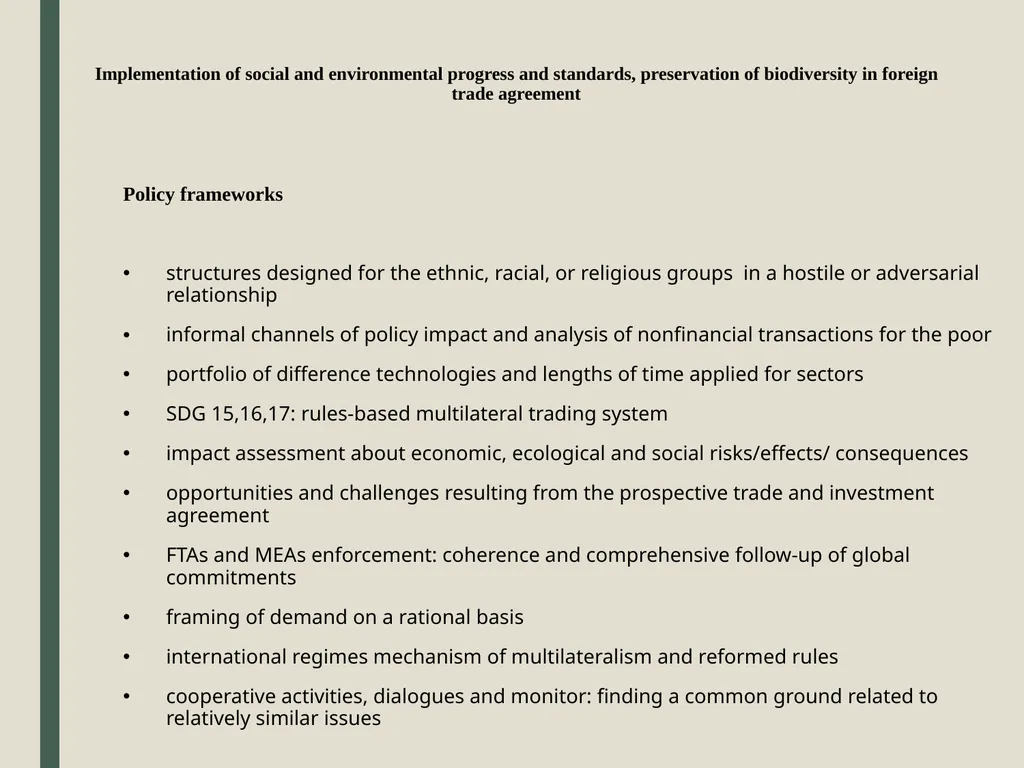
Policy frameworks
structures designed for the ethnic, racial, or religious groups in a hostile or adversarial relationship
informal channels of policy impact and analysis of nonfinancial transactions for the poor
portfolio of difference technologies and lengths of time applied for sectors
SDG 15,16,17: rules-based multilateral trading system
impact assessment about economic, ecological and social risks/effects/ consequences
opportunities and challenges resulting from the prospective trade and investment agreement
FTAs and MEAs enforcement: coherence and comprehensive follow-up of global commitments
framing of demand on a rational basis
international regimes mechanism of multilateralism and reformed rules
cooperative activities, dialogues and monitor: finding a common ground related to relatively similar issues Implementation of social and environmental progress and standards, preservation of biodiversity in foreign trade agreement<br>
07
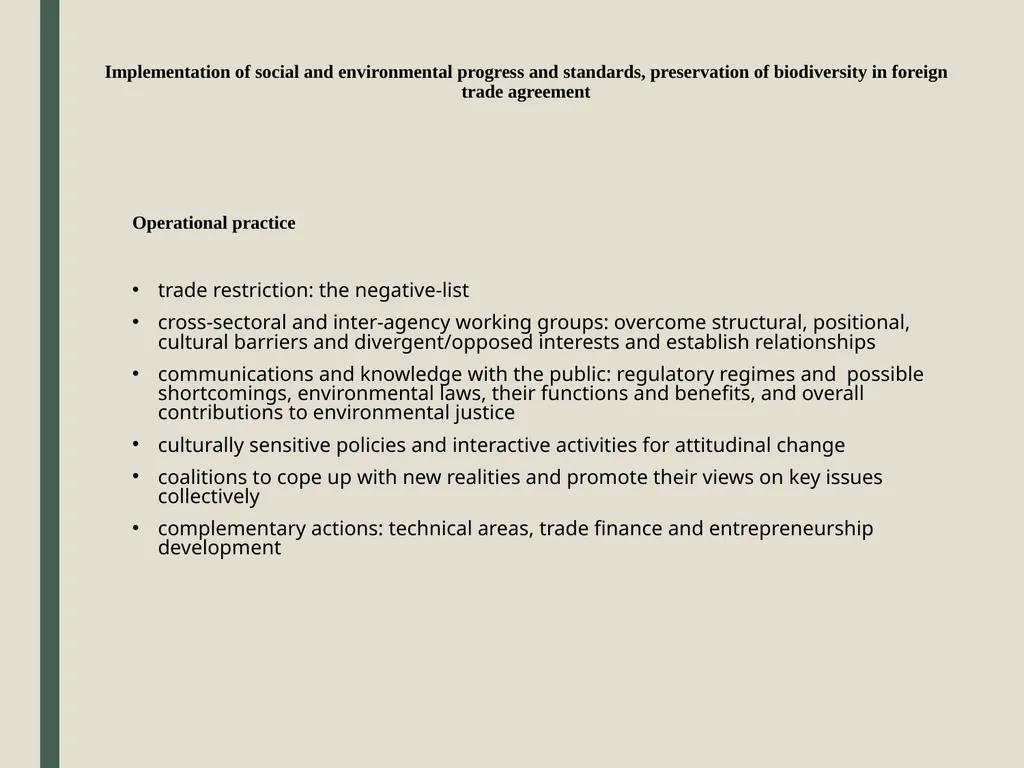
Operational practice
trade restriction: the negative-list
cross-sectoral and inter-agency working groups: overcome structural, positional, cultural barriers and divergent/opposed interests and establish relationships
communications and knowledge with the public: regulatory regimes and possible shortcomings, environmental laws, their functions and benefits, and overall contributions to environmental justice
culturally sensitive policies and interactive activities for attitudinal change
coalitions to cope up with new realities and promote their views on key issues collectively
complementary actions: technical areas, trade finance and entrepreneurship development Implementation of social and environmental progress and standards, preservation of biodiversity in foreign trade agreement<br>
08
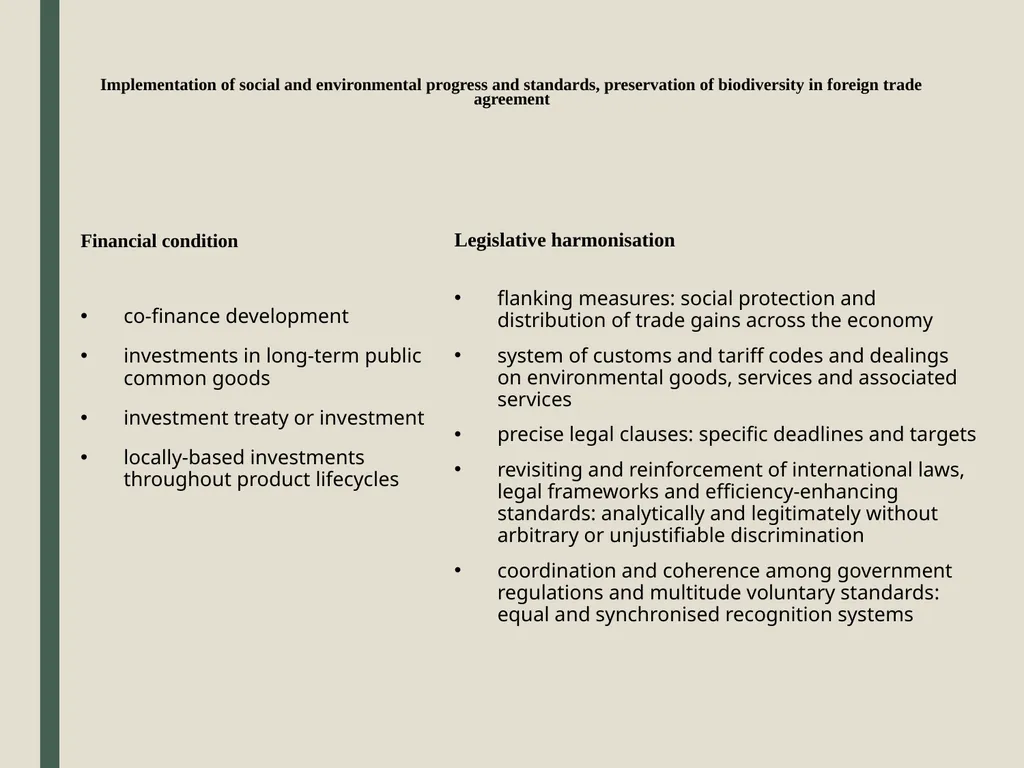
Implementation of social and environmental progress and standards, preservation of biodiversity in foreign trade agreement Financial condition
co-finance development
investments in long-term public common goods
investment treaty or investment
locally-based investments throughout product lifecycles Legislative harmonisation
flanking measures: social protection and distribution of trade gains across the economy
system of customs and tariff codes and dealings on environmental goods, services and associated services
precise legal clauses: specific deadlines and targets
revisiting and reinforcement of international laws, legal frameworks and efficiency-enhancing standards: analytically and legitimately without arbitrary or unjustifiable discrimination
coordination and coherence among government regulations and multitude voluntary standards: equal and synchronised recognition systems<br>
09
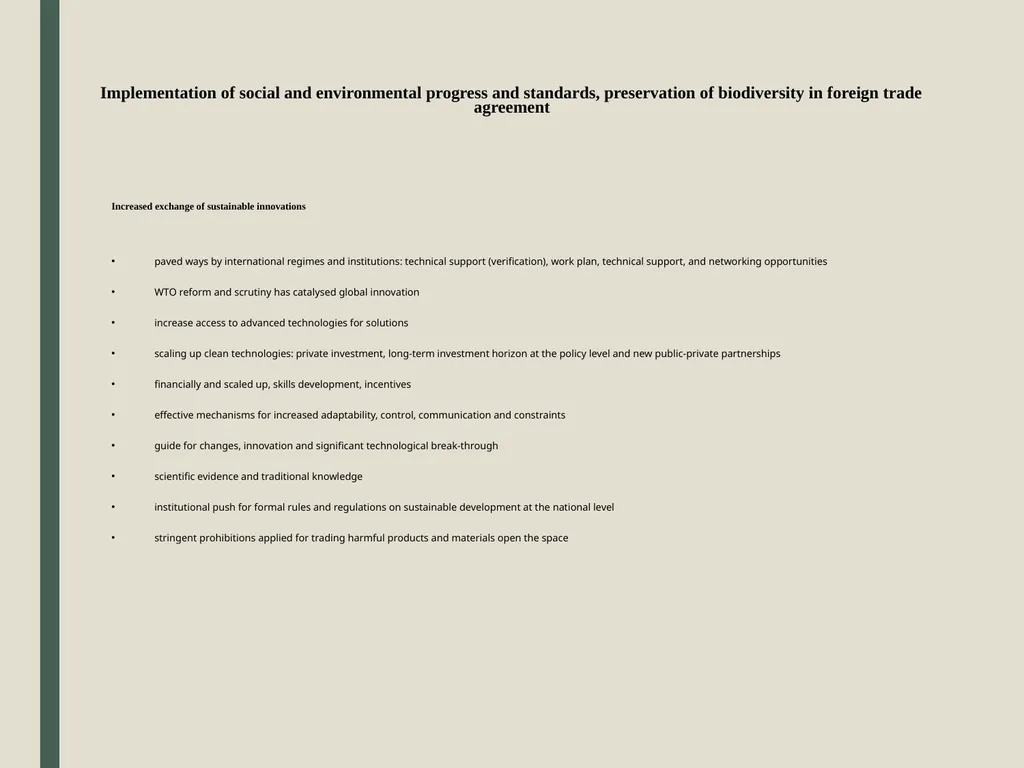
Implementation of social and environmental progress and standards, preservation of biodiversity in foreign trade agreement Increased exchange of sustainable innovations
paved ways by international regimes and institutions: technical support (verification), work plan, technical support, and networking opportunities
WTO reform and scrutiny has catalysed global innovation
increase access to advanced technologies for solutions
scaling up clean technologies: private investment, long-term investment horizon at the policy level and new public-private partnerships
financially and scaled up, skills development, incentives
effective mechanisms for increased adaptability, control, communication and constraints
guide for changes, innovation and significant technological break-through
scientific evidence and traditional knowledge
institutional push for formal rules and regulations on sustainable development at the national level
stringent prohibitions applied for trading harmful products and materials open the space<br>
10
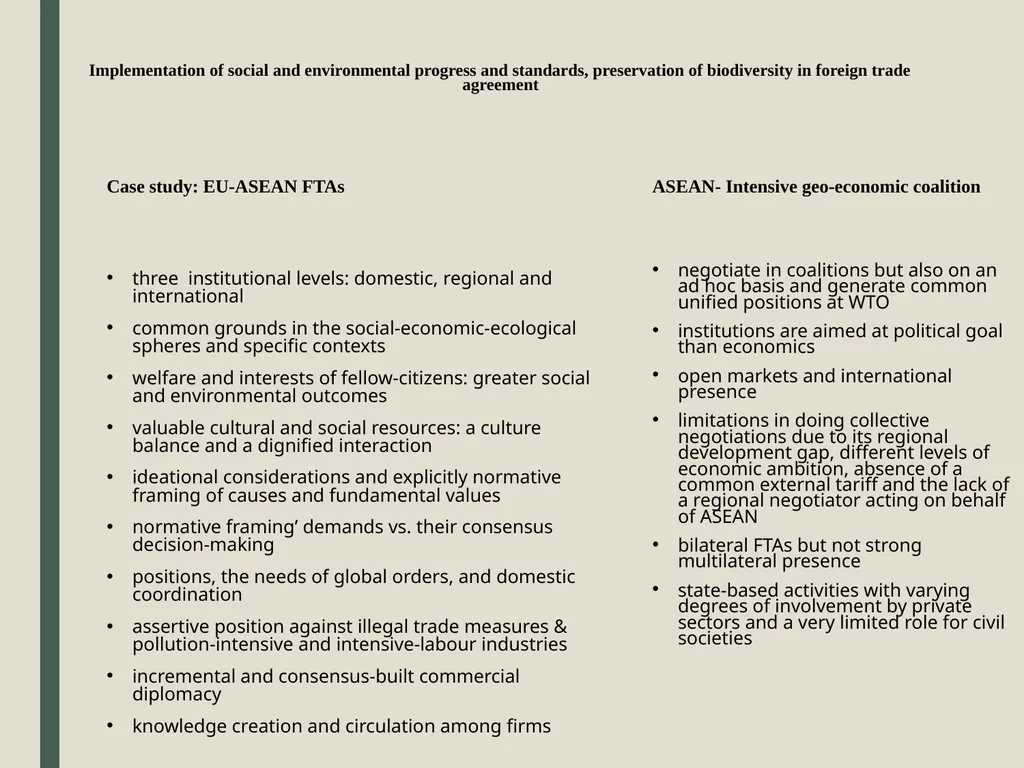
Implementation of social and environmental progress and standards, preservation of biodiversity in foreign trade agreement Case study: EU-ASEAN FTAs
three institutional levels: domestic, regional and international
common grounds in the social-economic-ecological spheres and specific contexts
welfare and interests of fellow-citizens: greater social and environmental outcomes
valuable cultural and social resources: a culture balance and a dignified interaction
ideational considerations and explicitly normative framing of causes and fundamental values
normative framing’ demands vs. their consensus decision-making
positions, the needs of global orders, and domestic coordination
assertive position against illegal trade measures & pollution-intensive and intensive-labour industries
incremental and consensus-built commercial diplomacy
knowledge creation and circulation among firms ASEAN- Intensive geo-economic coalition
negotiate in coalitions but also on an ad hoc basis and generate common unified positions at WTO
institutions are aimed at political goal than economics
open markets and international presence
limitations in doing collective negotiations due to its regional development gap, different levels of economic ambition, absence of a common external tariff and the lack of a regional negotiator acting on behalf of ASEAN
bilateral FTAs but not strong multilateral presence
state-based activities with varying degrees of involvement by private sectors and a very limited role for civil societies<br>
11
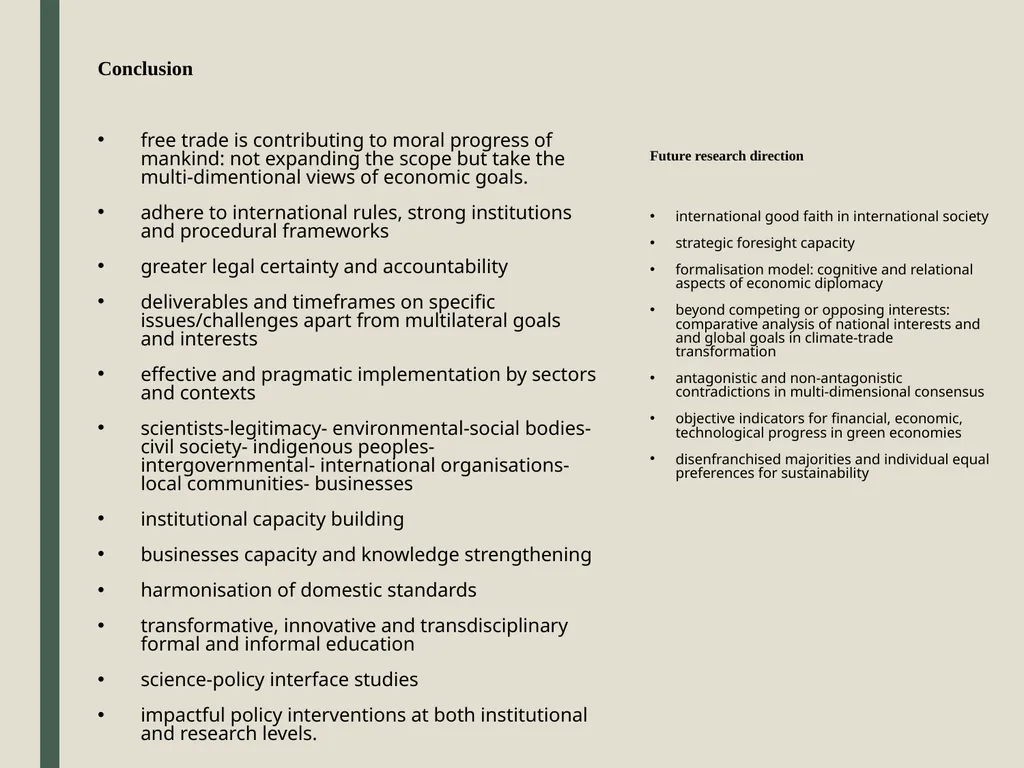
Conclusion
free trade is contributing to moral progress of mankind: not expanding the scope but take the multi-dimentional views of economic goals.
adhere to international rules, strong institutions and procedural frameworks
greater legal certainty and accountability
deliverables and timeframes on specific issues/challenges apart from multilateral goals and interests
effective and pragmatic implementation by sectors and contexts
scientists-legitimacy- environmental-social bodies-civil society- indigenous peoples- intergovernmental- international organisations- local communities- businesses
institutional capacity building
businesses capacity and knowledge strengthening
harmonisation of domestic standards
transformative, innovative and transdisciplinary formal and informal education
science-policy interface studies
impactful policy interventions at both institutional and research levels. Future research direction
international good faith in international society
strategic foresight capacity
formalisation model: cognitive and relational aspects of economic diplomacy
beyond competing or opposing interests: comparative analysis of national interests and and global goals in climate-trade transformation
antagonistic and non-antagonistic contradictions in multi-dimensional consensus
objective indicators for financial, economic, technological progress in green economies
disenfranchised majorities and individual equal preferences for sustainability<br>