
RC Workshop and AIMCAT Discussion (Verbal) AIMCAT



Description: RC Workshop and AIMCAT Discussion (Verbal) AIMCAT 1220-1216 RC pattern in the previous CAT papers T.I.M.E. Overview of the Aimcats T.I.M.E. Assuming a student gives equal time per section at the outset And also that a student tries to
Related Topics
Download Presentation
"RC Workshop and AIMCAT Discussion (Verbal) AIMCAT" is the property of its rightful owner. Permission is granted to download and print the materials on this website for personal, non-commercial use only, and to display it on your personal computer provided you do not modify the materials and that you retain all copyright notices contained in the materials. By downloading content from our website, you accept the terms of this agreement.
Presentation Transcript
slide1. RC Workshop and AIMCAT Discussion (Verbal) AIMCAT 1220-1216<br>
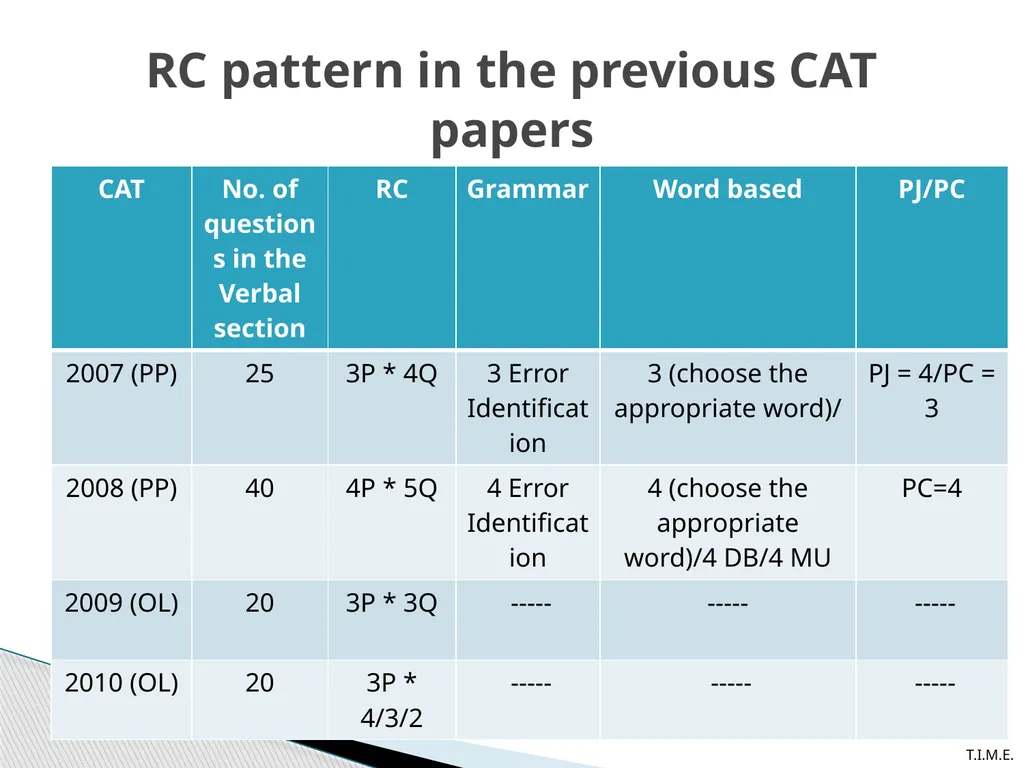
slide2. RC pattern in the previous CAT papers T.I.M.E.<br>
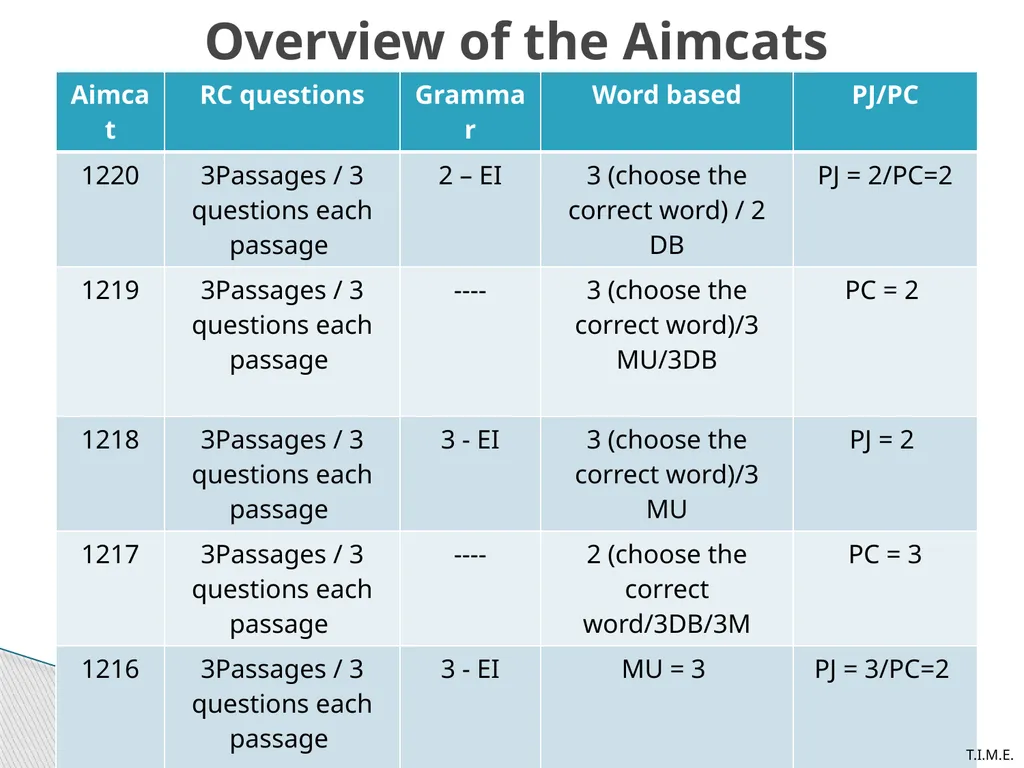
slide3. Overview of the Aimcats T.I.M.E.<br>
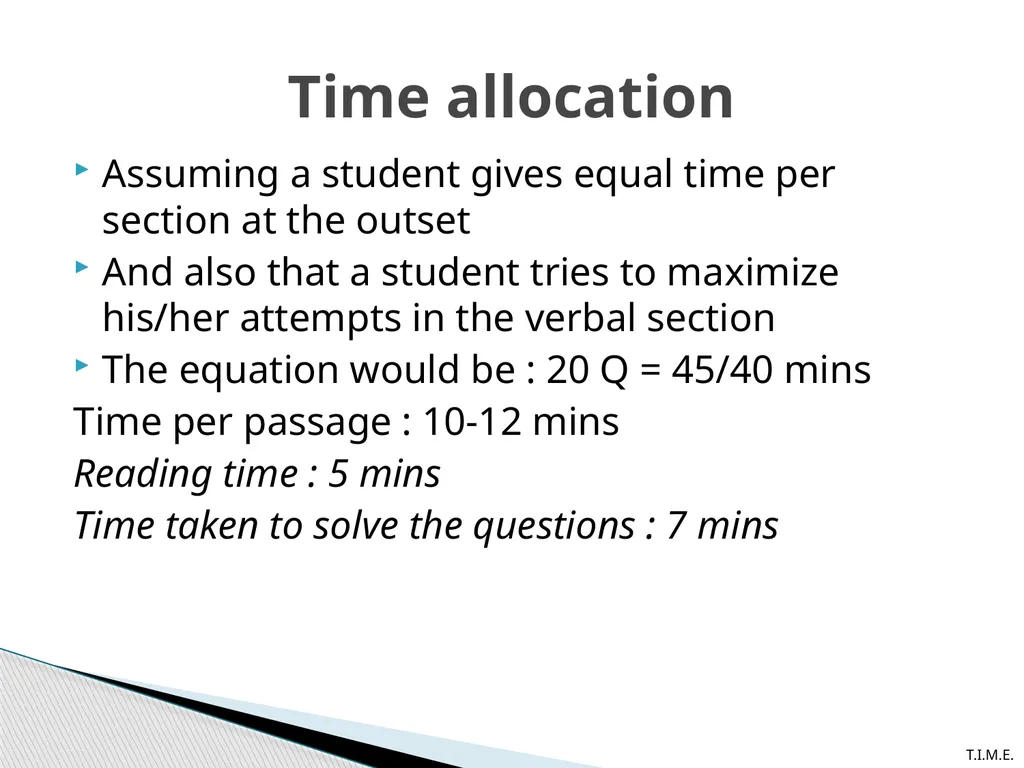
slide4. Assuming a student gives equal time per section at the outset
And also that a student tries to maximize his/her attempts in the verbal section
The equation would be : 20 Q = 45/40 mins
Time per passage : 10-12 mins
Reading time : 5 mins
Time taken to solve the questions : 7 mins T.I.M.E. Time allocation<br>
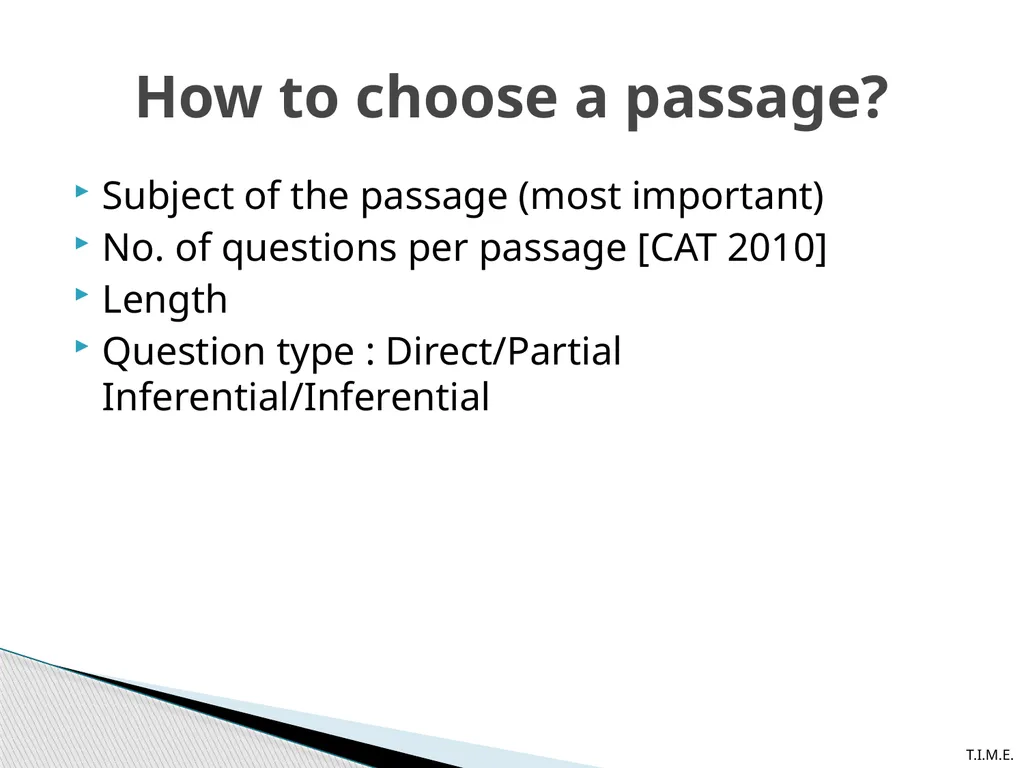
slide5. Subject of the passage (most important)
No. of questions per passage [CAT 2010]
Length
Question type : Direct/Partial Inferential/Inferential T.I.M.E. How to choose a passage?<br>
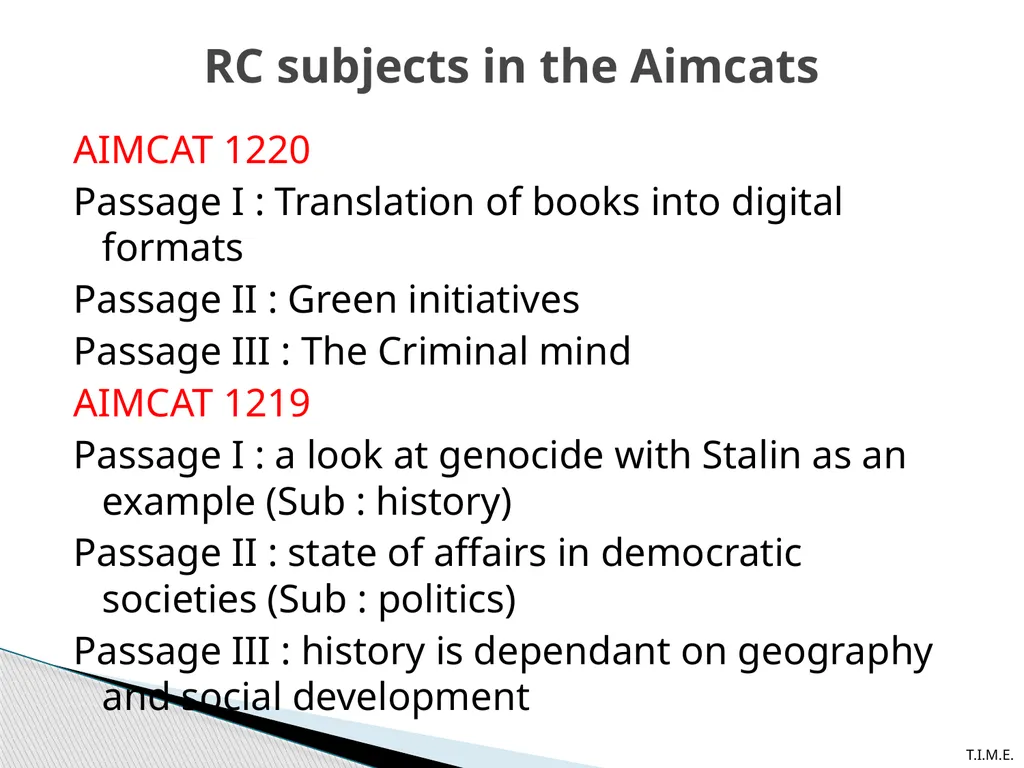
slide6. AIMCAT 1220
Passage I : Translation of books into digital formats
Passage II : Green initiatives
Passage III : The Criminal mind
AIMCAT 1219
Passage I : a look at genocide with Stalin as an example (Sub : history)
Passage II : state of affairs in democratic societies (Sub : politics)
Passage III : history is dependant on geography and social development T.I.M.E. RC subjects in the Aimcats<br>
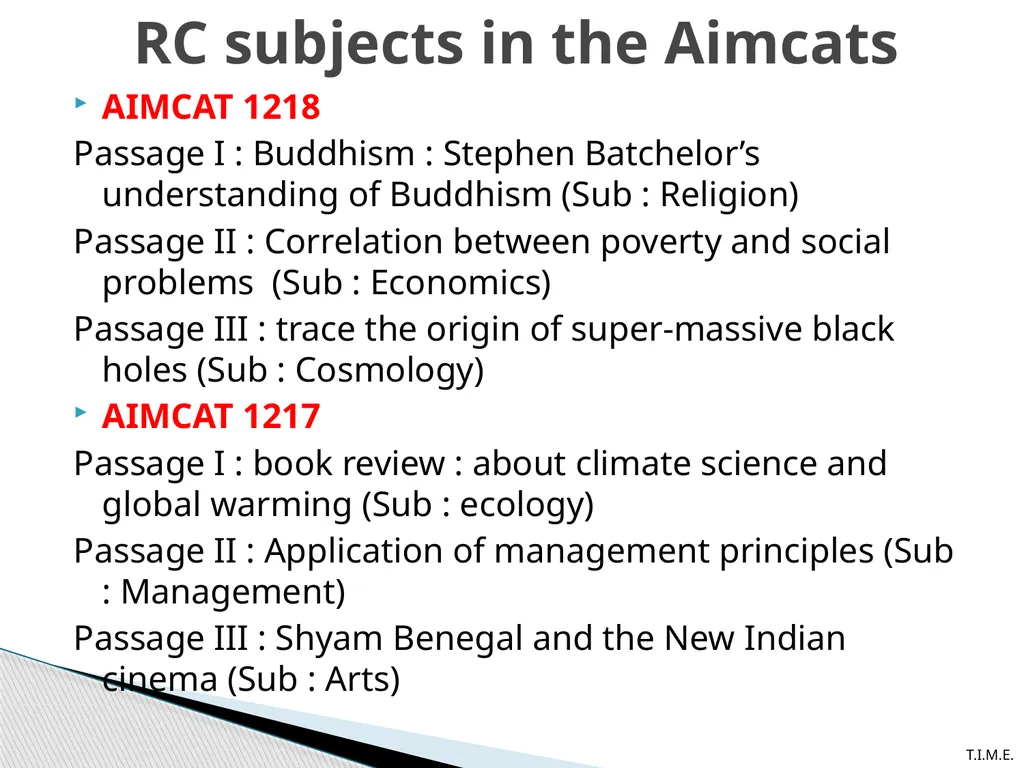
slide7. AIMCAT 1218
Passage I : Buddhism : Stephen Batchelor’s understanding of Buddhism (Sub : Religion)
Passage II : Correlation between poverty and social problems (Sub : Economics)
Passage III : trace the origin of super-massive black holes (Sub : Cosmology)
AIMCAT 1217
Passage I : book review : about climate science and global warming (Sub : ecology)
Passage II : Application of management principles (Sub : Management)
Passage III : Shyam Benegal and the New Indian cinema (Sub : Arts) T.I.M.E. RC subjects in the Aimcats<br>
slide8. AIMCAT 1216
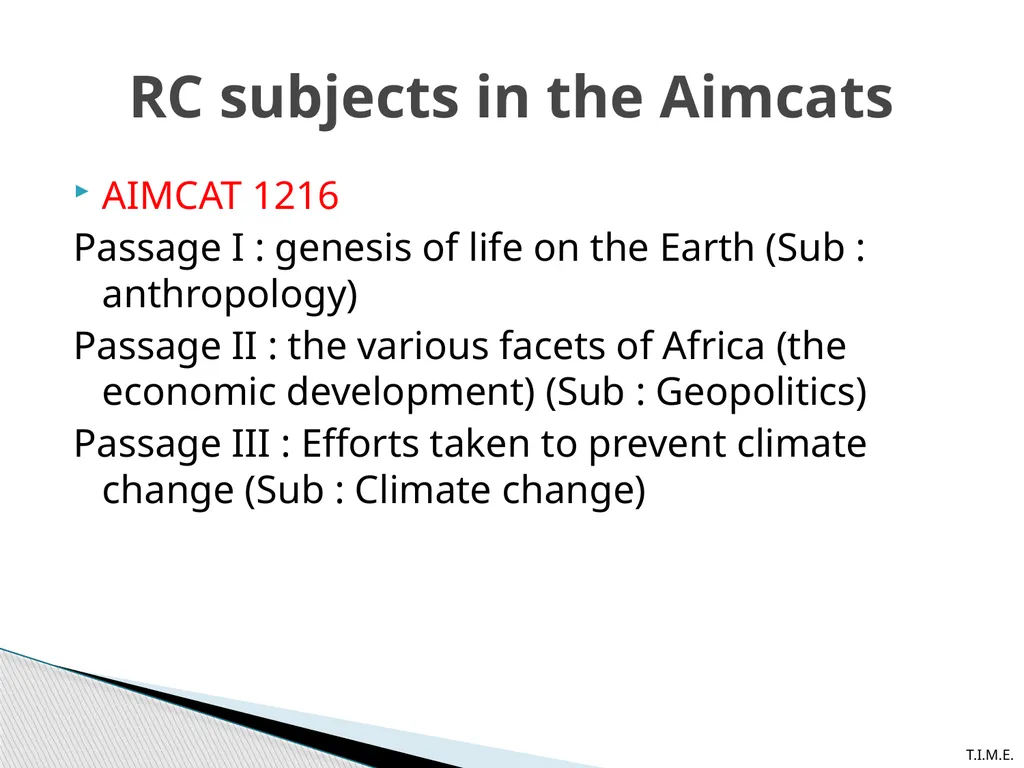
Passage I : genesis of life on the Earth (Sub : anthropology)
Passage II : the various facets of Africa (the economic development) (Sub : Geopolitics)
Passage III : Efforts taken to prevent climate change (Sub : Climate change) T.I.M.E. RC subjects in the Aimcats<br>
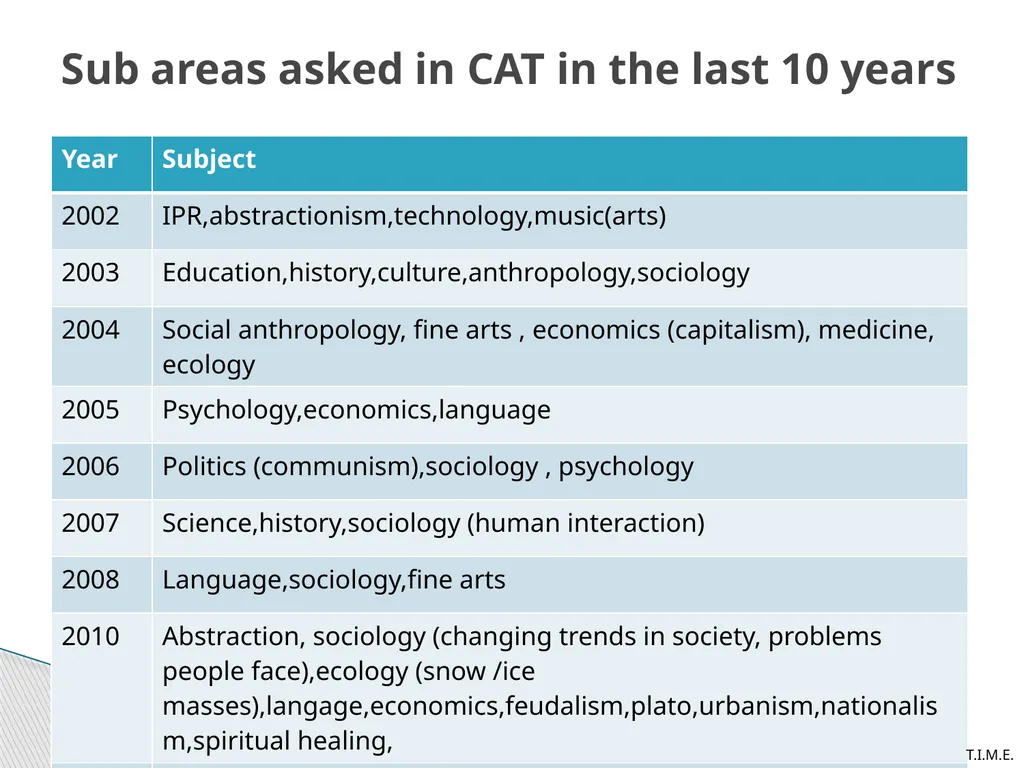
slide9. T.I.M.E. Sub areas asked in CAT in the last 10 years<br>
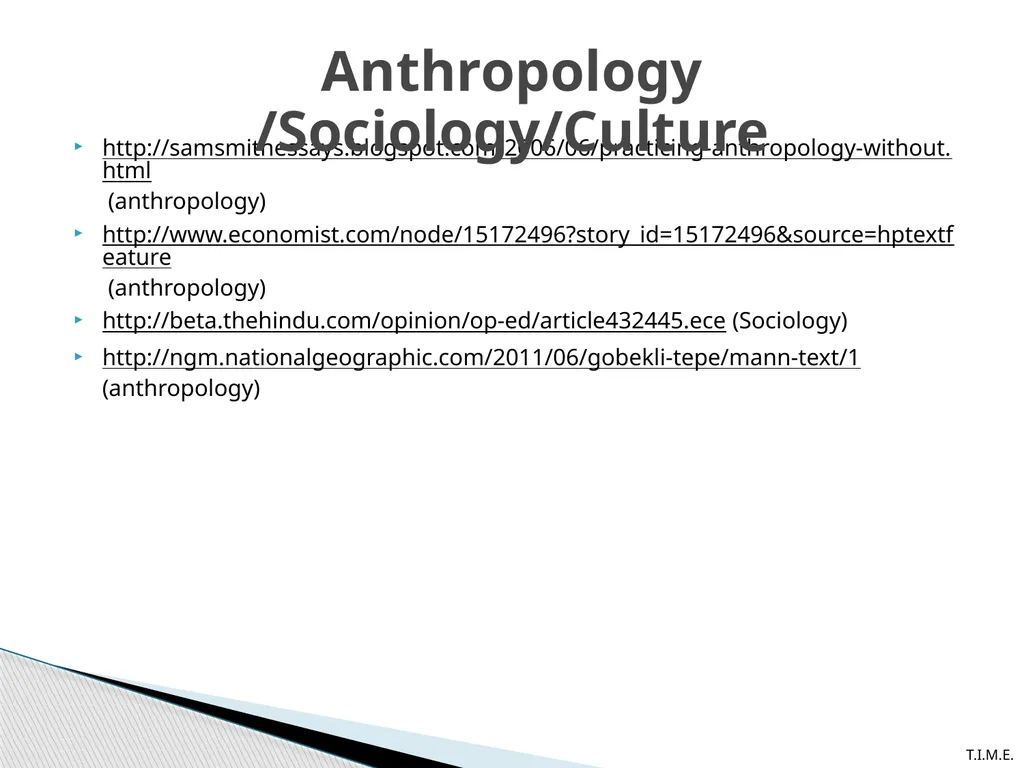
slide10. http://samsmithessays.blogspot.com/2006/06/practicing-anthropology-without.html (anthropology)
http://www.economist.com/node/15172496?story_id=15172496&source=hptextfeature (anthropology)
http://beta.thehindu.com/opinion/op-ed/article432445.ece (Sociology)
http://ngm.nationalgeographic.com/2011/06/gobekli-tepe/mann-text/1 (anthropology) T.I.M.E. Anthropology /Sociology/Culture<br>
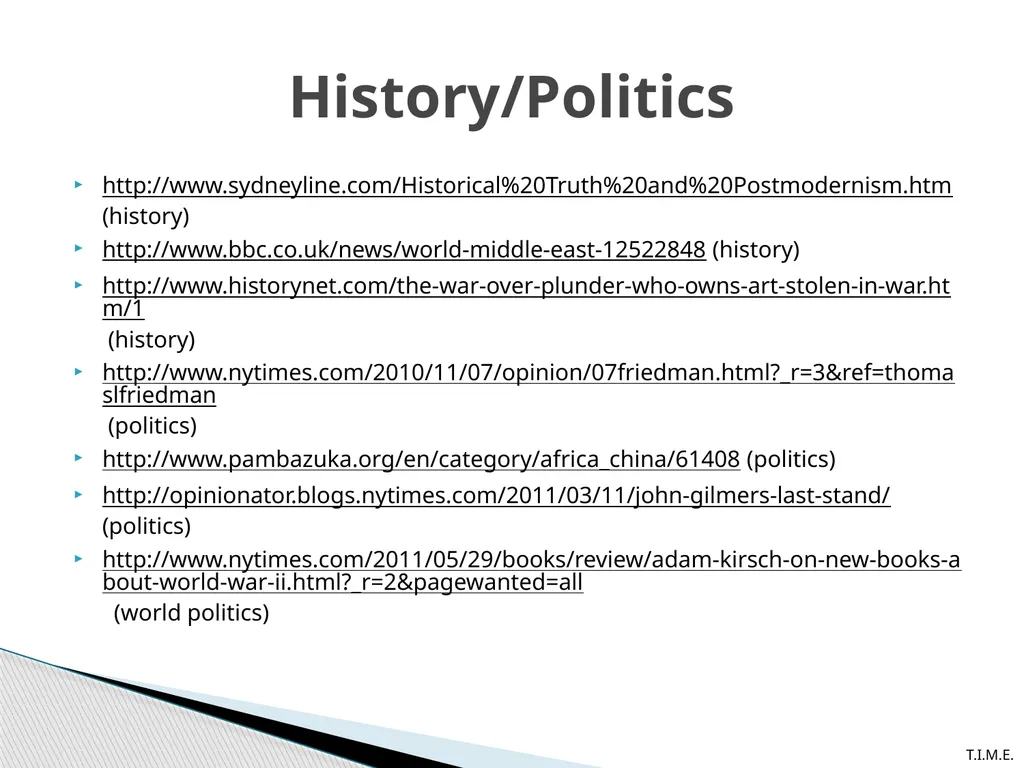
slide11. http://www.sydneyline.com/Historical%20Truth%20and%20Postmodernism.htm (history)
http://www.bbc.co.uk/news/world-middle-east-12522848 (history)
http://www.historynet.com/the-war-over-plunder-who-owns-art-stolen-in-war.htm/1 (history)
http://www.nytimes.com/2010/11/07/opinion/07friedman.html?_r=3&ref=thomaslfriedman (politics)
http://www.pambazuka.org/en/category/africa_china/61408 (politics)
http://opinionator.blogs.nytimes.com/2011/03/11/john-gilmers-last-stand/ (politics)
http://www.nytimes.com/2011/05/29/books/review/adam-kirsch-on-new-books-about-world-war-ii.html?_r=2&pagewanted=all (world politics) T.I.M.E. History/Politics<br>
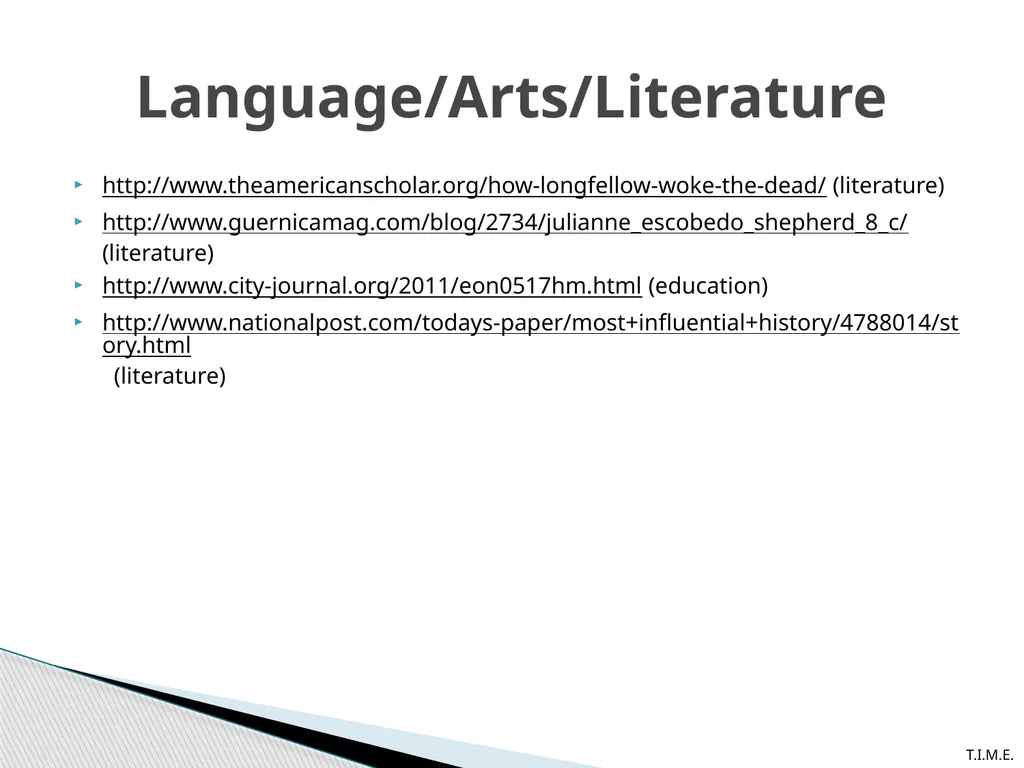
slide12. http://www.theamericanscholar.org/how-longfellow-woke-the-dead/ (literature)
http://www.guernicamag.com/blog/2734/julianne_escobedo_shepherd_8_c/ (literature)
http://www.city-journal.org/2011/eon0517hm.html (education)
http://www.nationalpost.com/todays-paper/most+influential+history/4788014/story.html (literature) T.I.M.E. Language/Arts/Literature<br>
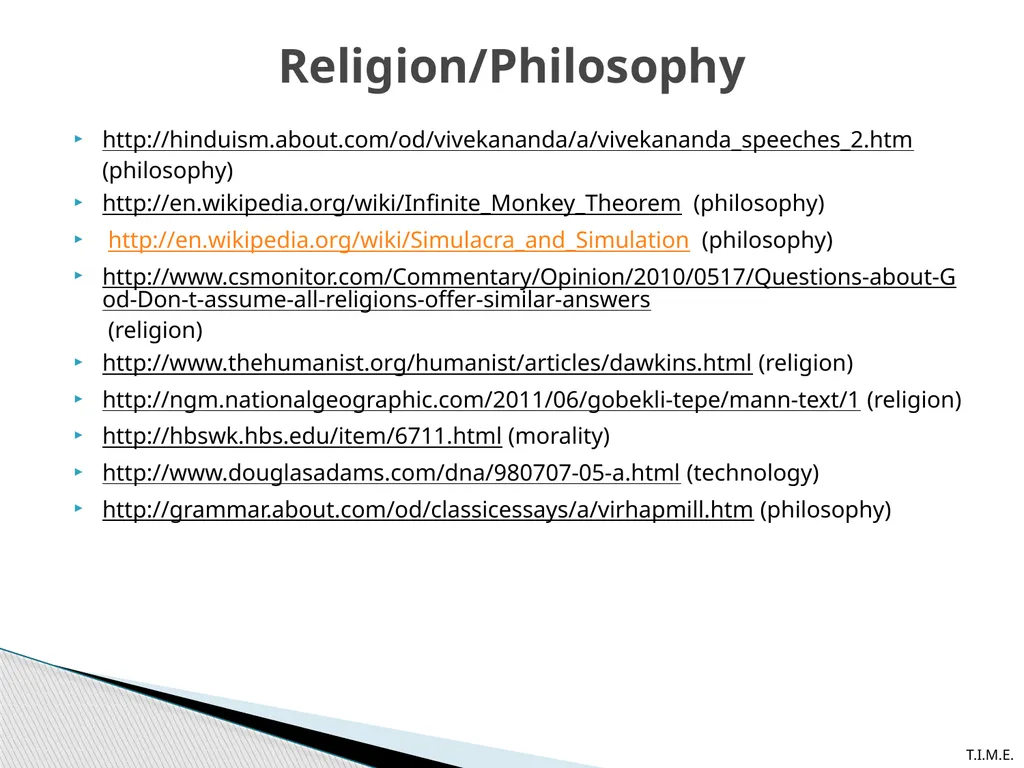
slide13. http://hinduism.about.com/od/vivekananda/a/vivekananda_speeches_2.htm (philosophy)
http://en.wikipedia.org/wiki/Infinite_Monkey_Theorem (philosophy)
http://en.wikipedia.org/wiki/Simulacra_and_Simulation (philosophy)
http://www.csmonitor.com/Commentary/Opinion/2010/0517/Questions-about-God-Don-t-assume-all-religions-offer-similar-answers (religion)
http://www.thehumanist.org/humanist/articles/dawkins.html (religion)
http://ngm.nationalgeographic.com/2011/06/gobekli-tepe/mann-text/1 (religion)
http://hbswk.hbs.edu/item/6711.html (morality)
http://www.douglasadams.com/dna/980707-05-a.html (technology)
http://grammar.about.com/od/classicessays/a/virhapmill.htm (philosophy) T.I.M.E. Religion/Philosophy<br>
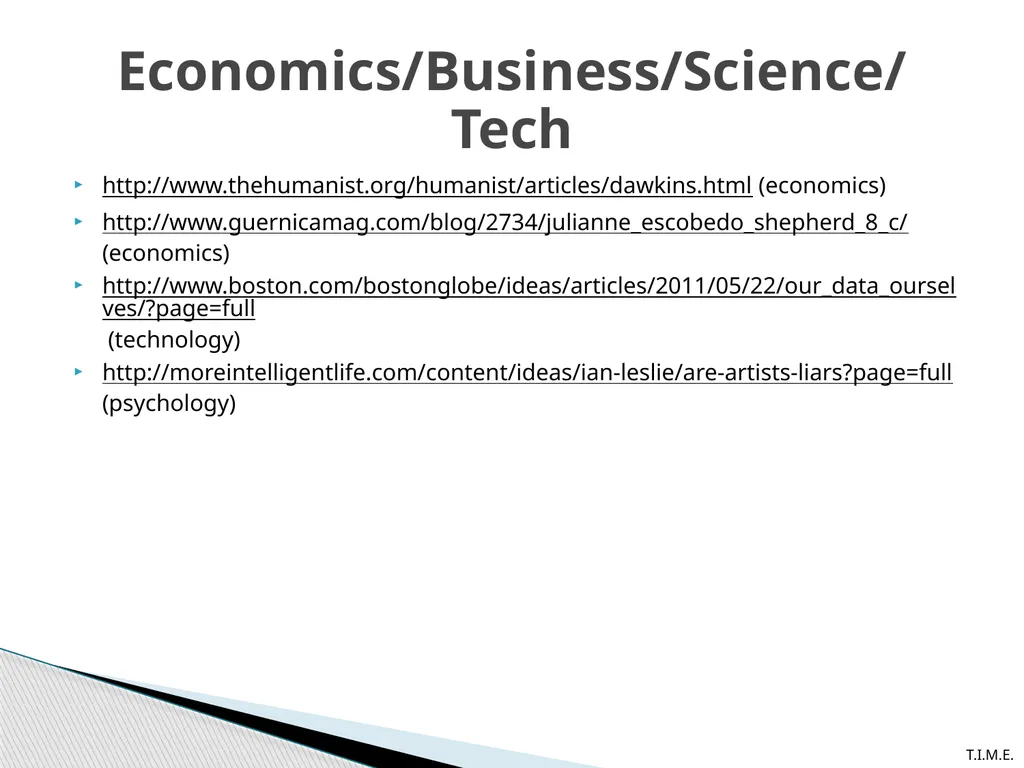
slide14. http://www.thehumanist.org/humanist/articles/dawkins.html (economics)
http://www.guernicamag.com/blog/2734/julianne_escobedo_shepherd_8_c/ (economics)
http://www.boston.com/bostonglobe/ideas/articles/2011/05/22/our_data_ourselves/?page=full (technology)
http://moreintelligentlife.com/content/ideas/ian-leslie/are-artists-liars?page=full (psychology) T.I.M.E. Economics/Business/Science/Tech<br>
slide15. Style is the way in which an author presents his ideas on a particular subject.
Different types of Style:
Factual
Analytical
Argumentative
Narrative
Descriptive
Abstract T.I.M.E. A few other concepts related to RC<br>
slide16. Tone is the author’s attitude towards the central idea or the subject being discussed
Types of tones
Positive
Negative
Neutral : unbiased
disinterested
objective T.I.M.E. Tones<br>
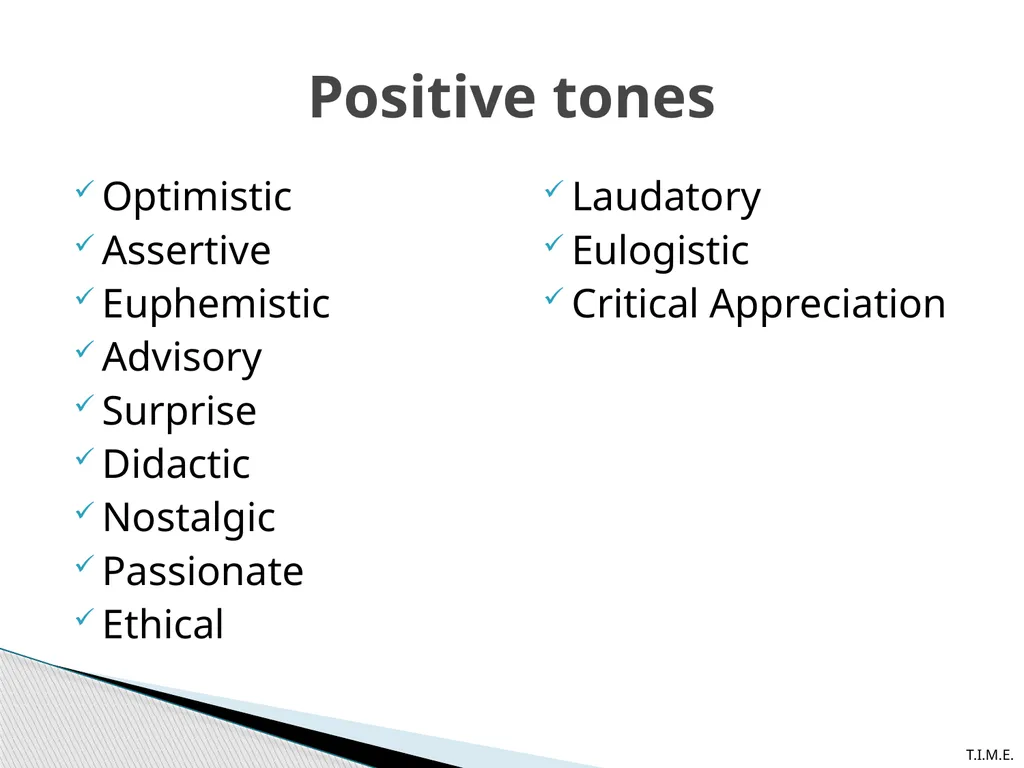
slide17. Optimistic
Assertive
Euphemistic
Advisory
Surprise
Didactic
Nostalgic
Passionate
Ethical Laudatory
Eulogistic
Critical Appreciation T.I.M.E. Positive tones<br>
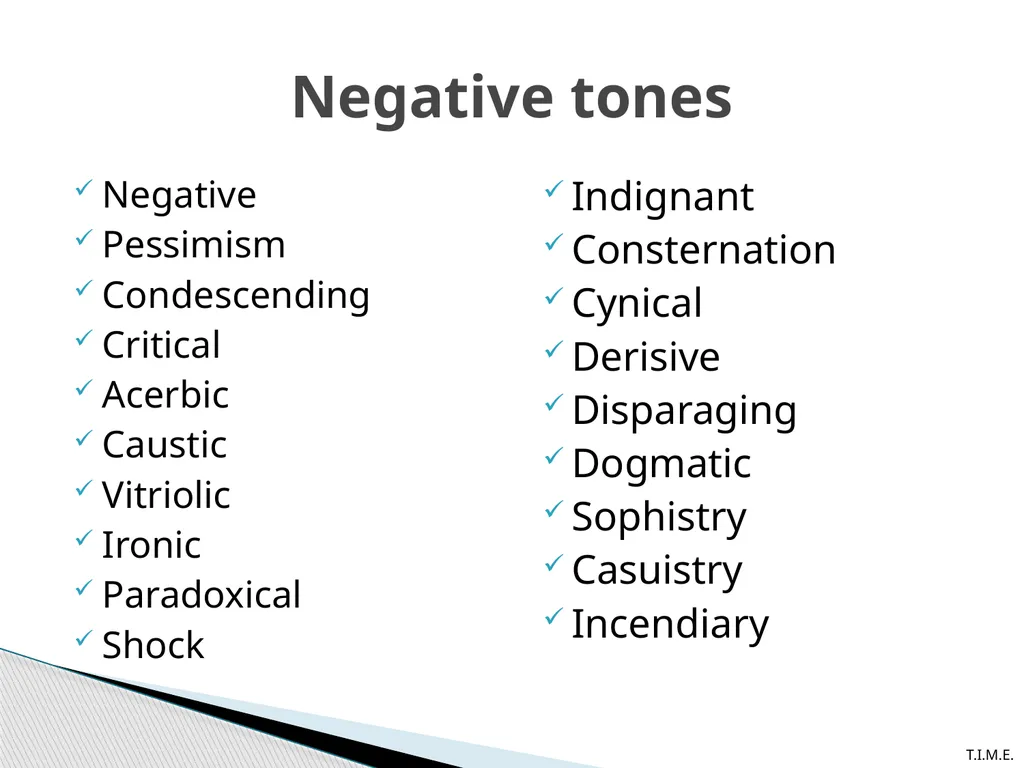
slide18. Negative
Pessimism
Condescending
Critical
Acerbic
Caustic
Vitriolic
Ironic
Paradoxical
Shock Indignant
Consternation
Cynical
Derisive
Disparaging
Dogmatic
Sophistry
Casuistry
Incendiary T.I.M.E. Negative tones<br>
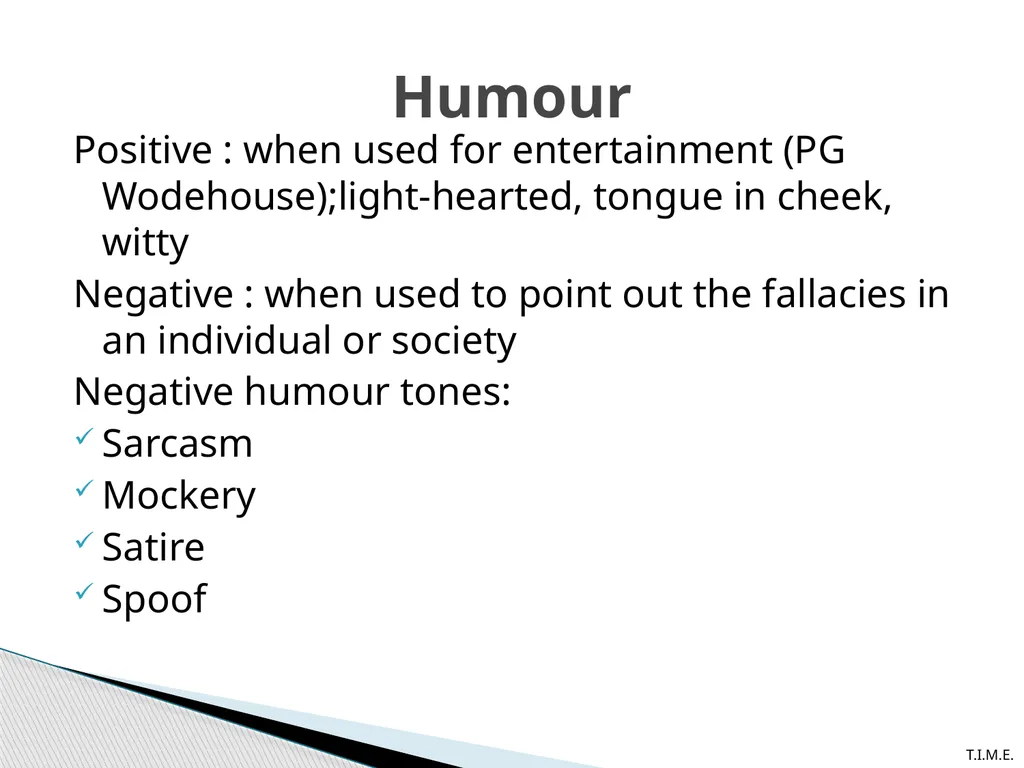
slide19. Positive : when used for entertainment (PG Wodehouse);light-hearted, tongue in cheek, witty
Negative : when used to point out the fallacies in an individual or society
Negative humour tones:
Sarcasm
Mockery
Satire
Spoof T.I.M.E. Humour<br>
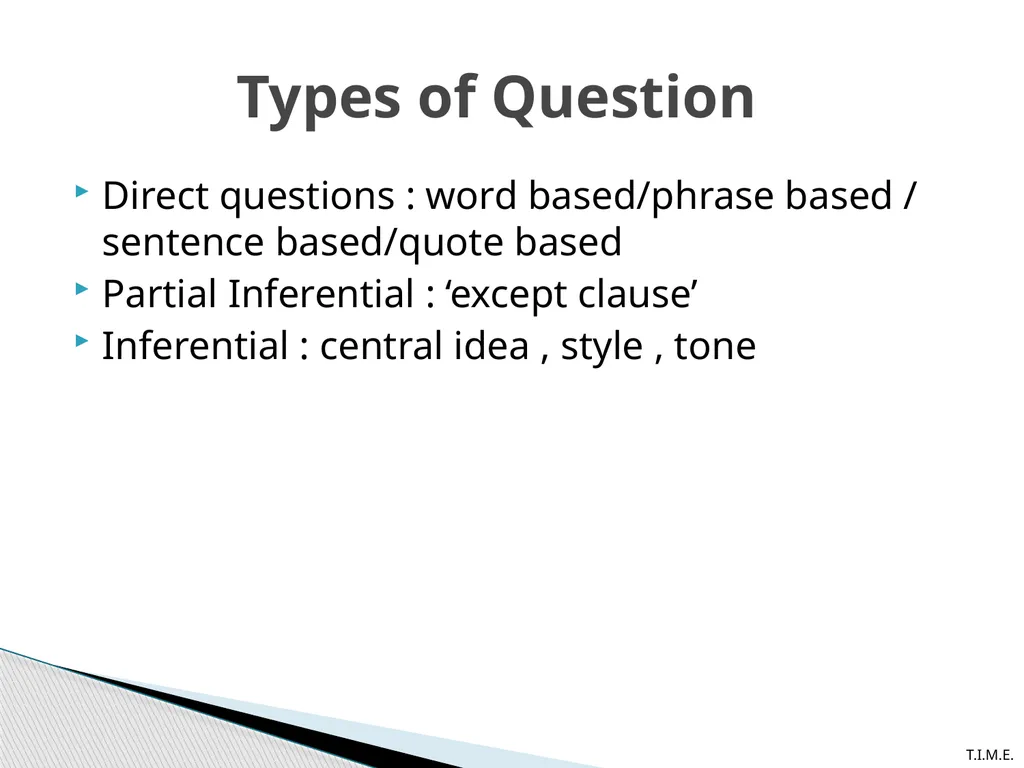
slide20. Direct questions : word based/phrase based / sentence based/quote based
Partial Inferential : ‘except clause’
Inferential : central idea , style , tone T.I.M.E. Types of Question<br>
slide21. The 'shift in power' caused by the digitization of books implies that (1220)
"Only 0.3 percent of Coca-Cola's drinks will come in Plant Bottles this year. They will, however, be consumed conspicuously". By this the author means one of the following. (1220)
Which of the following is closest to what the words, 'Perhaps 0.3 percent is some kind of magic number in green marketing circles' mean? (1220)
What does 'it' refer to in 'it's an unsettling thought'? (1220) T.I.M.E. Direct Questions<br>
slide22. The 'primordial soup' and 'warm little pond' (1216)
The author uses the phrase 'might give one pause' to ask which of the following questions? (1218)
The word ‘murky’ in the passage implies [1217] {passage 2}
What does ‘that’ stand for in ‘That is shame’ [1217] {Passage 1}
The term ‘Russian obliviousness’ in the passage means [1219] {Passage 1} T.I.M.E. Direct Questions<br>
slide23. Questions based on Central Idea
This passage (1216)
In this passage, the author primarily (1218)
In the given passage, the main purpose of the researchers is to (1218)
In the final analysis, the reviewer’s take on the book under review is that : [1217] {passage 1}
In this passage the author primarily : [1219] {Passage 2} T.I.M.E. Inference based questions<br>
slide24. According to the passage, all of the following features are true regarding Benegal’s “previous work” except …. [1217] {passage 3}
According to the passage, all of the following statements regarding the ‘chaos’ in the factories are true, except …. [1217] {passage 3}
Which of the following appears to be an unlikely outcome of the ‘consultant’s intervention’ [1217] {passage 2}
Tim Flannery,as per the passage , is all the following except … [1217] {passage 1} T.I.M.E. PI questions<br>
slide25. According to the passage , Naimark’s book title is plural because : [1219] {Passage 1}
The passage mentions some of the characteristics of the new middle class which emerged in the liberal states. Pick the exception. [1219] {Passage 2} T.I.M.E. PI questions<br>
slide26. Objective of these kind of questions in any entrance examinations
The words given in these type of question are the commonly used words also called the high frequency words
The objective of this question is to evaluate a student’s language proficiency unlike vocabulary based questions T.I.M.E. Multiple Usage questions<br>
slide27. Steps to be followed while solving these questions
check the usage of the word in terms of the part of speech [there are eight parts of speech : noun,pronoun,verb,adverb,adjective,preposition,conjunction,interjection]
The word in question could either be used as a noun or a verb.
E.g. the word nurse can be used in the following ways :
She works as a nurse in hospital. [noun]
She nursed me throughout my illness. [verb]
Do you nurse political ambitions ? [verb] T.I.M.E. How to solve these questions?<br>
slide28. if the word in question is used as a noun then check for the usage of the article [a,an,the] ; the error could be with the usage of article
E.g. Firm
Lie on a firm mattress to avoid a backache.
The new firm had several plans for expansion.
This is a residential school and kids here need a firm hand to make them behave. T.I.M.E. Multiple usage continued<br>
slide29. The noun used in MU questions is generally a common noun [so we need not bother about the usage of the article ‘the’ with any other type of noun]
Common nouns : types : countable/uncountable
Countable nouns : can be physically counted and always take a plural form
Uncountable nouns : cannot be physically counted and do not take a plural form
They also do not take a article : hence if the word in question is an uncountable noun it would not take any article T.I.M.E. Article usage for MU questions<br>
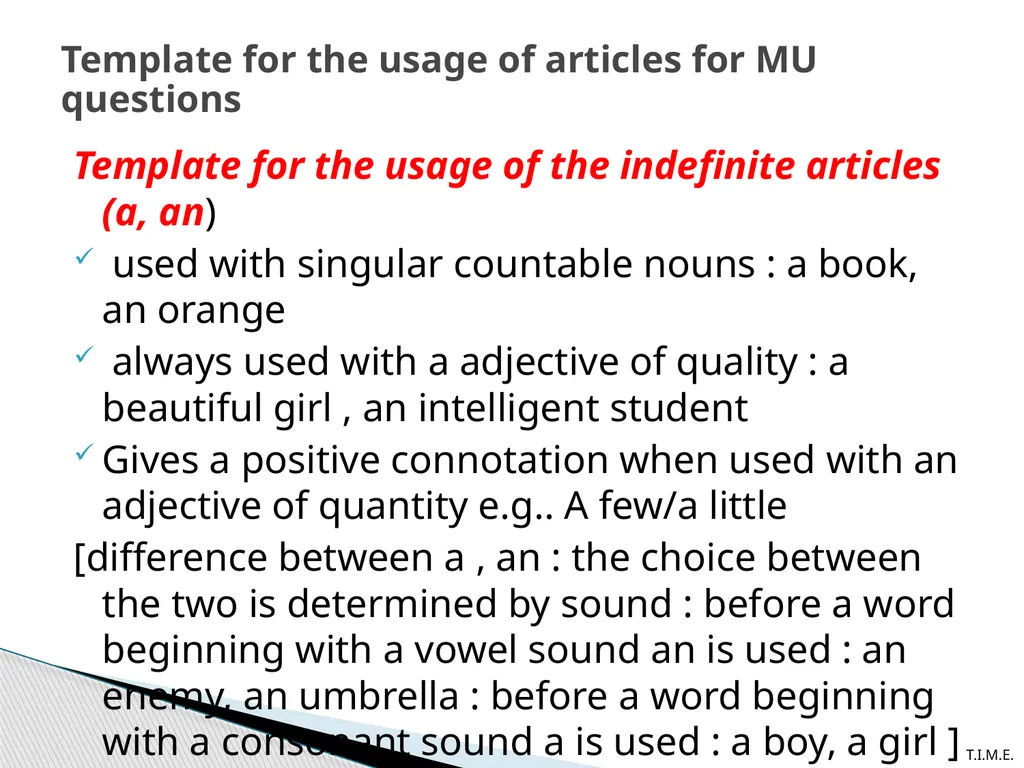
slide30. Template for the usage of the indefinite articles (a, an)
used with singular countable nouns : a book, an orange
always used with a adjective of quality : a beautiful girl , an intelligent student
Gives a positive connotation when used with an adjective of quantity e.g.. A few/a little
[difference between a , an : the choice between the two is determined by sound : before a word beginning with a vowel sound an is used : an enemy, an umbrella : before a word beginning with a consonant sound a is used : a boy, a girl ] T.I.M.E. Template for the usage of articles for MU questions<br>
slide31. If the word is used as a verb then the error could be with the preposition following it : a concept called ‘phrasal verbs’
E.g. Deal
You begin a game by dealing 7 cards to each player.
Parents find it difficult to deal with their children’s hostile and stubborn attitude.
The nuclear deal between India and the US has sparked off a controversy.
Judges usually deal in harsher sentences to repeat offenders T.I.M.E. Multiple usage contd<br>
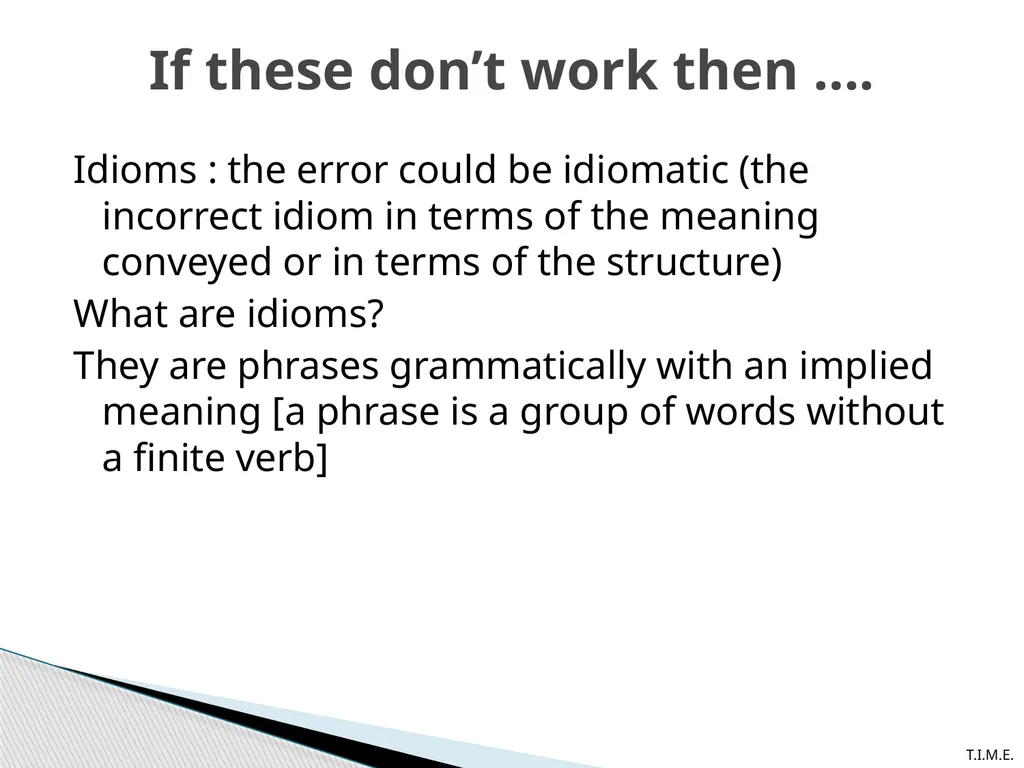
slide32. Idioms : the error could be idiomatic (the incorrect idiom in terms of the meaning conveyed or in terms of the structure)
What are idioms?
They are phrases grammatically with an implied meaning [a phrase is a group of words without a finite verb] T.I.M.E. If these don’t work then ….<br>
slide2. RC pattern in the previous CAT papers T.I.M.E.<br>
slide3. Overview of the Aimcats T.I.M.E.<br>
slide4. Assuming a student gives equal time per section at the outset
And also that a student tries to maximize his/her attempts in the verbal section
The equation would be : 20 Q = 45/40 mins
Time per passage : 10-12 mins
Reading time : 5 mins
Time taken to solve the questions : 7 mins T.I.M.E. Time allocation<br>
slide5. Subject of the passage (most important)
No. of questions per passage [CAT 2010]
Length
Question type : Direct/Partial Inferential/Inferential T.I.M.E. How to choose a passage?<br>
slide6. AIMCAT 1220
Passage I : Translation of books into digital formats
Passage II : Green initiatives
Passage III : The Criminal mind
AIMCAT 1219
Passage I : a look at genocide with Stalin as an example (Sub : history)
Passage II : state of affairs in democratic societies (Sub : politics)
Passage III : history is dependant on geography and social development T.I.M.E. RC subjects in the Aimcats<br>
slide7. AIMCAT 1218
Passage I : Buddhism : Stephen Batchelor’s understanding of Buddhism (Sub : Religion)
Passage II : Correlation between poverty and social problems (Sub : Economics)
Passage III : trace the origin of super-massive black holes (Sub : Cosmology)
AIMCAT 1217
Passage I : book review : about climate science and global warming (Sub : ecology)
Passage II : Application of management principles (Sub : Management)
Passage III : Shyam Benegal and the New Indian cinema (Sub : Arts) T.I.M.E. RC subjects in the Aimcats<br>
slide8. AIMCAT 1216
Passage I : genesis of life on the Earth (Sub : anthropology)
Passage II : the various facets of Africa (the economic development) (Sub : Geopolitics)
Passage III : Efforts taken to prevent climate change (Sub : Climate change) T.I.M.E. RC subjects in the Aimcats<br>
slide9. T.I.M.E. Sub areas asked in CAT in the last 10 years<br>
slide10. http://samsmithessays.blogspot.com/2006/06/practicing-anthropology-without.html (anthropology)
http://www.economist.com/node/15172496?story_id=15172496&source=hptextfeature (anthropology)
http://beta.thehindu.com/opinion/op-ed/article432445.ece (Sociology)
http://ngm.nationalgeographic.com/2011/06/gobekli-tepe/mann-text/1 (anthropology) T.I.M.E. Anthropology /Sociology/Culture<br>
slide11. http://www.sydneyline.com/Historical%20Truth%20and%20Postmodernism.htm (history)
http://www.bbc.co.uk/news/world-middle-east-12522848 (history)
http://www.historynet.com/the-war-over-plunder-who-owns-art-stolen-in-war.htm/1 (history)
http://www.nytimes.com/2010/11/07/opinion/07friedman.html?_r=3&ref=thomaslfriedman (politics)
http://www.pambazuka.org/en/category/africa_china/61408 (politics)
http://opinionator.blogs.nytimes.com/2011/03/11/john-gilmers-last-stand/ (politics)
http://www.nytimes.com/2011/05/29/books/review/adam-kirsch-on-new-books-about-world-war-ii.html?_r=2&pagewanted=all (world politics) T.I.M.E. History/Politics<br>
slide12. http://www.theamericanscholar.org/how-longfellow-woke-the-dead/ (literature)
http://www.guernicamag.com/blog/2734/julianne_escobedo_shepherd_8_c/ (literature)
http://www.city-journal.org/2011/eon0517hm.html (education)
http://www.nationalpost.com/todays-paper/most+influential+history/4788014/story.html (literature) T.I.M.E. Language/Arts/Literature<br>
slide13. http://hinduism.about.com/od/vivekananda/a/vivekananda_speeches_2.htm (philosophy)
http://en.wikipedia.org/wiki/Infinite_Monkey_Theorem (philosophy)
http://en.wikipedia.org/wiki/Simulacra_and_Simulation (philosophy)
http://www.csmonitor.com/Commentary/Opinion/2010/0517/Questions-about-God-Don-t-assume-all-religions-offer-similar-answers (religion)
http://www.thehumanist.org/humanist/articles/dawkins.html (religion)
http://ngm.nationalgeographic.com/2011/06/gobekli-tepe/mann-text/1 (religion)
http://hbswk.hbs.edu/item/6711.html (morality)
http://www.douglasadams.com/dna/980707-05-a.html (technology)
http://grammar.about.com/od/classicessays/a/virhapmill.htm (philosophy) T.I.M.E. Religion/Philosophy<br>
slide14. http://www.thehumanist.org/humanist/articles/dawkins.html (economics)
http://www.guernicamag.com/blog/2734/julianne_escobedo_shepherd_8_c/ (economics)
http://www.boston.com/bostonglobe/ideas/articles/2011/05/22/our_data_ourselves/?page=full (technology)
http://moreintelligentlife.com/content/ideas/ian-leslie/are-artists-liars?page=full (psychology) T.I.M.E. Economics/Business/Science/Tech<br>
slide15. Style is the way in which an author presents his ideas on a particular subject.
Different types of Style:
Factual
Analytical
Argumentative
Narrative
Descriptive
Abstract T.I.M.E. A few other concepts related to RC<br>
slide16. Tone is the author’s attitude towards the central idea or the subject being discussed
Types of tones
Positive
Negative
Neutral : unbiased
disinterested
objective T.I.M.E. Tones<br>
slide17. Optimistic
Assertive
Euphemistic
Advisory
Surprise
Didactic
Nostalgic
Passionate
Ethical Laudatory
Eulogistic
Critical Appreciation T.I.M.E. Positive tones<br>
slide18. Negative
Pessimism
Condescending
Critical
Acerbic
Caustic
Vitriolic
Ironic
Paradoxical
Shock Indignant
Consternation
Cynical
Derisive
Disparaging
Dogmatic
Sophistry
Casuistry
Incendiary T.I.M.E. Negative tones<br>
slide19. Positive : when used for entertainment (PG Wodehouse);light-hearted, tongue in cheek, witty
Negative : when used to point out the fallacies in an individual or society
Negative humour tones:
Sarcasm
Mockery
Satire
Spoof T.I.M.E. Humour<br>
slide20. Direct questions : word based/phrase based / sentence based/quote based
Partial Inferential : ‘except clause’
Inferential : central idea , style , tone T.I.M.E. Types of Question<br>
slide21. The 'shift in power' caused by the digitization of books implies that (1220)
"Only 0.3 percent of Coca-Cola's drinks will come in Plant Bottles this year. They will, however, be consumed conspicuously". By this the author means one of the following. (1220)
Which of the following is closest to what the words, 'Perhaps 0.3 percent is some kind of magic number in green marketing circles' mean? (1220)
What does 'it' refer to in 'it's an unsettling thought'? (1220) T.I.M.E. Direct Questions<br>
slide22. The 'primordial soup' and 'warm little pond' (1216)
The author uses the phrase 'might give one pause' to ask which of the following questions? (1218)
The word ‘murky’ in the passage implies [1217] {passage 2}
What does ‘that’ stand for in ‘That is shame’ [1217] {Passage 1}
The term ‘Russian obliviousness’ in the passage means [1219] {Passage 1} T.I.M.E. Direct Questions<br>
slide23. Questions based on Central Idea
This passage (1216)
In this passage, the author primarily (1218)
In the given passage, the main purpose of the researchers is to (1218)
In the final analysis, the reviewer’s take on the book under review is that : [1217] {passage 1}
In this passage the author primarily : [1219] {Passage 2} T.I.M.E. Inference based questions<br>
slide24. According to the passage, all of the following features are true regarding Benegal’s “previous work” except …. [1217] {passage 3}
According to the passage, all of the following statements regarding the ‘chaos’ in the factories are true, except …. [1217] {passage 3}
Which of the following appears to be an unlikely outcome of the ‘consultant’s intervention’ [1217] {passage 2}
Tim Flannery,as per the passage , is all the following except … [1217] {passage 1} T.I.M.E. PI questions<br>
slide25. According to the passage , Naimark’s book title is plural because : [1219] {Passage 1}
The passage mentions some of the characteristics of the new middle class which emerged in the liberal states. Pick the exception. [1219] {Passage 2} T.I.M.E. PI questions<br>
slide26. Objective of these kind of questions in any entrance examinations
The words given in these type of question are the commonly used words also called the high frequency words
The objective of this question is to evaluate a student’s language proficiency unlike vocabulary based questions T.I.M.E. Multiple Usage questions<br>
slide27. Steps to be followed while solving these questions
check the usage of the word in terms of the part of speech [there are eight parts of speech : noun,pronoun,verb,adverb,adjective,preposition,conjunction,interjection]
The word in question could either be used as a noun or a verb.
E.g. the word nurse can be used in the following ways :
She works as a nurse in hospital. [noun]
She nursed me throughout my illness. [verb]
Do you nurse political ambitions ? [verb] T.I.M.E. How to solve these questions?<br>
slide28. if the word in question is used as a noun then check for the usage of the article [a,an,the] ; the error could be with the usage of article
E.g. Firm
Lie on a firm mattress to avoid a backache.
The new firm had several plans for expansion.
This is a residential school and kids here need a firm hand to make them behave. T.I.M.E. Multiple usage continued<br>
slide29. The noun used in MU questions is generally a common noun [so we need not bother about the usage of the article ‘the’ with any other type of noun]
Common nouns : types : countable/uncountable
Countable nouns : can be physically counted and always take a plural form
Uncountable nouns : cannot be physically counted and do not take a plural form
They also do not take a article : hence if the word in question is an uncountable noun it would not take any article T.I.M.E. Article usage for MU questions<br>
slide30. Template for the usage of the indefinite articles (a, an)
used with singular countable nouns : a book, an orange
always used with a adjective of quality : a beautiful girl , an intelligent student
Gives a positive connotation when used with an adjective of quantity e.g.. A few/a little
[difference between a , an : the choice between the two is determined by sound : before a word beginning with a vowel sound an is used : an enemy, an umbrella : before a word beginning with a consonant sound a is used : a boy, a girl ] T.I.M.E. Template for the usage of articles for MU questions<br>
slide31. If the word is used as a verb then the error could be with the preposition following it : a concept called ‘phrasal verbs’
E.g. Deal
You begin a game by dealing 7 cards to each player.
Parents find it difficult to deal with their children’s hostile and stubborn attitude.
The nuclear deal between India and the US has sparked off a controversy.
Judges usually deal in harsher sentences to repeat offenders T.I.M.E. Multiple usage contd<br>
slide32. Idioms : the error could be idiomatic (the incorrect idiom in terms of the meaning conveyed or in terms of the structure)
What are idioms?
They are phrases grammatically with an implied meaning [a phrase is a group of words without a finite verb] T.I.M.E. If these don’t work then ….<br>