
Re-envisioning the MLIS: Assessing MLIS
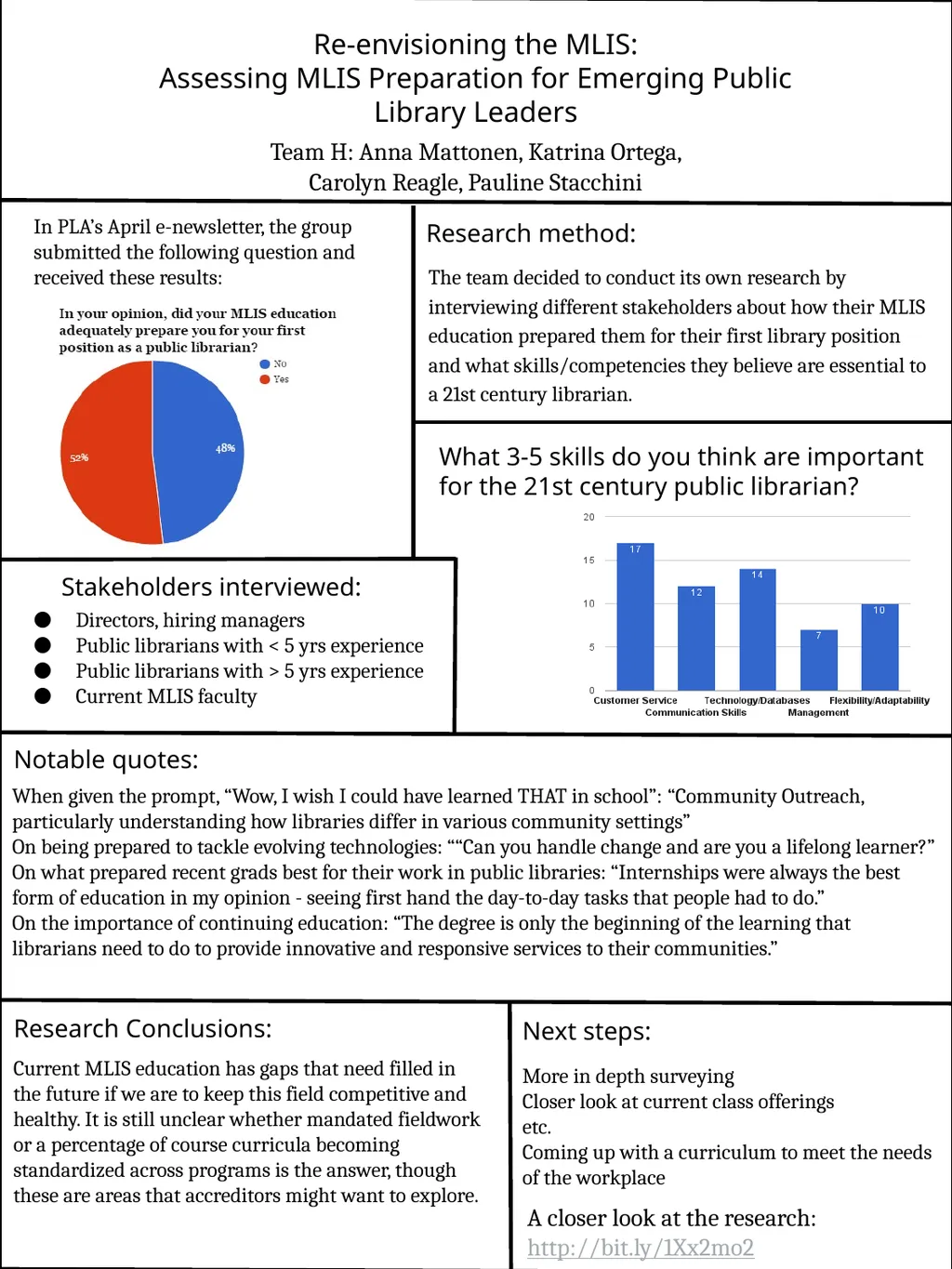
Description: Re-envisioning the MLIS: Assessing MLIS Preparation for Emerging Public Library Leaders Team H: Anna Mattonen, Katrina Ortega, Carolyn Reagle, Pauline Stacchini In PLAs April e-newsletter, the group submitted the following question and
Related Topics
Download Presentation
"Re-envisioning the MLIS: Assessing MLIS" is the property of its rightful owner. Permission is granted to download and print the materials on this website for personal, non-commercial use only, and to display it on your personal computer provided you do not modify the materials and that you retain all copyright notices contained in the materials. By downloading content from our website, you accept the terms of this agreement.
Presentation Transcript
slide1. Re-envisioning the MLIS:
Assessing MLIS Preparation for Emerging Public Library Leaders Team H: Anna Mattonen, Katrina Ortega, Carolyn Reagle, Pauline Stacchini In PLA’s April e-newsletter, the group submitted the following question and received these results: The team decided to conduct its own research by interviewing different stakeholders about how their MLIS education prepared them for their first library position and what skills/competencies they believe are essential to a 21st century librarian. Research method: What 3-5 skills do you think are important for the 21st century public librarian? Stakeholders interviewed: Directors, hiring managers
Public librarians with < 5 yrs experience
Public librarians with > 5 yrs experience
Current MLIS faculty Notable quotes: When given the prompt, “Wow, I wish I could have learned THAT in school”: “Community Outreach, particularly understanding how libraries differ in various community settings”
On being prepared to tackle evolving technologies: ““Can you handle change and are you a lifelong learner?”
On what prepared recent grads best for their work in public libraries: “Internships were always the best form of education in my opinion - seeing first hand the day-to-day tasks that people had to do.”
On the importance of continuing education: “The degree is only the beginning of the learning that librarians need to do to provide innovative and responsive services to their communities.” Research Conclusions: Current MLIS education has gaps that need filled in the future if we are to keep this field competitive and healthy. It is still unclear whether mandated fieldwork or a percentage of course curricula becoming standardized across programs is the answer, though these are areas that accreditors might want to explore. Next steps: More in depth surveying
Closer look at current class offerings
etc.
Coming up with a curriculum to meet the needs of the workplace A closer look at the research:
http://bit.ly/1Xx2mo2<br>
Assessing MLIS Preparation for Emerging Public Library Leaders Team H: Anna Mattonen, Katrina Ortega, Carolyn Reagle, Pauline Stacchini In PLA’s April e-newsletter, the group submitted the following question and received these results: The team decided to conduct its own research by interviewing different stakeholders about how their MLIS education prepared them for their first library position and what skills/competencies they believe are essential to a 21st century librarian. Research method: What 3-5 skills do you think are important for the 21st century public librarian? Stakeholders interviewed: Directors, hiring managers
Public librarians with < 5 yrs experience
Public librarians with > 5 yrs experience
Current MLIS faculty Notable quotes: When given the prompt, “Wow, I wish I could have learned THAT in school”: “Community Outreach, particularly understanding how libraries differ in various community settings”
On being prepared to tackle evolving technologies: ““Can you handle change and are you a lifelong learner?”
On what prepared recent grads best for their work in public libraries: “Internships were always the best form of education in my opinion - seeing first hand the day-to-day tasks that people had to do.”
On the importance of continuing education: “The degree is only the beginning of the learning that librarians need to do to provide innovative and responsive services to their communities.” Research Conclusions: Current MLIS education has gaps that need filled in the future if we are to keep this field competitive and healthy. It is still unclear whether mandated fieldwork or a percentage of course curricula becoming standardized across programs is the answer, though these are areas that accreditors might want to explore. Next steps: More in depth surveying
Closer look at current class offerings
etc.
Coming up with a curriculum to meet the needs of the workplace A closer look at the research:
http://bit.ly/1Xx2mo2<br>