04
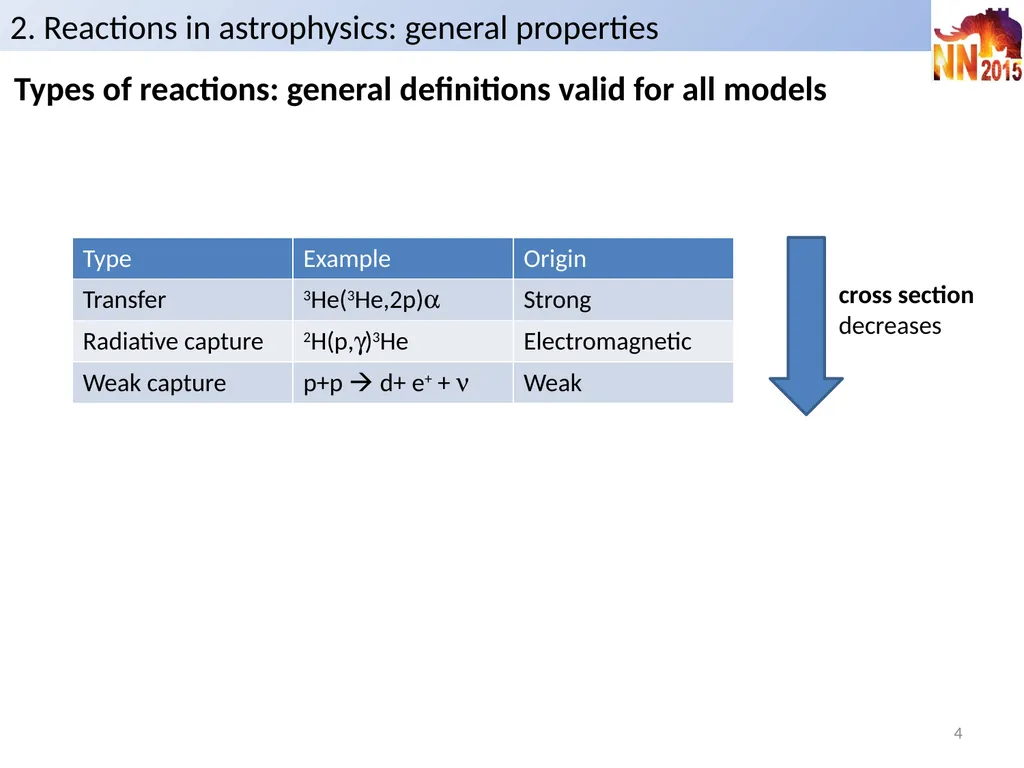
4 Types of reactions: general definitions valid for all models 2. Reactions in astrophysics: general properties cross section decreases<br>
05
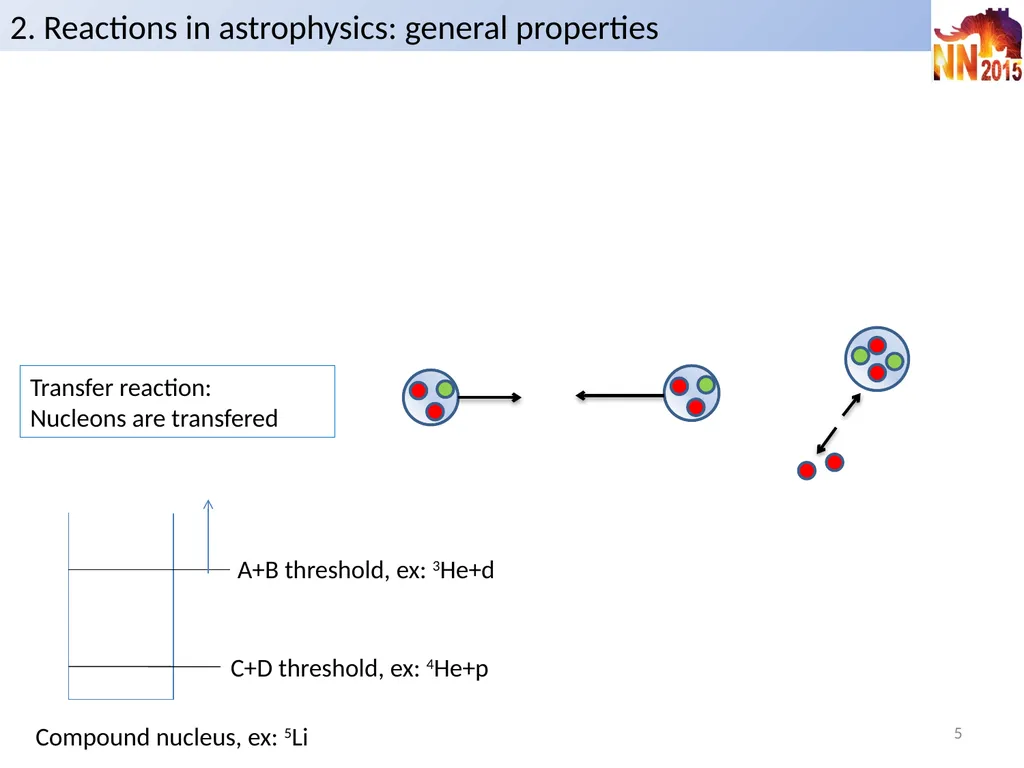
5 Transfer reaction:
Nucleons are transfered A+B threshold, ex: 3He+d C+D threshold, ex: 4He+p Compound nucleus, ex: 5Li 2. Reactions in astrophysics: general properties<br>
06
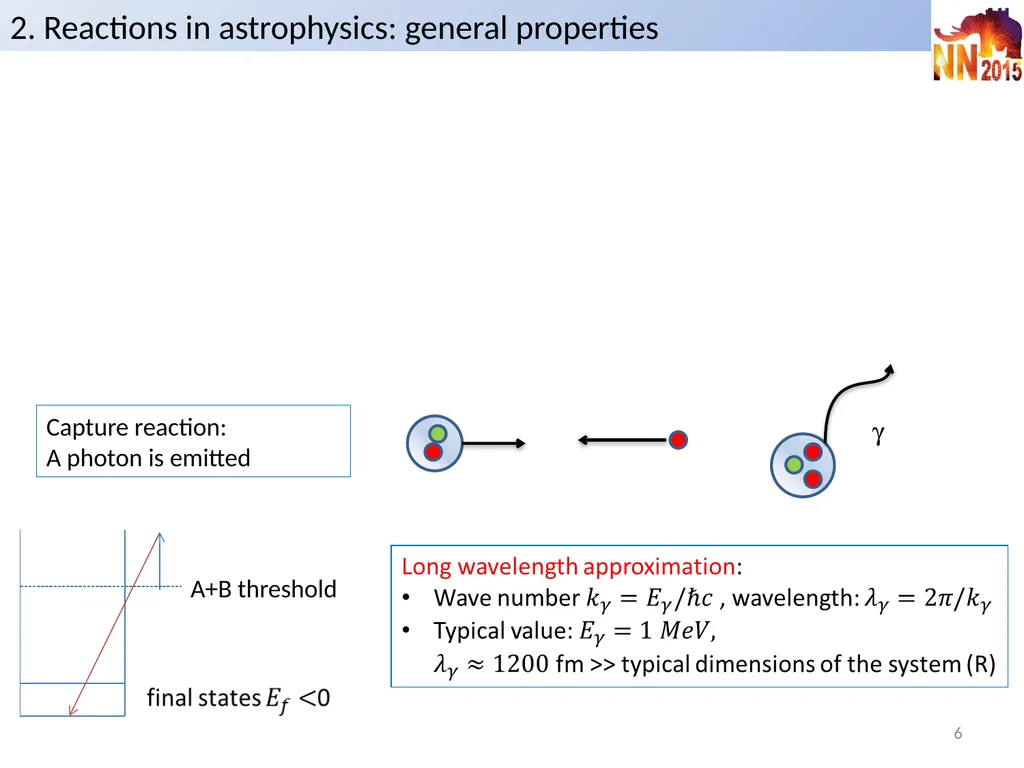
Capture reaction:
A photon is emitted g 6 2. Reactions in astrophysics: general properties A+B threshold<br>
07
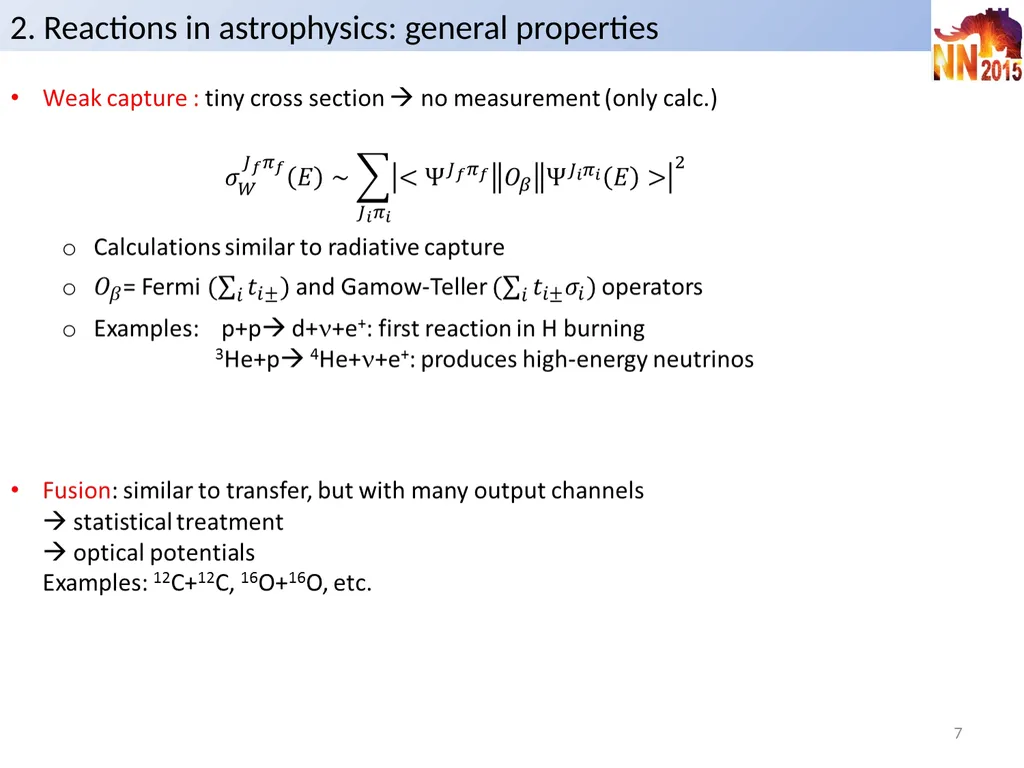
7 2. Reactions in astrophysics: general properties<br>
08
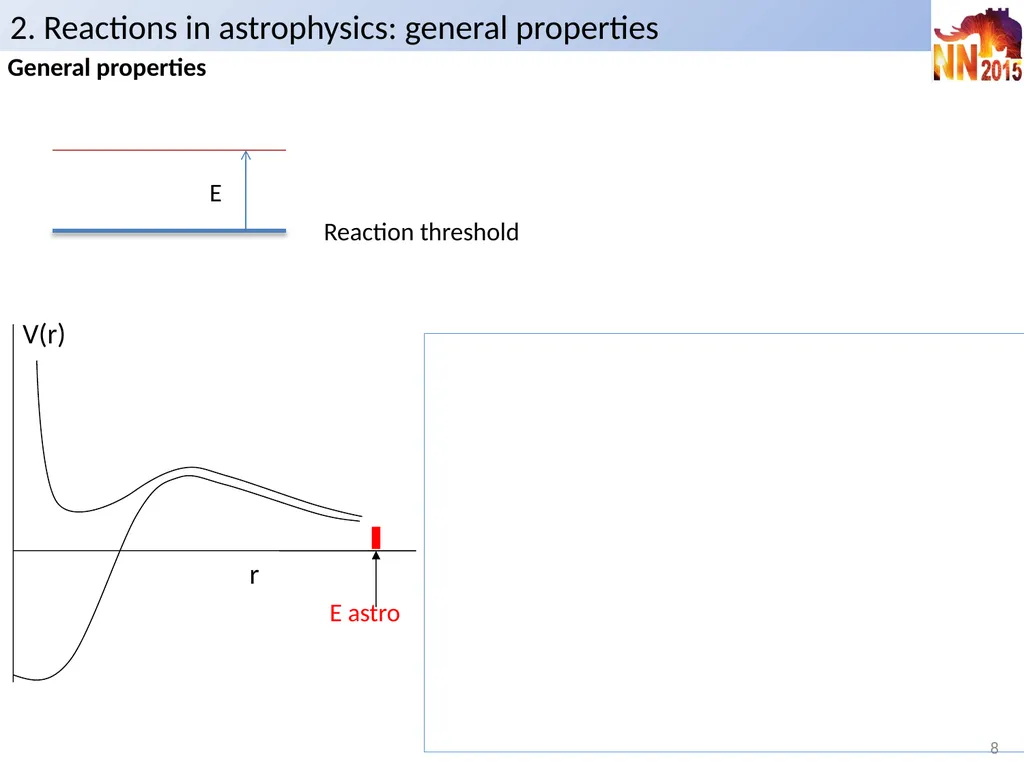
General properties Reaction threshold E 8 V(r) r E astro 2. Reactions in astrophysics: general properties<br>
09
9 2. Reactions in astrophysics: general properties<br>
10
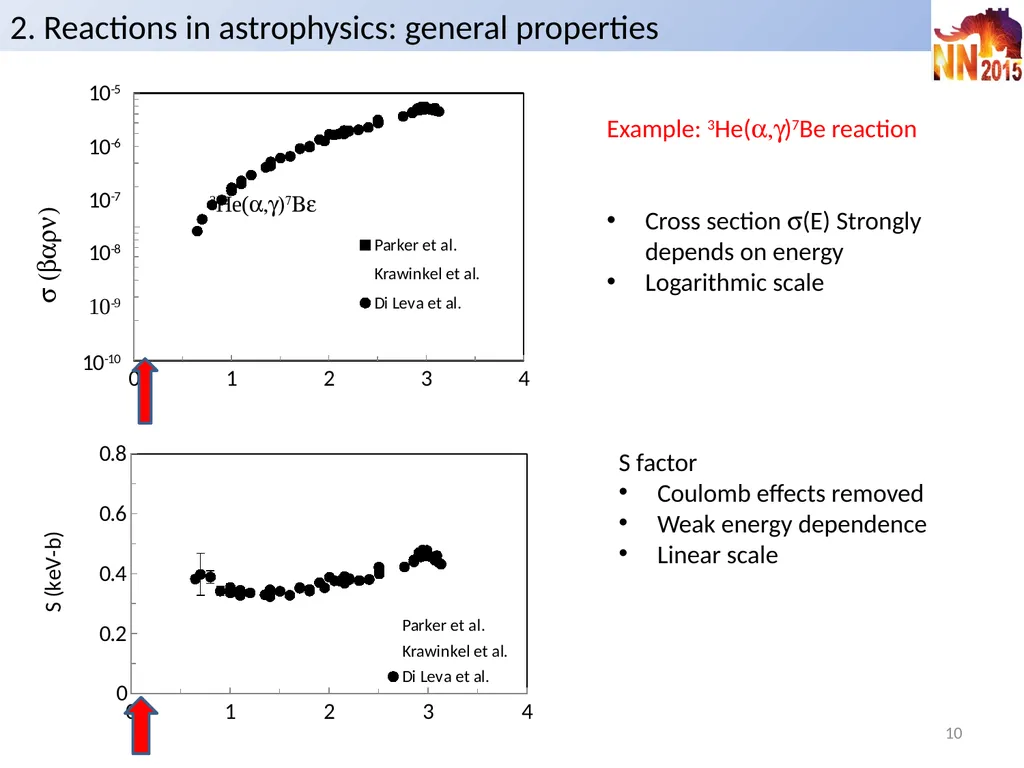
10 Example: 3He(a,g)7Be reaction
Cross section s(E) Strongly depends on energy
Logarithmic scale S factor
Coulomb effects removed
Weak energy dependence
Linear scale 2. Reactions in astrophysics: general properties<br>
11
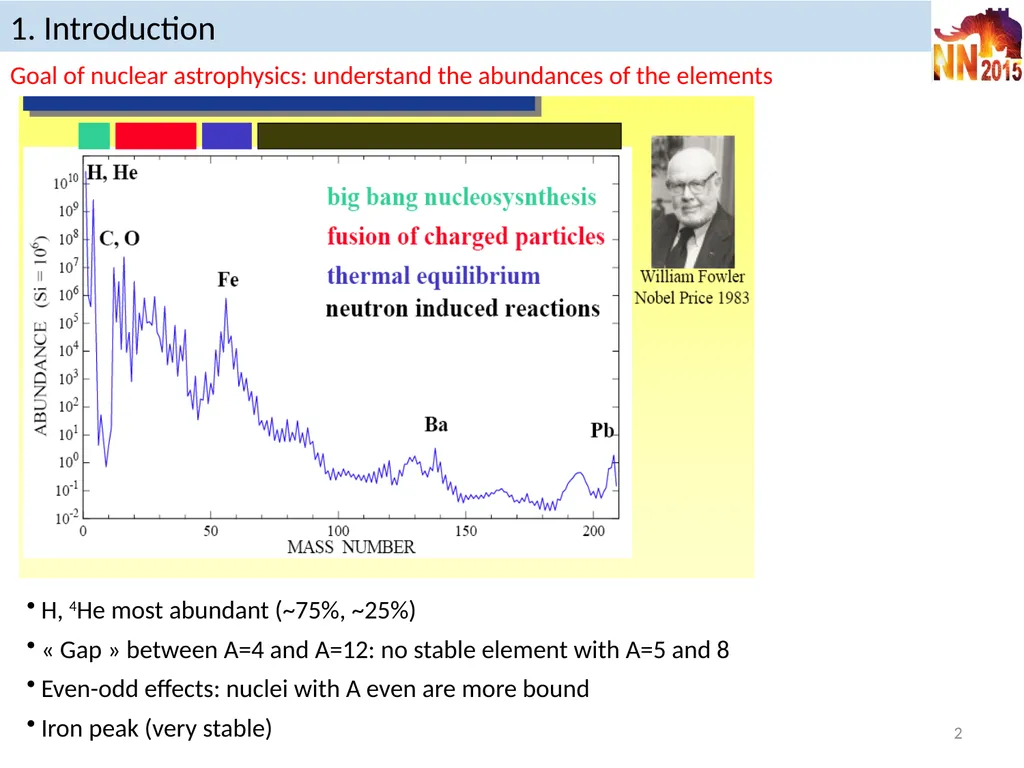
Nucleosynthesis:
Primordial (Bigbang): 3 first minutes of the Universe
Stellar: star evolution, energy production
Input required: reaction rate <sv>
strongly depend on temperatures
given by the low-energy part of the cross section s(E) (Gamow window)
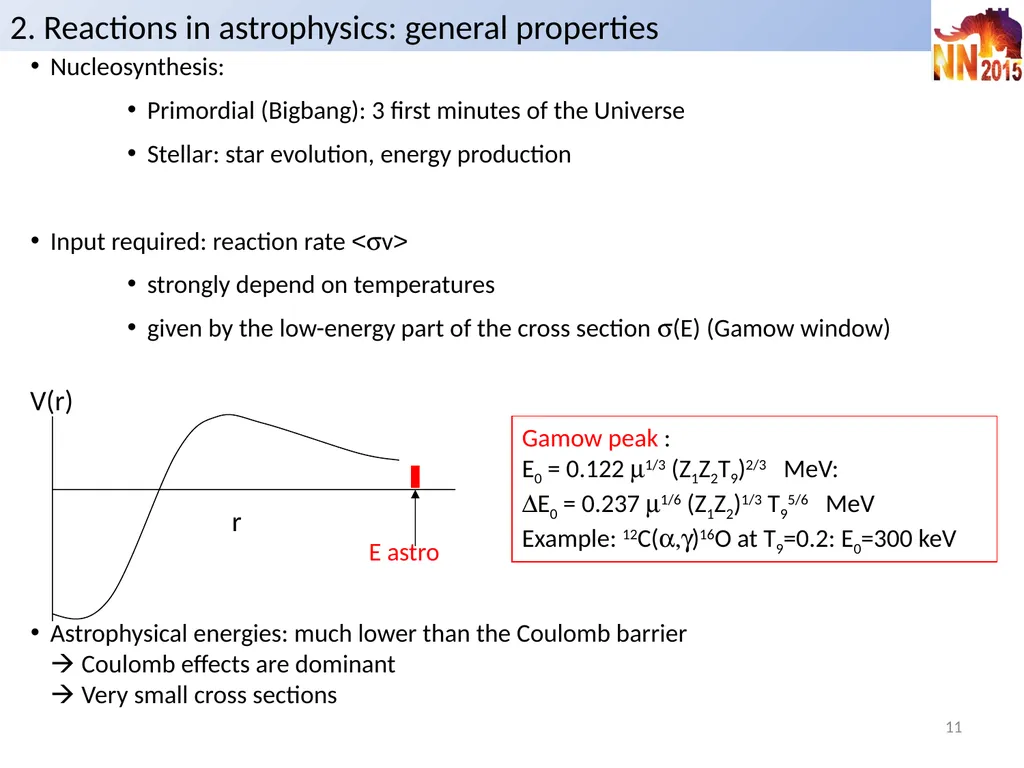
Astrophysical energies: much lower than the Coulomb barrier� Coulomb effects are dominant� Very small cross sections 11 V(r) r E astro Gamow peak : �E0 = 0.122 m1/3 (Z1Z2T9)2/3 MeV: �DE0 = 0.237 m1/6 (Z1Z2)1/3 T95/6 MeV�Example: 12C(a,g)16O at T9=0.2: E0=300 keV 2. Reactions in astrophysics: general properties<br>
12
12 General problems in nuclear astrophysics
Low energies very low cross sections (Coulomb barrier)
For heavy nuclei: high level densities many resonances must be known
Need for radioactive beams
No systematics (many different types of reactions)
transfer, capture
resonant, non-resonant
low or high level densities�
in most cases a theoretical support is necessary
data extrapolation (example: R-matrix method)�Available cross sections are parametrized, and extrapolated down to stellar energies
determination of cross sections �The cross sections are determined from the wave functions of the system�No need for experimental data (in principle!)�Examples: potential model, microscopic models (low level densities)� shell model (resonance properties in for high level densities) 2. Reactions in astrophysics: general properties<br>
13
13 3. Reaction models<br>
14
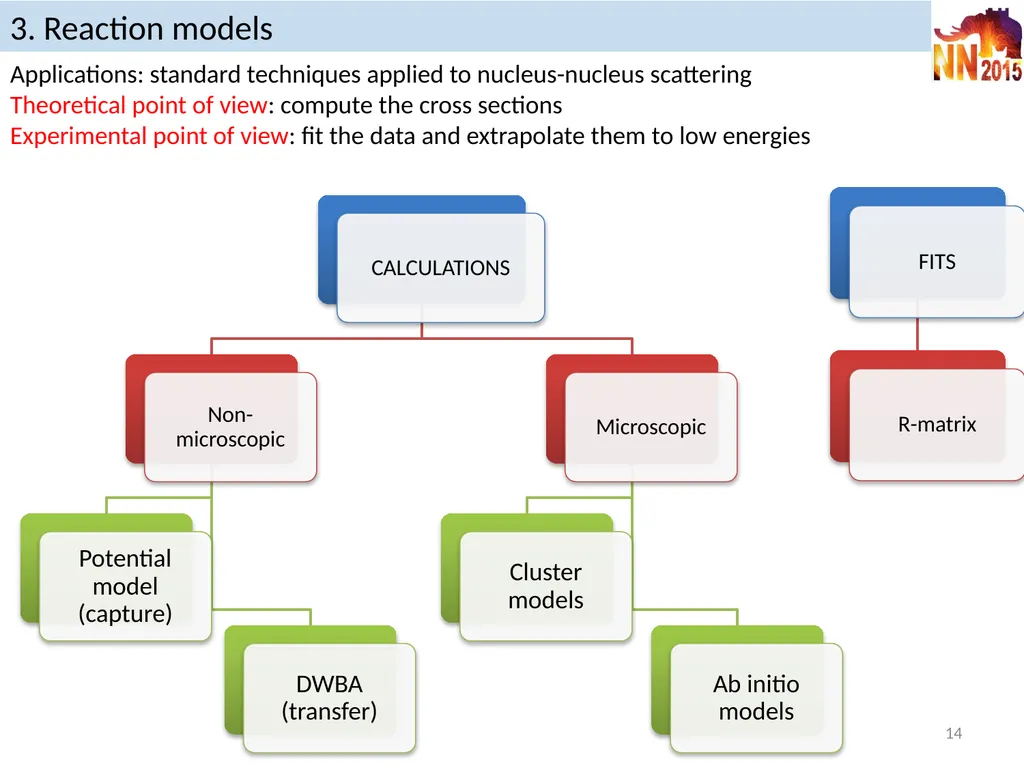
14 Applications: standard techniques applied to nucleus-nucleus scattering
Theoretical point of view: compute the cross sections
Experimental point of view: fit the data and extrapolate them to low energies 3. Reaction models<br>
15
15 3. Reaction models<br>
16
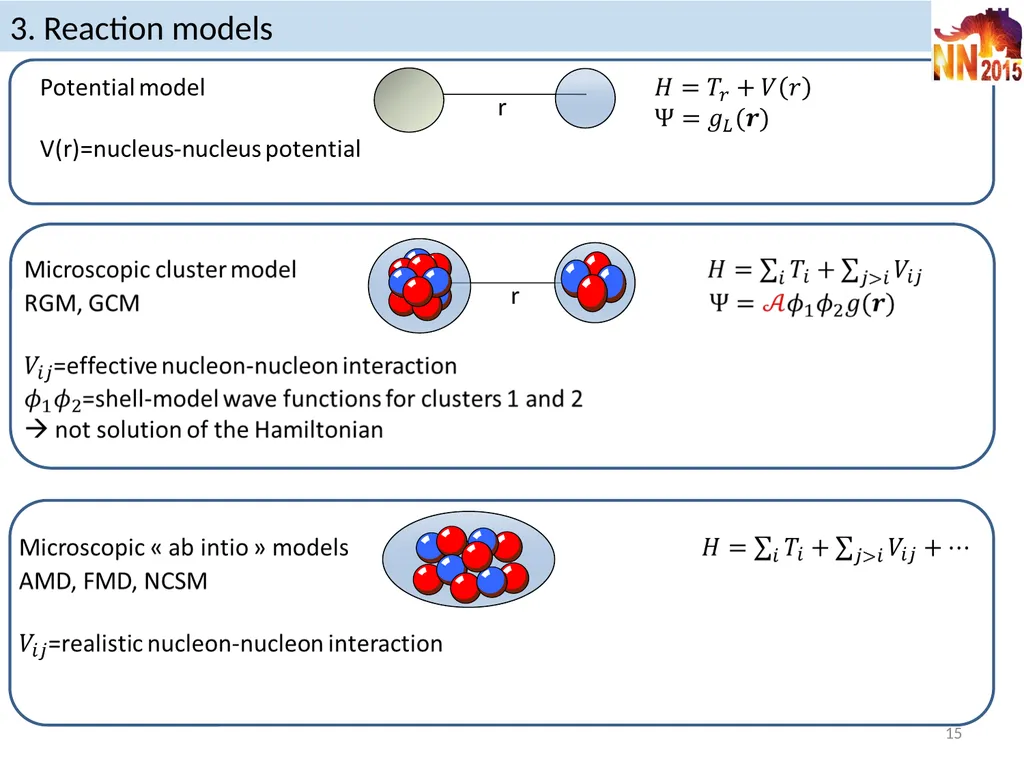
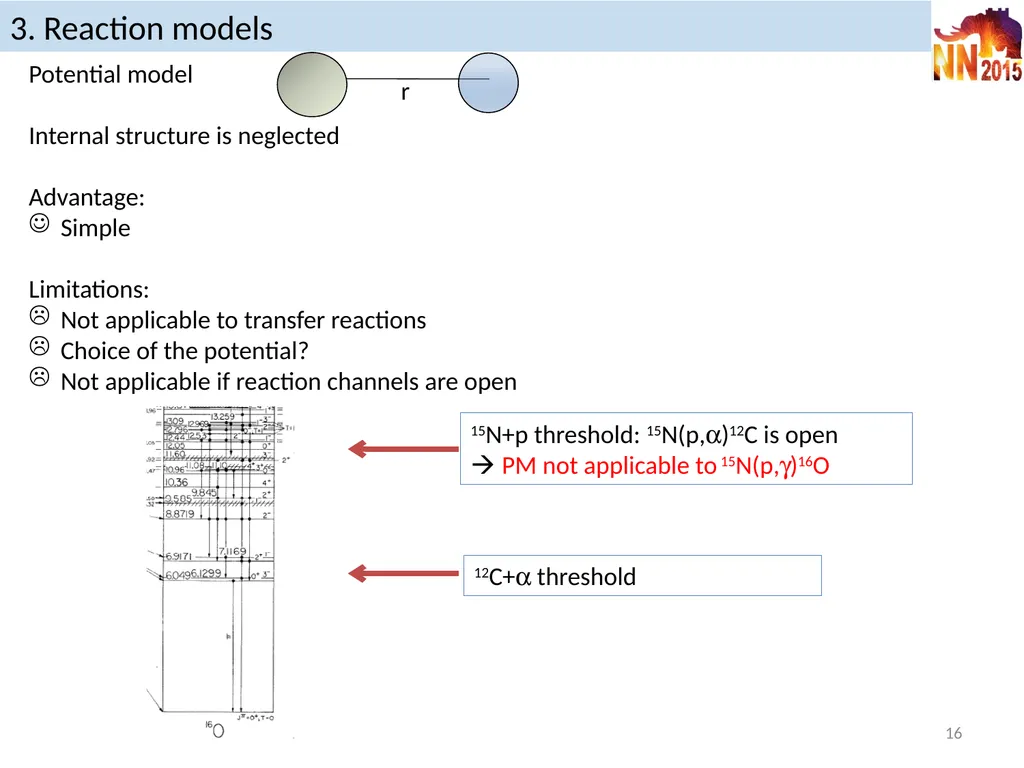
16 Potential model
Internal structure is neglected
Advantage:
Simple
Limitations:
Not applicable to transfer reactions
Choice of the potential?
Not applicable if reaction channels are open r 15N+p threshold: 15N(p,a)12C is open
PM not applicable to 15N(p,g)16O 12C+a threshold 3. Reaction models<br>
17
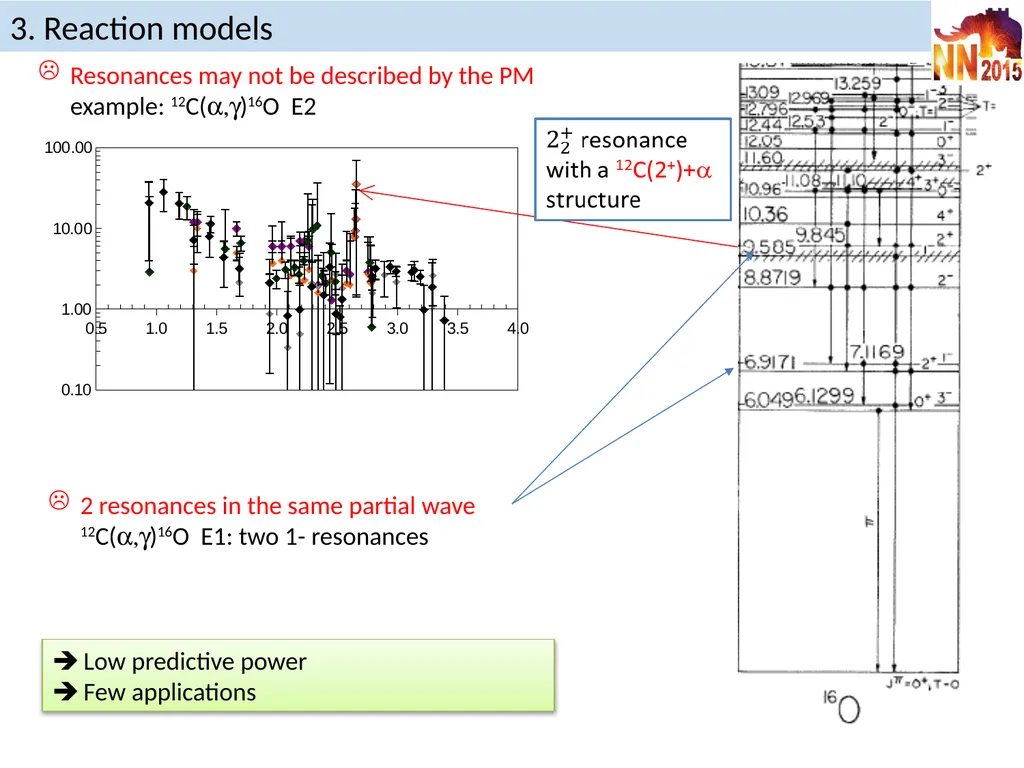
17 Resonances may not be described by the PM�example: 12C(a,g)16O E2 3. Reaction models 2 resonances in the same partial wave�12C(a,g)16O E1: two 1- resonances Low predictive power� Few applications<br>
18
18 4. Microscopic models<br>
19
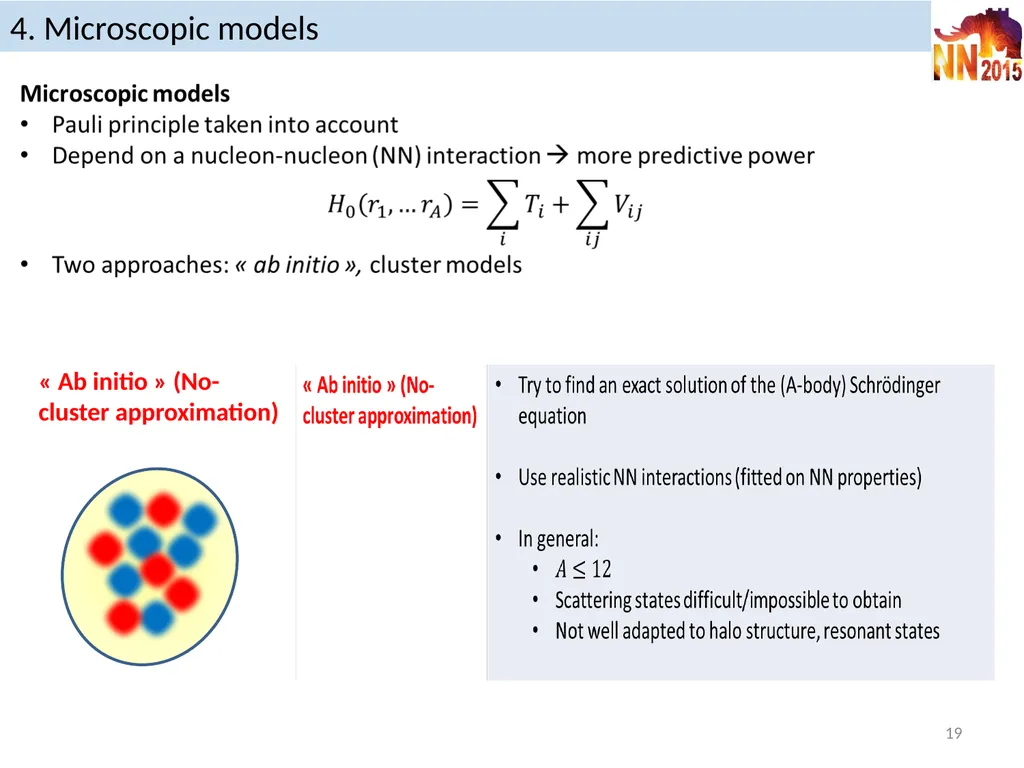
19 4. Microscopic models<br>
20
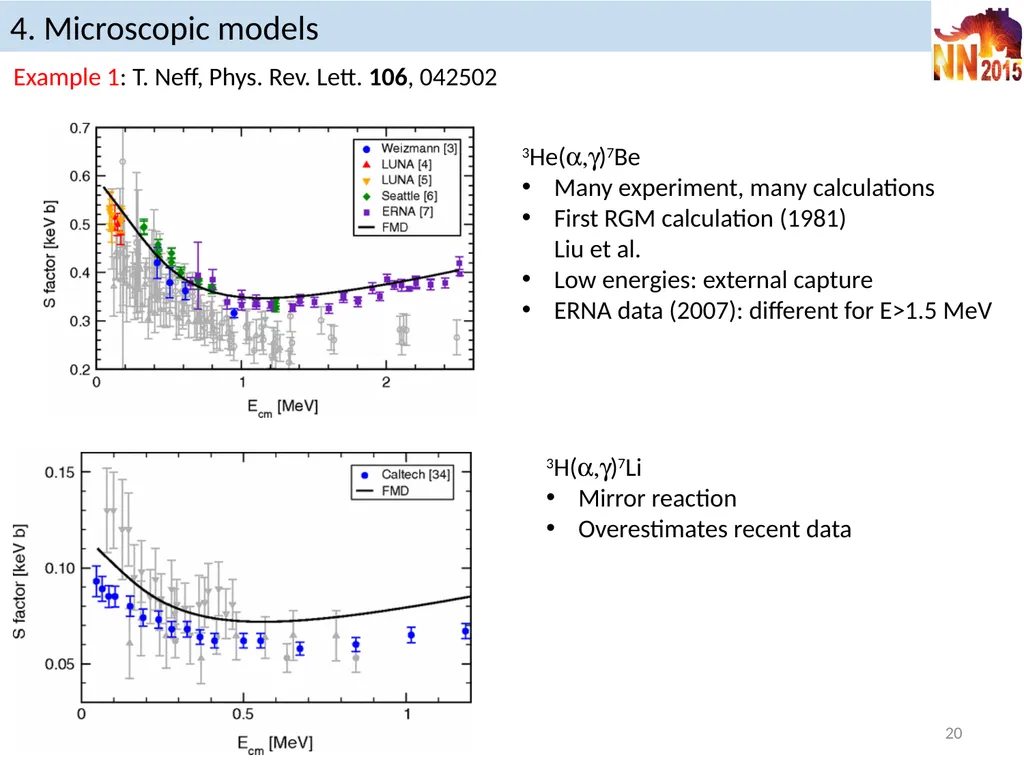
20 Example 1: T. Neff, Phys. Rev. Lett. 106, 042502 3He(a,g)7Be
Many experiment, many calculations
First RGM calculation (1981)�Liu et al.
Low energies: external capture
ERNA data (2007): different for E>1.5 MeV 3H(a,g)7Li
Mirror reaction
Overestimates recent data 4. Microscopic models<br>
21
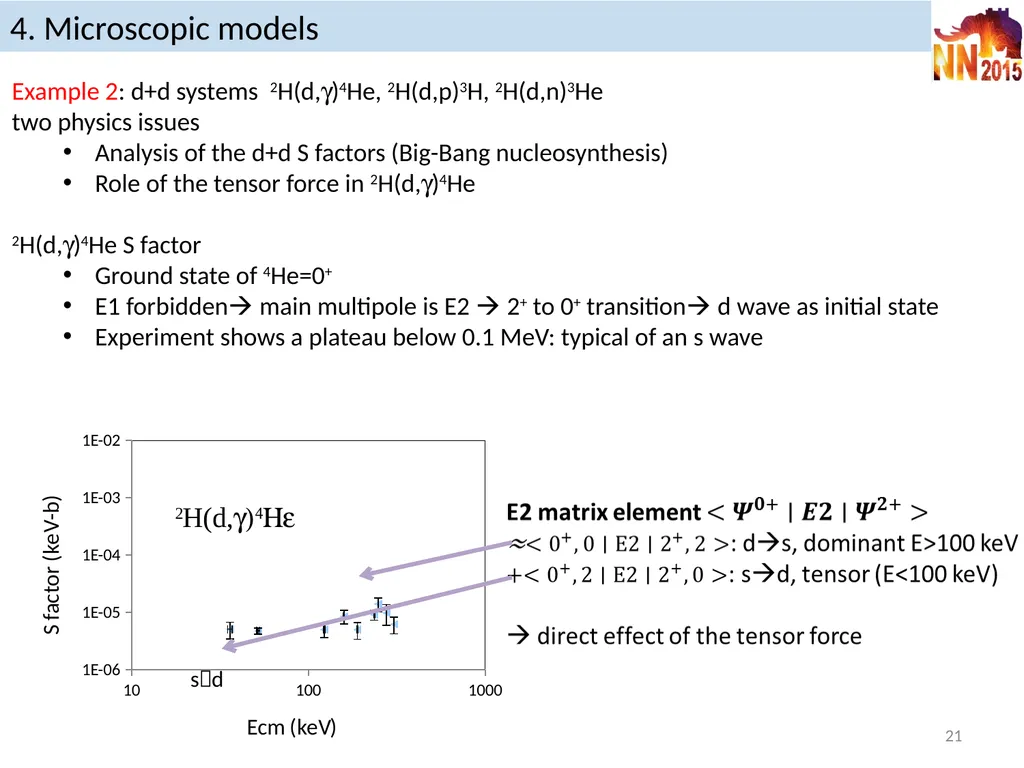
Example 2: d+d systems 2H(d,g)4He, 2H(d,p)3H, 2H(d,n)3He
two physics issues
Analysis of the d+d S factors (Big-Bang nucleosynthesis)
Role of the tensor force in 2H(d,g)4He
2H(d,g)4He S factor
Ground state of 4He=0+
E1 forbidden main multipole is E2 2+ to 0+ transition d wave as initial state
Experiment shows a plateau below 0.1 MeV: typical of an s wave 21 4. Microscopic models<br>
22
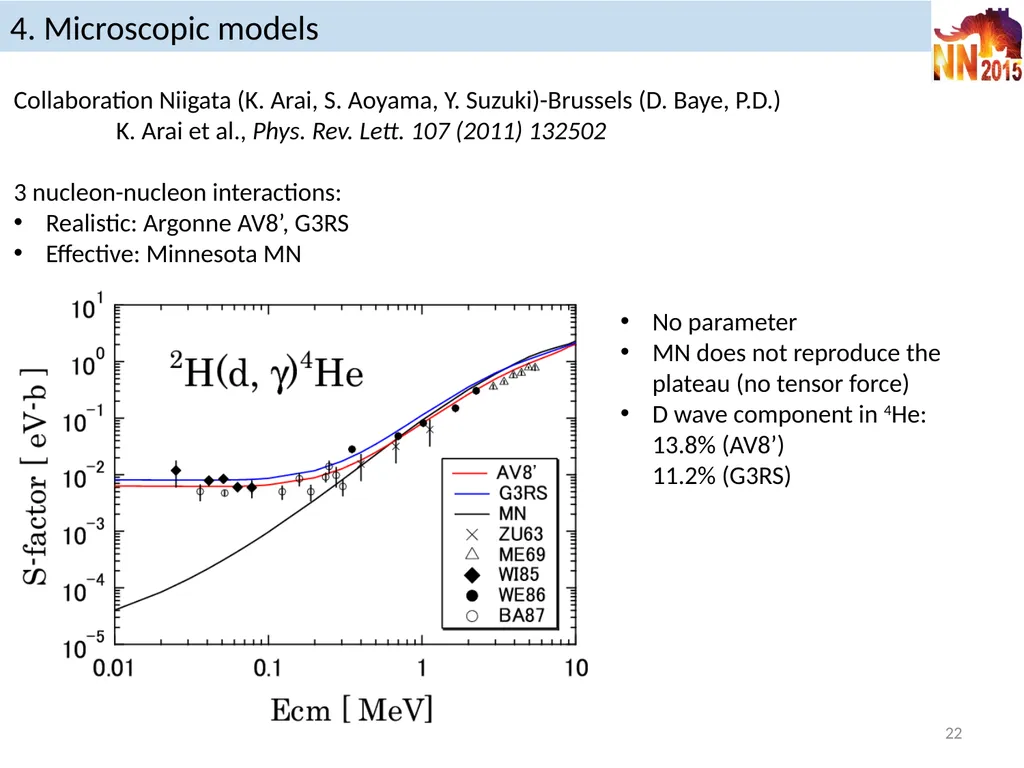
Collaboration Niigata (K. Arai, S. Aoyama, Y. Suzuki)-Brussels (D. Baye, P.D.)� K. Arai et al., Phys. Rev. Lett. 107 (2011) 132502
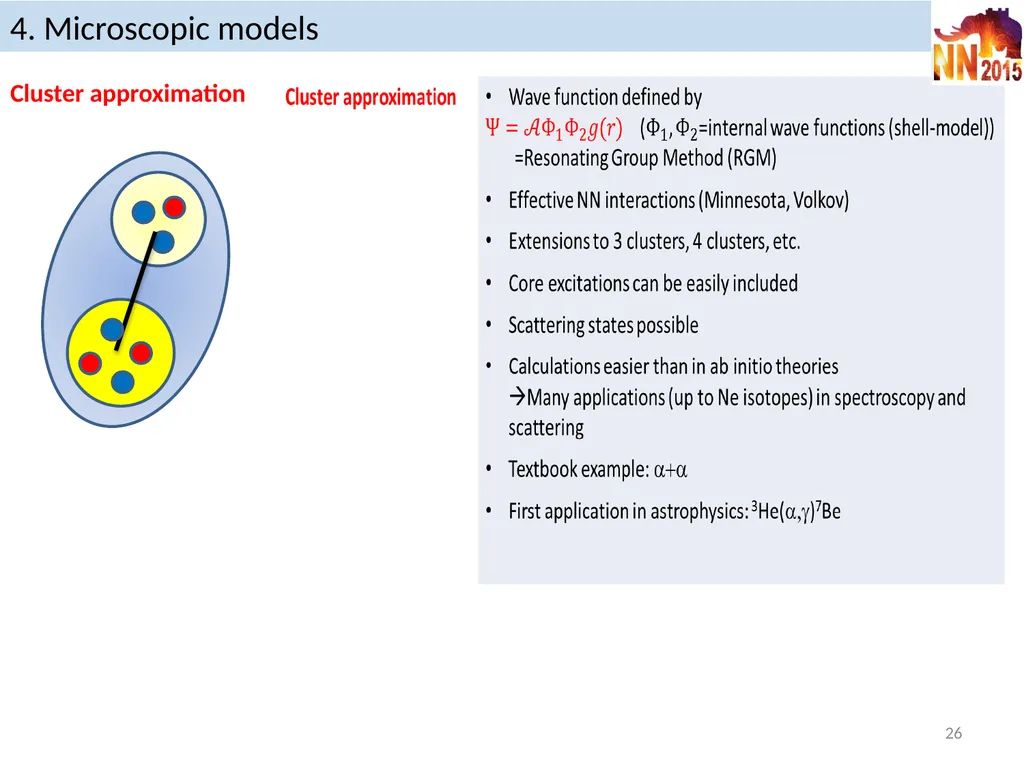
3 nucleon-nucleon interactions:
Realistic: Argonne AV8’, G3RS
Effective: Minnesota MN No parameter
MN does not reproduce the plateau (no tensor force)
D wave component in 4He:�13.8% (AV8’)�11.2% (G3RS) 22 4. Microscopic models<br>
23
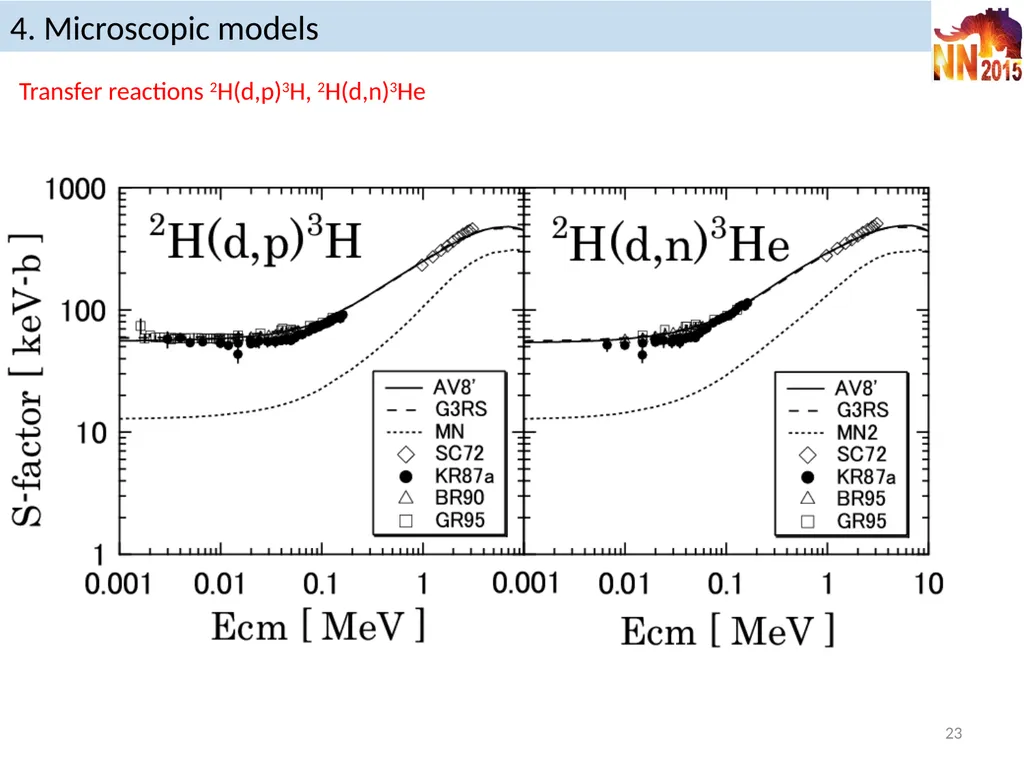
Transfer reactions 2H(d,p)3H, 2H(d,n)3He 23 4. Microscopic models<br>
24
24 4. Microscopic models<br>
25
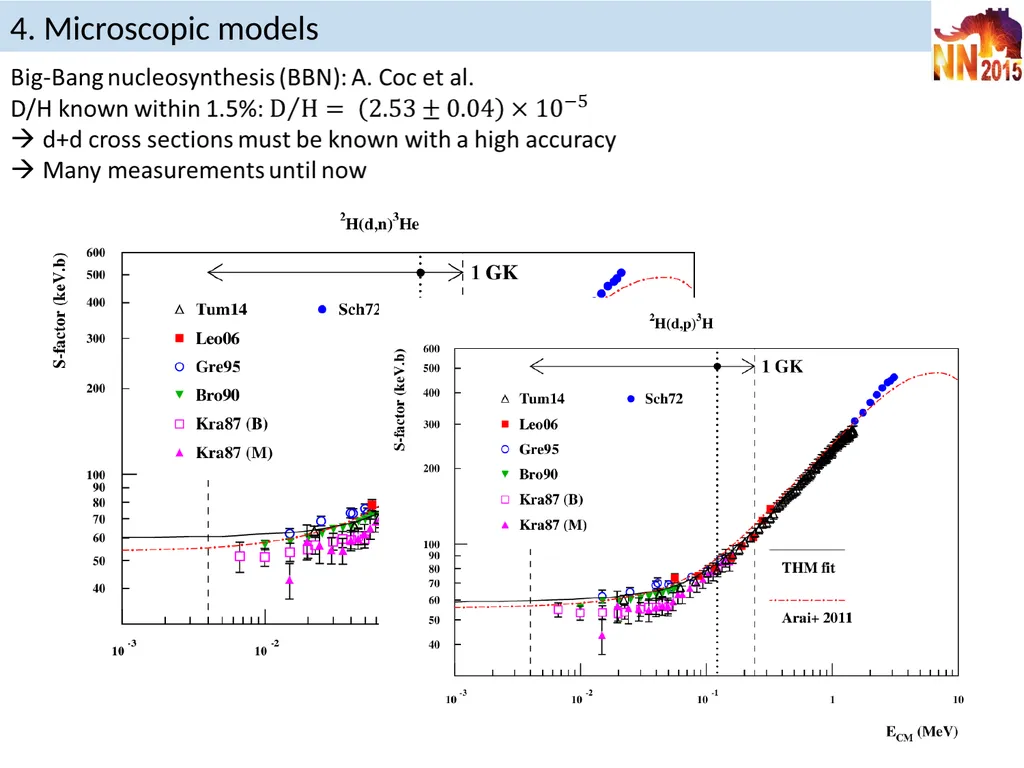
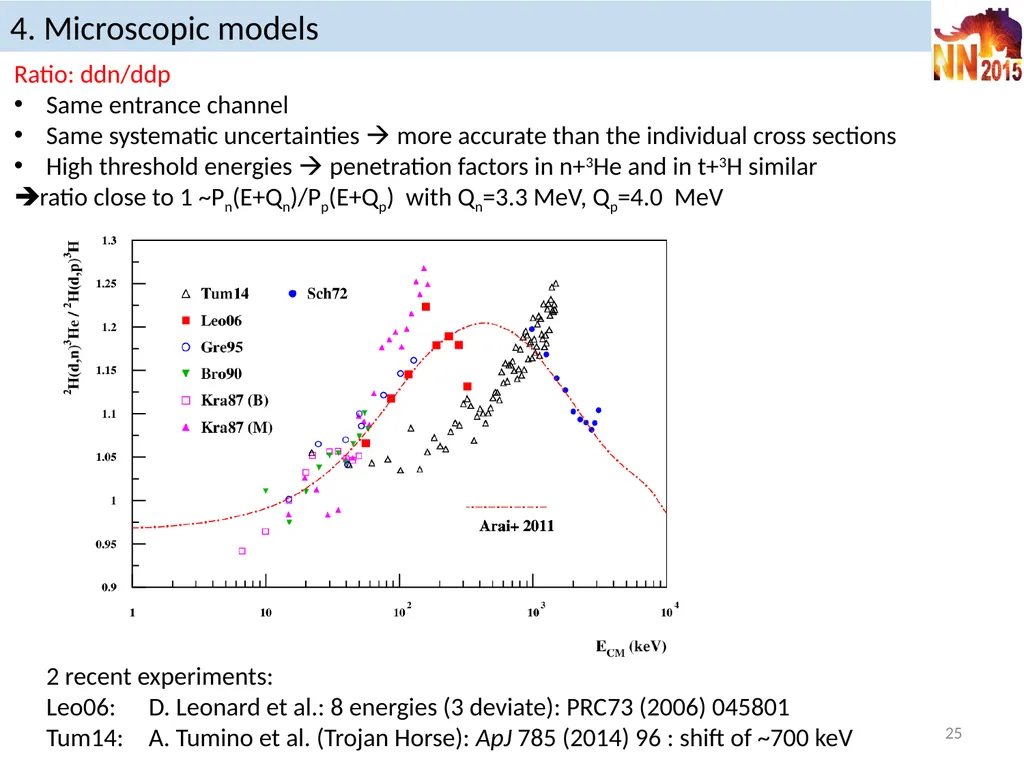
25 Ratio: ddn/ddp
Same entrance channel
Same systematic uncertainties more accurate than the individual cross sections
High threshold energies penetration factors in n+3He and in t+3H similar
ratio close to 1 ~Pn(E+Qn)/Pp(E+Qp) with Qn=3.3 MeV, Qp=4.0 MeV 2 recent experiments:
Leo06: D. Leonard et al.: 8 energies (3 deviate): PRC73 (2006) 045801
Tum14: A. Tumino et al. (Trojan Horse): ApJ 785 (2014) 96 : shift of ~700 keV 4. Microscopic models<br>
26
26 4. Microscopic models<br>
27
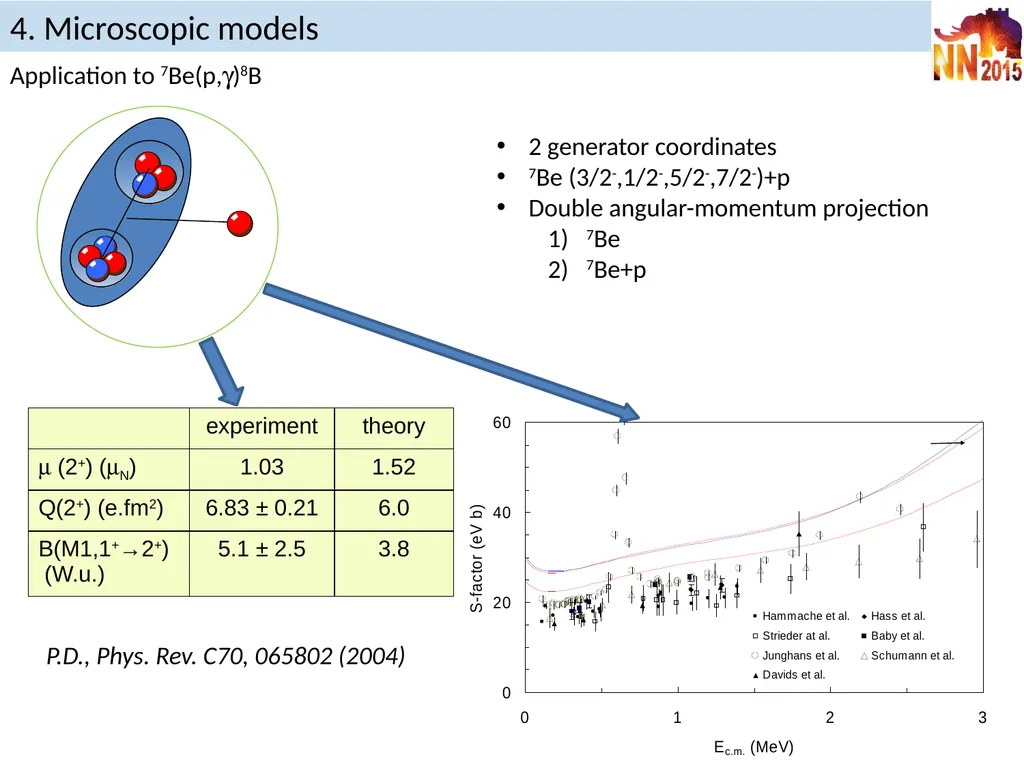
27 Application to 7Be(p,g)8B P.D., Phys. Rev. C70, 065802 (2004) 2 generator coordinates
7Be (3/2-,1/2-,5/2-,7/2-)+p
Double angular-momentum projection
7Be
7Be+p 4. Microscopic models<br>
28
28 5. The R-matrix method:
Data fitting<br>
29
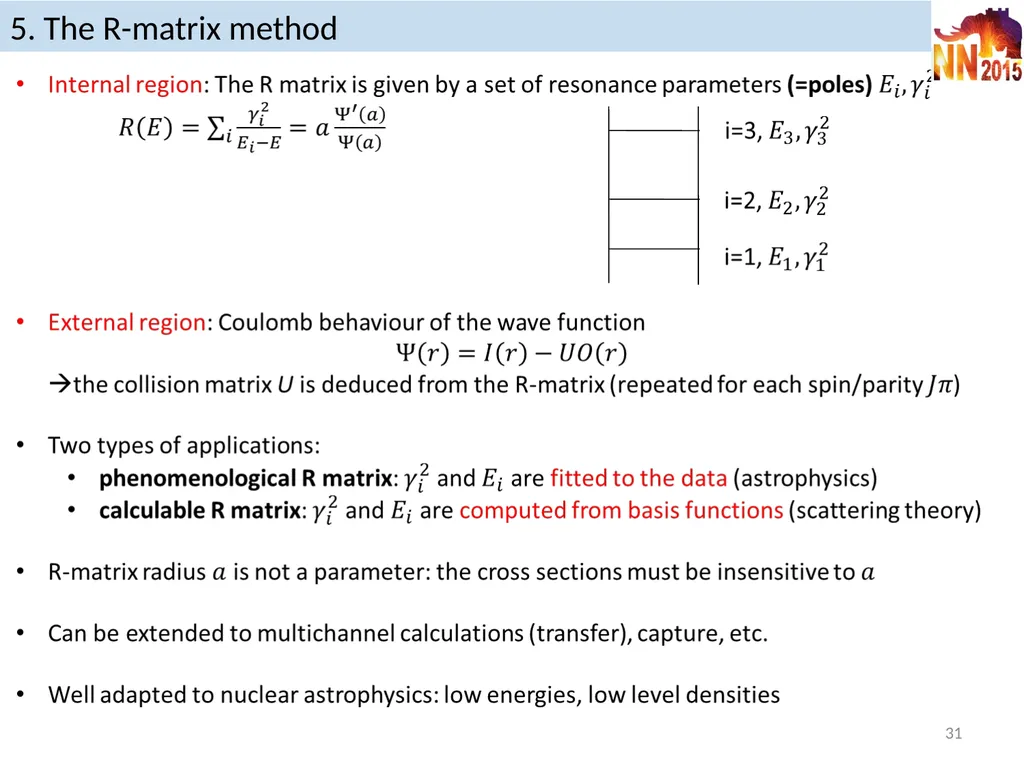
Introduced by Wigner (1937) to parametrize resonances (nuclear physics)�In nuclear astrophysics: used to fit data�
Provides scattering properties at all energies (not only at resonances)�
Based on the existence of 2 regions (radius a):
Internal: coulomb+nuclear
external: coulomb 2. Models: the R-matrix method 29 Internal region
16O Entrance channel
12C+a Exit channels 12C(2+)+a 15N+p, 15O+n 12C+a Coulomb Nuclear+Coulomb:�R-matrix parameters Coulomb 5. The R-matrix method<br>
30
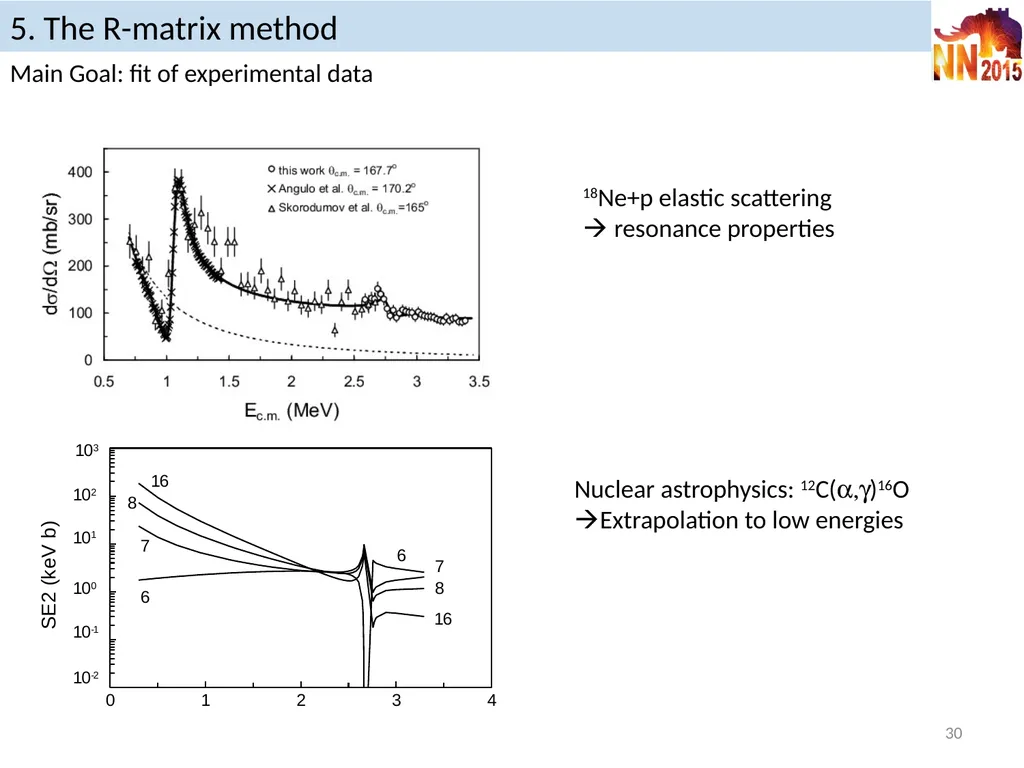
30 Main Goal: fit of experimental data 18Ne+p elastic scattering
resonance properties Nuclear astrophysics: 12C(a,g)16O�Extrapolation to low energies 5. The R-matrix method<br>
31
31 5. The R-matrix method<br>
32
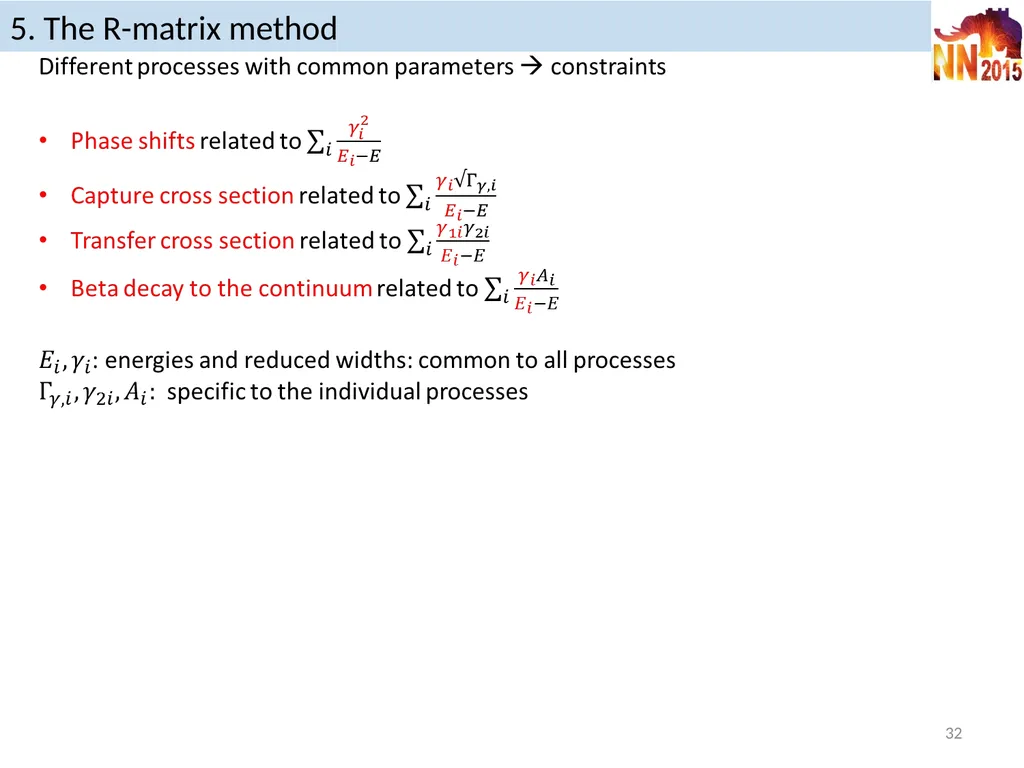
32 5. The R-matrix method<br>
33
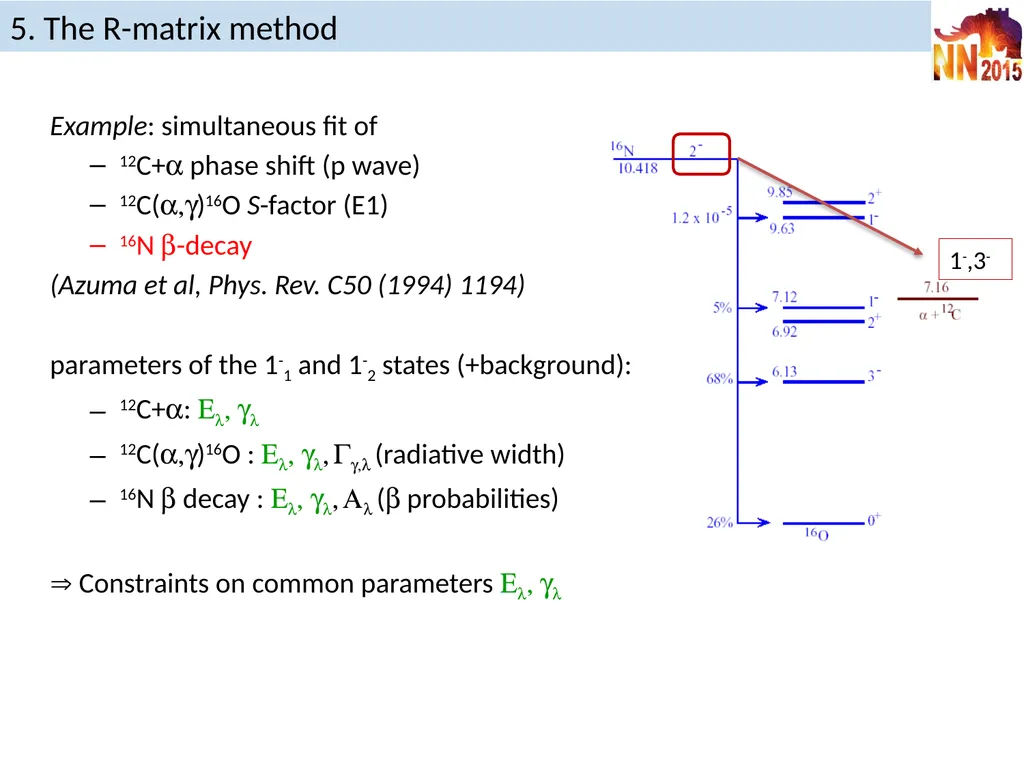
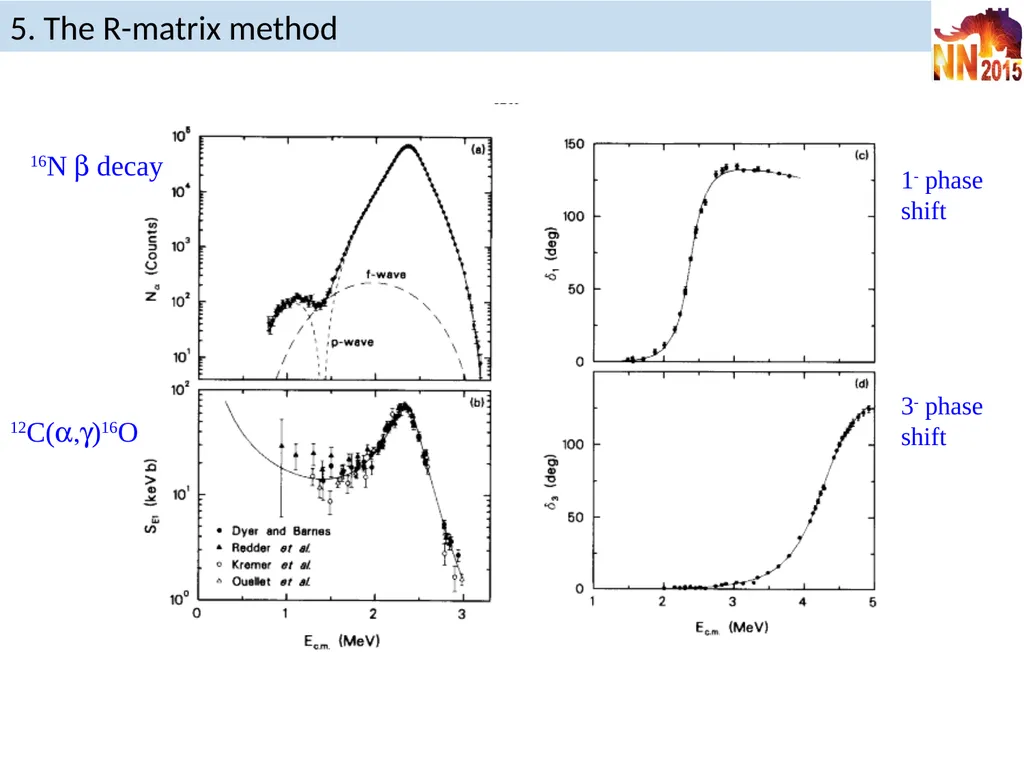
Example: simultaneous fit of
12C+a phase shift (p wave)
12C(a,g)16O S-factor (E1)
16N b-decay
(Azuma et al, Phys. Rev. C50 (1994) 1194)
parameters of the 1-1 and 1-2 states (+background):
12C+a: El, gl
12C(a,g)16O : El, gl, Gg,l (radiative width)
16N b decay : El, gl, Al (b probabilities)
Constraints on common parameters El, gl 5. The R-matrix method 1-,3-<br>
34
16N b decay 12C(a,g)16O 1- phase shift 3- phase shift 5. The R-matrix method<br>
35
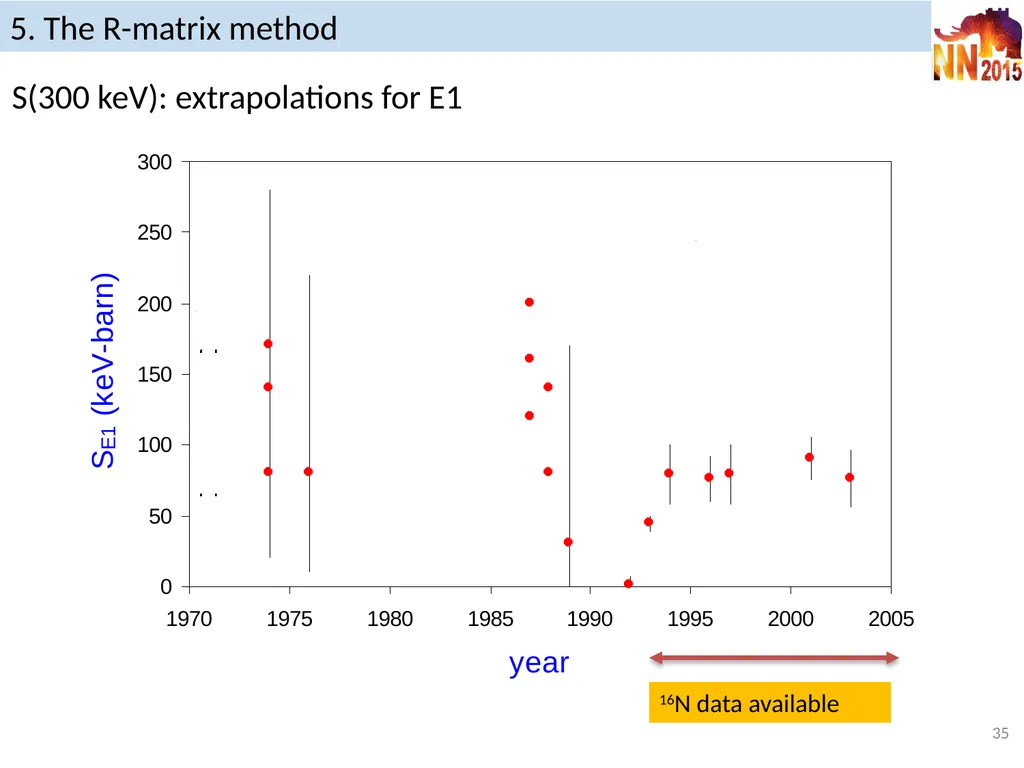
S(300 keV): extrapolations for E1 35 16N data available 5. The R-matrix method<br>
37
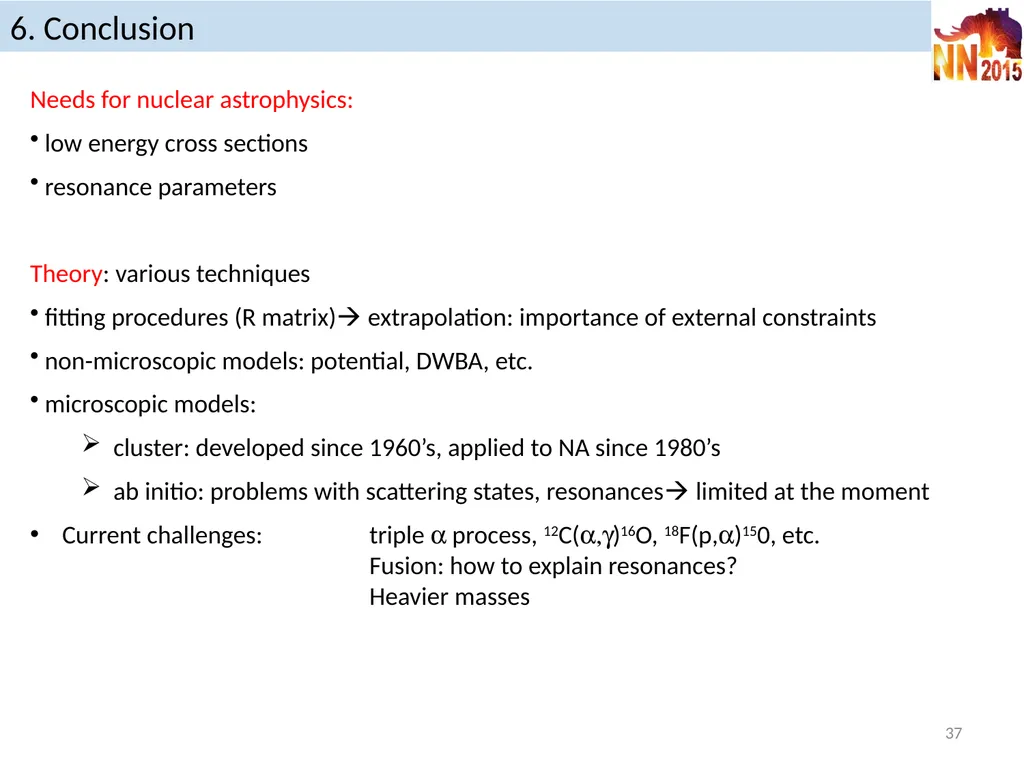
Needs for nuclear astrophysics:
low energy cross sections
resonance parameters
Theory: various techniques
fitting procedures (R matrix) extrapolation: importance of external constraints
non-microscopic models: potential, DWBA, etc.
microscopic models:
cluster: developed since 1960’s, applied to NA since 1980’s
ab initio: problems with scattering states, resonances limited at the moment
Current challenges: triple a process, 12C(a,g)16O, 18F(p,a)150, etc.� Fusion: how to explain resonances?� Heavier masses 37 6. Conclusion<br>