
Reception: Mrs Martin Curriculum Overview 2023 -
LS
Published · 7 slides · 0 views

1 / 1
Description
Reception: Mrs Martin Curriculum Overview 2023 - 2024 Religious Education Topic 1: Creation and Covenant Topic 2: Prophecy and Promise Topic 3: Galilee to Jerusalem Topic 4: Desert to Garden Topic 5: To the ends of the Earth Topic 6:
Related Topics
Share
Embed code
Download this presentation From Below
"Reception: Mrs Martin Curriculum Overview 2023 -" is the property of its rightful owner. Permission is granted to download and print the materials on this website for personal, non-commercial use only, and to display it on your personal computer provided you do not modify the materials and that you retain all copyright notices contained in the materials. By downloading content from our website, you accept the terms of this agreement.
Presentation Transcript
01
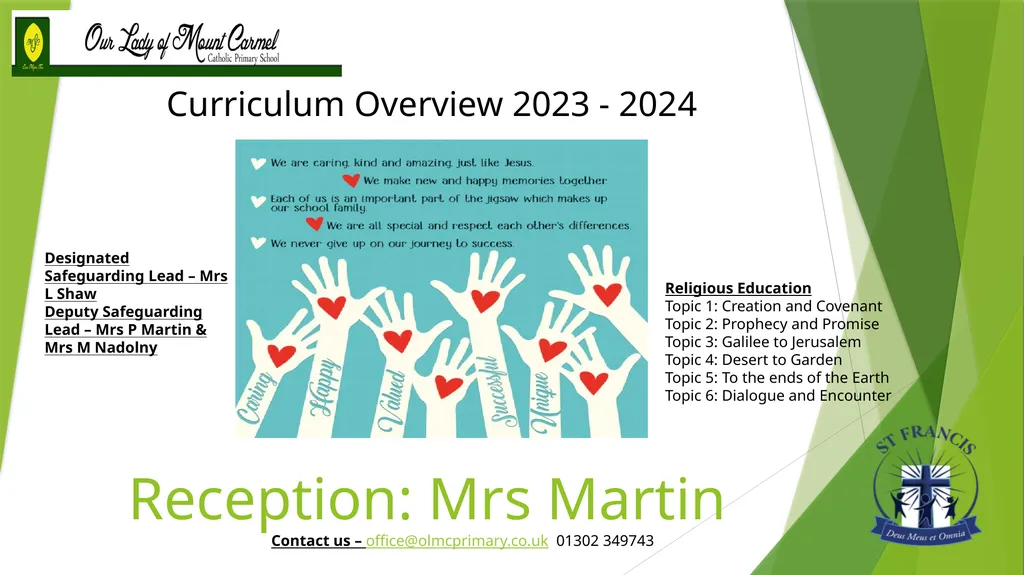
Reception: Mrs Martin Curriculum Overview 2023 - 2024 Religious Education
Topic 1: Creation and Covenant
Topic 2: Prophecy and Promise
Topic 3: Galilee to Jerusalem
Topic 4: Desert to Garden
Topic 5: To the ends of the Earth
Topic 6: Dialogue and Encounter Designated Safeguarding Lead – Mrs L Shaw
Deputy Safeguarding Lead – Mrs P Martin & Mrs M Nadolny Contact us – office@olmcprimary.co.uk 01302 349743<br>
Topic 1: Creation and Covenant
Topic 2: Prophecy and Promise
Topic 3: Galilee to Jerusalem
Topic 4: Desert to Garden
Topic 5: To the ends of the Earth
Topic 6: Dialogue and Encounter Designated Safeguarding Lead – Mrs L Shaw
Deputy Safeguarding Lead – Mrs P Martin & Mrs M Nadolny Contact us – office@olmcprimary.co.uk 01302 349743<br>
02
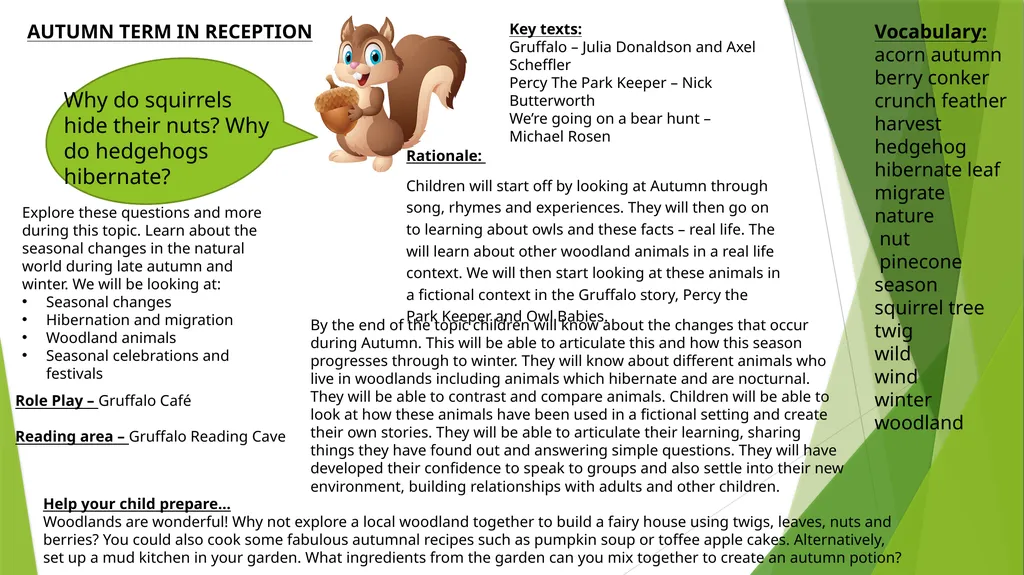
Why do squirrels hide their nuts? Why do hedgehogs hibernate? Vocabulary:
acorn autumn berry conker crunch feather harvest hedgehog hibernate leaf
migrate nature
nut
pinecone season squirrel tree
twig
wild
wind
winter woodland Key texts:
Gruffalo – Julia Donaldson and Axel Scheffler
Percy The Park Keeper – Nick Butterworth
We’re going on a bear hunt – Michael Rosen Explore these questions and more during this topic. Learn about the seasonal changes in the natural world during late autumn and winter. We will be looking at:
Seasonal changes
Hibernation and migration
Woodland animals
Seasonal celebrations and festivals AUTUMN TERM IN RECEPTION By the end of the topic children will know about the changes that occur during Autumn. This will be able to articulate this and how this season progresses through to winter. They will know about different animals who live in woodlands including animals which hibernate and are nocturnal. They will be able to contrast and compare animals. Children will be able to look at how these animals have been used in a fictional setting and create their own stories. They will be able to articulate their learning, sharing things they have found out and answering simple questions. They will have developed their confidence to speak to groups and also settle into their new environment, building relationships with adults and other children. Role Play – Gruffalo Café
Reading area – Gruffalo Reading Cave Help your child prepare…
Woodlands are wonderful! Why not explore a local woodland together to build a fairy house using twigs, leaves, nuts and
berries? You could also cook some fabulous autumnal recipes such as pumpkin soup or toffee apple cakes. Alternatively,
set up a mud kitchen in your garden. What ingredients from the garden can you mix together to create an autumn potion?<br>
acorn autumn berry conker crunch feather harvest hedgehog hibernate leaf
migrate nature
nut
pinecone season squirrel tree
twig
wild
wind
winter woodland Key texts:
Gruffalo – Julia Donaldson and Axel Scheffler
Percy The Park Keeper – Nick Butterworth
We’re going on a bear hunt – Michael Rosen Explore these questions and more during this topic. Learn about the seasonal changes in the natural world during late autumn and winter. We will be looking at:
Seasonal changes
Hibernation and migration
Woodland animals
Seasonal celebrations and festivals AUTUMN TERM IN RECEPTION By the end of the topic children will know about the changes that occur during Autumn. This will be able to articulate this and how this season progresses through to winter. They will know about different animals who live in woodlands including animals which hibernate and are nocturnal. They will be able to contrast and compare animals. Children will be able to look at how these animals have been used in a fictional setting and create their own stories. They will be able to articulate their learning, sharing things they have found out and answering simple questions. They will have developed their confidence to speak to groups and also settle into their new environment, building relationships with adults and other children. Role Play – Gruffalo Café
Reading area – Gruffalo Reading Cave Help your child prepare…
Woodlands are wonderful! Why not explore a local woodland together to build a fairy house using twigs, leaves, nuts and
berries? You could also cook some fabulous autumnal recipes such as pumpkin soup or toffee apple cakes. Alternatively,
set up a mud kitchen in your garden. What ingredients from the garden can you mix together to create an autumn potion?<br>
03
SPRING TERM IN RECEPTION Are carrots orange? Do cows drink milk? Vocabulary:
bitter
bread
carrot
cereal
chop
cook
courgette
dig
eat
exercise
fish
fruit
grow
healthy
lettuce
meat
orange
peel plants
peas
potato
radish
recipe
radish
salad
salty
seed
sour
spade
spicy
stir
sweet
tomato
trowel vegetable Rationale:
Children will start off by sharing what they know about the theme. Two themes have been linked to allow the children to learn about food, growing and minibeasts, but also farming and animals on farms. Broadening their experiences.
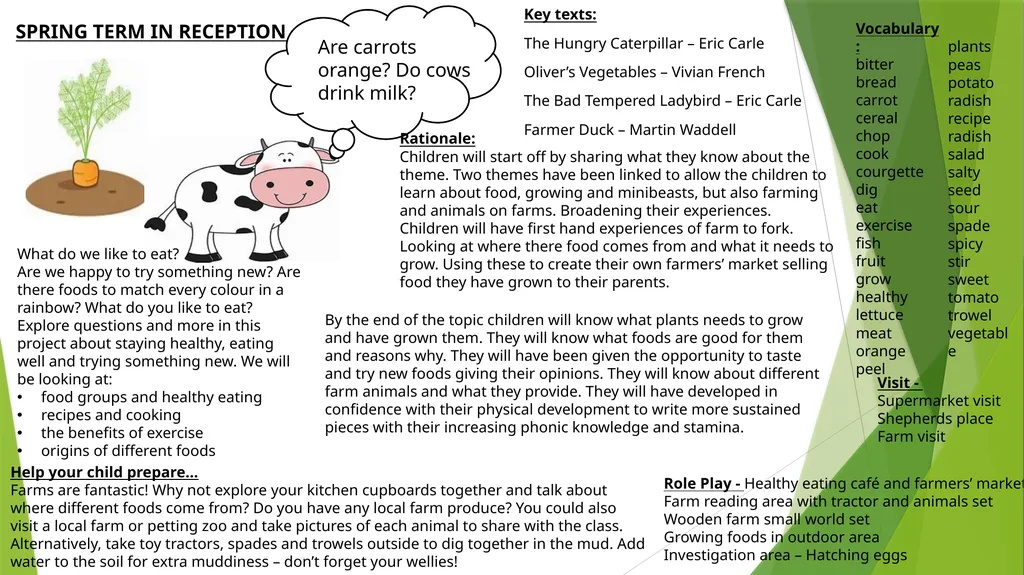
Children will have first hand experiences of farm to fork. Looking at where there food comes from and what it needs to grow. Using these to create their own farmers’ market selling food they have grown to their parents. By the end of the topic children will know what plants needs to grow and have grown them. They will know what foods are good for them and reasons why. They will have been given the opportunity to taste and try new foods giving their opinions. They will know about different farm animals and what they provide. They will have developed in confidence with their physical development to write more sustained pieces with their increasing phonic knowledge and stamina. What do we like to eat?
Are we happy to try something new? Are there foods to match every colour in a rainbow? What do you like to eat?
Explore questions and more in this project about staying healthy, eating well and trying something new. We will be looking at:
food groups and healthy eating
recipes and cooking
the benefits of exercise
origins of different foods Role Play - Healthy eating café and farmers’ market
Farm reading area with tractor and animals set
Wooden farm small world set
Growing foods in outdoor area
Investigation area – Hatching eggs Visit -
Supermarket visit
Shepherds place Farm visit Help your child prepare…
Farms are fantastic! Why not explore your kitchen cupboards together and talk about where different foods come from? Do you have any local farm produce? You could also visit a local farm or petting zoo and take pictures of each animal to share with the class. Alternatively, take toy tractors, spades and trowels outside to dig together in the mud. Add water to the soil for extra muddiness – don’t forget your wellies!<br>
bitter
bread
carrot
cereal
chop
cook
courgette
dig
eat
exercise
fish
fruit
grow
healthy
lettuce
meat
orange
peel plants
peas
potato
radish
recipe
radish
salad
salty
seed
sour
spade
spicy
stir
sweet
tomato
trowel vegetable Rationale:
Children will start off by sharing what they know about the theme. Two themes have been linked to allow the children to learn about food, growing and minibeasts, but also farming and animals on farms. Broadening their experiences.
Children will have first hand experiences of farm to fork. Looking at where there food comes from and what it needs to grow. Using these to create their own farmers’ market selling food they have grown to their parents. By the end of the topic children will know what plants needs to grow and have grown them. They will know what foods are good for them and reasons why. They will have been given the opportunity to taste and try new foods giving their opinions. They will know about different farm animals and what they provide. They will have developed in confidence with their physical development to write more sustained pieces with their increasing phonic knowledge and stamina. What do we like to eat?
Are we happy to try something new? Are there foods to match every colour in a rainbow? What do you like to eat?
Explore questions and more in this project about staying healthy, eating well and trying something new. We will be looking at:
food groups and healthy eating
recipes and cooking
the benefits of exercise
origins of different foods Role Play - Healthy eating café and farmers’ market
Farm reading area with tractor and animals set
Wooden farm small world set
Growing foods in outdoor area
Investigation area – Hatching eggs Visit -
Supermarket visit
Shepherds place Farm visit Help your child prepare…
Farms are fantastic! Why not explore your kitchen cupboards together and talk about where different foods come from? Do you have any local farm produce? You could also visit a local farm or petting zoo and take pictures of each animal to share with the class. Alternatively, take toy tractors, spades and trowels outside to dig together in the mud. Add water to the soil for extra muddiness – don’t forget your wellies!<br>
04
SUMMER TERM IN RECEPTION Why do Zebras have stripes? Where do lions live? Key texts:
Handa’s Surprise
The Lion Who Wanted to Love
Giraffes Can’t Dance
Elmer Vocabulary:
Africa camouflage cheetah
claw
colour
dance
elephant
fur
giraffe
hyena
Kenya
lion
Maasai
meerkat
monkey
pattern prowl
Safari
Serengeti
spot
stripe
Tanzania
tribe
wildlife
wild
zebra aeroplane
ship
train
hot air balloon bus
jeep Rationale:
Children will be referred back to what they learnt about animals and foods in this country. They have built a basis of information about this country and are building to learn about the wider world and a contrasting environment and culture.
They will learn about the Maasai people and contrast their life to a life in England. This will extend to clothes and will look at how these are different and will lead on to the use of fabrics and art work.
Throughout the project they will build up their knowledge of stories from different cultures, using these as a basis to create their own stories.
Children will be encouraged to develop their own personal opinions about where they would like to live and why. They will build up knowledge of transport to take them to different places and why that is necessary. Role play: Safari vehicle with binoculars, animal masks, hats
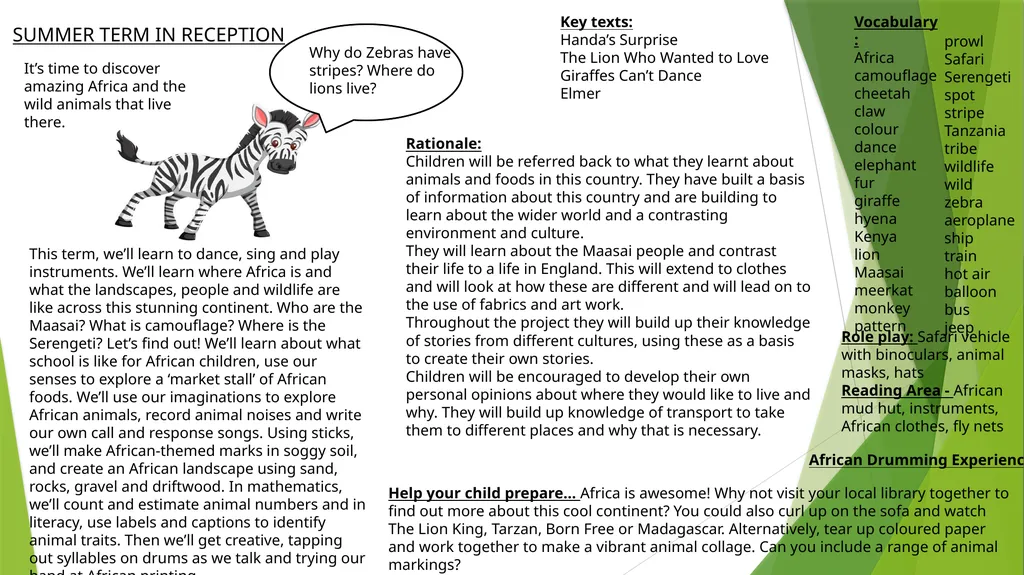
Reading Area - African mud hut, instruments, African clothes, fly nets African Drumming Experience This term, we’ll learn to dance, sing and play instruments. We’ll learn where Africa is and what the landscapes, people and wildlife are like across this stunning continent. Who are the Maasai? What is camouflage? Where is the Serengeti? Let’s find out! We’ll learn about what school is like for African children, use our senses to explore a ‘market stall’ of African foods. We’ll use our imaginations to explore African animals, record animal noises and write our own call and response songs. Using sticks, we’ll make African-themed marks in soggy soil, and create an African landscape using sand, rocks, gravel and driftwood. In mathematics, we’ll count and estimate animal numbers and in literacy, use labels and captions to identify animal traits. Then we’ll get creative, tapping out syllables on drums as we talk and trying our hand at African printing. It’s time to discover amazing Africa and the wild animals that live there. Help your child prepare… Africa is awesome! Why not visit your local library together to find out more about this cool continent? You could also curl up on the sofa and watch The Lion King, Tarzan, Born Free or Madagascar. Alternatively, tear up coloured paper and work together to make a vibrant animal collage. Can you include a range of animal markings?<br>
Handa’s Surprise
The Lion Who Wanted to Love
Giraffes Can’t Dance
Elmer Vocabulary:
Africa camouflage cheetah
claw
colour
dance
elephant
fur
giraffe
hyena
Kenya
lion
Maasai
meerkat
monkey
pattern prowl
Safari
Serengeti
spot
stripe
Tanzania
tribe
wildlife
wild
zebra aeroplane
ship
train
hot air balloon bus
jeep Rationale:
Children will be referred back to what they learnt about animals and foods in this country. They have built a basis of information about this country and are building to learn about the wider world and a contrasting environment and culture.
They will learn about the Maasai people and contrast their life to a life in England. This will extend to clothes and will look at how these are different and will lead on to the use of fabrics and art work.
Throughout the project they will build up their knowledge of stories from different cultures, using these as a basis to create their own stories.
Children will be encouraged to develop their own personal opinions about where they would like to live and why. They will build up knowledge of transport to take them to different places and why that is necessary. Role play: Safari vehicle with binoculars, animal masks, hats
Reading Area - African mud hut, instruments, African clothes, fly nets African Drumming Experience This term, we’ll learn to dance, sing and play instruments. We’ll learn where Africa is and what the landscapes, people and wildlife are like across this stunning continent. Who are the Maasai? What is camouflage? Where is the Serengeti? Let’s find out! We’ll learn about what school is like for African children, use our senses to explore a ‘market stall’ of African foods. We’ll use our imaginations to explore African animals, record animal noises and write our own call and response songs. Using sticks, we’ll make African-themed marks in soggy soil, and create an African landscape using sand, rocks, gravel and driftwood. In mathematics, we’ll count and estimate animal numbers and in literacy, use labels and captions to identify animal traits. Then we’ll get creative, tapping out syllables on drums as we talk and trying our hand at African printing. It’s time to discover amazing Africa and the wild animals that live there. Help your child prepare… Africa is awesome! Why not visit your local library together to find out more about this cool continent? You could also curl up on the sofa and watch The Lion King, Tarzan, Born Free or Madagascar. Alternatively, tear up coloured paper and work together to make a vibrant animal collage. Can you include a range of animal markings?<br>
05
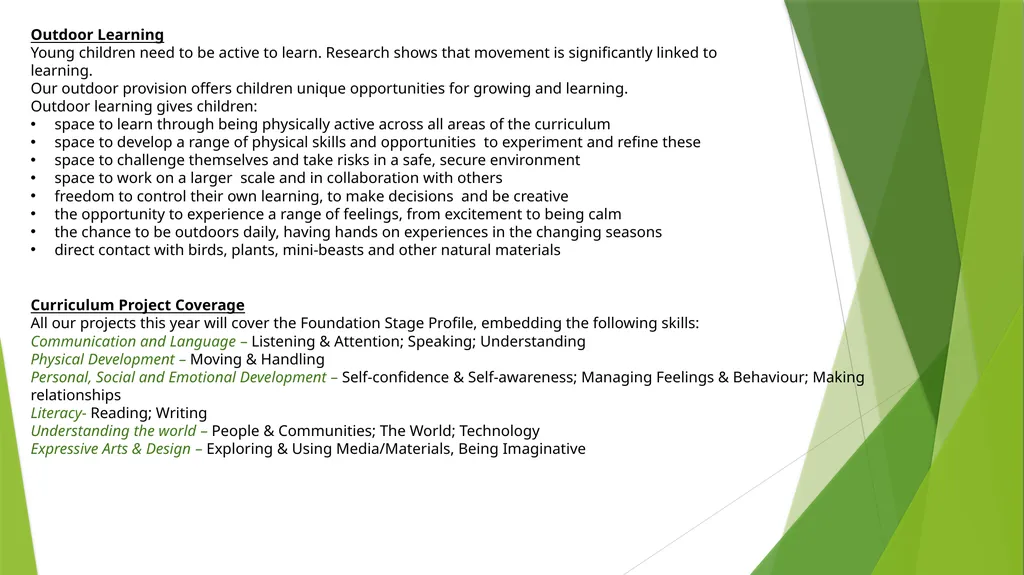
Outdoor Learning
Young children need to be active to learn. Research shows that movement is significantly linked to learning.
Our outdoor provision offers children unique opportunities for growing and learning.
Outdoor learning gives children:
space to learn through being physically active across all areas of the curriculum
space to develop a range of physical skills and opportunities to experiment and refine these
space to challenge themselves and take risks in a safe, secure environment
space to work on a larger scale and in collaboration with others
freedom to control their own learning, to make decisions and be creative
the opportunity to experience a range of feelings, from excitement to being calm
the chance to be outdoors daily, having hands on experiences in the changing seasons
direct contact with birds, plants, mini-beasts and other natural materials Curriculum Project Coverage
All our projects this year will cover the Foundation Stage Profile, embedding the following skills:
Communication and Language – Listening & Attention; Speaking; Understanding
Physical Development – Moving & Handling
Personal, Social and Emotional Development – Self-confidence & Self-awareness; Managing Feelings & Behaviour; Making relationships
Literacy- Reading; Writing
Understanding the world – People & Communities; The World; Technology
Expressive Arts & Design – Exploring & Using Media/Materials, Being Imaginative<br>
Young children need to be active to learn. Research shows that movement is significantly linked to learning.
Our outdoor provision offers children unique opportunities for growing and learning.
Outdoor learning gives children:
space to learn through being physically active across all areas of the curriculum
space to develop a range of physical skills and opportunities to experiment and refine these
space to challenge themselves and take risks in a safe, secure environment
space to work on a larger scale and in collaboration with others
freedom to control their own learning, to make decisions and be creative
the opportunity to experience a range of feelings, from excitement to being calm
the chance to be outdoors daily, having hands on experiences in the changing seasons
direct contact with birds, plants, mini-beasts and other natural materials Curriculum Project Coverage
All our projects this year will cover the Foundation Stage Profile, embedding the following skills:
Communication and Language – Listening & Attention; Speaking; Understanding
Physical Development – Moving & Handling
Personal, Social and Emotional Development – Self-confidence & Self-awareness; Managing Feelings & Behaviour; Making relationships
Literacy- Reading; Writing
Understanding the world – People & Communities; The World; Technology
Expressive Arts & Design – Exploring & Using Media/Materials, Being Imaginative<br>
06
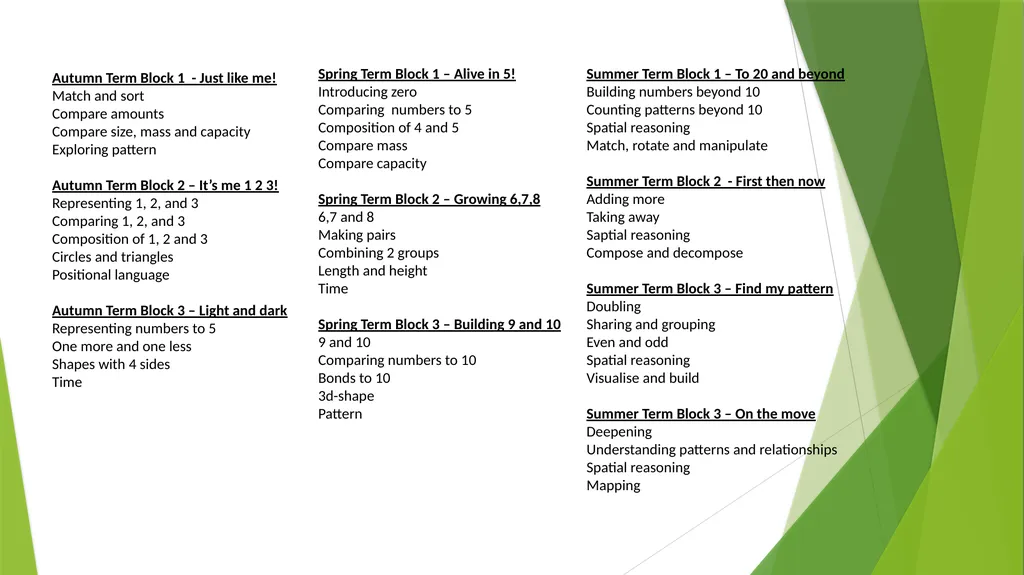
Autumn Term Block 1 - Just like me!
Match and sort
Compare amounts
Compare size, mass and capacity
Exploring pattern
Autumn Term Block 2 – It’s me 1 2 3!
Representing 1, 2, and 3
Comparing 1, 2, and 3
Composition of 1, 2 and 3
Circles and triangles
Positional language
Autumn Term Block 3 – Light and dark
Representing numbers to 5
One more and one less
Shapes with 4 sides
Time Spring Term Block 1 – Alive in 5!
Introducing zero
Comparing numbers to 5
Composition of 4 and 5
Compare mass
Compare capacity
Spring Term Block 2 – Growing 6,7,8
6,7 and 8
Making pairs
Combining 2 groups
Length and height
Time
Spring Term Block 3 – Building 9 and 10
9 and 10
Comparing numbers to 10
Bonds to 10
3d-shape
Pattern Summer Term Block 1 – To 20 and beyond
Building numbers beyond 10
Counting patterns beyond 10
Spatial reasoning
Match, rotate and manipulate
Summer Term Block 2 - First then now
Adding more
Taking away
Saptial reasoning
Compose and decompose
Summer Term Block 3 – Find my pattern
Doubling
Sharing and grouping
Even and odd
Spatial reasoning
Visualise and build
Summer Term Block 3 – On the move
Deepening
Understanding patterns and relationships
Spatial reasoning
Mapping<br>
Match and sort
Compare amounts
Compare size, mass and capacity
Exploring pattern
Autumn Term Block 2 – It’s me 1 2 3!
Representing 1, 2, and 3
Comparing 1, 2, and 3
Composition of 1, 2 and 3
Circles and triangles
Positional language
Autumn Term Block 3 – Light and dark
Representing numbers to 5
One more and one less
Shapes with 4 sides
Time Spring Term Block 1 – Alive in 5!
Introducing zero
Comparing numbers to 5
Composition of 4 and 5
Compare mass
Compare capacity
Spring Term Block 2 – Growing 6,7,8
6,7 and 8
Making pairs
Combining 2 groups
Length and height
Time
Spring Term Block 3 – Building 9 and 10
9 and 10
Comparing numbers to 10
Bonds to 10
3d-shape
Pattern Summer Term Block 1 – To 20 and beyond
Building numbers beyond 10
Counting patterns beyond 10
Spatial reasoning
Match, rotate and manipulate
Summer Term Block 2 - First then now
Adding more
Taking away
Saptial reasoning
Compose and decompose
Summer Term Block 3 – Find my pattern
Doubling
Sharing and grouping
Even and odd
Spatial reasoning
Visualise and build
Summer Term Block 3 – On the move
Deepening
Understanding patterns and relationships
Spatial reasoning
Mapping<br>
07
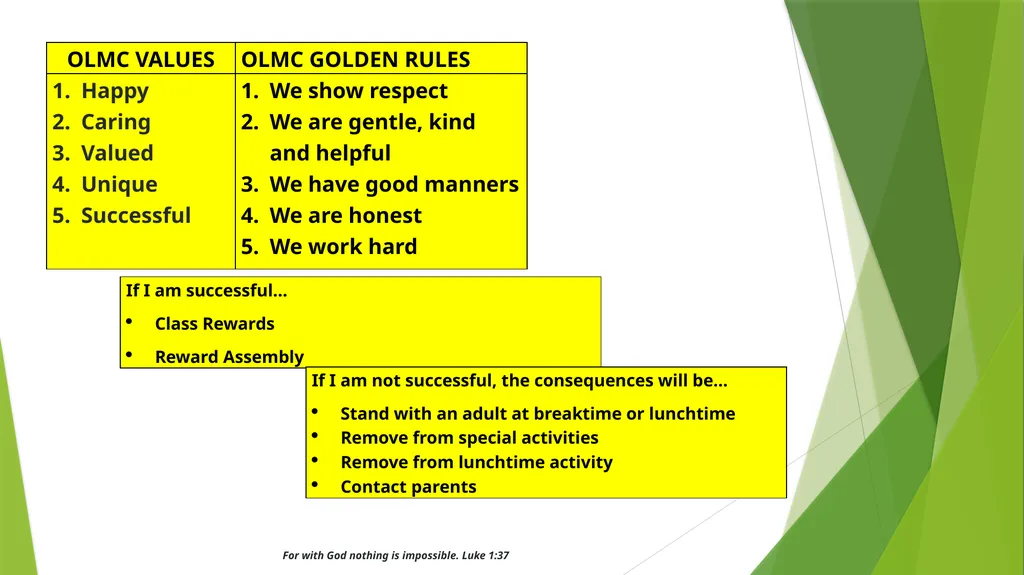
For with God nothing is impossible. Luke 1:37<br>