
“Reconcilable Differences” Beyond minimum legal
DP
Published · 48 slides · 0 views
1 / 1



Description
Reconcilable Differences Beyond minimum legal consultation and accommodation requirements for First Nations James Tate Ratcliff Co . LLP Lana Lowe Director of Lands, Fort Nelson First Nation Huy chexw a
Related Topics
Share
Embed code
Download this presentation From Below
"“Reconcilable Differences” Beyond minimum legal" is the property of its rightful owner. Permission is granted to download and print the materials on this website for personal, non-commercial use only, and to display it on your personal computer provided you do not modify the materials and that you retain all copyright notices contained in the materials. By downloading content from our website, you accept the terms of this agreement.
Presentation Transcript
01
“Reconcilable Differences”
Beyond minimum legal consultation and accommodation requirements for First Nations
_________________________________ James Tate
Ratcliff & Co . LLP Lana Lowe
Director of Lands,
Fort Nelson First Nation<br>
_________________________________ James Tate
Ratcliff & Co . LLP Lana Lowe
Director of Lands,
Fort Nelson First Nation<br>
02
Huy chexw a We recognize that our presentation today is happening on the unceded territory of the Coast Salish people: The Squamish, Musqueam, and Tsleil-Waututh Nations;
From a Dene perspective it is a recognition of the Nations’ jurisdiction and authority in regards to their territories.<br>
From a Dene perspective it is a recognition of the Nations’ jurisdiction and authority in regards to their territories.<br>
03
Objectives 1) For those Tribunals tasked with assessing the Duty to Consult and Accommodate – looking at “Hallmarks of Honour” for Crown Consultation processes as well as Dene legal perspectives;
2) Where First Nations are before Tribunals in various roles, looking at practices (based on FNFN experience) that result in access, better evidence, and better decisions.<br>
2) Where First Nations are before Tribunals in various roles, looking at practices (based on FNFN experience) that result in access, better evidence, and better decisions.<br>
04
The Duty to Consult and Accommodate “Since this Court’s landmark decision in Haida Nation v. British Columbia (Minister of Forests), 2004 SCC 73, …, the duty to consult has played a critical role in ensuring that Aboriginal and treaty rights receive meaningful protection.
Grounded in the honour of the Crown, this duty requires the Crown to consult (and if appropriate, accommodate) Aboriginal peoples before taking action that may adversely affect their asserted or established rights under s. 35 of the Constitution Act, 1982….”
Mikisew Cree First Nation v. Canada (Governor General in Council), 2018 SCC 40, (“Mikisew”) at para 1.<br>
Grounded in the honour of the Crown, this duty requires the Crown to consult (and if appropriate, accommodate) Aboriginal peoples before taking action that may adversely affect their asserted or established rights under s. 35 of the Constitution Act, 1982….”
Mikisew Cree First Nation v. Canada (Governor General in Council), 2018 SCC 40, (“Mikisew”) at para 1.<br>
05
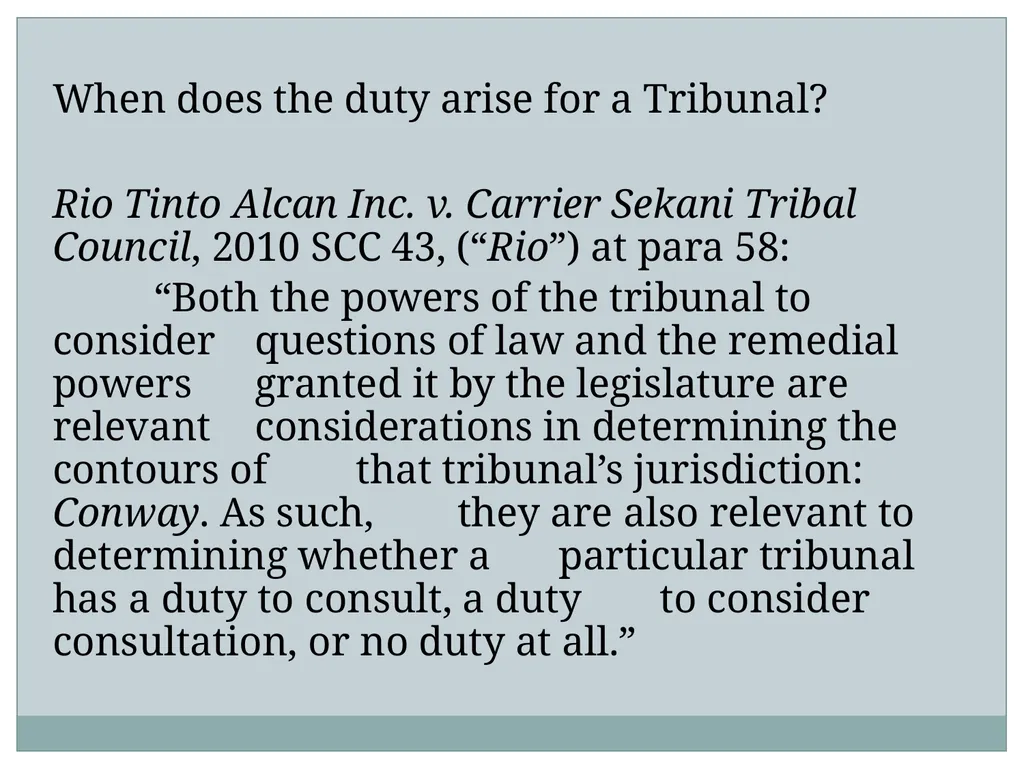
When does the duty arise for a Tribunal?
Rio Tinto Alcan Inc. v. Carrier Sekani Tribal Council, 2010 SCC 43, (“Rio”) at para 58:
“Both the powers of the tribunal to consider questions of law and the remedial powers granted it by the legislature are relevant considerations in determining the contours of that tribunal’s jurisdiction: Conway. As such, they are also relevant to determining whether a particular tribunal has a duty to consult, a duty to consider consultation, or no duty at all.”<br>
Rio Tinto Alcan Inc. v. Carrier Sekani Tribal Council, 2010 SCC 43, (“Rio”) at para 58:
“Both the powers of the tribunal to consider questions of law and the remedial powers granted it by the legislature are relevant considerations in determining the contours of that tribunal’s jurisdiction: Conway. As such, they are also relevant to determining whether a particular tribunal has a duty to consult, a duty to consider consultation, or no duty at all.”<br>
06
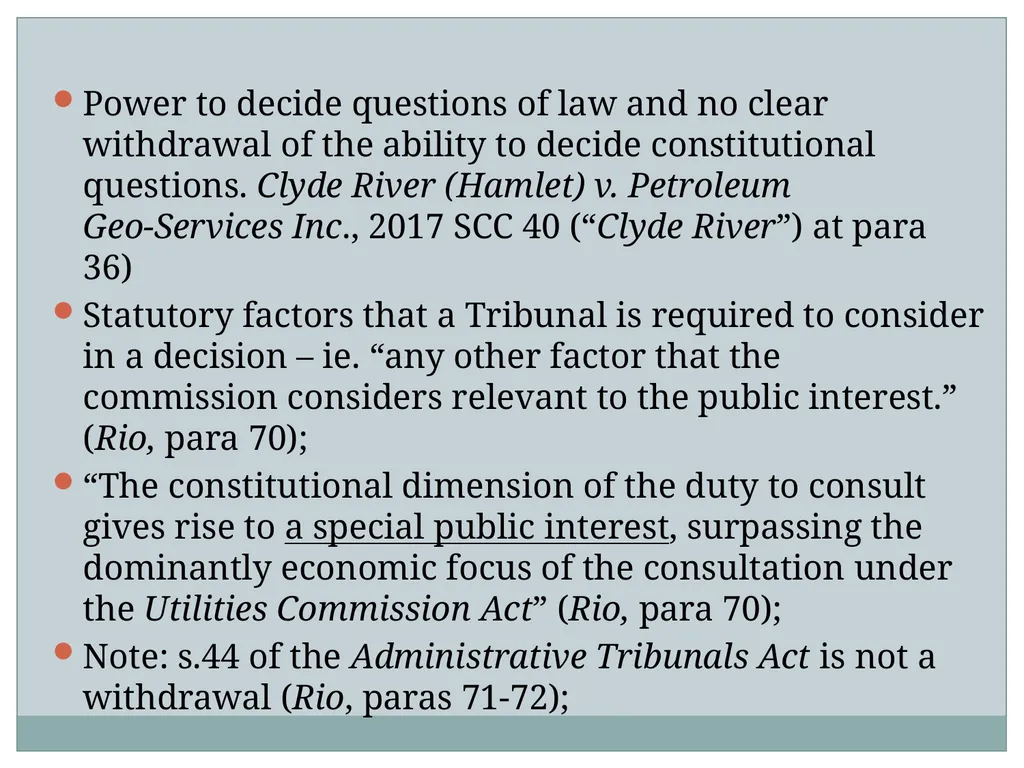
Power to decide questions of law and no clear withdrawal of the ability to decide constitutional questions. Clyde River (Hamlet) v. Petroleum Geo‑Services Inc., 2017 SCC 40 (“Clyde River”) at para 36)
Statutory factors that a Tribunal is required to consider in a decision – ie. “any other factor that the commission considers relevant to the public interest.” (Rio, para 70);
“The constitutional dimension of the duty to consult gives rise to a special public interest, surpassing the dominantly economic focus of the consultation under the Utilities Commission Act” (Rio, para 70);
Note: s.44 of the Administrative Tribunals Act is not a withdrawal (Rio, paras 71-72);<br>
Statutory factors that a Tribunal is required to consider in a decision – ie. “any other factor that the commission considers relevant to the public interest.” (Rio, para 70);
“The constitutional dimension of the duty to consult gives rise to a special public interest, surpassing the dominantly economic focus of the consultation under the Utilities Commission Act” (Rio, para 70);
Note: s.44 of the Administrative Tribunals Act is not a withdrawal (Rio, paras 71-72);<br>
07
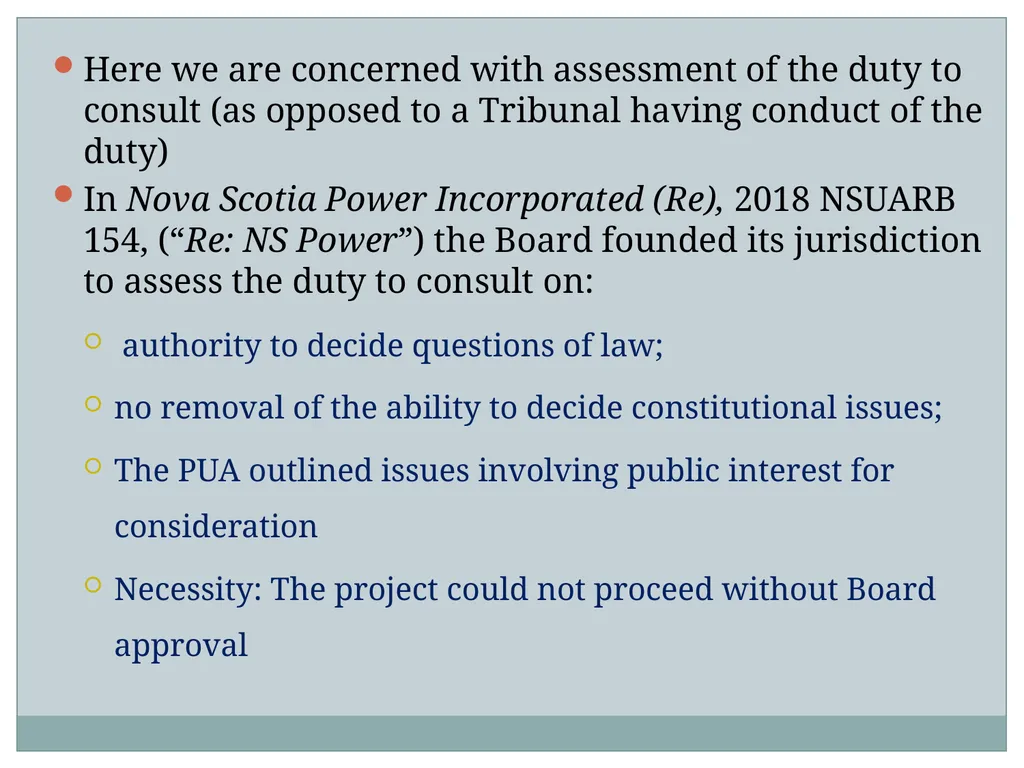
Here we are concerned with assessment of the duty to consult (as opposed to a Tribunal having conduct of the duty)
In Nova Scotia Power Incorporated (Re), 2018 NSUARB 154, (“Re: NS Power”) the Board founded its jurisdiction to assess the duty to consult on:
authority to decide questions of law;
no removal of the ability to decide constitutional issues;
The PUA outlined issues involving public interest for consideration
Necessity: The project could not proceed without Board approval<br>
In Nova Scotia Power Incorporated (Re), 2018 NSUARB 154, (“Re: NS Power”) the Board founded its jurisdiction to assess the duty to consult on:
authority to decide questions of law;
no removal of the ability to decide constitutional issues;
The PUA outlined issues involving public interest for consideration
Necessity: The project could not proceed without Board approval<br>
08
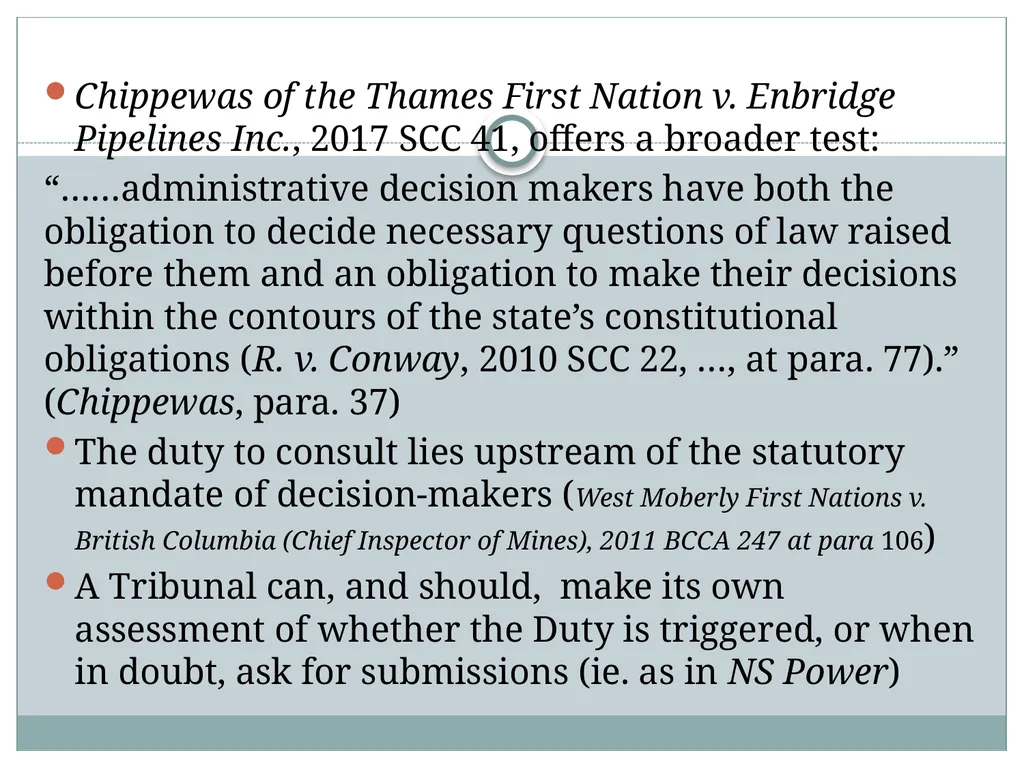
Chippewas of the Thames First Nation v. Enbridge Pipelines Inc., 2017 SCC 41, offers a broader test:
“……administrative decision makers have both the obligation to decide necessary questions of law raised before them and an obligation to make their decisions within the contours of the state’s constitutional obligations (R. v. Conway, 2010 SCC 22, …, at para. 77).” (Chippewas, para. 37)
The duty to consult lies upstream of the statutory mandate of decision-makers (West Moberly First Nations v. British Columbia (Chief Inspector of Mines), 2011 BCCA 247 at para 106)
A Tribunal can, and should, make its own assessment of whether the Duty is triggered, or when in doubt, ask for submissions (ie. as in NS Power)<br>
“……administrative decision makers have both the obligation to decide necessary questions of law raised before them and an obligation to make their decisions within the contours of the state’s constitutional obligations (R. v. Conway, 2010 SCC 22, …, at para. 77).” (Chippewas, para. 37)
The duty to consult lies upstream of the statutory mandate of decision-makers (West Moberly First Nations v. British Columbia (Chief Inspector of Mines), 2011 BCCA 247 at para 106)
A Tribunal can, and should, make its own assessment of whether the Duty is triggered, or when in doubt, ask for submissions (ie. as in NS Power)<br>
09
“Hallmarks of Honour” Haida Nation v. British Columbia (Minister of Forests), 2004 SCC 73, (“Haida”) at para 45:
The “controlling question in all situations is what is required to maintain the honour of the Crown and to effect reconciliation between the Crown and the Aboriginal peoples with respect to the interests at stake”<br>
The “controlling question in all situations is what is required to maintain the honour of the Crown and to effect reconciliation between the Crown and the Aboriginal peoples with respect to the interests at stake”<br>
10
“The Honour of the Crown” “
Mikisew at para. 24 [citations omitted]
“As this Court stated in Haida Nation, the honour of the Crown “is not a mere incantation, but rather a core precept that finds its application in concrete practices” and “gives rise to different duties in different circumstances”. When engaged, it imposes “a heavy obligation” on the Crown. Indeed, because of the close relationship between the honour of the Crown and s. 35, the honour of the Crown has been described as a “constitutional principle”. That said, this Court has made clear that the duties that flow from the honour of the Crown will vary with the situations in which it is engaged. Determining what constitutes honourable dealing, and what specific obligations are imposed by the honour of the Crown, depends heavily on the circumstances.”<br>
Mikisew at para. 24 [citations omitted]
“As this Court stated in Haida Nation, the honour of the Crown “is not a mere incantation, but rather a core precept that finds its application in concrete practices” and “gives rise to different duties in different circumstances”. When engaged, it imposes “a heavy obligation” on the Crown. Indeed, because of the close relationship between the honour of the Crown and s. 35, the honour of the Crown has been described as a “constitutional principle”. That said, this Court has made clear that the duties that flow from the honour of the Crown will vary with the situations in which it is engaged. Determining what constitutes honourable dealing, and what specific obligations are imposed by the honour of the Crown, depends heavily on the circumstances.”<br>
11
Hallmarks of Honour Honourable Process
Transparency: “The Crown’s duty is to carry on a process that is as transparent as possible.” Ke-Kin-Is-Uqs v. British Columbia (Minister of Forests), 2008 BCSC 1505 at para 147.
Flexibility: Meaningful, good faith consultation requires willingness on the Crown to make changes based upon information that emerges during the consultation process (Taku River Tlingit First Nation v. British Columbia (Project Assessment Director), 2004 SCC 74, at para 29).<br>
Transparency: “The Crown’s duty is to carry on a process that is as transparent as possible.” Ke-Kin-Is-Uqs v. British Columbia (Minister of Forests), 2008 BCSC 1505 at para 147.
Flexibility: Meaningful, good faith consultation requires willingness on the Crown to make changes based upon information that emerges during the consultation process (Taku River Tlingit First Nation v. British Columbia (Project Assessment Director), 2004 SCC 74, at para 29).<br>
12
Delegation:
Delegation: If the Crown intends to rely on the delegation of some procedural aspects of consultation to a proponent there must be explicit delegation by the crown which is understood by the First Nation (Re: NS power at para. 151).
Delegation can’t happen by accident (Gale v. BC and Nexen, 2012-WAT-013(c), (“FNFN v BC and Nexen”) at para 447:
“ Also, Nexen’s role in the consultation process was never clearly addressed. Although the Crown may delegate procedural aspects of consultation to industry proponents (Haida, at para. 53), the evidence of the parties’ communications during the consultation process does not indicate, expressly or impliedly, a clear intention by the Ministry to delegate any aspects of the process to Nexen”.<br>
Delegation: If the Crown intends to rely on the delegation of some procedural aspects of consultation to a proponent there must be explicit delegation by the crown which is understood by the First Nation (Re: NS power at para. 151).
Delegation can’t happen by accident (Gale v. BC and Nexen, 2012-WAT-013(c), (“FNFN v BC and Nexen”) at para 447:
“ Also, Nexen’s role in the consultation process was never clearly addressed. Although the Crown may delegate procedural aspects of consultation to industry proponents (Haida, at para. 53), the evidence of the parties’ communications during the consultation process does not indicate, expressly or impliedly, a clear intention by the Ministry to delegate any aspects of the process to Nexen”.<br>
13
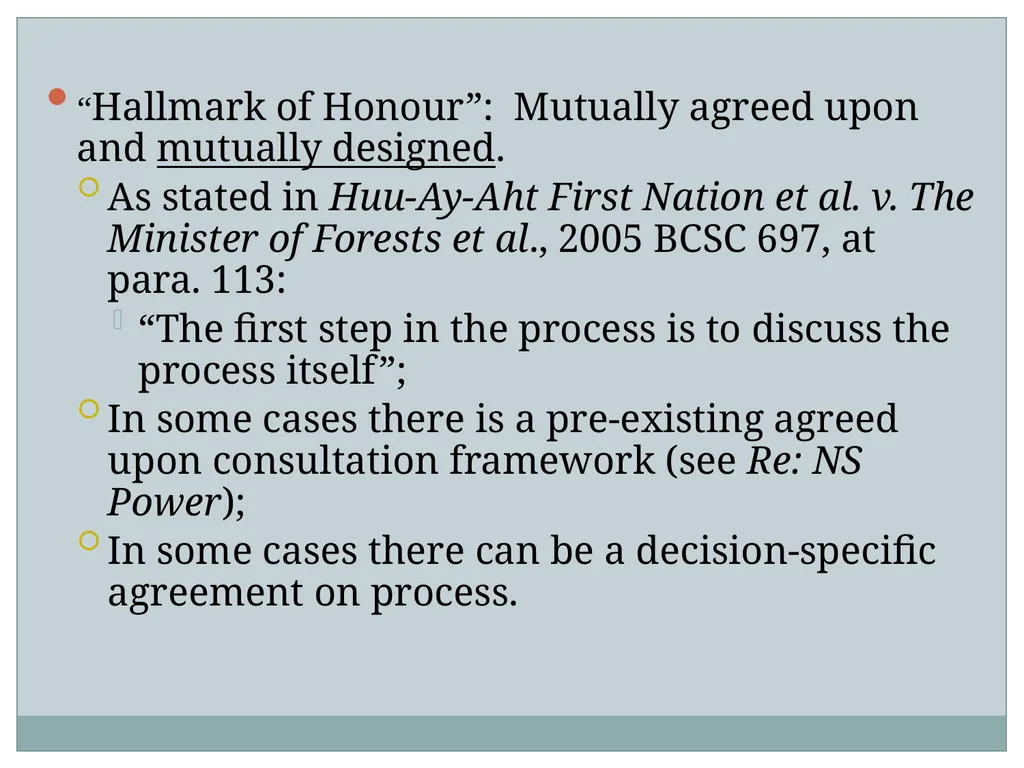
“Hallmark of Honour”: Mutually agreed upon and mutually designed.
As stated in Huu-Ay-Aht First Nation et al. v. The Minister of Forests et al., 2005 BCSC 697, at para. 113:
“The first step in the process is to discuss the process itself”;
In some cases there is a pre-existing agreed upon consultation framework (see Re: NS Power);
In some cases there can be a decision-specific agreement on process.<br>
As stated in Huu-Ay-Aht First Nation et al. v. The Minister of Forests et al., 2005 BCSC 697, at para. 113:
“The first step in the process is to discuss the process itself”;
In some cases there is a pre-existing agreed upon consultation framework (see Re: NS Power);
In some cases there can be a decision-specific agreement on process.<br>
14
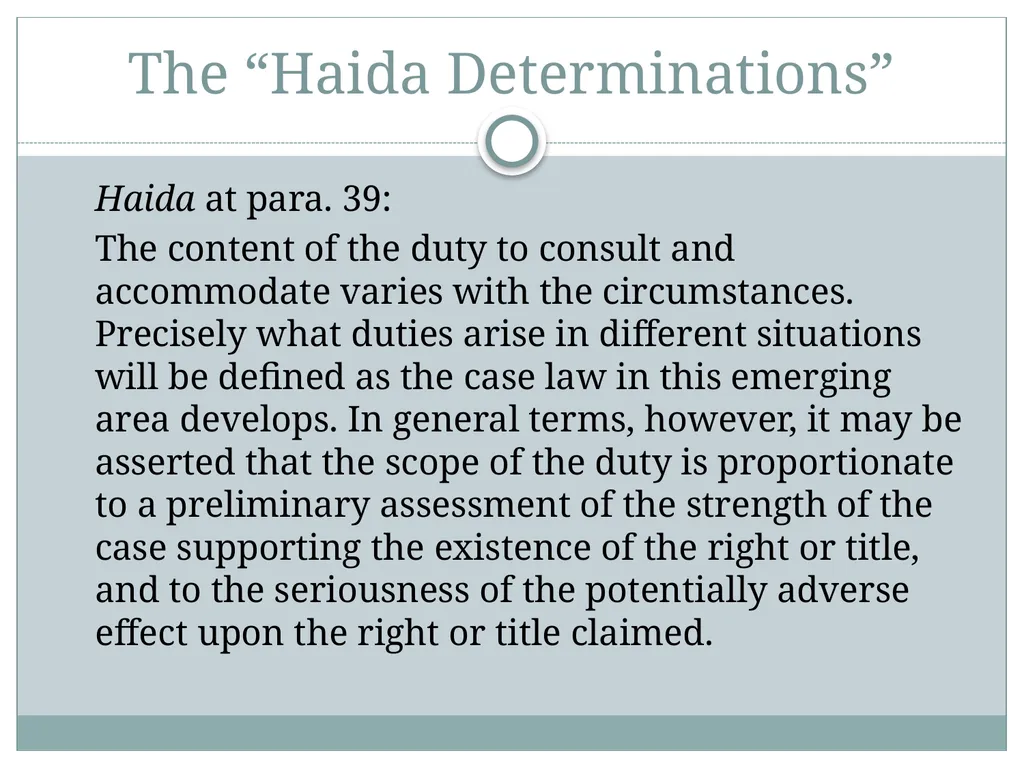
The “Haida Determinations” Haida at para. 39:
The content of the duty to consult and accommodate varies with the circumstances. Precisely what duties arise in different situations will be defined as the case law in this emerging area develops. In general terms, however, it may be asserted that the scope of the duty is proportionate to a preliminary assessment of the strength of the case supporting the existence of the right or title, and to the seriousness of the potentially adverse effect upon the right or title claimed.<br>
The content of the duty to consult and accommodate varies with the circumstances. Precisely what duties arise in different situations will be defined as the case law in this emerging area develops. In general terms, however, it may be asserted that the scope of the duty is proportionate to a preliminary assessment of the strength of the case supporting the existence of the right or title, and to the seriousness of the potentially adverse effect upon the right or title claimed.<br>
15
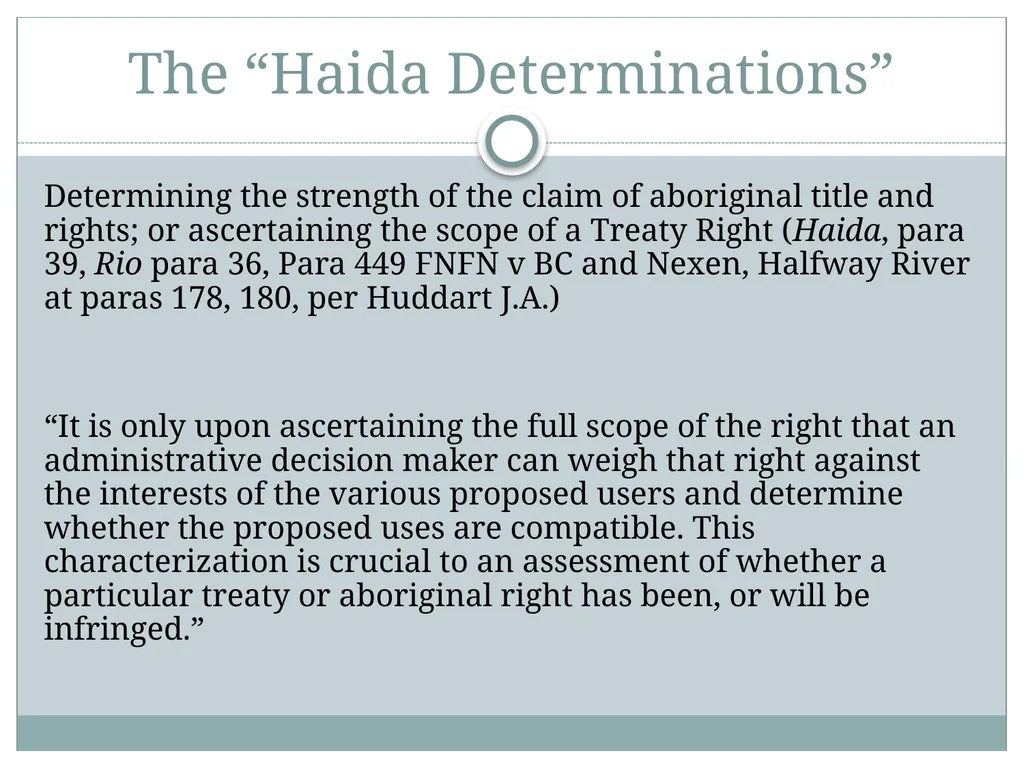
The “Haida Determinations” Determining the strength of the claim of aboriginal title and rights; or ascertaining the scope of a Treaty Right (Haida, para 39, Rio para 36, Para 449 FNFN v BC and Nexen, Halfway River at paras 178, 180, per Huddart J.A.)
“It is only upon ascertaining the full scope of the right that an administrative decision maker can weigh that right against the interests of the various proposed users and determine whether the proposed uses are compatible. This characterization is crucial to an assessment of whether a particular treaty or aboriginal right has been, or will be infringed.”<br>
“It is only upon ascertaining the full scope of the right that an administrative decision maker can weigh that right against the interests of the various proposed users and determine whether the proposed uses are compatible. This characterization is crucial to an assessment of whether a particular treaty or aboriginal right has been, or will be infringed.”<br>
16
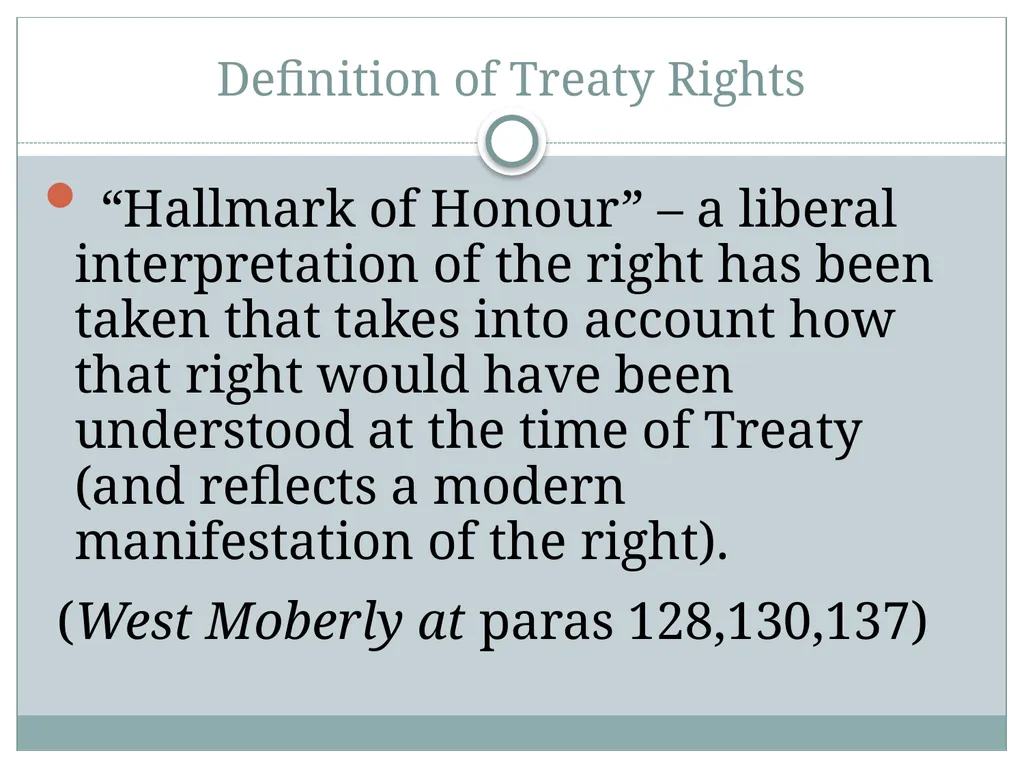
Definition of Treaty Rights “Hallmark of Honour” – a liberal interpretation of the right has been taken that takes into account how that right would have been understood at the time of Treaty (and reflects a modern manifestation of the right).
(West Moberly at paras 128,130,137)<br>
(West Moberly at paras 128,130,137)<br>
17
Example: Definition of Treaty Rights Narrow:
A requirement to show a limited site specific exercise of the right to hunt, fish or trap.
Liberal:
“guarantees of “continuity in traditional patterns of economic activity” and respect for “traditional patterns of activity and occupation” based on promises of Treaty Commissioners that “the same means of earning a livelihood would continue after the Treaty as existed before it” (West Moberly paras 130, 137).<br>
A requirement to show a limited site specific exercise of the right to hunt, fish or trap.
Liberal:
“guarantees of “continuity in traditional patterns of economic activity” and respect for “traditional patterns of activity and occupation” based on promises of Treaty Commissioners that “the same means of earning a livelihood would continue after the Treaty as existed before it” (West Moberly paras 130, 137).<br>
18
Dene Understanding of Treaty Rights The Crown characterizes Treaty No. 8 as a land surrender agreement, thereby assuming expansive and exclusive authority over treaty lands and resources;
The Crown’s declaration of exclusive jurisdiction over Treaty lands remains unchallenged in Canadian law;
The FNFN explicitly rejects this characterization of Treaty No. 8 and offers a counter-perspective:<br>
The Crown’s declaration of exclusive jurisdiction over Treaty lands remains unchallenged in Canadian law;
The FNFN explicitly rejects this characterization of Treaty No. 8 and offers a counter-perspective:<br>
19
Dene Understanding of Treaty Rights “Treaty 8 is not a surrender of lands, rights or responsibilities. It was signed in the spirit of peace and sharing, with respect to our own understandings of and connections to the lands of our territory. We have a commitment and an obligation to protect our rights, lands, animals, waters, and people for future generations. Part of protecting and respecting our treaty rights is by managing our environment and resources our way.”
"Our Voice—Our Vision," in Reaching for Our Vision (Fort Nelson First Nation: 2015), 15.<br>
"Our Voice—Our Vision," in Reaching for Our Vision (Fort Nelson First Nation: 2015), 15.<br>
20
Dene Understanding of Treaty Rights Treaty rights and obligations are about relationships between peoples and human relationships to the land;
The Treaty is an affirmation and recognition of our distinct relationship (legal rights and obligations) to the land as well as the legal rights and obligations between treaty partners.<br>
The Treaty is an affirmation and recognition of our distinct relationship (legal rights and obligations) to the land as well as the legal rights and obligations between treaty partners.<br>
21
Dene Understanding of Treaty Rights Deficiencies in Crown consultation processes stem from the disagreement regarding the nature of the legal rights, responsibilities and jurisdiction within the treaty relationship;
Where the Crown and its courts see a surrender of rights to the land, the FNFN sees an affirmation;
We need to get beyond Canadian common law and recognize the multi-juridical nature of the Treaty relationship.<br>
Where the Crown and its courts see a surrender of rights to the land, the FNFN sees an affirmation;
We need to get beyond Canadian common law and recognize the multi-juridical nature of the Treaty relationship.<br>
22
The “Haida Determinations” 2) Potential for adverse effects on rights
Potential is enough (FNFN v. BC and Nexen para 436);
This assessment is a foundational component (unlike in Tsleil-watauth where Canada made a conclusion on impact 2 weeks prior to the conclusion of consultation – paras 638 - 647)
Assessing environmental impacts is not a proxy for assessing impacts on title, aboriginal rights or treaty rights (Clyde River, paras 45, 51);
“The Board was required to focus on the Inuit’s treaty rights; the “consultative inquiry is not properly into environmental effects per se. Rather, it inquires into the impact on the right”.<br>
Potential is enough (FNFN v. BC and Nexen para 436);
This assessment is a foundational component (unlike in Tsleil-watauth where Canada made a conclusion on impact 2 weeks prior to the conclusion of consultation – paras 638 - 647)
Assessing environmental impacts is not a proxy for assessing impacts on title, aboriginal rights or treaty rights (Clyde River, paras 45, 51);
“The Board was required to focus on the Inuit’s treaty rights; the “consultative inquiry is not properly into environmental effects per se. Rather, it inquires into the impact on the right”.<br>
23
Strategic Higher Level Decisions The duty to consult extends to “strategic, higher level decisions” that may have an impact on Aboriginal claims and rights (Rio, para 44)
For example in the case of the BCUC : “…….the conduct of a comprehensive inquiry to determine a province’s infrastructure and capacity needs for electricity transmission”.<br>
For example in the case of the BCUC : “…….the conduct of a comprehensive inquiry to determine a province’s infrastructure and capacity needs for electricity transmission”.<br>
24
Context and Existing Conditions
(The “Thin Skull Rule” for Aboriginal Rights) Tsleil-Waututh Nation v. Canada (Attorney General), 2018 FCA 153, at para 505:
“When consulting on a project’s potential impacts the Crown must consider existing limitations on Indigenous rights. Therefore, the cumulative effects and historical context may inform the scope of the duty to consult. ([Chippewas], para. 42)”
West Moberly at 119:
“To take those matters into consideration as within the scope of the duty to consult, is not to attempt the redress of past wrongs. Rather, it is simply to recognize an existing state of affairs, and to address the consequences of what may result from pursuit of the exploration programs.”<br>
“When consulting on a project’s potential impacts the Crown must consider existing limitations on Indigenous rights. Therefore, the cumulative effects and historical context may inform the scope of the duty to consult. ([Chippewas], para. 42)”
West Moberly at 119:
“To take those matters into consideration as within the scope of the duty to consult, is not to attempt the redress of past wrongs. Rather, it is simply to recognize an existing state of affairs, and to address the consequences of what may result from pursuit of the exploration programs.”<br>
25
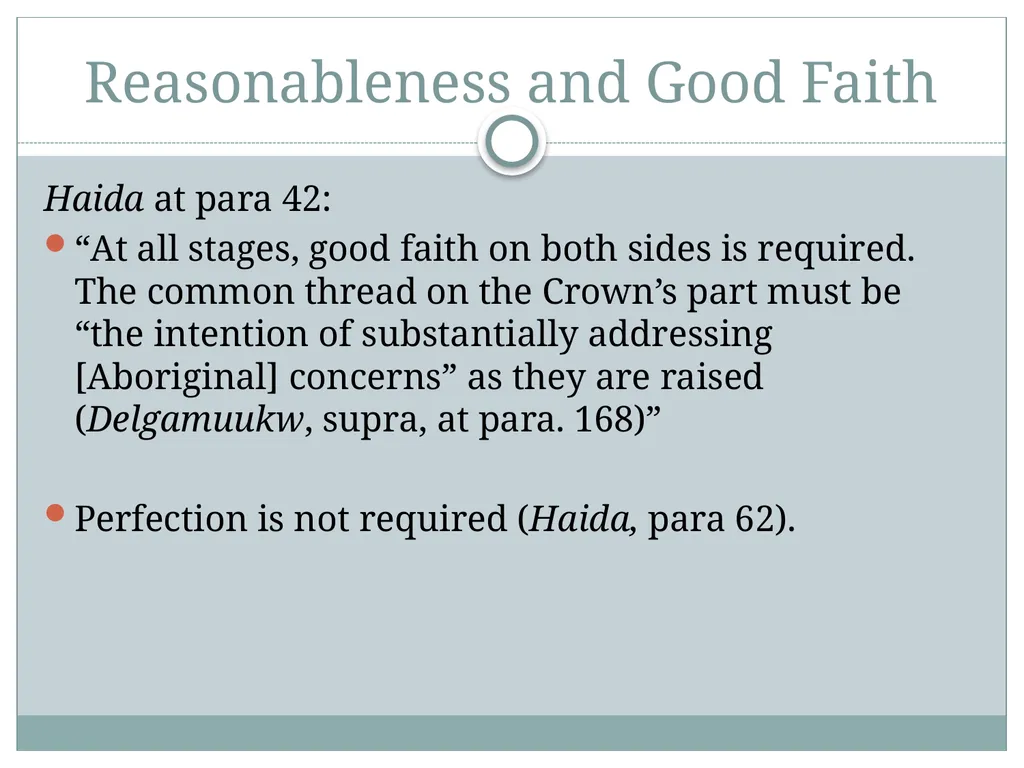
Reasonableness and Good Faith Haida at para 42:
“At all stages, good faith on both sides is required. The common thread on the Crown’s part must be “the intention of substantially addressing [Aboriginal] concerns” as they are raised (Delgamuukw, supra, at para. 168)”
Perfection is not required (Haida, para 62).<br>
“At all stages, good faith on both sides is required. The common thread on the Crown’s part must be “the intention of substantially addressing [Aboriginal] concerns” as they are raised (Delgamuukw, supra, at para. 168)”
Perfection is not required (Haida, para 62).<br>
26
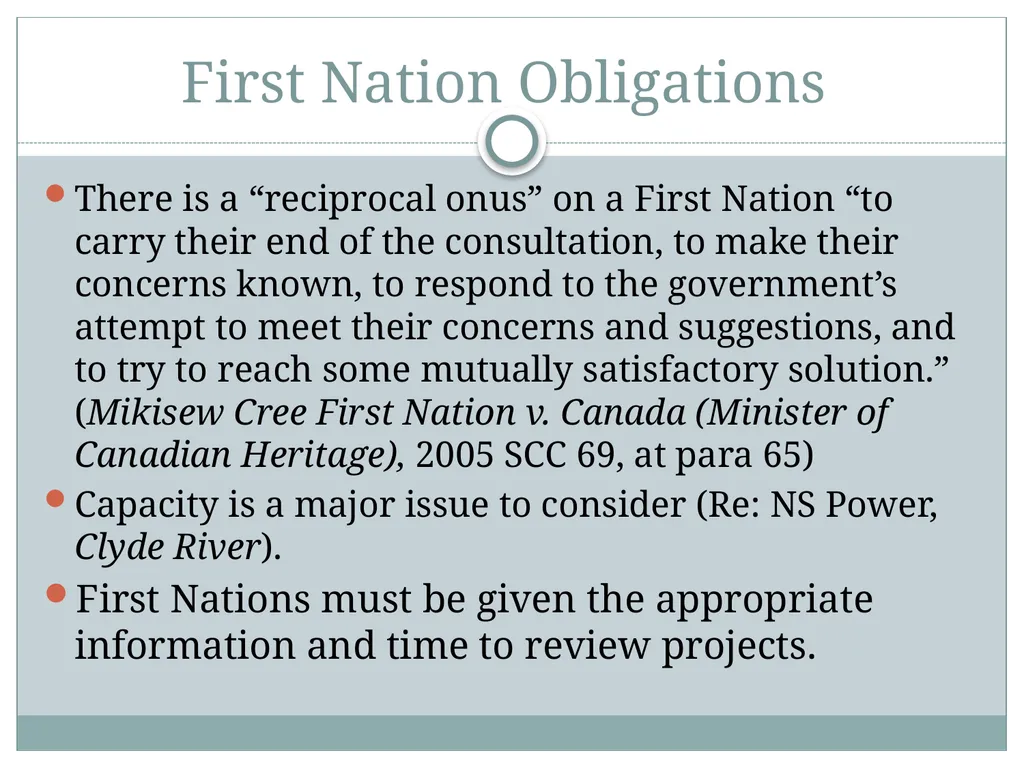
First Nation Obligations There is a “reciprocal onus” on a First Nation “to carry their end of the consultation, to make their concerns known, to respond to the government’s attempt to meet their concerns and suggestions, and to try to reach some mutually satisfactory solution.” (Mikisew Cree First Nation v. Canada (Minister of Canadian Heritage), 2005 SCC 69, at para 65)
Capacity is a major issue to consider (Re: NS Power, Clyde River).
First Nations must be given the appropriate information and time to review projects.<br>
Capacity is a major issue to consider (Re: NS Power, Clyde River).
First Nations must be given the appropriate information and time to review projects.<br>
27
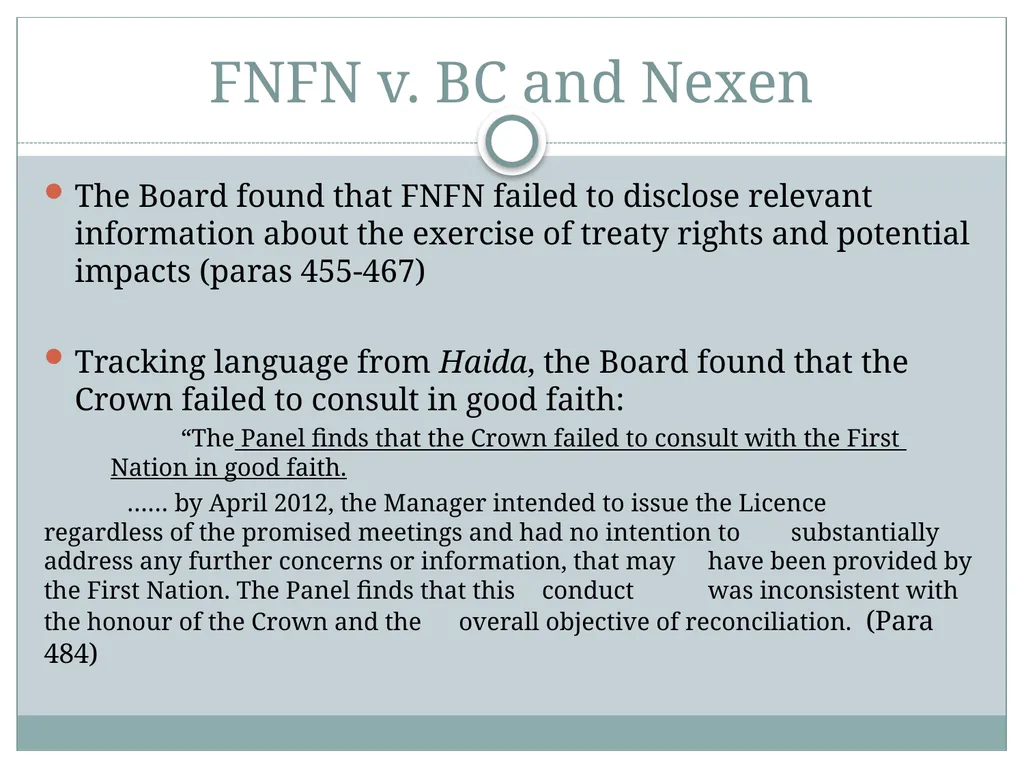
FNFN v. BC and Nexen The Board found that FNFN failed to disclose relevant information about the exercise of treaty rights and potential impacts (paras 455-467)
Tracking language from Haida, the Board found that the Crown failed to consult in good faith:
“The Panel finds that the Crown failed to consult with the First Nation in good faith.
…… by April 2012, the Manager intended to issue the Licence regardless of the promised meetings and had no intention to substantially address any further concerns or information, that may have been provided by the First Nation. The Panel finds that this conduct was inconsistent with the honour of the Crown and the overall objective of reconciliation. (Para 484)<br>
Tracking language from Haida, the Board found that the Crown failed to consult in good faith:
“The Panel finds that the Crown failed to consult with the First Nation in good faith.
…… by April 2012, the Manager intended to issue the Licence regardless of the promised meetings and had no intention to substantially address any further concerns or information, that may have been provided by the First Nation. The Panel finds that this conduct was inconsistent with the honour of the Crown and the overall objective of reconciliation. (Para 484)<br>
28
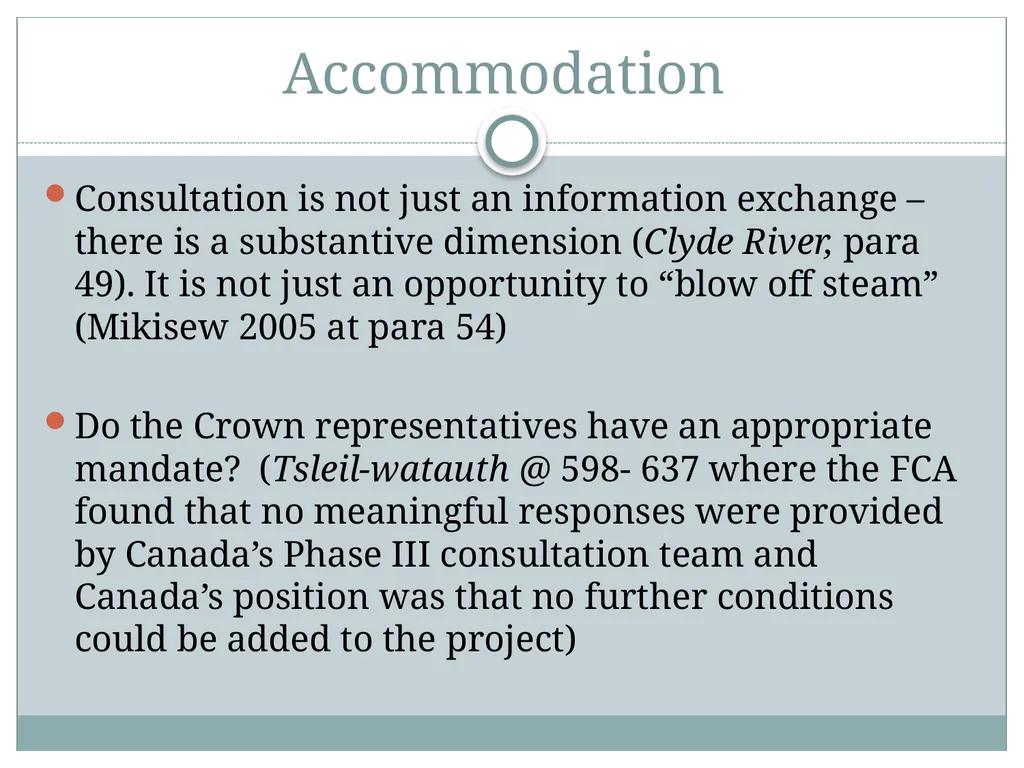
Accommodation Consultation is not just an information exchange – there is a substantive dimension (Clyde River, para 49). It is not just an opportunity to “blow off steam” (Mikisew 2005 at para 54)
Do the Crown representatives have an appropriate mandate? (Tsleil-watauth @ 598- 637 where the FCA found that no meaningful responses were provided by Canada’s Phase III consultation team and Canada’s position was that no further conditions could be added to the project)<br>
Do the Crown representatives have an appropriate mandate? (Tsleil-watauth @ 598- 637 where the FCA found that no meaningful responses were provided by Canada’s Phase III consultation team and Canada’s position was that no further conditions could be added to the project)<br>
29
Accommodation Even at the low end of the consultation spectrum the Crown is required to provide notice, solicit concerns, listen carefully and attempt to minimize adverse impacts (Mikisew 2005 at para 64 – citing Halfway River BCCA at paras 159-160 “representations are seriously considered and wherever possible demonstrably integrated into the plan of action.”
Haida, at para 47: may require taking steps to avoid irreparable harm or to minimize the effects of infringement, pending final resolution of the underlying claim.
Have appropriate “alternative scenarios” been considered and discussed with the First Nation? (Re: NS Power at para 159).<br>
Haida, at para 47: may require taking steps to avoid irreparable harm or to minimize the effects of infringement, pending final resolution of the underlying claim.
Have appropriate “alternative scenarios” been considered and discussed with the First Nation? (Re: NS Power at para 159).<br>
30
Case Study: FNFN v. OGC Fort Nelson First Nation v British Columbia (Oil and Gas Commission), 2017 BCSC 2500, [2017] B.C.J. No 227
FNFN challenged OGC permits granted to construct a pipeline through a caribou “core” protection area on the basis that the OGC had artificially limited the consultation process.
FNFN asserted that in order to assess the impact of the Project on FNFN treaty rights to harvest caribou, that the OGC needed to look at the existing state of caribou population in the area as well as existing impacts on the land.<br>
FNFN challenged OGC permits granted to construct a pipeline through a caribou “core” protection area on the basis that the OGC had artificially limited the consultation process.
FNFN asserted that in order to assess the impact of the Project on FNFN treaty rights to harvest caribou, that the OGC needed to look at the existing state of caribou population in the area as well as existing impacts on the land.<br>
31
The Court found that the OGC had breached the Duty to Consult: ..the Commission was intransigent regarding its position that it would not discuss caribou health and linear density in the area, or the adequacy of the caribou management plan prepared by Rockyview or the expert report prepared for Fort Nelson First Nation (para 65 ).
when the Commission's initial response to their concerns is to tell the Fort Nelson First Nation it will not discuss them, and that the Commission is satisfied that the Project will not have a material adverse effect on the ability of wildlife within the ungulate winter range to provide for the survival of boreal caribou within it, it cannot be said that the Commission was willing to engage in consultation (para 68)
Citing West Moberly as approved by Chippewas, the Court found that the OGC had failed to consider the existing state of affairs with respect to the state of caribou in the project area (paras 37,63 and 75).<br>
when the Commission's initial response to their concerns is to tell the Fort Nelson First Nation it will not discuss them, and that the Commission is satisfied that the Project will not have a material adverse effect on the ability of wildlife within the ungulate winter range to provide for the survival of boreal caribou within it, it cannot be said that the Commission was willing to engage in consultation (para 68)
Citing West Moberly as approved by Chippewas, the Court found that the OGC had failed to consider the existing state of affairs with respect to the state of caribou in the project area (paras 37,63 and 75).<br>
32
Meaningful consultation: What should have happened from a Dene legal perspective Dene legal perspectives are evident in the body of Dene stories that have been shared, recorded and retold over thousands of years;
Accessing Dene legal traditions through a critical analysis of these stories allows us to think of Dene laws as law and apply them to contemporary issues;
A preliminary analysis of selected Dene stories reveals some general principles for inter-societal relations from within the Dene legal tradition.<br>
Accessing Dene legal traditions through a critical analysis of these stories allows us to think of Dene laws as law and apply them to contemporary issues;
A preliminary analysis of selected Dene stories reveals some general principles for inter-societal relations from within the Dene legal tradition.<br>
33
Meaningful consultation: What should have happened from a Dene legal perspective General underlying principles:
All beings are dependent on each other for survival;
Share what you have;
Help each other as much as possible;
Take care of vulnerable ones;
Be considerate of others in your interactions<br>
All beings are dependent on each other for survival;
Share what you have;
Help each other as much as possible;
Take care of vulnerable ones;
Be considerate of others in your interactions<br>
34
Meaningful consultation: What should have happened from a Dene legal perspective According to Dene legal traditions, all people have the:
Right to peaceful relations;
Right to autonomy and self-determination;
Right to participate in deliberative and transparent decision-making in matters that would affect their rights;
Right to access land and resources for survival and security;
Right to maintain and develop distinct relationships with the land;
Right to due recognition of laws, customs and protocols in their territory.<br>
Right to peaceful relations;
Right to autonomy and self-determination;
Right to participate in deliberative and transparent decision-making in matters that would affect their rights;
Right to access land and resources for survival and security;
Right to maintain and develop distinct relationships with the land;
Right to due recognition of laws, customs and protocols in their territory.<br>
35
Meaningful consultation: What should have happened from a Dene legal perspective According to Dene legal traditions, all people have an:
Obligation to share available resources, knowledge and/or power when there is a demonstrated need;
Obligation to engage in good faith and with respect to peoples’ laws and customs to gain access to resources, knowledge and/or power;
Obligation to handle knowledge and/or power with due respect when received;
Obligation to behave with due respect to peoples’ laws and customs when in their territory;
Leaders have an obligation to make peace agreements with other peoples when inter-societal conflict arises.<br>
Obligation to share available resources, knowledge and/or power when there is a demonstrated need;
Obligation to engage in good faith and with respect to peoples’ laws and customs to gain access to resources, knowledge and/or power;
Obligation to handle knowledge and/or power with due respect when received;
Obligation to behave with due respect to peoples’ laws and customs when in their territory;
Leaders have an obligation to make peace agreements with other peoples when inter-societal conflict arises.<br>
36
Meaningful consultation: What should have happened from a Dene legal perspective The Crown did not recognize the autonomy and jurisdiction of the FNFN;
The Crown refused to share resources, power and knowledge or cooperate with the FNFN;
The Crown did not accept the knowledge offered by the FNFN, even though we had much to share;
The Crown refused to engage in good faith, prolonging the conflict;
Crown leadership failed to engage with FNFN leadership toward peaceful resolution.<br>
The Crown refused to share resources, power and knowledge or cooperate with the FNFN;
The Crown did not accept the knowledge offered by the FNFN, even though we had much to share;
The Crown refused to engage in good faith, prolonging the conflict;
Crown leadership failed to engage with FNFN leadership toward peaceful resolution.<br>
37
Meaningful consultation: What should have happened from a Dene legal perspective Meaningful consultation process would be:
The Commission and the FNFN engage in a transparent and deliberative decision-making process that involves a reciprocal and proportional sharing of resources, power and knowledge;
Each party listens intently to each other and does not take advantage of the vulnerabilities of the other. They share resources, knowledge and power to help each other become strong where they are weak.<br>
The Commission and the FNFN engage in a transparent and deliberative decision-making process that involves a reciprocal and proportional sharing of resources, power and knowledge;
Each party listens intently to each other and does not take advantage of the vulnerabilities of the other. They share resources, knowledge and power to help each other become strong where they are weak.<br>
38
Meaningful consultation: What should have happened from a Dene legal perspective The Commission behaves with due respect to FNFN rights, laws, customs and protocols while making decisions that affect FNFN people and territory;
The Commission and the FNFN work toward a decision that will not cause harm to the FNFN’s relationship to the land or interfere with FNFN’s access to the land and resources;<br>
The Commission and the FNFN work toward a decision that will not cause harm to the FNFN’s relationship to the land or interfere with FNFN’s access to the land and resources;<br>
39
Meaningful consultation: What should have happened from a Dene legal perspective Canadian and Dene laws are upheld. Where there is conflict between legal orders, the parties seek to reconcile the rights and obligations of both parties. (UNDRIP as guidance?)
The parties advise their people of the need for peaceful relations and their leaders act on their obligation to resolve conflicts.
Major decisions are confirmed at a joint public gathering and feast in FNFN territory to affirm the relationship, maintain trust, inform the public, and calm fears.<br>
The parties advise their people of the need for peaceful relations and their leaders act on their obligation to resolve conflicts.
Major decisions are confirmed at a joint public gathering and feast in FNFN territory to affirm the relationship, maintain trust, inform the public, and calm fears.<br>
40
Tribunal Practice and Procedure Considerations:
Participation and Capacity
Substantial commitment of time and money
Human resources and funding
Community participation and legitimacy
Venue
Setting, location and appropriateness of venue
Awareness and responsiveness
2011 NEB hearing vs 2016 EAB hearing<br>
Participation and Capacity
Substantial commitment of time and money
Human resources and funding
Community participation and legitimacy
Venue
Setting, location and appropriateness of venue
Awareness and responsiveness
2011 NEB hearing vs 2016 EAB hearing<br>
41
Tribunal Practice and Procedure Considerations:
Form and level of participation
Letter
Intervenor
Indigenous-led review
Composition – Indigenous board members, (ie. CER Act is requiring that at least one board member and one hearing commissioner be Indigenous)<br>
Form and level of participation
Letter
Intervenor
Indigenous-led review
Composition – Indigenous board members, (ie. CER Act is requiring that at least one board member and one hearing commissioner be Indigenous)<br>
42
Treatment of Indigenous Knowledge Evidence:
Sensitive Treatment of traditional information and Indigenous Knowledge
Oral History, Stories and Traditional Knowledge as Evidence - Proposed Impacts Assessment Act makes consideration of Indigenous knowledge mandatory;
Access to knowledge – isolated demographics and existing information
Witness Panels, collective testimony<br>
Sensitive Treatment of traditional information and Indigenous Knowledge
Oral History, Stories and Traditional Knowledge as Evidence - Proposed Impacts Assessment Act makes consideration of Indigenous knowledge mandatory;
Access to knowledge – isolated demographics and existing information
Witness Panels, collective testimony<br>
43
Tribunal Practice and Procedure Timeliness and transparency of Decisions :
Justice may demand that a remedy happen ahead of infringing action pursuant to an existing approval
The hurdle of injunctive relief is often too high to meet – ie. proof of irreparable harm can be difficult
This speaks to a need to return decisions quickly where possible (ie. FNFN v. OGC – the permit was quashed prior to construction of the pipeline).
Written reasons that amply demonstrate consideration of a First Nations evidence, concerns, and submissions.<br>
Justice may demand that a remedy happen ahead of infringing action pursuant to an existing approval
The hurdle of injunctive relief is often too high to meet – ie. proof of irreparable harm can be difficult
This speaks to a need to return decisions quickly where possible (ie. FNFN v. OGC – the permit was quashed prior to construction of the pipeline).
Written reasons that amply demonstrate consideration of a First Nations evidence, concerns, and submissions.<br>
44
Remedy Appropriate remedy is to quash if the Duty has been breached Clyde River, para 24:
“Above all, and irrespective of the process by which consultation is undertaken, any decision affecting Aboriginal or treaty rights made on the basis of inadequate consultation will not be in compliance with the duty to consult, which is a constitutional imperative. Where challenged, it should be quashed on judicial review.”
See also Tsleil-watauth, para 768<br>
“Above all, and irrespective of the process by which consultation is undertaken, any decision affecting Aboriginal or treaty rights made on the basis of inadequate consultation will not be in compliance with the duty to consult, which is a constitutional imperative. Where challenged, it should be quashed on judicial review.”
See also Tsleil-watauth, para 768<br>
45
Remedy NSUARB - where the duty had yet to be fulfilled ahead of the final decision:
The Board noted that it had no power to quash existing permits in relation to the project. Adjourned the proceedings with an obligation for the parties to report back on progress in 3 months.<br>
The Board noted that it had no power to quash existing permits in relation to the project. Adjourned the proceedings with an obligation for the parties to report back on progress in 3 months.<br>
46
Mussi Cho/Thank you.
Questions?<br>
Questions?<br>