Reducing Budget Shortfalls in Clinical Trials: Accurate Cost Projections for CT Scans Bonita Feinstein Carolyn Stefanski 1 EMORY UNIVERSITY OFFICE FOR CLINICAL RESEARCH Team Members EMORY UNIVERSITY OFFICE FOR CLINICAL RESEARCH Background
"Reducing Budget Shortfalls in Clinical Trials:" is the property of its rightful owner. Permission is granted to
download and print the materials on this website for personal, non-commercial use only, and to display it
on your personal computer provided you do not modify the materials and that you retain all copyright
notices contained in the materials. By downloading content from our website, you accept the terms of this
agreement.
Presentation Transcript
01
Reducing Budget Shortfalls in Clinical Trials: Accurate Cost Projections for CT Scans Bonita Feinstein &
Carolyn Stefanski 1 EMORY UNIVERSITY
OFFICE FOR CLINICAL RESEARCH<br>
02
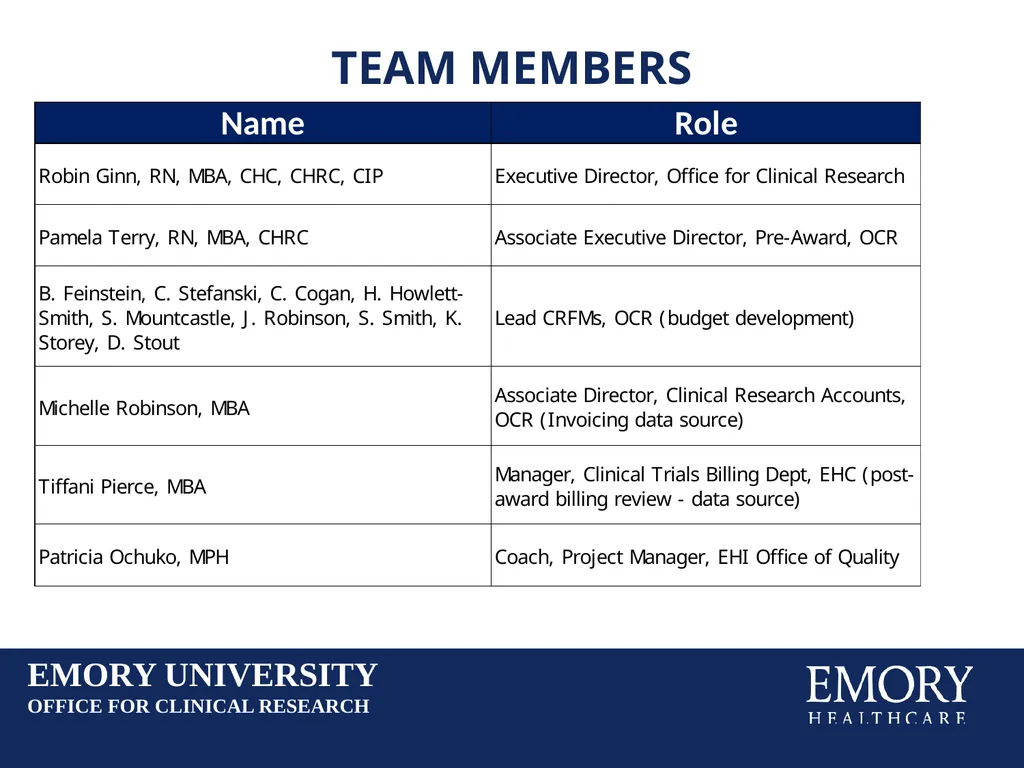
Team Members EMORY UNIVERSITY
OFFICE FOR CLINICAL RESEARCH<br>
03
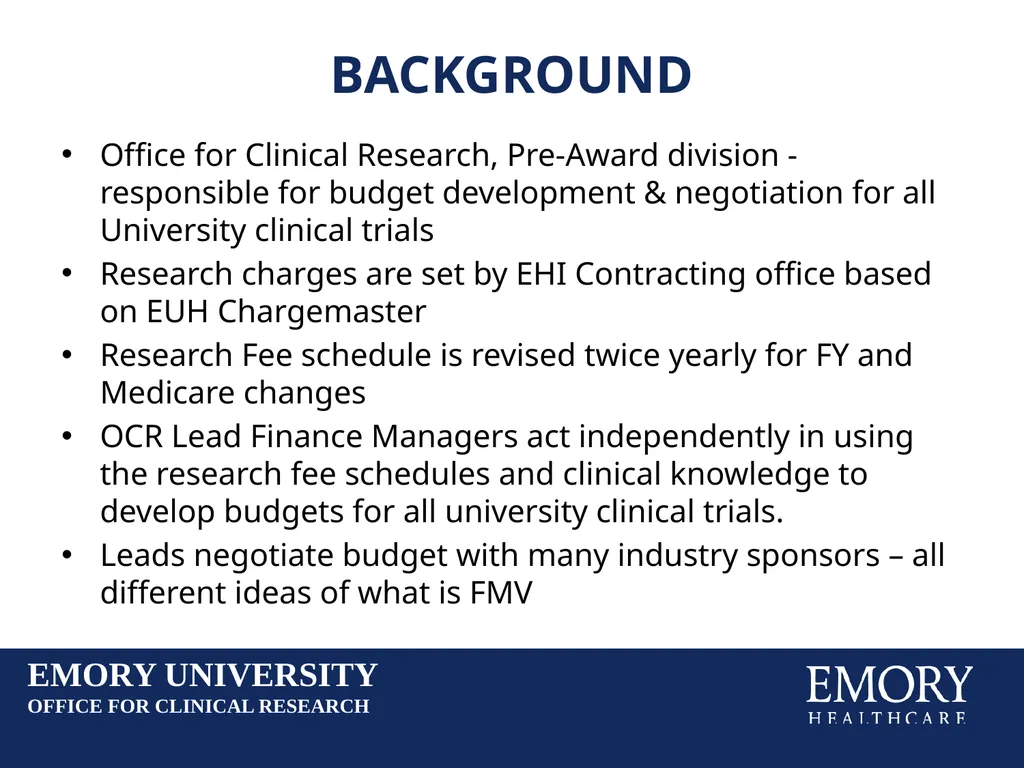
Background Office for Clinical Research, Pre-Award division - responsible for budget development & negotiation for all University clinical trials
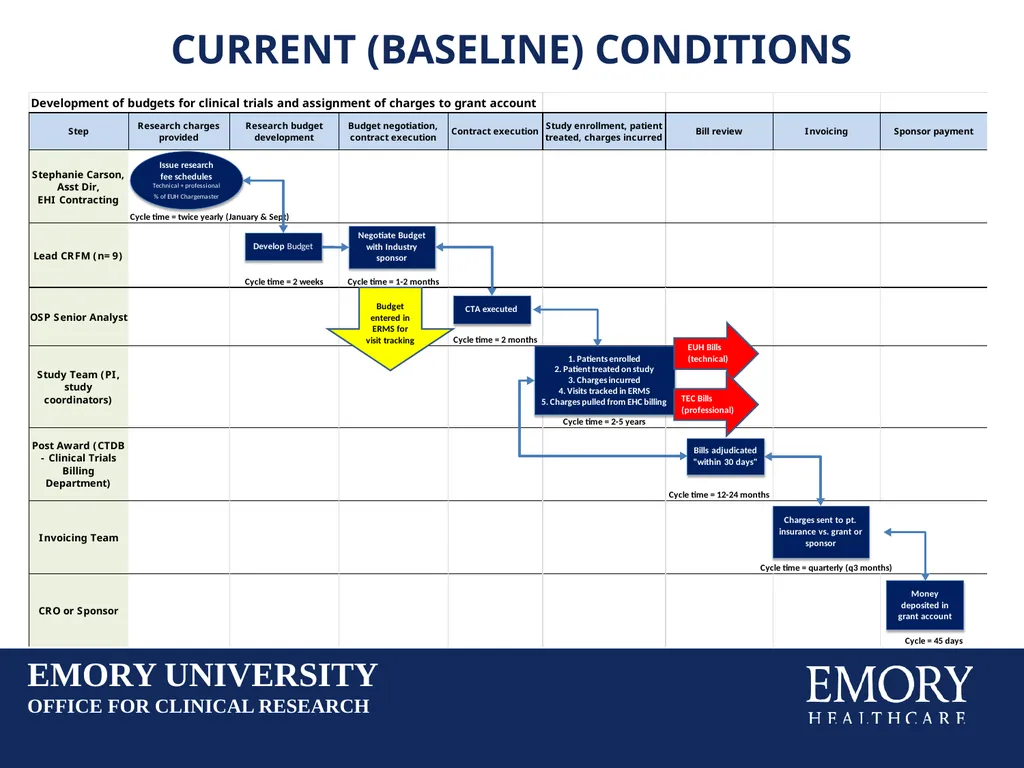
Research charges are set by EHI Contracting office based on EUH Chargemaster
Research Fee schedule is revised twice yearly for FY and Medicare changes
OCR Lead Finance Managers act independently in using the research fee schedules and clinical knowledge to develop budgets for all university clinical trials.
Leads negotiate budget with many industry sponsors – all different ideas of what is FMV EMORY UNIVERSITY
OFFICE FOR CLINICAL RESEARCH<br>
04
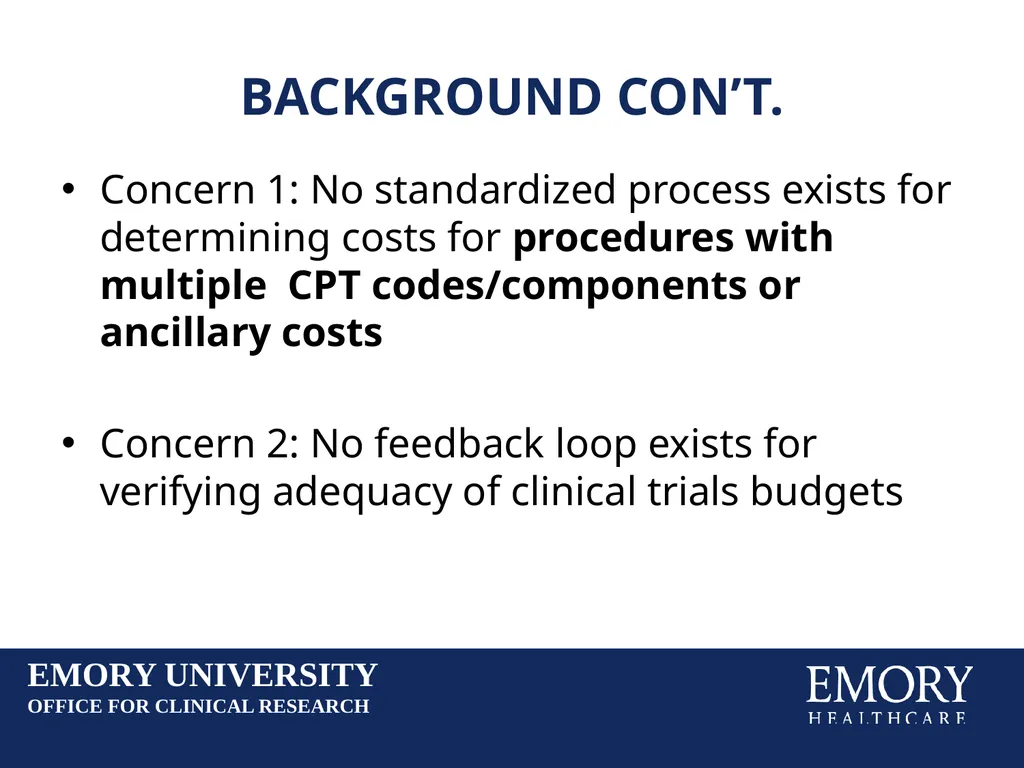
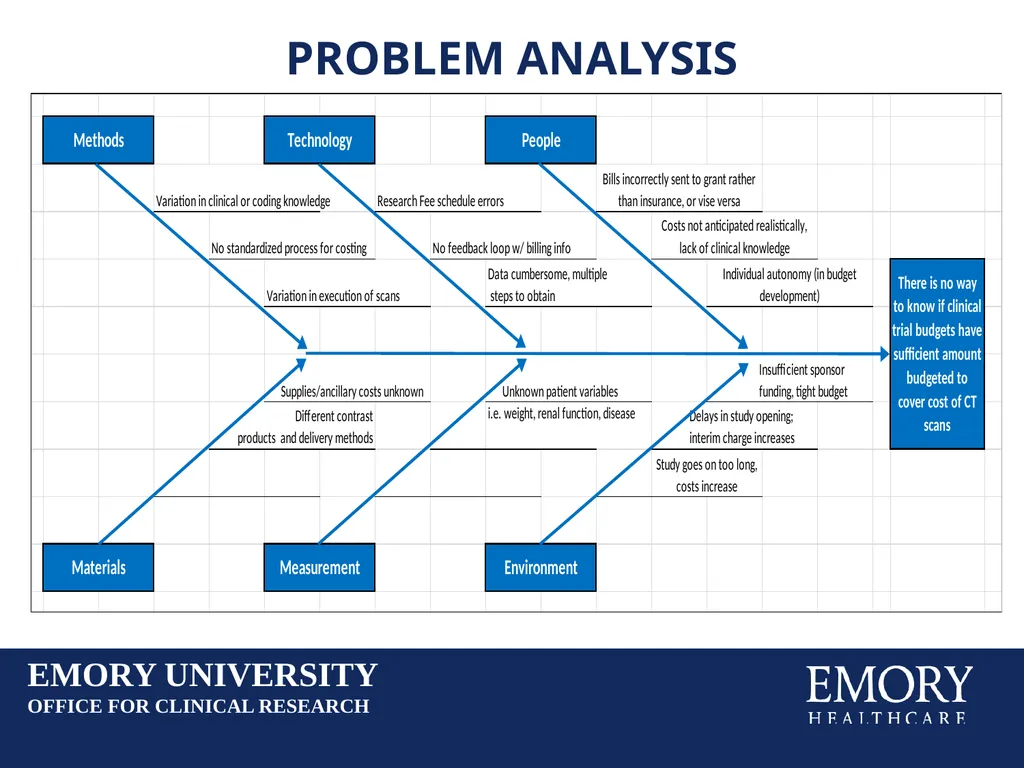
Background CON’T. Concern 1: No standardized process exists for determining costs for procedures with multiple CPT codes/components or ancillary costs
Concern 2: No feedback loop exists for verifying adequacy of clinical trials budgets EMORY UNIVERSITY
OFFICE FOR CLINICAL RESEARCH<br>
05
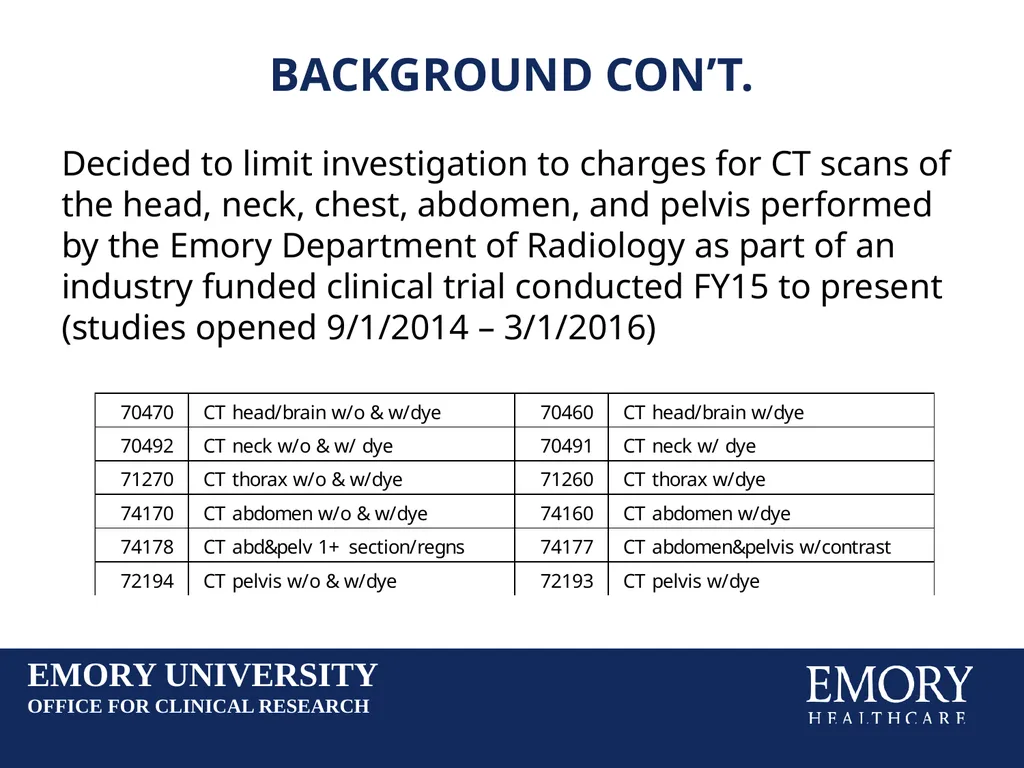
Background CON’T. Decided to limit investigation to charges for CT scans of the head, neck, chest, abdomen, and pelvis performed by the Emory Department of Radiology as part of an industry funded clinical trial conducted FY15 to present (studies opened 9/1/2014 – 3/1/2016) EMORY UNIVERSITY
OFFICE FOR CLINICAL RESEARCH<br>
06
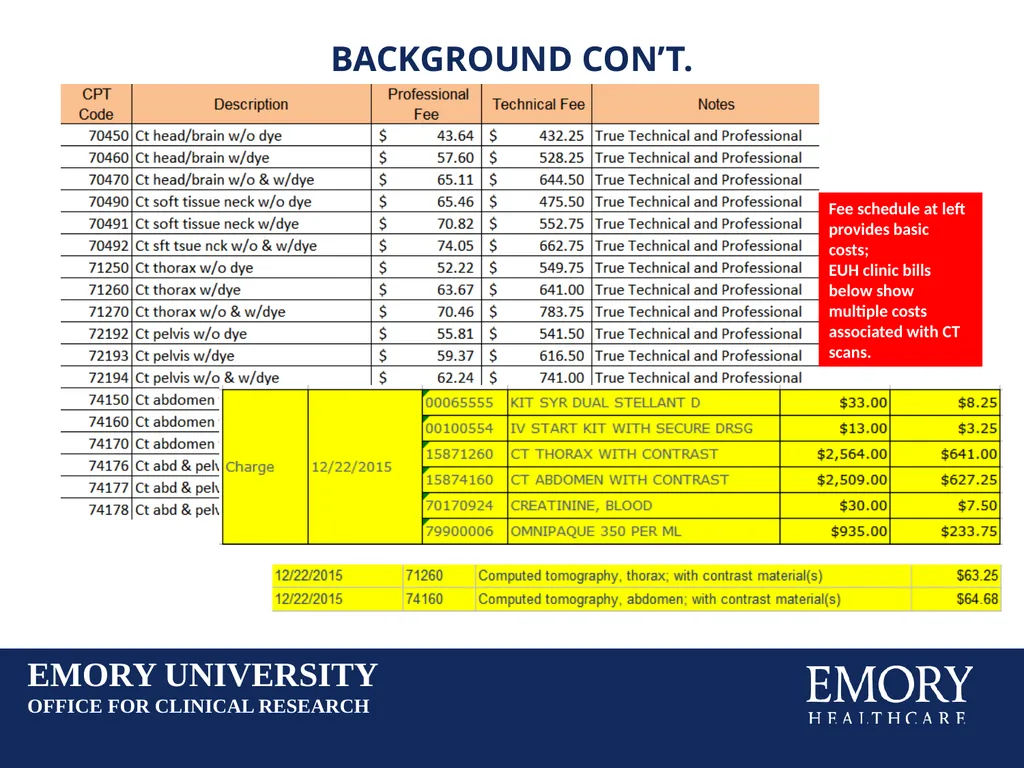
Background CON’T. EMORY UNIVERSITY
OFFICE FOR CLINICAL RESEARCH Fee schedule at left provides basic costs;
EUH clinic bills below show multiple costs associated with CT scans.<br>
07
Current (baseline) conditions EMORY UNIVERSITY
OFFICE FOR CLINICAL RESEARCH<br>
08
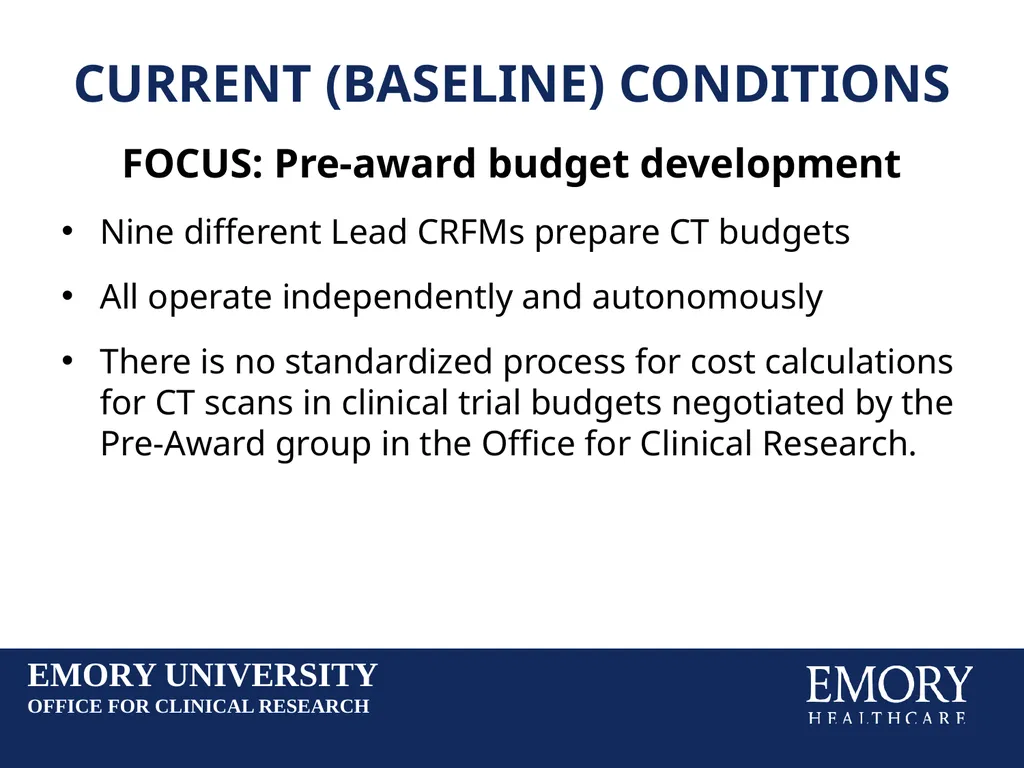
Current (baseline) conditions FOCUS: Pre-award budget development
Nine different Lead CRFMs prepare CT budgets
All operate independently and autonomously
There is no standardized process for cost calculations for CT scans in clinical trial budgets negotiated by the Pre-Award group in the Office for Clinical Research. EMORY UNIVERSITY
OFFICE FOR CLINICAL RESEARCH<br>
09
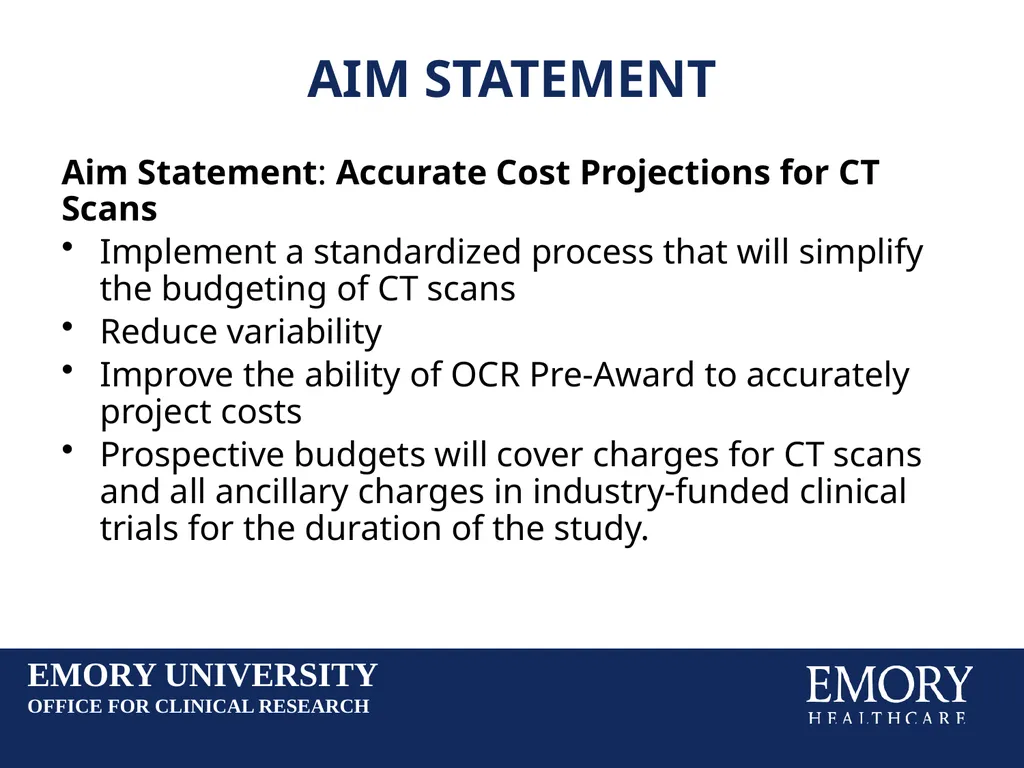
Aim statement Aim Statement: Accurate Cost Projections for CT Scans
Implement a standardized process that will simplify the budgeting of CT scans
Reduce variability
Improve the ability of OCR Pre-Award to accurately project costs
Prospective budgets will cover charges for CT scans and all ancillary charges in industry-funded clinical trials for the duration of the study. EMORY UNIVERSITY
OFFICE FOR CLINICAL RESEARCH<br>
10
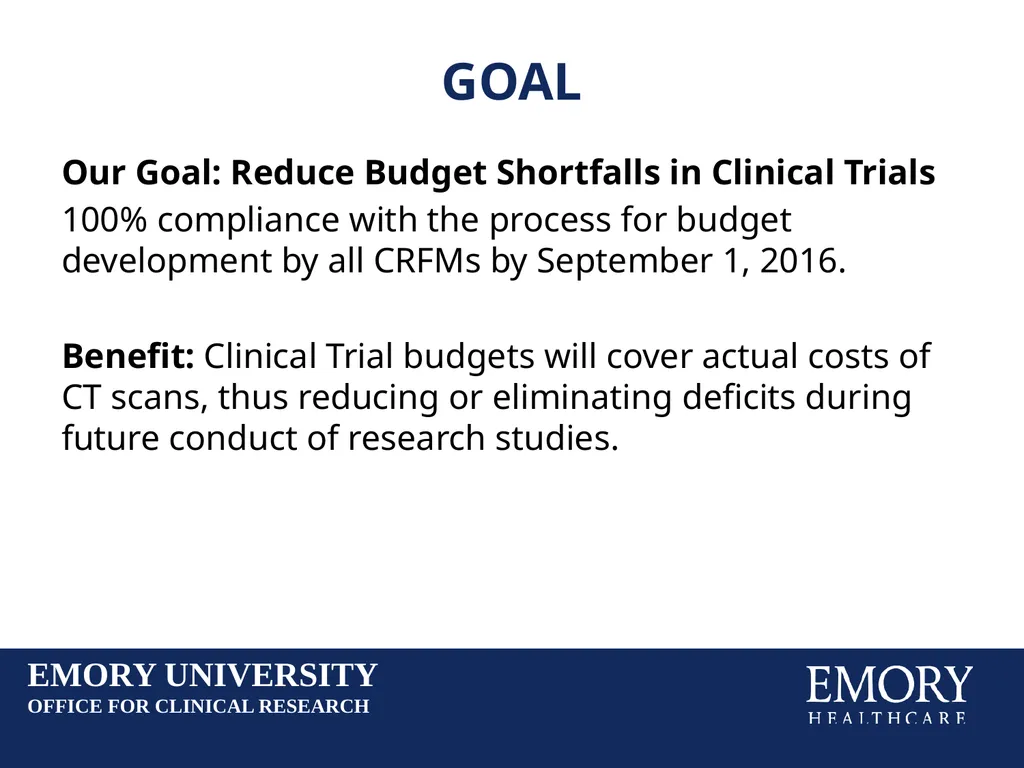
Goal Our Goal: Reduce Budget Shortfalls in Clinical Trials
100% compliance with the process for budget development by all CRFMs by September 1, 2016.
Benefit: Clinical Trial budgets will cover actual costs of CT scans, thus reducing or eliminating deficits during future conduct of research studies. EMORY UNIVERSITY
OFFICE FOR CLINICAL RESEARCH<br>
11
Problem analysis EMORY UNIVERSITY
OFFICE FOR CLINICAL RESEARCH<br>
12
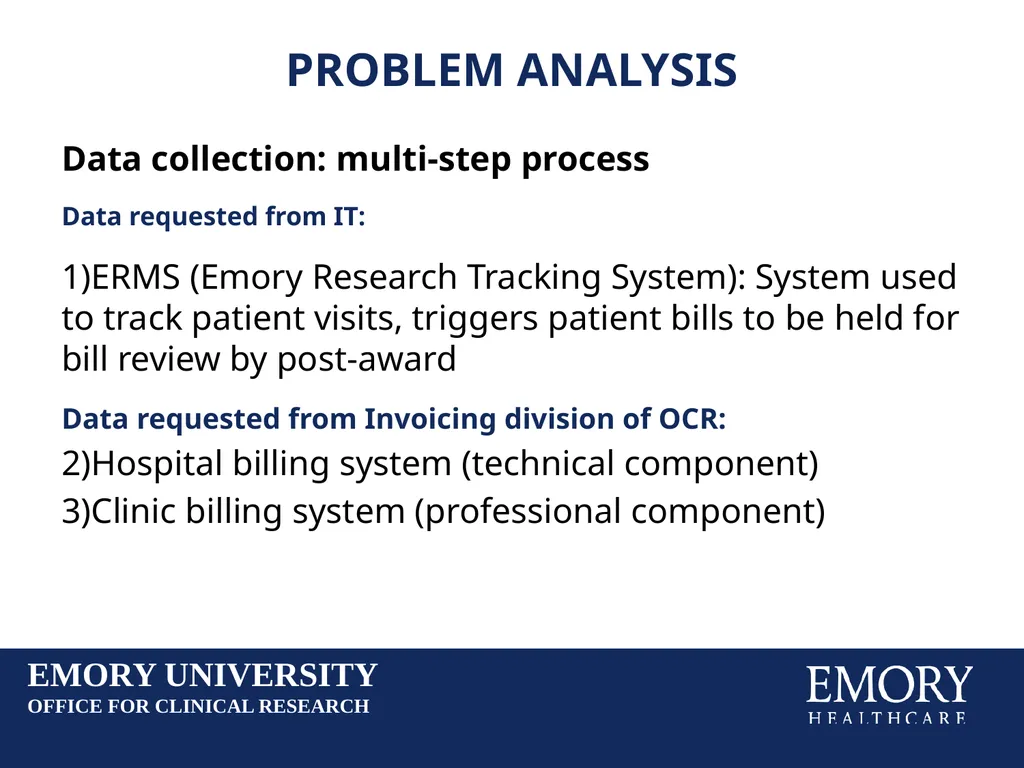
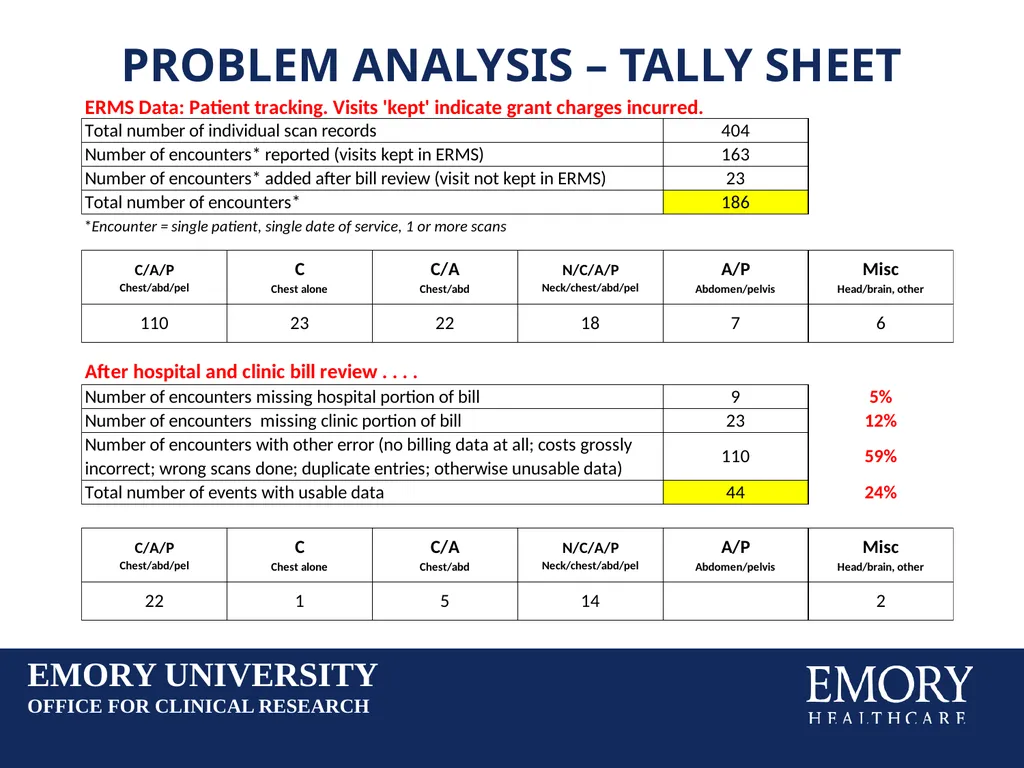
Problem analysis Data collection: multi-step process
Data requested from IT:
1)ERMS (Emory Research Tracking System): System used to track patient visits, triggers patient bills to be held for bill review by post-award
Data requested from Invoicing division of OCR:
2)Hospital billing system (technical component)
3)Clinic billing system (professional component) EMORY UNIVERSITY
OFFICE FOR CLINICAL RESEARCH<br>
13
Problem analysis – Tally Sheet EMORY UNIVERSITY
OFFICE FOR CLINICAL RESEARCH<br>
14
Problem analysis Use your improvement tools (one slide per tool)
Fishbone
Tally sheets
Pareto chart
Value stream map EMORY UNIVERSITY
OFFICE FOR CLINICAL RESEARCH<br>
15
Problem analysis EMORY UNIVERSITY
OFFICE FOR CLINICAL RESEARCH<br>
16
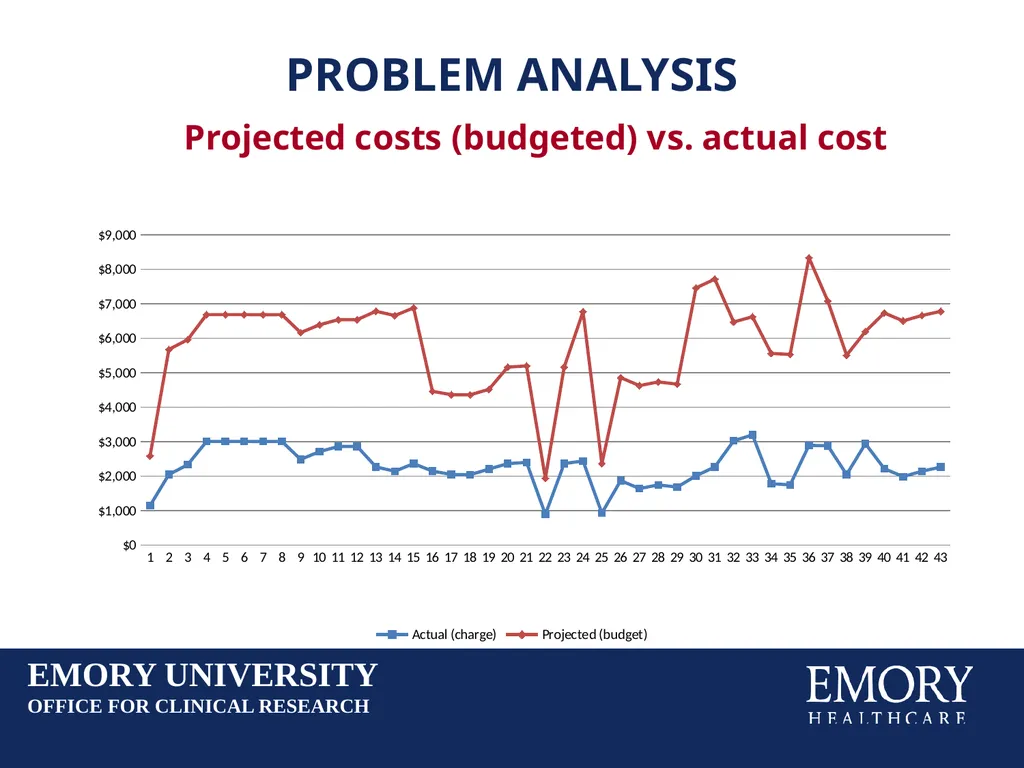
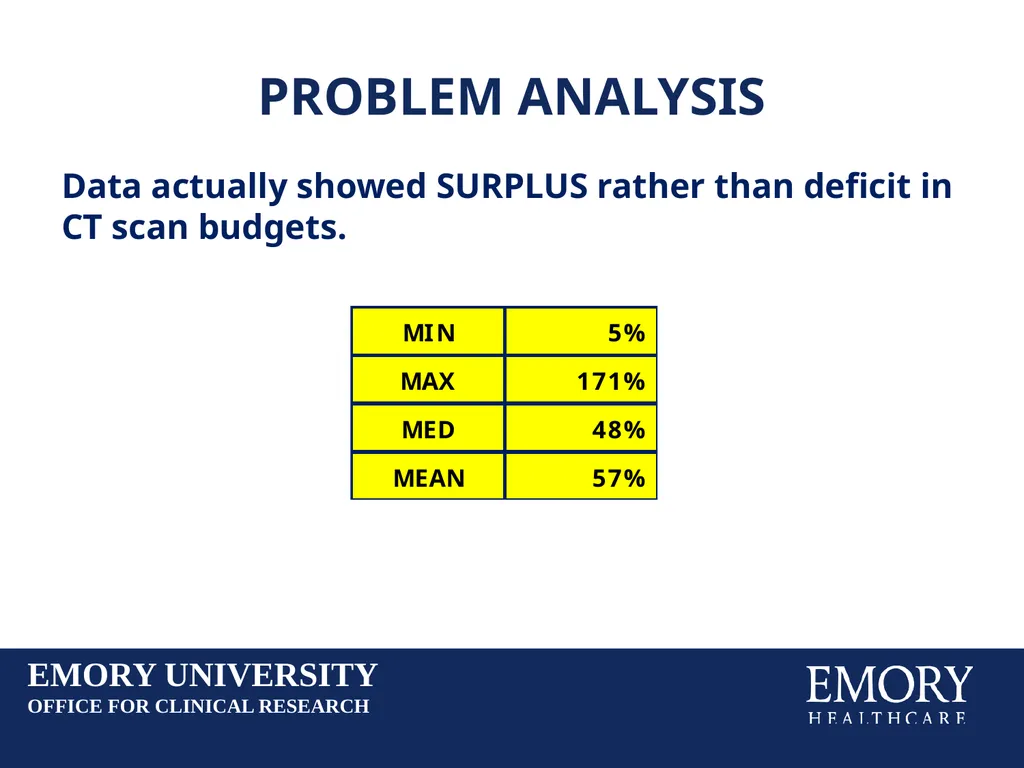
Problem analysis Data actually showed SURPLUS rather than deficit in CT scan budgets. EMORY UNIVERSITY
OFFICE FOR CLINICAL RESEARCH<br>
17
Problem analysis Use your improvement tools (one slide per tool)
Fishbone
Tally sheets
Pareto chart
Value stream map EMORY UNIVERSITY
OFFICE FOR CLINICAL RESEARCH<br>
18
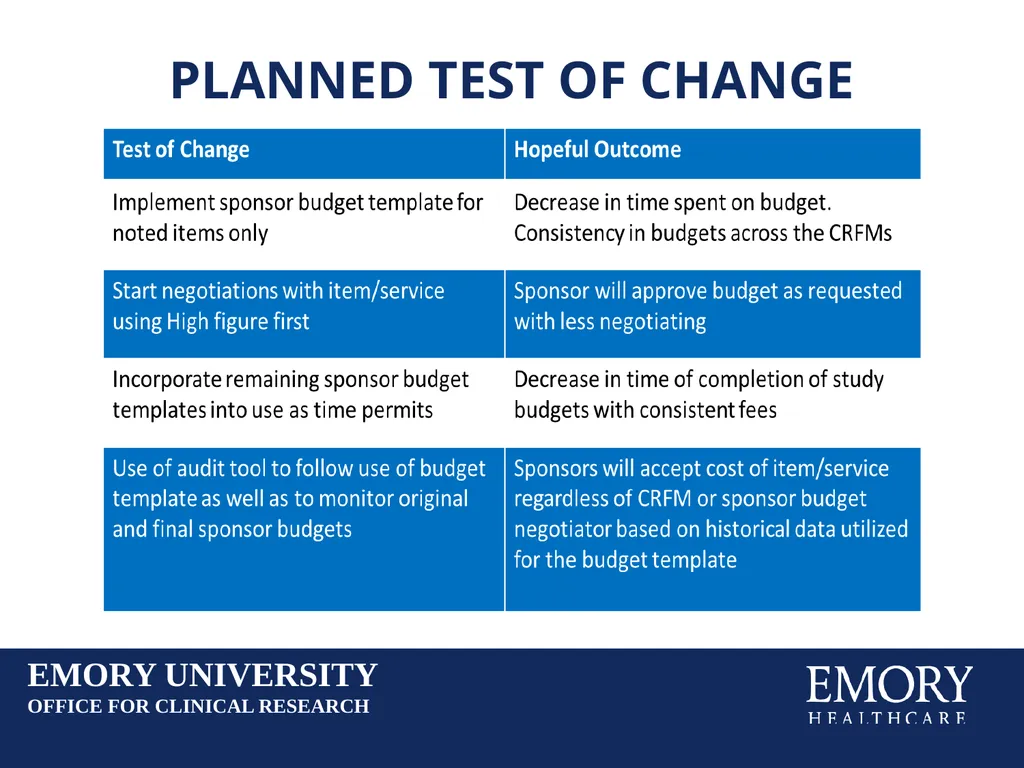
Planned Test of Change EMORY UNIVERSITY
OFFICE FOR CLINICAL RESEARCH<br>
19
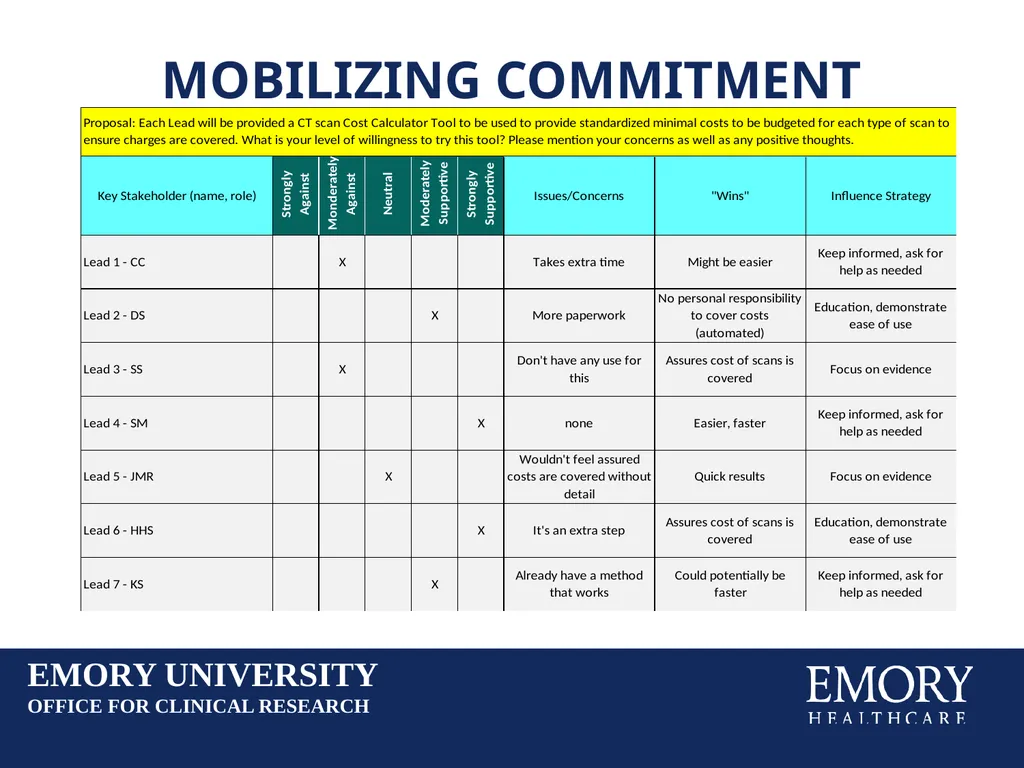
Mobilizing Commitment EMORY UNIVERSITY
OFFICE FOR CLINICAL RESEARCH<br>
20
Metrics/results Indicate what metric(s) you are following
Show an annotated run chart of your data EMORY UNIVERSITY
OFFICE FOR CLINICAL RESEARCH<br>
21
Follow up/Next steps EMORY UNIVERSITY
OFFICE FOR CLINICAL RESEARCH<br>
22
Project scoring EMORY UNIVERSITY
OFFICE FOR CLINICAL RESEARCH<br>