
Registration of Space Objects Space Law Conference


Description: Registration of Space Objects Space Law Conference 8-10 December 2020 Background Why registration? Assist in their identification Contribute to the application and development of international law Preamble, Registration Convention Important
Related Topics
Download Presentation
"Registration of Space Objects Space Law Conference" is the property of its rightful owner. Permission is granted to download and print the materials on this website for personal, non-commercial use only, and to display it on your personal computer provided you do not modify the materials and that you retain all copyright notices contained in the materials. By downloading content from our website, you accept the terms of this agreement.
Presentation Transcript
slide1. Registration of Space Objects
Space Law Conference
8-10 December 2020<br>
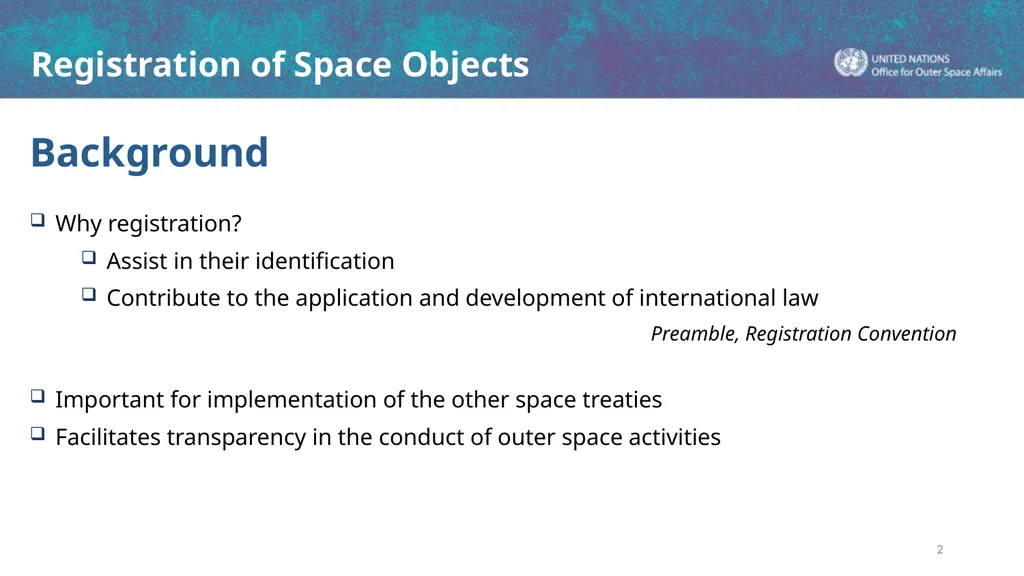
slide2. Background Why registration?
Assist in their identification
Contribute to the application and development of international law
Preamble, Registration Convention
Important for implementation of the other space treaties
Facilitates transparency in the conduct of outer space activities 2<br>
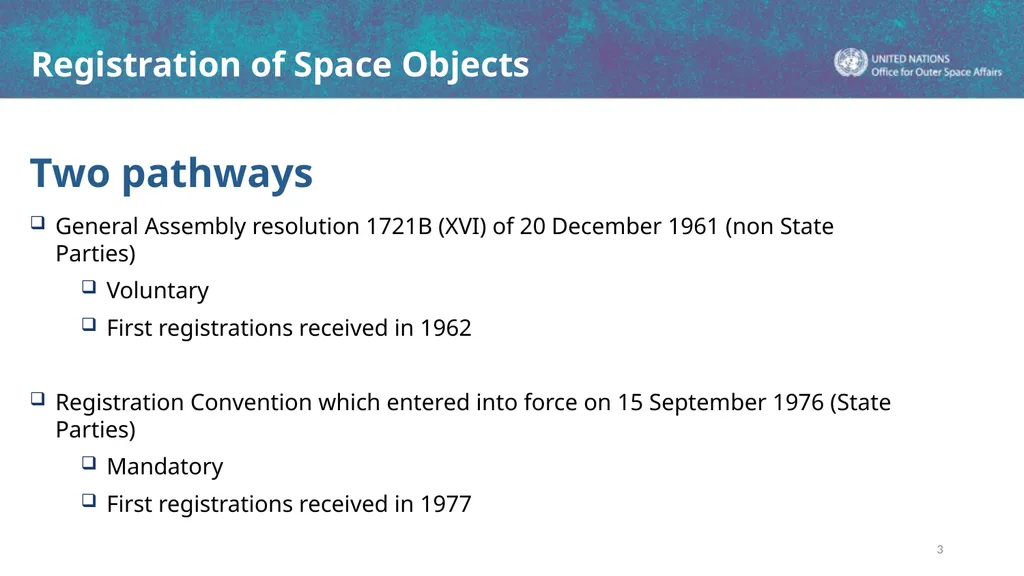
slide3. Two pathways General Assembly resolution 1721B (XVI) of 20 December 1961 (non State Parties)
Voluntary
First registrations received in 1962
Registration Convention which entered into force on 15 September 1976 (State Parties)
Mandatory
First registrations received in 1977 3<br>
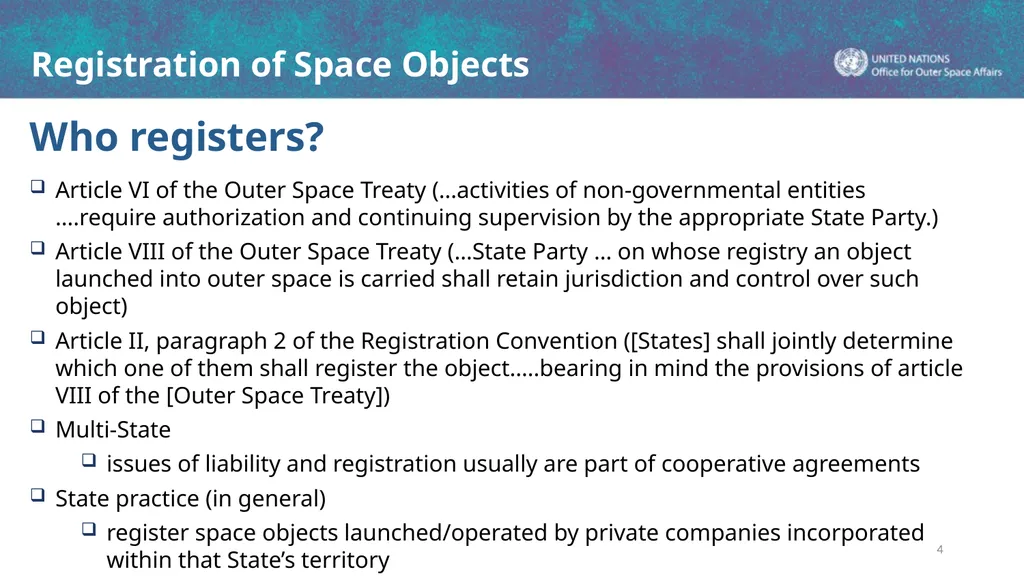
slide4. Who registers? Article VI of the Outer Space Treaty (…activities of non-governmental entities ….require authorization and continuing supervision by the appropriate State Party.)
Article VIII of the Outer Space Treaty (…State Party … on whose registry an object launched into outer space is carried shall retain jurisdiction and control over such object)
Article II, paragraph 2 of the Registration Convention ([States] shall jointly determine which one of them shall register the object.….bearing in mind the provisions of article VIII of the [Outer Space Treaty])
Multi-State
issues of liability and registration usually are part of cooperative agreements
State practice (in general)
register space objects launched/operated by private companies incorporated within that State’s territory 4<br>
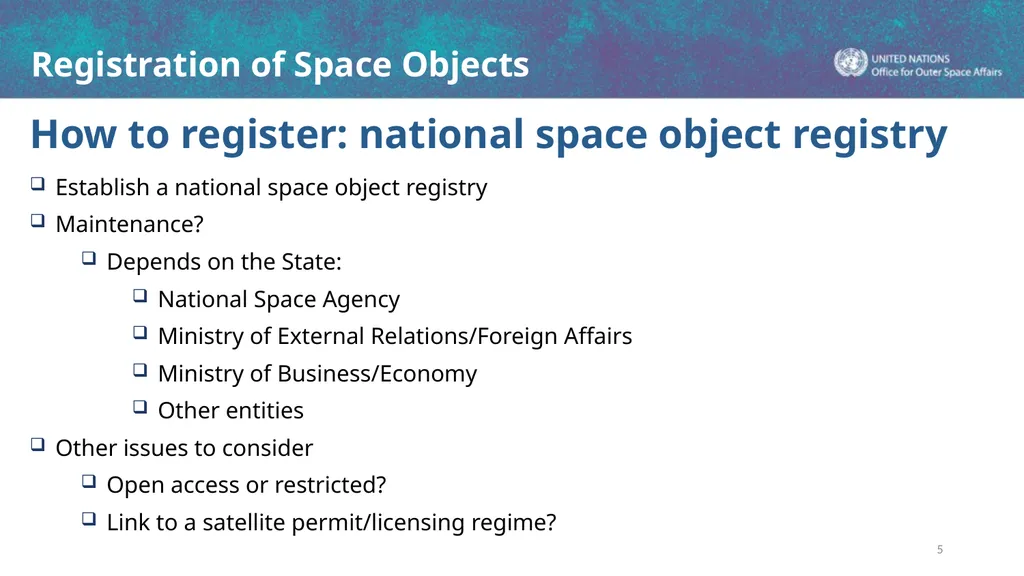
slide5. How to register: national space object registry Establish a national space object registry
Maintenance?
Depends on the State:
National Space Agency
Ministry of External Relations/Foreign Affairs
Ministry of Business/Economy
Other entities
Other issues to consider
Open access or restricted?
Link to a satellite permit/licensing regime? 5<br>
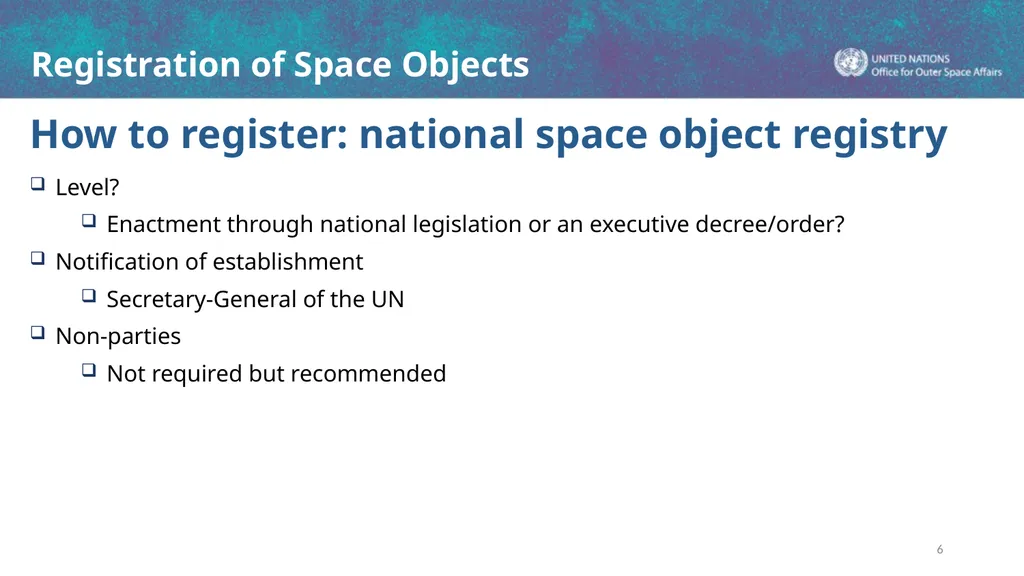
slide6. How to register: national space object registry Level?
Enactment through national legislation or an executive decree/order?
Notification of establishment
Secretary-General of the UN
Non-parties
Not required but recommended 6<br>
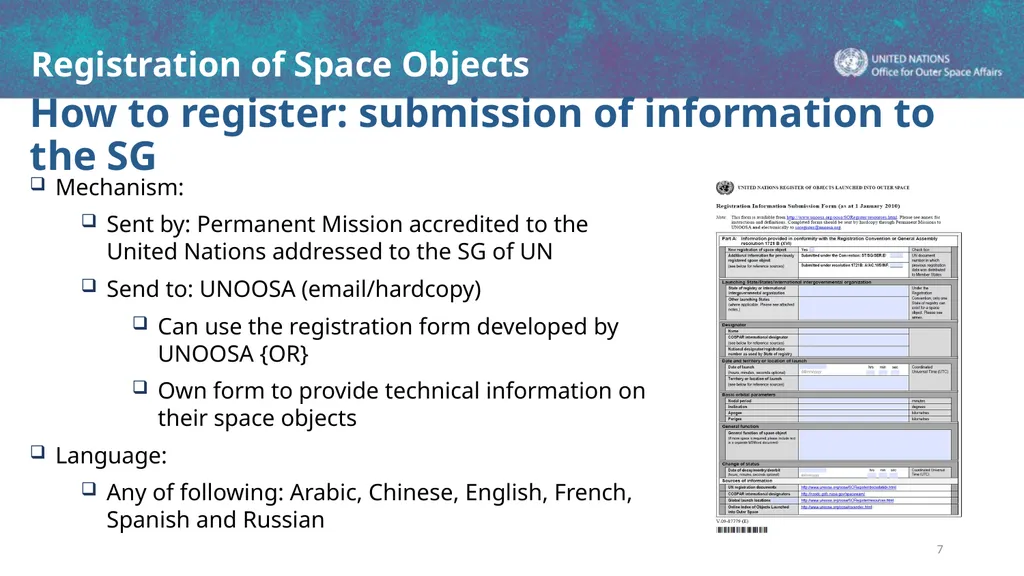
slide7. How to register: submission of information to the SG Mechanism:
Sent by: Permanent Mission accredited to the United Nations addressed to the SG of UN
Send to: UNOOSA (email/hardcopy)
Can use the registration form developed by UNOOSA {OR}
Own form to provide technical information on their space objects
Language:
Any of following: Arabic, Chinese, English, French, Spanish and Russian 7<br>
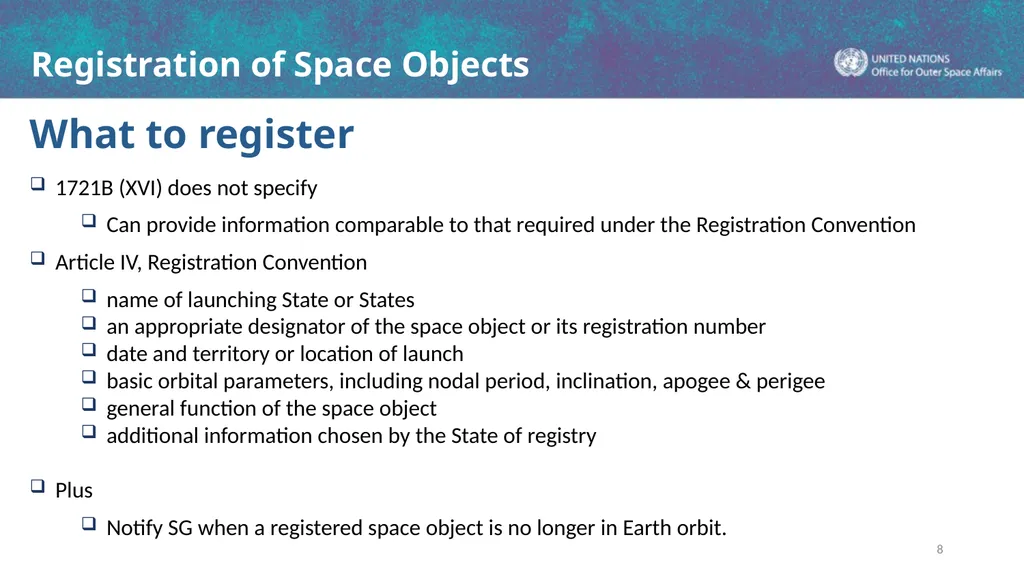
slide8. What to register 1721B (XVI) does not specify
Can provide information comparable to that required under the Registration Convention
Article IV, Registration Convention
name of launching State or States
an appropriate designator of the space object or its registration number
date and territory or location of launch
basic orbital parameters, including nodal period, inclination, apogee & perigee
general function of the space object
additional information chosen by the State of registry
Plus
Notify SG when a registered space object is no longer in Earth orbit. 8<br>
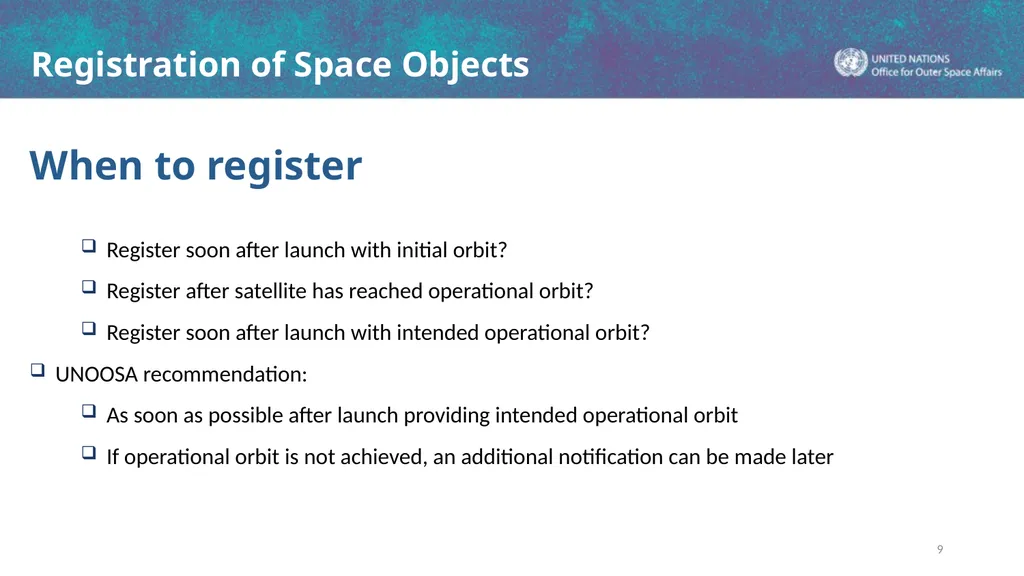
slide9. When to register Register soon after launch with initial orbit?
Register after satellite has reached operational orbit?
Register soon after launch with intended operational orbit?
UNOOSA recommendation:
As soon as possible after launch providing intended operational orbit
If operational orbit is not achieved, an additional notification can be made later 9<br>
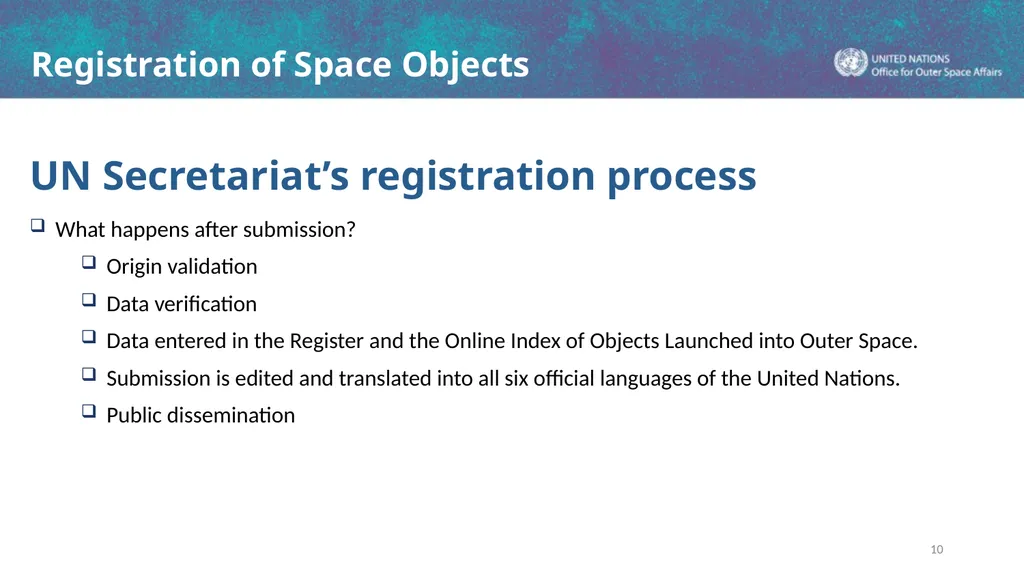
slide10. UN Secretariat’s registration process What happens after submission?
Origin validation
Data verification
Data entered in the Register and the Online Index of Objects Launched into Outer Space.
Submission is edited and translated into all six official languages of the United Nations.
Public dissemination 10<br>
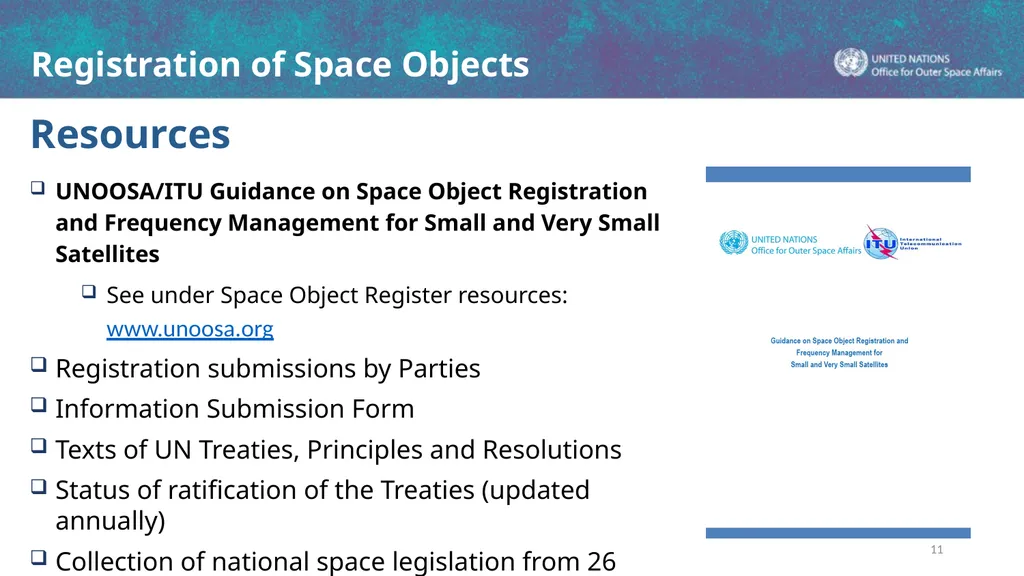
slide11. Resources UNOOSA/ITU Guidance on Space Object Registration and Frequency Management for Small and Very Small Satellites
See under Space Object Register resources: www.unoosa.org
Registration submissions by Parties
Information Submission Form
Texts of UN Treaties, Principles and Resolutions
Status of ratification of the Treaties (updated annually)
Collection of national space legislation from 26 Member States 11<br>
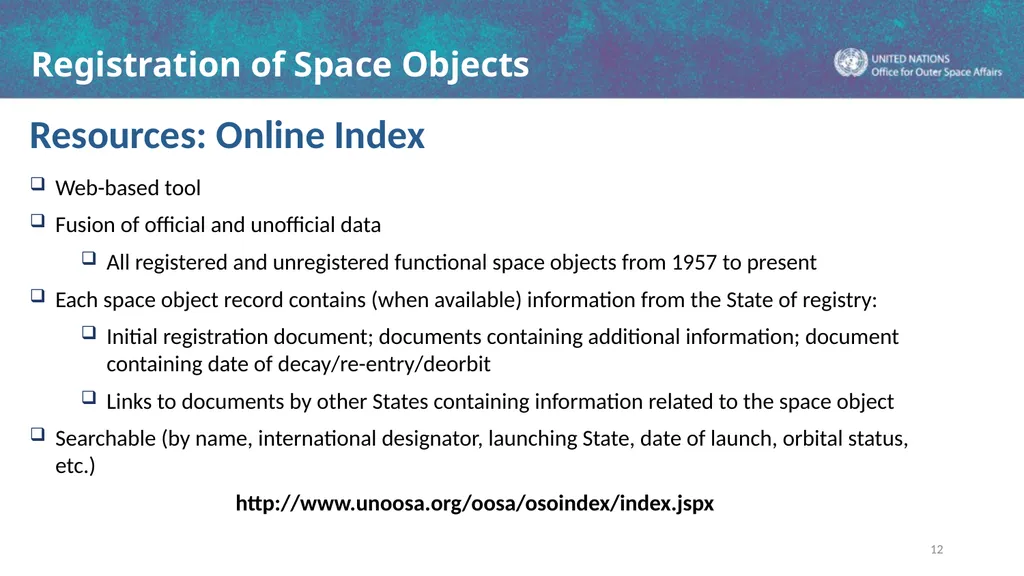
slide12. Resources: Online Index Web-based tool
Fusion of official and unofficial data
All registered and unregistered functional space objects from 1957 to present
Each space object record contains (when available) information from the State of registry:
Initial registration document; documents containing additional information; document containing date of decay/re-entry/deorbit
Links to documents by other States containing information related to the space object
Searchable (by name, international designator, launching State, date of launch, orbital status, etc.)
http://www.unoosa.org/oosa/osoindex/index.jspx 12<br>
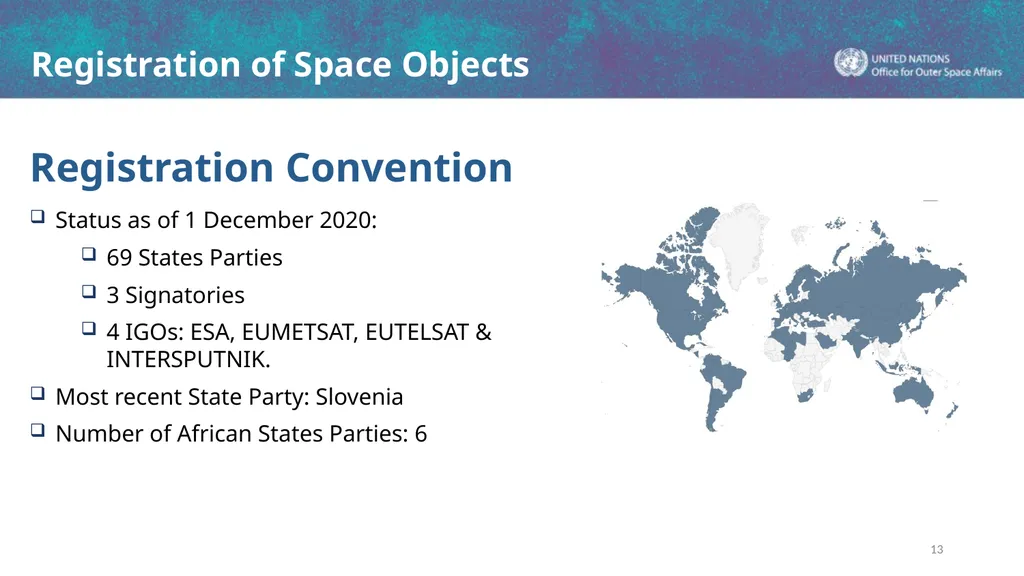
slide13. Registration Convention Status as of 1 December 2020:
69 States Parties
3 Signatories
4 IGOs: ESA, EUMETSAT, EUTELSAT & INTERSPUTNIK.
Most recent State Party: Slovenia
Number of African States Parties: 6 13<br>
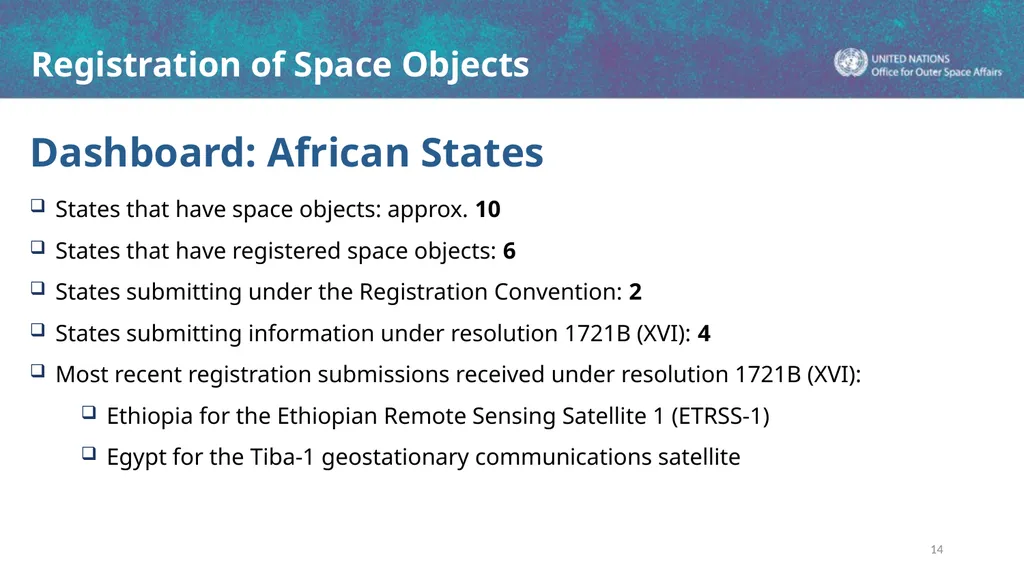
slide14. Dashboard: African States States that have space objects: approx. 10
States that have registered space objects: 6
States submitting under the Registration Convention: 2
States submitting information under resolution 1721B (XVI): 4
Most recent registration submissions received under resolution 1721B (XVI):
Ethiopia for the Ethiopian Remote Sensing Satellite 1 (ETRSS-1)
Egypt for the Tiba-1 geostationary communications satellite 14<br>
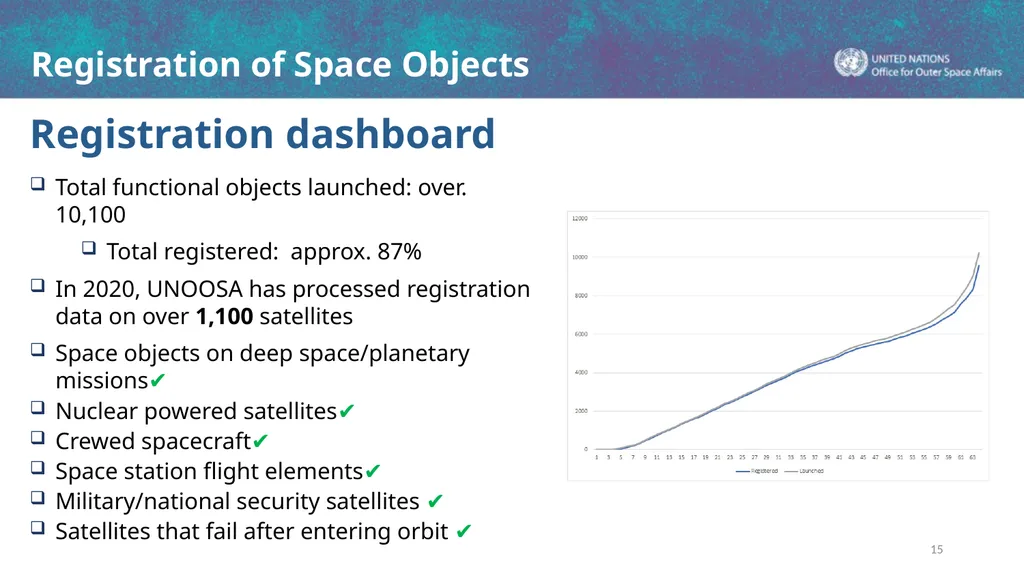
slide15. Registration dashboard Total functional objects launched: over. 10,100
Total registered: approx. 87%
In 2020, UNOOSA has processed registration data on over 1,100 satellites
Space objects on deep space/planetary missions✔
Nuclear powered satellites✔
Crewed spacecraft✔
Space station flight elements✔
Military/national security satellites ✔
Satellites that fail after entering orbit ✔ 15<br>
slide16. Thank you robert.wickramatunga@un.org
natercia.rodrigues@un.org<br>
Space Law Conference
8-10 December 2020<br>
slide2. Background Why registration?
Assist in their identification
Contribute to the application and development of international law
Preamble, Registration Convention
Important for implementation of the other space treaties
Facilitates transparency in the conduct of outer space activities 2<br>
slide3. Two pathways General Assembly resolution 1721B (XVI) of 20 December 1961 (non State Parties)
Voluntary
First registrations received in 1962
Registration Convention which entered into force on 15 September 1976 (State Parties)
Mandatory
First registrations received in 1977 3<br>
slide4. Who registers? Article VI of the Outer Space Treaty (…activities of non-governmental entities ….require authorization and continuing supervision by the appropriate State Party.)
Article VIII of the Outer Space Treaty (…State Party … on whose registry an object launched into outer space is carried shall retain jurisdiction and control over such object)
Article II, paragraph 2 of the Registration Convention ([States] shall jointly determine which one of them shall register the object.….bearing in mind the provisions of article VIII of the [Outer Space Treaty])
Multi-State
issues of liability and registration usually are part of cooperative agreements
State practice (in general)
register space objects launched/operated by private companies incorporated within that State’s territory 4<br>
slide5. How to register: national space object registry Establish a national space object registry
Maintenance?
Depends on the State:
National Space Agency
Ministry of External Relations/Foreign Affairs
Ministry of Business/Economy
Other entities
Other issues to consider
Open access or restricted?
Link to a satellite permit/licensing regime? 5<br>
slide6. How to register: national space object registry Level?
Enactment through national legislation or an executive decree/order?
Notification of establishment
Secretary-General of the UN
Non-parties
Not required but recommended 6<br>
slide7. How to register: submission of information to the SG Mechanism:
Sent by: Permanent Mission accredited to the United Nations addressed to the SG of UN
Send to: UNOOSA (email/hardcopy)
Can use the registration form developed by UNOOSA {OR}
Own form to provide technical information on their space objects
Language:
Any of following: Arabic, Chinese, English, French, Spanish and Russian 7<br>
slide8. What to register 1721B (XVI) does not specify
Can provide information comparable to that required under the Registration Convention
Article IV, Registration Convention
name of launching State or States
an appropriate designator of the space object or its registration number
date and territory or location of launch
basic orbital parameters, including nodal period, inclination, apogee & perigee
general function of the space object
additional information chosen by the State of registry
Plus
Notify SG when a registered space object is no longer in Earth orbit. 8<br>
slide9. When to register Register soon after launch with initial orbit?
Register after satellite has reached operational orbit?
Register soon after launch with intended operational orbit?
UNOOSA recommendation:
As soon as possible after launch providing intended operational orbit
If operational orbit is not achieved, an additional notification can be made later 9<br>
slide10. UN Secretariat’s registration process What happens after submission?
Origin validation
Data verification
Data entered in the Register and the Online Index of Objects Launched into Outer Space.
Submission is edited and translated into all six official languages of the United Nations.
Public dissemination 10<br>
slide11. Resources UNOOSA/ITU Guidance on Space Object Registration and Frequency Management for Small and Very Small Satellites
See under Space Object Register resources: www.unoosa.org
Registration submissions by Parties
Information Submission Form
Texts of UN Treaties, Principles and Resolutions
Status of ratification of the Treaties (updated annually)
Collection of national space legislation from 26 Member States 11<br>
slide12. Resources: Online Index Web-based tool
Fusion of official and unofficial data
All registered and unregistered functional space objects from 1957 to present
Each space object record contains (when available) information from the State of registry:
Initial registration document; documents containing additional information; document containing date of decay/re-entry/deorbit
Links to documents by other States containing information related to the space object
Searchable (by name, international designator, launching State, date of launch, orbital status, etc.)
http://www.unoosa.org/oosa/osoindex/index.jspx 12<br>
slide13. Registration Convention Status as of 1 December 2020:
69 States Parties
3 Signatories
4 IGOs: ESA, EUMETSAT, EUTELSAT & INTERSPUTNIK.
Most recent State Party: Slovenia
Number of African States Parties: 6 13<br>
slide14. Dashboard: African States States that have space objects: approx. 10
States that have registered space objects: 6
States submitting under the Registration Convention: 2
States submitting information under resolution 1721B (XVI): 4
Most recent registration submissions received under resolution 1721B (XVI):
Ethiopia for the Ethiopian Remote Sensing Satellite 1 (ETRSS-1)
Egypt for the Tiba-1 geostationary communications satellite 14<br>
slide15. Registration dashboard Total functional objects launched: over. 10,100
Total registered: approx. 87%
In 2020, UNOOSA has processed registration data on over 1,100 satellites
Space objects on deep space/planetary missions✔
Nuclear powered satellites✔
Crewed spacecraft✔
Space station flight elements✔
Military/national security satellites ✔
Satellites that fail after entering orbit ✔ 15<br>
slide16. Thank you robert.wickramatunga@un.org
natercia.rodrigues@un.org<br>