
Regular Languages are closed under the regular

Published  . 0 views
↓ Download
Regular Languages are closed under the regular
1 / 1
Regular Languages are closed under the regular - slide 1 of 10 Regular Languages are closed under the regular - slide 2 of 10 Regular Languages are closed under the regular - slide 3 of 10 Regular Languages are closed under the regular - slide 4 of 10 Regular Languages are closed under the regular - slide 5 of 10 Regular Languages are closed under the regular - slide 6 of 10 Regular Languages are closed under the regular - slide 7 of 10 Regular Languages are closed under the regular - slide 8 of 10 Regular Languages are closed under the regular - slide 9 of 10 Regular Languages are closed under the regular - slide 10 of 10
Description: Regular Languages are closed under the regular operations Regular Languages The regular languages are the languages that DFA accept. Since DFA are equivalent with NFAε, in order to show that L is regular it suffices to construct an NFAε

Related Topics

Download Presentation

"Regular Languages are closed under the regular" is the property of its rightful owner. Permission is granted to download and print the materials on this website for personal, non-commercial use only, and to display it on your personal computer provided you do not modify the materials and that you retain all copyright notices contained in the materials. By downloading content from our website, you accept the terms of this agreement.

Presentation Transcript

slide1. Regular Languages are closed under the regular operations<br>
slide2. Regular Languages The regular languages are the languages that DFA accept.
Since DFA are equivalent with NFAε, in order to show that L is regular it suffices to construct an NFAε that recognizes L.<br>
slide3. Regular Operations The regular operations are the following:
Union (U)
Concatenation (o)
Star (*)<br>
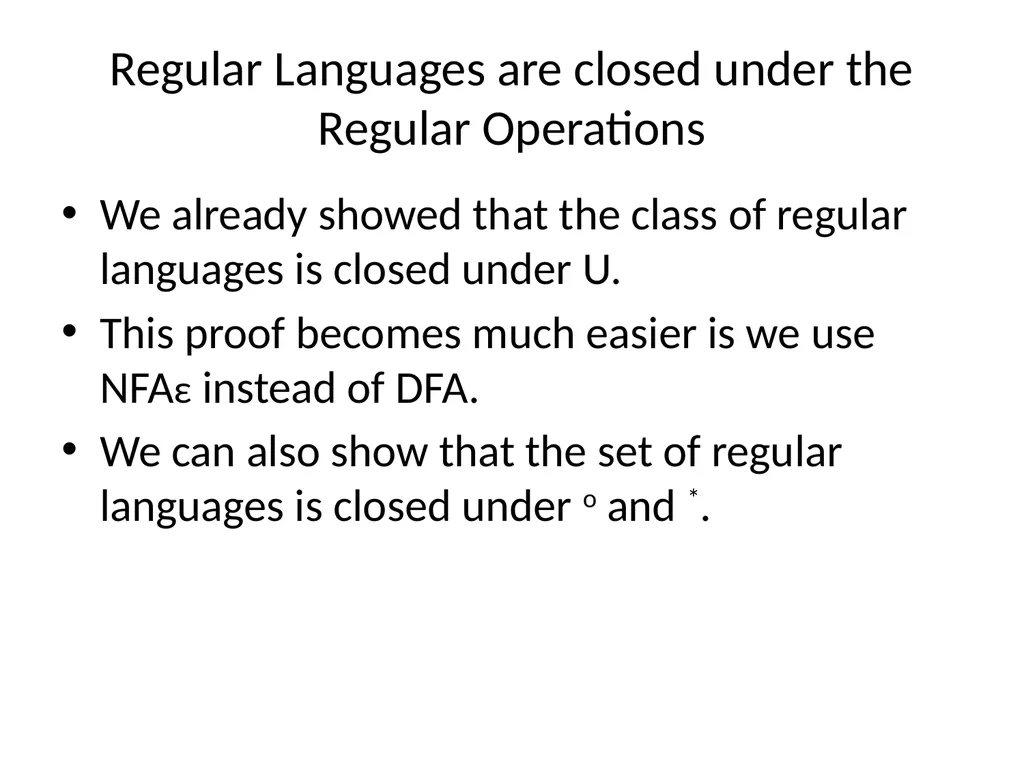
slide4. Regular Languages are closed under the Regular Operations We already showed that the class of regular languages is closed under U.
This proof becomes much easier is we use NFAε instead of DFA.
We can also show that the set of regular languages is closed under o and *.<br>
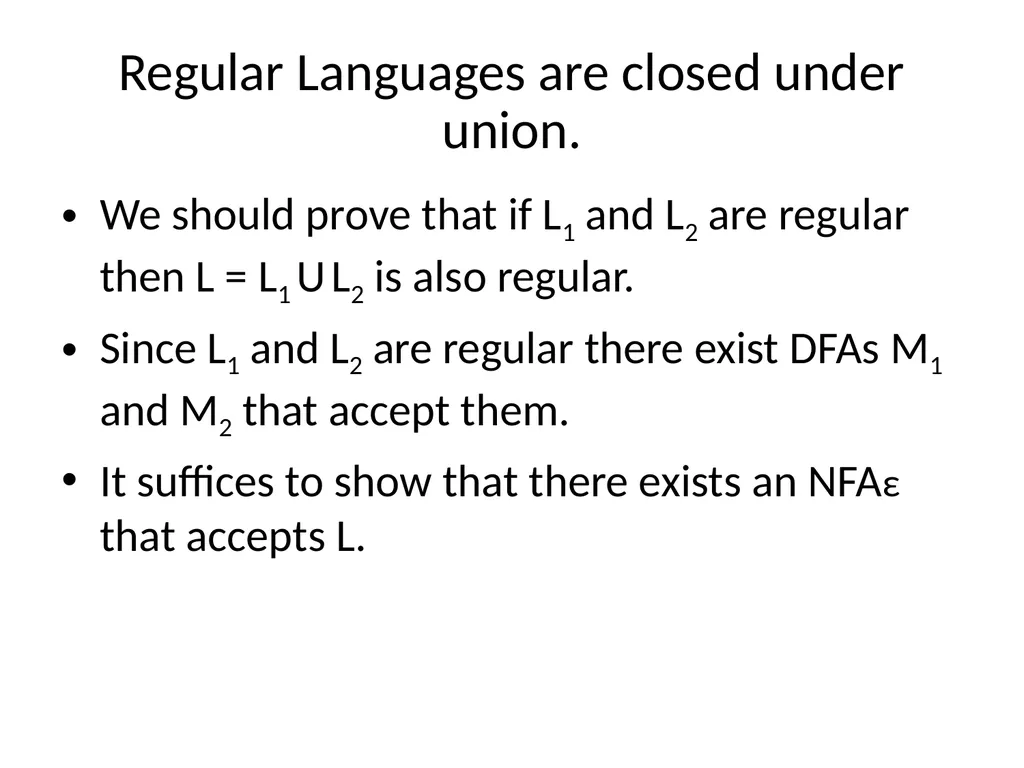
slide5. Regular Languages are closed under union. We should prove that if L1 and L2 are regular then L = L1 U L2 is also regular.
Since L1 and L2 are regular there exist DFAs M1 and M2 that accept them.
It suffices to show that there exists an NFAε that accepts L.<br>
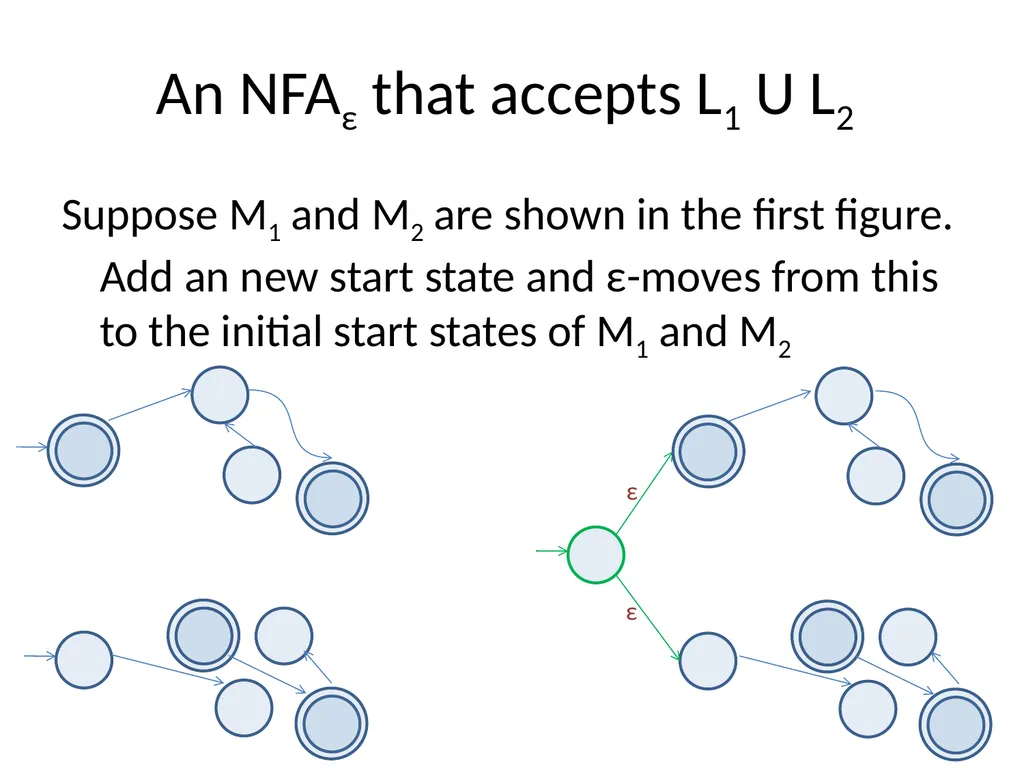
slide6. An NFAε that accepts L1 U L2 Suppose M1 and M2 are shown in the first figure. Add an new start state and ε-moves from this to the initial start states of M1 and M2<br>
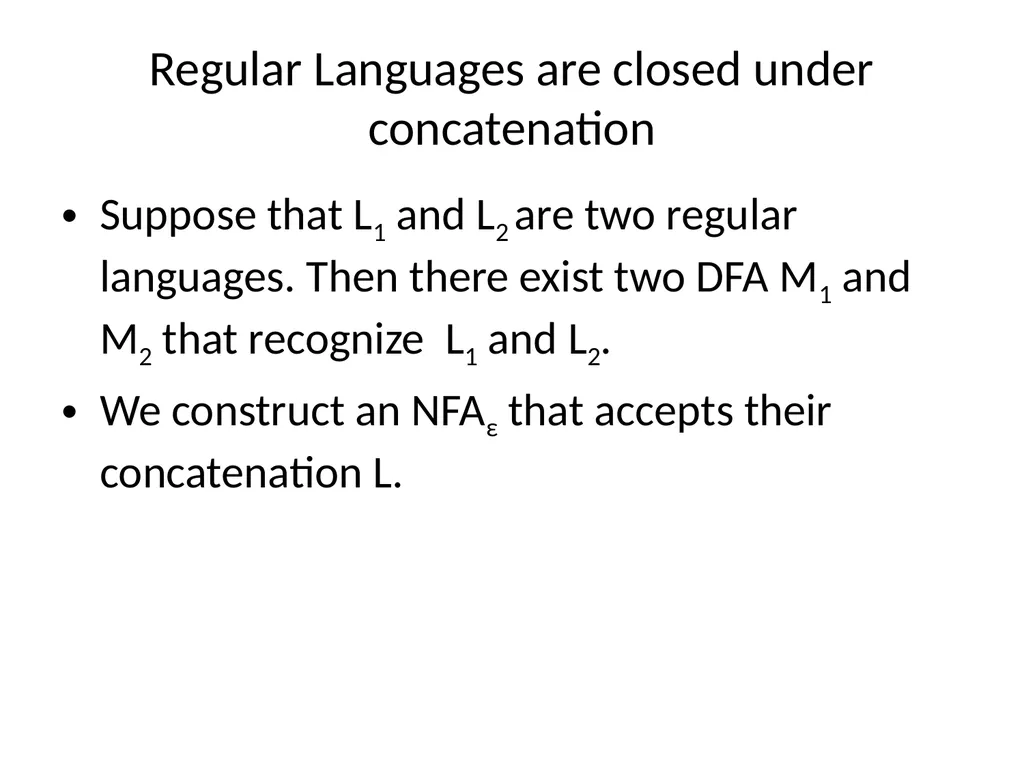
slide7. Regular Languages are closed under concatenation Suppose that L1 and L2 are two regular languages. Then there exist two DFA M1 and M2 that recognize L1 and L2.
We construct an NFAε that accepts their concatenation L.<br>
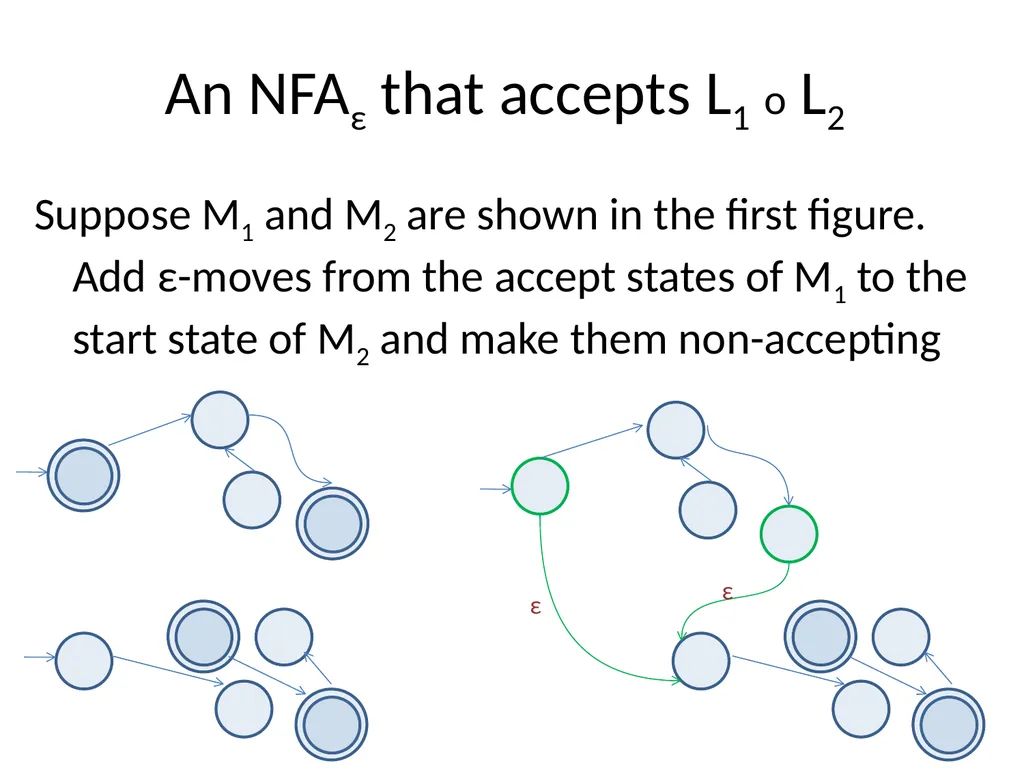
slide8. An NFAε that accepts L1 o L2 Suppose M1 and M2 are shown in the first figure. Add ε-moves from the accept states of M1 to the start state of M2 and make them non-accepting ε ε<br>
slide9. Regular Languages are closed under star operation Suppose that L is a regular language. Then there exists DFA M that recognizes L.
We construct an NFAε that accepts L*.<br>
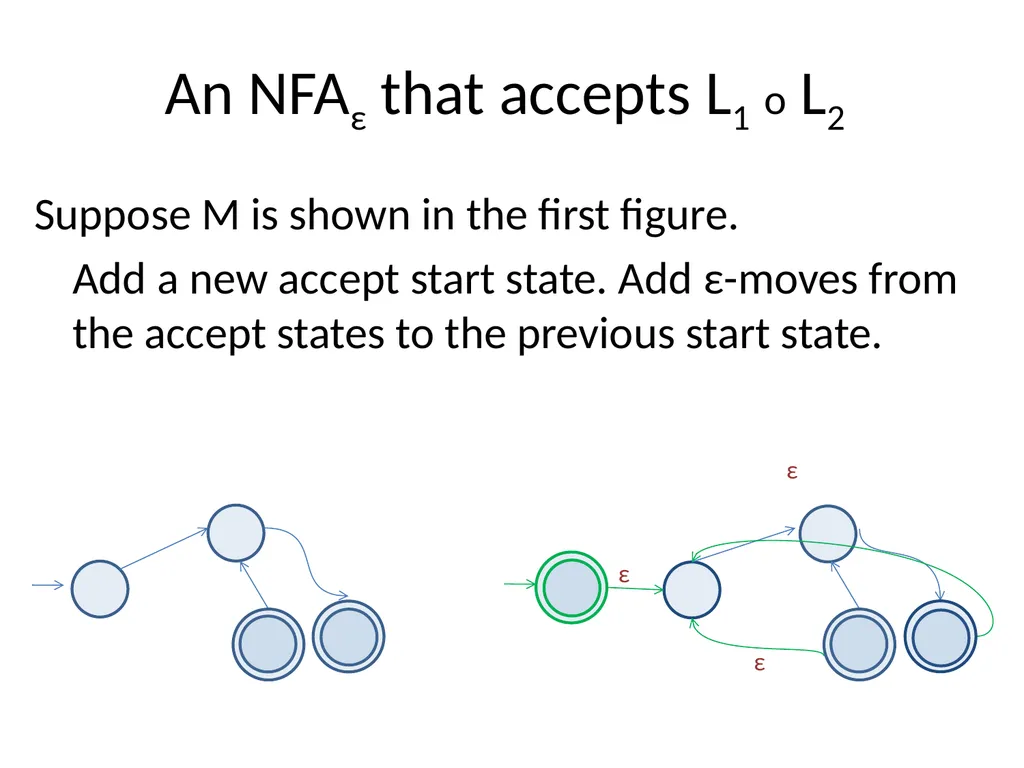
slide10. An NFAε that accepts L1 o L2 Suppose M is shown in the first figure.
Add a new accept start state. Add ε-moves from the accept states to the previous start state.<br>