
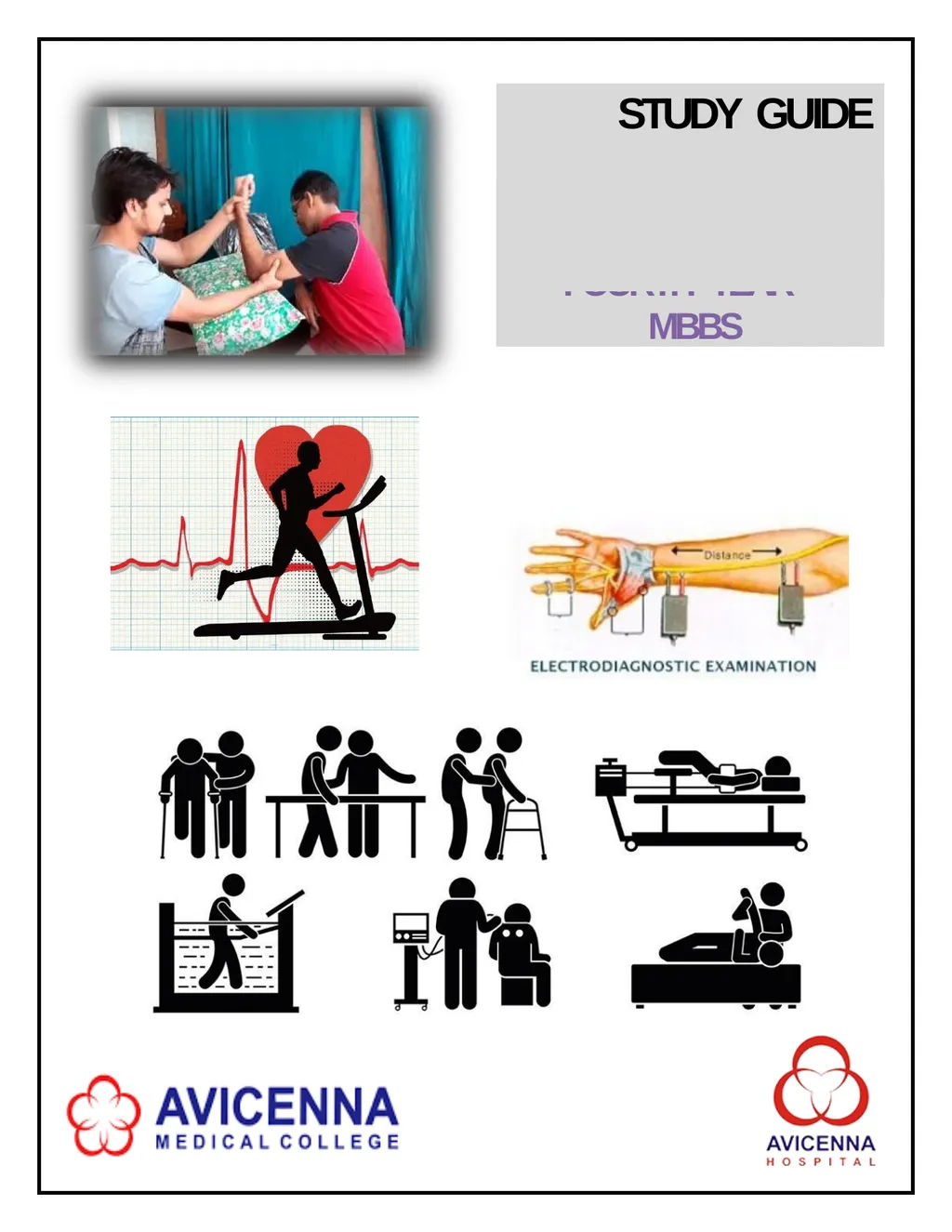
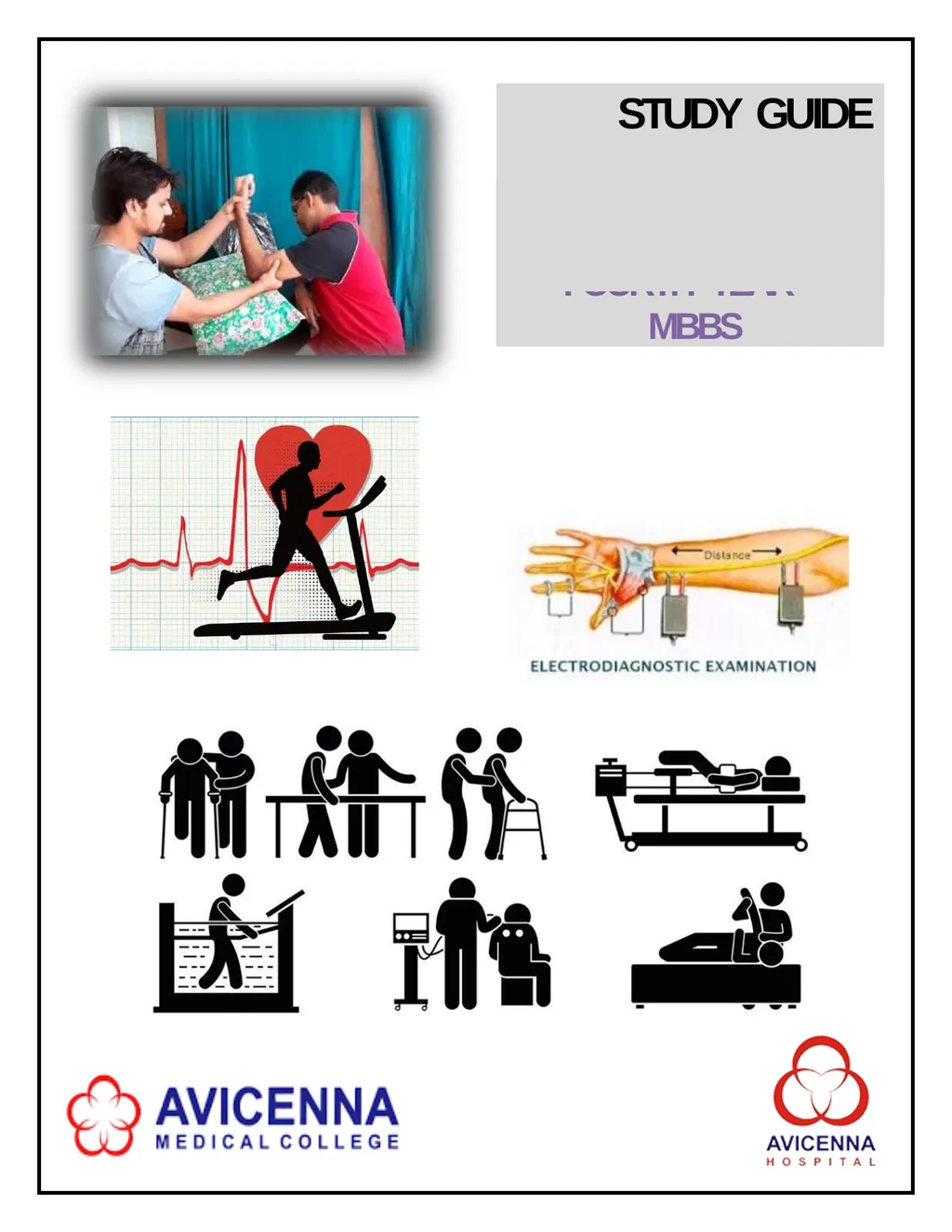
REHABILITATION MODULE FOURTH YEAR MBBS STUDY GUIDE
DJ
Published · 17 slides · 0 views
1 / 1
Description
REHABILITATION MODULE FOURTH YEAR MBBS STUDY GUIDE 4th YEAR MBBS, REHABILITATION MODULE Page 2 LIAQUAT NATIONAL MEDICAL COLLEGE STUDY GUIDE FOR REHABILITATION MODULE AVICENNA MEDICAL COLLEGE 4th YEAR MBBS, REHABILITATION MODULE Page 3
Related Topics
Download this presentation From Below
"REHABILITATION MODULE FOURTH YEAR MBBS STUDY GUIDE" is the property of its rightful owner. Permission is granted to download and print the materials on this website for personal, non-commercial use only, and to display it on your personal computer provided you do not modify the materials and that you retain all copyright notices contained in the materials. By downloading content from our website, you accept the terms of this agreement.
Share
Embed code
Presentation Transcript
01
REHABILITATION MODULE FOURTH YEAR
MBBS STUDY GUIDE<br>
MBBS STUDY GUIDE<br>
02
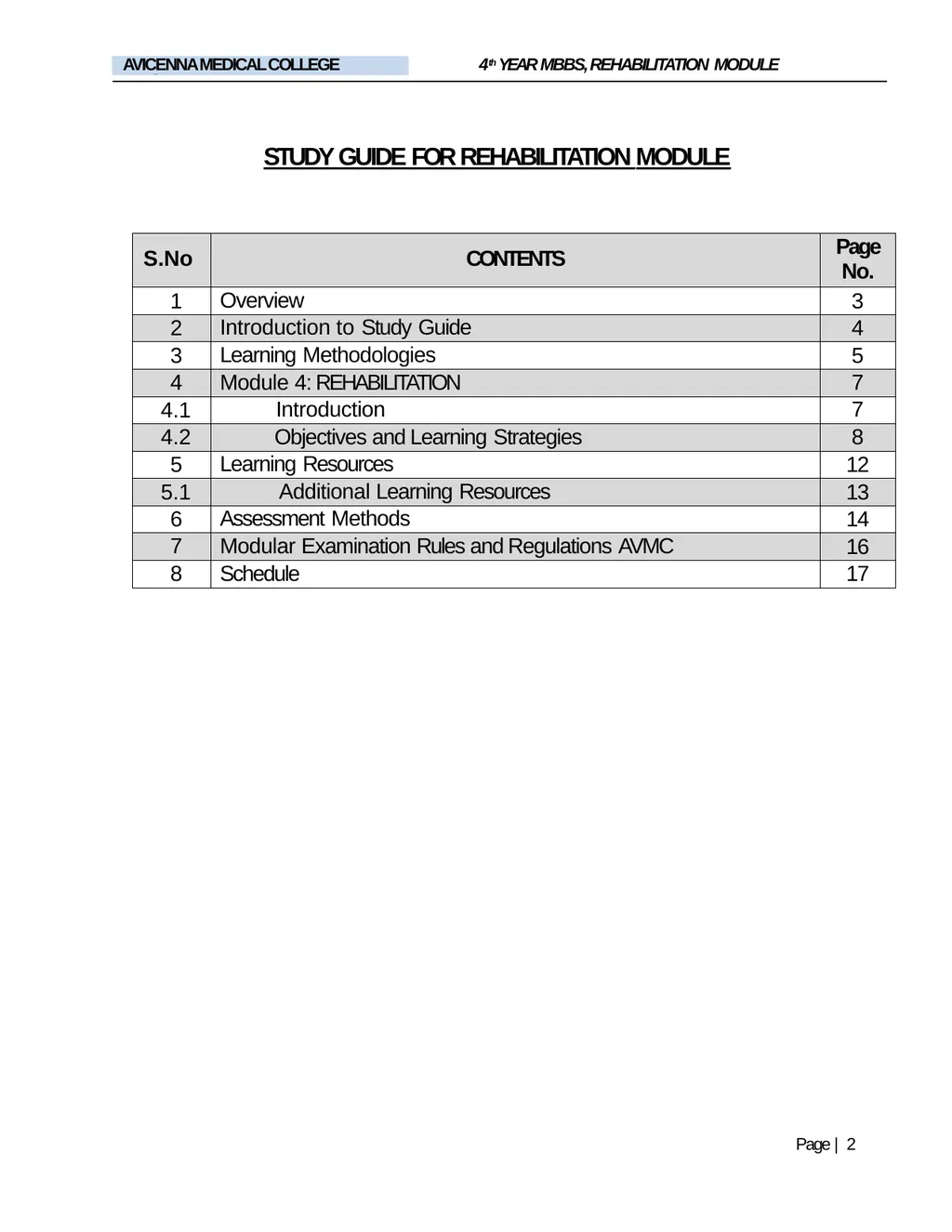
4th YEAR MBBS, REHABILITATION MODULE Page | 2 LIAQUAT NATIONAL MEDICAL COLLEGE STUDY GUIDE FOR REHABILITATION MODULE AVICENNA MEDICAL COLLEGE<br>
03
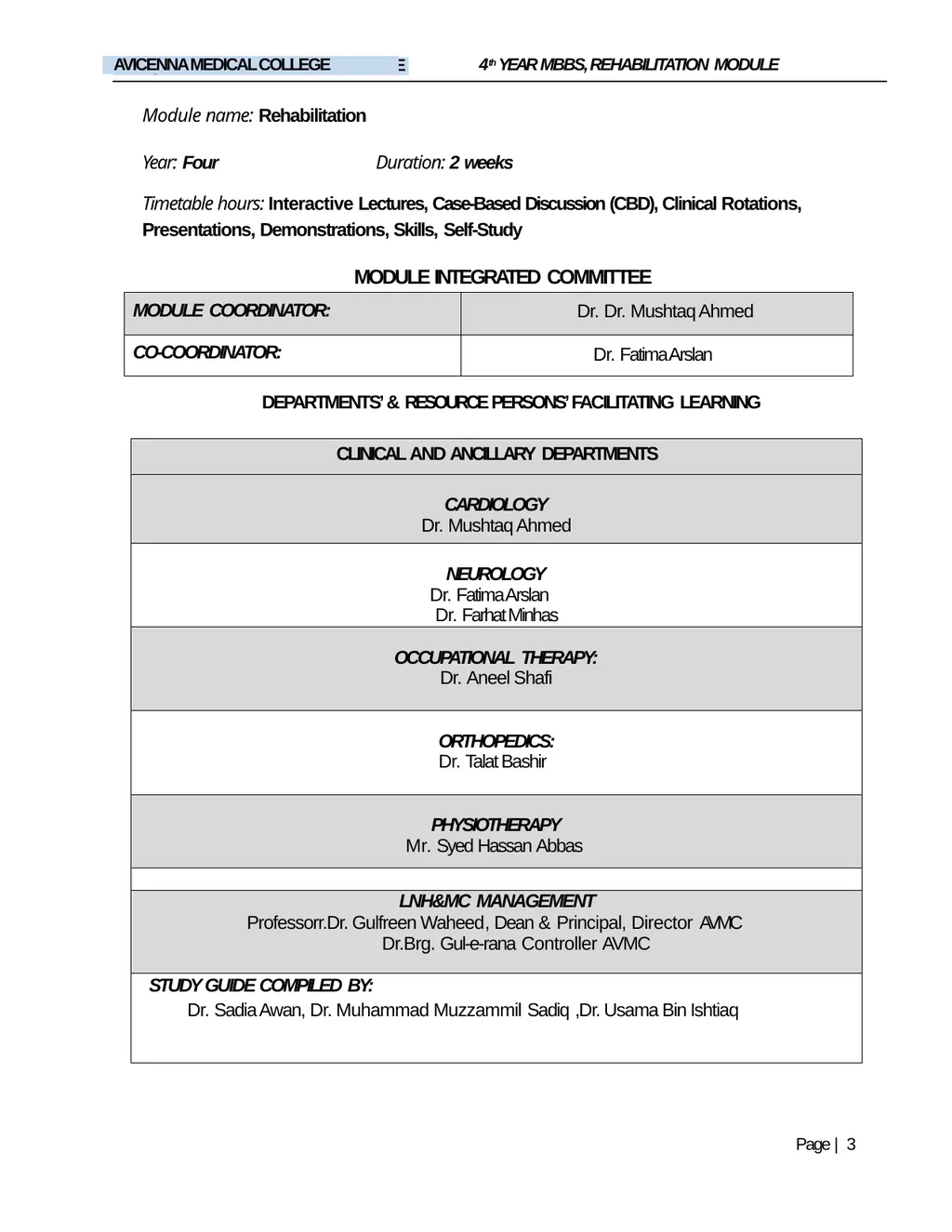
4th YEAR MBBS, REHABILITATION MODULE Page | 3 LIAQUAT NATIONAL MEDICAL COLLEGE Module name: Rehabilitation
Year: Four Duration: 2 weeks
Timetable hours: Interactive Lectures, Case-Based Discussion (CBD), Clinical Rotations, Presentations, Demonstrations, Skills, Self-Study
MODULE INTEGRATED COMMITTEE DEPARTMENTS’ & RESOURCE PERSONS’ FACILITATING LEARNING AVICENNA MEDICAL COLLEGE<br>
Year: Four Duration: 2 weeks
Timetable hours: Interactive Lectures, Case-Based Discussion (CBD), Clinical Rotations, Presentations, Demonstrations, Skills, Self-Study
MODULE INTEGRATED COMMITTEE DEPARTMENTS’ & RESOURCE PERSONS’ FACILITATING LEARNING AVICENNA MEDICAL COLLEGE<br>
04
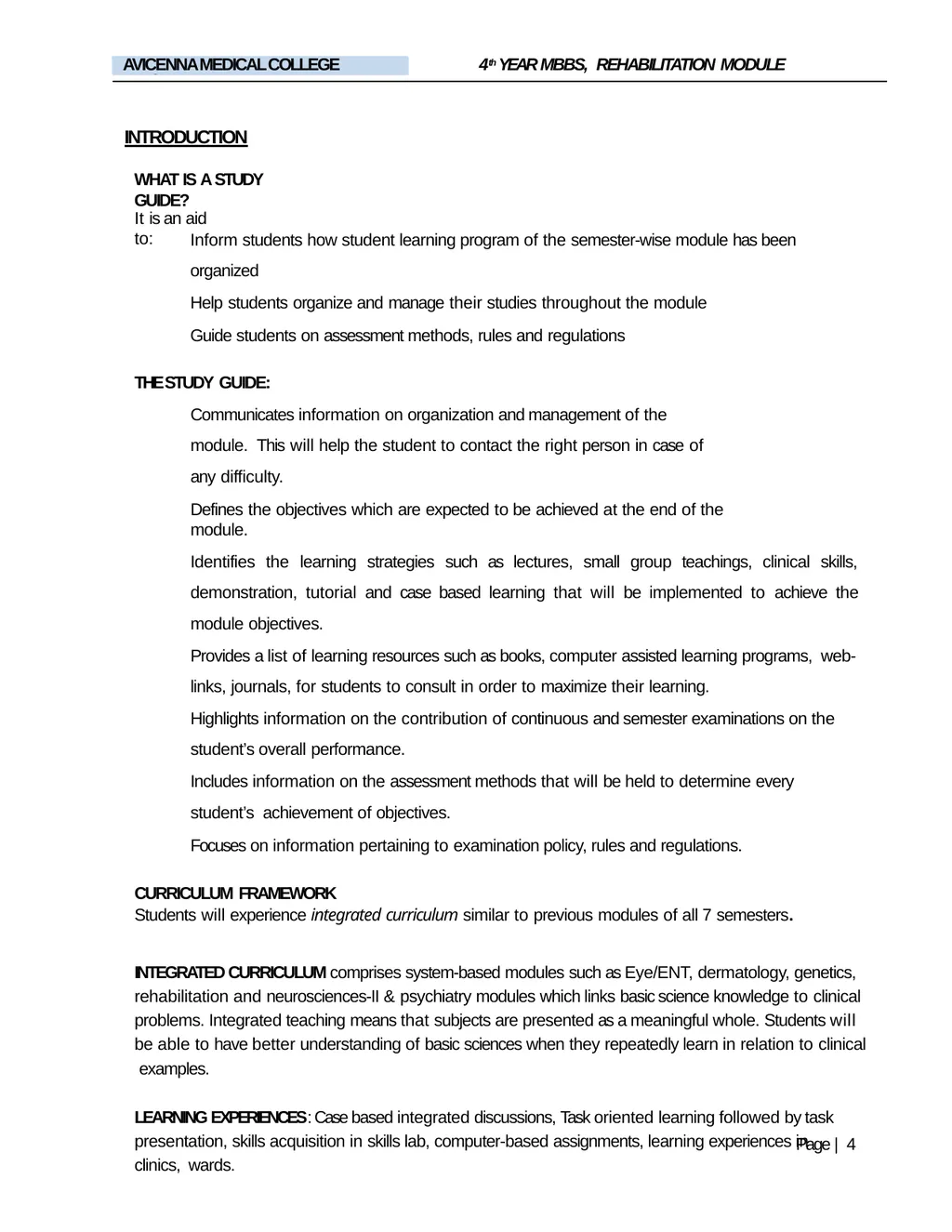
4th YEAR MBBS, REHABILITATION MODULE Page | 4 LIAQUAT NATIONAL MEDICAL COLLEGE INTRODUCTION
WHAT IS A STUDY GUIDE? It is an aid to: Inform students how student learning program of the semester-wise module has been organized
Help students organize and manage their studies throughout the module
Guide students on assessment methods, rules and regulations THE STUDY GUIDE:
Communicates information on organization and management of the module. This will help the student to contact the right person in case of any difficulty.
Defines the objectives which are expected to be achieved at the end of the module.
Identifies the learning strategies such as lectures, small group teachings, clinical skills, demonstration, tutorial and case based learning that will be implemented to achieve the module objectives.
Provides a list of learning resources such as books, computer assisted learning programs, web- links, journals, for students to consult in order to maximize their learning.
Highlights information on the contribution of continuous and semester examinations on the student’s overall performance.
Includes information on the assessment methods that will be held to determine every student’s achievement of objectives.
Focuses on information pertaining to examination policy, rules and regulations.
CURRICULUM FRAMEWORK
Students will experience integrated curriculum similar to previous modules of all 7 semesters.
INTEGRATED CURRICULUM comprises system-based modules such as Eye/ENT, dermatology, genetics, rehabilitation and neurosciences-II & psychiatry modules which links basic science knowledge to clinical problems. Integrated teaching means that subjects are presented as a meaningful whole. Students will be able to have better understanding of basic sciences when they repeatedly learn in relation to clinical examples.
LEARNING EXPERIENCES: Case based integrated discussions, Task oriented learning followed by task presentation, skills acquisition in skills lab, computer-based assignments, learning experiences in clinics, wards. AVICENNA MEDICAL COLLEGE<br>
WHAT IS A STUDY GUIDE? It is an aid to: Inform students how student learning program of the semester-wise module has been organized
Help students organize and manage their studies throughout the module
Guide students on assessment methods, rules and regulations THE STUDY GUIDE:
Communicates information on organization and management of the module. This will help the student to contact the right person in case of any difficulty.
Defines the objectives which are expected to be achieved at the end of the module.
Identifies the learning strategies such as lectures, small group teachings, clinical skills, demonstration, tutorial and case based learning that will be implemented to achieve the module objectives.
Provides a list of learning resources such as books, computer assisted learning programs, web- links, journals, for students to consult in order to maximize their learning.
Highlights information on the contribution of continuous and semester examinations on the student’s overall performance.
Includes information on the assessment methods that will be held to determine every student’s achievement of objectives.
Focuses on information pertaining to examination policy, rules and regulations.
CURRICULUM FRAMEWORK
Students will experience integrated curriculum similar to previous modules of all 7 semesters.
INTEGRATED CURRICULUM comprises system-based modules such as Eye/ENT, dermatology, genetics, rehabilitation and neurosciences-II & psychiatry modules which links basic science knowledge to clinical problems. Integrated teaching means that subjects are presented as a meaningful whole. Students will be able to have better understanding of basic sciences when they repeatedly learn in relation to clinical examples.
LEARNING EXPERIENCES: Case based integrated discussions, Task oriented learning followed by task presentation, skills acquisition in skills lab, computer-based assignments, learning experiences in clinics, wards. AVICENNA MEDICAL COLLEGE<br>
05
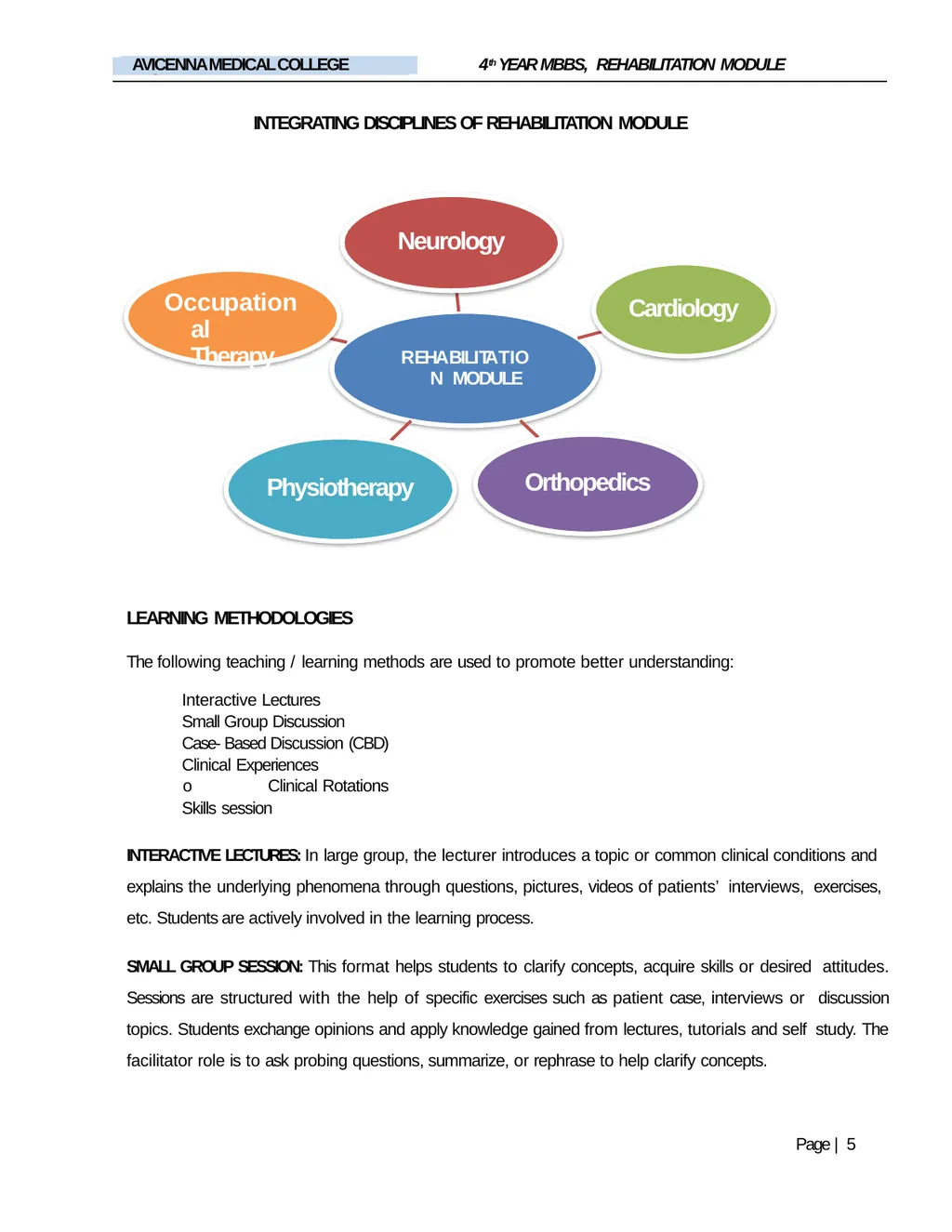
4th YEAR MBBS, REHABILITATION MODULE LIAQUAT NATIONAL MEDICAL COLLEGE INTEGRATING DISCIPLINES OF REHABILITATION MODULE LEARNING METHODOLOGIES
The following teaching / learning methods are used to promote better understanding:
Interactive Lectures
Small Group Discussion
Case- Based Discussion (CBD)
Clinical Experiences
o Clinical Rotations
Skills session
INTERACTIVE LECTURES: In large group, the lecturer introduces a topic or common clinical conditions and explains the underlying phenomena through questions, pictures, videos of patients’ interviews, exercises, etc. Students are actively involved in the learning process.
SMALL GROUP SESSION: This format helps students to clarify concepts, acquire skills or desired attitudes. Sessions are structured with the help of specific exercises such as patient case, interviews or discussion topics. Students exchange opinions and apply knowledge gained from lectures, tutorials and self study. The facilitator role is to ask probing questions, summarize, or rephrase to help clarify concepts. REHABILITATION MODULE Neurology Cardiology Orthopedics Physiotherapy Occupational Therapy Page | 5 AVICENNA MEDICAL COLLEGE<br>
The following teaching / learning methods are used to promote better understanding:
Interactive Lectures
Small Group Discussion
Case- Based Discussion (CBD)
Clinical Experiences
o Clinical Rotations
Skills session
INTERACTIVE LECTURES: In large group, the lecturer introduces a topic or common clinical conditions and explains the underlying phenomena through questions, pictures, videos of patients’ interviews, exercises, etc. Students are actively involved in the learning process.
SMALL GROUP SESSION: This format helps students to clarify concepts, acquire skills or desired attitudes. Sessions are structured with the help of specific exercises such as patient case, interviews or discussion topics. Students exchange opinions and apply knowledge gained from lectures, tutorials and self study. The facilitator role is to ask probing questions, summarize, or rephrase to help clarify concepts. REHABILITATION MODULE Neurology Cardiology Orthopedics Physiotherapy Occupational Therapy Page | 5 AVICENNA MEDICAL COLLEGE<br>
06
LIAQUAT NATIONAL MEDICAL COLLEGE 4th YEAR MBBS, REHABILITATION MODULE
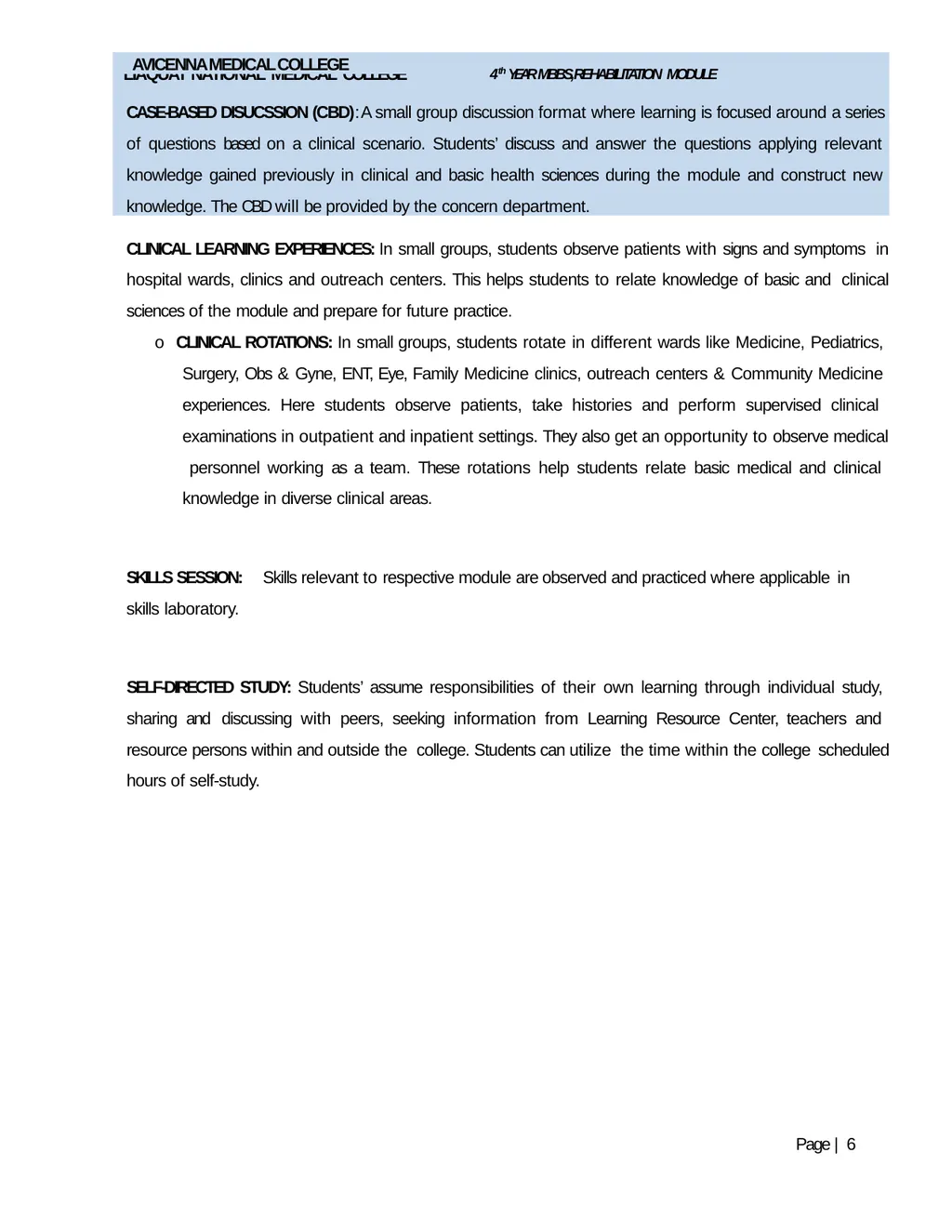
CASE-BASED DISUCSSION (CBD): A small group discussion format where learning is focused around a series of questions based on a clinical scenario. Students’ discuss and answer the questions applying relevant knowledge gained previously in clinical and basic health sciences during the module and construct new knowledge. The CBD will be provided by the concern department. Page | 6 CLINICAL LEARNING EXPERIENCES: In small groups, students observe patients with signs and symptoms in hospital wards, clinics and outreach centers. This helps students to relate knowledge of basic and clinical sciences of the module and prepare for future practice.
o CLINICAL ROTATIONS: In small groups, students rotate in different wards like Medicine, Pediatrics, Surgery, Obs & Gyne, ENT, Eye, Family Medicine clinics, outreach centers & Community Medicine experiences. Here students observe patients, take histories and perform supervised clinical examinations in outpatient and inpatient settings. They also get an opportunity to observe medical personnel working as a team. These rotations help students relate basic medical and clinical knowledge in diverse clinical areas. Skills relevant to respective module are observed and practiced where applicable in SKILLS SESSION:
skills laboratory. SELF-DIRECTED STUDY: Students’ assume responsibilities of their own learning through individual study, sharing and discussing with peers, seeking information from Learning Resource Center, teachers and resource persons within and outside the college. Students can utilize the time within the college scheduled hours of self-study. AVICENNA MEDICAL COLLEGE<br>
CASE-BASED DISUCSSION (CBD): A small group discussion format where learning is focused around a series of questions based on a clinical scenario. Students’ discuss and answer the questions applying relevant knowledge gained previously in clinical and basic health sciences during the module and construct new knowledge. The CBD will be provided by the concern department. Page | 6 CLINICAL LEARNING EXPERIENCES: In small groups, students observe patients with signs and symptoms in hospital wards, clinics and outreach centers. This helps students to relate knowledge of basic and clinical sciences of the module and prepare for future practice.
o CLINICAL ROTATIONS: In small groups, students rotate in different wards like Medicine, Pediatrics, Surgery, Obs & Gyne, ENT, Eye, Family Medicine clinics, outreach centers & Community Medicine experiences. Here students observe patients, take histories and perform supervised clinical examinations in outpatient and inpatient settings. They also get an opportunity to observe medical personnel working as a team. These rotations help students relate basic medical and clinical knowledge in diverse clinical areas. Skills relevant to respective module are observed and practiced where applicable in SKILLS SESSION:
skills laboratory. SELF-DIRECTED STUDY: Students’ assume responsibilities of their own learning through individual study, sharing and discussing with peers, seeking information from Learning Resource Center, teachers and resource persons within and outside the college. Students can utilize the time within the college scheduled hours of self-study. AVICENNA MEDICAL COLLEGE<br>
07
LIAQUAT NATIONAL MEDICAL COLLEGE 4th YEAR MBBS, REHABILITATION MODULE
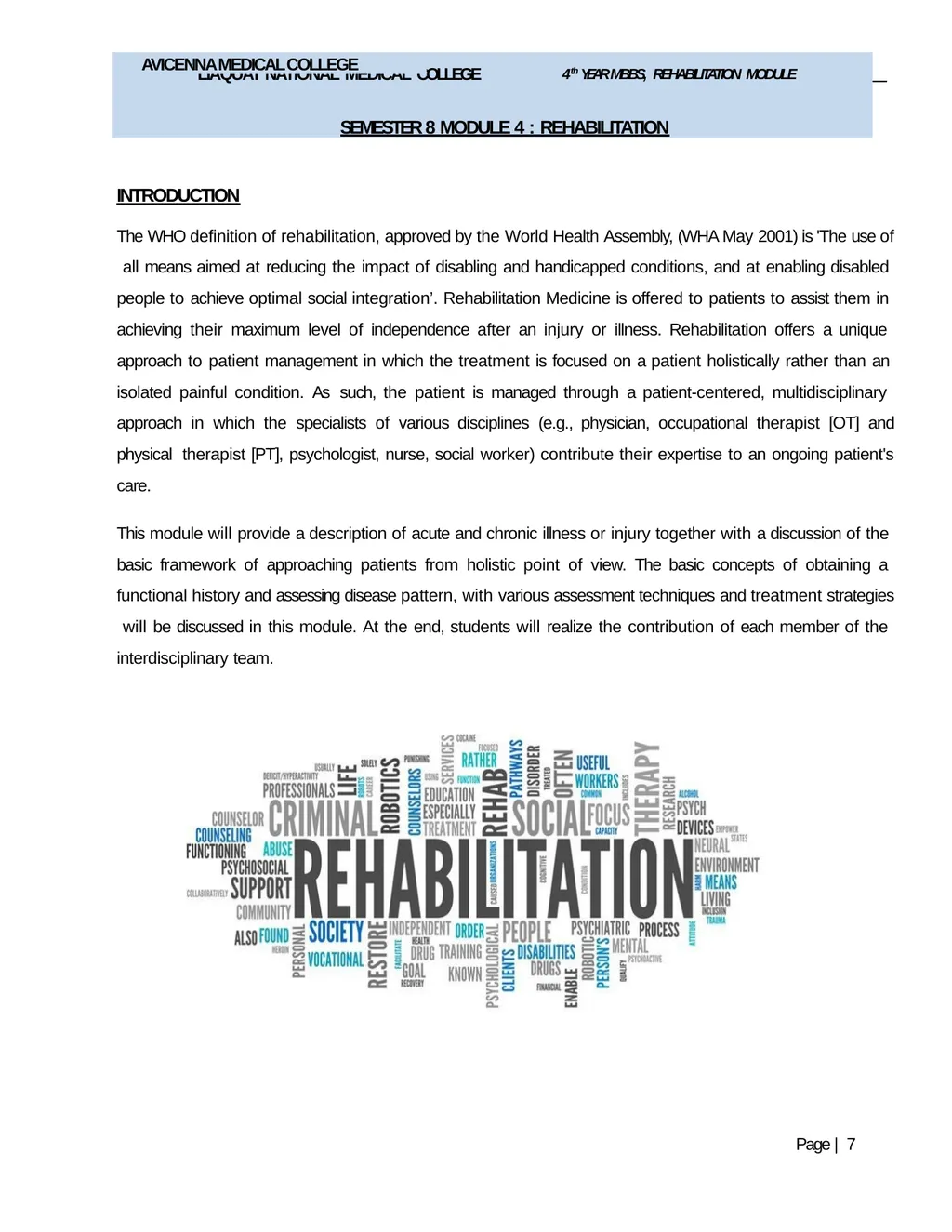
SEMESTER 8 MODULE 4 : REHABILITATION Page | 7 INTRODUCTION
The WHO definition of rehabilitation, approved by the World Health Assembly, (WHA May 2001) is 'The use of all means aimed at reducing the impact of disabling and handicapped conditions, and at enabling disabled people to achieve optimal social integration’. Rehabilitation Medicine is offered to patients to assist them in achieving their maximum level of independence after an injury or illness. Rehabilitation offers a unique approach to patient management in which the treatment is focused on a patient holistically rather than an isolated painful condition. As such, the patient is managed through a patient-centered, multidisciplinary approach in which the specialists of various disciplines (e.g., physician, occupational therapist [OT] and physical therapist [PT], psychologist, nurse, social worker) contribute their expertise to an ongoing patient's care.
This module will provide a description of acute and chronic illness or injury together with a discussion of the basic framework of approaching patients from holistic point of view. The basic concepts of obtaining a functional history and assessing disease pattern, with various assessment techniques and treatment strategies will be discussed in this module. At the end, students will realize the contribution of each member of the interdisciplinary team. AVICENNA MEDICAL COLLEGE<br>
SEMESTER 8 MODULE 4 : REHABILITATION Page | 7 INTRODUCTION
The WHO definition of rehabilitation, approved by the World Health Assembly, (WHA May 2001) is 'The use of all means aimed at reducing the impact of disabling and handicapped conditions, and at enabling disabled people to achieve optimal social integration’. Rehabilitation Medicine is offered to patients to assist them in achieving their maximum level of independence after an injury or illness. Rehabilitation offers a unique approach to patient management in which the treatment is focused on a patient holistically rather than an isolated painful condition. As such, the patient is managed through a patient-centered, multidisciplinary approach in which the specialists of various disciplines (e.g., physician, occupational therapist [OT] and physical therapist [PT], psychologist, nurse, social worker) contribute their expertise to an ongoing patient's care.
This module will provide a description of acute and chronic illness or injury together with a discussion of the basic framework of approaching patients from holistic point of view. The basic concepts of obtaining a functional history and assessing disease pattern, with various assessment techniques and treatment strategies will be discussed in this module. At the end, students will realize the contribution of each member of the interdisciplinary team. AVICENNA MEDICAL COLLEGE<br>
08
LIAQUAT NATIONAL MEDICAL COLLEGE 4th YEAR MBBS, REHABILITATION MODULE
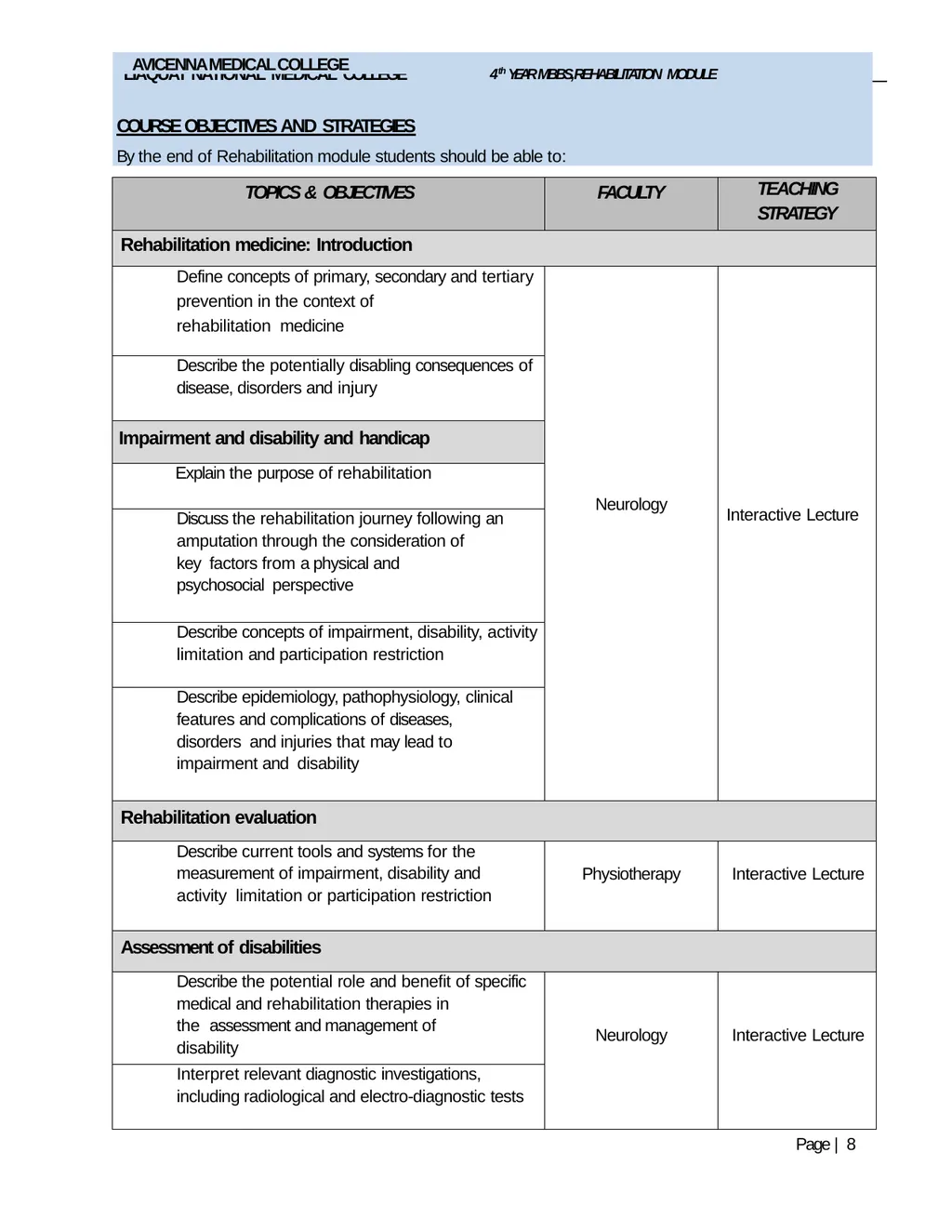
COURSE OBJECTIVES AND STRATEGIES
By the end of Rehabilitation module students should be able to: Page | 8 AVICENNA MEDICAL COLLEGE<br>
COURSE OBJECTIVES AND STRATEGIES
By the end of Rehabilitation module students should be able to: Page | 8 AVICENNA MEDICAL COLLEGE<br>
09
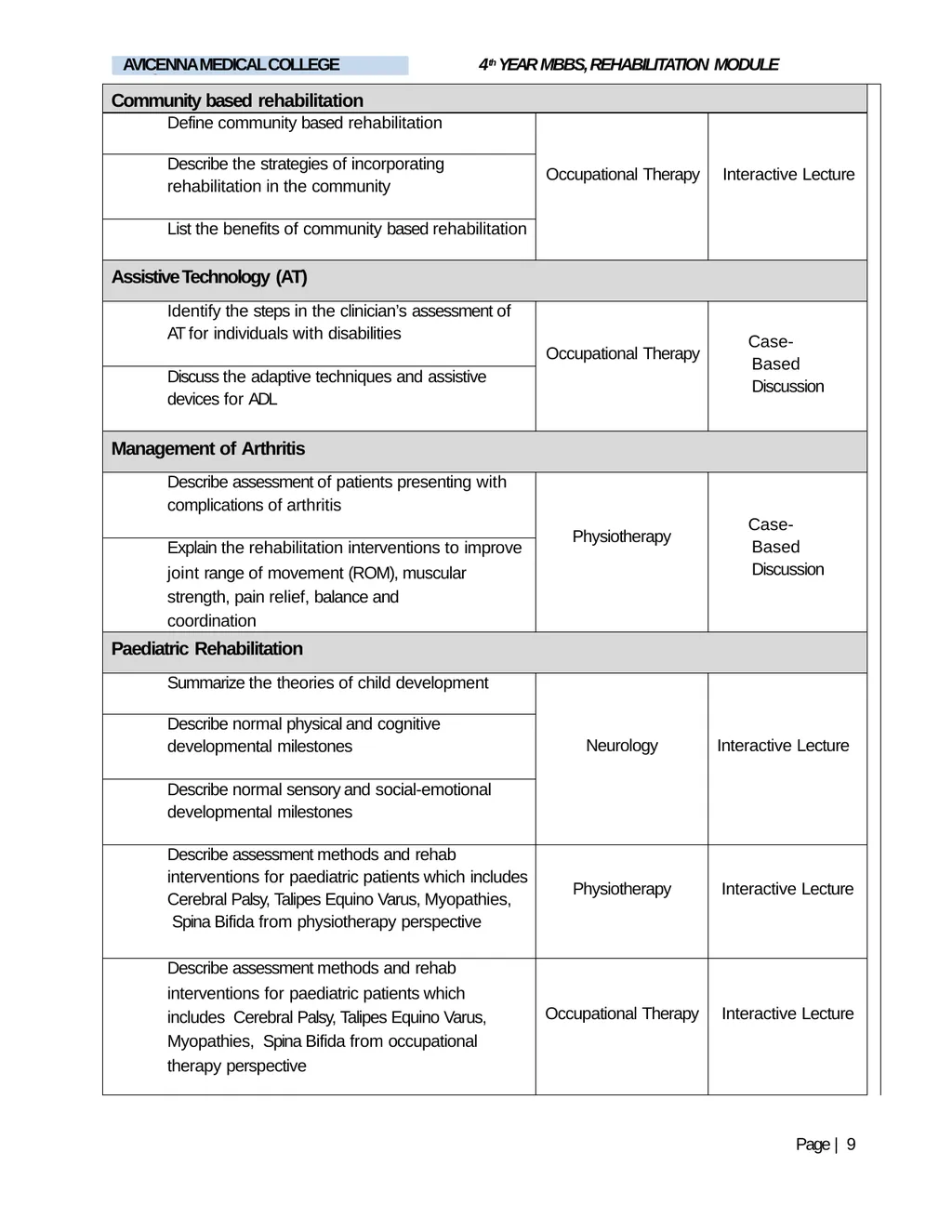
Page | 9 4th YEAR MBBS, REHABILITATION MODULE LIAQUAT NATIONAL MEDICAL COLLEGE AVICENNA MEDICAL COLLEGE<br>
10
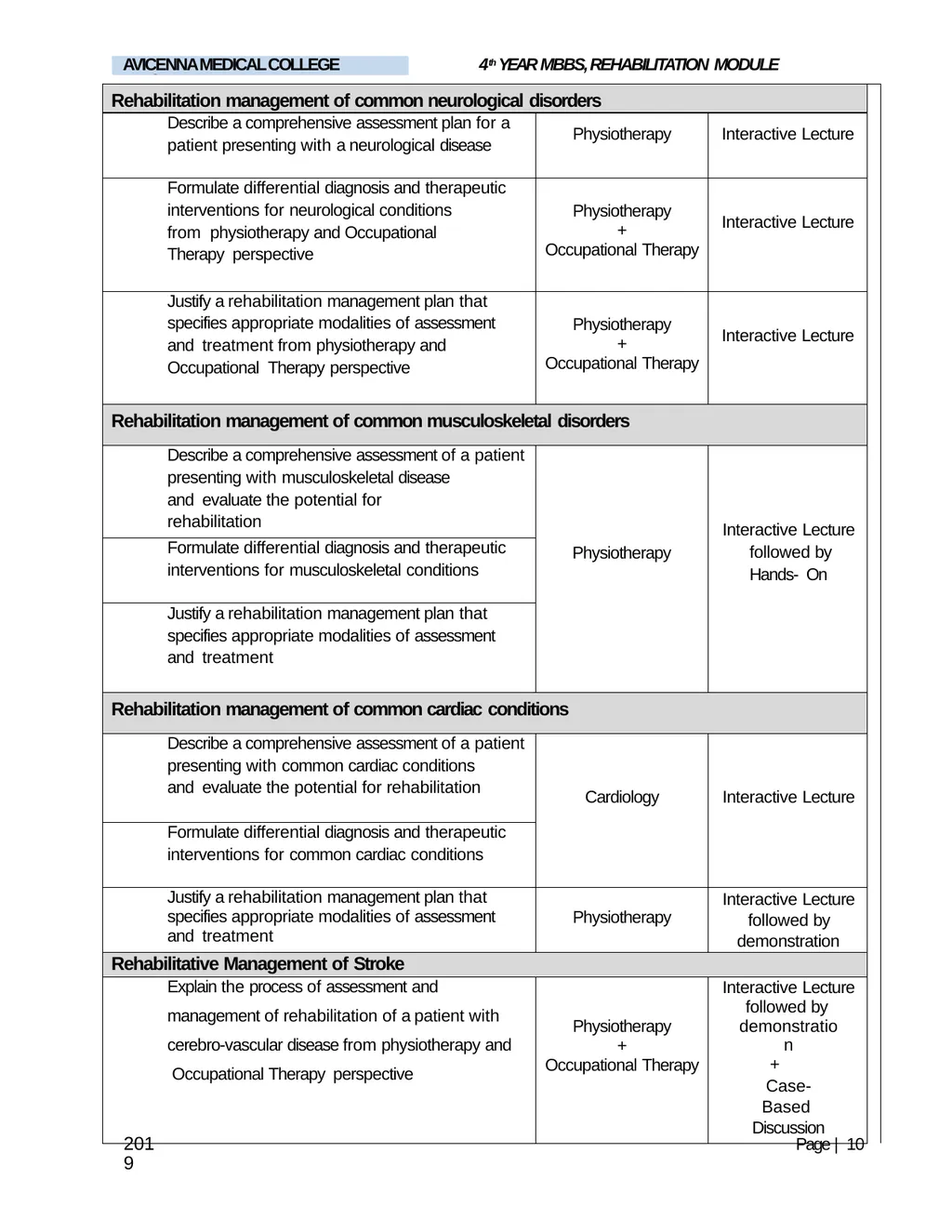
2019 Page | 10 4th YEAR MBBS, REHABILITATION MODULE LIAQUAT NATIONAL MEDICAL COLLEGE AVICENNA MEDICAL COLLEGE<br>
11
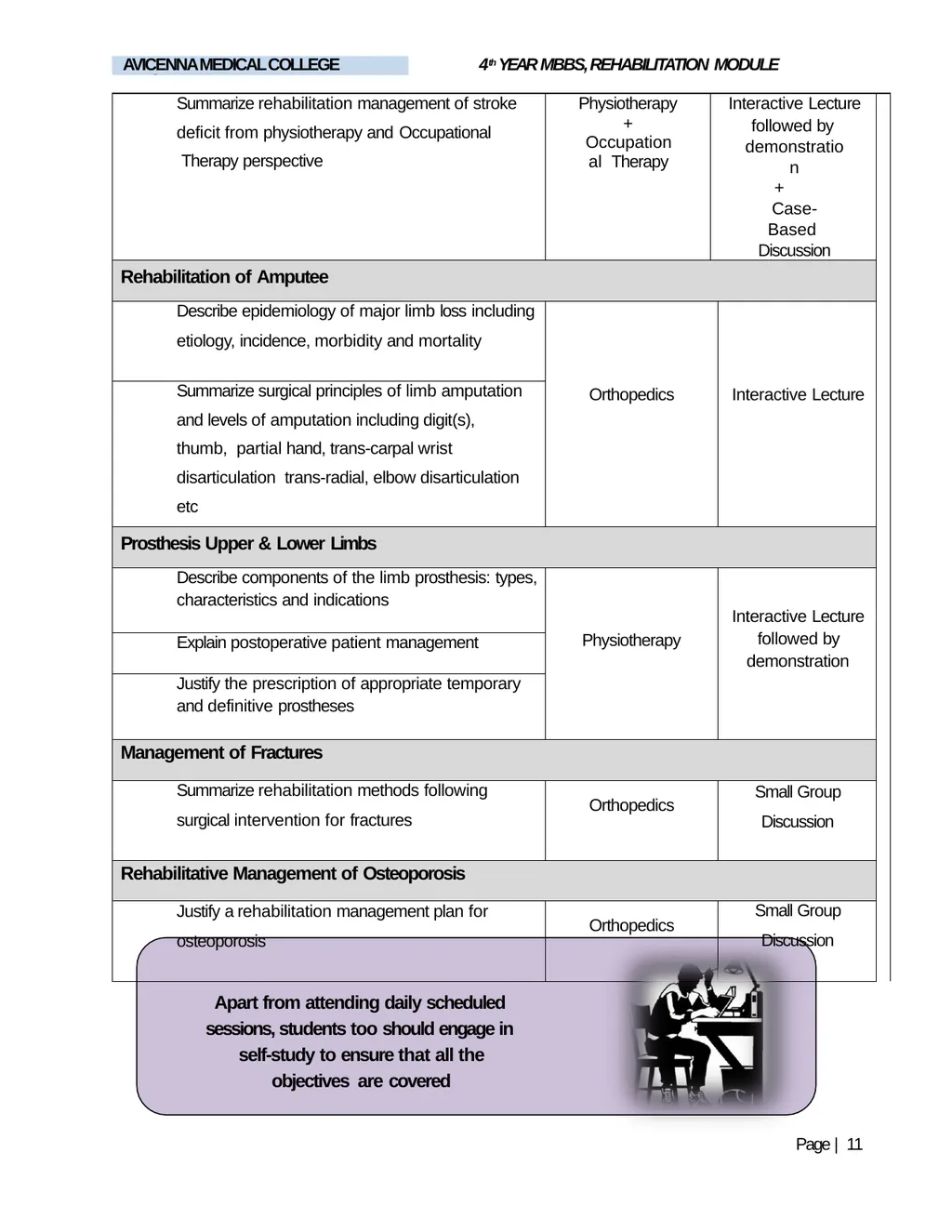
4th YEAR MBBS, REHABILITATION MODULE LIAQUAT NATIONAL MEDICAL COLLEGE Apart from attending daily scheduled sessions, students too should engage in self-study to ensure that all the objectives are covered Page | 11 AVICENNA MEDICAL COLLEGE<br>
12
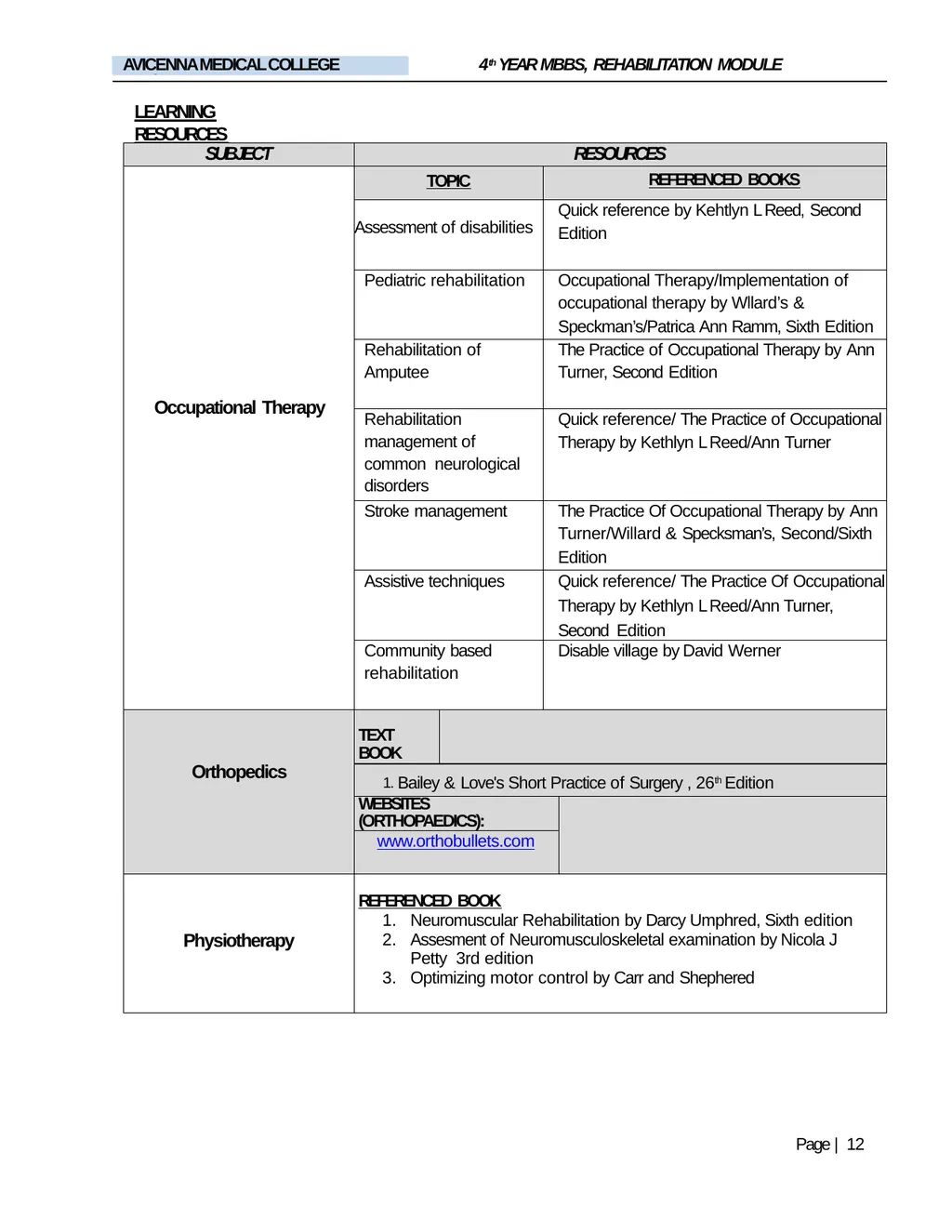
4th YEAR MBBS, REHABILITATION MODULE Page | 12 LIAQUAT NATIONAL MEDICAL COLLEGE LEARNING RESOURCES AVICENNA MEDICAL COLLEGE<br>
13
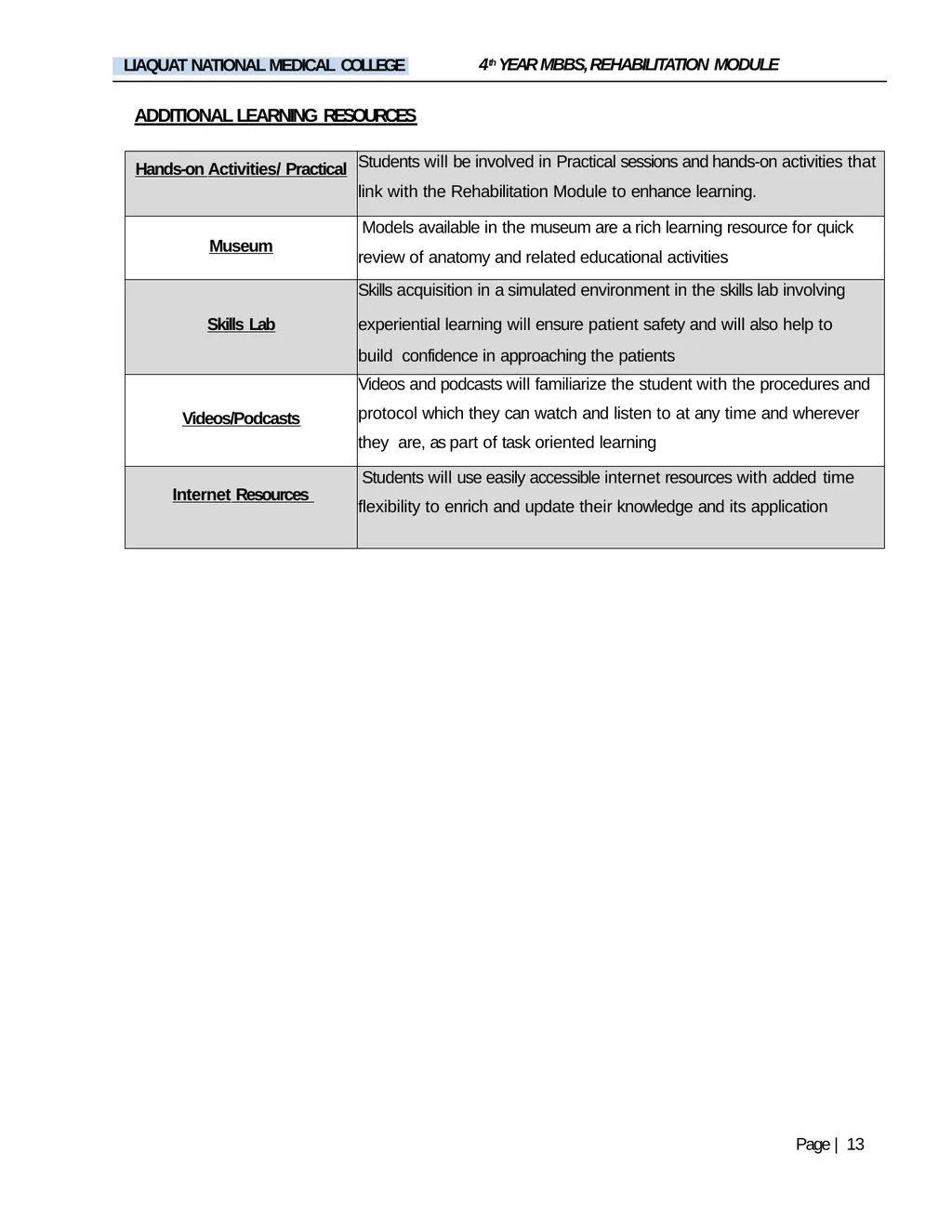
4th YEAR MBBS, REHABILITATION MODULE Page | 13 LIAQUAT NATIONAL MEDICAL COLLEGE ADDITIONAL LEARNING RESOURCES<br>
14
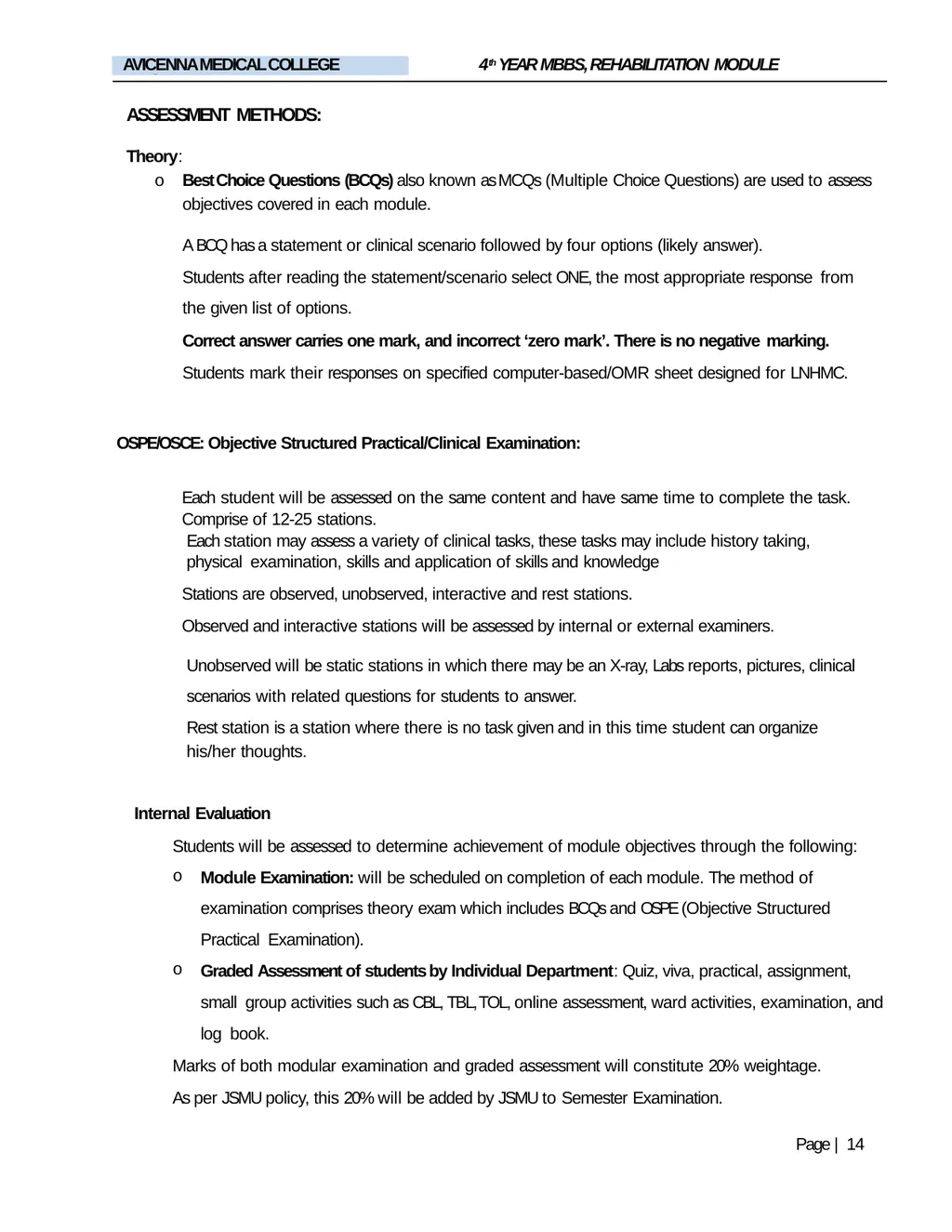
4th YEAR MBBS, REHABILITATION MODULE Page | 14 LIAQUAT NATIONAL MEDICAL COLLEGE ASSESSMENT METHODS:
Theory:
o Best Choice Questions (BCQs) also known as MCQs (Multiple Choice Questions) are used to assess objectives covered in each module.
A BCQ has a statement or clinical scenario followed by four options (likely answer).
Students after reading the statement/scenario select ONE, the most appropriate response from the given list of options.
Correct answer carries one mark, and incorrect ‘zero mark’. There is no negative marking.
Students mark their responses on specified computer-based/OMR sheet designed for LNHMC.
OSPE/OSCE: Objective Structured Practical/Clinical Examination:
Each student will be assessed on the same content and have same time to complete the task.
Comprise of 12-25 stations.
Each station may assess a variety of clinical tasks, these tasks may include history taking, physical examination, skills and application of skills and knowledge
Stations are observed, unobserved, interactive and rest stations.
Observed and interactive stations will be assessed by internal or external examiners.
Unobserved will be static stations in which there may be an X-ray, Labs reports, pictures, clinical scenarios with related questions for students to answer.
Rest station is a station where there is no task given and in this time student can organize his/her thoughts.
Internal Evaluation
Students will be assessed to determine achievement of module objectives through the following:
Module Examination: will be scheduled on completion of each module. The method of examination comprises theory exam which includes BCQs and OSPE (Objective Structured Practical Examination).
Graded Assessment of students by Individual Department: Quiz, viva, practical, assignment, small group activities such as CBL, TBL, TOL, online assessment, ward activities, examination, and log book.
Marks of both modular examination and graded assessment will constitute 20% weightage.
As per JSMU policy, this 20% will be added by JSMU to Semester Examination. AVICENNA MEDICAL COLLEGE<br>
Theory:
o Best Choice Questions (BCQs) also known as MCQs (Multiple Choice Questions) are used to assess objectives covered in each module.
A BCQ has a statement or clinical scenario followed by four options (likely answer).
Students after reading the statement/scenario select ONE, the most appropriate response from the given list of options.
Correct answer carries one mark, and incorrect ‘zero mark’. There is no negative marking.
Students mark their responses on specified computer-based/OMR sheet designed for LNHMC.
OSPE/OSCE: Objective Structured Practical/Clinical Examination:
Each student will be assessed on the same content and have same time to complete the task.
Comprise of 12-25 stations.
Each station may assess a variety of clinical tasks, these tasks may include history taking, physical examination, skills and application of skills and knowledge
Stations are observed, unobserved, interactive and rest stations.
Observed and interactive stations will be assessed by internal or external examiners.
Unobserved will be static stations in which there may be an X-ray, Labs reports, pictures, clinical scenarios with related questions for students to answer.
Rest station is a station where there is no task given and in this time student can organize his/her thoughts.
Internal Evaluation
Students will be assessed to determine achievement of module objectives through the following:
Module Examination: will be scheduled on completion of each module. The method of examination comprises theory exam which includes BCQs and OSPE (Objective Structured Practical Examination).
Graded Assessment of students by Individual Department: Quiz, viva, practical, assignment, small group activities such as CBL, TBL, TOL, online assessment, ward activities, examination, and log book.
Marks of both modular examination and graded assessment will constitute 20% weightage.
As per JSMU policy, this 20% will be added by JSMU to Semester Examination. AVICENNA MEDICAL COLLEGE<br>
15
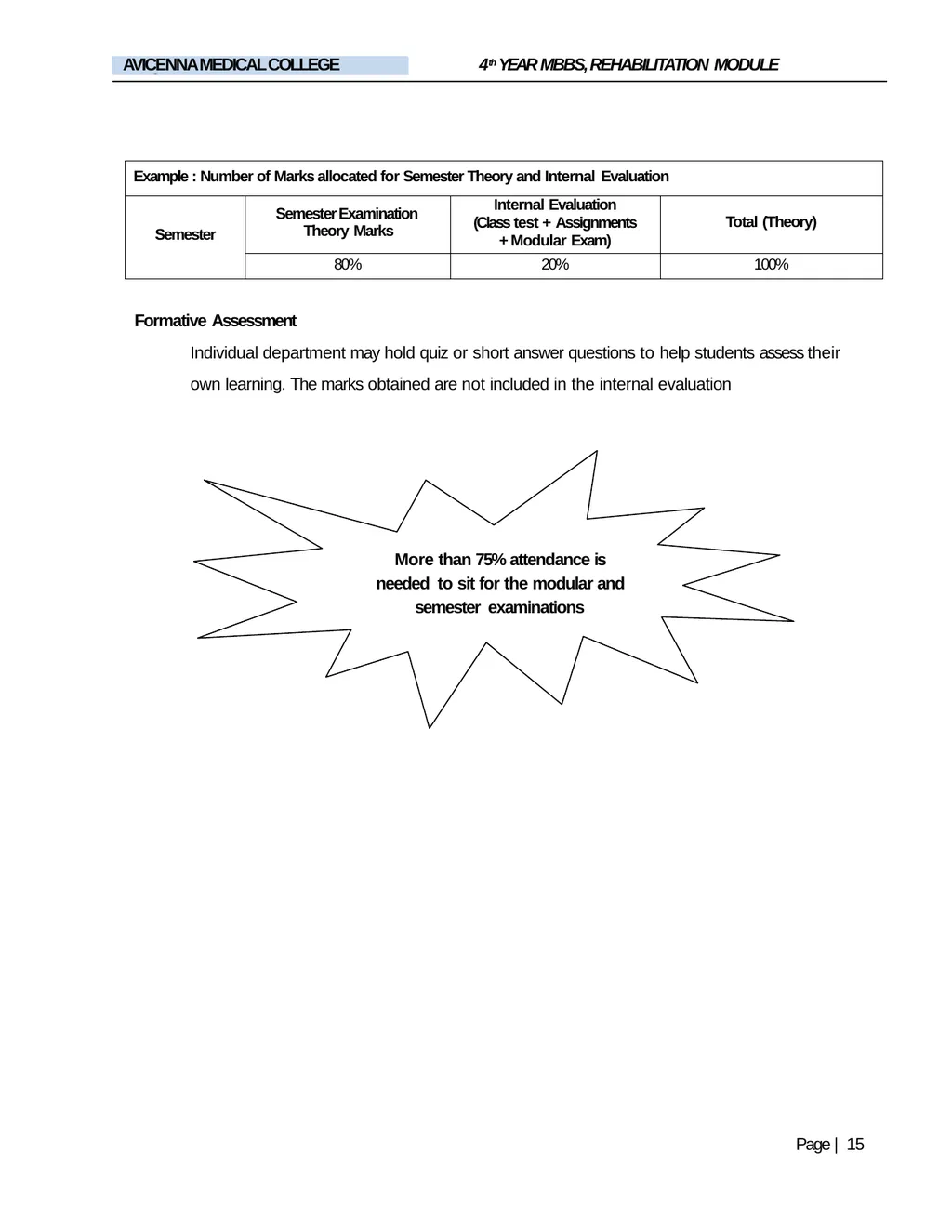
4th YEAR MBBS, REHABILITATION MODULE LIAQUAT NATIONAL MEDICAL COLLEGE Page | 15 Formative Assessment
Individual department may hold quiz or short answer questions to help students assess their own learning. The marks obtained are not included in the internal evaluation More than 75% attendance is needed to sit for the modular and semester examinations AVICENNA MEDICAL COLLEGE<br>
Individual department may hold quiz or short answer questions to help students assess their own learning. The marks obtained are not included in the internal evaluation More than 75% attendance is needed to sit for the modular and semester examinations AVICENNA MEDICAL COLLEGE<br>
16
LIAQUAT NATIONAL MEDICAL COLLEGE 4th YEAR MBBS, REHABILITATION MODULE
MODULAR EXAMINATION RULES & REGULATIONS (AVMC) Page | 16 Student must report to examination hall/venue, 30 minutes before the exam.
Exam will begin sharp at the given time.
No student will be allowed to enter the examination hall after 15 minutes of scheduled examination time.
Students must sit according to their roll numbers mentioned on the seats.
Cell phones are strictly not allowed in examination hall.
If any student is found with cell phone in any mode (silent, switched off or on) he/she will be not be allowed to continue their exam.
No students will be allowed to sit in exam without University Admit Card, AVMC College ID Card and Lab Coat
Student must bring the following stationary items for the exam: Pen, Pencil, Eraser, and Sharpener.
Indiscipline in the exam hall/venue is not acceptable. Students must not possess any written material or communicate with their fellow students.
UHS Grading System
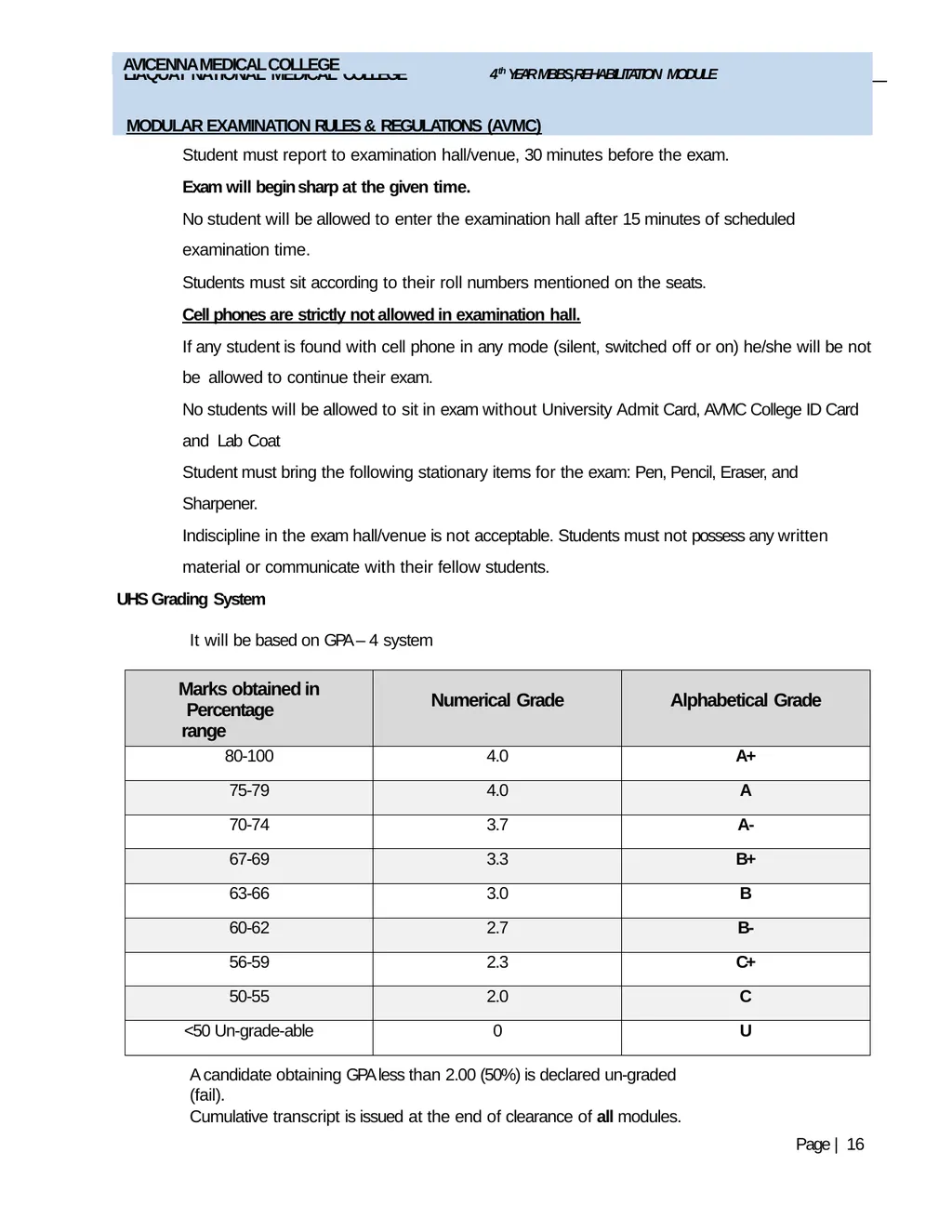
It will be based on GPA – 4 system A candidate obtaining GPA less than 2.00 (50%) is declared un-graded (fail).
Cumulative transcript is issued at the end of clearance of all modules. AVICENNA MEDICAL COLLEGE<br>
MODULAR EXAMINATION RULES & REGULATIONS (AVMC) Page | 16 Student must report to examination hall/venue, 30 minutes before the exam.
Exam will begin sharp at the given time.
No student will be allowed to enter the examination hall after 15 minutes of scheduled examination time.
Students must sit according to their roll numbers mentioned on the seats.
Cell phones are strictly not allowed in examination hall.
If any student is found with cell phone in any mode (silent, switched off or on) he/she will be not be allowed to continue their exam.
No students will be allowed to sit in exam without University Admit Card, AVMC College ID Card and Lab Coat
Student must bring the following stationary items for the exam: Pen, Pencil, Eraser, and Sharpener.
Indiscipline in the exam hall/venue is not acceptable. Students must not possess any written material or communicate with their fellow students.
UHS Grading System
It will be based on GPA – 4 system A candidate obtaining GPA less than 2.00 (50%) is declared un-graded (fail).
Cumulative transcript is issued at the end of clearance of all modules. AVICENNA MEDICAL COLLEGE<br>
17
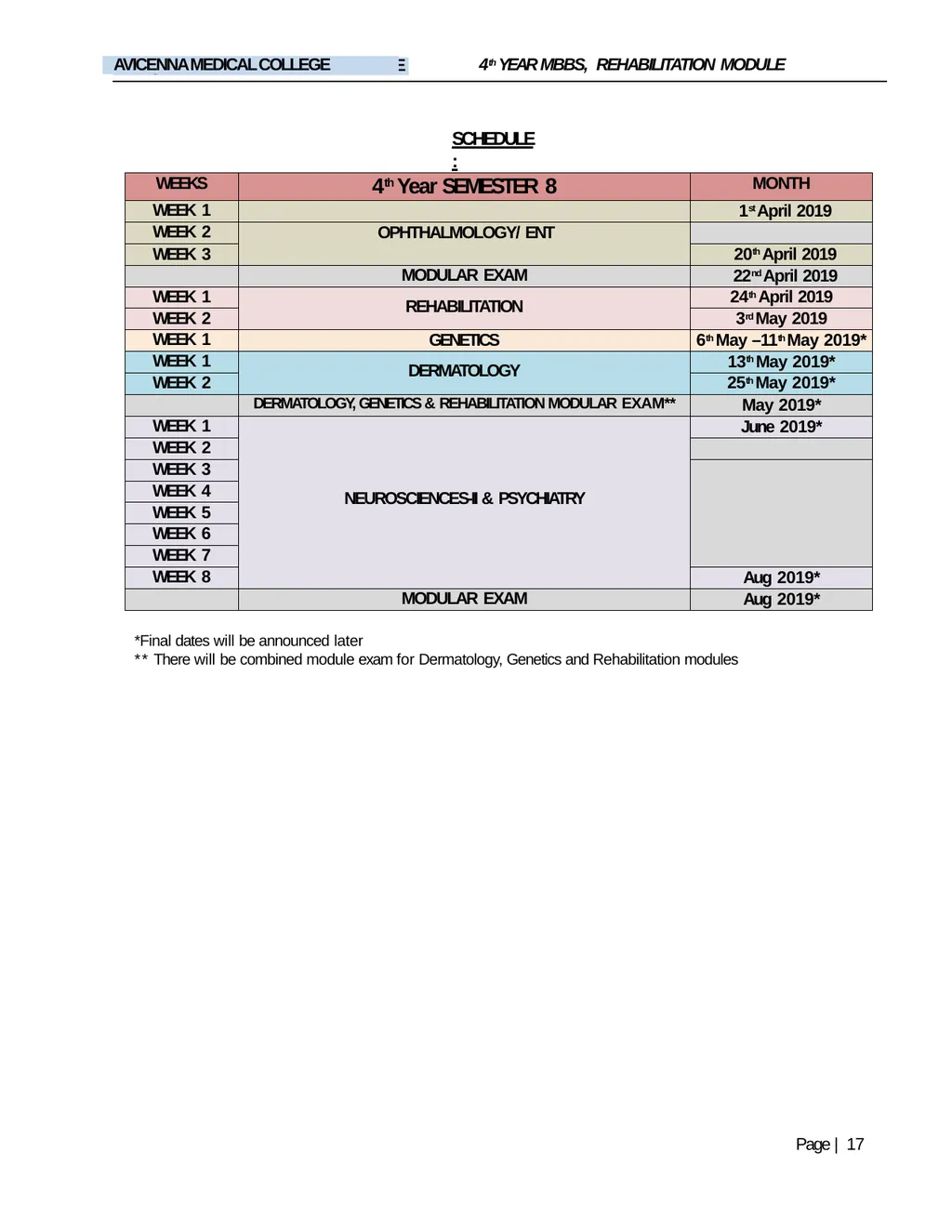
4th YEAR MBBS, REHABILITATION MODULE Page | 17 LIAQUAT NATIONAL MEDICAL COLLEGE SCHEDULE: *Final dates will be announced later
** There will be combined module exam for Dermatology, Genetics and Rehabilitation modules AVICENNA MEDICAL COLLEGE<br>
** There will be combined module exam for Dermatology, Genetics and Rehabilitation modules AVICENNA MEDICAL COLLEGE<br>