
Relations Chapter 9 © McGraw Hill LLC. All rights
NS
Published · 53 slides · 0 views

1 / 1

Description
Relations Chapter 9 McGraw Hill LLC. All rights reserved. No reproduction or distribution without the prior written consent of McGraw Hill LLC. Chapter Summary Relations and Their Properties. n-ary Relations and Their Applications (not
Related Topics
Share
Embed code
Download this presentation From Below
"Relations Chapter 9 © McGraw Hill LLC. All rights" is the property of its rightful owner. Permission is granted to download and print the materials on this website for personal, non-commercial use only, and to display it on your personal computer provided you do not modify the materials and that you retain all copyright notices contained in the materials. By downloading content from our website, you accept the terms of this agreement.
Presentation Transcript
01
Relations Chapter 9 © McGraw Hill LLC. All rights reserved. No reproduction or distribution without the prior written consent of McGraw Hill LLC.<br>
02
Chapter Summary Relations and Their Properties.
n-ary Relations and Their Applications (not currently included in overheads).
Representing Relations.
Closures of Relations (not currently included in overheads).
Equivalence Relations.
Partial Orderings. 2<br>
n-ary Relations and Their Applications (not currently included in overheads).
Representing Relations.
Closures of Relations (not currently included in overheads).
Equivalence Relations.
Partial Orderings. 2<br>
03
Relations and Their Properties Section 9.1 3<br>
04
Section Summary 1 Relations and Functions.
Properties of Relations.
Reflexive Relations.
Symmetric and Antisymmetric Relations.
Transitive Relations.
Combining Relations. 4<br>
Properties of Relations.
Reflexive Relations.
Symmetric and Antisymmetric Relations.
Transitive Relations.
Combining Relations. 4<br>
05
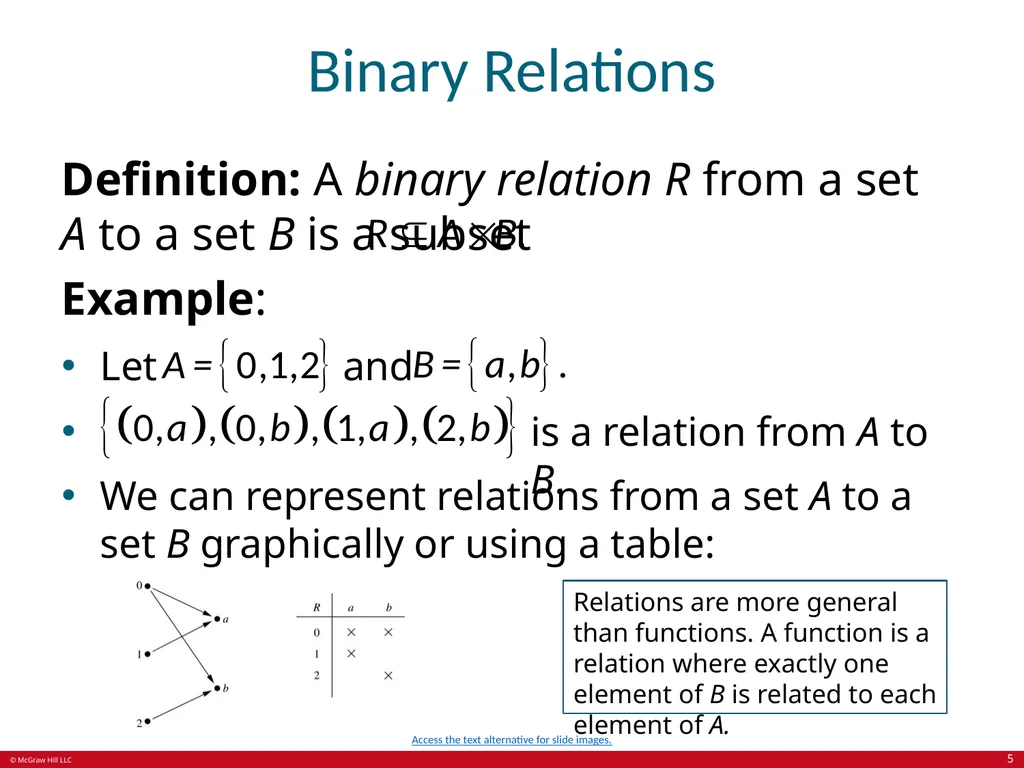
Binary Relations Definition: A binary relation R from a set A to a set B is a subset Example:
Let and is a relation from A to B. We can represent relations from a set A to a set B graphically or using a table: Relations are more general than functions. A function is a relation where exactly one element of B is related to each element of A. Access the text alternative for slide images. 5<br>
Let and is a relation from A to B. We can represent relations from a set A to a set B graphically or using a table: Relations are more general than functions. A function is a relation where exactly one element of B is related to each element of A. Access the text alternative for slide images. 5<br>
06
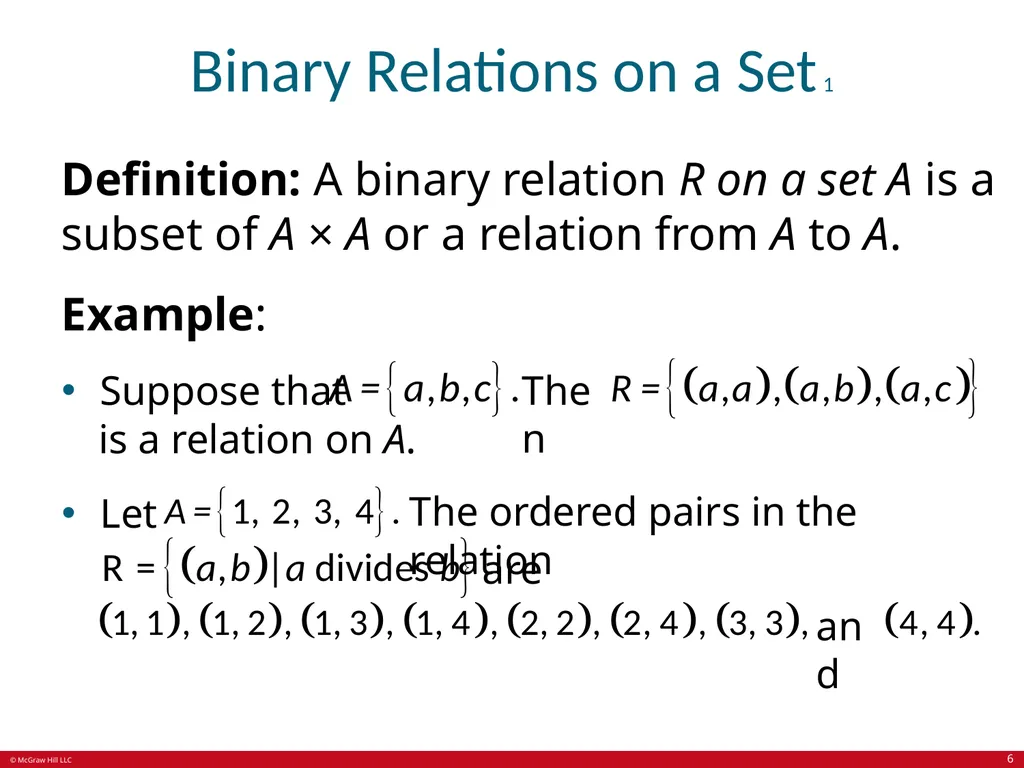
Binary Relations on a Set 1 Definition: A binary relation R on a set A is a subset of A × A or a relation from A to A.
Example:
Suppose that Then is a relation on A. Let The ordered pairs in the relation are and 6<br>
Example:
Suppose that Then is a relation on A. Let The ordered pairs in the relation are and 6<br>
07
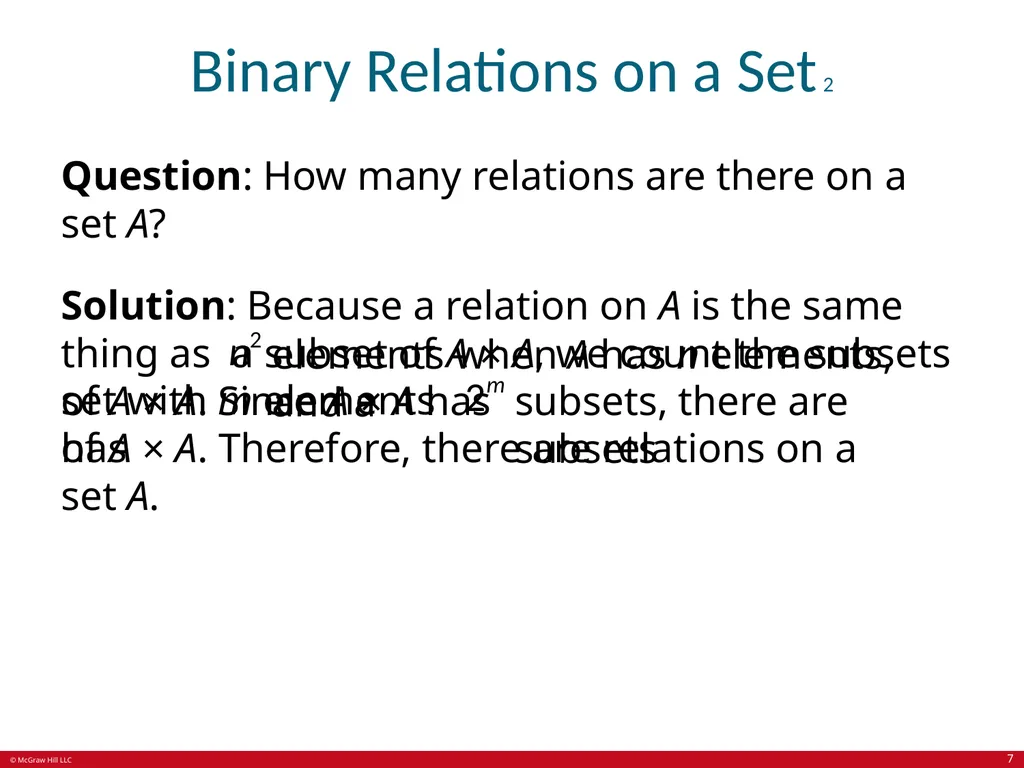
Binary Relations on a Set 2 Question: How many relations are there on a set A?
Solution: Because a relation on A is the same thing as a subset of A × A, we count the subsets of A × A. Since A × A has elements when A has n elements, and a set with m elements has subsets, there are subsets of A × A. Therefore, there are relations on a set A. 7<br>
Solution: Because a relation on A is the same thing as a subset of A × A, we count the subsets of A × A. Since A × A has elements when A has n elements, and a set with m elements has subsets, there are subsets of A × A. Therefore, there are relations on a set A. 7<br>
08
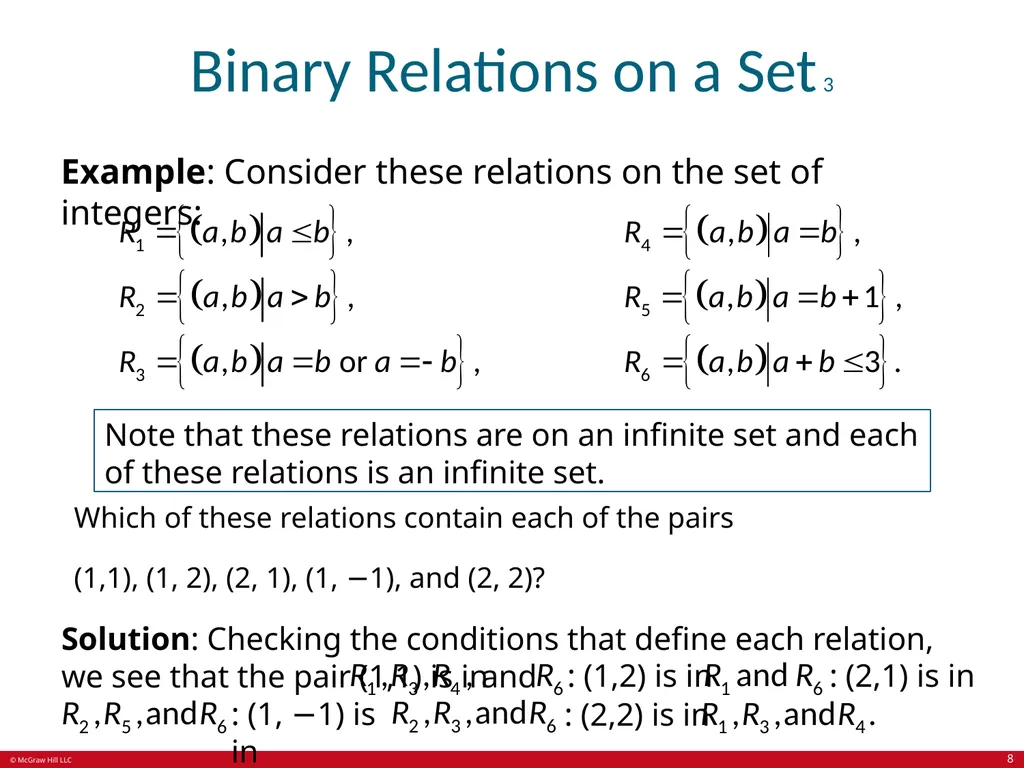
Binary Relations on a Set 3 Example: Consider these relations on the set of integers: Note that these relations are on an infinite set and each of these relations is an infinite set. Which of these relations contain each of the pairs
(1,1), (1, 2), (2, 1), (1, −1), and (2, 2)?
Solution: Checking the conditions that define each relation, we see that the pair (1,1) is in and : (1,2) is in : (2,1) is in : (1, −1) is in : (2,2) is in 8<br>
(1,1), (1, 2), (2, 1), (1, −1), and (2, 2)?
Solution: Checking the conditions that define each relation, we see that the pair (1,1) is in and : (1,2) is in : (2,1) is in : (1, −1) is in : (2,2) is in 8<br>
09
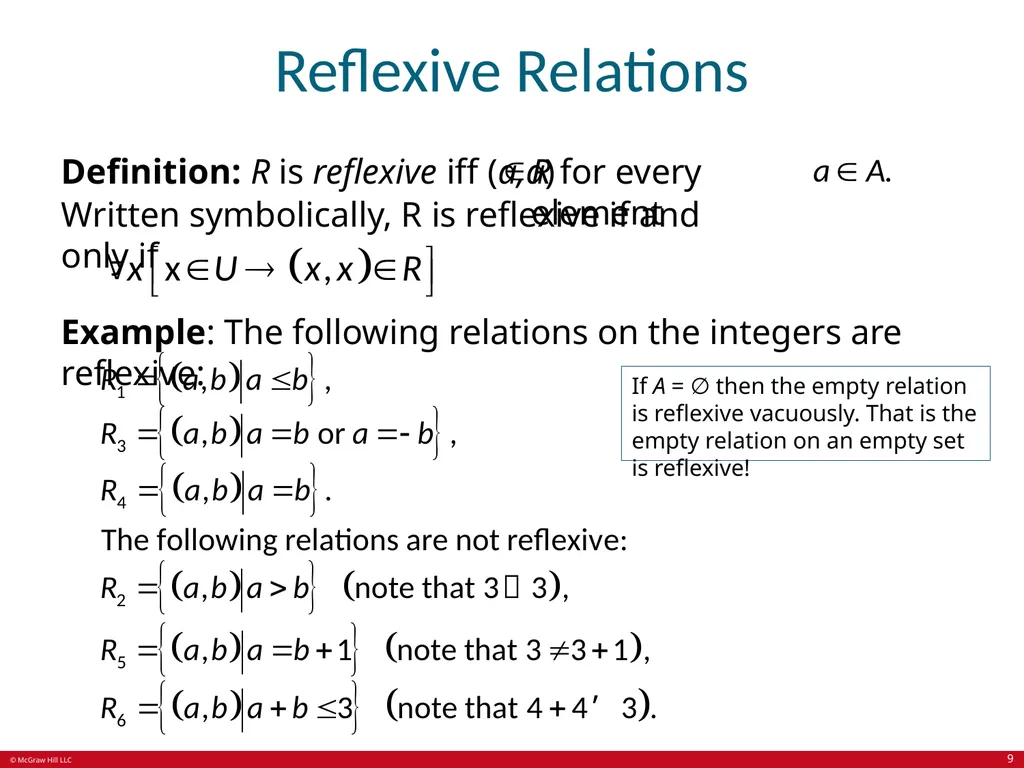
Reflexive Relations Definition: R is reflexive iff (a,a) R for every element Written symbolically, R is reflexive if and only if Example: The following relations on the integers are reflexive: If A = ∅ then the empty relation is reflexive vacuously. That is the empty relation on an empty set is reflexive! 9<br>
10
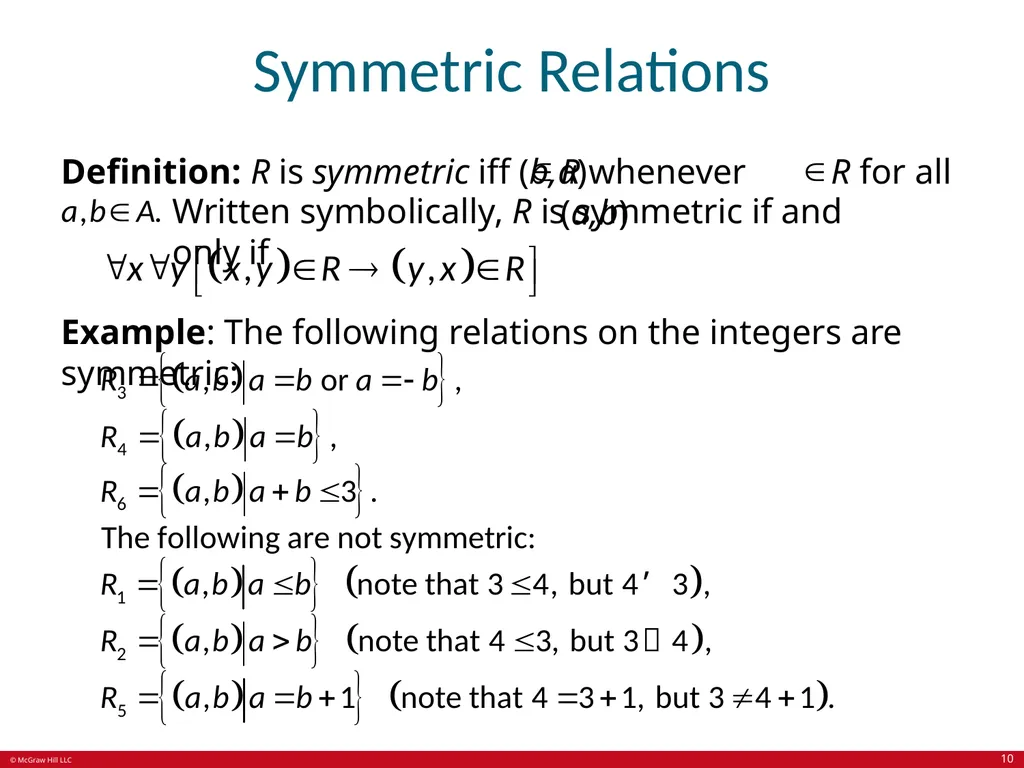
Symmetric Relations Definition: R is symmetric iff (b,a) R whenever (a,b) R for all Written symbolically, R is symmetric if and only if Example: The following relations on the integers are symmetric: 10<br>
11
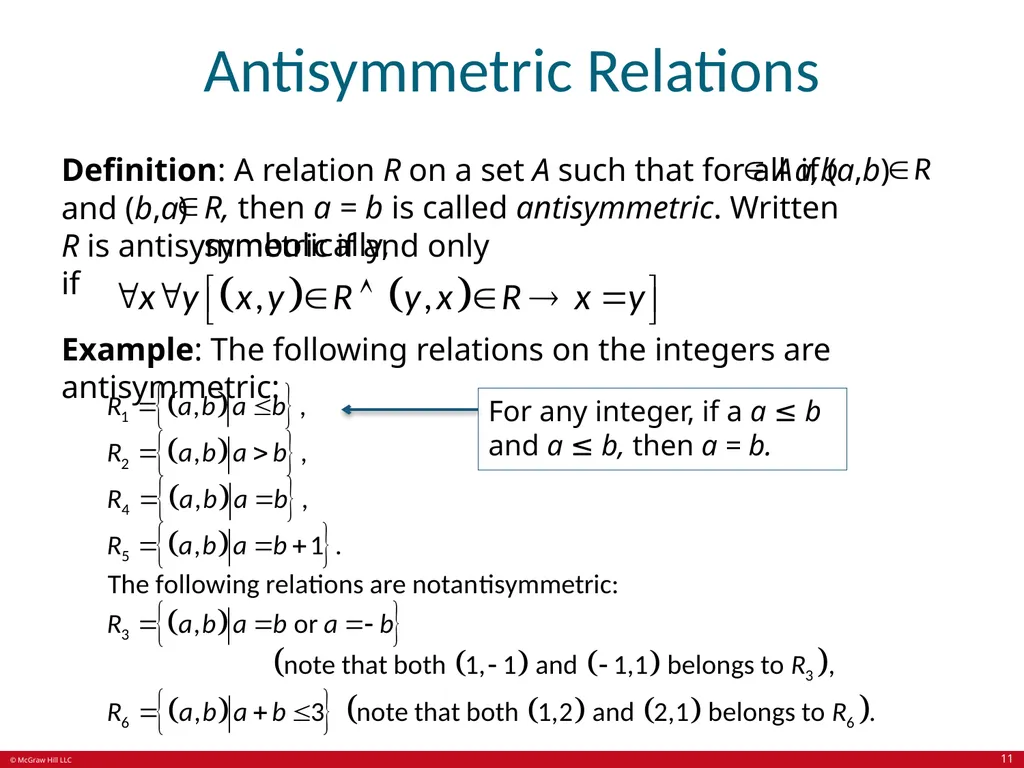
Antisymmetric Relations Definition: A relation R on a set A such that for all a,b A if (a,b) and (b,a) R, then a = b is called antisymmetric. Written symbolically, R is antisymmetric if and only if Example: The following relations on the integers are antisymmetric: For any integer, if a a ≤ b and a ≤ b, then a = b. 11<br>
12
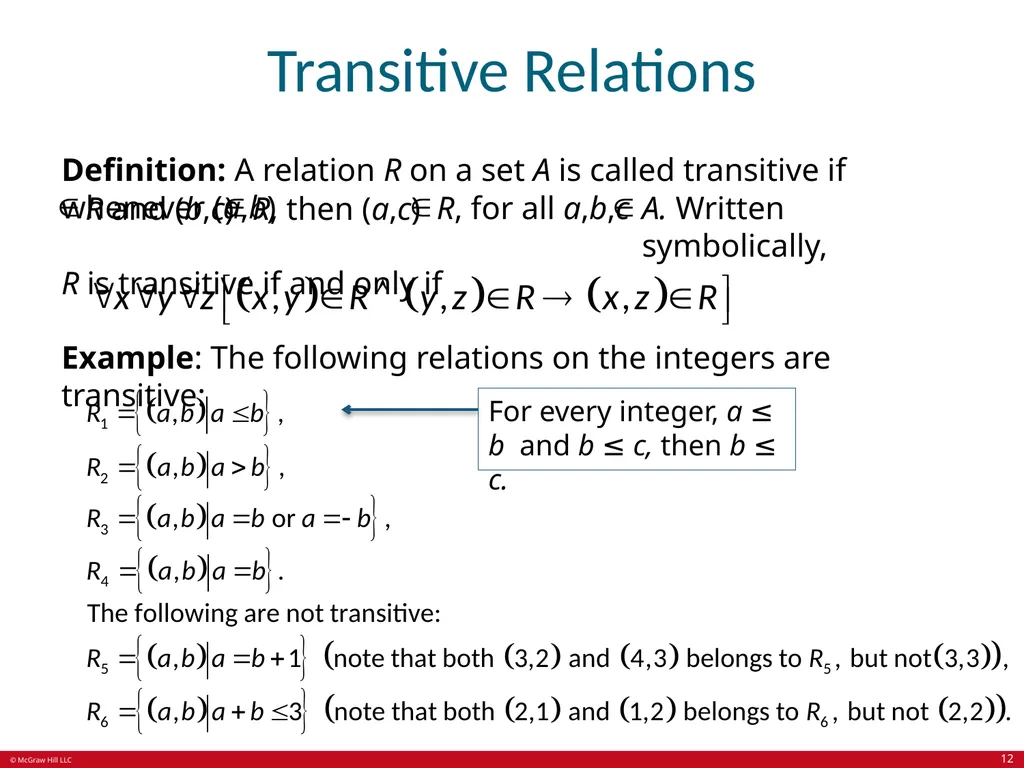
Transitive Relations Definition: A relation R on a set A is called transitive if whenever (a,b) R and (b,c) R, then (a,c) R, for all a,b,c A. Written symbolically,
R is transitive if and only if Example: The following relations on the integers are transitive: For every integer, a ≤ b and b ≤ c, then b ≤ c. 12<br>
R is transitive if and only if Example: The following relations on the integers are transitive: For every integer, a ≤ b and b ≤ c, then b ≤ c. 12<br>
13
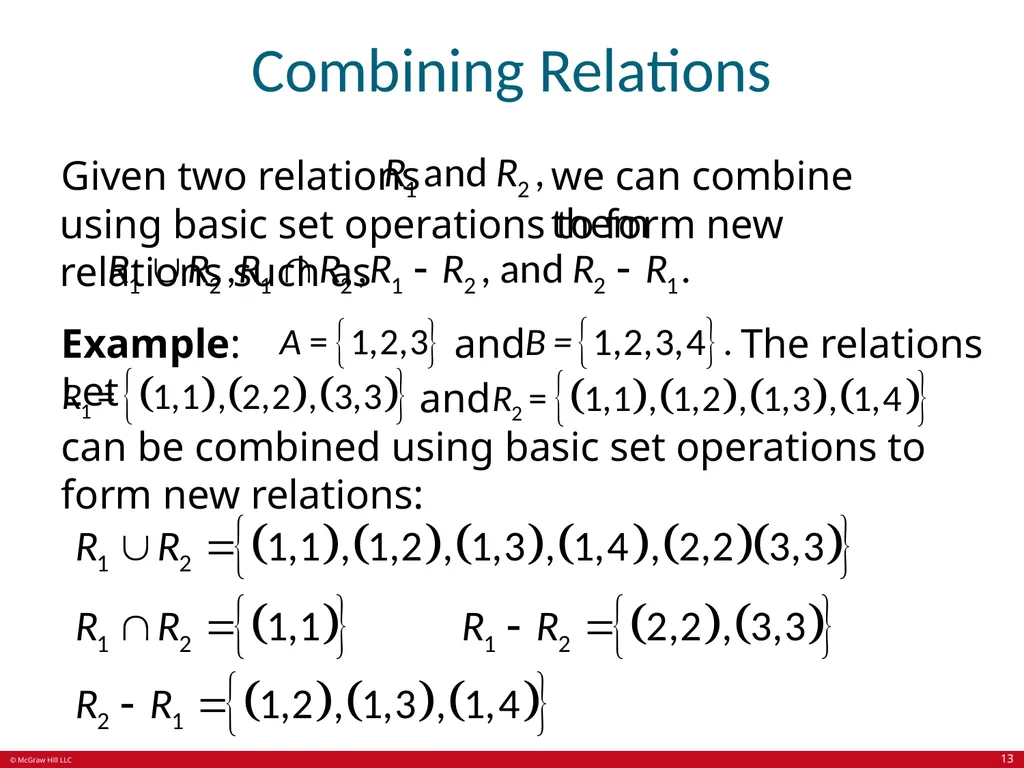
Combining Relations Given two relations we can combine them using basic set operations to form new relations such as Example: Let and The relations and can be combined using basic set operations to form new relations: 13<br>
14
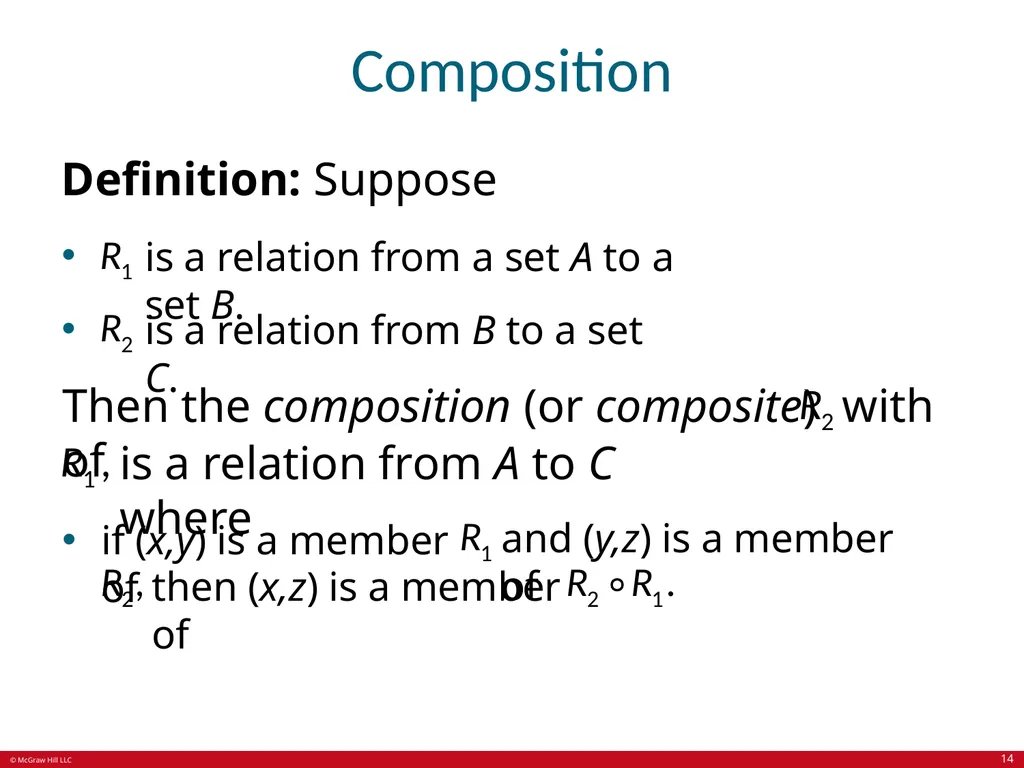
Composition Definition: Suppose is a relation from a set A to a set B. is a relation from B to a set C. Then the composition (or composite) of with is a relation from A to C where if (x,y) is a member of and (y,z) is a member of then (x,z) is a member of 14<br>
15
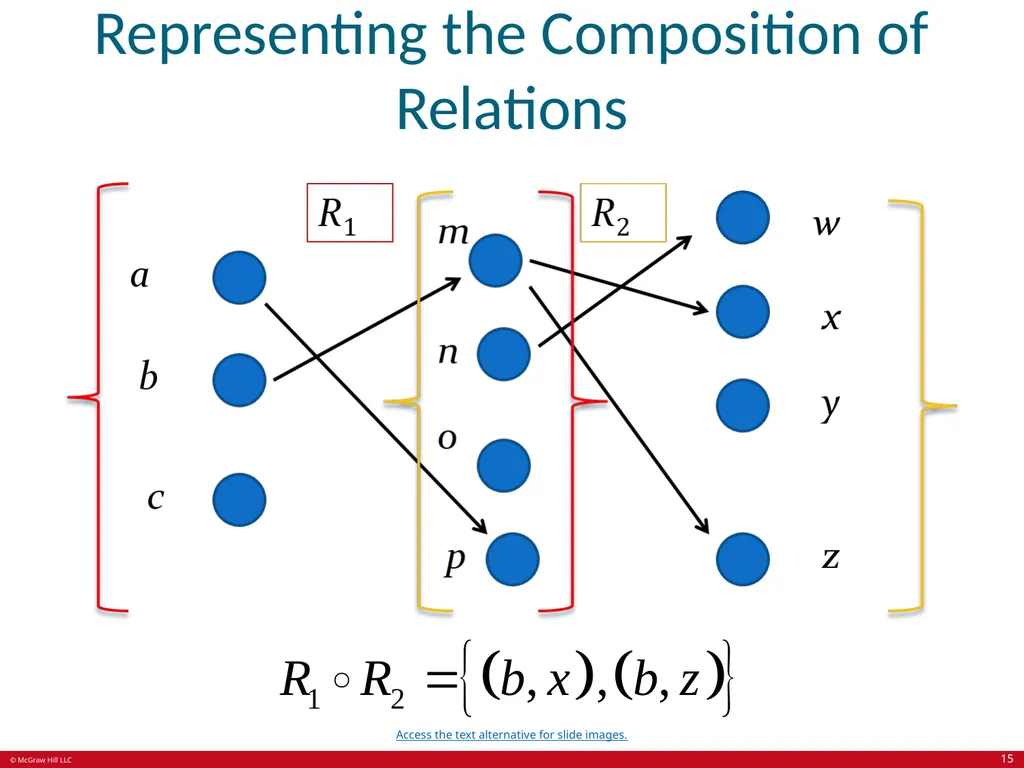
Representing the Composition of Relations Access the text alternative for slide images. 15<br>
16
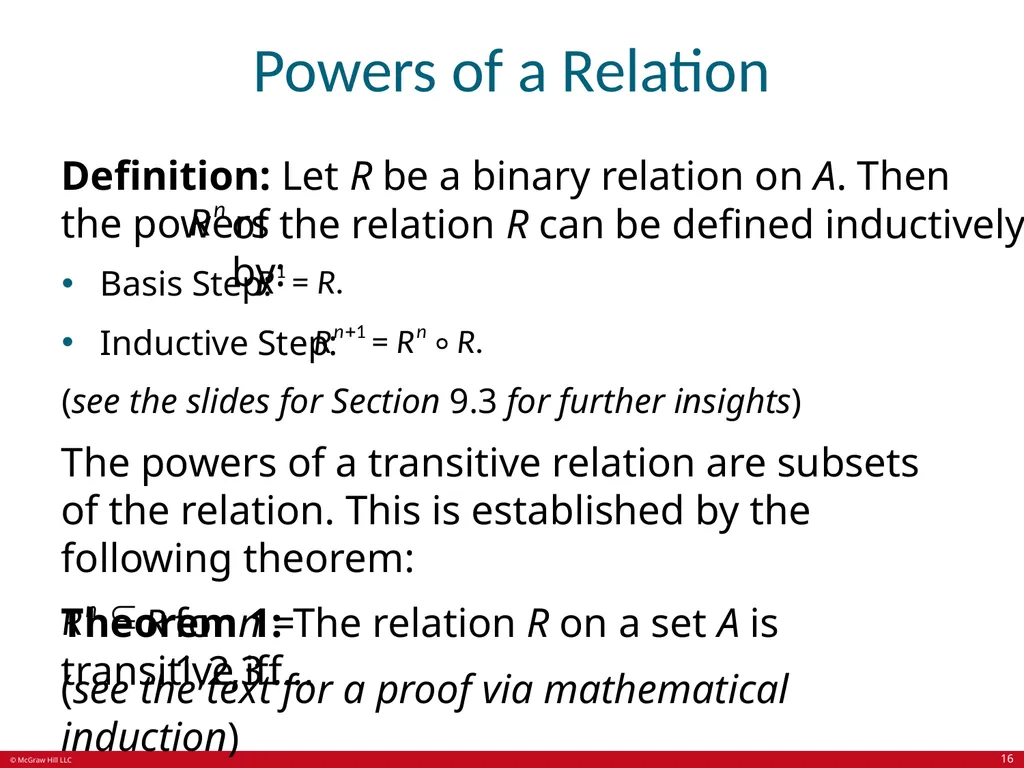
Powers of a Relation Definition: Let R be a binary relation on A. Then the powers of the relation R can be defined inductively by: Basis Step: Inductive Step: (see the slides for Section 9.3 for further insights)
The powers of a transitive relation are subsets of the relation. This is established by the following theorem:
Theorem 1: The relation R on a set A is transitive iff for n = 1,2,3 . . . . (see the text for a proof via mathematical induction) 16<br>
The powers of a transitive relation are subsets of the relation. This is established by the following theorem:
Theorem 1: The relation R on a set A is transitive iff for n = 1,2,3 . . . . (see the text for a proof via mathematical induction) 16<br>
17
Representing Relations Section 9.3 17<br>
18
Section Summary 2 Representing Relations using Matrices.
Representing Relations using Digraphs. 18<br>
Representing Relations using Digraphs. 18<br>
19
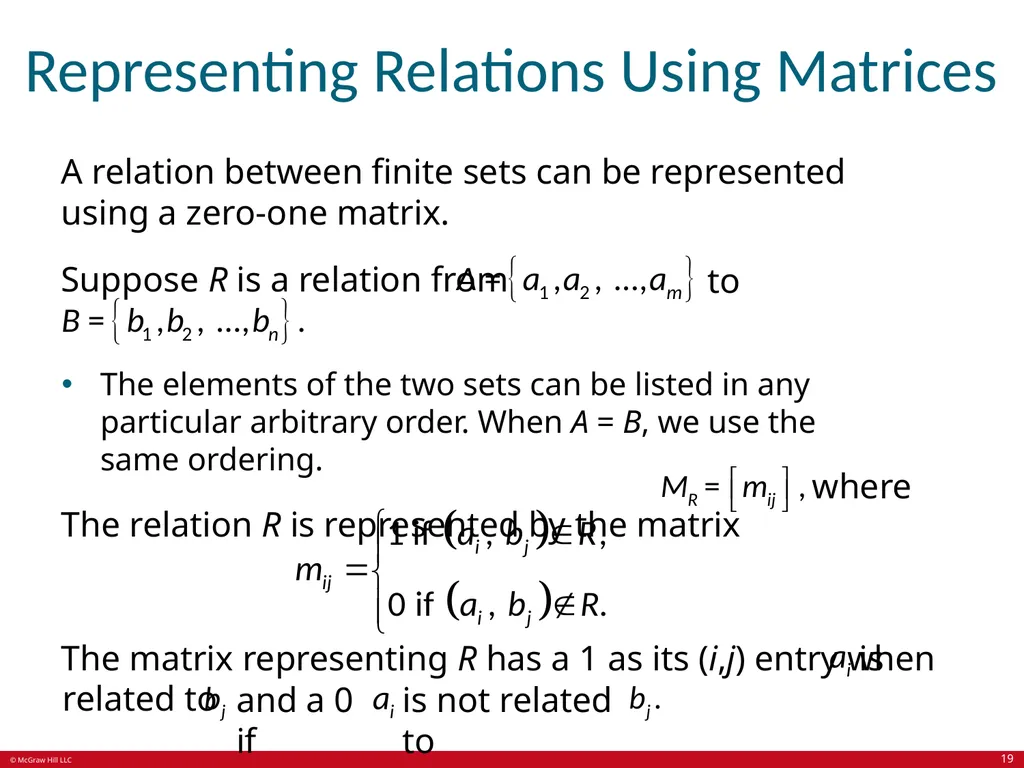
Representing Relations Using Matrices A relation between finite sets can be represented using a zero-one matrix.
Suppose R is a relation from to The elements of the two sets can be listed in any particular arbitrary order. When A = B, we use the same ordering.
The relation R is represented by the matrix where The matrix representing R has a 1 as its (i,j) entry when is related to and a 0 if is not related to 19<br>
Suppose R is a relation from to The elements of the two sets can be listed in any particular arbitrary order. When A = B, we use the same ordering.
The relation R is represented by the matrix where The matrix representing R has a 1 as its (i,j) entry when is related to and a 0 if is not related to 19<br>
20
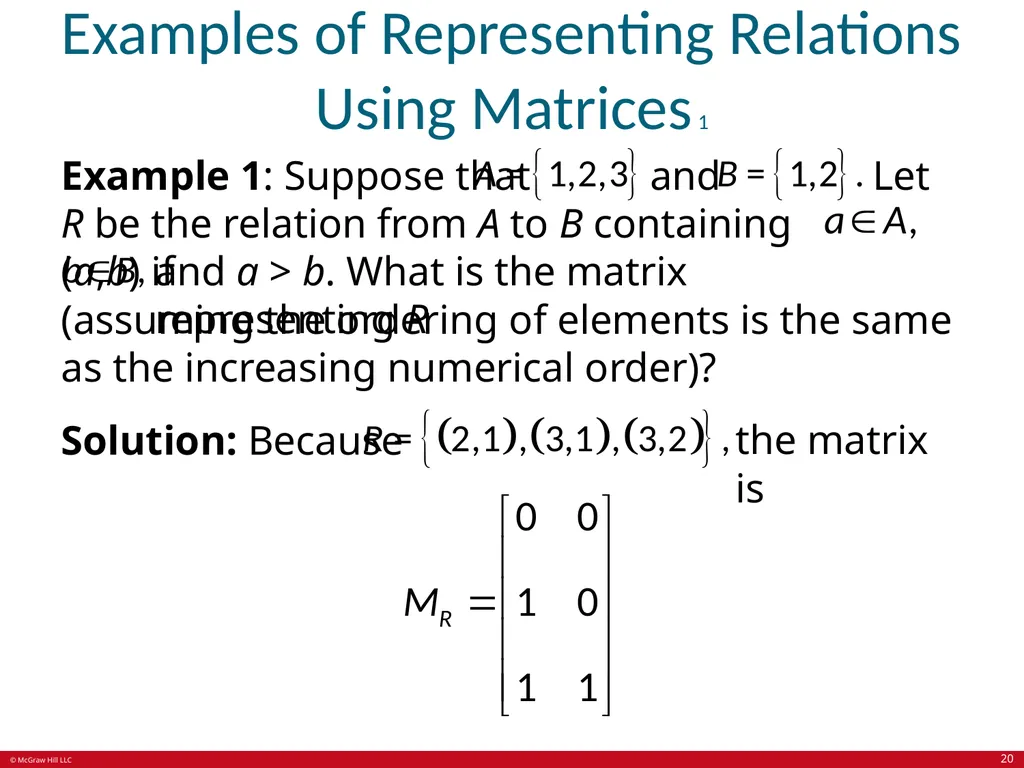
Examples of Representing Relations Using Matrices 1 Example 1: Suppose that and Let R be the relation from A to B containing (a,b) if and a > b. What is the matrix representing R (assuming the ordering of elements is the same as the increasing numerical order)?
Solution: Because the matrix is 20<br>
Solution: Because the matrix is 20<br>
21
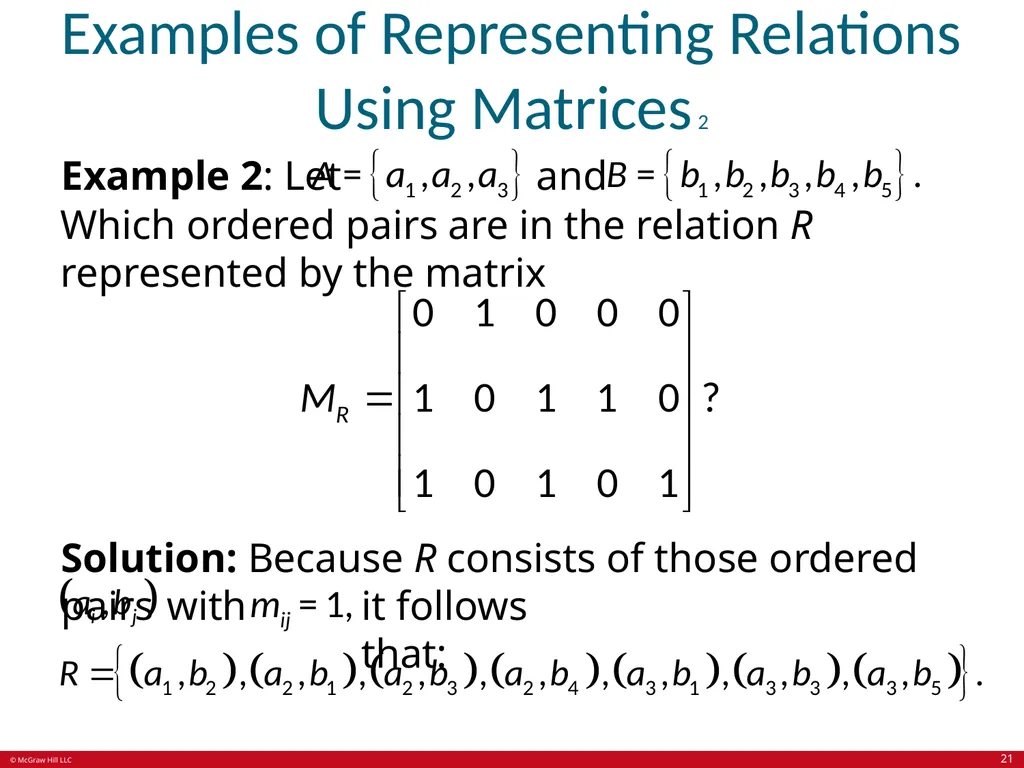
Examples of Representing Relations Using Matrices 2 Example 2: Let and Which ordered pairs are in the relation R represented by the matrix Solution: Because R consists of those ordered pairs with it follows that: 21<br>
22
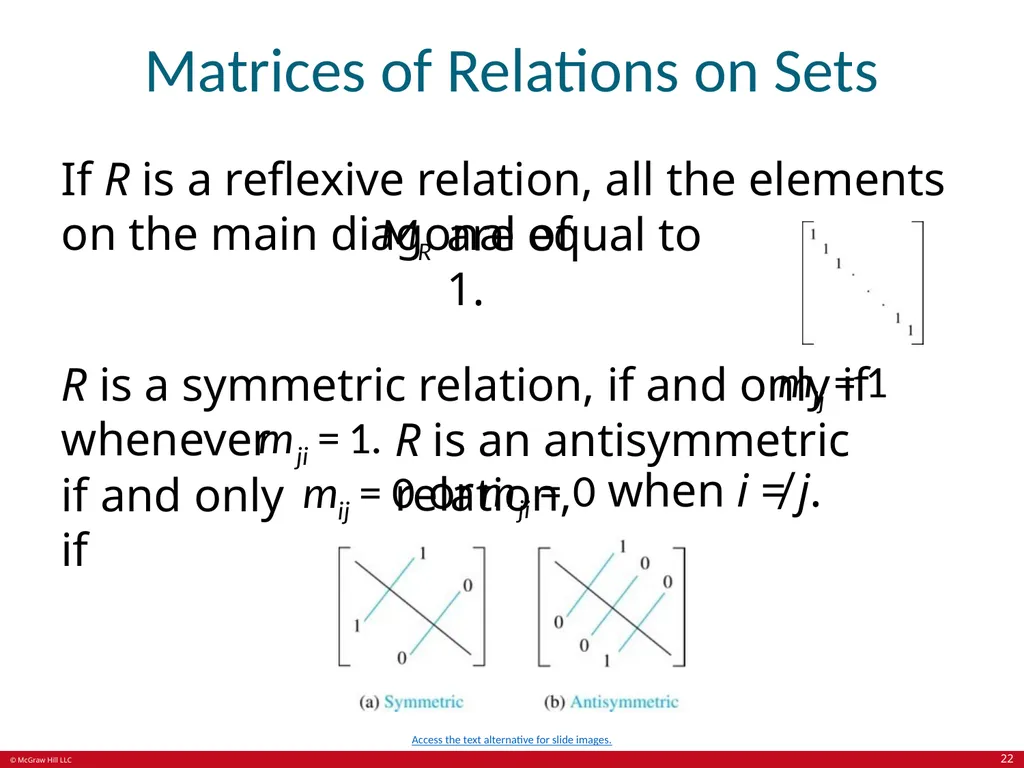
Matrices of Relations on Sets If R is a reflexive relation, all the elements on the main diagonal of are equal to 1. R is a symmetric relation, if and only if whenever R is an antisymmetric relation, if and only if or when i ≠ j. Access the text alternative for slide images. 22<br>
23
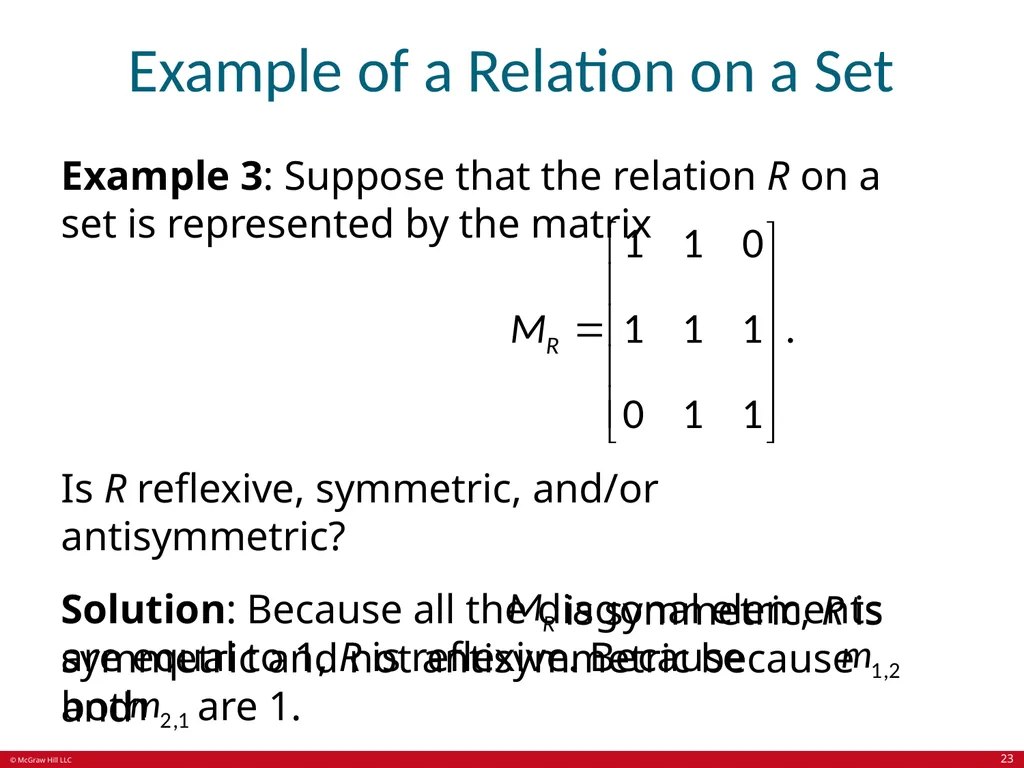
Example of a Relation on a Set Example 3: Suppose that the relation R on a set is represented by the matrix Is R reflexive, symmetric, and/or antisymmetric?
Solution: Because all the diagonal elements are equal to 1, R is reflexive. Because is symmetric, R is symmetric and not antisymmetric because both and are 1. 23<br>
Solution: Because all the diagonal elements are equal to 1, R is reflexive. Because is symmetric, R is symmetric and not antisymmetric because both and are 1. 23<br>
24
Representing Relations Using Digraphs Definition: A directed graph, or digraph, consists of a set V of vertices (or nodes) together with a set E of ordered pairs of elements of V called edges (or arcs). The vertex a is called the initial vertex of the edge (a,b), and the vertex b is called the terminal vertex of this edge.
An edge of the form (a,a) is called a loop.
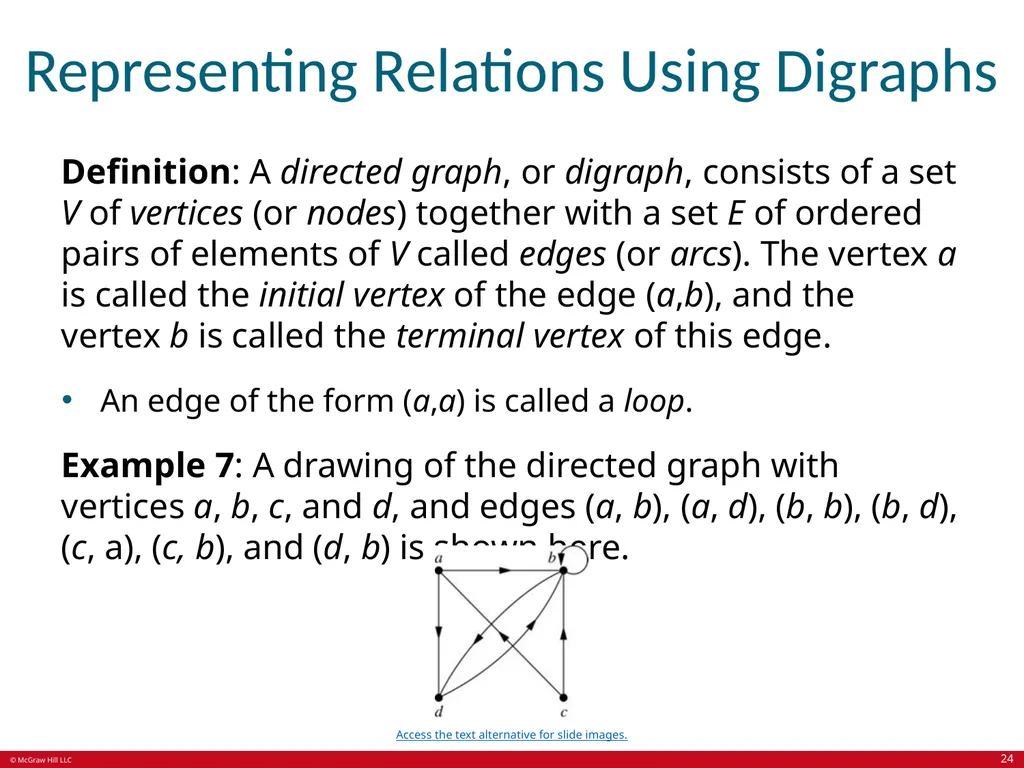
Example 7: A drawing of the directed graph with vertices a, b, c, and d, and edges (a, b), (a, d), (b, b), (b, d), (c, a), (c, b), and (d, b) is shown here. Access the text alternative for slide images. 24<br>
An edge of the form (a,a) is called a loop.
Example 7: A drawing of the directed graph with vertices a, b, c, and d, and edges (a, b), (a, d), (b, b), (b, d), (c, a), (c, b), and (d, b) is shown here. Access the text alternative for slide images. 24<br>
25
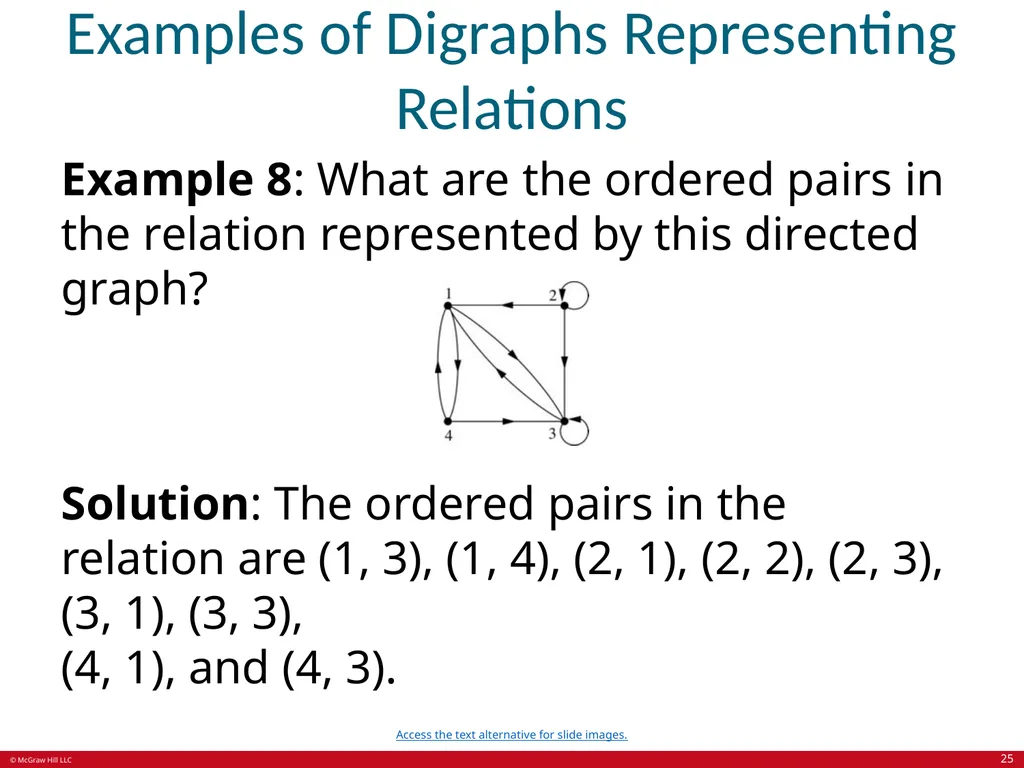
Examples of Digraphs Representing Relations Example 8: What are the ordered pairs in the relation represented by this directed graph? Solution: The ordered pairs in the relation are (1, 3), (1, 4), (2, 1), (2, 2), (2, 3), (3, 1), (3, 3),
(4, 1), and (4, 3). Access the text alternative for slide images. 25<br>
26
Determining which Properties a Relation has from its Digraph Reflexivity: A loop must be present at all vertices in the graph.
Symmetry: If (x,y) is an edge, then so is (y,x).
Antisymmetry: If (x,y) with x ≠ y is an edge, then (y,x) is not an edge.
Transitivity: If (x,y) and (y,z) are edges, then so is (x,z). 26<br>
Symmetry: If (x,y) is an edge, then so is (y,x).
Antisymmetry: If (x,y) with x ≠ y is an edge, then (y,x) is not an edge.
Transitivity: If (x,y) and (y,z) are edges, then so is (x,z). 26<br>
27
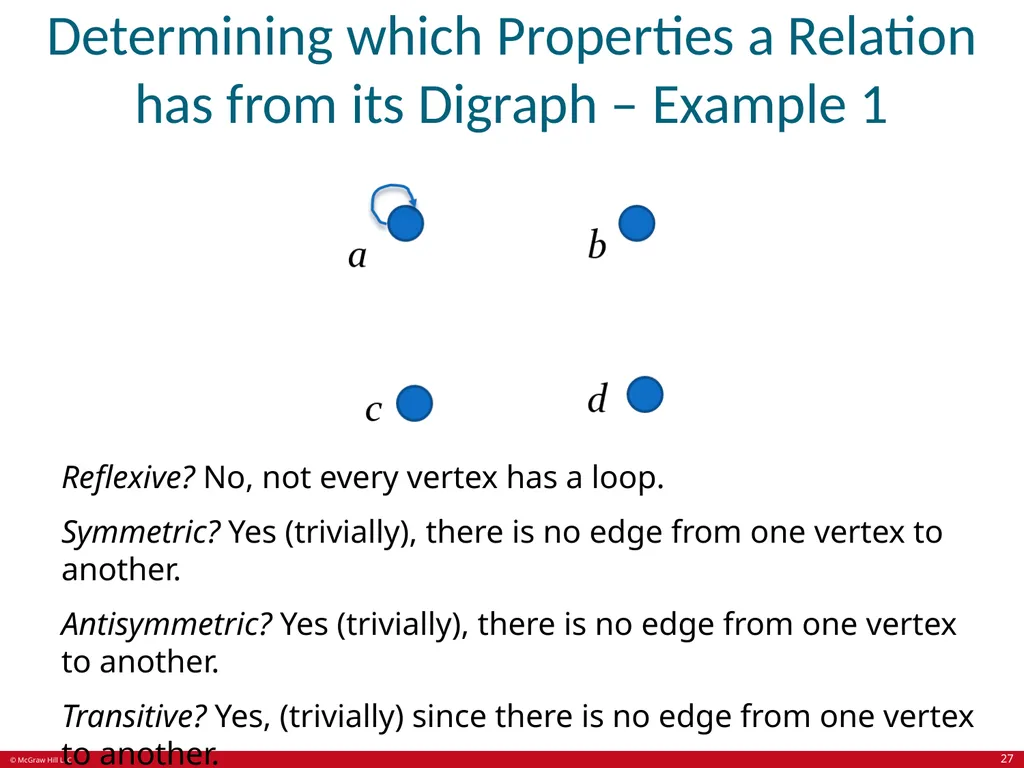
Determining which Properties a Relation has from its Digraph – Example 1 Reflexive? No, not every vertex has a loop.
Symmetric? Yes (trivially), there is no edge from one vertex to another.
Antisymmetric? Yes (trivially), there is no edge from one vertex to another.
Transitive? Yes, (trivially) since there is no edge from one vertex to another. 27<br>
Symmetric? Yes (trivially), there is no edge from one vertex to another.
Antisymmetric? Yes (trivially), there is no edge from one vertex to another.
Transitive? Yes, (trivially) since there is no edge from one vertex to another. 27<br>
28
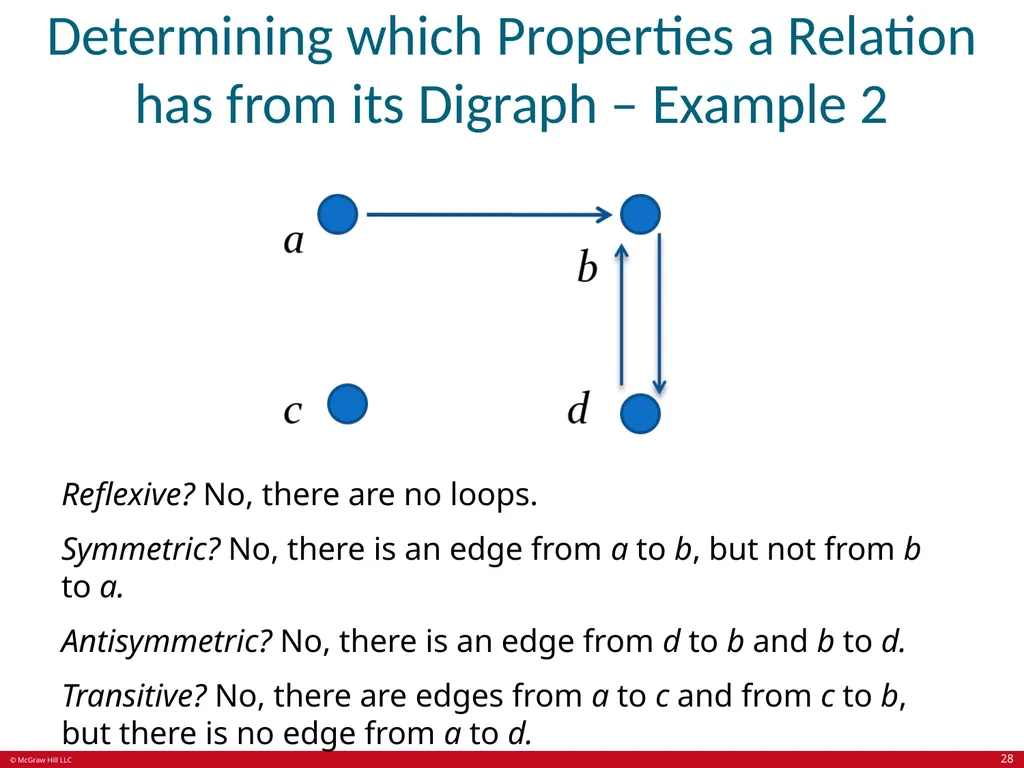
Determining which Properties a Relation has from its Digraph – Example 2 Reflexive? No, there are no loops.
Symmetric? No, there is an edge from a to b, but not from b to a.
Antisymmetric? No, there is an edge from d to b and b to d.
Transitive? No, there are edges from a to c and from c to b, but there is no edge from a to d. 28<br>
Symmetric? No, there is an edge from a to b, but not from b to a.
Antisymmetric? No, there is an edge from d to b and b to d.
Transitive? No, there are edges from a to c and from c to b, but there is no edge from a to d. 28<br>
29
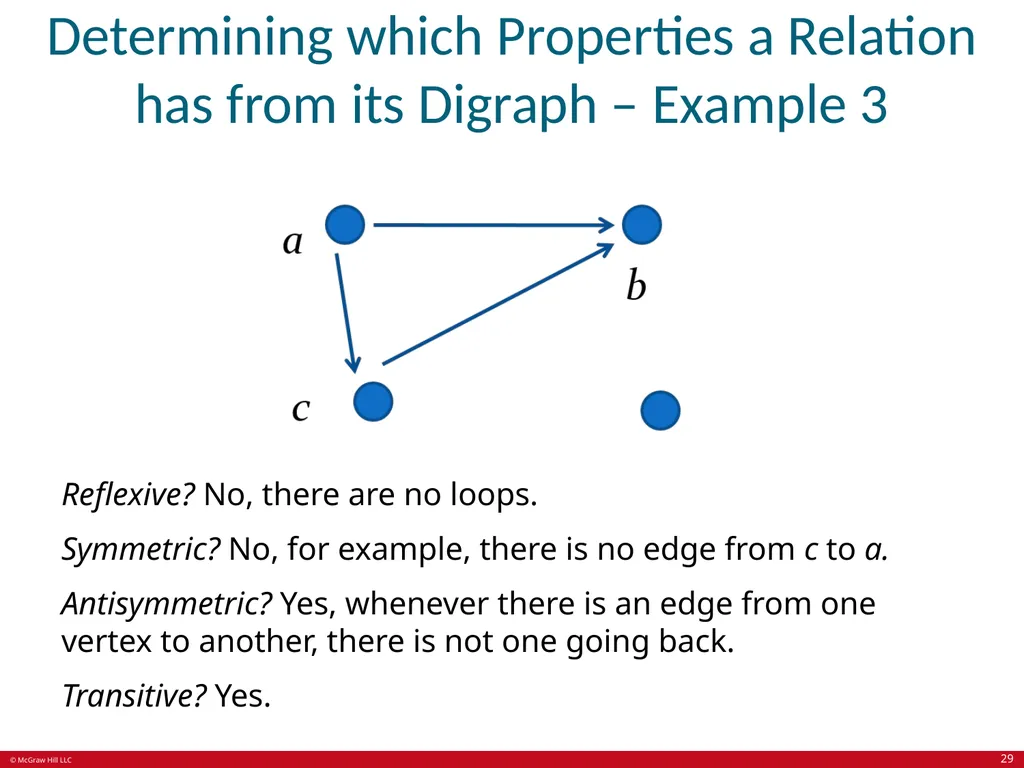
Determining which Properties a Relation has from its Digraph – Example 3 Reflexive? No, there are no loops.
Symmetric? No, for example, there is no edge from c to a.
Antisymmetric? Yes, whenever there is an edge from one vertex to another, there is not one going back.
Transitive? Yes. 29<br>
Symmetric? No, for example, there is no edge from c to a.
Antisymmetric? Yes, whenever there is an edge from one vertex to another, there is not one going back.
Transitive? Yes. 29<br>
30
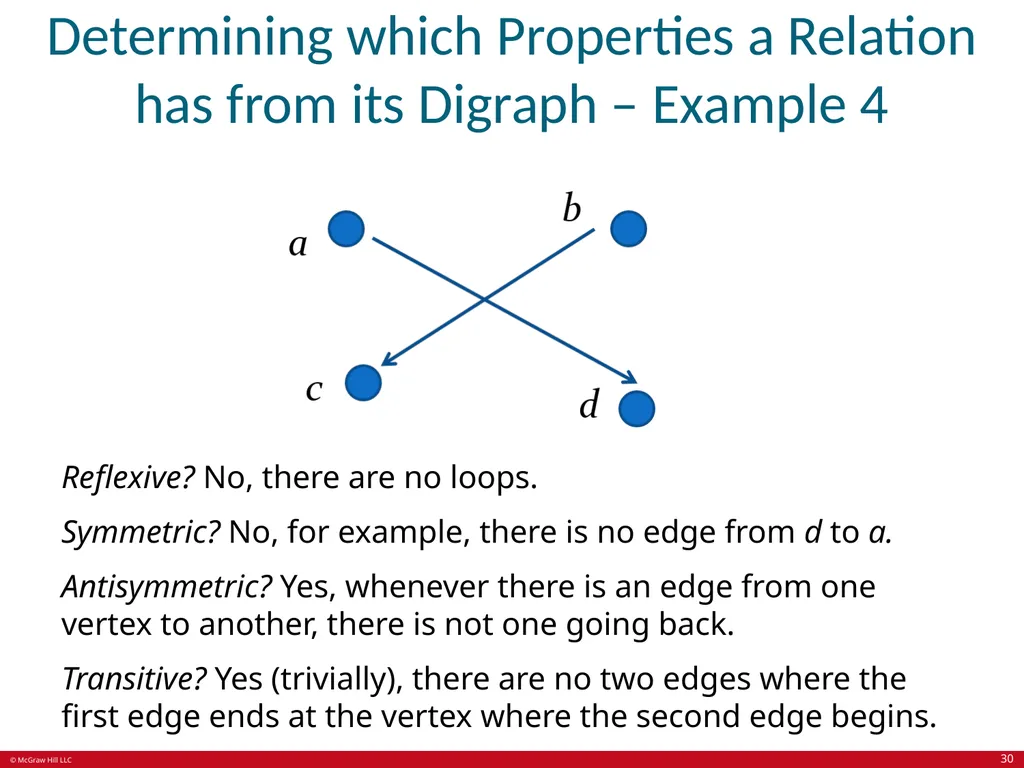
Determining which Properties a Relation has from its Digraph – Example 4 Reflexive? No, there are no loops.
Symmetric? No, for example, there is no edge from d to a.
Antisymmetric? Yes, whenever there is an edge from one vertex to another, there is not one going back.
Transitive? Yes (trivially), there are no two edges where the first edge ends at the vertex where the second edge begins. 30<br>
Symmetric? No, for example, there is no edge from d to a.
Antisymmetric? Yes, whenever there is an edge from one vertex to another, there is not one going back.
Transitive? Yes (trivially), there are no two edges where the first edge ends at the vertex where the second edge begins. 30<br>
31
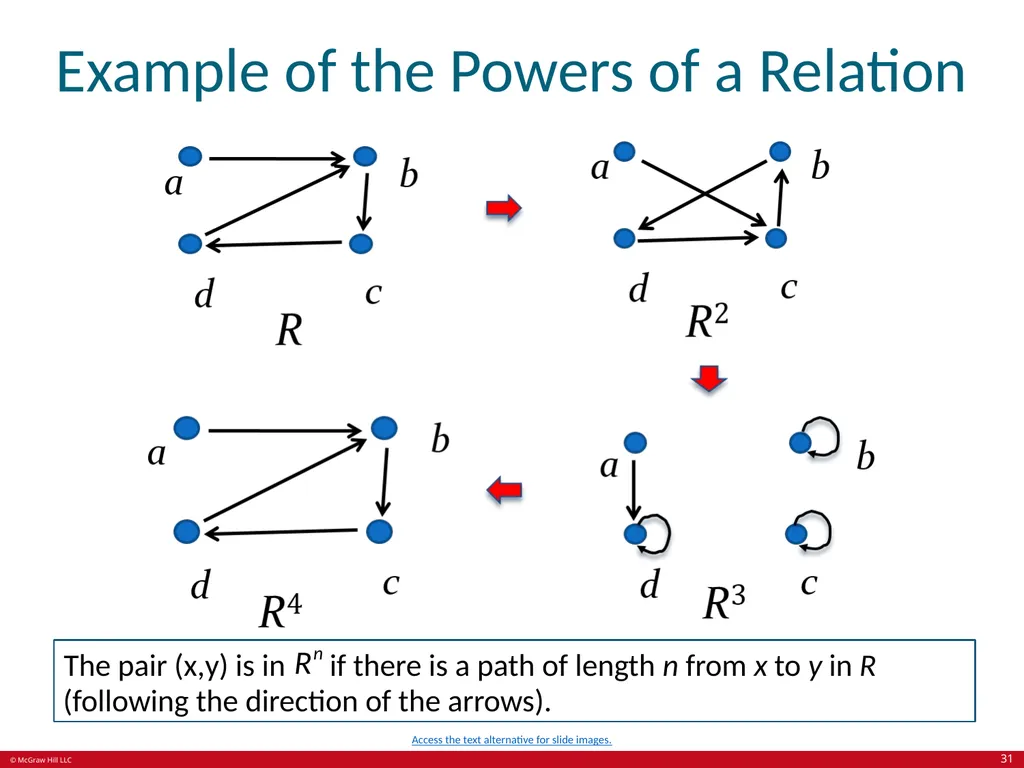
Example of the Powers of a Relation The pair (x,y) is in if there is a path of length n from x to y in R (following the direction of the arrows). Access the text alternative for slide images. 31<br>
32
Equivalence Relations Section 9.5 32<br>
33
Section Summary 3 Equivalence Relations.
Equivalence Classes.
Equivalence Classes and Partitions. 33<br>
Equivalence Classes.
Equivalence Classes and Partitions. 33<br>
34
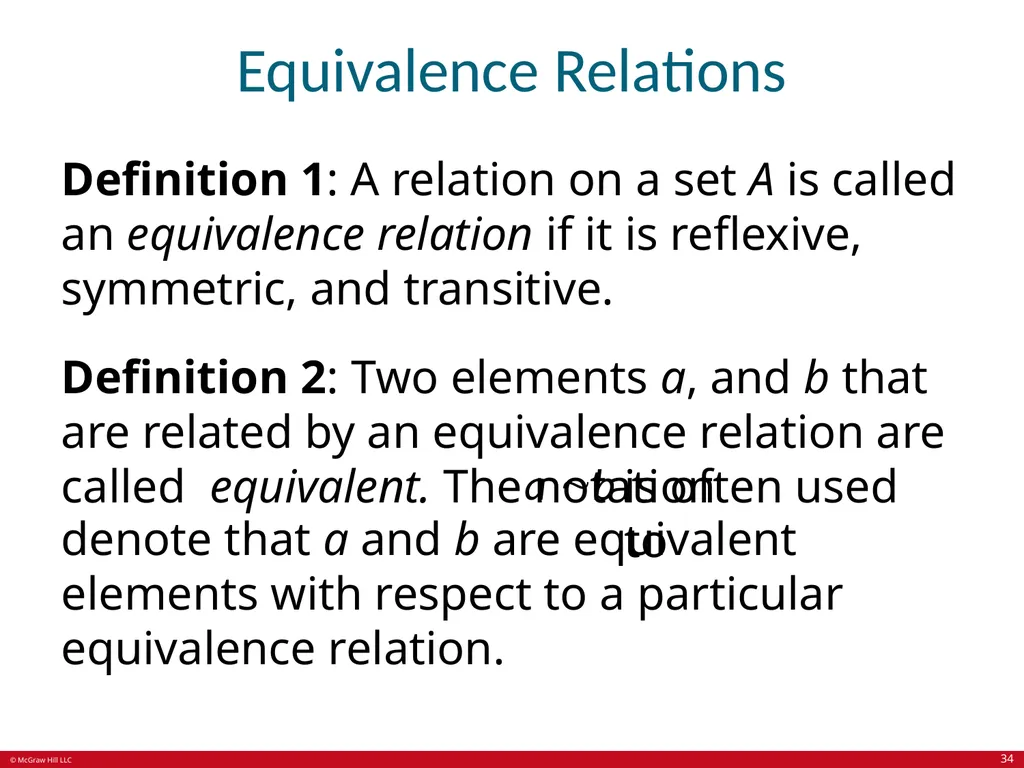
Equivalence Relations Definition 1: A relation on a set A is called an equivalence relation if it is reflexive, symmetric, and transitive.
Definition 2: Two elements a, and b that are related by an equivalence relation are called equivalent. The notation is often used to denote that a and b are equivalent elements with respect to a particular equivalence relation. 34<br>
Definition 2: Two elements a, and b that are related by an equivalence relation are called equivalent. The notation is often used to denote that a and b are equivalent elements with respect to a particular equivalence relation. 34<br>
35
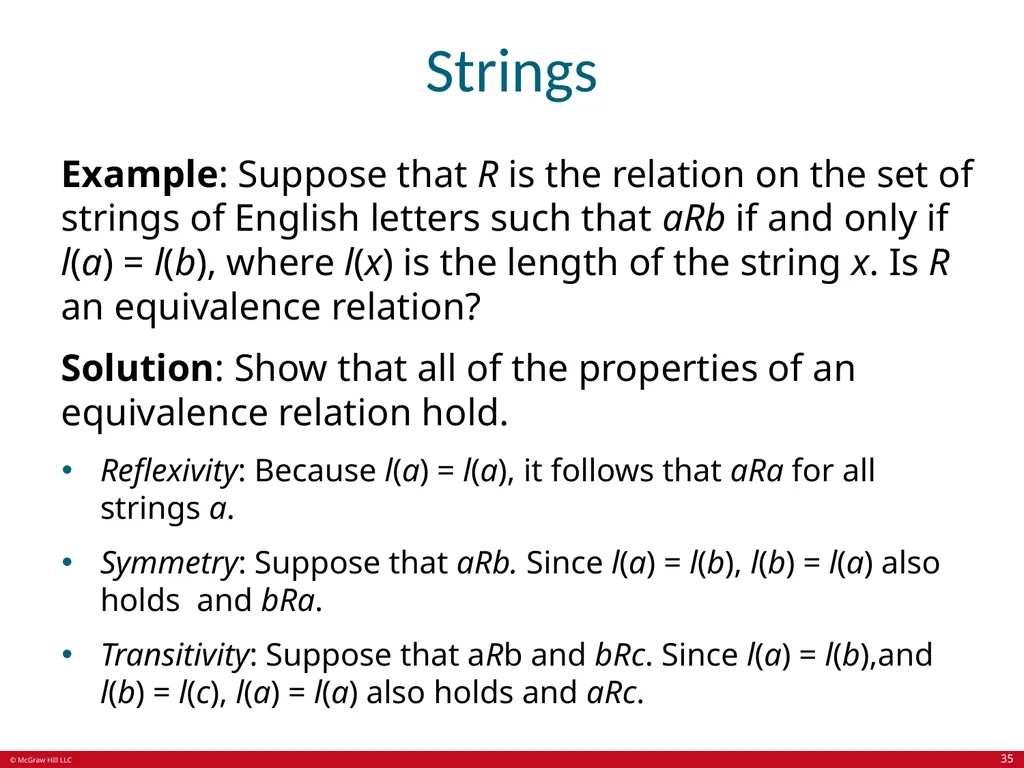
Strings Example: Suppose that R is the relation on the set of strings of English letters such that a R b if and only if l(a) = l(b), where l(x) is the length of the string x. Is R an equivalence relation?
Solution: Show that all of the properties of an equivalence relation hold.
Reflexivity: Because l(a) = l(a), it follows that a R a for all strings a.
Symmetry: Suppose that a R b. Since l(a) = l(b), l(b) = l(a) also holds and b R a.
Transitivity: Suppose that a R b and b R c. Since l(a) = l(b),and l(b) = l(c), l(a) = l(a) also holds and a R c. 35<br>
Solution: Show that all of the properties of an equivalence relation hold.
Reflexivity: Because l(a) = l(a), it follows that a R a for all strings a.
Symmetry: Suppose that a R b. Since l(a) = l(b), l(b) = l(a) also holds and b R a.
Transitivity: Suppose that a R b and b R c. Since l(a) = l(b),and l(b) = l(c), l(a) = l(a) also holds and a R c. 35<br>
36
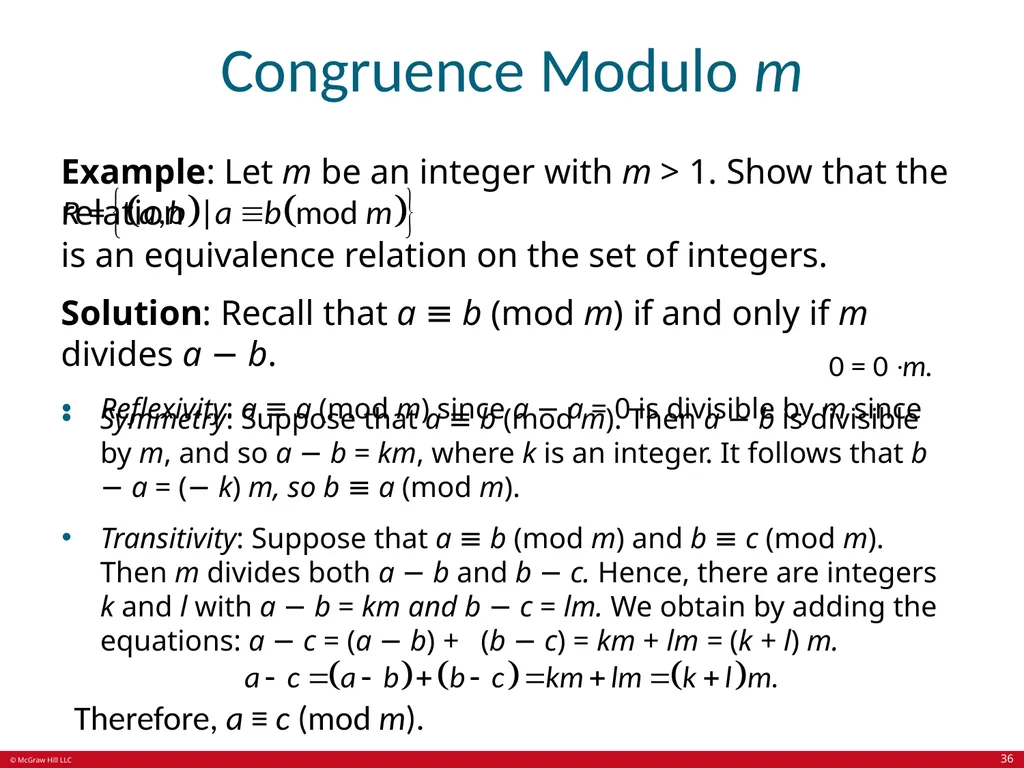
Congruence Modulo m Example: Let m be an integer with m > 1. Show that the relation is an equivalence relation on the set of integers.
Solution: Recall that a ≡ b (mod m) if and only if m divides a − b.
Reflexivity: a ≡ a (mod m) since a − a = 0 is divisible by m since Symmetry: Suppose that a ≡ b (mod m). Then a − b is divisible by m, and so a − b = km, where k is an integer. It follows that b − a = (− k) m, so b ≡ a (mod m).
Transitivity: Suppose that a ≡ b (mod m) and b ≡ c (mod m). Then m divides both a − b and b − c. Hence, there are integers k and l with a − b = km and b − c = lm. We obtain by adding the equations: a − c = (a − b) + (b − c) = km + lm = (k + l) m. Therefore, a ≡ c (mod m). 36<br>
Solution: Recall that a ≡ b (mod m) if and only if m divides a − b.
Reflexivity: a ≡ a (mod m) since a − a = 0 is divisible by m since Symmetry: Suppose that a ≡ b (mod m). Then a − b is divisible by m, and so a − b = km, where k is an integer. It follows that b − a = (− k) m, so b ≡ a (mod m).
Transitivity: Suppose that a ≡ b (mod m) and b ≡ c (mod m). Then m divides both a − b and b − c. Hence, there are integers k and l with a − b = km and b − c = lm. We obtain by adding the equations: a − c = (a − b) + (b − c) = km + lm = (k + l) m. Therefore, a ≡ c (mod m). 36<br>
37
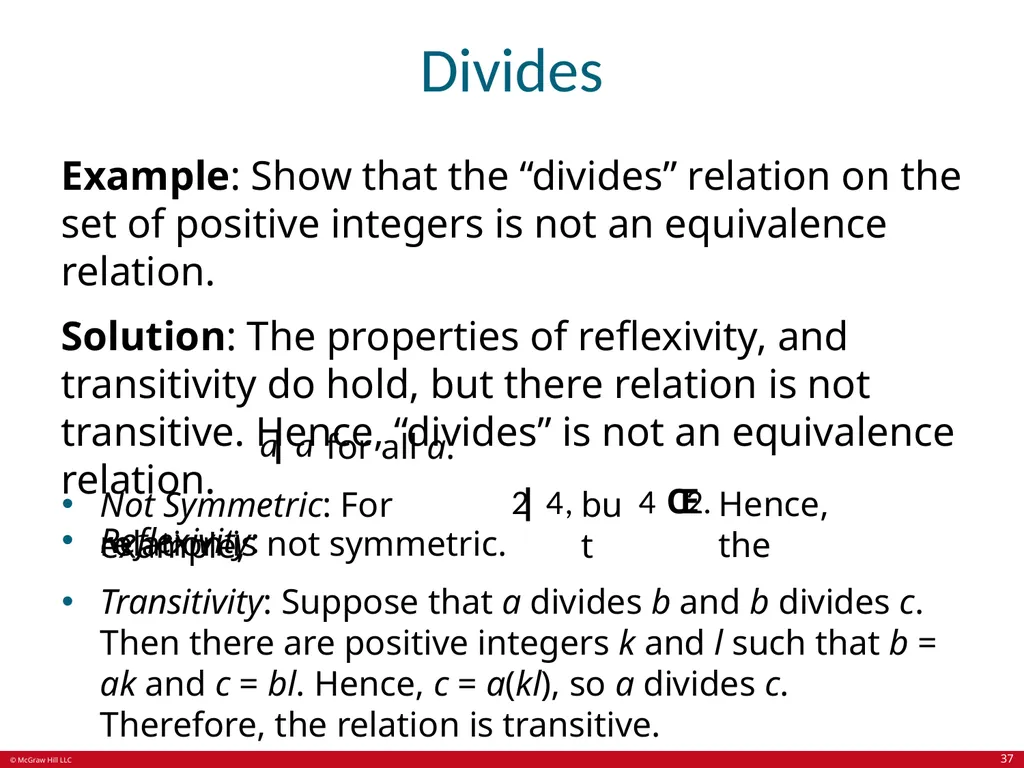
Divides Example: Show that the “divides” relation on the set of positive integers is not an equivalence relation.
Solution: The properties of reflexivity, and transitivity do hold, but there relation is not transitive. Hence, “divides” is not an equivalence relation.
Reflexivity: for all a. Not Symmetric: For example, but Hence, the relation is not symmetric.
Transitivity: Suppose that a divides b and b divides c. Then there are positive integers k and l such that b = ak and c = bl. Hence, c = a(kl), so a divides c. Therefore, the relation is transitive. 37<br>
Solution: The properties of reflexivity, and transitivity do hold, but there relation is not transitive. Hence, “divides” is not an equivalence relation.
Reflexivity: for all a. Not Symmetric: For example, but Hence, the relation is not symmetric.
Transitivity: Suppose that a divides b and b divides c. Then there are positive integers k and l such that b = ak and c = bl. Hence, c = a(kl), so a divides c. Therefore, the relation is transitive. 37<br>
38
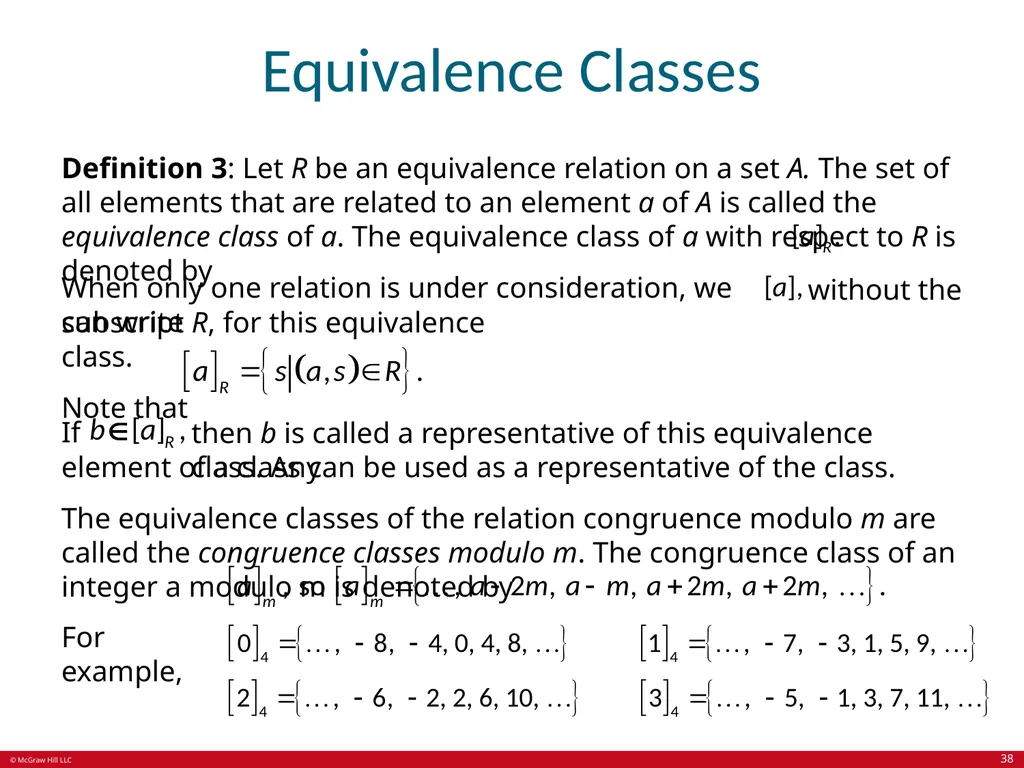
Equivalence Classes Definition 3: Let R be an equivalence relation on a set A. The set of all elements that are related to an element a of A is called the equivalence class of a. The equivalence class of a with respect to R is denoted by When only one relation is under consideration, we can write without the subscript R, for this equivalence class.
Note that If then b is called a representative of this equivalence class. Any element of a class can be used as a representative of the class.
The equivalence classes of the relation congruence modulo m are called the congruence classes modulo m. The congruence class of an integer a modulo m is denoted by For example, 38<br>
Note that If then b is called a representative of this equivalence class. Any element of a class can be used as a representative of the class.
The equivalence classes of the relation congruence modulo m are called the congruence classes modulo m. The congruence class of an integer a modulo m is denoted by For example, 38<br>
39
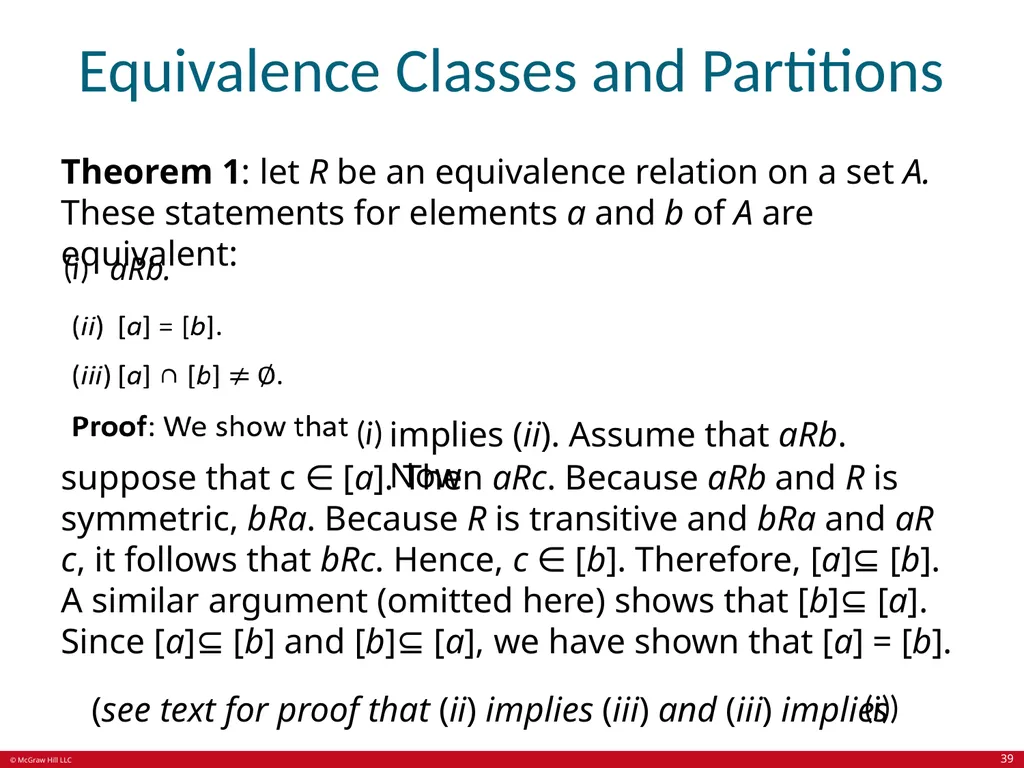
Equivalence Classes and Partitions Theorem 1: let R be an equivalence relation on a set A. These statements for elements a and b of A are equivalent: a R b. implies (ii). Assume that a R b. Now suppose that c ∈ [a]. Then a R c. Because a R b and R is symmetric, b R a. Because R is transitive and b R a and a R c, it follows that b R c. Hence, c ∈ [b]. Therefore, [a]⊆ [b]. A similar argument (omitted here) shows that [b]⊆ [a]. Since [a]⊆ [b] and [b]⊆ [a], we have shown that [a] = [b]. (see text for proof that (ii) implies (iii) and (iii) implies 39<br>
40
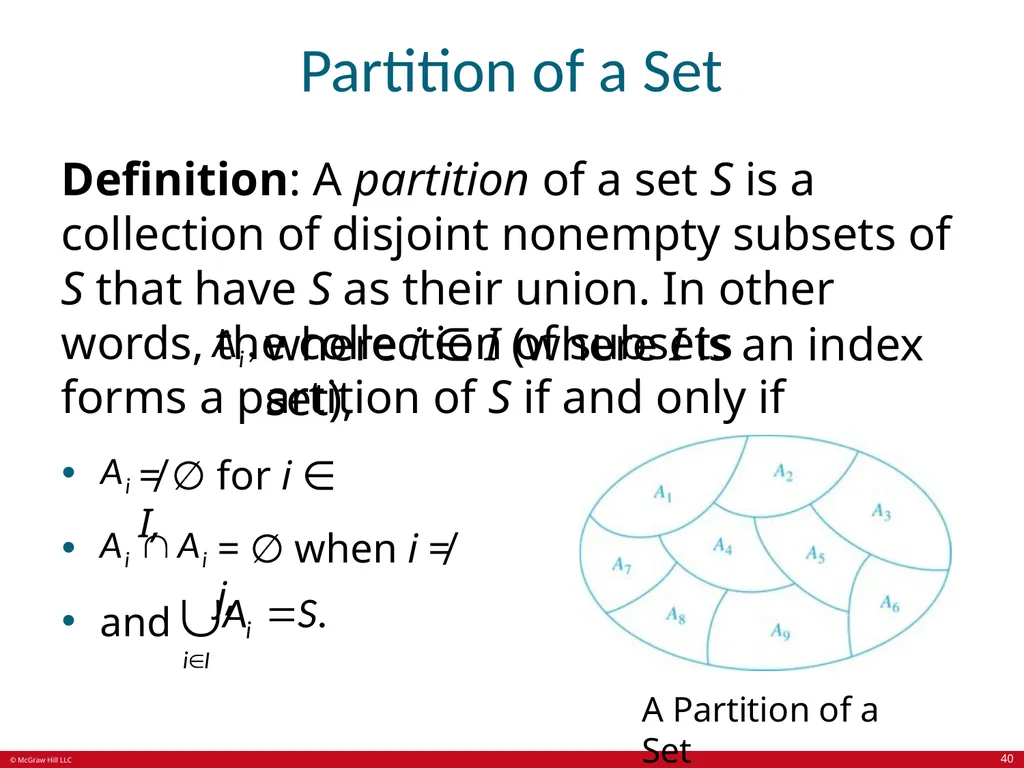
Partition of a Set Definition: A partition of a set S is a collection of disjoint nonempty subsets of S that have S as their union. In other words, the collection of subsets where i ∈ I (where I is an index set), forms a partition of S if and only if ≠ ∅ for i ∈ I, = ∅ when i ≠ j, and A Partition of a Set 40<br>
41
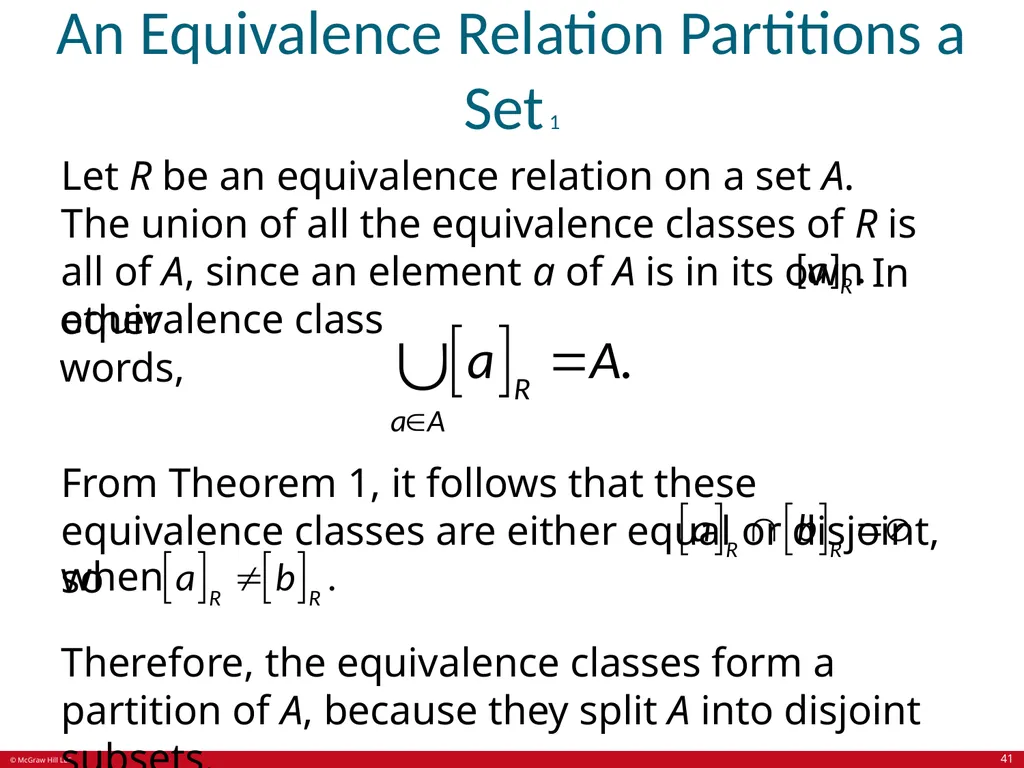
An Equivalence Relation Partitions a Set 1 Let R be an equivalence relation on a set A. The union of all the equivalence classes of R is all of A, since an element a of A is in its own equivalence class In other words, From Theorem 1, it follows that these equivalence classes are either equal or disjoint, so when Therefore, the equivalence classes form a partition of A, because they split A into disjoint subsets. 41<br>
42
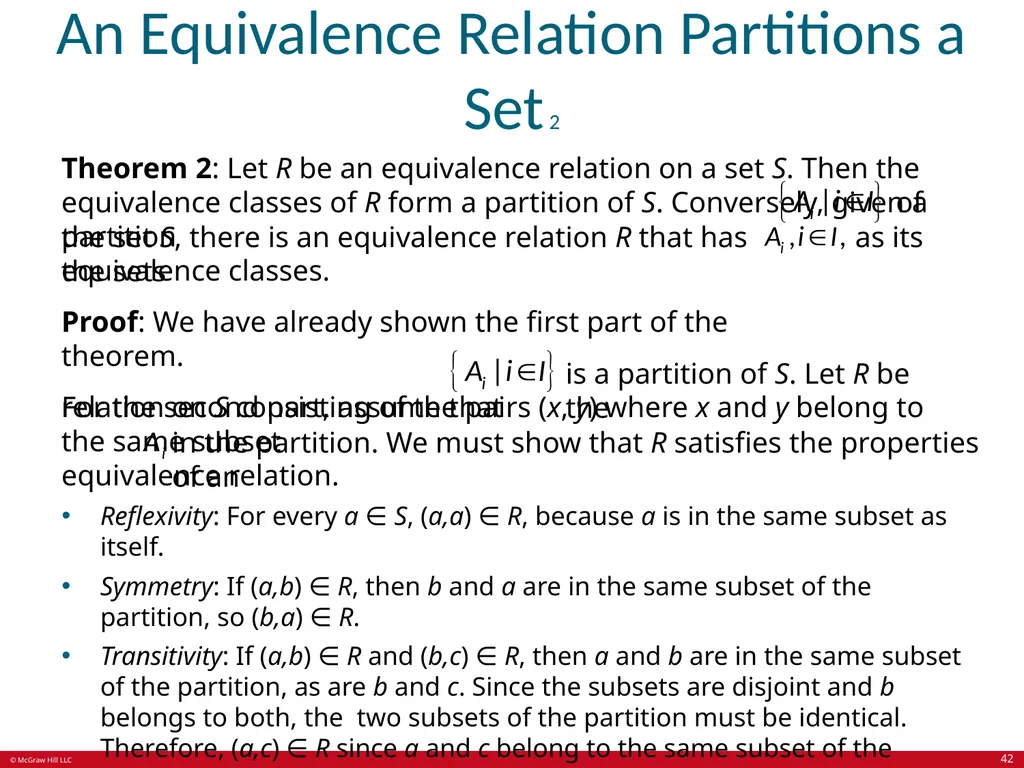
An Equivalence Relation Partitions a Set 2 Theorem 2: Let R be an equivalence relation on a set S. Then the equivalence classes of R form a partition of S. Conversely, given a partition of the set S, there is an equivalence relation R that has the sets as its equivalence classes.
Proof: We have already shown the first part of the theorem.
For the second part, assume that is a partition of S. Let R be the relation on S consisting of the pairs (x, y) where x and y belong to the same subset in the partition. We must show that R satisfies the properties of an equivalence relation.
Reflexivity: For every a ∈ S, (a,a) ∈ R, because a is in the same subset as itself.
Symmetry: If (a,b) ∈ R, then b and a are in the same subset of the partition, so (b,a) ∈ R.
Transitivity: If (a,b) ∈ R and (b,c) ∈ R, then a and b are in the same subset of the partition, as are b and c. Since the subsets are disjoint and b belongs to both, the two subsets of the partition must be identical. Therefore, (a,c) ∈ R since a and c belong to the same subset of the partition. 42<br>
Proof: We have already shown the first part of the theorem.
For the second part, assume that is a partition of S. Let R be the relation on S consisting of the pairs (x, y) where x and y belong to the same subset in the partition. We must show that R satisfies the properties of an equivalence relation.
Reflexivity: For every a ∈ S, (a,a) ∈ R, because a is in the same subset as itself.
Symmetry: If (a,b) ∈ R, then b and a are in the same subset of the partition, so (b,a) ∈ R.
Transitivity: If (a,b) ∈ R and (b,c) ∈ R, then a and b are in the same subset of the partition, as are b and c. Since the subsets are disjoint and b belongs to both, the two subsets of the partition must be identical. Therefore, (a,c) ∈ R since a and c belong to the same subset of the partition. 42<br>
43
Partial Orderings Section 9.6 43<br>
44
Section Summary 4 Partial Orderings and Partially-ordered Sets.
Lexicographic Orderings.
Hasse Diagrams.
Lattices (not currently in overheads).
Topological Sorting (not currently in overheads). 44<br>
Lexicographic Orderings.
Hasse Diagrams.
Lattices (not currently in overheads).
Topological Sorting (not currently in overheads). 44<br>
45
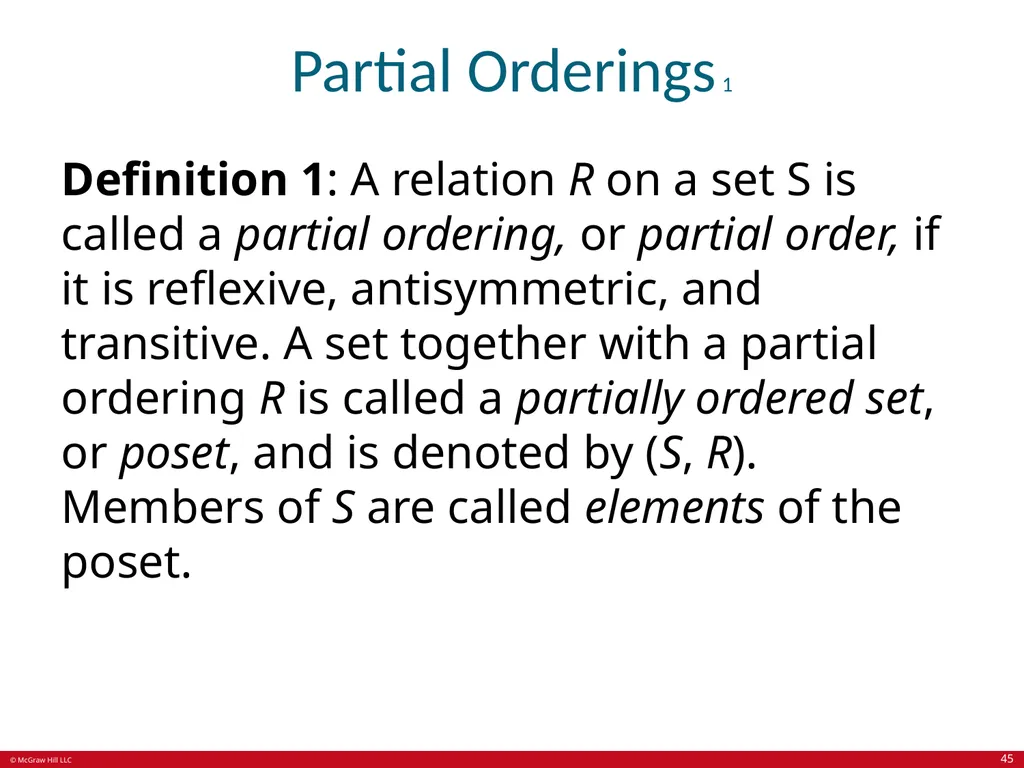
Partial Orderings 1 Definition 1: A relation R on a set S is called a partial ordering, or partial order, if it is reflexive, antisymmetric, and transitive. A set together with a partial ordering R is called a partially ordered set, or poset, and is denoted by (S, R). Members of S are called elements of the poset. 45<br>
46
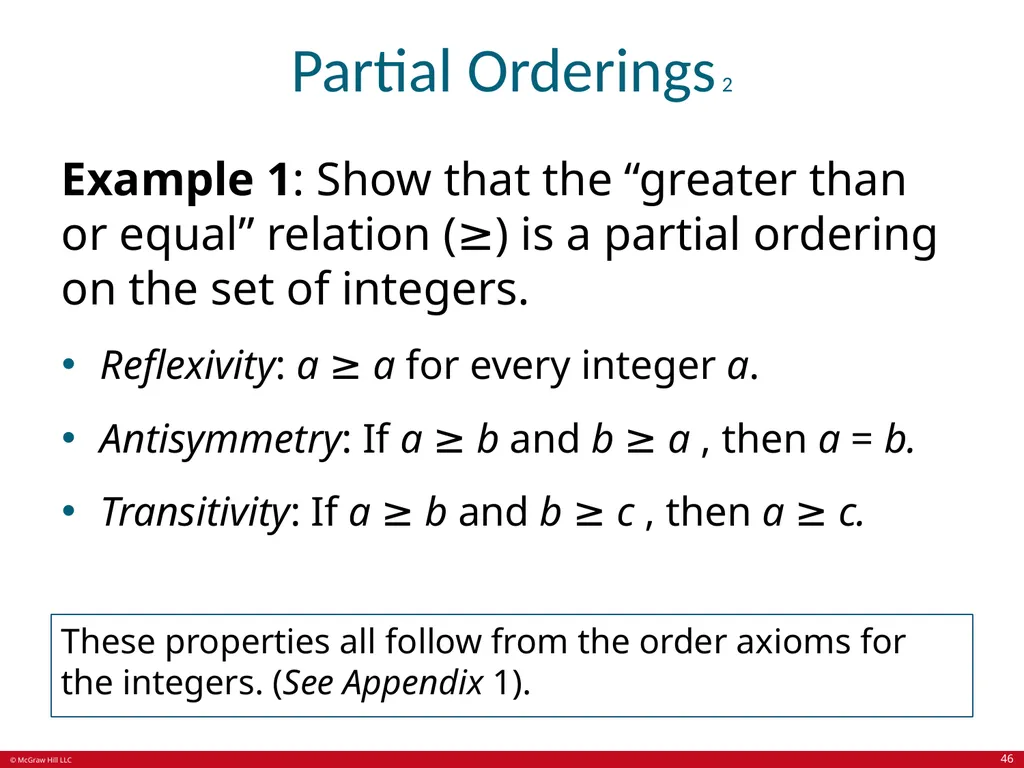
Partial Orderings 2 Example 1: Show that the “greater than or equal” relation (≥) is a partial ordering on the set of integers.
Reflexivity: a ≥ a for every integer a.
Antisymmetry: If a ≥ b and b ≥ a , then a = b.
Transitivity: If a ≥ b and b ≥ c , then a ≥ c. These properties all follow from the order axioms for the integers. (See Appendix 1). 46<br>
Reflexivity: a ≥ a for every integer a.
Antisymmetry: If a ≥ b and b ≥ a , then a = b.
Transitivity: If a ≥ b and b ≥ c , then a ≥ c. These properties all follow from the order axioms for the integers. (See Appendix 1). 46<br>
47
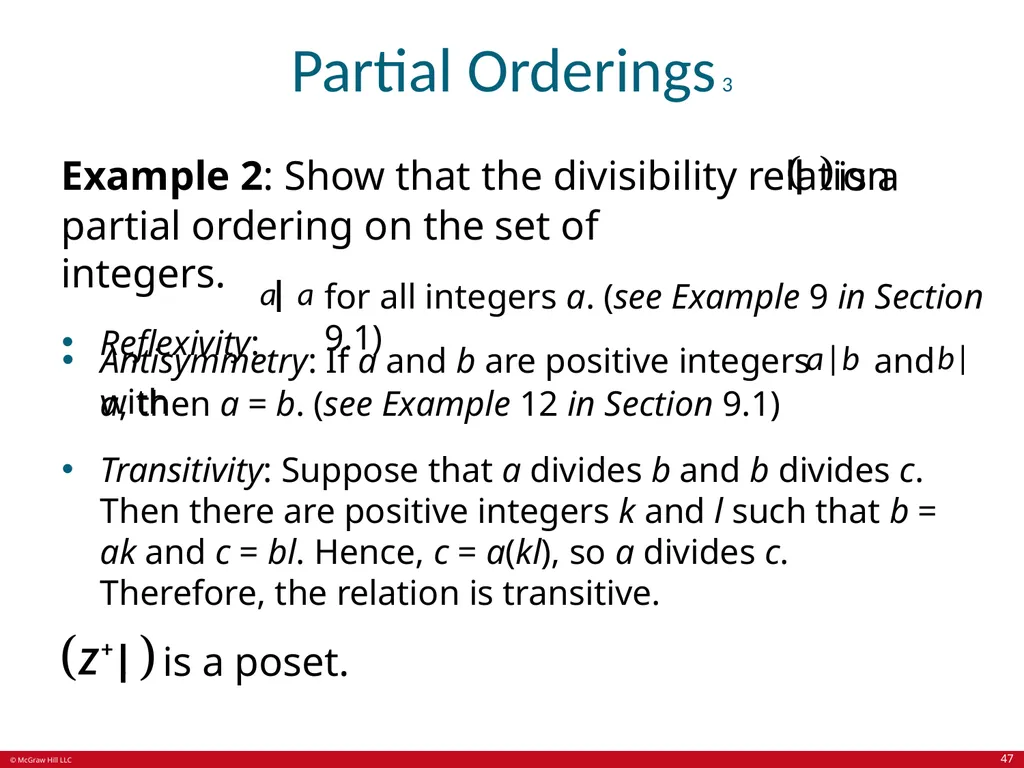
Partial Orderings 3 Example 2: Show that the divisibility relation is a partial ordering on the set of integers.
Reflexivity: for all integers a. (see Example 9 in Section 9.1) Antisymmetry: If a and b are positive integers with and a, then a = b. (see Example 12 in Section 9.1)
Transitivity: Suppose that a divides b and b divides c. Then there are positive integers k and l such that b = ak and c = bl. Hence, c = a(kl), so a divides c. Therefore, the relation is transitive. is a poset. 47<br>
Reflexivity: for all integers a. (see Example 9 in Section 9.1) Antisymmetry: If a and b are positive integers with and a, then a = b. (see Example 12 in Section 9.1)
Transitivity: Suppose that a divides b and b divides c. Then there are positive integers k and l such that b = ak and c = bl. Hence, c = a(kl), so a divides c. Therefore, the relation is transitive. is a poset. 47<br>
48
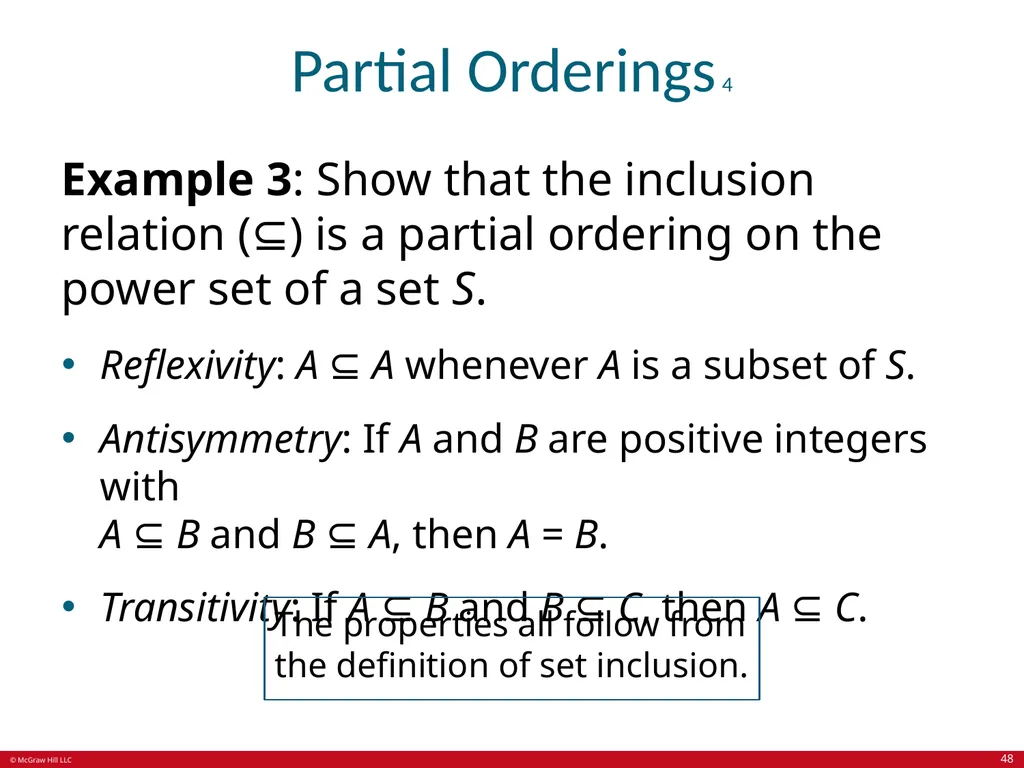
Partial Orderings 4 Example 3: Show that the inclusion relation (⊆) is a partial ordering on the power set of a set S.
Reflexivity: A ⊆ A whenever A is a subset of S.
Antisymmetry: If A and B are positive integers with A ⊆ B and B ⊆ A, then A = B.
Transitivity: If A ⊆ B and B ⊆ C, then A ⊆ C. The properties all follow from the definition of set inclusion. 48<br>
Reflexivity: A ⊆ A whenever A is a subset of S.
Antisymmetry: If A and B are positive integers with A ⊆ B and B ⊆ A, then A = B.
Transitivity: If A ⊆ B and B ⊆ C, then A ⊆ C. The properties all follow from the definition of set inclusion. 48<br>
49
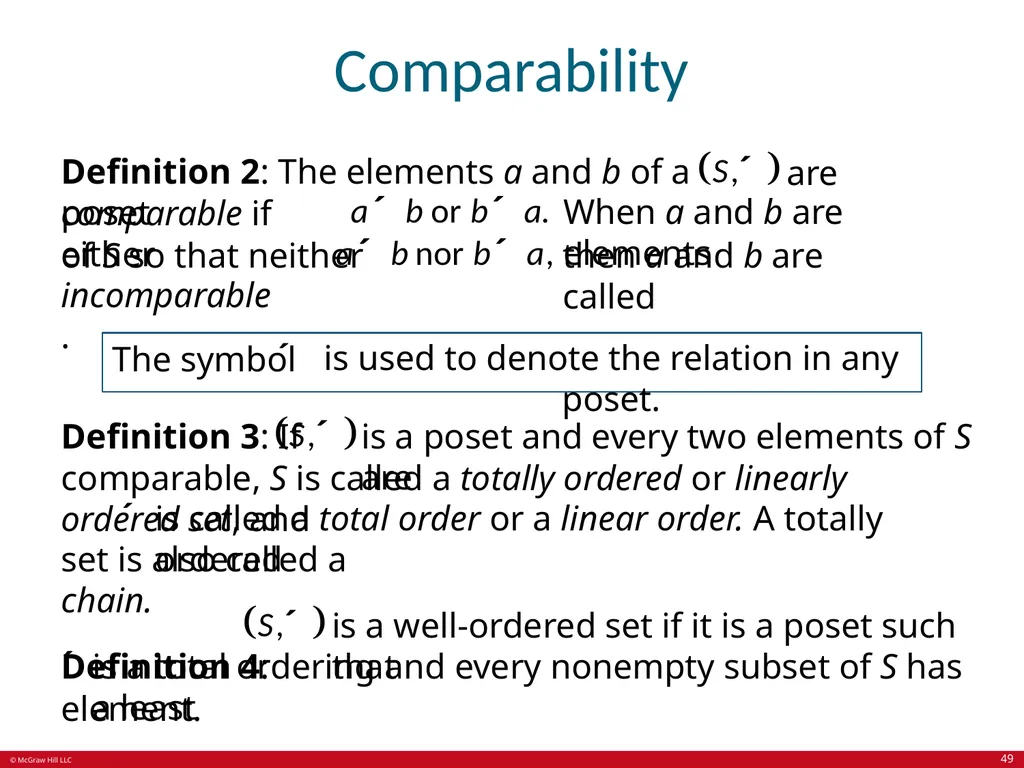
Comparability Definition 2: The elements a and b of a poset are comparable if either When a and b are elements of S so that neither then a and b are called incomparable. The symbol is used to denote the relation in any poset. Definition 3: If is a poset and every two elements of S are comparable, S is called a totally ordered or linearly ordered set, and is called a total order or a linear order. A totally ordered set is also called a chain.
Definition 4: is a well-ordered set if it is a poset such that is a total ordering and every nonempty subset of S has a least element. 49<br>
Definition 4: is a well-ordered set if it is a poset such that is a total ordering and every nonempty subset of S has a least element. 49<br>
50
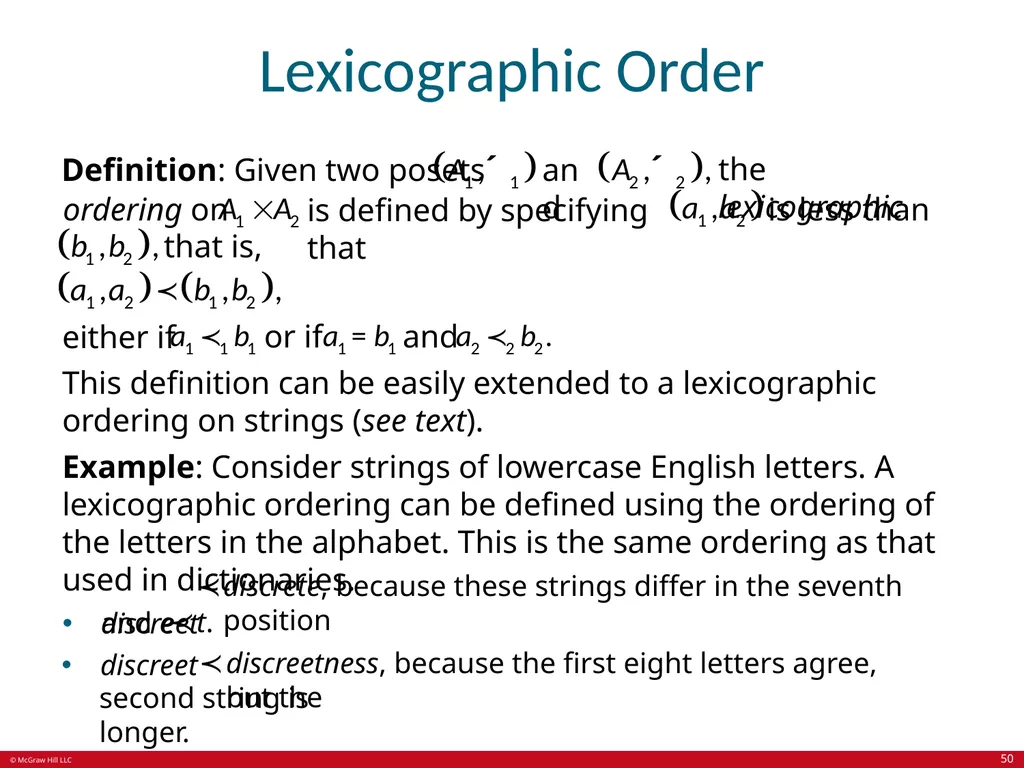
Lexicographic Order Definition: Given two posets and the lexicographic ordering on is defined by specifying that is less than that is, either if or if and This definition can be easily extended to a lexicographic ordering on strings (see text).
Example: Consider strings of lowercase English letters. A lexicographic ordering can be defined using the ordering of the letters in the alphabet. This is the same ordering as that used in dictionaries.
discreet discrete, because these strings differ in the seventh position and e t. discreet discreetness, because the first eight letters agree, but the second string is longer. 50<br>
Example: Consider strings of lowercase English letters. A lexicographic ordering can be defined using the ordering of the letters in the alphabet. This is the same ordering as that used in dictionaries.
discreet discrete, because these strings differ in the seventh position and e t. discreet discreetness, because the first eight letters agree, but the second string is longer. 50<br>
51
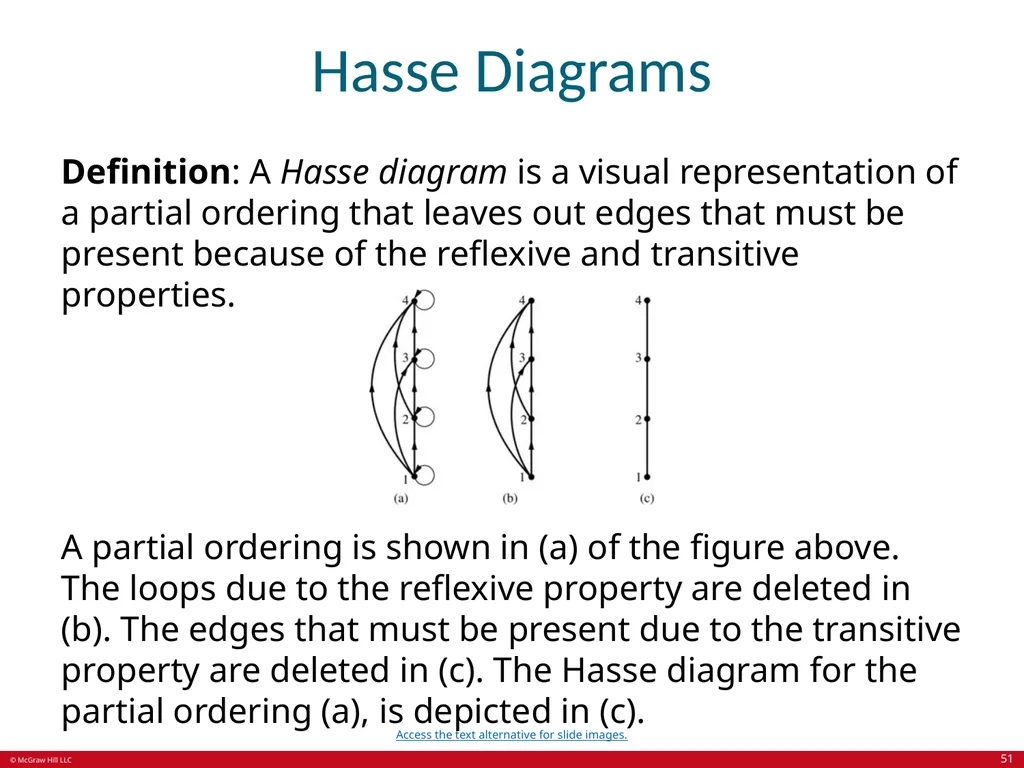
Hasse Diagrams Definition: A Hasse diagram is a visual representation of a partial ordering that leaves out edges that must be present because of the reflexive and transitive properties. A partial ordering is shown in (a) of the figure above. The loops due to the reflexive property are deleted in (b). The edges that must be present due to the transitive property are deleted in (c). The Hasse diagram for the partial ordering (a), is depicted in (c). Access the text alternative for slide images. 51<br>
52
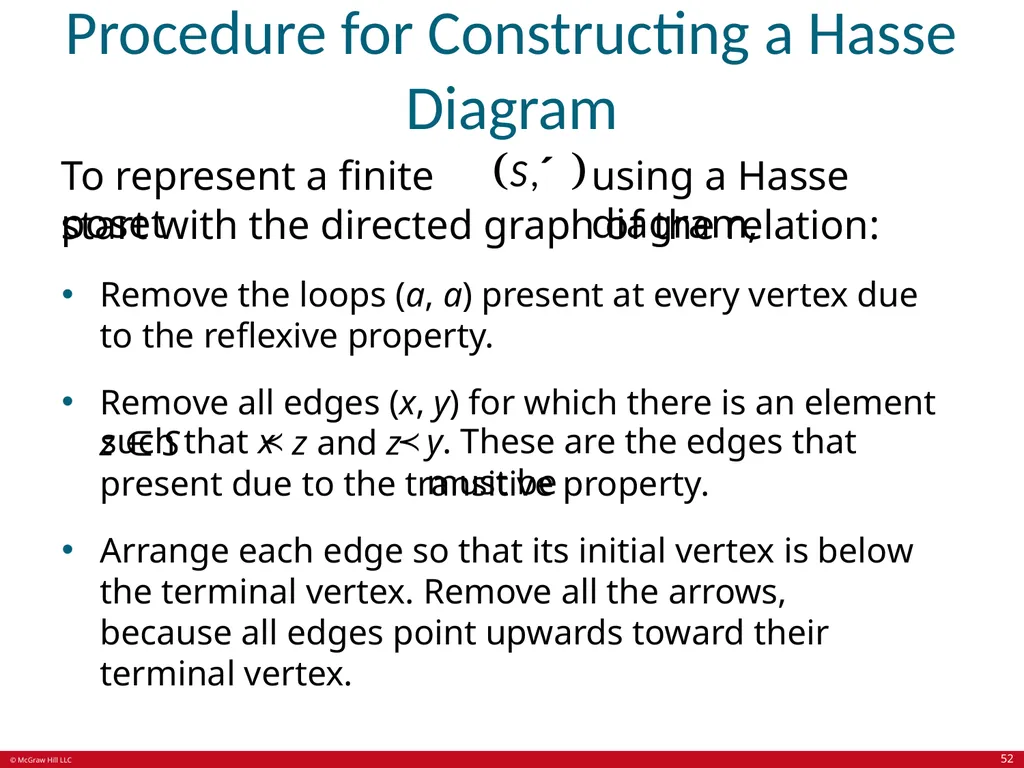
Procedure for Constructing a Hasse Diagram To represent a finite poset using a Hasse diagram, start with the directed graph of the relation:
Remove the loops (a, a) present at every vertex due to the reflexive property.
Remove all edges (x, y) for which there is an element z ∈ S such that x z and z y. These are the edges that must be present due to the transitive property.
Arrange each edge so that its initial vertex is below the terminal vertex. Remove all the arrows, because all edges point upwards toward their terminal vertex. 52<br>
Remove the loops (a, a) present at every vertex due to the reflexive property.
Remove all edges (x, y) for which there is an element z ∈ S such that x z and z y. These are the edges that must be present due to the transitive property.
Arrange each edge so that its initial vertex is below the terminal vertex. Remove all the arrows, because all edges point upwards toward their terminal vertex. 52<br>
53
End of Main Content © McGraw Hill LLC. All rights reserved. No reproduction or distribution without the prior written consent of McGraw Hill LLC.<br>
54
Accessibility Content:
Text Alternatives for Images 54<br>
55
Binary Relations – Text Alternative Return to parent-slide containing images. In the left part of the picture, there are 5 points. Points 0, 1 , and 2 are placed one above the other forming a column. Points a and b are located aside forming another column. Arrows point from 0 to A, from 0 to B, from 1 to A, and from 2 to B. In the right part of the picture there is a table with two columns labeled as A and B and three rows labeled as 0,1 and 2. Some elements of the intersection of rows and columns are marked with a cross, the others are empty. Both elements of the first row are marked with a cross. Only the first element of the second line is marked with a cross, the second one is empty. The first element of the second line is empty, and the second one is marked with a cross. Return to parent-slide containing images. 55<br>
56
Representing the Composition of Relations – Text Alternative Return to parent-slide containing images. In R sub 1 on the left is a, b, and c and on the right is m, n, o, and p. a is connected to p. b is connected to m. In R sub 2 on the left is m, n, o, and p and on the right is w, x, y, and z. m is connected to x and z. n is connected to w. Return to parent-slide containing images. 56<br>
57
Matrices of Relations on Sets – Text Alternative Return to parent-slide containing images. There is a square matrix, only the main diagonal is shown. All the elements of this diagonal are 1.
There are two square matrices A and B. In the matrix A, the elements that are symmetric with respect to the main diagonal are equal; in matrix B, these elements are not equal. Return to parent-slide containing images. 57<br>
There are two square matrices A and B. In the matrix A, the elements that are symmetric with respect to the main diagonal are equal; in matrix B, these elements are not equal. Return to parent-slide containing images. 57<br>
58
Representing Relations Using Digraphs – Text Alternative Return to parent-slide containing images. Points A, B, C, and D are vertices of the graph. Arrows point from A to B, from A to D, from B to D. From C to A, from C to B and from D to B. The arrow pointing from B to D does not coincide with the arrow pointing from D to B. There is a circle that starts and ends at vertex B. This circle is a loop. Return to parent-slide containing images. 58<br>
59
Examples of Digraphs Representing Relations – Text Alternative Return to parent-slide containing images. Points 1, 2, 3, and 4 are vertices of the graph. Arrows point from 1 to 4, from 1 to 3, from 2 to 1, from 2 to 3, from 3 to 1, from 4 to 1, from 4 to 3. The arrow pointing from 1 to 3 does not coincide with the arrow pointing from 3 to 1. The arrow pointing from 1 to 4 does not coincide with the arrow pointing from 4 to 1. There are loops at vertices 2 and 3. Return to parent-slide containing images. 59<br>
60
Example of the Powers of a Relation – Text Alternative Return to parent-slide containing images. R is connected to R squared which is connected to R cubed which is connected to R to the power 4. All relations are represented by four circles a, b, c, and d.
R: a is connected to b. b is connected to c. c is connected to d. d is connected to b.
R squared: a is connected to c. b is connected to d. c is connected to b. d is connected to c.
R cubed: a is connected to d. b, c, and d have a loop each.
R to the power 4: a is connected to b. b is connected to c. c is connected to d. d is connected to b. Return to parent-slide containing images. 60<br>
61
Hasse Diagrams – Text Alternative Return to parent-slide containing images. Case A. Points 1, 2, 3, and 4 located from the bottom to the top on the same line are vertices of the graph. Arrows point from 1 to 2, from 1 to 3, from 1 to 4, from 2 to 3, from 2 to 4, and from 3 to 4. There are loops at each vertex. Case B. The same graph is shown, but there are no loops at the vertices. Case C. The same graph is shown, but there are only edges connecting the vertices consequently present. Return to parent-slide containing images. 61<br>