
Relationship between Policy and Education Dr V.
MY
Published · 80 slides · 0 views
1 / 1

Description
Relationship between Policy and Education Dr V. Sasikala Formerly Assistant Professor (T) of Education Manonmaniam Sundaranar University Tirunelveli Introduction Nations development and progress depend upon availability of basic civil
Related Topics
Share
Embed code
Download this presentation From Below
"Relationship between Policy and Education Dr V." is the property of its rightful owner. Permission is granted to download and print the materials on this website for personal, non-commercial use only, and to display it on your personal computer provided you do not modify the materials and that you retain all copyright notices contained in the materials. By downloading content from our website, you accept the terms of this agreement.
Presentation Transcript
01
Relationship between Policy and Education Dr V. Sasikala
Formerly Assistant Professor (T) of Education
Manonmaniam Sundaranar University
Tirunelveli<br>
Formerly Assistant Professor (T) of Education
Manonmaniam Sundaranar University
Tirunelveli<br>
02
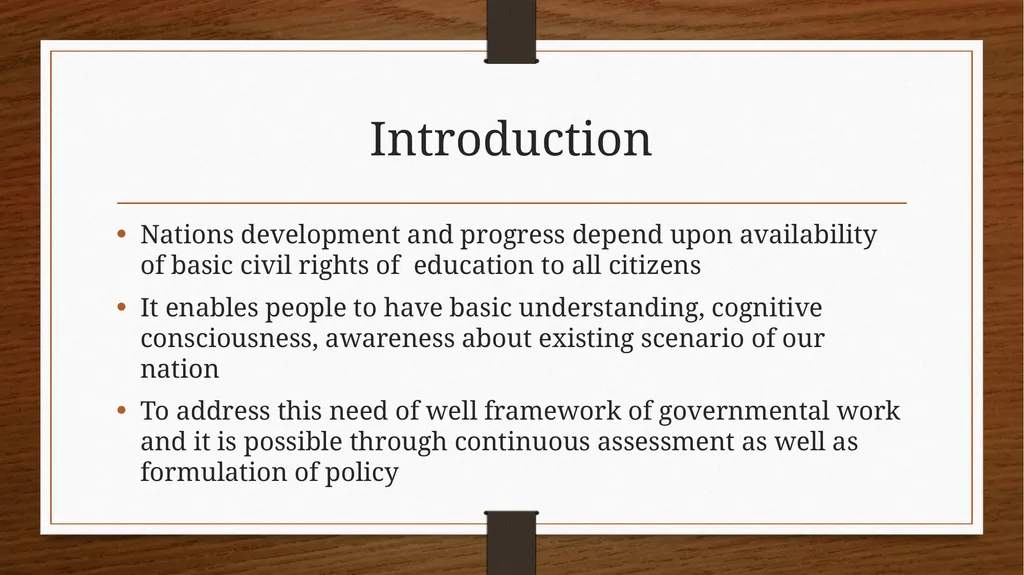
Introduction Nations development and progress depend upon availability of basic civil rights of education to all citizens
It enables people to have basic understanding, cognitive consciousness, awareness about existing scenario of our nation
To address this need of well framework of governmental work and it is possible through continuous assessment as well as formulation of policy<br>
It enables people to have basic understanding, cognitive consciousness, awareness about existing scenario of our nation
To address this need of well framework of governmental work and it is possible through continuous assessment as well as formulation of policy<br>
03
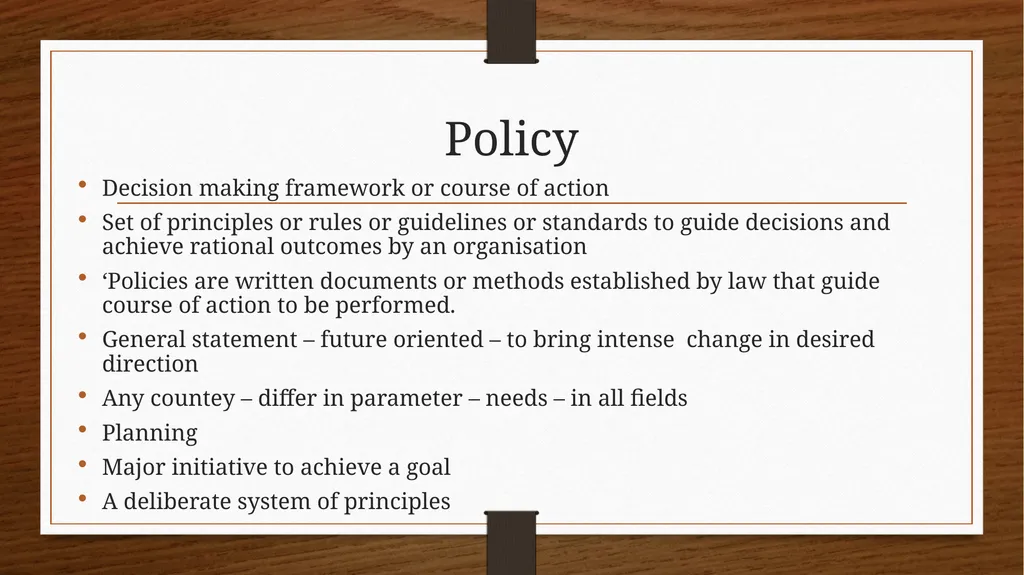
Policy Decision making framework or course of action
Set of principles or rules or guidelines or standards to guide decisions and achieve rational outcomes by an organisation
‘Policies are written documents or methods established by law that guide course of action to be performed.
General statement – future oriented – to bring intense change in desired direction
Any countey – differ in parameter – needs – in all fields
Planning
Major initiative to achieve a goal
A deliberate system of principles<br>
Set of principles or rules or guidelines or standards to guide decisions and achieve rational outcomes by an organisation
‘Policies are written documents or methods established by law that guide course of action to be performed.
General statement – future oriented – to bring intense change in desired direction
Any countey – differ in parameter – needs – in all fields
Planning
Major initiative to achieve a goal
A deliberate system of principles<br>
04
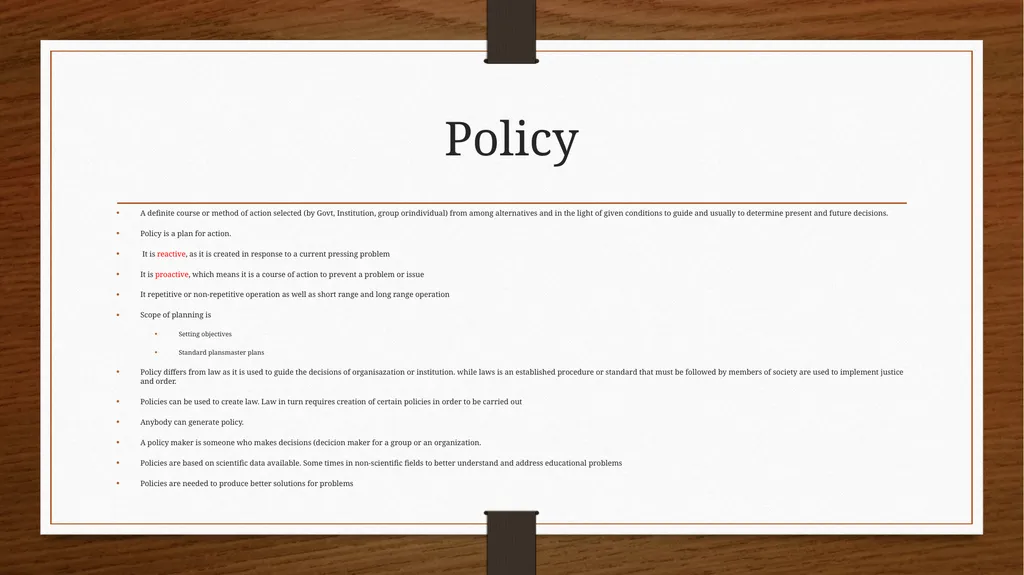
Policy A definite course or method of action selected (by Govt, Institution, group orindividual) from among alternatives and in the light of given conditions to guide and usually to determine present and future decisions.
Policy is a plan for action.
It is reactive, as it is created in response to a current pressing problem
It is proactive, which means it is a course of action to prevent a problem or issue
It repetitive or non-repetitive operation as well as short range and long range operation
Scope of planning is
Setting objectives
Standard plansmaster plans
Policy differs from law as it is used to guide the decisions of organisazation or institution. while laws is an established procedure or standard that must be followed by members of society are used to implement justice and order.
Policies can be used to create law. Law in turn requires creation of certain policies in order to be carried out
Anybody can generate policy.
A policy maker is someone who makes decisions (decicion maker for a group or an organization.
Policies are based on scientific data available. Some times in non-scientific fields to better understand and address educational problems
Policies are needed to produce better solutions for problems<br>
Policy is a plan for action.
It is reactive, as it is created in response to a current pressing problem
It is proactive, which means it is a course of action to prevent a problem or issue
It repetitive or non-repetitive operation as well as short range and long range operation
Scope of planning is
Setting objectives
Standard plansmaster plans
Policy differs from law as it is used to guide the decisions of organisazation or institution. while laws is an established procedure or standard that must be followed by members of society are used to implement justice and order.
Policies can be used to create law. Law in turn requires creation of certain policies in order to be carried out
Anybody can generate policy.
A policy maker is someone who makes decisions (decicion maker for a group or an organization.
Policies are based on scientific data available. Some times in non-scientific fields to better understand and address educational problems
Policies are needed to produce better solutions for problems<br>
05
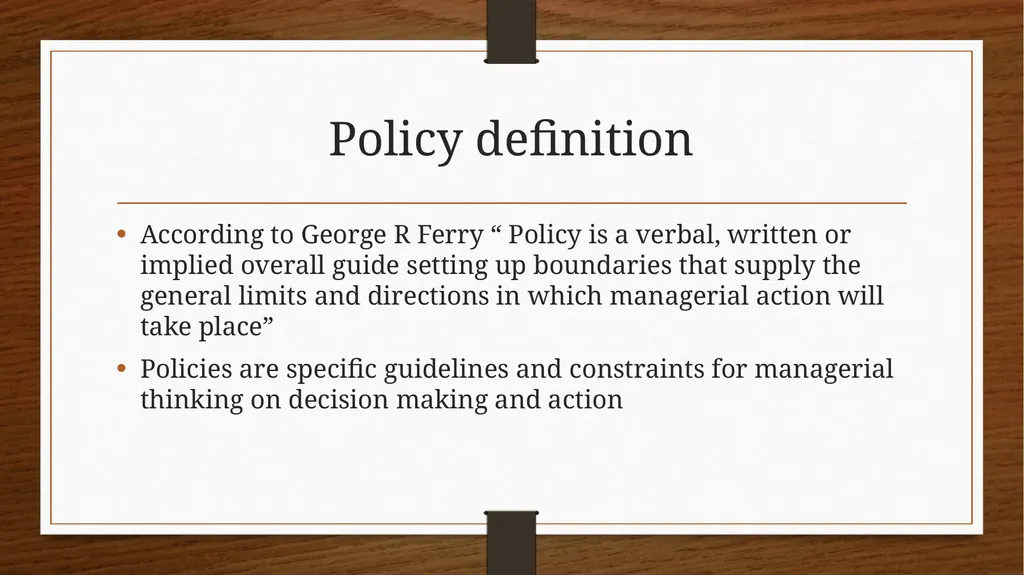
Policy definition According to George R Ferry “ Policy is a verbal, written or implied overall guide setting up boundaries that supply the general limits and directions in which managerial action will take place”
Policies are specific guidelines and constraints for managerial thinking on decision making and action<br>
Policies are specific guidelines and constraints for managerial thinking on decision making and action<br>
06
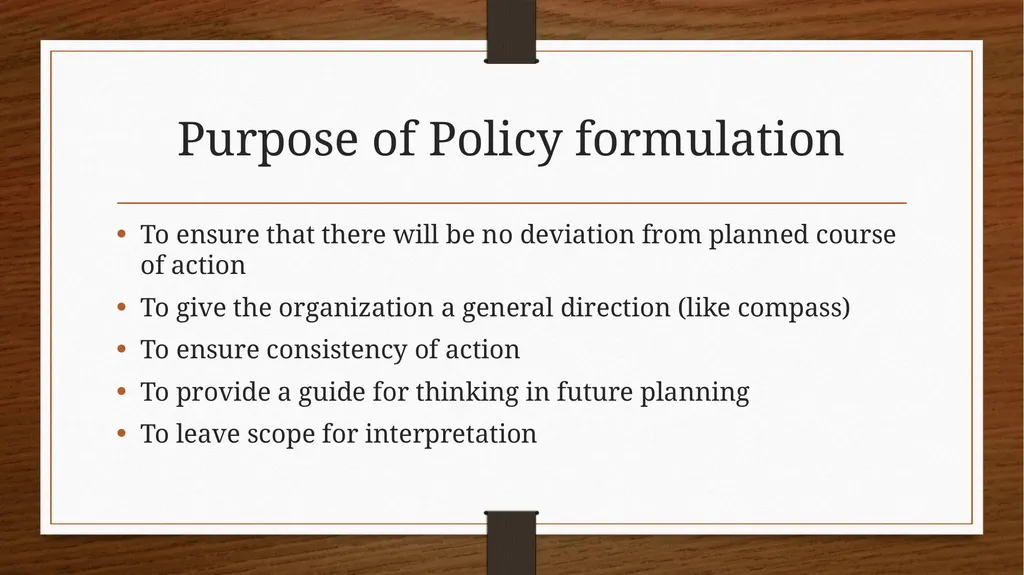
Purpose of Policy formulation To ensure that there will be no deviation from planned course of action
To give the organization a general direction (like compass)
To ensure consistency of action
To provide a guide for thinking in future planning
To leave scope for interpretation<br>
To give the organization a general direction (like compass)
To ensure consistency of action
To provide a guide for thinking in future planning
To leave scope for interpretation<br>
07
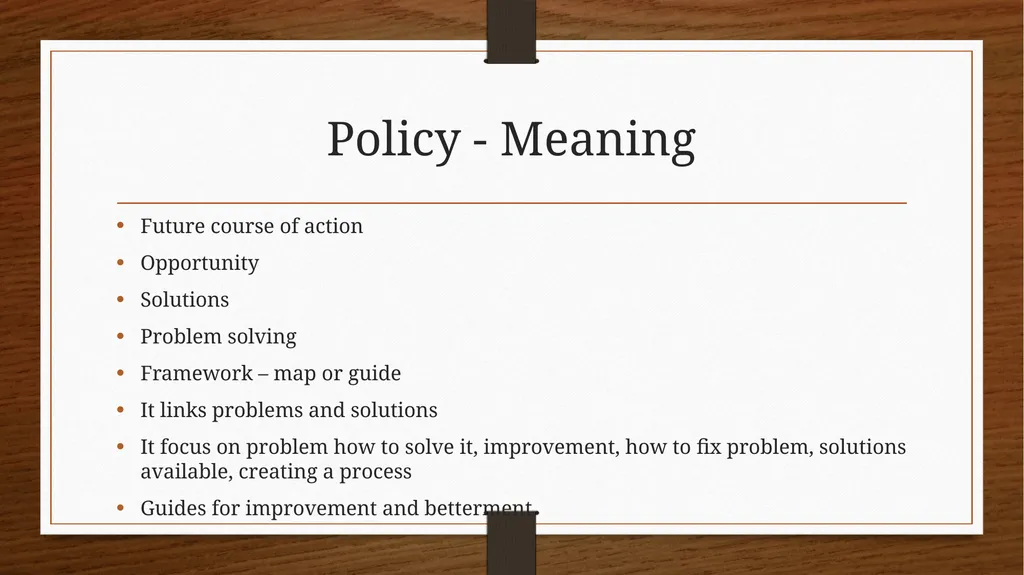
Policy - Meaning Future course of action
Opportunity
Solutions
Problem solving
Framework – map or guide
It links problems and solutions
It focus on problem how to solve it, improvement, how to fix problem, solutions available, creating a process
Guides for improvement and betterment<br>
Opportunity
Solutions
Problem solving
Framework – map or guide
It links problems and solutions
It focus on problem how to solve it, improvement, how to fix problem, solutions available, creating a process
Guides for improvement and betterment<br>
08
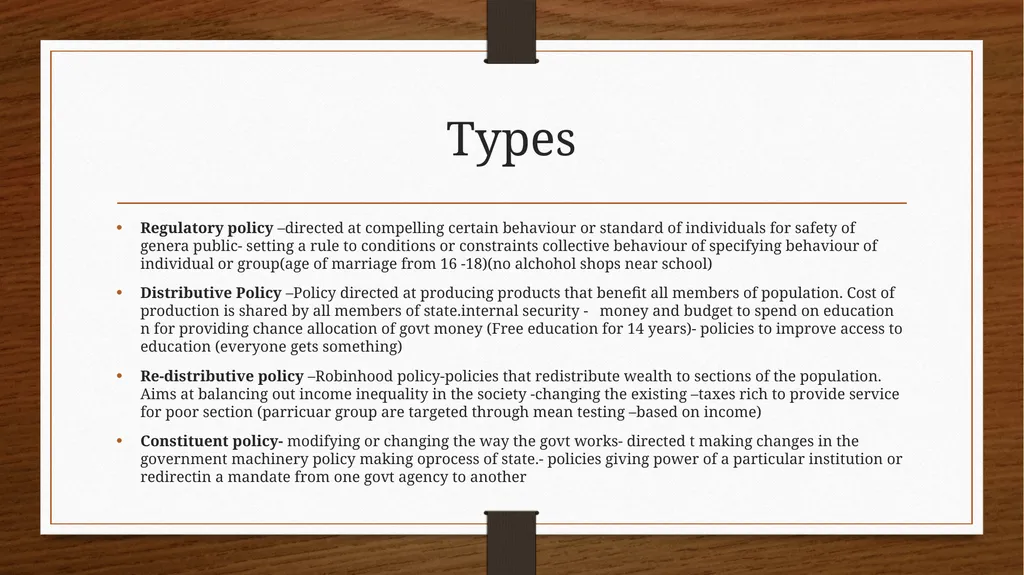
Types Regulatory policy –directed at compelling certain behaviour or standard of individuals for safety of genera public- setting a rule to conditions or constraints collective behaviour of specifying behaviour of individual or group(age of marriage from 16 -18)(no alchohol shops near school)
Distributive Policy –Policy directed at producing products that benefit all members of population. Cost of production is shared by all members of state.internal security - money and budget to spend on education n for providing chance allocation of govt money (Free education for 14 years)- policies to improve access to education (everyone gets something)
Re-distributive policy –Robinhood policy-policies that redistribute wealth to sections of the population. Aims at balancing out income inequality in the society -changing the existing –taxes rich to provide service for poor section (parricuar group are targeted through mean testing –based on income)
Constituent policy- modifying or changing the way the govt works- directed t making changes in the government machinery policy making oprocess of state.- policies giving power of a particular institution or redirectin a mandate from one govt agency to another<br>
Distributive Policy –Policy directed at producing products that benefit all members of population. Cost of production is shared by all members of state.internal security - money and budget to spend on education n for providing chance allocation of govt money (Free education for 14 years)- policies to improve access to education (everyone gets something)
Re-distributive policy –Robinhood policy-policies that redistribute wealth to sections of the population. Aims at balancing out income inequality in the society -changing the existing –taxes rich to provide service for poor section (parricuar group are targeted through mean testing –based on income)
Constituent policy- modifying or changing the way the govt works- directed t making changes in the government machinery policy making oprocess of state.- policies giving power of a particular institution or redirectin a mandate from one govt agency to another<br>
09
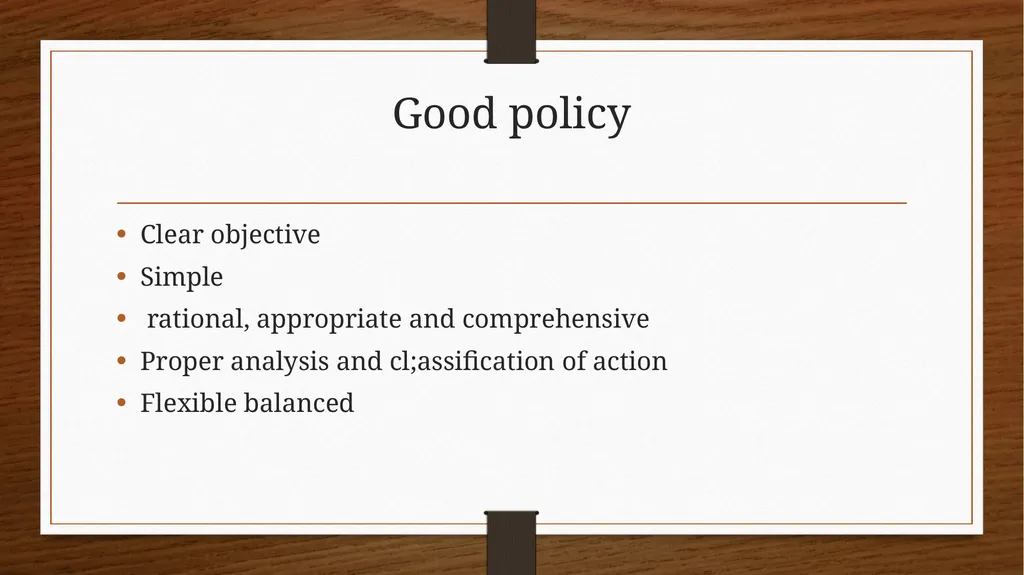
Good policy Clear objective
Simple
rational, appropriate and comprehensive
Proper analysis and cl;assification of action
Flexible balanced<br>
Simple
rational, appropriate and comprehensive
Proper analysis and cl;assification of action
Flexible balanced<br>
10
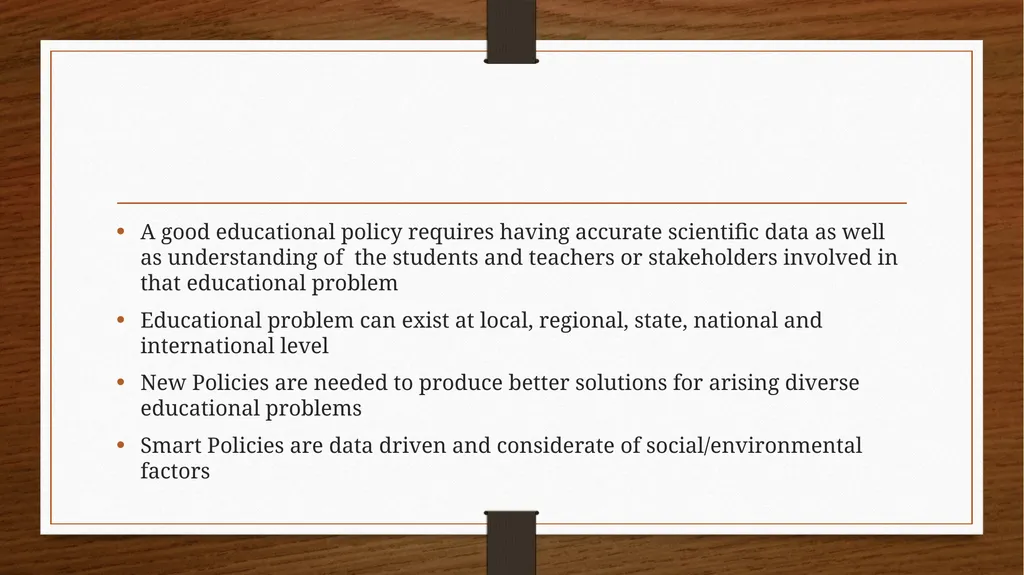
A good educational policy requires having accurate scientific data as well as understanding of the students and teachers or stakeholders involved in that educational problem
Educational problem can exist at local, regional, state, national and international level
New Policies are needed to produce better solutions for arising diverse educational problems
Smart Policies are data driven and considerate of social/environmental factors<br>
Educational problem can exist at local, regional, state, national and international level
New Policies are needed to produce better solutions for arising diverse educational problems
Smart Policies are data driven and considerate of social/environmental factors<br>
11
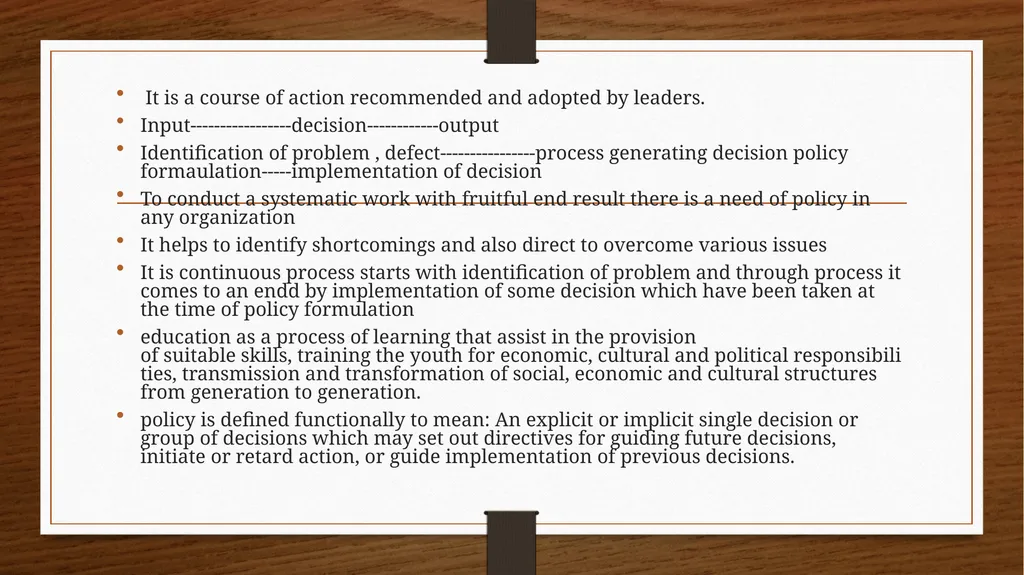
It is a course of action recommended and adopted by leaders.
Input-----------------decision------------output
Identification of problem , defect----------------process generating decision policy formaulation-----implementation of decision
To conduct a systematic work with fruitful end result there is a need of policy in any organization
It helps to identify shortcomings and also direct to overcome various issues
It is continuous process starts with identification of problem and through process it comes to an endd by implementation of some decision which have been taken at the time of policy formulation
education as a process of learning that assist in the provision of suitable skills, training the youth for economic, cultural and political responsibilities, transmission and transformation of social, economic and cultural structures from generation to generation.
policy is defined functionally to mean: An explicit or implicit single decision or group of decisions which may set out directives for guiding future decisions, initiate or retard action, or guide implementation of previous decisions.<br>
Input-----------------decision------------output
Identification of problem , defect----------------process generating decision policy formaulation-----implementation of decision
To conduct a systematic work with fruitful end result there is a need of policy in any organization
It helps to identify shortcomings and also direct to overcome various issues
It is continuous process starts with identification of problem and through process it comes to an endd by implementation of some decision which have been taken at the time of policy formulation
education as a process of learning that assist in the provision of suitable skills, training the youth for economic, cultural and political responsibilities, transmission and transformation of social, economic and cultural structures from generation to generation.
policy is defined functionally to mean: An explicit or implicit single decision or group of decisions which may set out directives for guiding future decisions, initiate or retard action, or guide implementation of previous decisions.<br>
12
Policy Detailed road map to implement schemes of education
Policies in education are subject to change.
education is the bedrock for any meaningful development.
education as a process of learning that assist in the provisionof suitable skills, training the youth for economic, cultural and political responsibilities, transmission and transformation of social, economic and cultural structures from generation to generation.
The absence of official education policy resulted in the lack of common syllabus, textbooks, regular or uniform school hours, adequate supervision of school building, teachers and pupils and a central examination system, others include uniformity in the condition of service teachers adequate financial support and control.<br>
Policies in education are subject to change.
education is the bedrock for any meaningful development.
education as a process of learning that assist in the provisionof suitable skills, training the youth for economic, cultural and political responsibilities, transmission and transformation of social, economic and cultural structures from generation to generation.
The absence of official education policy resulted in the lack of common syllabus, textbooks, regular or uniform school hours, adequate supervision of school building, teachers and pupils and a central examination system, others include uniformity in the condition of service teachers adequate financial support and control.<br>
13
Policy
Local needs
National needs
International needs<br>
Local needs
National needs
International needs<br>
14
Education policy Communicate decisions of political level in a country to stakeholders
Authoritative allocation of values
Policy is both text and discourse.As text process of interpretation and translation of policy through which school actors enact policy. As discourse the way in which teacher subjects and subjrct positions are formed and reformed by policy and are invited to speak, listen act, read, think, feel, work, behave and value ‘ in particular ways (ball 2005)<br>
Authoritative allocation of values
Policy is both text and discourse.As text process of interpretation and translation of policy through which school actors enact policy. As discourse the way in which teacher subjects and subjrct positions are formed and reformed by policy and are invited to speak, listen act, read, think, feel, work, behave and value ‘ in particular ways (ball 2005)<br>
15
Education Educare – to bring out – potential, talent
Powerful weapon to change the world
Function – to teach to think – critically -intelligence + character = peace
Wealth of a nation which cannot be taken away or destroyed
Act of training – it transforms the mind
Dynamic aspect of society
it changes its nature as per nature of society
It awakens the citizen – duty ot role of education
Directly or indirectly it is the responsibility of the nation to provide the essentials to education so that it can add values continuously
Education is broad section under govt which depends on various policy formulation and implementation<br>
Powerful weapon to change the world
Function – to teach to think – critically -intelligence + character = peace
Wealth of a nation which cannot be taken away or destroyed
Act of training – it transforms the mind
Dynamic aspect of society
it changes its nature as per nature of society
It awakens the citizen – duty ot role of education
Directly or indirectly it is the responsibility of the nation to provide the essentials to education so that it can add values continuously
Education is broad section under govt which depends on various policy formulation and implementation<br>
16
Quantitative – Quality
Enrolment
Dropout
Evaluation – formative summative, grading system, continuous comprehensive evaluation
Administration
Teaching learning process<br>
Enrolment
Dropout
Evaluation – formative summative, grading system, continuous comprehensive evaluation
Administration
Teaching learning process<br>
17
Relationship between Education and Policy Direct relationship – policy and education
Govt of India – appoints- committees and commissions in education sector
To govrn – curriculum, textbook, evaluation process, medium of instruction, teaching method, teacher training,
To know the existing education system
To understand the defects in existing system
To give suggestions to improve the education system to govt
To open new directions of education
To know the policy implementation impact on existing education
Based on recommendation of suggestion of these commissions brought improvement in education system in a systematic way<br>
Govt of India – appoints- committees and commissions in education sector
To govrn – curriculum, textbook, evaluation process, medium of instruction, teaching method, teacher training,
To know the existing education system
To understand the defects in existing system
To give suggestions to improve the education system to govt
To open new directions of education
To know the policy implementation impact on existing education
Based on recommendation of suggestion of these commissions brought improvement in education system in a systematic way<br>
18
Improvement of education inclined towards identification of problem, policy formulation, implementation of policy, impact of policy implication.
It is a continuous process
In terms of educational policy when policy change is needed then a policy process begins from starting, it may use duplicate analysis of alternate options, evaluation and planning carried out earlier
This is known as subsequent policy cycle
So, there is an interdependence of relationship between policy and education<br>
It is a continuous process
In terms of educational policy when policy change is needed then a policy process begins from starting, it may use duplicate analysis of alternate options, evaluation and planning carried out earlier
This is known as subsequent policy cycle
So, there is an interdependence of relationship between policy and education<br>
19
Linkage between Educational policy and National development<br>
20
National development is a broad term. It includes ll aspects of development of a nation like
Economic
Social
Political
Scientific
Cultural
Material<br>
Economic
Social
Political
Scientific
Cultural
Material<br>
21
According to UN report, “National development is growth plus change in turn in social, cultural as well as economic and qualitative as well as quantitative’’
It denotes the ability of the country to improve the social welfare of the people eg. By improving social amenities like quality education to all, healthcare, strong economy etc., So education is fundamental responsibility of a nation<br>
It denotes the ability of the country to improve the social welfare of the people eg. By improving social amenities like quality education to all, healthcare, strong economy etc., So education is fundamental responsibility of a nation<br>
22
Factors of National development As per UNO (1971) factors of national development are:
Equal living standard for all
Equal share of profit in all
Equal distribution of income and capital
Expansion of facilities regarding education, health, social welfare and shelter
Preservation of environment<br>
Equal living standard for all
Equal share of profit in all
Equal distribution of income and capital
Expansion of facilities regarding education, health, social welfare and shelter
Preservation of environment<br>
23
Major indicators of national development GDP (Gross Domestic Product)
PCI (Per Capita Income) total income/total population
HDI (Human Development Index)( expectancy education percapita income)
Literacy Rate
Life expectancy
Infant mortality rate (No of death per 1000 life birth of children under one year of age )<br>
PCI (Per Capita Income) total income/total population
HDI (Human Development Index)( expectancy education percapita income)
Literacy Rate
Life expectancy
Infant mortality rate (No of death per 1000 life birth of children under one year of age )<br>
24
Education – National Development Before and during british period – Gurukul system
It catered the need of learners –only for upper caste of society
Advent of British – eligible worker for govt.
This brought in a turning point – and reason behind improvement of education
This revealed Education connected with every aspect of nation<br>
It catered the need of learners –only for upper caste of society
Advent of British – eligible worker for govt.
This brought in a turning point – and reason behind improvement of education
This revealed Education connected with every aspect of nation<br>
25
Education and National Development Human Development
Economic Development
Social Development
Innovation
Scientific development
Technological Development<br>
Economic Development
Social Development
Innovation
Scientific development
Technological Development<br>
26
Educational policy and National development Policy related with development of education is educational policy
It is the backbone of educational development
Recommendations of various educational policies, on basis of
Curriculum
Textbook
Teaching method
Literature
Formal- non-formal education system (components indirectly develops our nation)
The destiny of India is shaped in her classroom (Kothari report)
Nations development is a continuous process which needs many alteration in previously taken decisions according to the needs of the time and situation.
Thus educational policy plays a vital role in national deve3lopment<br>
It is the backbone of educational development
Recommendations of various educational policies, on basis of
Curriculum
Textbook
Teaching method
Literature
Formal- non-formal education system (components indirectly develops our nation)
The destiny of India is shaped in her classroom (Kothari report)
Nations development is a continuous process which needs many alteration in previously taken decisions according to the needs of the time and situation.
Thus educational policy plays a vital role in national deve3lopment<br>
27
Determinants of Education policy<br>
28
Educational policy consists of principles of govt policies in the educational sphere as well as the collection of laws and rules that govern the operation of education system. Education occurs in many forms for many purposes through many institutions (Wiki)
NPE 1968, 1986, 1992…2020
According to Trowler (2003) Educational Policy is a “specification of principles and actions, related to educational issues, which are followed or which should be followed and which are designed to bring about desired goals”<br>
NPE 1968, 1986, 1992…2020
According to Trowler (2003) Educational Policy is a “specification of principles and actions, related to educational issues, which are followed or which should be followed and which are designed to bring about desired goals”<br>
29
Determinants Determinants are the background motivators to produce anything. There are many factors which plays a role as determinants to formulate and implement educational policy
Society
Economy
Physical Facilities
Parental Education
Political Aspects
Culture<br>
Society
Economy
Physical Facilities
Parental Education
Political Aspects
Culture<br>
30
Society Major determinant of educational policy
Aim of education depends upon the societal needs
Operational blackboard
Universalisation of education
Vocationalization of education
Sometimes society demands education for all
It demands job after obtaining educational degree
Thus societal demands fix the goal of educational Policy<br>
Aim of education depends upon the societal needs
Operational blackboard
Universalisation of education
Vocationalization of education
Sometimes society demands education for all
It demands job after obtaining educational degree
Thus societal demands fix the goal of educational Policy<br>
31
Economy It has a direct impact on educational expenditure
Economic growth rate
GDP ( detremnes educational expenditure, research work
Inflation
Unemployment all have impact on educational policy
Based on this aspects policy makers recommend to govt
To formulate policies on education
New setup of institutes, research work etc<br>
Economic growth rate
GDP ( detremnes educational expenditure, research work
Inflation
Unemployment all have impact on educational policy
Based on this aspects policy makers recommend to govt
To formulate policies on education
New setup of institutes, research work etc<br>
32
Culture India is the 7th largest country interms of area
Second largest country in terms of population
1652 spoken languages and atleast 9 recognized religins are in India
Diverse languages, religions, festivals, clothing etc have to be kept in mind every policy maker to frame a educational policy<br>
Second largest country in terms of population
1652 spoken languages and atleast 9 recognized religins are in India
Diverse languages, religions, festivals, clothing etc have to be kept in mind every policy maker to frame a educational policy<br>
33
Parental Education It plays a vital role in educational formulation
Mother is first teacher
Level of parental education has impact on educational policy formulation
Each level of education system indirectly dependent on parental education
Parents decide their child’s future<br>
Mother is first teacher
Level of parental education has impact on educational policy formulation
Each level of education system indirectly dependent on parental education
Parents decide their child’s future<br>
34
Physical facilities Education needs a specific physical set up for the educational policy aching –learning process.
Availability of necessary facilities, distribution of facilities and the use of available facilities from the educational expenditure is another important determinant of educational policy formulation<br>
Availability of necessary facilities, distribution of facilities and the use of available facilities from the educational expenditure is another important determinant of educational policy formulation<br>
35
Political Aspects Politics play an unavoidable role in educational policy formulation
Politics has the power to change society by using education as a weapon
Policy maker can provide various decisions but like other stakeholder they also don’t have power to implement any policy
Govt implement policies which is influenced by national political elite<br>
Politics has the power to change society by using education as a weapon
Policy maker can provide various decisions but like other stakeholder they also don’t have power to implement any policy
Govt implement policies which is influenced by national political elite<br>
36
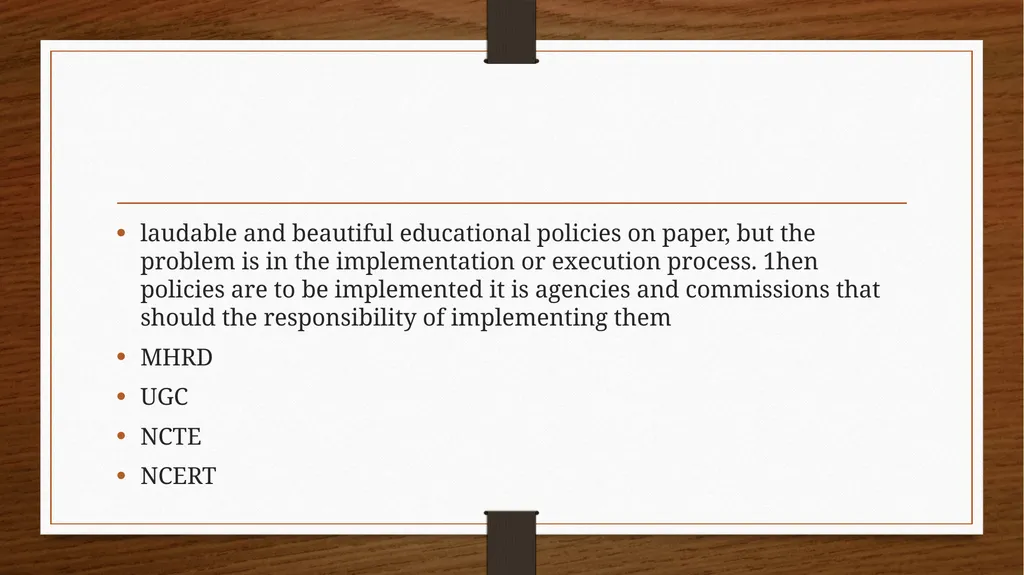
laudable and beautiful educational policies on paper, but the problem is in the implementation or execution process. 1hen policies are to be implemented it is agencies and commissions that should the responsibility of implementing them
MHRD
UGC
NCTE
NCERT<br>
MHRD
UGC
NCTE
NCERT<br>
37
The success of the implementation detects the lapses committed during the policy formulation.
Policy evolves when there is public problem.<br>
Policy evolves when there is public problem.<br>
38
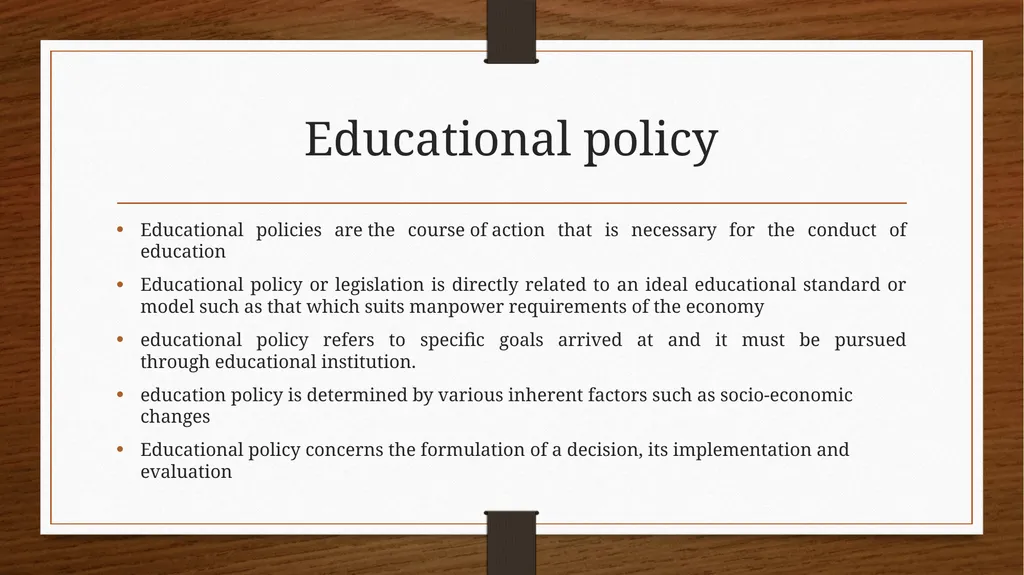
Educational policy Educational policies are the course of action that is necessary for the conduct of education
Educational policy or legislation is directly related to an ideal educational standard or model such as that which suits manpower requirements of the economy
educational policy refers to specific goals arrived at and it must be pursued through educational institution.
education policy is determined by various inherent factors such as socio-economic changes
Educational policy concerns the formulation of a decision, its implementation and evaluation<br>
Educational policy or legislation is directly related to an ideal educational standard or model such as that which suits manpower requirements of the economy
educational policy refers to specific goals arrived at and it must be pursued through educational institution.
education policy is determined by various inherent factors such as socio-economic changes
Educational policy concerns the formulation of a decision, its implementation and evaluation<br>
39
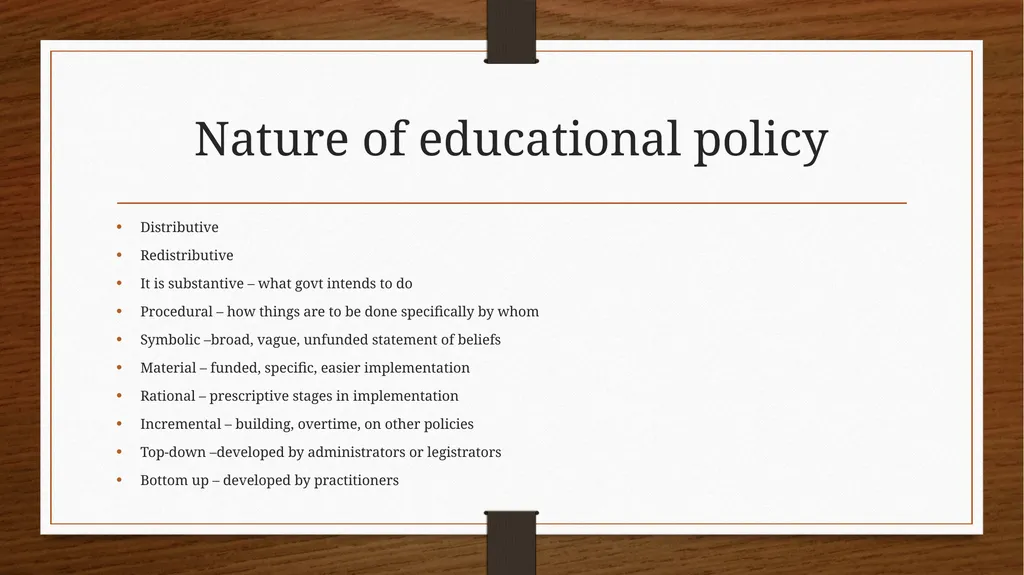
Nature of educational policy Distributive
Redistributive
It is substantive – what govt intends to do
Procedural – how things are to be done specifically by whom
Symbolic –broad, vague, unfunded statement of beliefs
Material – funded, specific, easier implementation
Rational – prescriptive stages in implementation
Incremental – building, overtime, on other policies
Top-down –developed by administrators or legistrators
Bottom up – developed by practitioners<br>
Redistributive
It is substantive – what govt intends to do
Procedural – how things are to be done specifically by whom
Symbolic –broad, vague, unfunded statement of beliefs
Material – funded, specific, easier implementation
Rational – prescriptive stages in implementation
Incremental – building, overtime, on other policies
Top-down –developed by administrators or legistrators
Bottom up – developed by practitioners<br>
40
Education Policy - Definition i) A process through which any society handles an educational problem. It includes a society's expressed intentions and official enactments as well as its consistent patterns of activity and inactivity in the area of education.
ii) The process by which governments (society) translate their educational vision into programmes and activities to deliver outcomes i.e. desired changes in the real world.
iii) An explicit or implicit single decision or group of decisions that may set out directives for guiding future decisions, initiate or retard action, or guide implementation of previous decisions.<br>
ii) The process by which governments (society) translate their educational vision into programmes and activities to deliver outcomes i.e. desired changes in the real world.
iii) An explicit or implicit single decision or group of decisions that may set out directives for guiding future decisions, initiate or retard action, or guide implementation of previous decisions.<br>
41
Aim of Educational Policy The development of each individual to the fullest potential;
Education is a method of transmission of social norms and values. This is also sometimes seen as a form of social control; and
The education system serves the industrial process and the economy by producing a trained workforce, and by providing child minding services.<br>
Education is a method of transmission of social norms and values. This is also sometimes seen as a form of social control; and
The education system serves the industrial process and the economy by producing a trained workforce, and by providing child minding services.<br>
42
Educational Policy cycle A framework of educational policy analysis involves a process in which various stakeholders analyse, generate, implement, assess and redesign policies. involves the following steps: Problem identification
Policy formation to deal with the identified problem
Decision-making targeting the identified problem
Implementation i.e. the realization of an application, or execution of the plan
Analysis and evaluation of a policy to continue or terminate.<br>
Policy formation to deal with the identified problem
Decision-making targeting the identified problem
Implementation i.e. the realization of an application, or execution of the plan
Analysis and evaluation of a policy to continue or terminate.<br>
43
Need To ensure adequate training and certification arrangement for all teachers in government and voluntary agencies schools.
To enhance religious and secular education thereby ensuring good discipline and character building among Nigerian pupils.
To ensure standard education in government founded schools.
To ensure that the school curriculum was moulded to the needs of the pupils and the society.
To cooperate with the various missions by encouraging more mission schools toin the assisted list of schools
To increase the grants6in6aid to the schools so as to increase government control and supervision of the schools<br>
To enhance religious and secular education thereby ensuring good discipline and character building among Nigerian pupils.
To ensure standard education in government founded schools.
To ensure that the school curriculum was moulded to the needs of the pupils and the society.
To cooperate with the various missions by encouraging more mission schools toin the assisted list of schools
To increase the grants6in6aid to the schools so as to increase government control and supervision of the schools<br>
44
Public policy refers to the actions taken by government — its decisions that are intended to solve problems and improve the quality of life for its citizen
Policies are enacted to regulate, aid through funding programs and to encourage social goals<br>
Policies are enacted to regulate, aid through funding programs and to encourage social goals<br>
45
Education Policy ideas State Government
Education department
School administrators
Teachers, parents, students
Social service & support services
Researchers & Academics
media
Public comments and witness<br>
Education department
School administrators
Teachers, parents, students
Social service & support services
Researchers & Academics
media
Public comments and witness<br>
46
Stages of policy formulation A policy established and carried out by the government goes through several stages from inception to conclusion. These are
Agenda building
Formulation
Adoption
Implementation
Evaluation and
Termination.<br>
Agenda building
Formulation
Adoption
Implementation
Evaluation and
Termination.<br>
47
Policy analysis<br>
48
Policy making Who does it? (The actors)
How ? (Process)<br>
How ? (Process)<br>
49
Synoptic Model one single central planning authority for the whole of society, combining
economic, political, and social control into one integrated planning
process that makes interaction unnecessary. It assumes:
(a) that the problem at hand does not go beyond man's cognitive capacities and
(b) there exist agreed criteria (rather than social conflict on values) by which solutions can be judged and
(c) that the problem- solvers have adequate incentives to stay with synoptic analysis until it is completed<br>
economic, political, and social control into one integrated planning
process that makes interaction unnecessary. It assumes:
(a) that the problem at hand does not go beyond man's cognitive capacities and
(b) there exist agreed criteria (rather than social conflict on values) by which solutions can be judged and
(c) that the problem- solvers have adequate incentives to stay with synoptic analysis until it is completed<br>
50
Incremental model Relies on interaction rather than on a complete analysis of the situation to develop a blueprint for solving problems.
The incremental approach to policy making is built on the following assumptions:
(a) Policy options are based on highly uncertain and fluid knowledge, and are in response to a dynamic situation (everchanging problems, and evolving contexts);
(b) No 'correct' solution can therefore be found, or technically derived from a diagnosis of the situation. Thus, no sweeping or drastic reforms should be attempted;
(c) Only incremental and limited policy adjustments can be made; and
(d) Policy adjustments are expected to remedy an experienced dissatisfaction with past policies, improving the existing situation or relieving an urgent problem.
Consequently, these adjustments should be tentative - and in some cases temporary - and must be revised as the dynamics of the situation evolve.<br>
The incremental approach to policy making is built on the following assumptions:
(a) Policy options are based on highly uncertain and fluid knowledge, and are in response to a dynamic situation (everchanging problems, and evolving contexts);
(b) No 'correct' solution can therefore be found, or technically derived from a diagnosis of the situation. Thus, no sweeping or drastic reforms should be attempted;
(c) Only incremental and limited policy adjustments can be made; and
(d) Policy adjustments are expected to remedy an experienced dissatisfaction with past policies, improving the existing situation or relieving an urgent problem.
Consequently, these adjustments should be tentative - and in some cases temporary - and must be revised as the dynamics of the situation evolve.<br>
51
Policy advocacy (aim, objective)
Information for policy
Policy monitoring and evaluation
Analysis of policy determination (impact)
Analysis of policy content (is our intension success)<br>
Information for policy
Policy monitoring and evaluation
Analysis of policy determination (impact)
Analysis of policy content (is our intension success)<br>
52
Process of Policy Formulation<br>
53
Formulation and adoption Policy formulation means coming up with an approach to solving a problem. Committees, NGOs
The process continues with adoption.
A policy is adopted when Congress passes legislation, the regulations become final.<br>
The process continues with adoption.
A policy is adopted when Congress passes legislation, the regulations become final.<br>
54
Agenda building Before a policy can be created, a problem must exist that is called to the attention of the government.<br>
55
implementation The implementation or carrying out of policy is most often accomplished by institutions other than those that formulated and adopted it.
A statute usually provides just a broad outline of a policy.<br>
A statute usually provides just a broad outline of a policy.<br>
56
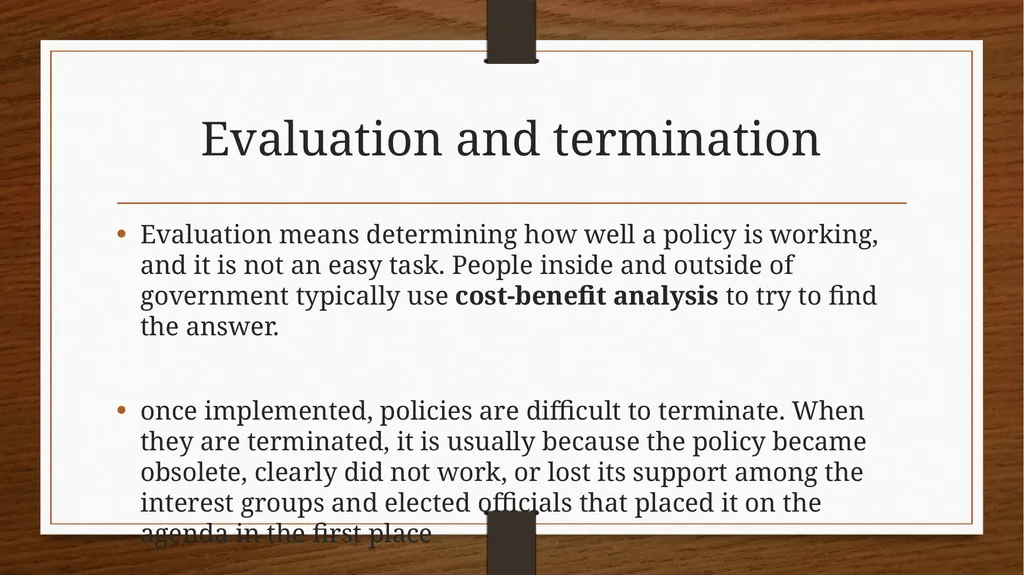
Evaluation and termination Evaluation means determining how well a policy is working, and it is not an easy task. People inside and outside of government typically use cost-benefit analysis to try to find the answer.
once implemented, policies are difficult to terminate. When they are terminated, it is usually because the policy became obsolete, clearly did not work, or lost its support among the interest groups and elected officials that placed it on the agenda in the first place<br>
once implemented, policies are difficult to terminate. When they are terminated, it is usually because the policy became obsolete, clearly did not work, or lost its support among the interest groups and elected officials that placed it on the agenda in the first place<br>
57
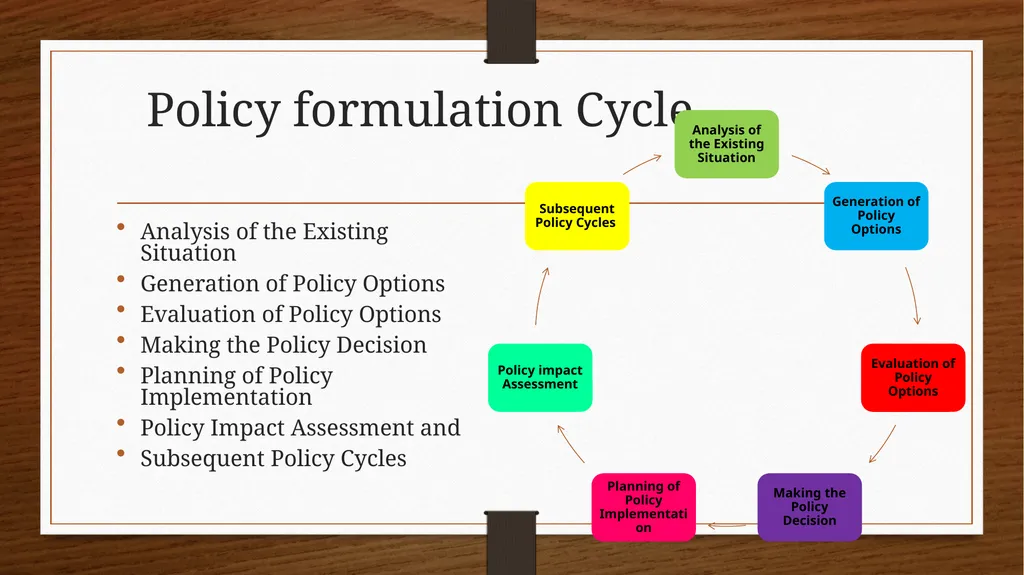
Policy formulation Cycle Analysis of the Existing Situation
Generation of Policy Options
Evaluation of Policy Options
Making the Policy Decision
Planning of Policy Implementation
Policy Impact Assessment and
Subsequent Policy Cycles<br>
Generation of Policy Options
Evaluation of Policy Options
Making the Policy Decision
Planning of Policy Implementation
Policy Impact Assessment and
Subsequent Policy Cycles<br>
58
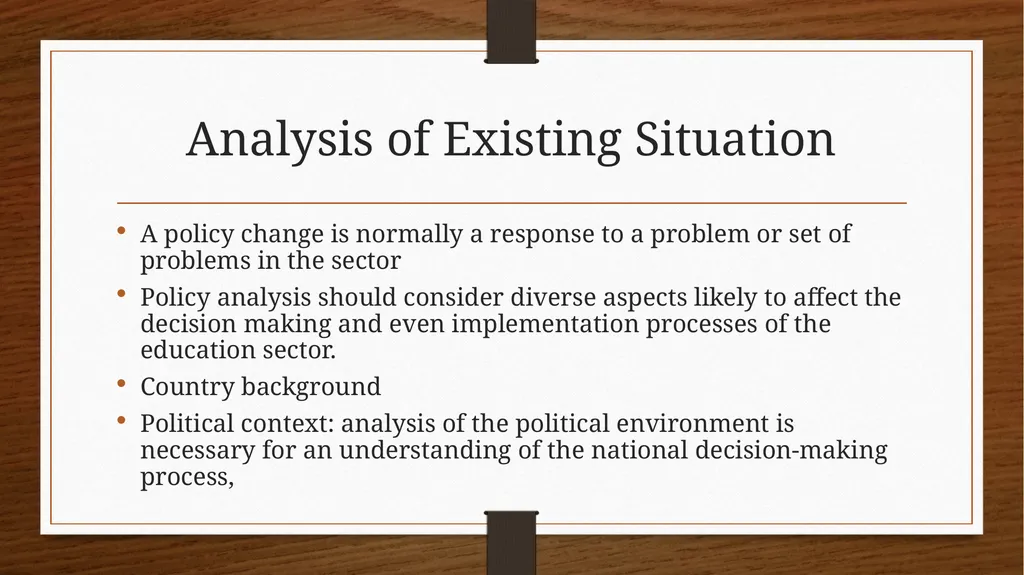
Analysis of Existing Situation A policy change is normally a response to a problem or set of problems in the sector
Policy analysis should consider diverse aspects likely to affect the decision making and even implementation processes of the education sector.
Country background
Political context: analysis of the political environment is necessary for an understanding of the national decision-making process,<br>
Policy analysis should consider diverse aspects likely to affect the decision making and even implementation processes of the education sector.
Country background
Political context: analysis of the political environment is necessary for an understanding of the national decision-making process,<br>
59
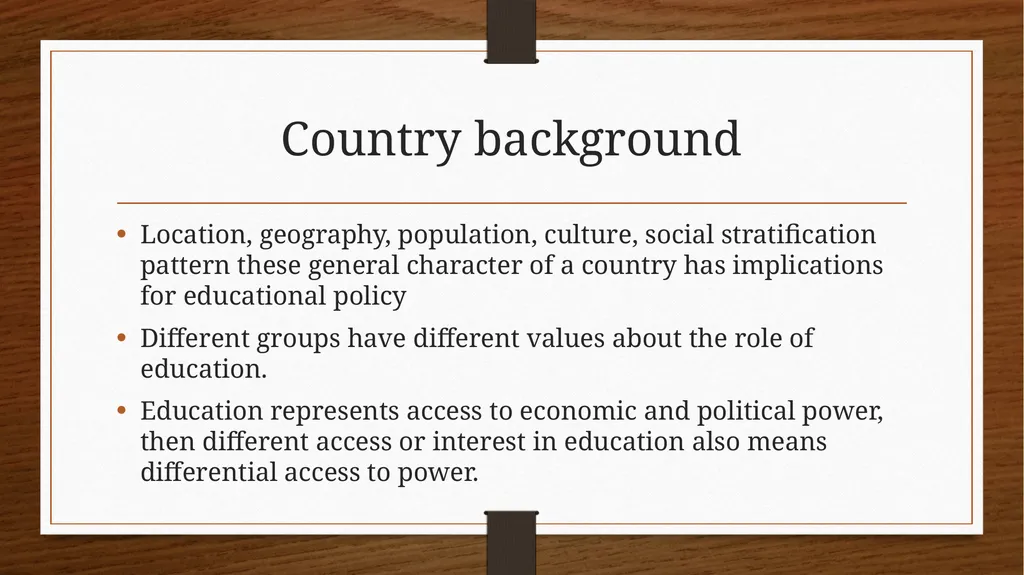
Country background Location, geography, population, culture, social stratification pattern these general character of a country has implications for educational policy
Different groups have different values about the role of education.
Education represents access to economic and political power, then different access or interest in education also means differential access to power.<br>
Different groups have different values about the role of education.
Education represents access to economic and political power, then different access or interest in education also means differential access to power.<br>
60
Political context Role of education in socio-political process is tightly intertwined.
Head of the ministry of education may have different plans from those of the political elite
Autonomy provided to the educational sector
Planning at the national level is another critical variable in the institutional analysis of the political sector.
Professional background of the bureaucrats who do the policy planning and where they have been trained (perhaps in foreign universities) can also affect the ideology of the elite.
The institutional structure of the political sector has implications for educational development.<br>
Head of the ministry of education may have different plans from those of the political elite
Autonomy provided to the educational sector
Planning at the national level is another critical variable in the institutional analysis of the political sector.
Professional background of the bureaucrats who do the policy planning and where they have been trained (perhaps in foreign universities) can also affect the ideology of the elite.
The institutional structure of the political sector has implications for educational development.<br>
61
Economic Context Policy analyst wants to understand the present macro-economic situation in general and the human resources situation in particular.
Trends in the various sectors in the future and the financial resources of the country in order to assess what the economy requires from the education sector and what the sector expects to face from the rest of the economy, particularly in terms of general infrastructure and financial resources.
Demographic shifts, urbanization, and migration, coupled with the likely growth in various sectors of the economy, will have a significant impact on labour markets
needs for education and skill training.
constraints on the capacity of the educational system to build schools and to expand
estimating the future amounts of slack resources<br>
Trends in the various sectors in the future and the financial resources of the country in order to assess what the economy requires from the education sector and what the sector expects to face from the rest of the economy, particularly in terms of general infrastructure and financial resources.
Demographic shifts, urbanization, and migration, coupled with the likely growth in various sectors of the economy, will have a significant impact on labour markets
needs for education and skill training.
constraints on the capacity of the educational system to build schools and to expand
estimating the future amounts of slack resources<br>
62
Education Sector These issues may be explored under six categories:
(i) access to educational opportunities;
(ii) equity in the distribution of educational services;
(iii) structure of the education system;
(iv) internal efficiency;
(v) external efficiency; and
(vi) institutional arrangements for the management of the sector.
By studying the past, one also learns the likely speed with which educational policies can be implemented<br>
(i) access to educational opportunities;
(ii) equity in the distribution of educational services;
(iii) structure of the education system;
(iv) internal efficiency;
(v) external efficiency; and
(vi) institutional arrangements for the management of the sector.
By studying the past, one also learns the likely speed with which educational policies can be implemented<br>
63
Assessment of the present situation cannot be complete without evaluating the forces for or against change in the event that policy changes need to be made
policy planners need to identify interest groups and assess their openness to reform
Understand what the self-interests of the educational bureaucrats are and to recognize that these are not necessarily identical with those of the teachers, other educational professionals or consumers.
The pressure to see change can come from individuals or groups outside the education sector or from external actors, both individual experts and development agencies<br>
policy planners need to identify interest groups and assess their openness to reform
Understand what the self-interests of the educational bureaucrats are and to recognize that these are not necessarily identical with those of the teachers, other educational professionals or consumers.
The pressure to see change can come from individuals or groups outside the education sector or from external actors, both individual experts and development agencies<br>
64
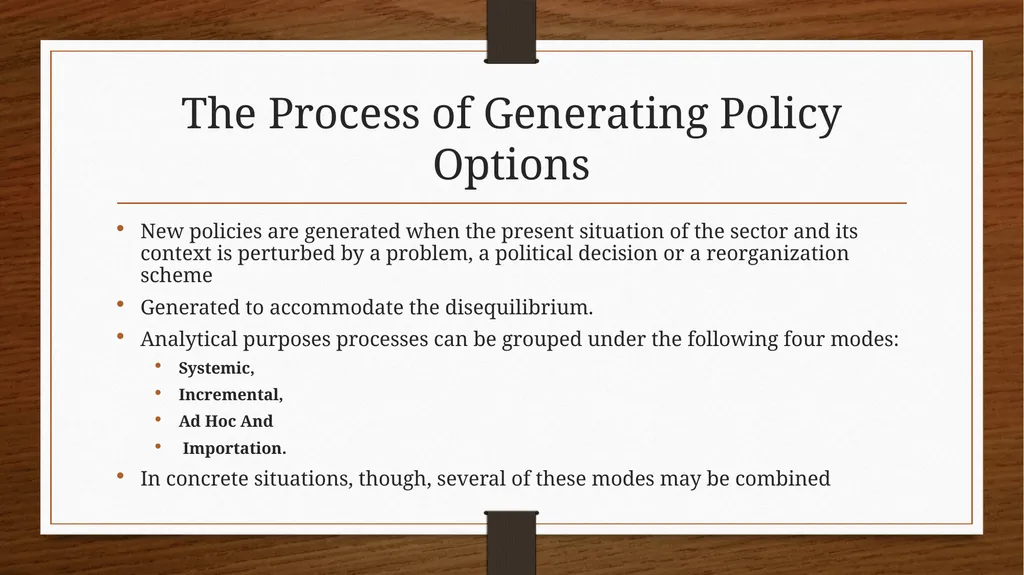
The Process of Generating Policy Options New policies are generated when the present situation of the sector and its context is perturbed by a problem, a political decision or a reorganization scheme
Generated to accommodate the disequilibrium.
Analytical purposes processes can be grouped under the following four modes:
Systemic,
Incremental,
Ad Hoc And
Importation.
In concrete situations, though, several of these modes may be combined<br>
Generated to accommodate the disequilibrium.
Analytical purposes processes can be grouped under the following four modes:
Systemic,
Incremental,
Ad Hoc And
Importation.
In concrete situations, though, several of these modes may be combined<br>
65
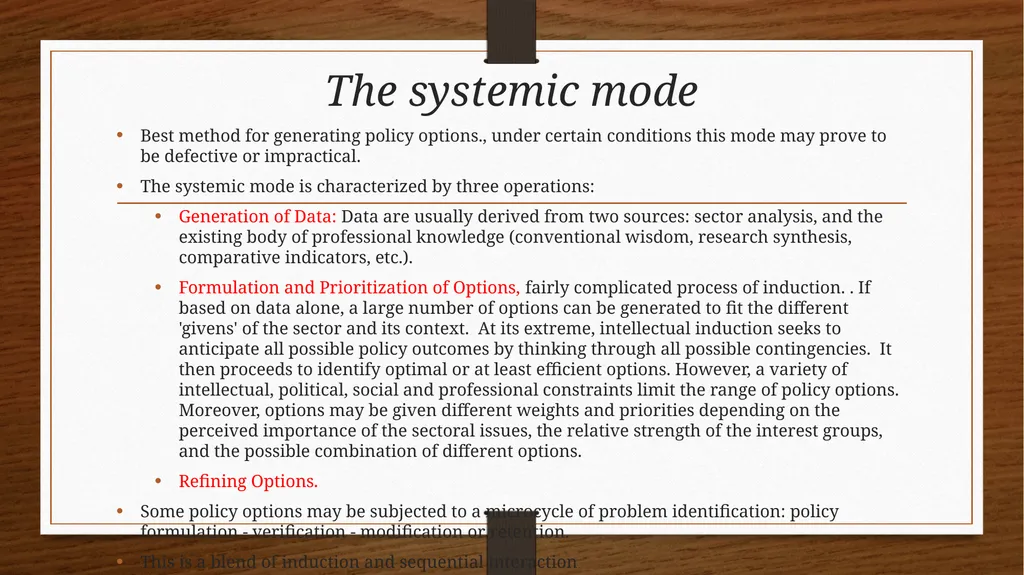
The systemic mode Best method for generating policy options., under certain conditions this mode may prove to be defective or impractical.
The systemic mode is characterized by three operations:
Generation of Data: Data are usually derived from two sources: sector analysis, and the existing body of professional knowledge (conventional wisdom, research synthesis, comparative indicators, etc.).
Formulation and Prioritization of Options, fairly complicated process of induction. . If based on data alone, a large number of options can be generated to fit the different 'givens' of the sector and its context. At its extreme, intellectual induction seeks to anticipate all possible policy outcomes by thinking through all possible contingencies. It then proceeds to identify optimal or at least efficient options. However, a variety of intellectual, political, social and professional constraints limit the range of policy options. Moreover, options may be given different weights and priorities depending on the perceived importance of the sectoral issues, the relative strength of the interest groups, and the possible combination of different options.
Refining Options.
Some policy options may be subjected to a microcycle of problem identification: policy formulation - verification - modification or retention.
This is a blend of induction and sequential interaction.<br>
The systemic mode is characterized by three operations:
Generation of Data: Data are usually derived from two sources: sector analysis, and the existing body of professional knowledge (conventional wisdom, research synthesis, comparative indicators, etc.).
Formulation and Prioritization of Options, fairly complicated process of induction. . If based on data alone, a large number of options can be generated to fit the different 'givens' of the sector and its context. At its extreme, intellectual induction seeks to anticipate all possible policy outcomes by thinking through all possible contingencies. It then proceeds to identify optimal or at least efficient options. However, a variety of intellectual, political, social and professional constraints limit the range of policy options. Moreover, options may be given different weights and priorities depending on the perceived importance of the sectoral issues, the relative strength of the interest groups, and the possible combination of different options.
Refining Options.
Some policy options may be subjected to a microcycle of problem identification: policy formulation - verification - modification or retention.
This is a blend of induction and sequential interaction.<br>
66
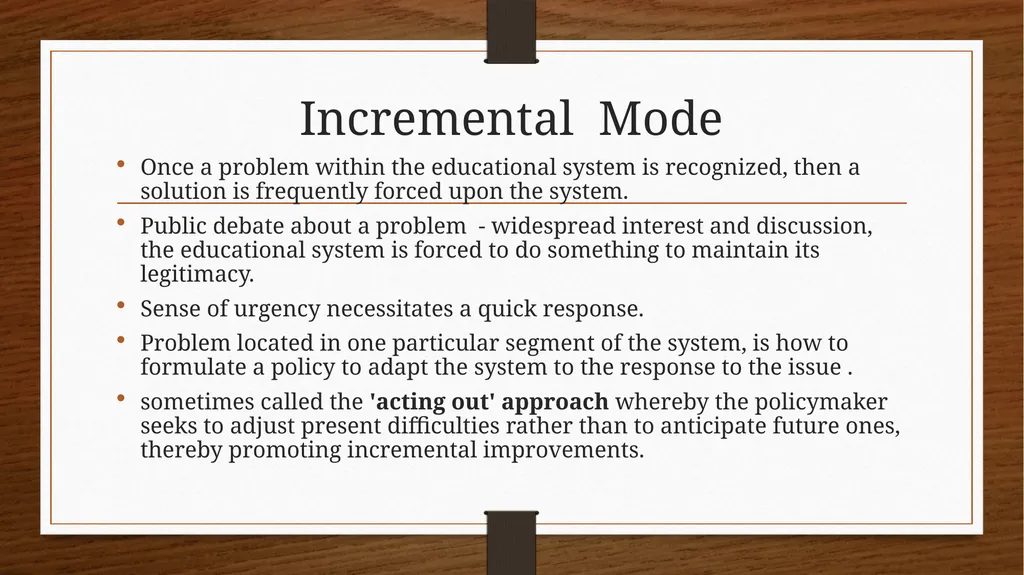
Incremental Mode Once a problem within the educational system is recognized, then a solution is frequently forced upon the system.
Public debate about a problem - widespread interest and discussion, the educational system is forced to do something to maintain its legitimacy.
Sense of urgency necessitates a quick response.
Problem located in one particular segment of the system, is how to formulate a policy to adapt the system to the response to the issue .
sometimes called the 'acting out' approach whereby the policymaker seeks to adjust present difficulties rather than to anticipate future ones, thereby promoting incremental improvements.<br>
Public debate about a problem - widespread interest and discussion, the educational system is forced to do something to maintain its legitimacy.
Sense of urgency necessitates a quick response.
Problem located in one particular segment of the system, is how to formulate a policy to adapt the system to the response to the issue .
sometimes called the 'acting out' approach whereby the policymaker seeks to adjust present difficulties rather than to anticipate future ones, thereby promoting incremental improvements.<br>
67
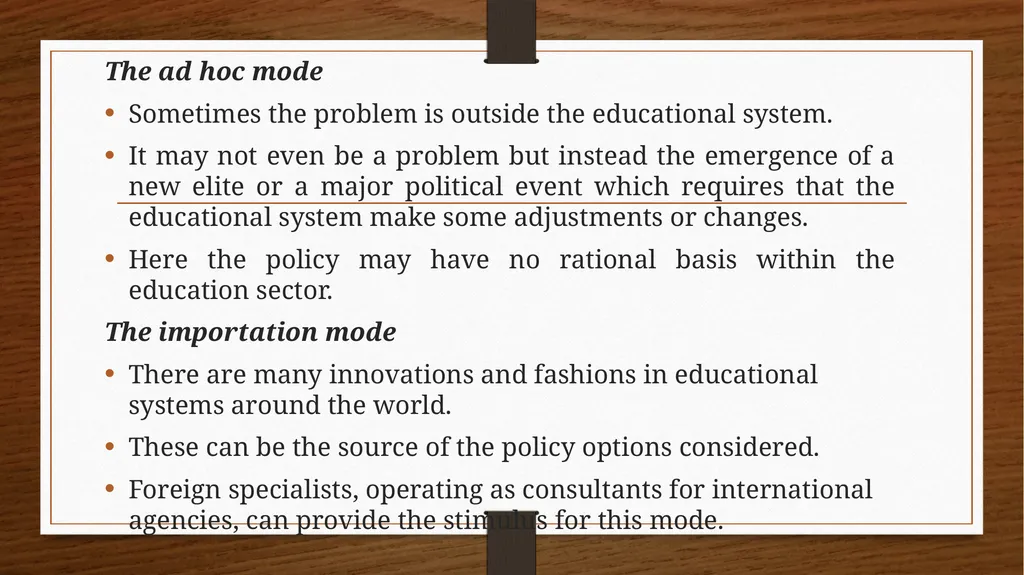
The ad hoc mode
Sometimes the problem is outside the educational system.
It may not even be a problem but instead the emergence of a new elite or a major political event which requires that the educational system make some adjustments or changes.
Here the policy may have no rational basis within the education sector.
The importation mode
There are many innovations and fashions in educational systems around the world.
These can be the source of the policy options considered.
Foreign specialists, operating as consultants for international agencies, can provide the stimulus for this mode.<br>
Sometimes the problem is outside the educational system.
It may not even be a problem but instead the emergence of a new elite or a major political event which requires that the educational system make some adjustments or changes.
Here the policy may have no rational basis within the education sector.
The importation mode
There are many innovations and fashions in educational systems around the world.
These can be the source of the policy options considered.
Foreign specialists, operating as consultants for international agencies, can provide the stimulus for this mode.<br>
68
C. Evaluation of Policy Options Policy options can be evaluated only if alternative scenarios are developed to allow estimations of the likely implications of the options considered.
The 'imaginary' situation that would be created if a policy option were implemented is compared with the present situation, and the scenario of transition from the existing to the imaginary case is evaluated in terms of
Desirability,
Affordability, and
Feasibility.<br>
The 'imaginary' situation that would be created if a policy option were implemented is compared with the present situation, and the scenario of transition from the existing to the imaginary case is evaluated in terms of
Desirability,
Affordability, and
Feasibility.<br>
69
Desirability This involves three dimensions:
(1) The impact of the option on the various interest groups or stakeholders: who would benefit? who might feel threatened? how might the potential losers be compensated? what would make the option desirable to all stakeholders?
(2) Compatibility with the dominant ideology and targets of economic growth articulated in national development plans; and
(3) Impact of a policy option on political development and the stability.<br>
(1) The impact of the option on the various interest groups or stakeholders: who would benefit? who might feel threatened? how might the potential losers be compensated? what would make the option desirable to all stakeholders?
(2) Compatibility with the dominant ideology and targets of economic growth articulated in national development plans; and
(3) Impact of a policy option on political development and the stability.<br>
70
Affordability The fiscal costs of the change as well as the social and political costs need to be evaluated.
The difficulty of making these estimations lies in the ability to predict future trends, including economic growth.
This is especially important because educational expenditures are more vulnerable to changes in economic situations and political objectives than some other kinds of public expenditure.
Therefore, alternative economic scenarios need to be considered.
Further, private costs (will a reform require consumers to share the costs, and if so what happens to the poorer groups?)- opportunity costs
Political costs should also be weighed..<br>
The difficulty of making these estimations lies in the ability to predict future trends, including economic growth.
This is especially important because educational expenditures are more vulnerable to changes in economic situations and political objectives than some other kinds of public expenditure.
Therefore, alternative economic scenarios need to be considered.
Further, private costs (will a reform require consumers to share the costs, and if so what happens to the poorer groups?)- opportunity costs
Political costs should also be weighed..<br>
71
Feasibility Another and very different kind of implication is the availability of human resources for implementing the change.
Fiscal resources are easy to compute.
More difficult is - level of training is required of teachers (the more sophisticated the programme and/or technology involved, the more highly trained the personnel need to be) and whether there are enough personnel to implement the policy option. I
Short supply of highly trained personnel - raises the question of whether they can be imported or trained and at what cost.
Equally important is the presence of the institutional culture (norms, procedures, environment) necessary to attract, retain, and effectively utilize trained personnel in transforming policies into plans and implemented programmes.
Another element in the calculus of feasibility is Time. -education projects indicate time overruns in implementation. More realistic estimates of time need to be made based on careful assessment of the implementation capabilities and experiences.
Sustainability should fare prominently when the above criteria are applied.
Education initiatives have to be sustained politically and financially over a lengthy period of time to reach fruition.
To ensure that, the long-term implications of policy options should be weighed within an overall sectoral policy, itself embedded in a prudent macro framework, and consistent with long-term national aspirations.<br>
Fiscal resources are easy to compute.
More difficult is - level of training is required of teachers (the more sophisticated the programme and/or technology involved, the more highly trained the personnel need to be) and whether there are enough personnel to implement the policy option. I
Short supply of highly trained personnel - raises the question of whether they can be imported or trained and at what cost.
Equally important is the presence of the institutional culture (norms, procedures, environment) necessary to attract, retain, and effectively utilize trained personnel in transforming policies into plans and implemented programmes.
Another element in the calculus of feasibility is Time. -education projects indicate time overruns in implementation. More realistic estimates of time need to be made based on careful assessment of the implementation capabilities and experiences.
Sustainability should fare prominently when the above criteria are applied.
Education initiatives have to be sustained politically and financially over a lengthy period of time to reach fruition.
To ensure that, the long-term implications of policy options should be weighed within an overall sectoral policy, itself embedded in a prudent macro framework, and consistent with long-term national aspirations.<br>
72
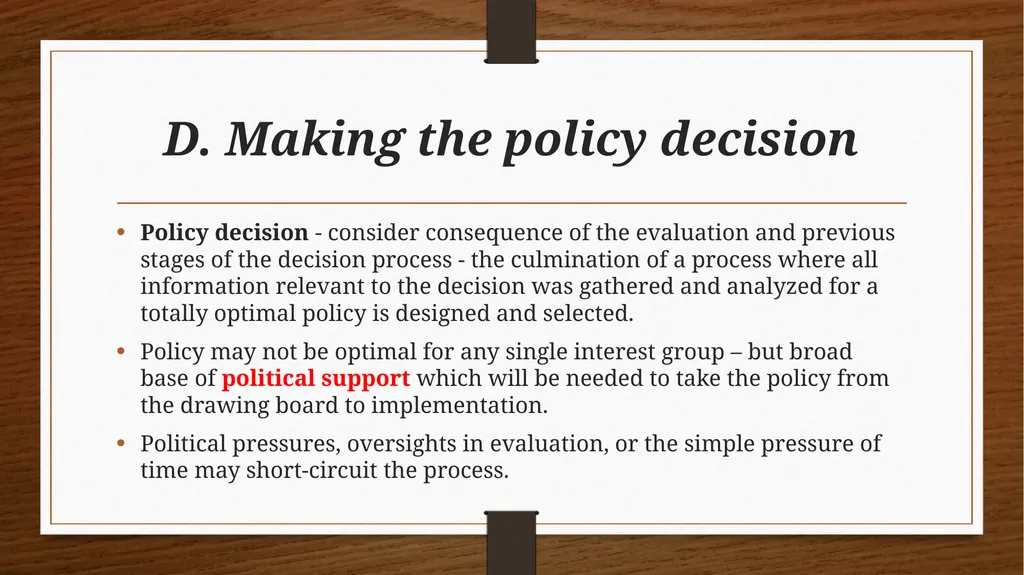
D. Making the policy decision Policy decision - consider consequence of the evaluation and previous stages of the decision process - the culmination of a process where all information relevant to the decision was gathered and analyzed for a totally optimal policy is designed and selected.
Policy may not be optimal for any single interest group – but broad base of political support which will be needed to take the policy from the drawing board to implementation.
Political pressures, oversights in evaluation, or the simple pressure of time may short-circuit the process.<br>
Policy may not be optimal for any single interest group – but broad base of political support which will be needed to take the policy from the drawing board to implementation.
Political pressures, oversights in evaluation, or the simple pressure of time may short-circuit the process.<br>
73
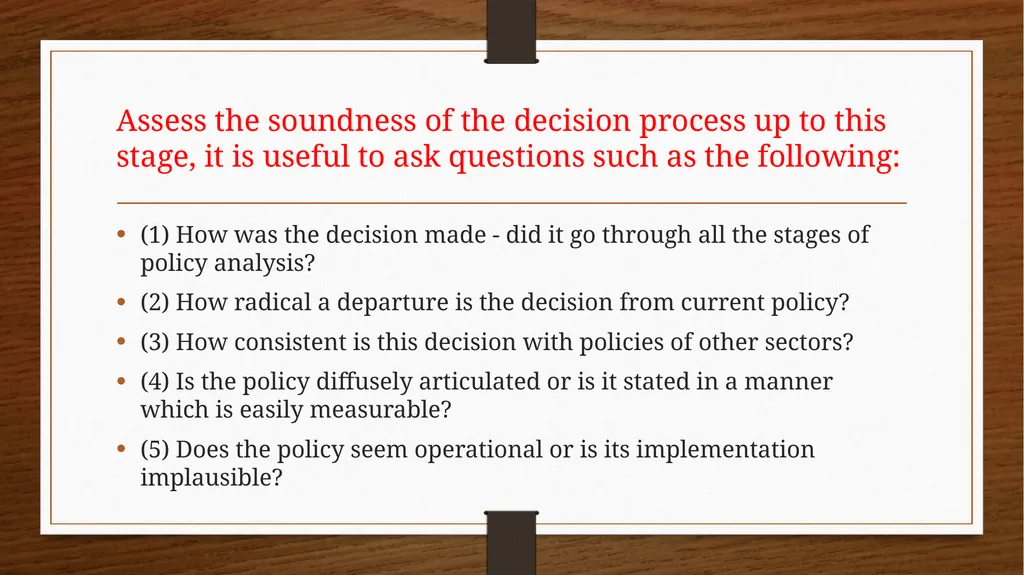
Assess the soundness of the decision process up to this stage, it is useful to ask questions such as the following: (1) How was the decision made - did it go through all the stages of policy analysis?
(2) How radical a departure is the decision from current policy?
(3) How consistent is this decision with policies of other sectors?
(4) Is the policy diffusely articulated or is it stated in a manner which is easily measurable?
(5) Does the policy seem operational or is its implementation implausible?<br>
(2) How radical a departure is the decision from current policy?
(3) How consistent is this decision with policies of other sectors?
(4) Is the policy diffusely articulated or is it stated in a manner which is easily measurable?
(5) Does the policy seem operational or is its implementation implausible?<br>
74
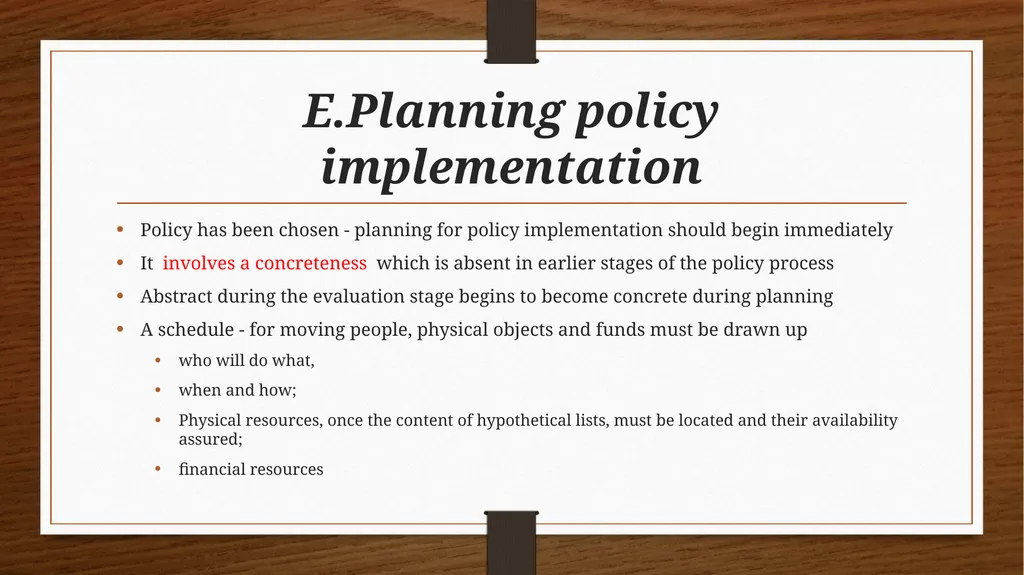
E.Planning policy implementation Policy has been chosen - planning for policy implementation should begin immediately
It involves a concreteness which is absent in earlier stages of the policy process
Abstract during the evaluation stage begins to become concrete during planning
A schedule - for moving people, physical objects and funds must be drawn up
who will do what,
when and how;
Physical resources, once the content of hypothetical lists, must be located and their availability assured;
financial resources<br>
It involves a concreteness which is absent in earlier stages of the policy process
Abstract during the evaluation stage begins to become concrete during planning
A schedule - for moving people, physical objects and funds must be drawn up
who will do what,
when and how;
Physical resources, once the content of hypothetical lists, must be located and their availability assured;
financial resources<br>
75
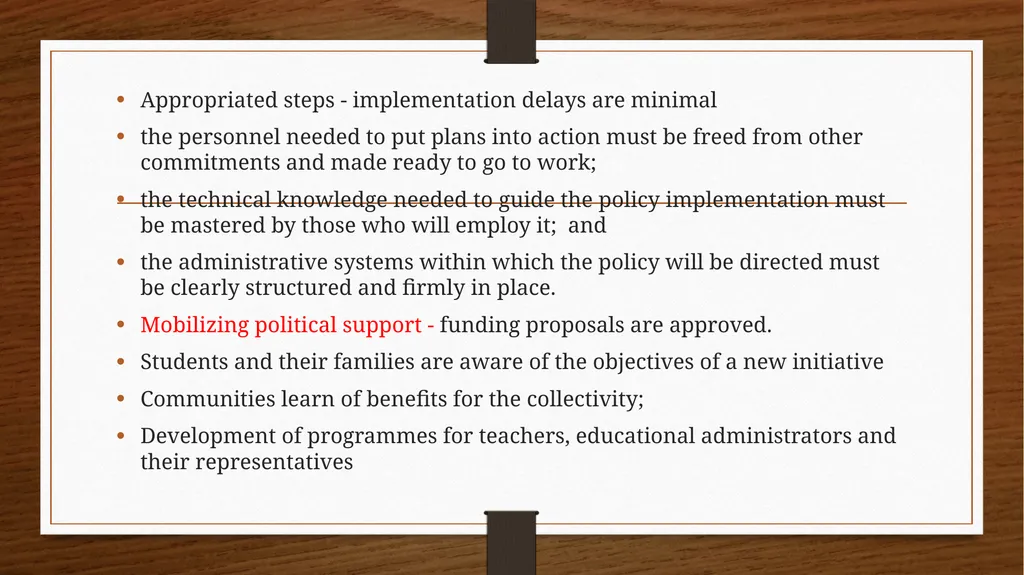
Appropriated steps - implementation delays are minimal
the personnel needed to put plans into action must be freed from other commitments and made ready to go to work;
the technical knowledge needed to guide the policy implementation must be mastered by those who will employ it; and
the administrative systems within which the policy will be directed must be clearly structured and firmly in place.
Mobilizing political support - funding proposals are approved.
Students and their families are aware of the objectives of a new initiative
Communities learn of benefits for the collectivity;
Development of programmes for teachers, educational administrators and their representatives<br>
the personnel needed to put plans into action must be freed from other commitments and made ready to go to work;
the technical knowledge needed to guide the policy implementation must be mastered by those who will employ it; and
the administrative systems within which the policy will be directed must be clearly structured and firmly in place.
Mobilizing political support - funding proposals are approved.
Students and their families are aware of the objectives of a new initiative
Communities learn of benefits for the collectivity;
Development of programmes for teachers, educational administrators and their representatives<br>
76
(a) circumstances related to implementation constraints cause policy modifications to take place;
(b) feedback obtained during implementation causes reassessment of aspects of the policy decision and subsequent modifications by policymakers; and
(c) the mere translation of abstract policy intentions into concrete implementation causes re-assessment and re-design.
T h e s e changes occur with great frequency because, unfortunately, implementation problems are often greatly under-estimated during the stage of policy planning.<br>
(b) feedback obtained during implementation causes reassessment of aspects of the policy decision and subsequent modifications by policymakers; and
(c) the mere translation of abstract policy intentions into concrete implementation causes re-assessment and re-design.
T h e s e changes occur with great frequency because, unfortunately, implementation problems are often greatly under-estimated during the stage of policy planning.<br>
77
implementation is the time when one discovers that schedules are unrealistic and that programmes are over-ambitious;<br>
78
F. Policy Impact Assessment Policy output measurement can be carried out on a continual basis, premature attempts at assessment can mis-state the effectiveness of the policy. preferable to delay final
New initiative for the first time -assessment until a number of teaching cycles have transpired to separate the effect of the content of the policy change
Sooner accurate assessment takes place, the sooner policy-makers can know if their initiatives are working as anticipated or if adjustments in policy design or policy implementation are required.
Policy outcome is lacking - Causes of failure of a well designed policy is determined (whether the policy itself is inadequate, poor implementation Human capital inadequacies, under-funding, or inadequate economic stimulus during the implementation stage)<br>
New initiative for the first time -assessment until a number of teaching cycles have transpired to separate the effect of the content of the policy change
Sooner accurate assessment takes place, the sooner policy-makers can know if their initiatives are working as anticipated or if adjustments in policy design or policy implementation are required.
Policy outcome is lacking - Causes of failure of a well designed policy is determined (whether the policy itself is inadequate, poor implementation Human capital inadequacies, under-funding, or inadequate economic stimulus during the implementation stage)<br>
79
Assessment reveals deficiencies in outcomes - re-examine the policy decision and to determine what adjustments or what new policies should be substituted for the original choice. then one moves again to the planning and implementation stages.
Policy impact assessment is carried out using the same criteria employed during the policy evaluation stage.
The assessment process revolves around the following questions:
What have been the actual impacts of the policies in question?
Are these impacts desirable given the changes that were hoped for?
Are the changes affordable?
Did costs prevent their full implementation?
Did cost over-runs make it unthinkable to implement them over a longer term or on a wider basis?
Can the policy be lived with politically and socially?
Are the impacts feasible?
Were full impacts accomplished?
Would exceptional efforts be required to replicate these impacts in other circumstances?<br>
Policy impact assessment is carried out using the same criteria employed during the policy evaluation stage.
The assessment process revolves around the following questions:
What have been the actual impacts of the policies in question?
Are these impacts desirable given the changes that were hoped for?
Are the changes affordable?
Did costs prevent their full implementation?
Did cost over-runs make it unthinkable to implement them over a longer term or on a wider basis?
Can the policy be lived with politically and socially?
Are the impacts feasible?
Were full impacts accomplished?
Would exceptional efforts be required to replicate these impacts in other circumstances?<br>
80
G. Subsequent Policy Cycles Policy initiative is carried out systematically
The process of policy design, planning, implementation, impact assessment, and re-design is iterative, and, in theory, infinitely
But - policy change is needed - a policy process often begins from beginning and may duplicate much of the analysis, derivation of alternative options, evaluation, and planning carried out earlier.
Policy analysis is never to conclude.
Once implementation has been completed and policy outcomes are forthcoming, a policy impact assessment stage ensues, leading potentially to a new policy cycle.<br>
The process of policy design, planning, implementation, impact assessment, and re-design is iterative, and, in theory, infinitely
But - policy change is needed - a policy process often begins from beginning and may duplicate much of the analysis, derivation of alternative options, evaluation, and planning carried out earlier.
Policy analysis is never to conclude.
Once implementation has been completed and policy outcomes are forthcoming, a policy impact assessment stage ensues, leading potentially to a new policy cycle.<br>