
Reltio Data Model Reltio Data Model vs Legacy data
KB
Published · 18 slides · 0 views
1 / 1

Description
Reltio Data Model Reltio Data Model vs Legacy data model Reltio multi layer architecture Reltio Accelerators Guidelines Best practices Use Case Agenda Legacy Data model Identify Entities Attributes Relationships (1:1, 1:M, M:M) Create
Related Topics
Share
Embed code
Download this presentation From Below
"Reltio Data Model Reltio Data Model vs Legacy data" is the property of its rightful owner. Permission is granted to download and print the materials on this website for personal, non-commercial use only, and to display it on your personal computer provided you do not modify the materials and that you retain all copyright notices contained in the materials. By downloading content from our website, you accept the terms of this agreement.
Presentation Transcript
01
Reltio Data Model<br>
02
Reltio Data Model vs Legacy data model
Reltio multi layer architecture
Reltio Accelerators
Guidelines & Best practices
Use Case Agenda<br>
Reltio multi layer architecture
Reltio Accelerators
Guidelines & Best practices
Use Case Agenda<br>
03
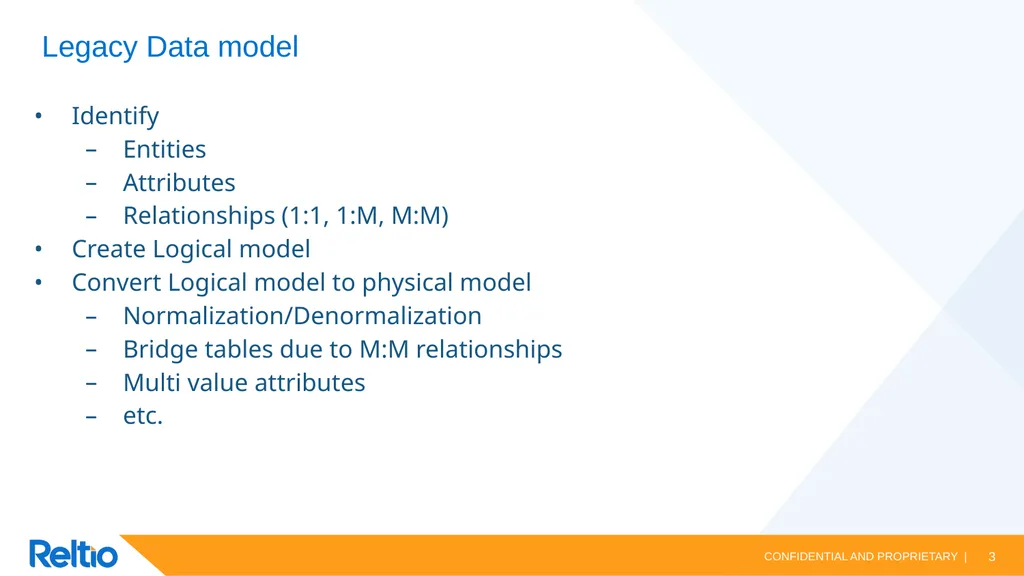
Legacy Data model Identify
Entities
Attributes
Relationships (1:1, 1:M, M:M)
Create Logical model
Convert Logical model to physical model
Normalization/Denormalization
Bridge tables due to M:M relationships
Multi value attributes
etc.<br>
Entities
Attributes
Relationships (1:1, 1:M, M:M)
Create Logical model
Convert Logical model to physical model
Normalization/Denormalization
Bridge tables due to M:M relationships
Multi value attributes
etc.<br>
04
Reltio Data Model Dynamic Model:
The Reltio model is metadata driven and can help avoid many of these issues.
Traditional database modeling iteratively can become tedious. Even small changes in a data model - such as making an organization name a multi-valued attribute - can result in costly data migration projects, or rely on temporary workarounds just to make things work, until the next change is made in the model.
The Reltio model can be changed dynamically without making changes to the underlying physical storage. The Reltio UI reflects these model changes automatically and instantly.<br>
The Reltio model is metadata driven and can help avoid many of these issues.
Traditional database modeling iteratively can become tedious. Even small changes in a data model - such as making an organization name a multi-valued attribute - can result in costly data migration projects, or rely on temporary workarounds just to make things work, until the next change is made in the model.
The Reltio model can be changed dynamically without making changes to the underlying physical storage. The Reltio UI reflects these model changes automatically and instantly.<br>
05
Key differences between Reltio and relational models are Every attribute in Reltio is multi-valued. This eliminates the need to model additional tables to support this functionality.
Reltio supports nested attributes to remove the need for 1->M dependent entities. Attributes can be deeply nested, which eliminates the need for cascading joins. This eliminates the need for frequent foreign key resolution.
Reltio allows addresses to be modeled as nested attributes and the built-in address cleanse engine handles this model seamlessly.
Reltio RDM can be used to model reference data without the need for a large number of reference data tables. This can greatly simplify the model.<br>
Reltio supports nested attributes to remove the need for 1->M dependent entities. Attributes can be deeply nested, which eliminates the need for cascading joins. This eliminates the need for frequent foreign key resolution.
Reltio allows addresses to be modeled as nested attributes and the built-in address cleanse engine handles this model seamlessly.
Reltio RDM can be used to model reference data without the need for a large number of reference data tables. This can greatly simplify the model.<br>
06
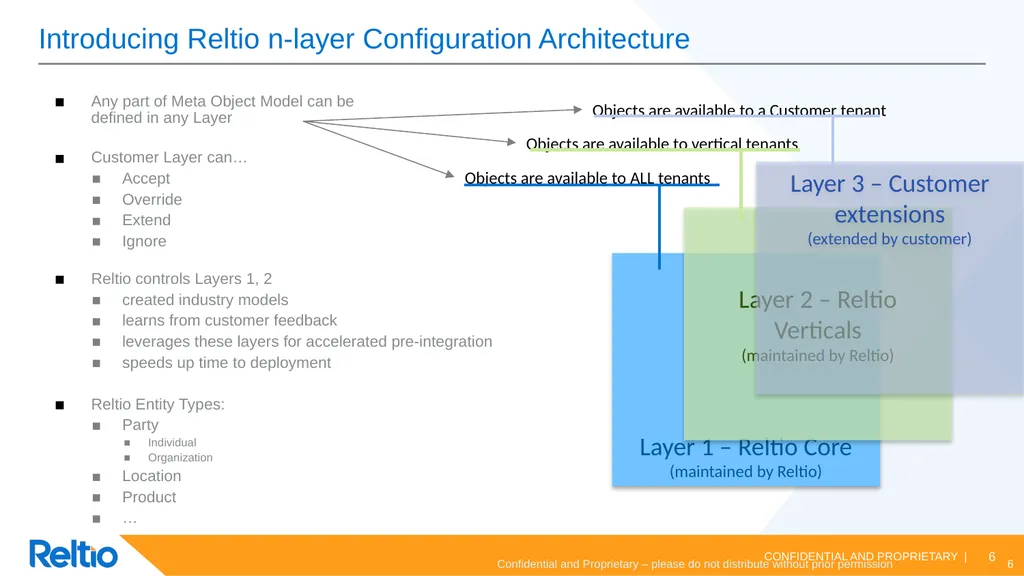
Any part of Meta Object Model can be
defined in any Layer
Customer Layer can…
Accept
Override
Extend
Ignore
Reltio controls Layers 1, 2
created industry models
learns from customer feedback
leverages these layers for accelerated pre-integration
speeds up time to deployment
Reltio Entity Types:
Party
Individual
Organization
Location
Product
… Confidential and Proprietary – please do not distribute without prior permission 6 Layer 1 – Reltio Core
(maintained by Reltio) Layer 2 – Reltio Verticals
(maintained by Reltio) Layer 3 – Customer extensions
(extended by customer) Objects are available to ALL tenants Objects are available to vertical tenants Objects are available to a Customer tenant Introducing Reltio n-layer Configuration Architecture<br>
Customer Layer can…
Accept
Override
Extend
Ignore
Reltio controls Layers 1, 2
created industry models
learns from customer feedback
leverages these layers for accelerated pre-integration
speeds up time to deployment
Reltio Entity Types:
Party
Individual
Organization
Location
Product
… Confidential and Proprietary – please do not distribute without prior permission 6 Layer 1 – Reltio Core
(maintained by Reltio) Layer 2 – Reltio Verticals
(maintained by Reltio) Layer 3 – Customer extensions
(extended by customer) Objects are available to ALL tenants Objects are available to vertical tenants Objects are available to a Customer tenant Introducing Reltio n-layer Configuration Architecture<br>
07
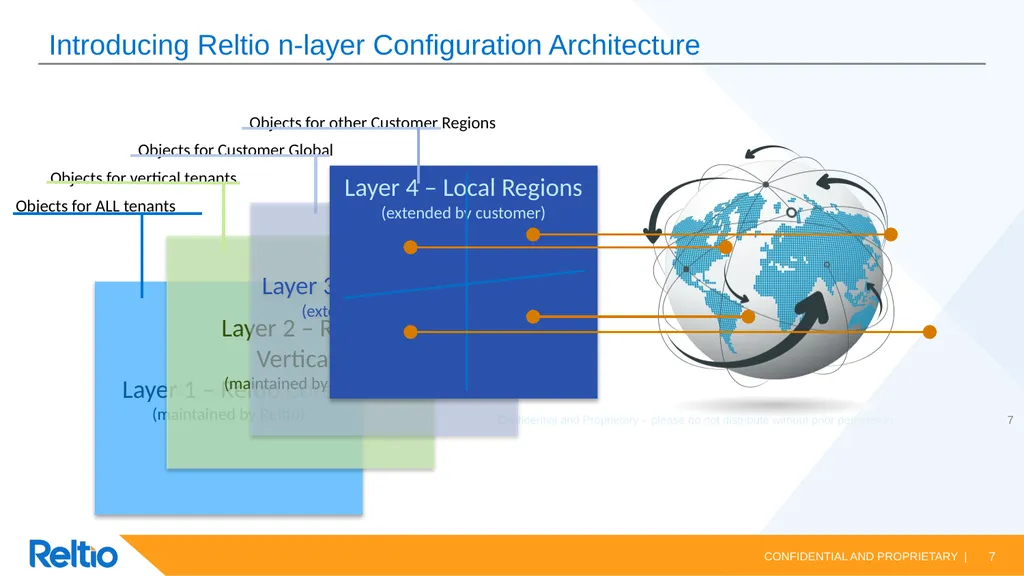
Introducing Reltio n-layer Configuration Architecture Confidential and Proprietary – please do not distribute without prior permission 7 Layer 1 – Reltio Core
(maintained by Reltio) Layer 2 – Reltio Verticals
(maintained by Reltio) Objects for ALL tenants Objects for vertical tenants Objects for Customer Global Layer 3 – Amgen Global
(extended by customer) Layer 4 – Local Regions
(extended by customer) Objects for other Customer Regions<br>
(maintained by Reltio) Layer 2 – Reltio Verticals
(maintained by Reltio) Objects for ALL tenants Objects for vertical tenants Objects for Customer Global Layer 3 – Amgen Global
(extended by customer) Layer 4 – Local Regions
(extended by customer) Objects for other Customer Regions<br>
08
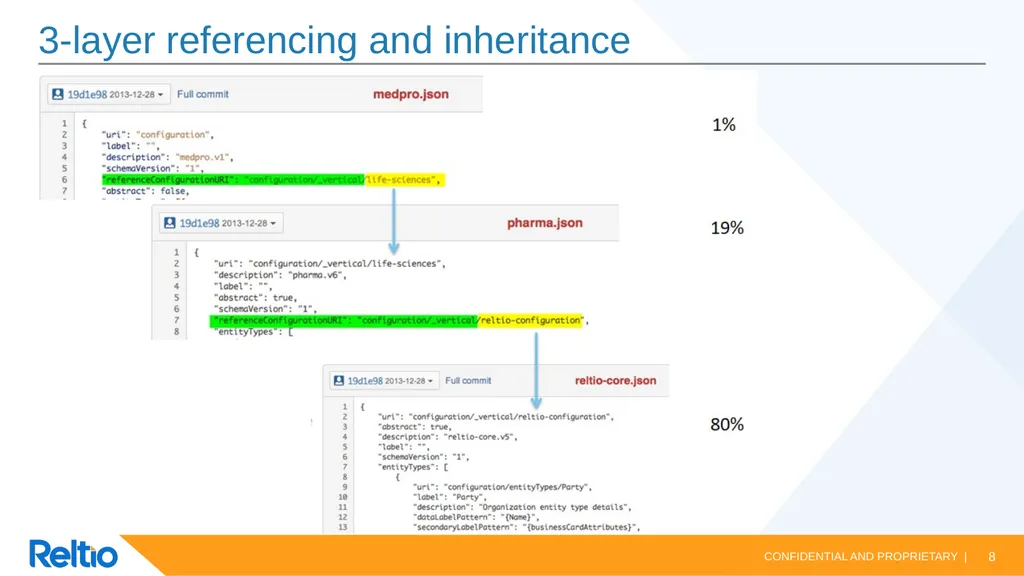
3-layer referencing and inheritance<br>
09
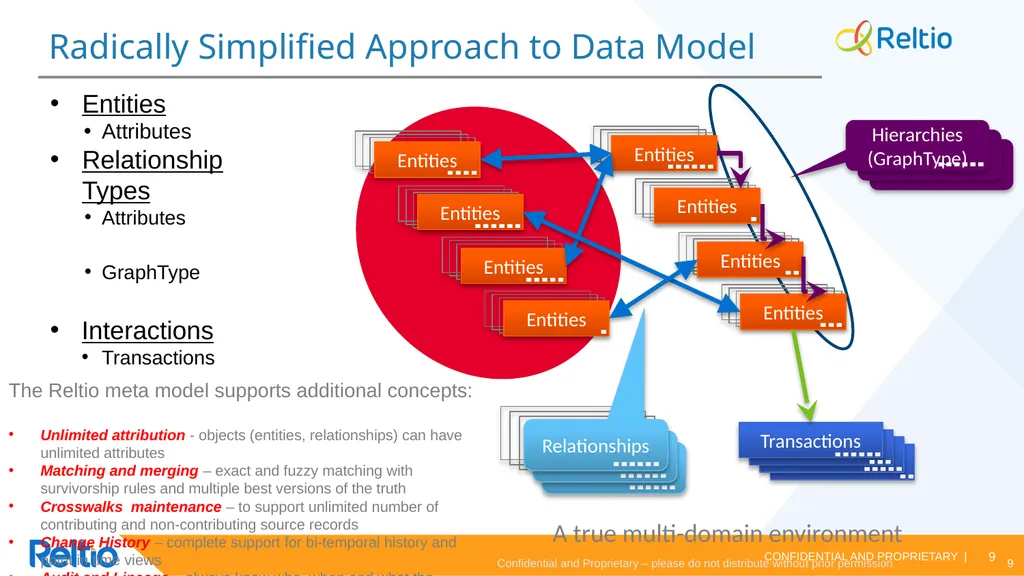
Radically Simplified Approach to Data Model Confidential and Proprietary – please do not distribute without prior permission 9 The Reltio meta model supports additional concepts:
Unlimited attribution - objects (entities, relationships) can have unlimited attributes
Matching and merging – exact and fuzzy matching with survivorship rules and multiple best versions of the truth
Crosswalks maintenance – to support unlimited number of contributing and non-contributing source records
Change History – complete support for bi-temporal history and point in time views
Audit and Lineage – always know who, when and what the change was at the attribute level Entities Entities Entities Entities Entities Entities Entities Entities Hierarchies
(GraphType) A true multi-domain environment Entities
Attributes
Relationship Types
Attributes
GraphType
Interactions
Transactions<br>
Unlimited attribution - objects (entities, relationships) can have unlimited attributes
Matching and merging – exact and fuzzy matching with survivorship rules and multiple best versions of the truth
Crosswalks maintenance – to support unlimited number of contributing and non-contributing source records
Change History – complete support for bi-temporal history and point in time views
Audit and Lineage – always know who, when and what the change was at the attribute level Entities Entities Entities Entities Entities Entities Entities Entities Hierarchies
(GraphType) A true multi-domain environment Entities
Attributes
Relationship Types
Attributes
GraphType
Interactions
Transactions<br>
10
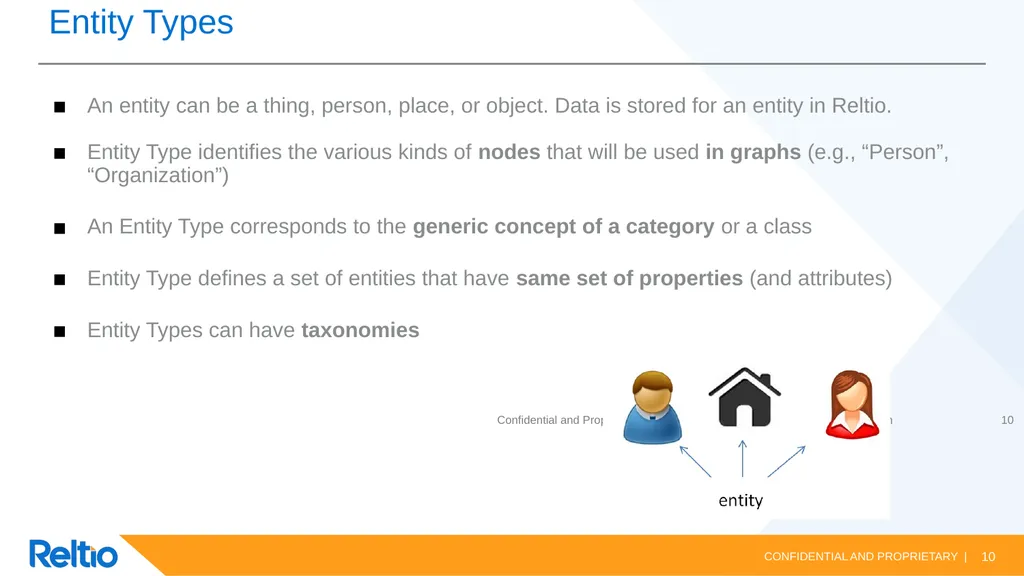
An entity can be a thing, person, place, or object. Data is stored for an entity in Reltio.
Entity Type identifies the various kinds of nodes that will be used in graphs (e.g., “Person”, “Organization”)
An Entity Type corresponds to the generic concept of a category or a class
Entity Type defines a set of entities that have same set of properties (and attributes)
Entity Types can have taxonomies Entity Types Confidential and Proprietary – please do not distribute without prior permission 10<br>
Entity Type identifies the various kinds of nodes that will be used in graphs (e.g., “Person”, “Organization”)
An Entity Type corresponds to the generic concept of a category or a class
Entity Type defines a set of entities that have same set of properties (and attributes)
Entity Types can have taxonomies Entity Types Confidential and Proprietary – please do not distribute without prior permission 10<br>
11
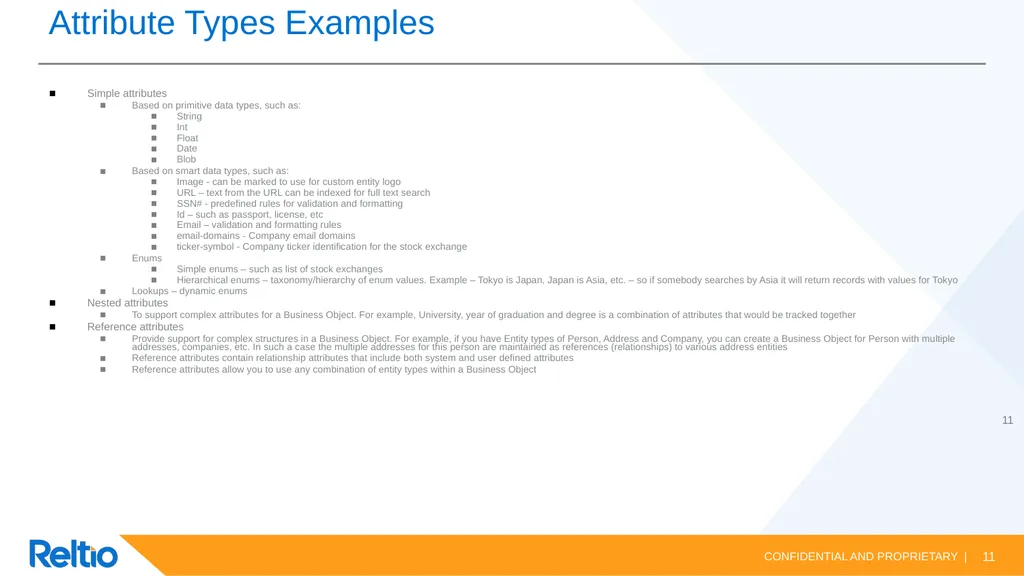
Simple attributes
Based on primitive data types, such as:
String
Int
Float
Date
Blob
Based on smart data types, such as:
Image - can be marked to use for custom entity logo
URL – text from the URL can be indexed for full text search
SSN# - predefined rules for validation and formatting
Id – such as passport, license, etc
Email – validation and formatting rules
email-domains - Company email domains
ticker-symbol - Company ticker identification for the stock exchange
Enums
Simple enums – such as list of stock exchanges
Hierarchical enums – taxonomy/hierarchy of enum values. Example – Tokyo is Japan, Japan is Asia, etc. – so if somebody searches by Asia it will return records with values for Tokyo
Lookups – dynamic enums
Nested attributes
To support complex attributes for a Business Object. For example, University, year of graduation and degree is a combination of attributes that would be tracked together
Reference attributes
Provide support for complex structures in a Business Object. For example, if you have Entity types of Person, Address and Company, you can create a Business Object for Person with multiple addresses, companies, etc. In such a case the multiple addresses for this person are maintained as references (relationships) to various address entities
Reference attributes contain relationship attributes that include both system and user defined attributes
Reference attributes allow you to use any combination of entity types within a Business Object Attribute Types Examples 11<br>
Based on primitive data types, such as:
String
Int
Float
Date
Blob
Based on smart data types, such as:
Image - can be marked to use for custom entity logo
URL – text from the URL can be indexed for full text search
SSN# - predefined rules for validation and formatting
Id – such as passport, license, etc
Email – validation and formatting rules
email-domains - Company email domains
ticker-symbol - Company ticker identification for the stock exchange
Enums
Simple enums – such as list of stock exchanges
Hierarchical enums – taxonomy/hierarchy of enum values. Example – Tokyo is Japan, Japan is Asia, etc. – so if somebody searches by Asia it will return records with values for Tokyo
Lookups – dynamic enums
Nested attributes
To support complex attributes for a Business Object. For example, University, year of graduation and degree is a combination of attributes that would be tracked together
Reference attributes
Provide support for complex structures in a Business Object. For example, if you have Entity types of Person, Address and Company, you can create a Business Object for Person with multiple addresses, companies, etc. In such a case the multiple addresses for this person are maintained as references (relationships) to various address entities
Reference attributes contain relationship attributes that include both system and user defined attributes
Reference attributes allow you to use any combination of entity types within a Business Object Attribute Types Examples 11<br>
12
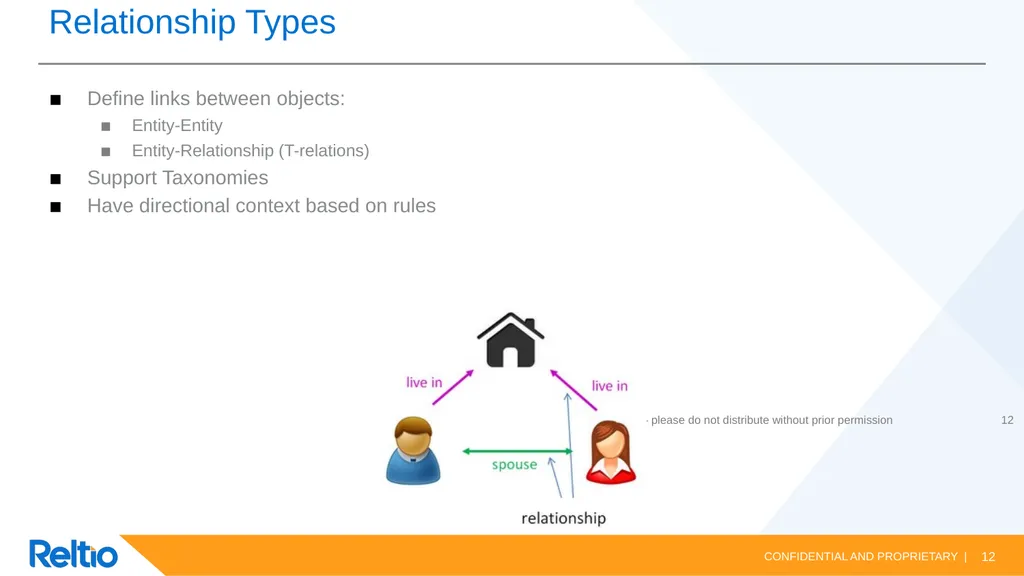
Define links between objects:
Entity-Entity
Entity-Relationship (T-relations)
Support Taxonomies
Have directional context based on rules Relationship Types Confidential and Proprietary – please do not distribute without prior permission 12<br>
Entity-Entity
Entity-Relationship (T-relations)
Support Taxonomies
Have directional context based on rules Relationship Types Confidential and Proprietary – please do not distribute without prior permission 12<br>
13
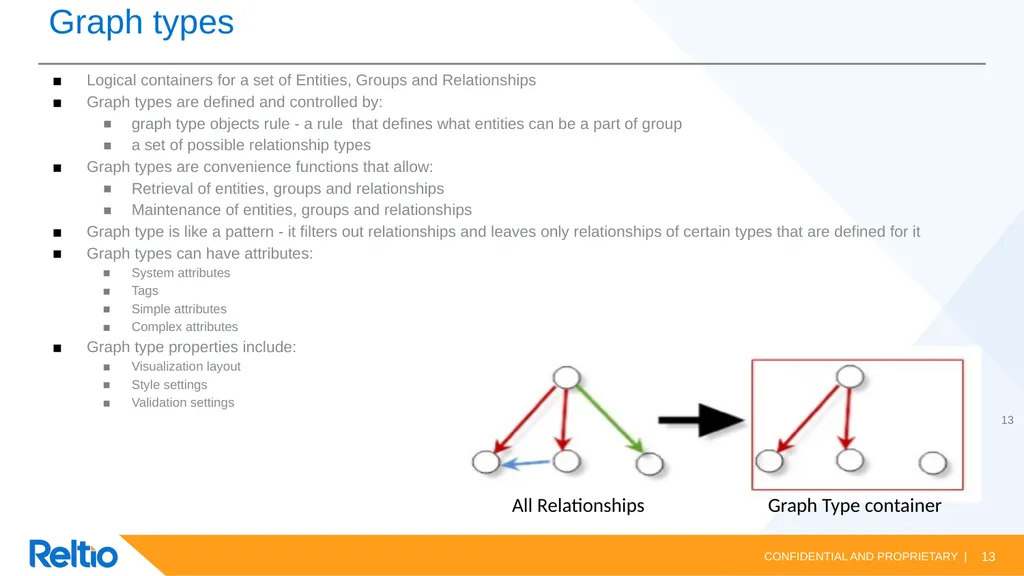
Logical containers for a set of Entities, Groups and Relationships
Graph types are defined and controlled by:
graph type objects rule - a rule that defines what entities can be a part of group
a set of possible relationship types
Graph types are convenience functions that allow:
Retrieval of entities, groups and relationships
Maintenance of entities, groups and relationships
Graph type is like a pattern - it filters out relationships and leaves only relationships of certain types that are defined for it
Graph types can have attributes:
System attributes
Tags
Simple attributes
Complex attributes
Graph type properties include:
Visualization layout
Style settings
Validation settings Graph types Confidential and Proprietary – please do not distribute without prior permission 13<br>
Graph types are defined and controlled by:
graph type objects rule - a rule that defines what entities can be a part of group
a set of possible relationship types
Graph types are convenience functions that allow:
Retrieval of entities, groups and relationships
Maintenance of entities, groups and relationships
Graph type is like a pattern - it filters out relationships and leaves only relationships of certain types that are defined for it
Graph types can have attributes:
System attributes
Tags
Simple attributes
Complex attributes
Graph type properties include:
Visualization layout
Style settings
Validation settings Graph types Confidential and Proprietary – please do not distribute without prior permission 13<br>
14
Guidelines / Best practices<br>
15
Reltio provides default out of the box multi layer configuration. Please use following approach for defining new entities.
If customer vertical has defined Reltio L2, please use the L2 entities already defined. Following are the existing L2 configuration available today:
Repository: https://bitbucket.org/reltio-ondemand/workspace/projects/ROCS
Life-Sciences
Consumer360
Account360
LSProduct360
Identify the existing (L1/L2/L3) entity and relationships types
Use L2 entities for defined verticals and extend them in L3 for customization. Define new attributes only if they do not exist in L1 or L2
Identify new entity types
Identify new relationship types
Identify new interaction types
Identify the Reference data (RDM) Reltio Accelerators 15<br>
If customer vertical has defined Reltio L2, please use the L2 entities already defined. Following are the existing L2 configuration available today:
Repository: https://bitbucket.org/reltio-ondemand/workspace/projects/ROCS
Life-Sciences
Consumer360
Account360
LSProduct360
Identify the existing (L1/L2/L3) entity and relationships types
Use L2 entities for defined verticals and extend them in L3 for customization. Define new attributes only if they do not exist in L1 or L2
Identify new entity types
Identify new relationship types
Identify new interaction types
Identify the Reference data (RDM) Reltio Accelerators 15<br>
16
If the vertical is not defined in Reltio L2 or the information being stored cannot use one of the existing entities, we follow the below approach to define it as either an entity, RDM or a lookup.
Below are some of the additional considerations when defining new entities:
If not done correctly, entity modeling can adversely affect UI, data load, and matching performance. Please collect enough data points during initial phases to drive the modeling decisions.
When modeling high cardinality relations, nested attributes are preferable over the reference attributes. Nested attributes perform better in terms of storage, and maintenance of data (create, update, delete etc.).
When moving a MDM system originally defined in Relational databases, do not map entities directly to Reltio. Relito is non-relational and converting relational system to non-relational does not work. Instead, use the best practice guidelines (link given above) to convert relational entities to either Reltio entities, Reltio nested attributes, Reltio RDM objects or lookup as it fits based on the requirements. Entities/Model For New Verticals 16<br>
Below are some of the additional considerations when defining new entities:
If not done correctly, entity modeling can adversely affect UI, data load, and matching performance. Please collect enough data points during initial phases to drive the modeling decisions.
When modeling high cardinality relations, nested attributes are preferable over the reference attributes. Nested attributes perform better in terms of storage, and maintenance of data (create, update, delete etc.).
When moving a MDM system originally defined in Relational databases, do not map entities directly to Reltio. Relito is non-relational and converting relational system to non-relational does not work. Instead, use the best practice guidelines (link given above) to convert relational entities to either Reltio entities, Reltio nested attributes, Reltio RDM objects or lookup as it fits based on the requirements. Entities/Model For New Verticals 16<br>
17
Use Case<br>
18
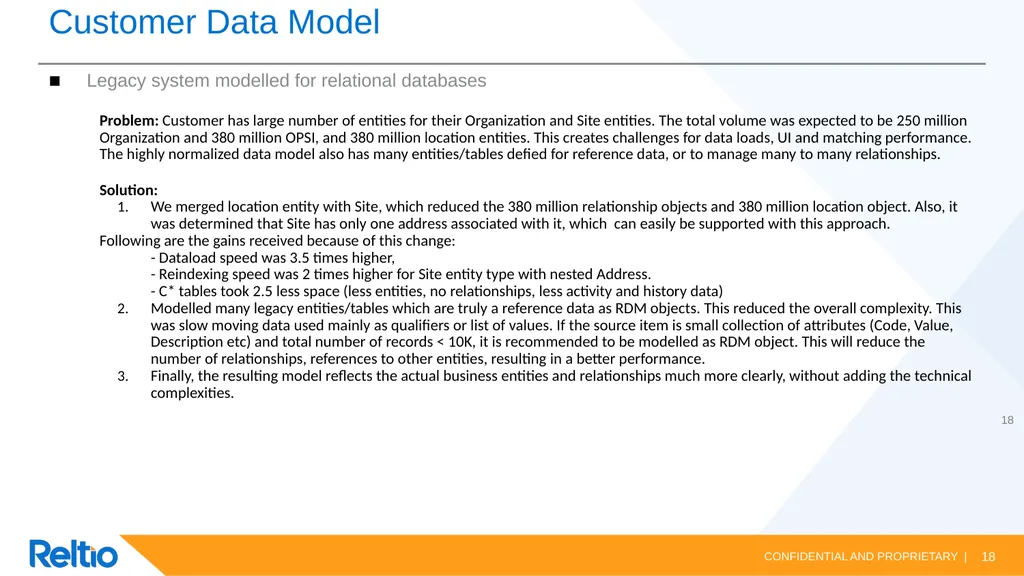
Legacy system modelled for relational databases
Problem: Customer has large number of entities for their Organization and Site entities. The total volume was expected to be 250 million Organization and 380 million OPSI, and 380 million location entities. This creates challenges for data loads, UI and matching performance.
The highly normalized data model also has many entities/tables defied for reference data, or to manage many to many relationships.
Solution:
We merged location entity with Site, which reduced the 380 million relationship objects and 380 million location object. Also, it was determined that Site has only one address associated with it, which can easily be supported with this approach.
Following are the gains received because of this change:
- Dataload speed was 3.5 times higher,
- Reindexing speed was 2 times higher for Site entity type with nested Address.
- C* tables took 2.5 less space (less entities, no relationships, less activity and history data)
Modelled many legacy entities/tables which are truly a reference data as RDM objects. This reduced the overall complexity. This was slow moving data used mainly as qualifiers or list of values. If the source item is small collection of attributes (Code, Value, Description etc) and total number of records < 10K, it is recommended to be modelled as RDM object. This will reduce the number of relationships, references to other entities, resulting in a better performance.
Finally, the resulting model reflects the actual business entities and relationships much more clearly, without adding the technical complexities. Customer Data Model 18<br>
Problem: Customer has large number of entities for their Organization and Site entities. The total volume was expected to be 250 million Organization and 380 million OPSI, and 380 million location entities. This creates challenges for data loads, UI and matching performance.
The highly normalized data model also has many entities/tables defied for reference data, or to manage many to many relationships.
Solution:
We merged location entity with Site, which reduced the 380 million relationship objects and 380 million location object. Also, it was determined that Site has only one address associated with it, which can easily be supported with this approach.
Following are the gains received because of this change:
- Dataload speed was 3.5 times higher,
- Reindexing speed was 2 times higher for Site entity type with nested Address.
- C* tables took 2.5 less space (less entities, no relationships, less activity and history data)
Modelled many legacy entities/tables which are truly a reference data as RDM objects. This reduced the overall complexity. This was slow moving data used mainly as qualifiers or list of values. If the source item is small collection of attributes (Code, Value, Description etc) and total number of records < 10K, it is recommended to be modelled as RDM object. This will reduce the number of relationships, references to other entities, resulting in a better performance.
Finally, the resulting model reflects the actual business entities and relationships much more clearly, without adding the technical complexities. Customer Data Model 18<br>