Rent Seeking and Redistribution Resources used (or created) in the process of obtaining property rights Classic public finance assumes, without attempting proof, that the rectangle (i.e., tax revenue or profits) is just a transfer rather
Related Topics
Share
Embed code
Download this presentation From Below
"Rent Seeking and Redistribution Resources used (or" is the property of its rightful owner. Permission is granted to
download and print the materials on this website for personal, non-commercial use only, and to display it
on your personal computer provided you do not modify the materials and that you retain all copyright
notices contained in the materials. By downloading content from our website, you accept the terms of this
agreement.
Presentation Transcript
01
Rent Seeking and Redistribution Resources used (or created) in the process of obtaining property rights
Classic public finance assumes, without attempting proof, that the “rectangle” (i.e., tax revenue or profits) is just a transfer rather than a use of resources or loss of value
The lost value from taxation or market power is limited to the Harberger triangle, which refers to value lost from the exercise of property rights
But resources have to used to obtain the property rights in the first place<br>
02
Special Case: Struggle to Obtain Market Power Monopoly I:
Use resources to erect barriers to market entry in order to obtain control over the market’s supply
Change the nature of the product in a way that harms entrants without creating commensurate value for customers.
E.g., adopt, with a cost, a production process merely because it is more difficult to reverse engineer
Sabotage competitors’ production
Based on the amount of supply controlled, elevate prices to maximize profit
Entry barriers erected is the rent seeking
Lost gains from trade (potential customers with value between price and MC) is the Harberger triangle<br>
03
Rent Seeking – Monopoly I example Labor union
Harberger triangle: workers who are excluded from the union because it is restricting supply
Rent seeking: union goes on strike to get a better wage contract
Rent seeking: management institutes a lockout so that the union will accept lower wages
Rent seeking: resources used to restrict supply (e.g., excessive qualifications)
Not rent seeking: fees charged to apprentices
Rent seeking: battle over how to use the apprentice fees<br>
04
Rent Seeking Monopoly II:
Create a new product in order to obtain a patent
With the monopoly granted by the patent, elevate prices to maximize profit
Creating a new product is the rent seeking, and may add value rather than destroy it
Lost gains from trade are the Harberger triangle
Policy influence I
Use resources to win a contest for excise tax revenue
Those resources are rent seeking
The lost gains from trade due to excise tax is the Harberger triangle<br>
05
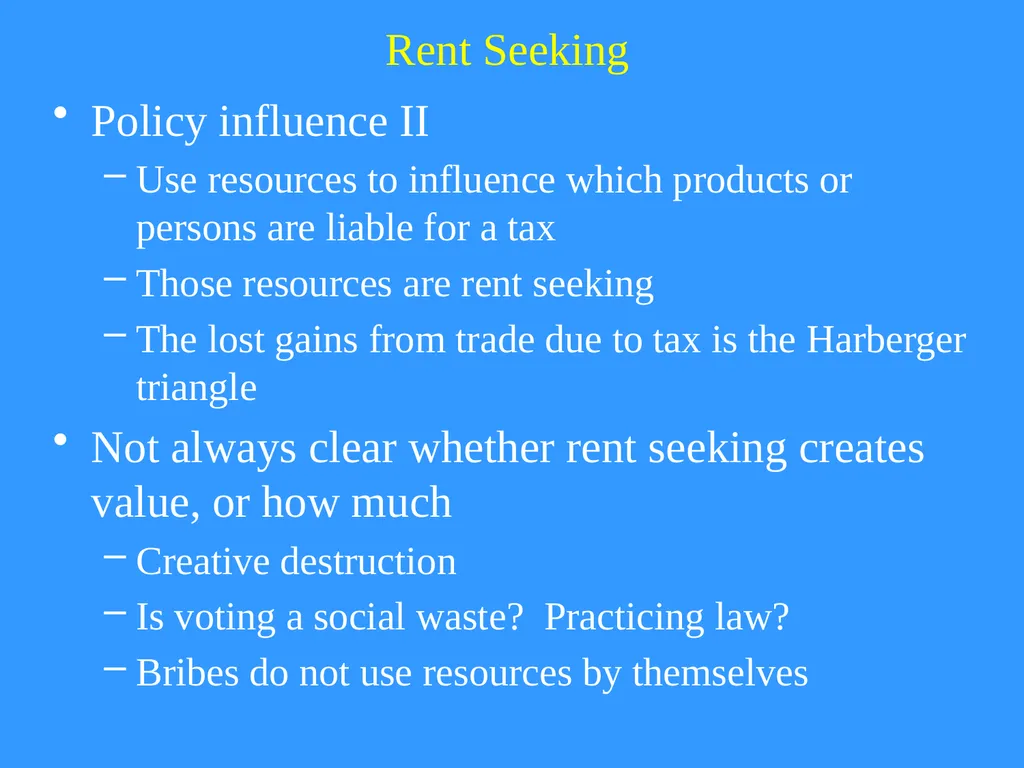
Rent Seeking Policy influence II
Use resources to influence which products or persons are liable for a tax
Those resources are rent seeking
The lost gains from trade due to tax is the Harberger triangle
Not always clear whether rent seeking creates value, or how much
Creative destruction
Is voting a social waste? Practicing law?
Bribes do not use resources by themselves<br>
06
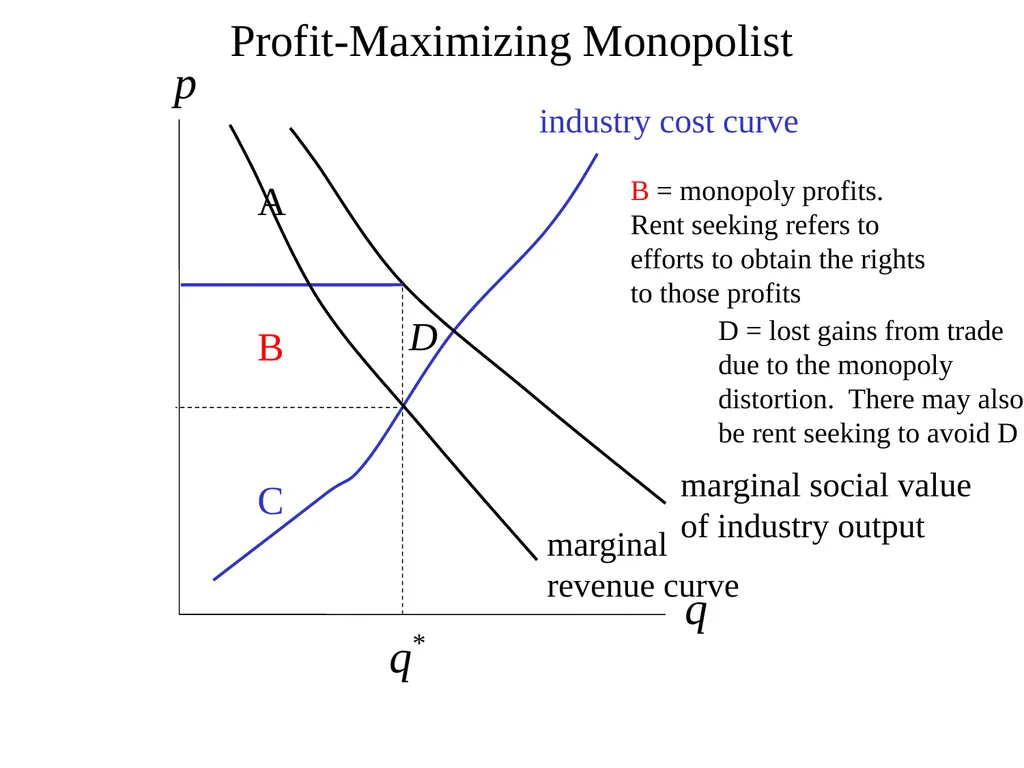
Profit-Maximizing Monopolist B = monopoly profits.
Rent seeking refers to efforts to obtain the rights to those profits D = lost gains from trade due to the monopoly distortion. There may also be rent seeking to avoid D<br>
07
Amount of Rent Seeking: First or Second Order? Is rent seeking just another form of tax avoidance?
Actions that reduce the tax base
Featured in the Harberger triangle
Taxpayer optimization implies that the first avoidance actions have no marginal cost --> “costs are 2nd order”
Actions to affect property rights
If obtaining the first bit (i.e., probability, or ownership share) of property rights had zero marginal cost, then rent seeking would also be second order
No economic argument for (or against) this assumption
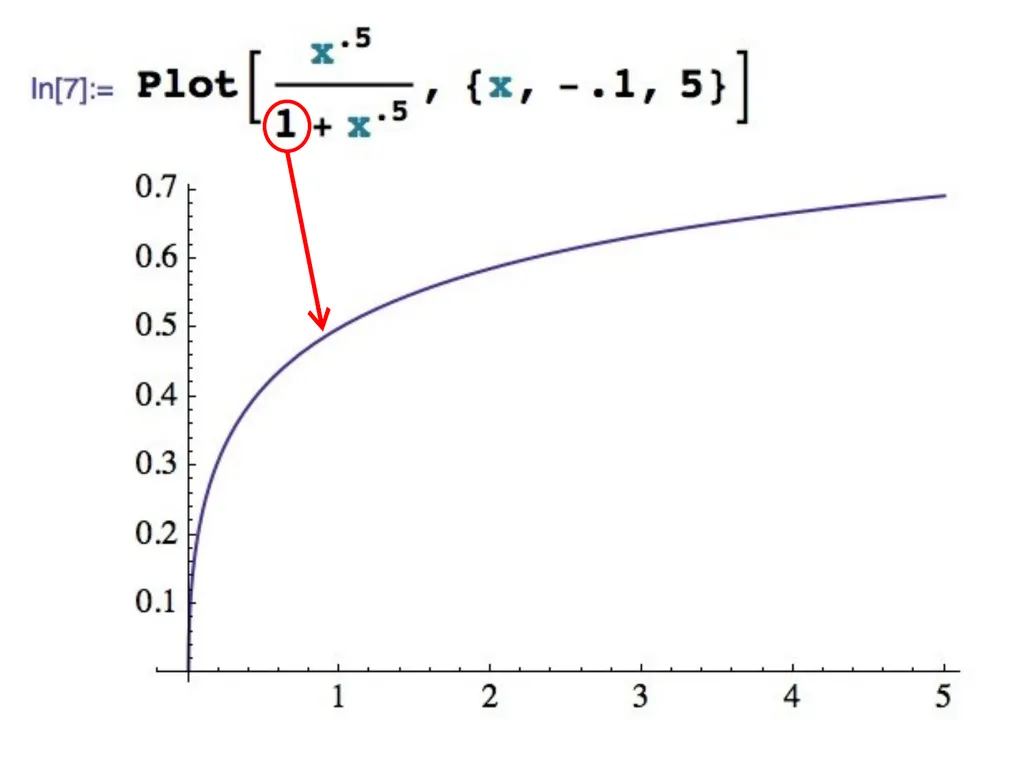
Literature assumes strictly positive marginal cost --> rent seeking costs are first order
Zero-sum argument that rent seeking is proportional<br>
08
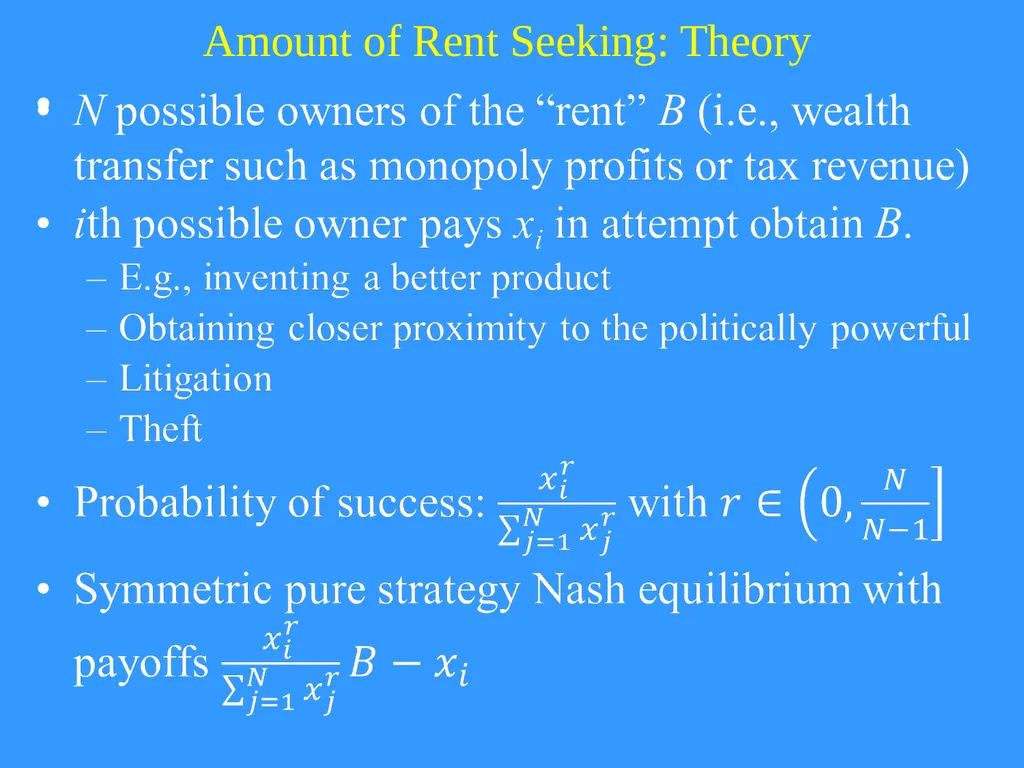
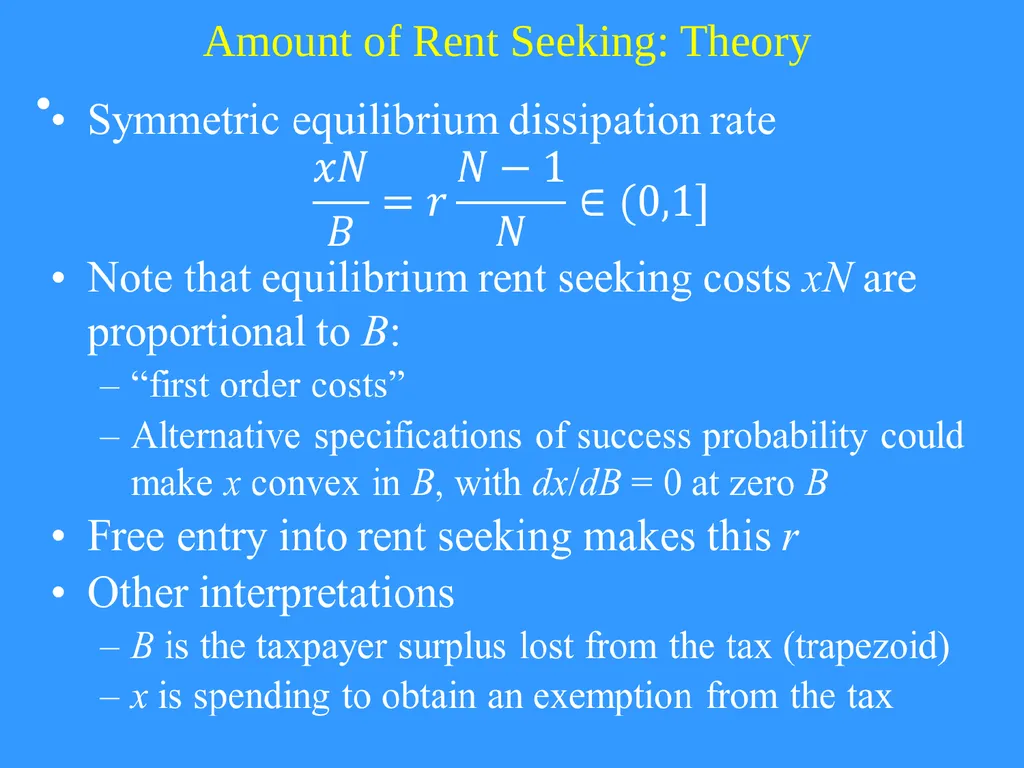
Amount of Rent Seeking: Theory<br>
09
Amount of Rent Seeking: Theory<br>
10
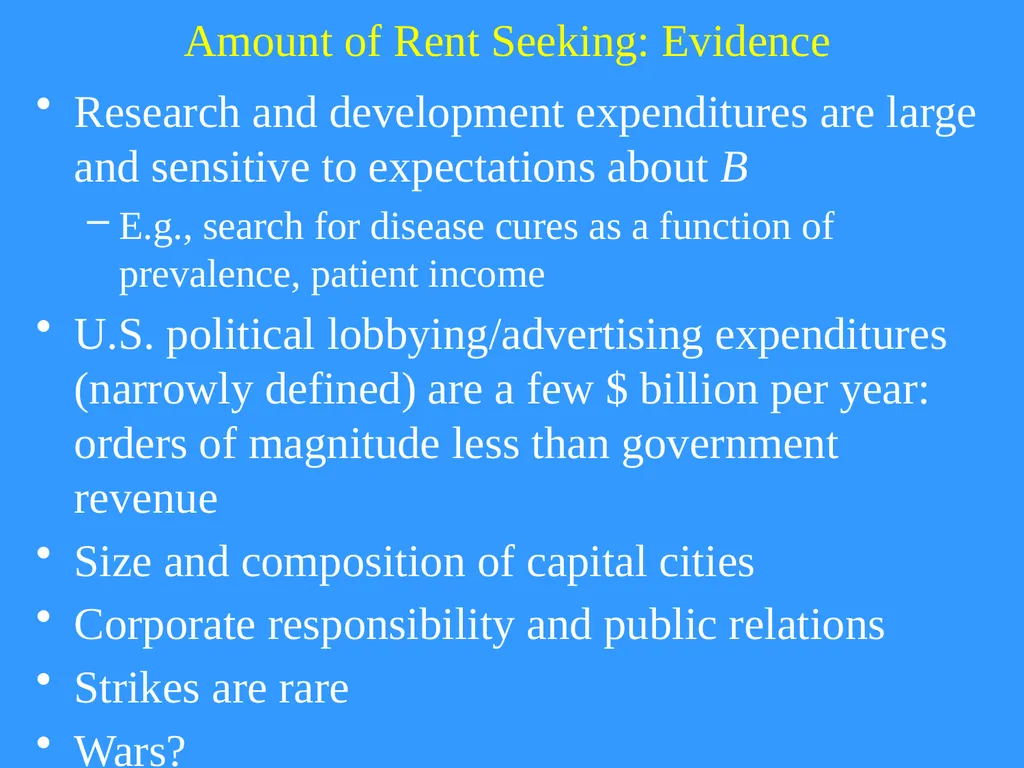
Amount of Rent Seeking: Evidence Research and development expenditures are large and sensitive to expectations about B
E.g., search for disease cures as a function of prevalence, patient income
U.S. political lobbying/advertising expenditures (narrowly defined) are a few $ billion per year: orders of magnitude less than government revenue
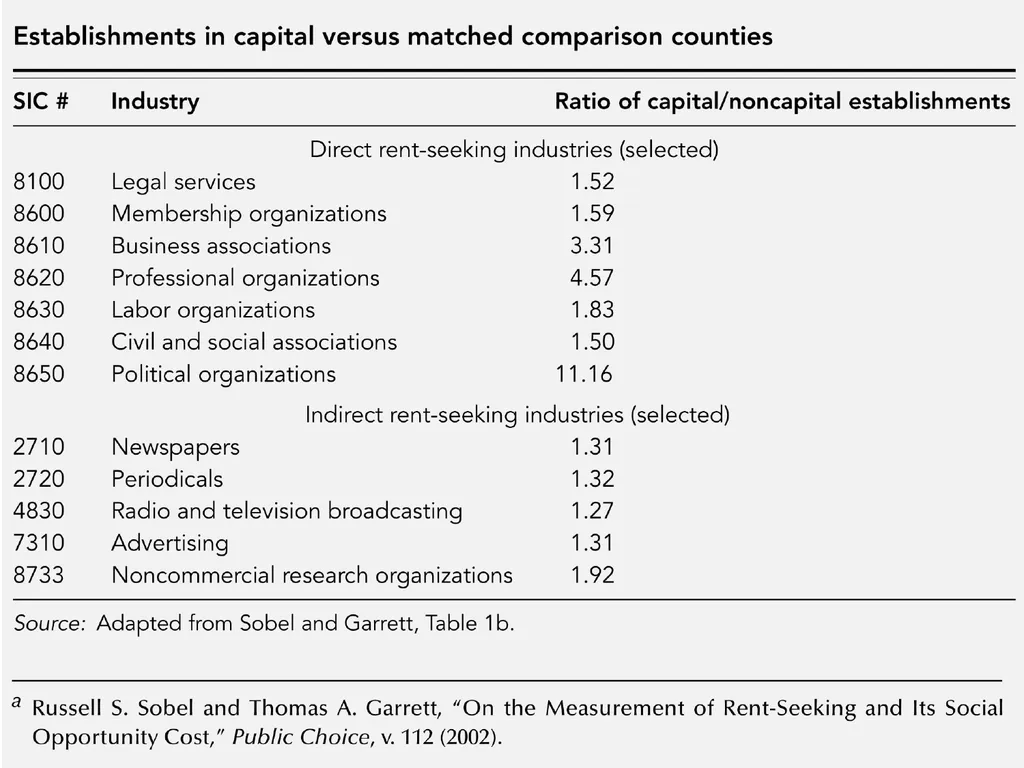
Size and composition of capital cities
Corporate responsibility and public relations
Strikes are rare
Wars?<br>
11
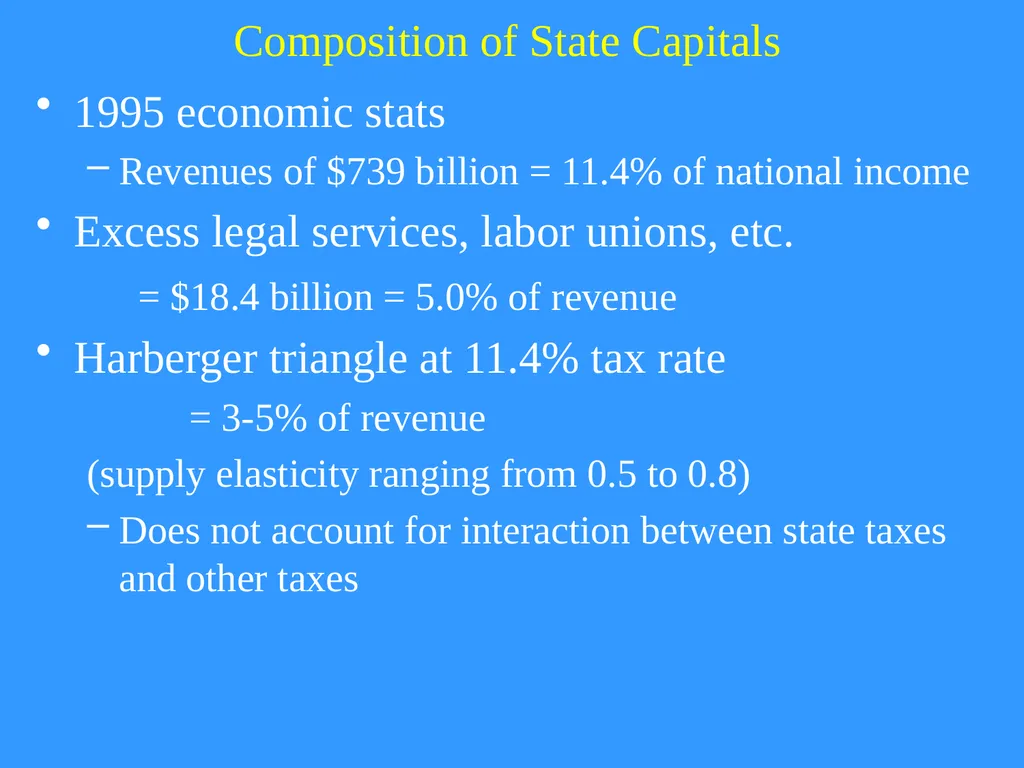
Composition of State Capitals 1995 economic stats
Revenues of $739 billion = 11.4% of national income
Excess legal services, labor unions, etc.
= $18.4 billion = 5.0% of revenue
Harberger triangle at 11.4% tax rate
= 3-5% of revenue
(supply elasticity ranging from 0.5 to 0.8)
Does not account for interaction between state taxes and other taxes<br>