
RESEARCH METHODS IN BUSINESS ADMINISTRATION AND
DJ
Published · 144 slides · 0 views

1 / 1






















Description
RESEARCH METHODS IN BUSINESS ADMINISTRATION AND LAW PROFESSOR J.U.J. ONWUMERE DEAN FACULTY OF BUSINESS ADMINISTRATION UNIVERSITY OF NIGERIA, ENUGU CAMPUS INTRODUCTION DEFINITION AND FEATURES OF RESEARCH The Websters NEW ENCYCLOPEDIC
Related Topics
Share
Embed code
Download this presentation From Below
"RESEARCH METHODS IN BUSINESS ADMINISTRATION AND" is the property of its rightful owner. Permission is granted to download and print the materials on this website for personal, non-commercial use only, and to display it on your personal computer provided you do not modify the materials and that you retain all copyright notices contained in the materials. By downloading content from our website, you accept the terms of this agreement.
Presentation Transcript
01
RESEARCH METHODS IN BUSINESS ADMINISTRATION AND LAW PROFESSOR J.U.J. ONWUMERE
DEAN
FACULTY OF BUSINESS ADMINISTRATION
UNIVERSITY OF NIGERIA, ENUGU CAMPUS<br>
DEAN
FACULTY OF BUSINESS ADMINISTRATION
UNIVERSITY OF NIGERIA, ENUGU CAMPUS<br>
02
INTRODUCTION DEFINITION AND FEATURES OF RESEARCH
The Webster’s NEW ENCYCLOPEDIC DICTIONARY defines research as “a careful or diligent search, studious inquiry or examination, investigation or experimentation aimed at the discovery and interpretation of facts, revision of theories or laws in the light of new facts”.
Kerlinger (1973) defines it as “a systematic, controlled, empirical and critical investigation of hypothetical proposition about presumed relations among natural phenomena” (p. 11).
Bennet (1983:24) equally views it as a systematic and careful inquiry or examination aimed at discovering “new information or relationship and to expand/verify existing knowledge for some specified purpose”
Onwumere(2009) views research from a holistic perspective as “an organized search for the truth about identified problems, challenges and phenomena through investigation and analysis and proffering of relevant solutions or recommendations.<br>
The Webster’s NEW ENCYCLOPEDIC DICTIONARY defines research as “a careful or diligent search, studious inquiry or examination, investigation or experimentation aimed at the discovery and interpretation of facts, revision of theories or laws in the light of new facts”.
Kerlinger (1973) defines it as “a systematic, controlled, empirical and critical investigation of hypothetical proposition about presumed relations among natural phenomena” (p. 11).
Bennet (1983:24) equally views it as a systematic and careful inquiry or examination aimed at discovering “new information or relationship and to expand/verify existing knowledge for some specified purpose”
Onwumere(2009) views research from a holistic perspective as “an organized search for the truth about identified problems, challenges and phenomena through investigation and analysis and proffering of relevant solutions or recommendations.<br>
03
Features of Research Research is a human activity aimed at discovering the truth about phenomenon.
Research involves the use of resources.
Research involves organisation.
Research is a process.
Research is systematic.
Research is directed at problems or challenges.
Research must have theoretical backing.
Research involves data gathering, inferencing and analysis.
Research must aid decision-making.
Research is cumulative.
Research is time-bound.<br>
Research involves the use of resources.
Research involves organisation.
Research is a process.
Research is systematic.
Research is directed at problems or challenges.
Research must have theoretical backing.
Research involves data gathering, inferencing and analysis.
Research must aid decision-making.
Research is cumulative.
Research is time-bound.<br>
04
What Research aims to accomplish Validating or invalidating existing phenomena;
Discovering new frontiers of knowledge;
Contributing to the body of existing knowledge, i.e. expanding the existing frontiers of knowledge;
Aiding the process of theory construction; and
Proffering solutions to relevant problems or challenges.<br>
Discovering new frontiers of knowledge;
Contributing to the body of existing knowledge, i.e. expanding the existing frontiers of knowledge;
Aiding the process of theory construction; and
Proffering solutions to relevant problems or challenges.<br>
05
FUNCTIONS/SIGNIFICANCE OF RESEARCH - Why study research? Research serves as a veritable source of information
Research has become necessary to aid decision-making especially for those organizations that adopt the scientific approach to taking decisions
Research helps man to properly understand and utilize resources provided by nature.
Research aids appropriate and sound policy making.
Research helps in advancing the frontiers of knowledge.
Research helps in skills development and enhancement of experience of the undertakers.
Research adds to the literature on existing body of knowledge in the particular area under study.<br>
Research has become necessary to aid decision-making especially for those organizations that adopt the scientific approach to taking decisions
Research helps man to properly understand and utilize resources provided by nature.
Research aids appropriate and sound policy making.
Research helps in advancing the frontiers of knowledge.
Research helps in skills development and enhancement of experience of the undertakers.
Research adds to the literature on existing body of knowledge in the particular area under study.<br>
06
THE RESEARCH PROCESS Identification and formulation of the problem to be investigated
Careful study of the background to the problem
Defining the objectives and scope of the study
Formulation of hypothesis/hypotheses
Doing a literature review on the specific area of investigation
Provision of criteria for measurement of identified variables
Development of a good methodology
Cost estimation
Conduct of the research
Analysis and
Report writing<br>
Careful study of the background to the problem
Defining the objectives and scope of the study
Formulation of hypothesis/hypotheses
Doing a literature review on the specific area of investigation
Provision of criteria for measurement of identified variables
Development of a good methodology
Cost estimation
Conduct of the research
Analysis and
Report writing<br>
07
TOPIC SELECTION IN RESEARCH Choosing a topic for research can be quite challenging to the student. It is at the same time something that could be quite simple. Potential sources of topics for business, economic, social, and legal research include the following:
Unpublished research works such as projects, dissertations and theses. Some of these may suggest areas for further research.
Published research works in academic journals or publications of research institutes, bureaus, etc.
Government publications Events of contemporary nature such as regularly in the news media
Discussions with practitioners and colleagues<br>
Unpublished research works such as projects, dissertations and theses. Some of these may suggest areas for further research.
Published research works in academic journals or publications of research institutes, bureaus, etc.
Government publications Events of contemporary nature such as regularly in the news media
Discussions with practitioners and colleagues<br>
08
ESSENTIALS OF A GOOD RESEARCH/RESEARCHER For a research to be adjudged to be good, it must exhibit the following features:
Clarity of Problem Statement
Clarity of Statement of Objectives
Evidence of Detailed Research Proposal
Evidence of Detailed Methodology
Application of High Ethical Standards
Adequate Data Analysis
Findings and Conclusions Appropriately Drawned and Justified
Limitations are Honestly Revealed
Reflection of Researcher’s Experience<br>
Clarity of Problem Statement
Clarity of Statement of Objectives
Evidence of Detailed Research Proposal
Evidence of Detailed Methodology
Application of High Ethical Standards
Adequate Data Analysis
Findings and Conclusions Appropriately Drawned and Justified
Limitations are Honestly Revealed
Reflection of Researcher’s Experience<br>
09
THE ENVIRONMENTS OF RESEARCH An environment can be defined as a setting in which certain variables operate and have direct and indirect effects on each other individually or collectively or both in diverse dimensions.
It creates a set of conditions and forces that present certain opportunities, threats, weaknesses/challenges and strengths to its within-operators and regulators.
It thus, throws up a lot of issues and variables of research interest and endeavours.<br>
It creates a set of conditions and forces that present certain opportunities, threats, weaknesses/challenges and strengths to its within-operators and regulators.
It thus, throws up a lot of issues and variables of research interest and endeavours.<br>
10
Components of Environment There are two key components of an environment. These are:
The internal and
The external environment.<br>
The internal and
The external environment.<br>
11
Internal Environment An internal environment represents the within (in or internal) setting of anything or matter. Another name for the internal environment is the micro-environment.
Thus, it is an internal setting where there is the interaction of the forces of production to generate output(s) and or service(s).
These forces or variables may be land, labour, capital and raw materials, all of which are under the control of the organization.<br>
Thus, it is an internal setting where there is the interaction of the forces of production to generate output(s) and or service(s).
These forces or variables may be land, labour, capital and raw materials, all of which are under the control of the organization.<br>
12
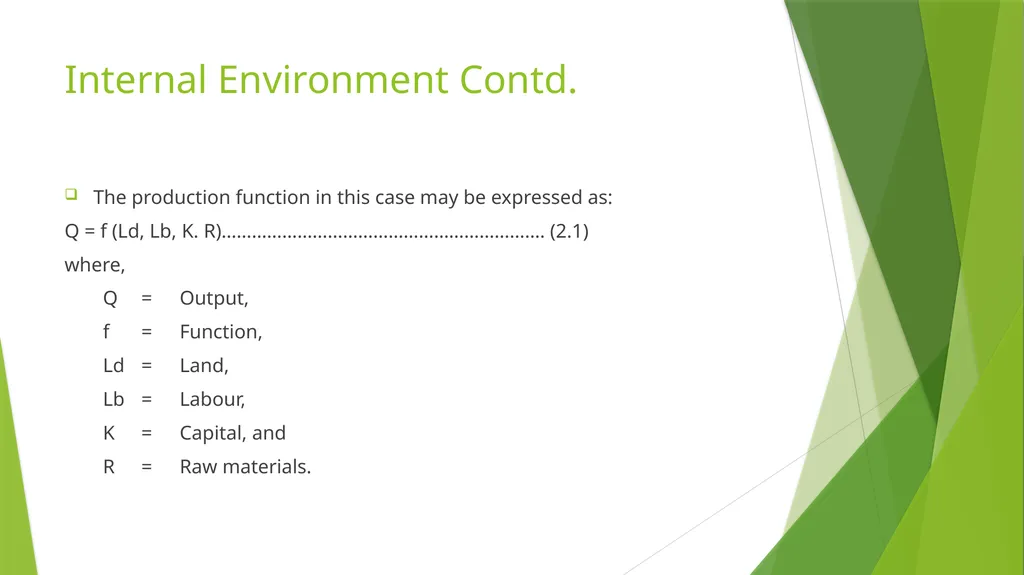
Internal Environment Contd. The production function in this case may be expressed as:
Q = f (Ld, Lb, K. R)………………………………………………………. (2.1)
where,
Q = Output,
f = Function,
Ld = Land,
Lb = Labour,
K = Capital, and
R = Raw materials.<br>
Q = f (Ld, Lb, K. R)………………………………………………………. (2.1)
where,
Q = Output,
f = Function,
Ld = Land,
Lb = Labour,
K = Capital, and
R = Raw materials.<br>
13
Internal Environment Contd. Beyond these, other aspects of the internal environment of an organization include:
The Organization’s Processes
The Organization’s Organogram
The Organization’s Culture
The Organization’s Resources and their Linkages
The Organization’s Climate<br>
The Organization’s Processes
The Organization’s Organogram
The Organization’s Culture
The Organization’s Resources and their Linkages
The Organization’s Climate<br>
14
External Environment The task environment represents the immediate environment that affects a behavioural unit. With respect to a business organization, it represents that industry in which the business unit operates. This includes:
The economic environment
the socio-cultural environment
the political environment
the legal environment
the business environment
the international environment<br>
The economic environment
the socio-cultural environment
the political environment
the legal environment
the business environment
the international environment<br>
15
Concepts, Variables and Causality MEANING OF CONCEPT
Concepts generally are our abstractions from reality expressed in definite words or phrases for ease of identification of a particular phenomenon or phenomena. They are thus peculiar, in the main, to such situations. In this way, concepts represent definite items that can be defined, such as fixed assets, output, production, advertising, etc. Concepts are symbols of phenomenon but are themselves not phenomena (Nachimas and Nachimas, 1976)
A concept has been defined in the following way: “... an abstract symbol representing an object, property of an object, or a certain phenomenon. For example, ‘status’, ‘role,’ ‘power’, and ‘relative deprivation’ are common concepts in political science and sociology. Concepts such as ‘intelligent’, ‘perception’, and ‘learning’ are common among psychologists” (Nachimas and Nachimas, 1976:15).<br>
Concepts generally are our abstractions from reality expressed in definite words or phrases for ease of identification of a particular phenomenon or phenomena. They are thus peculiar, in the main, to such situations. In this way, concepts represent definite items that can be defined, such as fixed assets, output, production, advertising, etc. Concepts are symbols of phenomenon but are themselves not phenomena (Nachimas and Nachimas, 1976)
A concept has been defined in the following way: “... an abstract symbol representing an object, property of an object, or a certain phenomenon. For example, ‘status’, ‘role,’ ‘power’, and ‘relative deprivation’ are common concepts in political science and sociology. Concepts such as ‘intelligent’, ‘perception’, and ‘learning’ are common among psychologists” (Nachimas and Nachimas, 1976:15).<br>
16
Concepts Contd. It (concept) has also been defined and described as: “… a generally accepted collection of meanings or characteristics associated with certain events, objects, conditions, situations and behaviours. Classifying and categorizing objects or events that have common characteristics beyond any single observation create concepts. The terms ‘height’, ‘width’ and ‘depth’, for example, symbolize a conception of the properties of a physical object. Similarly, the economic term ‘profit’ points to the financial situation of an organization” (Blumberg, Cooper and Schindler, 2011, p. 25).
Concepts are therefore relevant within the context of their meanings and functionality. They can be seen as our abstraction, thoughts about reality which we have expressed in certain words or phrases.<br>
Concepts are therefore relevant within the context of their meanings and functionality. They can be seen as our abstraction, thoughts about reality which we have expressed in certain words or phrases.<br>
17
SOURCES OF CONCEPTS IN RESEARCH These are:
Language and Culture
Observation
Borrowing
Experience<br>
Language and Culture
Observation
Borrowing
Experience<br>
18
SIGNIFICANCE OF CONCEPTS Permit communication
Permit research
Enable the classification or categorisation of objects and policies, among others
They specifically aid science and scientific research
Aid general comprehension of the relevant issues at stake<br>
Permit research
Enable the classification or categorisation of objects and policies, among others
They specifically aid science and scientific research
Aid general comprehension of the relevant issues at stake<br>
19
CONSTRUCTS These are theoretical inventions by an individual or individuals which have become accepted even when they have no dictionary meaning. In this regard, constructs which are concepts by nature have been deliberately invented for the purpose of research. A construct is a special concept.
Examples of constructs include International Monetary Fund’s ‘conditionalities’ ‘timber and calibre’; ‘cognitive dissonance’; etc. (Osuagwu, 1999:6).<br>
Examples of constructs include International Monetary Fund’s ‘conditionalities’ ‘timber and calibre’; ‘cognitive dissonance’; etc. (Osuagwu, 1999:6).<br>
20
VARIABLES DEFINITION OF VARIABLE
Variables are the essential ingredients of analysis in any research. They are seen as those rational units of analysis that can assume any one of designated sets of values.
Variables could at the theoretical level not be subject to any form of values or numerals but at the level of empiricism, this cannot be avoided.<br>
Variables are the essential ingredients of analysis in any research. They are seen as those rational units of analysis that can assume any one of designated sets of values.
Variables could at the theoretical level not be subject to any form of values or numerals but at the level of empiricism, this cannot be avoided.<br>
21
TYPES OF VARIABLES There are various types of variables. They are often better understood in relation to each other. Researchers are interested in variables because of their functionality in relation to the problem of their study or in aiding analysis with respect to the study.
Numerical Variables: These are variables with values that can be expressed in numbers. Examples of numerical variables are gross domestic product (in monetary terms), weight (in kilograms), and height (in meters).
Categorical Variables (or Discrete Variables): These are variables whose values can be expressed in categories or scales or types. Examples are colour (which can be categorized into white, blue, red, green, yellow, brown, among others), income level (low, middle and high, among others), etc. Numbers could be assigned to each of the categories such as 5, 4, 3, but with no option for 4.5 or 3.5 in that order.
Discrete Random Variables: These are peculiar types of random variable in the sense that their values are limited. The number of values are countable.<br>
Numerical Variables: These are variables with values that can be expressed in numbers. Examples of numerical variables are gross domestic product (in monetary terms), weight (in kilograms), and height (in meters).
Categorical Variables (or Discrete Variables): These are variables whose values can be expressed in categories or scales or types. Examples are colour (which can be categorized into white, blue, red, green, yellow, brown, among others), income level (low, middle and high, among others), etc. Numbers could be assigned to each of the categories such as 5, 4, 3, but with no option for 4.5 or 3.5 in that order.
Discrete Random Variables: These are peculiar types of random variable in the sense that their values are limited. The number of values are countable.<br>
22
TYPES OF VARIABLES Contd. Dichotomous Variables: These are variables that have only two values, without any in-between properties. Example is gender (male or female). One cannot be male and female at the same time. The male can be assigned value of 1 and the female, a value of 0.
Continuous Variables: These are variables whose values are taken within a given range within an infinite range. An example of these variables is one \’s examination score in a range of 100%. Someone’s age ia another example. Where it will end is unknown to man<br>
Continuous Variables: These are variables whose values are taken within a given range within an infinite range. An example of these variables is one \’s examination score in a range of 100%. Someone’s age ia another example. Where it will end is unknown to man<br>
23
Types of Variables Contd. Other notable variables which researchers are even more interested in because of their functional relation to the problem being investigated include as follows:
Independent Variables
Dependent Variables
Intervening Variables
Moderator Variables
Extraneous/Control Variables
Dummy Variables
Lagged Variables
Background Variables
Random Variables<br>
Independent Variables
Dependent Variables
Intervening Variables
Moderator Variables
Extraneous/Control Variables
Dummy Variables
Lagged Variables
Background Variables
Random Variables<br>
24
CAUSALITY DEFINITION OF CAUSALITY
Causality has to do with generating, leading or effecting. Causal variables are those having effect on other variables. This effect could be positive or negative, significant or insignificant.
The issue of causality has arisen because of the relationship that exists in real life among variables<br>
Causality has to do with generating, leading or effecting. Causal variables are those having effect on other variables. This effect could be positive or negative, significant or insignificant.
The issue of causality has arisen because of the relationship that exists in real life among variables<br>
25
CRITERIA FOR CAUSALITY There are at least 3 conditions to be met to establish a causal relationship between two variables:
Association is demonstrated between them. This is, more often than not, derived from theory.
Variables must exist in a particular time order.
It must be shown that the relationship between the two variables persists when other variables that precede them in time are variables that could possibly apply for the relationship.<br>
Association is demonstrated between them. This is, more often than not, derived from theory.
Variables must exist in a particular time order.
It must be shown that the relationship between the two variables persists when other variables that precede them in time are variables that could possibly apply for the relationship.<br>
26
SPURIOUSNESS When a relationship between two variables has occurred by accident and does not imply a causal relationship at all, it is describable as spurious. It thus represents a kind of inaccuracy but in a special way.
Spuriousness occurs especially when we are making use of time series data in regression equations. Most time series data are non-stationary and this has the inherent danger of leading us into obtaining regression results which are good – high coefficient of determination (R2), significant t-values, etc. but which are meaningless. This is because the relationship between the variables is false. The data used for their estimation should have been stationary to make meaning and be reliable.
To avoid having spurious regressions as associated regressions are called, it is necessary to test data for their estimation for stationarity and non-stationarity.<br>
Spuriousness occurs especially when we are making use of time series data in regression equations. Most time series data are non-stationary and this has the inherent danger of leading us into obtaining regression results which are good – high coefficient of determination (R2), significant t-values, etc. but which are meaningless. This is because the relationship between the variables is false. The data used for their estimation should have been stationary to make meaning and be reliable.
To avoid having spurious regressions as associated regressions are called, it is necessary to test data for their estimation for stationarity and non-stationarity.<br>
27
HYPOTHESIS, MODELS AND MODELING IN RESEARCH, AND THEORY DEFINING HYPOTHESIS
Hypothesis is very important in research and is better defined within the context of proposition(s).
A proposition is seen as a statement referring to the situation of a concept or a suggestion that is yet to be proven true or false about observable behavioural settings. It is a form of supposition or conjectural belief.
A hypothesis is therefore a declarative proposition that has to be tested to determine whether it is acceptable or not with respect to the case in question. We formulate hypothesis for the purpose of testing it.
In this way, a hypothesis is a tentative statement about phenomena whose validity is usually unknown. It is thus a statement of probability. It is a statement that so far is not supported by relevant information or data. It is often stated to highlight the perceived relationship between a dependent and an independent variable.<br>
Hypothesis is very important in research and is better defined within the context of proposition(s).
A proposition is seen as a statement referring to the situation of a concept or a suggestion that is yet to be proven true or false about observable behavioural settings. It is a form of supposition or conjectural belief.
A hypothesis is therefore a declarative proposition that has to be tested to determine whether it is acceptable or not with respect to the case in question. We formulate hypothesis for the purpose of testing it.
In this way, a hypothesis is a tentative statement about phenomena whose validity is usually unknown. It is thus a statement of probability. It is a statement that so far is not supported by relevant information or data. It is often stated to highlight the perceived relationship between a dependent and an independent variable.<br>
28
Hypothesis Contd. It is much better and for ease of testability that a hypothesis should have:
Magnitude, and
Direction
Having magnitude and direction are therefore very critical in almost all hypotheses. They assist a lot in the testability of a hypothesis.
It is because a hypothesis will be tested to determine its validity that, more often than not, during the process of testing, it is restated into null and alternate forms<br>
Magnitude, and
Direction
Having magnitude and direction are therefore very critical in almost all hypotheses. They assist a lot in the testability of a hypothesis.
It is because a hypothesis will be tested to determine its validity that, more often than not, during the process of testing, it is restated into null and alternate forms<br>
29
TYPES OF HYPOTHESIS Research Hypothesis
Null Hypothesis
Alternate Hypothesis
Statistical Hypotheses
Causal Hypothesis
Relational Hypotheses<br>
Null Hypothesis
Alternate Hypothesis
Statistical Hypotheses
Causal Hypothesis
Relational Hypotheses<br>
30
Sources of Hypothesis There are many sources of hypotheses which include, among others:
The state of knowledge available in the area of investigation – theories, literatures, etc.
The researcher’s cultural background: The culture, under which a researcher was nurtured, influences his perception about phenomena.
The researcher’s intellectual training.
The objectives of the study, the problem statement and the research questions.<br>
The state of knowledge available in the area of investigation – theories, literatures, etc.
The researcher’s cultural background: The culture, under which a researcher was nurtured, influences his perception about phenomena.
The researcher’s intellectual training.
The objectives of the study, the problem statement and the research questions.<br>
31
Functions of Hypothesis These include:
To test theories
To suggest theories
To describe economic, business or social phenomena
To guide on the form and choice of appropriate research design
To give direction on data collection
To give direction on the technique of data analysis
To guide the researcher in addressing the problem that necessitated the study
To guide the researcher in making relevant suggestions and recommendations from the exercise<br>
To test theories
To suggest theories
To describe economic, business or social phenomena
To guide on the form and choice of appropriate research design
To give direction on data collection
To give direction on the technique of data analysis
To guide the researcher in addressing the problem that necessitated the study
To guide the researcher in making relevant suggestions and recommendations from the exercise<br>
32
QUALITIES OF A GOOD HYPOTHESIS A good hypothesis must possess the following qualities:
It must be as simple as possible. It has to be easy to understand.
It must not be ambiguous. It must not be verbose and conflicting. It must be clearly stated and specific.
The concepts or variables therein must be easily identifiable and understood.<br>
It must be as simple as possible. It has to be easy to understand.
It must not be ambiguous. It must not be verbose and conflicting. It must be clearly stated and specific.
The concepts or variables therein must be easily identifiable and understood.<br>
33
REQUIREMENTS NECESSARY FOR HYPOTHESIS TO BE RESEARCHABLE It must be simple and clear (unambiguous)
It must be specific. There should no room for over-generalisation. It should state the expected relationship and the conditions where possible, under which it could exist.
It must be testable using available and relevant methods.<br>
It must be specific. There should no room for over-generalisation. It should state the expected relationship and the conditions where possible, under which it could exist.
It must be testable using available and relevant methods.<br>
34
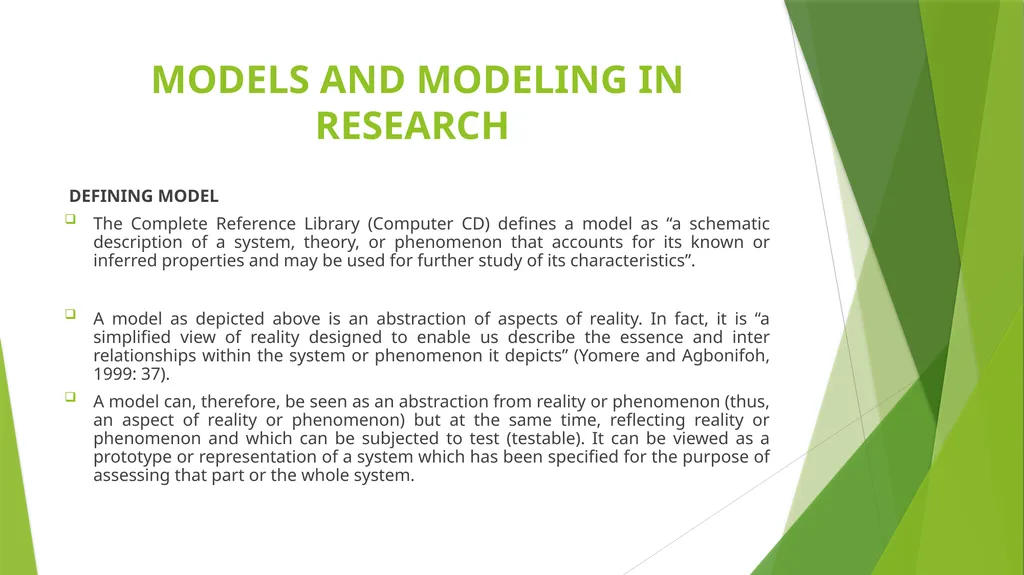
MODELS AND MODELING IN RESEARCH DEFINING MODEL
The Complete Reference Library (Computer CD) defines a model as “a schematic description of a system, theory, or phenomenon that accounts for its known or inferred properties and may be used for further study of its characteristics”.
A model as depicted above is an abstraction of aspects of reality. In fact, it is “a simplified view of reality designed to enable us describe the essence and inter relationships within the system or phenomenon it depicts” (Yomere and Agbonifoh, 1999: 37).
A model can, therefore, be seen as an abstraction from reality or phenomenon (thus, an aspect of reality or phenomenon) but at the same time, reflecting reality or phenomenon and which can be subjected to test (testable). It can be viewed as a prototype or representation of a system which has been specified for the purpose of assessing that part or the whole system.<br>
The Complete Reference Library (Computer CD) defines a model as “a schematic description of a system, theory, or phenomenon that accounts for its known or inferred properties and may be used for further study of its characteristics”.
A model as depicted above is an abstraction of aspects of reality. In fact, it is “a simplified view of reality designed to enable us describe the essence and inter relationships within the system or phenomenon it depicts” (Yomere and Agbonifoh, 1999: 37).
A model can, therefore, be seen as an abstraction from reality or phenomenon (thus, an aspect of reality or phenomenon) but at the same time, reflecting reality or phenomenon and which can be subjected to test (testable). It can be viewed as a prototype or representation of a system which has been specified for the purpose of assessing that part or the whole system.<br>
35
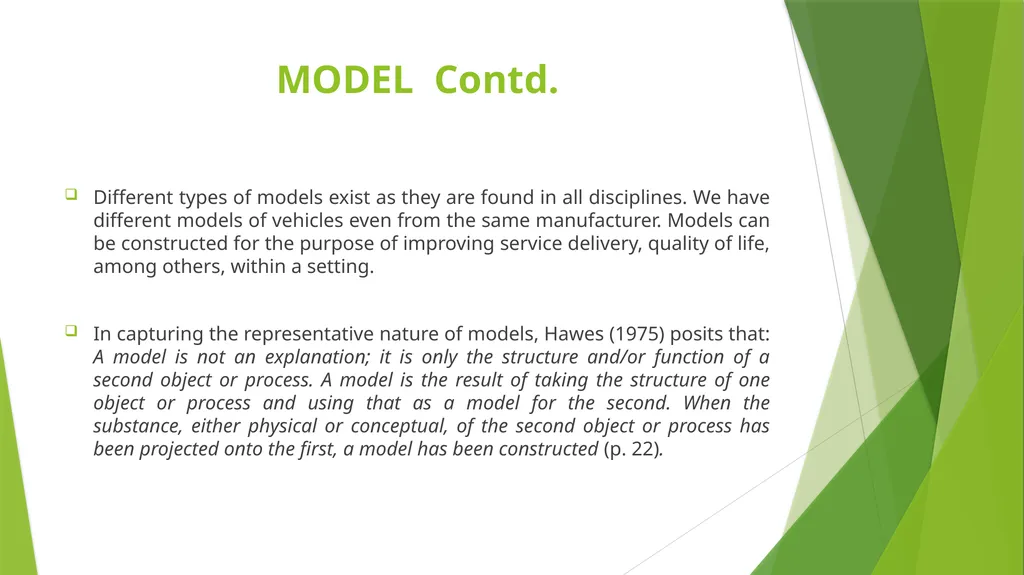
MODEL Contd. Different types of models exist as they are found in all disciplines. We have different models of vehicles even from the same manufacturer. Models can be constructed for the purpose of improving service delivery, quality of life, among others, within a setting.
In capturing the representative nature of models, Hawes (1975) posits that: A model is not an explanation; it is only the structure and/or function of a second object or process. A model is the result of taking the structure of one object or process and using that as a model for the second. When the substance, either physical or conceptual, of the second object or process has been projected onto the first, a model has been constructed (p. 22).<br>
In capturing the representative nature of models, Hawes (1975) posits that: A model is not an explanation; it is only the structure and/or function of a second object or process. A model is the result of taking the structure of one object or process and using that as a model for the second. When the substance, either physical or conceptual, of the second object or process has been projected onto the first, a model has been constructed (p. 22).<br>
36
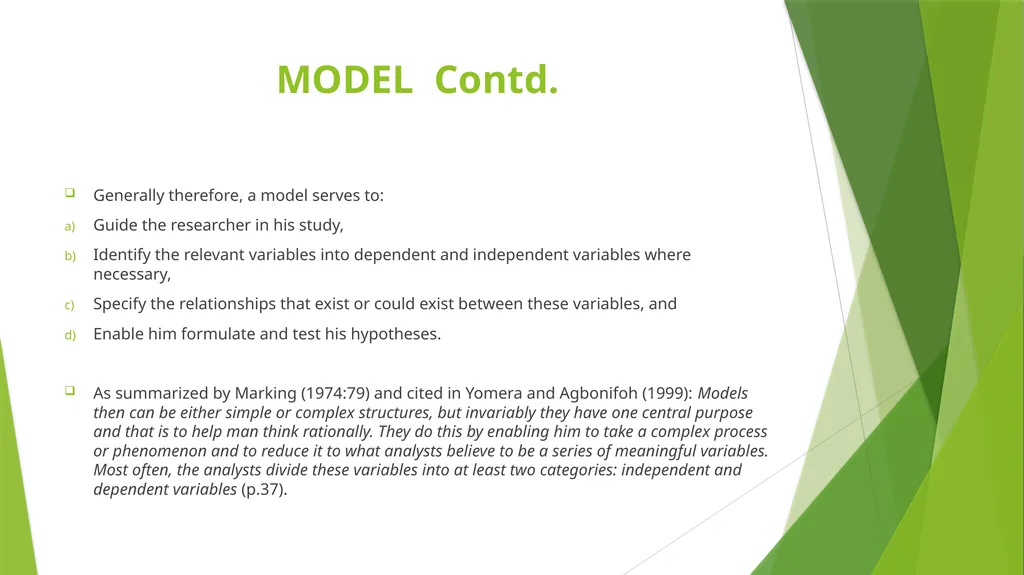
MODEL Contd. Generally therefore, a model serves to:
Guide the researcher in his study,
Identify the relevant variables into dependent and independent variables where necessary,
Specify the relationships that exist or could exist between these variables, and
Enable him formulate and test his hypotheses.
As summarized by Marking (1974:79) and cited in Yomera and Agbonifoh (1999): Models then can be either simple or complex structures, but invariably they have one central purpose and that is to help man think rationally. They do this by enabling him to take a complex process or phenomenon and to reduce it to what analysts believe to be a series of meaningful variables. Most often, the analysts divide these variables into at least two categories: independent and dependent variables (p.37).<br>
Guide the researcher in his study,
Identify the relevant variables into dependent and independent variables where necessary,
Specify the relationships that exist or could exist between these variables, and
Enable him formulate and test his hypotheses.
As summarized by Marking (1974:79) and cited in Yomera and Agbonifoh (1999): Models then can be either simple or complex structures, but invariably they have one central purpose and that is to help man think rationally. They do this by enabling him to take a complex process or phenomenon and to reduce it to what analysts believe to be a series of meaningful variables. Most often, the analysts divide these variables into at least two categories: independent and dependent variables (p.37).<br>
37
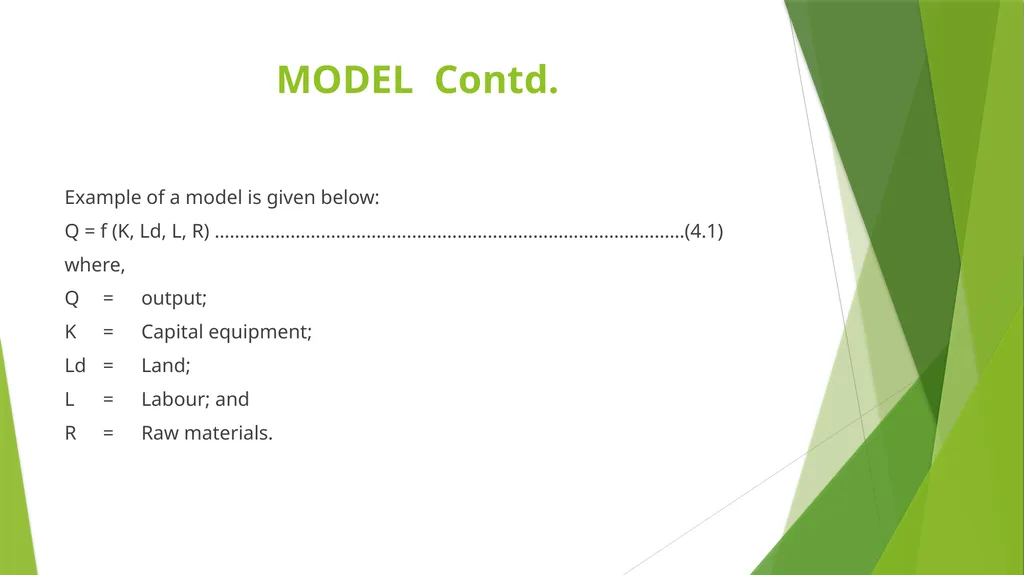
MODEL Contd. Example of a model is given below:
Q = f (K, Ld, L, R) …………………………………………………………………………………(4.1)
where,
Q = output;
K = Capital equipment;
Ld = Land;
L = Labour; and
R = Raw materials.<br>
Q = f (K, Ld, L, R) …………………………………………………………………………………(4.1)
where,
Q = output;
K = Capital equipment;
Ld = Land;
L = Labour; and
R = Raw materials.<br>
38
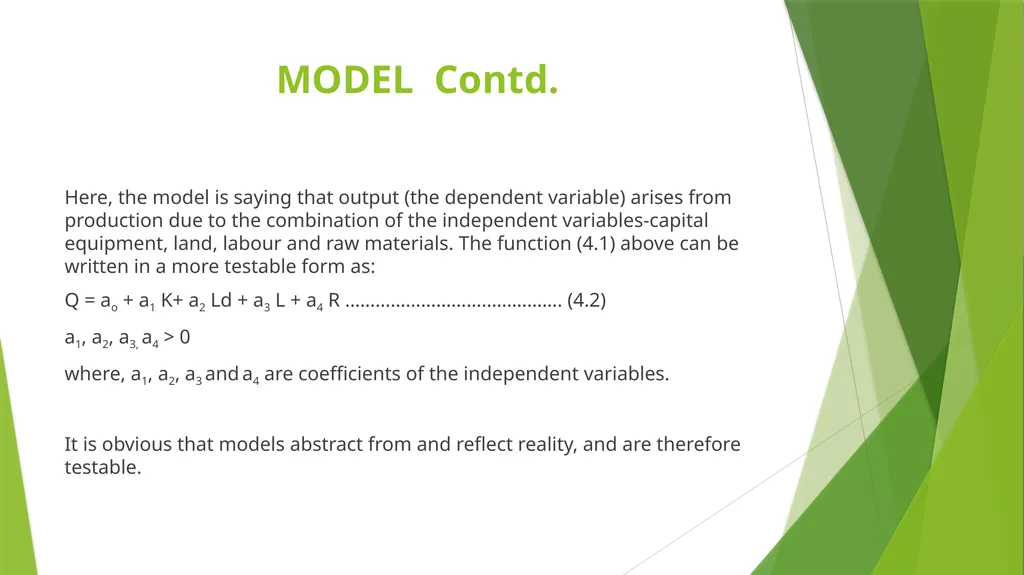
MODEL Contd. Here, the model is saying that output (the dependent variable) arises from production due to the combination of the independent variables-capital equipment, land, labour and raw materials. The function (4.1) above can be written in a more testable form as:
Q = ao + a1 K+ a2 Ld + a3 L + a4 R ……………………………………. (4.2)
a1, a2, a3, a4 > 0
where, a1, a2, a3 and a4 are coefficients of the independent variables.
It is obvious that models abstract from and reflect reality, and are therefore testable.<br>
Q = ao + a1 K+ a2 Ld + a3 L + a4 R ……………………………………. (4.2)
a1, a2, a3, a4 > 0
where, a1, a2, a3 and a4 are coefficients of the independent variables.
It is obvious that models abstract from and reflect reality, and are therefore testable.<br>
39
TYPES OF MODELS There are various types of models as we said earlier. They abound in all fields of human endeavour. Hawes (1975) presents three types of models arising from their functionality. They are:
Descriptive Models: These are those models that describe how some elements behave in a system especially in situations where there are no existing associated theories or the existing theories are simply inadequate.
Explicative Models: These are those models that provide explanations leading to better understanding of the concepts in relevant well-developed theories or on the application of these theories
Simulation Models: These are models that provide clarifications on the structural and process relationships existing between concepts in a theory.<br>
Descriptive Models: These are those models that describe how some elements behave in a system especially in situations where there are no existing associated theories or the existing theories are simply inadequate.
Explicative Models: These are those models that provide explanations leading to better understanding of the concepts in relevant well-developed theories or on the application of these theories
Simulation Models: These are models that provide clarifications on the structural and process relationships existing between concepts in a theory.<br>
40
QUANTITATIVE MODELS These are models related to quantitative types of research. They are models that can make or make use of data that are of numeric form. Illustrative examples of quantitative models is he Simple Linear Regression Function
This is the simplest form of a quantitative model. It is often a two-variable model in which there is a dependant variable and an independent variable. Example is –
Y = f (X) ………………… (4.1)
Where y is the dependent variable, and
X = the independent variable.<br>
This is the simplest form of a quantitative model. It is often a two-variable model in which there is a dependant variable and an independent variable. Example is –
Y = f (X) ………………… (4.1)
Where y is the dependent variable, and
X = the independent variable.<br>
41
QUALITATIVE MODELS These are models associated with qualitative research. They are often dealing with why certain actions or outcomes occur. In this respect, they are descriptive in analysis focusing more on perceptions and opinions. Nevertheless, such information could be converted into numerical for quantitative analysis.
Qualitative models or qualitative response models are such in which the regression, dependent or response variable is of qualitative nature. It could be continuous but not fully observable because it is dichotomous. It exists in such a way that it takes more than one value. Its range of values is constrained and may not be fully observable.
Qualitative models often have the outcomes or response variable being of a product of selective choice, hence its value may be a yes or no decision with yes having a value of for example, 1, and no, a value of for example, zero. In this case, the regression is binary.<br>
Qualitative models or qualitative response models are such in which the regression, dependent or response variable is of qualitative nature. It could be continuous but not fully observable because it is dichotomous. It exists in such a way that it takes more than one value. Its range of values is constrained and may not be fully observable.
Qualitative models often have the outcomes or response variable being of a product of selective choice, hence its value may be a yes or no decision with yes having a value of for example, 1, and no, a value of for example, zero. In this case, the regression is binary.<br>
42
QUALITATIVE MODELS Contd. Models of qualitative nature are expected to satisfy certain conditions which include:
The dependent variables must have a range of values or classifications which a choice has to be made.
The value of the classifications or choices must be finite.
The set of choices must be independent of each other (mutually exclusive).
Only one choice must be made at a time.
The choice made represents the dependent or response variable or regression.
The dependent variable is therefore a discrete variable representing this choice category that it incorporates.
They must satisfy the explanatory adequacy including their estimates which would have to be accurate.
Set of choices or classifications should be presented in such a way that they are collectively exhaustive.<br>
The dependent variables must have a range of values or classifications which a choice has to be made.
The value of the classifications or choices must be finite.
The set of choices must be independent of each other (mutually exclusive).
Only one choice must be made at a time.
The choice made represents the dependent or response variable or regression.
The dependent variable is therefore a discrete variable representing this choice category that it incorporates.
They must satisfy the explanatory adequacy including their estimates which would have to be accurate.
Set of choices or classifications should be presented in such a way that they are collectively exhaustive.<br>
43
THEORY A theory has been looked at from different perspectives. Some have seen it as:
Unsubstantiated ideas.
A mystique.
Confirmed postulates.
It has also been defined as “a set of interrelated concepts, definitions, and propositions that presents a systematic view of some phenomena” (Kerlinger, 1973).<br>
Unsubstantiated ideas.
A mystique.
Confirmed postulates.
It has also been defined as “a set of interrelated concepts, definitions, and propositions that presents a systematic view of some phenomena” (Kerlinger, 1973).<br>
44
Theory Contd. Generally, for sets of ideas to satisfy theoretical acceptability, they must conform to the following:
They must be logically consistent: There should be no discernible internal contradictions.
They must be interrelated: There should be no statements about phenomena unrelated to another.
The statement should be exhaustive: They should cover the full range of variations about the nature of the phenomena in question.
The propositions should be mutually exclusive: There should be no repetition or duplication.
They must be capable of being subjected to empirical scrutiny : They should be amenable to be tested through research. This is the only way to determine their scientific worth.<br>
They must be logically consistent: There should be no discernible internal contradictions.
They must be interrelated: There should be no statements about phenomena unrelated to another.
The statement should be exhaustive: They should cover the full range of variations about the nature of the phenomena in question.
The propositions should be mutually exclusive: There should be no repetition or duplication.
They must be capable of being subjected to empirical scrutiny : They should be amenable to be tested through research. This is the only way to determine their scientific worth.<br>
45
THE SCIENTIFIC METHOD OF RESEARCH The scientific method includes the following:
Problem identification
Problem definition
Concept formation
Induction
Conduct of the empirical study
Deductions<br>
Problem identification
Problem definition
Concept formation
Induction
Conduct of the empirical study
Deductions<br>
46
FEATURES OF SCIENTIFIC RESEARCH/ACTIVITY There are several characteristics which when taken together constitute the key elements of any scientific activity. These qualify any research to be regarded as scientific:
Such an activity must be empirical
It must be theoretically based
It must be cumulative
It must be non-ethical<br>
Such an activity must be empirical
It must be theoretically based
It must be cumulative
It must be non-ethical<br>
47
CLASSIFICATIONS OF RESEARCH BY PURPOSE PURE OR BASIC RESEARCH
This is the type of research aimed at inquiring further into existing theories with a view to analyzing, expanding or even refuting them at the conceptualization (non-practical) level. It is, therefore, directed at the development of theories and in so doing, extends the frontiers of knowledge. An example of basic research is “An Examination of Production Theory.”
APPLIED RESEARCH
This is the opposite of pure or theoretical research and involves the application of theory to relevant situations or phenomena. Thus, this kind of study is empirical as data are used to substantiate a certain position or invalidate that position or to validate or invalidate a theory. The relevance of applied research is that it is directed at solving problems of practical significance. It must therefore, come up with solutions to relevant problems. Examples of applied research are:
A Study of Employee Motivation in XYZ (Nig) Plc.
Impact of Monetary and Fiscal Policies on the Nigerian Economy, 2010 – 2025.
Marketing of Credit Products and Customer Patronage in the Nigerian Banking Industry: The Case of First Bank of Nigeria Plc.<br>
This is the type of research aimed at inquiring further into existing theories with a view to analyzing, expanding or even refuting them at the conceptualization (non-practical) level. It is, therefore, directed at the development of theories and in so doing, extends the frontiers of knowledge. An example of basic research is “An Examination of Production Theory.”
APPLIED RESEARCH
This is the opposite of pure or theoretical research and involves the application of theory to relevant situations or phenomena. Thus, this kind of study is empirical as data are used to substantiate a certain position or invalidate that position or to validate or invalidate a theory. The relevance of applied research is that it is directed at solving problems of practical significance. It must therefore, come up with solutions to relevant problems. Examples of applied research are:
A Study of Employee Motivation in XYZ (Nig) Plc.
Impact of Monetary and Fiscal Policies on the Nigerian Economy, 2010 – 2025.
Marketing of Credit Products and Customer Patronage in the Nigerian Banking Industry: The Case of First Bank of Nigeria Plc.<br>
48
CLASSIFICATIONS OF RESEARCH APPROACH DESCRIPTIVE RESEARCH
Studies of the nature of descriptive research aim mainly at collecting information that reveal the characteristics or features of an existing phenomenon. In the opinion of Cohen and Manion (1980), these studies are concerned with: Conditions that exist, practices that prevail, beliefs, points of view, or attitudes that are developing. At times, descriptive research is concerned with how what is or what exists, is related to some preceding event that has influenced or affected a present condition or event (p. 48).
Thus, descriptive research generally aims at the following:
Identify current or existing problems;
Collect information or data with a view to describing existing conditions, characteristics or phenomena;
Make comparative analysis of these features or characteristics, as relevant; and
Provide good insights into circumstances surrounding the issues under study and enough guide (through information gathered) for decision making or for further investigation.<br>
Studies of the nature of descriptive research aim mainly at collecting information that reveal the characteristics or features of an existing phenomenon. In the opinion of Cohen and Manion (1980), these studies are concerned with: Conditions that exist, practices that prevail, beliefs, points of view, or attitudes that are developing. At times, descriptive research is concerned with how what is or what exists, is related to some preceding event that has influenced or affected a present condition or event (p. 48).
Thus, descriptive research generally aims at the following:
Identify current or existing problems;
Collect information or data with a view to describing existing conditions, characteristics or phenomena;
Make comparative analysis of these features or characteristics, as relevant; and
Provide good insights into circumstances surrounding the issues under study and enough guide (through information gathered) for decision making or for further investigation.<br>
49
CLASSIFICATIONS OF RESEARCH APPROACH Contd. Data, under this type of research, are usually gathered through any of the following methods:
Questionnaires: Standardized or open-ended or both inclusive.
Interviews: Direct (one on one) or through the mail system or by telephony or the internet (information communications technology).
Direct Observation.
Examples of descriptive research include:
Studies that seek to ascertain perceptions of respondents on some relevant variables (e.g. perceptions of workers on management style/strategy; perceptions of customers on the corporate image of the relevant organization; etc).
Studies into current management styles, marketing strategies, motivational variables in place in organizations; etc.
Studies assessing the quality of goods and services offered by some specialized organizations.<br>
Questionnaires: Standardized or open-ended or both inclusive.
Interviews: Direct (one on one) or through the mail system or by telephony or the internet (information communications technology).
Direct Observation.
Examples of descriptive research include:
Studies that seek to ascertain perceptions of respondents on some relevant variables (e.g. perceptions of workers on management style/strategy; perceptions of customers on the corporate image of the relevant organization; etc).
Studies into current management styles, marketing strategies, motivational variables in place in organizations; etc.
Studies assessing the quality of goods and services offered by some specialized organizations.<br>
50
HISTORICAL RESEARCH As the name implies, this involves studying facts and variables relating to past events with a view to arriving at some relevant judgments. It will include the collation of past data. Thus, a historical research will provide relevant answers to the following:
What were the things that happened in the relevant period?
How did these things occur, in what dimensions, etc?
What were the causal factors (remote and immediate)?
What were the specific effects of each factor?
What relevant lessons could be drawn in view of current events or how relevant has the study been in comprehending current issues?<br>
What were the things that happened in the relevant period?
How did these things occur, in what dimensions, etc?
What were the causal factors (remote and immediate)?
What were the specific effects of each factor?
What relevant lessons could be drawn in view of current events or how relevant has the study been in comprehending current issues?<br>
51
HISTORICAL RESEARCH Contd. There are two main sources of data in historical research:
Primary Sources: These directly relate to the problem under investigation. They include eye witness accounts got by interviewing respondents or through the administration of questionnaires on them; and material data from original documents.
Secondary Sources: These are those sources that cannot pass as original sources and include written materials either as in textbooks, encyclopedias, quoted briefs, paintings and artworks, etc.<br>
Primary Sources: These directly relate to the problem under investigation. They include eye witness accounts got by interviewing respondents or through the administration of questionnaires on them; and material data from original documents.
Secondary Sources: These are those sources that cannot pass as original sources and include written materials either as in textbooks, encyclopedias, quoted briefs, paintings and artworks, etc.<br>
52
EXPLORATORY RESEARCH This is research aimed at providing preliminary information/analysis that will give insights into the main things (factors or variables) to look for in the next aspect or phase of the research which should be more detailed. The second stage of research may seek to validate statistically or otherwise, the preliminary findings. Selltiz, et al.(1976) see the aim of exploratory research as being: To gain familiarity with a phenomenon or to achieve new insights into it in order to formulate a more precise research problem or to develop hypothesis (p. 90).
An example of exploratory research is a two-stage research into the corporate image of an organisation from the standpoint of customer perception of its services. The first is a qualitative study while the second aspect of the exercise is the quantitative study. The first part, therefore, is the exploratory research that will provide the initial information which may be probed into, validated or invalidated using statistical data during the quantitative phase.<br>
An example of exploratory research is a two-stage research into the corporate image of an organisation from the standpoint of customer perception of its services. The first is a qualitative study while the second aspect of the exercise is the quantitative study. The first part, therefore, is the exploratory research that will provide the initial information which may be probed into, validated or invalidated using statistical data during the quantitative phase.<br>
53
ANALYTICAL RESEARCH This is the research in which all manners of tools (mathematical, econometric, statistical, etc) are employed in the appraisal of data with the aim of establishing relationships. Sax (1979) sees analytical research as involving “mathematical, linguistic, historical, and philosophical analysis as well as any deductive system that can be used to derive relationships not necessarily of an empirical nature” (p.17).
Most studies could be classified as analytical. An example is when we try to establish the extent of relationship between the changing prices of a commodity and the relevant volumes of sales, or between wages and employment in an organisation or the public sector, etc.<br>
Most studies could be classified as analytical. An example is when we try to establish the extent of relationship between the changing prices of a commodity and the relevant volumes of sales, or between wages and employment in an organisation or the public sector, etc.<br>
54
RESEARCH CLASSIFIED ON BASIS OF METHODOLOGY Experimental Research
This is research in which the researcher can deliberately manipulate the conditions that impact on or determine the results, event or phenomenon of his or her interest. Two sets of variables are normally involved – the dependent and the independent. Conditions are set to ensure variables are unhindered in their behavior.
The independent variables are normally manipulated such that changes or variations in them will affect or cause variations in the dependent variable. The whole experimental research involves observations of these changes subject to the set conditions by way of control hence laboratory experiments as in Physics, Chemistry, Engineering, etc present classic examples. These are pure scientific researches. Cohen and Manion (1980) have posited that: The fundamental purpose of experimental design is to impose control over conditions that would otherwise cloud the true effects of the independent variable upon the dependent variable (p.164).<br>
This is research in which the researcher can deliberately manipulate the conditions that impact on or determine the results, event or phenomenon of his or her interest. Two sets of variables are normally involved – the dependent and the independent. Conditions are set to ensure variables are unhindered in their behavior.
The independent variables are normally manipulated such that changes or variations in them will affect or cause variations in the dependent variable. The whole experimental research involves observations of these changes subject to the set conditions by way of control hence laboratory experiments as in Physics, Chemistry, Engineering, etc present classic examples. These are pure scientific researches. Cohen and Manion (1980) have posited that: The fundamental purpose of experimental design is to impose control over conditions that would otherwise cloud the true effects of the independent variable upon the dependent variable (p.164).<br>
55
EX POST FACTO RESEARCH This is research which aims at determining or establishing or measuring the relationship between one variable and another or the impact of one variable on another, in which the variables involved are not manipulated by the researcher. This is unlike what obtains under experimental research in which the researcher can manipulate the variables as he so desires in pursuit of his objectives.
The term “ex post-facto” is Latin and means “after the fact”, i.e. after the event. The implication here is that the variables in ex post-facto research are those the researcher cannot influence or change in the course of the exercise. In business, economic and social research; such variables as age of individuals or respondents, education, personality, size of business, employment, profit figures (Profit Before and After Tax), gender, marital status, religious affiliation, business location, quantity of goods sold, etc are accepted by the researcher as given as he cannot manipulate them.<br>
The term “ex post-facto” is Latin and means “after the fact”, i.e. after the event. The implication here is that the variables in ex post-facto research are those the researcher cannot influence or change in the course of the exercise. In business, economic and social research; such variables as age of individuals or respondents, education, personality, size of business, employment, profit figures (Profit Before and After Tax), gender, marital status, religious affiliation, business location, quantity of goods sold, etc are accepted by the researcher as given as he cannot manipulate them.<br>
56
SURVEY RESEARCH Till and Albaum (1973) define survey as “the systematic gathering of information from respondents for the purpose of understanding and/or predicting some aspects of the behaviour of the population of interest” (p.3). From this definition, we can make a lot of instructive deductions:
Survey research is descriptive.
It involves data gathering which can be done through primary sources (questionnaire, interviews, etc.) or secondary sources (books, professional journals, publications of research institutes, etc.)
It involves analysis and forecasting or projecting into the future.
A particular population is involved. This population may just be a sample in which case we can talk of sample survey. On the other hand, it could involve the whole population and would be referred to as census survey.<br>
Survey research is descriptive.
It involves data gathering which can be done through primary sources (questionnaire, interviews, etc.) or secondary sources (books, professional journals, publications of research institutes, etc.)
It involves analysis and forecasting or projecting into the future.
A particular population is involved. This population may just be a sample in which case we can talk of sample survey. On the other hand, it could involve the whole population and would be referred to as census survey.<br>
57
EX POST FACTO RESEARCH Contd. Generally, there are two main types of survey:
The Cross-Sectional Survey: This involves investigating the state of affairs of the phenomenon or phenomena at a point in time. Example is, Study of the corporate image of some business organisations at a given point in time. Cross-Sectional surveys are common in business.
The Longitudinal Survey: This involves gathering information on phenomena occurring at different time periods. Hence, there is no attempt on the part of the researcher to influence the phenomenon or phenomena. Data obtained reveal the nature of phenomena at the different periods, showing changes if any. Study will reveal the direction and magnitude of changes occurring in the relevant variables during the relevant periods and Data from longitudinal surveys are very relevant in analyses involving the use of some statistical tools such as correlation and regression.<br>
The Cross-Sectional Survey: This involves investigating the state of affairs of the phenomenon or phenomena at a point in time. Example is, Study of the corporate image of some business organisations at a given point in time. Cross-Sectional surveys are common in business.
The Longitudinal Survey: This involves gathering information on phenomena occurring at different time periods. Hence, there is no attempt on the part of the researcher to influence the phenomenon or phenomena. Data obtained reveal the nature of phenomena at the different periods, showing changes if any. Study will reveal the direction and magnitude of changes occurring in the relevant variables during the relevant periods and Data from longitudinal surveys are very relevant in analyses involving the use of some statistical tools such as correlation and regression.<br>
58
CASE STUDIES As the name implies, these are studies aimed at exploring or investigating specific areas of phenomena with a view to gaining more insight into the particular problem under investigation, depending also on the objectives of such exercises. In a case study, there is an in-depth understanding and analysis of phenomena. Recommendations or suggestions are tailored towards the particular case or cases. Students especially those in business and behavioural areas commonly choose the case study approach in their project works. Examples of case studies are:
Employee Motivation and the Performance of the Manufacturing Industry in Nigeria: The Case of United African Company (Nig.) Plc.
Manpower Development and Performance of Commercial Banks: A Case Study of First Bank of Nigeria Plc.
Auditing of Corporation Accounts in Nigeria and Its Implications for Performance: A Case Study of the Nigerian Railways.
Managing Tertiary Education for Quality Graduate Output in Nigeria: The Case of Federal Universities.
Corporate Image Management for Organizational Performance: A Case Study of Nigerian Breweries Plc.<br>
Employee Motivation and the Performance of the Manufacturing Industry in Nigeria: The Case of United African Company (Nig.) Plc.
Manpower Development and Performance of Commercial Banks: A Case Study of First Bank of Nigeria Plc.
Auditing of Corporation Accounts in Nigeria and Its Implications for Performance: A Case Study of the Nigerian Railways.
Managing Tertiary Education for Quality Graduate Output in Nigeria: The Case of Federal Universities.
Corporate Image Management for Organizational Performance: A Case Study of Nigerian Breweries Plc.<br>
59
ECONOMETRIC RESEARCH Econometric research is a particular case of applied research which has to do with measuring parameters of economic relationships and making where necessary, forecasts or predictions of values of such relevant variables. The relationships in question are those in which certain variables are identified as causal variables (independent variables). The starting point in econometric research is theory.<br>
60
CLASSIFICATIONS OF RESEARCH BY SETTING LABORATORY RESEARCH
This is research normally conducted in a controlled environment. The environment of the research is called a laboratory.
FIELD RESEARCH
Field researches should be monitored especially where there are interviews using questionnaires. This is to ensure that the interviews are actually conducted (through back-checking), and information or responses from respondents are not manipulated by the interviewers.
LIBRARY RESEARCH
This is research done mainly in the libraries. Information got are normally already processed and are published data. Thus, library research is a secondary source of data collection.<br>
This is research normally conducted in a controlled environment. The environment of the research is called a laboratory.
FIELD RESEARCH
Field researches should be monitored especially where there are interviews using questionnaires. This is to ensure that the interviews are actually conducted (through back-checking), and information or responses from respondents are not manipulated by the interviewers.
LIBRARY RESEARCH
This is research done mainly in the libraries. Information got are normally already processed and are published data. Thus, library research is a secondary source of data collection.<br>
61
RESEARCH DESIGN A research design is a kind of blueprint that guides the researcher in his or her investigation and analysis. It is a format which the researcher employs in order to systematically apply the scientific method in the investigation of problems. As Nachimias and Nachimias (1985) observed, it is crafted to address problems of scientific inquiry. Kerlinger (1983) sees it from the perspective of aiming to provide answers to research questions and controlling variances. Luck and Rubin (1989), apart from describing it as only stating the essential elements of a research study by providing the basic guidelines (master plan) for details of the exercise, have gone further to identify the main components as:
Statement of objectives,
Statement of inputs, and
Method of data analysis.<br>
Statement of objectives,
Statement of inputs, and
Method of data analysis.<br>
62
Research Design Contd. Generally, a research design provides some or all of the following:
Defining the direction of the research,
Stating or identifying the main variables of the study,
Defining the population and size of the sample,
Deciding the nature and sources of data,
Defining the appropriate data source instruments,
Defining the techniques of analysis, and
Stating the overall type of study (whether it is an econometric study or a historical study, etc or whether it is a combination of various relevant methods).<br>
Defining the direction of the research,
Stating or identifying the main variables of the study,
Defining the population and size of the sample,
Deciding the nature and sources of data,
Defining the appropriate data source instruments,
Defining the techniques of analysis, and
Stating the overall type of study (whether it is an econometric study or a historical study, etc or whether it is a combination of various relevant methods).<br>
63
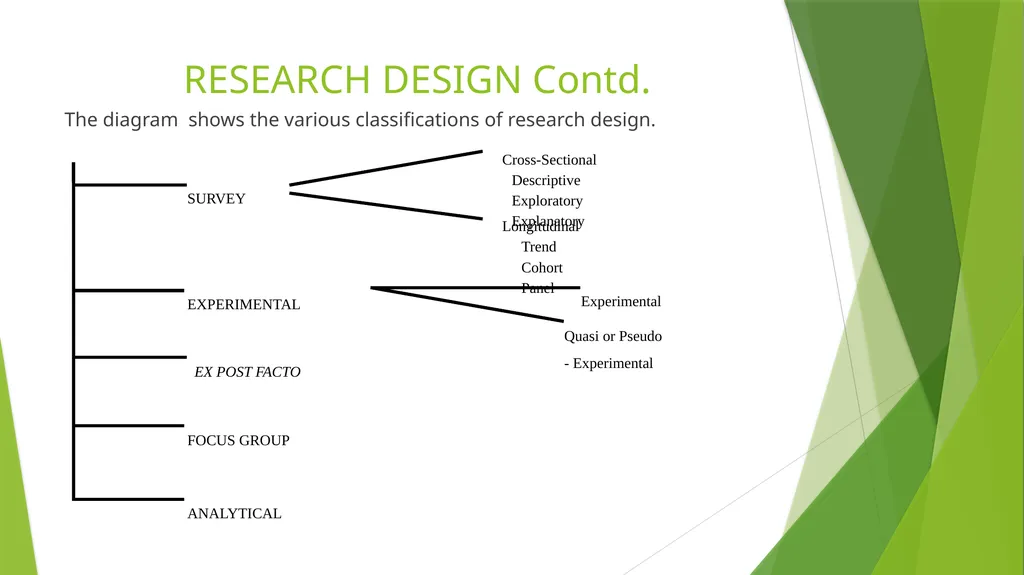
RESEARCH DESIGN Contd. The diagram shows the various classifications of research design.<br>
64
SURVEY DESIGN Survey design is one in which the researcher does not aim to control, i.e. manipulate or control any of the variables under investigation. His main predisposition is to observe occurrences at a point in time. In this case, the study is cross sectional whereas when observations are done at different points in time, it is longitudinal.<br>
65
TYPES OF SURVEY DESIGN CROSS SECTIONAL SURVEY DESIGN
A cross sectional survey design can take any of the following forms:
Descriptive; where it is concerned with the observation of independent and non-manipulative variables all at once (a one-time situation).
Exploratory and Explanatory; where it goes beyond describing to explaining. They are similar to descriptive designs but only differ in the area of application. The important thing to note about these variants of cross-sectional design is that they all involve one-time observations though the number of variables under study could be as many as desired.<br>
A cross sectional survey design can take any of the following forms:
Descriptive; where it is concerned with the observation of independent and non-manipulative variables all at once (a one-time situation).
Exploratory and Explanatory; where it goes beyond describing to explaining. They are similar to descriptive designs but only differ in the area of application. The important thing to note about these variants of cross-sectional design is that they all involve one-time observations though the number of variables under study could be as many as desired.<br>
66
SURVEY DESIGN Contd. LONGITUDINAL SURVEY DESIGN
Longitudinal survey design differs from cross-sectional designs in the sense that time, here, varies though it is not the variable or among the variables under investigation. The variables, thus, change in weight (or value) or in any other form over time. Forms of longitudinal design include:
Trend
Cohort and
Panel.<br>
Longitudinal survey design differs from cross-sectional designs in the sense that time, here, varies though it is not the variable or among the variables under investigation. The variables, thus, change in weight (or value) or in any other form over time. Forms of longitudinal design include:
Trend
Cohort and
Panel.<br>
67
SURVEY DESIGN Contd. Under the Trend Design, the focus is on one or more independent variables which can be observed over a period of time. Data collected can be used in plotting a trend.
Cohort, though similar to tend, differs in terms of sampling procedure. Here, a cohort or specific group out of a population is targeted, from which (group) different samples are drawn and analyzed over the years.
Panel Design: This involves doing at different points in time, same measurement from same sample.<br>
Cohort, though similar to tend, differs in terms of sampling procedure. Here, a cohort or specific group out of a population is targeted, from which (group) different samples are drawn and analyzed over the years.
Panel Design: This involves doing at different points in time, same measurement from same sample.<br>
68
EXPERIMENTAL DESIGN This is an aspect of the scientific research method; hence it adopts the scientific procedure of investigation. These are designs that involve control groups. These groups serve the prupose of enabling the researcher to isolate causal relationships and determine experimentally the extent of cause-effect relationships that exist among them.
There are two main types of experimental design:
Pure experimental designs, which have control groups, and
Pseudo or quasi experimental designs, which do not make use of control groups.<br>
There are two main types of experimental design:
Pure experimental designs, which have control groups, and
Pseudo or quasi experimental designs, which do not make use of control groups.<br>
69
EX POST FACTO RESEARCH DESIGN This is the type of research involving events that have already taken place. Data already exist as no attempt is made to control or manipulate relevant independent variables apparently because these variables are not manipulatable. It is of note that with the ex- post facto research design, the researcher is more into data gathering.<br>
70
FOCUS GROUP DESIGN This type of design involves the composition of a group or sample derived from the population most often for the purpose of conducting an exploratory research prior to the well expanded quantitative phase. Composition of the sample is based on certain specific criteria.
A moderator would interact with the group and lead discussions around the subject area of interest. He makes sure that the respondents discuss freely, expressing their views individually and collectively. Information gathered could be validated or otherwise during the second phase (which is the quantitative phase).<br>
A moderator would interact with the group and lead discussions around the subject area of interest. He makes sure that the respondents discuss freely, expressing their views individually and collectively. Information gathered could be validated or otherwise during the second phase (which is the quantitative phase).<br>
71
SAMPLE AND SAMPLING DESIGNS A sample is normally derived or extracted from a population. A population comprises all elements, subjects and perhaps observations in relation to a particular phenomenon.
A population, therefore, represents a universe of elements with similar characteristics hence it is a census of all relevant elements and may be finite or infinite.
A sample is thus, a group of variables or items derived from a relevant population for the purpose of examination or analysis<br>
A population, therefore, represents a universe of elements with similar characteristics hence it is a census of all relevant elements and may be finite or infinite.
A sample is thus, a group of variables or items derived from a relevant population for the purpose of examination or analysis<br>
72
why do we sample? There may be difficulty of coverage in studying the entire population either due to the pattern of distribution of that population, size or cost, amongst others.
As a result of similar features of the elements making up a population, sufficient knowledge of the entire population can be got from studying a few of the elements.
It is cheaper in terms of cost to deal with a fraction of the population. More thorough study and detailed analysis are done using a sample than when dealing with the entire population.
Deadlines are easier met when a sample is involved as results come out quicker.
A lot of time that would have been entailed when studying an entire population is avoided.<br>
As a result of similar features of the elements making up a population, sufficient knowledge of the entire population can be got from studying a few of the elements.
It is cheaper in terms of cost to deal with a fraction of the population. More thorough study and detailed analysis are done using a sample than when dealing with the entire population.
Deadlines are easier met when a sample is involved as results come out quicker.
A lot of time that would have been entailed when studying an entire population is avoided.<br>
73
Qualities of a good sample It must be a good representation of the population.
It must be well focused.
It must be such that random errors or fluctuations are avoided in the exercise.
Bias must have been avoided in its derivation.<br>
It must be well focused.
It must be such that random errors or fluctuations are avoided in the exercise.
Bias must have been avoided in its derivation.<br>
74
SAMPLING METHODS OR DESIGNS There are many methods or types of sampling and these can be classified into two main types:
Probability or Random Sampling Methods, and
Non-Probability or Non-Random Sampling Methods.<br>
Probability or Random Sampling Methods, and
Non-Probability or Non-Random Sampling Methods.<br>
75
PROBABILITY SAMPLING METHODS OR DESIGNS Probability sampling methods include:
Sample Random Sampling,
Stratified Sampling,
Systematic Sampling, and
Area or Cluster Sampling.<br>
Sample Random Sampling,
Stratified Sampling,
Systematic Sampling, and
Area or Cluster Sampling.<br>
76
SIMPLE RANDOM SAMPLING This is a sampling method that gives every unit or element in the population a chance of being selected. In fact, every element has equal chance of being selected. In other words, every element has the same probability of being included in the sample. For instance, if the population is 1000, each element theoretically has 1/1000th chance of being selected.<br>
77
Advantages of Simple Random Sampling It gives every element in the population an equal and independent chance of being selected. The implication of this, at least, on theoretical grounds, is that a sample so obtained is a representative one.
The method can be used in conjunction with any of the other probability sampling techniques. It often serves as a kind of foundation on which other methods can be applied.
It has always been the simplest probability sampling method and the easiest to understand.
It might often not be necessary for the researcher to even know ab initio the actual composition of the population. The sample randomly selected will theoretically reflect all its important segments.
It is easy to calculate sampling errors that may arise when any given sample is being drawn. Sampling errors show the extent or degree to which an estimated sample of the population fails to reflect the true population values.
Classification errors are avoided since the researcher needs not be thoroughly familiar with the population features. Classification errors are those that emanate from improper classification of parameters or features of the population.<br>
The method can be used in conjunction with any of the other probability sampling techniques. It often serves as a kind of foundation on which other methods can be applied.
It has always been the simplest probability sampling method and the easiest to understand.
It might often not be necessary for the researcher to even know ab initio the actual composition of the population. The sample randomly selected will theoretically reflect all its important segments.
It is easy to calculate sampling errors that may arise when any given sample is being drawn. Sampling errors show the extent or degree to which an estimated sample of the population fails to reflect the true population values.
Classification errors are avoided since the researcher needs not be thoroughly familiar with the population features. Classification errors are those that emanate from improper classification of parameters or features of the population.<br>
78
Disadvantages of Simple Random Sampling The researcher's knowledge of the population may not be fully exploited (or explored).
The method cannot provide adequate guarantee that certain elements existing perhaps in small numbers in the population have been included in the sample.
There are possibilities of greater errors in simple random samples of "N" size when compared with sample of equal size obtained using the stratified sampling technique.<br>
The method cannot provide adequate guarantee that certain elements existing perhaps in small numbers in the population have been included in the sample.
There are possibilities of greater errors in simple random samples of "N" size when compared with sample of equal size obtained using the stratified sampling technique.<br>
79
STRATIFIED RANDOM SAMPLING This method involves division of the population into classes or groups with each group or stratum having some definite (similar) characteristics or features. Effort is then made to ensure that each group is represented in the sample. Thus, after breaking the population into groups, sample from each group is got by employing the simple random sampling rule.
If a researcher, for example, is interested in assessing the extent of job satisfaction among employees in a certain bank or in a certain manufacturing concern, employees of the organization can be categorized into the following:
Management Staff,
Senior Staff, and
Junior Staff.<br>
If a researcher, for example, is interested in assessing the extent of job satisfaction among employees in a certain bank or in a certain manufacturing concern, employees of the organization can be categorized into the following:
Management Staff,
Senior Staff, and
Junior Staff.<br>
80
Advantages of Proportionate Stratified Random Sampling This method enhances the representativeness of the sample in relation to the problem.
It also leads to a sample that produces a better estimate of the true population characteristics especially when compared with results from random sampling method.
There is great efficiency using this method which is a function of decreasing the sampling. Results emanating from this method are more efficient than those from simple random sampling.
Equally, the need to weight the elements according to their original distribution is eliminated.<br>
It also leads to a sample that produces a better estimate of the true population characteristics especially when compared with results from random sampling method.
There is great efficiency using this method which is a function of decreasing the sampling. Results emanating from this method are more efficient than those from simple random sampling.
Equally, the need to weight the elements according to their original distribution is eliminated.<br>
81
Disadvantages of Proportionate Stratified Random Sampling It is somehow difficult to carry out this exercise as the researcher is expected to have some knowledge of the composition of the population as well as its characteristics before applying the method.
More time is required in order to obtain elements from each of the several groups. However, the reduction of sampling errors compared with simple random sampling possibly offsets the additional time taken to obtain proportional samples.
It has to be noted that classification errors may likely occur especially in a situation where several classes or strata have to be identified. Classification errors are those occurring when trying to classify elements in a population with some being put into the wrong class or strata.<br>
More time is required in order to obtain elements from each of the several groups. However, the reduction of sampling errors compared with simple random sampling possibly offsets the additional time taken to obtain proportional samples.
It has to be noted that classification errors may likely occur especially in a situation where several classes or strata have to be identified. Classification errors are those occurring when trying to classify elements in a population with some being put into the wrong class or strata.<br>
82
DISPROPORTIONATE STRATIFIED RANDOM SAMPLING As earlier explained, this sampling technique requires giving misappropriate weights to different strata. An example is shown below:
High income group - 20%
Middle income group - 30%
Low income group - 50%<br>
High income group - 20%
Middle income group - 30%
Low income group - 50%<br>
83
Advantages of Disproportionate Stratified Random Sampling This approach, when compared with proportionate stratified random sampling, is less time-consuming as the researcher is not so concerned with the representativeness of the resulting sample.
Weighting is consistent with this sampling technique as the researcher is free to give greater weight to certain elements not frequently represented in the population especially when compared with other elements.<br>
Weighting is consistent with this sampling technique as the researcher is free to give greater weight to certain elements not frequently represented in the population especially when compared with other elements.<br>
84
Disadvantages of Disproportionate Stratified Random Sampling Some strata may enjoy heavier representation than others and this might introduce some kinds of error.
Good knowledge of the composition of the original population though necessary, might not be readily forthcoming.
Classification errors can always occur.<br>
Good knowledge of the composition of the original population though necessary, might not be readily forthcoming.
Classification errors can always occur.<br>
85
SYSTEMATIC SAMPLING This is a sampling method that involves the collection of elements by drawing the nth subject or items from serially listed population elements. The "n" is a number normally determined by dividing the population, N, by required sample.
Given a population of 9000 items and a sample of 1000 is to be obtained from it, the following: procedure should be adopted:
A serial numbering of the items up to 9000 should be done.
N, which 9000 is divided by 1000, i.e. N/n = 9000/1000 = 9
A random selection of the starting point of 9 on the population list is done.
Every 9th unit on the population is selected until 1000 units are got, i.e. 9th, 19th, 27th, 36th, ………………… etc on the population list.<br>
Given a population of 9000 items and a sample of 1000 is to be obtained from it, the following: procedure should be adopted:
A serial numbering of the items up to 9000 should be done.
N, which 9000 is divided by 1000, i.e. N/n = 9000/1000 = 9
A random selection of the starting point of 9 on the population list is done.
Every 9th unit on the population is selected until 1000 units are got, i.e. 9th, 19th, 27th, 36th, ………………… etc on the population list.<br>
86
Advantages of Systematic Sampling It is very easy to use especially when compared with the situation in simple random sampling where a table of random numbers is employed.
Mistakes in drawing elements are relatively inconsequential as it will not seriously affect sample. Example is, instead of drawing the 18th element, the 19th is drawn.
It is easier to cross examine whether every nth element has been included in the sample. Mistakes can be easily spotted.
It is a very quick way of obtaining a sample.<br>
Mistakes in drawing elements are relatively inconsequential as it will not seriously affect sample. Example is, instead of drawing the 18th element, the 19th is drawn.
It is easier to cross examine whether every nth element has been included in the sample. Mistakes can be easily spotted.
It is a very quick way of obtaining a sample.<br>
87
Disadvantages of Systematic Sampling It ignores elements that fall between very nth element chosen for the sample. Thus, every element does not stand the chance of being selected. The particular order in which the list of elements is arranged serves as a disadvantage as any form of rearrangement will introduce certain elements of bias.
Some researches have also shown that there is the possibility of some resulting biases arising from over representation of certain ethic groups when lists of individuals are alphabetized.
For some specific researches involving some specific objectives and research designs, the fact that each element does not enjoy the opportunity of having a chance of being selected, is a big minus.<br>
Some researches have also shown that there is the possibility of some resulting biases arising from over representation of certain ethic groups when lists of individuals are alphabetized.
For some specific researches involving some specific objectives and research designs, the fact that each element does not enjoy the opportunity of having a chance of being selected, is a big minus.<br>
88
AREA OR CLUSTER SAMPLING This is a sampling method that is usually used when populations are distributed in clusters or pockets of settlements with the clusters serving as the basis for obtaining the sample. The sample is then got using simple random sampling. The steps normally adopted here are:
Identification of the population to be sampled.
Identification of the salient features that will enhance representativeness; e.g. income groups, ethnic groups, etc.
Identify/locate the relevant areas where elements exhibiting the necessary features or characteristics cluster and know their respective subjects.
Use simple random selection technique to select sample units from each cluster. It is important that the number of elements got from each sample is proportional to the share of the cluster among the total share of the cluster among the total population.<br>
Identification of the population to be sampled.
Identification of the salient features that will enhance representativeness; e.g. income groups, ethnic groups, etc.
Identify/locate the relevant areas where elements exhibiting the necessary features or characteristics cluster and know their respective subjects.
Use simple random selection technique to select sample units from each cluster. It is important that the number of elements got from each sample is proportional to the share of the cluster among the total share of the cluster among the total population.<br>
89
Advantages of Area Sampling It is much easier to use especially in situations where large populations or large geographical areas are under study as the researcher does not need fore knowledge of the number or lists of individuals inhabiting the given area.
There is the possibility of readily substituting respondents within same sampling cluster as clusters rather than individuals as such are sampled.
The sampling exercise is faster under this technique once the clusters have been identified.
There is also the advantage of flexibility as different sampling methods can be employed at different stages in different cluster areas.<br>
There is the possibility of readily substituting respondents within same sampling cluster as clusters rather than individuals as such are sampled.
The sampling exercise is faster under this technique once the clusters have been identified.
There is also the advantage of flexibility as different sampling methods can be employed at different stages in different cluster areas.<br>
90
Disadvantages of Area Sampling There is little control for the researcher as to the size of each cluster. There is simply nothing he can do.
More sampling errors are experienced using this technique.
There is also difficulty of determining the independence of individuals included in a cluster relative to other clusters.<br>
More sampling errors are experienced using this technique.
There is also difficulty of determining the independence of individuals included in a cluster relative to other clusters.<br>
91
NON-PROBABILITY SAMPLING METHODS Non-probability sampling is a common name for all non-chance methods of selecting samples, and it includes:
Convenience/Accidental Sampling,
Quota Sampling,
Judgment Sampling, and
Panel Sampling.<br>
Convenience/Accidental Sampling,
Quota Sampling,
Judgment Sampling, and
Panel Sampling.<br>
92
OTHER SAMPLING METHODS MULTI-STAGE SAMPLING
This involves a complex situation where because of the need for precision and thoroughness, both the probability and non-probability methods would have to be applied in order to get the desired results.
DOUBLE SAMPLING
This process is used to ensure precision by enlarging the sample earlier got and doing a second exercise.<br>
This involves a complex situation where because of the need for precision and thoroughness, both the probability and non-probability methods would have to be applied in order to get the desired results.
DOUBLE SAMPLING
This process is used to ensure precision by enlarging the sample earlier got and doing a second exercise.<br>
93
SITUATIONS UNDER WHICH NON-PROBABILITY SAMPLING METHODS CAN BE APPLIED When the researcher is dealing with infinite population whose subjects are not easy to reach.
Situation where probability sampling methods might not provide the needed sample which will include typical subjects, e.g. when sampling to get sample of drug users.
Where data are non-parametric: Gathering such data would require the use of non-probability sampling methods. The important thing here is that the nature of technique of analysis will guide the nature of data to be got and subsequently the sampling method.
Where making generalization from results is not necessary.
Where considerations of time and cost are exigent as non-probability sampling will here enjoy a pride of place over probability sampling techniques.<br>
Situation where probability sampling methods might not provide the needed sample which will include typical subjects, e.g. when sampling to get sample of drug users.
Where data are non-parametric: Gathering such data would require the use of non-probability sampling methods. The important thing here is that the nature of technique of analysis will guide the nature of data to be got and subsequently the sampling method.
Where making generalization from results is not necessary.
Where considerations of time and cost are exigent as non-probability sampling will here enjoy a pride of place over probability sampling techniques.<br>
94
NATURE AND SOURCES OF DATA Data can be defined as those facts, figures or ideas about certain areas of activity that have been collected through various sources which can be subjected to interpretation and analysis for the purpose of critically understanding and resolving certain problem issues, challenges, knowledge gap or lacuna concerning phenomena.
Data, however, takes two main forms:
Primary and
Secondary.<br>
Data, however, takes two main forms:
Primary and
Secondary.<br>
95
NATURE AND SOURCES OF DATA Contd. Primary data are those collected first hand, directly from the respondents. They are uncollated or raw and have to be organized by the researcher.
Secondary data are those already collected and collated and often exist in published form.<br>
Secondary data are those already collected and collated and often exist in published form.<br>
96
PRIMARY SOURCES Primary sources essentially include personal interview, the questionnaire and observation
THE INTERVIEW METHOD
THE OBSERVATION METHOD
THE QUESTIONNAIRE METHOD<br>
THE INTERVIEW METHOD
THE OBSERVATION METHOD
THE QUESTIONNAIRE METHOD<br>
97
DESIGNING OR CONSTRUCTING QUESTIONNAIRE A typical questionnaire should contain three or more sections. In short, a minimum of three types of information are provided.
Section one of the questionnaire normally seeks information on the respondent, some information bordering on his or her bio-data. Such information and classifications are necessary for analysis.
Section two deals with the research questions as well as the objectives. It also includes information bordering on aiding the administration of questionnaires.
Section three dwells on the research hypotheses. In short, sections two or three must contain questions on critical variables.<br>
Section one of the questionnaire normally seeks information on the respondent, some information bordering on his or her bio-data. Such information and classifications are necessary for analysis.
Section two deals with the research questions as well as the objectives. It also includes information bordering on aiding the administration of questionnaires.
Section three dwells on the research hypotheses. In short, sections two or three must contain questions on critical variables.<br>
98
Attributes of a Good Questionnaire Questions must be straight to the point.
Questions must be clear; i.e. easy to understand.
Questions must be such that will not task the respondents so much, such as doing some rigorous calculations.
It must avoid ambiguity.
Open ended questions could be asked only when necessary and should not dominate the questionnaire.
In the event of asking multiple questions, appropriate (viable) alternative answers should be provided to adequately guide the respondents.<br>
Questions must be clear; i.e. easy to understand.
Questions must be such that will not task the respondents so much, such as doing some rigorous calculations.
It must avoid ambiguity.
Open ended questions could be asked only when necessary and should not dominate the questionnaire.
In the event of asking multiple questions, appropriate (viable) alternative answers should be provided to adequately guide the respondents.<br>
99
Advantages of Using Questionnaires Compared with other research instruments, it is cost effective. However, when data are so much and have to be analysed, costs might increase though marginally.
It is easy to obtain a sample since a large population is involved.
Respondents have good time to fully comprehend the questions before answering them.
Bias normally encountered in personal interview is easily avoided.<br>
It is easy to obtain a sample since a large population is involved.
Respondents have good time to fully comprehend the questions before answering them.
Bias normally encountered in personal interview is easily avoided.<br>
100
Disadvantages of Using Questionnaires There are many developing countries including Nigeria in which some people avoid responding to questionnaires. People show apathy towards questionnaires.
There is still the possibility of bias on the part of respondents as only interested people will react to the questions.
The researcher does not have opportunity of being heard.
At times, there is a lot of time-wasting as it might take the respondents much time not only to complete the questionnaire but to return it.
Often too, people may fill the questionnaire providing fictitious answers in a bid to deceive.<br>
There is still the possibility of bias on the part of respondents as only interested people will react to the questions.
The researcher does not have opportunity of being heard.
At times, there is a lot of time-wasting as it might take the respondents much time not only to complete the questionnaire but to return it.
Often too, people may fill the questionnaire providing fictitious answers in a bid to deceive.<br>
101
SECONDARY SOURCES OF DATA Secondary data being already processed and collated, are easily found in publications of private individuals; institutions/organizations and governments. Examples of institutions that publish data in processed or secondary forms or store it include the Federal Bureau of Statistics (FBS), Central Bank of Nigeria (CBN), the National Library, Libraries of Universities and Polytechnics and any other library for that matter, etc. Other sources include unpublished works such as theses, dissertations, mimeos, etc.
Further on data, on source basis, it could be grouped into (a) Experimental Data and (b) Non-experimental Data.<br>
Further on data, on source basis, it could be grouped into (a) Experimental Data and (b) Non-experimental Data.<br>
102
EXPERIMENTAL DATA These are easily available in the physical and chemical sciences where laboratory experiments can be conducted with certain variables held constant while others are varied, as information are gathered;
However in business and economics (including other social sciences), such situational data do not come readily except perhaps in Clinical Psychology and Marketing and any other area where specific values of variables can be obtained after repeated trials.<br>
However in business and economics (including other social sciences), such situational data do not come readily except perhaps in Clinical Psychology and Marketing and any other area where specific values of variables can be obtained after repeated trials.<br>
103
NON EXPERIMENTAL DATA These are data often collected from surveys. Accordingly, they can exist in various forms:
Time – Series Form: These are data collected over a period of time, i.e. at various intervals of time, e.g. Wages of Senior Managers in XYZ Bank Plc between 2010 – 2020.
Cross Section Form: These are variable data that are collected at a particular time period. An example is the number of students that graduated from the Faculty of Business Administration, University of Lagos in 2009.
Panel (Data) Form: These are data from on-going studies over time. These are “data that follow individual micro units over time” (Hill, et al., 2007: 6).<br>
Time – Series Form: These are data collected over a period of time, i.e. at various intervals of time, e.g. Wages of Senior Managers in XYZ Bank Plc between 2010 – 2020.
Cross Section Form: These are variable data that are collected at a particular time period. An example is the number of students that graduated from the Faculty of Business Administration, University of Lagos in 2009.
Panel (Data) Form: These are data from on-going studies over time. These are “data that follow individual micro units over time” (Hill, et al., 2007: 6).<br>
104
NON EXPERIMENTAL DATA Contd. Hill, et. al. (2007) have further disaggregated data into the following:
Micro Data: These are data collected at the micro level on actors at individual economic decision-making units. These units include individuals, households or firms.
Macro Data: These are data arising from aggregation of data collected on individuals, households or firms at the Local, State or National Levels.
Flow Data: These are data measured or collected over a period of time, such as quantity or barrels of crude oil per day or per month or per year. These data have time dimension.
Stock Data: These are data measured or collected at particular point in time or at a given instant in time. Examples are barrels of crude oil on 31st December, 2011, and revenues that accrued to the Federal Republic of Nigeria as at 31st October, 2010. These data have no time dimension but merely exist as at the particular date.
Quantitative Data: These are data that can be reduced, expressed or transformed into numbers. Examples are gross domestic produce (GDP) per capita and rate of inflation.
Qualitative Data: These are data arising from outcomes that are of an ‘either – or’ situation. For example, a consumer either did or did not make a purchase of a particular good, or a person either is or is not married (Hill, et. al., 2007).<br>
Micro Data: These are data collected at the micro level on actors at individual economic decision-making units. These units include individuals, households or firms.
Macro Data: These are data arising from aggregation of data collected on individuals, households or firms at the Local, State or National Levels.
Flow Data: These are data measured or collected over a period of time, such as quantity or barrels of crude oil per day or per month or per year. These data have time dimension.
Stock Data: These are data measured or collected at particular point in time or at a given instant in time. Examples are barrels of crude oil on 31st December, 2011, and revenues that accrued to the Federal Republic of Nigeria as at 31st October, 2010. These data have no time dimension but merely exist as at the particular date.
Quantitative Data: These are data that can be reduced, expressed or transformed into numbers. Examples are gross domestic produce (GDP) per capita and rate of inflation.
Qualitative Data: These are data arising from outcomes that are of an ‘either – or’ situation. For example, a consumer either did or did not make a purchase of a particular good, or a person either is or is not married (Hill, et. al., 2007).<br>
105
DEFINITION OF RESEARCH PROPOSAL A research proposal is an indication of activities or intents a researcher or a group of researchers would aspire to accomplish within the context of an agreed research project and time frame. It is a statement of what the researcher aspires to do to accomplish the project, indicating in the process – clear statement of the problem and research questions under investigation in respect of the topic, justification of the study, objectives of the research, hypotheses if any, scope, brief review of related literature, methodology, expectations from the study, research plan and budget for the exercise.
In some cases, a proposal incorporates an executive summary, depending on its nature. Thus, a research proposal must clearly define the problem of the study, the objectives and scope, methodology of the research and a detailed statement of the research plan and budget.
Every research proposal normally has a sponsor. This might be the researcher himself or herself or might be an outside body different from the researcher. The outside body may be soliciting or requesting for it with a view to financing the research if the proposal is approved.<br>
In some cases, a proposal incorporates an executive summary, depending on its nature. Thus, a research proposal must clearly define the problem of the study, the objectives and scope, methodology of the research and a detailed statement of the research plan and budget.
Every research proposal normally has a sponsor. This might be the researcher himself or herself or might be an outside body different from the researcher. The outside body may be soliciting or requesting for it with a view to financing the research if the proposal is approved.<br>
106
NATURE OF RESEARCH PROPOSAL A research proposal may take various forms, notable of which are written and oral.
WRITTEN RESEARCH PROPOSAL
A written research proposal is one in which the researchers or investigators have documented all its relevant aspects in writing.
ORAL RESEARCH PROPOSAL
An oral research proposal is one in which the researcher discuses all aspects of how he intends to go about the research with a supervisor or supervising agency not having such discussions codified in writing.
ORAL/WRITTEN PROPOSAL
This is a combination of oral and written proposals in one strategic proposal approach. Situations arise where a proposal would have to be written and defended. It may apply to student and non-student research proposals.<br>
WRITTEN RESEARCH PROPOSAL
A written research proposal is one in which the researchers or investigators have documented all its relevant aspects in writing.
ORAL RESEARCH PROPOSAL
An oral research proposal is one in which the researcher discuses all aspects of how he intends to go about the research with a supervisor or supervising agency not having such discussions codified in writing.
ORAL/WRITTEN PROPOSAL
This is a combination of oral and written proposals in one strategic proposal approach. Situations arise where a proposal would have to be written and defended. It may apply to student and non-student research proposals.<br>
107
TYPES OF RESEARCH PROPOSAL Research proposals may be classified into two main types. These are internal and external research proposals.
Internal Research Proposal
As the name implies, an internal research proposal is one produced by a research unit or department, or staff who are specialists in research within a company or firm or organization.
External Research Proposal
An external research proposal is one initiated and solicited or unsolicited by private and public organizations. With respect to public sector proposals, these may exist in forms initiated or sponsored by government establishments or agencies, contractors and university grant committees. In Nigeria for example, TETFUND.<br>
Internal Research Proposal
As the name implies, an internal research proposal is one produced by a research unit or department, or staff who are specialists in research within a company or firm or organization.
External Research Proposal
An external research proposal is one initiated and solicited or unsolicited by private and public organizations. With respect to public sector proposals, these may exist in forms initiated or sponsored by government establishments or agencies, contractors and university grant committees. In Nigeria for example, TETFUND.<br>
108
SIGNIFICANCE OF A STUDENT’S RESEARCH PROPOSAL The importance of a student’s research proposal is mainly to the student as follows:
In arriving at a proposal, the student explores the literature in his area of interest and identifies the main problem or challenge or the lacuna or knowledge gap, etc. that has to be investigated.
It further reveals the research questions to be addressed during investigation.
A research proposal also outlines the nature of data to be gathered.<br>
In arriving at a proposal, the student explores the literature in his area of interest and identifies the main problem or challenge or the lacuna or knowledge gap, etc. that has to be investigated.
It further reveals the research questions to be addressed during investigation.
A research proposal also outlines the nature of data to be gathered.<br>
109
STRUCTURING A STUDENT RESEARCH PROPOSAL Generally, a student’s academic proposal, prepared towards satisfying partial requirements for the award of a degree at both the undergraduate and postgraduate levels, may take the form denoted hereunder:
Cover page (normally not numbered).
Title page.
Table of contents.
Introduction.
Literature Review (or Review of Related Literature).
Methodology (or Research Methodology).
Plan of Work (Plan of the Research).
The pages where these are to be found should be indicated in the table of contents. Thus, it may be specifically structured into the following sections or chapters:<br>
Cover page (normally not numbered).
Title page.
Table of contents.
Introduction.
Literature Review (or Review of Related Literature).
Methodology (or Research Methodology).
Plan of Work (Plan of the Research).
The pages where these are to be found should be indicated in the table of contents. Thus, it may be specifically structured into the following sections or chapters:<br>
110
SECTION ONE: INTRODUCTION 1.1 Background to the Study
1.2 Statement of the Problem
1.3 Research Questions
1.4 Objectives of the Study
1.5 Hypotheses of the Study
1.6 Scope of the Research
1.7 Significance of the Research
1.8 Operational Definition of Terms
1.9 Arrangement or Organization or Outline of Chapters<br>
1.2 Statement of the Problem
1.3 Research Questions
1.4 Objectives of the Study
1.5 Hypotheses of the Study
1.6 Scope of the Research
1.7 Significance of the Research
1.8 Operational Definition of Terms
1.9 Arrangement or Organization or Outline of Chapters<br>
111
SECTION TWO: REVIEW OF RELATED LITERATURE 2.1 Conceptual Framework
2.2 Theoretical Review
2.3 Empirical Review
2.4 Review Summary<br>
2.2 Theoretical Review
2.3 Empirical Review
2.4 Review Summary<br>
112
SECTION THREE: METHODOLOGY 3.1 Research Design
3.2 Population and Sample Determination
3.3 Nature and Sources of Data
3.4 Models Specification
3.5 Description of Model Variables
3.6 Techniques of Analysis
3.7 Limitations of the Study<br>
3.2 Population and Sample Determination
3.3 Nature and Sources of Data
3.4 Models Specification
3.5 Description of Model Variables
3.6 Techniques of Analysis
3.7 Limitations of the Study<br>
113
SECTION FOUR: PLAN OF WORK AND TIME LINES 4.1 Details of Study Schedule and Time Lines
4.2 Resource Requirements/Financials
APPENDICES
BIBLIOGRAPHY<br>
4.2 Resource Requirements/Financials
APPENDICES
BIBLIOGRAPHY<br>
114
The Background to the Study This essentially serves to provide the background environment to the problem, that is, the particular circumstance surrounding the problem without necessarily going into giving very elaborate details or the entire history of the relevant area concerned. It should, therefore, focus on the issues or circumstances surrounding the lacuna, research gap or knowledge gap, or challenge.
This is an important section of the research proposal because it serves as the springboard to the entire exercise at this stage and at the time of actually conducting the research. In this way, it sets the tone for the research proposal, the actual research when conducted and the report writing.<br>
This is an important section of the research proposal because it serves as the springboard to the entire exercise at this stage and at the time of actually conducting the research. In this way, it sets the tone for the research proposal, the actual research when conducted and the report writing.<br>
115
Statement of the Problem As the name implies, this elaborates the problem that should necessitate the study in the first instance. This area is very important as without the existence of a problem, or challenge, a study should not be conducted at all.
A problem reveals knowledge gap or lacuna that has to be bridged or analysed through research. The knowledge gap may manifest in the form of conceptual distortions, theoretical divergencies, empirical contradictions, methodological deficiencies, data inconsistencies or mutations or irrelevances, flawed conclusions, persistent challenges, un-updated research works (lacking in currency of scope), inadequate geographical coverage (among areas, countries, zones, etc) and other aspects or types of lacuna which needed to be resolved through the current research.<br>
A problem reveals knowledge gap or lacuna that has to be bridged or analysed through research. The knowledge gap may manifest in the form of conceptual distortions, theoretical divergencies, empirical contradictions, methodological deficiencies, data inconsistencies or mutations or irrelevances, flawed conclusions, persistent challenges, un-updated research works (lacking in currency of scope), inadequate geographical coverage (among areas, countries, zones, etc) and other aspects or types of lacuna which needed to be resolved through the current research.<br>
116
Statement of the Problem Contd. A problem is normally associated with conditions that define its existence. These include:
The environment in which the problem prevails. Such an environment has its own defining characteristics.
The variables within the environment or setting that are associated with the problem. Specifically there might be individuals, households, private/public organizations or governments, or values/cultures, etc. associated with the problem or challenge.
The identified variables might be influencing the problem. In this way, they are endogenous to it or the problem might be endogenous to them. There might also be situations where causation is bi-directional.
There must be a corollary, at the least between the researcher’s desired search and or outcome and the problem. In other words, the desired objective(s) of the researcher may be situated or achievable within the context of the problem.<br>
The environment in which the problem prevails. Such an environment has its own defining characteristics.
The variables within the environment or setting that are associated with the problem. Specifically there might be individuals, households, private/public organizations or governments, or values/cultures, etc. associated with the problem or challenge.
The identified variables might be influencing the problem. In this way, they are endogenous to it or the problem might be endogenous to them. There might also be situations where causation is bi-directional.
There must be a corollary, at the least between the researcher’s desired search and or outcome and the problem. In other words, the desired objective(s) of the researcher may be situated or achievable within the context of the problem.<br>
117
Statement of the Problem Contd. 5) There is a gap in knowledge, challenge or lacuna which the problem exemplifies or typifies. The implication of this is that some knowledge of the problem exist and are documentable.
The issues surrounding the problem are capable of generating questions which research will seek to provide answers to.
There is the issue of the significance of the problem in leading to adequate appreciation and understanding of the importance of the proposed research. The significance of the research lies in its ability to resolve the problem.
There must be facts revealing the problem. These facts must be up-to-date and accurate and referable i.e. traced to certain reliable sources. These sources could even include authorities in the relevant area who had diagnosed and indicated the problem in their published works. They are evidences, therefore, arising from review of related literature on past researches or authoritative sources that must, of necessity, justify the need for the research and again, the choice of the topic.<br>
The issues surrounding the problem are capable of generating questions which research will seek to provide answers to.
There is the issue of the significance of the problem in leading to adequate appreciation and understanding of the importance of the proposed research. The significance of the research lies in its ability to resolve the problem.
There must be facts revealing the problem. These facts must be up-to-date and accurate and referable i.e. traced to certain reliable sources. These sources could even include authorities in the relevant area who had diagnosed and indicated the problem in their published works. They are evidences, therefore, arising from review of related literature on past researches or authoritative sources that must, of necessity, justify the need for the research and again, the choice of the topic.<br>
118
Statement of the Problem Contd. Statement of the problem may also be presented along the lines of
the ideal state (which is prescriptive in nature);
the deviation from the ideal (descriptive in nature); and lastly
asserting analytically the sorry state of affairs that will arise or currently arising due to deviations from the ideal, hence the necessity and urgency of the study.
A problem may equally arise from methodological approaches, and their divergences, or from inappropriateness of variables and data.<br>
the ideal state (which is prescriptive in nature);
the deviation from the ideal (descriptive in nature); and lastly
asserting analytically the sorry state of affairs that will arise or currently arising due to deviations from the ideal, hence the necessity and urgency of the study.
A problem may equally arise from methodological approaches, and their divergences, or from inappropriateness of variables and data.<br>
119
Research Questions Research questions must, therefore, be:
Specific (clearly stated),
Directly related to the title of the research,
Derived from the problem of the study,
Answerable (such that will yield solutions),
Fluid in nature (such that it will motivate enquiry and not immediately elicit “yes” or “no” answers). Examples are questions starting with “How far…?, To what extent…? What are…?, etc.
Precise (unambiguous and not lengthy),
Serve as guide to the whole study,
Exhaustive (in the sense of covering vital issues of the study), and
Amenable to empirical tests using data gathered in the process of the research.<br>
Specific (clearly stated),
Directly related to the title of the research,
Derived from the problem of the study,
Answerable (such that will yield solutions),
Fluid in nature (such that it will motivate enquiry and not immediately elicit “yes” or “no” answers). Examples are questions starting with “How far…?, To what extent…? What are…?, etc.
Precise (unambiguous and not lengthy),
Serve as guide to the whole study,
Exhaustive (in the sense of covering vital issues of the study), and
Amenable to empirical tests using data gathered in the process of the research.<br>
120
Objectives of the Study In specifying objectives, a researcher should take the following into consideration:
Intended scope of the study,
Resources (financial and others) available at his or her disposal,
Time frame for completing the study; and
Avoidance of over-ambition and ambiguity (by stating more than necessary objectives that can be achieved).<br>
Intended scope of the study,
Resources (financial and others) available at his or her disposal,
Time frame for completing the study; and
Avoidance of over-ambition and ambiguity (by stating more than necessary objectives that can be achieved).<br>
121
Research Questions Contd. It is normal to state the objectives of a study in operative terms, the essence of which is to give indication at a glance, of the nature of expected tangible outputs. Such terms include the following, among others, depending on the nature of the study:
To assess….
To evaluate…..
To investigate…
To analyse…..
To compare…..
To examine…..<br>
To assess….
To evaluate…..
To investigate…
To analyse…..
To compare…..
To examine…..<br>
122
Research Questions Contd. To establish….
To measure….
To describe…..
To ascertain….
To determine….
To identify…..
To provide…..
Etc.<br>
To measure….
To describe…..
To ascertain….
To determine….
To identify…..
To provide…..
Etc.<br>
123
Research Questions Contd. Generally, specific objectives must be SMART in order to remain reasonable:
Specific: There should be no ambiguity as to its intention. There should be clarity of purpose.
Measurable: The variables in it are such that can be measured.
Achievable: It must be attainable.
Realistic: It makes sense and relates to phenomenon.
Time bound(ed): It gives an indication of the period (of time) being assessed or studied.<br>
Specific: There should be no ambiguity as to its intention. There should be clarity of purpose.
Measurable: The variables in it are such that can be measured.
Achievable: It must be attainable.
Realistic: It makes sense and relates to phenomenon.
Time bound(ed): It gives an indication of the period (of time) being assessed or studied.<br>
124
Hypotheses of the Study These define the relationship that exists between relevant variables in the researcher’s investigation. This relationship could be causal, associational, divergent, comparative, independent, etc.
Hypotheses are thus tentative or probabilistic statements which are yet to be tested (to be tested later). Their verification or otherwise is subject to empirical scrutiny through the conduct of relevant tests.
They derive from and consequently are extensions of the research questions and objectives of the study. Thus, there has to be synergy between the research questions, the objectives of the study and the research hypotheses.<br>
Hypotheses are thus tentative or probabilistic statements which are yet to be tested (to be tested later). Their verification or otherwise is subject to empirical scrutiny through the conduct of relevant tests.
They derive from and consequently are extensions of the research questions and objectives of the study. Thus, there has to be synergy between the research questions, the objectives of the study and the research hypotheses.<br>
125
Scope of the Research Scope is seen along the following lines:
The time period under-studied: For example, it could be at a point in time, t; or for a period of time, t1 to t2.
Geography (the area in the world being covered): It could be a local government within a state in a country, a state within a country, a country in an economic zone (e.g. the West African economic community, the South East Economic zone), etc
Industry: A particular line of economic activity operating within a particular area which could be a local government, State, country, etc.
Firm: A company or organization operating with an industry.
Variables: The particular ingredients or units for analysis in the study.
Methodology: It might state the approach to be adopted in the analysis without going into details.<br>
The time period under-studied: For example, it could be at a point in time, t; or for a period of time, t1 to t2.
Geography (the area in the world being covered): It could be a local government within a state in a country, a state within a country, a country in an economic zone (e.g. the West African economic community, the South East Economic zone), etc
Industry: A particular line of economic activity operating within a particular area which could be a local government, State, country, etc.
Firm: A company or organization operating with an industry.
Variables: The particular ingredients or units for analysis in the study.
Methodology: It might state the approach to be adopted in the analysis without going into details.<br>
126
Significance of the Study Specifically, it may highlight the following:
How the outcomes will provide solution to the problem or challenge that necessitated the study.
How the outcomes will be beneficial to certain groups: Here, the individuals, groups or agencies that will benefit from the study are itemized. For each group, it is shown how they stand to benefit.
How the study’s outcomes will contribute to the body of knowledge in the particular area of investigation: This area is important especially for masters and doctor of philosophy research. At the Ph.D level of research, it is normally expected that the thesis embodies significant contributions to knowledge. The thesis has to be orally defended and significant contributions seen to be true before the examiners can recommend that the degree (Ph.D) be awarded by the relevant university or institution. Most masters degree dissertations or project reports are also orally defended though the level of expectation from them is lower than with Ph.D theses. Candidates are always asked during their orals to state and explain the significant contributions their works have made to knowledge.
How the study will contribute to further empirical research in the area of investigation, and to policy making for accelerated development at the local, state, national and regional levels.<br>
How the outcomes will provide solution to the problem or challenge that necessitated the study.
How the outcomes will be beneficial to certain groups: Here, the individuals, groups or agencies that will benefit from the study are itemized. For each group, it is shown how they stand to benefit.
How the study’s outcomes will contribute to the body of knowledge in the particular area of investigation: This area is important especially for masters and doctor of philosophy research. At the Ph.D level of research, it is normally expected that the thesis embodies significant contributions to knowledge. The thesis has to be orally defended and significant contributions seen to be true before the examiners can recommend that the degree (Ph.D) be awarded by the relevant university or institution. Most masters degree dissertations or project reports are also orally defended though the level of expectation from them is lower than with Ph.D theses. Candidates are always asked during their orals to state and explain the significant contributions their works have made to knowledge.
How the study will contribute to further empirical research in the area of investigation, and to policy making for accelerated development at the local, state, national and regional levels.<br>
127
Significance of the Study Contd. Also, depending on departments or institutions, this aspect of the research proposal may be divided into two major parts, viz, the practical and academic significance.
Practical Significance: Here, it shall itemize those that will benefit from the work (such as managers, policy makers, regulators and the interested public). Under each of these groups, it will be shown how they will benefit from the work.
Academic Significance: Here, it shall be shown how the study will contribute from the academic perspective viewpoint. Focus will be on enrichment of the relevant literature from (i) conceptual grounds, (ii) theoretical angles, and (iii) empirical perspectives.<br>
Practical Significance: Here, it shall itemize those that will benefit from the work (such as managers, policy makers, regulators and the interested public). Under each of these groups, it will be shown how they will benefit from the work.
Academic Significance: Here, it shall be shown how the study will contribute from the academic perspective viewpoint. Focus will be on enrichment of the relevant literature from (i) conceptual grounds, (ii) theoretical angles, and (iii) empirical perspectives.<br>
128
LITERATURE REVIEW OR REVIEW OF RELATED LITERATURE. In line with the above, a good review of literature around a topic should function along the following lines:
It must establish why the topic is worth being researched. In this respect, it should reveal its importance as it relates to the problem under study as well as within the context of studies undertaken in the past.
It will reveal the structure of the problem, the challenge, knowledge gap or lacuna under investigation. A problem may have diverse parts.
Literature will identify relevant variables to the topic and problem and also the conceptual and relations issues surrounding them.
It provides the researcher with an up-to-date account of relevant theories to his topic of research.<br>
It must establish why the topic is worth being researched. In this respect, it should reveal its importance as it relates to the problem under study as well as within the context of studies undertaken in the past.
It will reveal the structure of the problem, the challenge, knowledge gap or lacuna under investigation. A problem may have diverse parts.
Literature will identify relevant variables to the topic and problem and also the conceptual and relations issues surrounding them.
It provides the researcher with an up-to-date account of relevant theories to his topic of research.<br>
129
Literature Review Contd. It shows evidence of how the relevant theories were applied elsewhere in order to solve the problem under investigation or associated problems.
Literature also reveals researches carried out in the past that were directed at solving the current problem or related lacuna.
Literature equally reveals the methodologies that had been applied in the past in tackling the problem.
The review will show the relevant empirical researches earlier carried out in the area of investigation, revealing the names of the authors of the published works, the methodologies adopted and their findings.
In the process of review of related literature, relevant data, especially those of time-series nature, may be gathered by the researcher.<br>
Literature also reveals researches carried out in the past that were directed at solving the current problem or related lacuna.
Literature equally reveals the methodologies that had been applied in the past in tackling the problem.
The review will show the relevant empirical researches earlier carried out in the area of investigation, revealing the names of the authors of the published works, the methodologies adopted and their findings.
In the process of review of related literature, relevant data, especially those of time-series nature, may be gathered by the researcher.<br>
130
Sources of Literature Main sources of literature or materials to be reviewed include as follows:
Publication containing theories in relevant areas of study – Information on theories can be easily found (located) in academic journals and textbooks.
Conceptual issues can be found in journals and text books and even published conference proceedings. These may be available in soft copies in the relevant internet sites as well as in hard copies (as hard copy published materials).
Issues of perception and public opinions and the like can be found in newspapers, magazines, periodicals of varied nature and even through verbal transmissions. The social media have recently become avenues through which people vent out their views.
Empirical works (completed and published works) are mainly found in journals and other relevant publications. There are many and varied journal publications in journals. Discussion of empirical works and also often found in text books.
Issues of methodology are mainly incorporated in books and researched works in journals. There are also research institutes that publish methods of research investigation which they have evolved over time.
Others: there we are looking at archival records, narrative correspondences and sundry publications.<br>
Publication containing theories in relevant areas of study – Information on theories can be easily found (located) in academic journals and textbooks.
Conceptual issues can be found in journals and text books and even published conference proceedings. These may be available in soft copies in the relevant internet sites as well as in hard copies (as hard copy published materials).
Issues of perception and public opinions and the like can be found in newspapers, magazines, periodicals of varied nature and even through verbal transmissions. The social media have recently become avenues through which people vent out their views.
Empirical works (completed and published works) are mainly found in journals and other relevant publications. There are many and varied journal publications in journals. Discussion of empirical works and also often found in text books.
Issues of methodology are mainly incorporated in books and researched works in journals. There are also research institutes that publish methods of research investigation which they have evolved over time.
Others: there we are looking at archival records, narrative correspondences and sundry publications.<br>
131
Qualities of a Good Literature Review For a literature to be considered good, it must incorporate the following, among others:
Discussion must relate to the background and problem statement under investigation (study). We had discussed issues around problem statement much earlier in this chapter.
It must identify and discuss the relevant concepts of the study and issues around them including how they contribute to explaining the problem statement.
It must incorporate and discuss relevant theories against the background of the topic and problem statement within the context of previous studies. In this respect, some theories may be emphasizing variables of economic and social nature or of even political or psychological nature, however applicable.
It should incorporate previous related empirical studies within the context of their methodology (research design, models, techniques of analysis, etc) and findings. It is not uncommon to the many works in economics, management, accounting, marketing and social sciences to produce conflicting evidences or results. In this light, while results emanating from some specific studies might be in agreement with those from some other studies, or their results might be conflicting. Such contradicting results may be as a result of differences in aspects of methodology.<br>
Discussion must relate to the background and problem statement under investigation (study). We had discussed issues around problem statement much earlier in this chapter.
It must identify and discuss the relevant concepts of the study and issues around them including how they contribute to explaining the problem statement.
It must incorporate and discuss relevant theories against the background of the topic and problem statement within the context of previous studies. In this respect, some theories may be emphasizing variables of economic and social nature or of even political or psychological nature, however applicable.
It should incorporate previous related empirical studies within the context of their methodology (research design, models, techniques of analysis, etc) and findings. It is not uncommon to the many works in economics, management, accounting, marketing and social sciences to produce conflicting evidences or results. In this light, while results emanating from some specific studies might be in agreement with those from some other studies, or their results might be conflicting. Such contradicting results may be as a result of differences in aspects of methodology.<br>
132
Qualities of a Good Literature Review Contd. Literature should reveal the environments in which earlier related empirical works were carried out. In this respect, it might group the reviewed works using certain criteria. For instance, it might classify them in terms of areas in which they were carried such as emerging economies, developing economies and developed economies. It could be delineated into those from low-income, middle-income and high-income countries. It could also be studies classified as carried out in industrial or non-industrial enclaves within a country. Different types of criteria may be adopted by the researcher in classifying where previous studies were carried out.
It should reveal the type and nature of data used in relevant empirical works in some. In many advanced economies, the nature of data is so complex and highly disaggregated. A researcher carrying out similar studies in developing countries may notice, to his dismay, that available data for his may not exist in the disaggregated forms as prevalent in developed economies. At times, the types of data available in the advanced economies may not be available in developing economies. With this exposure form literature, the researcher may have to modify his methodology in order to accommodate the type of data available to him.
A good literature review should reveal the types of conclusion reached from previous relevant studies and the recommendation made. It will easily show how the recommendations flowed from the findings. It may also reveal the contributions to knowledge by such researches and gaps or areas that need to be covered.<br>
It should reveal the type and nature of data used in relevant empirical works in some. In many advanced economies, the nature of data is so complex and highly disaggregated. A researcher carrying out similar studies in developing countries may notice, to his dismay, that available data for his may not exist in the disaggregated forms as prevalent in developed economies. At times, the types of data available in the advanced economies may not be available in developing economies. With this exposure form literature, the researcher may have to modify his methodology in order to accommodate the type of data available to him.
A good literature review should reveal the types of conclusion reached from previous relevant studies and the recommendation made. It will easily show how the recommendations flowed from the findings. It may also reveal the contributions to knowledge by such researches and gaps or areas that need to be covered.<br>
133
Limitations of the Study There is no study that does not have some limitations. It is the duty of a researcher to be honest and to highlight these limitations. A limitation may exist by way of most of the respondents not providing answers to all the questions in the questionnaire. It may also be related to the interviews granted. These apply to situation where the research involves the use of questionnaires and interview to elicit the positions or perceptions of respondents to issues.
Researchers should be careful in stating the limitations. Financial constraints may not be acceptable as limitation in research.
Where limitations of a study should be situated has remained an issue. However, it is often left to the discretion of the researcher. Some researchers state them in chapter one of a research proposal or research report, some in chapter three under methodology, and some in the final chapter of the report (that is, at the conclusion of the work).<br>
Researchers should be careful in stating the limitations. Financial constraints may not be acceptable as limitation in research.
Where limitations of a study should be situated has remained an issue. However, it is often left to the discretion of the researcher. Some researchers state them in chapter one of a research proposal or research report, some in chapter three under methodology, and some in the final chapter of the report (that is, at the conclusion of the work).<br>
134
PLAN OF WORK AN THE TIME LINES. It shows details of the proposal schedule of the research and the time line for accomplishing each task from start to finish.
Apart from tasks and their time lines, it highlights the financial involvement for accomplishing each task.
It has to be also included in a student’s research proposal A REFERENCES section. As usual with this section, a particular referencing style could be adopted. For in stance, it could be the American Psychological Association (APA) referencing style but a particular edition of it. The relevant Department or Faculty often indicates the particular style to be adopted not writing the proposal proper (in text references) but also at the end of entire work (end of chapter references or end of proposal references in this case).<br>
Apart from tasks and their time lines, it highlights the financial involvement for accomplishing each task.
It has to be also included in a student’s research proposal A REFERENCES section. As usual with this section, a particular referencing style could be adopted. For in stance, it could be the American Psychological Association (APA) referencing style but a particular edition of it. The relevant Department or Faculty often indicates the particular style to be adopted not writing the proposal proper (in text references) but also at the end of entire work (end of chapter references or end of proposal references in this case).<br>
135
ETHICAL ISSUES IN RESEARCH MEANING OF ETHICS
Ethics refer to those principles connoting good and right behaviours which must be practised within a group or an association or profession or in society. Deviations from these behaviours are seen as bad and frowned at by members of the group. Thus, ethics can be seen within the context of moral standards or rules of behaviour which must be upheld as representing the best traditions in the activities of a group or association or a profession.
The Webster’s II New Revised University Dictionary (1988) defines ethics as follows:
A principle of right or good behaviour,
A system of moral principles or values,
Ethic (sing. In number) – the study of the general nature of morals and the specific moral choices an individual makes in relating to others,
Ethic – the rules or standards of conduct governing the members of a profession (medical ethics).<br>
Ethics refer to those principles connoting good and right behaviours which must be practised within a group or an association or profession or in society. Deviations from these behaviours are seen as bad and frowned at by members of the group. Thus, ethics can be seen within the context of moral standards or rules of behaviour which must be upheld as representing the best traditions in the activities of a group or association or a profession.
The Webster’s II New Revised University Dictionary (1988) defines ethics as follows:
A principle of right or good behaviour,
A system of moral principles or values,
Ethic (sing. In number) – the study of the general nature of morals and the specific moral choices an individual makes in relating to others,
Ethic – the rules or standards of conduct governing the members of a profession (medical ethics).<br>
136
ETHICAL ISSUES IN RESEARCH Contd. Also, the Oxford Dictionary of Current English, Third Edition (2001:305), defines ethics as:
The moral principles that govern a person’s behaviour or how an activity is conducted…
The branch of knowledge concerned with moral principles.<br>
The moral principles that govern a person’s behaviour or how an activity is conducted…
The branch of knowledge concerned with moral principles.<br>
137
ETHICAL ISSUES IN RESEARCH Contd. Ethics in research will resolve around the following issues:
Honesty and truthfulness.
Confidentiality.
Facts.
Anonymity.
Legality/morality.
Privacy and secrecy.
Respect for participants.
Use of the “right” instruments.
Use of “right” materials.
Professionalism.<br>
Honesty and truthfulness.
Confidentiality.
Facts.
Anonymity.
Legality/morality.
Privacy and secrecy.
Respect for participants.
Use of the “right” instruments.
Use of “right” materials.
Professionalism.<br>
138
ETHICS IN BUSINESS AND LAW The principles underlining scientific researches (which business, economic and social researches are an integral part) from the ethical perceptive are the following:
Sanctity of the truth.
Reportage of methodology of the process without bias.
Unbiasedness in the reportage of the results.
The superiority of knowledge over ignorance.
Confidentiality.
Recommendations arising from the research should flow from the findings.<br>
Sanctity of the truth.
Reportage of methodology of the process without bias.
Unbiasedness in the reportage of the results.
The superiority of knowledge over ignorance.
Confidentiality.
Recommendations arising from the research should flow from the findings.<br>
139
ETHICS IN BUSINESS AND LAW Contd. Critical ethical aspects that have to be also maintained include:
Protection of study participants rights.
Protection of Rights of Co-Researchers.
Ethics with Respect to Sponsors Vis-à-vis Researchers.
Ethics with Respect to Researchers and the Research Community.
Non-Engagement in Plagiarism.<br>
Protection of study participants rights.
Protection of Rights of Co-Researchers.
Ethics with Respect to Sponsors Vis-à-vis Researchers.
Ethics with Respect to Researchers and the Research Community.
Non-Engagement in Plagiarism.<br>
140
FURTHER ON UN-ETHICAL BEHAVIOURS IN RESEARCH Unethical behaviours in research border so much on intellectual dishonesty.
A lot of these happen when data or facts are falsified or distorted. This occurs in a number of ways including falsely filling questionnaires and claiming the data originated from respondents; falsely filling sheets as recordings from interviews and falsely presenting academic reports (projects, dissertations and theses) prepared by others as their own; among others.
It is wrong for students to get people write academic reports for them which they present as original works in partial fulfillment of the requirements for the acquisition of a diploma or a degree. It is unethical on their part as well as on the part of those who write such for them. Students are supposed to conduct research and write the relevant reports themselves. The people who write for them (and possibly get paid for their services) are doing a disservice not only to those students but to society. Such writers aid fraud as the students fraudulently acquire diplomas, degrees and certificates they do not merit to have. Such writers contribute to the falling standards of education in their societies where they constitute public danger.<br>
A lot of these happen when data or facts are falsified or distorted. This occurs in a number of ways including falsely filling questionnaires and claiming the data originated from respondents; falsely filling sheets as recordings from interviews and falsely presenting academic reports (projects, dissertations and theses) prepared by others as their own; among others.
It is wrong for students to get people write academic reports for them which they present as original works in partial fulfillment of the requirements for the acquisition of a diploma or a degree. It is unethical on their part as well as on the part of those who write such for them. Students are supposed to conduct research and write the relevant reports themselves. The people who write for them (and possibly get paid for their services) are doing a disservice not only to those students but to society. Such writers aid fraud as the students fraudulently acquire diplomas, degrees and certificates they do not merit to have. Such writers contribute to the falling standards of education in their societies where they constitute public danger.<br>
141
FURTHER ON UN-ETHICAL BEHAVIOURS IN RESEARCH Contd. There is also the issue of Value Judgments. Though values are critical in our everyday life but value judgments should not affect our researches. In value judgments, opinions are considered above facts. This goes contrary to scientific research where conclusions are largely reached based on facts. The integrity of the scientific method should not be undermined on the alter of value judgments. The expectation here is that results of our studies should not be biased in favour of our own values. This is especially necessary and true in the behavioural sciences where the individual researchers as human beings, are already imbued with their own values (before embarking on research). Thus, researchers should not be personally involved in the results of their researches even when they are contrary to his rigidly held positions.<br>
142
PREVENTING (REMEDYING) UNETHICAL PRACTICES IN RESEARCH Some of the suggested ways to prevent unethical practices are:
Education : Researchers of whatever category should be exposed to or educated on the ethical requirements and compliance in any research undertaking with respect to the rights of participants, sponsors, co-researchers and the community.
Training: People should be well trained before they embark on research on how to design ethically imbued research instruments and ethically conduct and report research. They should be trained on how to uphold ethics in all stages of research.<br>
Education : Researchers of whatever category should be exposed to or educated on the ethical requirements and compliance in any research undertaking with respect to the rights of participants, sponsors, co-researchers and the community.
Training: People should be well trained before they embark on research on how to design ethically imbued research instruments and ethically conduct and report research. They should be trained on how to uphold ethics in all stages of research.<br>
143
PREVENTING (REMEDYING) UNETHICAL PRACTICES IN RESEARCH Contd. Plagiarism is an academic crime that should be specially treated.
Student and non-student researchers should be encouraged to enroll (join) professional bodies. All professional bodies have a body of ethics, rules and regulations that guide members in their behaviours even when off-duty.
People (whether student or non-student) who are found guilty of ethical misconduct in research should be punished to serve as deterrent to those aspiring to adopt this easy but dangerous route.<br>
Student and non-student researchers should be encouraged to enroll (join) professional bodies. All professional bodies have a body of ethics, rules and regulations that guide members in their behaviours even when off-duty.
People (whether student or non-student) who are found guilty of ethical misconduct in research should be punished to serve as deterrent to those aspiring to adopt this easy but dangerous route.<br>
144
Thanks for listening<br>