
Research on Climate Change at CREATE Adam Rose
DJ
Published · 17 slides · 0 views

1 / 1
Description
Research on Climate Change at CREATE Adam Rose CREATE Fellows, Post-Docs, Grad Students April 19, 2024 Presentation Overview Example of Recent Case Study: Regional and National Supply-Chain Impacts of Mississippi River Agricultural
Related Topics
Share
Embed code
Download this presentation From Below
"Research on Climate Change at CREATE Adam Rose" is the property of its rightful owner. Permission is granted to download and print the materials on this website for personal, non-commercial use only, and to display it on your personal computer provided you do not modify the materials and that you retain all copyright notices contained in the materials. By downloading content from our website, you accept the terms of this agreement.
Presentation Transcript
01
Research on Climate Change at CREATE Adam Rose
CREATE Fellows, Post-Docs, Grad Students
April 19, 2024<br>
CREATE Fellows, Post-Docs, Grad Students
April 19, 2024<br>
02
Presentation Overview Example of Recent Case Study:
“Regional and National Supply-Chain Impacts of Mississippi River
Agricultural Shipments Disrupted by Climate Change”
Z. Chen (OSU), A. Rose (USC), F. Roberts (Rutgers), Andrew Tucci (USCG, ret.)
Funded by CAOE contract -- Modeling the Impact of Complex, Multi-Vector
(Compound/Cascading) Disruptions to the Marine Transportation System
Overview of Previous CREATE Research on Climate Change
– Macroeconomic impacts of climate change
– Resilience
– Mitigation of drivers
– Mitigation of climate impacts (Adaptation)
– Aggregate vs. distributional impacts (Equity, Justice)
– Policy instrument design<br>
“Regional and National Supply-Chain Impacts of Mississippi River
Agricultural Shipments Disrupted by Climate Change”
Z. Chen (OSU), A. Rose (USC), F. Roberts (Rutgers), Andrew Tucci (USCG, ret.)
Funded by CAOE contract -- Modeling the Impact of Complex, Multi-Vector
(Compound/Cascading) Disruptions to the Marine Transportation System
Overview of Previous CREATE Research on Climate Change
– Macroeconomic impacts of climate change
– Resilience
– Mitigation of drivers
– Mitigation of climate impacts (Adaptation)
– Aggregate vs. distributional impacts (Equity, Justice)
– Policy instrument design<br>
03
Background for Mississippi River Study Mississippi River Vital to the US economy
– transport networks inherently vulnerable (nodes & links)
– highly vulnerable to climate change (record drought, heat)
Prone to Compound Disasters
– several happening at once
– concern over negative synergies (non-linearities)
All major disasters are Cascading
– all have ripple (multiplier) effects beyond the immediate site
– transmitted across sectors, supply-chains, socioeconomic groups, regions
(longstanding research area of CREATE – economy-wide impacts)<br>
– transport networks inherently vulnerable (nodes & links)
– highly vulnerable to climate change (record drought, heat)
Prone to Compound Disasters
– several happening at once
– concern over negative synergies (non-linearities)
All major disasters are Cascading
– all have ripple (multiplier) effects beyond the immediate site
– transmitted across sectors, supply-chains, socioeconomic groups, regions
(longstanding research area of CREATE – economy-wide impacts)<br>
04
Climate Change Complex Disasters Mississippi Scenario (focus on fertilizer & crop shipments)
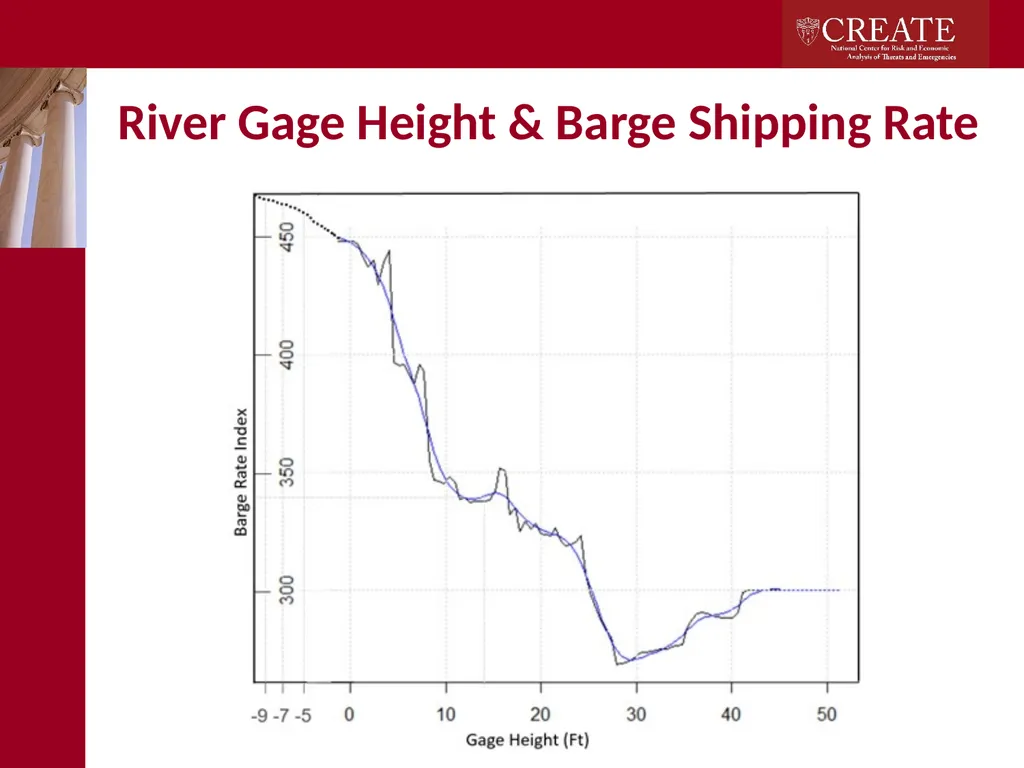
1. Drought (lower water levels => less weight per barge)
2. Lock/Dam Failure (congestion => delays)
3. Import Disruption (outright decrease in supply)
Shocks to the transportation & agricultural systems
– Barge rates
– Barge labor productivity
– Direct reduction in supply<br>
1. Drought (lower water levels => less weight per barge)
2. Lock/Dam Failure (congestion => delays)
3. Import Disruption (outright decrease in supply)
Shocks to the transportation & agricultural systems
– Barge rates
– Barge labor productivity
– Direct reduction in supply<br>
05
River Gage Height & Barge Shipping Rate<br>
06
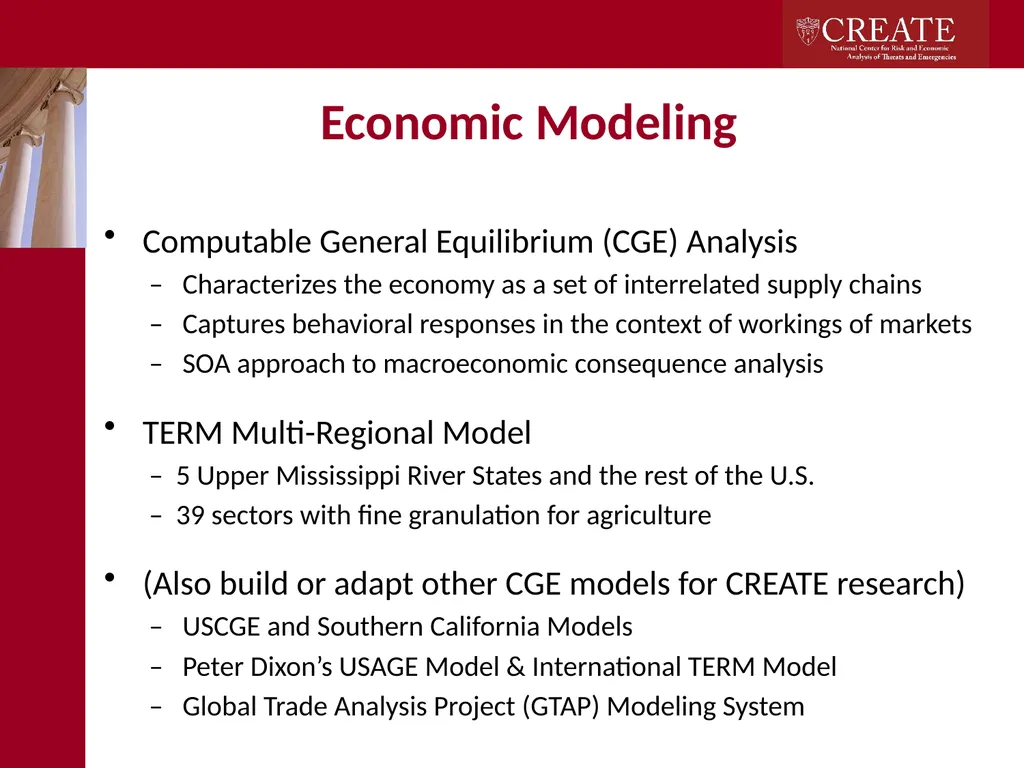
Economic Modeling Computable General Equilibrium (CGE) Analysis
– Characterizes the economy as a set of interrelated supply chains
– Captures behavioral responses in the context of workings of markets
– SOA approach to macroeconomic consequence analysis
TERM Multi-Regional Model
– 5 Upper Mississippi River States and the rest of the U.S.
– 39 sectors with fine granulation for agriculture
(Also build or adapt other CGE models for CREATE research)
– USCGE and Southern California Models
– Peter Dixon’s USAGE Model & International TERM Model
– Global Trade Analysis Project (GTAP) Modeling System<br>
– Characterizes the economy as a set of interrelated supply chains
– Captures behavioral responses in the context of workings of markets
– SOA approach to macroeconomic consequence analysis
TERM Multi-Regional Model
– 5 Upper Mississippi River States and the rest of the U.S.
– 39 sectors with fine granulation for agriculture
(Also build or adapt other CGE models for CREATE research)
– USCGE and Southern California Models
– Peter Dixon’s USAGE Model & International TERM Model
– Global Trade Analysis Project (GTAP) Modeling System<br>
07
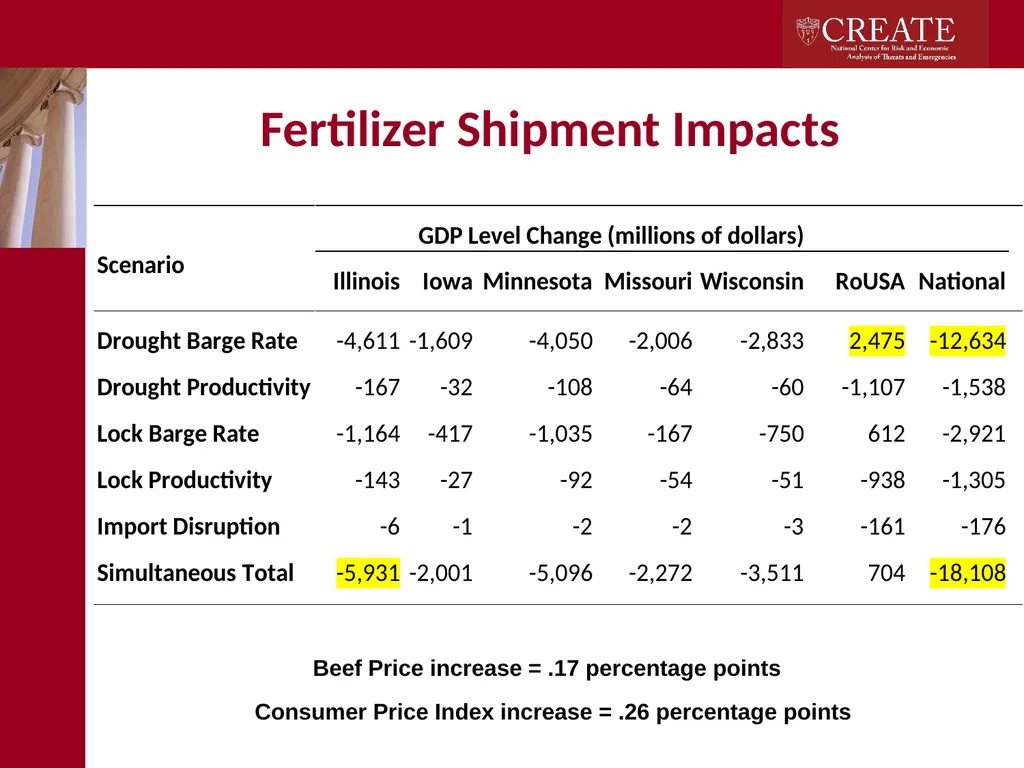
Fertilizer Shipment Impacts Beef Price increase = .17 percentage points
Consumer Price Index increase = .26 percentage points<br>
Consumer Price Index increase = .26 percentage points<br>
08
CREATE Research on Climate Change Increasing evidence and awareness that climate change spawns short-term & long-term disasters (hence now under the purview of DHS and COEs)
Many CREATE researchers work in fields closely related to climate change (e.g., energy, environment, eng, risk analysis)
– research is generally applicable to disasters/terrorism & climate change
– at the same time some of this research on climate change has informed
research on disasters & terrorism
One of the major contributions of DHS University COEs is independent thinking & unrestricted time to pursue research we deem important even before it gets on the policy radar<br>
Many CREATE researchers work in fields closely related to climate change (e.g., energy, environment, eng, risk analysis)
– research is generally applicable to disasters/terrorism & climate change
– at the same time some of this research on climate change has informed
research on disasters & terrorism
One of the major contributions of DHS University COEs is independent thinking & unrestricted time to pursue research we deem important even before it gets on the policy radar<br>
09
Macroeconomic Impacts of Climate Change Econ Consequence Analysis studies have general applicability. Climate change is increasingly being viewed a security threat.
“Macroeconomic Consequences of Terrorist Attacks: Estimation for the Analysis of Policies and Rules," in Benefit Transfer for the Analysis of DHS Policies and Rules, Edward Elgar, 2015. https://doi.org/10.4337/9781784711085.00016
“Economic Consequence Analysis of the ARkStorm Scenario,” Natural Hazards Review, 2016. https://doi.org/10.1061/(ASCE)NH.1527-6996.0000173<br>
“Macroeconomic Consequences of Terrorist Attacks: Estimation for the Analysis of Policies and Rules," in Benefit Transfer for the Analysis of DHS Policies and Rules, Edward Elgar, 2015. https://doi.org/10.4337/9781784711085.00016
“Economic Consequence Analysis of the ARkStorm Scenario,” Natural Hazards Review, 2016. https://doi.org/10.1061/(ASCE)NH.1527-6996.0000173<br>
10
Mitigation of Climate Change Drivers Has some of the same features as mitigation of disasters; in this case, it’s about mitigating greenhouse gas emissions
“Regional Economic Impacts of the Los Angeles 100% Renewable Energy Transition,” Climate Policy, 2024 . http://dx.doi.org/10.1080/14693062.2023.2287076.
“Economywide Implications from U.S. Bioenergy Expansion,” American Economic Review: Papers and Proceedings, 2010.<br>
“Regional Economic Impacts of the Los Angeles 100% Renewable Energy Transition,” Climate Policy, 2024 . http://dx.doi.org/10.1080/14693062.2023.2287076.
“Economywide Implications from U.S. Bioenergy Expansion,” American Economic Review: Papers and Proceedings, 2010.<br>
11
Resilience to Climate Change Research on resilience to disasters applies to disasters exacerbated by climate change.
“Impact of the COVID-19 pandemic on resilience to climate change in underserved communities,” Sustainability and Climate Change, doi:10.1089/scc.2021.0022
“Socioeconomic Impacts of Resilience to Seaport and Highway Transportation Network Disruption,” Transportation Research D, 2022. doi.org/10.1016/j.trd.2022.103236<br>
“Impact of the COVID-19 pandemic on resilience to climate change in underserved communities,” Sustainability and Climate Change, doi:10.1089/scc.2021.0022
“Socioeconomic Impacts of Resilience to Seaport and Highway Transportation Network Disruption,” Transportation Research D, 2022. doi.org/10.1016/j.trd.2022.103236<br>
12
Adaptation to Climate Change Can be interpreted as mitigation of climate change impacts
“Vulnerable, resilient, or both? A qualitative study of adaptation resources and behaviors to heat waves and health outcomes of low-income residents of urban heat islands,” International Journal of Environmental Research and Public Health, 2022. https://doi.org/10.330-/ijerph191711090.
“Envisioning climate change adaptation futures using storytelling workshops,” Sustainability, 2021. https://doi.org/10.3390/su13126630<br>
“Vulnerable, resilient, or both? A qualitative study of adaptation resources and behaviors to heat waves and health outcomes of low-income residents of urban heat islands,” International Journal of Environmental Research and Public Health, 2022. https://doi.org/10.330-/ijerph191711090.
“Envisioning climate change adaptation futures using storytelling workshops,” Sustainability, 2021. https://doi.org/10.3390/su13126630<br>
13
Distribution, Equity, Justice Fairness issues are becoming much more prominent in general
(see, e.g., recent revisions of OMB Circular A-4 Guidelines)
“Understanding and Mitigating the Impacts of Massive Relocations Due to Disasters,” Economics of Disasters and Climate Change, 2017. https://www.start.umd.edu/publication/understanding-and-mitigating-impacts-massive-relocations-due-disasters
“Impact of the COVID-19 Pandemic on Resilience to Climate Change in Underserved Communities,” Sustainability and Climate Change 14 (5): 288-304, 2021. https://doi.org/10.1089/scc.2021.0022<br>
(see, e.g., recent revisions of OMB Circular A-4 Guidelines)
“Understanding and Mitigating the Impacts of Massive Relocations Due to Disasters,” Economics of Disasters and Climate Change, 2017. https://www.start.umd.edu/publication/understanding-and-mitigating-impacts-massive-relocations-due-disasters
“Impact of the COVID-19 Pandemic on Resilience to Climate Change in Underserved Communities,” Sustainability and Climate Change 14 (5): 288-304, 2021. https://doi.org/10.1089/scc.2021.0022<br>
14
Policy Instrument Design Climate Change policy instruments also affect federal, state & local government operations directly, as well as international relations.
The Economics of Climate Change Policy: International, National and Regional Strategies, Edward Elgar, 2009. https://www.e-elgar.com/shop/usd/the-economics-of-climate-change-policy-9781848440814.html
“Carbon Auctions, Energy Markets and Market Power: An Experimental Analysis,” Energy Economics 44: 468-482, 2014. https://doi.org/10.1016/j.eneco.2014.03.013<br>
The Economics of Climate Change Policy: International, National and Regional Strategies, Edward Elgar, 2009. https://www.e-elgar.com/shop/usd/the-economics-of-climate-change-policy-9781848440814.html
“Carbon Auctions, Energy Markets and Market Power: An Experimental Analysis,” Energy Economics 44: 468-482, 2014. https://doi.org/10.1016/j.eneco.2014.03.013<br>
15
Conclusion CREATE has established a reputation as a leading center for research on the economics and risks of terrorism and natural disasters.
Given our capabilities and contributions in our established areas and their applicability to a broader range of extreme events, as well as actual research and policy advising by CREATE Fellows working in parallel in the area of climate change, we are in a strong position to be a leader in this area well.<br>
Given our capabilities and contributions in our established areas and their applicability to a broader range of extreme events, as well as actual research and policy advising by CREATE Fellows working in parallel in the area of climate change, we are in a strong position to be a leader in this area well.<br>
16
Selected References Bier, V. M. 2017. “Understanding and Mitigating the Impacts of Massive Relocations Due to Disasters,” Economics of Disasters and Climate Change 1: 79-202. https://doi.org/10.1007/s41885-017-0003-4
Bier, V. M. et al. 2020. “Game-theoretic Modeling of Pre-disaster Relocation,” The Engineering Economist 65: 89-113. https://doi.org/10.1080/0013791X.2019.1677837
Bruine de Bruin, W. et al. 2021. “Public understanding of climate change terminology,” Climatic Change 167(3-4): 37 . https://link.springer.com/article/10.1007/s10584-021-03183-0
Cutler, H., M. Shields, A. Rose, D. Wei, D. Keyser, and K. Crofton. 2023. “Regional Economic Impacts of the Los Angeles 100% Renewable Energy Transition,” Climate Policy, electronic preprint. https://doi.org/10.1080/14693062.2023.2287076
Gehlhar, M., A. Somwaru, P.B. Dixon, M.T. Rimmer, and A.R. Winston. 2010. “Economywide Implications from US Bioenergy Expansion,” American Economic Review: Papers & Proceedings 100(3): 172-77. https://doi.org/10.1257/aer.100.2.172
Dixon, P.B., S. Osborne, and M.T. Rimmer. 2007. “The economy-wide effects in the United States of replacing crude petroleum with biomass,” Energy and Environment 18(6): 709-722. http://www.jstor.org/stable/44397171
Dormady, N. 2014. “Carbon auctions, energy markets and market power: An experimental analysis,” Energy Economics 44: 468-482. https://doi.org/10.1016/j.eneco.2014.03.013
Dormady, N. et al. 2022. “Informational Determinants of Large-Area Hurricane Evacuations,” Bulletin of the American Meteorological Society 103(3): E642-E656. https://doi.org/10.1175/BAMS-D-21-0008.1
Fong, M. and R. John. 2024. “Motivated Bias in Detecting Climate Change Misinformation,” Proceedings of the 57th Annual Hawaiian International Conference on System Sciences (HICSS-2024). https://hdl.handle.net/10125/106636<br>
Bier, V. M. et al. 2020. “Game-theoretic Modeling of Pre-disaster Relocation,” The Engineering Economist 65: 89-113. https://doi.org/10.1080/0013791X.2019.1677837
Bruine de Bruin, W. et al. 2021. “Public understanding of climate change terminology,” Climatic Change 167(3-4): 37 . https://link.springer.com/article/10.1007/s10584-021-03183-0
Cutler, H., M. Shields, A. Rose, D. Wei, D. Keyser, and K. Crofton. 2023. “Regional Economic Impacts of the Los Angeles 100% Renewable Energy Transition,” Climate Policy, electronic preprint. https://doi.org/10.1080/14693062.2023.2287076
Gehlhar, M., A. Somwaru, P.B. Dixon, M.T. Rimmer, and A.R. Winston. 2010. “Economywide Implications from US Bioenergy Expansion,” American Economic Review: Papers & Proceedings 100(3): 172-77. https://doi.org/10.1257/aer.100.2.172
Dixon, P.B., S. Osborne, and M.T. Rimmer. 2007. “The economy-wide effects in the United States of replacing crude petroleum with biomass,” Energy and Environment 18(6): 709-722. http://www.jstor.org/stable/44397171
Dormady, N. 2014. “Carbon auctions, energy markets and market power: An experimental analysis,” Energy Economics 44: 468-482. https://doi.org/10.1016/j.eneco.2014.03.013
Dormady, N. et al. 2022. “Informational Determinants of Large-Area Hurricane Evacuations,” Bulletin of the American Meteorological Society 103(3): E642-E656. https://doi.org/10.1175/BAMS-D-21-0008.1
Fong, M. and R. John. 2024. “Motivated Bias in Detecting Climate Change Misinformation,” Proceedings of the 57th Annual Hawaiian International Conference on System Sciences (HICSS-2024). https://hdl.handle.net/10125/106636<br>
17
Selected References (continued) Harcourt, R., W. Bruine de Bruin, S. Dessai, and A. Taylor. 2021. “Envisioning Climate Change Adaptation Futures Using Storytelling Workshops,” Sustainability 13(12): 6630. https://doi.org/10.3390/su1312663
Kunreuther, H., and Slovic, P. 2020. “What the Coronavirus Curve Teaches Us About Climate Change.” Politico. https://www.politico.com/news/magazine/2020/03/26/what-the-coronavirus-curve-teaches-us-about-climate-change-148318
Palinkas, L.A. et al. 2022. “Vulnerable, Resilient, or Both? A Qualitative Study of Adaptation Resources and Behaviors to Heat Waves and Health Outcomes of Low-Income Residents of Urban Heat Islands,” International Journal of Environmental Research and Public Health 19(17): 11090. https://doi.org/10.330-/ijerph191711090.
Palinkas, L.A. et al. 2021. “Impact of the COVID-19 Pandemic on Resilience to Climate Change in Underserved Communities,” Sustainability and Climate Change 14 (5): 288-304. https://doi.org/10.1089/scc.2021.0022
Rose, A. 2009. “The Economics of Climate Change Policy: International, National and Regional Strategies,” Cheltenham: Edward Elgar. https://ideas.repec.org/b/elg/eebook/13269.html
Rose, A. 2015. “Macroeconomic Consequences of Terrorist Attacks: Estimation for the Analysis of Policies and Rules," in C. Mansfield and V. K. Smith (eds.), Benefit Transfer for the Analysis of DHS Policies and Rules, Cheltenham, UK: Edward Elgar. https://doi.org/10.4337/9781784711085.00016
Sue Wing, I., A. Rose, and A. Wein. 2016. “Economic Consequence Analysis of the ARkStorm Scenario,” Natural Hazards Review 17(4): A4015002. https://doi.org/10.1061/(ASCE)NH.1527-6996.0000173
Wei, D., A. Rose, E. Koc, Z. Chen, and L. Soibelman. 2022. “Socioeconomic Impacts of Resilience to Seaport and Highway Transportation Network Disruption,” Transportation Research D: Transport and Environment 106: 103236. doi.org/10.1016/j.trd.2022.103236<br>
Kunreuther, H., and Slovic, P. 2020. “What the Coronavirus Curve Teaches Us About Climate Change.” Politico. https://www.politico.com/news/magazine/2020/03/26/what-the-coronavirus-curve-teaches-us-about-climate-change-148318
Palinkas, L.A. et al. 2022. “Vulnerable, Resilient, or Both? A Qualitative Study of Adaptation Resources and Behaviors to Heat Waves and Health Outcomes of Low-Income Residents of Urban Heat Islands,” International Journal of Environmental Research and Public Health 19(17): 11090. https://doi.org/10.330-/ijerph191711090.
Palinkas, L.A. et al. 2021. “Impact of the COVID-19 Pandemic on Resilience to Climate Change in Underserved Communities,” Sustainability and Climate Change 14 (5): 288-304. https://doi.org/10.1089/scc.2021.0022
Rose, A. 2009. “The Economics of Climate Change Policy: International, National and Regional Strategies,” Cheltenham: Edward Elgar. https://ideas.repec.org/b/elg/eebook/13269.html
Rose, A. 2015. “Macroeconomic Consequences of Terrorist Attacks: Estimation for the Analysis of Policies and Rules," in C. Mansfield and V. K. Smith (eds.), Benefit Transfer for the Analysis of DHS Policies and Rules, Cheltenham, UK: Edward Elgar. https://doi.org/10.4337/9781784711085.00016
Sue Wing, I., A. Rose, and A. Wein. 2016. “Economic Consequence Analysis of the ARkStorm Scenario,” Natural Hazards Review 17(4): A4015002. https://doi.org/10.1061/(ASCE)NH.1527-6996.0000173
Wei, D., A. Rose, E. Koc, Z. Chen, and L. Soibelman. 2022. “Socioeconomic Impacts of Resilience to Seaport and Highway Transportation Network Disruption,” Transportation Research D: Transport and Environment 106: 103236. doi.org/10.1016/j.trd.2022.103236<br>