
“Research on Sex Differences” Helen Longino

Description: Research on Sex Differences Helen Longino Science as Social Knowledge (1990) Longino wants to demonstrate that science cannot exclude social and cultural influence I will argue not only that scientific practices and content on the one
Related Topics
Download Presentation
"“Research on Sex Differences” Helen Longino" is the property of its rightful owner. Permission is granted to download and print the materials on this website for personal, non-commercial use only, and to display it on your personal computer provided you do not modify the materials and that you retain all copyright notices contained in the materials. By downloading content from our website, you accept the terms of this agreement.
Presentation Transcript
slide1. “Research on Sex Differences” Helen Longino<br>
slide2. Science as Social Knowledge (1990) Longino wants to demonstrate that science cannot exclude social and cultural influence
“I will argue not only that scientific practices and content on the one hand and social needs and values on the other are in dynamic interaction but that the logical and cognitive structures of scientific inquiry require such interaction” (4).<br>
slide3. Science as Social Knowledge (1990) Constitutive values are internal to science: they determine the rules of what constitutes acceptable scientific practice.
Ex: simplicity, generality, etc.
Contextual values come from the social and cultural environment in which science is done
Ex: sexism and androcentrism<br>
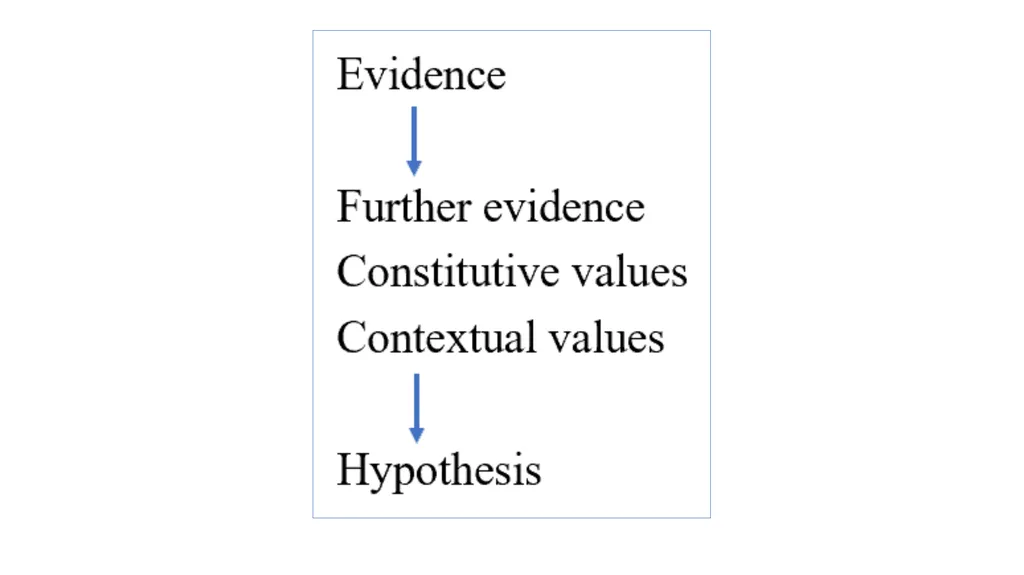
slide4. Science as Social Knowledge (1990) Longino claims that, because theories are underdetermined by available evidence, values are needed to fill in the gap.
Ways that contextual values shape knowledge:
Practices
Questions
Data
Specific assumptions
Global assumptions<br>
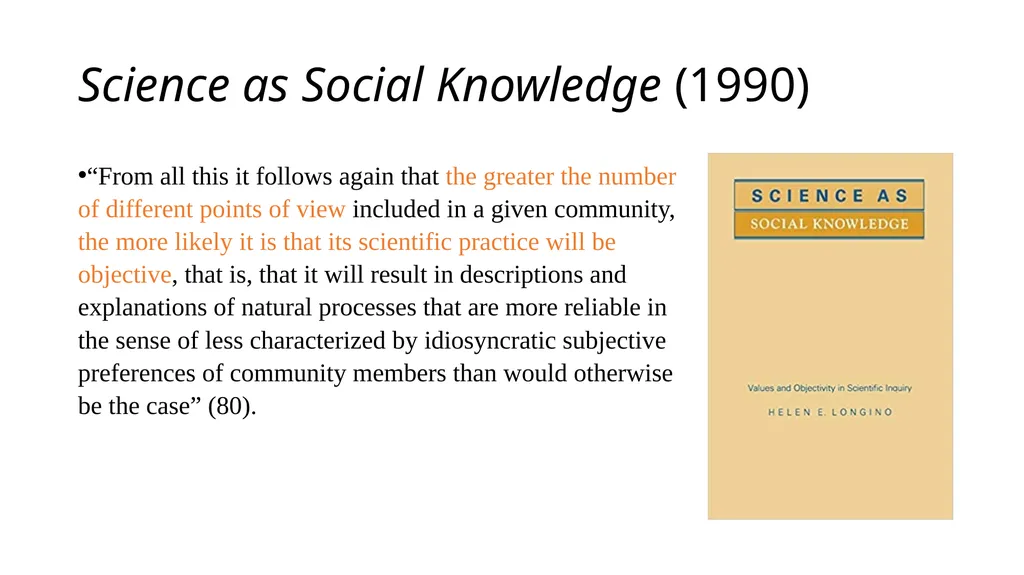
slide5. Science as Social Knowledge (1990) “From all this it follows again that the greater the number of different points of view included in a given community, the more likely it is that its scientific practice will be objective, that is, that it will result in descriptions and explanations of natural processes that are more reliable in the sense of less characterized by idiosyncratic subjective preferences of community members than would otherwise be the case” (80).<br>
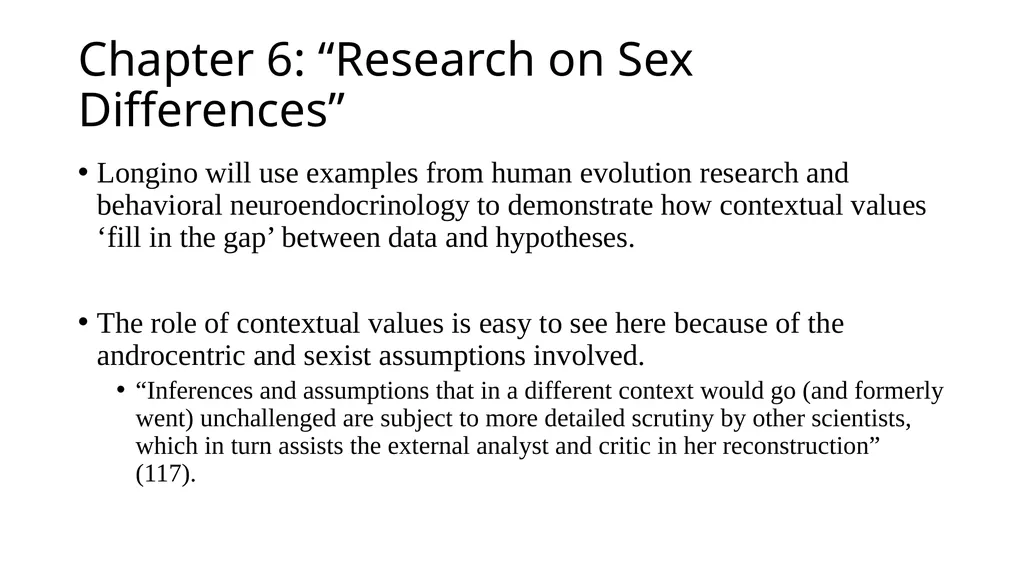
slide6. Chapter 6: “Research on Sex Differences” Longino will use examples from human evolution research and behavioral neuroendocrinology to demonstrate how contextual values ‘fill in the gap’ between data and hypotheses.
The role of contextual values is easy to see here because of the androcentric and sexist assumptions involved.
“Inferences and assumptions that in a different context would go (and formerly went) unchallenged are subject to more detailed scrutiny by other scientists, which in turn assists the external analyst and critic in her reconstruction” (117).<br>
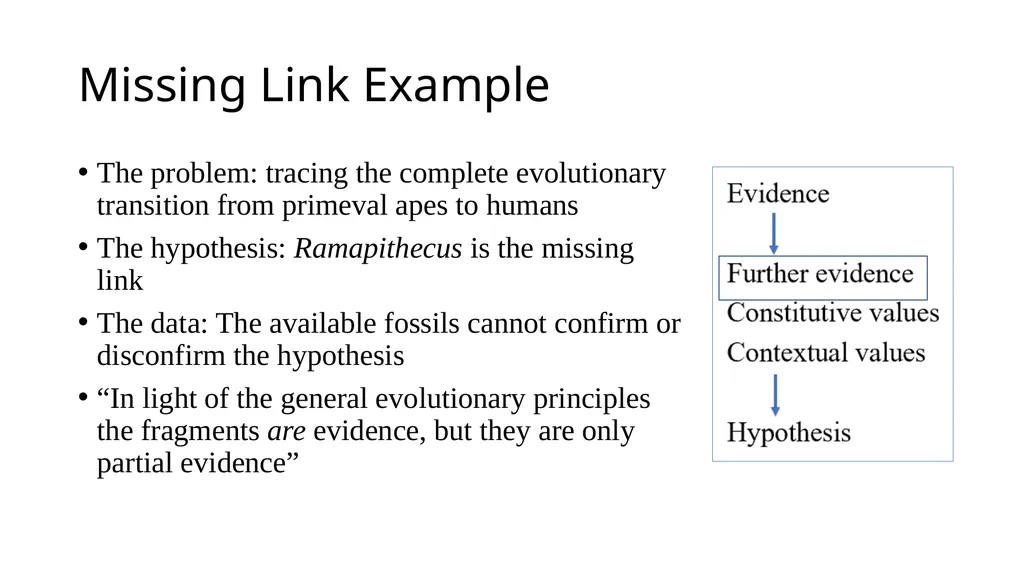
slide8. Missing Link Example The problem: tracing the complete evolutionary transition from primeval apes to humans
The hypothesis: Ramapithecus is the missing link
The data: The available fossils cannot confirm or disconfirm the hypothesis
“In light of the general evolutionary principles the fragments are evidence, but they are only partial evidence”<br>
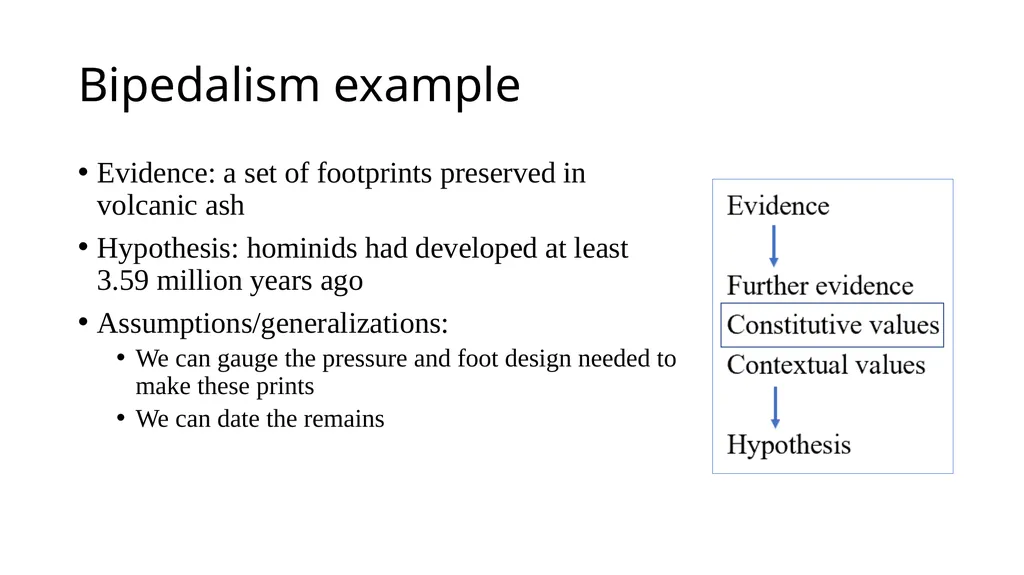
slide9. Bipedalism example Evidence: a set of footprints preserved in volcanic ash
Hypothesis: hominids had developed at least 3.59 million years ago
Assumptions/generalizations:
We can gauge the pressure and foot design needed to make these prints
We can date the remains<br>
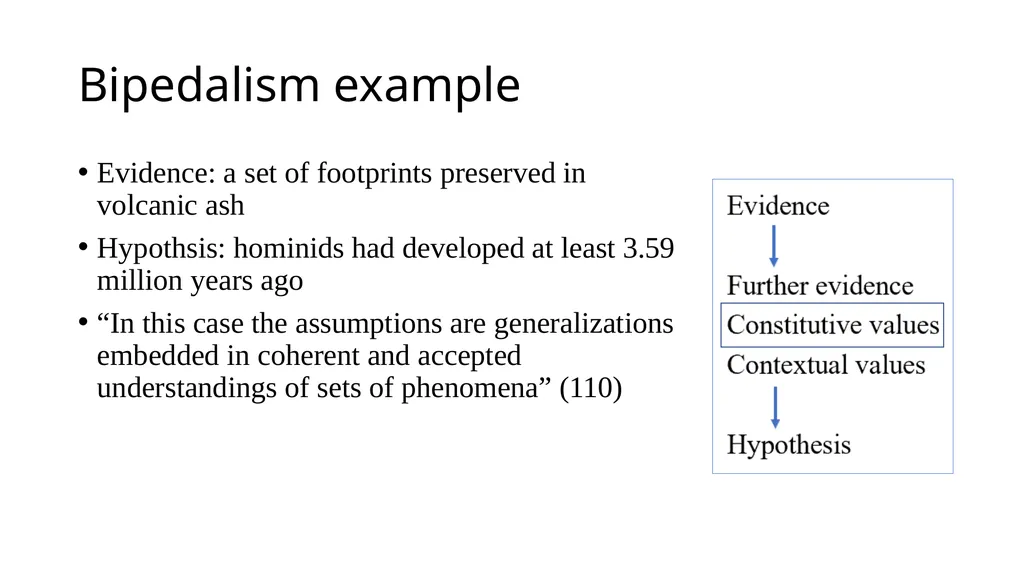
slide10. Bipedalism example Evidence: a set of footprints preserved in volcanic ash
Hypothsis: hominids had developed at least 3.59 million years ago
“In this case the assumptions are generalizations embedded in coherent and accepted understandings of sets of phenomena” (110)<br>
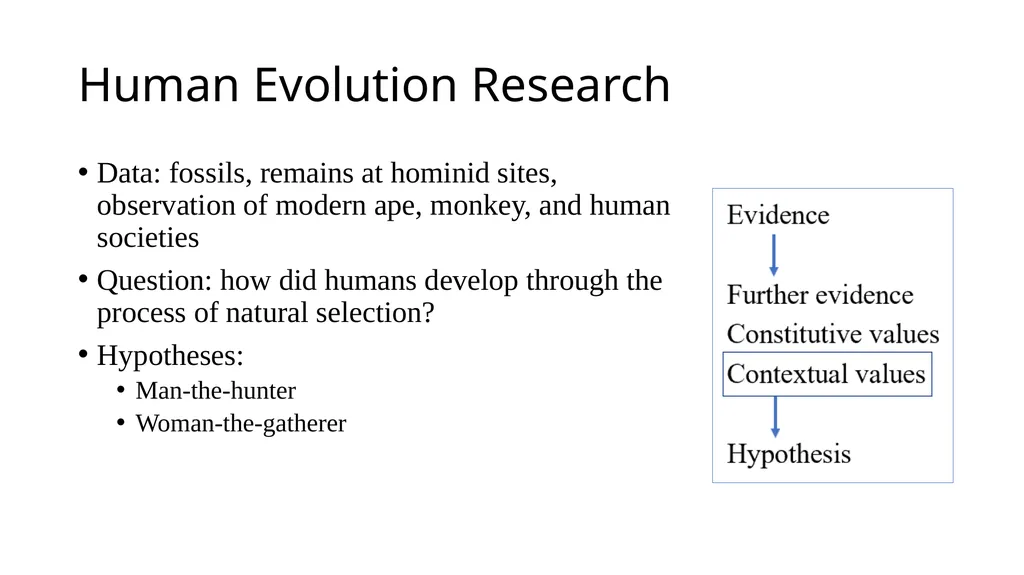
slide11. Human Evolution Research Data: fossils, remains at hominid sites, observation of modern ape, monkey, and human societies
Question: how did humans develop through the process of natural selection?
Hypotheses:
Man-the-hunter
Woman-the-gatherer<br>
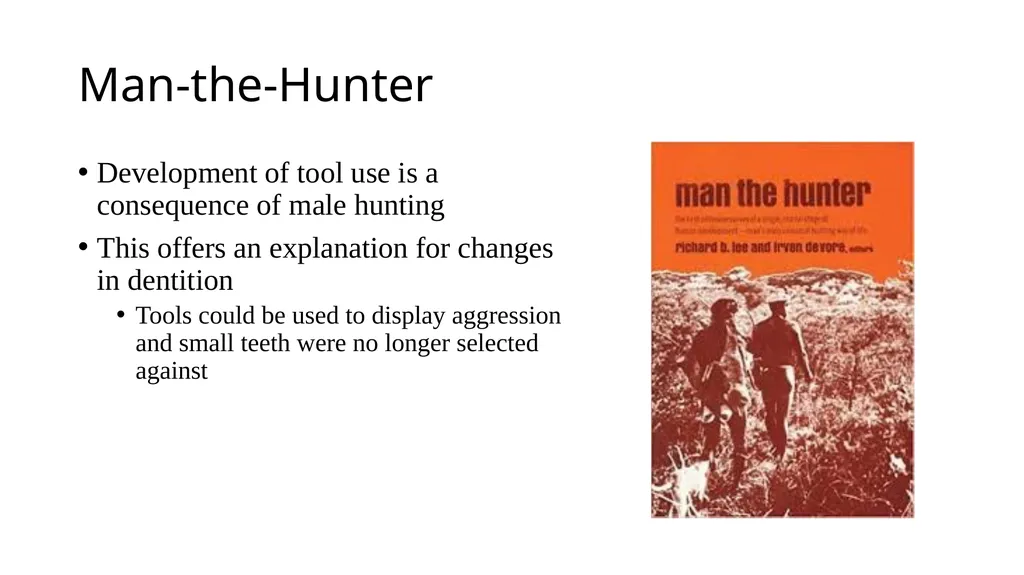
slide12. Man-the-Hunter Development of tool use is a consequence of male hunting
This offers an explanation for changes in dentition
Tools could be used to display aggression and small teeth were no longer selected against<br>
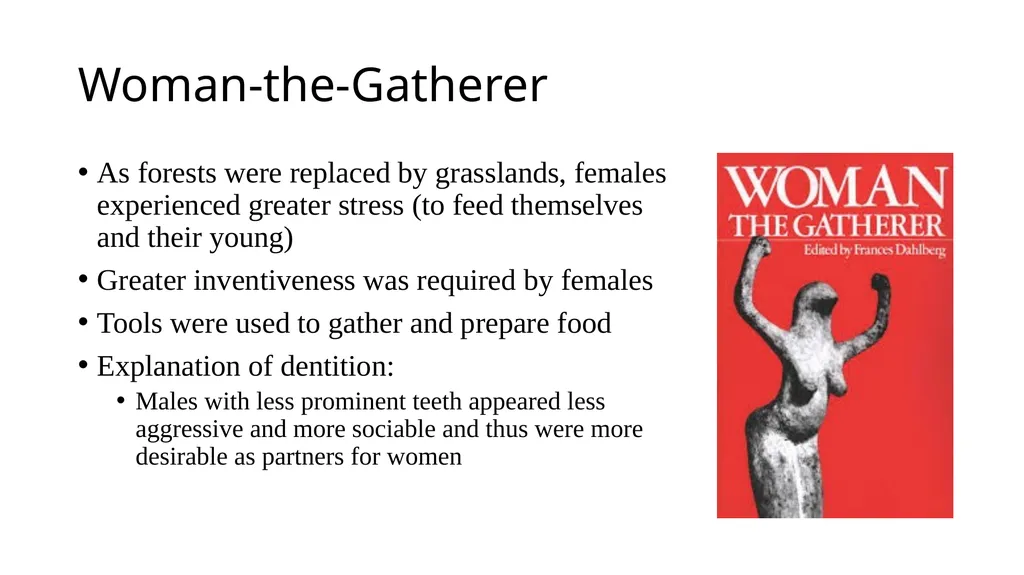
slide13. Woman-the-Gatherer As forests were replaced by grasslands, females experienced greater stress (to feed themselves and their young)
Greater inventiveness was required by females
Tools were used to gather and prepare food
Explanation of dentition:
Males with less prominent teeth appeared less aggressive and more sociable and thus were more desirable as partners for women<br>
slide14. Inferences and Assumptions Objects as tools
The odds of finding objects of a similar size that are roughly isomorphic and suitable for grasping are low without the presence of a creature to make them
Thus, we infer that the objects are tools
Inference from tools to tool-users
Turn to analogies with contemporary hunters and gatherers
Different theorists will appeal to different populations
“How the data are read depends on whether one is working within the framework of man-the-hunter or woman-the-gatherer” (109)<br>
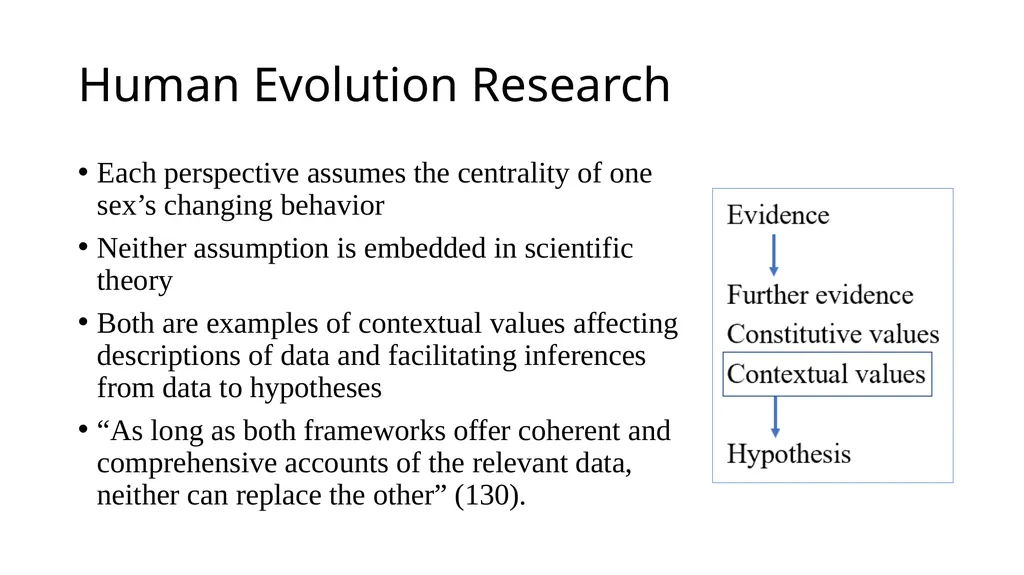
slide15. Human Evolution Research Each perspective assumes the centrality of one sex’s changing behavior
Neither assumption is embedded in scientific theory
Both are examples of contextual values affecting descriptions of data and facilitating inferences from data to hypotheses
“As long as both frameworks offer coherent and comprehensive accounts of the relevant data, neither can replace the other” (130).<br>
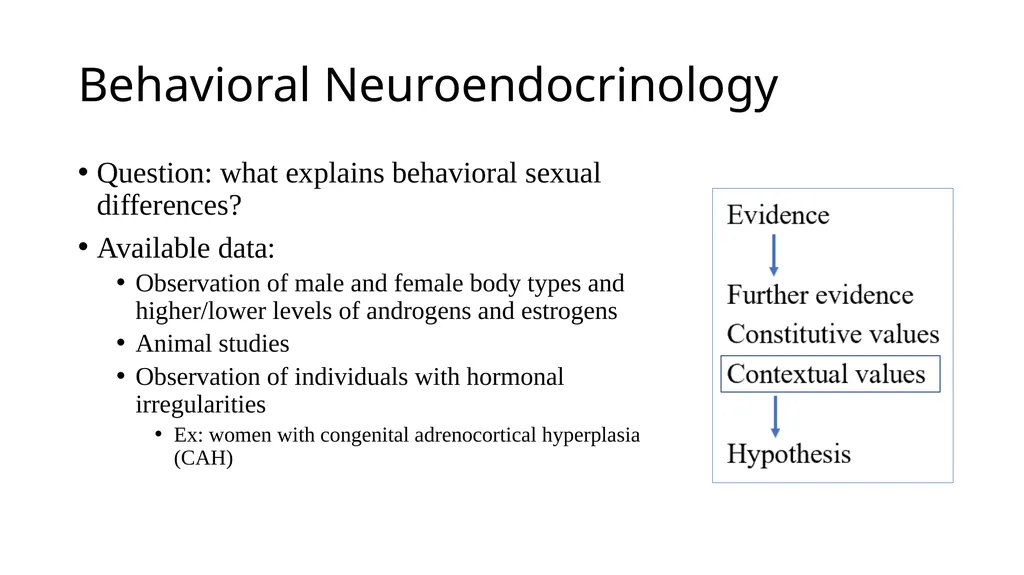
slide16. Behavioral Neuroendocrinology Question: what explains behavioral sexual differences?
Available data:
Observation of male and female body types and higher/lower levels of androgens and estrogens
Animal studies
Observation of individuals with hormonal irregularities
Ex: women with congenital adrenocortical hyperplasia (CAH)<br>
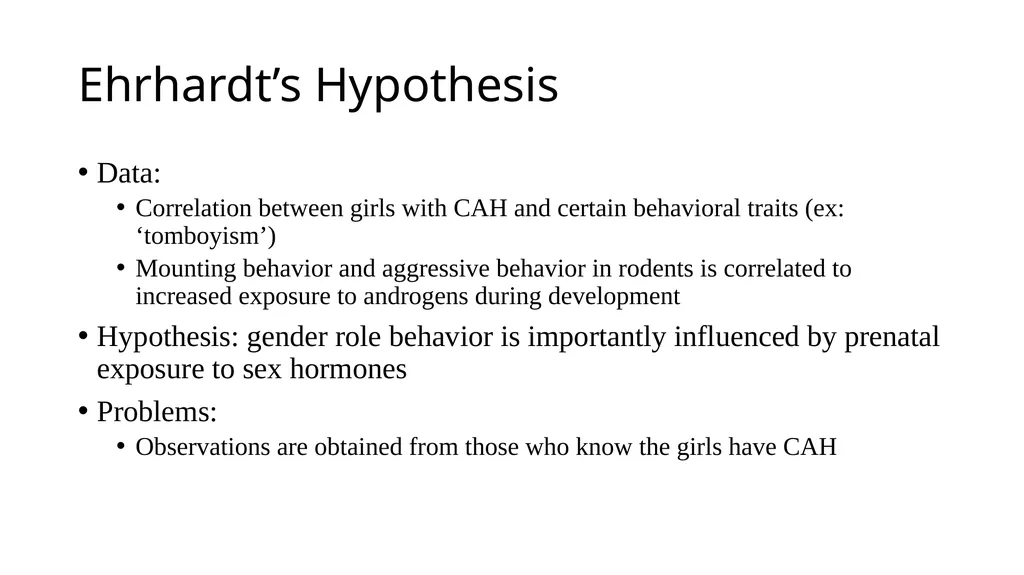
slide17. Ehrhardt’s Hypothesis Data:
Correlation between girls with CAH and certain behavioral traits (ex: ‘tomboyism’)
Mounting behavior and aggressive behavior in rodents is correlated to increased exposure to androgens during development
Hypothesis: gender role behavior is importantly influenced by prenatal exposure to sex hormones
Problems:
Observations are obtained from those who know the girls have CAH<br>
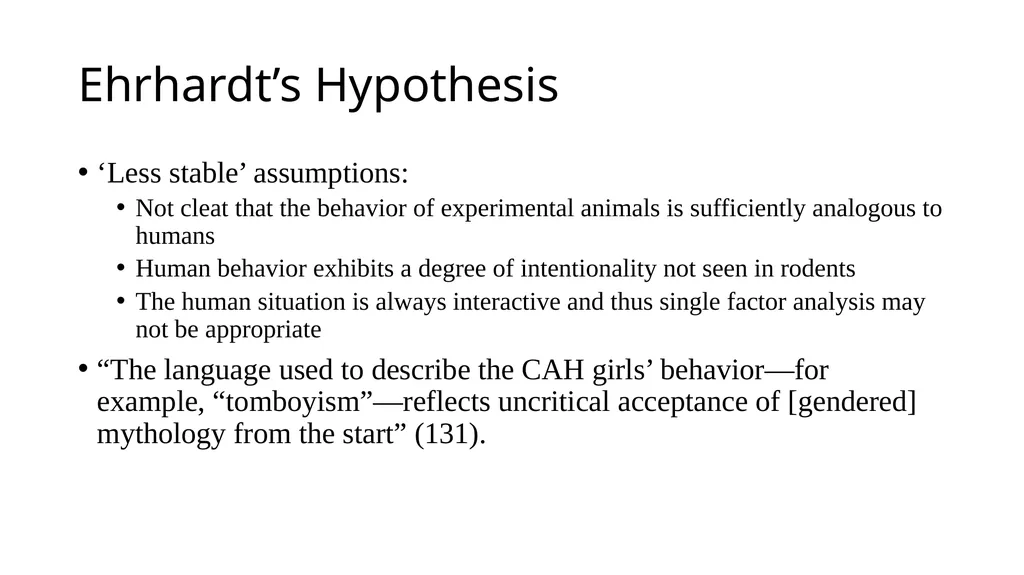
slide18. Ehrhardt’s Hypothesis ‘Less stable’ assumptions:
Not cleat that the behavior of experimental animals is sufficiently analogous to humans
Human behavior exhibits a degree of intentionality not seen in rodents
The human situation is always interactive and thus single factor analysis may not be appropriate
“The language used to describe the CAH girls’ behavior—for example, “tomboyism”—reflects uncritical acceptance of [gendered] mythology from the start” (131).<br>
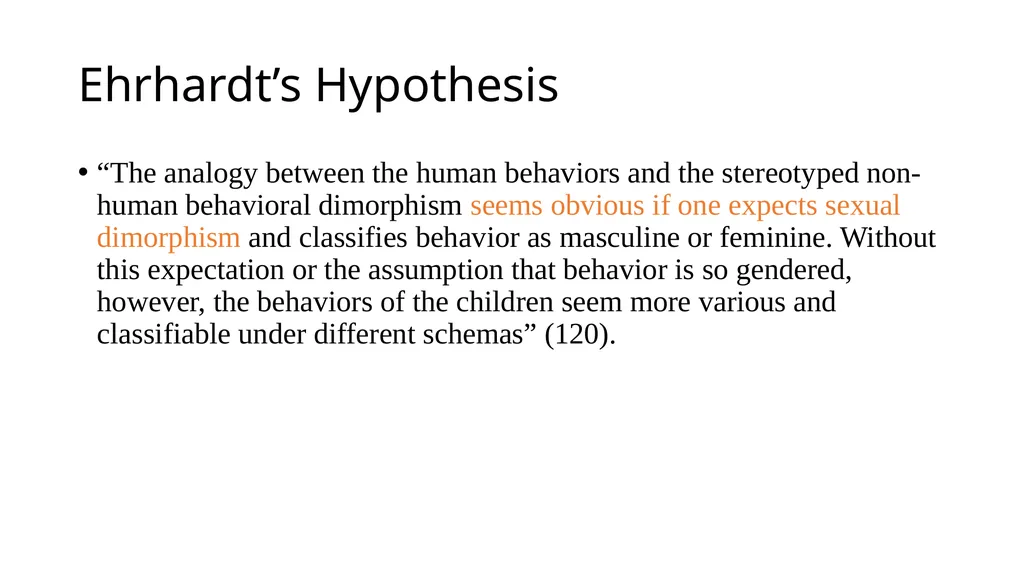
slide19. Ehrhardt’s Hypothesis “The analogy between the human behaviors and the stereotyped non-human behavioral dimorphism seems obvious if one expects sexual dimorphism and classifies behavior as masculine or feminine. Without this expectation or the assumption that behavior is so gendered, however, the behaviors of the children seem more various and classifiable under different schemas” (120).<br>
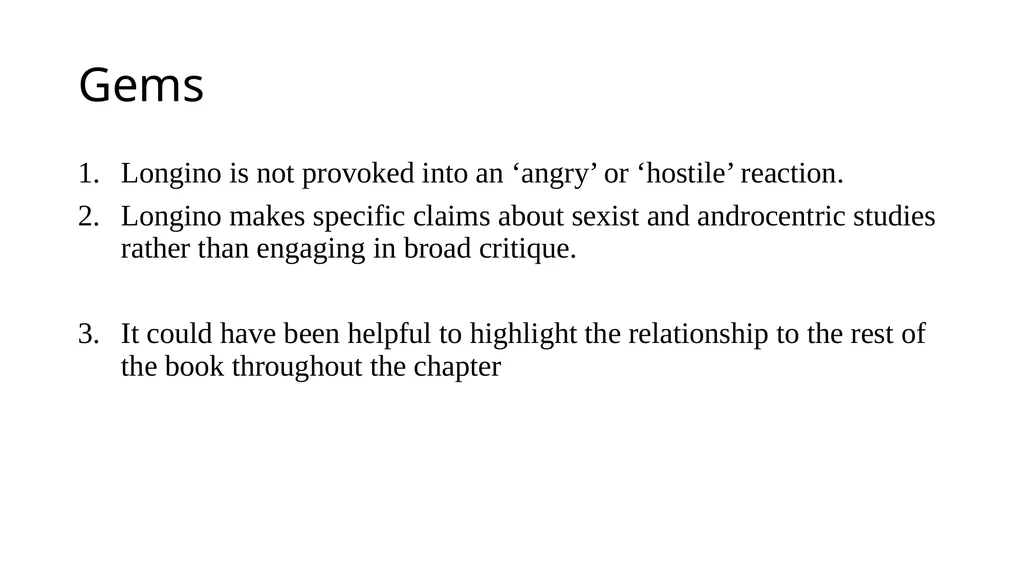
slide20. Gems Longino is not provoked into an ‘angry’ or ‘hostile’ reaction.
Longino makes specific claims about sexist and androcentric studies rather than engaging in broad critique.
It could have been helpful to highlight the relationship to the rest of the book throughout the chapter<br>
slide21. Discussion Questions Should we only expect contextual values to play a role in scientific fields that have to do with social behavior?
When should we expect further evidence to ‘fill the gap’ between data and hypotheses rather than contextual values?<br>
slide2. Science as Social Knowledge (1990) Longino wants to demonstrate that science cannot exclude social and cultural influence
“I will argue not only that scientific practices and content on the one hand and social needs and values on the other are in dynamic interaction but that the logical and cognitive structures of scientific inquiry require such interaction” (4).<br>
slide3. Science as Social Knowledge (1990) Constitutive values are internal to science: they determine the rules of what constitutes acceptable scientific practice.
Ex: simplicity, generality, etc.
Contextual values come from the social and cultural environment in which science is done
Ex: sexism and androcentrism<br>
slide4. Science as Social Knowledge (1990) Longino claims that, because theories are underdetermined by available evidence, values are needed to fill in the gap.
Ways that contextual values shape knowledge:
Practices
Questions
Data
Specific assumptions
Global assumptions<br>
slide5. Science as Social Knowledge (1990) “From all this it follows again that the greater the number of different points of view included in a given community, the more likely it is that its scientific practice will be objective, that is, that it will result in descriptions and explanations of natural processes that are more reliable in the sense of less characterized by idiosyncratic subjective preferences of community members than would otherwise be the case” (80).<br>
slide6. Chapter 6: “Research on Sex Differences” Longino will use examples from human evolution research and behavioral neuroendocrinology to demonstrate how contextual values ‘fill in the gap’ between data and hypotheses.
The role of contextual values is easy to see here because of the androcentric and sexist assumptions involved.
“Inferences and assumptions that in a different context would go (and formerly went) unchallenged are subject to more detailed scrutiny by other scientists, which in turn assists the external analyst and critic in her reconstruction” (117).<br>
slide8. Missing Link Example The problem: tracing the complete evolutionary transition from primeval apes to humans
The hypothesis: Ramapithecus is the missing link
The data: The available fossils cannot confirm or disconfirm the hypothesis
“In light of the general evolutionary principles the fragments are evidence, but they are only partial evidence”<br>
slide9. Bipedalism example Evidence: a set of footprints preserved in volcanic ash
Hypothesis: hominids had developed at least 3.59 million years ago
Assumptions/generalizations:
We can gauge the pressure and foot design needed to make these prints
We can date the remains<br>
slide10. Bipedalism example Evidence: a set of footprints preserved in volcanic ash
Hypothsis: hominids had developed at least 3.59 million years ago
“In this case the assumptions are generalizations embedded in coherent and accepted understandings of sets of phenomena” (110)<br>
slide11. Human Evolution Research Data: fossils, remains at hominid sites, observation of modern ape, monkey, and human societies
Question: how did humans develop through the process of natural selection?
Hypotheses:
Man-the-hunter
Woman-the-gatherer<br>
slide12. Man-the-Hunter Development of tool use is a consequence of male hunting
This offers an explanation for changes in dentition
Tools could be used to display aggression and small teeth were no longer selected against<br>
slide13. Woman-the-Gatherer As forests were replaced by grasslands, females experienced greater stress (to feed themselves and their young)
Greater inventiveness was required by females
Tools were used to gather and prepare food
Explanation of dentition:
Males with less prominent teeth appeared less aggressive and more sociable and thus were more desirable as partners for women<br>
slide14. Inferences and Assumptions Objects as tools
The odds of finding objects of a similar size that are roughly isomorphic and suitable for grasping are low without the presence of a creature to make them
Thus, we infer that the objects are tools
Inference from tools to tool-users
Turn to analogies with contemporary hunters and gatherers
Different theorists will appeal to different populations
“How the data are read depends on whether one is working within the framework of man-the-hunter or woman-the-gatherer” (109)<br>
slide15. Human Evolution Research Each perspective assumes the centrality of one sex’s changing behavior
Neither assumption is embedded in scientific theory
Both are examples of contextual values affecting descriptions of data and facilitating inferences from data to hypotheses
“As long as both frameworks offer coherent and comprehensive accounts of the relevant data, neither can replace the other” (130).<br>
slide16. Behavioral Neuroendocrinology Question: what explains behavioral sexual differences?
Available data:
Observation of male and female body types and higher/lower levels of androgens and estrogens
Animal studies
Observation of individuals with hormonal irregularities
Ex: women with congenital adrenocortical hyperplasia (CAH)<br>
slide17. Ehrhardt’s Hypothesis Data:
Correlation between girls with CAH and certain behavioral traits (ex: ‘tomboyism’)
Mounting behavior and aggressive behavior in rodents is correlated to increased exposure to androgens during development
Hypothesis: gender role behavior is importantly influenced by prenatal exposure to sex hormones
Problems:
Observations are obtained from those who know the girls have CAH<br>
slide18. Ehrhardt’s Hypothesis ‘Less stable’ assumptions:
Not cleat that the behavior of experimental animals is sufficiently analogous to humans
Human behavior exhibits a degree of intentionality not seen in rodents
The human situation is always interactive and thus single factor analysis may not be appropriate
“The language used to describe the CAH girls’ behavior—for example, “tomboyism”—reflects uncritical acceptance of [gendered] mythology from the start” (131).<br>
slide19. Ehrhardt’s Hypothesis “The analogy between the human behaviors and the stereotyped non-human behavioral dimorphism seems obvious if one expects sexual dimorphism and classifies behavior as masculine or feminine. Without this expectation or the assumption that behavior is so gendered, however, the behaviors of the children seem more various and classifiable under different schemas” (120).<br>
slide20. Gems Longino is not provoked into an ‘angry’ or ‘hostile’ reaction.
Longino makes specific claims about sexist and androcentric studies rather than engaging in broad critique.
It could have been helpful to highlight the relationship to the rest of the book throughout the chapter<br>
slide21. Discussion Questions Should we only expect contextual values to play a role in scientific fields that have to do with social behavior?
When should we expect further evidence to ‘fill the gap’ between data and hypotheses rather than contextual values?<br>