
Research Professionals Network Workshop Series

Description: Research Professionals Network Workshop Series What you need to know about Single IRB Presenters: Matthew Ogrodnik, BUBMC IRB Director, Janet Seo, BU Research Coordinator, Kimberly Luebbers, UVM Assistant Dean for Clinical Research, Donna
Related Topics
Download Presentation
"Research Professionals Network Workshop Series" is the property of its rightful owner. Permission is granted to download and print the materials on this website for personal, non-commercial use only, and to display it on your personal computer provided you do not modify the materials and that you retain all copyright notices contained in the materials. By downloading content from our website, you accept the terms of this agreement.
Presentation Transcript
slide1. Research Professionals Network Workshop Series What you need to know about Single IRB Presenters: Matthew Ogrodnik, BU/BMC IRB Director, Janet Seo, BU Research Coordinator,
Kimberly Luebbers, UVM Assistant Dean for Clinical Research, Donna Silver, UVM Research Protections Office, IRB Director<br>
slide2. Aims of this Presentation Summarize information regarding this new regulatory requirement
Give examples of experiences with single IRB that have occurred since regulatory compliance date
Educate audience as to required documents needed to prepare for single IRB
Explain local procedures for single IRB<br>
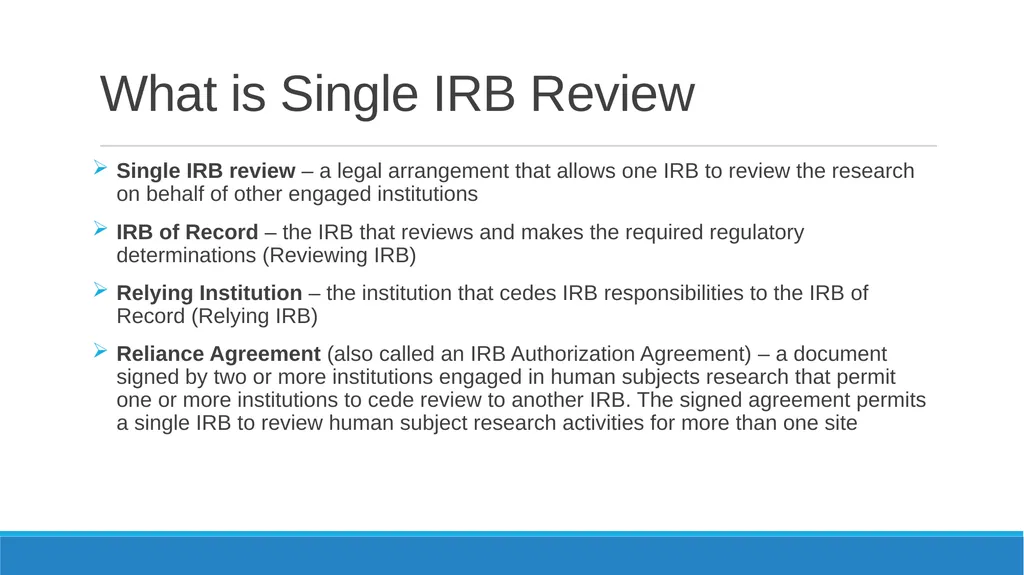
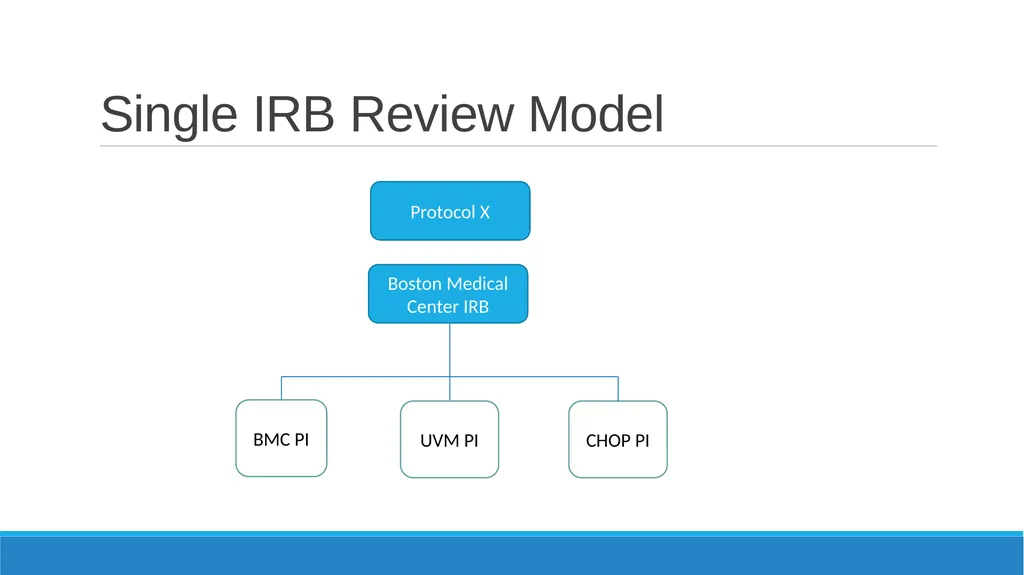
slide3. What is Single IRB Review Single IRB review – a legal arrangement that allows one IRB to review the research on behalf of other engaged institutions
IRB of Record – the IRB that reviews and makes the required regulatory determinations (Reviewing IRB)
Relying Institution – the institution that cedes IRB responsibilities to the IRB of Record (Relying IRB)
Reliance Agreement (also called an IRB Authorization Agreement) – a document signed by two or more institutions engaged in human subjects research that permit one or more institutions to cede review to another IRB. The signed agreement permits a single IRB to review human subject research activities for more than one site<br>
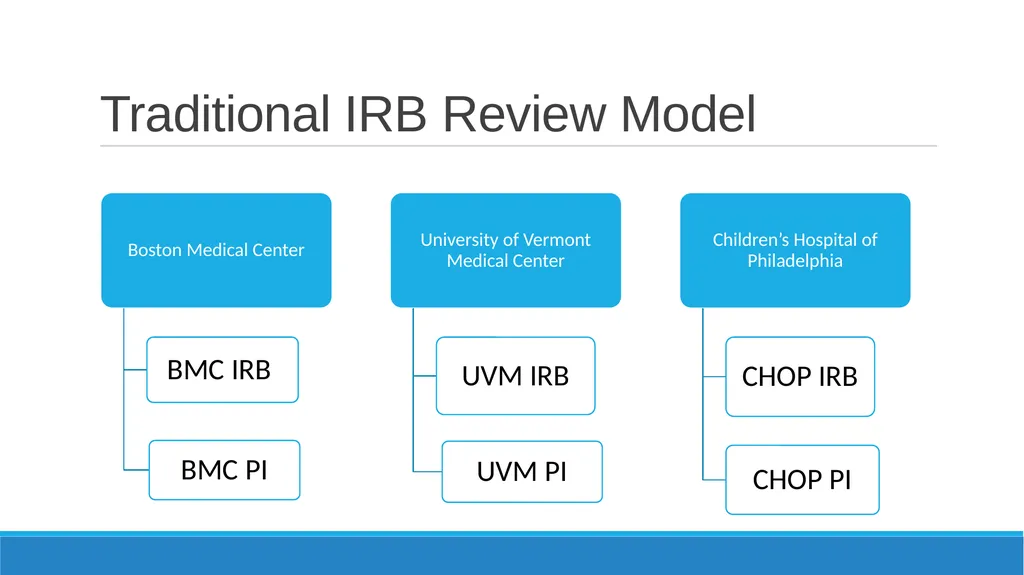
slide4. Traditional IRB Review Model<br>
slide5. Single IRB Review Model Protocol X BMC PI UVM PI CHOP PI Boston Medical Center IRB<br>
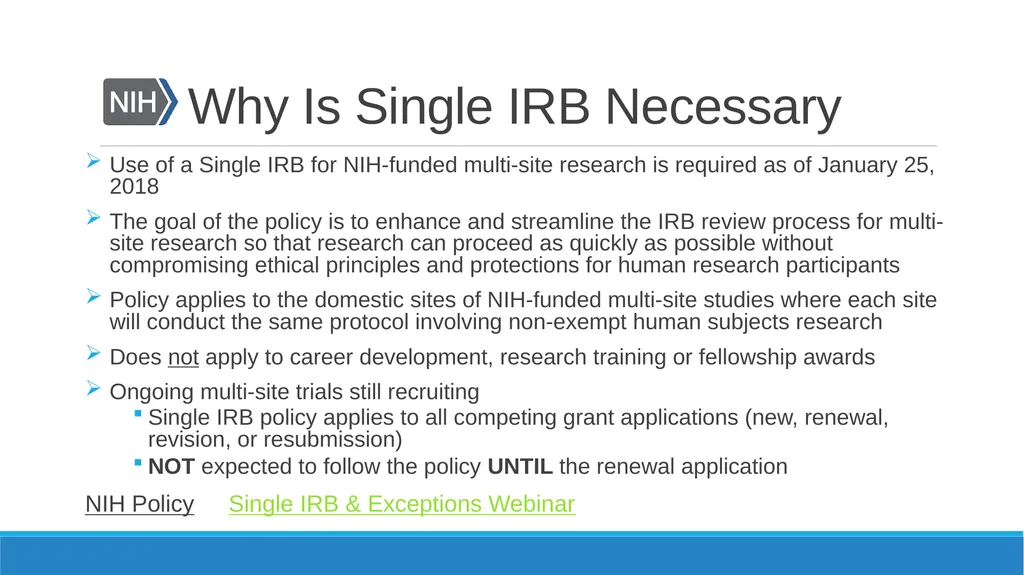
slide6. Why Is Single IRB Necessary Use of a Single IRB for NIH-funded multi-site research is required as of January 25, 2018
The goal of the policy is to enhance and streamline the IRB review process for multi-site research so that research can proceed as quickly as possible without compromising ethical principles and protections for human research participants
Policy applies to the domestic sites of NIH-funded multi-site studies where each site will conduct the same protocol involving non-exempt human subjects research
Does not apply to career development, research training or fellowship awards
Ongoing multi-site trials still recruiting
Single IRB policy applies to all competing grant applications (new, renewal, revision, or resubmission)
NOT expected to follow the policy UNTIL the renewal application
NIH Policy Single IRB & Exceptions Webinar<br>
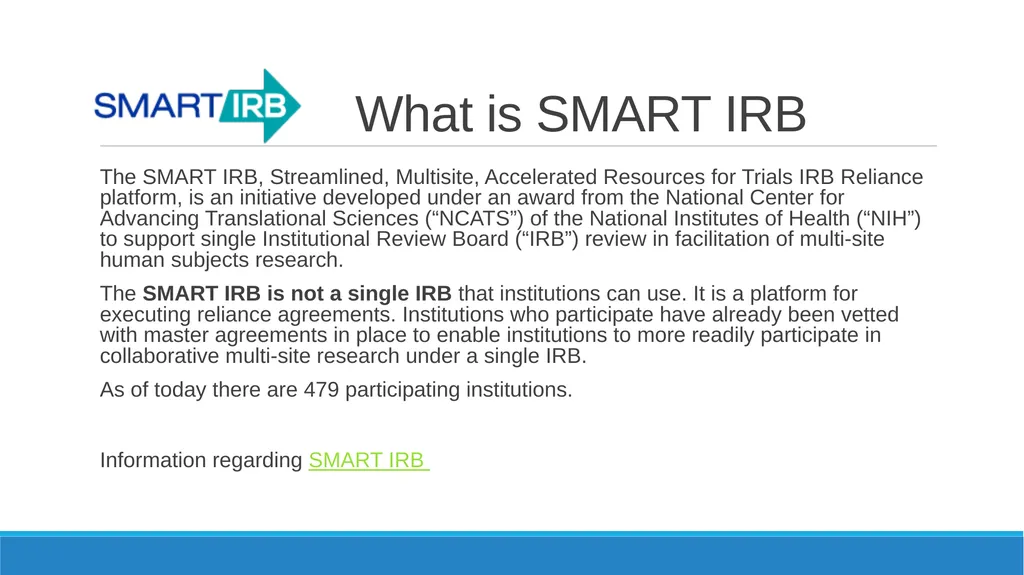
slide7. What is SMART IRB The SMART IRB, Streamlined, Multisite, Accelerated Resources for Trials IRB Reliance platform, is an initiative developed under an award from the National Center for Advancing Translational Sciences (“NCATS”) of the National Institutes of Health (“NIH”) to support single Institutional Review Board (“IRB”) review in facilitation of multi-site human subjects research.
The SMART IRB is not a single IRB that institutions can use. It is a platform for executing reliance agreements. Institutions who participate have already been vetted with master agreements in place to enable institutions to more readily participate in collaborative multi-site research under a single IRB.
As of today there are 479 participating institutions.
Information regarding SMART IRB<br>
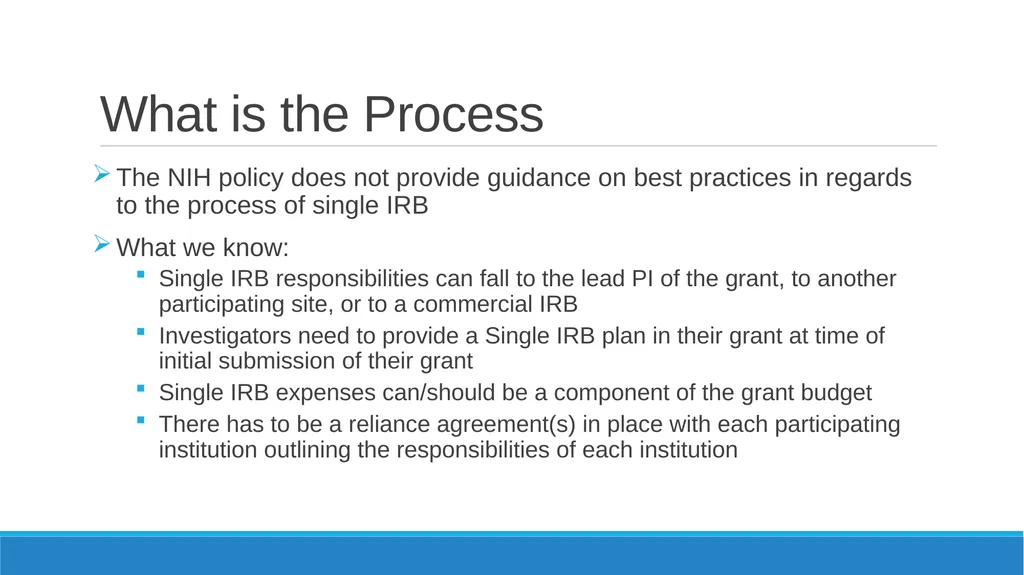
slide8. What is the Process The NIH policy does not provide guidance on best practices in regards to the process of single IRB
What we know:
Single IRB responsibilities can fall to the lead PI of the grant, to another participating site, or to a commercial IRB
Investigators need to provide a Single IRB plan in their grant at time of initial submission of their grant
Single IRB expenses can/should be a component of the grant budget
There has to be a reliance agreement(s) in place with each participating institution outlining the responsibilities of each institution<br>
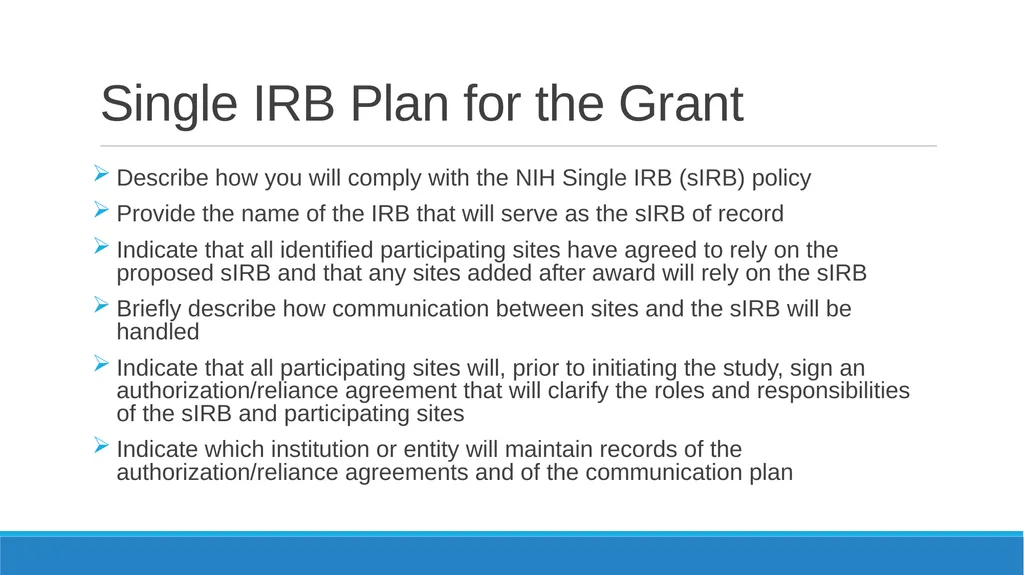
slide9. Single IRB Plan for the Grant Describe how you will comply with the NIH Single IRB (sIRB) policy
Provide the name of the IRB that will serve as the sIRB of record
Indicate that all identified participating sites have agreed to rely on the proposed sIRB and that any sites added after award will rely on the sIRB
Briefly describe how communication between sites and the sIRB will be handled
Indicate that all participating sites will, prior to initiating the study, sign an authorization/reliance agreement that will clarify the roles and responsibilities of the sIRB and participating sites
Indicate which institution or entity will maintain records of the authorization/reliance agreements and of the communication plan<br>
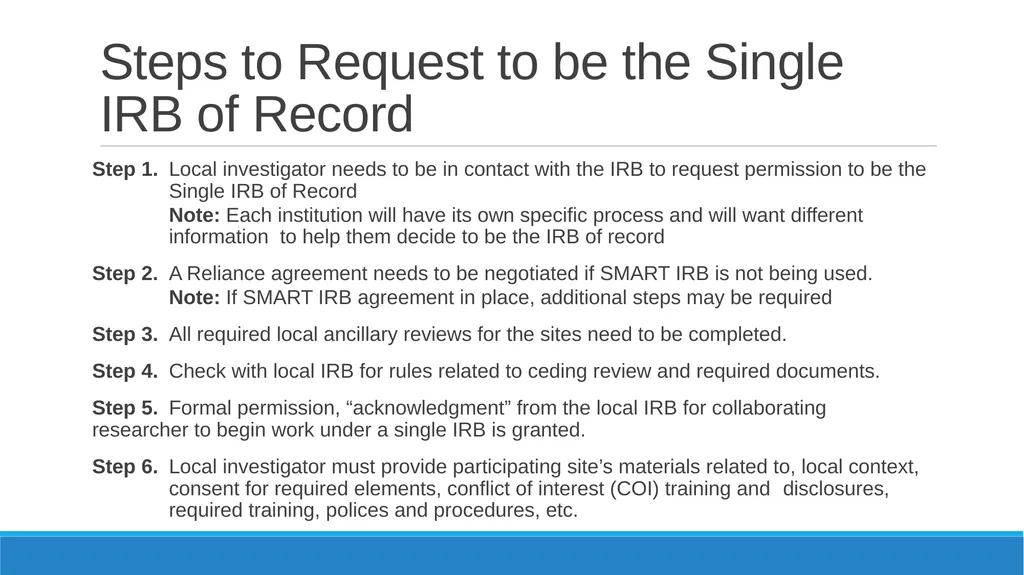
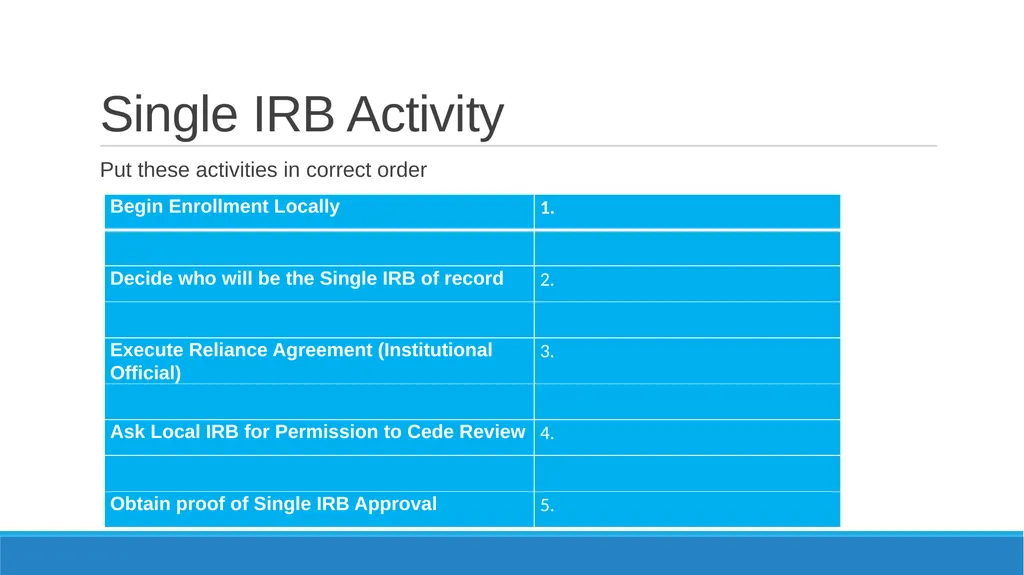
slide10. Steps to Request to be the Single IRB of Record Step 1. Local investigator needs to be in contact with the IRB to request permission to be the Single IRB of Record
Note: Each institution will have its own specific process and will want different information to help them decide to be the IRB of record
Step 2. A Reliance agreement needs to be negotiated if SMART IRB is not being used.
Note: If SMART IRB agreement in place, additional steps may be required
Step 3. All required local ancillary reviews for the sites need to be completed.
Step 4. Check with local IRB for rules related to ceding review and required documents.
Step 5. Formal permission, “acknowledgment” from the local IRB for collaborating researcher to begin work under a single IRB is granted.
Step 6. Local investigator must provide participating site’s materials related to, local context, consent for required elements, conflict of interest (COI) training and disclosures, required training, polices and procedures, etc.<br>
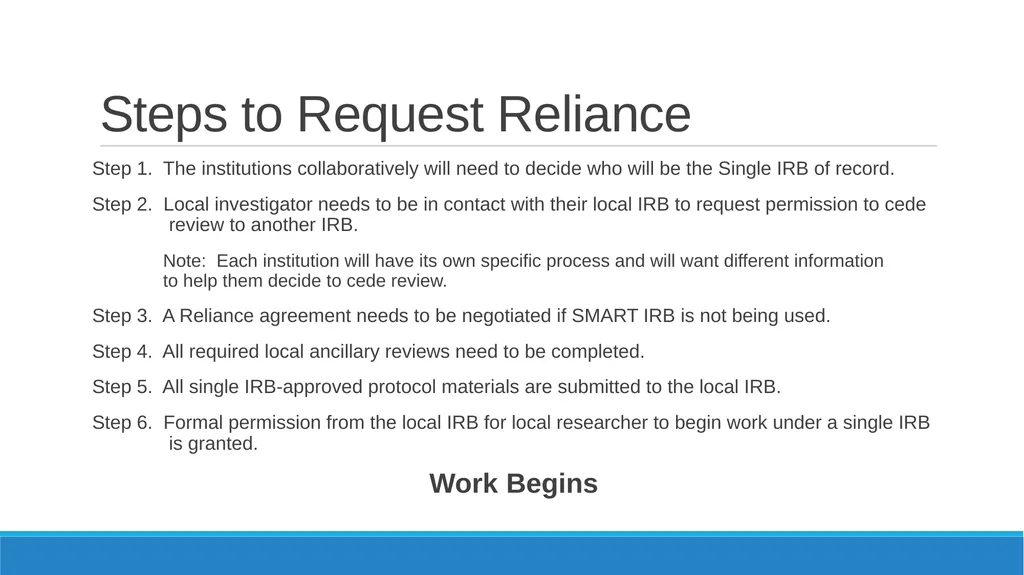
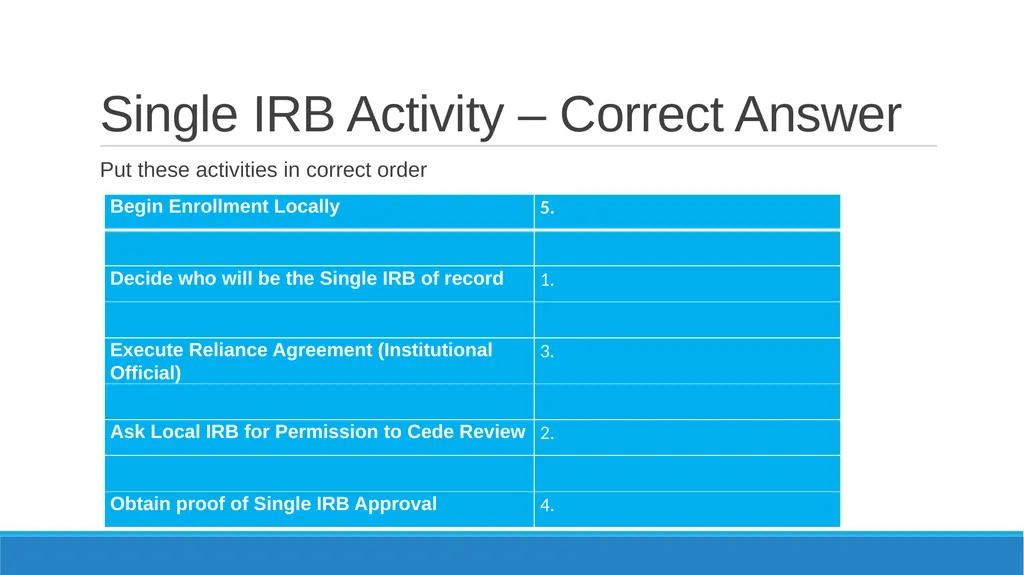
slide11. Steps to Request Reliance Step 1. The institutions collaboratively will need to decide who will be the Single IRB of record.
Step 2. Local investigator needs to be in contact with their local IRB to request permission to cede review to another IRB.
Note: Each institution will have its own specific process and will want different information to help them decide to cede review.
Step 3. A Reliance agreement needs to be negotiated if SMART IRB is not being used.
Step 4. All required local ancillary reviews need to be completed.
Step 5. All single IRB-approved protocol materials are submitted to the local IRB.
Step 6. Formal permission from the local IRB for local researcher to begin work under a single IRB is granted.
Work Begins<br>
slide12. Required Consent Elements When ceding IRB review to a Single IRB, the consent form must first be customized with information specific to the local site. This information includes:
Contact information; and
If the project involves Protected Health Information (PHI) subject to HIPAA, you must include the name of the local IRB and local institution as being among the organizations with access to PHI; and
The PI must ensure that the consent form contains research-related Injury language, and the correct information regarding costs to the participant.
Other study specific information, e.g. compensation, state reporting (HIV, Hepatitis, etc.)<br>
slide13. Health Information Portability and Accountability Act (HIPAA) Most Single IRBs, who are also Privacy Boards, will accept the responsibility of making the HIPAA determination of written authorization or a waiver of authorization
However, in some cases the Single IRB is not the Privacy Board and therefore will not accept the responsibility to make the HIPAA determination
It is important for the local institution to ask this question, as the HIPAA responsibility for this determination will fall to the local IRB or Privacy Board<br>
slide14. Ancillary Institutional Reviews While we are able to cede review to a Single IRB, other institutional reviews still need to be completed prior to work beginning. Some examples are:
Billing Compliance
Institutional Biosafety
Cancer Center Scientific Review
Educate yourself as to which institutional reviews are required.<br>
slide15. Responsibilities to the Single IRB PI and research staff may need to learn a separate electronic protocol submission system
PI and staff need to be aware of and follow the Single IRB policies and procedures
Follow all determinations of the Single IRB
Notify Single IRB of any reportable events or noncompliance
Implement changes only after Single IRB has approved them
Provide access to study records for audit by the Single IRB and/or the local HRPP.
Act as though the Single IRB is Us. Follow their policies and procedures.<br>
slide16. Responsibilities to your Local IRB You must ensure that the local IRB has all currently approved document versions loaded to the eIRB system at the time of initial activation locally
Must notify when there are changes in key personnel to allow us to ensure required training is complete and any COI for new staff can be addressed
Ongoing submissions include reportable events, changes in PI or key personnel, noncompliance, protocol closure
Notify the local IRB if you receive notification of any audits related to the research protocol<br>
slide17. BU Specific Guidance The HRPP Policies and Procedures contains detailed guidance on the process for use of a Single IRB:
Section 2.5 Multi-Site Research
Section 7.2.2.18 Requirements for Relying on another IRB
Section 10.2.3 Evaluation of Requests to Cede Review
OR
Email or Call the IRB at 617-358-5372 or medirb@bu.edu<br>
slide18. UVM Specific Guidance A step-by-step guide can be found in the IRB Policies and Procedures Manual in Section 13.3.
13.3 Procedures for Relying on External IRB for NIH Research
OR
Email or Call your Analyst for Assistance at 656-5040.<br>
slide19. Tips on Operationalizing Single IRB Review Lead Site
Communicate with your IRB early and often
Share SOPs and required information with relying sites
Ceded review is complex! Organization, patience and flexibility is key
Relying Site
Familiarize yourself with the IRB of Record’s single IRB SOPs
Know your local IRB requirements
Understand your obligation as a researcher<br>
slide20. Activities<br>
slide21. Single IRB Activity Put these activities in correct order<br>
slide22. Single IRB Activity – Correct Answer Put these activities in correct order<br>
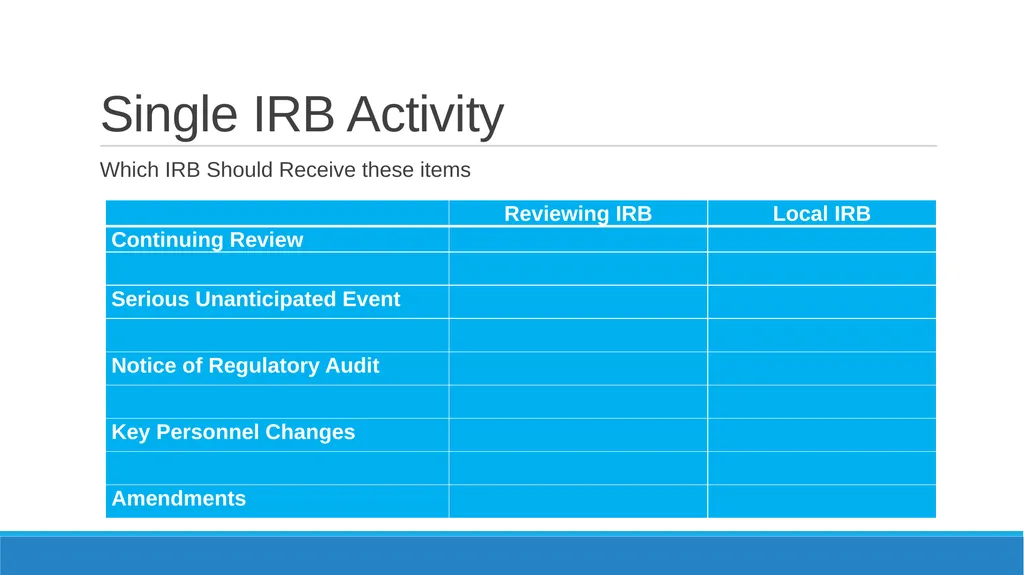
slide23. Single IRB Activity Which IRB Should Receive these items<br>
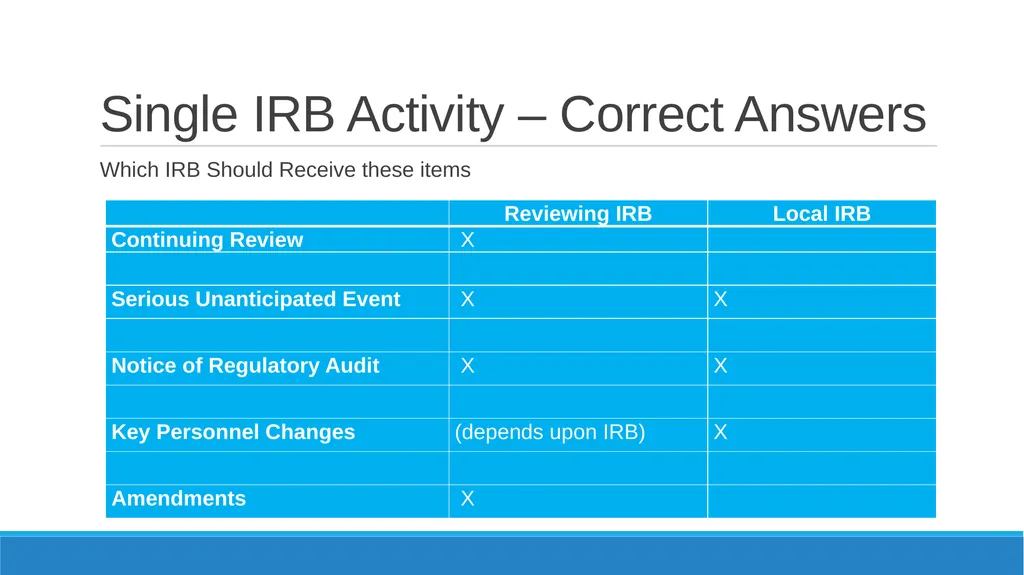
slide24. Single IRB Activity – Correct Answers Which IRB Should Receive these items<br>
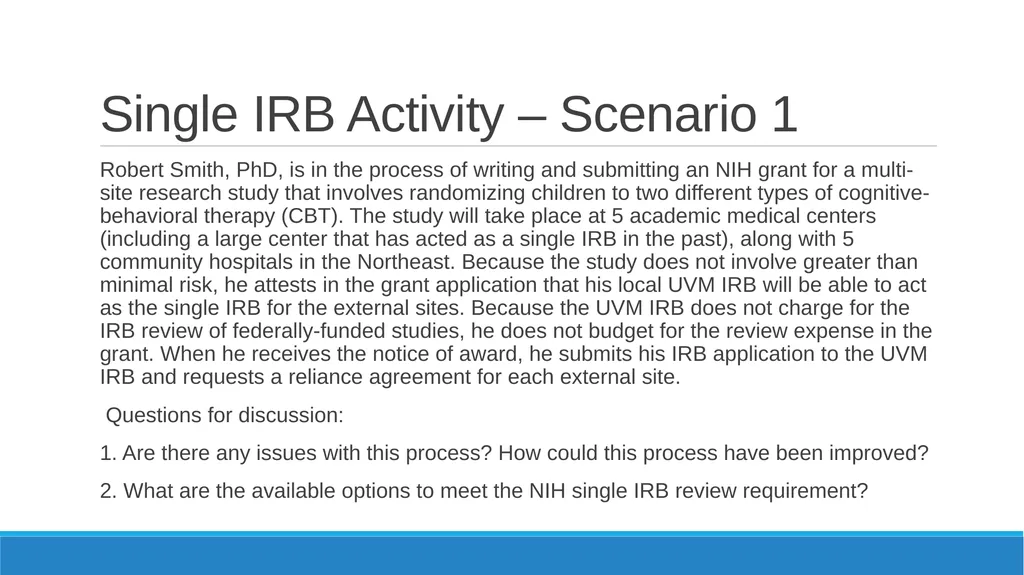
slide25. Single IRB Activity – Scenario 1 Robert Smith, PhD, is in the process of writing and submitting an NIH grant for a multi-site research study that involves randomizing children to two different types of cognitive-behavioral therapy (CBT). The study will take place at 5 academic medical centers (including a large center that has acted as a single IRB in the past), along with 5 community hospitals in the Northeast. Because the study does not involve greater than minimal risk, he attests in the grant application that his local UVM IRB will be able to act as the single IRB for the external sites. Because the UVM IRB does not charge for the IRB review of federally-funded studies, he does not budget for the review expense in the grant. When he receives the notice of award, he submits his IRB application to the UVM IRB and requests a reliance agreement for each external site.
Questions for discussion:
1. Are there any issues with this process? How could this process have been improved?
2. What are the available options to meet the NIH single IRB review requirement?<br>
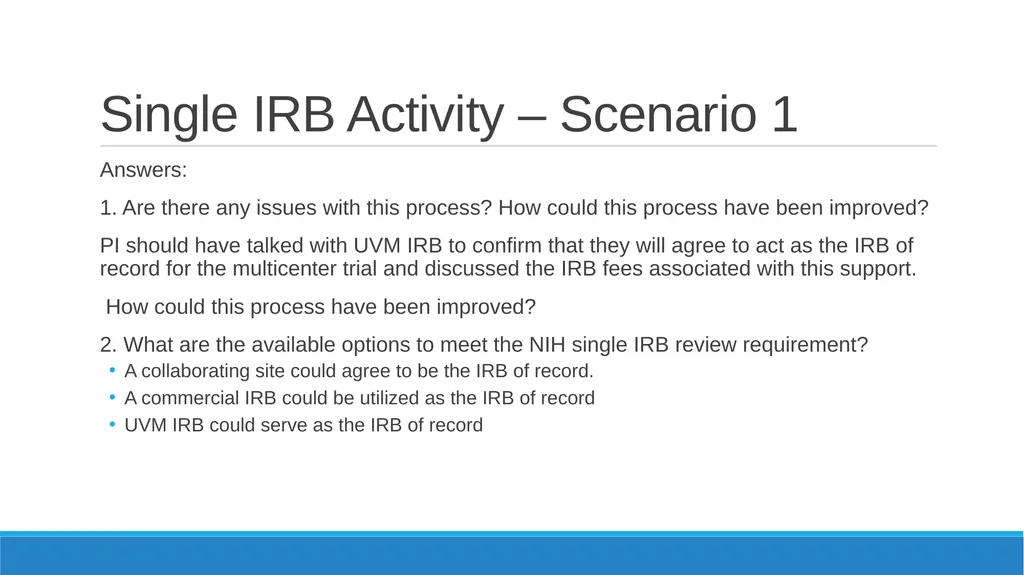
slide26. Single IRB Activity – Scenario 1 Answers:
1. Are there any issues with this process? How could this process have been improved?
PI should have talked with UVM IRB to confirm that they will agree to act as the IRB of record for the multicenter trial and discussed the IRB fees associated with this support.
How could this process have been improved?
2. What are the available options to meet the NIH single IRB review requirement?
A collaborating site could agree to be the IRB of record.
A commercial IRB could be utilized as the IRB of record
UVM IRB could serve as the IRB of record<br>
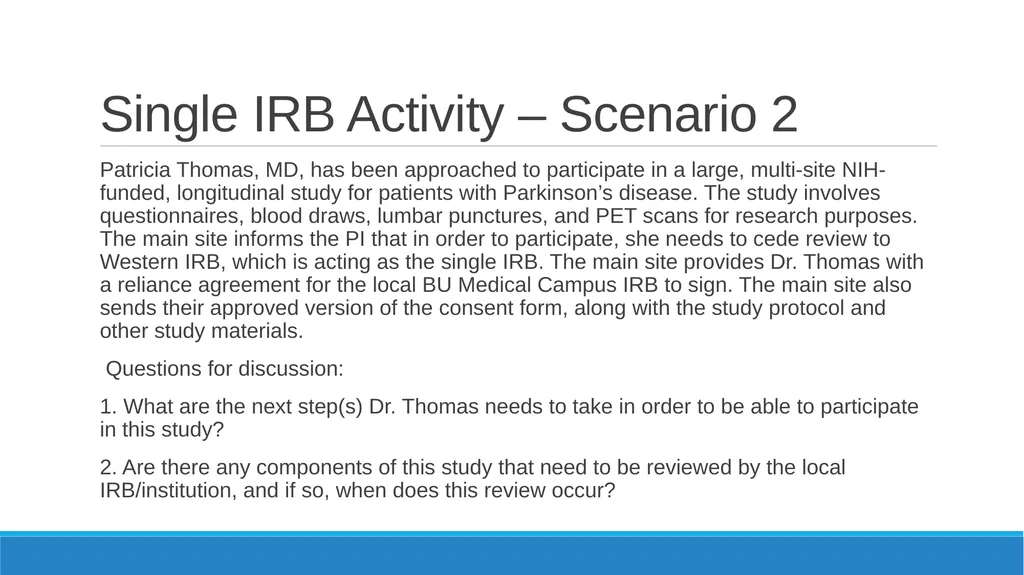
slide27. Single IRB Activity – Scenario 2 Patricia Thomas, MD, has been approached to participate in a large, multi-site NIH-funded, longitudinal study for patients with Parkinson’s disease. The study involves questionnaires, blood draws, lumbar punctures, and PET scans for research purposes. The main site informs the PI that in order to participate, she needs to cede review to Western IRB, which is acting as the single IRB. The main site provides Dr. Thomas with a reliance agreement for the local BU Medical Campus IRB to sign. The main site also sends their approved version of the consent form, along with the study protocol and other study materials.
Questions for discussion:
1. What are the next step(s) Dr. Thomas needs to take in order to be able to participate in this study?
2. Are there any components of this study that need to be reviewed by the local IRB/institution, and if so, when does this review occur?<br>
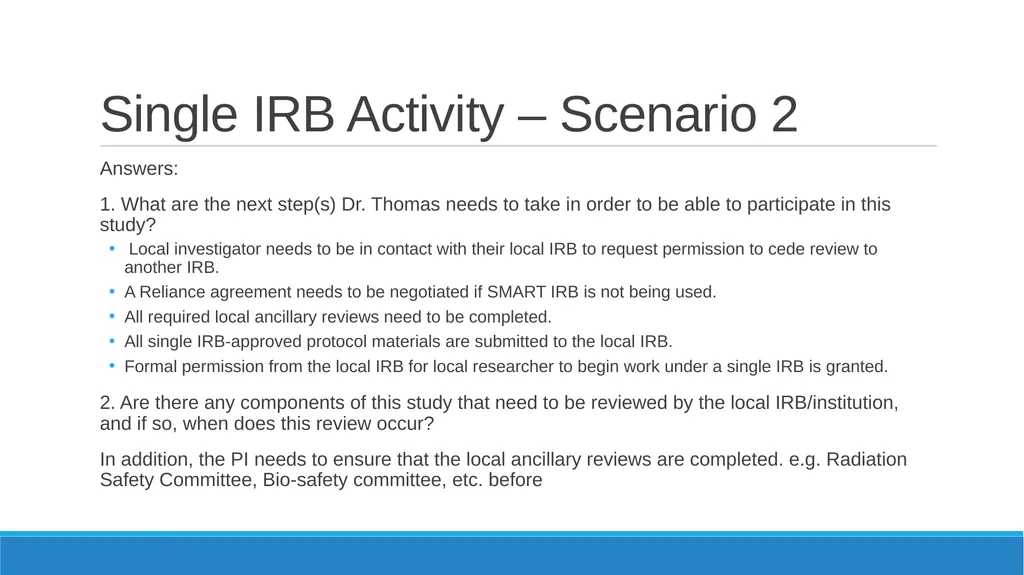
slide28. Single IRB Activity – Scenario 2 Answers:
1. What are the next step(s) Dr. Thomas needs to take in order to be able to participate in this study?
Local investigator needs to be in contact with their local IRB to request permission to cede review to another IRB.
A Reliance agreement needs to be negotiated if SMART IRB is not being used.
All required local ancillary reviews need to be completed.
All single IRB-approved protocol materials are submitted to the local IRB.
Formal permission from the local IRB for local researcher to begin work under a single IRB is granted.
2. Are there any components of this study that need to be reviewed by the local IRB/institution, and if so, when does this review occur?
In addition, the PI needs to ensure that the local ancillary reviews are completed. e.g. Radiation Safety Committee, Bio-safety committee, etc. before<br>
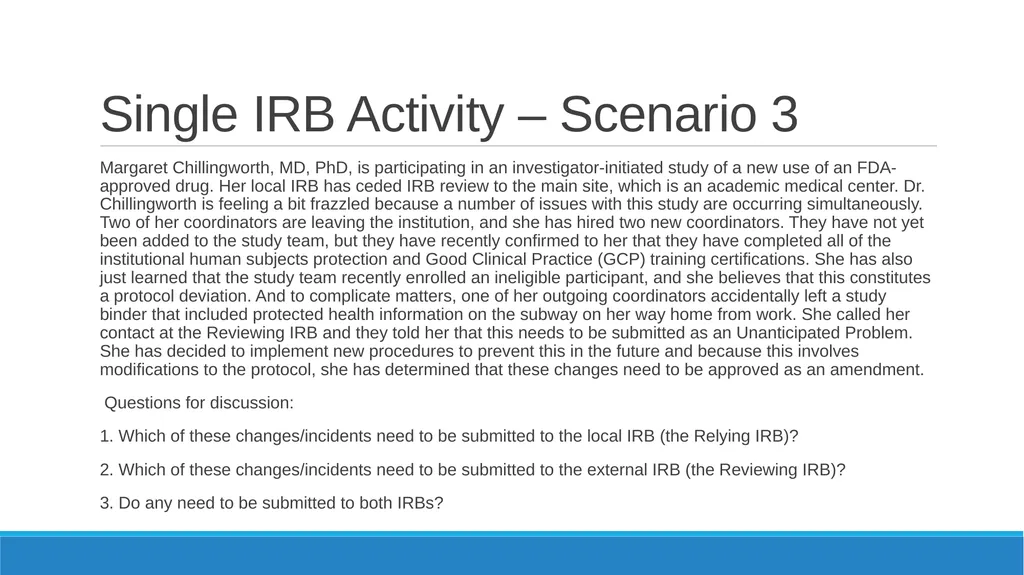
slide29. Single IRB Activity – Scenario 3 Margaret Chillingworth, MD, PhD, is participating in an investigator-initiated study of a new use of an FDA-approved drug. Her local IRB has ceded IRB review to the main site, which is an academic medical center. Dr. Chillingworth is feeling a bit frazzled because a number of issues with this study are occurring simultaneously. Two of her coordinators are leaving the institution, and she has hired two new coordinators. They have not yet been added to the study team, but they have recently confirmed to her that they have completed all of the institutional human subjects protection and Good Clinical Practice (GCP) training certifications. She has also just learned that the study team recently enrolled an ineligible participant, and she believes that this constitutes a protocol deviation. And to complicate matters, one of her outgoing coordinators accidentally left a study binder that included protected health information on the subway on her way home from work. She called her contact at the Reviewing IRB and they told her that this needs to be submitted as an Unanticipated Problem. She has decided to implement new procedures to prevent this in the future and because this involves modifications to the protocol, she has determined that these changes need to be approved as an amendment.
Questions for discussion:
1. Which of these changes/incidents need to be submitted to the local IRB (the Relying IRB)?
2. Which of these changes/incidents need to be submitted to the external IRB (the Reviewing IRB)?
3. Do any need to be submitted to both IRBs?<br>
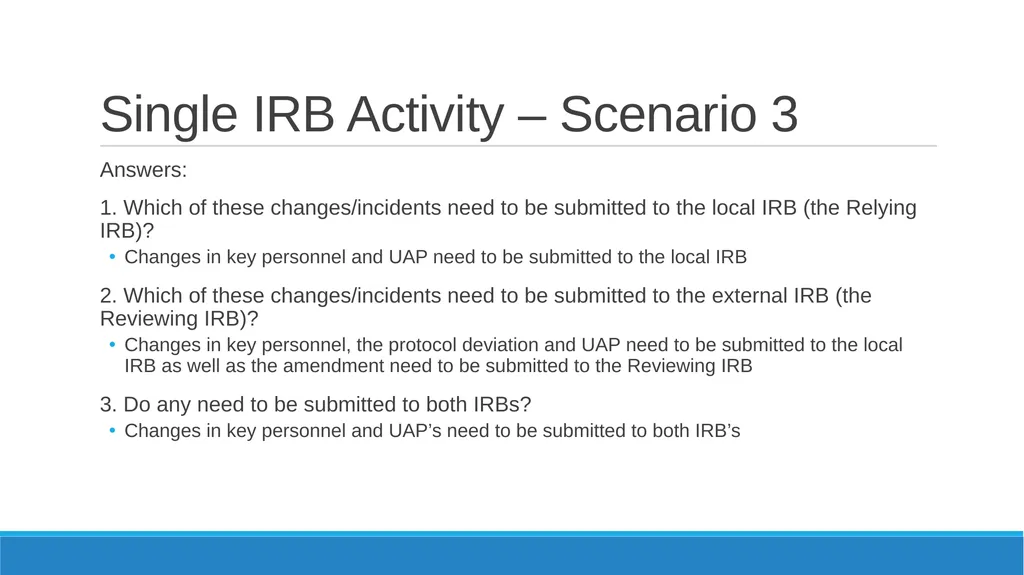
slide30. Single IRB Activity – Scenario 3 Answers:
1. Which of these changes/incidents need to be submitted to the local IRB (the Relying IRB)?
Changes in key personnel and UAP need to be submitted to the local IRB
2. Which of these changes/incidents need to be submitted to the external IRB (the Reviewing IRB)?
Changes in key personnel, the protocol deviation and UAP need to be submitted to the local IRB as well as the amendment need to be submitted to the Reviewing IRB
3. Do any need to be submitted to both IRBs?
Changes in key personnel and UAP’s need to be submitted to both IRB’s<br>
slide31. Single IRB Activity Consent Template – Handout<br>
slide32. Program Evaluation Please take a few minutes to complete the evaluation of this program<br>
Kimberly Luebbers, UVM Assistant Dean for Clinical Research, Donna Silver, UVM Research Protections Office, IRB Director<br>
slide2. Aims of this Presentation Summarize information regarding this new regulatory requirement
Give examples of experiences with single IRB that have occurred since regulatory compliance date
Educate audience as to required documents needed to prepare for single IRB
Explain local procedures for single IRB<br>
slide3. What is Single IRB Review Single IRB review – a legal arrangement that allows one IRB to review the research on behalf of other engaged institutions
IRB of Record – the IRB that reviews and makes the required regulatory determinations (Reviewing IRB)
Relying Institution – the institution that cedes IRB responsibilities to the IRB of Record (Relying IRB)
Reliance Agreement (also called an IRB Authorization Agreement) – a document signed by two or more institutions engaged in human subjects research that permit one or more institutions to cede review to another IRB. The signed agreement permits a single IRB to review human subject research activities for more than one site<br>
slide4. Traditional IRB Review Model<br>
slide5. Single IRB Review Model Protocol X BMC PI UVM PI CHOP PI Boston Medical Center IRB<br>
slide6. Why Is Single IRB Necessary Use of a Single IRB for NIH-funded multi-site research is required as of January 25, 2018
The goal of the policy is to enhance and streamline the IRB review process for multi-site research so that research can proceed as quickly as possible without compromising ethical principles and protections for human research participants
Policy applies to the domestic sites of NIH-funded multi-site studies where each site will conduct the same protocol involving non-exempt human subjects research
Does not apply to career development, research training or fellowship awards
Ongoing multi-site trials still recruiting
Single IRB policy applies to all competing grant applications (new, renewal, revision, or resubmission)
NOT expected to follow the policy UNTIL the renewal application
NIH Policy Single IRB & Exceptions Webinar<br>
slide7. What is SMART IRB The SMART IRB, Streamlined, Multisite, Accelerated Resources for Trials IRB Reliance platform, is an initiative developed under an award from the National Center for Advancing Translational Sciences (“NCATS”) of the National Institutes of Health (“NIH”) to support single Institutional Review Board (“IRB”) review in facilitation of multi-site human subjects research.
The SMART IRB is not a single IRB that institutions can use. It is a platform for executing reliance agreements. Institutions who participate have already been vetted with master agreements in place to enable institutions to more readily participate in collaborative multi-site research under a single IRB.
As of today there are 479 participating institutions.
Information regarding SMART IRB<br>
slide8. What is the Process The NIH policy does not provide guidance on best practices in regards to the process of single IRB
What we know:
Single IRB responsibilities can fall to the lead PI of the grant, to another participating site, or to a commercial IRB
Investigators need to provide a Single IRB plan in their grant at time of initial submission of their grant
Single IRB expenses can/should be a component of the grant budget
There has to be a reliance agreement(s) in place with each participating institution outlining the responsibilities of each institution<br>
slide9. Single IRB Plan for the Grant Describe how you will comply with the NIH Single IRB (sIRB) policy
Provide the name of the IRB that will serve as the sIRB of record
Indicate that all identified participating sites have agreed to rely on the proposed sIRB and that any sites added after award will rely on the sIRB
Briefly describe how communication between sites and the sIRB will be handled
Indicate that all participating sites will, prior to initiating the study, sign an authorization/reliance agreement that will clarify the roles and responsibilities of the sIRB and participating sites
Indicate which institution or entity will maintain records of the authorization/reliance agreements and of the communication plan<br>
slide10. Steps to Request to be the Single IRB of Record Step 1. Local investigator needs to be in contact with the IRB to request permission to be the Single IRB of Record
Note: Each institution will have its own specific process and will want different information to help them decide to be the IRB of record
Step 2. A Reliance agreement needs to be negotiated if SMART IRB is not being used.
Note: If SMART IRB agreement in place, additional steps may be required
Step 3. All required local ancillary reviews for the sites need to be completed.
Step 4. Check with local IRB for rules related to ceding review and required documents.
Step 5. Formal permission, “acknowledgment” from the local IRB for collaborating researcher to begin work under a single IRB is granted.
Step 6. Local investigator must provide participating site’s materials related to, local context, consent for required elements, conflict of interest (COI) training and disclosures, required training, polices and procedures, etc.<br>
slide11. Steps to Request Reliance Step 1. The institutions collaboratively will need to decide who will be the Single IRB of record.
Step 2. Local investigator needs to be in contact with their local IRB to request permission to cede review to another IRB.
Note: Each institution will have its own specific process and will want different information to help them decide to cede review.
Step 3. A Reliance agreement needs to be negotiated if SMART IRB is not being used.
Step 4. All required local ancillary reviews need to be completed.
Step 5. All single IRB-approved protocol materials are submitted to the local IRB.
Step 6. Formal permission from the local IRB for local researcher to begin work under a single IRB is granted.
Work Begins<br>
slide12. Required Consent Elements When ceding IRB review to a Single IRB, the consent form must first be customized with information specific to the local site. This information includes:
Contact information; and
If the project involves Protected Health Information (PHI) subject to HIPAA, you must include the name of the local IRB and local institution as being among the organizations with access to PHI; and
The PI must ensure that the consent form contains research-related Injury language, and the correct information regarding costs to the participant.
Other study specific information, e.g. compensation, state reporting (HIV, Hepatitis, etc.)<br>
slide13. Health Information Portability and Accountability Act (HIPAA) Most Single IRBs, who are also Privacy Boards, will accept the responsibility of making the HIPAA determination of written authorization or a waiver of authorization
However, in some cases the Single IRB is not the Privacy Board and therefore will not accept the responsibility to make the HIPAA determination
It is important for the local institution to ask this question, as the HIPAA responsibility for this determination will fall to the local IRB or Privacy Board<br>
slide14. Ancillary Institutional Reviews While we are able to cede review to a Single IRB, other institutional reviews still need to be completed prior to work beginning. Some examples are:
Billing Compliance
Institutional Biosafety
Cancer Center Scientific Review
Educate yourself as to which institutional reviews are required.<br>
slide15. Responsibilities to the Single IRB PI and research staff may need to learn a separate electronic protocol submission system
PI and staff need to be aware of and follow the Single IRB policies and procedures
Follow all determinations of the Single IRB
Notify Single IRB of any reportable events or noncompliance
Implement changes only after Single IRB has approved them
Provide access to study records for audit by the Single IRB and/or the local HRPP.
Act as though the Single IRB is Us. Follow their policies and procedures.<br>
slide16. Responsibilities to your Local IRB You must ensure that the local IRB has all currently approved document versions loaded to the eIRB system at the time of initial activation locally
Must notify when there are changes in key personnel to allow us to ensure required training is complete and any COI for new staff can be addressed
Ongoing submissions include reportable events, changes in PI or key personnel, noncompliance, protocol closure
Notify the local IRB if you receive notification of any audits related to the research protocol<br>
slide17. BU Specific Guidance The HRPP Policies and Procedures contains detailed guidance on the process for use of a Single IRB:
Section 2.5 Multi-Site Research
Section 7.2.2.18 Requirements for Relying on another IRB
Section 10.2.3 Evaluation of Requests to Cede Review
OR
Email or Call the IRB at 617-358-5372 or medirb@bu.edu<br>
slide18. UVM Specific Guidance A step-by-step guide can be found in the IRB Policies and Procedures Manual in Section 13.3.
13.3 Procedures for Relying on External IRB for NIH Research
OR
Email or Call your Analyst for Assistance at 656-5040.<br>
slide19. Tips on Operationalizing Single IRB Review Lead Site
Communicate with your IRB early and often
Share SOPs and required information with relying sites
Ceded review is complex! Organization, patience and flexibility is key
Relying Site
Familiarize yourself with the IRB of Record’s single IRB SOPs
Know your local IRB requirements
Understand your obligation as a researcher<br>
slide20. Activities<br>
slide21. Single IRB Activity Put these activities in correct order<br>
slide22. Single IRB Activity – Correct Answer Put these activities in correct order<br>
slide23. Single IRB Activity Which IRB Should Receive these items<br>
slide24. Single IRB Activity – Correct Answers Which IRB Should Receive these items<br>
slide25. Single IRB Activity – Scenario 1 Robert Smith, PhD, is in the process of writing and submitting an NIH grant for a multi-site research study that involves randomizing children to two different types of cognitive-behavioral therapy (CBT). The study will take place at 5 academic medical centers (including a large center that has acted as a single IRB in the past), along with 5 community hospitals in the Northeast. Because the study does not involve greater than minimal risk, he attests in the grant application that his local UVM IRB will be able to act as the single IRB for the external sites. Because the UVM IRB does not charge for the IRB review of federally-funded studies, he does not budget for the review expense in the grant. When he receives the notice of award, he submits his IRB application to the UVM IRB and requests a reliance agreement for each external site.
Questions for discussion:
1. Are there any issues with this process? How could this process have been improved?
2. What are the available options to meet the NIH single IRB review requirement?<br>
slide26. Single IRB Activity – Scenario 1 Answers:
1. Are there any issues with this process? How could this process have been improved?
PI should have talked with UVM IRB to confirm that they will agree to act as the IRB of record for the multicenter trial and discussed the IRB fees associated with this support.
How could this process have been improved?
2. What are the available options to meet the NIH single IRB review requirement?
A collaborating site could agree to be the IRB of record.
A commercial IRB could be utilized as the IRB of record
UVM IRB could serve as the IRB of record<br>
slide27. Single IRB Activity – Scenario 2 Patricia Thomas, MD, has been approached to participate in a large, multi-site NIH-funded, longitudinal study for patients with Parkinson’s disease. The study involves questionnaires, blood draws, lumbar punctures, and PET scans for research purposes. The main site informs the PI that in order to participate, she needs to cede review to Western IRB, which is acting as the single IRB. The main site provides Dr. Thomas with a reliance agreement for the local BU Medical Campus IRB to sign. The main site also sends their approved version of the consent form, along with the study protocol and other study materials.
Questions for discussion:
1. What are the next step(s) Dr. Thomas needs to take in order to be able to participate in this study?
2. Are there any components of this study that need to be reviewed by the local IRB/institution, and if so, when does this review occur?<br>
slide28. Single IRB Activity – Scenario 2 Answers:
1. What are the next step(s) Dr. Thomas needs to take in order to be able to participate in this study?
Local investigator needs to be in contact with their local IRB to request permission to cede review to another IRB.
A Reliance agreement needs to be negotiated if SMART IRB is not being used.
All required local ancillary reviews need to be completed.
All single IRB-approved protocol materials are submitted to the local IRB.
Formal permission from the local IRB for local researcher to begin work under a single IRB is granted.
2. Are there any components of this study that need to be reviewed by the local IRB/institution, and if so, when does this review occur?
In addition, the PI needs to ensure that the local ancillary reviews are completed. e.g. Radiation Safety Committee, Bio-safety committee, etc. before<br>
slide29. Single IRB Activity – Scenario 3 Margaret Chillingworth, MD, PhD, is participating in an investigator-initiated study of a new use of an FDA-approved drug. Her local IRB has ceded IRB review to the main site, which is an academic medical center. Dr. Chillingworth is feeling a bit frazzled because a number of issues with this study are occurring simultaneously. Two of her coordinators are leaving the institution, and she has hired two new coordinators. They have not yet been added to the study team, but they have recently confirmed to her that they have completed all of the institutional human subjects protection and Good Clinical Practice (GCP) training certifications. She has also just learned that the study team recently enrolled an ineligible participant, and she believes that this constitutes a protocol deviation. And to complicate matters, one of her outgoing coordinators accidentally left a study binder that included protected health information on the subway on her way home from work. She called her contact at the Reviewing IRB and they told her that this needs to be submitted as an Unanticipated Problem. She has decided to implement new procedures to prevent this in the future and because this involves modifications to the protocol, she has determined that these changes need to be approved as an amendment.
Questions for discussion:
1. Which of these changes/incidents need to be submitted to the local IRB (the Relying IRB)?
2. Which of these changes/incidents need to be submitted to the external IRB (the Reviewing IRB)?
3. Do any need to be submitted to both IRBs?<br>
slide30. Single IRB Activity – Scenario 3 Answers:
1. Which of these changes/incidents need to be submitted to the local IRB (the Relying IRB)?
Changes in key personnel and UAP need to be submitted to the local IRB
2. Which of these changes/incidents need to be submitted to the external IRB (the Reviewing IRB)?
Changes in key personnel, the protocol deviation and UAP need to be submitted to the local IRB as well as the amendment need to be submitted to the Reviewing IRB
3. Do any need to be submitted to both IRBs?
Changes in key personnel and UAP’s need to be submitted to both IRB’s<br>
slide31. Single IRB Activity Consent Template – Handout<br>
slide32. Program Evaluation Please take a few minutes to complete the evaluation of this program<br>