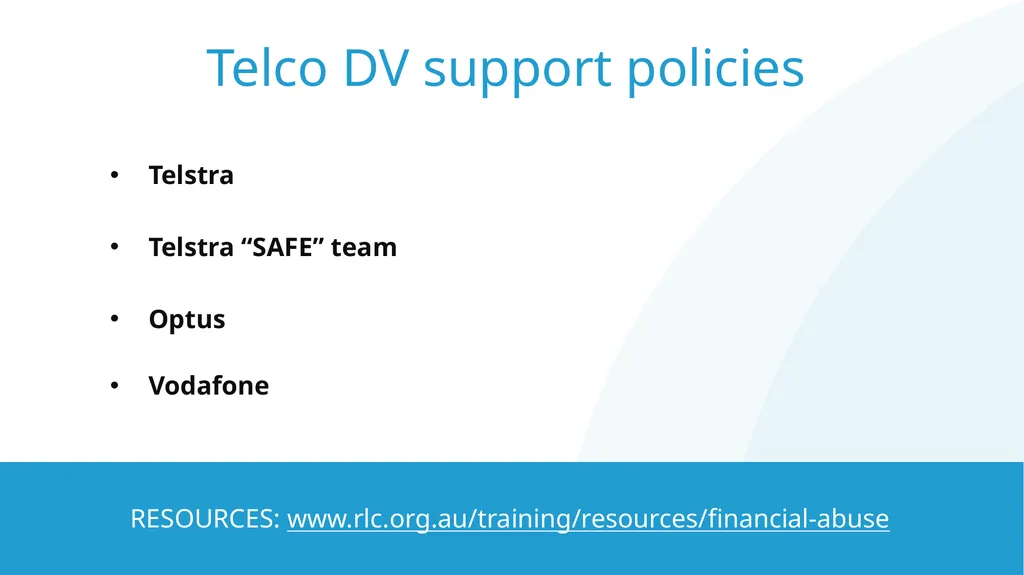
Resolving financial abuse legal issues with telco providers Outline How to identify financial abuse Negotiating with telco providers Negotiating with utility providers Questions and further resources RESOURCES:
"Resolving financial abuse legal issues with telco" is the property of its rightful owner. Permission is granted to
download and print the materials on this website for personal, non-commercial use only, and to display it
on your personal computer provided you do not modify the materials and that you retain all copyright
notices contained in the materials. By downloading content from our website, you accept the terms of this
agreement.
Presentation Transcript
01
Resolving financial abuse legal issues with telco providers<br>
02
Outline
How to identify financial abuse
Negotiating with telco providers
Negotiating with utility providers
Questions and further resources RESOURCES: www.rlc.org.au/training/resources/financial-abuse<br>
03
1. How to identify financial abuse<br>
04
What is financial abuse? Financial or economic abuse is a form of domestic violence where an abuser uses money as a means to gain power and to control their partner.
Domestic violence is “a pattern of abusive behaviour in an intimate relationship or other type of family relationship where one person assumes a position of power over another and causes fear… It is often referred to as a pattern of coercion and control.” (1800RESPECT)
There is no single agreed legal definition of domestic violence in Australia.<br>
05
Behaviours Control over day-to-day household finances & material wellbeing
Denying accumulation of personal assets or eroding those assets
Manipulating credit and debt to the abused partner’s disadvantage
Blocking access to social and economic participation
Financially monitoring, over-controlling and scrutinising their partner
Refusing to contribute
Exploiting women sexually in exchange for money
SOURCE: Restoring Financial Safety: Legal Responses to Economic Abuse (see Resources)<br>
06
Financial abuse during COVID-19 In times of crisis, family and domestic violence increases in frequency and severity due to social isolation, heightened stress, financial pressure, loss of work and loss of support networks.
It can be easier for signs of financial abuse to be disguised as financial stress, unemployment and housing insecurity.
Opportunities to safely contact support services can be limited.<br>
07
Warning signs Forcing them to make an early withdrawal from superannuation
Using social distancing as an excuse to stop them attending their workplace or working or studying from home
Using the pandemic as an excuse to withhold financial support like child support payments, or to transfer household bills or debts into their name
Fraudulently applying for or taking control of social security benefits in their name<br>
08
2. Negotiating with Telco Providers<br>
09
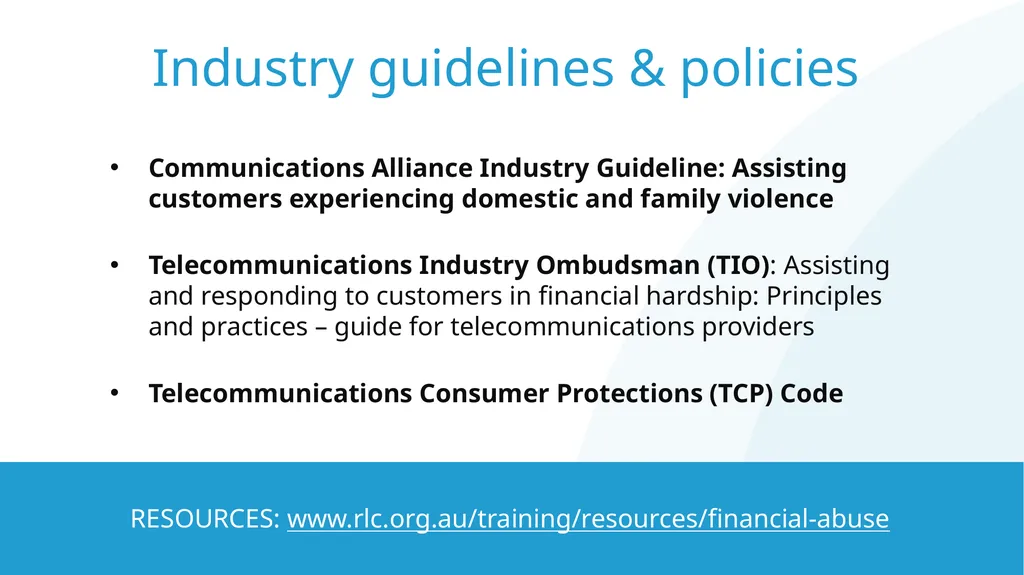
Industry guidelines & policies Communications Alliance Industry Guideline: Assisting customers experiencing domestic and family violence
Telecommunications Industry Ombudsman (TIO): Assisting and responding to customers in financial hardship: Principles and practices – guide for telecommunications providers
Telecommunications Consumer Protections (TCP) Code RESOURCES: www.rlc.org.au/training/resources/financial-abuse<br>
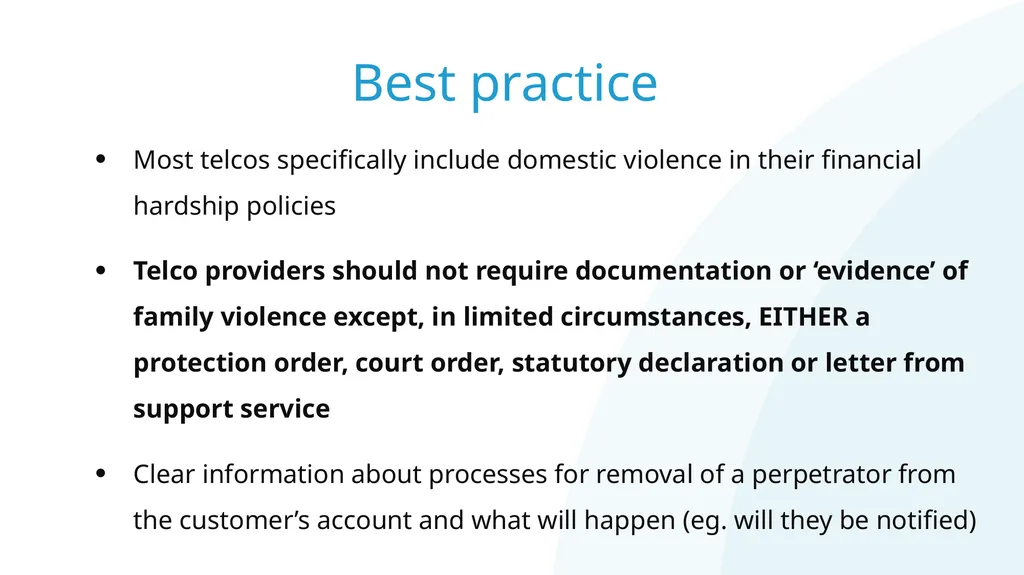
Best practice Most telcos specifically include domestic violence in their financial hardship policies
Telco providers should not require documentation or ‘evidence’ of family violence except, in limited circumstances, EITHER a protection order, court order, statutory declaration or letter from support service
Clear information about processes for removal of a perpetrator from the customer’s account and what will happen (eg. will they be notified)<br>
12
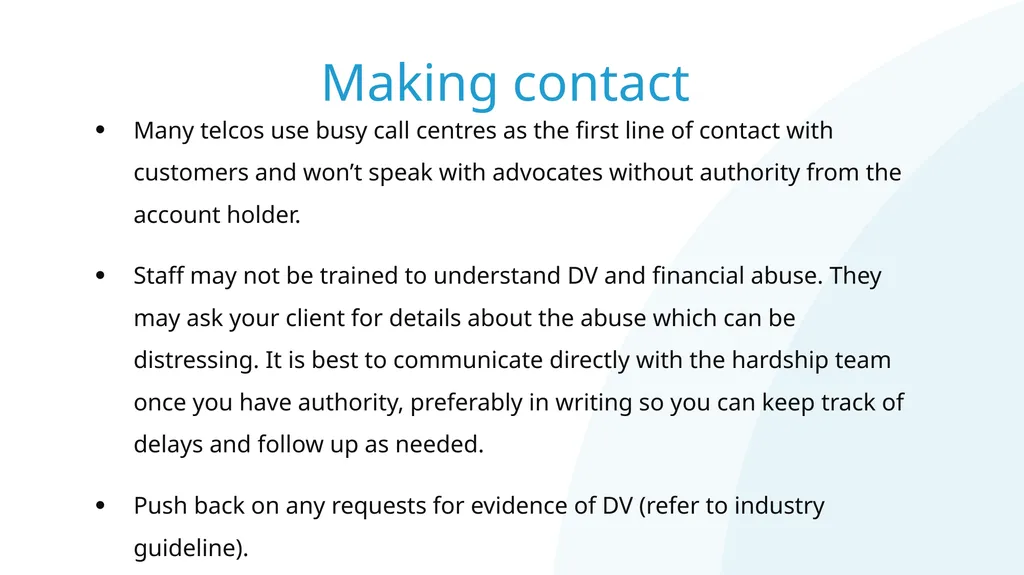
Making contact Many telcos use busy call centres as the first line of contact with customers and won’t speak with advocates without authority from the account holder.
Staff may not be trained to understand DV and financial abuse. They may ask your client for details about the abuse which can be distressing. It is best to communicate directly with the hardship team once you have authority, preferably in writing so you can keep track of delays and follow up as needed.
Push back on any requests for evidence of DV (refer to industry guideline).<br>
13
Phone plans Speak to your client about their communication needs. Consider privacy, safety and connection to family, friends and other supports.
Try to negotiate for any post-paid contracts to be cancelled and the client to be moved onto a pre-paid contract (with complimentary free credit).
Where account not in clients name (client is ‘on ex- partners plan’) Telcos can transfer service to new number / account.
New phone number: Depending on the client’s wishes and safety concerns, they may want to have their phone number changed and/or contacts transferred over. Phone numbers
Work with the telco to minimise safety risks, e.g. if disconnecting perpetrator’s phone, is it safer to do so without warning or give them notice?<br>
14
Phone handsets Check if the client’s mobile handset is included in the contract and if so, how much they still need to pay off (and any applicable cancellation fees).
Telcos may agree to waive the amount owing on the handset if it is returned in good condition. If so, make sure the client has an alternative phone to use.
If the handset is damaged, check if the client has been paying for insurance. If the handset can be repaired or replaced under insurance first, then the client may be able to return the handset in good condition as above.
If the perpetrator has the handset and it is not safe for the client to recover it, ask the telco to consider waiving the outstanding handset fee in the client’s name.<br>
15
“Unwelcome” contact Telcos can take action against a “pattern of unwelcome communication” such as repeated texts or phone calls which involve harassment or threats. They can conduct investigations when this behaviour is reported and issue warnings to the callers.
They can also provide advice on blocking and screening unwelcome calls – through the telco service or by using the handset to block certain numbers.
This is of limited assistance as it generally does not cover contact through third party apps like Facebook messenger, WhatsApp or Apple iMessage, only the SMS and call service linked to the telco.
Unwelcome contact through these Apps can be blocked by the user on these services – e.g. https://www.facebook.com/help/1682395428676916/<br>
16
3. Negotiating with Utilities Providers<br>
17
Resources Many utility providers also acknowledge domestic violence in their financial hardship policies. Some have specific domestic violence policies and trained staff to identify and assist people experiencing domestic violence.
Energy & Water Ombudsman NSW
NSW Energy Accounts Payment Assistance (EAPA) vouchers
State government rebates<br>
18
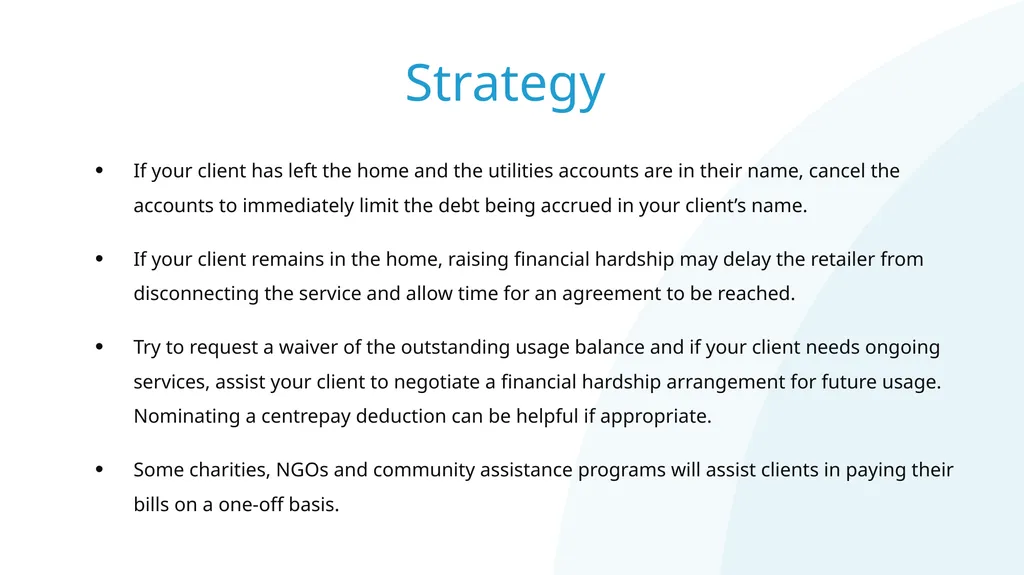
Strategy If your client has left the home and the utilities accounts are in their name, cancel the accounts to immediately limit the debt being accrued in your client’s name.
If your client remains in the home, raising financial hardship may delay the retailer from disconnecting the service and allow time for an agreement to be reached.
Try to request a waiver of the outstanding usage balance and if your client needs ongoing services, assist your client to negotiate a financial hardship arrangement for future usage. Nominating a centrepay deduction can be helpful if appropriate.
Some charities, NGOs and community assistance programs will assist clients in paying their bills on a one-off basis.<br>
19
4. Questions and further resources Will Dwyer Solicitor, Financial Abuse Service NSW
Redfern Legal Centre RESOURCES: www.rlc.org.au/training/resources/financial-abuse<br>
20
Before You Go Your feedback helps us improve our training.
Please stay with us for another 60 seconds… Training: rlc.org.au/training
Enquiries: Nick Manning
education@rlc.org.au This workshop is a guide to the law in Australia. It is not a substitute for legal advice. If you have a legal problem, seek legal advice from a legal centre or Legal Aid.<br>