
RESPeCT PD pROGRAM RESPeCT Summer Institute Day 3
NS
Published · 40 slides · 0 views
1 / 1
Description
RESPeCT PD pROGRAM RESPeCT Summer Institute Day 3 Agenda for Day 3 Day-2 reflections Focus questions Introducing Student Thinking Lens strategies 4 and 5 Lesson analysis: STL strategies 4 and 5 Lunch Content deepening: water cycle Summary,
Related Topics
Share
Embed code
Download this presentation From Below
"RESPeCT PD pROGRAM RESPeCT Summer Institute Day 3" is the property of its rightful owner. Permission is granted to download and print the materials on this website for personal, non-commercial use only, and to display it on your personal computer provided you do not modify the materials and that you retain all copyright notices contained in the materials. By downloading content from our website, you accept the terms of this agreement.
Presentation Transcript
01
RESPeCT PD pROGRAM RESPeCT Summer Institute Day 3<br>
02
Agenda for Day 3 Day-2 reflections
Focus questions
Introducing Student Thinking Lens strategies 4 and 5
Lesson analysis: STL strategies 4 and 5
Lunch
Content deepening: water cycle
Summary, homework, and reflections<br>
Focus questions
Introducing Student Thinking Lens strategies 4 and 5
Lesson analysis: STL strategies 4 and 5
Lunch
Content deepening: water cycle
Summary, homework, and reflections<br>
03
Trends in Reflections<br>
04
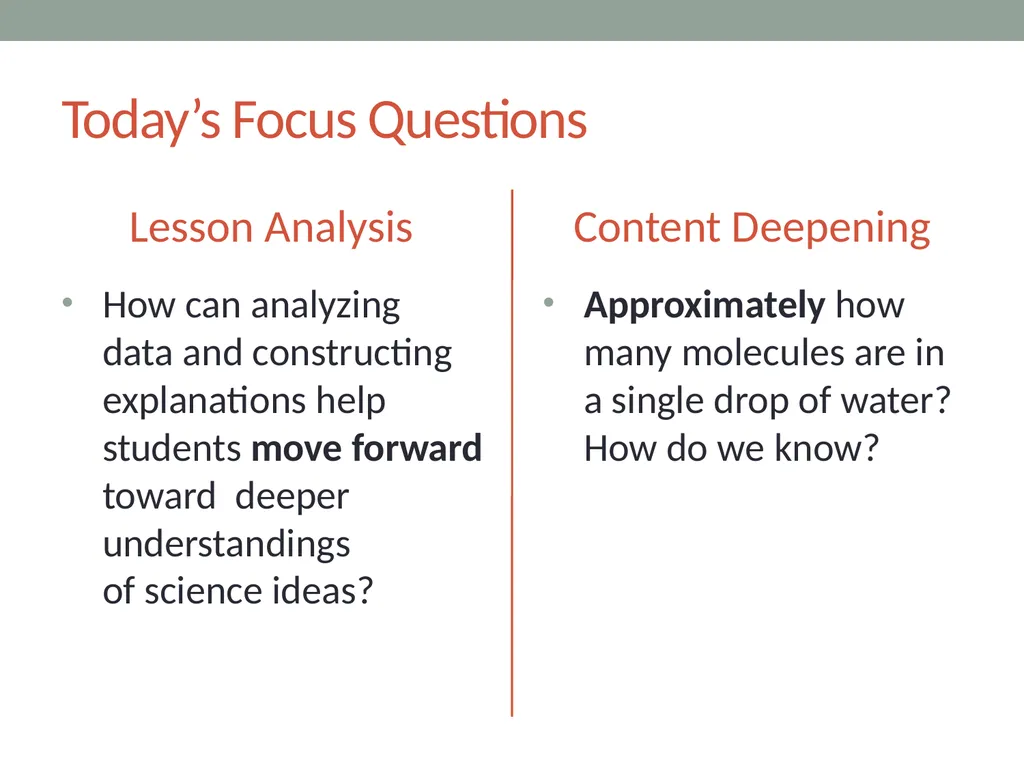
Today’s Focus Questions Lesson Analysis How can analyzing
data and constructing explanations help students move forward toward deeper understandings
of science ideas? Content Deepening Approximately how many molecules are in a single drop of water? How do we know?<br>
05
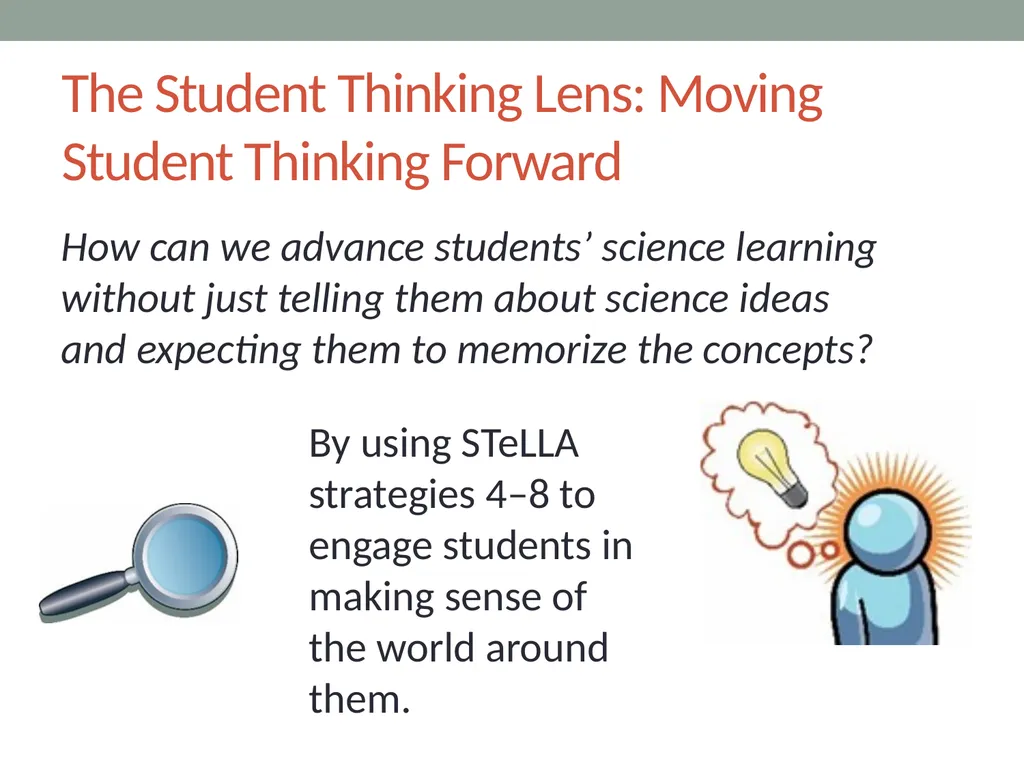
The Student Thinking Lens: Moving Student Thinking Forward By using STeLLA strategies 4–8 to engage students in making sense of the world around them. How can we advance students’ science learning without just telling them about science ideas and expecting them to memorize the concepts?<br>
06
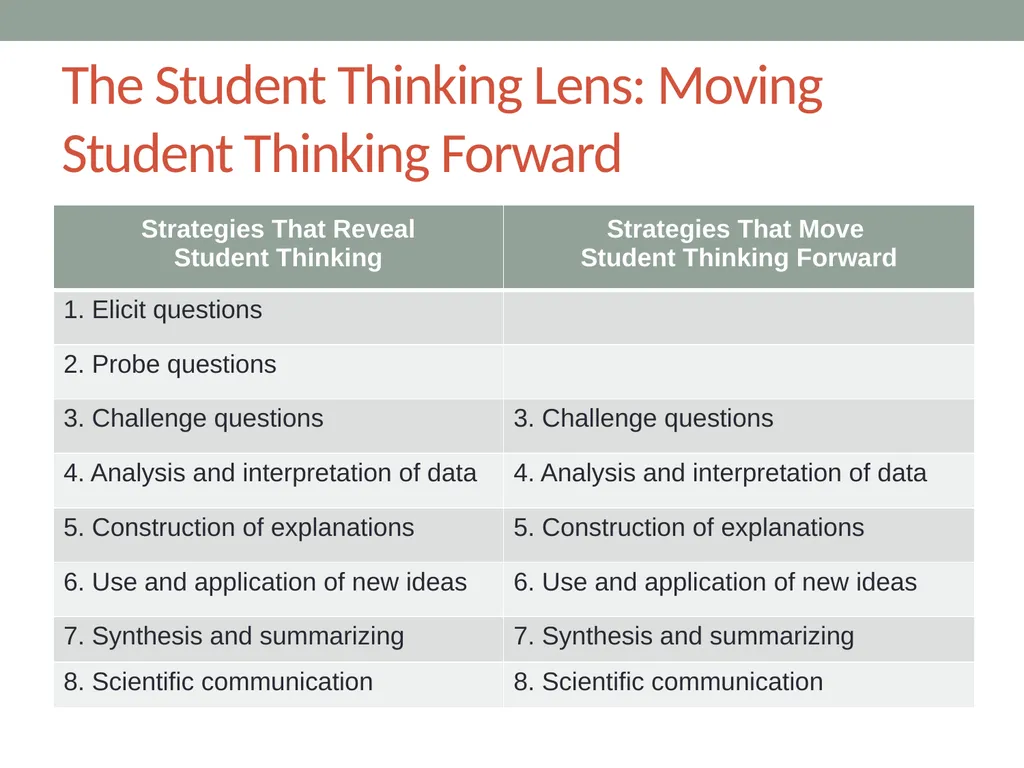
The Student Thinking Lens: Moving Student Thinking Forward<br>
07
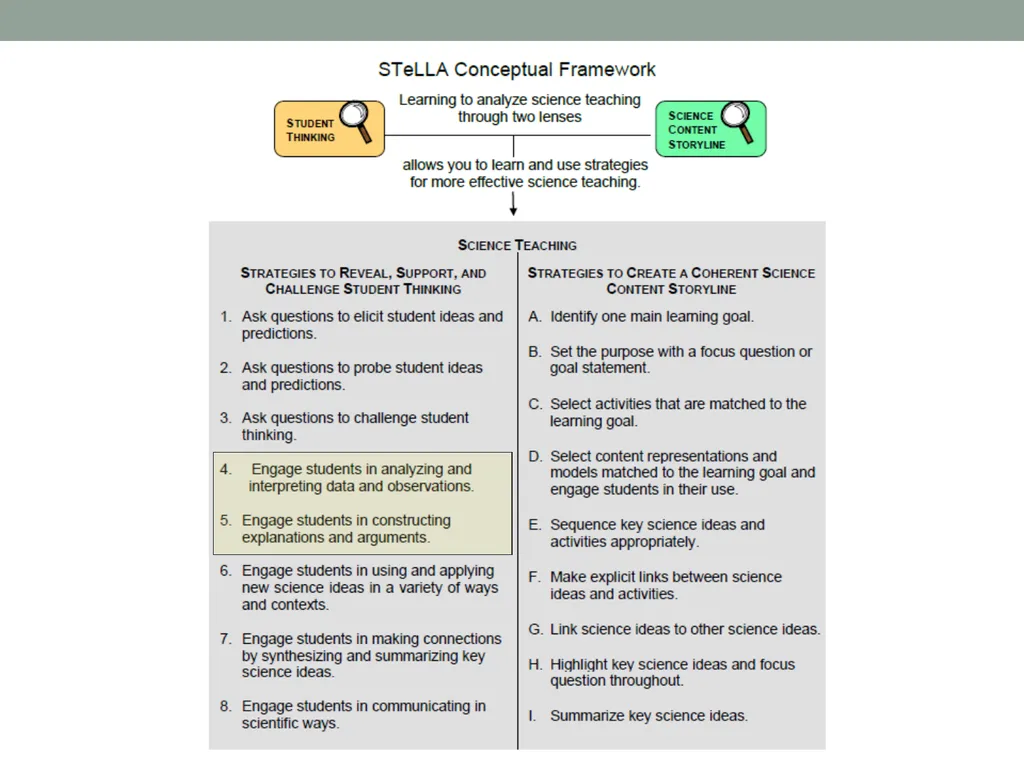
The Student Thinking Lens: From Questions to Activities Look at the Summary of STeLLA Student Thinking Lens Strategies in the strategies booklet.
What distinguishes strategies 1–3 from the rest of the Student Thinking Lens strategies?<br>
What distinguishes strategies 1–3 from the rest of the Student Thinking Lens strategies?<br>
08
STL Strategies 4 and 5: Purposes and Key Features Strategy 4
What are the purpose and key features? Strategy 5
What are the purpose and key features?<br>
What are the purpose and key features? Strategy 5
What are the purpose and key features?<br>
09
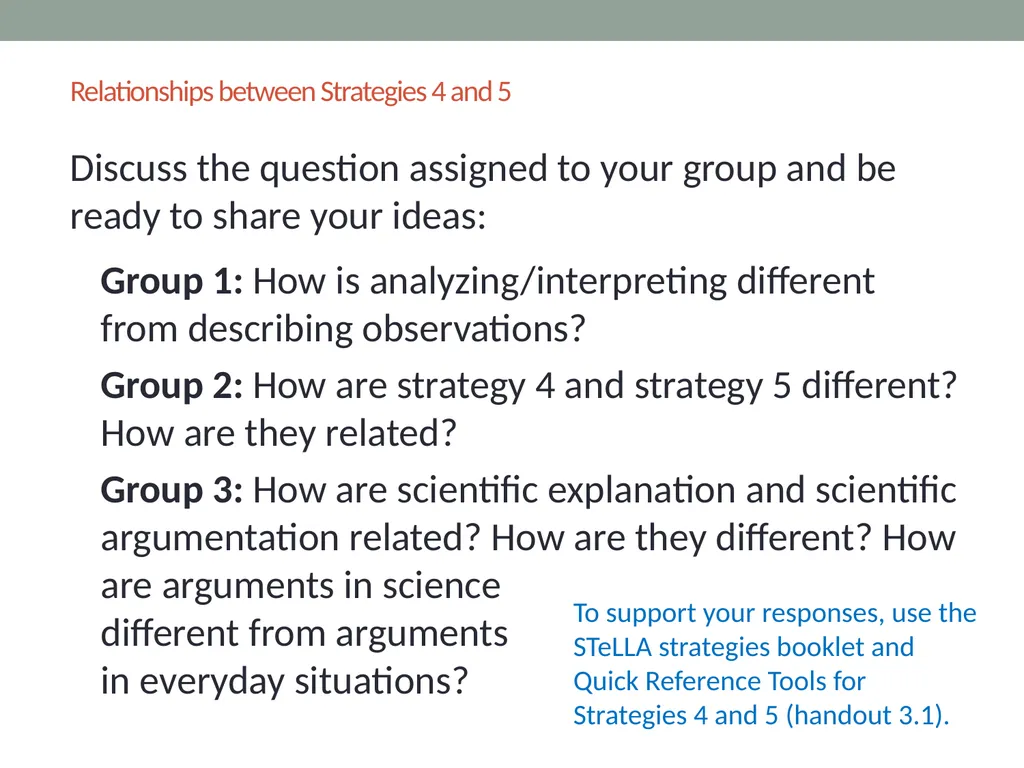
Relationships between Strategies 4 and 5 Discuss the question assigned to your group and be ready to share your ideas:
Group 1: How is analyzing/interpreting different from describing observations?
Group 2: How are strategy 4 and strategy 5 different? How are they related?
Group 3: How are scientific explanation and scientific argumentation related? How are they different? How are arguments in science different from arguments in everyday situations? To support your responses, use the STeLLA strategies booklet and Quick Reference Tools for Strategies 4 and 5 (handout 3.1).<br>
Group 1: How is analyzing/interpreting different from describing observations?
Group 2: How are strategy 4 and strategy 5 different? How are they related?
Group 3: How are scientific explanation and scientific argumentation related? How are they different? How are arguments in science different from arguments in everyday situations? To support your responses, use the STeLLA strategies booklet and Quick Reference Tools for Strategies 4 and 5 (handout 3.1).<br>
10
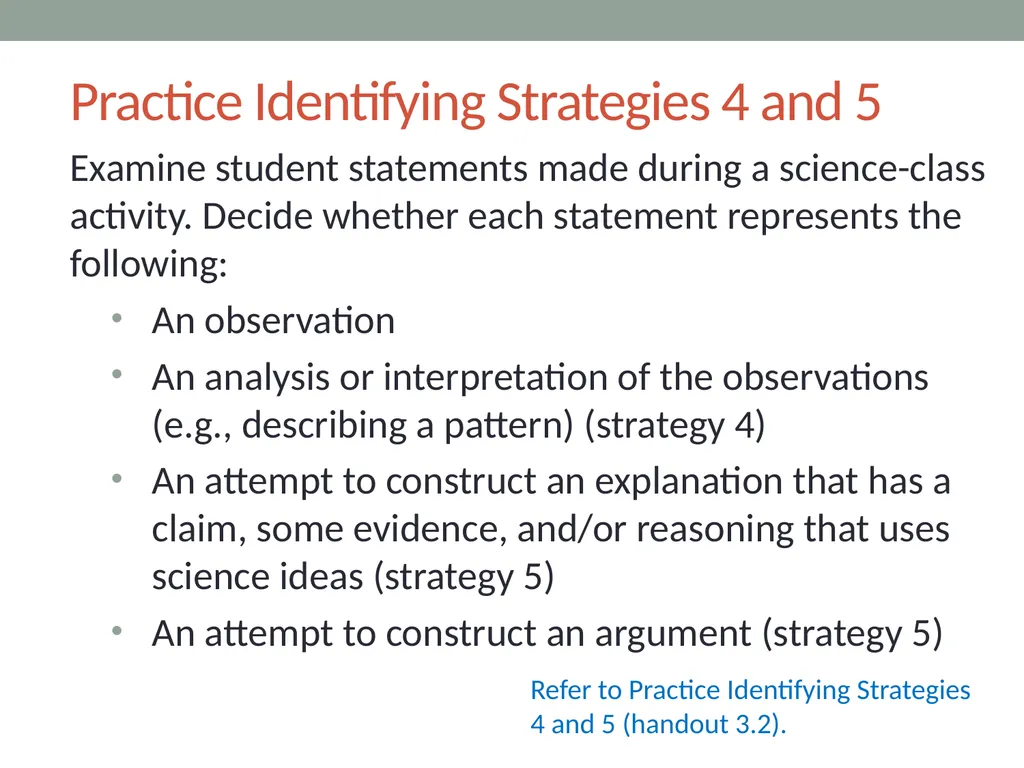
Practice Identifying Strategies 4 and 5 Examine student statements made during a science-class activity. Decide whether each statement represents the following:
An observation
An analysis or interpretation of the observations (e.g., describing a pattern) (strategy 4)
An attempt to construct an explanation that has a claim, some evidence, and/or reasoning that uses science ideas (strategy 5)
An attempt to construct an argument (strategy 5) Refer to Practice Identifying Strategies 4 and 5 (handout 3.2).<br>
An observation
An analysis or interpretation of the observations (e.g., describing a pattern) (strategy 4)
An attempt to construct an explanation that has a claim, some evidence, and/or reasoning that uses science ideas (strategy 5)
An attempt to construct an argument (strategy 5) Refer to Practice Identifying Strategies 4 and 5 (handout 3.2).<br>
11
Lesson Analysis Focus Question How can analyzing data and constructing explanations help students move forward toward deeper understandings of science ideas?<br>
12
Lesson Analysis: Review Lesson
Context Review the lesson context at the top of the video transcript (handout 3.3 in your program binder). Video Clip 1<br>
13
Lesson Analysis: Identify Strategy 4 Identify instances where the teacher or the students are engaged in analyzing and interpreting data and observations by
clarifying key observations,
identifying a pattern in the observations,
identifying what needs to be explained,
organizing data/observations, and/or
trying to make sense of the observations (analyzing, interpreting).
Discuss: How are these actions implemented in the video? Link to video clip 1: 3.1_stella_WC_belcastro_web_c1 Video Clip 1<br>
clarifying key observations,
identifying a pattern in the observations,
identifying what needs to be explained,
organizing data/observations, and/or
trying to make sense of the observations (analyzing, interpreting).
Discuss: How are these actions implemented in the video? Link to video clip 1: 3.1_stella_WC_belcastro_web_c1 Video Clip 1<br>
14
Lesson Analysis: Analyze Strategy 4 and Reflect Analyze
What student thinking is revealed in the video clip by engaging students in analysis and interpretation?
Were any opportunities missed for engaging students in analyzing and interpreting data and observations?
Reflect
What did you learn about strategy 4 from analyzing this video clip?
Did the analysis process focus your attention on aspects you might not have noticed before? If yes, what is one example? Video Clip 1<br>
What student thinking is revealed in the video clip by engaging students in analysis and interpretation?
Were any opportunities missed for engaging students in analyzing and interpreting data and observations?
Reflect
What did you learn about strategy 4 from analyzing this video clip?
Did the analysis process focus your attention on aspects you might not have noticed before? If yes, what is one example? Video Clip 1<br>
15
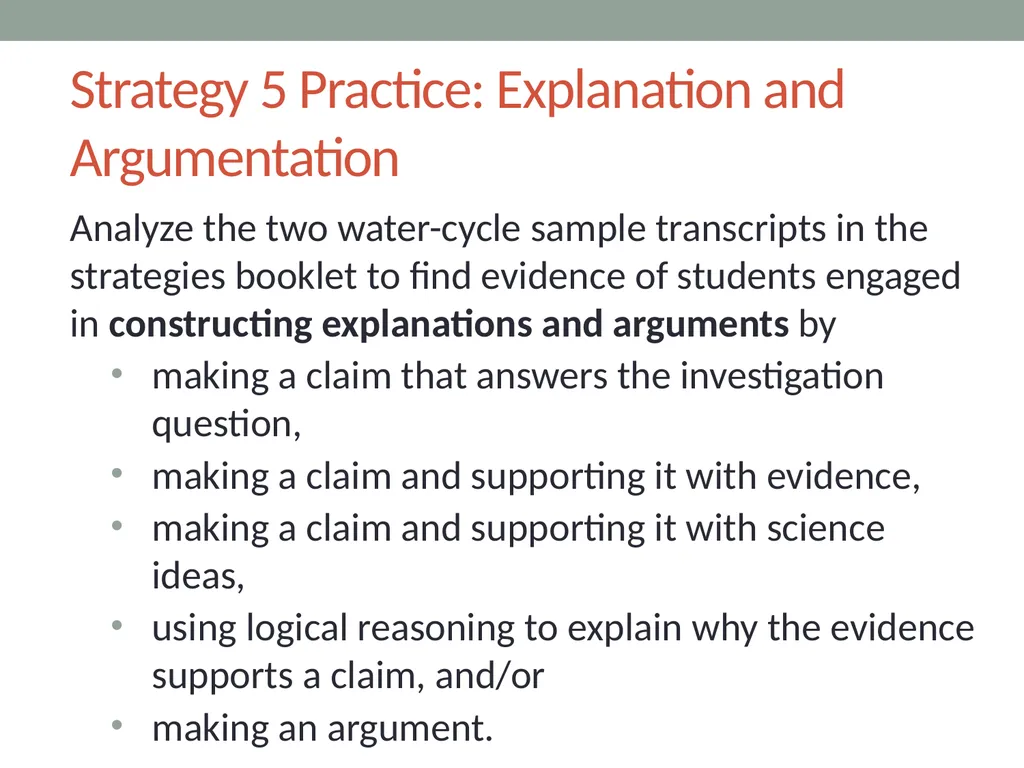
Strategy 5 Practice: Explanation and Argumentation Analyze the two water-cycle sample transcripts in the strategies booklet to find evidence of students engaged in constructing explanations and arguments by
making a claim that answers the investigation question,
making a claim and supporting it with evidence,
making a claim and supporting it with science ideas,
using logical reasoning to explain why the evidence supports a claim, and/or
making an argument.<br>
making a claim that answers the investigation question,
making a claim and supporting it with evidence,
making a claim and supporting it with science ideas,
using logical reasoning to explain why the evidence supports a claim, and/or
making an argument.<br>
16
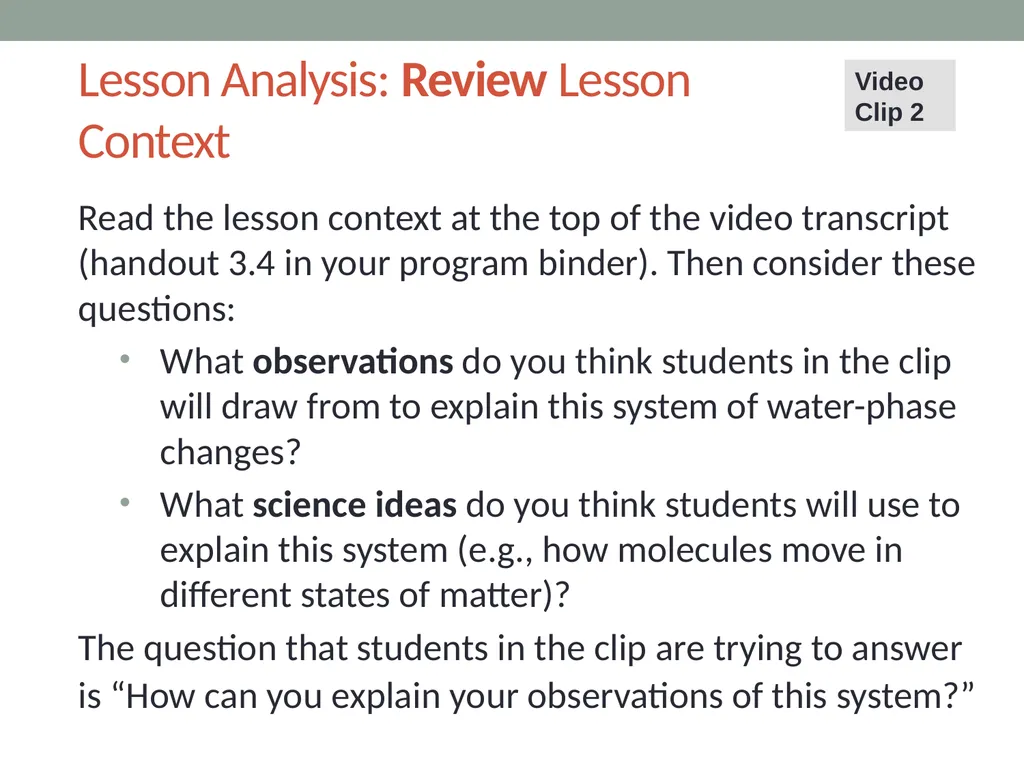
Lesson Analysis: Review Lesson
Context Read the lesson context at the top of the video transcript (handout 3.4 in your program binder). Then consider these questions:
What observations do you think students in the clip will draw from to explain this system of water-phase changes?
What science ideas do you think students will use to explain this system (e.g., how molecules move in different states of matter)?
The question that students in the clip are trying to answer is “How can you explain your observations of this system?” Video Clip 2<br>
What observations do you think students in the clip will draw from to explain this system of water-phase changes?
What science ideas do you think students will use to explain this system (e.g., how molecules move in different states of matter)?
The question that students in the clip are trying to answer is “How can you explain your observations of this system?” Video Clip 2<br>
17
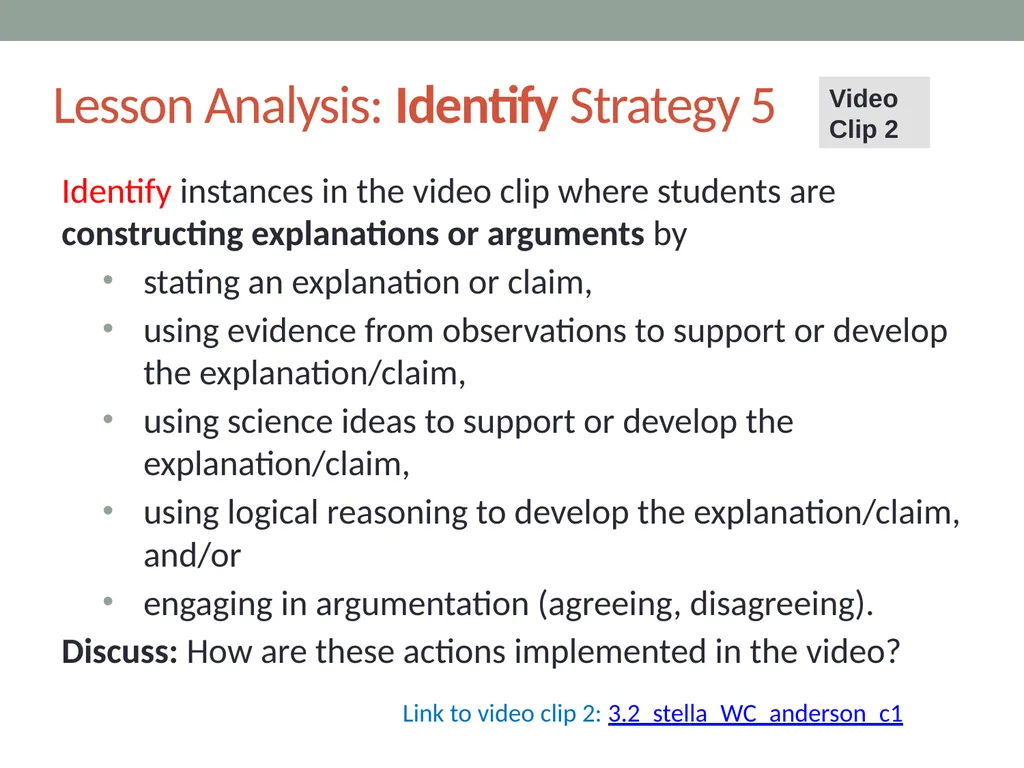
Lesson Analysis: Identify Strategy 5 Identify instances in the video clip where students are constructing explanations or arguments by
stating an explanation or claim,
using evidence from observations to support or develop the explanation/claim,
using science ideas to support or develop the explanation/claim,
using logical reasoning to develop the explanation/claim, and/or
engaging in argumentation (agreeing, disagreeing).
Discuss: How are these actions implemented in the video? Link to video clip 2: 3.2_stella_WC_anderson_c1 Video Clip 2<br>
stating an explanation or claim,
using evidence from observations to support or develop the explanation/claim,
using science ideas to support or develop the explanation/claim,
using logical reasoning to develop the explanation/claim, and/or
engaging in argumentation (agreeing, disagreeing).
Discuss: How are these actions implemented in the video? Link to video clip 2: 3.2_stella_WC_anderson_c1 Video Clip 2<br>
18
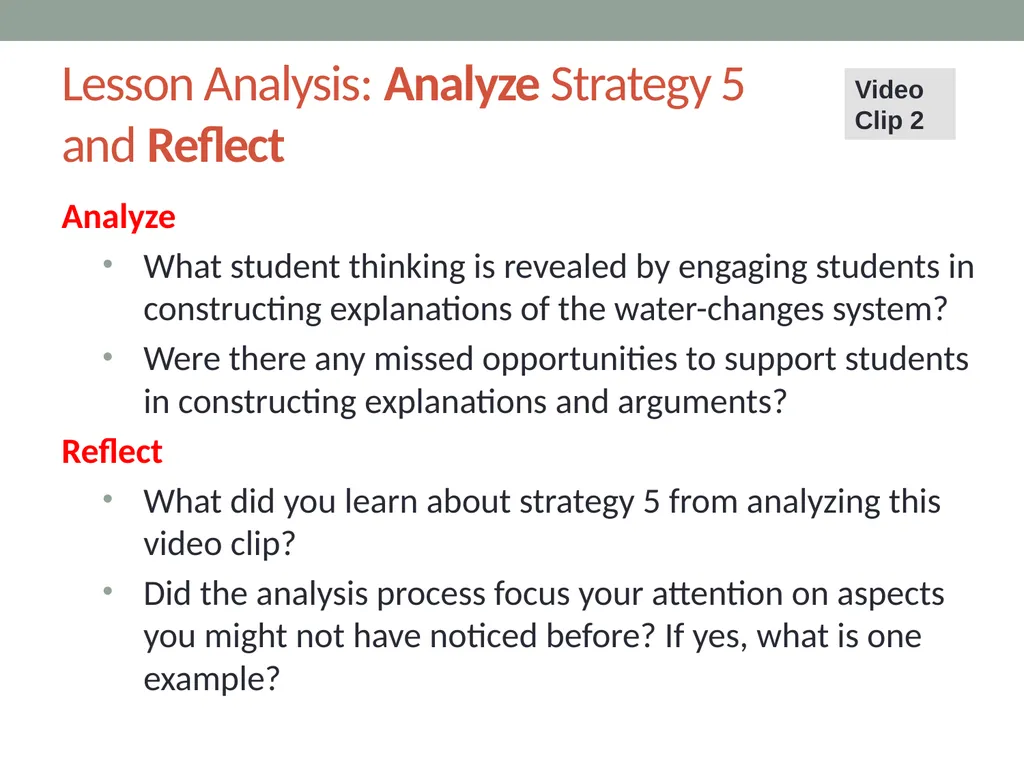
Lesson Analysis: Analyze Strategy 5 and Reflect Analyze
What student thinking is revealed by engaging students in constructing explanations of the water-changes system?
Were there any missed opportunities to support students in constructing explanations and arguments?
Reflect
What did you learn about strategy 5 from analyzing this video clip?
Did the analysis process focus your attention on aspects you might not have noticed before? If yes, what is one example? Video Clip 2<br>
What student thinking is revealed by engaging students in constructing explanations of the water-changes system?
Were there any missed opportunities to support students in constructing explanations and arguments?
Reflect
What did you learn about strategy 5 from analyzing this video clip?
Did the analysis process focus your attention on aspects you might not have noticed before? If yes, what is one example? Video Clip 2<br>
19
Reflect: Key Ideas about Lesson Analysis Lesson analysis slows down classroom events so we can focus on specific student thinking.
Making a claim based on evidence challenges us to listen carefully to what students are saying and understanding. When we make quick assessments, we might think they understand things they’re actually still struggling with.
Even though events happen fast in classroom teaching, we can get better at listening to students and making on-the-spot assessments of their understandings and confusion!<br>
Making a claim based on evidence challenges us to listen carefully to what students are saying and understanding. When we make quick assessments, we might think they understand things they’re actually still struggling with.
Even though events happen fast in classroom teaching, we can get better at listening to students and making on-the-spot assessments of their understandings and confusion!<br>
20
Summarizing Strategies 4 and 5 Create a word picture (a concept map, a thinking map, or other visual) to show how analysis and interpretation (strategy 4) are related to explanation and argumentation (strategy 5). Label any connecting arrows. Suggested words to use: Analyze and interpret
Argument
Data
Evidence
Explanation
Logical thinking Organize
Observe/observations
Patterns
Reasoning
Science ideas<br>
Argument
Data
Evidence
Explanation
Logical thinking Organize
Observe/observations
Patterns
Reasoning
Science ideas<br>
21
Reflect: Lesson Analysis Focus Question How can analyzing data and constructing explanations help students move forward toward deeper understandings of science ideas?<br>
22
WATER CYCLE MATH CONTENT DEEPENING Grade 5<br>
23
Content Deepening Focus Question Approximately how many molecules are in a single drop of water? How do we know?<br>
24
Activity 1: Ping-Pong Balls in a Bin Estimate the number of Ping-Pong balls in the container.
Rules:
You are not allowed to open the container.
Derive an estimate that you have confidence in. Be ready to express that confidence by identifying a lower bound and an upper bound for your estimate.
A lower bound is a number you’re sure is less than the number of balls in the bin.
An upper bound is a number you’re sure is greater than the number of balls in the bin.<br>
Rules:
You are not allowed to open the container.
Derive an estimate that you have confidence in. Be ready to express that confidence by identifying a lower bound and an upper bound for your estimate.
A lower bound is a number you’re sure is less than the number of balls in the bin.
An upper bound is a number you’re sure is greater than the number of balls in the bin.<br>
25
Activity 2: Popcorn in a Bin Estimate the number of popcorn kernels in the container.
Rules:
You are not allowed to open the container.
Derive an estimate that you have confidence in. Be ready to express that confidence by identifying a lower bound and an upper bound for your estimate.<br>
Rules:
You are not allowed to open the container.
Derive an estimate that you have confidence in. Be ready to express that confidence by identifying a lower bound and an upper bound for your estimate.<br>
26
Activity 3: Grains of Rice in a Bin Estimate the number of rice grains in the container.
Rules:
You are not allowed to open the container.
Derive an estimate that you have confidence in. Be ready to express that confidence by identifying a lower bound and an upper bound for your estimate.<br>
Rules:
You are not allowed to open the container.
Derive an estimate that you have confidence in. Be ready to express that confidence by identifying a lower bound and an upper bound for your estimate.<br>
27
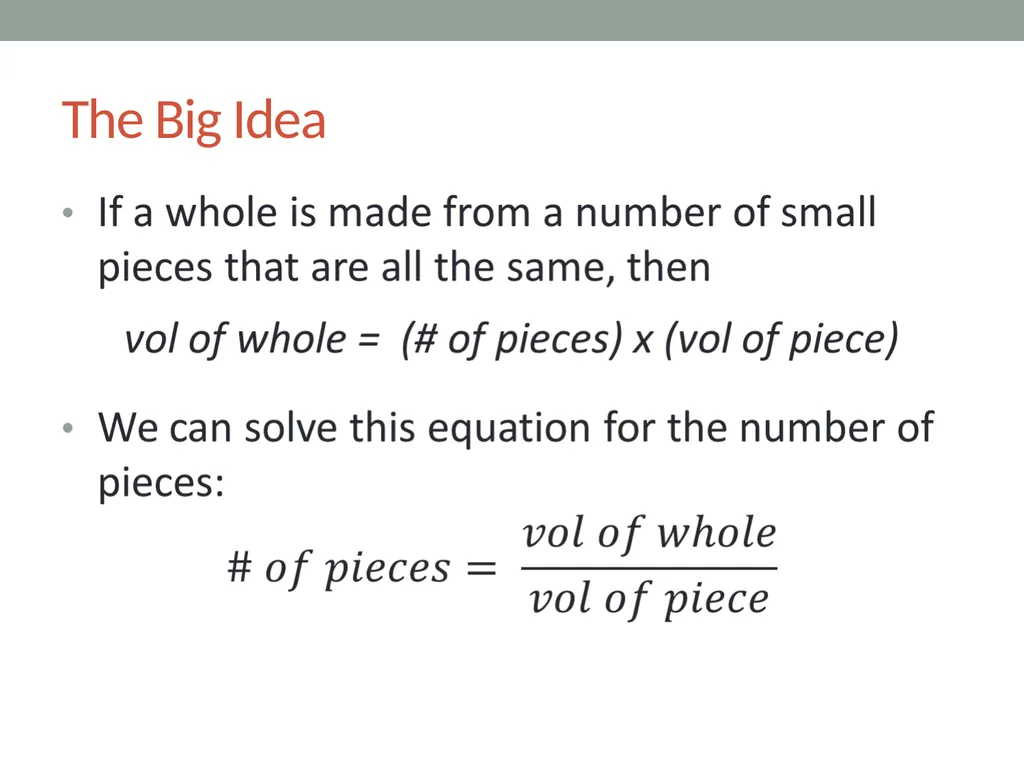
The Big Idea<br>
28
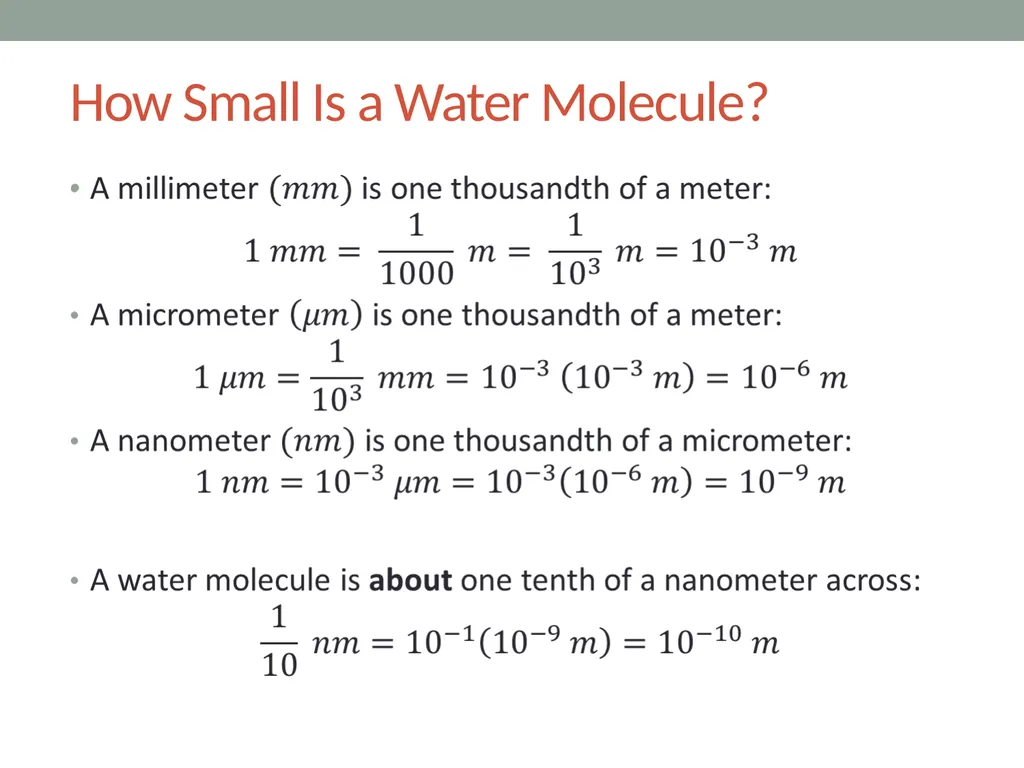
How Small Is a Water Molecule?<br>
29
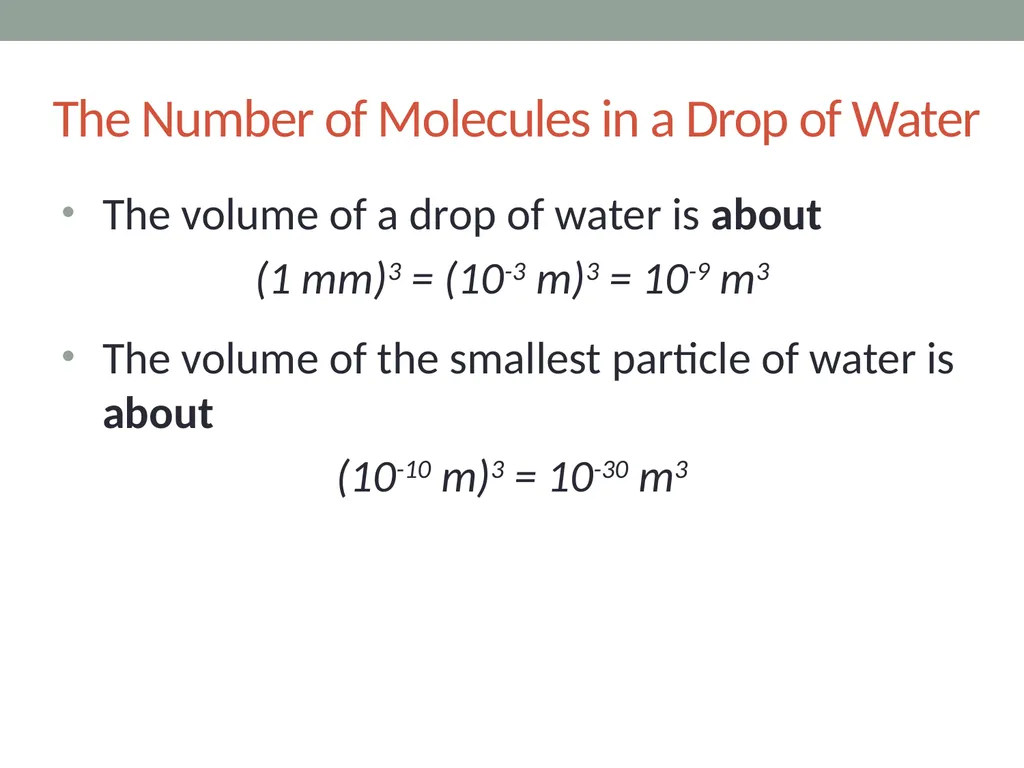
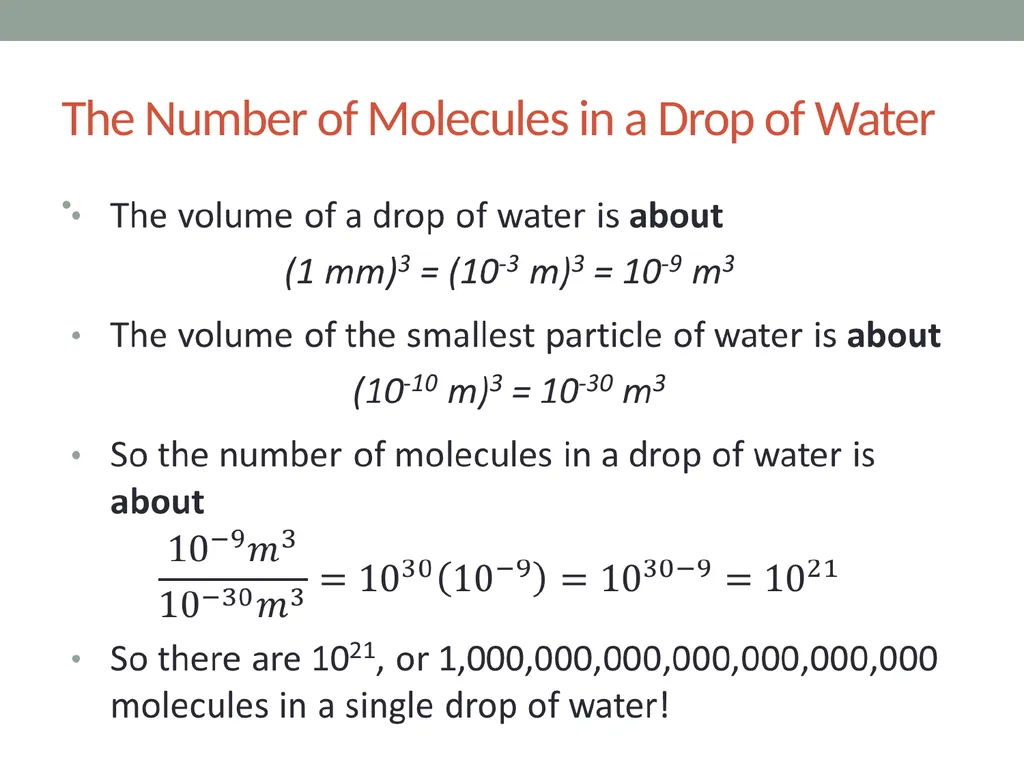
The Number of Molecules in a Drop of Water The volume of a drop of water is about
(1 mm)3 = (10-3 m)3 = 10-9 m3
The volume of the smallest particle of water is about
(10-10 m)3 = 10-30 m3<br>
(1 mm)3 = (10-3 m)3 = 10-9 m3
The volume of the smallest particle of water is about
(10-10 m)3 = 10-30 m3<br>
30
The Number of Molecules in a Drop of Water<br>
31
Building Confidence with Bounds How do we know that 1021 is roughly correct? Can we find lower and upper bounds for our estimate to give us confidence?<br>
32
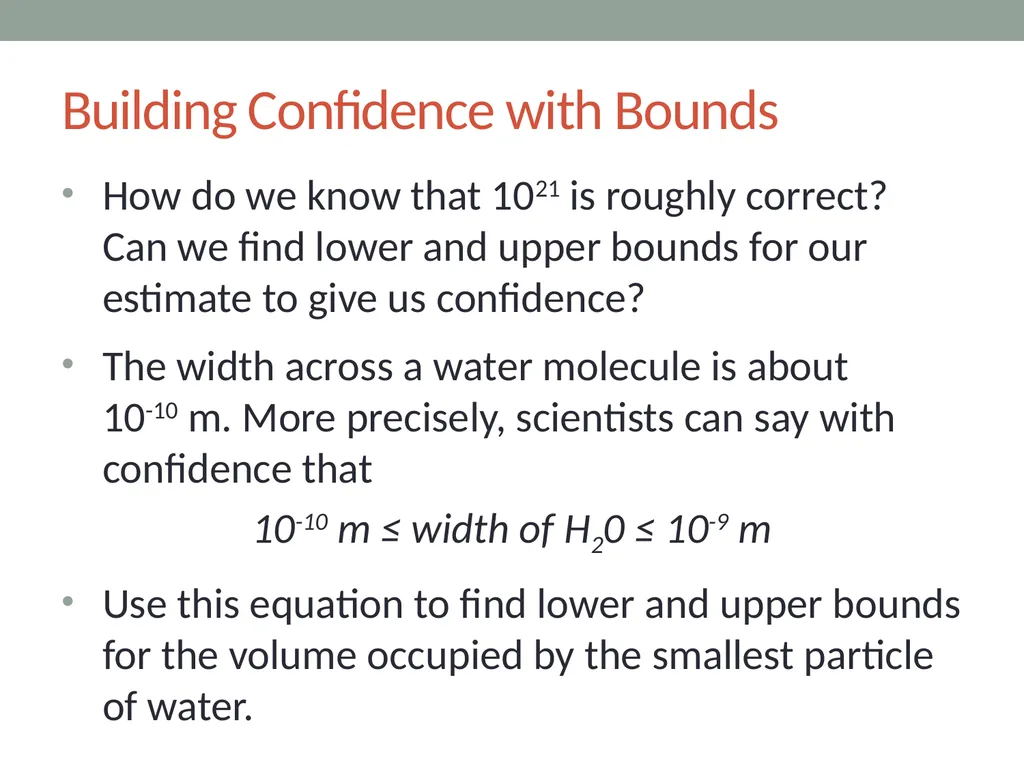
Building Confidence with Bounds How do we know that 1021 is roughly correct? Can we find lower and upper bounds for our estimate to give us confidence?
The width across a water molecule is about 10-10 m. More precisely, scientists can say with confidence that
10-10 m ≤ width of H20 ≤ 10-9 m
Use this equation to find lower and upper bounds for the volume occupied by the smallest particle of water.<br>
The width across a water molecule is about 10-10 m. More precisely, scientists can say with confidence that
10-10 m ≤ width of H20 ≤ 10-9 m
Use this equation to find lower and upper bounds for the volume occupied by the smallest particle of water.<br>
33
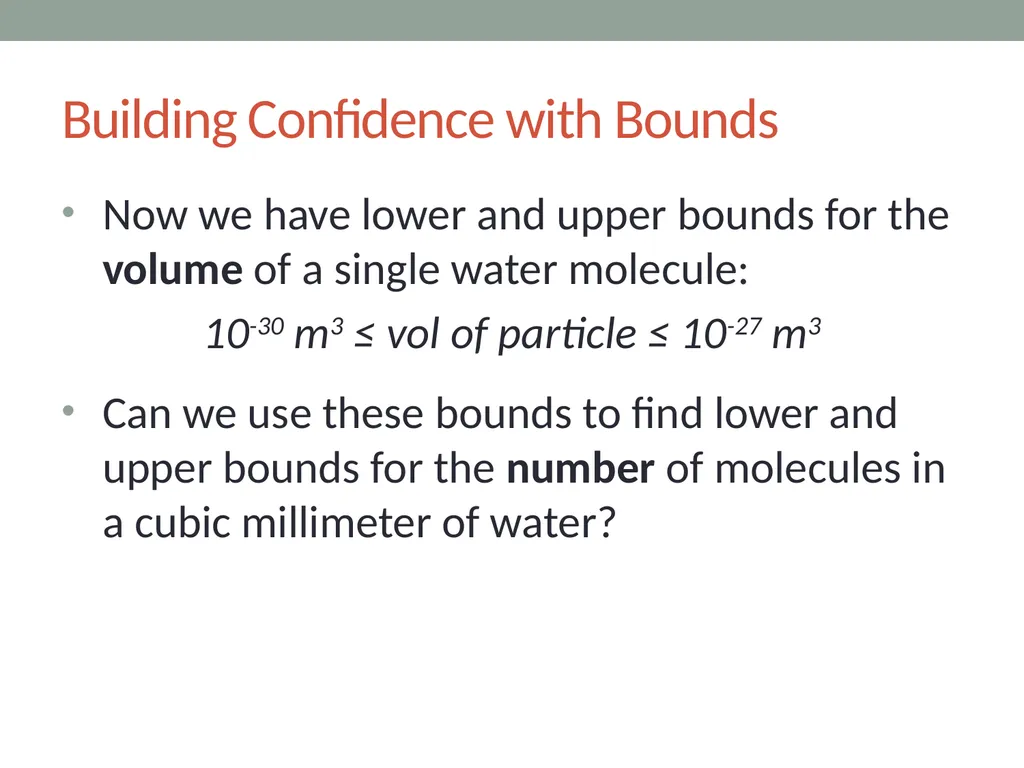
Building Confidence with Bounds Now we have lower and upper bounds for the volume of a single water molecule:
10-30 m3 ≤ vol of particle ≤ 10-27 m3
Can we use these bounds to find lower and upper bounds for the number of molecules in a cubic millimeter of water?<br>
10-30 m3 ≤ vol of particle ≤ 10-27 m3
Can we use these bounds to find lower and upper bounds for the number of molecules in a cubic millimeter of water?<br>
34
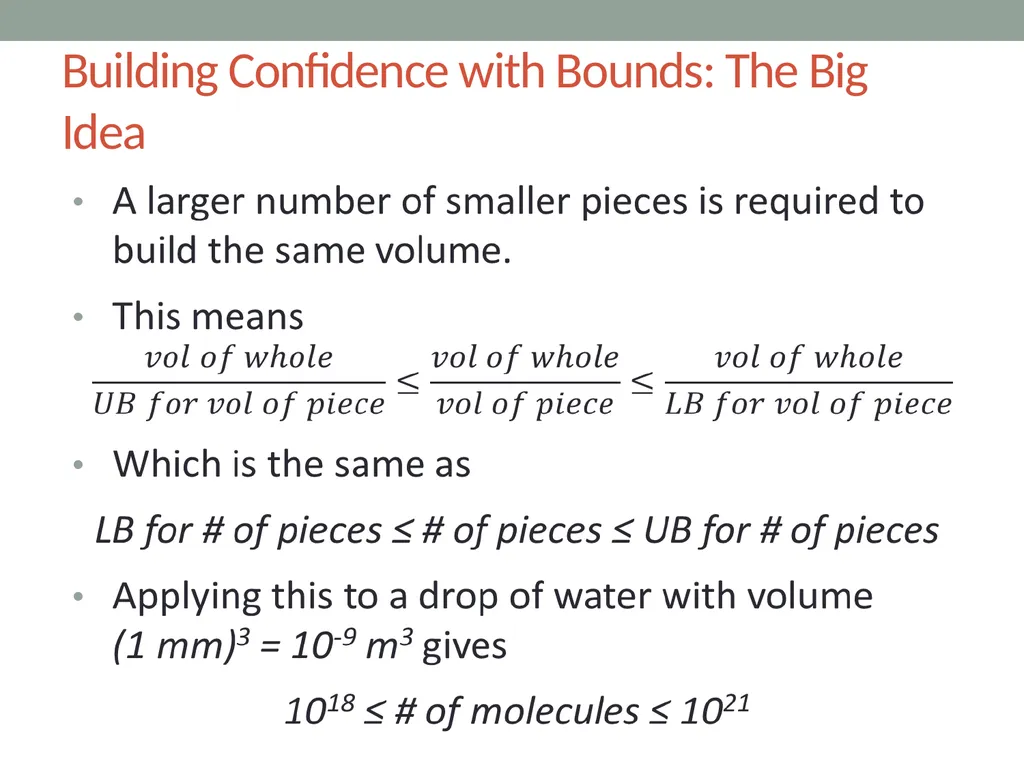
Building Confidence with Bounds: The Big Idea<br>
35
Reflect: Content Deepening Focus Question Approximately how many molecules are in a single drop of water? How do we know?<br>
36
Summary: Moving Student Thinking Forward How can we advance student thinking without just telling students about ideas and asking them to memorize those concepts?
Refer to our Effective Science Teaching chart from day 1. Which of these ideas do you want to highlight based on the strategies we’ve explored so far? Anything you want to add or modify?<br>
Refer to our Effective Science Teaching chart from day 1. Which of these ideas do you want to highlight based on the strategies we’ve explored so far? Anything you want to add or modify?<br>
37
Summary: Today’s Focus Questions Lesson Analysis How can analyzing
data and constructing explanations help students move forward toward deeper understandings
of science ideas? Content Deepening Approximately how many molecules are in a single drop of water? How do we know?<br>
38
Homework Review strategy 6 in the STeLLA strategies booklet and complete the STL Z-fold summary chart for this strategy: Engage students in using and applying new science ideas in a variety of ways and contexts.
Be prepared to share your assigned lesson plan review.<br>
Be prepared to share your assigned lesson plan review.<br>
39
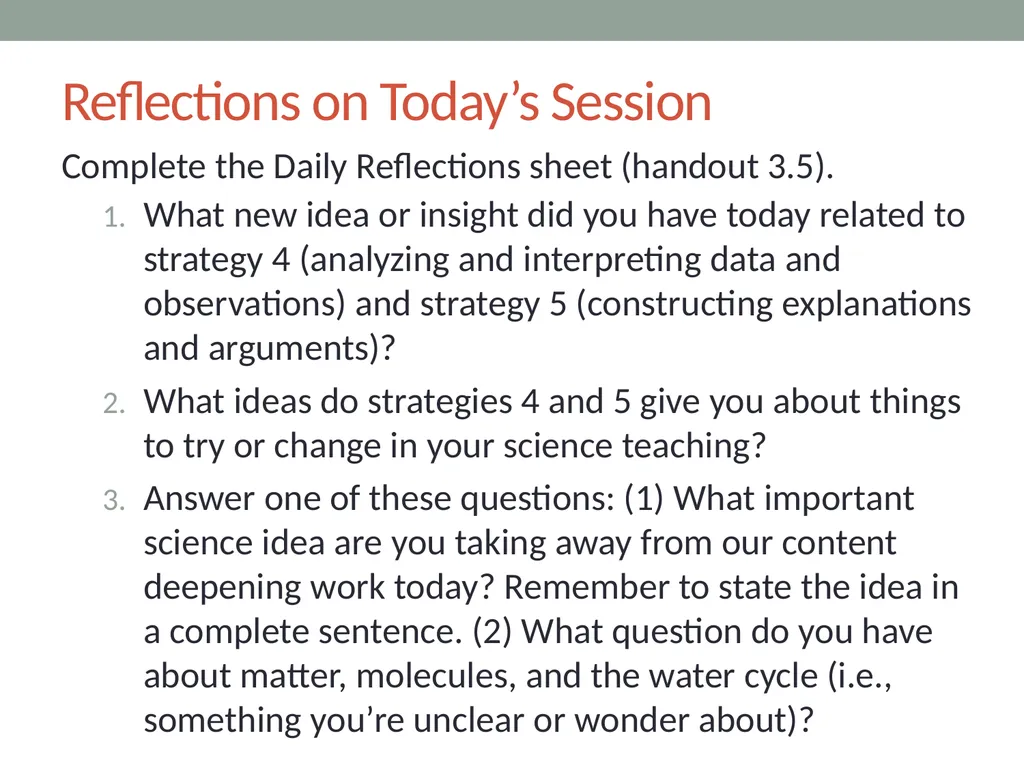
Reflections on Today’s Session Complete the Daily Reflections sheet (handout 3.5).
What new idea or insight did you have today related to strategy 4 (analyzing and interpreting data and observations) and strategy 5 (constructing explanations and arguments)?
What ideas do strategies 4 and 5 give you about things to try or change in your science teaching?
Answer one of these questions: (1) What important science idea are you taking away from our content deepening work today? Remember to state the idea in a complete sentence. (2) What question do you have about matter, molecules, and the water cycle (i.e., something you’re unclear or wonder about)?<br>
What new idea or insight did you have today related to strategy 4 (analyzing and interpreting data and observations) and strategy 5 (constructing explanations and arguments)?
What ideas do strategies 4 and 5 give you about things to try or change in your science teaching?
Answer one of these questions: (1) What important science idea are you taking away from our content deepening work today? Remember to state the idea in a complete sentence. (2) What question do you have about matter, molecules, and the water cycle (i.e., something you’re unclear or wonder about)?<br>
40
Norms for Working Together: The Basics The Basics
Arrive prepared and on time; stay for the duration; return from breaks on time.
Remain attentive, thoughtful, and respectful; engage and be present.
Eliminate interruptions (turn off cell phones, email, and other electronic devices; avoid sidebar conversations).
Make room for everyone to participate (monitor your floor time). Purpose: Build trust and develop a productive study group for all participants.<br>
Arrive prepared and on time; stay for the duration; return from breaks on time.
Remain attentive, thoughtful, and respectful; engage and be present.
Eliminate interruptions (turn off cell phones, email, and other electronic devices; avoid sidebar conversations).
Make room for everyone to participate (monitor your floor time). Purpose: Build trust and develop a productive study group for all participants.<br>
41
Norms for Working Together: The Heart The Heart of RESPeCT Lesson Analysis and Content
Deepening
Keep the goal in mind: analysis of teaching to improve student learning.
Share your ideas, uncertainties, confusion, disagreements, questions, and good humor. All points of view are welcome.
Expect and ask questions to deepen everyone’s learning; be constructively challenging.
Listen carefully; seek to understand other participants’ points of view. Purpose: Build trust and develop a productive study group for all participants.<br>
Keep the goal in mind: analysis of teaching to improve student learning.
Share your ideas, uncertainties, confusion, disagreements, questions, and good humor. All points of view are welcome.
Expect and ask questions to deepen everyone’s learning; be constructively challenging.
Listen carefully; seek to understand other participants’ points of view. Purpose: Build trust and develop a productive study group for all participants.<br>