
RESPeCT PD pROGRAM RESPeCT Summer Institute Day 4
DP
Published · 63 slides · 0 views
1 / 1

Description
RESPeCT PD pROGRAM RESPeCT Summer Institute Day 4 Agenda for Day 4 Day-3 reflections Importance of STL strategy 5: constructing explanations Introducing Student Thinking Lens strategy 6 Lesson analysis: STL strategy 6 Review: STL strategies
Related Topics
Share
Embed code
Download this presentation From Below
"RESPeCT PD pROGRAM RESPeCT Summer Institute Day 4" is the property of its rightful owner. Permission is granted to download and print the materials on this website for personal, non-commercial use only, and to display it on your personal computer provided you do not modify the materials and that you retain all copyright notices contained in the materials. By downloading content from our website, you accept the terms of this agreement.
Presentation Transcript
01
RESPeCT PD pROGRAM RESPeCT Summer Institute Day 4<br>
02
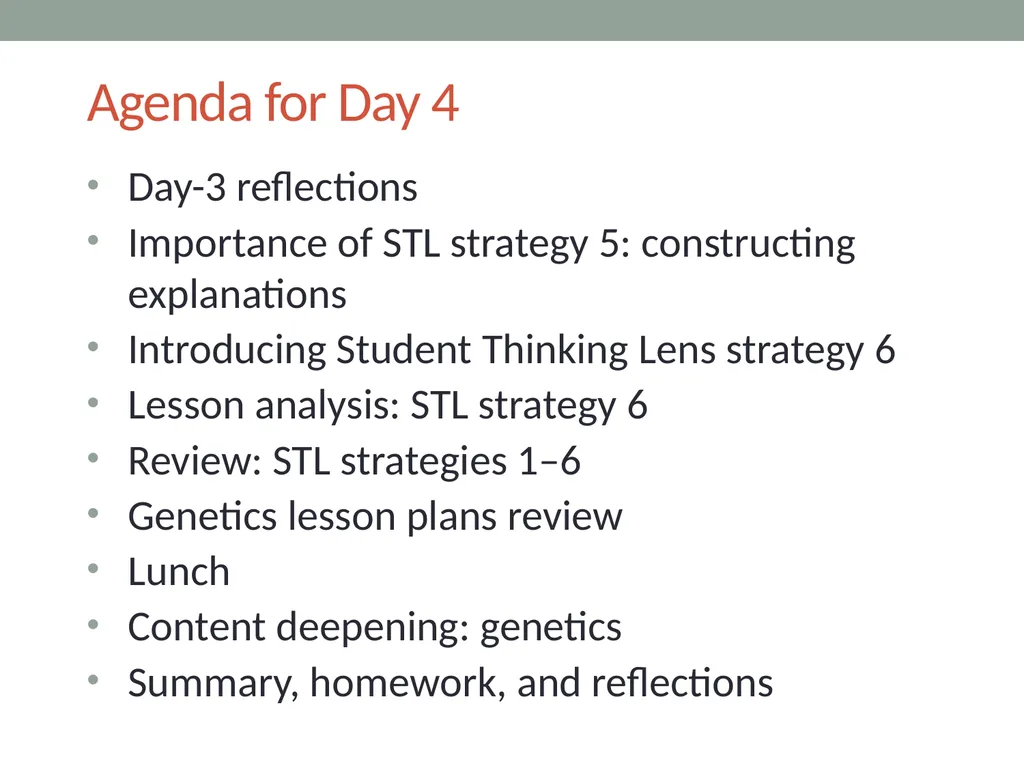
Agenda for Day 4 Day-3 reflections
Importance of STL strategy 5: constructing explanations
Introducing Student Thinking Lens strategy 6
Lesson analysis: STL strategy 6
Review: STL strategies 1–6
Genetics lesson plans review
Lunch
Content deepening: genetics
Summary, homework, and reflections<br>
Importance of STL strategy 5: constructing explanations
Introducing Student Thinking Lens strategy 6
Lesson analysis: STL strategy 6
Review: STL strategies 1–6
Genetics lesson plans review
Lunch
Content deepening: genetics
Summary, homework, and reflections<br>
03
Trends in Reflections<br>
04
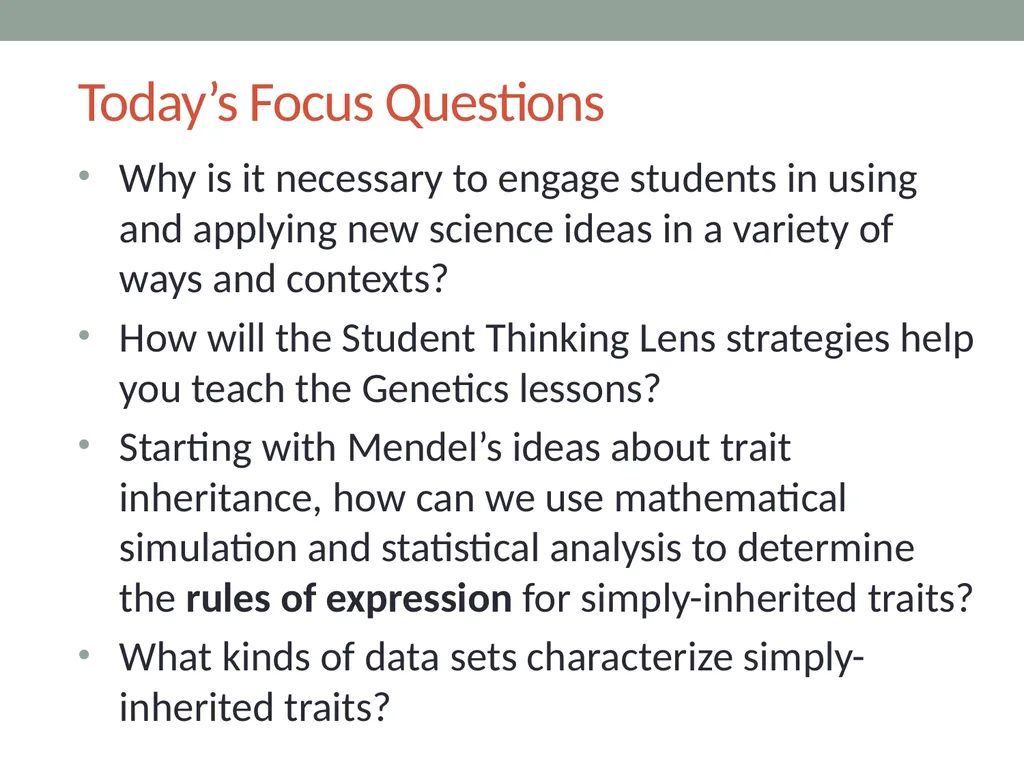
Today’s Focus Questions Why is it necessary to engage students in using and applying new science ideas in a variety of ways and contexts?
How will the Student Thinking Lens strategies help you teach the Genetics lessons?
Starting with Mendel’s ideas about trait inheritance, how can we use mathematical simulation and statistical analysis to determine the rules of expression for simply-inherited traits?
What kinds of data sets characterize simply-inherited traits?<br>
How will the Student Thinking Lens strategies help you teach the Genetics lessons?
Starting with Mendel’s ideas about trait inheritance, how can we use mathematical simulation and statistical analysis to determine the rules of expression for simply-inherited traits?
What kinds of data sets characterize simply-inherited traits?<br>
05
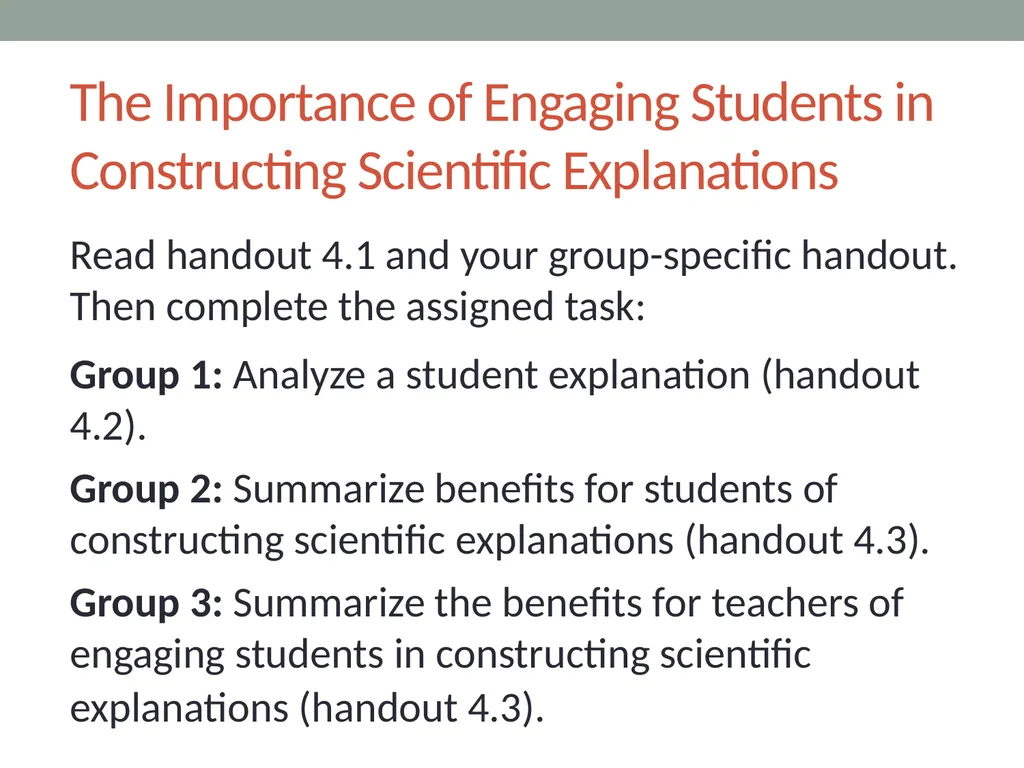
The Importance of Engaging Students in Constructing Scientific Explanations Read handout 4.1 and your group-specific handout. Then complete the assigned task:
Group 1: Analyze a student explanation (handout 4.2).
Group 2: Summarize benefits for students of constructing scientific explanations (handout 4.3).
Group 3: Summarize the benefits for teachers of engaging students in constructing scientific explanations (handout 4.3).<br>
Group 1: Analyze a student explanation (handout 4.2).
Group 2: Summarize benefits for students of constructing scientific explanations (handout 4.3).
Group 3: Summarize the benefits for teachers of engaging students in constructing scientific explanations (handout 4.3).<br>
06
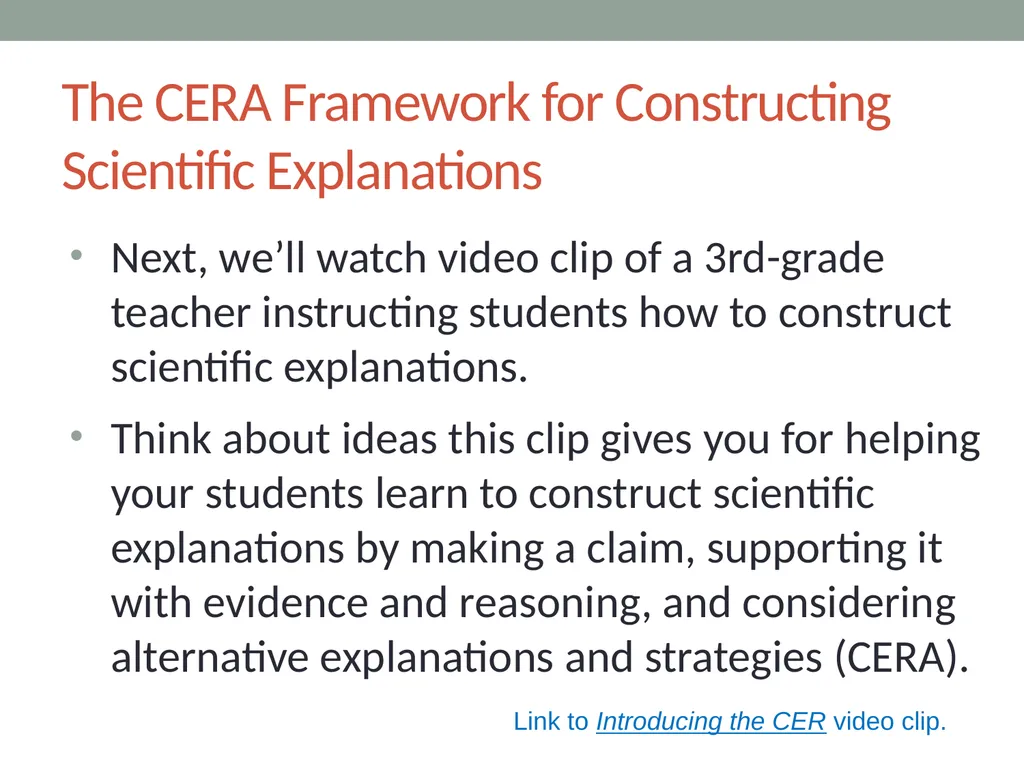
The CERA Framework for Constructing Scientific Explanations Next, we’ll watch video clip of a 3rd-grade teacher instructing students how to construct scientific explanations.
Think about ideas this clip gives you for helping your students learn to construct scientific explanations by making a claim, supporting it with evidence and reasoning, and considering alternative explanations and strategies (CERA). Link to Introducing the CER video clip.<br>
Think about ideas this clip gives you for helping your students learn to construct scientific explanations by making a claim, supporting it with evidence and reasoning, and considering alternative explanations and strategies (CERA). Link to Introducing the CER video clip.<br>
07
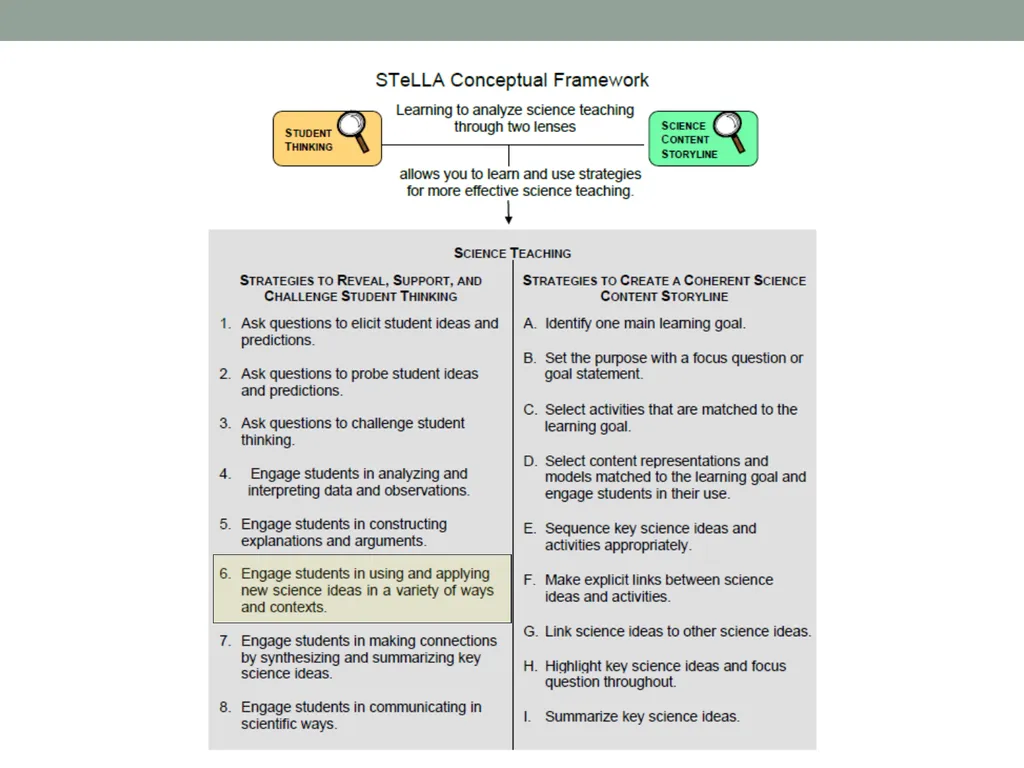
Introducing STL Strategy 6 Engage students in using and applying new science ideas in a variety of ways and contexts.
What are the purpose and key features of this strategy?
Why do you think use-and-apply questions or activities are often shortchanged in science teaching?<br>
What are the purpose and key features of this strategy?
Why do you think use-and-apply questions or activities are often shortchanged in science teaching?<br>
08
Lesson Analysis: Focus Question 1 Why is it necessary to engage students in using and applying new science ideas in a variety of ways and contexts?<br>
09
Lesson Analysis: Review Lesson Context Read the lesson context for this video clip at the top of the transcript (handout 4.4 in your PD program binder).<br>
10
Lesson Analysis: Identify Strategy 6 What makes this a use-and-apply task? (Focus on task.)
What do you notice about the types of questions the teacher asks during the clip? Link to video clip: 4.1_stella_GEN_doggett_L5_c1<br>
What do you notice about the types of questions the teacher asks during the clip? Link to video clip: 4.1_stella_GEN_doggett_L5_c1<br>
11
Lesson Analysis: Analyze Strategy 6 and Reflect Analyze:
What student thinking is revealed by engaging students in using and applying new science ideas? By providing a claim, evidence, and reasoning?
Reflect:
What did you learn about strategy 6 from watching and analyzing this video clip?<br>
What student thinking is revealed by engaging students in using and applying new science ideas? By providing a claim, evidence, and reasoning?
Reflect:
What did you learn about strategy 6 from watching and analyzing this video clip?<br>
12
Check Your Understanding of Strategy 6 Jot down your responses to this multiple-choice quiz:
Use-and-apply tasks are used [before/during/after] new science ideas are introduced.
For difficult content ideas, students might need to practice applying new ideas in [one/two/many] different contexts.
[True/false]: Use-and-apply questions or activities are used primarily for student assessment at the end of a unit.
It’s appropriate for teachers to ask [elicit/probe/challenge] questions during a use-and-apply activity.
Teachers should [never/judiciously/always] tell students about science ideas they are missing or stating inaccurately.<br>
Use-and-apply tasks are used [before/during/after] new science ideas are introduced.
For difficult content ideas, students might need to practice applying new ideas in [one/two/many] different contexts.
[True/false]: Use-and-apply questions or activities are used primarily for student assessment at the end of a unit.
It’s appropriate for teachers to ask [elicit/probe/challenge] questions during a use-and-apply activity.
Teachers should [never/judiciously/always] tell students about science ideas they are missing or stating inaccurately.<br>
13
Reflect: Lesson Analysis Focus Question 1 Why is it necessary to engage students in using and applying new science ideas in a variety of ways and contexts?<br>
14
Lesson Analysis: Focus Question 2 How will the Student Thinking Lens strategies help you teach the Genetics lessons?<br>
15
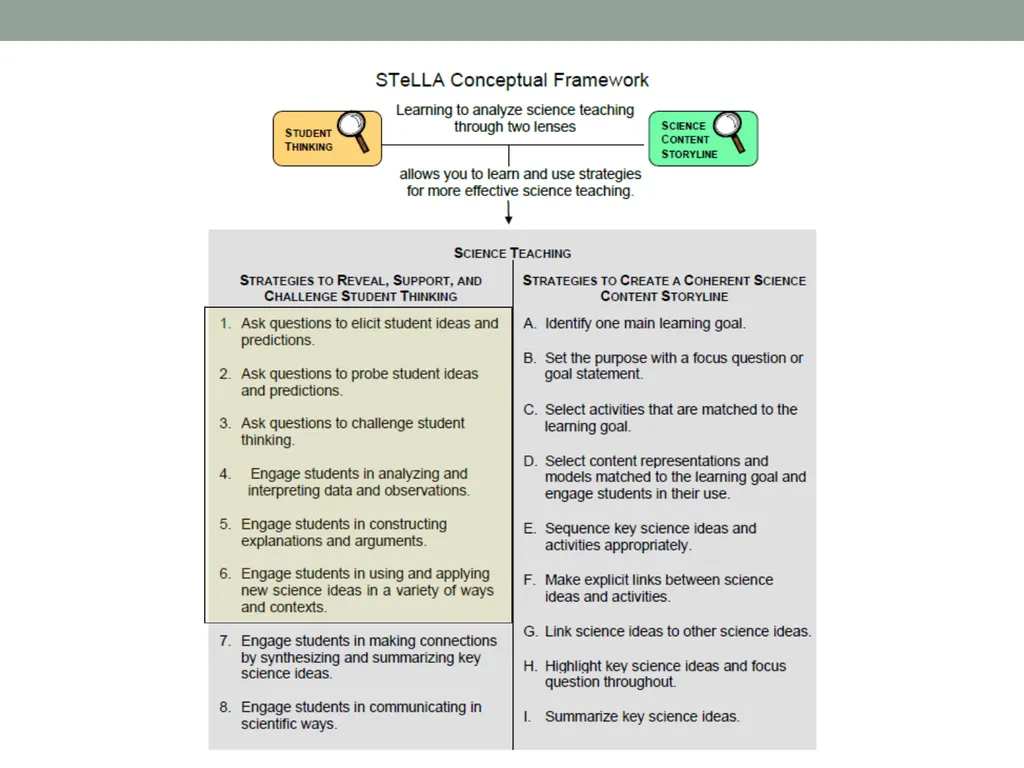
Review: Student Thinking Lens Strategies Review the STL summary chart in the STeLLA strategies booklet and discuss these questions:
What pattern(s) do you see in this arrangement (organization) of the STL strategies?
How does this arrangement (organization) highlight the differences and similarities among the Student Thinking Lens strategies?<br>
What pattern(s) do you see in this arrangement (organization) of the STL strategies?
How does this arrangement (organization) highlight the differences and similarities among the Student Thinking Lens strategies?<br>
16
Lesson Analysis: Review Lesson Context Read the lesson context for this video clip at the top of the transcript (handout 4.5 in your PD program binder).<br>
17
Lesson Analysis: Identify Student Thinking Lens Strategies What Student Thinking Lens strategies can you identify in this video clip?
After watching the video, study the transcript (handout 4.5) and fill in handout 4.6 (Identifying Student thinking Lens Strategies).
Be ready to share your findings with the group, including any missed opportunities. Link to video clip: 4.2_stella_GEN_kawamura_L3_c4<br>
After watching the video, study the transcript (handout 4.5) and fill in handout 4.6 (Identifying Student thinking Lens Strategies).
Be ready to share your findings with the group, including any missed opportunities. Link to video clip: 4.2_stella_GEN_kawamura_L3_c4<br>
18
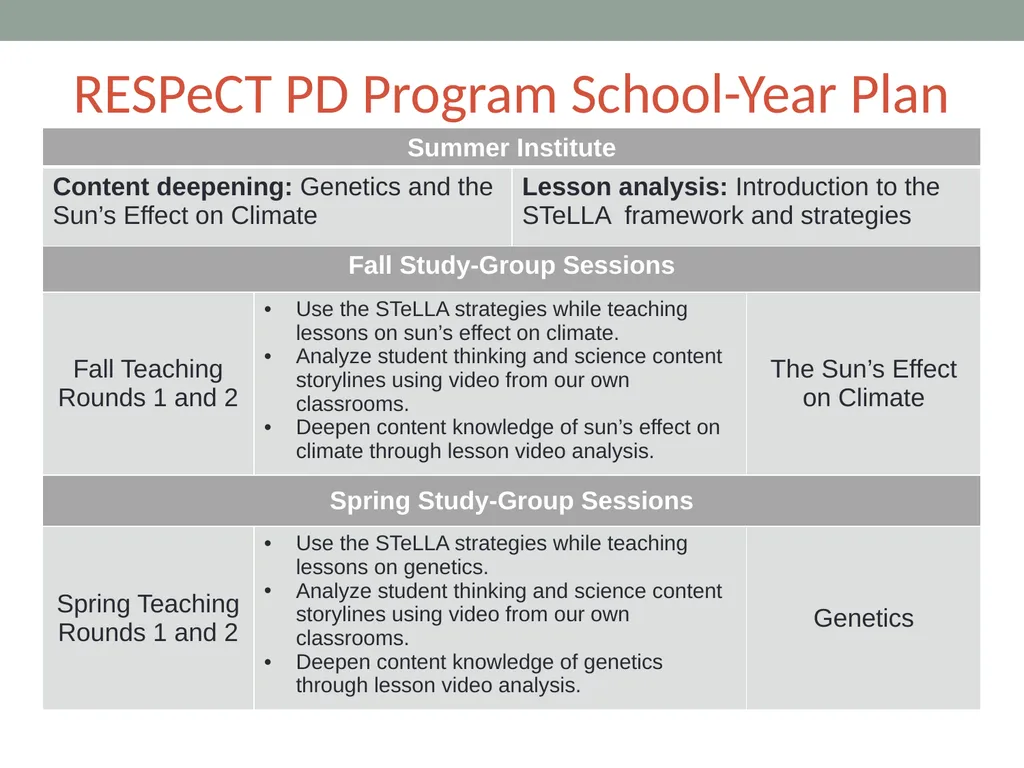
RESPeCT PD Program School-Year Plan<br>
19
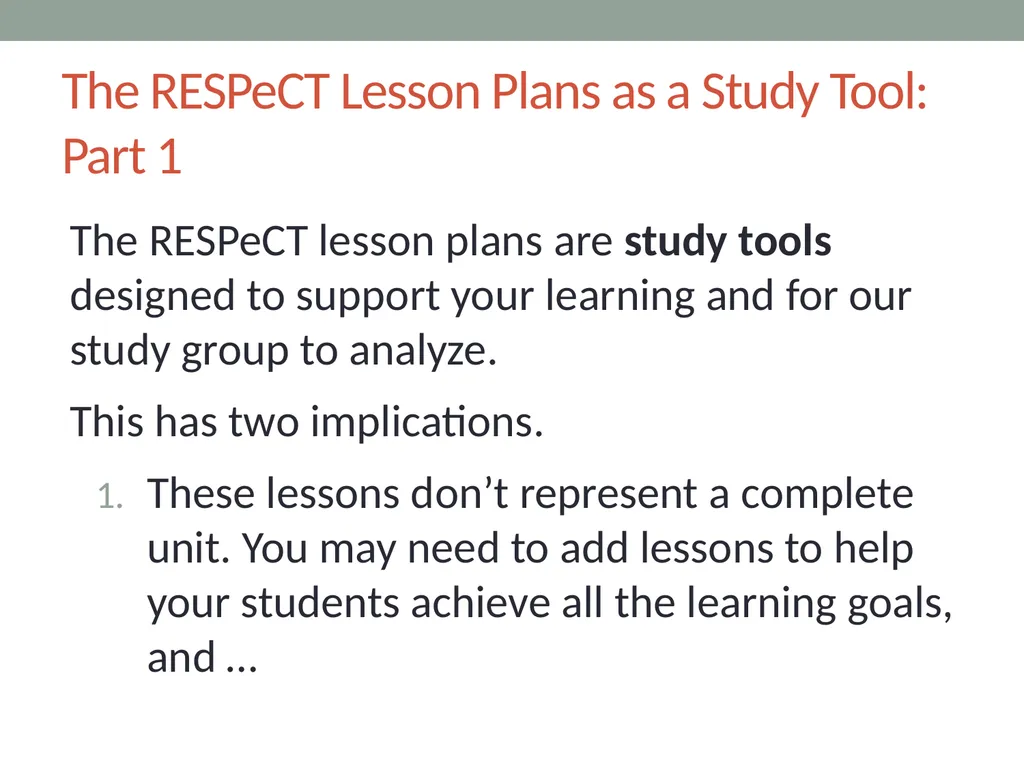
The RESPeCT Lesson Plans as a Study Tool: Part 1 The RESPeCT lesson plans are study tools designed to support your learning and for our study group to analyze.
This has two implications.
These lessons don’t represent a complete unit. You may need to add lessons to help your students achieve all the learning goals, and …<br>
This has two implications.
These lessons don’t represent a complete unit. You may need to add lessons to help your students achieve all the learning goals, and …<br>
20
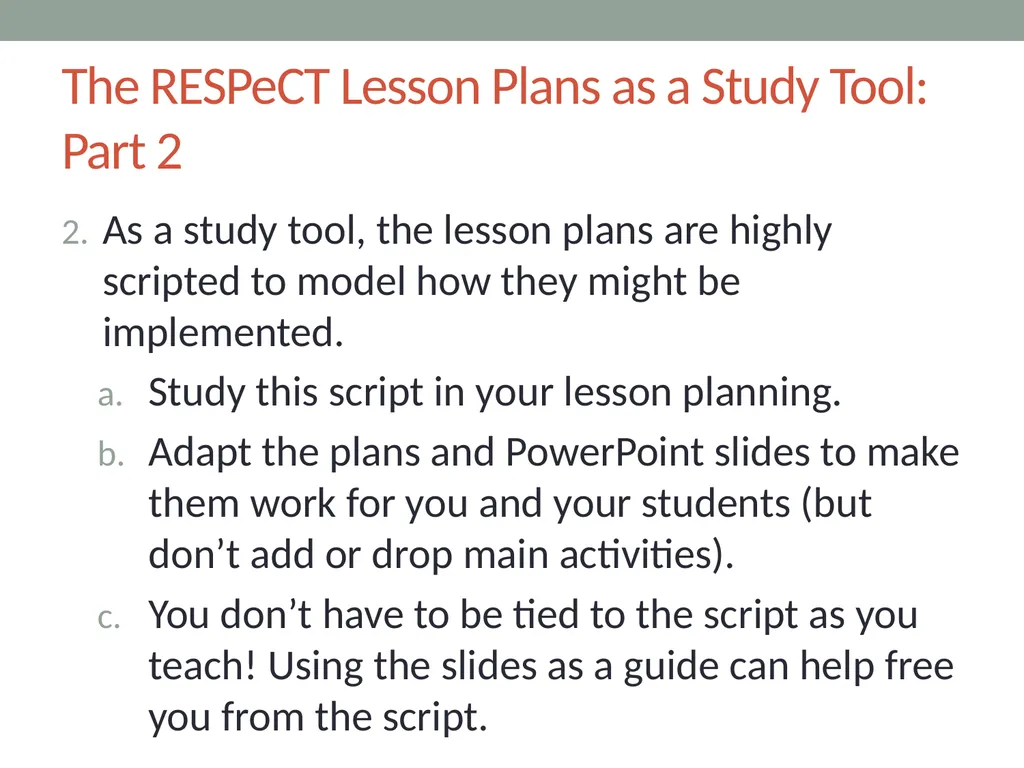
The RESPeCT Lesson Plans as a Study Tool: Part 2 As a study tool, the lesson plans are highly scripted to model how they might be implemented.
Study this script in your lesson planning.
Adapt the plans and PowerPoint slides to make them work for you and your students (but don’t add or drop main activities).
You don’t have to be tied to the script as you teach! Using the slides as a guide can help free you from the script.<br>
Study this script in your lesson planning.
Adapt the plans and PowerPoint slides to make them work for you and your students (but don’t add or drop main activities).
You don’t have to be tied to the script as you teach! Using the slides as a guide can help free you from the script.<br>
21
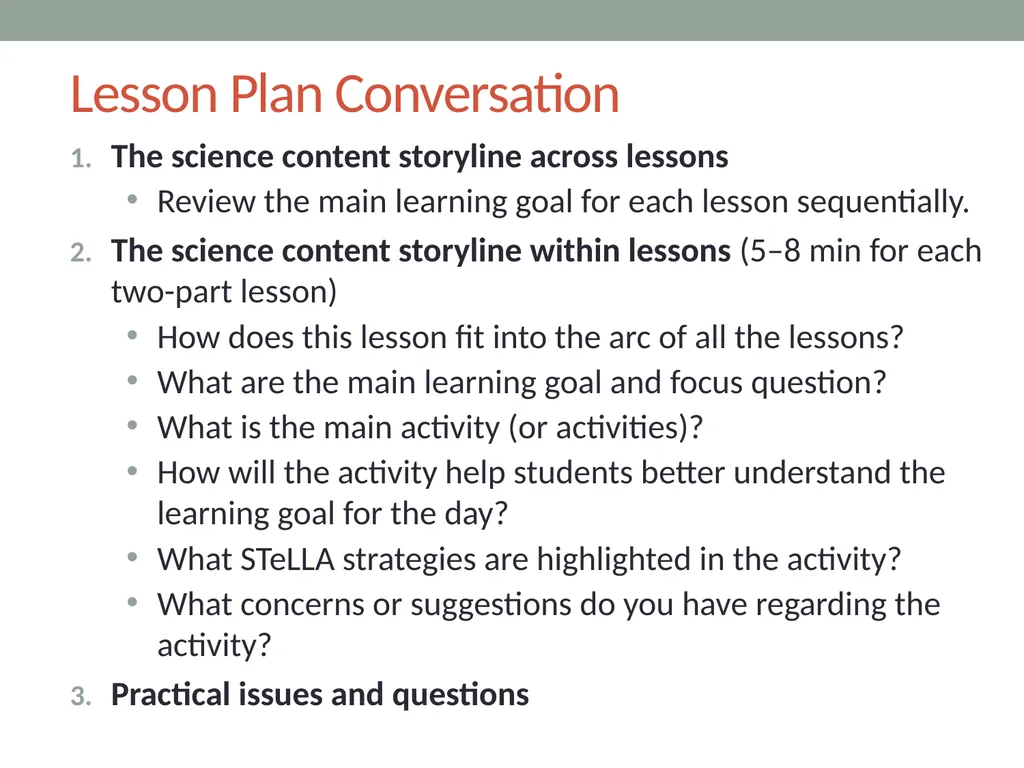
Lesson Plan Conversation The science content storyline across lessons
Review the main learning goal for each lesson sequentially.
The science content storyline within lessons (5–8 min for each two-part lesson)
How does this lesson fit into the arc of all the lessons?
What are the main learning goal and focus question?
What is the main activity (or activities)?
How will the activity help students better understand the learning goal for the day?
What STeLLA strategies are highlighted in the activity?
What concerns or suggestions do you have regarding the activity?
Practical issues and questions<br>
Review the main learning goal for each lesson sequentially.
The science content storyline within lessons (5–8 min for each two-part lesson)
How does this lesson fit into the arc of all the lessons?
What are the main learning goal and focus question?
What is the main activity (or activities)?
How will the activity help students better understand the learning goal for the day?
What STeLLA strategies are highlighted in the activity?
What concerns or suggestions do you have regarding the activity?
Practical issues and questions<br>
22
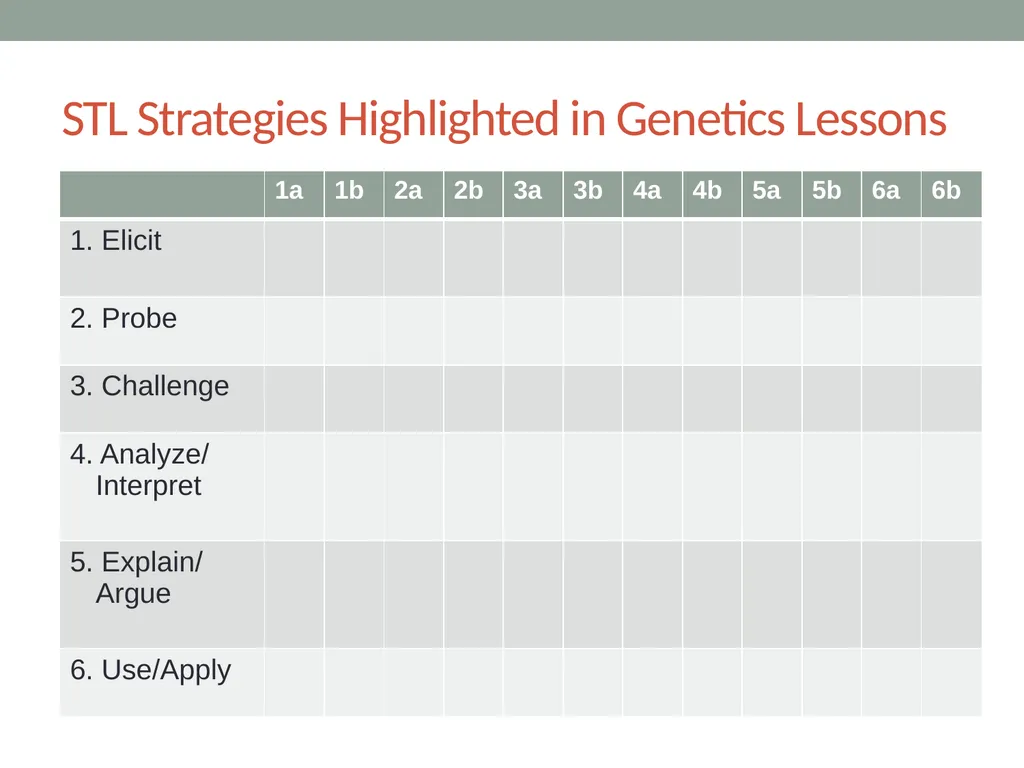
STL Strategies Highlighted in Genetics Lessons<br>
23
Genetics MATH CONTENT DEEPENING Grade 6<br>
24
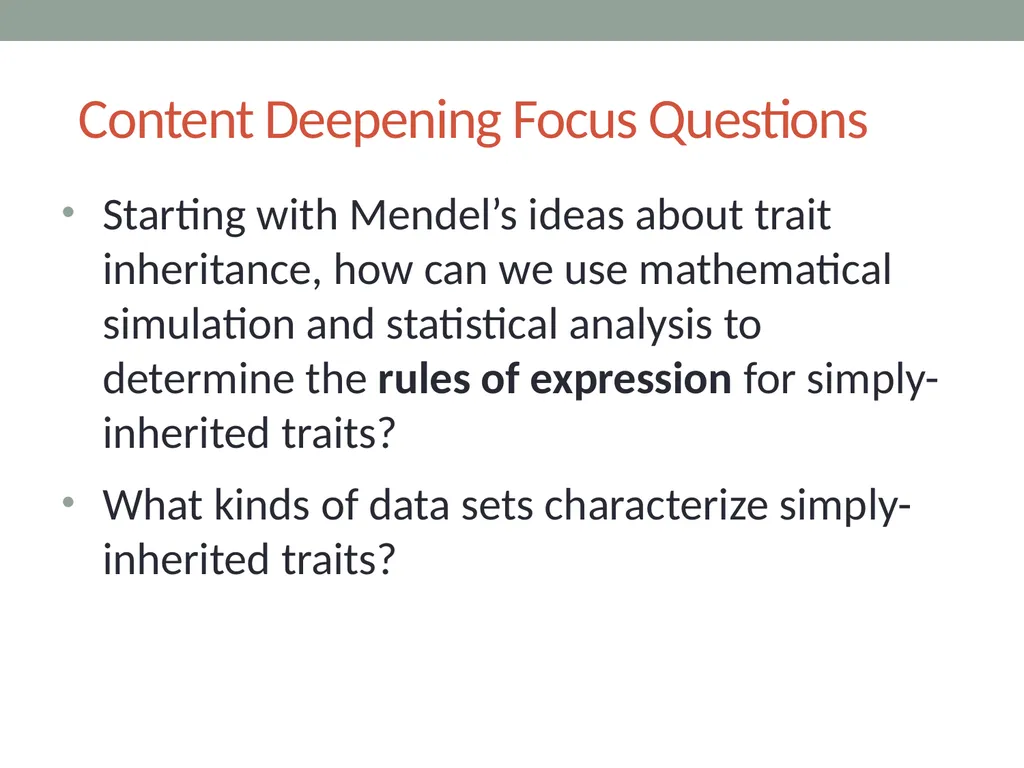
Content Deepening Focus Questions Starting with Mendel’s ideas about trait inheritance, how can we use mathematical simulation and statistical analysis to determine the rules of expression for simply-inherited traits?
What kinds of data sets characterize simply-inherited traits?<br>
What kinds of data sets characterize simply-inherited traits?<br>
25
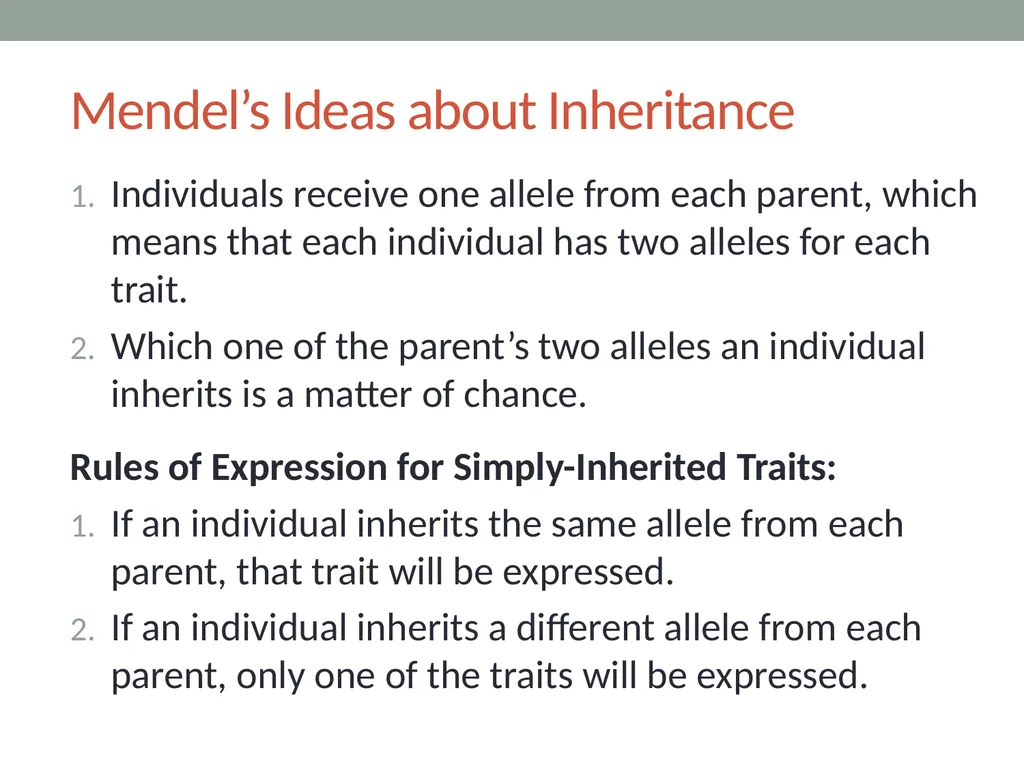
Mendel’s Ideas about Inheritance Individuals receive one allele from each parent, which means that each individual has two alleles for each trait.
Which one of the parent’s two alleles an individual inherits is a matter of chance.
Rules of Expression for Simply-Inherited Traits:
If an individual inherits the same allele from each parent, that trait will be expressed.
If an individual inherits a different allele from each parent, only one of the traits will be expressed.<br>
Which one of the parent’s two alleles an individual inherits is a matter of chance.
Rules of Expression for Simply-Inherited Traits:
If an individual inherits the same allele from each parent, that trait will be expressed.
If an individual inherits a different allele from each parent, only one of the traits will be expressed.<br>
26
Content Deepening: Focus Question 1 Starting with Mendel’s ideas about trait inheritance, how can we use mathematical simulation and statistical analysis to determine the rules of expression for simply-inherited traits?<br>
27
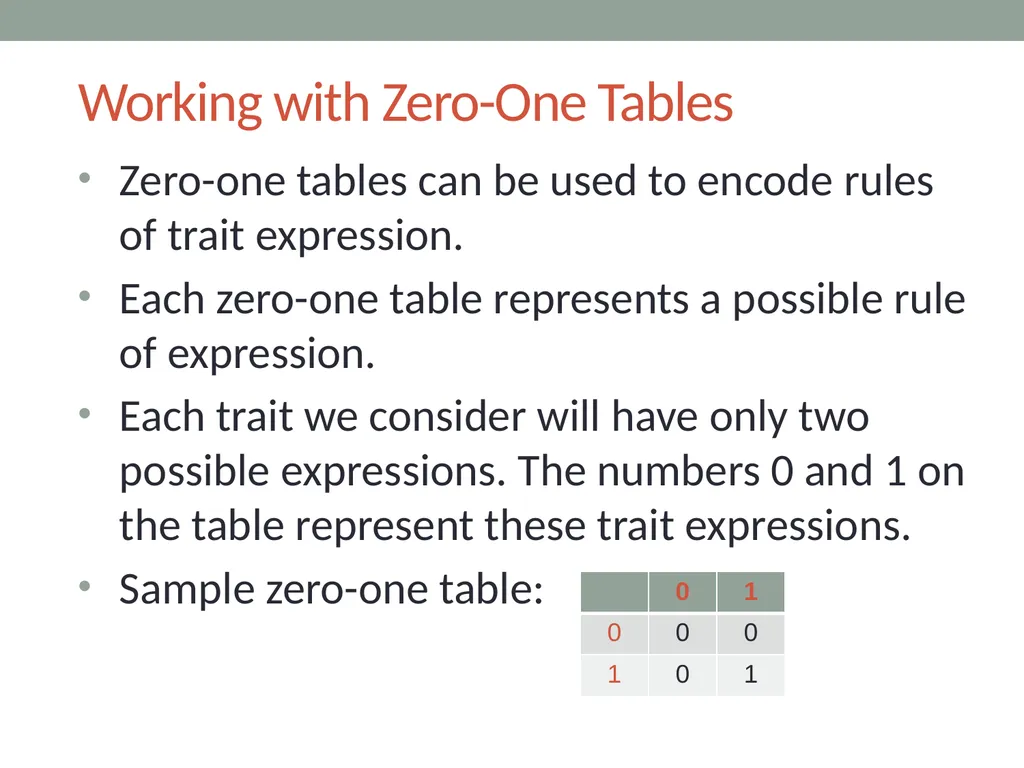
Working with Zero-One Tables Zero-one tables can be used to encode rules of trait expression.
Each zero-one table represents a possible rule of expression.
Each trait we consider will have only two possible expressions. The numbers 0 and 1 on the table represent these trait expressions.
Sample zero-one table:<br>
Each zero-one table represents a possible rule of expression.
Each trait we consider will have only two possible expressions. The numbers 0 and 1 on the table represent these trait expressions.
Sample zero-one table:<br>
28
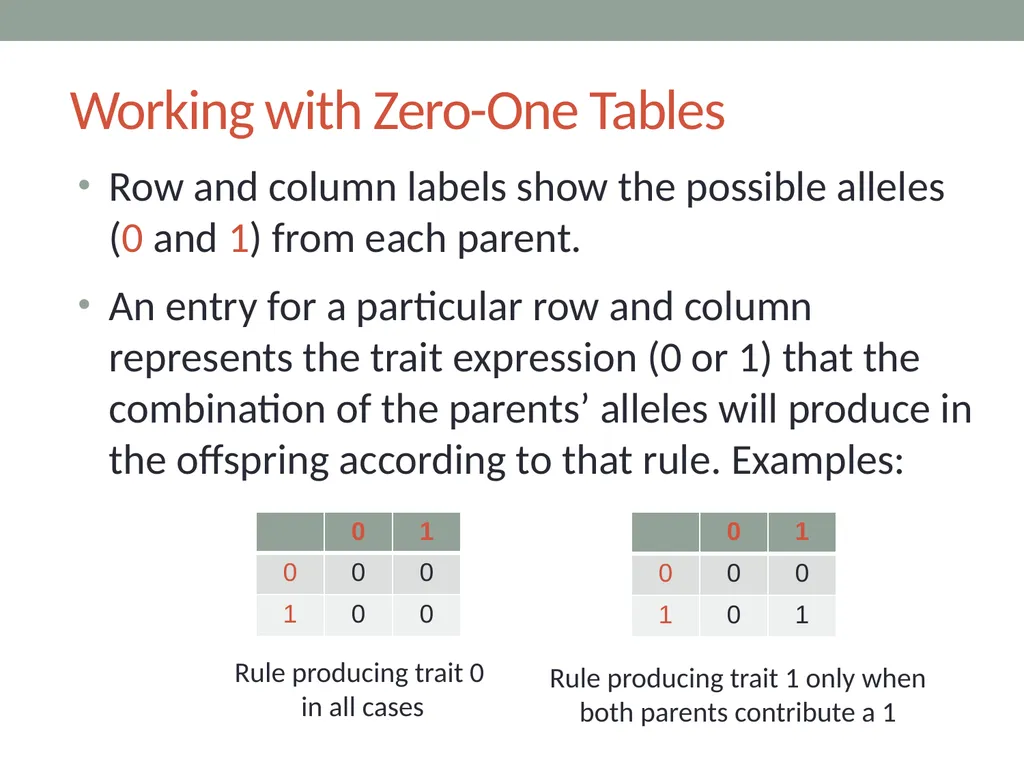
Working with Zero-One Tables Row and column labels show the possible alleles (0 and 1) from each parent.
An entry for a particular row and column represents the trait expression (0 or 1) that the combination of the parents’ alleles will produce in the offspring according to that rule. Examples: Rule producing trait 0 in all cases Rule producing trait 1 only when both parents contribute a 1<br>
An entry for a particular row and column represents the trait expression (0 or 1) that the combination of the parents’ alleles will produce in the offspring according to that rule. Examples: Rule producing trait 0 in all cases Rule producing trait 1 only when both parents contribute a 1<br>
29
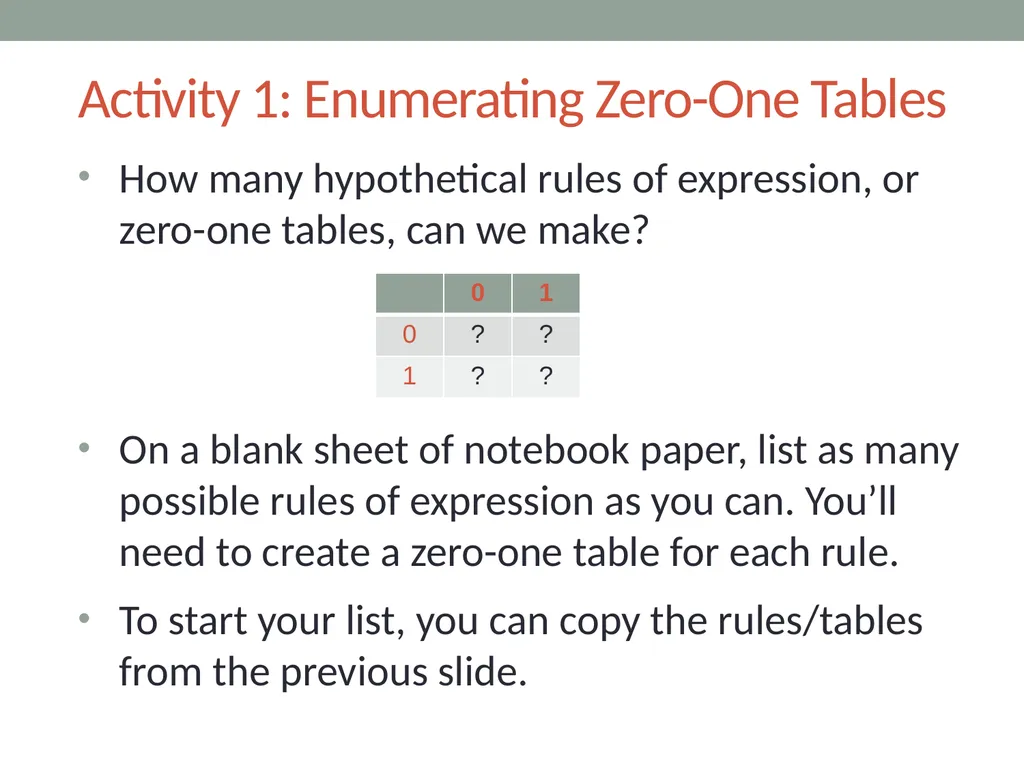
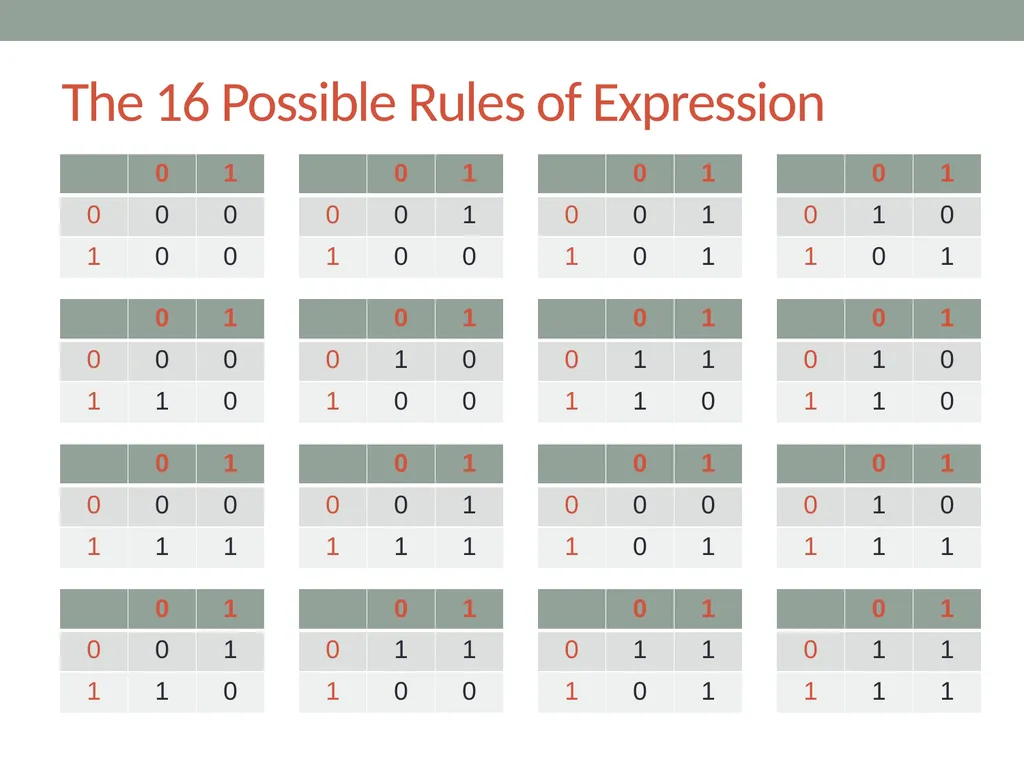
Activity 1: Enumerating Zero-One Tables How many hypothetical rules of expression, or zero-one tables, can we make?
On a blank sheet of notebook paper, list as many possible rules of expression as you can. You’ll need to create a zero-one table for each rule.
To start your list, you can copy the rules/tables from the previous slide.<br>
On a blank sheet of notebook paper, list as many possible rules of expression as you can. You’ll need to create a zero-one table for each rule.
To start your list, you can copy the rules/tables from the previous slide.<br>
30
The 16 Possible Rules of Expression<br>
31
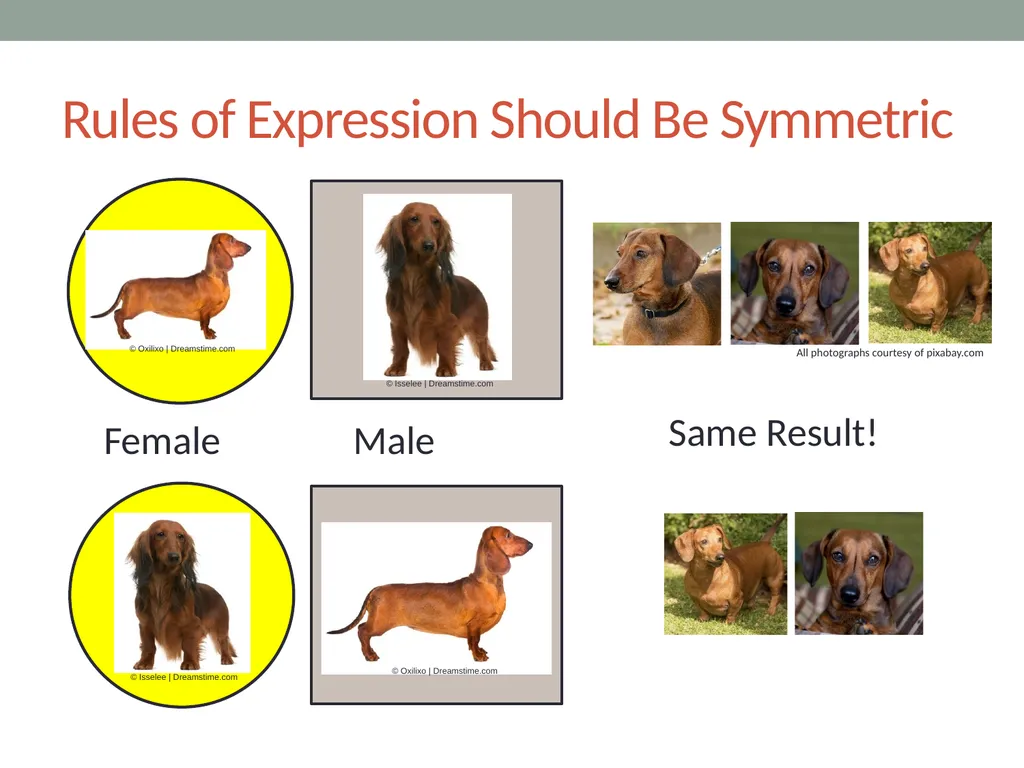
Rules of Expression Should Be Symmetric Female Male Same Result! All photographs courtesy of pixabay.com<br>
32
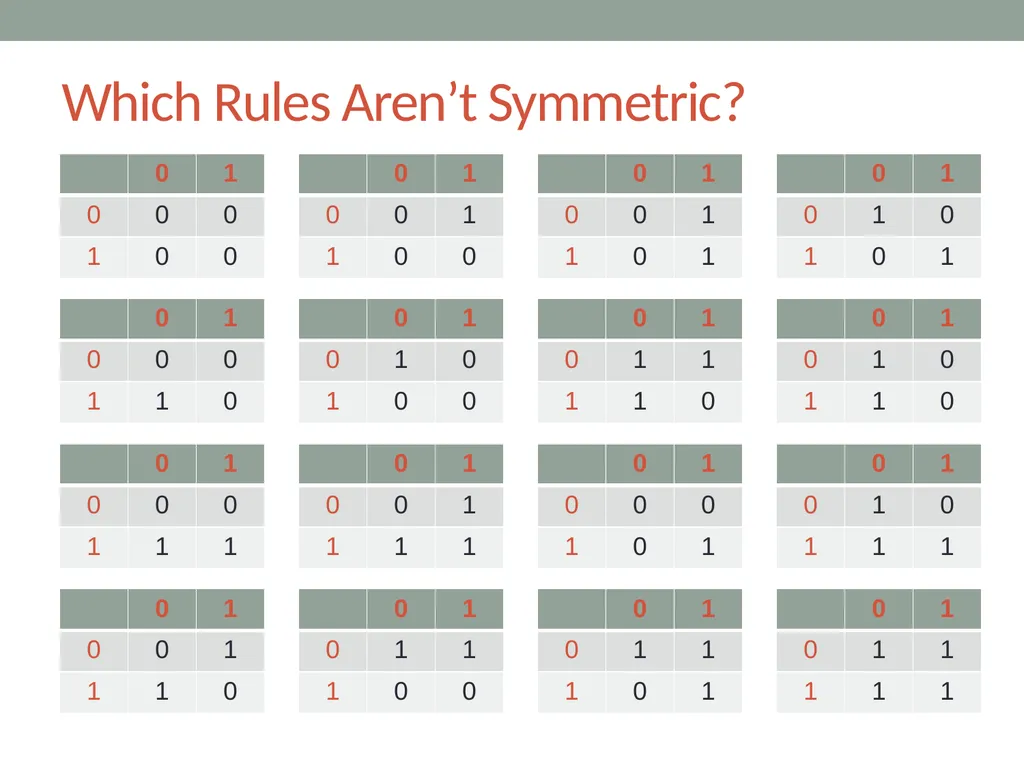
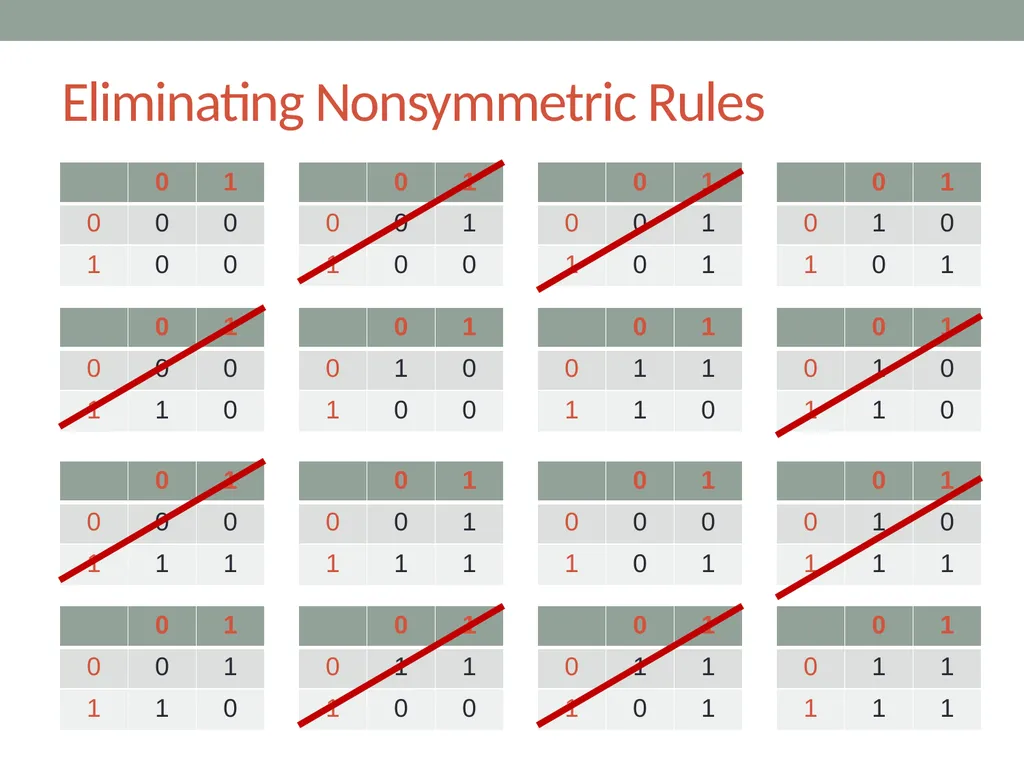
Which Rules Aren’t Symmetric?<br>
33
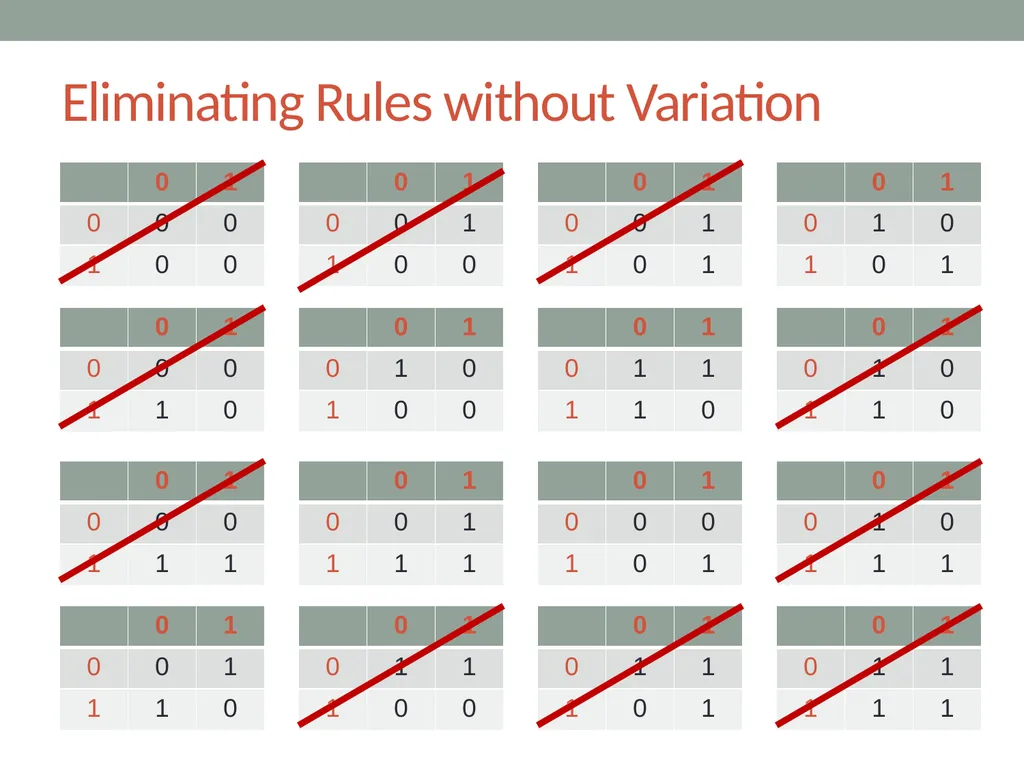
Eliminating Nonsymmetric Rules<br>
34
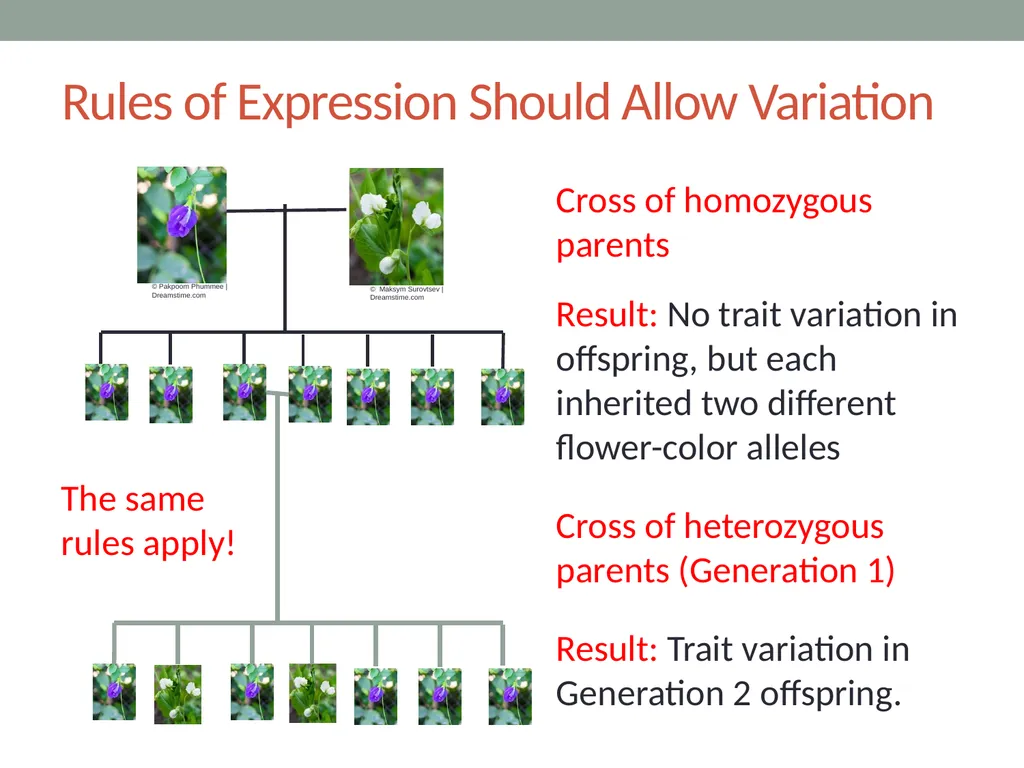
Rules of Expression Should Allow Variation © Pakpoom Phummee | Dreamstime.com © Maksym Surovtsev | Dreamstime.com Cross of homozygous parents
Result: No trait variation in offspring, but each inherited two different flower-color alleles
Cross of heterozygous parents (Generation 1)
Result: Trait variation in Generation 2 offspring. The same rules apply!<br>
Result: No trait variation in offspring, but each inherited two different flower-color alleles
Cross of heterozygous parents (Generation 1)
Result: Trait variation in Generation 2 offspring. The same rules apply!<br>
35
Eliminating Rules without Variation<br>
36
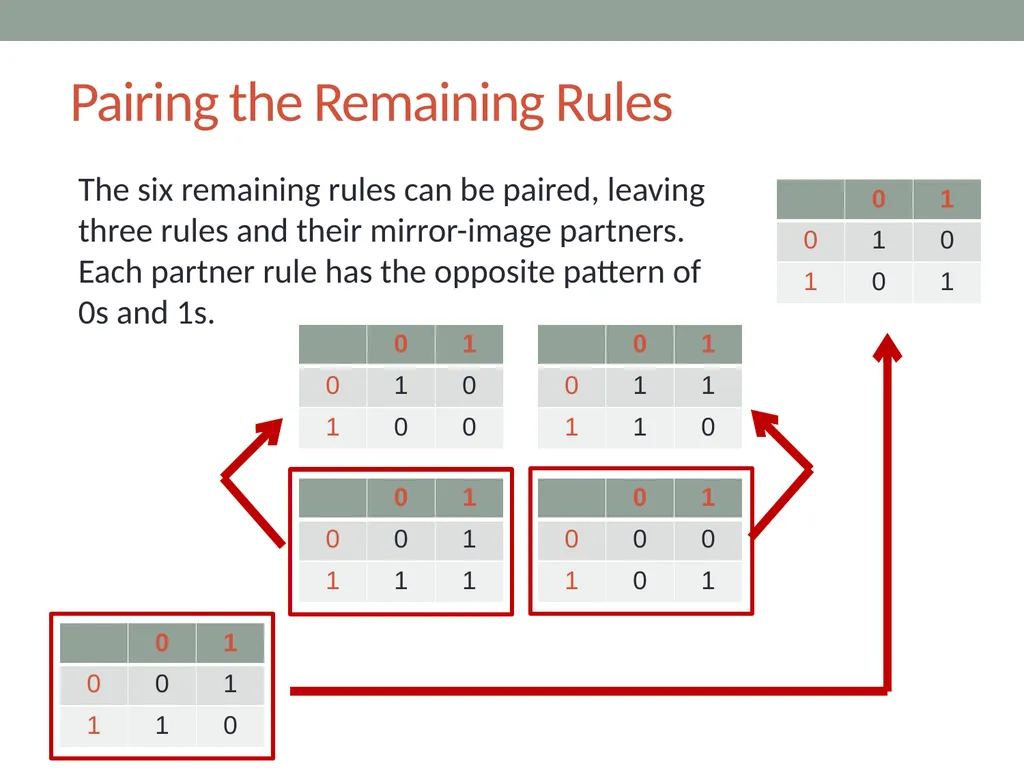
Pairing the Remaining Rules The six remaining rules can be paired, leaving three rules and their mirror-image partners. Each partner rule has the opposite pattern of 0s and 1s.<br>
37
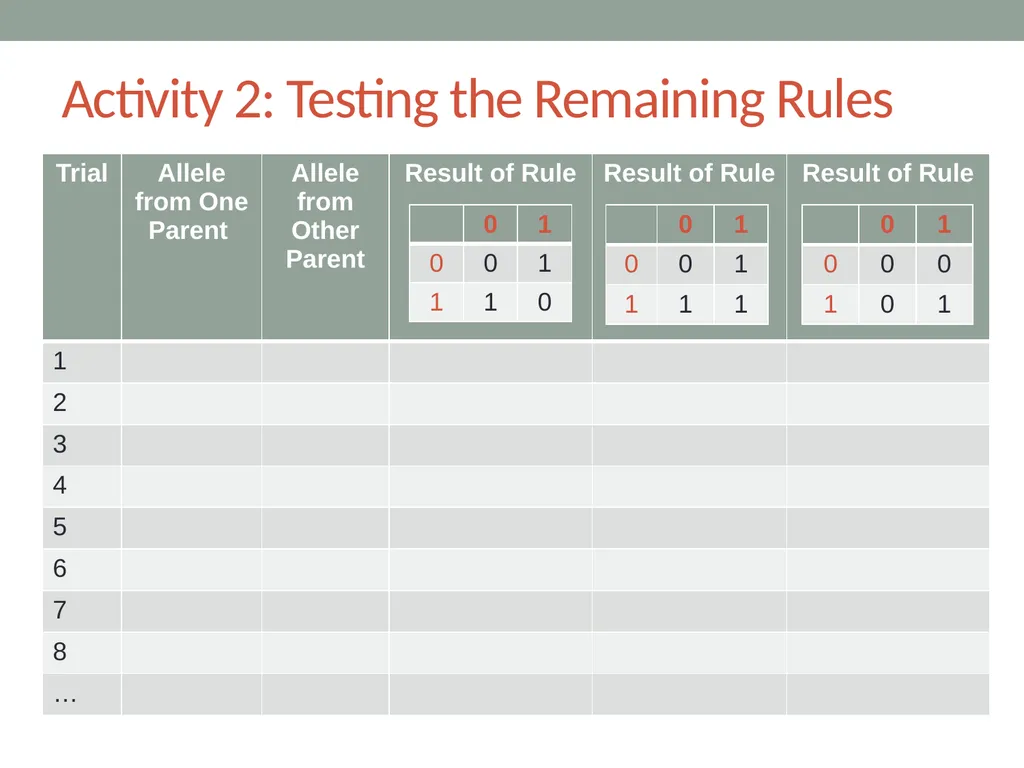
Activity 2: Testing the Remaining Rules<br>
38
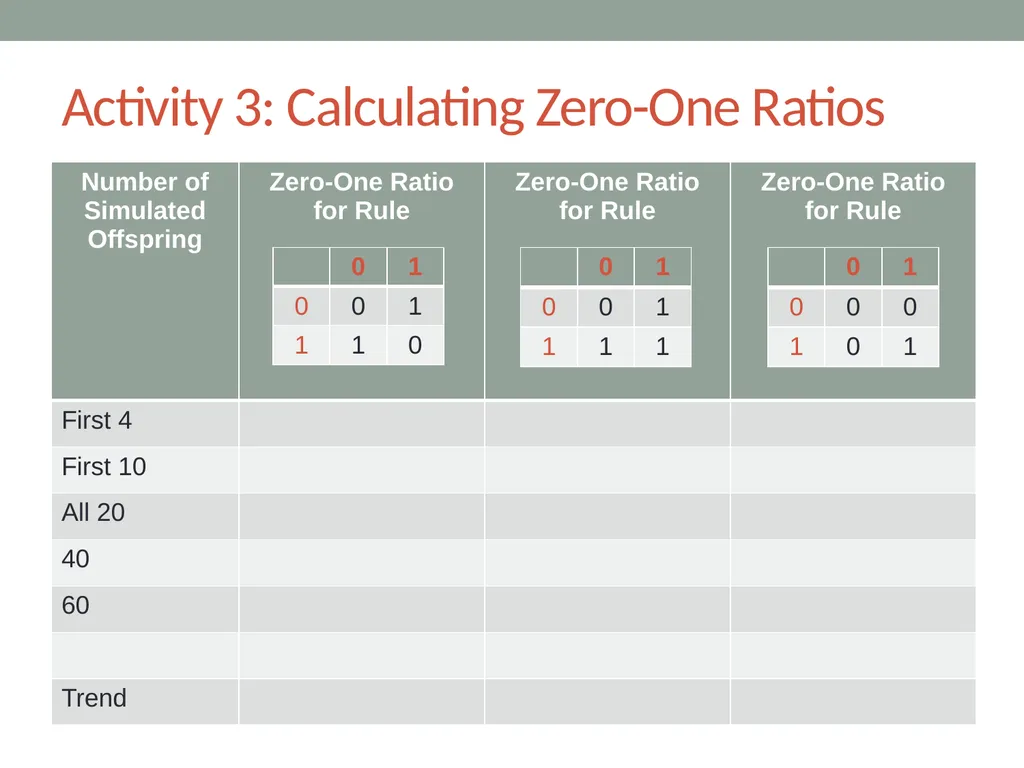
Activity 3: Calculating Zero-One Ratios<br>
39
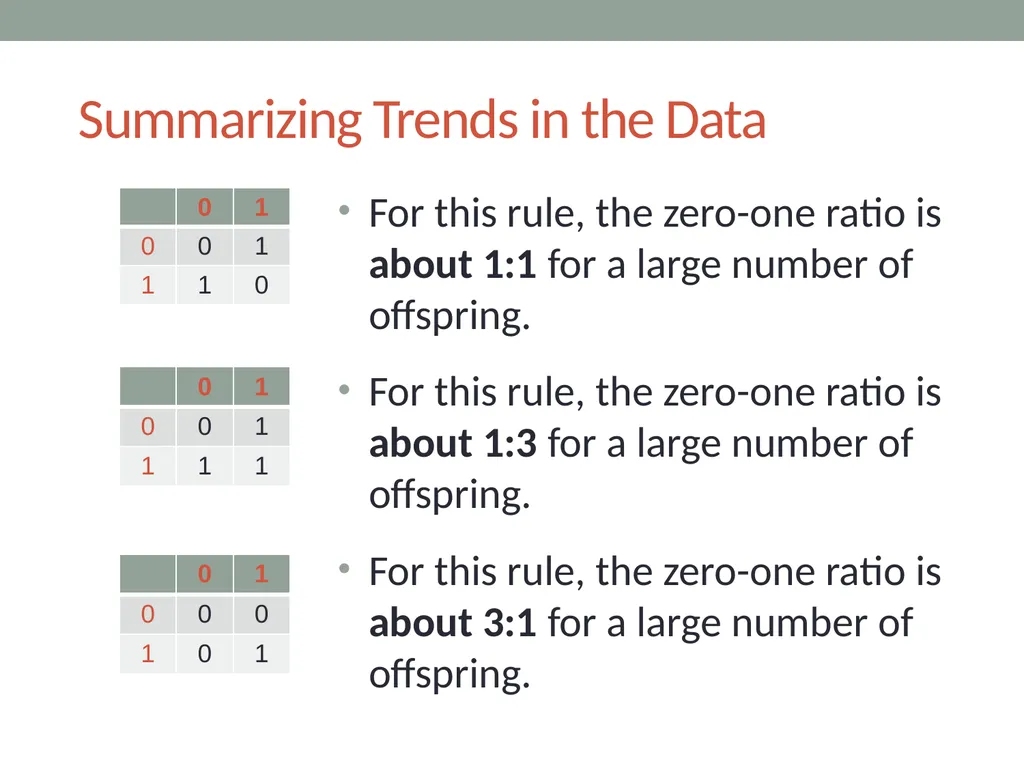
Summarizing Trends in the Data For this rule, the zero-one ratio is about 1:1 for a large number of offspring.
For this rule, the zero-one ratio is about 1:3 for a large number of offspring.
For this rule, the zero-one ratio is about 3:1 for a large number of offspring.<br>
For this rule, the zero-one ratio is about 1:3 for a large number of offspring.
For this rule, the zero-one ratio is about 3:1 for a large number of offspring.<br>
40
Dachshund and Pea-Plant Ratios Pea Plants Dachshunds Photograph by Oxilixo Photograph by Isselee Photograph by Pakpoom Phummee Photograph by Maksym Surovtsev<br>
41
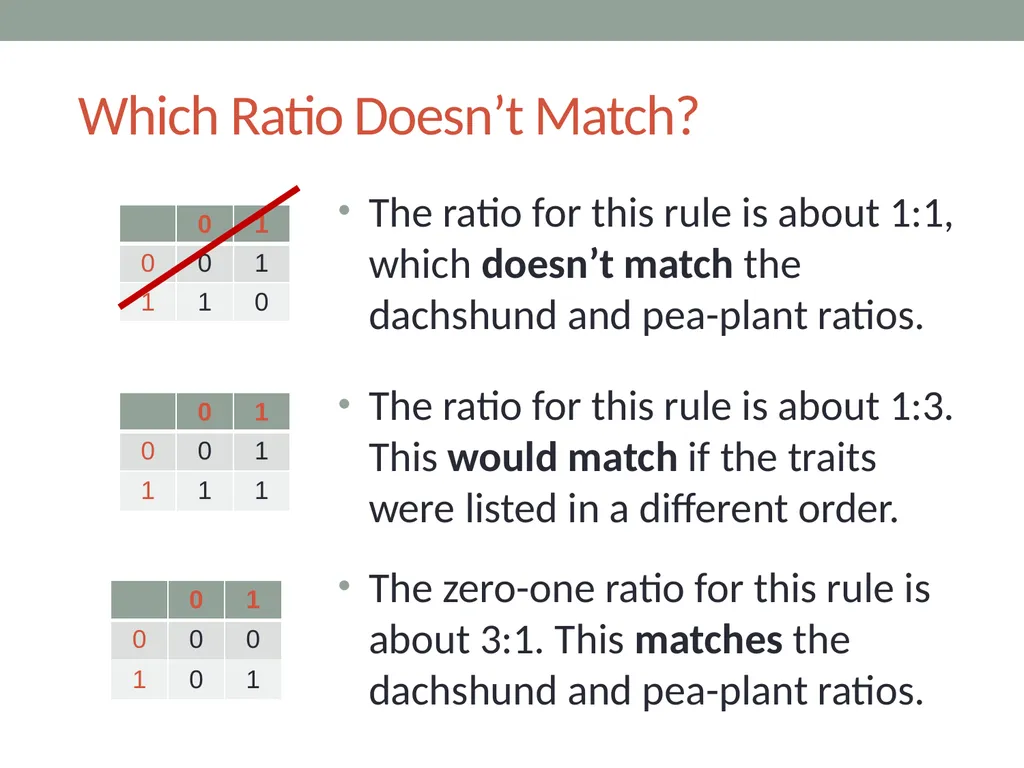
Which Ratio Doesn’t Match? The ratio for this rule is about 1:1, which doesn’t match the dachshund and pea-plant ratios.
The ratio for this rule is about 1:3. This would match if the traits were listed in a different order.
The zero-one ratio for this rule is about 3:1. This matches the dachshund and pea-plant ratios.<br>
The ratio for this rule is about 1:3. This would match if the traits were listed in a different order.
The zero-one ratio for this rule is about 3:1. This matches the dachshund and pea-plant ratios.<br>
42
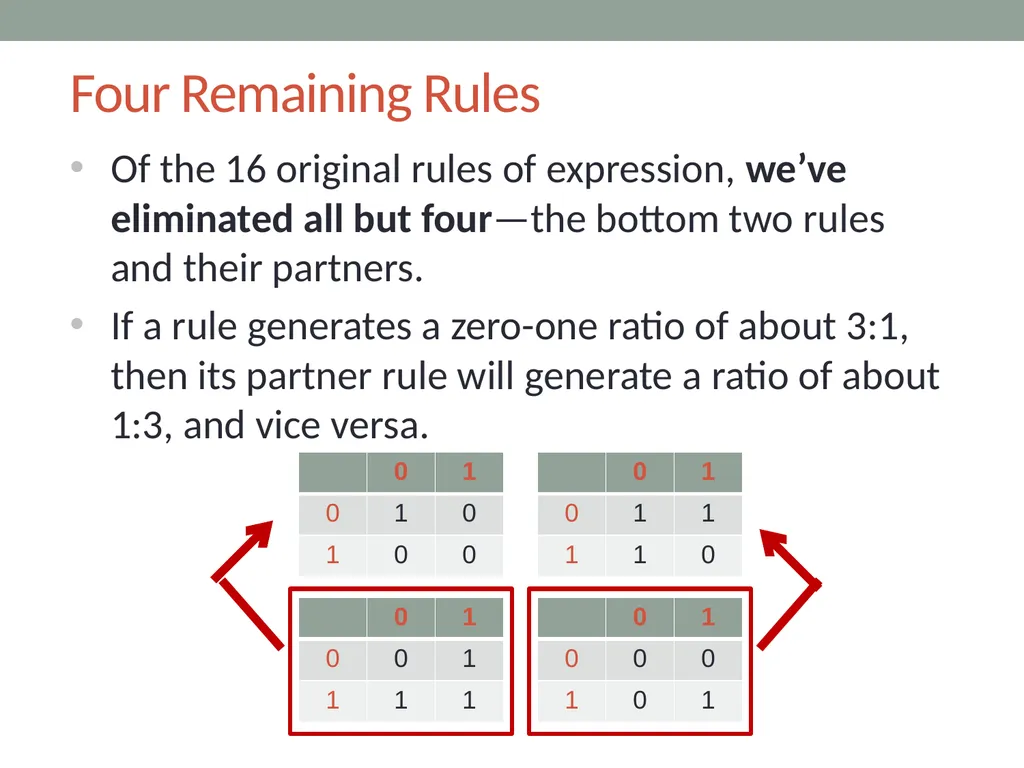
Four Remaining Rules Of the 16 original rules of expression, we’ve eliminated all but four—the bottom two rules
and their partners.
If a rule generates a zero-one ratio of about 3:1, then its partner rule will generate a ratio of about 1:3, and vice versa.<br>
If a rule generates a zero-one ratio of about 3:1, then its partner rule will generate a ratio of about 1:3, and vice versa.<br>
43
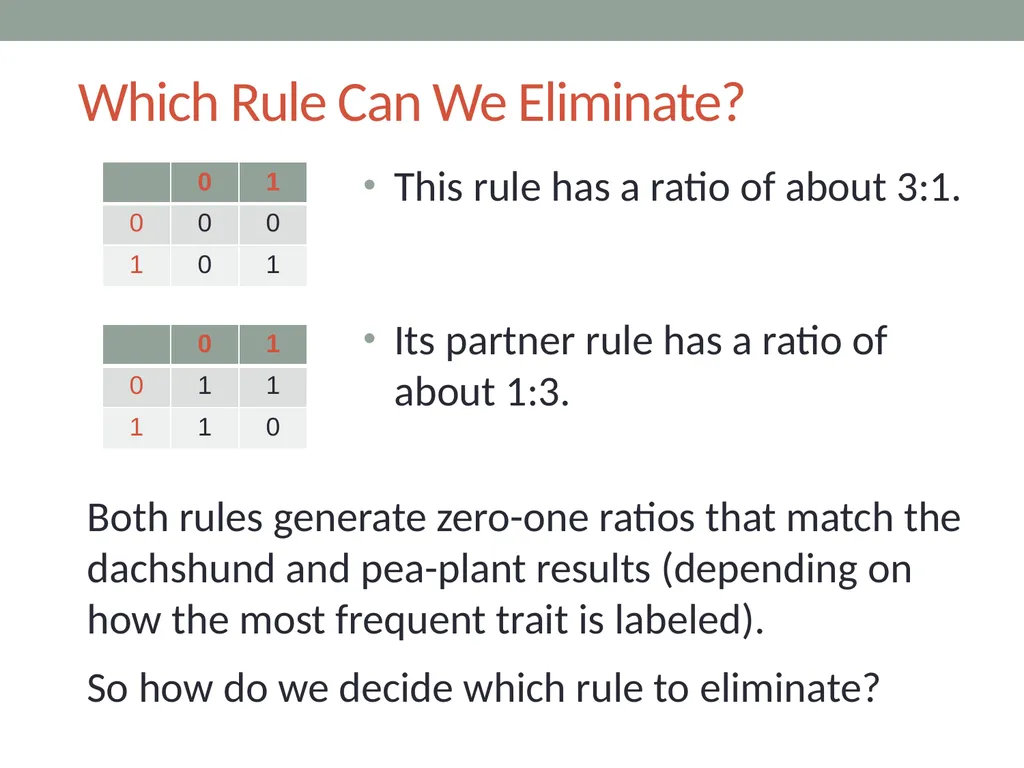
Which Rule Can We Eliminate? This rule has a ratio of about 3:1.
Its partner rule has a ratio of about 1:3.
Both rules generate zero-one ratios that match the dachshund and pea-plant results (depending on how the most frequent trait is labeled).
So how do we decide which rule to eliminate?<br>
Its partner rule has a ratio of about 1:3.
Both rules generate zero-one ratios that match the dachshund and pea-plant results (depending on how the most frequent trait is labeled).
So how do we decide which rule to eliminate?<br>
44
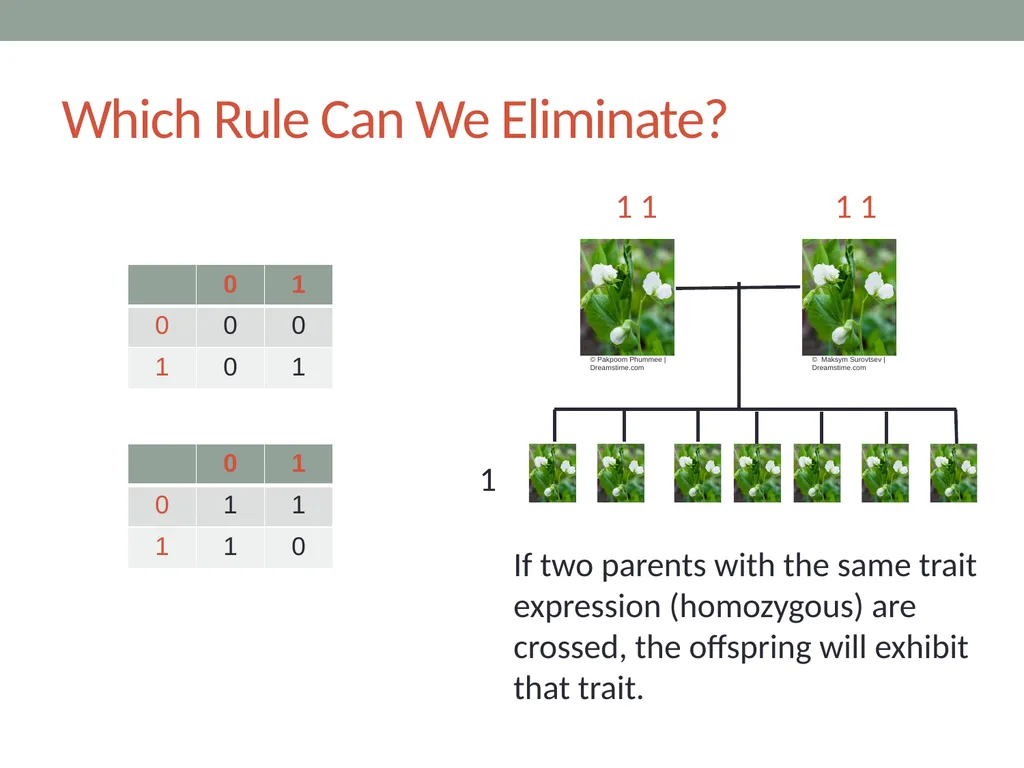
Which Rule Can We Eliminate? © Pakpoom Phummee | Dreamstime.com © Maksym Surovtsev | Dreamstime.com If two parents with the same trait expression (homozygous) are crossed, the offspring will exhibit that trait. 1 1 1 1 1<br>
45
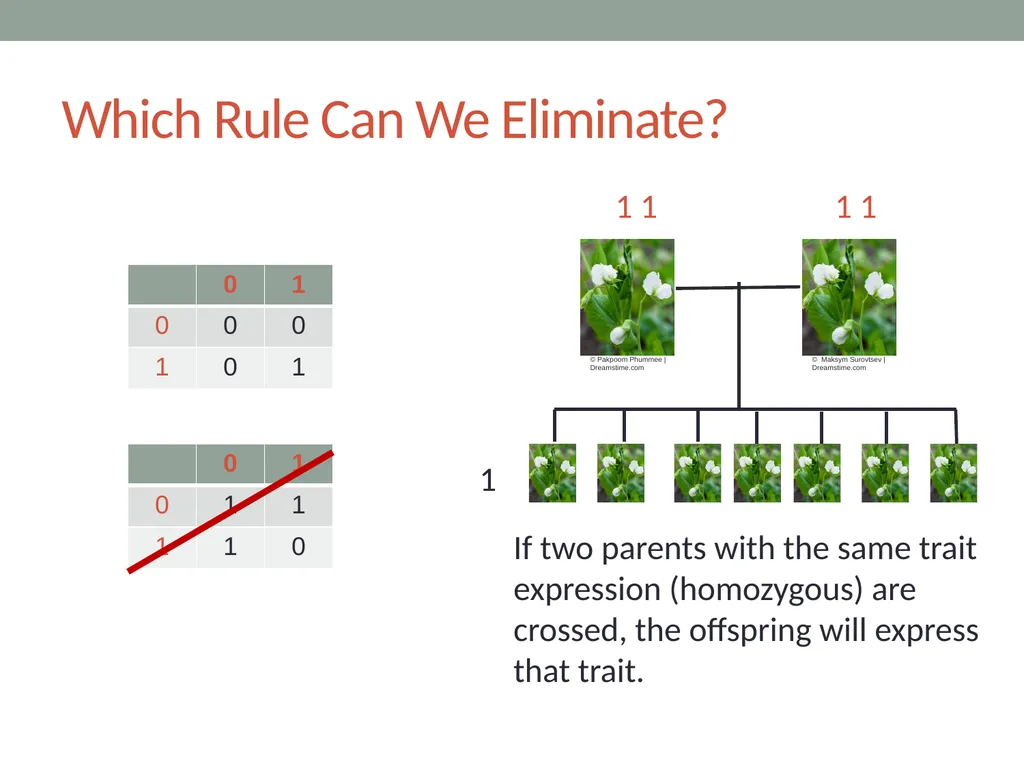
Which Rule Can We Eliminate? © Pakpoom Phummee | Dreamstime.com © Maksym Surovtsev | Dreamstime.com If two parents with the same trait expression (homozygous) are crossed, the offspring will express that trait. 1 1 1 1 1<br>
46
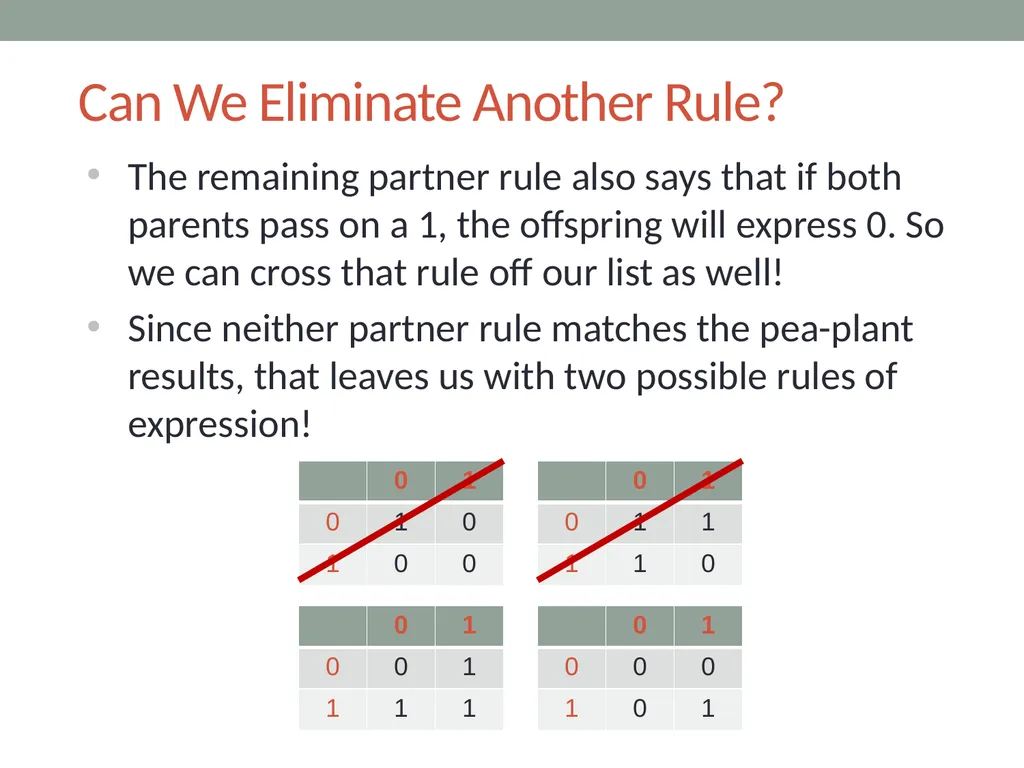
Can We Eliminate Another Rule? The remaining partner rule also says that if both parents pass on a 1, the offspring will express 0. So we can cross that rule off our list as well!
Since neither partner rule matches the pea-plant results, that leaves us with two possible rules of expression!<br>
Since neither partner rule matches the pea-plant results, that leaves us with two possible rules of expression!<br>
47
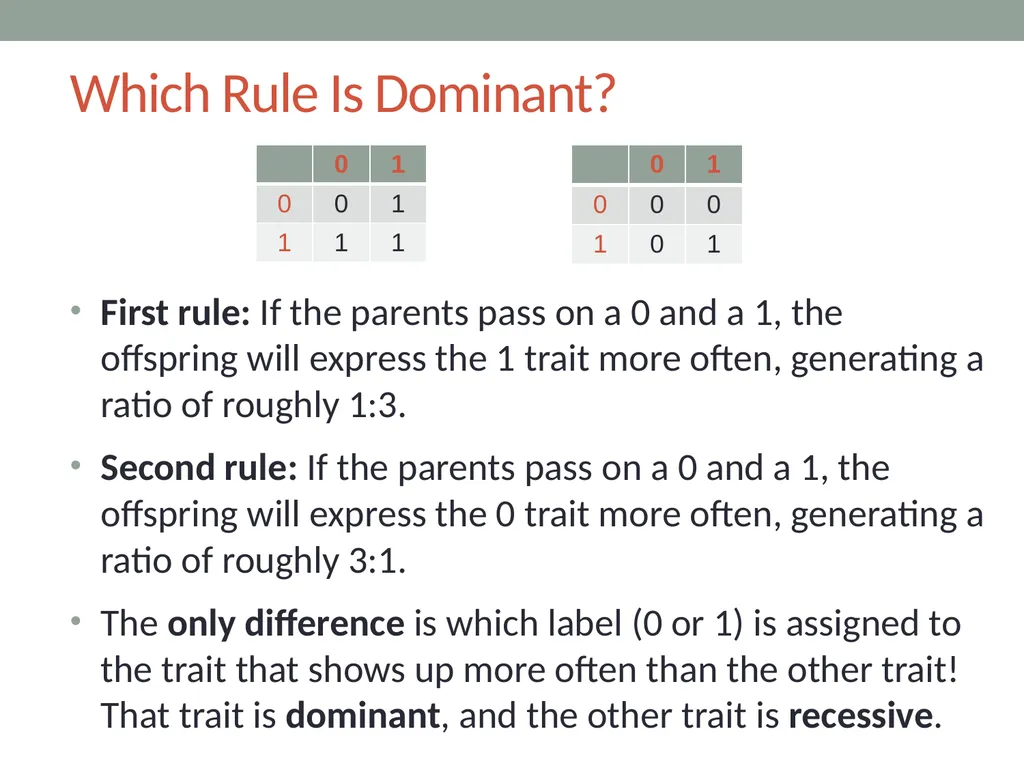
Which Rule Is Dominant? First rule: If the parents pass on a 0 and a 1, the offspring will express the 1 trait more often, generating a ratio of roughly 1:3.
Second rule: If the parents pass on a 0 and a 1, the offspring will express the 0 trait more often, generating a ratio of roughly 3:1.
The only difference is which label (0 or 1) is assigned to the trait that shows up more often than the other trait! That trait is dominant, and the other trait is recessive.<br>
Second rule: If the parents pass on a 0 and a 1, the offspring will express the 0 trait more often, generating a ratio of roughly 3:1.
The only difference is which label (0 or 1) is assigned to the trait that shows up more often than the other trait! That trait is dominant, and the other trait is recessive.<br>
48
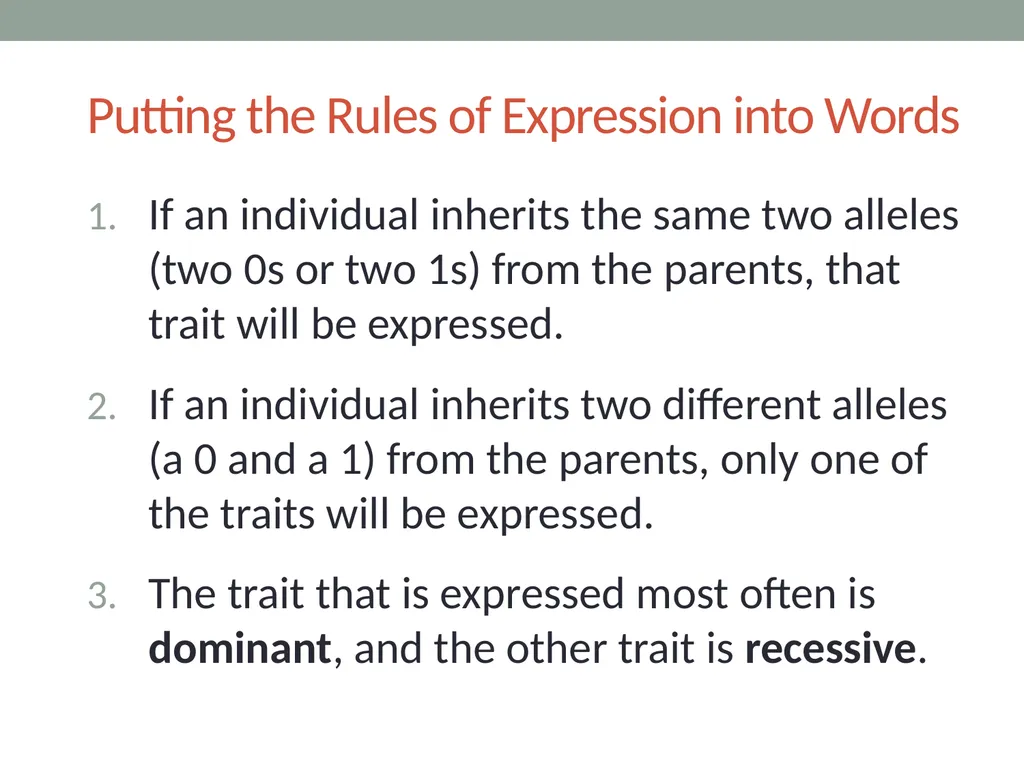
Putting the Rules of Expression into Words If an individual inherits the same two alleles (two 0s or two 1s) from the parents, that trait will be expressed.
If an individual inherits two different alleles (a 0 and a 1) from the parents, only one of the traits will be expressed.
The trait that is expressed most often is dominant, and the other trait is recessive.<br>
If an individual inherits two different alleles (a 0 and a 1) from the parents, only one of the traits will be expressed.
The trait that is expressed most often is dominant, and the other trait is recessive.<br>
49
Reflect: Content Deepening Focus
Question 1 Starting with Mendel’s ideas about trait inheritance, how can we use mathematical simulation and statistical analysis to determine the rules of expression for simply-inherited traits?<br>
50
Content Deepening: Focus Question 2 What kinds of data sets characterize simply-inherited traits?<br>
51
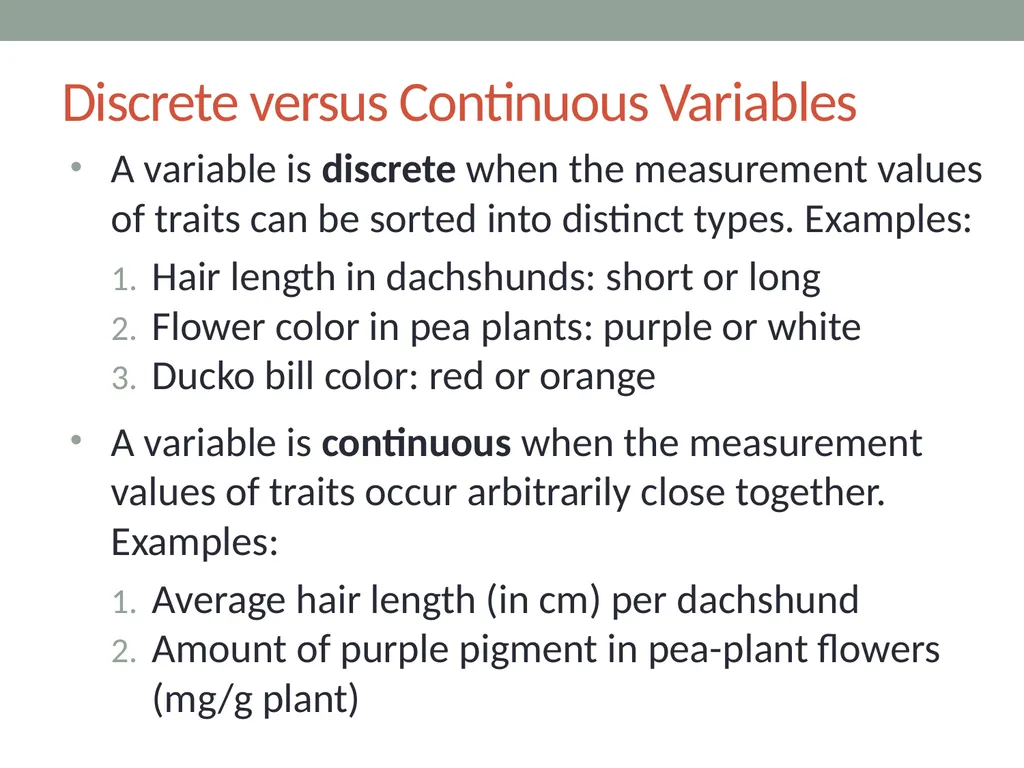
Discrete versus Continuous Variables A variable is discrete when the measurement values of traits can be sorted into distinct types. Examples:
Hair length in dachshunds: short or long
Flower color in pea plants: purple or white
Ducko bill color: red or orange
A variable is continuous when the measurement values of traits occur arbitrarily close together. Examples:
Average hair length (in cm) per dachshund
Amount of purple pigment in pea-plant flowers (mg/g plant)<br>
Hair length in dachshunds: short or long
Flower color in pea plants: purple or white
Ducko bill color: red or orange
A variable is continuous when the measurement values of traits occur arbitrarily close together. Examples:
Average hair length (in cm) per dachshund
Amount of purple pigment in pea-plant flowers (mg/g plant)<br>
52
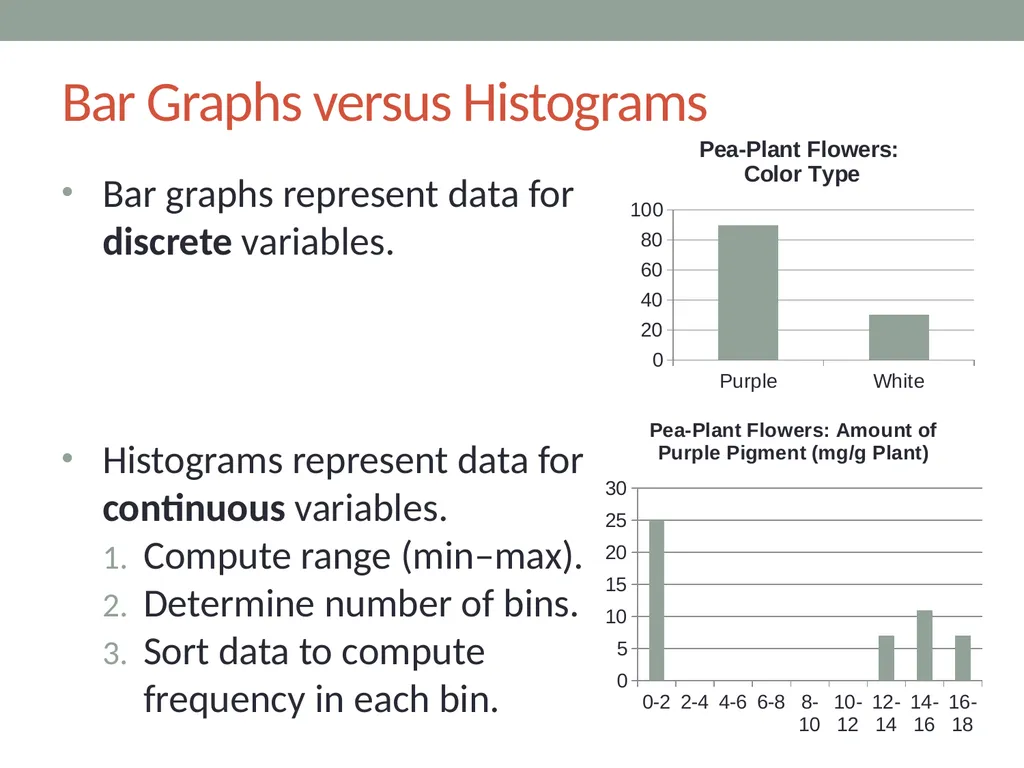
Bar Graphs versus Histograms Bar graphs represent data for
discrete variables.
Histograms represent data for continuous variables.
Compute range (min–max).
Determine number of bins.
Sort data to compute frequency in each bin.<br>
Histograms represent data for continuous variables.
Compute range (min–max).
Determine number of bins.
Sort data to compute frequency in each bin.<br>
53
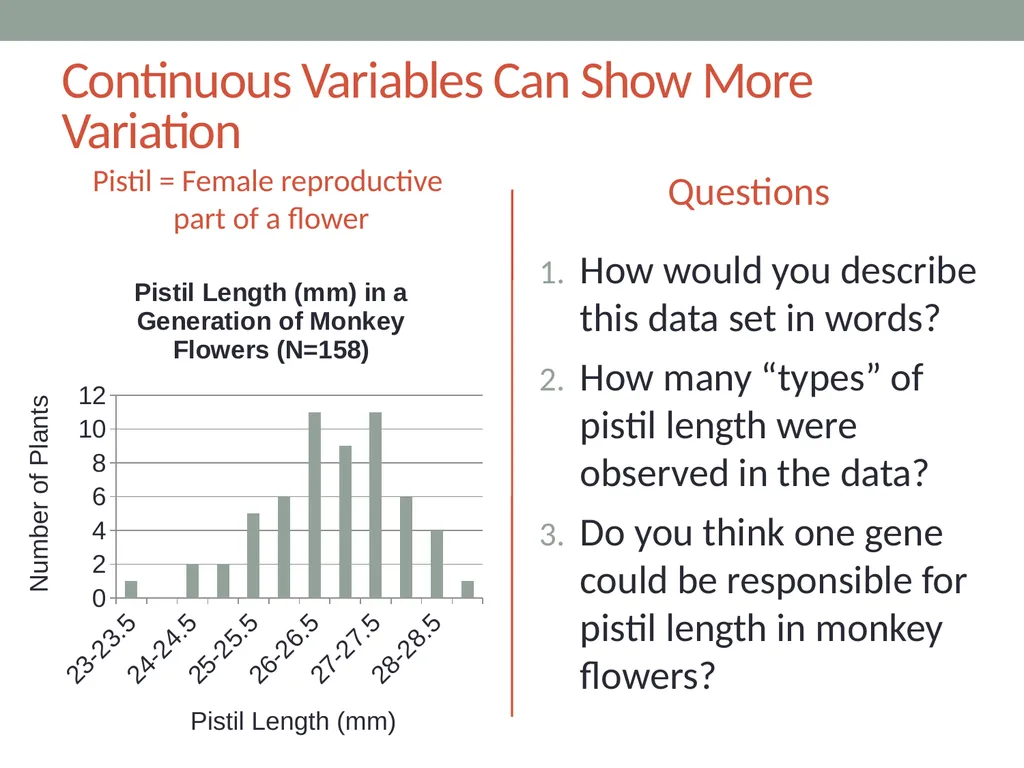
Continuous Variables Can Show More Variation Pistil = Female reproductive
part of a flower Questions How would you describe this data set in words?
How many “types” of pistil length were observed in the data?
Do you think one gene could be responsible for pistil length in monkey flowers? Pistil Length (mm) Number of Plants<br>
How many “types” of pistil length were observed in the data?
Do you think one gene could be responsible for pistil length in monkey flowers? Pistil Length (mm) Number of Plants<br>
54
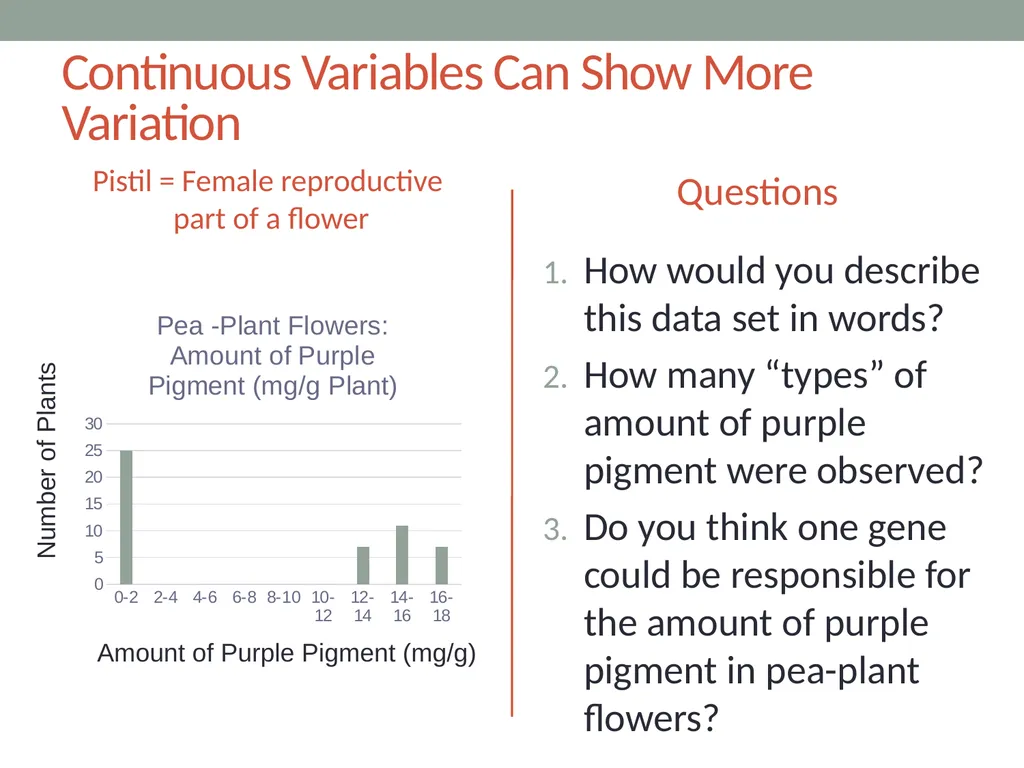
Continuous Variables Can Show More Variation Pistil = Female reproductive
part of a flower Questions How would you describe this data set in words?
How many “types” of amount of purple pigment were observed?
Do you think one gene could be responsible for the amount of purple pigment in pea-plant flowers? Number of Plants Amount of Purple Pigment (mg/g)<br>
How many “types” of amount of purple pigment were observed?
Do you think one gene could be responsible for the amount of purple pigment in pea-plant flowers? Number of Plants Amount of Purple Pigment (mg/g)<br>
55
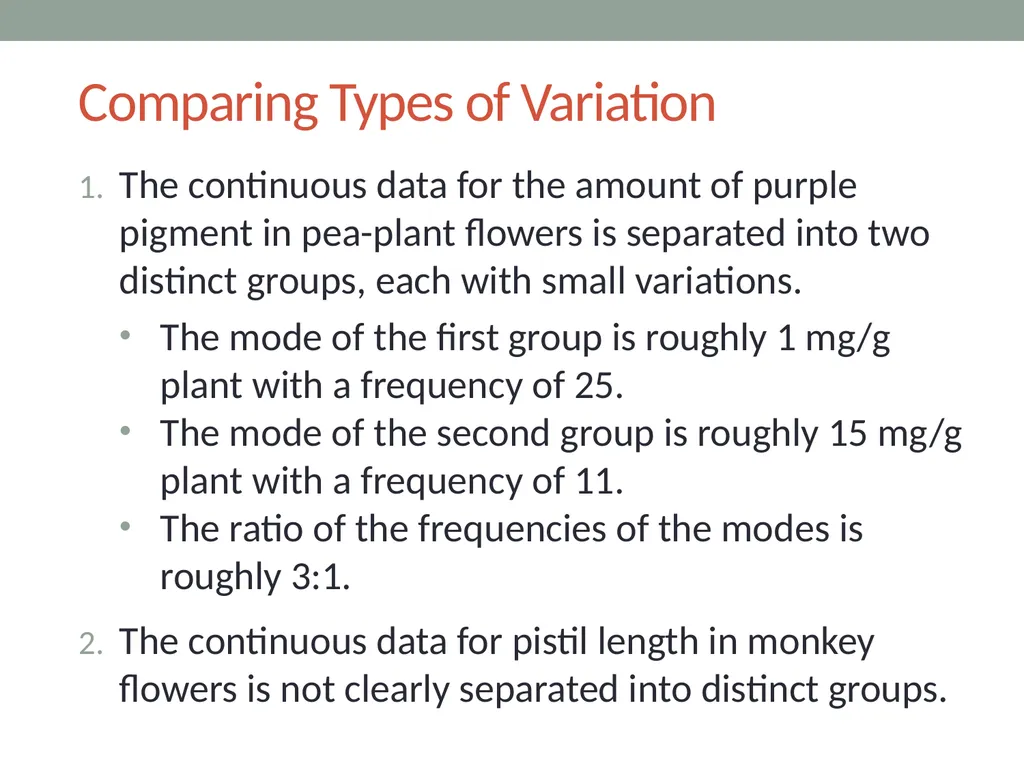
Comparing Types of Variation The continuous data for the amount of purple pigment in pea-plant flowers is separated into two distinct groups, each with small variations.
The mode of the first group is roughly 1 mg/g plant with a frequency of 25.
The mode of the second group is roughly 15 mg/g plant with a frequency of 11.
The ratio of the frequencies of the modes is roughly 3:1.
The continuous data for pistil length in monkey flowers is not clearly separated into distinct groups.<br>
The mode of the first group is roughly 1 mg/g plant with a frequency of 25.
The mode of the second group is roughly 15 mg/g plant with a frequency of 11.
The ratio of the frequencies of the modes is roughly 3:1.
The continuous data for pistil length in monkey flowers is not clearly separated into distinct groups.<br>
56
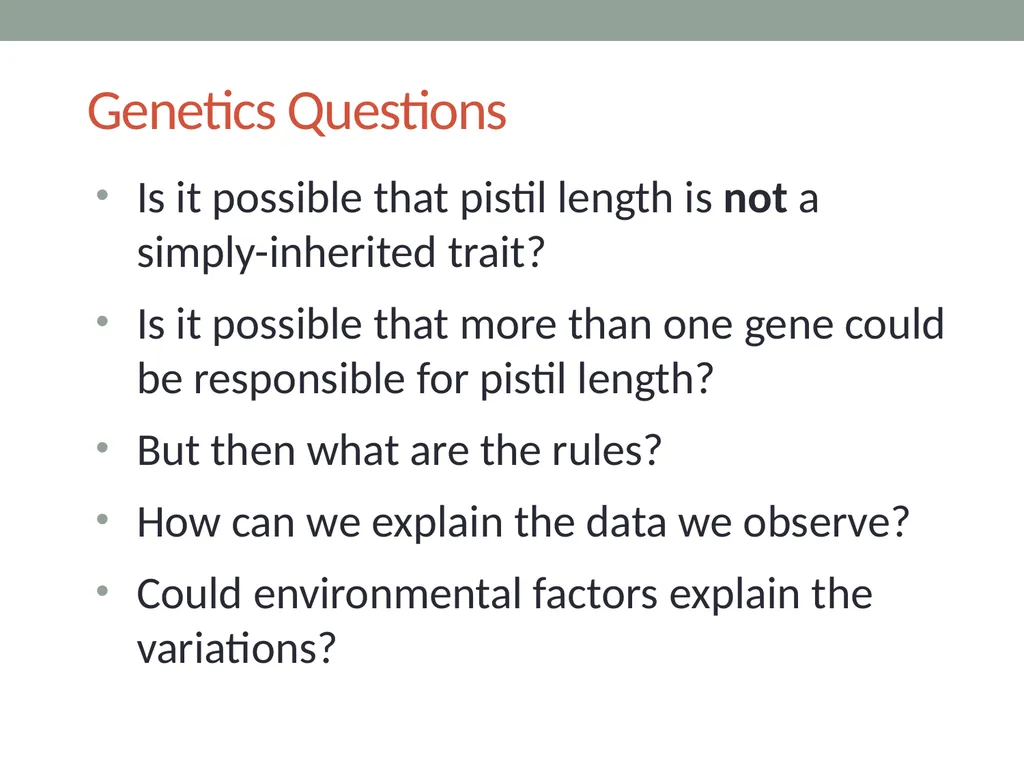
Genetics Questions Is it possible that pistil length is not a simply-inherited trait?
Is it possible that more than one gene could be responsible for pistil length?
But then what are the rules?
How can we explain the data we observe?
Could environmental factors explain the variations?<br>
Is it possible that more than one gene could be responsible for pistil length?
But then what are the rules?
How can we explain the data we observe?
Could environmental factors explain the variations?<br>
57
Reflect: Content Deepening Focus
Question 2 What kinds of data sets characterize simply-inherited traits?<br>
58
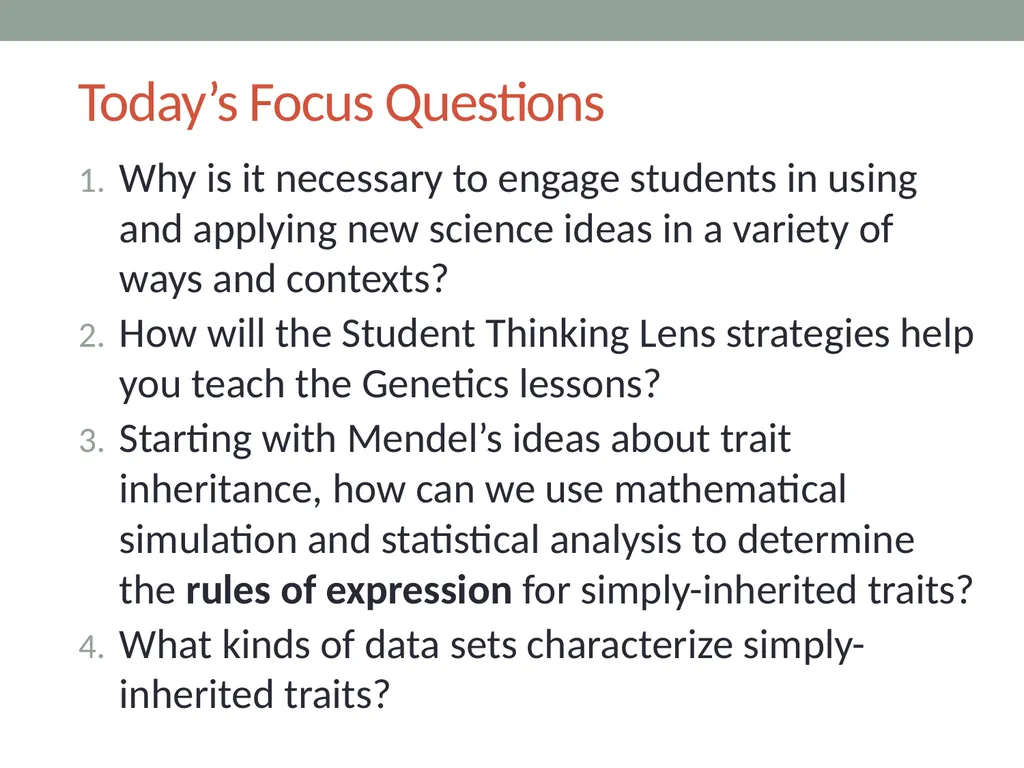
Today’s Focus Questions Why is it necessary to engage students in using and applying new science ideas in a variety of ways and contexts?
How will the Student Thinking Lens strategies help you teach the Genetics lessons?
Starting with Mendel’s ideas about trait inheritance, how can we use mathematical simulation and statistical analysis to determine the rules of expression for simply-inherited traits?
What kinds of data sets characterize simply-inherited traits?<br>
How will the Student Thinking Lens strategies help you teach the Genetics lessons?
Starting with Mendel’s ideas about trait inheritance, how can we use mathematical simulation and statistical analysis to determine the rules of expression for simply-inherited traits?
What kinds of data sets characterize simply-inherited traits?<br>
59
Let’s Summarize! Lesson Analysis Strategy 6
What new understandings did you develop?
What do you still have questions about?
Lesson Plans Review
What new insight(s) did you gain?
What do you still have questions about?
Content Deepening
What did you learn?
What do you still have questions about?<br>
What new understandings did you develop?
What do you still have questions about?
Lesson Plans Review
What new insight(s) did you gain?
What do you still have questions about?
Content Deepening
What did you learn?
What do you still have questions about?<br>
60
Homework Read in the STeLLA strategies booklet:
Student Ideas and Science Ideas Defined
Introduction to the Science Content Storyline Lens
Science Content Storyline Lens, STeLLA Strategy A: Identify One Main Learning Goal
Complete strategy-A column on the Coherent Science Content Storyline Strategies Z-fold summary chart (front binder pocket).<br>
Student Ideas and Science Ideas Defined
Introduction to the Science Content Storyline Lens
Science Content Storyline Lens, STeLLA Strategy A: Identify One Main Learning Goal
Complete strategy-A column on the Coherent Science Content Storyline Strategies Z-fold summary chart (front binder pocket).<br>
61
Reflections on Today’s Session Complete the Daily Reflections sheet (handout 4.7 in PD program binder).
This weekend you bump into a friend who knew you were attending RESPeCT this week. What would you say you’ve learned about the STeLLA Student Thinking Lens strategies and their potential impact on your teaching practice and/or student learning?
What do you understand better about trait variation and inheritance after this week’s session? What helped clarify your understanding?<br>
This weekend you bump into a friend who knew you were attending RESPeCT this week. What would you say you’ve learned about the STeLLA Student Thinking Lens strategies and their potential impact on your teaching practice and/or student learning?
What do you understand better about trait variation and inheritance after this week’s session? What helped clarify your understanding?<br>
62
Norms for Working Together: The Basics The Basics
Arrive prepared and on time; stay for the duration; return from breaks on time.
Remain attentive, thoughtful, and respectful; engage and be present.
Eliminate interruptions (turn off cell phones, email, and other electronic devices; avoid sidebar conversations).
Make room for everyone to participate (monitor your floor time). Purpose: Build trust and develop a productive study group for all participants.<br>
Arrive prepared and on time; stay for the duration; return from breaks on time.
Remain attentive, thoughtful, and respectful; engage and be present.
Eliminate interruptions (turn off cell phones, email, and other electronic devices; avoid sidebar conversations).
Make room for everyone to participate (monitor your floor time). Purpose: Build trust and develop a productive study group for all participants.<br>
63
Norms for Working Together: The Heart The Heart of RESPeCT Lesson Analysis and Content
Deepening
Keep the goal in mind: analysis of teaching to improve student learning.
Share your ideas, uncertainties, confusion, disagreements, questions, and good humor. All points of view are welcome.
Expect and ask questions to deepen everyone’s learning; be constructively challenging.
Listen carefully; seek to understand other participants’ points of view. Purpose: Build trust and develop a productive study group for all participants.<br>
Keep the goal in mind: analysis of teaching to improve student learning.
Share your ideas, uncertainties, confusion, disagreements, questions, and good humor. All points of view are welcome.
Expect and ask questions to deepen everyone’s learning; be constructively challenging.
Listen carefully; seek to understand other participants’ points of view. Purpose: Build trust and develop a productive study group for all participants.<br>