
Restrictions, including those restrictions
MS
Published · 43 slides · 0 views
1 / 1




Description
Restrictions, including those restrictions permitted by the European Convention on Human Rights Torts of Defamation Defamation Explain and define the law of defamation. Explain the factors a claimant must satisfy with reference to relevant
Related Topics
Share
Embed code
Download this presentation From Below
"Restrictions, including those restrictions" is the property of its rightful owner. Permission is granted to download and print the materials on this website for personal, non-commercial use only, and to display it on your personal computer provided you do not modify the materials and that you retain all copyright notices contained in the materials. By downloading content from our website, you accept the terms of this agreement.
Presentation Transcript
01
Restrictions, including those restrictions permitted by the European Convention on Human Rights
Torts of Defamation<br>
Torts of Defamation<br>
02
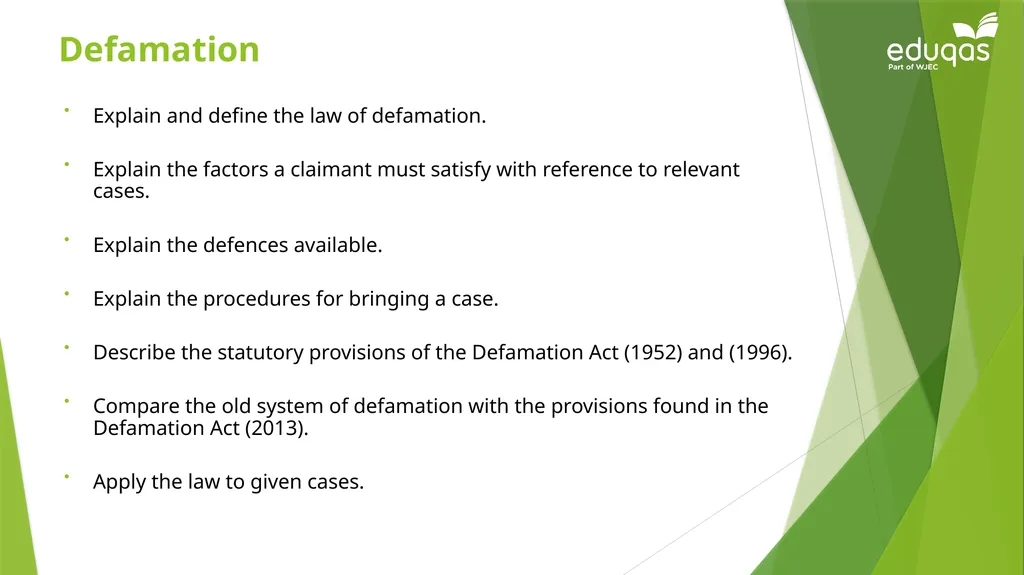
Defamation Explain and define the law of defamation.
Explain the factors a claimant must satisfy with reference to relevant cases.
Explain the defences available.
Explain the procedures for bringing a case.
Describe the statutory provisions of the Defamation Act (1952) and (1996).
Compare the old system of defamation with the provisions found in the Defamation Act (2013).
Apply the law to given cases.<br>
Explain the factors a claimant must satisfy with reference to relevant cases.
Explain the defences available.
Explain the procedures for bringing a case.
Describe the statutory provisions of the Defamation Act (1952) and (1996).
Compare the old system of defamation with the provisions found in the Defamation Act (2013).
Apply the law to given cases.<br>
03
Defamation In groups….
* Define defamation
* What factors do you think a claimant would need to prove?<br>
* Define defamation
* What factors do you think a claimant would need to prove?<br>
04
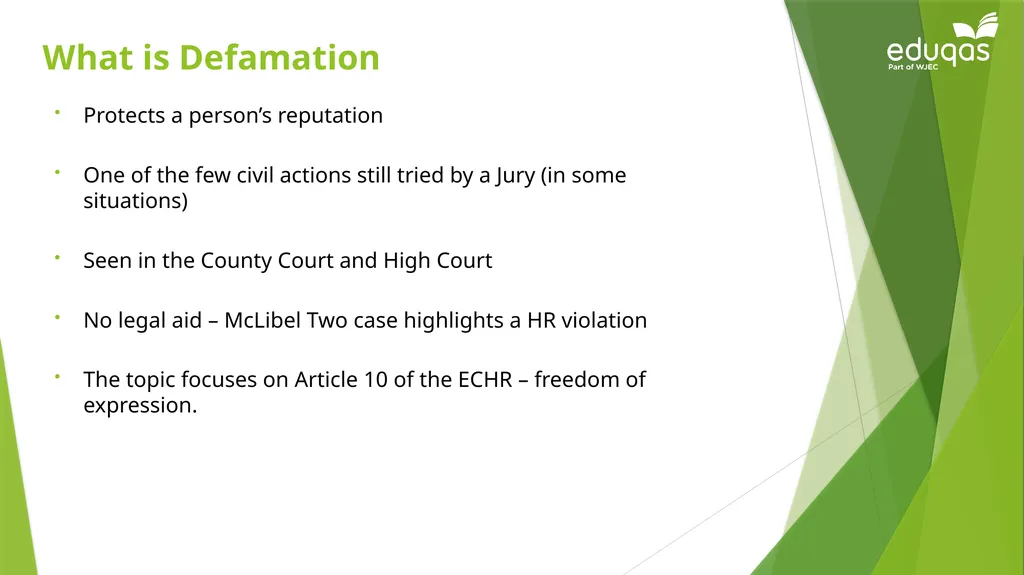
What is Defamation Protects a person’s reputation
One of the few civil actions still tried by a Jury (in some situations)
Seen in the County Court and High Court
No legal aid – McLibel Two case highlights a HR violation
The topic focuses on Article 10 of the ECHR – freedom of expression.<br>
One of the few civil actions still tried by a Jury (in some situations)
Seen in the County Court and High Court
No legal aid – McLibel Two case highlights a HR violation
The topic focuses on Article 10 of the ECHR – freedom of expression.<br>
05
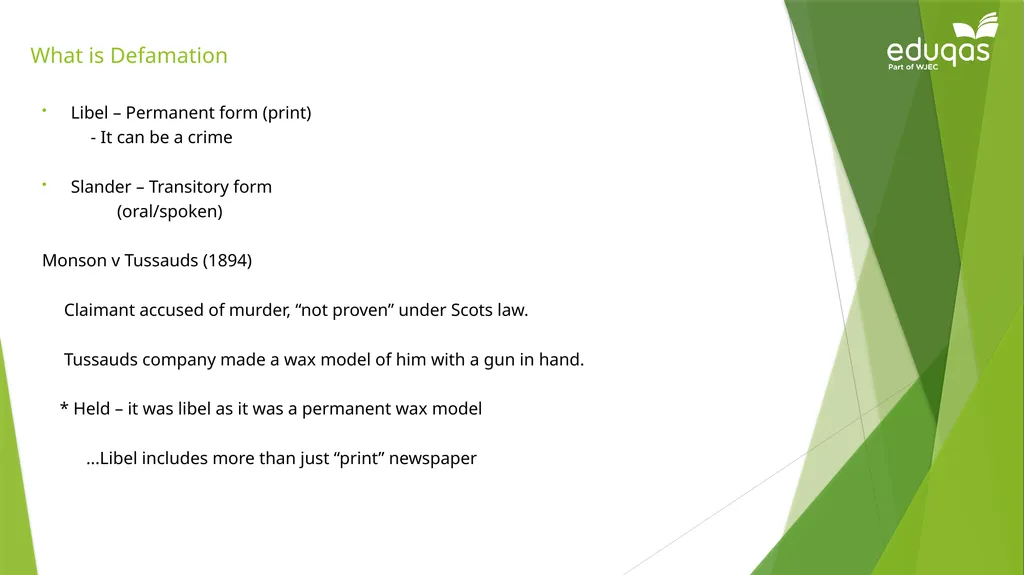
What is Defamation Libel – Permanent form (print)
- It can be a crime
Slander – Transitory form
(oral/spoken)
Monson v Tussauds (1894)
Claimant accused of murder, “not proven” under Scots law.
Tussauds company made a wax model of him with a gun in hand.
* Held – it was libel as it was a permanent wax model
...Libel includes more than just “print” newspaper<br>
- It can be a crime
Slander – Transitory form
(oral/spoken)
Monson v Tussauds (1894)
Claimant accused of murder, “not proven” under Scots law.
Tussauds company made a wax model of him with a gun in hand.
* Held – it was libel as it was a permanent wax model
...Libel includes more than just “print” newspaper<br>
06
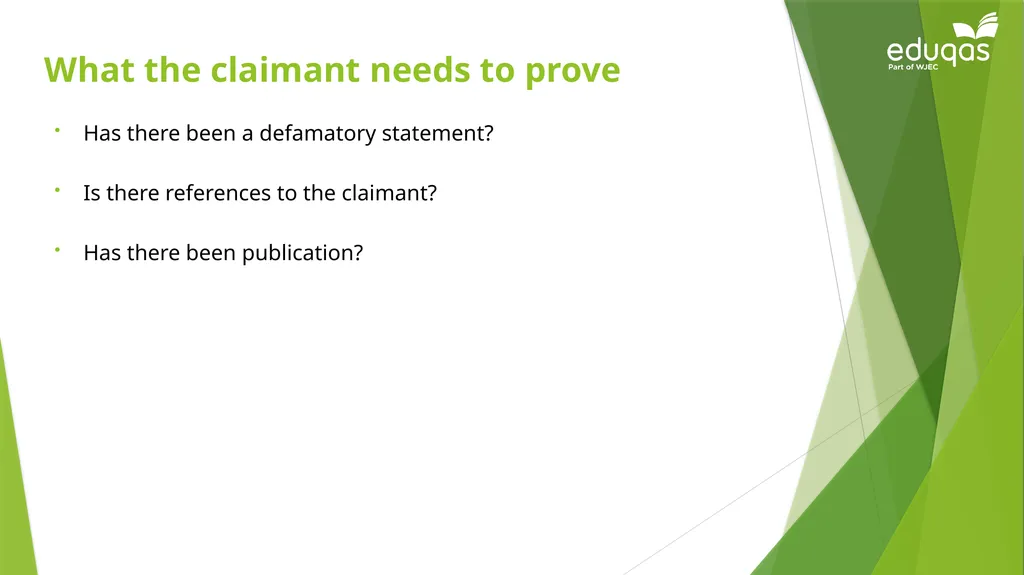
What the claimant needs to prove Has there been a defamatory statement?
Is there references to the claimant?
Has there been publication?<br>
Is there references to the claimant?
Has there been publication?<br>
07
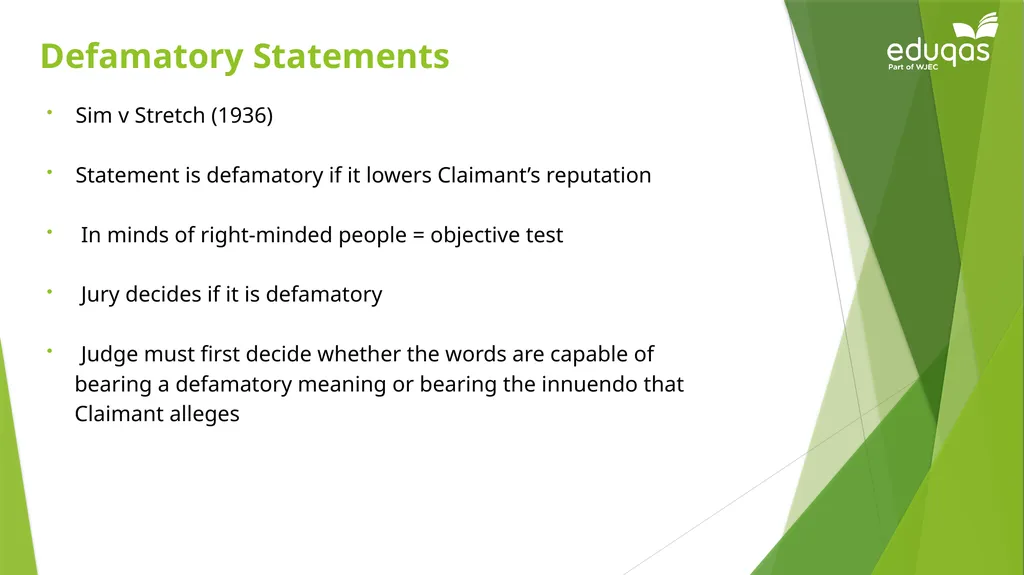
Defamatory Statements Sim v Stretch (1936)
Statement is defamatory if it lowers Claimant’s reputation
In minds of right-minded people = objective test
Jury decides if it is defamatory
Judge must first decide whether the words are capable of
bearing a defamatory meaning or bearing the innuendo that
Claimant alleges<br>
Statement is defamatory if it lowers Claimant’s reputation
In minds of right-minded people = objective test
Jury decides if it is defamatory
Judge must first decide whether the words are capable of
bearing a defamatory meaning or bearing the innuendo that
Claimant alleges<br>
08
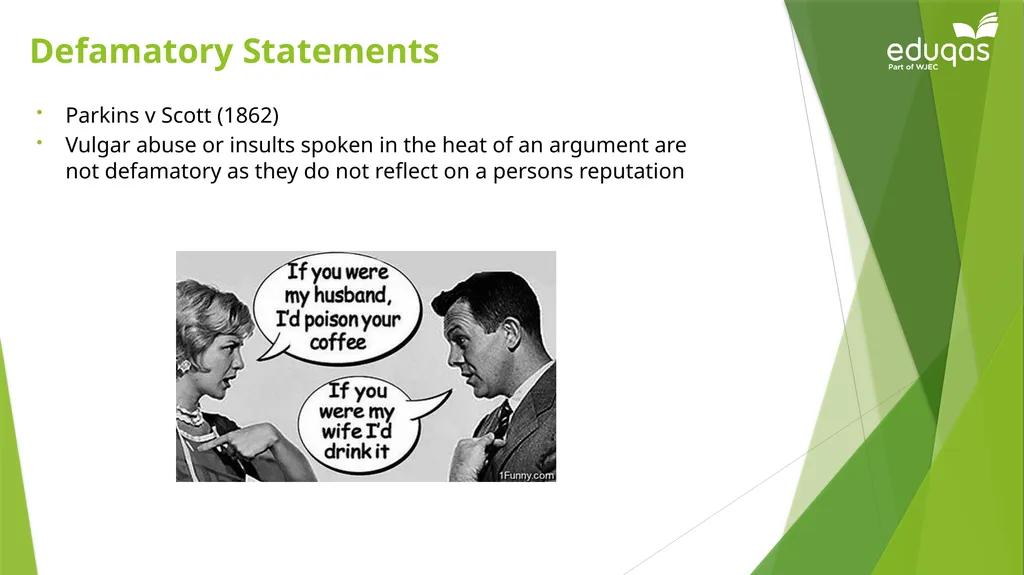
Defamatory Statements Parkins v Scott (1862)
Vulgar abuse or insults spoken in the heat of an argument are not defamatory as they do not reflect on a persons reputation<br>
Vulgar abuse or insults spoken in the heat of an argument are not defamatory as they do not reflect on a persons reputation<br>
09
Defamatory Statements Innuendo and implication can also amount to a defamatory statement
In groups explain what is meant by an innuendo or implication<br>
In groups explain what is meant by an innuendo or implication<br>
10
Defamatory Statements Tolley v Fry (1931)
HoL held that an advertisement was defamatory
Showed amateur golfer with a brand of defendant’s chocolate in pocket
Golfers not allowed to promote
Cosmos v BBC (1996)
https://www.youtube.com/watch?v=1aT5gGDA59k
BBC showed a film of Cosmos holiday camp
Played music in the background from Escape from Colditz, a film about a prisoner of war camp – Held defamatory.<br>
HoL held that an advertisement was defamatory
Showed amateur golfer with a brand of defendant’s chocolate in pocket
Golfers not allowed to promote
Cosmos v BBC (1996)
https://www.youtube.com/watch?v=1aT5gGDA59k
BBC showed a film of Cosmos holiday camp
Played music in the background from Escape from Colditz, a film about a prisoner of war camp – Held defamatory.<br>
11
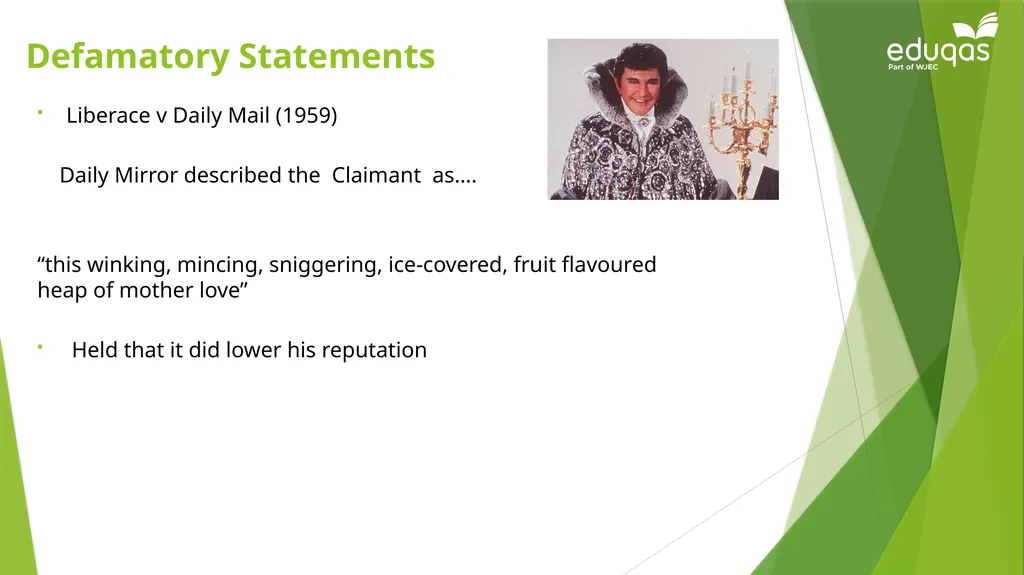
Defamatory Statements Liberace v Daily Mail (1959)
Daily Mirror described the Claimant as….
“this winking, mincing, sniggering, ice-covered, fruit flavoured heap of mother love”
Held that it did lower his reputation<br>
Daily Mirror described the Claimant as….
“this winking, mincing, sniggering, ice-covered, fruit flavoured heap of mother love”
Held that it did lower his reputation<br>
12
Defamatory Statements Cassidy v Daily Mirror (1929)
- Man photographed with woman who was not his wife,
- Reported that he was engaged to her.
Real wife sued for defamation arguing it implied to others that she was not the real wife.
Held defamatory.<br>
- Man photographed with woman who was not his wife,
- Reported that he was engaged to her.
Real wife sued for defamation arguing it implied to others that she was not the real wife.
Held defamatory.<br>
13
Defamatory Statements The context is also very important….
Charleston v News Group Newspapers (1995)
Defendant published photo of Neighbours actors, superimposed on two naked bodies engaging in sexual acts.
* Article made it clear it was superimposed.
Held – not defamatory.<br>
Charleston v News Group Newspapers (1995)
Defendant published photo of Neighbours actors, superimposed on two naked bodies engaging in sexual acts.
* Article made it clear it was superimposed.
Held – not defamatory.<br>
14
Defamatory Statements Byrne v Deane (1937)
Defendant owned golf club with illegal gambling machines
Someone told police and they were removed
Note appeared on club wall stating that person
who told police should “Byrne in Hell”.
Suggested club disloyalty – possible defamation
Not defamatory. Right-minded person would
approve of him informing the police<br>
Defendant owned golf club with illegal gambling machines
Someone told police and they were removed
Note appeared on club wall stating that person
who told police should “Byrne in Hell”.
Suggested club disloyalty – possible defamation
Not defamatory. Right-minded person would
approve of him informing the police<br>
15
Now that we have looked at defamatory statements, the second thing the claimant must prove is “whether he is being referenced to”
– Is it about him?<br>
– Is it about him?<br>
16
Reference to the Claimant Does not need to be “express” - innuendo
The ordinary sensible person would need to understand it referred to Claimant
A class of people cannot be defamed.
* Eastwood v Holmes (1858)
“All lawyers are thieves” – not defamatory<br>
The ordinary sensible person would need to understand it referred to Claimant
A class of people cannot be defamed.
* Eastwood v Holmes (1858)
“All lawyers are thieves” – not defamatory<br>
17
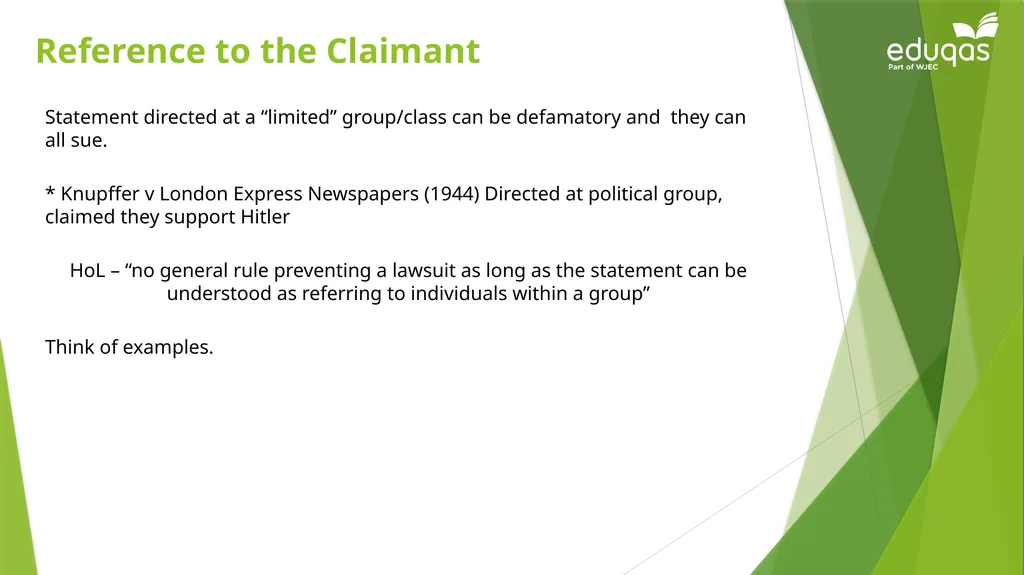
Reference to the Claimant Statement directed at a “limited” group/class can be defamatory and they can all sue.
* Knupffer v London Express Newspapers (1944) Directed at political group, claimed they support Hitler
HoL – “no general rule preventing a lawsuit as long as the statement can be understood as referring to individuals within a group”
Think of examples.<br>
* Knupffer v London Express Newspapers (1944) Directed at political group, claimed they support Hitler
HoL – “no general rule preventing a lawsuit as long as the statement can be understood as referring to individuals within a group”
Think of examples.<br>
18
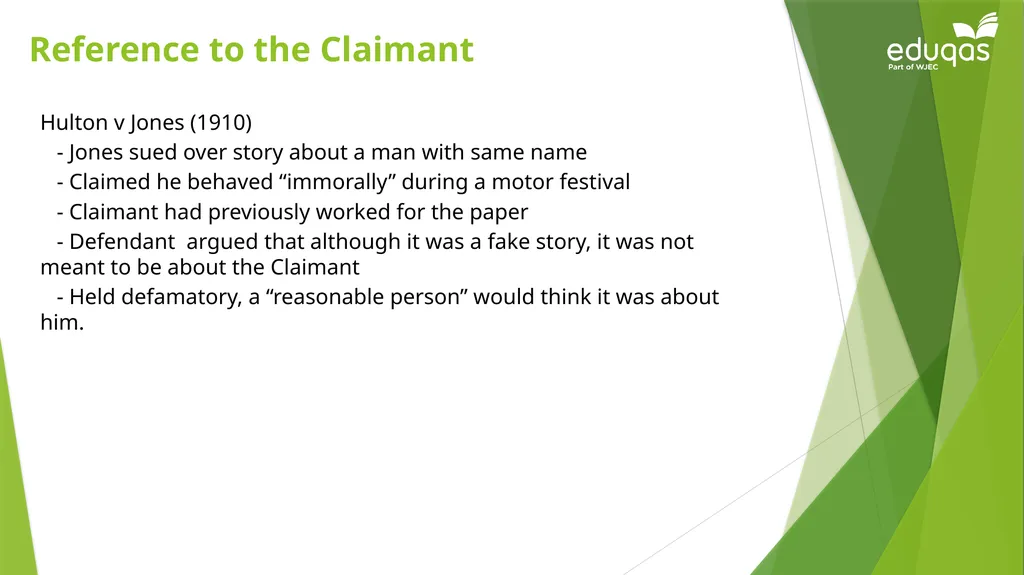
Reference to the Claimant Hulton v Jones (1910)
- Jones sued over story about a man with same name
- Claimed he behaved “immorally” during a motor festival
- Claimant had previously worked for the paper
- Defendant argued that although it was a fake story, it was not meant to be about the Claimant
- Held defamatory, a “reasonable person” would think it was about him.<br>
- Jones sued over story about a man with same name
- Claimed he behaved “immorally” during a motor festival
- Claimant had previously worked for the paper
- Defendant argued that although it was a fake story, it was not meant to be about the Claimant
- Held defamatory, a “reasonable person” would think it was about him.<br>
19
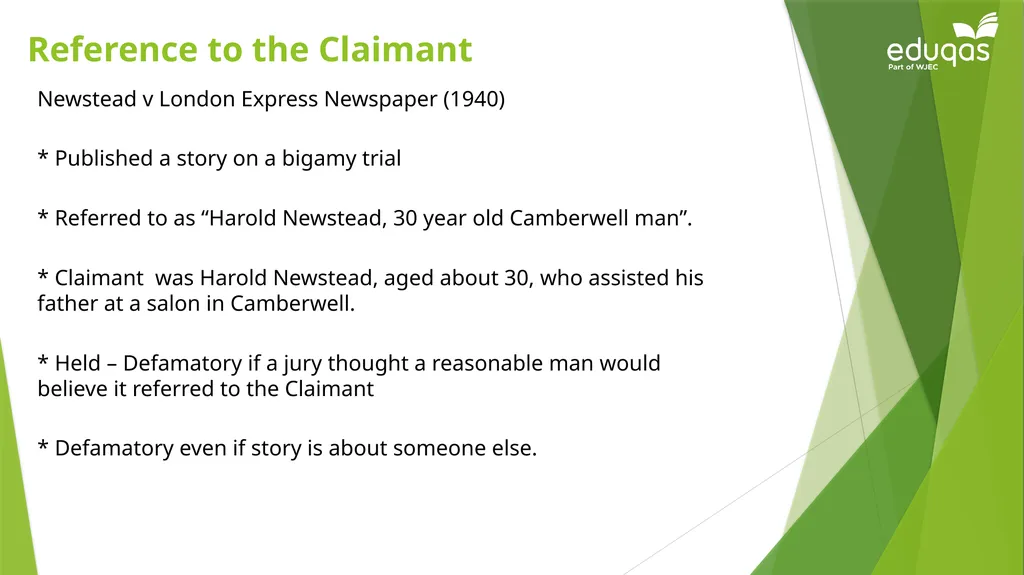
Reference to the Claimant Newstead v London Express Newspaper (1940)
* Published a story on a bigamy trial
* Referred to as “Harold Newstead, 30 year old Camberwell man”.
* Claimant was Harold Newstead, aged about 30, who assisted his father at a salon in Camberwell.
* Held – Defamatory if a jury thought a reasonable man would believe it referred to the Claimant
* Defamatory even if story is about someone else.<br>
* Published a story on a bigamy trial
* Referred to as “Harold Newstead, 30 year old Camberwell man”.
* Claimant was Harold Newstead, aged about 30, who assisted his father at a salon in Camberwell.
* Held – Defamatory if a jury thought a reasonable man would believe it referred to the Claimant
* Defamatory even if story is about someone else.<br>
20
Now that we have looked at defamatory statements and whether it has referred to the claimant, we must finally consider whether the statement has been published<br>
21
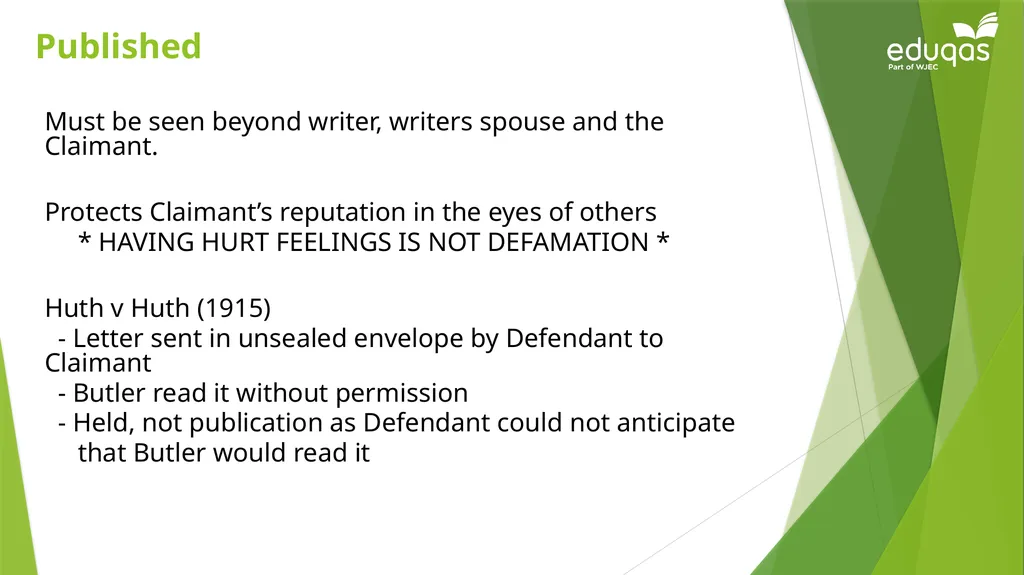
Published Must be seen beyond writer, writers spouse and the Claimant.
Protects Claimant’s reputation in the eyes of others
* HAVING HURT FEELINGS IS NOT DEFAMATION *
Huth v Huth (1915)
- Letter sent in unsealed envelope by Defendant to Claimant
- Butler read it without permission
- Held, not publication as Defendant could not anticipate
that Butler would read it<br>
Protects Claimant’s reputation in the eyes of others
* HAVING HURT FEELINGS IS NOT DEFAMATION *
Huth v Huth (1915)
- Letter sent in unsealed envelope by Defendant to Claimant
- Butler read it without permission
- Held, not publication as Defendant could not anticipate
that Butler would read it<br>
22
Published Don’t leave documents in public view or talk loudly enough for others to hear.
If you have a secretary then letters should be labelled “private”.<br>
If you have a secretary then letters should be labelled “private”.<br>
23
Published Statements in books will result in a series of publications:
* Author to publisher
* Publisher to printer
* To the distributer
…..each step could be a new lawsuit.<br>
* Author to publisher
* Publisher to printer
* To the distributer
…..each step could be a new lawsuit.<br>
24
In groups identify what defences someone accused of defamation might have.
You might also like to consider what defences you think should exist.<br>
You might also like to consider what defences you think should exist.<br>
25
Defences Absolute privilege - Common law defence
Defendant protected no matter how dishonest/malice
Public interest must outweigh damage to Claimant:
* Comments in Parliamentary
* Comments in court (Judicial proceedings)
* Official communications (world leaders)
* A statement made by one spouse to another
Scientific peer review statement/academic journal
* has absolute privilege – Defamation Act (2013)
* No privilege where there is malice.<br>
Defendant protected no matter how dishonest/malice
Public interest must outweigh damage to Claimant:
* Comments in Parliamentary
* Comments in court (Judicial proceedings)
* Official communications (world leaders)
* A statement made by one spouse to another
Scientific peer review statement/academic journal
* has absolute privilege – Defamation Act (2013)
* No privilege where there is malice.<br>
26
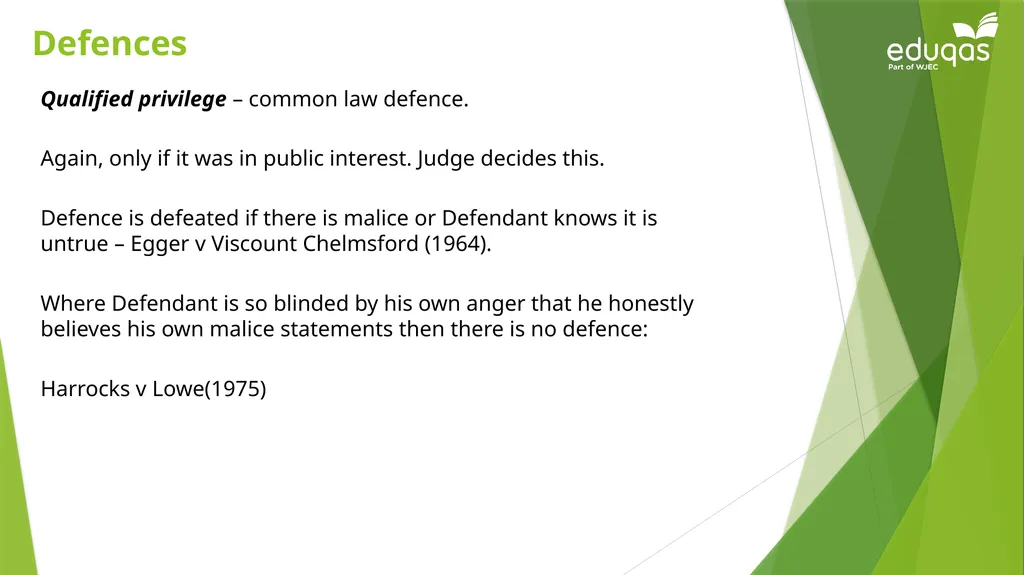
Defences Qualified privilege – common law defence.
Again, only if it was in public interest. Judge decides this.
Defence is defeated if there is malice or Defendant knows it is untrue – Egger v Viscount Chelmsford (1964).
Where Defendant is so blinded by his own anger that he honestly believes his own malice statements then there is no defence:
Harrocks v Lowe(1975)<br>
Again, only if it was in public interest. Judge decides this.
Defence is defeated if there is malice or Defendant knows it is untrue – Egger v Viscount Chelmsford (1964).
Where Defendant is so blinded by his own anger that he honestly believes his own malice statements then there is no defence:
Harrocks v Lowe(1975)<br>
27
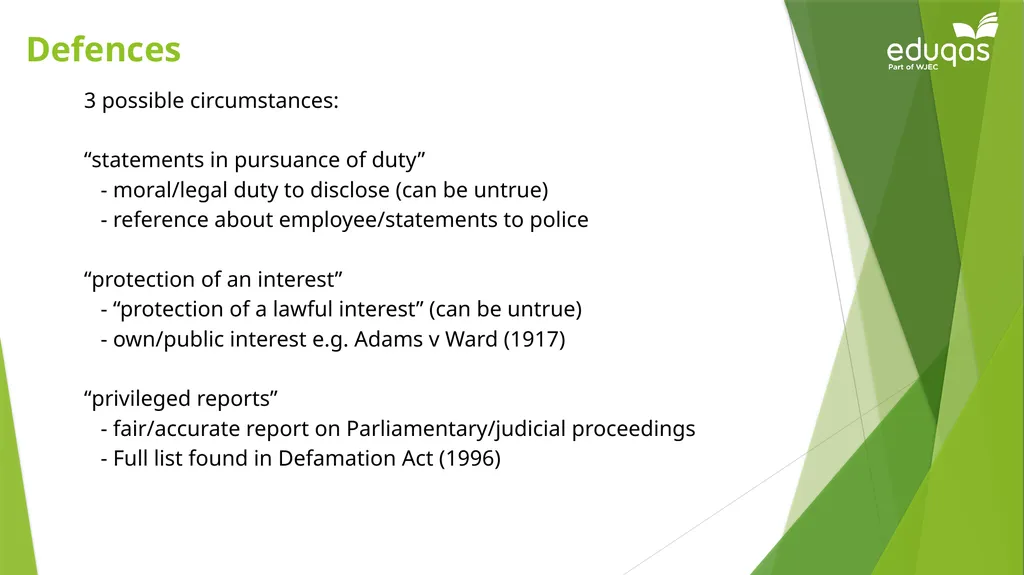
Defences 3 possible circumstances:
“statements in pursuance of duty”
- moral/legal duty to disclose (can be untrue)
- reference about employee/statements to police
“protection of an interest”
- “protection of a lawful interest” (can be untrue)
- own/public interest e.g. Adams v Ward (1917)
“privileged reports”
- fair/accurate report on Parliamentary/judicial proceedings
- Full list found in Defamation Act (1996)<br>
“statements in pursuance of duty”
- moral/legal duty to disclose (can be untrue)
- reference about employee/statements to police
“protection of an interest”
- “protection of a lawful interest” (can be untrue)
- own/public interest e.g. Adams v Ward (1917)
“privileged reports”
- fair/accurate report on Parliamentary/judicial proceedings
- Full list found in Defamation Act (1996)<br>
28
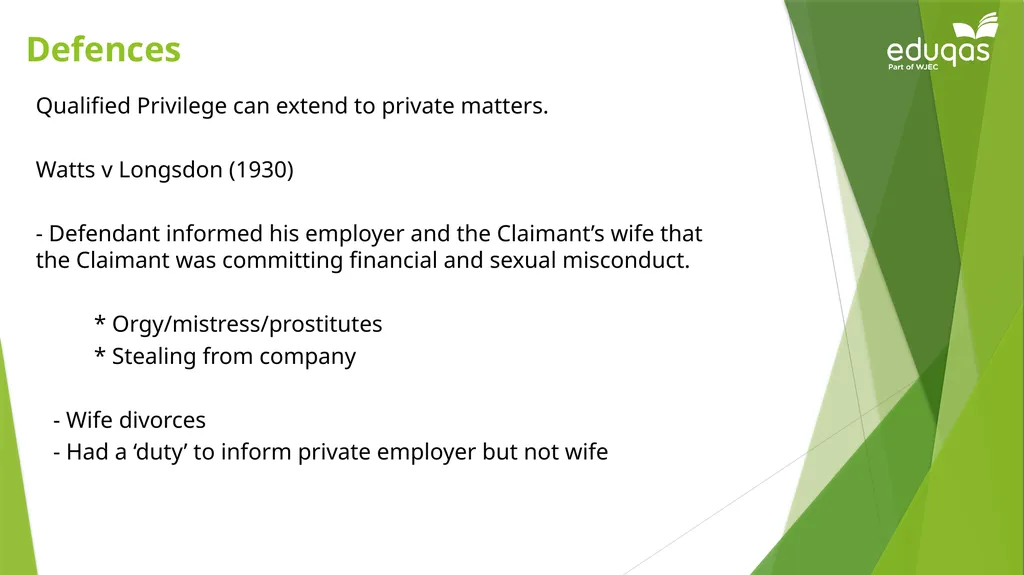
Defences Qualified Privilege can extend to private matters.
Watts v Longsdon (1930)
- Defendant informed his employer and the Claimant’s wife that the Claimant was committing financial and sexual misconduct.
* Orgy/mistress/prostitutes
* Stealing from company
- Wife divorces
- Had a ‘duty’ to inform private employer but not wife<br>
Watts v Longsdon (1930)
- Defendant informed his employer and the Claimant’s wife that the Claimant was committing financial and sexual misconduct.
* Orgy/mistress/prostitutes
* Stealing from company
- Wife divorces
- Had a ‘duty’ to inform private employer but not wife<br>
29
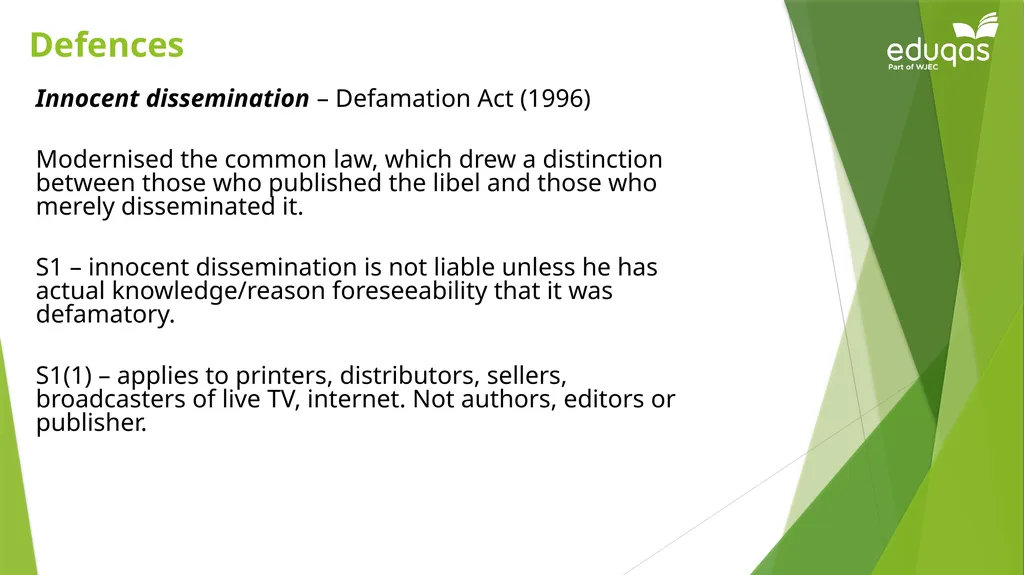
Defences Innocent dissemination – Defamation Act (1996)
Modernised the common law, which drew a distinction between those who published the libel and those who merely disseminated it.
S1 – innocent dissemination is not liable unless he has actual knowledge/reason foreseeability that it was defamatory.
S1(1) – applies to printers, distributors, sellers, broadcasters of live TV, internet. Not authors, editors or publisher.<br>
Modernised the common law, which drew a distinction between those who published the libel and those who merely disseminated it.
S1 – innocent dissemination is not liable unless he has actual knowledge/reason foreseeability that it was defamatory.
S1(1) – applies to printers, distributors, sellers, broadcasters of live TV, internet. Not authors, editors or publisher.<br>
30
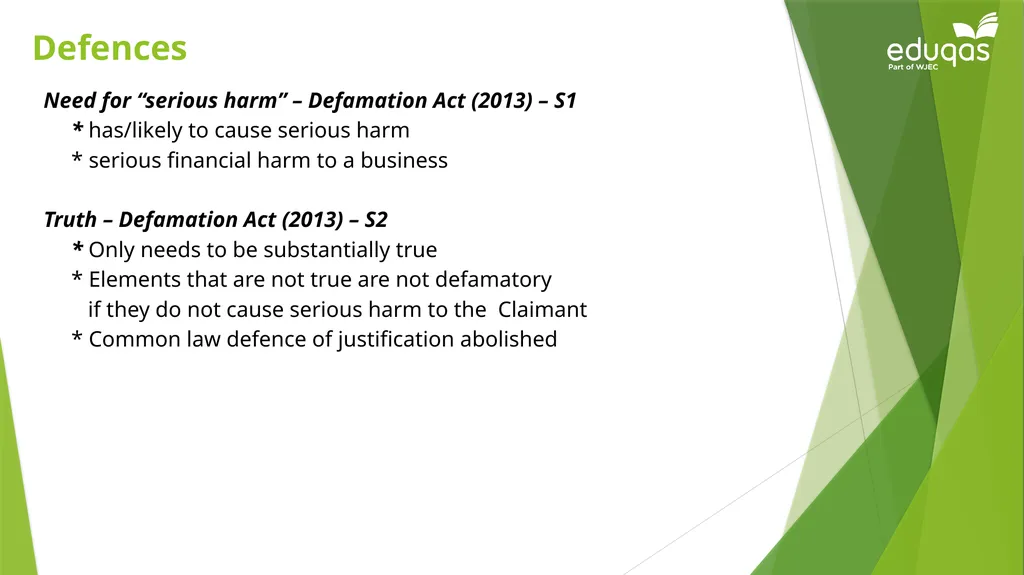
Defences Need for “serious harm” – Defamation Act (2013) – S1
* has/likely to cause serious harm
* serious financial harm to a business
Truth – Defamation Act (2013) – S2
* Only needs to be substantially true
* Elements that are not true are not defamatory
if they do not cause serious harm to the Claimant
* Common law defence of justification abolished<br>
* has/likely to cause serious harm
* serious financial harm to a business
Truth – Defamation Act (2013) – S2
* Only needs to be substantially true
* Elements that are not true are not defamatory
if they do not cause serious harm to the Claimant
* Common law defence of justification abolished<br>
31
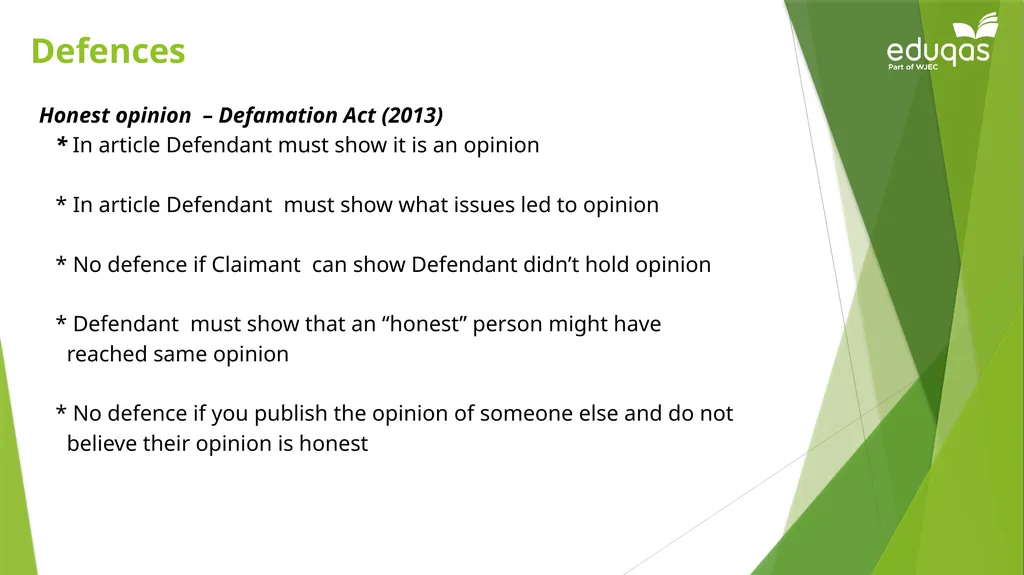
Defences Honest opinion – Defamation Act (2013)
* In article Defendant must show it is an opinion
* In article Defendant must show what issues led to opinion
* No defence if Claimant can show Defendant didn’t hold opinion
* Defendant must show that an “honest” person might have
reached same opinion
* No defence if you publish the opinion of someone else and do not
believe their opinion is honest<br>
* In article Defendant must show it is an opinion
* In article Defendant must show what issues led to opinion
* No defence if Claimant can show Defendant didn’t hold opinion
* Defendant must show that an “honest” person might have
reached same opinion
* No defence if you publish the opinion of someone else and do not
believe their opinion is honest<br>
32
Defences Honest opinion (continued)
* Matters of public importance
* Scientific peer reviews
* Academic journals
= All protected by absolute privilege<br>
* Matters of public importance
* Scientific peer reviews
* Academic journals
= All protected by absolute privilege<br>
33
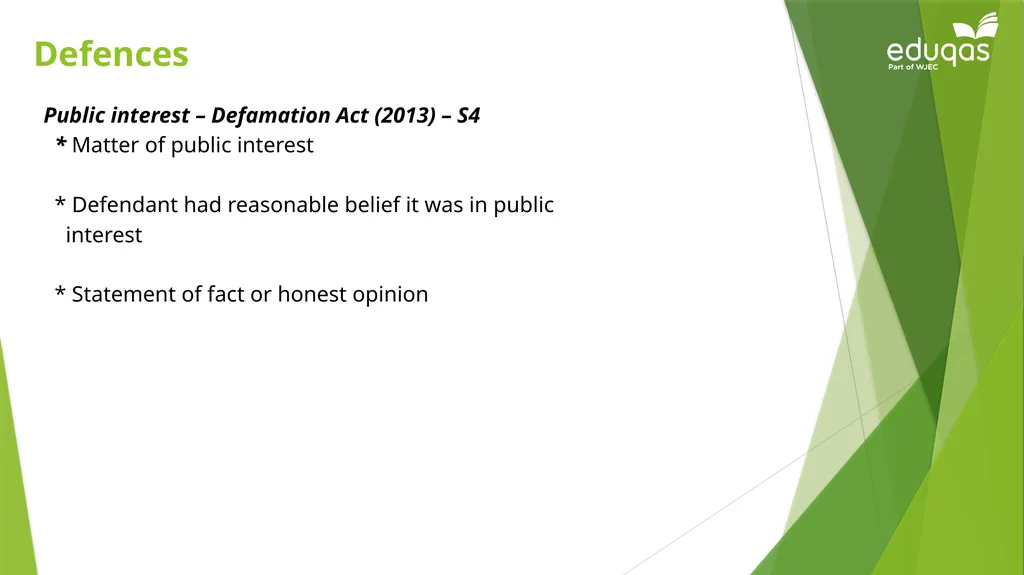
Defences Public interest – Defamation Act (2013) – S4
* Matter of public interest
* Defendant had reasonable belief it was in public
interest
* Statement of fact or honest opinion<br>
* Matter of public interest
* Defendant had reasonable belief it was in public
interest
* Statement of fact or honest opinion<br>
34
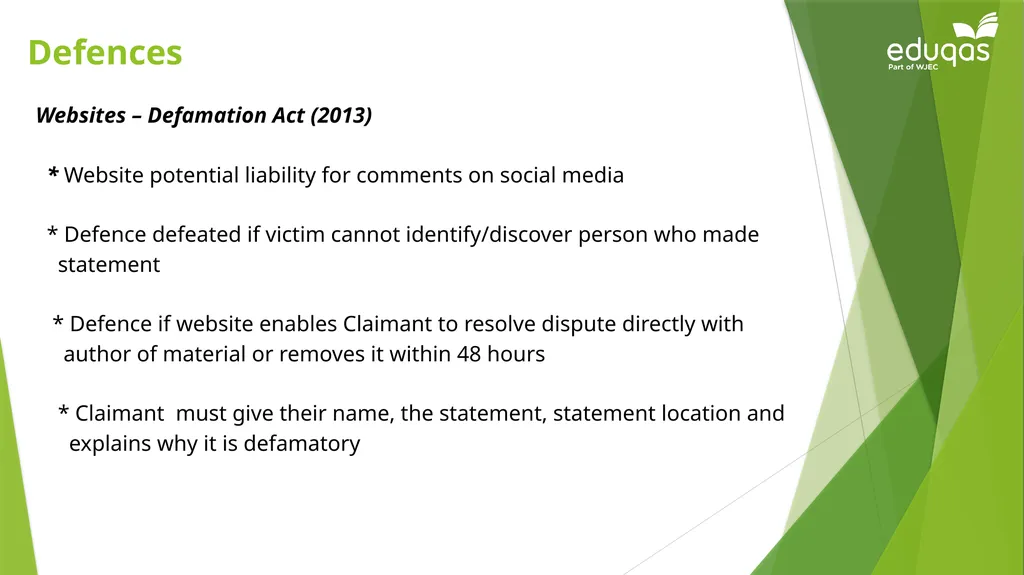
Defences Websites – Defamation Act (2013)
* Website potential liability for comments on social media
* Defence defeated if victim cannot identify/discover person who made
statement
* Defence if website enables Claimant to resolve dispute directly with
author of material or removes it within 48 hours
* Claimant must give their name, the statement, statement location and
explains why it is defamatory<br>
* Website potential liability for comments on social media
* Defence defeated if victim cannot identify/discover person who made
statement
* Defence if website enables Claimant to resolve dispute directly with
author of material or removes it within 48 hours
* Claimant must give their name, the statement, statement location and
explains why it is defamatory<br>
35
Procedure Limitation period reduced 3 to 1 year – DA (1996 )
No legal aid – Mc libel Two
- ECHR ruled UK breached their Human Right
to a fair trial.<br>
No legal aid – Mc libel Two
- ECHR ruled UK breached their Human Right
to a fair trial.<br>
36
In groups consider what remedies/ solutions the court might provide if someone is found liable for a defamatory statement.<br>
37
Remedies – “Offer of Amends” Defence under DA 1996 S(2)
Statement generally or in relation to a specific defamatory meaning:
* Offer in writing
* Suitable apology – accept it is defamatory
* Publish correction in a reasonable manner
* Pay compensation and costs “<br>
Statement generally or in relation to a specific defamatory meaning:
* Offer in writing
* Suitable apology – accept it is defamatory
* Publish correction in a reasonable manner
* Pay compensation and costs “<br>
38
Remedies – “Offer of Amends” When an offer is accepted it is a bar to proceedings.
If the offer is not accepted it will be a defence to proceedings.
S2(5) – D cannot use “offer to amends” if he has used a defence already.<br>
If the offer is not accepted it will be a defence to proceedings.
S2(5) – D cannot use “offer to amends” if he has used a defence already.<br>
39
Consider the advantages/ disadvantages of an “offer to amends” for the claimant, defendant and courts.<br>
40
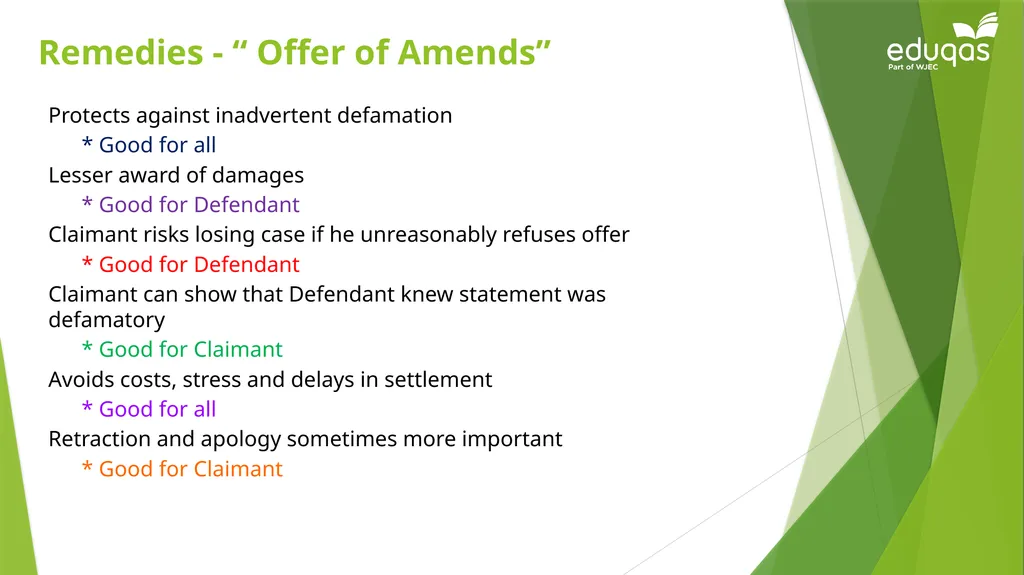
Remedies - “ Offer of Amends” Protects against inadvertent defamation
* Good for all
Lesser award of damages
* Good for Defendant
Claimant risks losing case if he unreasonably refuses offer
* Good for Defendant
Claimant can show that Defendant knew statement was defamatory
* Good for Claimant
Avoids costs, stress and delays in settlement
* Good for all
Retraction and apology sometimes more important
* Good for Claimant<br>
* Good for all
Lesser award of damages
* Good for Defendant
Claimant risks losing case if he unreasonably refuses offer
* Good for Defendant
Claimant can show that Defendant knew statement was defamatory
* Good for Claimant
Avoids costs, stress and delays in settlement
* Good for all
Retraction and apology sometimes more important
* Good for Claimant<br>
41
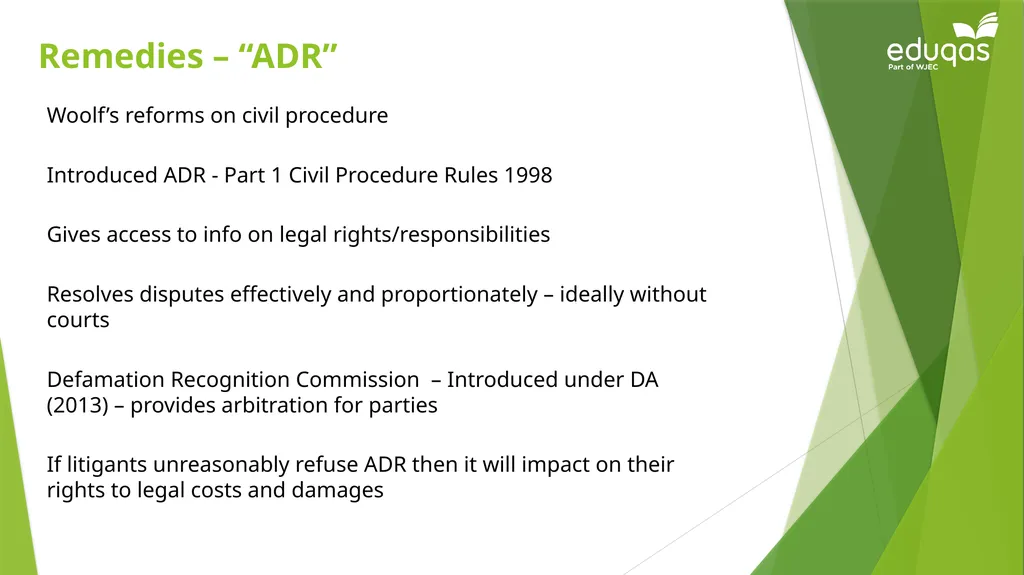
Remedies – “ADR” Woolf’s reforms on civil procedure
Introduced ADR - Part 1 Civil Procedure Rules 1998
Gives access to info on legal rights/responsibilities
Resolves disputes effectively and proportionately – ideally without courts
Defamation Recognition Commission – Introduced under DA (2013) – provides arbitration for parties
If litigants unreasonably refuse ADR then it will impact on their rights to legal costs and damages<br>
Introduced ADR - Part 1 Civil Procedure Rules 1998
Gives access to info on legal rights/responsibilities
Resolves disputes effectively and proportionately – ideally without courts
Defamation Recognition Commission – Introduced under DA (2013) – provides arbitration for parties
If litigants unreasonably refuse ADR then it will impact on their rights to legal costs and damages<br>
42
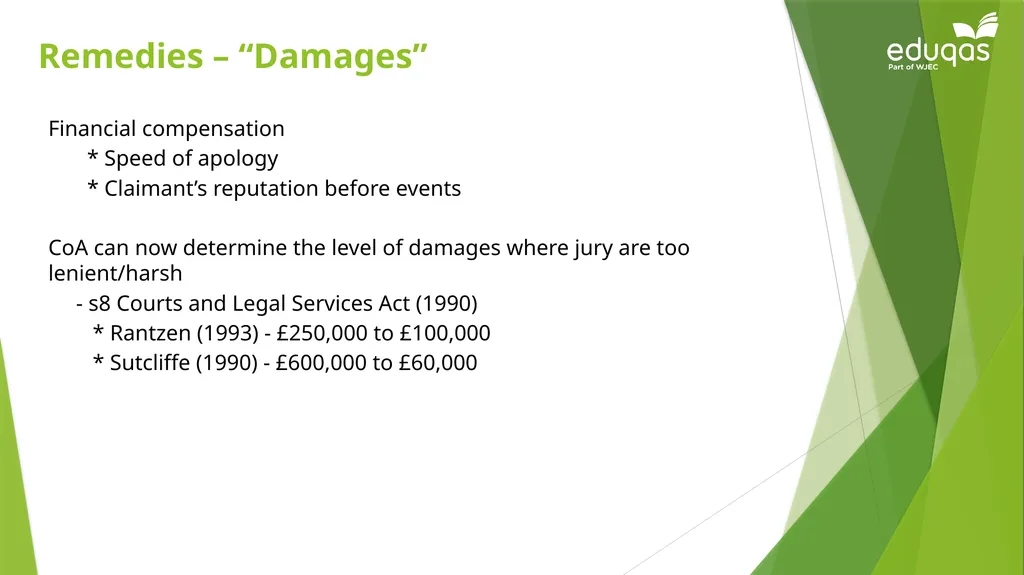
Remedies – “Damages” Financial compensation
* Speed of apology
* Claimant’s reputation before events
CoA can now determine the level of damages where jury are too lenient/harsh
- s8 Courts and Legal Services Act (1990)
* Rantzen (1993) - £250,000 to £100,000
* Sutcliffe (1990) - £600,000 to £60,000<br>
* Speed of apology
* Claimant’s reputation before events
CoA can now determine the level of damages where jury are too lenient/harsh
- s8 Courts and Legal Services Act (1990)
* Rantzen (1993) - £250,000 to £100,000
* Sutcliffe (1990) - £600,000 to £60,000<br>
43
Remedies – “Injunction” Granted by a judge
Can prevent defamatory material being released<br>
Can prevent defamatory material being released<br>