
Result(S) PURPOSE Conclusion(S) Method(S)
Description: Result(S) PURPOSE Conclusion(S) Method(S) REFERENCE Development of High Drug Loading Lipid Nanoparticle Formulations Yingxi Gu, Lu Tian, Liang Mao, Jing Li, Fangfang Zhang, Shulei Duan, Yang Zhang, Ruyue Yu STA Pharmaceutical Co. Ltd
Related Topics
Download Presentation
"Result(S) PURPOSE Conclusion(S) Method(S)" is the property of its rightful owner. Permission is granted to download and print the materials on this website for personal, non-commercial use only, and to display it on your personal computer provided you do not modify the materials and that you retain all copyright notices contained in the materials. By downloading content from our website, you accept the terms of this agreement.
Presentation Transcript
slide1. Result(S) PURPOSE Conclusion(S) Method(S) REFERENCE Development of High Drug Loading Lipid Nanoparticle Formulations
Yingxi Gu, Lu Tian, Liang Mao, Jing Li, Fangfang Zhang, Shulei Duan, Yang Zhang, Ruyue Yu
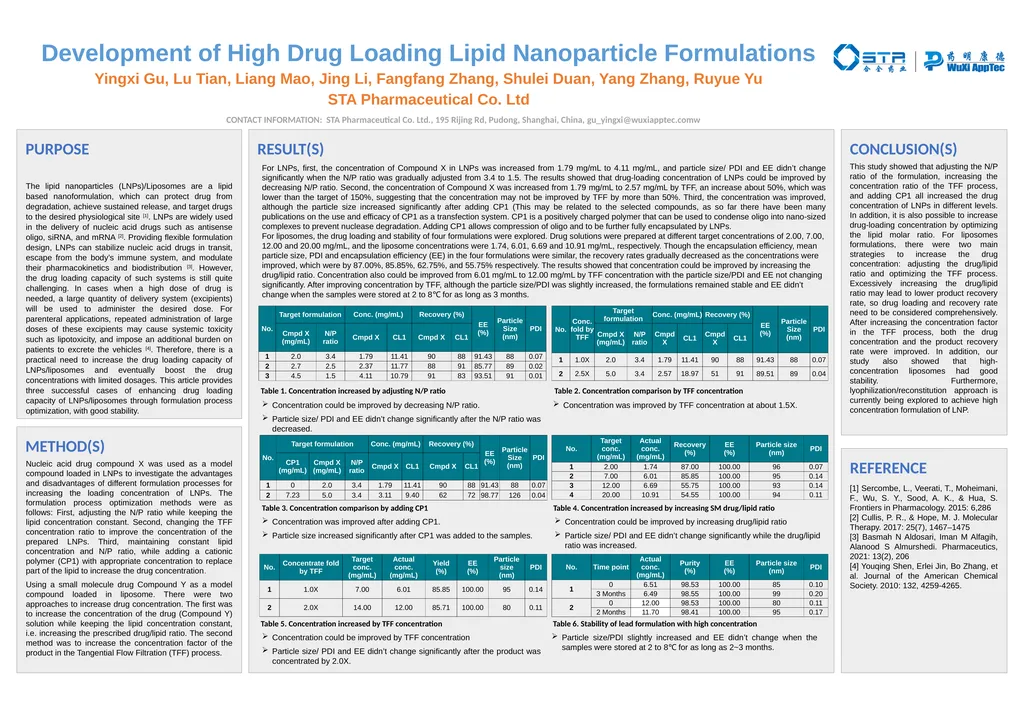
STA Pharmaceutical Co. Ltd CONTACT INFORMATION: STA Pharmaceutical Co. Ltd., 195 Rijing Rd, Pudong, Shanghai, China, gu_yingxi@wuxiapptec.comw This study showed that adjusting the N/P ratio of the formulation, increasing the concentration ratio of the TFF process, and adding CP1 all increased the drug concentration of LNPs in different levels. In addition, it is also possible to increase drug-loading concentration by optimizing the lipid molar ratio. For liposomes formulations, there were two main strategies to increase the drug concentration: adjusting the drug/lipid ratio and optimizing the TFF process. Excessively increasing the drug/lipid ratio may lead to lower product recovery rate, so drug loading and recovery rate need to be considered comprehensively. After increasing the concentration factor in the TFF process, both the drug concentration and the product recovery rate were improved. In addition, our study also showed that high-concentration liposomes had good stability. Furthermore, lyophilization/reconstitution approach is currently being explored to achieve high concentration formulation of LNP. Nucleic acid drug compound X was used as a model compound loaded in LNPs to investigate the advantages and disadvantages of different formulation processes for increasing the loading concentration of LNPs. The formulation process optimization methods were as follows: First, adjusting the N/P ratio while keeping the lipid concentration constant. Second, changing the TFF concentration ratio to improve the concentration of the prepared LNPs. Third, maintaining constant lipid concentration and N/P ratio, while adding a cationic polymer (CP1) with appropriate concentration to replace part of the lipid to increase the drug concentration.
Using a small molecule drug Compound Y as a model compound loaded in liposome. There were two approaches to increase drug concentration. The first was to increase the concentration of the drug (Compound Y) solution while keeping the lipid concentration constant, i.e. increasing the prescribed drug/lipid ratio. The second method was to increase the concentration factor of the product in the Tangential Flow Filtration (TFF) process. The lipid nanoparticles (LNPs)/Liposomes are a lipid based nanoformulation, which can protect drug from degradation, achieve sustained release, and target drugs to the desired physiological site [1]. LNPs are widely used in the delivery of nucleic acid drugs such as antisense oligo, siRNA, and mRNA [2]. Providing flexible formulation design, LNPs can stabilize nucleic acid drugs in transit, escape from the body’s immune system, and modulate their pharmacokinetics and biodistribution [3]. However, the drug loading capacity of such systems is still quite challenging. In cases when a high dose of drug is needed, a large quantity of delivery system (excipients) will be used to administer the desired dose. For parenteral applications, repeated administration of large doses of these excipients may cause systemic toxicity such as lipotoxicity, and impose an additional burden on patients to excrete the vehicles [4]. Therefore, there is a practical need to increase the drug loading capacity of LNPs/liposomes and eventually boost the drug concentrations with limited dosages. This article provides three successful cases of enhancing drug loading capacity of LNPs/liposomes through formulation process optimization, with good stability. [1] Sercombe, L., Veerati, T., Moheimani, F., Wu, S. Y., Sood, A. K., & Hua, S. Frontiers in Pharmacology. 2015: 6,286
[2] Cullis, P. R., & Hope, M. J. Molecular Therapy. 2017: 25(7), 1467–1475
[3] Basmah N Aldosari, Iman M Alfagih, Alanood S Almurshedi. Pharmaceutics, 2021: 13(2), 206
[4] Youqing Shen, Erlei Jin, Bo Zhang, et al. Journal of the American Chemical Society. 2010: 132, 4259-4265. Concentration could be improved by decreasing N/P ratio.
Particle size/ PDI and EE didn’t change significantly after the N/P ratio was decreased. Table 1. Concentration increased by adjusting N/P ratio Concentration was improved by TFF concentration at about 1.5X. Table 2. Concentration comparison by TFF concentration Concentration was improved after adding CP1.
Particle size increased significantly after CP1 was added to the samples. Table 3. Concentration comparison by adding CP1 Concentration could be improved by increasing drug/lipid ratio
Particle size/ PDI and EE didn’t change significantly while the drug/lipid ratio was increased. Table 4. Concentration increased by increasing SM drug/lipid ratio Concentration could be improved by TFF concentration
Particle size/ PDI and EE didn’t change significantly after the product was concentrated by 2.0X. Table 5. Concentration increased by TFF concentration Particle size/PDI slightly increased and EE didn’t change when the samples were stored at 2 to 8℃ for as long as 2~3 months. Table 6. Stability of lead formulation with high concentration For LNPs, first, the concentration of Compound X in LNPs was increased from 1.79 mg/mL to 4.11 mg/mL, and particle size/ PDI and EE didn’t change significantly when the N/P ratio was gradually adjusted from 3.4 to 1.5. The results showed that drug-loading concentration of LNPs could be improved by decreasing N/P ratio. Second, the concentration of Compound X was increased from 1.79 mg/mL to 2.57 mg/mL by TFF, an increase about 50%, which was lower than the target of 150%, suggesting that the concentration may not be improved by TFF by more than 50%. Third, the concentration was improved, although the particle size increased significantly after adding CP1 (This may be related to the selected compounds, as so far there have been many publications on the use and efficacy of CP1 as a transfection system. CP1 is a positively charged polymer that can be used to condense oligo into nano-sized complexes to prevent nuclease degradation. Adding CP1 allows compression of oligo and to be further fully encapsulated by LNPs.
For liposomes, the drug loading and stability of four formulations were explored. Drug solutions were prepared at different target concentrations of 2.00, 7.00, 12.00 and 20.00 mg/mL, and the liposome concentrations were 1.74, 6.01, 6.69 and 10.91 mg/mL, respectively. Though the encapsulation efficiency, mean particle size, PDI and encapsulation efficiency (EE) in the four formulations were similar, the recovery rates gradually decreased as the concentrations were improved, which were by 87.00%, 85.85%, 62.75%, and 55.75% respectively. The results showed that concentration could be improved by increasing the drug/lipid ratio. Concentration also could be improved from 6.01 mg/mL to 12.00 mg/mL by TFF concentration with the particle size/PDI and EE not changing significantly. After improving concentration by TFF, although the particle size/PDI was slightly increased, the formulations remained stable and EE didn’t change when the samples were stored at 2 to 8℃ for as long as 3 months.<br>
Yingxi Gu, Lu Tian, Liang Mao, Jing Li, Fangfang Zhang, Shulei Duan, Yang Zhang, Ruyue Yu
STA Pharmaceutical Co. Ltd CONTACT INFORMATION: STA Pharmaceutical Co. Ltd., 195 Rijing Rd, Pudong, Shanghai, China, gu_yingxi@wuxiapptec.comw This study showed that adjusting the N/P ratio of the formulation, increasing the concentration ratio of the TFF process, and adding CP1 all increased the drug concentration of LNPs in different levels. In addition, it is also possible to increase drug-loading concentration by optimizing the lipid molar ratio. For liposomes formulations, there were two main strategies to increase the drug concentration: adjusting the drug/lipid ratio and optimizing the TFF process. Excessively increasing the drug/lipid ratio may lead to lower product recovery rate, so drug loading and recovery rate need to be considered comprehensively. After increasing the concentration factor in the TFF process, both the drug concentration and the product recovery rate were improved. In addition, our study also showed that high-concentration liposomes had good stability. Furthermore, lyophilization/reconstitution approach is currently being explored to achieve high concentration formulation of LNP. Nucleic acid drug compound X was used as a model compound loaded in LNPs to investigate the advantages and disadvantages of different formulation processes for increasing the loading concentration of LNPs. The formulation process optimization methods were as follows: First, adjusting the N/P ratio while keeping the lipid concentration constant. Second, changing the TFF concentration ratio to improve the concentration of the prepared LNPs. Third, maintaining constant lipid concentration and N/P ratio, while adding a cationic polymer (CP1) with appropriate concentration to replace part of the lipid to increase the drug concentration.
Using a small molecule drug Compound Y as a model compound loaded in liposome. There were two approaches to increase drug concentration. The first was to increase the concentration of the drug (Compound Y) solution while keeping the lipid concentration constant, i.e. increasing the prescribed drug/lipid ratio. The second method was to increase the concentration factor of the product in the Tangential Flow Filtration (TFF) process. The lipid nanoparticles (LNPs)/Liposomes are a lipid based nanoformulation, which can protect drug from degradation, achieve sustained release, and target drugs to the desired physiological site [1]. LNPs are widely used in the delivery of nucleic acid drugs such as antisense oligo, siRNA, and mRNA [2]. Providing flexible formulation design, LNPs can stabilize nucleic acid drugs in transit, escape from the body’s immune system, and modulate their pharmacokinetics and biodistribution [3]. However, the drug loading capacity of such systems is still quite challenging. In cases when a high dose of drug is needed, a large quantity of delivery system (excipients) will be used to administer the desired dose. For parenteral applications, repeated administration of large doses of these excipients may cause systemic toxicity such as lipotoxicity, and impose an additional burden on patients to excrete the vehicles [4]. Therefore, there is a practical need to increase the drug loading capacity of LNPs/liposomes and eventually boost the drug concentrations with limited dosages. This article provides three successful cases of enhancing drug loading capacity of LNPs/liposomes through formulation process optimization, with good stability. [1] Sercombe, L., Veerati, T., Moheimani, F., Wu, S. Y., Sood, A. K., & Hua, S. Frontiers in Pharmacology. 2015: 6,286
[2] Cullis, P. R., & Hope, M. J. Molecular Therapy. 2017: 25(7), 1467–1475
[3] Basmah N Aldosari, Iman M Alfagih, Alanood S Almurshedi. Pharmaceutics, 2021: 13(2), 206
[4] Youqing Shen, Erlei Jin, Bo Zhang, et al. Journal of the American Chemical Society. 2010: 132, 4259-4265. Concentration could be improved by decreasing N/P ratio.
Particle size/ PDI and EE didn’t change significantly after the N/P ratio was decreased. Table 1. Concentration increased by adjusting N/P ratio Concentration was improved by TFF concentration at about 1.5X. Table 2. Concentration comparison by TFF concentration Concentration was improved after adding CP1.
Particle size increased significantly after CP1 was added to the samples. Table 3. Concentration comparison by adding CP1 Concentration could be improved by increasing drug/lipid ratio
Particle size/ PDI and EE didn’t change significantly while the drug/lipid ratio was increased. Table 4. Concentration increased by increasing SM drug/lipid ratio Concentration could be improved by TFF concentration
Particle size/ PDI and EE didn’t change significantly after the product was concentrated by 2.0X. Table 5. Concentration increased by TFF concentration Particle size/PDI slightly increased and EE didn’t change when the samples were stored at 2 to 8℃ for as long as 2~3 months. Table 6. Stability of lead formulation with high concentration For LNPs, first, the concentration of Compound X in LNPs was increased from 1.79 mg/mL to 4.11 mg/mL, and particle size/ PDI and EE didn’t change significantly when the N/P ratio was gradually adjusted from 3.4 to 1.5. The results showed that drug-loading concentration of LNPs could be improved by decreasing N/P ratio. Second, the concentration of Compound X was increased from 1.79 mg/mL to 2.57 mg/mL by TFF, an increase about 50%, which was lower than the target of 150%, suggesting that the concentration may not be improved by TFF by more than 50%. Third, the concentration was improved, although the particle size increased significantly after adding CP1 (This may be related to the selected compounds, as so far there have been many publications on the use and efficacy of CP1 as a transfection system. CP1 is a positively charged polymer that can be used to condense oligo into nano-sized complexes to prevent nuclease degradation. Adding CP1 allows compression of oligo and to be further fully encapsulated by LNPs.
For liposomes, the drug loading and stability of four formulations were explored. Drug solutions were prepared at different target concentrations of 2.00, 7.00, 12.00 and 20.00 mg/mL, and the liposome concentrations were 1.74, 6.01, 6.69 and 10.91 mg/mL, respectively. Though the encapsulation efficiency, mean particle size, PDI and encapsulation efficiency (EE) in the four formulations were similar, the recovery rates gradually decreased as the concentrations were improved, which were by 87.00%, 85.85%, 62.75%, and 55.75% respectively. The results showed that concentration could be improved by increasing the drug/lipid ratio. Concentration also could be improved from 6.01 mg/mL to 12.00 mg/mL by TFF concentration with the particle size/PDI and EE not changing significantly. After improving concentration by TFF, although the particle size/PDI was slightly increased, the formulations remained stable and EE didn’t change when the samples were stored at 2 to 8℃ for as long as 3 months.<br>