
Retirement Income Solutions: Recordkeeper Study

Description: Retirement Income Solutions: Recordkeeper Study June 2024 Sample Characteristics 18 recordkeepers were surveyed in total with the following characteristics: 2 Background Sample The DCIIA RRC fielded two online surveys targeting 18
Related Topics
Download Presentation
"Retirement Income Solutions: Recordkeeper Study" is the property of its rightful owner. Permission is granted to download and print the materials on this website for personal, non-commercial use only, and to display it on your personal computer provided you do not modify the materials and that you retain all copyright notices contained in the materials. By downloading content from our website, you accept the terms of this agreement.
Presentation Transcript
slide1. Retirement Income Solutions: Recordkeeper Study June 2024<br>
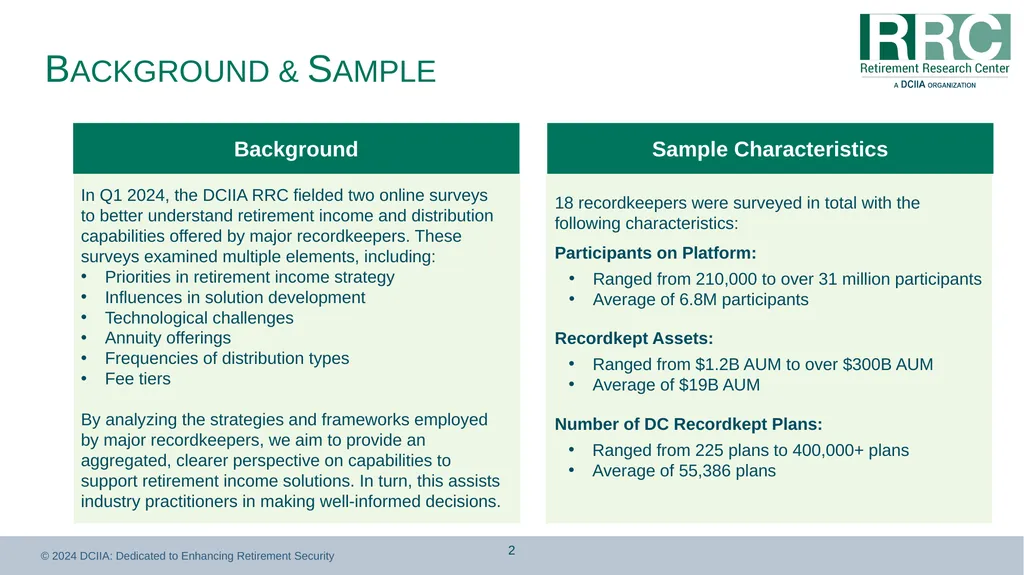
slide2. Sample Characteristics 18 recordkeepers were surveyed in total with the following characteristics: 2 Background & Sample<br>
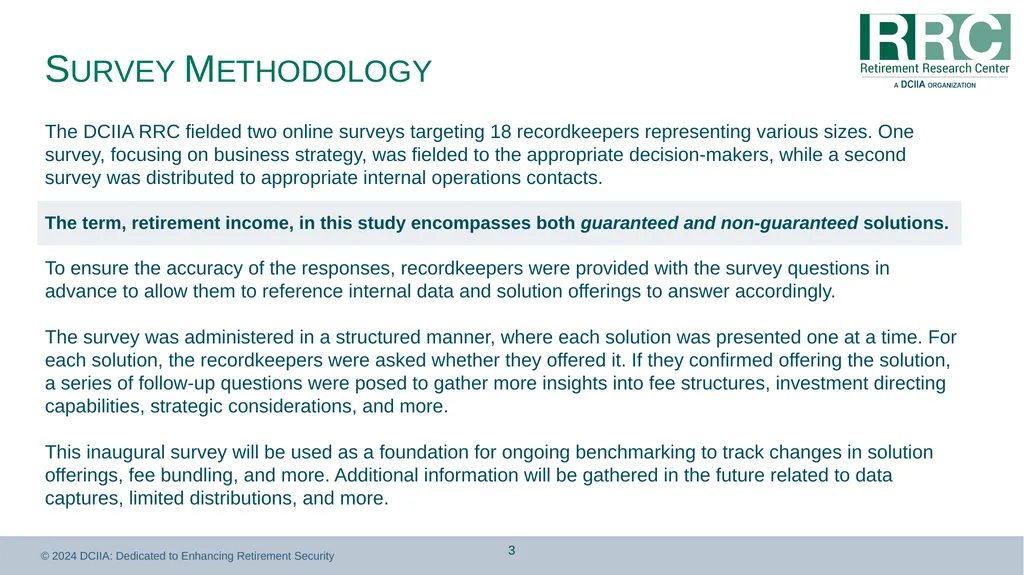
slide3. The DCIIA RRC fielded two online surveys targeting 18 recordkeepers representing various sizes. One survey, focusing on business strategy, was fielded to the appropriate decision-makers, while a second survey was distributed to appropriate internal operations contacts.
The term, retirement income, in this study encompasses both guaranteed and non-guaranteed solutions.
To ensure the accuracy of the responses, recordkeepers were provided with the survey questions in advance to allow them to reference internal data and solution offerings to answer accordingly.
The survey was administered in a structured manner, where each solution was presented one at a time. For each solution, the recordkeepers were asked whether they offered it. If they confirmed offering the solution, a series of follow-up questions were posed to gather more insights into fee structures, investment directing capabilities, strategic considerations, and more.
This inaugural survey will be used as a foundation for ongoing benchmarking to track changes in solution offerings, fee bundling, and more. Additional information will be gathered in the future related to data captures, limited distributions, and more. 3 Survey Methodology<br>
slide4. Influential Considerations in Solution Planning
Technology’s Role in Shaping Solution Development
In-Plan Guaranteed Solutions
Non-Guaranteed Solutions 4 Table of Contents<br>
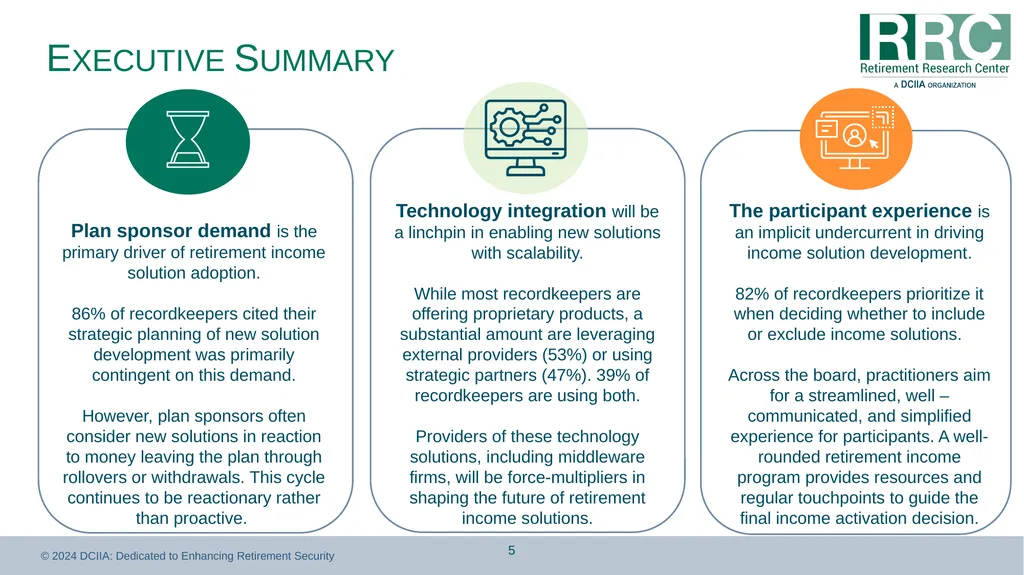
slide5. Executive Summary 5 Technology integration will be a linchpin in enabling new solutions with scalability.
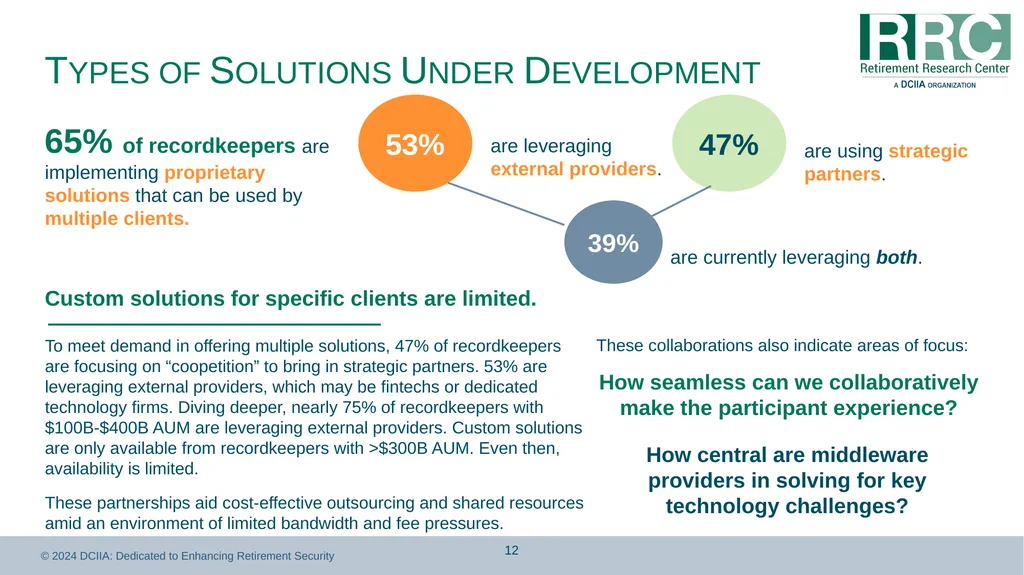
While most recordkeepers are offering proprietary products, a substantial amount are leveraging external providers (53%) or using strategic partners (47%). 39% of recordkeepers are using both.
Providers of these technology solutions, including middleware firms, will be force-multipliers in shaping the future of retirement income solutions. The participant experience is an implicit undercurrent in driving income solution development.
82% of recordkeepers prioritize it when deciding whether to include or exclude income solutions.
Across the board, practitioners aim for a streamlined, well –communicated, and simplified experience for participants. A well-rounded retirement income program provides resources and regular touchpoints to guide the final income activation decision. Plan sponsor demand is the primary driver of retirement income solution adoption.
86% of recordkeepers cited their strategic planning of new solution development was primarily contingent on this demand.
However, plan sponsors often consider new solutions in reaction to money leaving the plan through rollovers or withdrawals. This cycle continues to be reactionary rather than proactive.<br>
slide6. Influential Factors in Solution Planning 6<br>
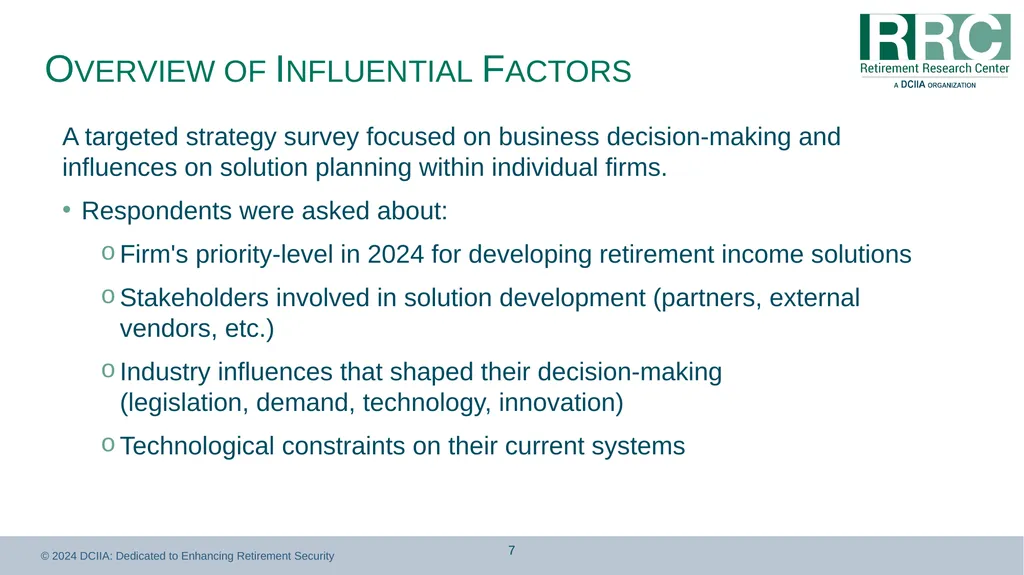
slide7. A targeted strategy survey focused on business decision-making and influences on solution planning within individual firms.
Respondents were asked about:
Firm's priority-level in 2024 for developing retirement income solutions
Stakeholders involved in solution development (partners, external vendors, etc.)
Industry influences that shaped their decision-making (legislation, demand, technology, innovation)
Technological constraints on their current systems 7 Overview of Influential Factors<br>
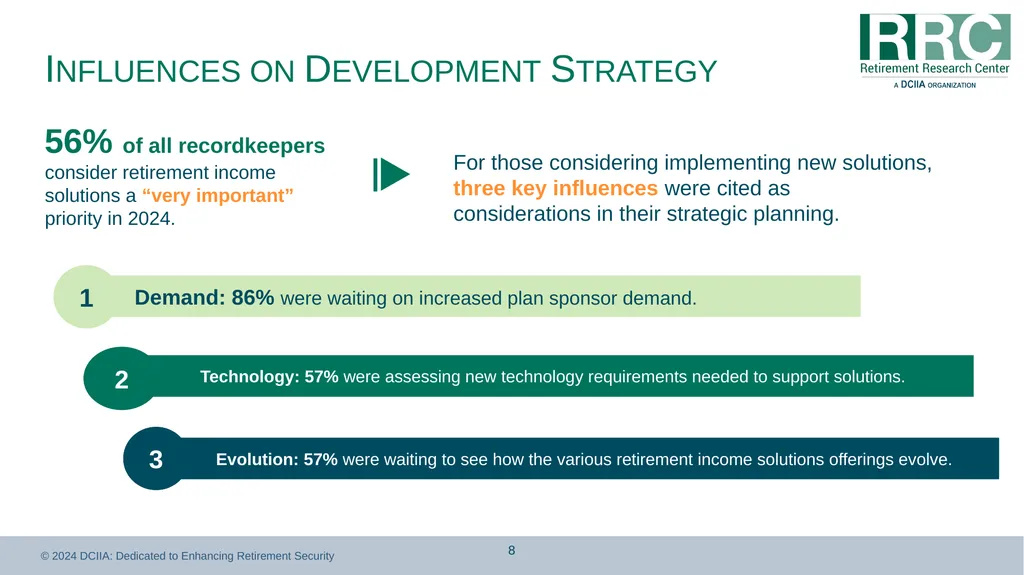
slide8. Influences on Development Strategy 8 56% of all recordkeepers consider retirement income solutions a “very important” priority in 2024. For those considering implementing new solutions, three key influences were cited as considerations in their strategic planning.<br>
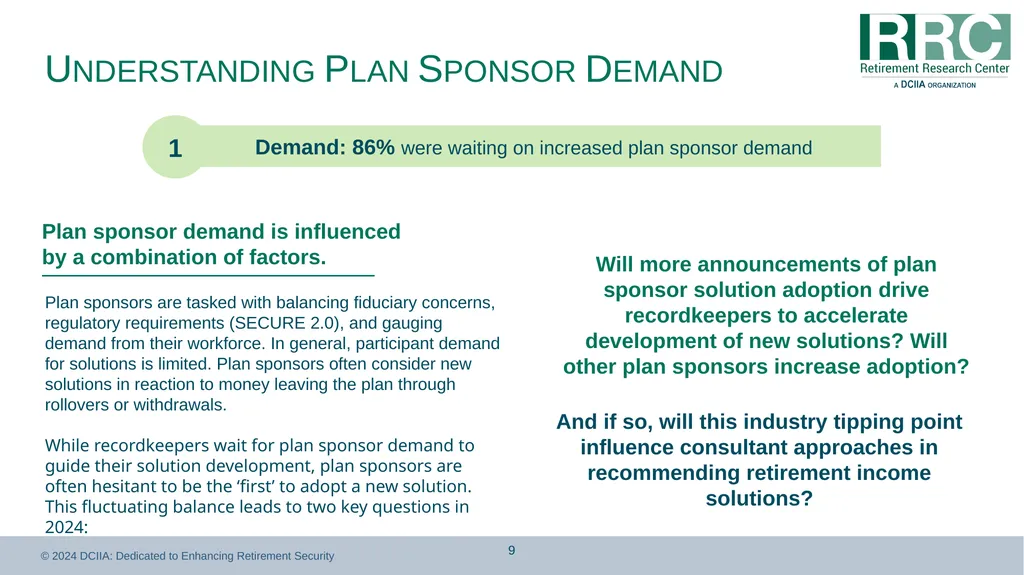
slide9. Understanding Plan Sponsor Demand 9 Plan sponsors are tasked with balancing fiduciary concerns, regulatory requirements (SECURE 2.0), and gauging demand from their workforce. In general, participant demand for solutions is limited. Plan sponsors often consider new solutions in reaction to money leaving the plan through rollovers or withdrawals.
While recordkeepers wait for plan sponsor demand to guide their solution development, plan sponsors are often hesitant to be the ‘first’ to adopt a new solution. This fluctuating balance leads to two key questions in 2024: Plan sponsor demand is influenced by a combination of factors. Will more announcements of plan sponsor solution adoption drive recordkeepers to accelerate development of new solutions? Will other plan sponsors increase adoption? And if so, will this industry tipping point influence consultant approaches in recommending retirement income solutions?<br>
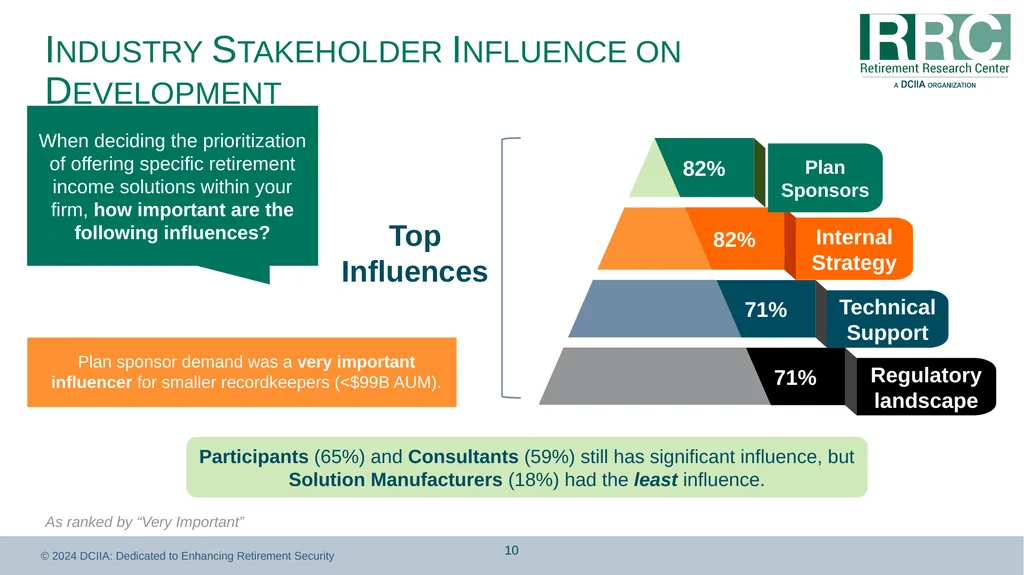
slide10. Industry Stakeholder Influence on Development 10 As ranked by “Very Important” When deciding the prioritization of offering specific retirement income solutions within your firm, how important are the following influences? Top Influences Participants (65%) and Consultants (59%) still has significant influence, but Solution Manufacturers (18%) had the least influence.<br>
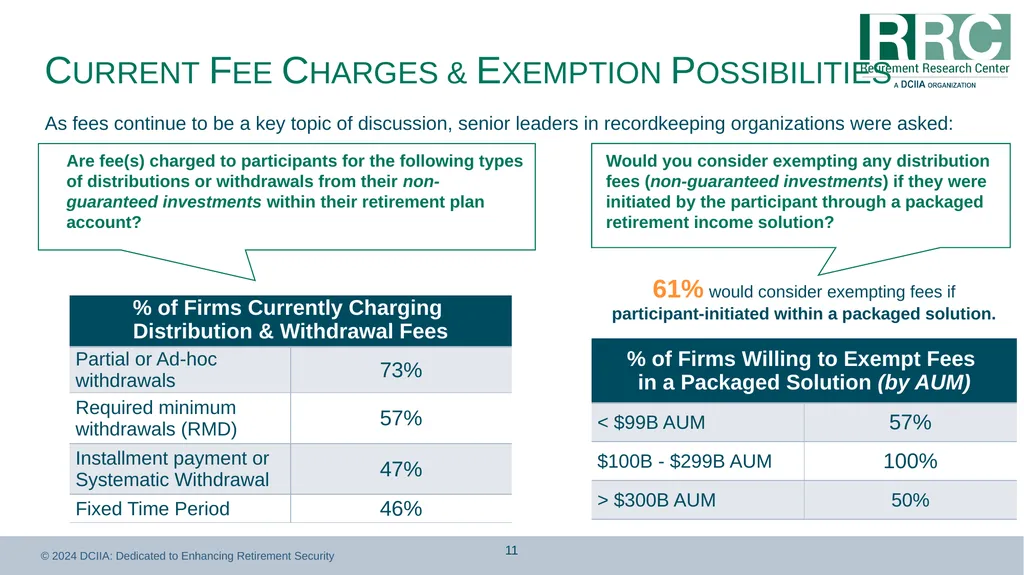
slide11. Current Fee Charges & Exemption Possibilities 11 61% would consider exempting fees if participant-initiated within a packaged solution. As fees continue to be a key topic of discussion, senior leaders in recordkeeping organizations were asked:<br>
slide12. Types of Solutions Under Development 12 65% of recordkeepers are implementing proprietary solutions that can be used by multiple clients. 53% are leveraging external providers. 47% are using strategic partners. Custom solutions for specific clients are limited. To meet demand in offering multiple solutions, 47% of recordkeepers are focusing on “coopetition” to bring in strategic partners. 53% are leveraging external providers, which may be fintechs or dedicated technology firms. Diving deeper, nearly 75% of recordkeepers with $100B-$400B AUM are leveraging external providers. Custom solutions are only available from recordkeepers with >$300B AUM. Even then, availability is limited.
These partnerships aid cost-effective outsourcing and shared resources amid an environment of limited bandwidth and fee pressures. How seamless can we collaboratively make the participant experience? These collaborations also indicate areas of focus: How central are middleware providers in solving for key technology challenges? are currently leveraging both. 39%<br>
slide13. Technology’s Role in Shaping Solution Development 13<br>
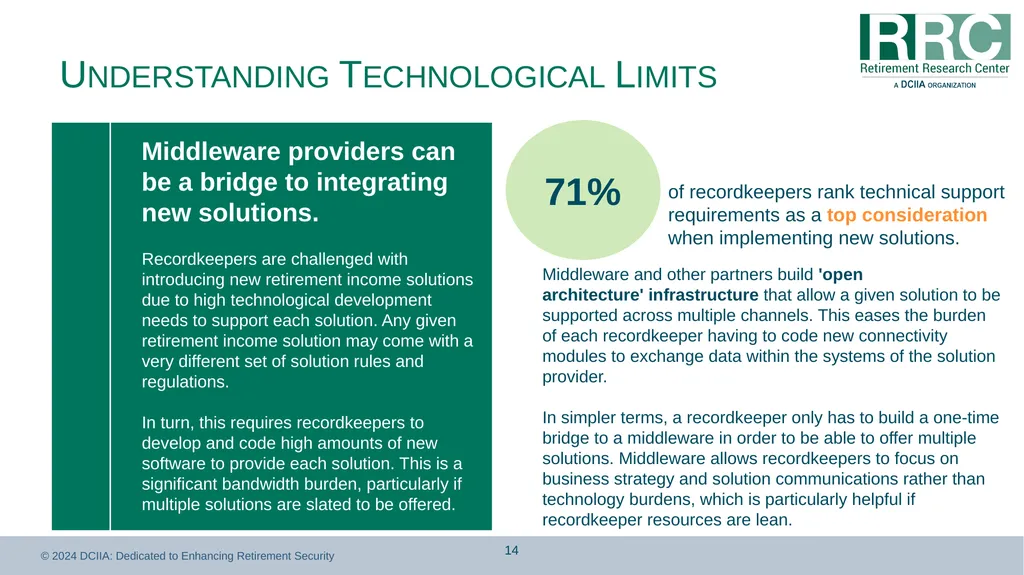
slide14. Understanding Technological Limits 14 Middleware providers can be a bridge to integrating new solutions. Recordkeepers are challenged with introducing new retirement income solutions due to high technological development needs to support each solution. Any given retirement income solution may come with a very different set of solution rules and regulations.
In turn, this requires recordkeepers to develop and code high amounts of new software to provide each solution. This is a significant bandwidth burden, particularly if multiple solutions are slated to be offered. Middleware and other partners build 'open architecture' infrastructure that allow a given solution to be supported across multiple channels. This eases the burden of each recordkeeper having to code new connectivity modules to exchange data within the systems of the solution provider.
In simpler terms, a recordkeeper only has to build a one-time bridge to a middleware in order to be able to offer multiple solutions. Middleware allows recordkeepers to focus on business strategy and solution communications rather than technology burdens, which is particularly helpful if recordkeeper resources are lean.<br>
slide15. Can increase time-to-market of new solutions while simplifying delivery paths. Development Amplifier 1 4 2 3 Middleware Provider Middleware can often supplement educational tools, resources, calculators, and participant touchpoints to help increase confidence before payout phase decisions. Participant Resources Recordkeepers are relieved of the burden of coding new connectivity modules and creating multiple new pathways for delivery. Ease of Entry Shared Pathways Ecosystem path to share demographic and transactional data with other service providers (managed accounts, insurers, asset managers). Visualizing Middleware Technology<br>
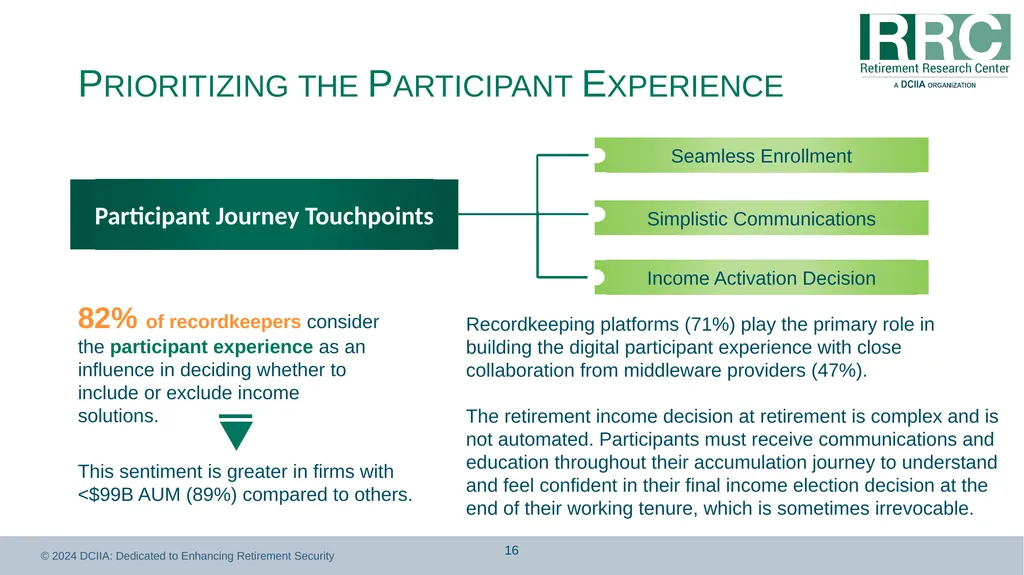
slide16. Prioritizing the Participant Experience 16 82% of recordkeepers consider the participant experience as an influence in deciding whether to include or exclude income solutions. This sentiment is greater in firms with <$99B AUM (89%) compared to others. Recordkeeping platforms (71%) play the primary role in building the digital participant experience with close collaboration from middleware providers (47%).
The retirement income decision at retirement is complex and is not automated. Participants must receive communications and education throughout their accumulation journey to understand and feel confident in their final income election decision at the end of their working tenure, which is sometimes irrevocable.<br>
slide17. In-Plan Guaranteed Solutions 17<br>
slide18. Overview of In-Plan Guaranteed Solutions 18 A capabilities survey was fielded to understand current in-plan solutions offerings across recordkeepers of varying sizes. Solutions were defined as in-plan solutions that are specifically geared toward generating income for participants through retirement and include a feature or annuitization process to facilitate guaranteed income at retirement.
Respondents were asked about:
Availability of Fixed Annuity (FA), Income Annuities (SPIA, DIA, QLAC), and any annuity with a guaranteed lifetime withdrawal benefit (GLWB).
Vehicle the annuity is offered through (TDF, stand-alone option, managed account, model portfolio)
Which annuities are currently being considered for future implementation (6-18 months)<br>
slide19. In-Plan Guaranteed Definitions 19 The following definitions were provided for each in-plan guaranteed solution:
Fixed Annuity (FA):
Offers a guaranteed fixed interest rate on the money paid into it (over a period of time) AND facilitates conversion into lifetime income – this does not include annuities used solely as stable value funds.
Income Annuity:
A contract that exchanges an irrevocable payment for guaranteed income for the rest of one’s life. The income may start immediately (SPIA) or at some future date (DIA and QLAC).
Guaranteed Lifetime Withdrawal Benefit (GLWB):
A GLWB provides guaranteed lifetime income through systematic withdrawals from the account and preserves some liquidity rather than the exchange of a lump sum for guaranteed lifetime income. It may be associated with any type of annuity.<br>
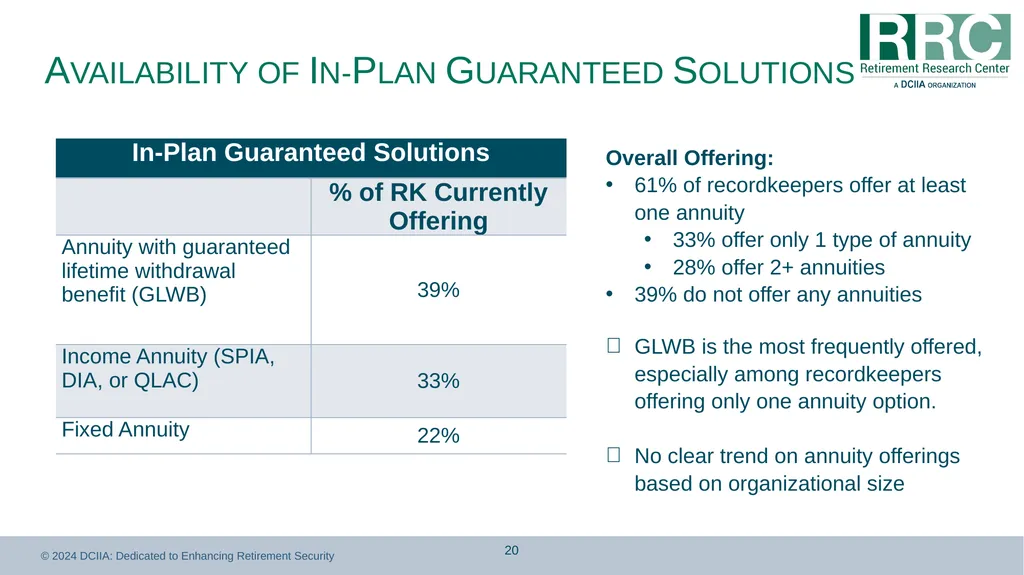
slide20. Availability of In-Plan Guaranteed Solutions 20 Overall Offering:
61% of recordkeepers offer at least one annuity
33% offer only 1 type of annuity
28% offer 2+ annuities
39% do not offer any annuities
GLWB is the most frequently offered, especially among recordkeepers offering only one annuity option.
No clear trend on annuity offerings based on organizational size<br>
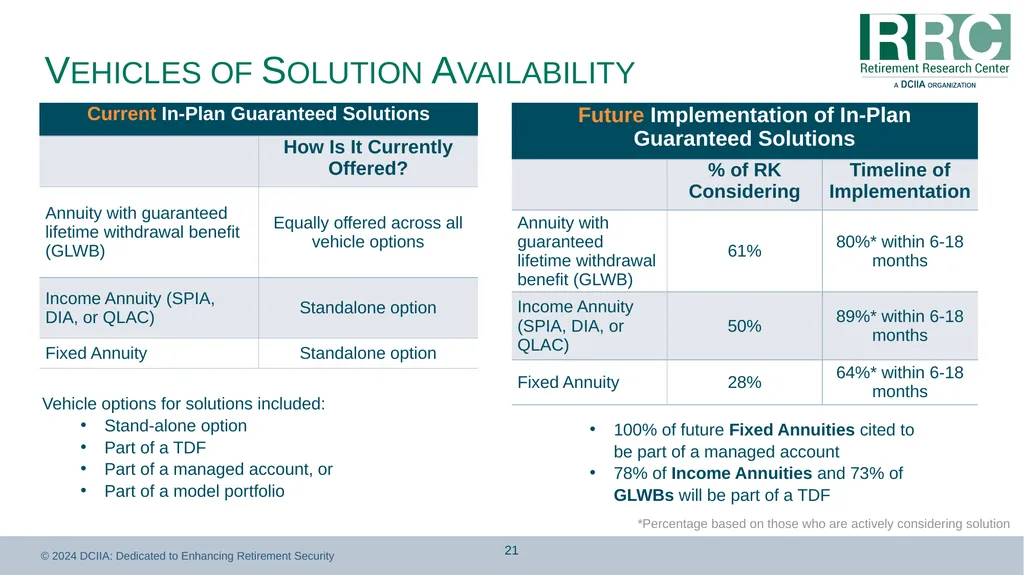
slide21. Vehicles of Solution Availability 21 Vehicle options for solutions included:
Stand-alone option
Part of a TDF
Part of a managed account, or
Part of a model portfolio 100% of future Fixed Annuities cited to be part of a managed account
78% of Income Annuities and 73% of GLWBs will be part of a TDF *Percentage based on those who are actively considering solution<br>
slide22. Non-Guaranteed Solutions 22<br>
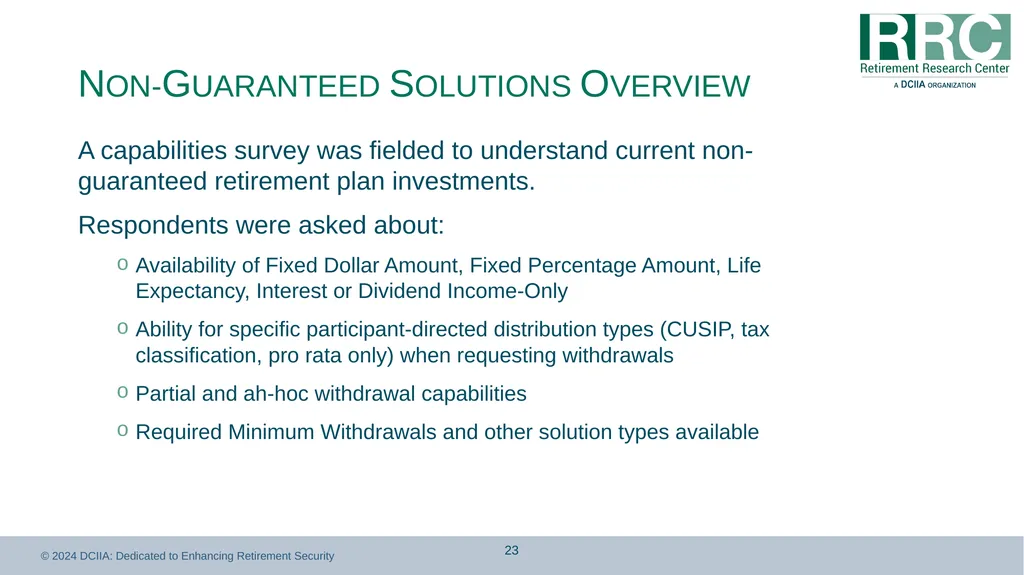
slide23. Non-Guaranteed Solutions Overview 23 A capabilities survey was fielded to understand current non-guaranteed retirement plan investments.
Respondents were asked about:
Availability of Fixed Dollar Amount, Fixed Percentage Amount, Life Expectancy, Interest or Dividend Income-Only
Ability for specific participant-directed distribution types (CUSIP, tax classification, pro rata only) when requesting withdrawals
Partial and ah-hoc withdrawal capabilities
Required Minimum Withdrawals and other solution types available<br>
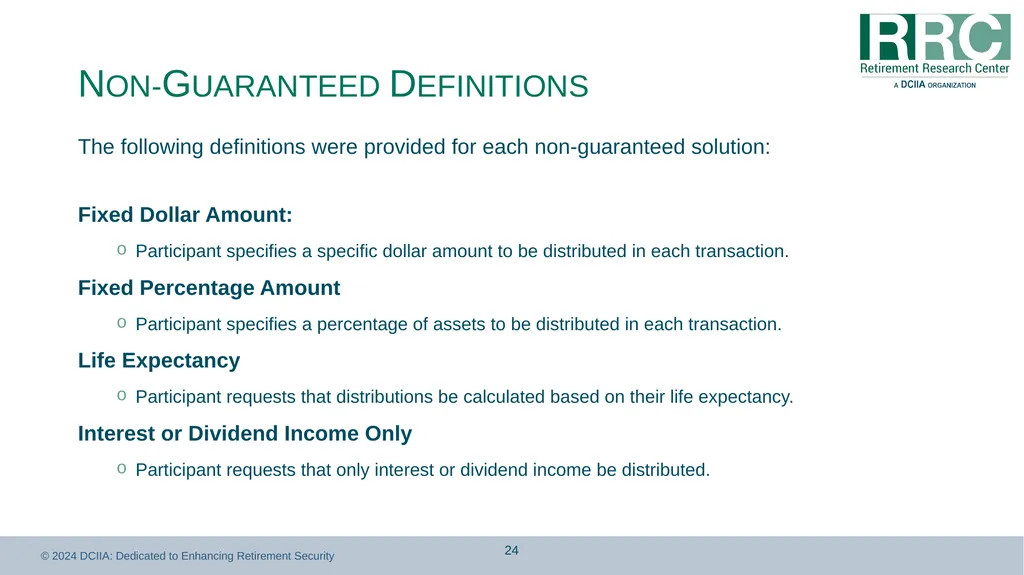
slide24. Non-Guaranteed Definitions 24 The following definitions were provided for each non-guaranteed solution:
Fixed Dollar Amount:
Participant specifies a specific dollar amount to be distributed in each transaction.
Fixed Percentage Amount
Participant specifies a percentage of assets to be distributed in each transaction.
Life Expectancy
Participant requests that distributions be calculated based on their life expectancy.
Interest or Dividend Income Only
Participant requests that only interest or dividend income be distributed.<br>
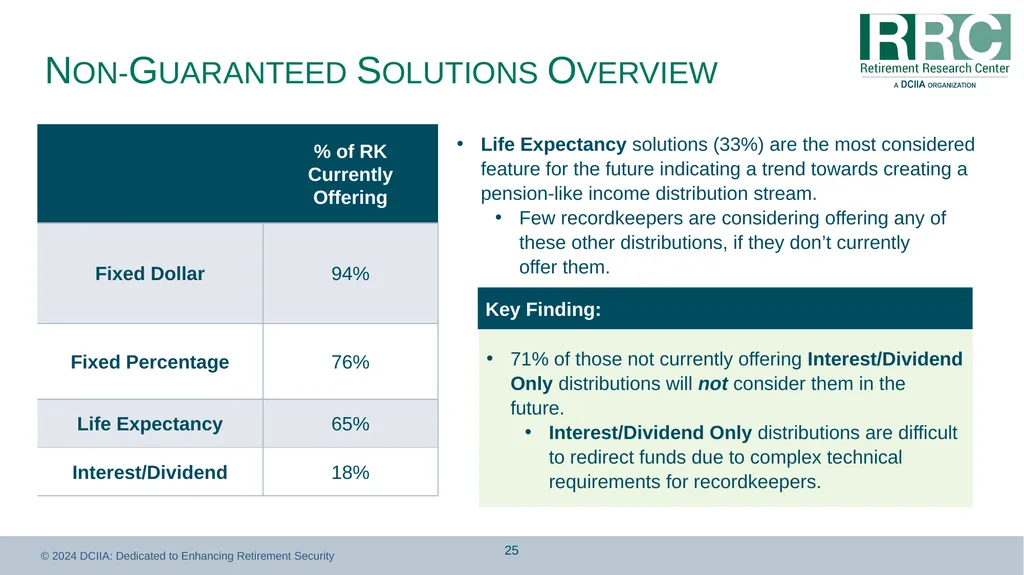
slide25. Non-Guaranteed Solutions Overview 25 Life Expectancy solutions (33%) are the most considered feature for the future indicating a trend towards creating a pension-like income distribution stream.
Few recordkeepers are considering offering any of these other distributions, if they don’t currently offer them.<br>
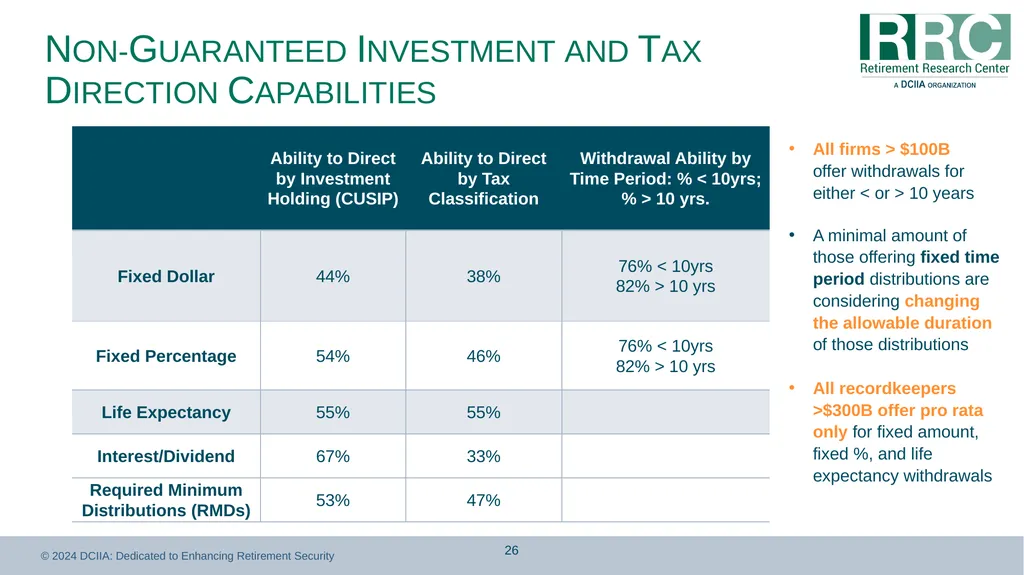
slide26. Non-Guaranteed Investment and Tax Direction Capabilities 26 All firms > $100B offer withdrawals for either < or > 10 years
A minimal amount of those offering fixed time period distributions are considering changing the allowable duration of those distributions
All recordkeepers >$300B offer pro rata only for fixed amount, fixed %, and life expectancy withdrawals<br>
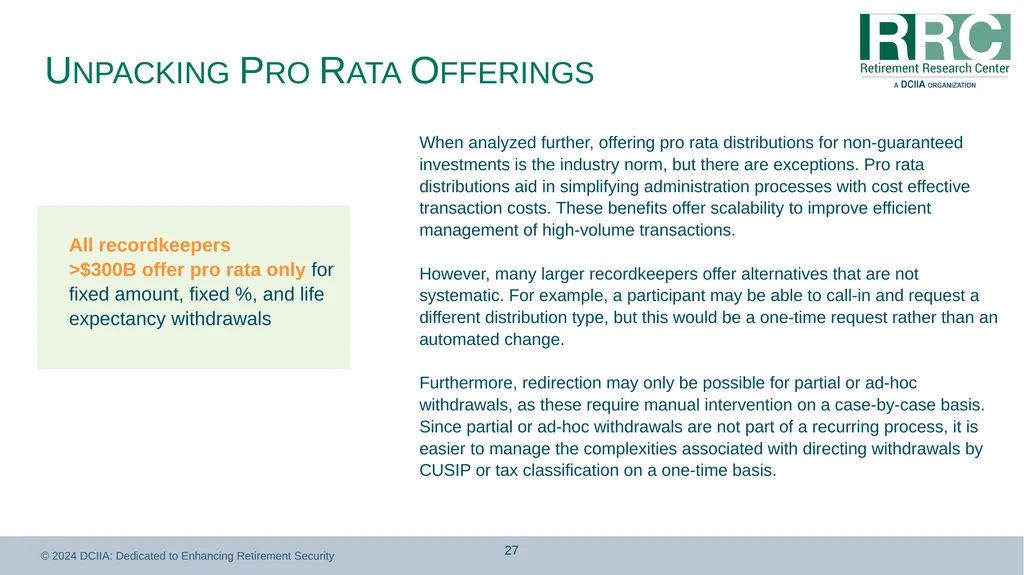
slide27. Unpacking Pro Rata Offerings 27 When analyzed further, offering pro rata distributions for non-guaranteed investments is the industry norm, but there are exceptions. Pro rata distributions aid in simplifying administration processes with cost effective transaction costs. These benefits offer scalability to improve efficient management of high-volume transactions.
However, many larger recordkeepers offer alternatives that are not systematic. For example, a participant may be able to call-in and request a different distribution type, but this would be a one-time request rather than an automated change.
Furthermore, redirection may only be possible for partial or ad-hoc withdrawals, as these require manual intervention on a case-by-case basis. Since partial or ad-hoc withdrawals are not part of a recurring process, it is easier to manage the complexities associated with directing withdrawals by CUSIP or tax classification on a one-time basis.<br>
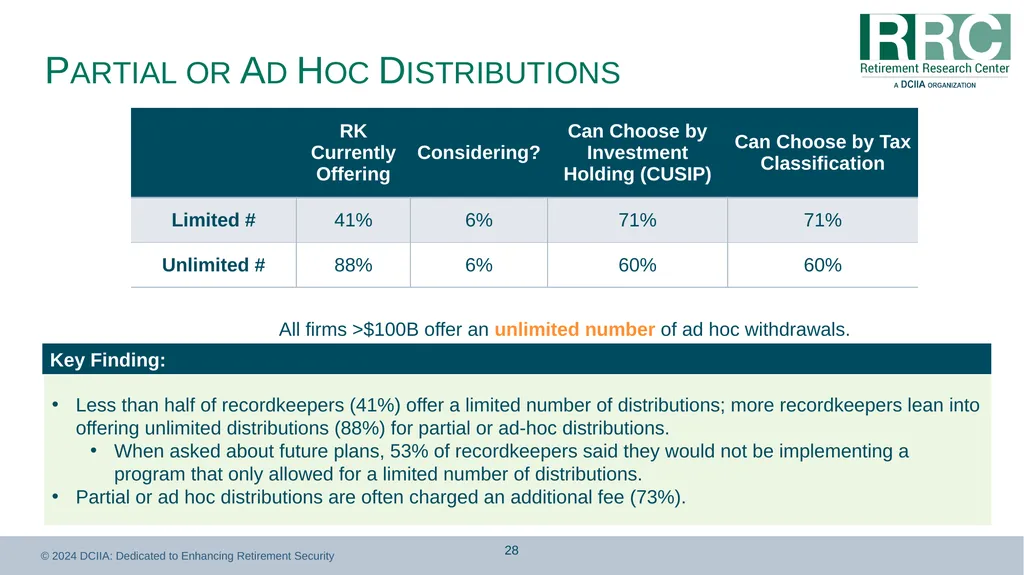
slide28. Partial or Ad Hoc Distributions 28 All firms >$100B offer an unlimited number of ad hoc withdrawals.<br>
slide29. Acknowledgements 29<br>
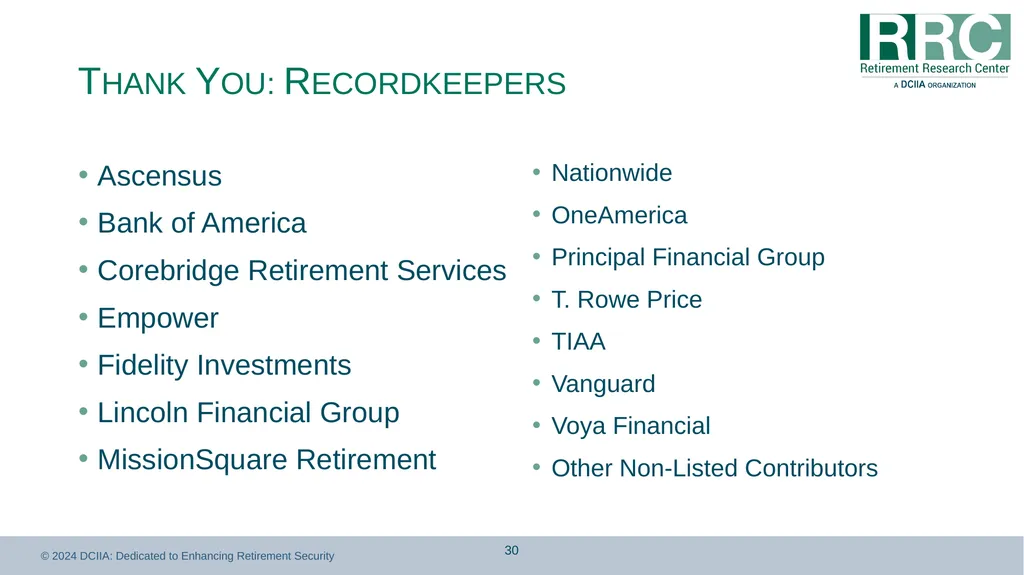
slide30. Thank You: Recordkeepers Ascensus
Bank of America
Corebridge Retirement Services
Empower
Fidelity Investments
Lincoln Financial Group
MissionSquare Retirement Nationwide
OneAmerica
Principal Financial Group
T. Rowe Price
TIAA
Vanguard
Voya Financial
Other Non-Listed Contributors 30<br>
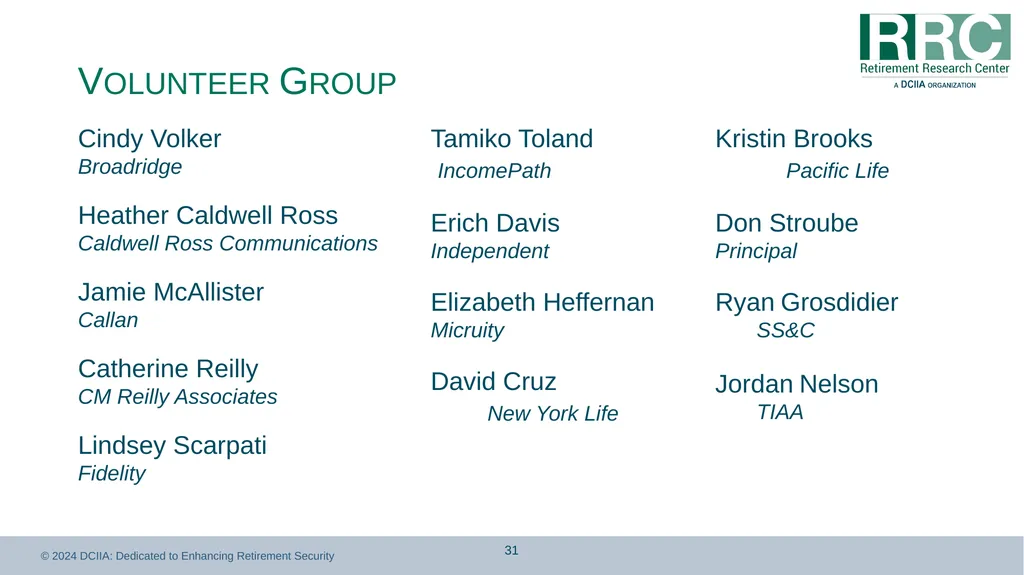
slide31. Volunteer Group 31 Cindy Volker
Broadridge
Heather Caldwell Ross
Caldwell Ross Communications
Jamie McAllister
Callan
Catherine Reilly
CM Reilly Associates
Lindsey Scarpati
Fidelity Tamiko Toland IncomePath
Erich Davis Independent
Elizabeth Heffernan
Micruity
David Cruz New York Life Kristin Brooks Pacific Life
Don Stroube Principal
Ryan Grosdidier SS&C
Jordan Nelson TIAA<br>
slide2. Sample Characteristics 18 recordkeepers were surveyed in total with the following characteristics: 2 Background & Sample<br>
slide3. The DCIIA RRC fielded two online surveys targeting 18 recordkeepers representing various sizes. One survey, focusing on business strategy, was fielded to the appropriate decision-makers, while a second survey was distributed to appropriate internal operations contacts.
The term, retirement income, in this study encompasses both guaranteed and non-guaranteed solutions.
To ensure the accuracy of the responses, recordkeepers were provided with the survey questions in advance to allow them to reference internal data and solution offerings to answer accordingly.
The survey was administered in a structured manner, where each solution was presented one at a time. For each solution, the recordkeepers were asked whether they offered it. If they confirmed offering the solution, a series of follow-up questions were posed to gather more insights into fee structures, investment directing capabilities, strategic considerations, and more.
This inaugural survey will be used as a foundation for ongoing benchmarking to track changes in solution offerings, fee bundling, and more. Additional information will be gathered in the future related to data captures, limited distributions, and more. 3 Survey Methodology<br>
slide4. Influential Considerations in Solution Planning
Technology’s Role in Shaping Solution Development
In-Plan Guaranteed Solutions
Non-Guaranteed Solutions 4 Table of Contents<br>
slide5. Executive Summary 5 Technology integration will be a linchpin in enabling new solutions with scalability.
While most recordkeepers are offering proprietary products, a substantial amount are leveraging external providers (53%) or using strategic partners (47%). 39% of recordkeepers are using both.
Providers of these technology solutions, including middleware firms, will be force-multipliers in shaping the future of retirement income solutions. The participant experience is an implicit undercurrent in driving income solution development.
82% of recordkeepers prioritize it when deciding whether to include or exclude income solutions.
Across the board, practitioners aim for a streamlined, well –communicated, and simplified experience for participants. A well-rounded retirement income program provides resources and regular touchpoints to guide the final income activation decision. Plan sponsor demand is the primary driver of retirement income solution adoption.
86% of recordkeepers cited their strategic planning of new solution development was primarily contingent on this demand.
However, plan sponsors often consider new solutions in reaction to money leaving the plan through rollovers or withdrawals. This cycle continues to be reactionary rather than proactive.<br>
slide6. Influential Factors in Solution Planning 6<br>
slide7. A targeted strategy survey focused on business decision-making and influences on solution planning within individual firms.
Respondents were asked about:
Firm's priority-level in 2024 for developing retirement income solutions
Stakeholders involved in solution development (partners, external vendors, etc.)
Industry influences that shaped their decision-making (legislation, demand, technology, innovation)
Technological constraints on their current systems 7 Overview of Influential Factors<br>
slide8. Influences on Development Strategy 8 56% of all recordkeepers consider retirement income solutions a “very important” priority in 2024. For those considering implementing new solutions, three key influences were cited as considerations in their strategic planning.<br>
slide9. Understanding Plan Sponsor Demand 9 Plan sponsors are tasked with balancing fiduciary concerns, regulatory requirements (SECURE 2.0), and gauging demand from their workforce. In general, participant demand for solutions is limited. Plan sponsors often consider new solutions in reaction to money leaving the plan through rollovers or withdrawals.
While recordkeepers wait for plan sponsor demand to guide their solution development, plan sponsors are often hesitant to be the ‘first’ to adopt a new solution. This fluctuating balance leads to two key questions in 2024: Plan sponsor demand is influenced by a combination of factors. Will more announcements of plan sponsor solution adoption drive recordkeepers to accelerate development of new solutions? Will other plan sponsors increase adoption? And if so, will this industry tipping point influence consultant approaches in recommending retirement income solutions?<br>
slide10. Industry Stakeholder Influence on Development 10 As ranked by “Very Important” When deciding the prioritization of offering specific retirement income solutions within your firm, how important are the following influences? Top Influences Participants (65%) and Consultants (59%) still has significant influence, but Solution Manufacturers (18%) had the least influence.<br>
slide11. Current Fee Charges & Exemption Possibilities 11 61% would consider exempting fees if participant-initiated within a packaged solution. As fees continue to be a key topic of discussion, senior leaders in recordkeeping organizations were asked:<br>
slide12. Types of Solutions Under Development 12 65% of recordkeepers are implementing proprietary solutions that can be used by multiple clients. 53% are leveraging external providers. 47% are using strategic partners. Custom solutions for specific clients are limited. To meet demand in offering multiple solutions, 47% of recordkeepers are focusing on “coopetition” to bring in strategic partners. 53% are leveraging external providers, which may be fintechs or dedicated technology firms. Diving deeper, nearly 75% of recordkeepers with $100B-$400B AUM are leveraging external providers. Custom solutions are only available from recordkeepers with >$300B AUM. Even then, availability is limited.
These partnerships aid cost-effective outsourcing and shared resources amid an environment of limited bandwidth and fee pressures. How seamless can we collaboratively make the participant experience? These collaborations also indicate areas of focus: How central are middleware providers in solving for key technology challenges? are currently leveraging both. 39%<br>
slide13. Technology’s Role in Shaping Solution Development 13<br>
slide14. Understanding Technological Limits 14 Middleware providers can be a bridge to integrating new solutions. Recordkeepers are challenged with introducing new retirement income solutions due to high technological development needs to support each solution. Any given retirement income solution may come with a very different set of solution rules and regulations.
In turn, this requires recordkeepers to develop and code high amounts of new software to provide each solution. This is a significant bandwidth burden, particularly if multiple solutions are slated to be offered. Middleware and other partners build 'open architecture' infrastructure that allow a given solution to be supported across multiple channels. This eases the burden of each recordkeeper having to code new connectivity modules to exchange data within the systems of the solution provider.
In simpler terms, a recordkeeper only has to build a one-time bridge to a middleware in order to be able to offer multiple solutions. Middleware allows recordkeepers to focus on business strategy and solution communications rather than technology burdens, which is particularly helpful if recordkeeper resources are lean.<br>
slide15. Can increase time-to-market of new solutions while simplifying delivery paths. Development Amplifier 1 4 2 3 Middleware Provider Middleware can often supplement educational tools, resources, calculators, and participant touchpoints to help increase confidence before payout phase decisions. Participant Resources Recordkeepers are relieved of the burden of coding new connectivity modules and creating multiple new pathways for delivery. Ease of Entry Shared Pathways Ecosystem path to share demographic and transactional data with other service providers (managed accounts, insurers, asset managers). Visualizing Middleware Technology<br>
slide16. Prioritizing the Participant Experience 16 82% of recordkeepers consider the participant experience as an influence in deciding whether to include or exclude income solutions. This sentiment is greater in firms with <$99B AUM (89%) compared to others. Recordkeeping platforms (71%) play the primary role in building the digital participant experience with close collaboration from middleware providers (47%).
The retirement income decision at retirement is complex and is not automated. Participants must receive communications and education throughout their accumulation journey to understand and feel confident in their final income election decision at the end of their working tenure, which is sometimes irrevocable.<br>
slide17. In-Plan Guaranteed Solutions 17<br>
slide18. Overview of In-Plan Guaranteed Solutions 18 A capabilities survey was fielded to understand current in-plan solutions offerings across recordkeepers of varying sizes. Solutions were defined as in-plan solutions that are specifically geared toward generating income for participants through retirement and include a feature or annuitization process to facilitate guaranteed income at retirement.
Respondents were asked about:
Availability of Fixed Annuity (FA), Income Annuities (SPIA, DIA, QLAC), and any annuity with a guaranteed lifetime withdrawal benefit (GLWB).
Vehicle the annuity is offered through (TDF, stand-alone option, managed account, model portfolio)
Which annuities are currently being considered for future implementation (6-18 months)<br>
slide19. In-Plan Guaranteed Definitions 19 The following definitions were provided for each in-plan guaranteed solution:
Fixed Annuity (FA):
Offers a guaranteed fixed interest rate on the money paid into it (over a period of time) AND facilitates conversion into lifetime income – this does not include annuities used solely as stable value funds.
Income Annuity:
A contract that exchanges an irrevocable payment for guaranteed income for the rest of one’s life. The income may start immediately (SPIA) or at some future date (DIA and QLAC).
Guaranteed Lifetime Withdrawal Benefit (GLWB):
A GLWB provides guaranteed lifetime income through systematic withdrawals from the account and preserves some liquidity rather than the exchange of a lump sum for guaranteed lifetime income. It may be associated with any type of annuity.<br>
slide20. Availability of In-Plan Guaranteed Solutions 20 Overall Offering:
61% of recordkeepers offer at least one annuity
33% offer only 1 type of annuity
28% offer 2+ annuities
39% do not offer any annuities
GLWB is the most frequently offered, especially among recordkeepers offering only one annuity option.
No clear trend on annuity offerings based on organizational size<br>
slide21. Vehicles of Solution Availability 21 Vehicle options for solutions included:
Stand-alone option
Part of a TDF
Part of a managed account, or
Part of a model portfolio 100% of future Fixed Annuities cited to be part of a managed account
78% of Income Annuities and 73% of GLWBs will be part of a TDF *Percentage based on those who are actively considering solution<br>
slide22. Non-Guaranteed Solutions 22<br>
slide23. Non-Guaranteed Solutions Overview 23 A capabilities survey was fielded to understand current non-guaranteed retirement plan investments.
Respondents were asked about:
Availability of Fixed Dollar Amount, Fixed Percentage Amount, Life Expectancy, Interest or Dividend Income-Only
Ability for specific participant-directed distribution types (CUSIP, tax classification, pro rata only) when requesting withdrawals
Partial and ah-hoc withdrawal capabilities
Required Minimum Withdrawals and other solution types available<br>
slide24. Non-Guaranteed Definitions 24 The following definitions were provided for each non-guaranteed solution:
Fixed Dollar Amount:
Participant specifies a specific dollar amount to be distributed in each transaction.
Fixed Percentage Amount
Participant specifies a percentage of assets to be distributed in each transaction.
Life Expectancy
Participant requests that distributions be calculated based on their life expectancy.
Interest or Dividend Income Only
Participant requests that only interest or dividend income be distributed.<br>
slide25. Non-Guaranteed Solutions Overview 25 Life Expectancy solutions (33%) are the most considered feature for the future indicating a trend towards creating a pension-like income distribution stream.
Few recordkeepers are considering offering any of these other distributions, if they don’t currently offer them.<br>
slide26. Non-Guaranteed Investment and Tax Direction Capabilities 26 All firms > $100B offer withdrawals for either < or > 10 years
A minimal amount of those offering fixed time period distributions are considering changing the allowable duration of those distributions
All recordkeepers >$300B offer pro rata only for fixed amount, fixed %, and life expectancy withdrawals<br>
slide27. Unpacking Pro Rata Offerings 27 When analyzed further, offering pro rata distributions for non-guaranteed investments is the industry norm, but there are exceptions. Pro rata distributions aid in simplifying administration processes with cost effective transaction costs. These benefits offer scalability to improve efficient management of high-volume transactions.
However, many larger recordkeepers offer alternatives that are not systematic. For example, a participant may be able to call-in and request a different distribution type, but this would be a one-time request rather than an automated change.
Furthermore, redirection may only be possible for partial or ad-hoc withdrawals, as these require manual intervention on a case-by-case basis. Since partial or ad-hoc withdrawals are not part of a recurring process, it is easier to manage the complexities associated with directing withdrawals by CUSIP or tax classification on a one-time basis.<br>
slide28. Partial or Ad Hoc Distributions 28 All firms >$100B offer an unlimited number of ad hoc withdrawals.<br>
slide29. Acknowledgements 29<br>
slide30. Thank You: Recordkeepers Ascensus
Bank of America
Corebridge Retirement Services
Empower
Fidelity Investments
Lincoln Financial Group
MissionSquare Retirement Nationwide
OneAmerica
Principal Financial Group
T. Rowe Price
TIAA
Vanguard
Voya Financial
Other Non-Listed Contributors 30<br>
slide31. Volunteer Group 31 Cindy Volker
Broadridge
Heather Caldwell Ross
Caldwell Ross Communications
Jamie McAllister
Callan
Catherine Reilly
CM Reilly Associates
Lindsey Scarpati
Fidelity Tamiko Toland IncomePath
Erich Davis Independent
Elizabeth Heffernan
Micruity
David Cruz New York Life Kristin Brooks Pacific Life
Don Stroube Principal
Ryan Grosdidier SS&C
Jordan Nelson TIAA<br>