
Retirement Planning for the Young Professional Dr.
DJ
Published · 33 slides · 0 views

1 / 1



Description
Retirement Planning for the Young Professional Dr. Alex Uncle Al White CALS, Dairy Science moneyguyvt.edu Retirement planning overview Tax benefits of qualified retirement accounts Basic retirement planning calculations Types of VT plans
Related Topics
Share
Embed code
Download this presentation From Below
"Retirement Planning for the Young Professional Dr." is the property of its rightful owner. Permission is granted to download and print the materials on this website for personal, non-commercial use only, and to display it on your personal computer provided you do not modify the materials and that you retain all copyright notices contained in the materials. By downloading content from our website, you accept the terms of this agreement.
Presentation Transcript
01
Retirement Planning
for the
Young Professional Dr. Alex “Uncle Al” White
CALS, Dairy Science
moneyguy@vt.edu<br>
CALS, Dairy Science
moneyguy@vt.edu<br>
02
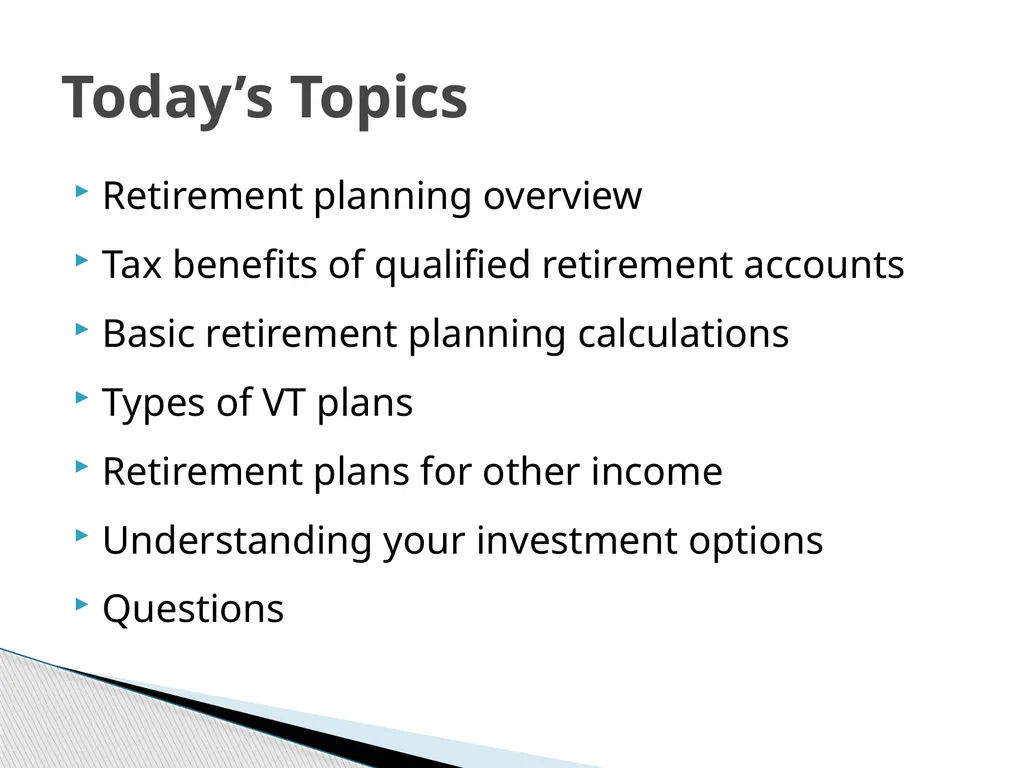
Retirement planning overview
Tax benefits of qualified retirement accounts
Basic retirement planning calculations
Types of VT plans
Retirement plans for other income
Understanding your investment options
Questions Today’s Topics<br>
Tax benefits of qualified retirement accounts
Basic retirement planning calculations
Types of VT plans
Retirement plans for other income
Understanding your investment options
Questions Today’s Topics<br>
03
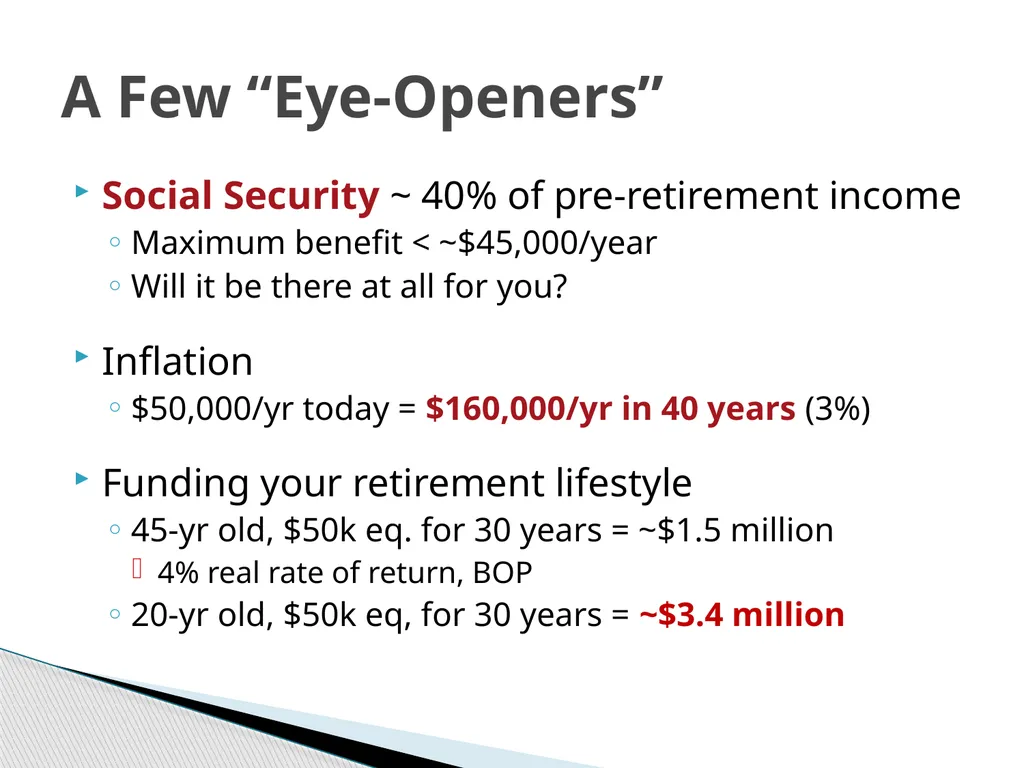
Social Security ~ 40% of pre-retirement income
Maximum benefit < ~$45,000/year
Will it be there at all for you?
Inflation
$50,000/yr today = $160,000/yr in 40 years (3%)
Funding your retirement lifestyle
45-yr old, $50k eq. for 30 years = ~$1.5 million
4% real rate of return, BOP
20-yr old, $50k eq, for 30 years = ~$3.4 million A Few “Eye-Openers”<br>
Maximum benefit < ~$45,000/year
Will it be there at all for you?
Inflation
$50,000/yr today = $160,000/yr in 40 years (3%)
Funding your retirement lifestyle
45-yr old, $50k eq. for 30 years = ~$1.5 million
4% real rate of return, BOP
20-yr old, $50k eq, for 30 years = ~$3.4 million A Few “Eye-Openers”<br>
04
To reach $1 million at age 65:
20-yr old needs to invest ~$9/day
40-yr old needs to invest ~$40/day
7% APY, no taxes, no inflation, BOP
Does not include VRS benefits
With 3% annual inflation:
20-yr old needs to invest ~$35/day
40-yr old needs to invest ~$85/day
The earlier you start, the easier it is! More Eye-Openers<br>
20-yr old needs to invest ~$9/day
40-yr old needs to invest ~$40/day
7% APY, no taxes, no inflation, BOP
Does not include VRS benefits
With 3% annual inflation:
20-yr old needs to invest ~$35/day
40-yr old needs to invest ~$85/day
The earlier you start, the easier it is! More Eye-Openers<br>
05
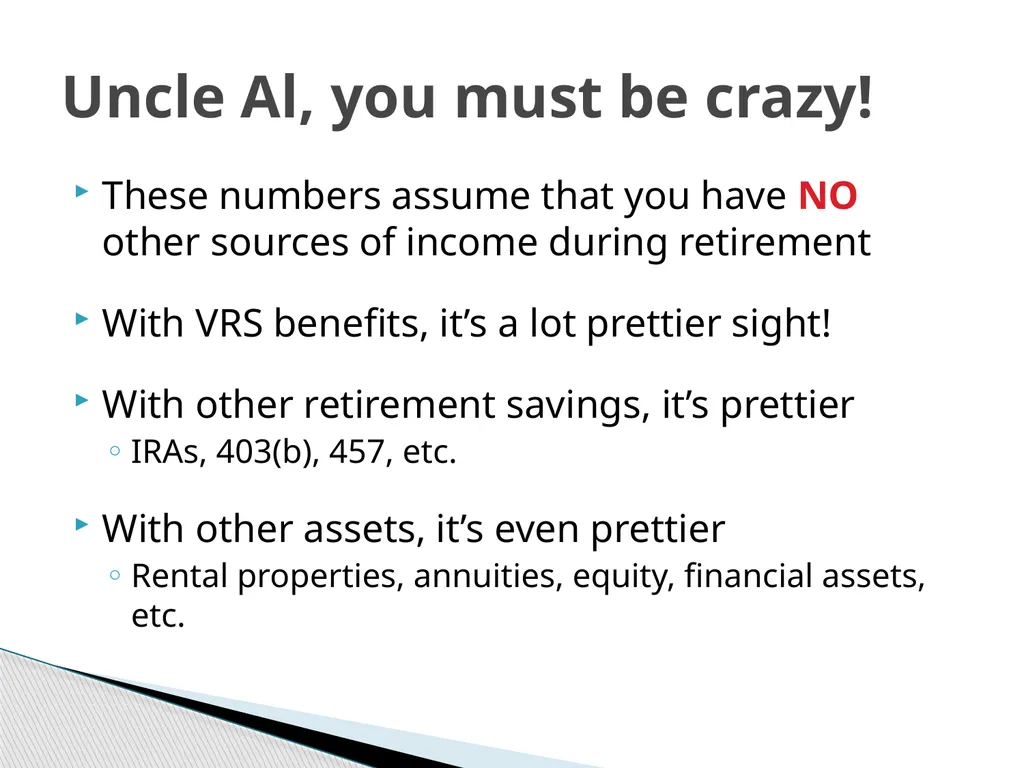
These numbers assume that you have NO other sources of income during retirement
With VRS benefits, it’s a lot prettier sight!
With other retirement savings, it’s prettier
IRAs, 403(b), 457, etc.
With other assets, it’s even prettier
Rental properties, annuities, equity, financial assets, etc. Uncle Al, you must be crazy!<br>
With VRS benefits, it’s a lot prettier sight!
With other retirement savings, it’s prettier
IRAs, 403(b), 457, etc.
With other assets, it’s even prettier
Rental properties, annuities, equity, financial assets, etc. Uncle Al, you must be crazy!<br>
06
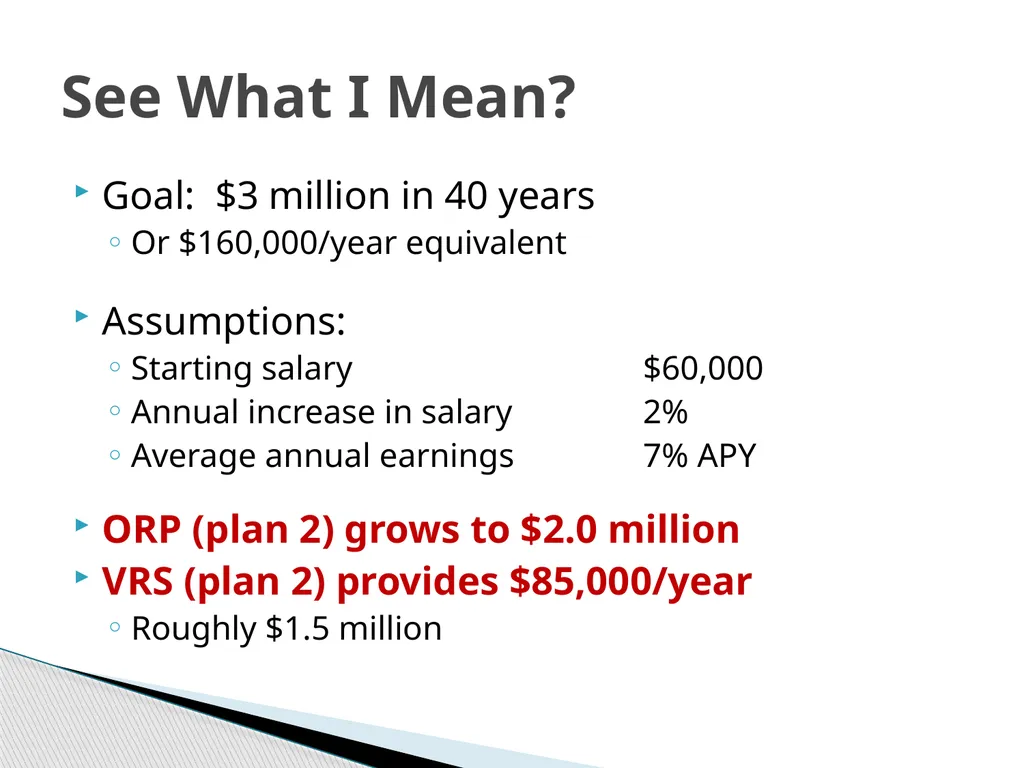
Goal: $3 million in 40 years
Or $160,000/year equivalent
Assumptions:
Starting salary $60,000
Annual increase in salary 2%
Average annual earnings 7% APY
ORP (plan 2) grows to $2.0 million
VRS (plan 2) provides $85,000/year
Roughly $1.5 million See What I Mean?<br>
Or $160,000/year equivalent
Assumptions:
Starting salary $60,000
Annual increase in salary 2%
Average annual earnings 7% APY
ORP (plan 2) grows to $2.0 million
VRS (plan 2) provides $85,000/year
Roughly $1.5 million See What I Mean?<br>
07
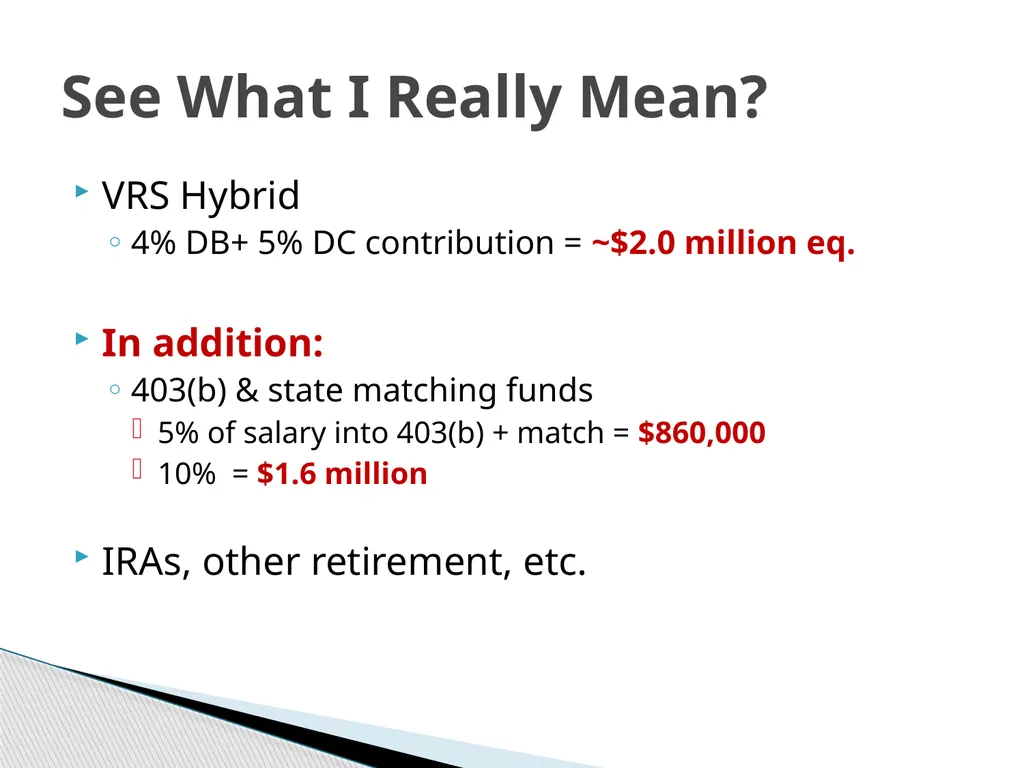
VRS Hybrid
4% DB+ 5% DC contribution = ~$2.0 million eq.
In addition:
403(b) & state matching funds
5% of salary into 403(b) + match = $860,000
10% = $1.6 million
IRAs, other retirement, etc. See What I Really Mean?<br>
4% DB+ 5% DC contribution = ~$2.0 million eq.
In addition:
403(b) & state matching funds
5% of salary into 403(b) + match = $860,000
10% = $1.6 million
IRAs, other retirement, etc. See What I Really Mean?<br>
08
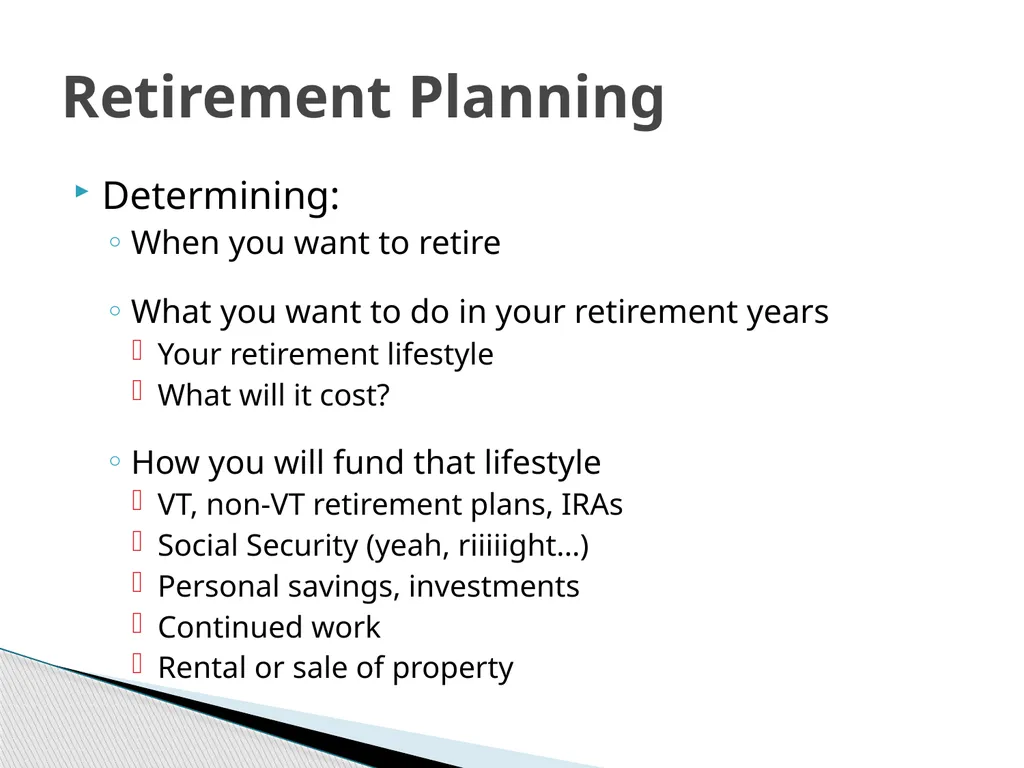
Determining:
When you want to retire
What you want to do in your retirement years
Your retirement lifestyle
What will it cost?
How you will fund that lifestyle
VT, non-VT retirement plans, IRAs
Social Security (yeah, riiiiight…)
Personal savings, investments
Continued work
Rental or sale of property Retirement Planning<br>
When you want to retire
What you want to do in your retirement years
Your retirement lifestyle
What will it cost?
How you will fund that lifestyle
VT, non-VT retirement plans, IRAs
Social Security (yeah, riiiiight…)
Personal savings, investments
Continued work
Rental or sale of property Retirement Planning<br>
09
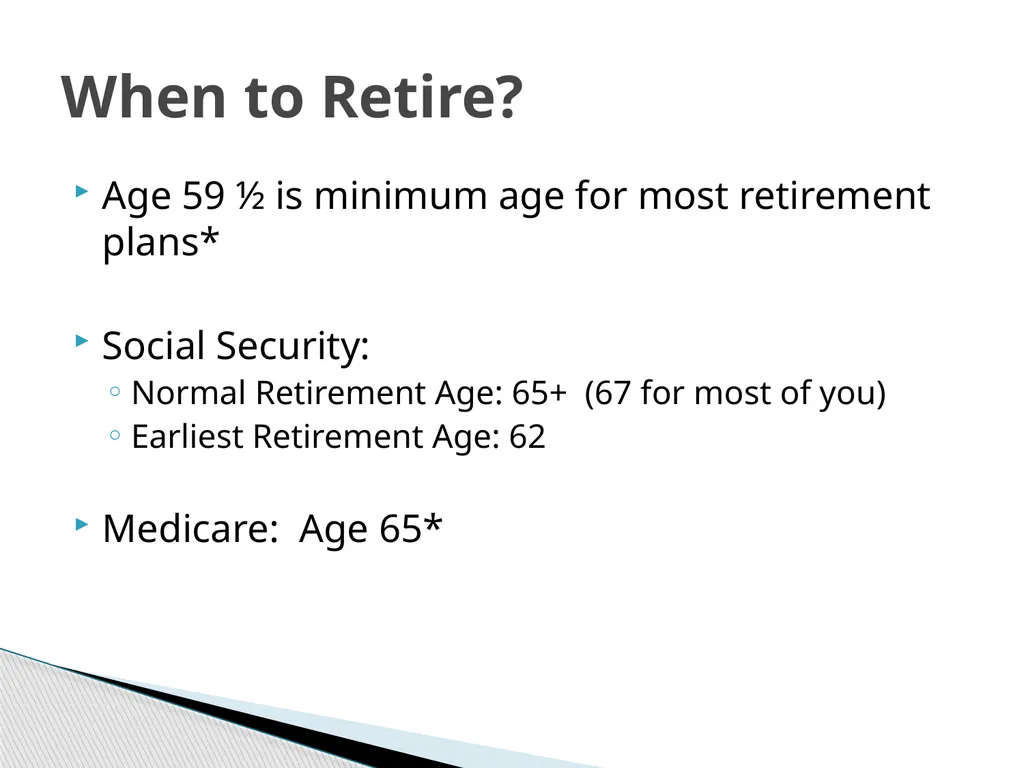
Age 59 ½ is minimum age for most retirement plans*
Social Security:
Normal Retirement Age: 65+ (67 for most of you)
Earliest Retirement Age: 62
Medicare: Age 65* When to Retire?<br>
Social Security:
Normal Retirement Age: 65+ (67 for most of you)
Earliest Retirement Age: 62
Medicare: Age 65* When to Retire?<br>
10
Main Expense Categories: Retirement Lifestyle<br>
11
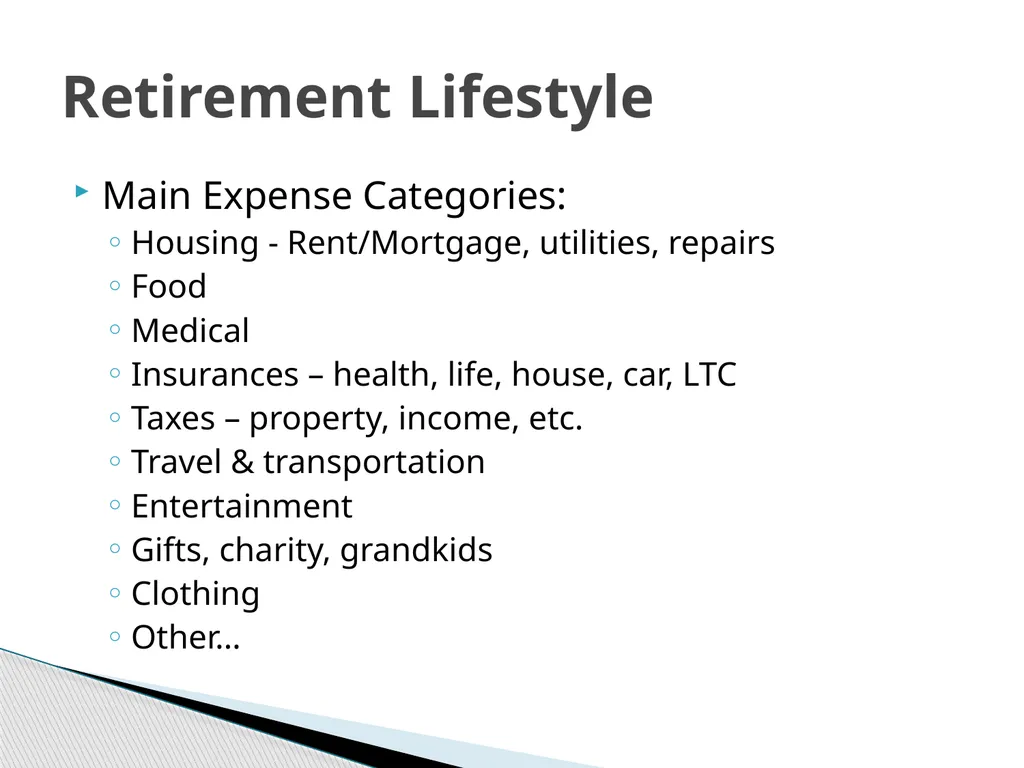
Main Expense Categories:
Housing - Rent/Mortgage, utilities, repairs
Food
Medical
Insurances – health, life, house, car, LTC
Taxes – property, income, etc.
Travel & transportation
Entertainment
Gifts, charity, grandkids
Clothing
Other… Retirement Lifestyle<br>
Housing - Rent/Mortgage, utilities, repairs
Food
Medical
Insurances – health, life, house, car, LTC
Taxes – property, income, etc.
Travel & transportation
Entertainment
Gifts, charity, grandkids
Clothing
Other… Retirement Lifestyle<br>
12
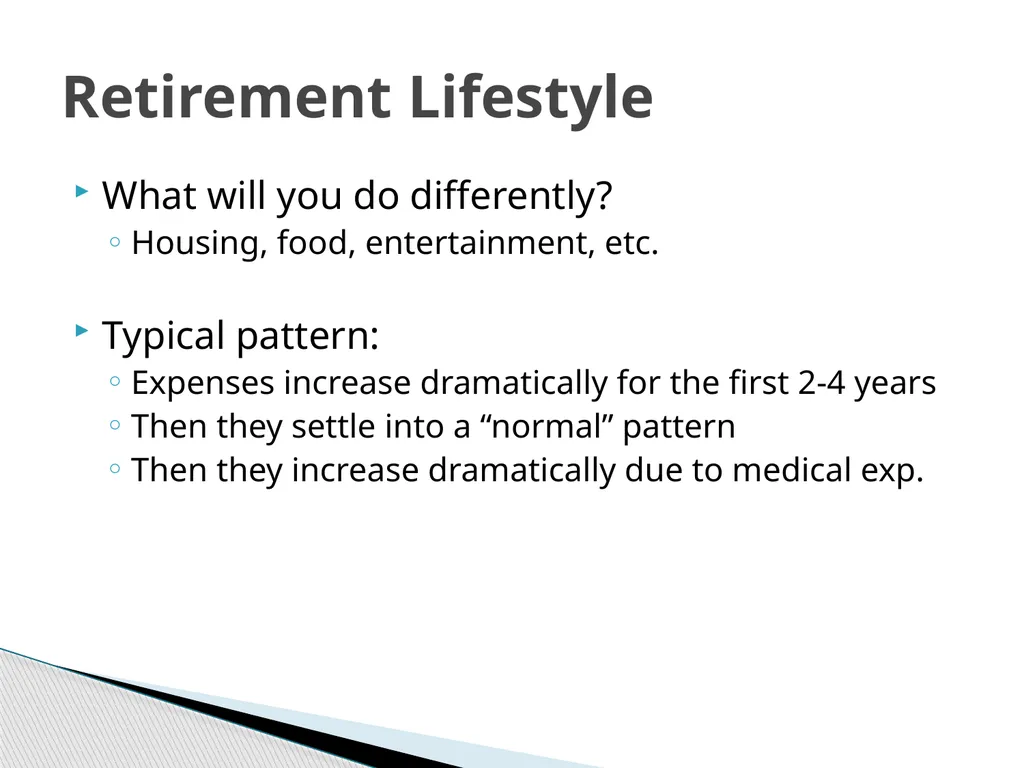
What will you do differently?
Housing, food, entertainment, etc.
Typical pattern:
Expenses increase dramatically for the first 2-4 years
Then they settle into a “normal” pattern
Then they increase dramatically due to medical exp. Retirement Lifestyle<br>
Housing, food, entertainment, etc.
Typical pattern:
Expenses increase dramatically for the first 2-4 years
Then they settle into a “normal” pattern
Then they increase dramatically due to medical exp. Retirement Lifestyle<br>
13
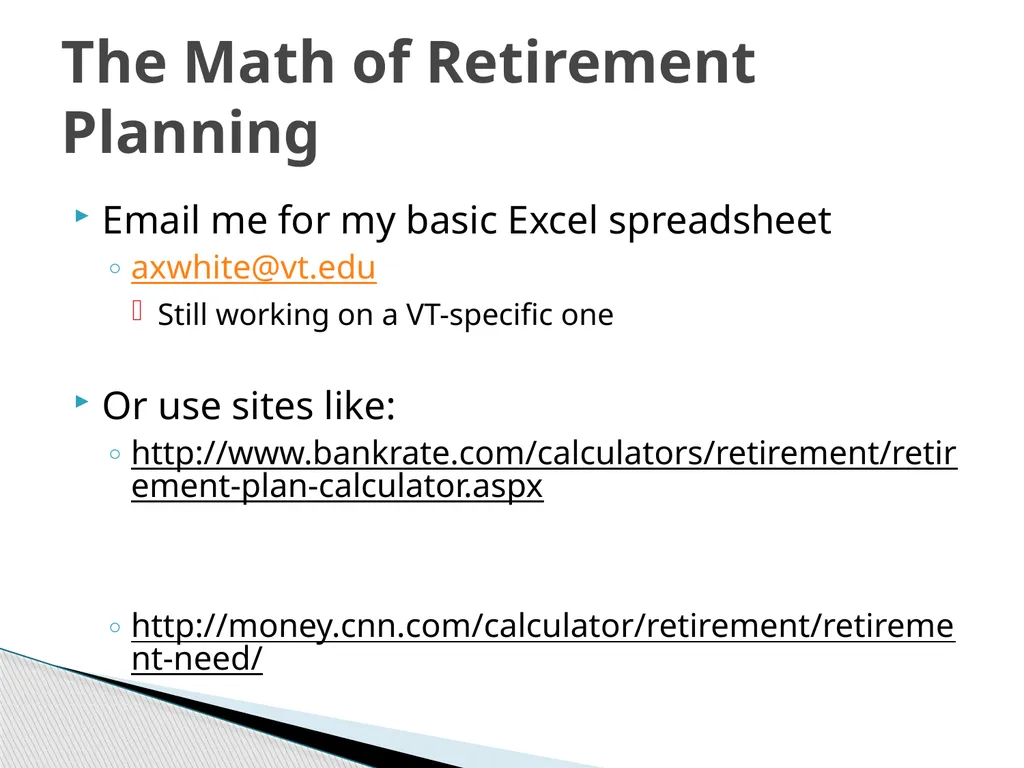
Email me for my basic Excel spreadsheet
axwhite@vt.edu
Still working on a VT-specific one
Or use sites like:
http://www.bankrate.com/calculators/retirement/retirement-plan-calculator.aspx
http://money.cnn.com/calculator/retirement/retirement-need/ The Math of Retirement Planning<br>
axwhite@vt.edu
Still working on a VT-specific one
Or use sites like:
http://www.bankrate.com/calculators/retirement/retirement-plan-calculator.aspx
http://money.cnn.com/calculator/retirement/retirement-need/ The Math of Retirement Planning<br>
14
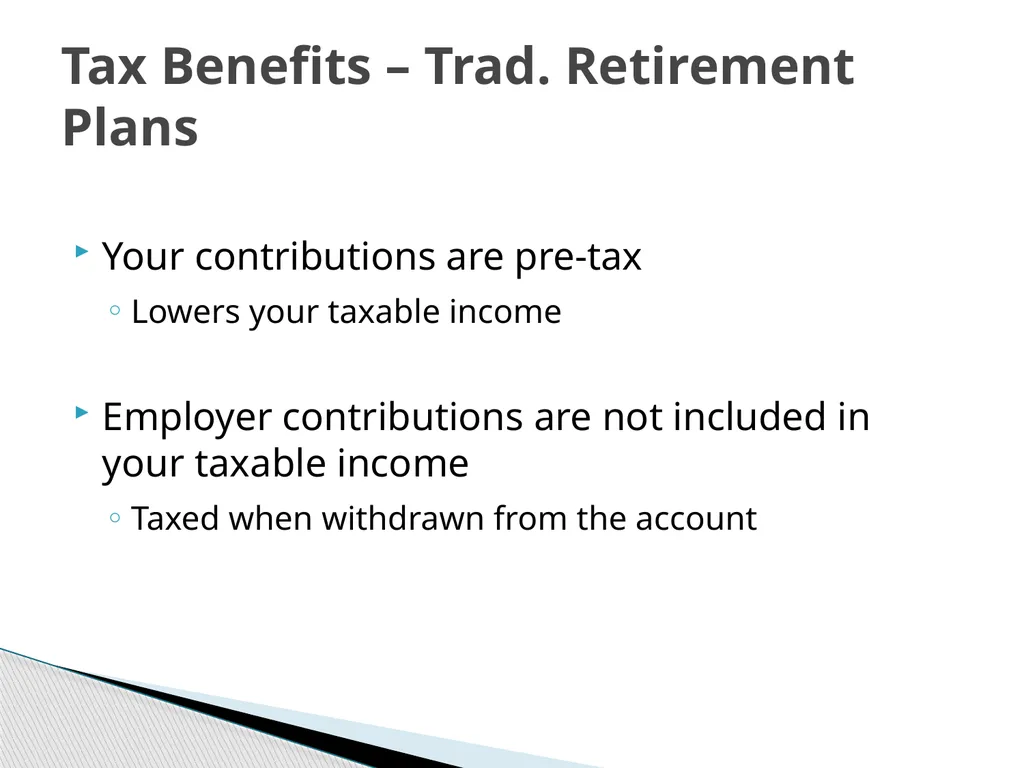
Your contributions are pre-tax
Lowers your taxable income
Employer contributions are not included in your taxable income
Taxed when withdrawn from the account Tax Benefits – Trad. Retirement Plans<br>
Lowers your taxable income
Employer contributions are not included in your taxable income
Taxed when withdrawn from the account Tax Benefits – Trad. Retirement Plans<br>
15
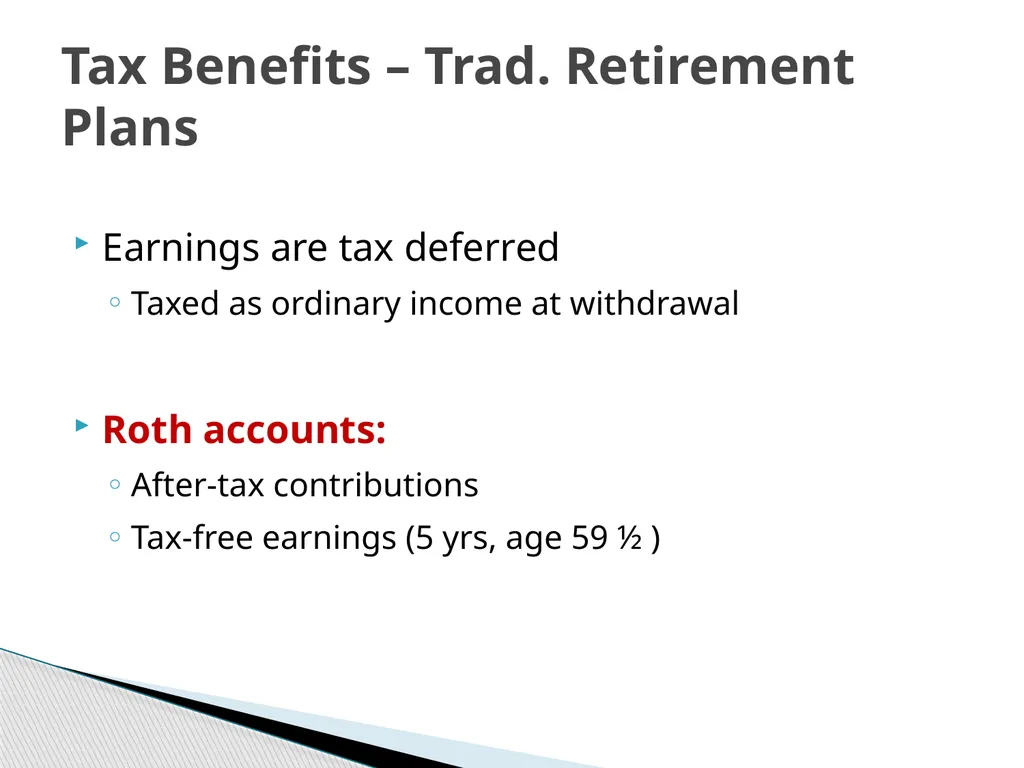
Earnings are tax deferred
Taxed as ordinary income at withdrawal
Roth accounts:
After-tax contributions
Tax-free earnings (5 yrs, age 59 ½ ) Tax Benefits – Trad. Retirement Plans<br>
Taxed as ordinary income at withdrawal
Roth accounts:
After-tax contributions
Tax-free earnings (5 yrs, age 59 ½ ) Tax Benefits – Trad. Retirement Plans<br>
16
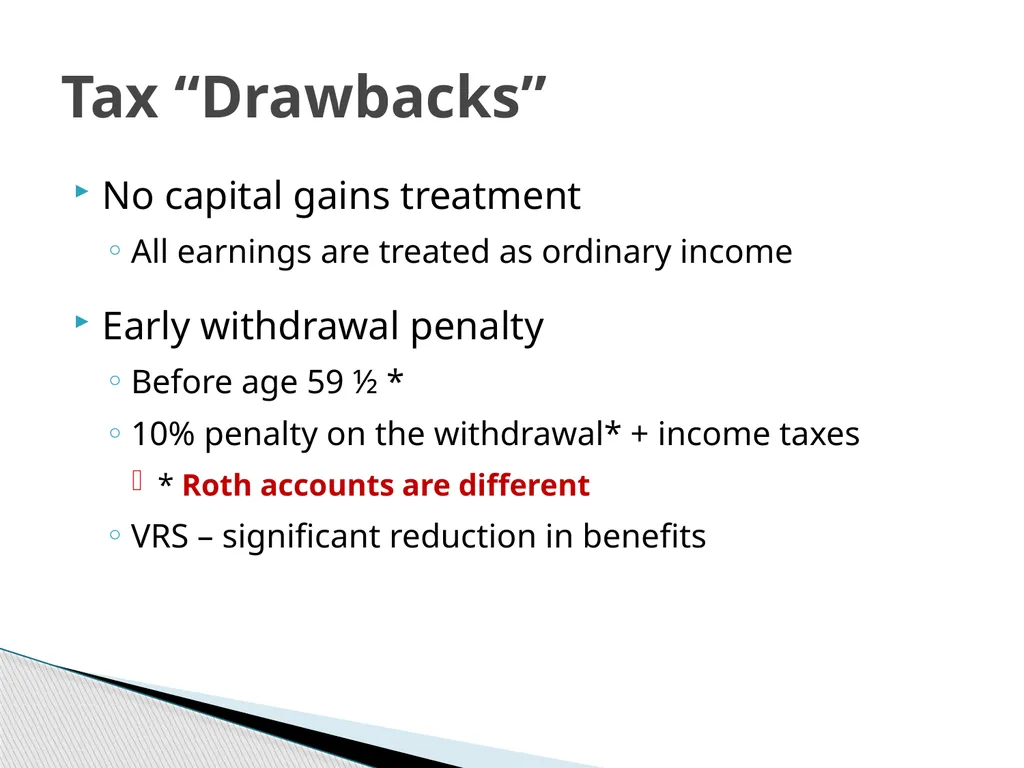
No capital gains treatment
All earnings are treated as ordinary income
Early withdrawal penalty
Before age 59 ½ *
10% penalty on the withdrawal* + income taxes
* Roth accounts are different
VRS – significant reduction in benefits Tax “Drawbacks”<br>
All earnings are treated as ordinary income
Early withdrawal penalty
Before age 59 ½ *
10% penalty on the withdrawal* + income taxes
* Roth accounts are different
VRS – significant reduction in benefits Tax “Drawbacks”<br>
17
Dollar Cost Averaging
Investing the same dollar amount into your account each period
Painless & Brainless!
Automatic deposit or payroll deduction (403(b)/457)
You don’t have to think about how many shares to buy
Example: Invest $50/pay period into your 403(b)
When the stock market is high, $50 buys less shares
When the market is low, $50 buys more shares
The shares are “on sale”! The Deep, Dark Secret!<br>
Investing the same dollar amount into your account each period
Painless & Brainless!
Automatic deposit or payroll deduction (403(b)/457)
You don’t have to think about how many shares to buy
Example: Invest $50/pay period into your 403(b)
When the stock market is high, $50 buys less shares
When the market is low, $50 buys more shares
The shares are “on sale”! The Deep, Dark Secret!<br>
18
VRS – Virginia Retirement System
Plan 1 – hired pre-June 2010, vested by Jan 2013
Plan 2 – hired post-June 2010, not vested by Jan 2013
Defined Benefit plan
Annual Benefit = years x average salary** x 1.7%
Your contribution = 5% of salary VT Retirement Plans<br>
Plan 1 – hired pre-June 2010, vested by Jan 2013
Plan 2 – hired post-June 2010, not vested by Jan 2013
Defined Benefit plan
Annual Benefit = years x average salary** x 1.7%
Your contribution = 5% of salary VT Retirement Plans<br>
19
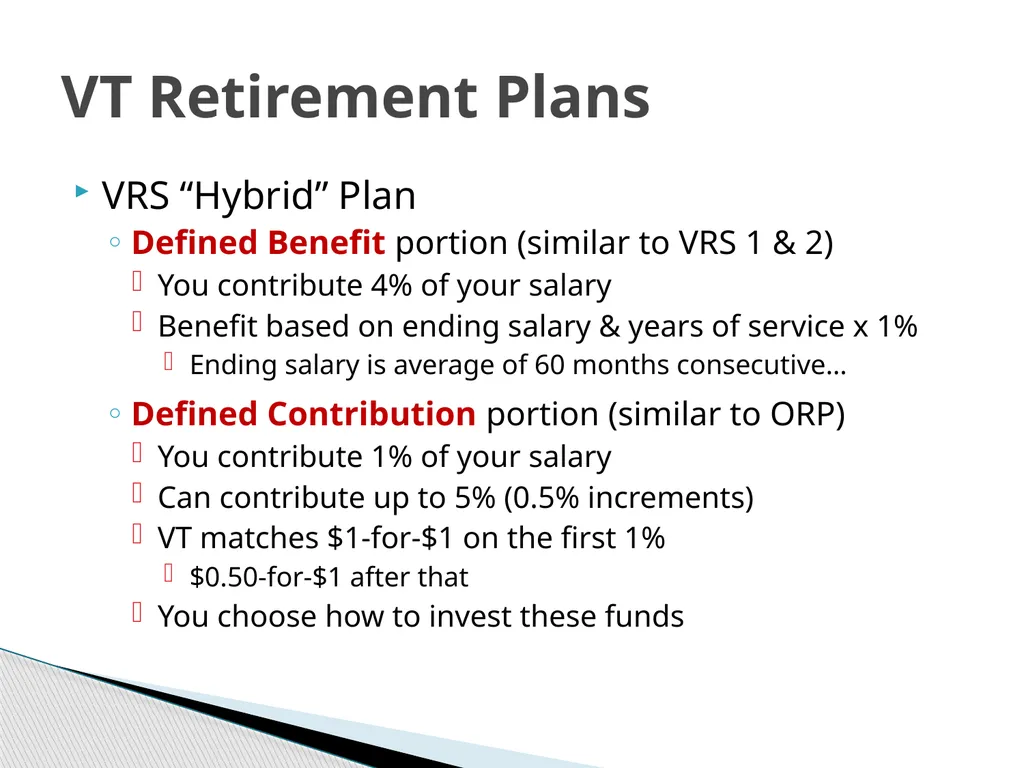
VRS “Hybrid” Plan
Defined Benefit portion (similar to VRS 1 & 2)
You contribute 4% of your salary
Benefit based on ending salary & years of service x 1%
Ending salary is average of 60 months consecutive…
Defined Contribution portion (similar to ORP)
You contribute 1% of your salary
Can contribute up to 5% (0.5% increments)
VT matches $1-for-$1 on the first 1%
$0.50-for-$1 after that
You choose how to invest these funds VT Retirement Plans<br>
Defined Benefit portion (similar to VRS 1 & 2)
You contribute 4% of your salary
Benefit based on ending salary & years of service x 1%
Ending salary is average of 60 months consecutive…
Defined Contribution portion (similar to ORP)
You contribute 1% of your salary
Can contribute up to 5% (0.5% increments)
VT matches $1-for-$1 on the first 1%
$0.50-for-$1 after that
You choose how to invest these funds VT Retirement Plans<br>
20
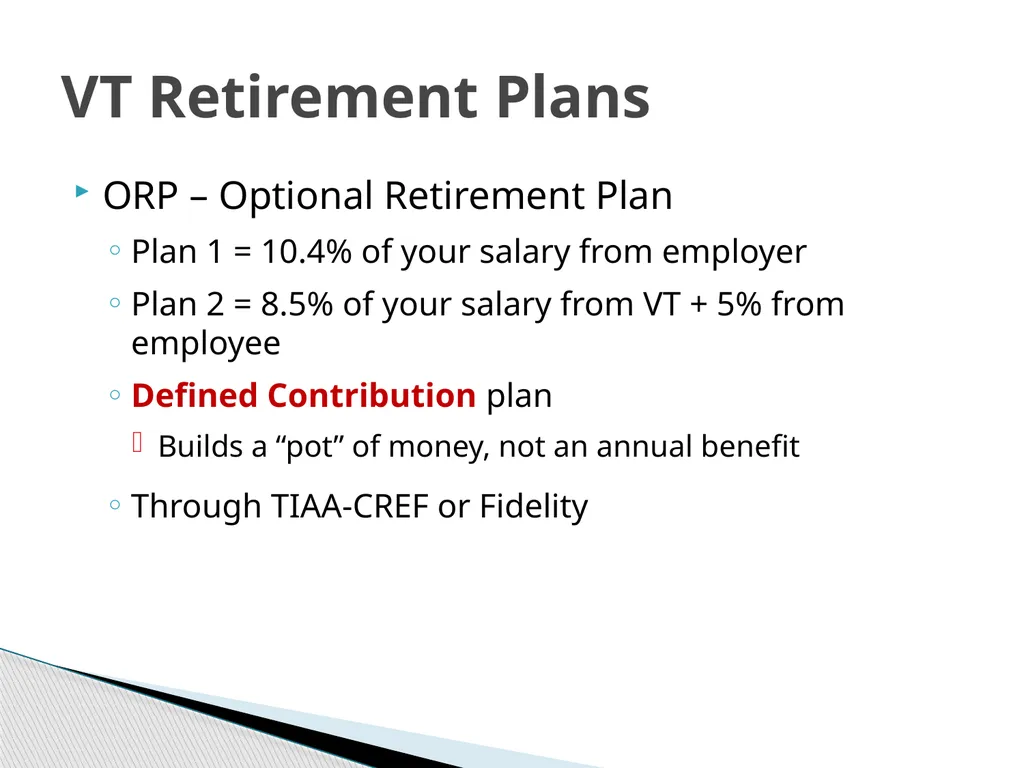
ORP – Optional Retirement Plan
Plan 1 = 10.4% of your salary from employer
Plan 2 = 8.5% of your salary from VT + 5% from employee
Defined Contribution plan
Builds a “pot” of money, not an annual benefit
Through TIAA-CREF or Fidelity VT Retirement Plans<br>
Plan 1 = 10.4% of your salary from employer
Plan 2 = 8.5% of your salary from VT + 5% from employee
Defined Contribution plan
Builds a “pot” of money, not an annual benefit
Through TIAA-CREF or Fidelity VT Retirement Plans<br>
21
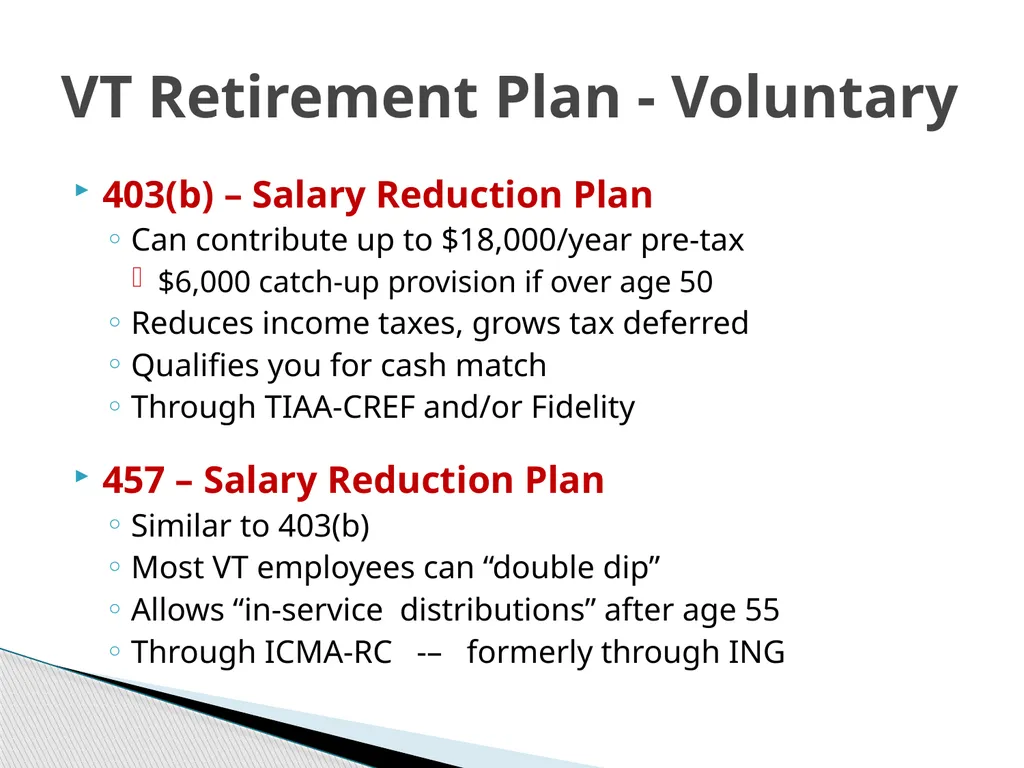
403(b) – Salary Reduction Plan
Can contribute up to $18,000/year pre-tax
$6,000 catch-up provision if over age 50
Reduces income taxes, grows tax deferred
Qualifies you for cash match
Through TIAA-CREF and/or Fidelity
457 – Salary Reduction Plan
Similar to 403(b)
Most VT employees can “double dip”
Allows “in-service distributions” after age 55
Through ICMA-RC -– formerly through ING VT Retirement Plan - Voluntary<br>
Can contribute up to $18,000/year pre-tax
$6,000 catch-up provision if over age 50
Reduces income taxes, grows tax deferred
Qualifies you for cash match
Through TIAA-CREF and/or Fidelity
457 – Salary Reduction Plan
Similar to 403(b)
Most VT employees can “double dip”
Allows “in-service distributions” after age 55
Through ICMA-RC -– formerly through ING VT Retirement Plan - Voluntary<br>
22
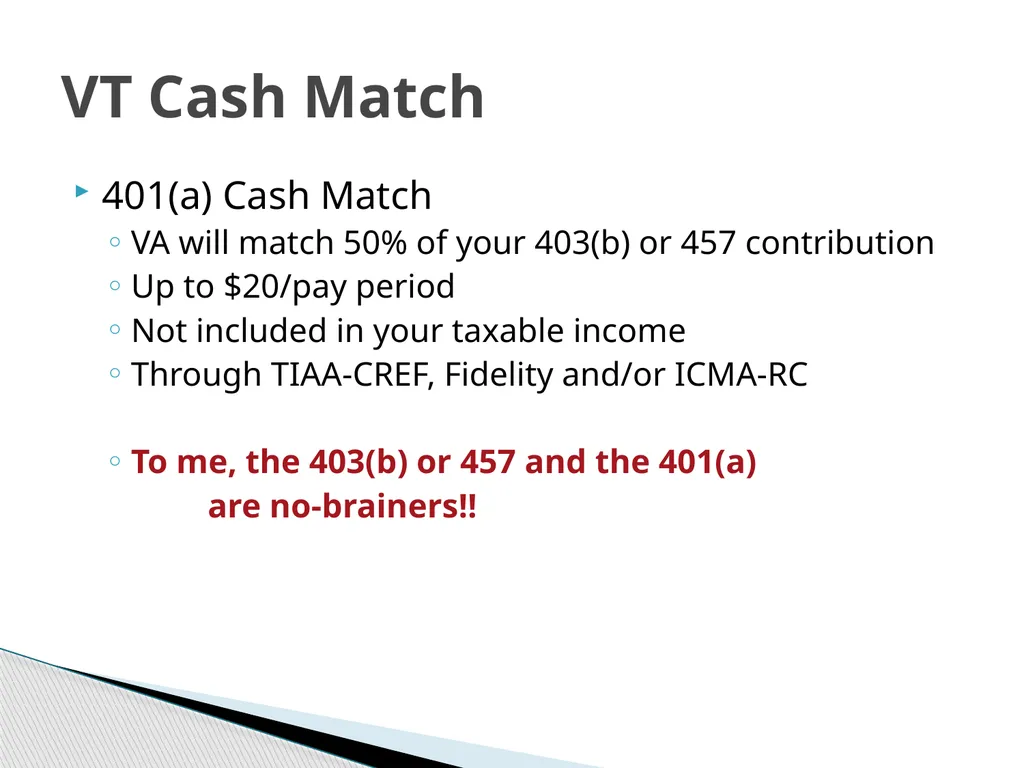
401(a) Cash Match
VA will match 50% of your 403(b) or 457 contribution
Up to $20/pay period
Not included in your taxable income
Through TIAA-CREF, Fidelity and/or ICMA-RC
To me, the 403(b) or 457 and the 401(a)
are no-brainers!! VT Cash Match<br>
VA will match 50% of your 403(b) or 457 contribution
Up to $20/pay period
Not included in your taxable income
Through TIAA-CREF, Fidelity and/or ICMA-RC
To me, the 403(b) or 457 and the 401(a)
are no-brainers!! VT Cash Match<br>
23
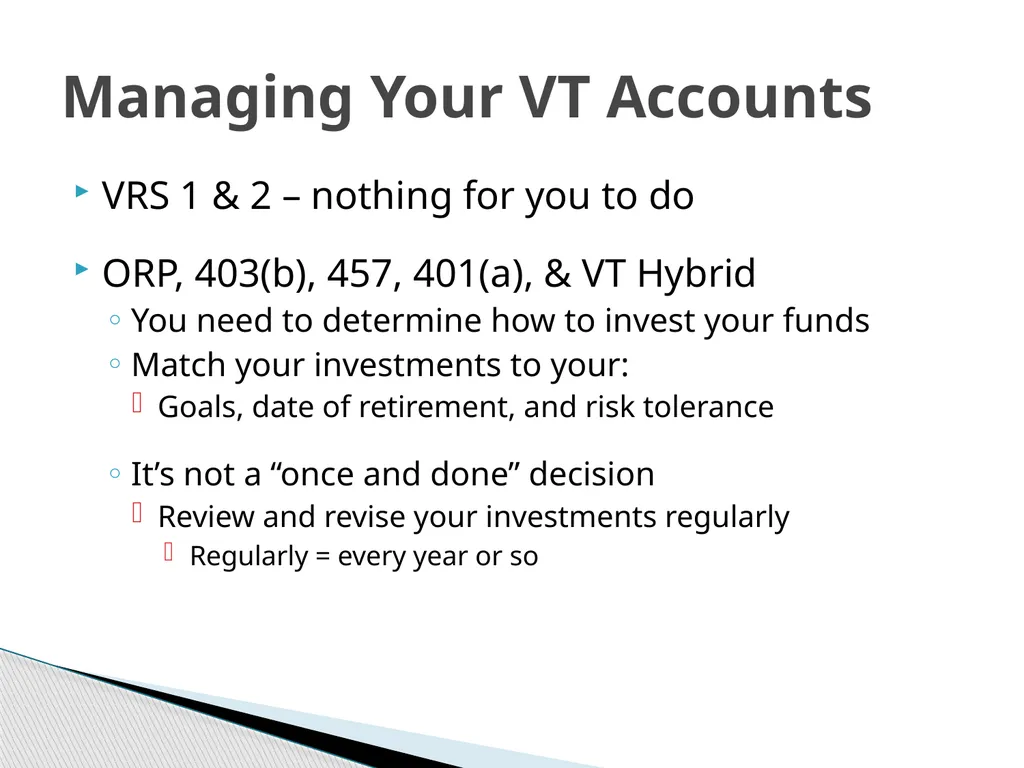
VRS 1 & 2 – nothing for you to do
ORP, 403(b), 457, 401(a), & VT Hybrid
You need to determine how to invest your funds
Match your investments to your:
Goals, date of retirement, and risk tolerance
It’s not a “once and done” decision
Review and revise your investments regularly
Regularly = every year or so Managing Your VT Accounts<br>
ORP, 403(b), 457, 401(a), & VT Hybrid
You need to determine how to invest your funds
Match your investments to your:
Goals, date of retirement, and risk tolerance
It’s not a “once and done” decision
Review and revise your investments regularly
Regularly = every year or so Managing Your VT Accounts<br>
24
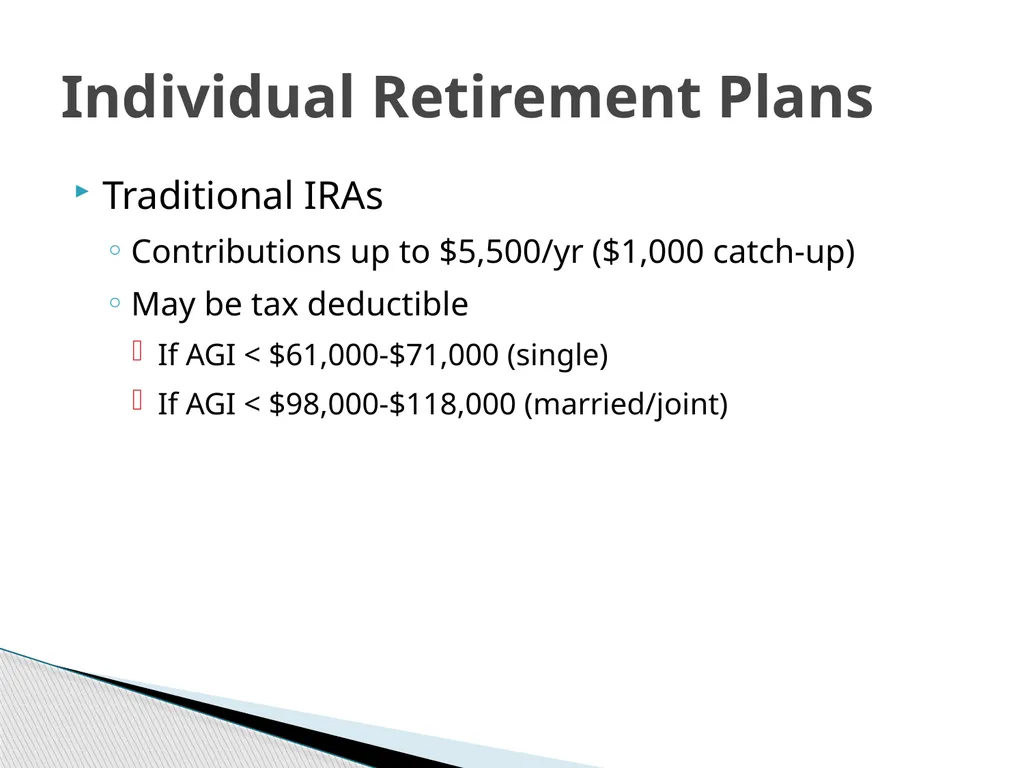
Traditional IRAs
Contributions up to $5,500/yr ($1,000 catch-up)
May be tax deductible
If AGI < $61,000-$71,000 (single)
If AGI < $98,000-$118,000 (married/joint) Individual Retirement Plans<br>
Contributions up to $5,500/yr ($1,000 catch-up)
May be tax deductible
If AGI < $61,000-$71,000 (single)
If AGI < $98,000-$118,000 (married/joint) Individual Retirement Plans<br>
25
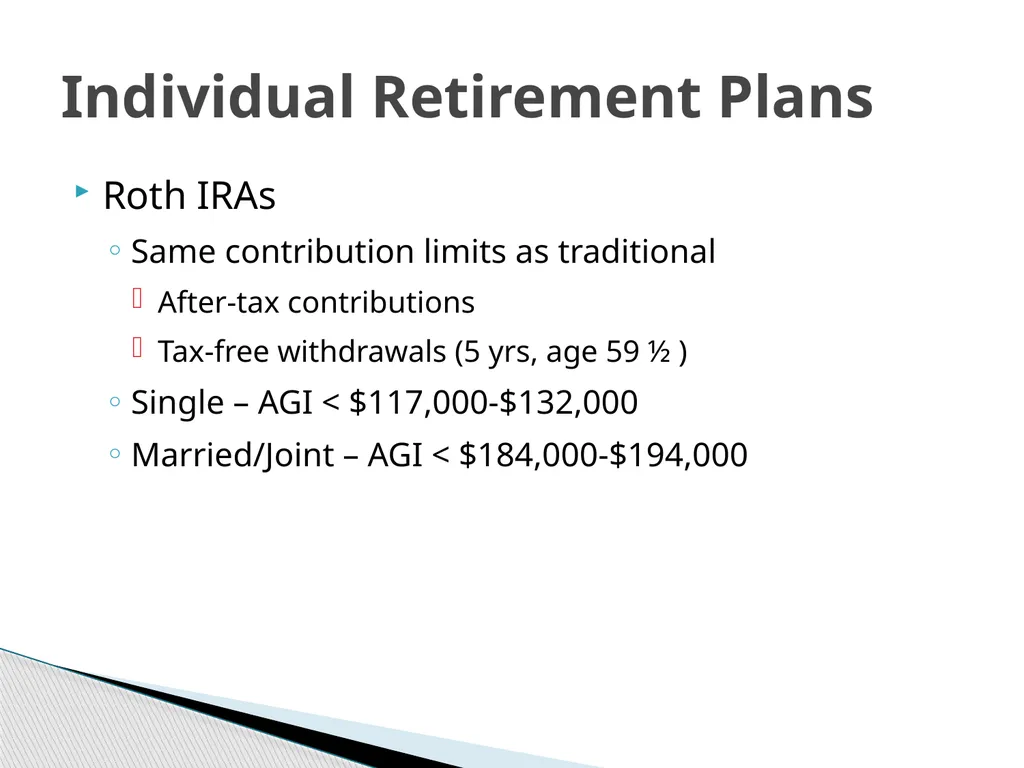
Roth IRAs
Same contribution limits as traditional
After-tax contributions
Tax-free withdrawals (5 yrs, age 59 ½ )
Single – AGI < $117,000-$132,000
Married/Joint – AGI < $184,000-$194,000 Individual Retirement Plans<br>
Same contribution limits as traditional
After-tax contributions
Tax-free withdrawals (5 yrs, age 59 ½ )
Single – AGI < $117,000-$132,000
Married/Joint – AGI < $184,000-$194,000 Individual Retirement Plans<br>
26
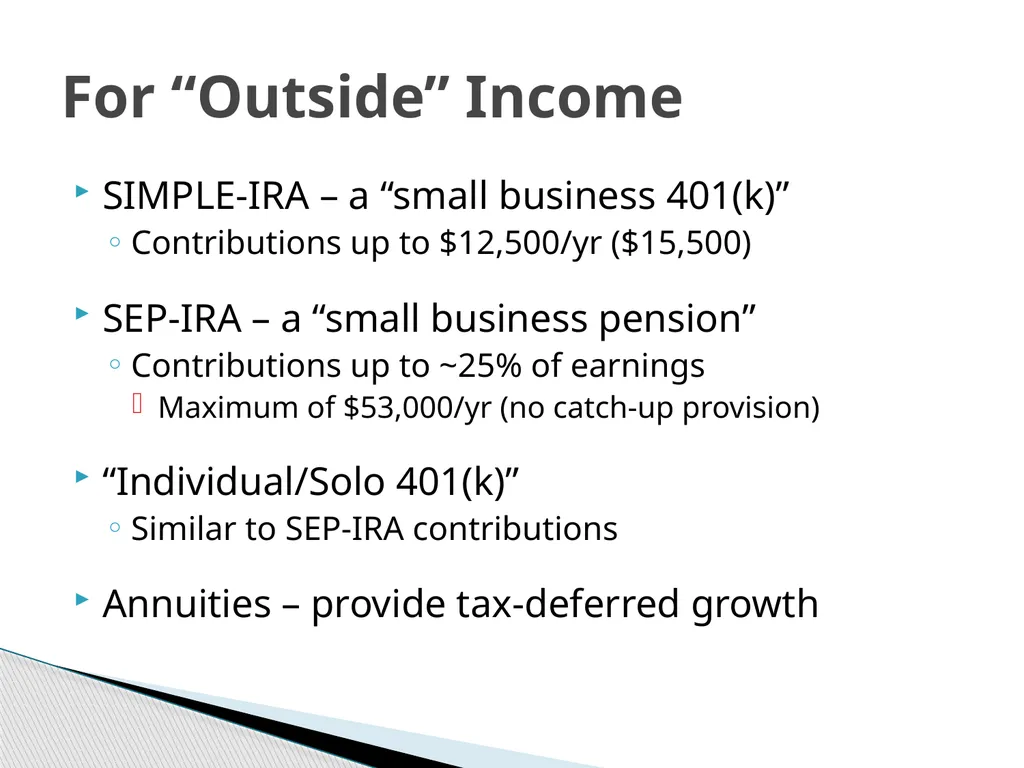
SIMPLE-IRA – a “small business 401(k)”
Contributions up to $12,500/yr ($15,500)
SEP-IRA – a “small business pension”
Contributions up to ~25% of earnings
Maximum of $53,000/yr (no catch-up provision)
“Individual/Solo 401(k)”
Similar to SEP-IRA contributions
Annuities – provide tax-deferred growth For “Outside” Income<br>
Contributions up to $12,500/yr ($15,500)
SEP-IRA – a “small business pension”
Contributions up to ~25% of earnings
Maximum of $53,000/yr (no catch-up provision)
“Individual/Solo 401(k)”
Similar to SEP-IRA contributions
Annuities – provide tax-deferred growth For “Outside” Income<br>
27
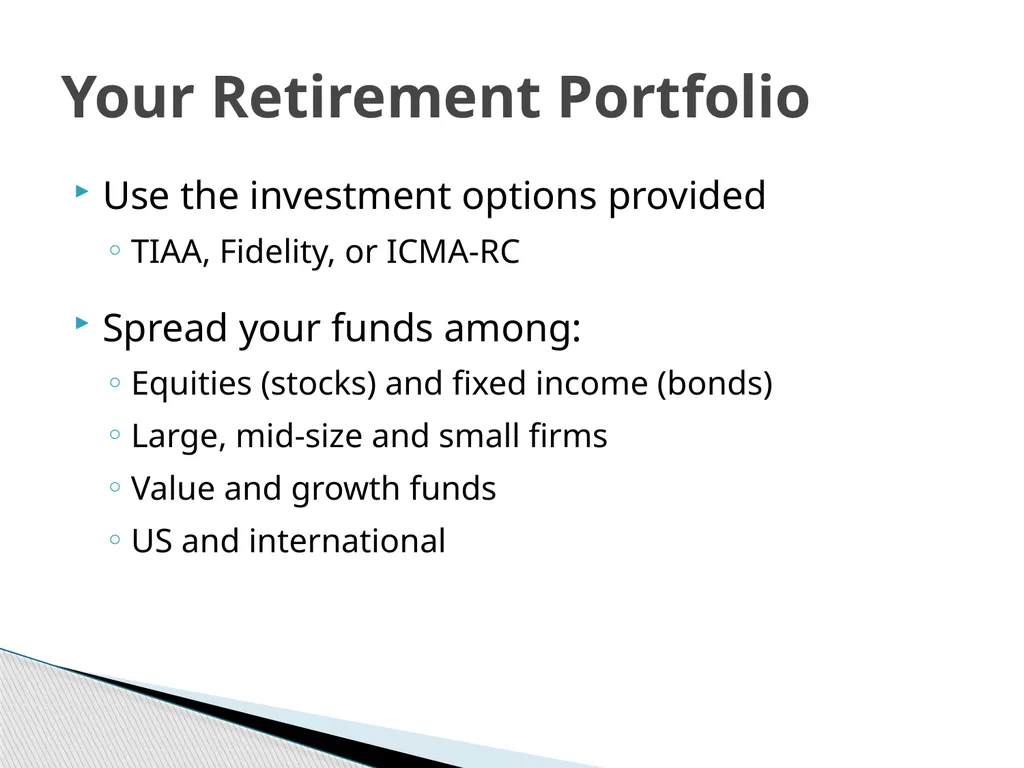
Use the investment options provided
TIAA, Fidelity, or ICMA-RC
Spread your funds among:
Equities (stocks) and fixed income (bonds)
Large, mid-size and small firms
Value and growth funds
US and international Your Retirement Portfolio<br>
TIAA, Fidelity, or ICMA-RC
Spread your funds among:
Equities (stocks) and fixed income (bonds)
Large, mid-size and small firms
Value and growth funds
US and international Your Retirement Portfolio<br>
28
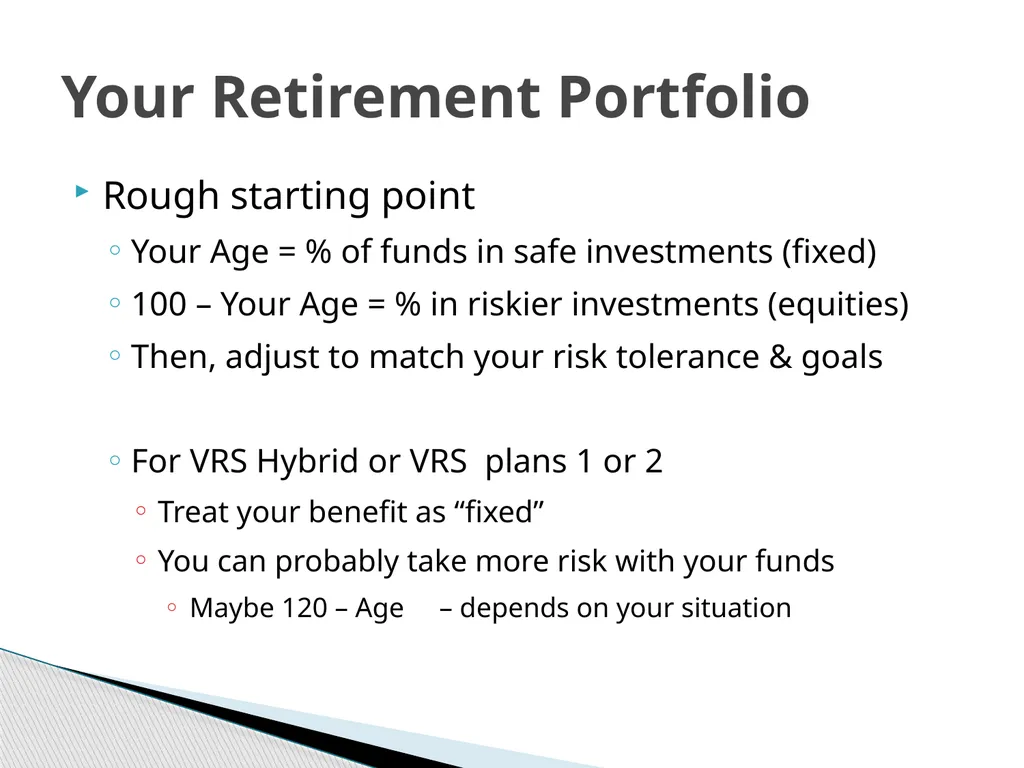
Rough starting point
Your Age = % of funds in safe investments (fixed)
100 – Your Age = % in riskier investments (equities)
Then, adjust to match your risk tolerance & goals
For VRS Hybrid or VRS plans 1 or 2
Treat your benefit as “fixed”
You can probably take more risk with your funds
Maybe 120 – Age – depends on your situation Your Retirement Portfolio<br>
Your Age = % of funds in safe investments (fixed)
100 – Your Age = % in riskier investments (equities)
Then, adjust to match your risk tolerance & goals
For VRS Hybrid or VRS plans 1 or 2
Treat your benefit as “fixed”
You can probably take more risk with your funds
Maybe 120 – Age – depends on your situation Your Retirement Portfolio<br>
29
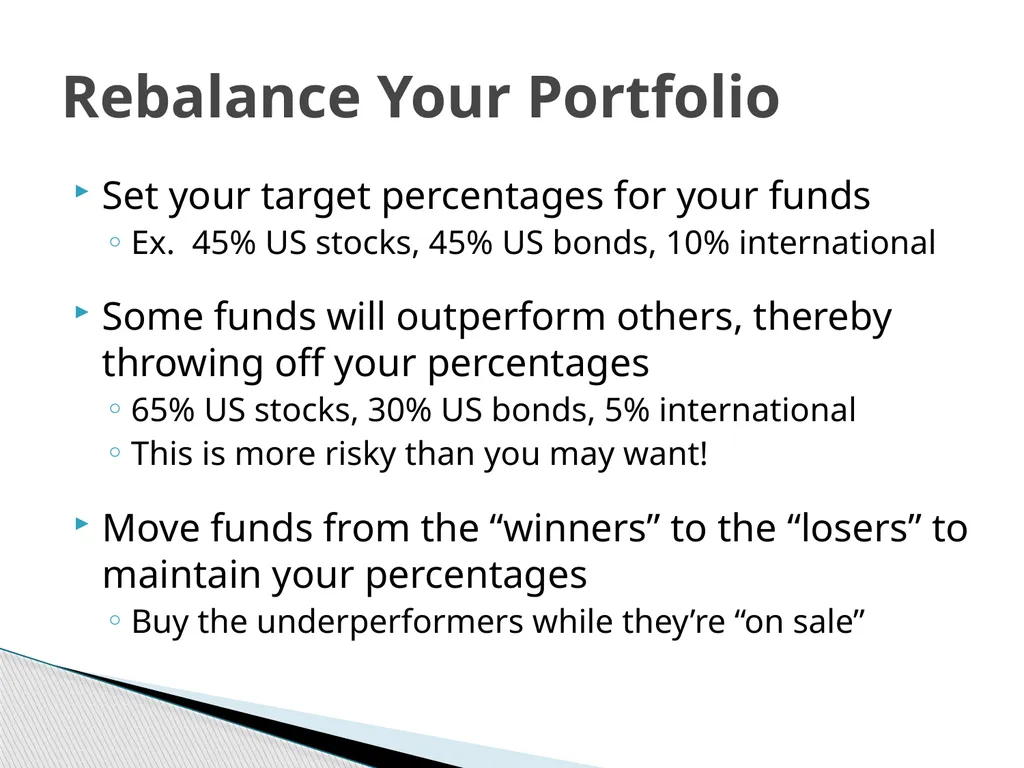
Set your target percentages for your funds
Ex. 45% US stocks, 45% US bonds, 10% international
Some funds will outperform others, thereby throwing off your percentages
65% US stocks, 30% US bonds, 5% international
This is more risky than you may want!
Move funds from the “winners” to the “losers” to maintain your percentages
Buy the underperformers while they’re “on sale” Rebalance Your Portfolio<br>
Ex. 45% US stocks, 45% US bonds, 10% international
Some funds will outperform others, thereby throwing off your percentages
65% US stocks, 30% US bonds, 5% international
This is more risky than you may want!
Move funds from the “winners” to the “losers” to maintain your percentages
Buy the underperformers while they’re “on sale” Rebalance Your Portfolio<br>
30
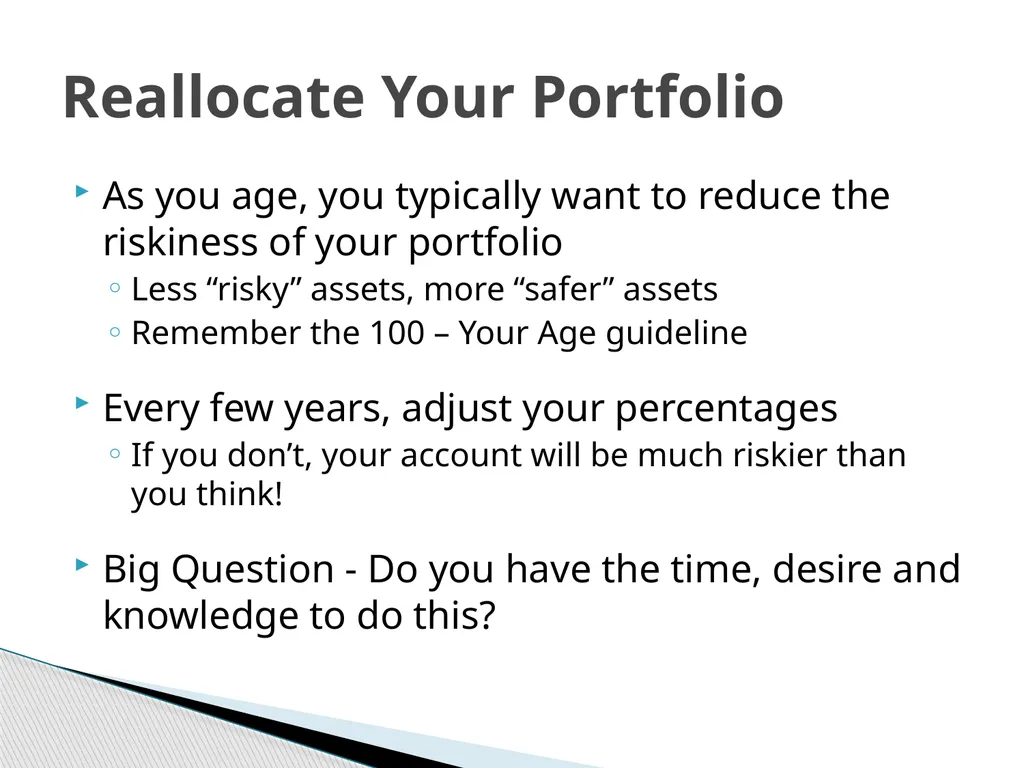
As you age, you typically want to reduce the riskiness of your portfolio
Less “risky” assets, more “safer” assets
Remember the 100 – Your Age guideline
Every few years, adjust your percentages
If you don’t, your account will be much riskier than you think!
Big Question - Do you have the time, desire and knowledge to do this? Reallocate Your Portfolio<br>
Less “risky” assets, more “safer” assets
Remember the 100 – Your Age guideline
Every few years, adjust your percentages
If you don’t, your account will be much riskier than you think!
Big Question - Do you have the time, desire and knowledge to do this? Reallocate Your Portfolio<br>
31
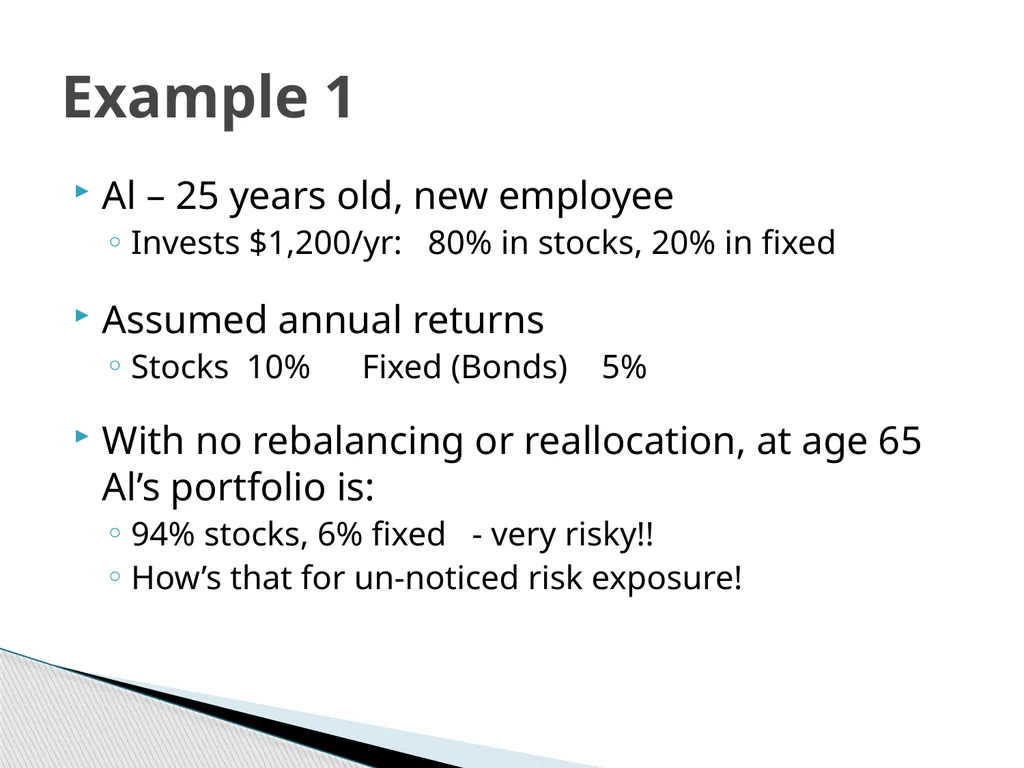
Al – 25 years old, new employee
Invests $1,200/yr: 80% in stocks, 20% in fixed
Assumed annual returns
Stocks 10% Fixed (Bonds) 5%
With no rebalancing or reallocation, at age 65 Al’s portfolio is:
94% stocks, 6% fixed - very risky!!
How’s that for un-noticed risk exposure! Example 1<br>
Invests $1,200/yr: 80% in stocks, 20% in fixed
Assumed annual returns
Stocks 10% Fixed (Bonds) 5%
With no rebalancing or reallocation, at age 65 Al’s portfolio is:
94% stocks, 6% fixed - very risky!!
How’s that for un-noticed risk exposure! Example 1<br>
32
Al – 25 years old, new employee
Invests $1,200/yr: 50% in stocks, 50% in fixed
Assumed average annual returns
Stocks 10% Fixed (Bonds) 5%
With no rebalancing or reallocation, at age 65 Al’s portfolio is:
80% stocks, 20% fixed = a lot of risk exposure
Note to self: Rebalance & Reallocate regularly Example 2<br>
Invests $1,200/yr: 50% in stocks, 50% in fixed
Assumed average annual returns
Stocks 10% Fixed (Bonds) 5%
With no rebalancing or reallocation, at age 65 Al’s portfolio is:
80% stocks, 20% fixed = a lot of risk exposure
Note to self: Rebalance & Reallocate regularly Example 2<br>
33
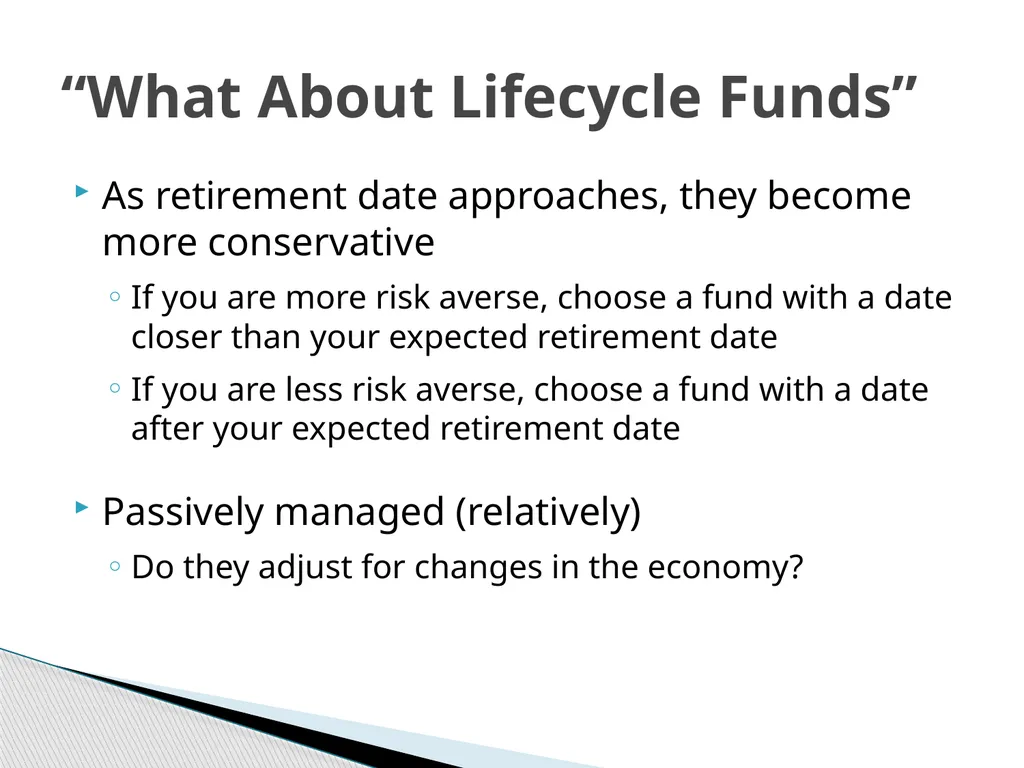
As retirement date approaches, they become more conservative
If you are more risk averse, choose a fund with a date closer than your expected retirement date
If you are less risk averse, choose a fund with a date after your expected retirement date
Passively managed (relatively)
Do they adjust for changes in the economy? “What About Lifecycle Funds”<br>
If you are more risk averse, choose a fund with a date closer than your expected retirement date
If you are less risk averse, choose a fund with a date after your expected retirement date
Passively managed (relatively)
Do they adjust for changes in the economy? “What About Lifecycle Funds”<br>
34
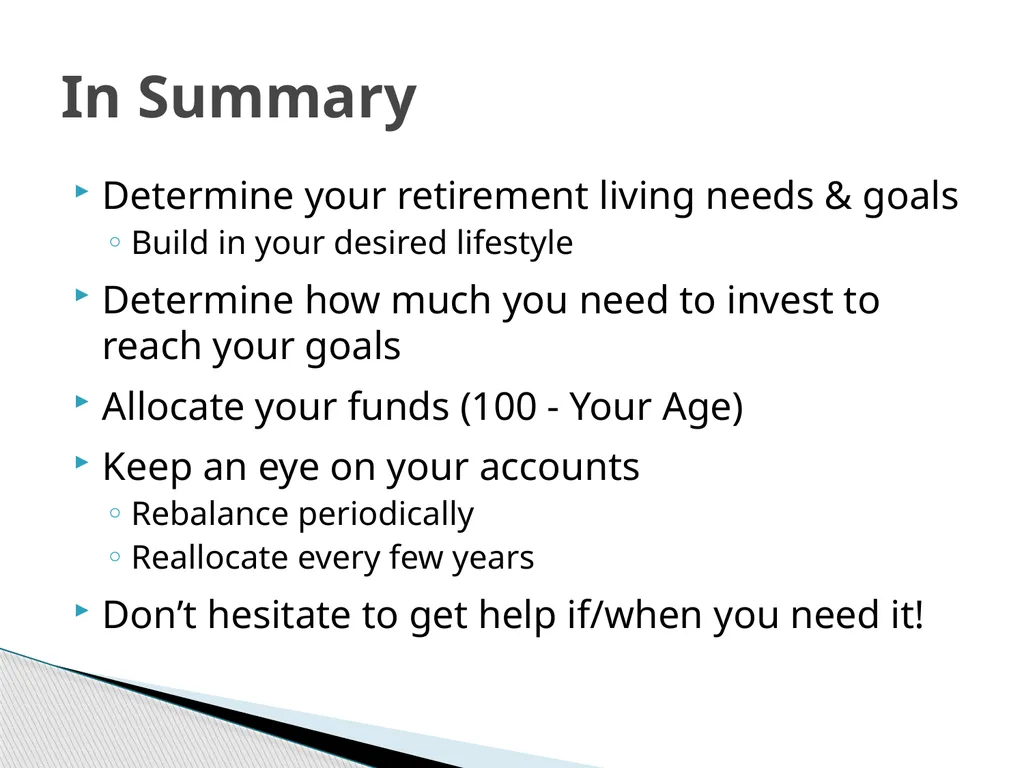
Determine your retirement living needs & goals
Build in your desired lifestyle
Determine how much you need to invest to reach your goals
Allocate your funds (100 - Your Age)
Keep an eye on your accounts
Rebalance periodically
Reallocate every few years
Don’t hesitate to get help if/when you need it! In Summary<br>
Build in your desired lifestyle
Determine how much you need to invest to reach your goals
Allocate your funds (100 - Your Age)
Keep an eye on your accounts
Rebalance periodically
Reallocate every few years
Don’t hesitate to get help if/when you need it! In Summary<br>
35
Dr. Alex White
Dairy Science
Virginia Tech
moneyguy@vt.edu
I am not a licensed investment advisor.
I merely teach the basics. Questions?<br>
Dairy Science
Virginia Tech
moneyguy@vt.edu
I am not a licensed investment advisor.
I merely teach the basics. Questions?<br>