
Retirement, post retirement employment and
CS
Published · 53 slides · 0 views

1 / 1












Description
Retirement, post retirement employment and Succession Planning TCTA Conference May 19th, 2022 Joe Monzo JPMonzo Municipal Consulting CMFO- Retired PROLOGUE Can you afford to retire? Considerations Most of you are Tier 1 PERS members
Related Topics
Share
Embed code
Download this presentation From Below
"Retirement, post retirement employment and" is the property of its rightful owner. Permission is granted to download and print the materials on this website for personal, non-commercial use only, and to display it on your personal computer provided you do not modify the materials and that you retain all copyright notices contained in the materials. By downloading content from our website, you accept the terms of this agreement.
Presentation Transcript
01
Retirement, post retirement employment and Succession Planning TCTA Conference
May 19th, 2022
Joe Monzo
JPMonzo Municipal Consulting
CMFO- Retired<br>
May 19th, 2022
Joe Monzo
JPMonzo Municipal Consulting
CMFO- Retired<br>
02
PROLOGUE<br>
03
Can you afford to retire?<br>
04
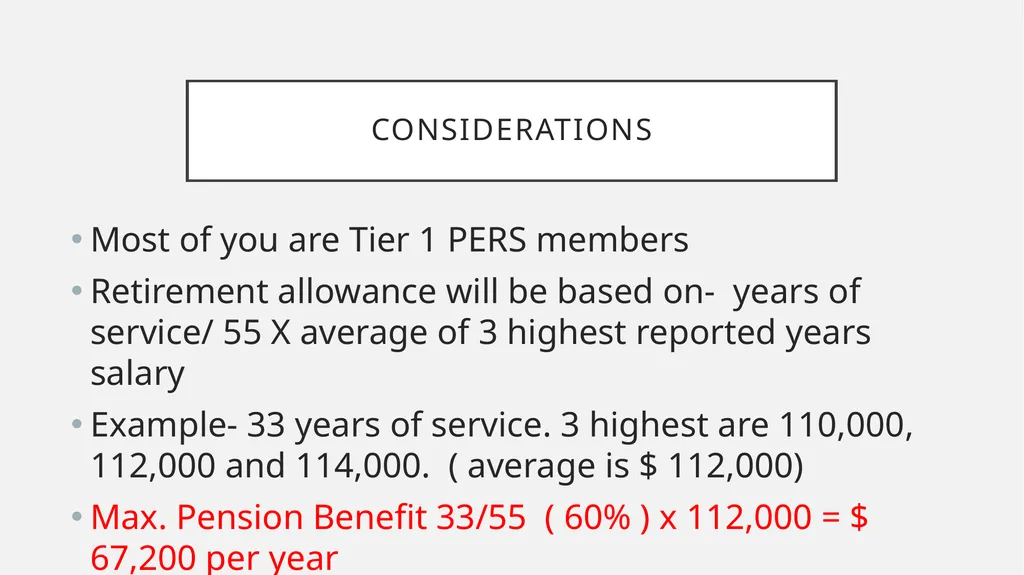
Considerations Most of you are Tier 1 PERS members
Retirement allowance will be based on- years of service/ 55 X average of 3 highest reported years salary
Example- 33 years of service. 3 highest are 110,000, 112,000 and 114,000. ( average is $ 112,000)
Max. Pension Benefit 33/55 ( 60% ) x 112,000 = $ 67,200 per year<br>
Retirement allowance will be based on- years of service/ 55 X average of 3 highest reported years salary
Example- 33 years of service. 3 highest are 110,000, 112,000 and 114,000. ( average is $ 112,000)
Max. Pension Benefit 33/55 ( 60% ) x 112,000 = $ 67,200 per year<br>
05
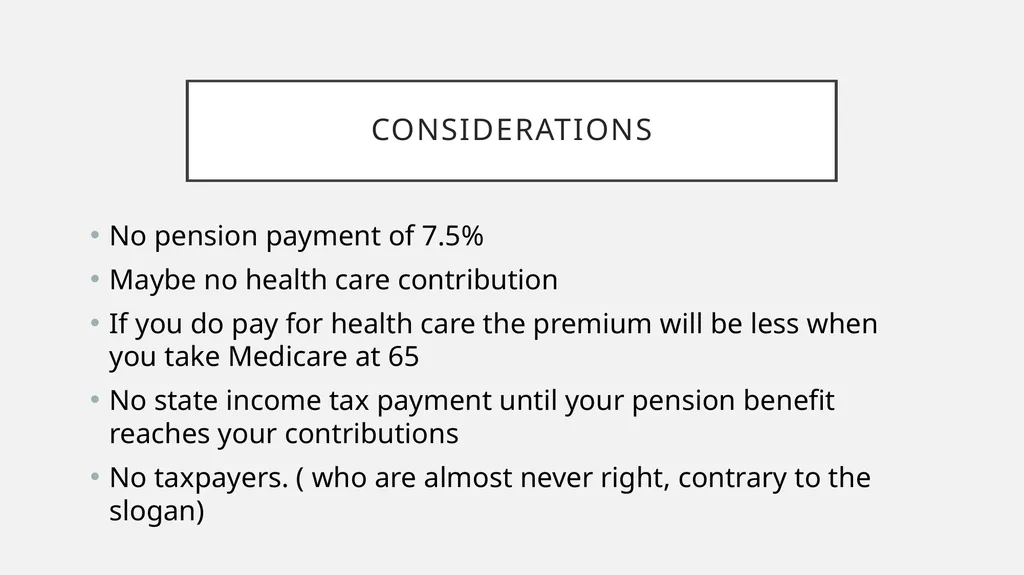
Considerations No pension payment of 7.5%
Maybe no health care contribution
If you do pay for health care the premium will be less when you take Medicare at 65
No state income tax payment until your pension benefit reaches your contributions
No taxpayers. ( who are almost never right, contrary to the slogan)<br>
Maybe no health care contribution
If you do pay for health care the premium will be less when you take Medicare at 65
No state income tax payment until your pension benefit reaches your contributions
No taxpayers. ( who are almost never right, contrary to the slogan)<br>
06
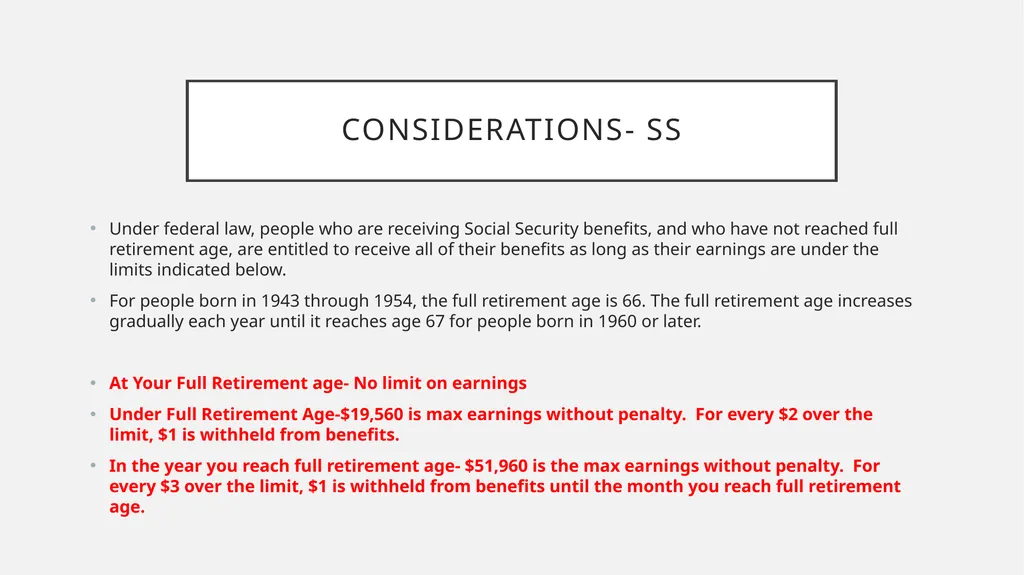
Considerations- SS Under federal law, people who are receiving Social Security benefits, and who have not reached full retirement age, are entitled to receive all of their benefits as long as their earnings are under the limits indicated below.
For people born in 1943 through 1954, the full retirement age is 66. The full retirement age increases gradually each year until it reaches age 67 for people born in 1960 or later.
At Your Full Retirement age- No limit on earnings
Under Full Retirement Age-$19,560 is max earnings without penalty. For every $2 over the limit, $1 is withheld from benefits.
In the year you reach full retirement age- $51,960 is the max earnings without penalty. For every $3 over the limit, $1 is withheld from benefits until the month you reach full retirement age.<br>
For people born in 1943 through 1954, the full retirement age is 66. The full retirement age increases gradually each year until it reaches age 67 for people born in 1960 or later.
At Your Full Retirement age- No limit on earnings
Under Full Retirement Age-$19,560 is max earnings without penalty. For every $2 over the limit, $1 is withheld from benefits.
In the year you reach full retirement age- $51,960 is the max earnings without penalty. For every $3 over the limit, $1 is withheld from benefits until the month you reach full retirement age.<br>
07
PART 1: RETIREMENT<br>
08
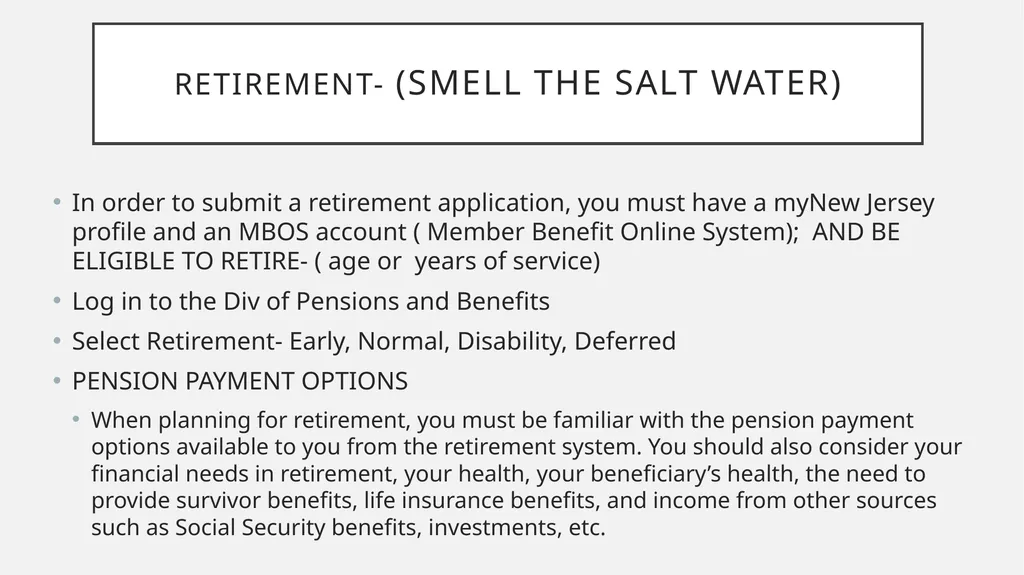
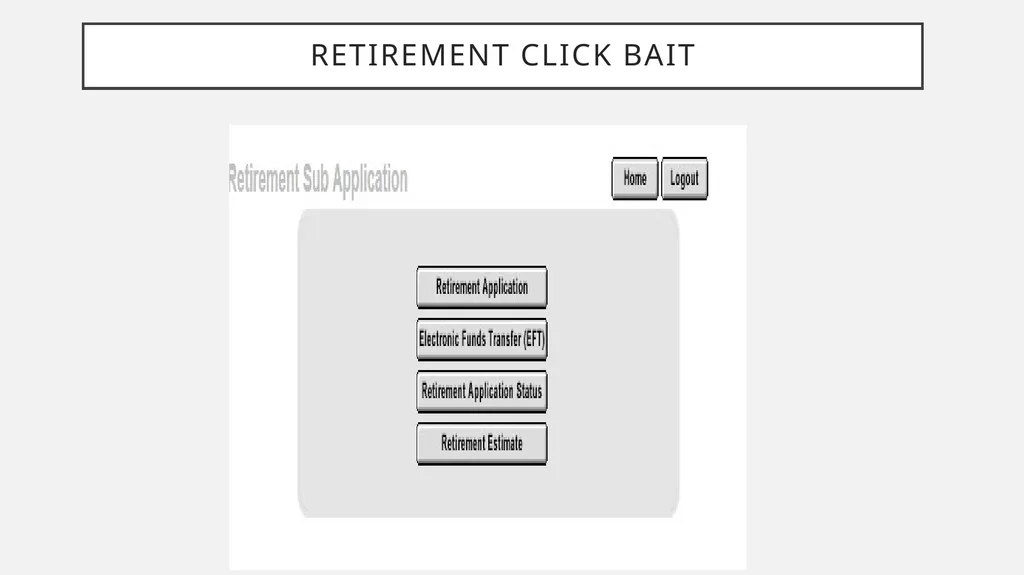
Retirement- (smell the salt water) In order to submit a retirement application, you must have a myNew Jersey profile and an MBOS account ( Member Benefit Online System); AND BE ELIGIBLE TO RETIRE- ( age or years of service)
Log in to the Div of Pensions and Benefits
Select Retirement- Early, Normal, Disability, Deferred
PENSION PAYMENT OPTIONS
When planning for retirement, you must be familiar with the pension payment options available to you from the retirement system. You should also consider your financial needs in retirement, your health, your beneficiary’s health, the need to provide survivor benefits, life insurance benefits, and income from other sources such as Social Security benefits, investments, etc.<br>
Log in to the Div of Pensions and Benefits
Select Retirement- Early, Normal, Disability, Deferred
PENSION PAYMENT OPTIONS
When planning for retirement, you must be familiar with the pension payment options available to you from the retirement system. You should also consider your financial needs in retirement, your health, your beneficiary’s health, the need to provide survivor benefits, life insurance benefits, and income from other sources such as Social Security benefits, investments, etc.<br>
09
Retirement- (smell the salt water) When you apply for retirement, you will have to choose one of nine ways to receive your retirement benefits. Please be sure you understand the different payment options available to you, because once you have made your choice and your retirement becomes due and payable (usually when your first check is issued), you cannot change your payment option.
If you die before receiving monthly retirement benefits equal to the amount that you paid into the retirement system while you were employed (including interest on those contributions), the balance of your contributions will be paid to your named beneficiary, regardless of which option you choose.<br>
If you die before receiving monthly retirement benefits equal to the amount that you paid into the retirement system while you were employed (including interest on those contributions), the balance of your contributions will be paid to your named beneficiary, regardless of which option you choose.<br>
10
Retirement click bait<br>
11
Retirement click bait<br>
12
Retirement click bait<br>
13
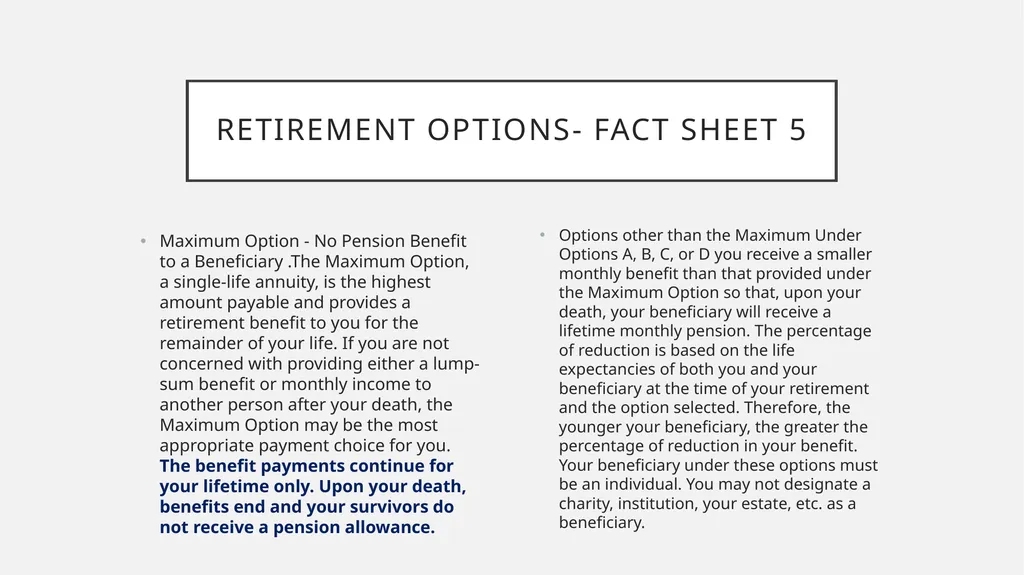
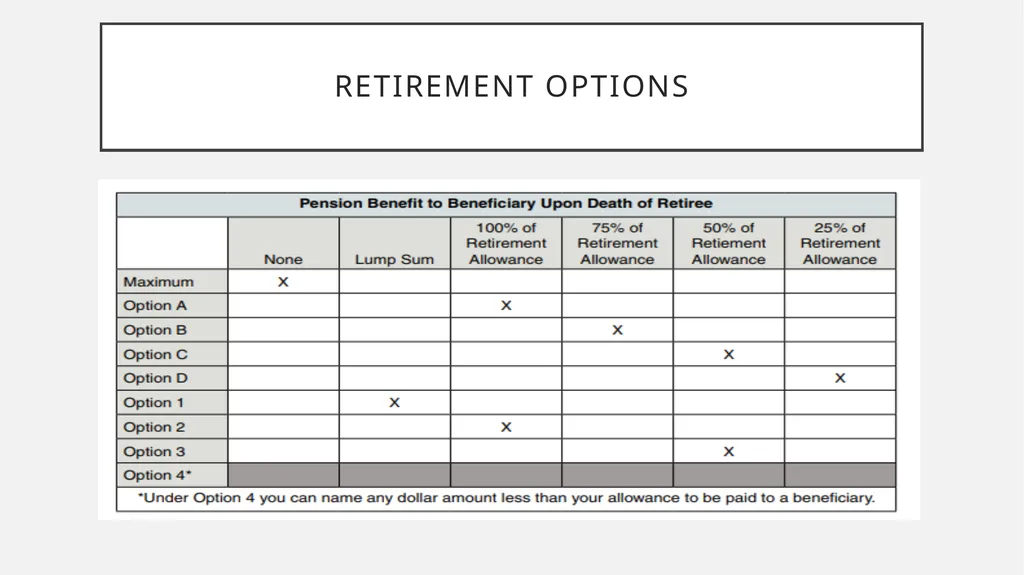
Retirement options- fact sheet 5 Maximum Option - No Pension Benefit to a Beneficiary .The Maximum Option, a single-life annuity, is the highest amount payable and provides a retirement benefit to you for the remainder of your life. If you are not concerned with providing either a lump-sum benefit or monthly income to another person after your death, the Maximum Option may be the most appropriate payment choice for you. The benefit payments continue for your lifetime only. Upon your death, benefits end and your survivors do not receive a pension allowance. Options other than the Maximum Under Options A, B, C, or D you receive a smaller monthly benefit than that provided under the Maximum Option so that, upon your death, your beneficiary will receive a lifetime monthly pension. The percentage of reduction is based on the life expectancies of both you and your beneficiary at the time of your retirement and the option selected. Therefore, the younger your beneficiary, the greater the percentage of reduction in your benefit. Your beneficiary under these options must be an individual. You may not designate a charity, institution, your estate, etc. as a beneficiary.<br>
14
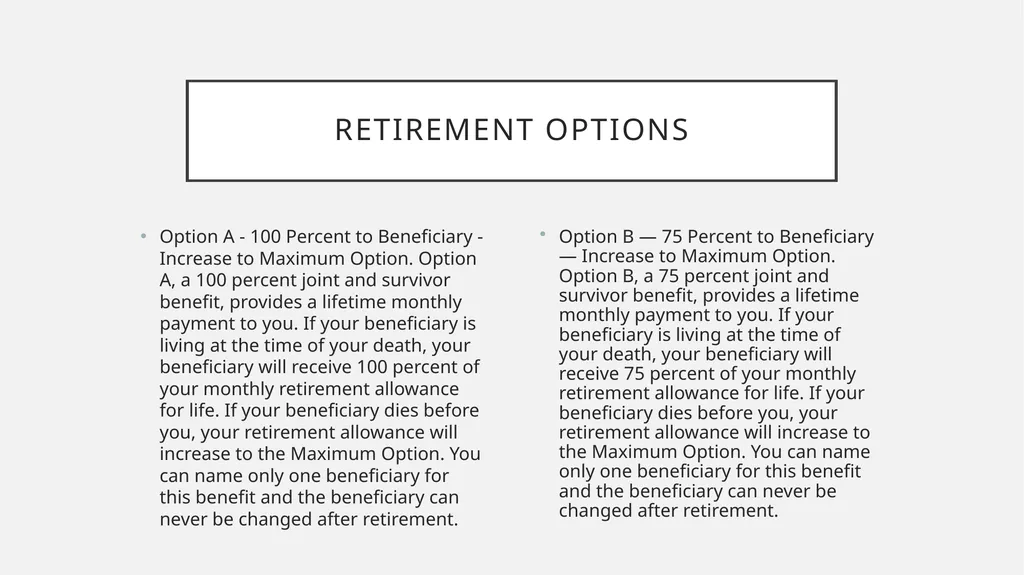
Retirement options Option A - 100 Percent to Beneficiary - Increase to Maximum Option. Option A, a 100 percent joint and survivor benefit, provides a lifetime monthly payment to you. If your beneficiary is living at the time of your death, your beneficiary will receive 100 percent of your monthly retirement allowance for life. If your beneficiary dies before you, your retirement allowance will increase to the Maximum Option. You can name only one beneficiary for this benefit and the beneficiary can never be changed after retirement. Option B — 75 Percent to Beneficiary — Increase to Maximum Option. Option B, a 75 percent joint and survivor benefit, provides a lifetime monthly payment to you. If your beneficiary is living at the time of your death, your beneficiary will receive 75 percent of your monthly retirement allowance for life. If your beneficiary dies before you, your retirement allowance will increase to the Maximum Option. You can name only one beneficiary for this benefit and the beneficiary can never be changed after retirement.<br>
15
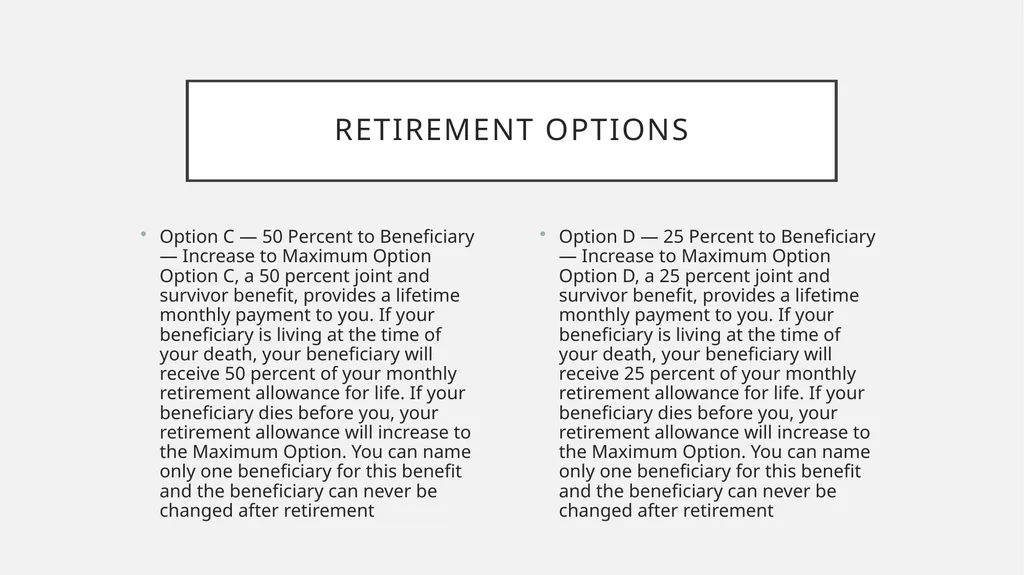
Retirement options Option C — 50 Percent to Beneficiary — Increase to Maximum Option Option C, a 50 percent joint and survivor benefit, provides a lifetime monthly payment to you. If your beneficiary is living at the time of your death, your beneficiary will receive 50 percent of your monthly retirement allowance for life. If your beneficiary dies before you, your retirement allowance will increase to the Maximum Option. You can name only one beneficiary for this benefit and the beneficiary can never be changed after retirement Option D — 25 Percent to Beneficiary — Increase to Maximum Option Option D, a 25 percent joint and survivor benefit, provides a lifetime monthly payment to you. If your beneficiary is living at the time of your death, your beneficiary will receive 25 percent of your monthly retirement allowance for life. If your beneficiary dies before you, your retirement allowance will increase to the Maximum Option. You can name only one beneficiary for this benefit and the beneficiary can never be changed after retirement<br>
16
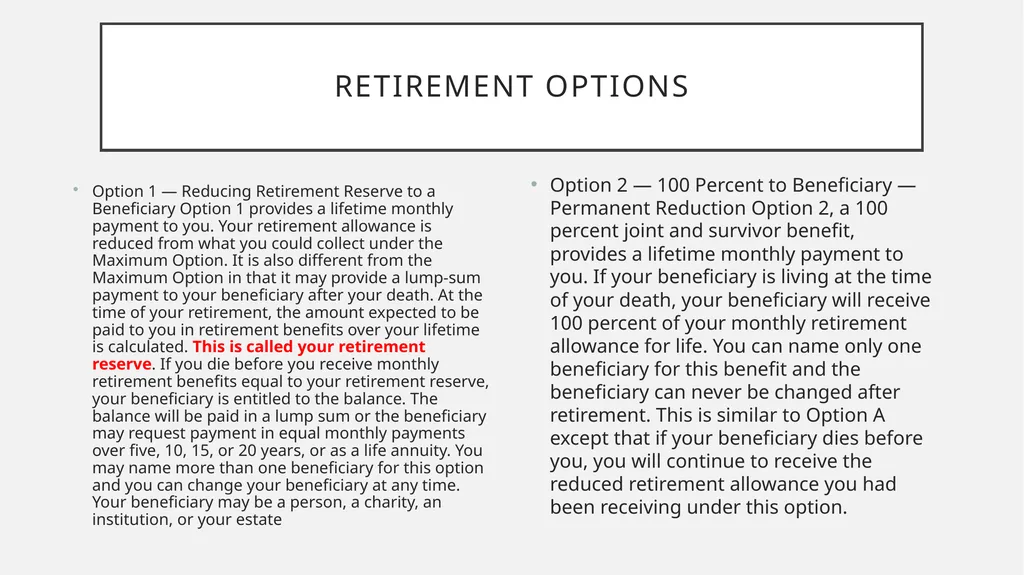
Retirement options Option 1 — Reducing Retirement Reserve to a Beneficiary Option 1 provides a lifetime monthly payment to you. Your retirement allowance is reduced from what you could collect under the Maximum Option. It is also different from the Maximum Option in that it may provide a lump-sum payment to your beneficiary after your death. At the time of your retirement, the amount expected to be paid to you in retirement benefits over your lifetime is calculated. This is called your retirement reserve. If you die before you receive monthly retirement benefits equal to your retirement reserve, your beneficiary is entitled to the balance. The balance will be paid in a lump sum or the beneficiary may request payment in equal monthly payments over five, 10, 15, or 20 years, or as a life annuity. You may name more than one beneficiary for this option and you can change your beneficiary at any time. Your beneficiary may be a person, a charity, an institution, or your estate Option 2 — 100 Percent to Beneficiary — Permanent Reduction Option 2, a 100 percent joint and survivor benefit, provides a lifetime monthly payment to you. If your beneficiary is living at the time of your death, your beneficiary will receive 100 percent of your monthly retirement allowance for life. You can name only one beneficiary for this benefit and the beneficiary can never be changed after retirement. This is similar to Option A except that if your beneficiary dies before you, you will continue to receive the reduced retirement allowance you had been receiving under this option.<br>
17
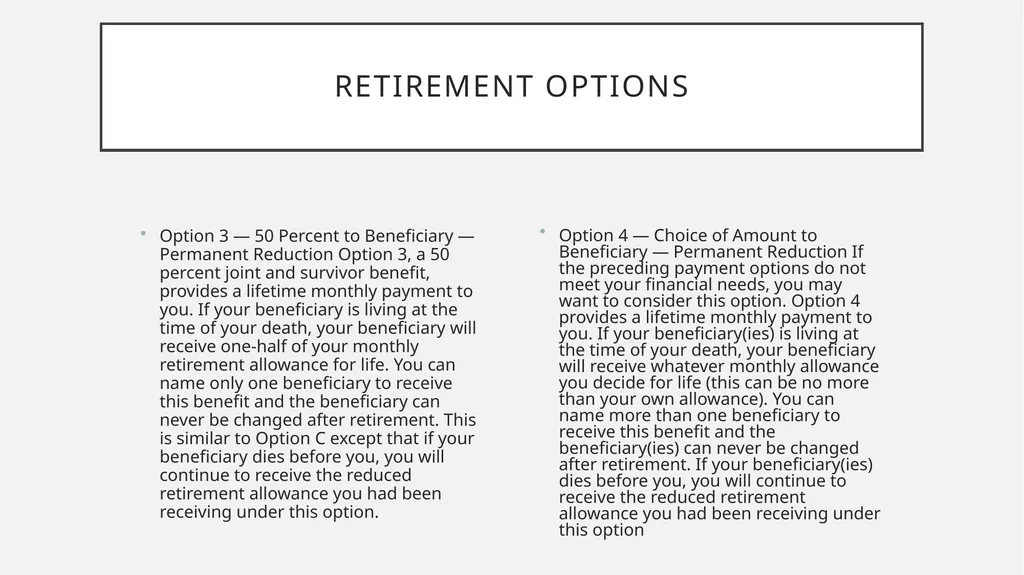
Retirement options Option 3 — 50 Percent to Beneficiary — Permanent Reduction Option 3, a 50 percent joint and survivor benefit, provides a lifetime monthly payment to you. If your beneficiary is living at the time of your death, your beneficiary will receive one-half of your monthly retirement allowance for life. You can name only one beneficiary to receive this benefit and the beneficiary can never be changed after retirement. This is similar to Option C except that if your beneficiary dies before you, you will continue to receive the reduced retirement allowance you had been receiving under this option. Option 4 — Choice of Amount to Beneficiary — Permanent Reduction If the preceding payment options do not meet your financial needs, you may want to consider this option. Option 4 provides a lifetime monthly payment to you. If your beneficiary(ies) is living at the time of your death, your beneficiary will receive whatever monthly allowance you decide for life (this can be no more than your own allowance). You can name more than one beneficiary to receive this benefit and the beneficiary(ies) can never be changed after retirement. If your beneficiary(ies) dies before you, you will continue to receive the reduced retirement allowance you had been receiving under this option<br>
18
Retirement options<br>
19
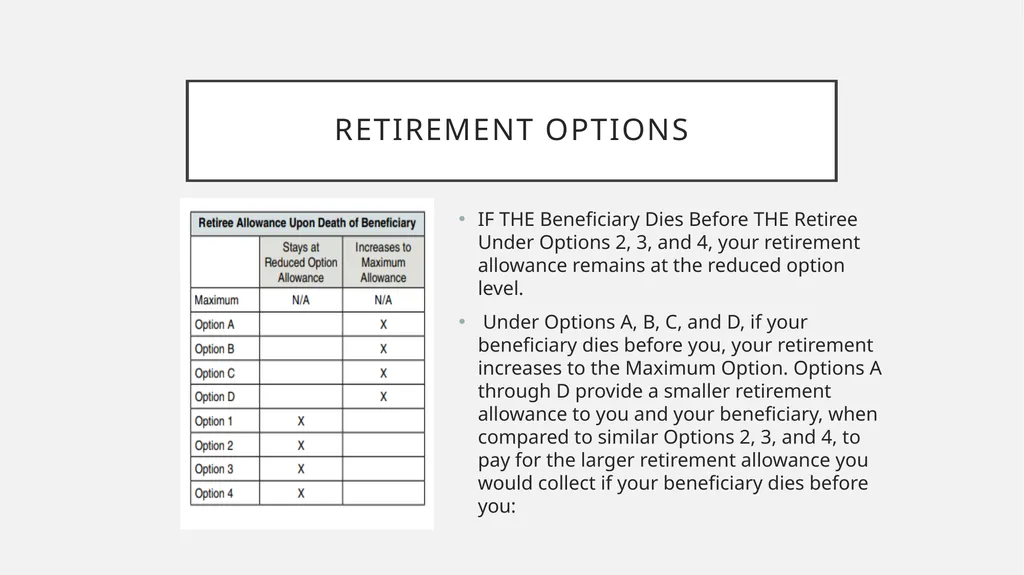
Retirement options IF THE Beneficiary Dies Before THE Retiree Under Options 2, 3, and 4, your retirement allowance remains at the reduced option level.
Under Options A, B, C, and D, if your beneficiary dies before you, your retirement increases to the Maximum Option. Options A through D provide a smaller retirement allowance to you and your beneficiary, when compared to similar Options 2, 3, and 4, to pay for the larger retirement allowance you would collect if your beneficiary dies before you:<br>
Under Options A, B, C, and D, if your beneficiary dies before you, your retirement increases to the Maximum Option. Options A through D provide a smaller retirement allowance to you and your beneficiary, when compared to similar Options 2, 3, and 4, to pay for the larger retirement allowance you would collect if your beneficiary dies before you:<br>
20
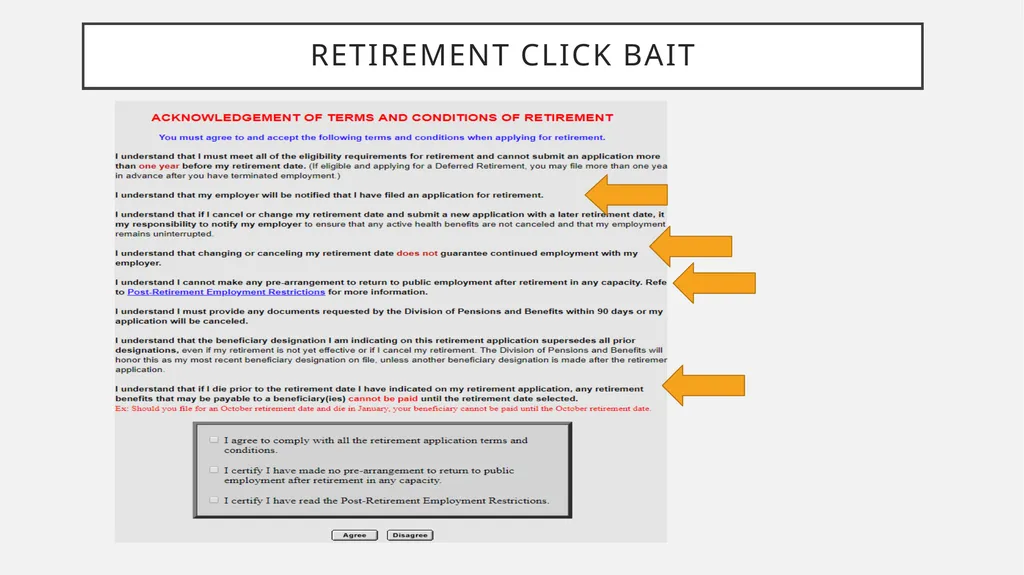
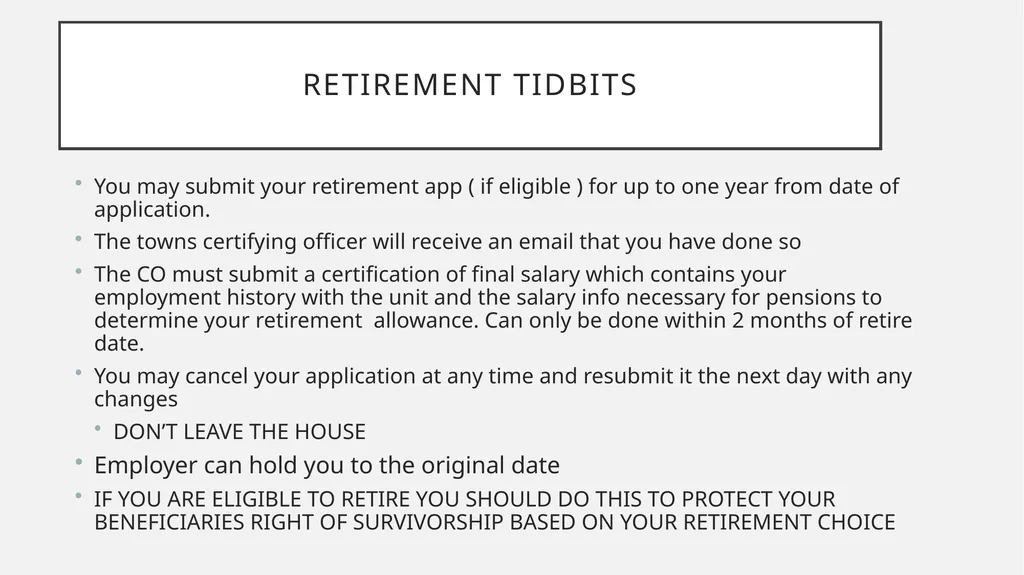
Retirement tidbits You may submit your retirement app ( if eligible ) for up to one year from date of application.
The towns certifying officer will receive an email that you have done so
The CO must submit a certification of final salary which contains your employment history with the unit and the salary info necessary for pensions to determine your retirement allowance. Can only be done within 2 months of retire date.
You may cancel your application at any time and resubmit it the next day with any changes
DON’T LEAVE THE HOUSE
Employer can hold you to the original date
IF YOU ARE ELIGIBLE TO RETIRE YOU SHOULD DO THIS TO PROTECT YOUR BENEFICIARIES RIGHT OF SURVIVORSHIP BASED ON YOUR RETIREMENT CHOICE<br>
The towns certifying officer will receive an email that you have done so
The CO must submit a certification of final salary which contains your employment history with the unit and the salary info necessary for pensions to determine your retirement allowance. Can only be done within 2 months of retire date.
You may cancel your application at any time and resubmit it the next day with any changes
DON’T LEAVE THE HOUSE
Employer can hold you to the original date
IF YOU ARE ELIGIBLE TO RETIRE YOU SHOULD DO THIS TO PROTECT YOUR BENEFICIARIES RIGHT OF SURVIVORSHIP BASED ON YOUR RETIREMENT CHOICE<br>
21
Retirement tidbits If your die before your retirement and you do not have an active retirement application on file then your beneficiary will receive the value of your life insurance policy PLUS your pension contributions to date.
If your die before your retirement and you do have an active retirement application on file then your beneficiary will receive the beneficiary benefit you selected.
That is why I chose the max option to beneficiary until I actually had a legit retirement date.<br>
If your die before your retirement and you do have an active retirement application on file then your beneficiary will receive the beneficiary benefit you selected.
That is why I chose the max option to beneficiary until I actually had a legit retirement date.<br>
22
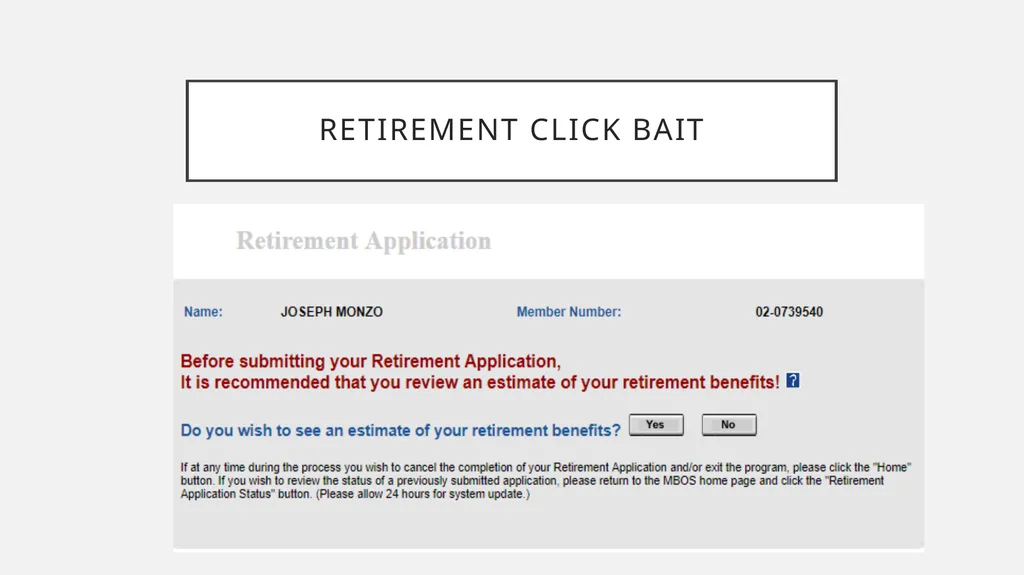
Retirement tidbits After your REAL application is submitted and you have a confirmed date the Div of Pensions Board of Trustees will meet ( once a month) to approve your retirement.
Confirm that you are on a mtg date in MBOS
I had an issue with overage / shortage – almost delayed me getting on the June 2019 mtg. Had to pull a favor
Go to the EFT tab and enter your direct deposit info. ABA and Account number<br>
Confirm that you are on a mtg date in MBOS
I had an issue with overage / shortage – almost delayed me getting on the June 2019 mtg. Had to pull a favor
Go to the EFT tab and enter your direct deposit info. ABA and Account number<br>
23
Retirement tidbits Don’t feel special- all the retirements for the next month are on the same board meeting
You are going to be retired from all employment. HOORAH.
WHAT’S NEXT
Get your replacement up to speed
Retirement party<br>
You are going to be retired from all employment. HOORAH.
WHAT’S NEXT
Get your replacement up to speed
Retirement party<br>
24
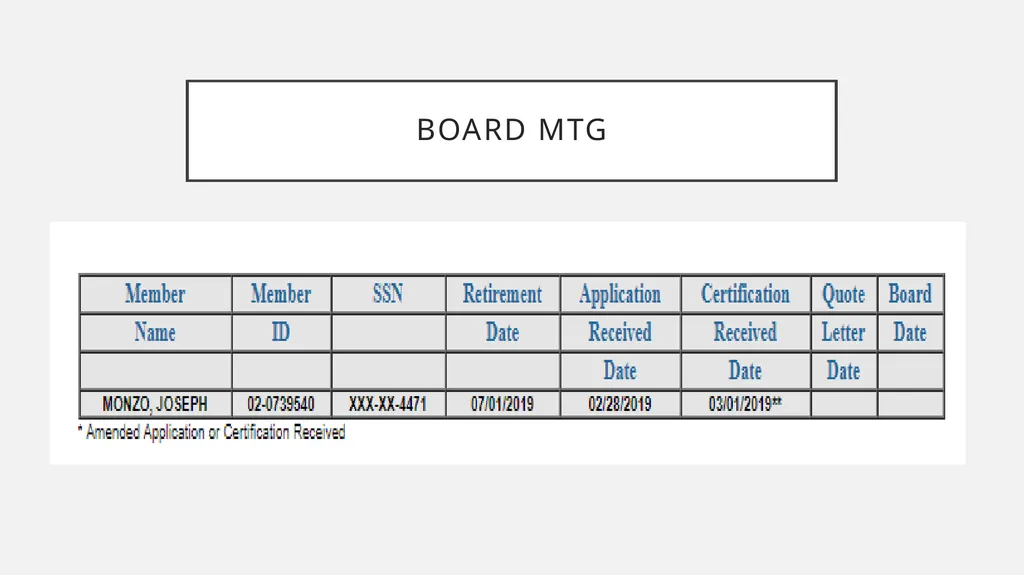
Board Mtg<br>
25
PART 2: PROTECTION<br>
26
Before you walk out the door…internal IT can set an outgoing email message response notifying the sender of your retirement
Take and destroy any leftover business cards
Same for letterhead- although that can be reproduced
Check the drives on computer for any personal files- music, pictures, web bookmarks
If you have a work laptop and/ or cell phone do the same before you turn it in
Copy any email addresses you may want to keep
Remove your tax or accounting system authorization
Destroy any stamps with your signature
Change petty cash resolutions
Rekey the lock to your office
Turn in old one<br>
Take and destroy any leftover business cards
Same for letterhead- although that can be reproduced
Check the drives on computer for any personal files- music, pictures, web bookmarks
If you have a work laptop and/ or cell phone do the same before you turn it in
Copy any email addresses you may want to keep
Remove your tax or accounting system authorization
Destroy any stamps with your signature
Change petty cash resolutions
Rekey the lock to your office
Turn in old one<br>
27
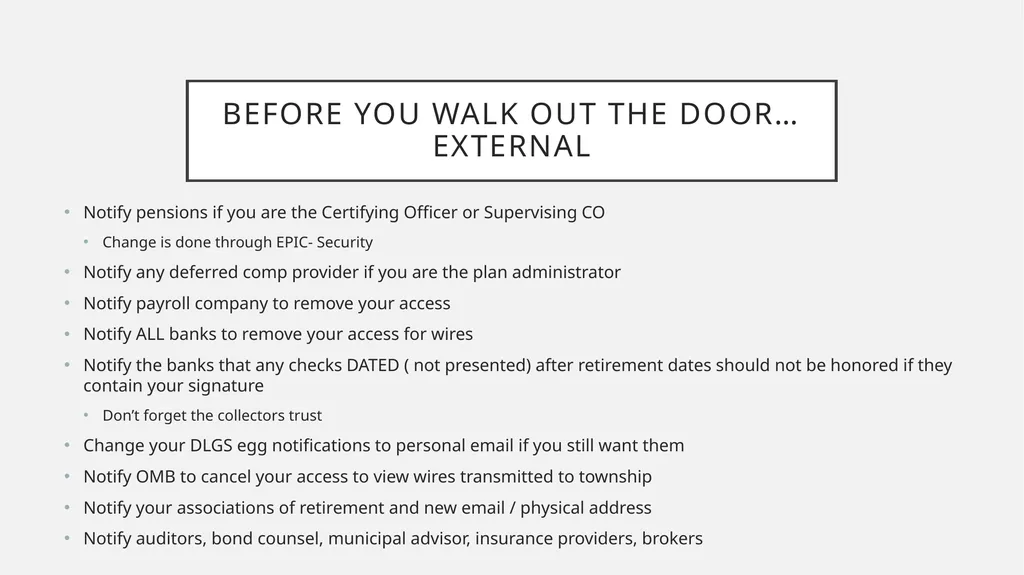
Before you walk out the door…external Notify pensions if you are the Certifying Officer or Supervising CO
Change is done through EPIC- Security
Notify any deferred comp provider if you are the plan administrator
Notify payroll company to remove your access
Notify ALL banks to remove your access for wires
Notify the banks that any checks DATED ( not presented) after retirement dates should not be honored if they contain your signature
Don’t forget the collectors trust
Change your DLGS egg notifications to personal email if you still want them
Notify OMB to cancel your access to view wires transmitted to township
Notify your associations of retirement and new email / physical address
Notify auditors, bond counsel, municipal advisor, insurance providers, brokers<br>
Change is done through EPIC- Security
Notify any deferred comp provider if you are the plan administrator
Notify payroll company to remove your access
Notify ALL banks to remove your access for wires
Notify the banks that any checks DATED ( not presented) after retirement dates should not be honored if they contain your signature
Don’t forget the collectors trust
Change your DLGS egg notifications to personal email if you still want them
Notify OMB to cancel your access to view wires transmitted to township
Notify your associations of retirement and new email / physical address
Notify auditors, bond counsel, municipal advisor, insurance providers, brokers<br>
28
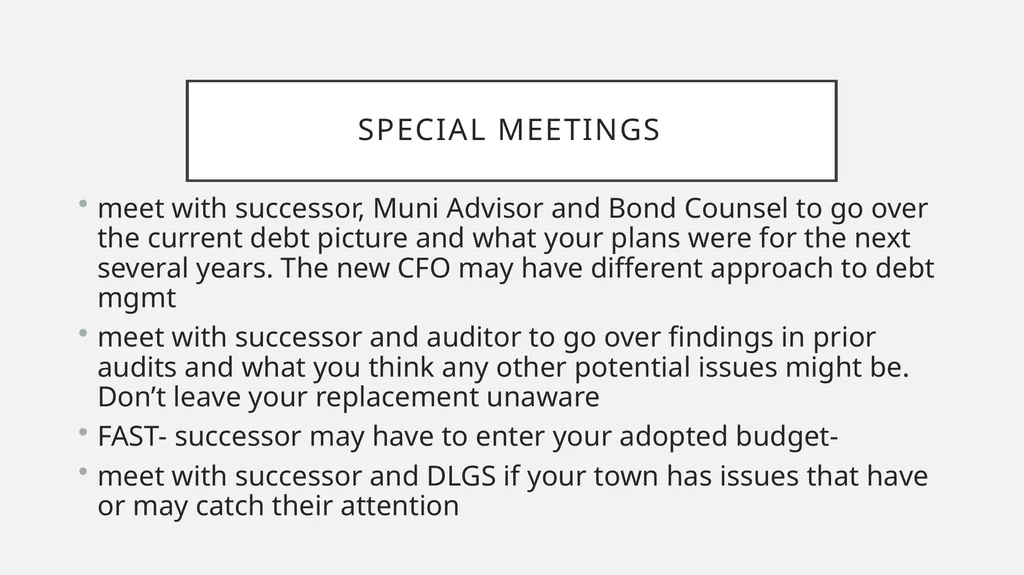
Special Meetings meet with successor, Muni Advisor and Bond Counsel to go over the current debt picture and what your plans were for the next several years. The new CFO may have different approach to debt mgmt
meet with successor and auditor to go over findings in prior audits and what you think any other potential issues might be. Don’t leave your replacement unaware
FAST- successor may have to enter your adopted budget-
meet with successor and DLGS if your town has issues that have or may catch their attention<br>
meet with successor and auditor to go over findings in prior audits and what you think any other potential issues might be. Don’t leave your replacement unaware
FAST- successor may have to enter your adopted budget-
meet with successor and DLGS if your town has issues that have or may catch their attention<br>
29
Before you really walk out the door Thank everyone in your building- this is not a solitary job. Most likely all of these people helped you or did something for you along the way<br>
30
PART 3: POST RETIREMENT PUBLIC SERVICE<br>
31
Ok you are retired.. Now what?<br>
32
So, you want to go back to work-
(that did not take long) As my friend and pension expert Ken Hartman once said– “ if you are going to retire, F$$@@## ‘in retire… BUT IF YOU MUST
FIRST RULE – DO NOT PLAN TO WORK IN PUBLIC EMPLOYMENT AFTER YOUR RETIREMENT. NO CONVERSATIONS, NO TEXTS, NO EMAILS. THIS COULD JEOPARDIZE YOUR BONA FIDE RETIREMENT.
FACT SHEET 86 IS YOUR FRIEND.. KIND OF
If you are considering working after retirement, you should be aware of the restrictions imposed by laws and regulations governing post-retirement employment. It is your responsibility to inform your prospective employer that you are receiving retirement benefits from a New Jersey public retirement system, and to understand the impact employment will have on those retirement benefits. In some instances,your retirement benefits may be suspended or even canceled entirely; if this occurs, you will be responsible for the repayment of any benefits you were not entitled to receive. You may also be required to re-enroll in your former retirement system or a different retirement system, and make pension contributions into that system<br>
FIRST RULE – DO NOT PLAN TO WORK IN PUBLIC EMPLOYMENT AFTER YOUR RETIREMENT. NO CONVERSATIONS, NO TEXTS, NO EMAILS. THIS COULD JEOPARDIZE YOUR BONA FIDE RETIREMENT.
FACT SHEET 86 IS YOUR FRIEND.. KIND OF
If you are considering working after retirement, you should be aware of the restrictions imposed by laws and regulations governing post-retirement employment. It is your responsibility to inform your prospective employer that you are receiving retirement benefits from a New Jersey public retirement system, and to understand the impact employment will have on those retirement benefits. In some instances,your retirement benefits may be suspended or even canceled entirely; if this occurs, you will be responsible for the repayment of any benefits you were not entitled to receive. You may also be required to re-enroll in your former retirement system or a different retirement system, and make pension contributions into that system<br>
33
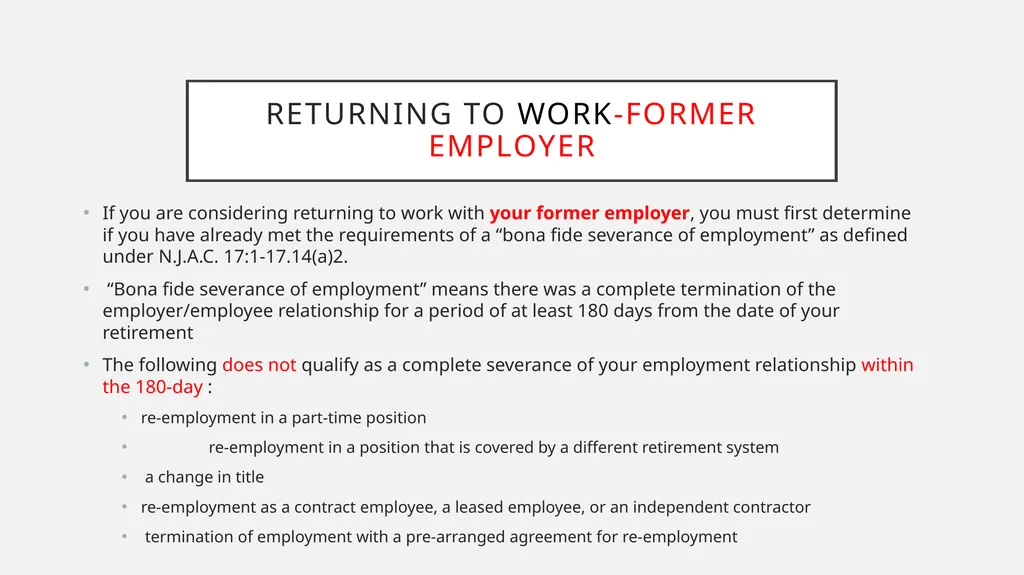
Returning to work-former employer If you are considering returning to work with your former employer, you must first determine if you have already met the requirements of a “bona fide severance of employment” as defined under N.J.A.C. 17:1-17.14(a)2.
“Bona fide severance of employment” means there was a complete termination of the employer/employee relationship for a period of at least 180 days from the date of your retirement
The following does not qualify as a complete severance of your employment relationship within the 180-day :
re-employment in a part-time position
re-employment in a position that is covered by a different retirement system
a change in title
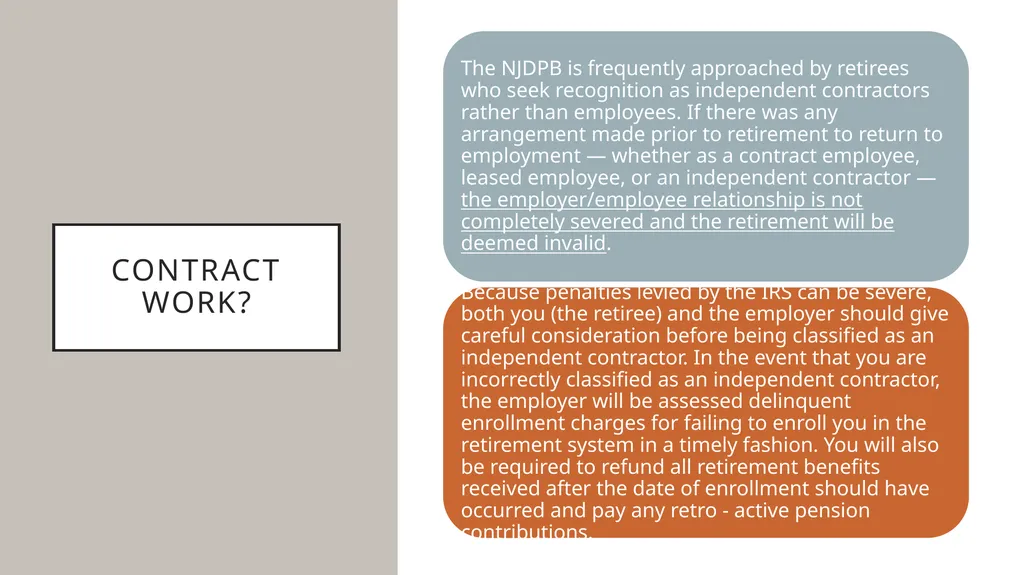
re-employment as a contract employee, a leased employee, or an independent contractor
termination of employment with a pre-arranged agreement for re-employment<br>
“Bona fide severance of employment” means there was a complete termination of the employer/employee relationship for a period of at least 180 days from the date of your retirement
The following does not qualify as a complete severance of your employment relationship within the 180-day :
re-employment in a part-time position
re-employment in a position that is covered by a different retirement system
a change in title
re-employment as a contract employee, a leased employee, or an independent contractor
termination of employment with a pre-arranged agreement for re-employment<br>
34
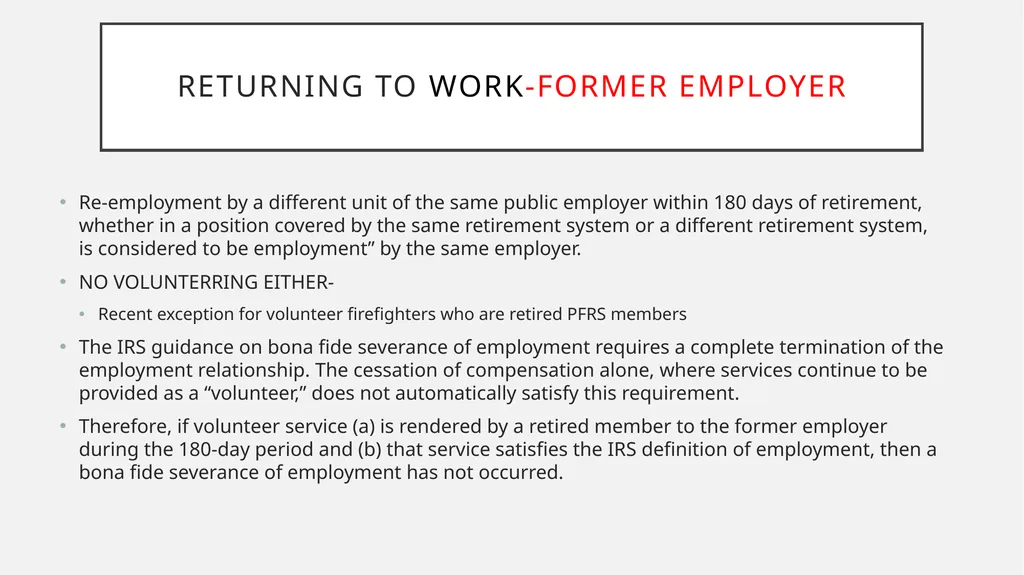
Returning to work-former employer Re-employment by a different unit of the same public employer within 180 days of retirement, whether in a position covered by the same retirement system or a different retirement system, is considered to be employment” by the same employer.
NO VOLUNTERRING EITHER-
Recent exception for volunteer firefighters who are retired PFRS members
The IRS guidance on bona fide severance of employment requires a complete termination of the employment relationship. The cessation of compensation alone, where services continue to be provided as a “volunteer,” does not automatically satisfy this requirement.
Therefore, if volunteer service (a) is rendered by a retired member to the former employer during the 180-day period and (b) that service satisfies the IRS definition of employment, then a bona fide severance of employment has not occurred.<br>
NO VOLUNTERRING EITHER-
Recent exception for volunteer firefighters who are retired PFRS members
The IRS guidance on bona fide severance of employment requires a complete termination of the employment relationship. The cessation of compensation alone, where services continue to be provided as a “volunteer,” does not automatically satisfy this requirement.
Therefore, if volunteer service (a) is rendered by a retired member to the former employer during the 180-day period and (b) that service satisfies the IRS definition of employment, then a bona fide severance of employment has not occurred.<br>
35
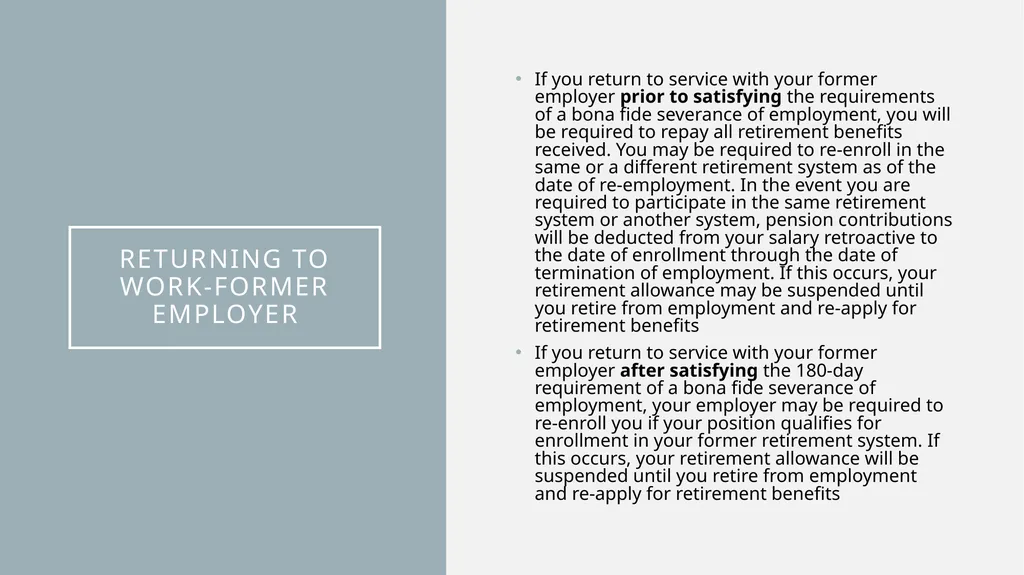
Returning to work-former employer If you return to service with your former employer prior to satisfying the requirements of a bona fide severance of employment, you will be required to repay all retirement benefits received. You may be required to re-enroll in the same or a different retirement system as of the date of re-employment. In the event you are required to participate in the same retirement system or another system, pension contributions will be deducted from your salary retroactive to the date of enrollment through the date of termination of employment. If this occurs, your retirement allowance may be suspended until you retire from employment and re-apply for retirement benefits
If you return to service with your former employer after satisfying the 180-day requirement of a bona fide severance of employment, your employer may be required to re-enroll you if your position qualifies for enrollment in your former retirement system. If this occurs, your retirement allowance will be suspended until you retire from employment and re-apply for retirement benefits<br>
If you return to service with your former employer after satisfying the 180-day requirement of a bona fide severance of employment, your employer may be required to re-enroll you if your position qualifies for enrollment in your former retirement system. If this occurs, your retirement allowance will be suspended until you retire from employment and re-apply for retirement benefits<br>
36
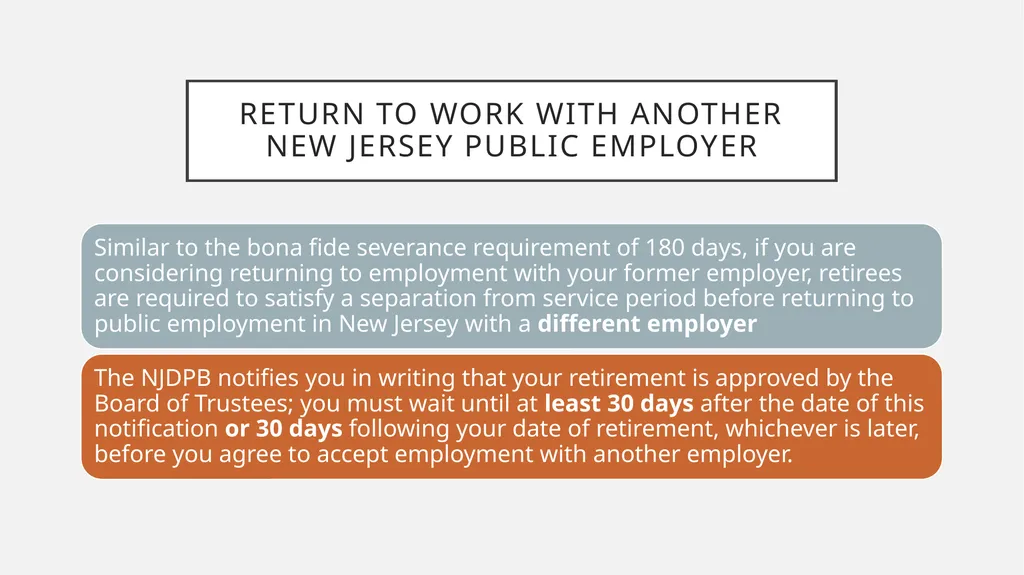
RETURN TO WORK WITH ANOTHER NEW JERSEY PUBLIC EMPLOYER<br>
37
CONTRACT WORK?<br>
38
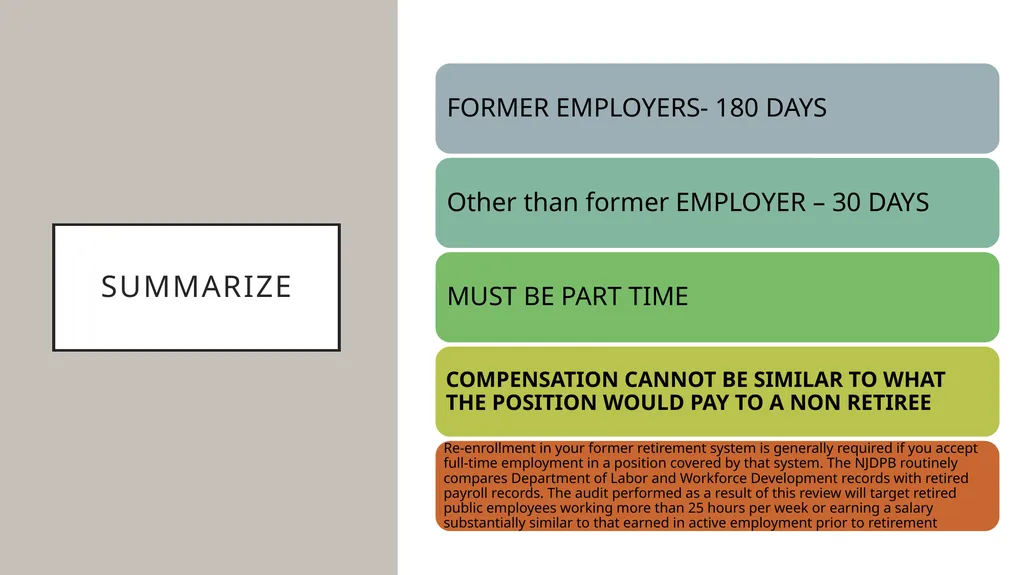
SUMMARIZE<br>
39
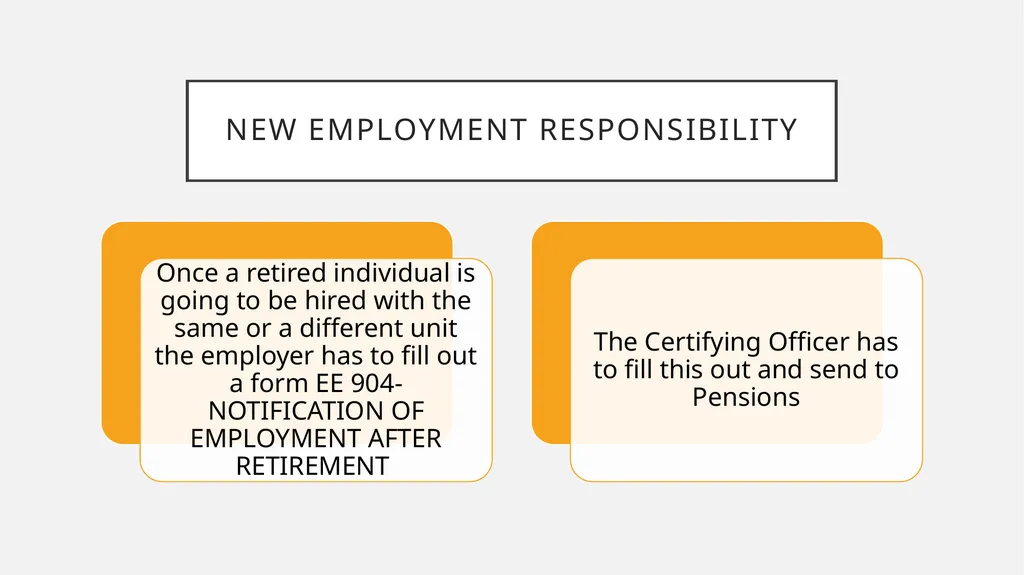
NEW EMPLOYMENT RESPONSIBILITY<br>
40
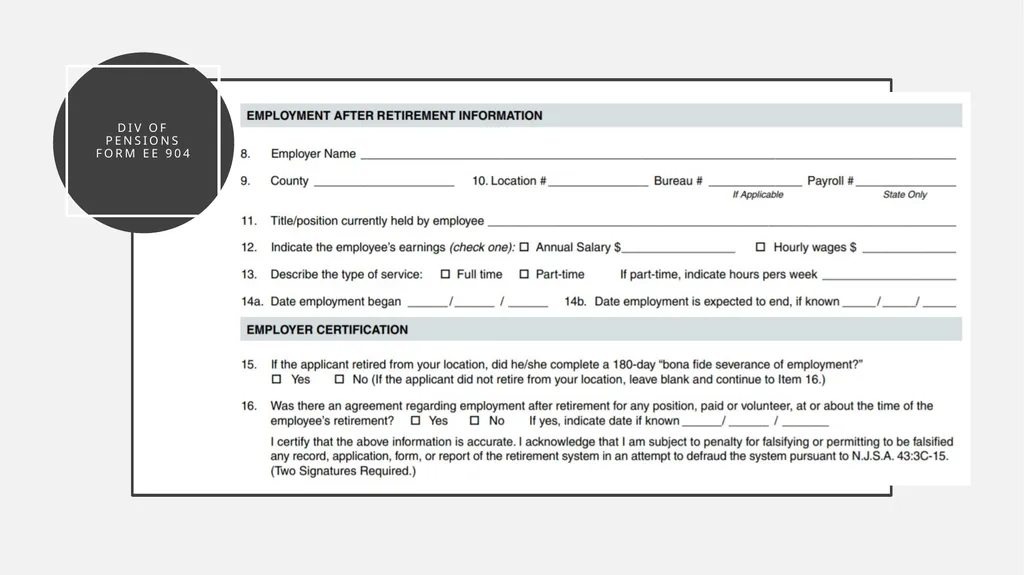
Div of Pensions Form EE 904<br>
41
PART 3: SUCCESSION PLANNING<br>
42
Succession planning is a process for identifying and developing new leaders who can replace old leaders when they leave, retire or die.
Succession planning increases the availability of experienced and capable employees that are prepared to assume these roles as they become available.<br>
Succession planning increases the availability of experienced and capable employees that are prepared to assume these roles as they become available.<br>
43
Governing Magazine 2016 Every day in the United States, 10,000 people turn 65. And according to the Pew Research Center, millennials now outnumber baby boomers in the workplace, 76 million to 75 million, while millennials will make up 75 percent of the workforce just 10 years from now.
NOW THAT IS SCARY
As a result of the rapidly aging workforce, government organizations -- small and large, rural and urban -- are experiencing a brain drain that is placing their organizations at a critical juncture:
The need for experienced and seasoned employees has never been greater, yet those are the very workers who are most likely to be departing in the very near future. It's clear that governments need to get serious about succession planning.<br>
NOW THAT IS SCARY
As a result of the rapidly aging workforce, government organizations -- small and large, rural and urban -- are experiencing a brain drain that is placing their organizations at a critical juncture:
The need for experienced and seasoned employees has never been greater, yet those are the very workers who are most likely to be departing in the very near future. It's clear that governments need to get serious about succession planning.<br>
44
KEY IDEAS Small organizations are particularly challenged when an employee departs, since a natural successor may not already be within the workforce. That problem may not be as much of an issue for mid-sized and large organizations, but a wave of retirements can still disrupt service delivery. And even in larger organizations, it's a challenge to replace a sole incumbent who handles a breadth of responsibilities or possesses extensive specialized knowledge.
THIS IS ESPECIALLY TRUE IN MID TO SMALL SIZE GOVERNMENT UNITS WHERE WE HOLD MULTIPLE TITLES
Beyond simply replacing positions that become vacant, effective succession planning is an ongoing process of identifying, assessing and developing talent to ensure leadership, management and supervisory continuity throughout an organization and, moreover, to sustain its performance.
The major focus is that replacements are prepared to fill key vacancies on short notice and that individuals have the development capacity to assume greater responsibilities and exercise increased technical proficiency and expanded management roles.<br>
THIS IS ESPECIALLY TRUE IN MID TO SMALL SIZE GOVERNMENT UNITS WHERE WE HOLD MULTIPLE TITLES
Beyond simply replacing positions that become vacant, effective succession planning is an ongoing process of identifying, assessing and developing talent to ensure leadership, management and supervisory continuity throughout an organization and, moreover, to sustain its performance.
The major focus is that replacements are prepared to fill key vacancies on short notice and that individuals have the development capacity to assume greater responsibilities and exercise increased technical proficiency and expanded management roles.<br>
45
KEY IDEAS Succession planning is about a lot more than just increasing employee training. Nor should it be the exclusive responsibility of the human-resources department. Effective succession planning requires advocacy and visible support by all members of the executive leadership team. A well-designed succession-planning program will enable an organization to align workforce requirements directly to strategic and operational plans; identify and implement strategies to transition from the existing workforce to the one that will be needed; and build the capability to continually shape the workforce to respond to emerging trends, shifting priorities and technological change.
Establishing systematic succession planning can entail a culture change. It can be a major shift in an organization where decision-makers may have been accustomed to filling one vacancy at a time. It requires commitment to a longer-term strategic view of talent needs, and doing it will bring a number of benefits:<br>
Establishing systematic succession planning can entail a culture change. It can be a major shift in an organization where decision-makers may have been accustomed to filling one vacancy at a time. It requires commitment to a longer-term strategic view of talent needs, and doing it will bring a number of benefits:<br>
46
KEY IDEAS Identifying the bench strength that is in place will help departments and divisions meet both long-term and emergency leadership, management and non-supervisory needs.
• It sends a positive message throughout the workforce. Promoting people is good for morale, and promoting from within encourages people to take on responsibility, assume risk and grow through their achievements.
MY SBT RETIREMENT PROMPTED THREE PROMOTIONS
• The organization will have a clearer sense of the strengths of internal candidates, enabling more informed selection and promotion decisions.
Effective succession planning in government is an ongoing, dynamic process, not a static, one-time objective. It not only empowers employees to achieve their professional goals but also supports organizational goals. It's essential in today's competition for talent.<br>
• It sends a positive message throughout the workforce. Promoting people is good for morale, and promoting from within encourages people to take on responsibility, assume risk and grow through their achievements.
MY SBT RETIREMENT PROMPTED THREE PROMOTIONS
• The organization will have a clearer sense of the strengths of internal candidates, enabling more informed selection and promotion decisions.
Effective succession planning in government is an ongoing, dynamic process, not a static, one-time objective. It not only empowers employees to achieve their professional goals but also supports organizational goals. It's essential in today's competition for talent.<br>
47
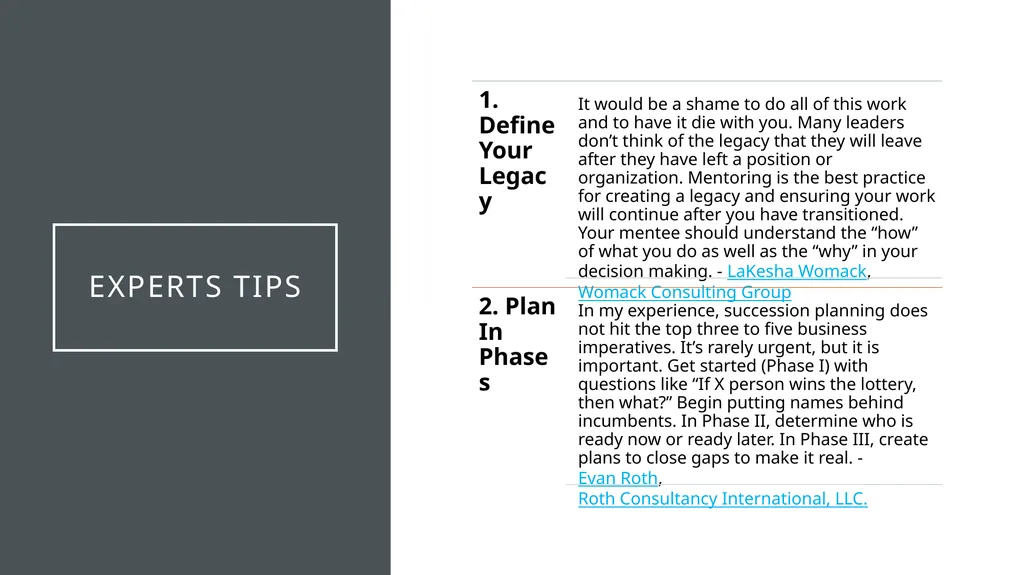
EXPERTS TIPS<br>
48
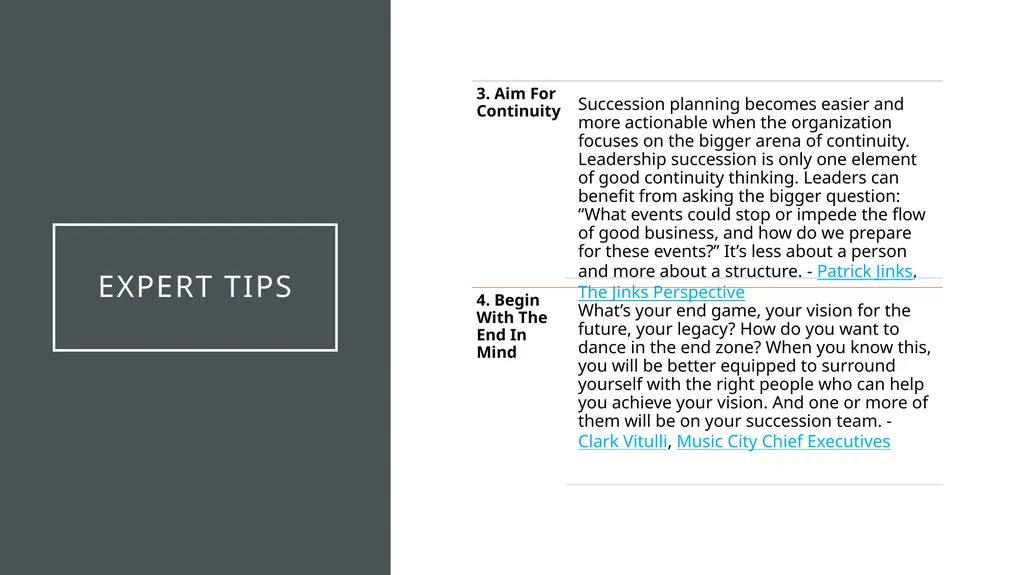
EXPERT TIPS<br>
49
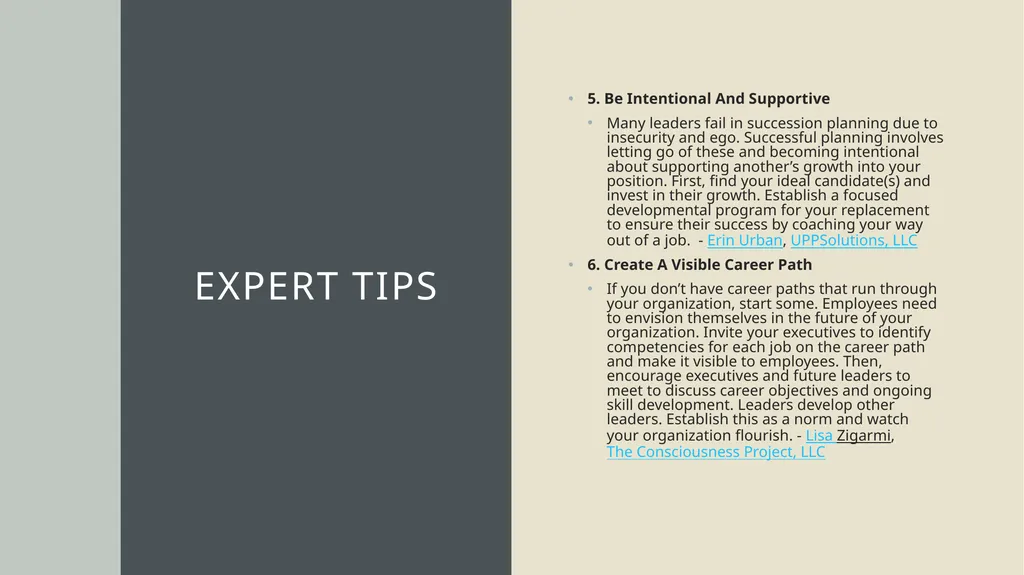
EXPERT TIPS 5. Be Intentional And Supportive
Many leaders fail in succession planning due to insecurity and ego. Successful planning involves letting go of these and becoming intentional about supporting another’s growth into your position. First, find your ideal candidate(s) and invest in their growth. Establish a focused developmental program for your replacement to ensure their success by coaching your way out of a job. - Erin Urban, UPPSolutions, LLC
6. Create A Visible Career Path
If you don’t have career paths that run through your organization, start some. Employees need to envision themselves in the future of your organization. Invite your executives to identify competencies for each job on the career path and make it visible to employees. Then, encourage executives and future leaders to meet to discuss career objectives and ongoing skill development. Leaders develop other leaders. Establish this as a norm and watch your organization flourish. - Lisa Zigarmi, The Consciousness Project, LLC<br>
Many leaders fail in succession planning due to insecurity and ego. Successful planning involves letting go of these and becoming intentional about supporting another’s growth into your position. First, find your ideal candidate(s) and invest in their growth. Establish a focused developmental program for your replacement to ensure their success by coaching your way out of a job. - Erin Urban, UPPSolutions, LLC
6. Create A Visible Career Path
If you don’t have career paths that run through your organization, start some. Employees need to envision themselves in the future of your organization. Invite your executives to identify competencies for each job on the career path and make it visible to employees. Then, encourage executives and future leaders to meet to discuss career objectives and ongoing skill development. Leaders develop other leaders. Establish this as a norm and watch your organization flourish. - Lisa Zigarmi, The Consciousness Project, LLC<br>
50
EXPERT TIPS 7. Identify Successors
Leaders should identify and prepare successors for their roles in an effort to support business continuity and their own career growth. Your supervisor is much less likely to discourage you from seeking out and applying for internal promotions if you’ve been preparing one or two people to take your place and your departure won’t leave a talent gap. - Dr. Kimberly Jarvis, All Career Matters, Inc.
8. Retain Your Talent With Future Possibilities
“The only thing we can promise is change,” is the mantra of most organizations these days. Keep high-potential performers engaged by highlighting the opportunity to grow within. Be transparent about your process and retain your team through succession planning. Each leader can recommend training, mentorship and share expectations to fulfill future roles. - Meredith Moore Crosby, Leverette Weekes<br>
Leaders should identify and prepare successors for their roles in an effort to support business continuity and their own career growth. Your supervisor is much less likely to discourage you from seeking out and applying for internal promotions if you’ve been preparing one or two people to take your place and your departure won’t leave a talent gap. - Dr. Kimberly Jarvis, All Career Matters, Inc.
8. Retain Your Talent With Future Possibilities
“The only thing we can promise is change,” is the mantra of most organizations these days. Keep high-potential performers engaged by highlighting the opportunity to grow within. Be transparent about your process and retain your team through succession planning. Each leader can recommend training, mentorship and share expectations to fulfill future roles. - Meredith Moore Crosby, Leverette Weekes<br>
51
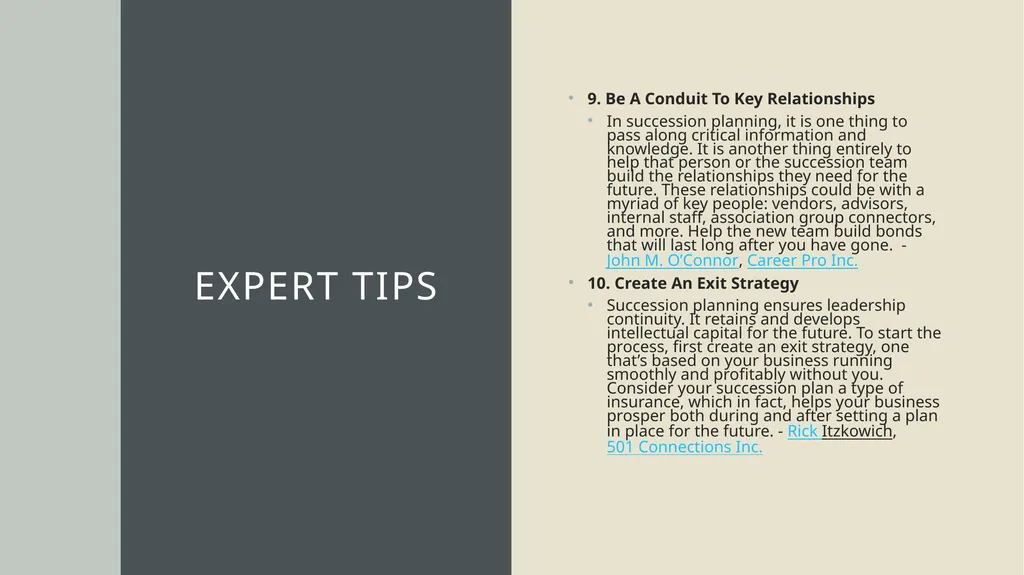
EXPERT TIPS 9. Be A Conduit To Key Relationships
In succession planning, it is one thing to pass along critical information and knowledge. It is another thing entirely to help that person or the succession team build the relationships they need for the future. These relationships could be with a myriad of key people: vendors, advisors, internal staff, association group connectors, and more. Help the new team build bonds that will last long after you have gone. - John M. O’Connor, Career Pro Inc.
10. Create An Exit Strategy
Succession planning ensures leadership continuity. It retains and develops intellectual capital for the future. To start the process, first create an exit strategy, one that’s based on your business running smoothly and profitably without you. Consider your succession plan a type of insurance, which in fact, helps your business prosper both during and after setting a plan in place for the future. - Rick Itzkowich, 501 Connections Inc.<br>
In succession planning, it is one thing to pass along critical information and knowledge. It is another thing entirely to help that person or the succession team build the relationships they need for the future. These relationships could be with a myriad of key people: vendors, advisors, internal staff, association group connectors, and more. Help the new team build bonds that will last long after you have gone. - John M. O’Connor, Career Pro Inc.
10. Create An Exit Strategy
Succession planning ensures leadership continuity. It retains and develops intellectual capital for the future. To start the process, first create an exit strategy, one that’s based on your business running smoothly and profitably without you. Consider your succession plan a type of insurance, which in fact, helps your business prosper both during and after setting a plan in place for the future. - Rick Itzkowich, 501 Connections Inc.<br>
52
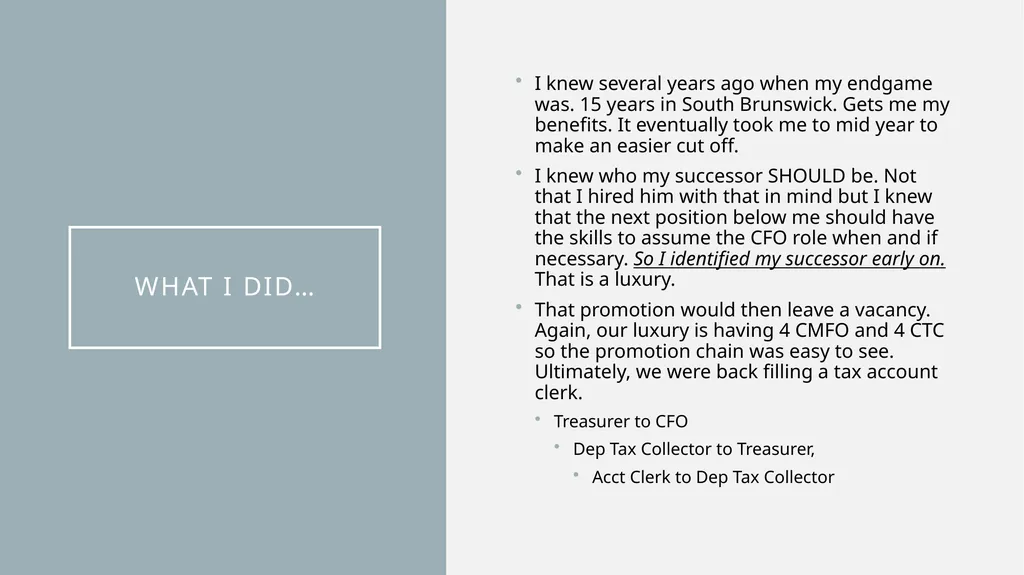
What I did… I knew several years ago when my endgame was. 15 years in South Brunswick. Gets me my benefits. It eventually took me to mid year to make an easier cut off.
I knew who my successor SHOULD be. Not that I hired him with that in mind but I knew that the next position below me should have the skills to assume the CFO role when and if necessary. So I identified my successor early on. That is a luxury.
That promotion would then leave a vacancy. Again, our luxury is having 4 CMFO and 4 CTC so the promotion chain was easy to see. Ultimately, we were back filling a tax account clerk.
Treasurer to CFO
Dep Tax Collector to Treasurer,
Acct Clerk to Dep Tax Collector<br>
I knew who my successor SHOULD be. Not that I hired him with that in mind but I knew that the next position below me should have the skills to assume the CFO role when and if necessary. So I identified my successor early on. That is a luxury.
That promotion would then leave a vacancy. Again, our luxury is having 4 CMFO and 4 CTC so the promotion chain was easy to see. Ultimately, we were back filling a tax account clerk.
Treasurer to CFO
Dep Tax Collector to Treasurer,
Acct Clerk to Dep Tax Collector<br>
53
questions<br>