
Reversible Non-Volatile Electronic Switching in a

Published  . 0 views
↓ Download
Reversible Non-Volatile Electronic Switching in a
1 / 1
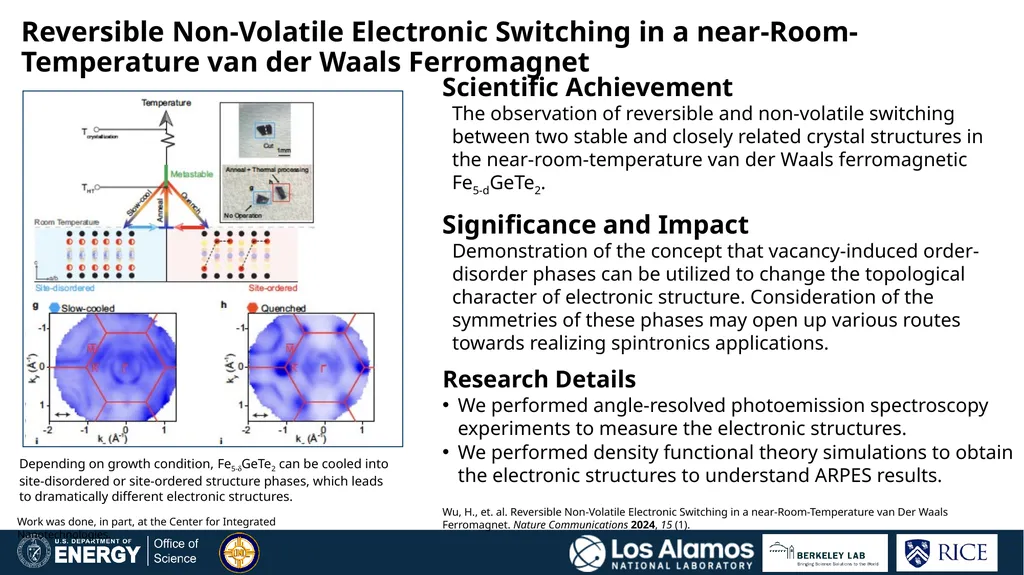
Description: Reversible Non-Volatile Electronic Switching in a near-Room-Temperature van der Waals Ferromagnet Scientific Achievement The observation of reversible and non-volatile switching between two stable and closely related crystal structures in

Related Topics

Download Presentation

"Reversible Non-Volatile Electronic Switching in a" is the property of its rightful owner. Permission is granted to download and print the materials on this website for personal, non-commercial use only, and to display it on your personal computer provided you do not modify the materials and that you retain all copyright notices contained in the materials. By downloading content from our website, you accept the terms of this agreement.

Presentation Transcript

slide1. Reversible Non-Volatile Electronic Switching in a near-Room-Temperature van der Waals Ferromagnet Scientific Achievement
The observation of reversible and non-volatile switching between two stable and closely related crystal structures in the near-room-temperature van der Waals ferromagnetic Fe5-dGeTe2. Research Details
We performed angle-resolved photoemission spectroscopy experiments to measure the electronic structures.
We performed density functional theory simulations to obtain the electronic structures to understand ARPES results. Significance and Impact
Demonstration of the concept that vacancy-induced order-disorder phases can be utilized to change the topological character of electronic structure. Consideration of the symmetries of these phases may open up various routes towards realizing spintronics applications. Wu, H., et. al. Reversible Non-Volatile Electronic Switching in a near-Room-Temperature van Der Waals Ferromagnet. Nature Communications 2024, 15 (1). Depending on growth condition, Fe5-dGeTe2 can be cooled into site-disordered or site-ordered structure phases, which leads to dramatically different electronic structures. Work was done, in part, at the Center for Integrated Nanotechnologies.<br>