Risky business Understanding what can destroy value Risks Two sorts of risks The risk to the value of your investment if you do not understand what risks management is bringing into the business and how it can affect financial performance
"Risky business Understanding what can destroy" is the property of its rightful owner. Permission is granted to
download and print the materials on this website for personal, non-commercial use only, and to display it
on your personal computer provided you do not modify the materials and that you retain all copyright
notices contained in the materials. By downloading content from our website, you accept the terms of this
agreement.
Presentation Transcript
01
Risky business Understanding what can destroy value<br>
02
Risks Two sorts of risks
The risk to the value of your investment if you do not understand what risks management is bringing into the business and how it can affect financial performance down the track
The risk of not understanding that the community increasingly does not view shareholder value maximisation as a reasonable rationale for how directors make decisions or corporations behave.<br>
03
Risks to value of investment ESG risks – this not not socially responsible investment
It is the inclusion of environmental, social, and governance factors into financial analysis to evaluate risks and opportunities
AMP Capital research shows that only around 26% of a company’s true value lies in physical assets such as stock or buildings
Intangible assets make up the other 74%
A number of studies show that ESG principles positively affect long-term, risk-adjusted returns<br>
04
Risks to the value of investment Understanding non-financial drivers provides deeper insights into how well a company or asset grows and protects company value – let’s consider some examples
Retail companies, management of supply chain and labour issues and bribery and corruption exposure are key drivers, particularly for those entities with offshore operations
Insurance companies, staff management practices including absenteeism, training, professional development and turnover rates are important indicators of overall company value and management quality<br>
05
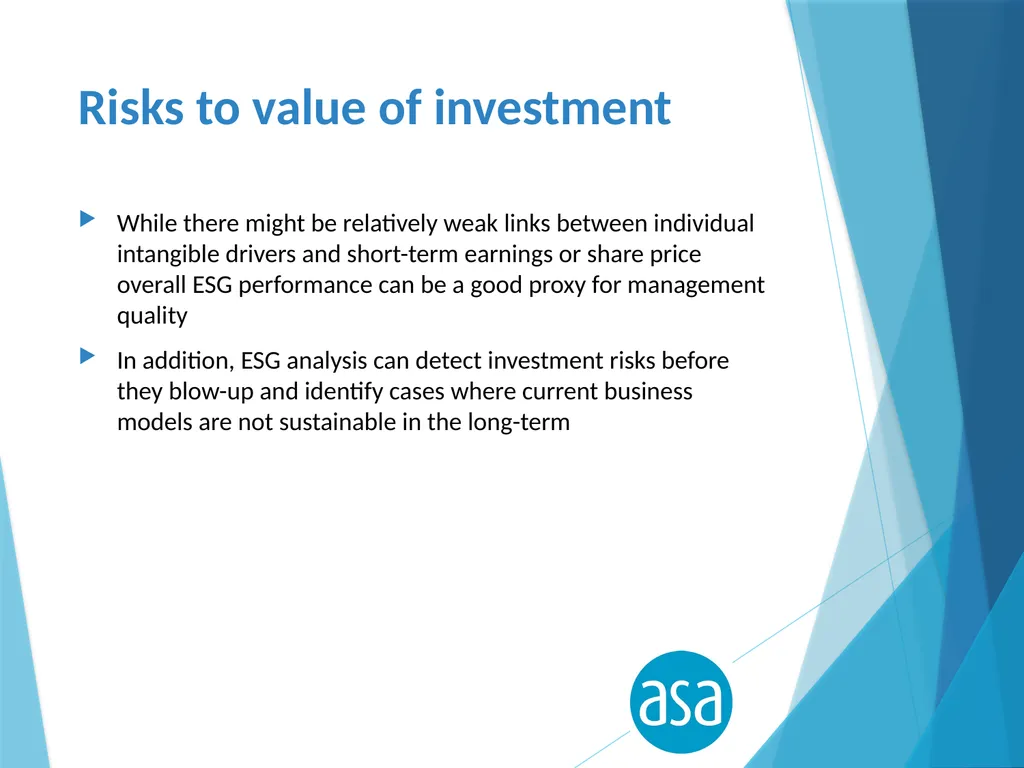
Risks to value of investment While there might be relatively weak links between individual intangible drivers and short-term earnings or share price overall ESG performance can be a good proxy for management quality
In addition, ESG analysis can detect investment risks before they blow-up and identify cases where current business models are not sustainable in the long-term<br>
06
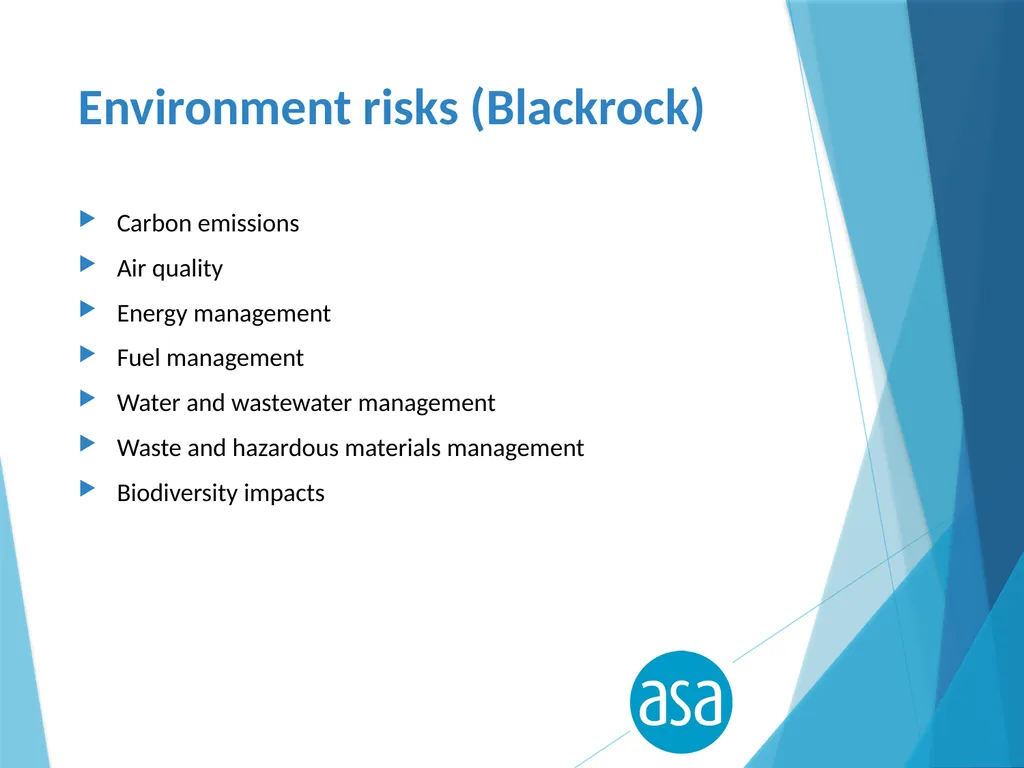
Environment risks (Blackrock) Carbon emissions
Air quality
Energy management
Fuel management
Water and wastewater management
Waste and hazardous materials management
Biodiversity impacts<br>
07
Social capital risks (Blackrock) Human rights and community relations
Access and affordability
Customer welfare
Data security and customer privacy
Fair disclosure and labelling
Fair marketing and advertising<br>
08
Human capital risks (Blackrock) Industrial relations
Fair industrial practices
Employee health, safety and wellbeing
Diversity and inclusion
Remuneration and benefits
Recruitment, development and retention<br>
09
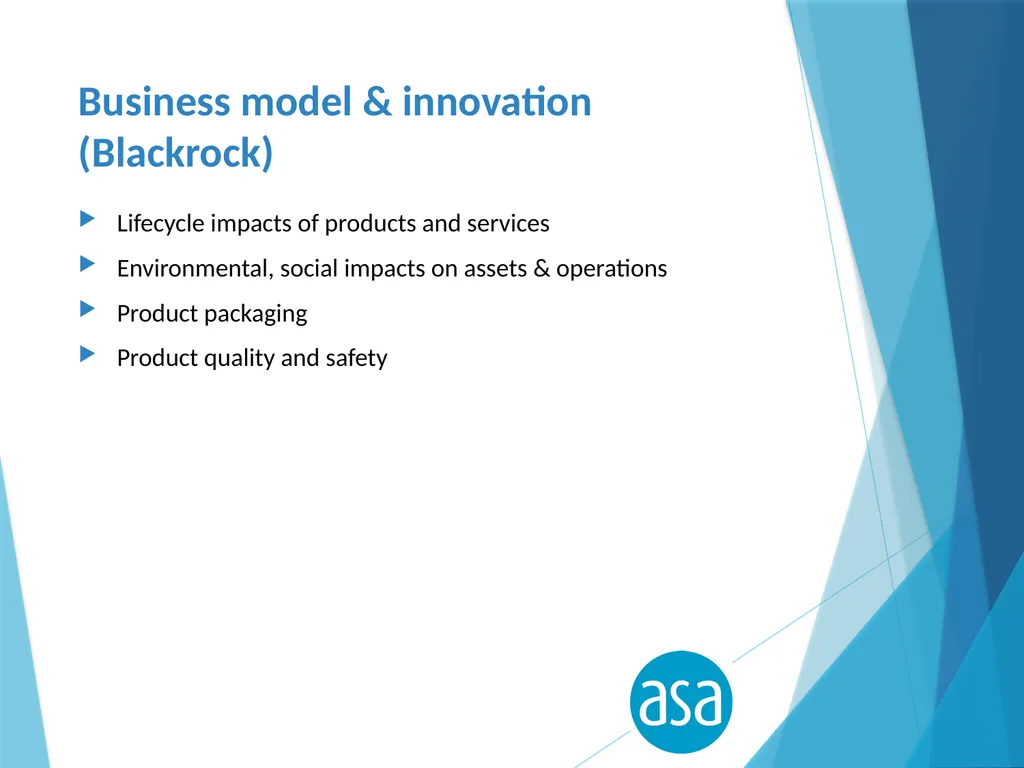
Business model & innovation (Blackrock) Lifecycle impacts of products and services
Environmental, social impacts on assets & operations
Product packaging
Product quality and safety<br>
10
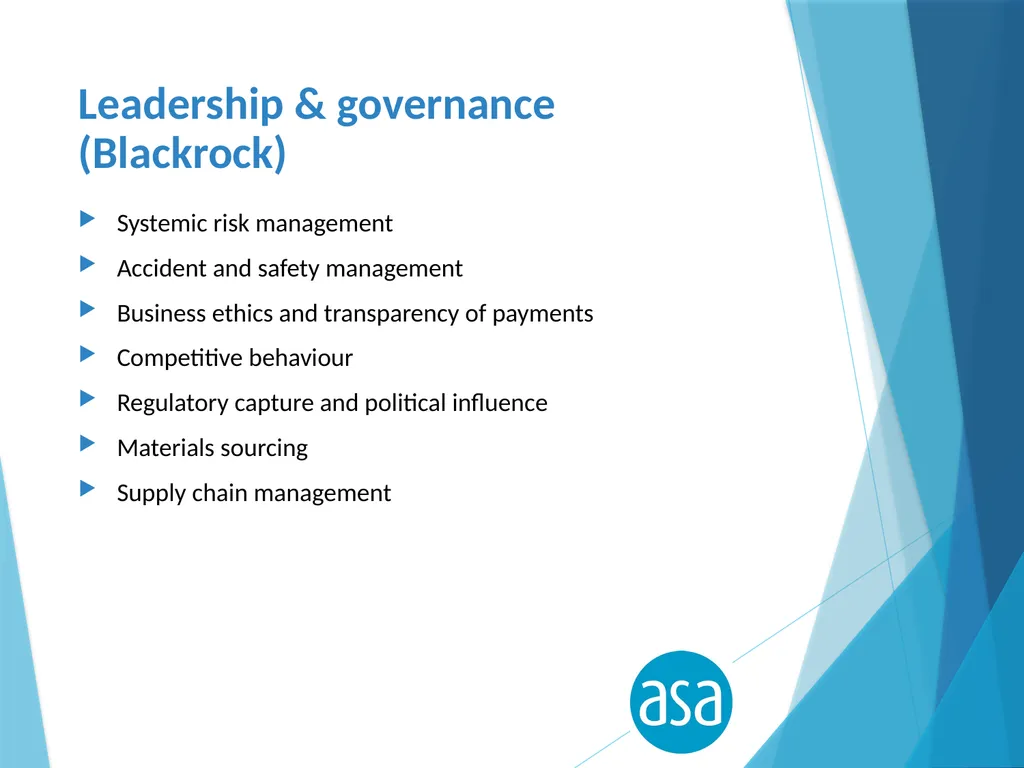
Leadership & governance (Blackrock) Systemic risk management
Accident and safety management
Business ethics and transparency of payments
Competitive behaviour
Regulatory capture and political influence
Materials sourcing
Supply chain management<br>
11
How to analyse ESG risks Very challenging for retail shareholders
The ESG research by parties is expensive and geared to institutional investors
But more companies report on a broad array of issues, including their atmospheric emissions, energy and water consumption, labour and diversity standards, human rights practices and executive remuneration linked to ESG performance
More third-party sources are gathering data, such as MSCI, Sustainalytics, Thomson Reuters and Bloomberg and provide comprehensive ESG scoring on an ongoing basis<br>
12
How to analyse ESG risk Companies’ Climate Performance Score (CDP) scores, which provide a measure of their climate change initiatives, are now available on Google Finance, thus adding to the pool of public data that investors have access to
More analysts cover ESG as an integral part of their business and today, there are more analysts engaged in collecting and evaluating ESG data than ever before
There are higher levels of engagement with ESG issues by institutional investors, proxy advisers and asset managers and ASA is now starting to look at this in engagement<br>
13
Risks to value of investment ESG is all about time horizons
The best interests of the company cannot just be performance at any cost
This leads into the second set of risks<br>
14
Shareholder primacy under question Directors do not owe their duties to shareholders – although case law has granted primacy to shareholders’ interests
Directors owe their fiduciary duty to the best interests of the company
No corporations law across 26 jurisdictions has required directors to to act in best interests of shareholders<br>
15
Shareholder primacy under question Shareholder primacy view holds that the overriding goal of the corporation is to maximise shareholder value
Significant criticism of this view including:
It puts private interest of shareholder ahead of public interest
External costs of corporation, eg cost to the community or the environment, passed to society while shareholders benefit from increased wealth
Shareholders have no personal liability for corporate decisions and can remain indifferent to how profit is generated<br>
16
Shareholder primacy under question Shareholder value maximisation increasingly in conflict with community expectations
This in itself is a risk to the value of the investment
Corporations need to maintain their social licence to operate
This leads back to responsibility of shareholders to be aware of ESG risks<br>