Roles and responsibilities in WDQMS Recalling the RWCs concept and principles Terms of Reference of various NFPs Luís Nunes WIGOS Branch, WMO Secretariat WIGOS Operational Phase (2020 2023) Main priority areas according to Res.37Cg-18
"Roles and responsibilities in WDQMS Recalling the" is the property of its rightful owner. Permission is granted to
download and print the materials on this website for personal, non-commercial use only, and to display it
on your personal computer provided you do not modify the materials and that you retain all copyright
notices contained in the materials. By downloading content from our website, you accept the terms of this
agreement.
Presentation Transcript
01
Roles and responsibilities in WDQMS Recalling the RWCs concept and principles
Terms of Reference of various NFPs
Luís Nunes
WIGOS Branch, WMO Secretariat<br>
02
WIGOS Operational Phase (2020 – 2023) Main priority areas according to Res.37/Cg-18 National WIGOS implementation;
Implementation of the Global Basic Observing Network and the Regional Basic Observing Networks;
Operational deployment of the WIGOS Data Quality Monitoring System;
Operational deployment of Regional WIGOS Centres;
Further development of the Observing Systems Capability Analysis and Review (OSCAR) databases and integration with other system elements;
Fostering a culture of compliance with the WIGOS technical regulations. 2<br>
03
Regional WIGOS Centres (RWCs) will play a critical role in advancing operation of WIGOS.
The overall purpose of the RWCs is to provide support and assistance to WMO Members and Regions for their national and regional WIGOS implementation efforts.
The RWCs will work closely with:
WMO Regional Offices
RICs, RRCs, RMICs
RTCs, RCC
Regional TTs/WGs on WIGOS/Inf
Members
INF Department Recalling the RWCs principles<br>
04
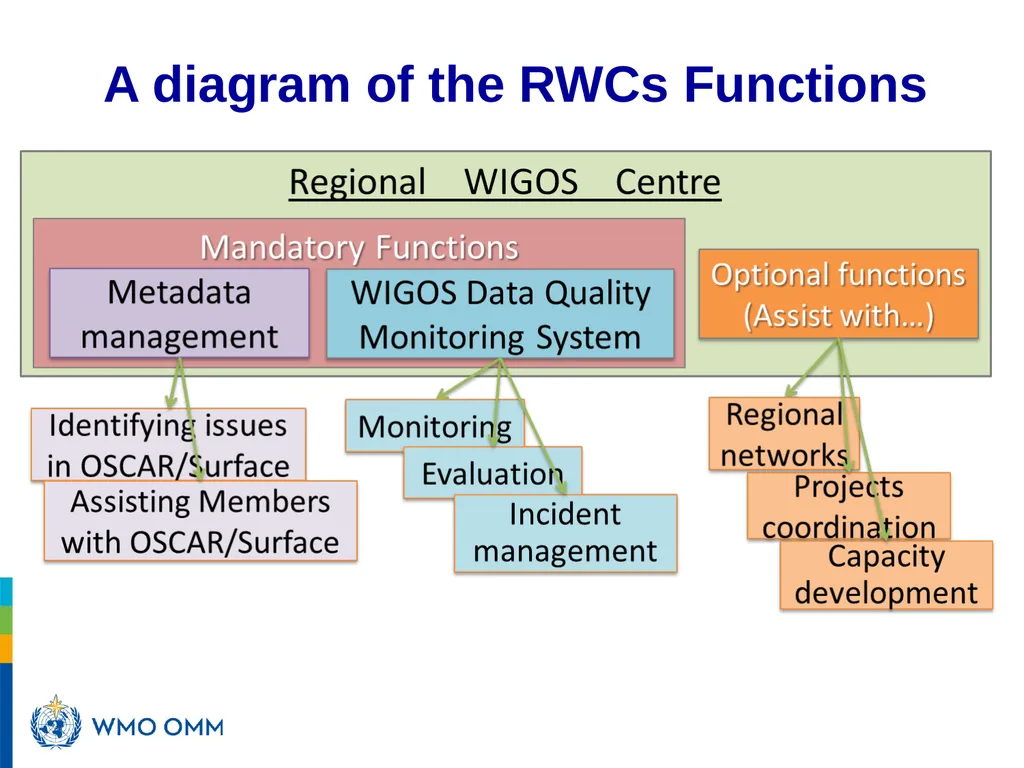
Mandatory functions Regional WIGOS metadata management
work with data providers to facilitate collecting, updating and providing quality control of WIGOS metadata in OSCAR/Surface;
Regional WIGOS performance monitoring, evaluation and incident management (WIGOS Data Quality Monitoring System - WDQMS)
These functions are operational functions
Unlike many other WMO Regional Centres, the RWCs have to perform daily operations such as:
Checking the outputs and statistics from the monitoring function,
Identify, analyse and decide on issues that should be raised as incidents
Register and follow up on the issues and incidents with the NFPs, using an incident management procedure<br>
05
Optional Functions (mostly non daily-operation) Assistance with the coordination of regional/sub-regional and national WIGOS projects;
Assistance with regional and national observing network management; and
Support for regional capacity development activities.
…<br>
06
A diagram of the RWCs Functions<br>
07
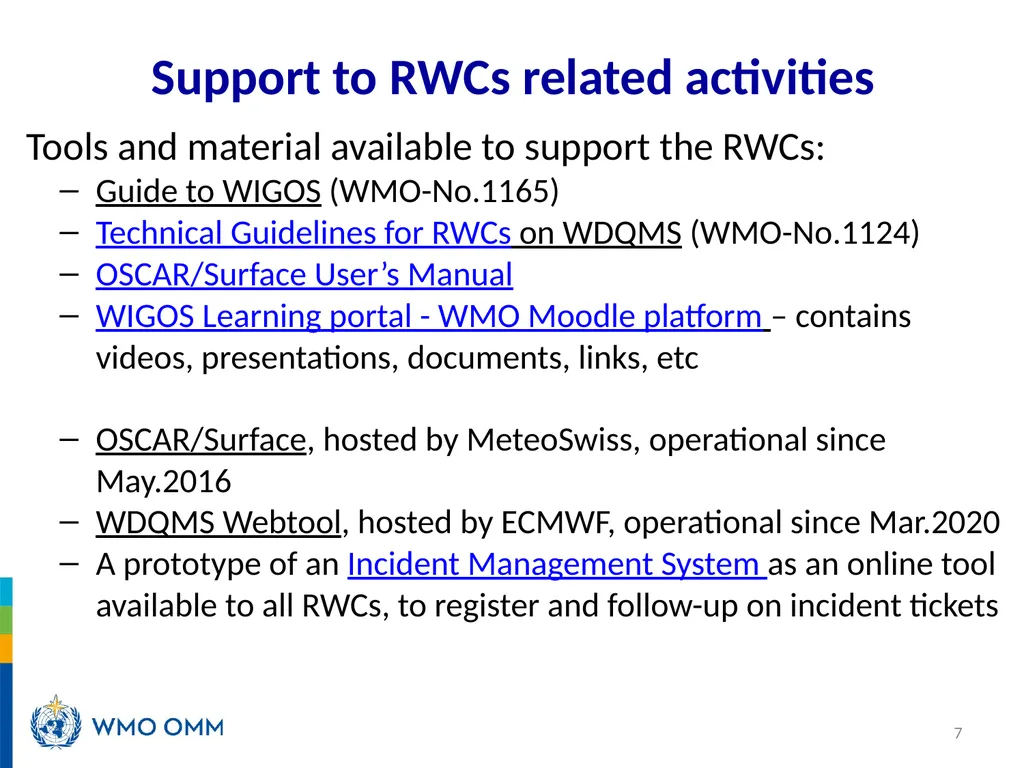
Tools and material available to support the RWCs:
Guide to WIGOS (WMO-No.1165)
Technical Guidelines for RWCs on WDQMS (WMO-No.1124)
OSCAR/Surface User’s Manual
WIGOS Learning portal - WMO Moodle platform – contains videos, presentations, documents, links, etc
OSCAR/Surface, hosted by MeteoSwiss, operational since May.2016
WDQMS Webtool, hosted by ECMWF, operational since Mar.2020
A prototype of an Incident Management System as an online tool available to all RWCs, to register and follow-up on incident tickets Support to RWCs related activities 7<br>
08
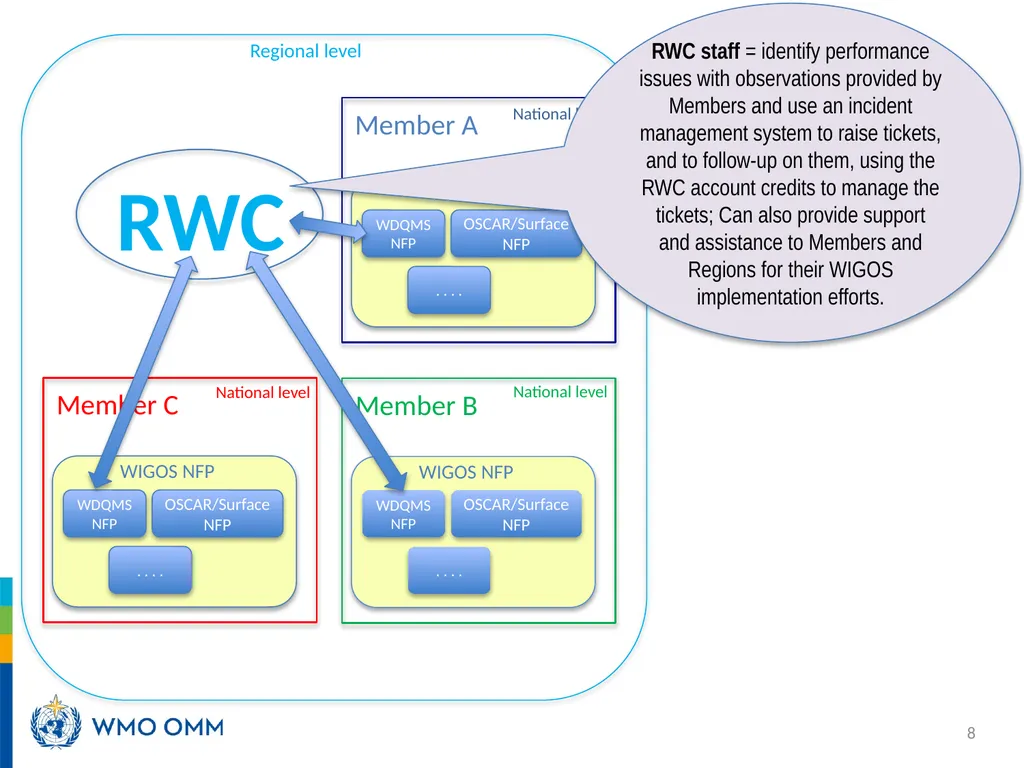
8 RWC National level National level National level Regional level RWC staff = identify performance issues with observations provided by Members and use an incident management system to raise tickets, and to follow-up on them, using the RWC account credits to manage the tickets; Can also provide support and assistance to Members and Regions for their WIGOS implementation efforts.<br>
09
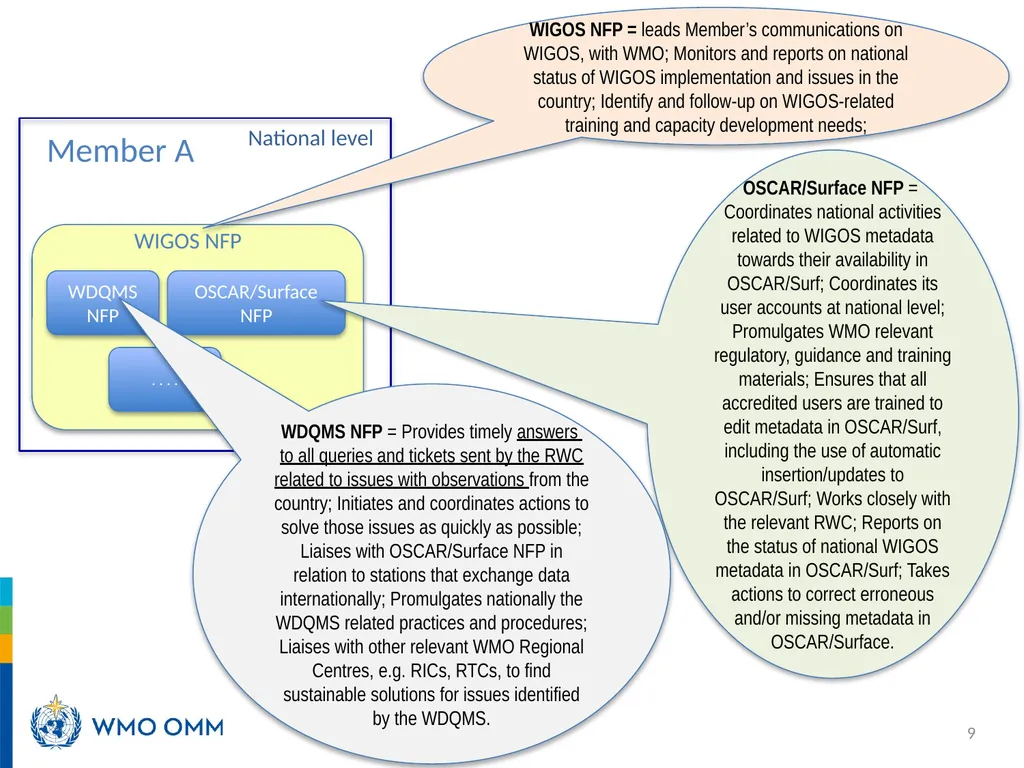
9 WIGOS NFP = leads Member’s communications on WIGOS, with WMO; Monitors and reports on national status of WIGOS implementation and issues in the country; Identify and follow-up on WIGOS-related training and capacity development needs; OSCAR/Surface NFP = Coordinates national activities related to WIGOS metadata towards their availability in OSCAR/Surf; Coordinates its user accounts at national level; Promulgates WMO relevant regulatory, guidance and training materials; Ensures that all accredited users are trained to edit metadata in OSCAR/Surf, including the use of automatic insertion/updates to OSCAR/Surf; Works closely with the relevant RWC; Reports on the status of national WIGOS metadata in OSCAR/Surf; Takes actions to correct erroneous and/or missing metadata in OSCAR/Surface. WDQMS NFP = Provides timely answers to all queries and tickets sent by the RWC related to issues with observations from the country; Initiates and coordinates actions to solve those issues as quickly as possible; Liaises with OSCAR/Surface NFP in relation to stations that exchange data internationally; Promulgates nationally the WDQMS related practices and procedures; Liaises with other relevant WMO Regional Centres, e.g. RICs, RTCs, to find sustainable solutions for issues identified by the WDQMS.<br>
10
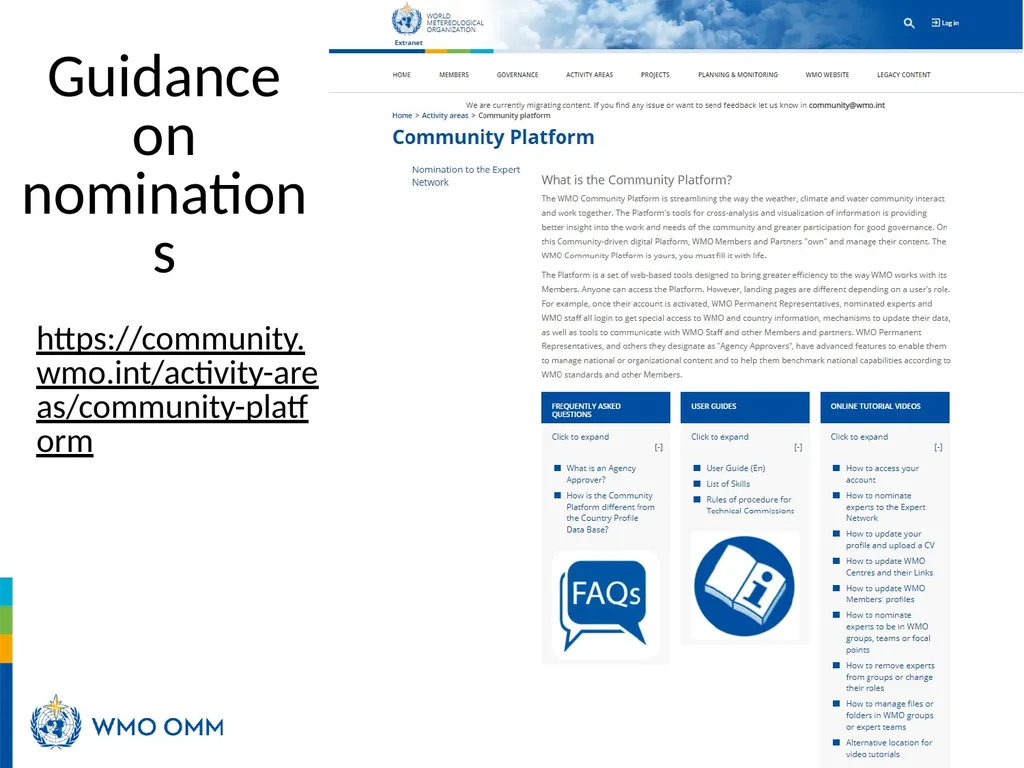
Guidance on nominations https://community.wmo.int/activity-areas/community-platform<br>
11
Thank you
Luís Nunes lfnunes@wmo.int
For further information:
https://community.wmo.int/activity-areas/wigos<br>