
Rounding integers to significant figures (from 1.1

Description: Rounding integers to significant figures (from 1.1 Place value, estimation and rounding) KS3 Mastery PD Materials: Exemplified Key Ideas Materials for use in the classroom or to support professional development discussions Summer 2021 About
Related Topics
Download Presentation
"Rounding integers to significant figures (from 1.1" is the property of its rightful owner. Permission is granted to download and print the materials on this website for personal, non-commercial use only, and to display it on your personal computer provided you do not modify the materials and that you retain all copyright notices contained in the materials. By downloading content from our website, you accept the terms of this agreement.
Presentation Transcript
slide1. Rounding integers to significant figures (from 1.1 Place value, estimation and rounding) KS3 Mastery PD Materials: Exemplified Key Ideas
Materials for use in the classroom or to support professional development discussions Summer 2021<br>
slide2. About this resource These slides are designed to complement the 1.1 Place value, estimation and rounding Core Concept document and its associated Theme Overview document 1 The Structure of the number system, both found in the Secondary Mastery Professional Development pages.
These slides re-present the key examples from the Core Concept document so that the examples can be used either directly in the classroom or with a group of teachers. There are prompt questions alongside the examples, and further clarification in the notes.
These slides do not fully replicate the Core Concept document, so should be used alongside it. Reference to specific page numbers, and to other useful NCETM resources, can be found in the notes for each slide.
This slide deck is not designed to be a complete PD session, rather it is a selection of resources that you can adapt and use as needed when planning a session with a group of teachers.<br>
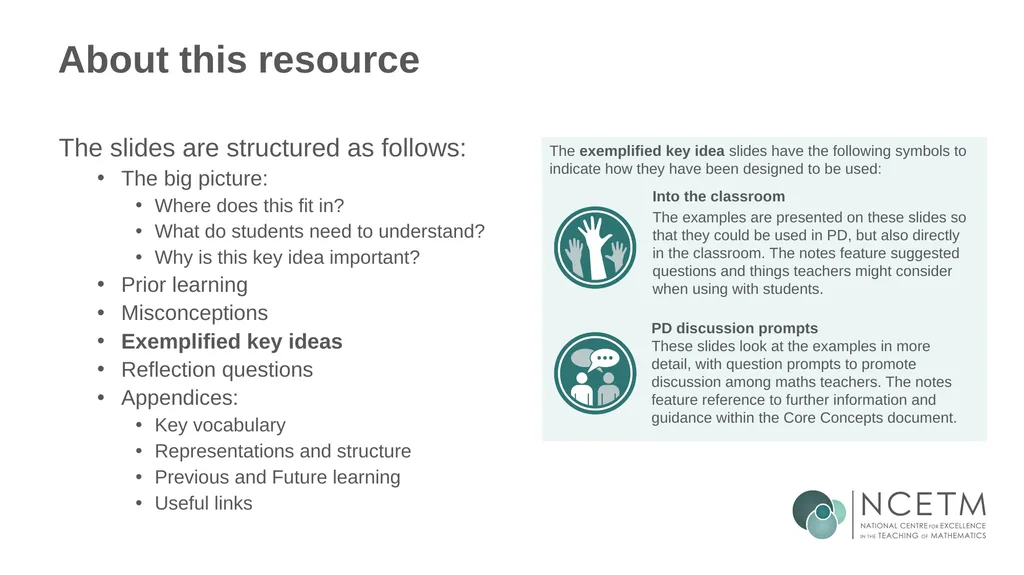
slide3. About this resource The slides are structured as follows:
The big picture:
Where does this fit in?
What do students need to understand?
Why is this key idea important?
Prior learning
Misconceptions
Exemplified key ideas
Reflection questions
Appendices:
Key vocabulary
Representations and structure
Previous and Future learning
Useful links The exemplified key idea slides have the following symbols to indicate how they have been designed to be used: Into the classroom
The examples are presented on these slides so that they could be used in PD, but also directly in the classroom. The notes feature suggested questions and things teachers might consider when using with students. PD discussion prompts
These slides look at the examples in more detail, with question prompts to promote discussion among maths teachers. The notes feature reference to further information and guidance within the Core Concepts document.<br>
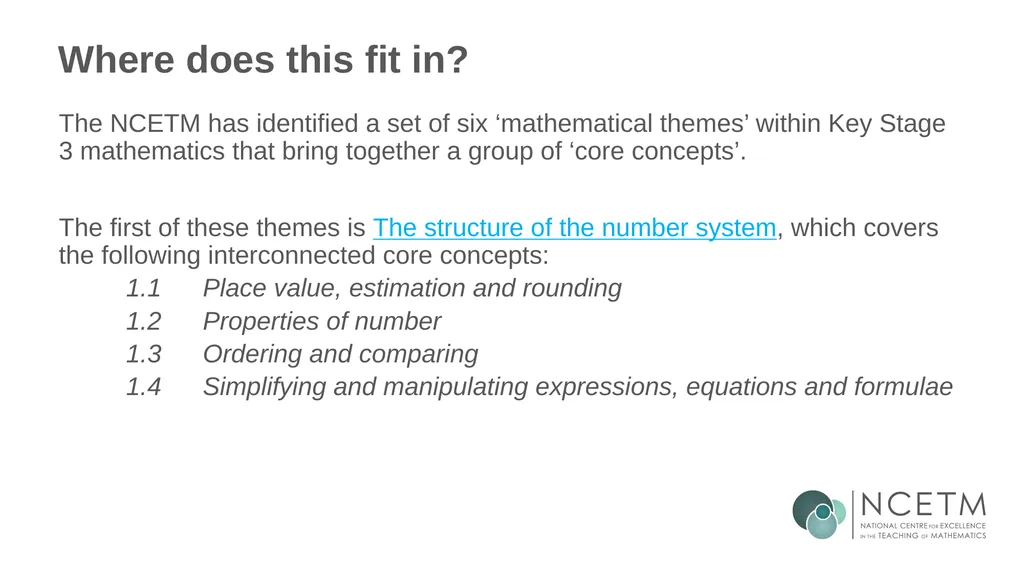
slide4. Where does this fit in? The NCETM has identified a set of six ‘mathematical themes’ within Key Stage 3 mathematics that bring together a group of ‘core concepts’.
The first of these themes is The structure of the number system, which covers the following interconnected core concepts:
1.1 Place value, estimation and rounding
1.2 Properties of number
1.3 Ordering and comparing
1.4 Simplifying and manipulating expressions, equations and formulae<br>
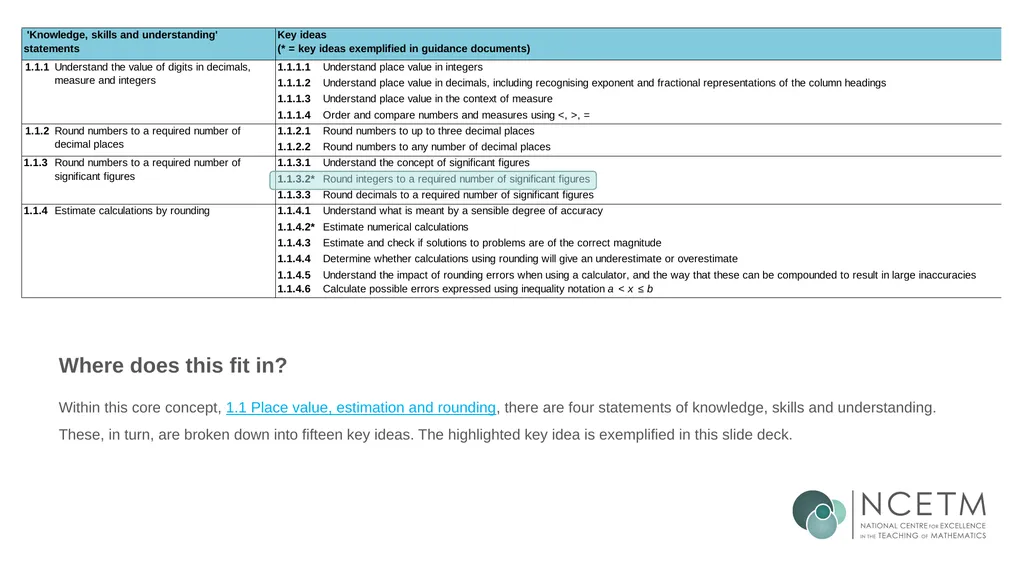
slide5. Where does this fit in? Within this core concept, 1.1 Place value, estimation and rounding, there are four statements of knowledge, skills and understanding.
These, in turn, are broken down into fifteen key ideas. The highlighted key idea is exemplified in this slide deck.<br>
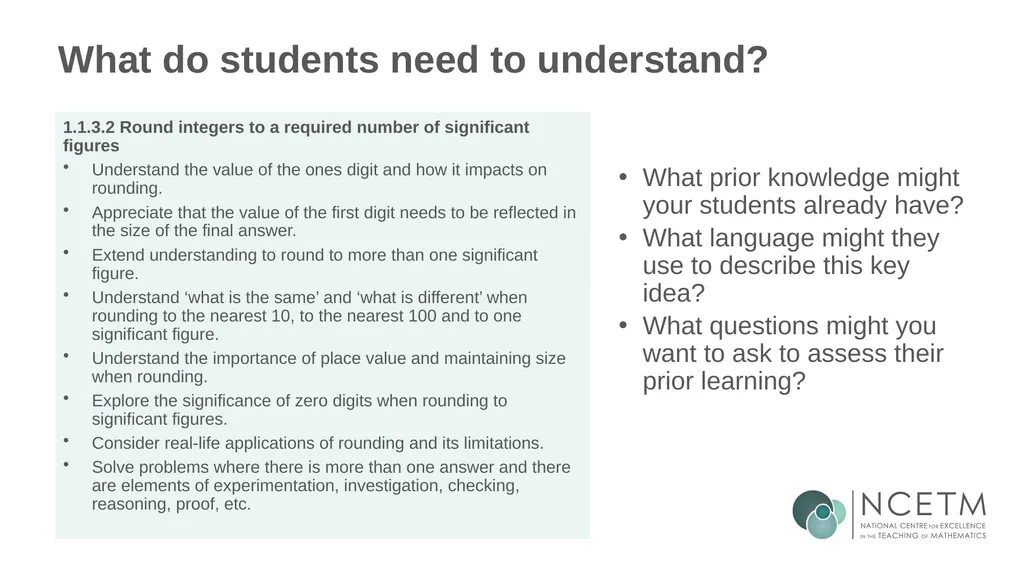
slide6. What do students need to understand? What prior knowledge might your students already have?
What language might they use to describe this key idea?
What questions might you want to ask to assess their prior learning? 1.1.3.2 Round integers to a required number of significant figures
Understand the value of the ones digit and how it impacts on rounding.
Appreciate that the value of the first digit needs to be reflected in the size of the final answer.
Extend understanding to round to more than one significant figure.
Understand ‘what is the same’ and ‘what is different’ when rounding to the nearest 10, to the nearest 100 and to one significant figure.
Understand the importance of place value and maintaining size when rounding.
Explore the significance of zero digits when rounding to significant figures.
Consider real-life applications of rounding and its limitations.
Solve problems where there is more than one answer and there are elements of experimentation, investigation, checking, reasoning, proof, etc.<br>
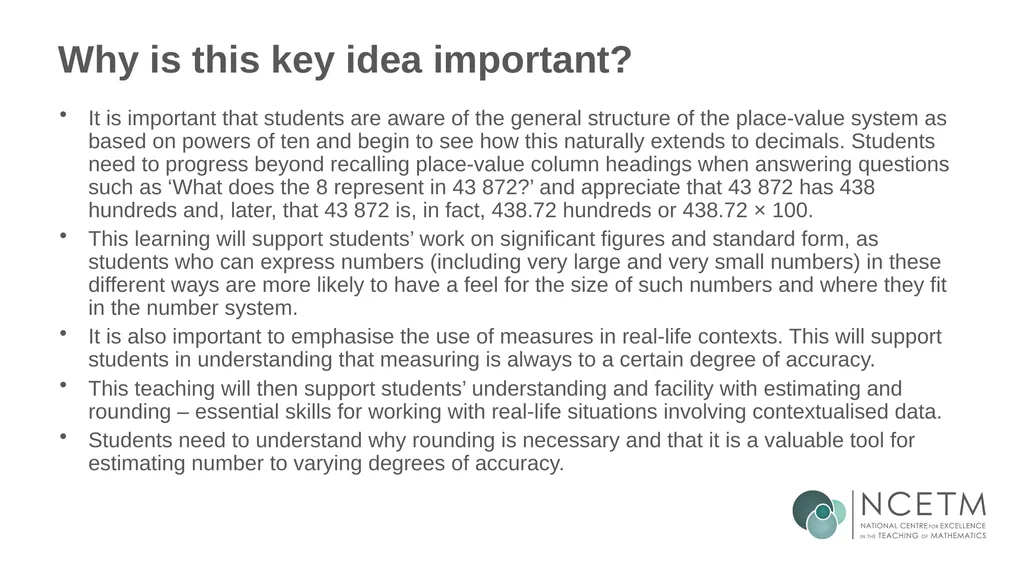
slide7. Why is this key idea important? It is important that students are aware of the general structure of the place-value system as based on powers of ten and begin to see how this naturally extends to decimals. Students need to progress beyond recalling place-value column headings when answering questions such as ‘What does the 8 represent in 43 872?’ and appreciate that 43 872 has 438 hundreds and, later, that 43 872 is, in fact, 438.72 hundreds or 438.72 × 100.
This learning will support students’ work on significant figures and standard form, as students who can express numbers (including very large and very small numbers) in these different ways are more likely to have a feel for the size of such numbers and where they fit in the number system.
It is also important to emphasise the use of measures in real-life contexts. This will support students in understanding that measuring is always to a certain degree of accuracy.
This teaching will then support students’ understanding and facility with estimating and rounding – essential skills for working with real-life situations involving contextualised data.
Students need to understand why rounding is necessary and that it is a valuable tool for estimating number to varying degrees of accuracy.<br>
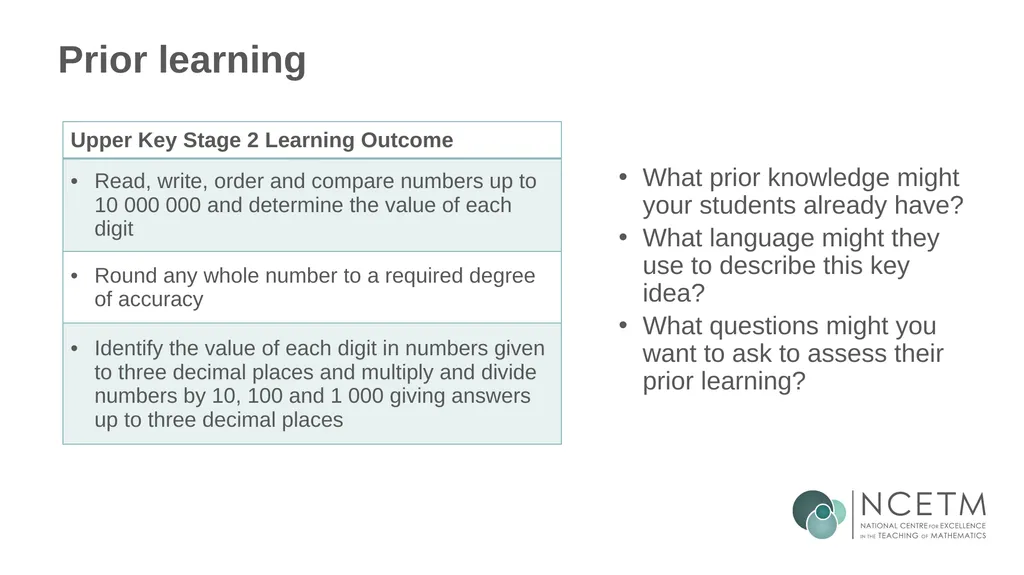
slide8. Prior learning What prior knowledge might your students already have?
What language might they use to describe this key idea?
What questions might you want to ask to assess their prior learning?<br>
slide9. Checking prior learning The following slides contain questions for checking prior learning.
What representations might students use to support their understanding of these questions?
What variation might you put in place for these questions to fully assess students’ understanding of the concept?
How might changing the language of each question change the difficulty?
Why are these such crucial pre-requisites for this key idea?<br>
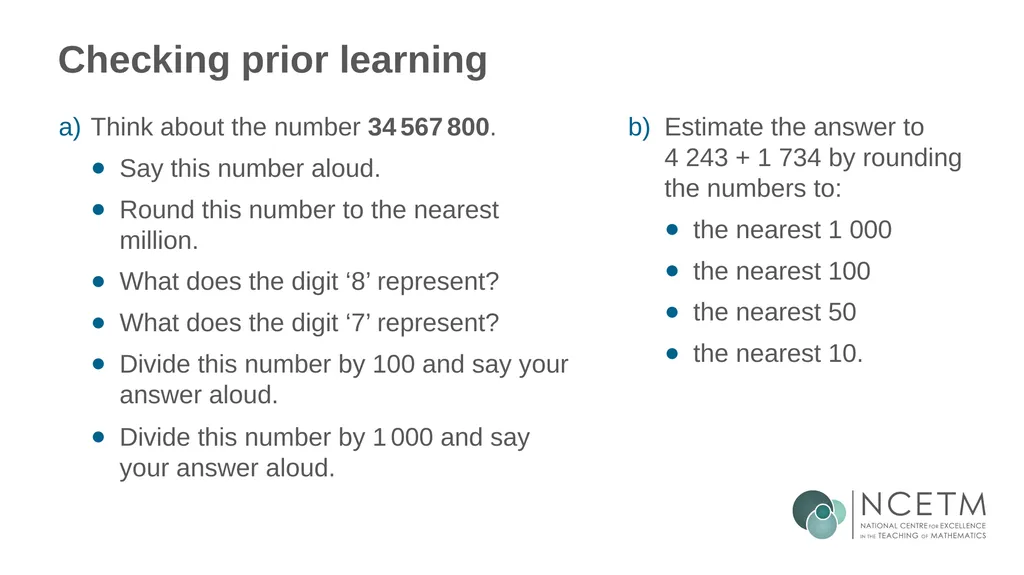
slide10. Checking prior learning Think about the number 34 567 800.
Say this number aloud.
Round this number to the nearest million.
What does the digit ‘8’ represent?
What does the digit ‘7’ represent?
Divide this number by 100 and say your answer aloud.
Divide this number by 1 000 and say your answer aloud. a) Estimate the answer to 4 243 + 1 734 by rounding the numbers to:
the nearest 1 000
the nearest 100
the nearest 50
the nearest 10. b)<br>
slide11. Common difficulties and misconceptions What aspects of this key idea might pupils find challenging?
What misconceptions might pupils have? When teaching this topic, you may find students encounter difficulties with…
Approaching rounding as an algorithm to follow
Identifying when a zero digit is significant
More information, and some suggestions for overcoming these challenges, can be found on the following slides.<br>
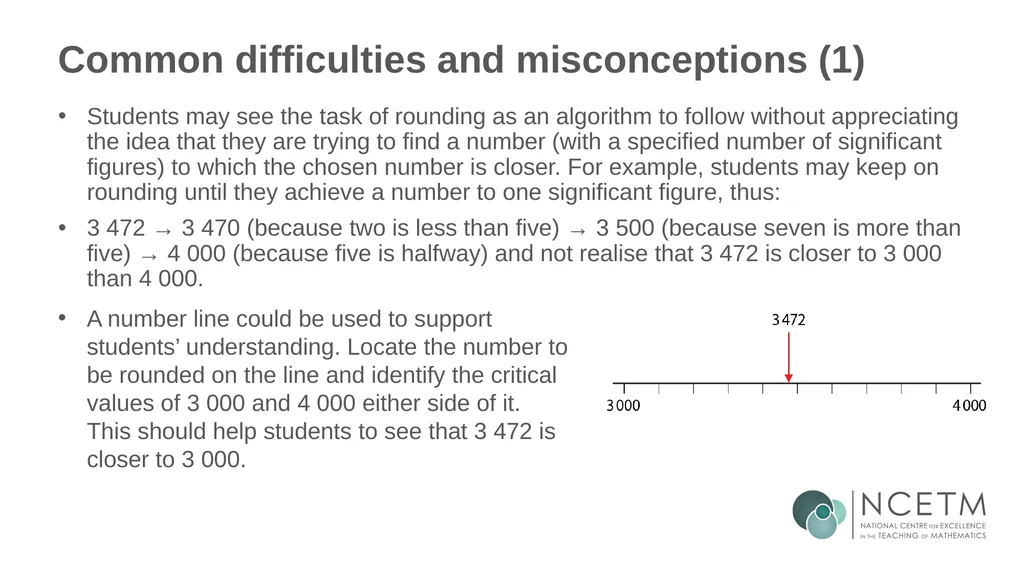
slide12. Common difficulties and misconceptions (1) Students may see the task of rounding as an algorithm to follow without appreciating the idea that they are trying to find a number (with a specified number of significant figures) to which the chosen number is closer. For example, students may keep on rounding until they achieve a number to one significant figure, thus:
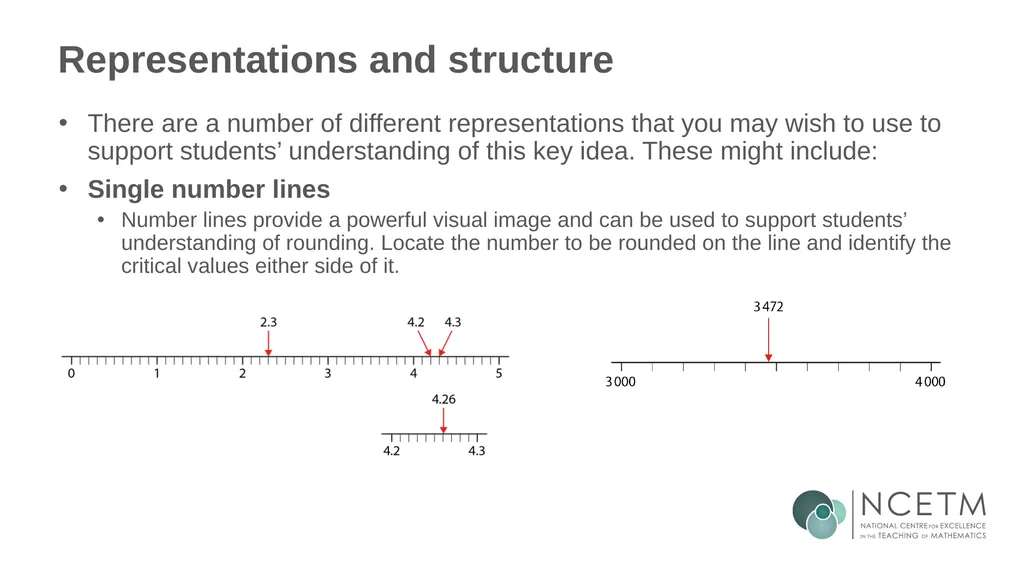
3 472 → 3 470 (because two is less than five) → 3 500 (because seven is more than five) → 4 000 (because five is halfway) and not realise that 3 472 is closer to 3 000 than 4 000. A number line could be used to support students’ understanding. Locate the number to be rounded on the line and identify the critical values of 3 000 and 4 000 either side of it. This should help students to see that 3 472 is closer to 3 000.<br>
slide13. Common difficulties and misconceptions (2) Students can also find it challenging to identify when a zero digit is significant.
Designing questions that contain zero digits in a variety of positions (i.e. within a number and at the end of a number) will help challenge students’ understanding and enable you to identify and address misconceptions.
Students should experience situations where they are asked to round to more significant figures than the number has digits (for example, rounding 96 to three significant figures). Knowing what to do in these scenarios, and how zero digits can be used, is important in developing a comprehensive understanding of the concept.
For a deeper understanding, it will also be important to offer students the opportunity to think about numbers that have already been rounded (as in Example 9).
Further information about how you might use variation to support students’ understanding can be found in the notes below.<br>
slide14. Common difficulties and misconceptions (2 cont’d) Avoid mechanistic practice of exclusively standard questions, as this can result in students stopping thinking and blindly following a procedure. Carefully design questions which draw students’ attention to a specific aspect by varying one element at a time (see Example 1), as this will enable students to notice what is happening and develop a deeper understanding of the structure.
The use of non-standard examples, examples of errors or non-examples (such as Examples 5 and 6) for students to critique and reason about, and asking students to solve problems in a number of different ways, can all support students to overcome difficulties and establish a secure understanding.<br>
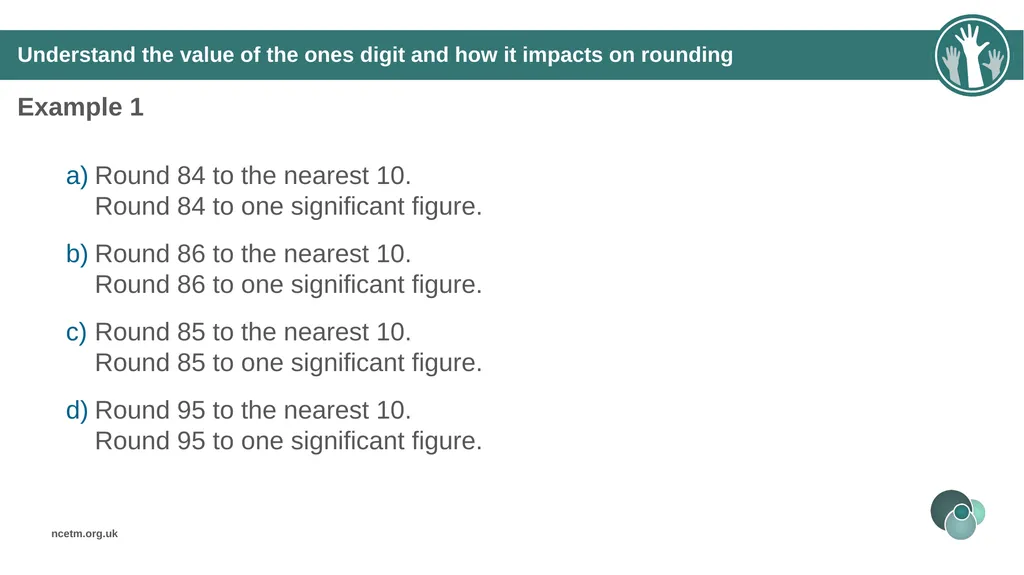
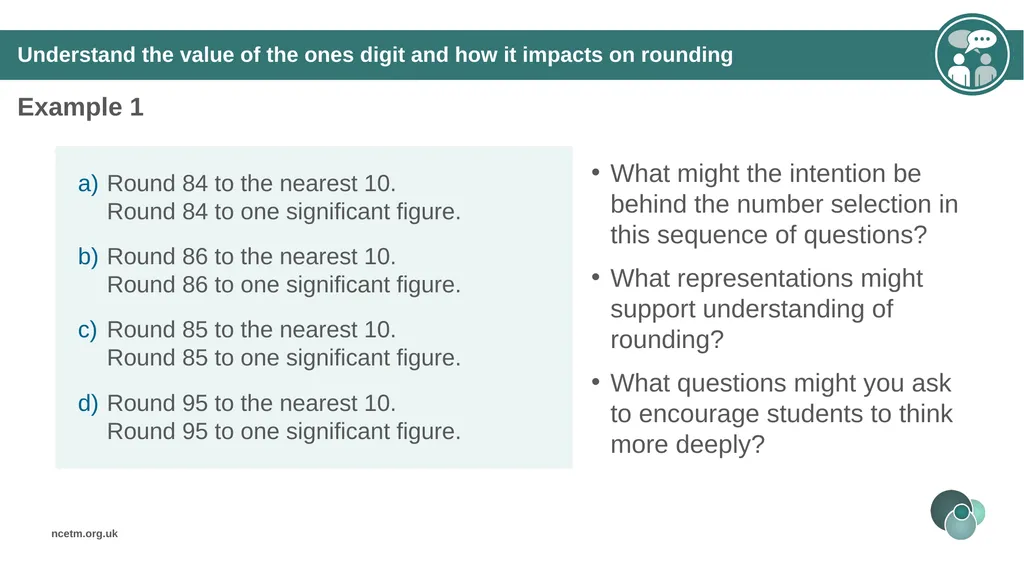
slide15. Understand the value of the ones digit and how it impacts on rounding Example 1 Round 84 to the nearest 10. Round 84 to one significant figure.
Round 86 to the nearest 10. Round 86 to one significant figure.
Round 85 to the nearest 10. Round 85 to one significant figure.
Round 95 to the nearest 10. Round 95 to one significant figure.<br>
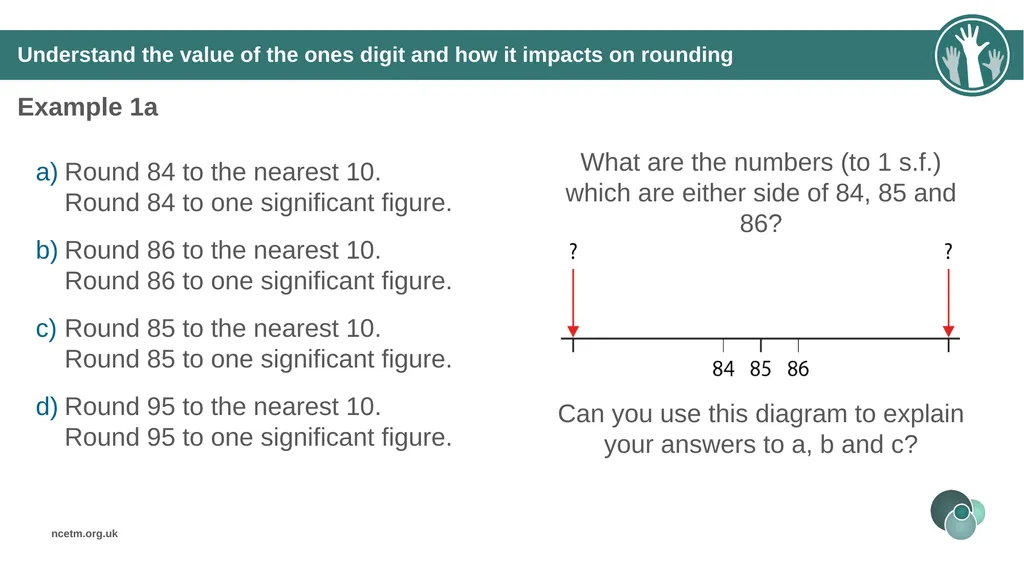
slide16. Understand the value of the ones digit and how it impacts on rounding Example 1a Round 84 to the nearest 10. Round 84 to one significant figure.
Round 86 to the nearest 10. Round 86 to one significant figure.
Round 85 to the nearest 10. Round 85 to one significant figure.
Round 95 to the nearest 10. Round 95 to one significant figure. Can you use this diagram to explain your answers to a, b and c? What are the numbers (to 1 s.f.) which are either side of 84, 85 and 86?<br>
slide17. What might the intention be behind the number selection in this sequence of questions?
What representations might support understanding of rounding?
What questions might you ask to encourage students to think more deeply? Understand the value of the ones digit and how it impacts on rounding Example 1<br>
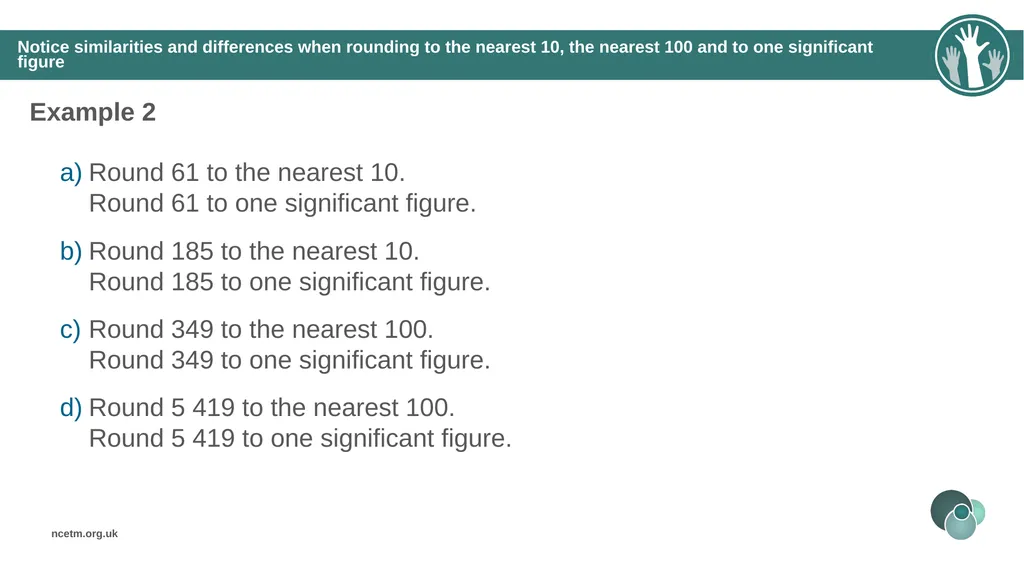
slide18. Notice similarities and differences when rounding to the nearest 10, the nearest 100 and to one significant figure Example 2 Round 61 to the nearest 10. Round 61 to one significant figure.
Round 185 to the nearest 10. Round 185 to one significant figure.
Round 349 to the nearest 100. Round 349 to one significant figure.
Round 5 419 to the nearest 100. Round 5 419 to one significant figure.<br>
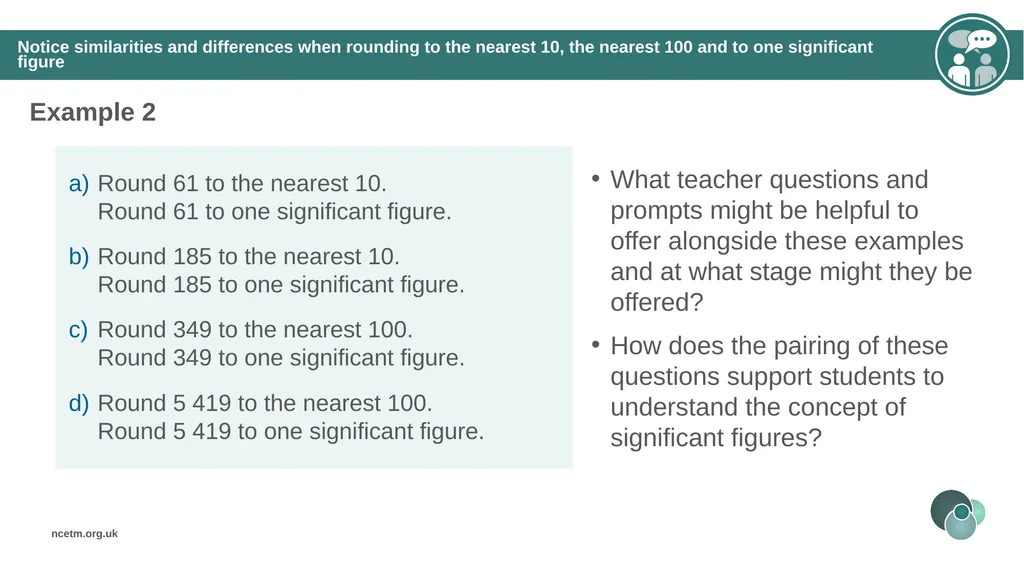
slide19. What teacher questions and prompts might be helpful to offer alongside these examples and at what stage might they be offered?
How does the pairing of these questions support students to understand the concept of significant figures? Notice similarities and differences when rounding to the nearest 10, the nearest 100 and to one significant figure Example 2<br>
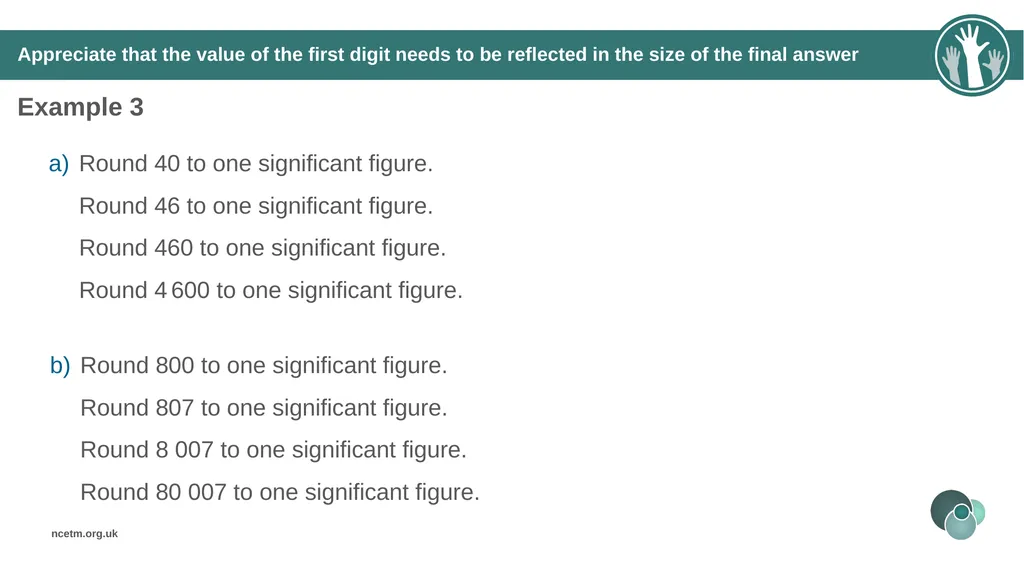
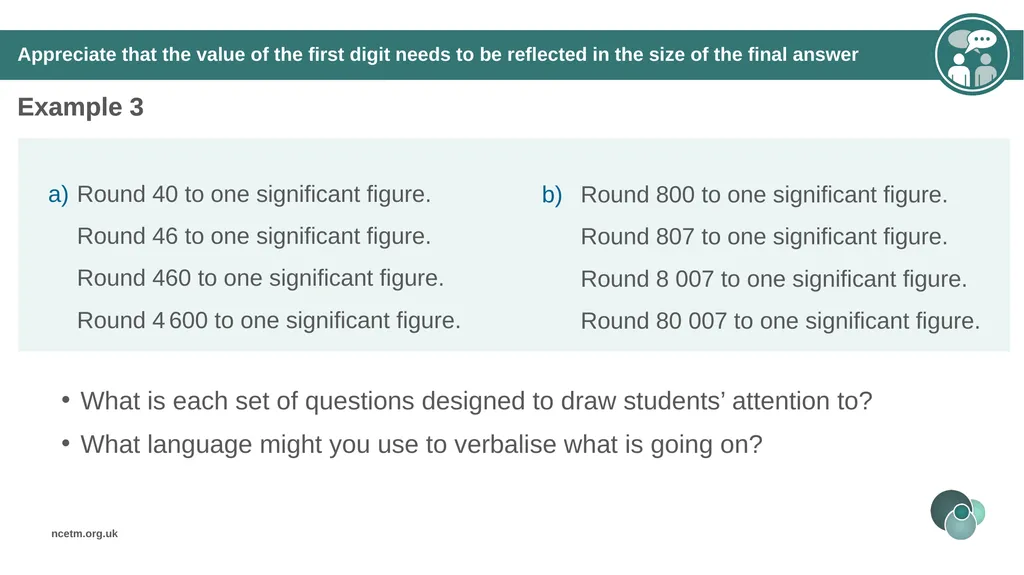
slide20. Appreciate that the value of the first digit needs to be reflected in the size of the final answer Example 3 Round 40 to one significant figure. Round 46 to one significant figure. Round 460 to one significant figure. Round 4 600 to one significant figure. Round 800 to one significant figure. Round 807 to one significant figure. Round 8 007 to one significant figure. Round 80 007 to one significant figure.<br>
slide21. What is each set of questions designed to draw students’ attention to?
What language might you use to verbalise what is going on? Appreciate that the value of the first digit needs to be reflected in the size of the final answer Example 3 Example 3<br>
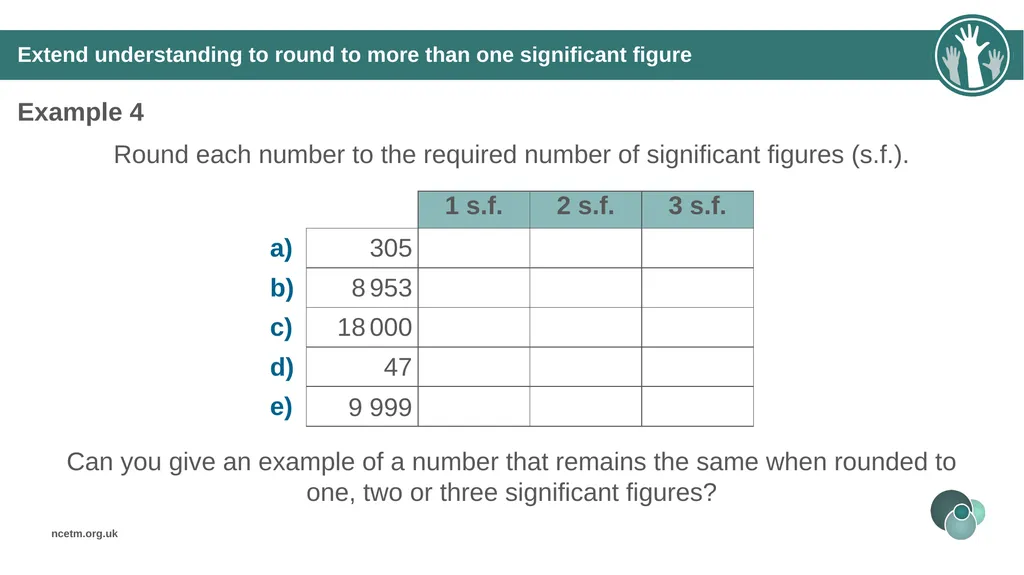
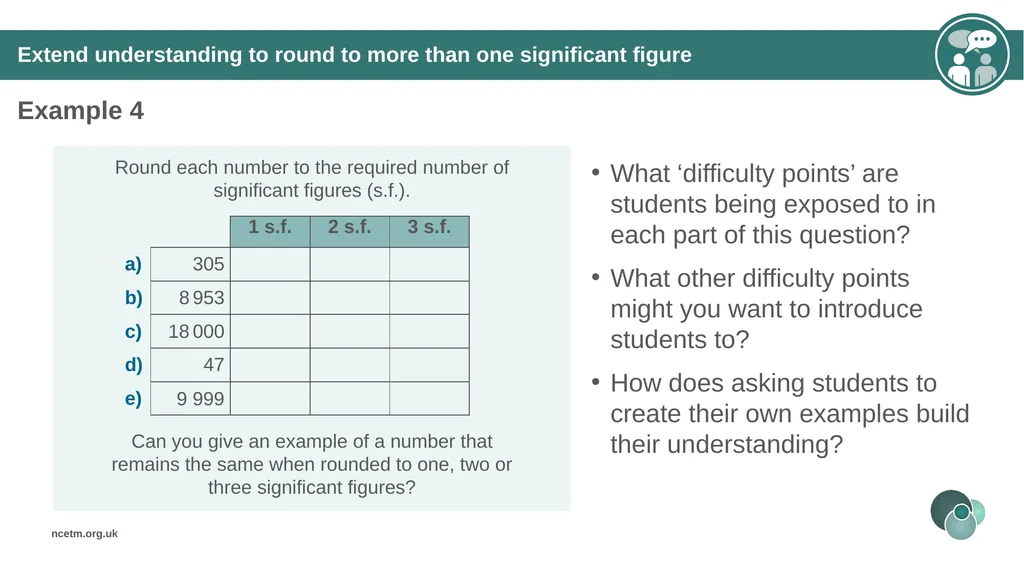
slide22. Extend understanding to round to more than one significant figure Example 4 Round each number to the required number of significant figures (s.f.). Can you give an example of a number that remains the same when rounded to one, two or three significant figures?<br>
slide23. What ‘difficulty points’ are students being exposed to in each part of this question?
What other difficulty points might you want to introduce students to?
How does asking students to create their own examples build their understanding? Extend understanding to round to more than one significant figure Example 4<br>
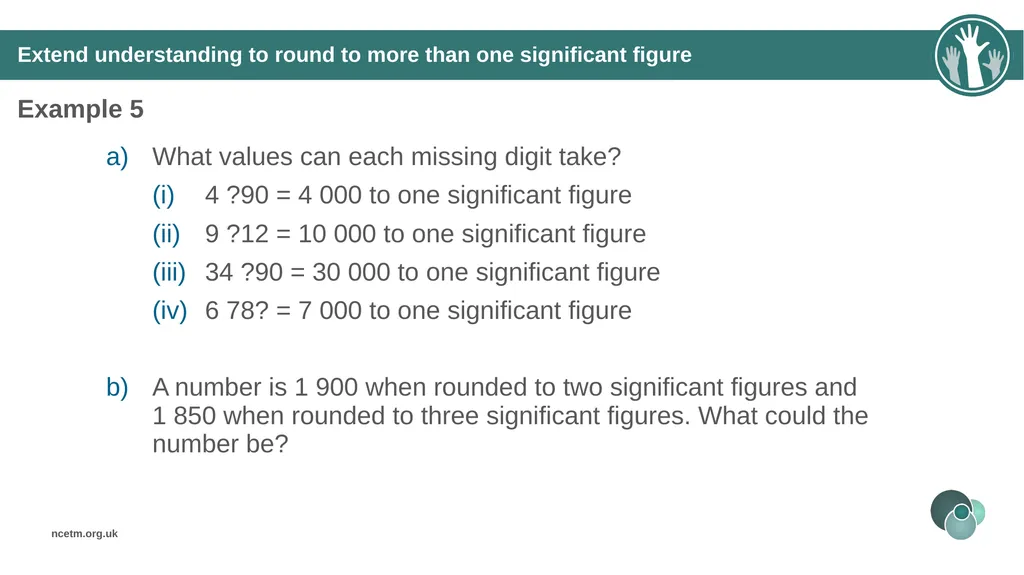
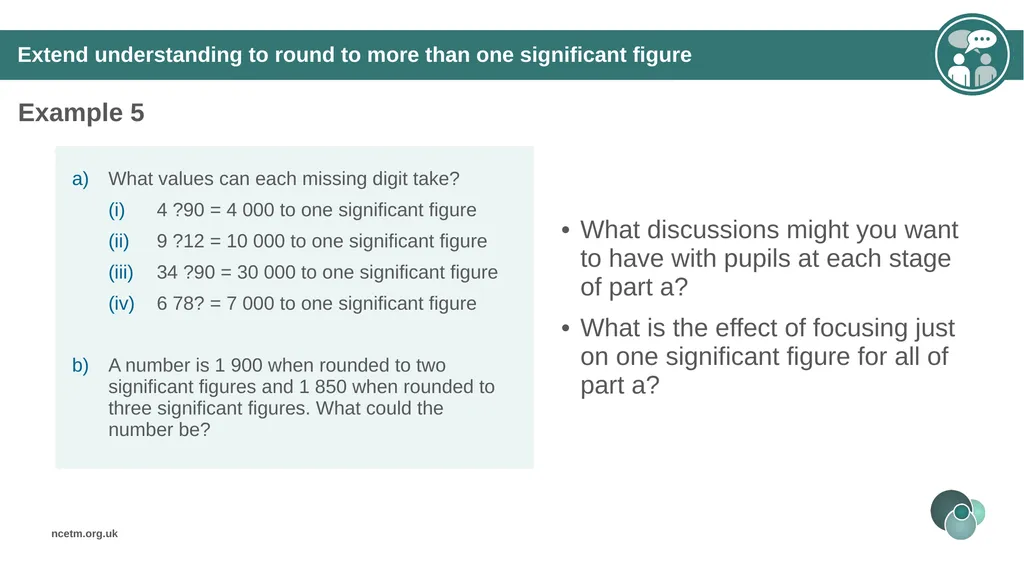
slide24. Extend understanding to round to more than one significant figure Example 5<br>
slide25. What discussions might you want to have with pupils at each stage of part a?
What is the effect of focusing just on one significant figure for all of part a? Extend understanding to round to more than one significant figure Example 5<br>
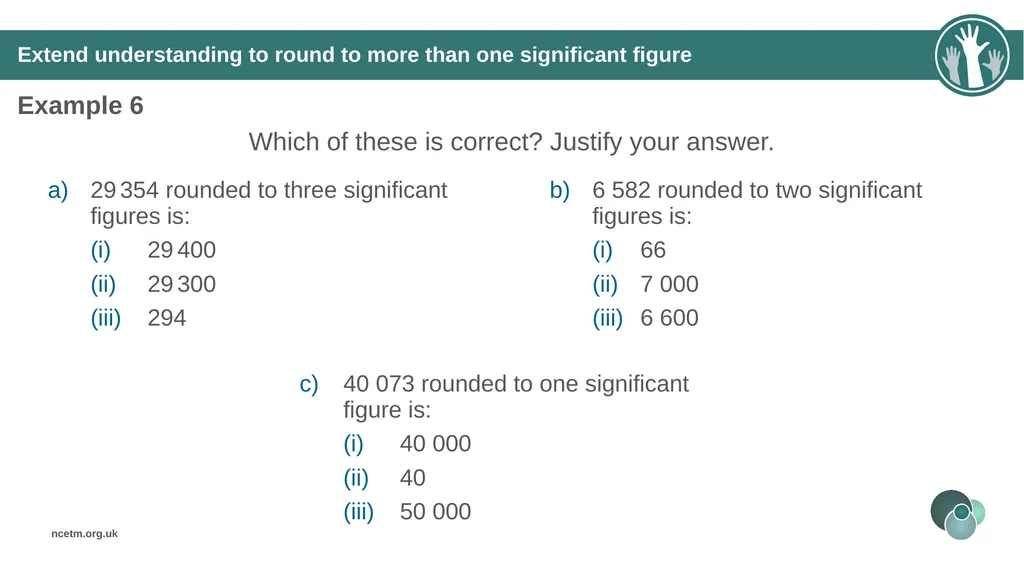
slide26. Example 6 Extend understanding to round to more than one significant figure<br>
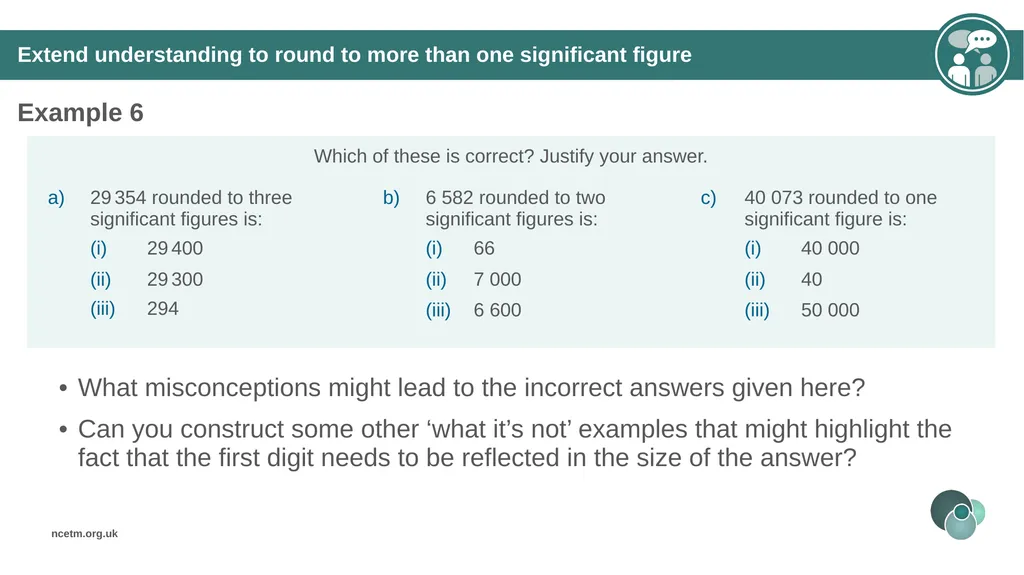
slide27. What misconceptions might lead to the incorrect answers given here?
Can you construct some other ‘what it’s not’ examples that might highlight the fact that the first digit needs to be reflected in the size of the answer? Example 6 Extend understanding to round to more than one significant figure<br>
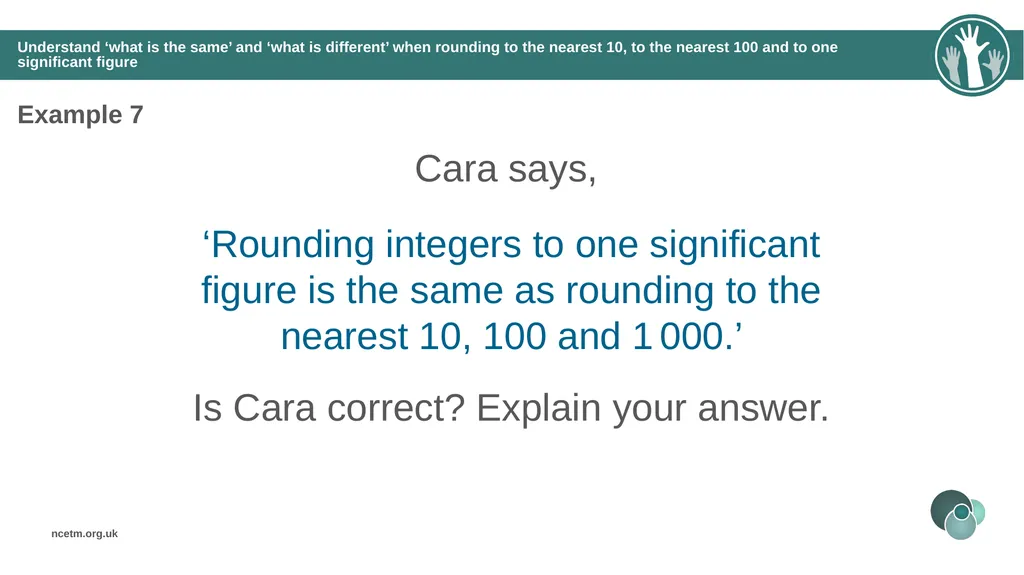
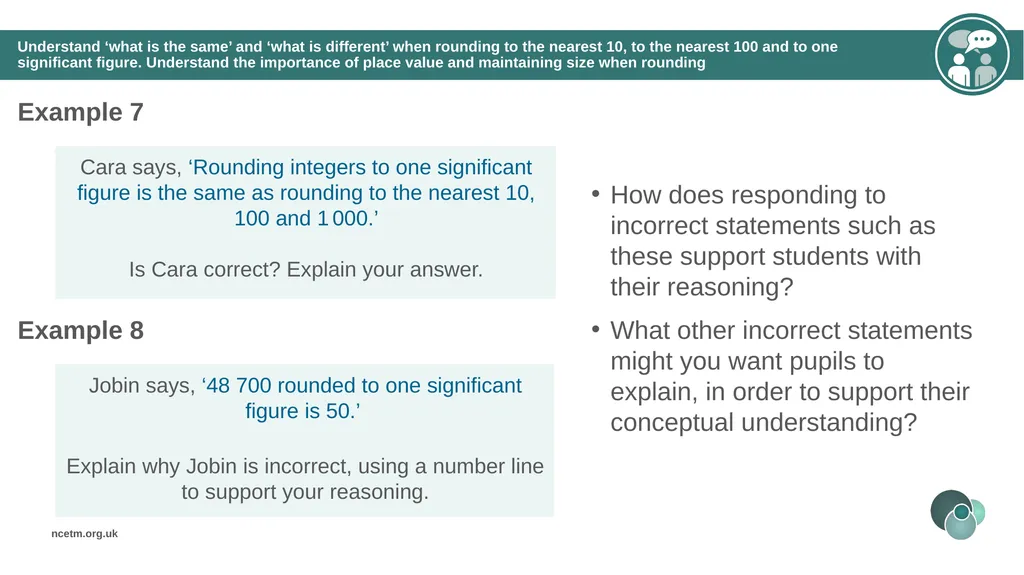
slide28. Understand ‘what is the same’ and ‘what is different’ when rounding to the nearest 10, to the nearest 100 and to one significant figure Example 7 Cara says,
‘Rounding integers to one significant figure is the same as rounding to the nearest 10, 100 and 1 000.’
Is Cara correct? Explain your answer.<br>
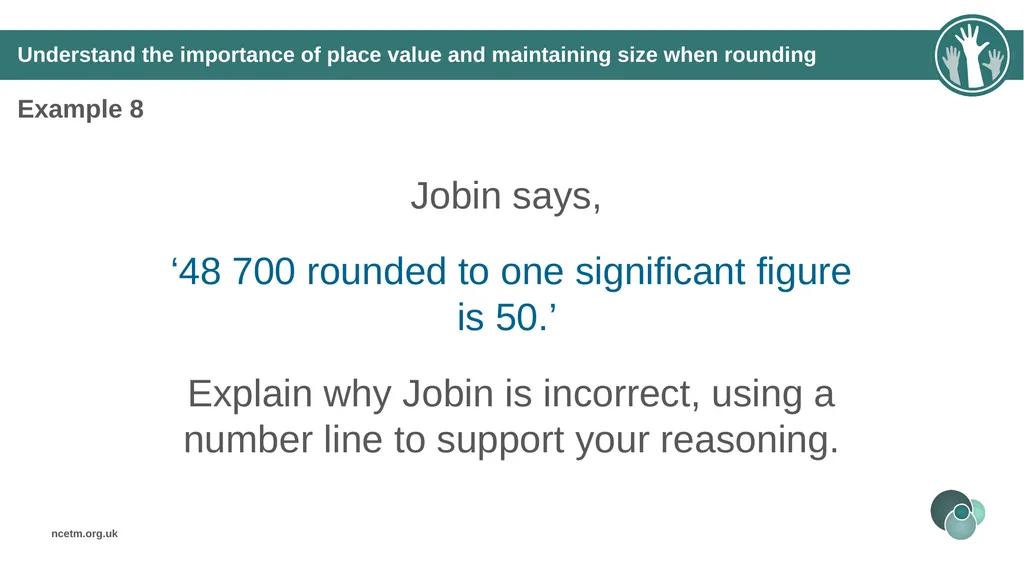
slide29. Understand the importance of place value and maintaining size when rounding Example 8 Jobin says,
‘48 700 rounded to one significant figure is 50.’
Explain why Jobin is incorrect, using a number line to support your reasoning.<br>
slide30. How does responding to incorrect statements such as these support students with their reasoning?
What other incorrect statements might you want pupils to explain, in order to support their conceptual understanding? Understand ‘what is the same’ and ‘what is different’ when rounding to the nearest 10, to the nearest 100 and to one significant figure. Understand the importance of place value and maintaining size when rounding Example 7 Example 8<br>
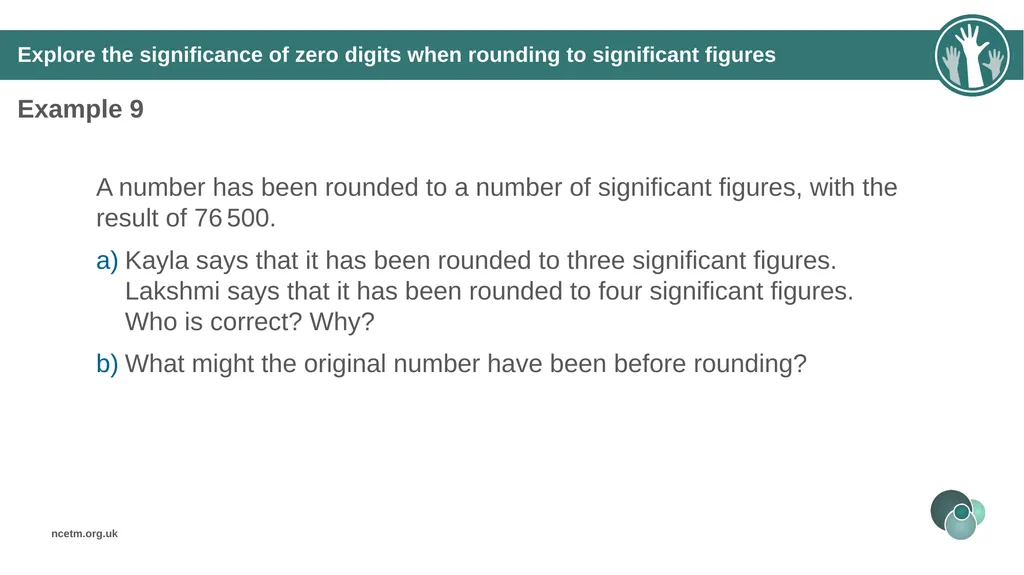
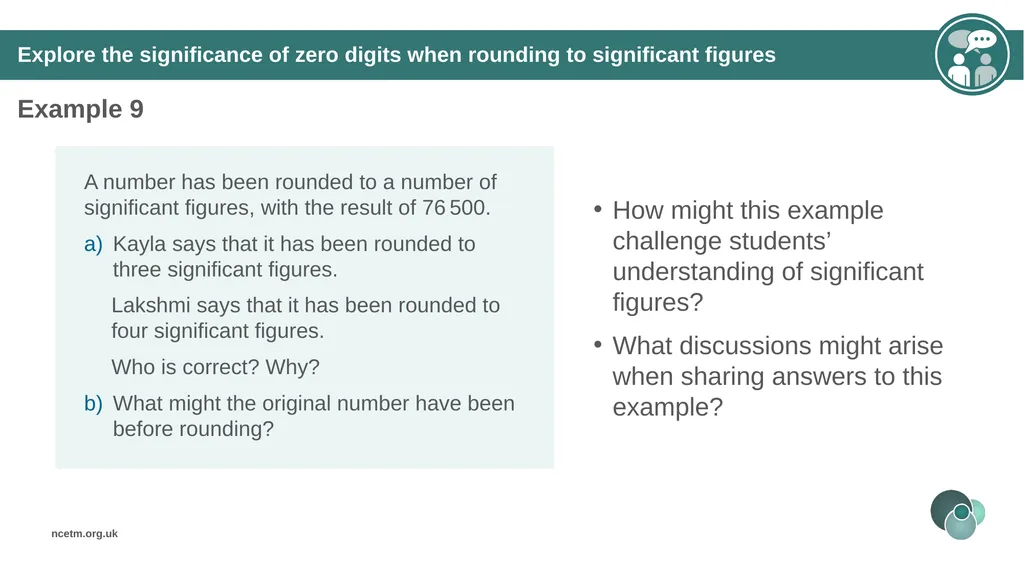
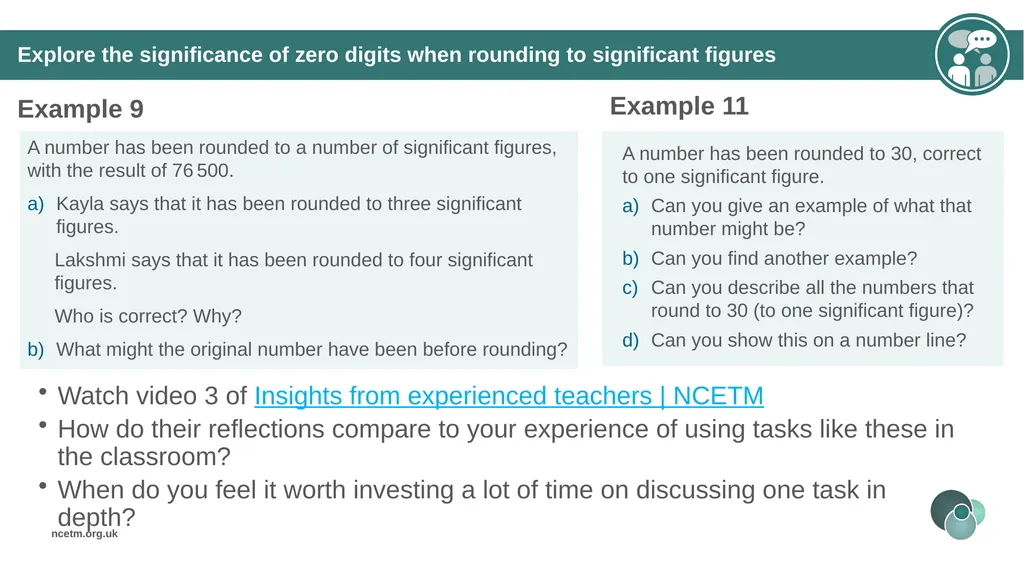
slide31. Explore the significance of zero digits when rounding to significant figures Example 9 A number has been rounded to a number of significant figures, with the result of 76 500.
Kayla says that it has been rounded to three significant figures. Lakshmi says that it has been rounded to four significant figures. Who is correct? Why?
What might the original number have been before rounding?<br>
slide32. How might this example challenge students’ understanding of significant figures?
What discussions might arise when sharing answers to this example? Explore the significance of zero digits when rounding to significant figures Example 9<br>
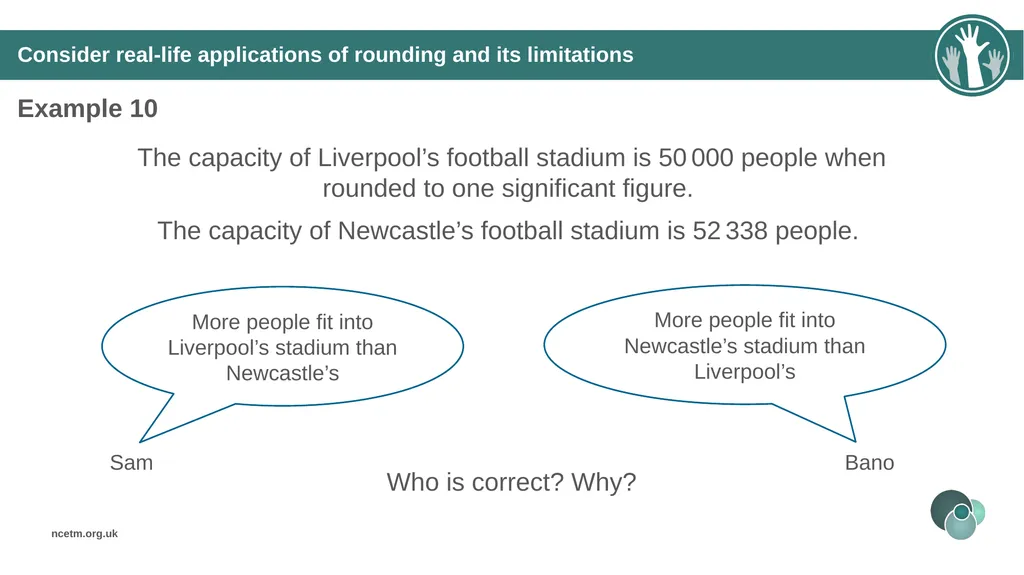
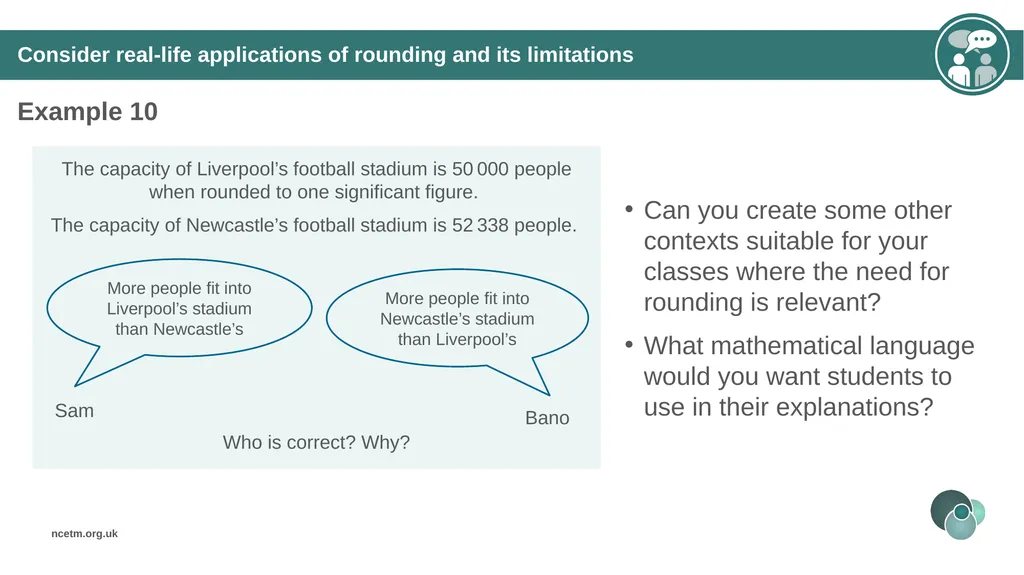
slide33. Consider real-life applications of rounding and its limitations Example 10 The capacity of Liverpool’s football stadium is 50 000 people when rounded to one significant figure.
The capacity of Newcastle’s football stadium is 52 338 people. More people fit into Liverpool’s stadium than Newcastle’s More people fit into Newcastle’s stadium than Liverpool’s Sam Bano Who is correct? Why?<br>
slide34. Can you create some other contexts suitable for your classes where the need for rounding is relevant?
What mathematical language would you want students to use in their explanations? Consider real-life applications of rounding and its limitations Example 10<br>
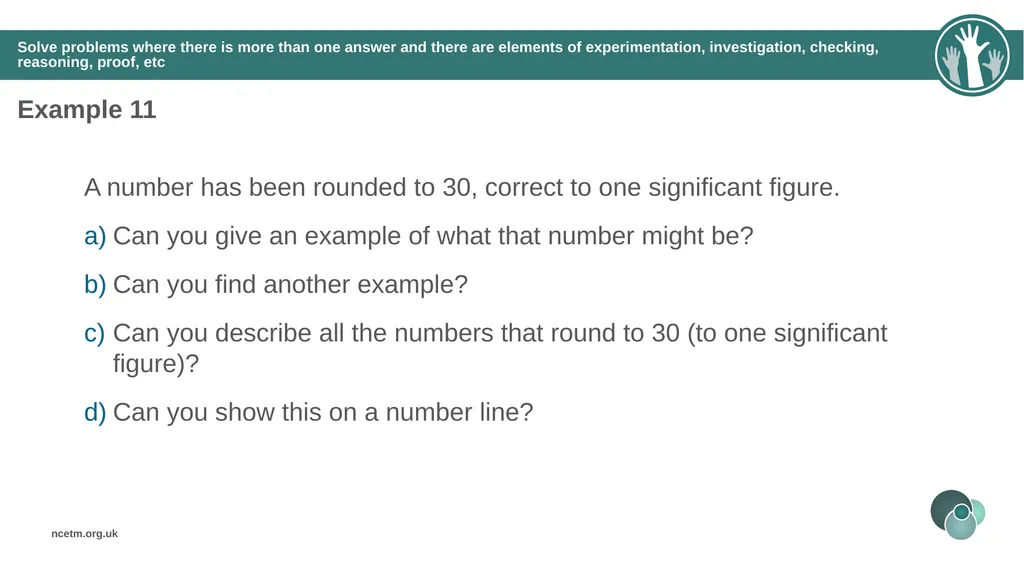
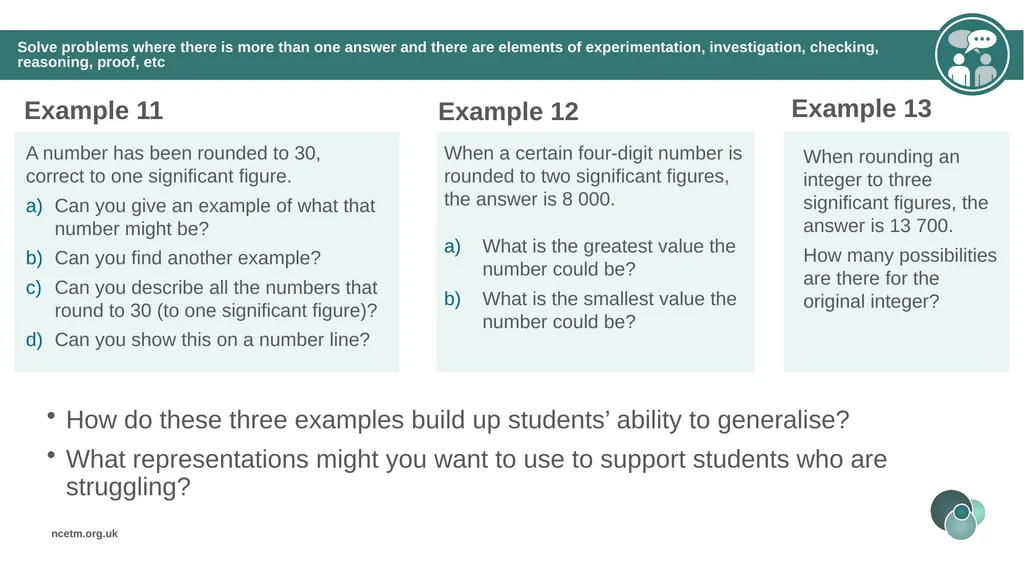
slide35. Solve problems where there is more than one answer and there are elements of experimentation, investigation, checking, reasoning, proof, etc Example 11 A number has been rounded to 30, correct to one significant figure.
Can you give an example of what that number might be?
Can you find another example?
Can you describe all the numbers that round to 30 (to one significant figure)?
Can you show this on a number line?<br>
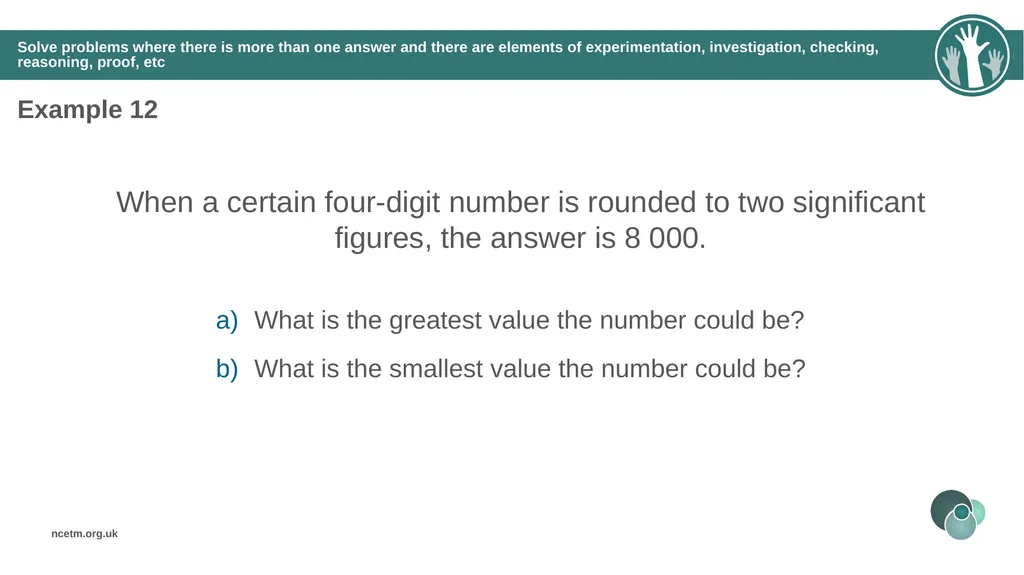
slide36. Solve problems where there is more than one answer and there are elements of experimentation, investigation, checking, reasoning, proof, etc Example 12 What is the greatest value the number could be?
What is the smallest value the number could be? When a certain four-digit number is rounded to two significant figures, the answer is 8 000.<br>
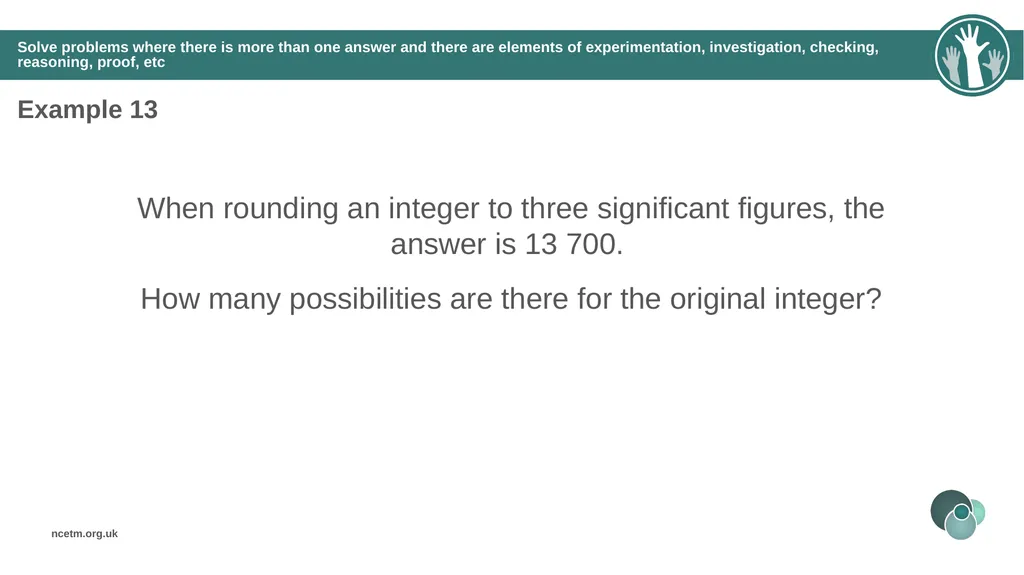
slide37. Solve problems where there is more than one answer and there are elements of experimentation, investigation, checking, reasoning, proof, etc Example 13 When rounding an integer to three significant figures, the answer is 13 700.
How many possibilities are there for the original integer?<br>
slide38. How do these three examples build up students’ ability to generalise?
What representations might you want to use to support students who are struggling? Solve problems where there is more than one answer and there are elements of experimentation, investigation, checking, reasoning, proof, etc Example 13 Example 11 Example 12<br>
slide39. Watch video 3 of Insights from experienced teachers | NCETM
How do their reflections compare to your experience of using tasks like these in the classroom?
When do you feel it worth investing a lot of time on discussing one task in depth? Explore the significance of zero digits when rounding to significant figures Example 9 Example 11<br>
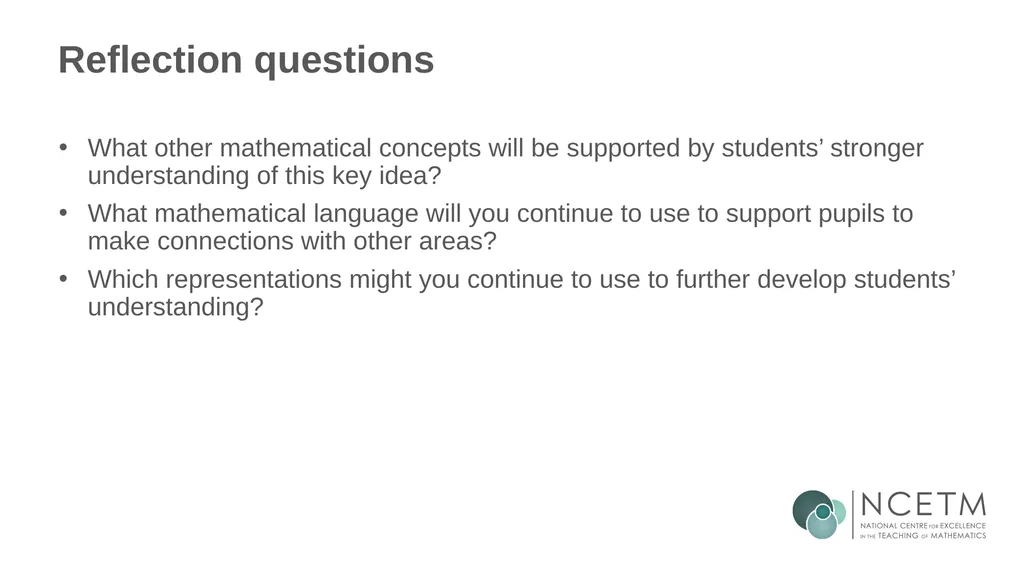
slide40. Reflection questions What other mathematical concepts will be supported by students’ stronger understanding of this key idea?
What mathematical language will you continue to use to support pupils to make connections with other areas?
Which representations might you continue to use to further develop students’ understanding?<br>
slide42. Appendices You may choose to use the following slides when planning or delivering a PD session. They cover:
Key vocabulary
Representations and structure
Previous learning
Future learning
Library of links<br>
slide43. Key vocabulary<br>
slide44. Representations and structure There are a number of different representations that you may wish to use to support students’ understanding of this key idea. These might include:
Single number lines
Number lines provide a powerful visual image and can be used to support students’ understanding of rounding. Locate the number to be rounded on the line and identify the critical values either side of it.<br>
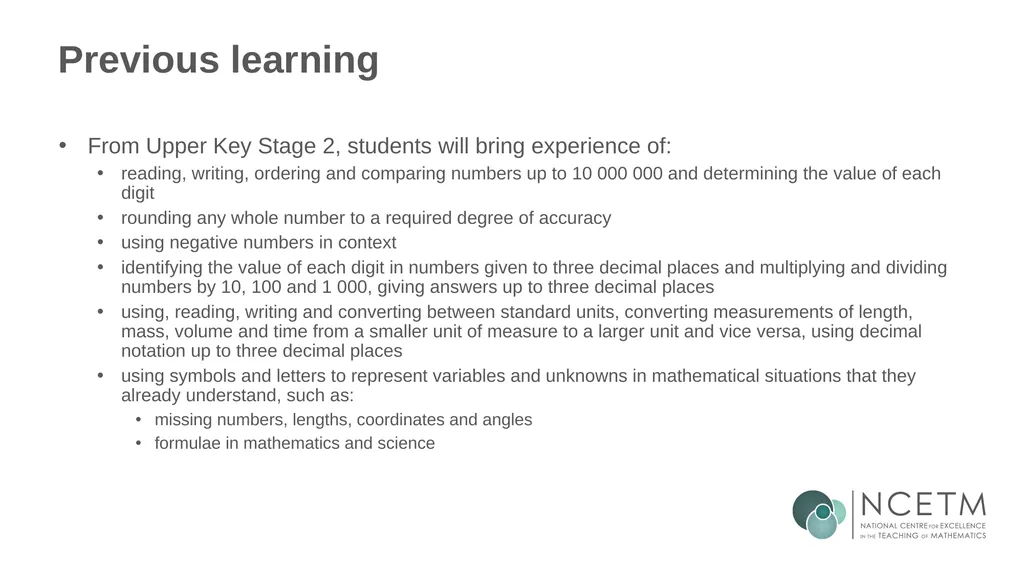
slide45. Previous learning From Upper Key Stage 2, students will bring experience of:
reading, writing, ordering and comparing numbers up to 10 000 000 and determining the value of each digit
rounding any whole number to a required degree of accuracy
using negative numbers in context
identifying the value of each digit in numbers given to three decimal places and multiplying and dividing numbers by 10, 100 and 1 000, giving answers up to three decimal places
using, reading, writing and converting between standard units, converting measurements of length, mass, volume and time from a smaller unit of measure to a larger unit and vice versa, using decimal notation up to three decimal places
using symbols and letters to represent variables and unknowns in mathematical situations that they already understand, such as:
missing numbers, lengths, coordinates and angles
formulae in mathematics and science<br>
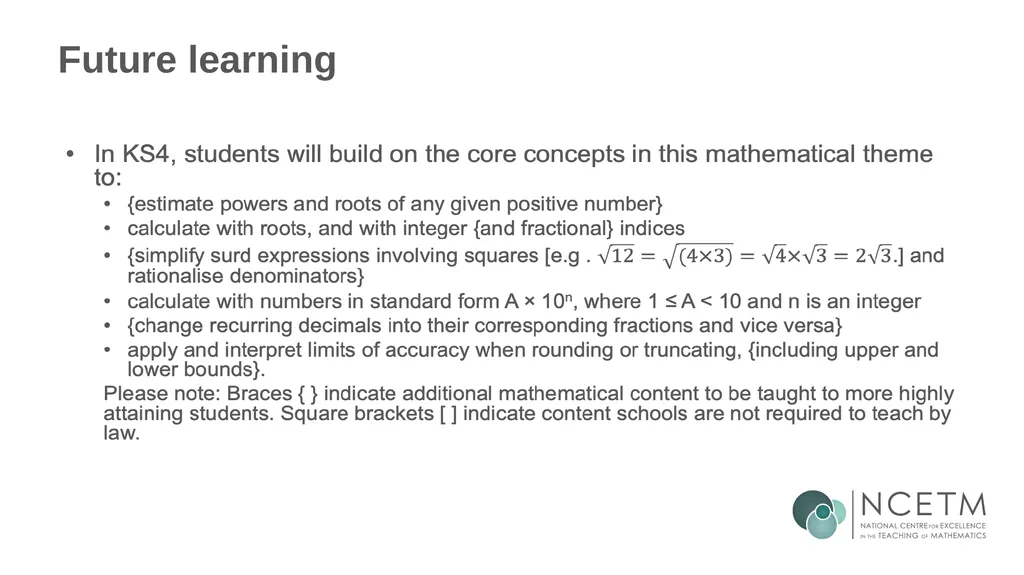
slide46. Future learning<br>
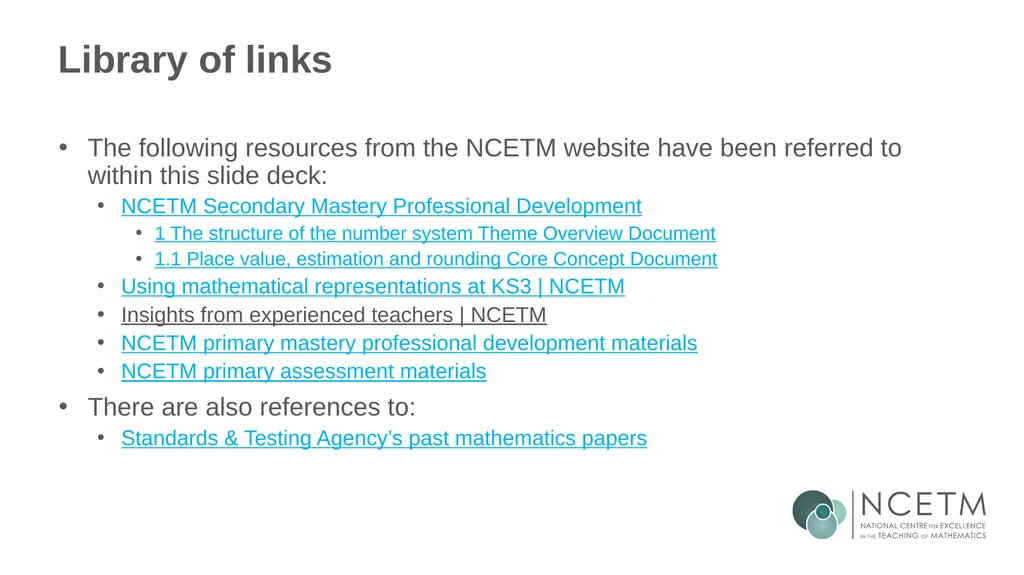
slide47. Library of links The following resources from the NCETM website have been referred to within this slide deck:
NCETM Secondary Mastery Professional Development
1 The structure of the number system Theme Overview Document
1.1 Place value, estimation and rounding Core Concept Document
Using mathematical representations at KS3 | NCETM
Insights from experienced teachers | NCETM
NCETM primary mastery professional development materials
NCETM primary assessment materials
There are also references to:
Standards & Testing Agency’s past mathematics papers<br>
Materials for use in the classroom or to support professional development discussions Summer 2021<br>
slide2. About this resource These slides are designed to complement the 1.1 Place value, estimation and rounding Core Concept document and its associated Theme Overview document 1 The Structure of the number system, both found in the Secondary Mastery Professional Development pages.
These slides re-present the key examples from the Core Concept document so that the examples can be used either directly in the classroom or with a group of teachers. There are prompt questions alongside the examples, and further clarification in the notes.
These slides do not fully replicate the Core Concept document, so should be used alongside it. Reference to specific page numbers, and to other useful NCETM resources, can be found in the notes for each slide.
This slide deck is not designed to be a complete PD session, rather it is a selection of resources that you can adapt and use as needed when planning a session with a group of teachers.<br>
slide3. About this resource The slides are structured as follows:
The big picture:
Where does this fit in?
What do students need to understand?
Why is this key idea important?
Prior learning
Misconceptions
Exemplified key ideas
Reflection questions
Appendices:
Key vocabulary
Representations and structure
Previous and Future learning
Useful links The exemplified key idea slides have the following symbols to indicate how they have been designed to be used: Into the classroom
The examples are presented on these slides so that they could be used in PD, but also directly in the classroom. The notes feature suggested questions and things teachers might consider when using with students. PD discussion prompts
These slides look at the examples in more detail, with question prompts to promote discussion among maths teachers. The notes feature reference to further information and guidance within the Core Concepts document.<br>
slide4. Where does this fit in? The NCETM has identified a set of six ‘mathematical themes’ within Key Stage 3 mathematics that bring together a group of ‘core concepts’.
The first of these themes is The structure of the number system, which covers the following interconnected core concepts:
1.1 Place value, estimation and rounding
1.2 Properties of number
1.3 Ordering and comparing
1.4 Simplifying and manipulating expressions, equations and formulae<br>
slide5. Where does this fit in? Within this core concept, 1.1 Place value, estimation and rounding, there are four statements of knowledge, skills and understanding.
These, in turn, are broken down into fifteen key ideas. The highlighted key idea is exemplified in this slide deck.<br>
slide6. What do students need to understand? What prior knowledge might your students already have?
What language might they use to describe this key idea?
What questions might you want to ask to assess their prior learning? 1.1.3.2 Round integers to a required number of significant figures
Understand the value of the ones digit and how it impacts on rounding.
Appreciate that the value of the first digit needs to be reflected in the size of the final answer.
Extend understanding to round to more than one significant figure.
Understand ‘what is the same’ and ‘what is different’ when rounding to the nearest 10, to the nearest 100 and to one significant figure.
Understand the importance of place value and maintaining size when rounding.
Explore the significance of zero digits when rounding to significant figures.
Consider real-life applications of rounding and its limitations.
Solve problems where there is more than one answer and there are elements of experimentation, investigation, checking, reasoning, proof, etc.<br>
slide7. Why is this key idea important? It is important that students are aware of the general structure of the place-value system as based on powers of ten and begin to see how this naturally extends to decimals. Students need to progress beyond recalling place-value column headings when answering questions such as ‘What does the 8 represent in 43 872?’ and appreciate that 43 872 has 438 hundreds and, later, that 43 872 is, in fact, 438.72 hundreds or 438.72 × 100.
This learning will support students’ work on significant figures and standard form, as students who can express numbers (including very large and very small numbers) in these different ways are more likely to have a feel for the size of such numbers and where they fit in the number system.
It is also important to emphasise the use of measures in real-life contexts. This will support students in understanding that measuring is always to a certain degree of accuracy.
This teaching will then support students’ understanding and facility with estimating and rounding – essential skills for working with real-life situations involving contextualised data.
Students need to understand why rounding is necessary and that it is a valuable tool for estimating number to varying degrees of accuracy.<br>
slide8. Prior learning What prior knowledge might your students already have?
What language might they use to describe this key idea?
What questions might you want to ask to assess their prior learning?<br>
slide9. Checking prior learning The following slides contain questions for checking prior learning.
What representations might students use to support their understanding of these questions?
What variation might you put in place for these questions to fully assess students’ understanding of the concept?
How might changing the language of each question change the difficulty?
Why are these such crucial pre-requisites for this key idea?<br>
slide10. Checking prior learning Think about the number 34 567 800.
Say this number aloud.
Round this number to the nearest million.
What does the digit ‘8’ represent?
What does the digit ‘7’ represent?
Divide this number by 100 and say your answer aloud.
Divide this number by 1 000 and say your answer aloud. a) Estimate the answer to 4 243 + 1 734 by rounding the numbers to:
the nearest 1 000
the nearest 100
the nearest 50
the nearest 10. b)<br>
slide11. Common difficulties and misconceptions What aspects of this key idea might pupils find challenging?
What misconceptions might pupils have? When teaching this topic, you may find students encounter difficulties with…
Approaching rounding as an algorithm to follow
Identifying when a zero digit is significant
More information, and some suggestions for overcoming these challenges, can be found on the following slides.<br>
slide12. Common difficulties and misconceptions (1) Students may see the task of rounding as an algorithm to follow without appreciating the idea that they are trying to find a number (with a specified number of significant figures) to which the chosen number is closer. For example, students may keep on rounding until they achieve a number to one significant figure, thus:
3 472 → 3 470 (because two is less than five) → 3 500 (because seven is more than five) → 4 000 (because five is halfway) and not realise that 3 472 is closer to 3 000 than 4 000. A number line could be used to support students’ understanding. Locate the number to be rounded on the line and identify the critical values of 3 000 and 4 000 either side of it. This should help students to see that 3 472 is closer to 3 000.<br>
slide13. Common difficulties and misconceptions (2) Students can also find it challenging to identify when a zero digit is significant.
Designing questions that contain zero digits in a variety of positions (i.e. within a number and at the end of a number) will help challenge students’ understanding and enable you to identify and address misconceptions.
Students should experience situations where they are asked to round to more significant figures than the number has digits (for example, rounding 96 to three significant figures). Knowing what to do in these scenarios, and how zero digits can be used, is important in developing a comprehensive understanding of the concept.
For a deeper understanding, it will also be important to offer students the opportunity to think about numbers that have already been rounded (as in Example 9).
Further information about how you might use variation to support students’ understanding can be found in the notes below.<br>
slide14. Common difficulties and misconceptions (2 cont’d) Avoid mechanistic practice of exclusively standard questions, as this can result in students stopping thinking and blindly following a procedure. Carefully design questions which draw students’ attention to a specific aspect by varying one element at a time (see Example 1), as this will enable students to notice what is happening and develop a deeper understanding of the structure.
The use of non-standard examples, examples of errors or non-examples (such as Examples 5 and 6) for students to critique and reason about, and asking students to solve problems in a number of different ways, can all support students to overcome difficulties and establish a secure understanding.<br>
slide15. Understand the value of the ones digit and how it impacts on rounding Example 1 Round 84 to the nearest 10. Round 84 to one significant figure.
Round 86 to the nearest 10. Round 86 to one significant figure.
Round 85 to the nearest 10. Round 85 to one significant figure.
Round 95 to the nearest 10. Round 95 to one significant figure.<br>
slide16. Understand the value of the ones digit and how it impacts on rounding Example 1a Round 84 to the nearest 10. Round 84 to one significant figure.
Round 86 to the nearest 10. Round 86 to one significant figure.
Round 85 to the nearest 10. Round 85 to one significant figure.
Round 95 to the nearest 10. Round 95 to one significant figure. Can you use this diagram to explain your answers to a, b and c? What are the numbers (to 1 s.f.) which are either side of 84, 85 and 86?<br>
slide17. What might the intention be behind the number selection in this sequence of questions?
What representations might support understanding of rounding?
What questions might you ask to encourage students to think more deeply? Understand the value of the ones digit and how it impacts on rounding Example 1<br>
slide18. Notice similarities and differences when rounding to the nearest 10, the nearest 100 and to one significant figure Example 2 Round 61 to the nearest 10. Round 61 to one significant figure.
Round 185 to the nearest 10. Round 185 to one significant figure.
Round 349 to the nearest 100. Round 349 to one significant figure.
Round 5 419 to the nearest 100. Round 5 419 to one significant figure.<br>
slide19. What teacher questions and prompts might be helpful to offer alongside these examples and at what stage might they be offered?
How does the pairing of these questions support students to understand the concept of significant figures? Notice similarities and differences when rounding to the nearest 10, the nearest 100 and to one significant figure Example 2<br>
slide20. Appreciate that the value of the first digit needs to be reflected in the size of the final answer Example 3 Round 40 to one significant figure. Round 46 to one significant figure. Round 460 to one significant figure. Round 4 600 to one significant figure. Round 800 to one significant figure. Round 807 to one significant figure. Round 8 007 to one significant figure. Round 80 007 to one significant figure.<br>
slide21. What is each set of questions designed to draw students’ attention to?
What language might you use to verbalise what is going on? Appreciate that the value of the first digit needs to be reflected in the size of the final answer Example 3 Example 3<br>
slide22. Extend understanding to round to more than one significant figure Example 4 Round each number to the required number of significant figures (s.f.). Can you give an example of a number that remains the same when rounded to one, two or three significant figures?<br>
slide23. What ‘difficulty points’ are students being exposed to in each part of this question?
What other difficulty points might you want to introduce students to?
How does asking students to create their own examples build their understanding? Extend understanding to round to more than one significant figure Example 4<br>
slide24. Extend understanding to round to more than one significant figure Example 5<br>
slide25. What discussions might you want to have with pupils at each stage of part a?
What is the effect of focusing just on one significant figure for all of part a? Extend understanding to round to more than one significant figure Example 5<br>
slide26. Example 6 Extend understanding to round to more than one significant figure<br>
slide27. What misconceptions might lead to the incorrect answers given here?
Can you construct some other ‘what it’s not’ examples that might highlight the fact that the first digit needs to be reflected in the size of the answer? Example 6 Extend understanding to round to more than one significant figure<br>
slide28. Understand ‘what is the same’ and ‘what is different’ when rounding to the nearest 10, to the nearest 100 and to one significant figure Example 7 Cara says,
‘Rounding integers to one significant figure is the same as rounding to the nearest 10, 100 and 1 000.’
Is Cara correct? Explain your answer.<br>
slide29. Understand the importance of place value and maintaining size when rounding Example 8 Jobin says,
‘48 700 rounded to one significant figure is 50.’
Explain why Jobin is incorrect, using a number line to support your reasoning.<br>
slide30. How does responding to incorrect statements such as these support students with their reasoning?
What other incorrect statements might you want pupils to explain, in order to support their conceptual understanding? Understand ‘what is the same’ and ‘what is different’ when rounding to the nearest 10, to the nearest 100 and to one significant figure. Understand the importance of place value and maintaining size when rounding Example 7 Example 8<br>
slide31. Explore the significance of zero digits when rounding to significant figures Example 9 A number has been rounded to a number of significant figures, with the result of 76 500.
Kayla says that it has been rounded to three significant figures. Lakshmi says that it has been rounded to four significant figures. Who is correct? Why?
What might the original number have been before rounding?<br>
slide32. How might this example challenge students’ understanding of significant figures?
What discussions might arise when sharing answers to this example? Explore the significance of zero digits when rounding to significant figures Example 9<br>
slide33. Consider real-life applications of rounding and its limitations Example 10 The capacity of Liverpool’s football stadium is 50 000 people when rounded to one significant figure.
The capacity of Newcastle’s football stadium is 52 338 people. More people fit into Liverpool’s stadium than Newcastle’s More people fit into Newcastle’s stadium than Liverpool’s Sam Bano Who is correct? Why?<br>
slide34. Can you create some other contexts suitable for your classes where the need for rounding is relevant?
What mathematical language would you want students to use in their explanations? Consider real-life applications of rounding and its limitations Example 10<br>
slide35. Solve problems where there is more than one answer and there are elements of experimentation, investigation, checking, reasoning, proof, etc Example 11 A number has been rounded to 30, correct to one significant figure.
Can you give an example of what that number might be?
Can you find another example?
Can you describe all the numbers that round to 30 (to one significant figure)?
Can you show this on a number line?<br>
slide36. Solve problems where there is more than one answer and there are elements of experimentation, investigation, checking, reasoning, proof, etc Example 12 What is the greatest value the number could be?
What is the smallest value the number could be? When a certain four-digit number is rounded to two significant figures, the answer is 8 000.<br>
slide37. Solve problems where there is more than one answer and there are elements of experimentation, investigation, checking, reasoning, proof, etc Example 13 When rounding an integer to three significant figures, the answer is 13 700.
How many possibilities are there for the original integer?<br>
slide38. How do these three examples build up students’ ability to generalise?
What representations might you want to use to support students who are struggling? Solve problems where there is more than one answer and there are elements of experimentation, investigation, checking, reasoning, proof, etc Example 13 Example 11 Example 12<br>
slide39. Watch video 3 of Insights from experienced teachers | NCETM
How do their reflections compare to your experience of using tasks like these in the classroom?
When do you feel it worth investing a lot of time on discussing one task in depth? Explore the significance of zero digits when rounding to significant figures Example 9 Example 11<br>
slide40. Reflection questions What other mathematical concepts will be supported by students’ stronger understanding of this key idea?
What mathematical language will you continue to use to support pupils to make connections with other areas?
Which representations might you continue to use to further develop students’ understanding?<br>
slide42. Appendices You may choose to use the following slides when planning or delivering a PD session. They cover:
Key vocabulary
Representations and structure
Previous learning
Future learning
Library of links<br>
slide43. Key vocabulary<br>
slide44. Representations and structure There are a number of different representations that you may wish to use to support students’ understanding of this key idea. These might include:
Single number lines
Number lines provide a powerful visual image and can be used to support students’ understanding of rounding. Locate the number to be rounded on the line and identify the critical values either side of it.<br>
slide45. Previous learning From Upper Key Stage 2, students will bring experience of:
reading, writing, ordering and comparing numbers up to 10 000 000 and determining the value of each digit
rounding any whole number to a required degree of accuracy
using negative numbers in context
identifying the value of each digit in numbers given to three decimal places and multiplying and dividing numbers by 10, 100 and 1 000, giving answers up to three decimal places
using, reading, writing and converting between standard units, converting measurements of length, mass, volume and time from a smaller unit of measure to a larger unit and vice versa, using decimal notation up to three decimal places
using symbols and letters to represent variables and unknowns in mathematical situations that they already understand, such as:
missing numbers, lengths, coordinates and angles
formulae in mathematics and science<br>
slide46. Future learning<br>
slide47. Library of links The following resources from the NCETM website have been referred to within this slide deck:
NCETM Secondary Mastery Professional Development
1 The structure of the number system Theme Overview Document
1.1 Place value, estimation and rounding Core Concept Document
Using mathematical representations at KS3 | NCETM
Insights from experienced teachers | NCETM
NCETM primary mastery professional development materials
NCETM primary assessment materials
There are also references to:
Standards & Testing Agency’s past mathematics papers<br>