04
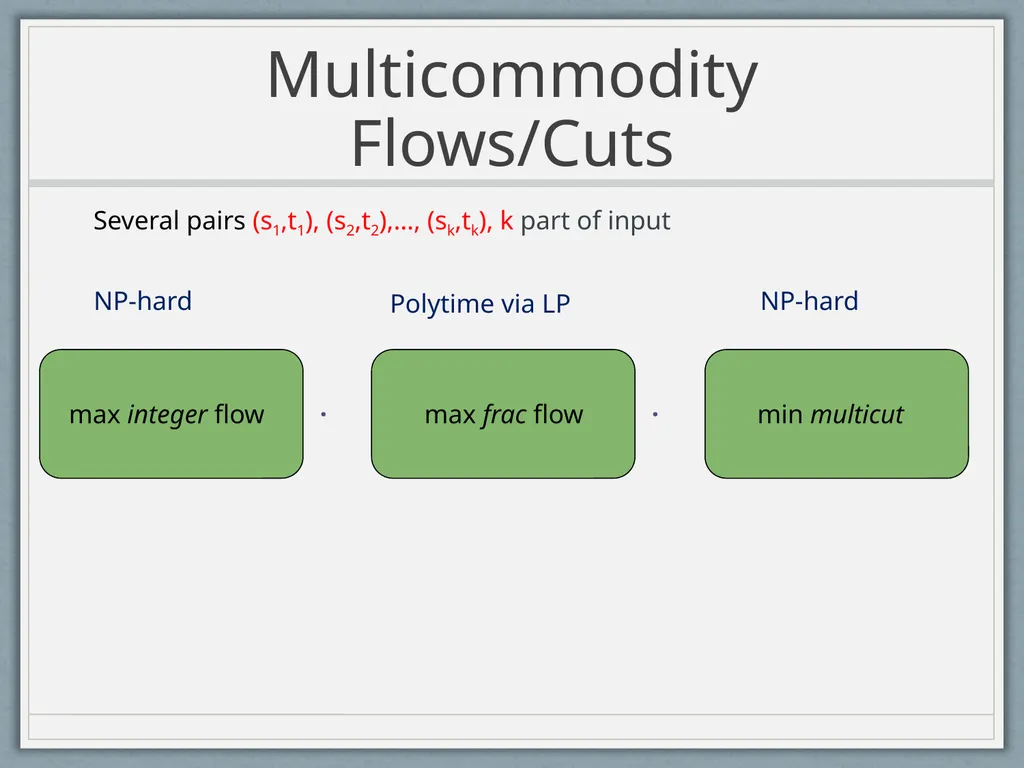
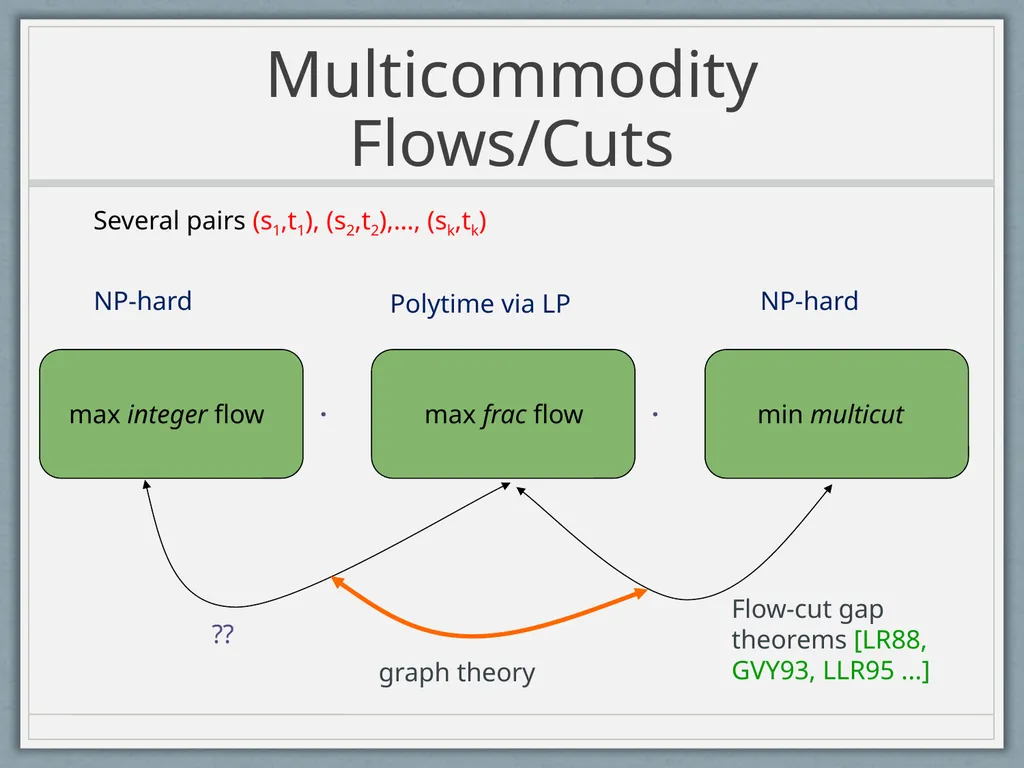
Multicommodity Flows/Cuts max integer flow max frac flow min multicut · · NP-hard NP-hard Polytime via LP Several pairs (s1,t1), (s2,t2),…, (sk,tk)<br>
05
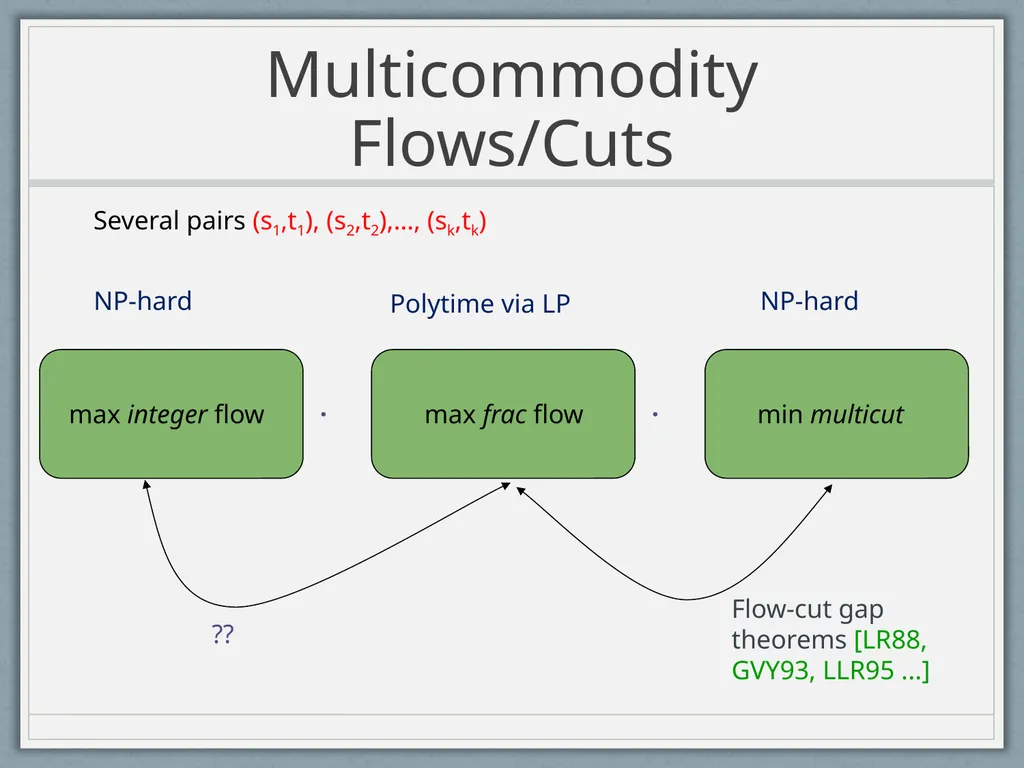
Multicommodity Flows/Cuts max integer flow max frac flow min multicut · · NP-hard NP-hard Polytime via LP Several pairs (s1,t1), (s2,t2),…, (sk,tk) Flow-cut gap theorems [LR88, GVY93, LLR95 ...]<br>
06
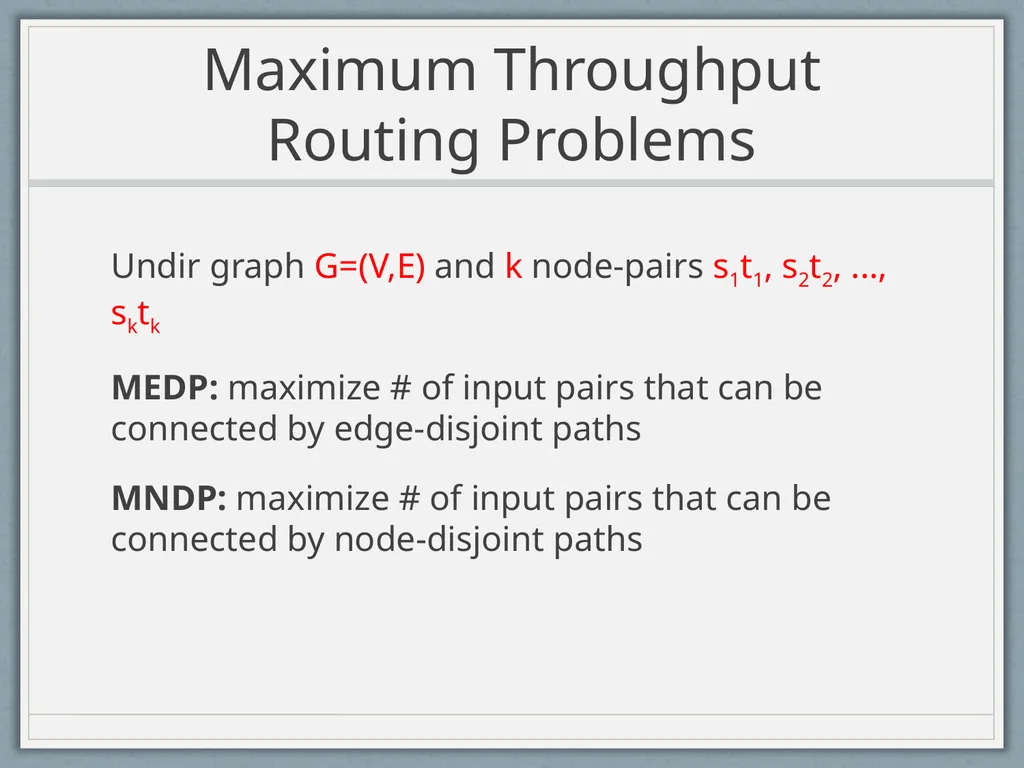
Maximum Throughput Routing Problems Undir graph G=(V,E) and k node-pairs s1t1, s2t2, ..., sktk
MEDP: maximize # of input pairs that can be connected by edge-disjoint paths
MNDP: maximize # of input pairs that can be connected by node-disjoint paths<br>
07
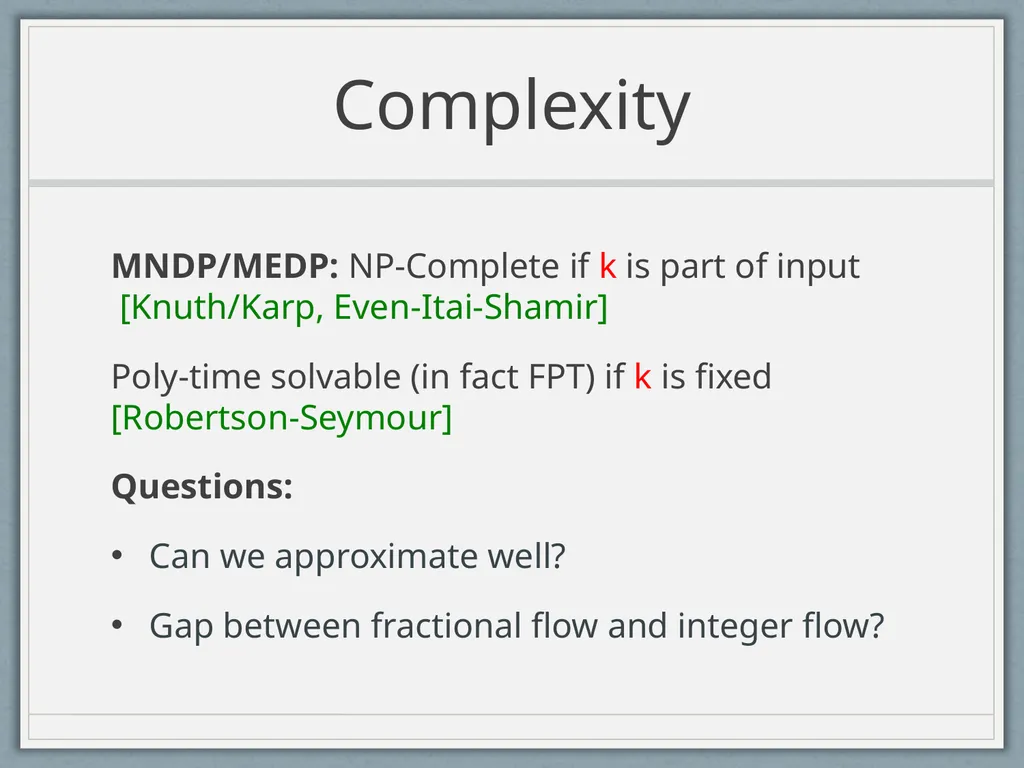
Complexity MNDP/MEDP: NP-Complete if k is part of input [Knuth/Karp, Even-Itai-Shamir]
Poly-time solvable (in fact FPT) if k is fixed [Robertson-Seymour]
Questions:
Can we approximate well?
Gap between fractional flow and integer flow?<br>
08
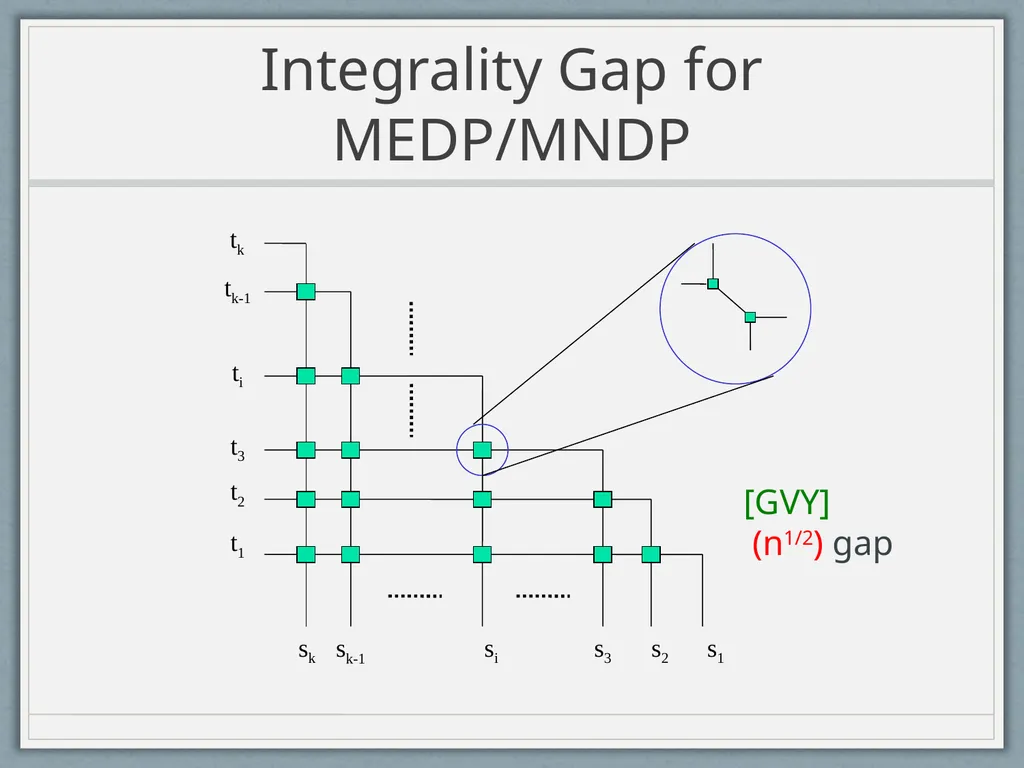
Integrality Gap for MEDP/MNDP s1 s2 si s3 sk-1 sk t1 tk-1 tk t3 t2 ti [GVY]
(n1/2) gap<br>
09
Two Relaxations MNDP/MEDP with Congestion: Allow paths to use an edge/node c times for some small c.
All-or-Nothing Flow (MANF): Allow pairs to route one unit of flow along any # of paths<br>
10
Reduction to Graph Theory [C-Khanna-Shepherd’05] Well-linked-decomposition via flow-cut gap results
Reduce problem at polylog(k) loss to answering:
Question: If G has treewidth k, does it have a routing structure of large size?<br>
11
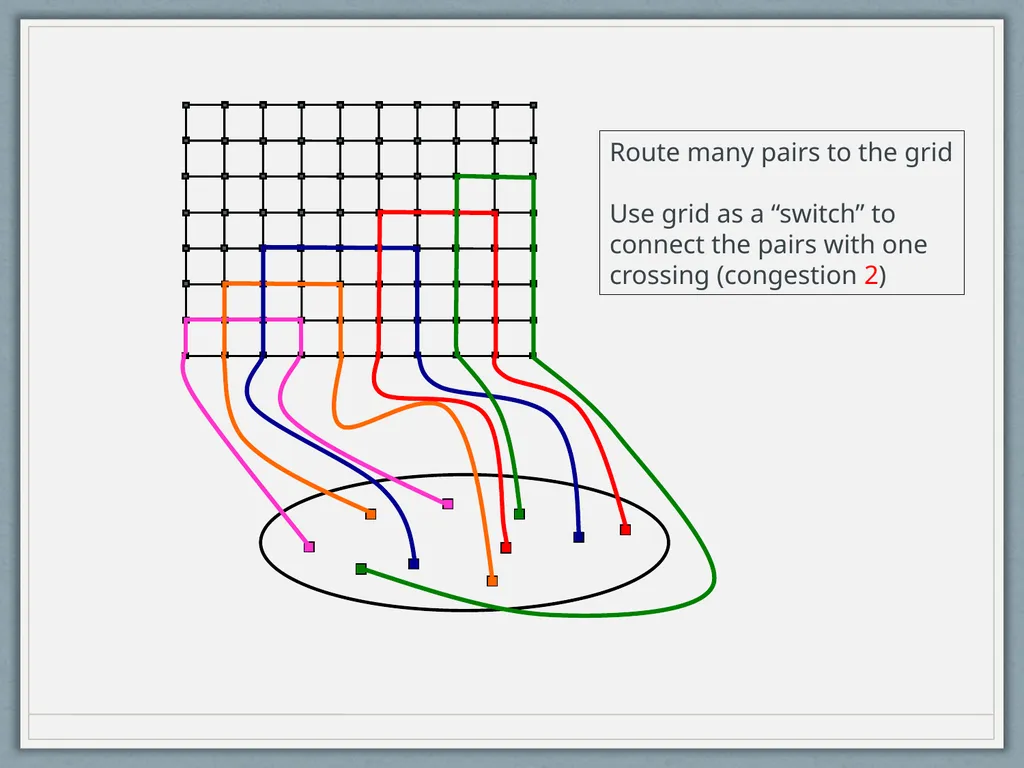
Route many pairs to the grid
Use grid as a “switch” to connect the pairs with one crossing (congestion 2)<br>
12
Reduction to Graph Theory [C-Khanna-Shepherd’05] Well-linked-decomposition via flow-cut gap results
Reduce problem at polylog(k) loss to answering:
Question: If G has treewidth k, does it have a routing structure of size k/polylog(k)?<br>
13
Answers to the Question Question: If G has treewidth k, does it have a routing structure of size k/polylog(k) ?
Planar graphs: Via [Robertson-Seymour-Thomas] there is a grid-minor of size ck
General graphs: Building on several tools and results, [Chuzhoy’11] showed that an expander of size k/polylog(k) can be “embedded” in G. Improved in [Chuzhoy-Li’12] to optimal congestion 2. [C-Ene’13,C-Chuzhoy’15] for node congestion.<br>
14
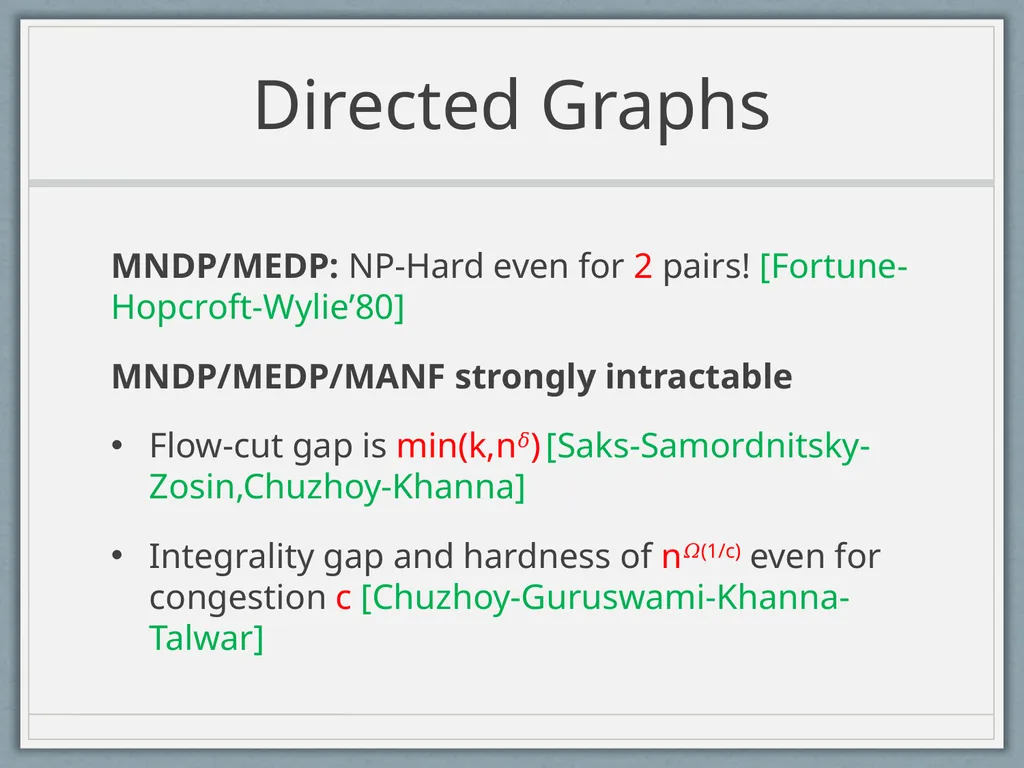
Directed Graphs MNDP/MEDP: NP-Hard even for 2 pairs! [Fortune-Hopcroft-Wylie’80]
MNDP/MEDP/MANF strongly intractable
Flow-cut gap is min(k,n𝛿) [Saks-Samordnitsky-Zosin,Chuzhoy-Khanna]
Integrality gap and hardness of n𝛺(1/c) even for congestion c [Chuzhoy-Guruswami-Khanna-Talwar]<br>
15
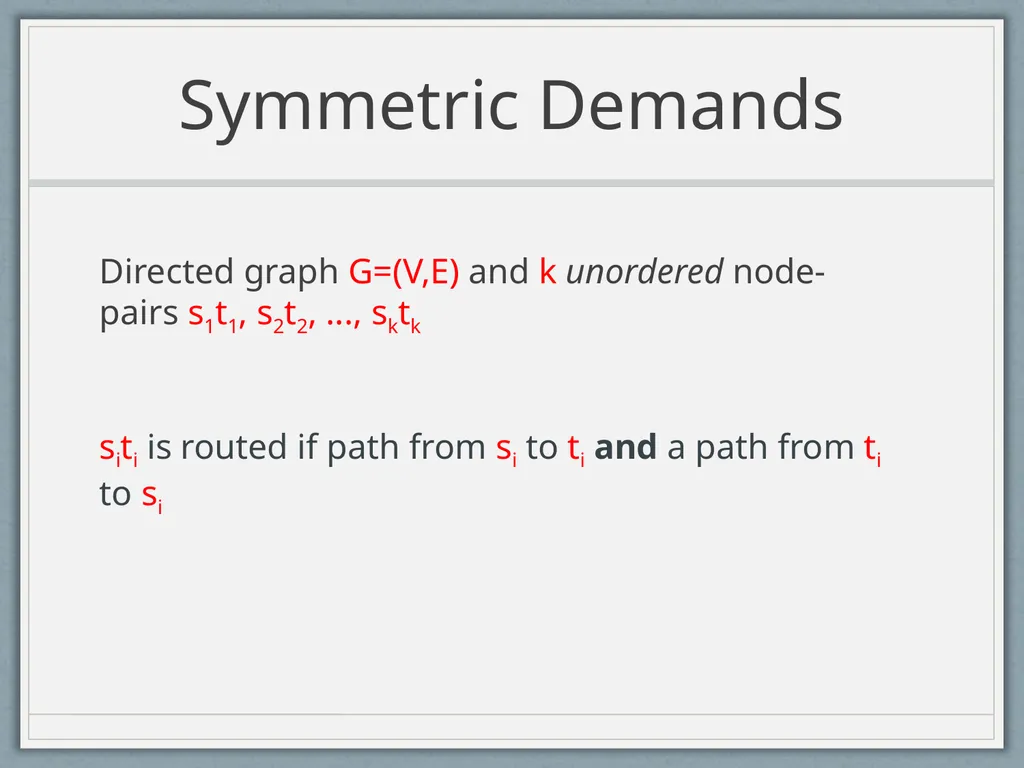
Symmetric Demands Directed graph G=(V,E) and k unordered node-pairs s1t1, s2t2, ..., sktk
siti is routed if path from si to ti and a path from ti to si<br>
16
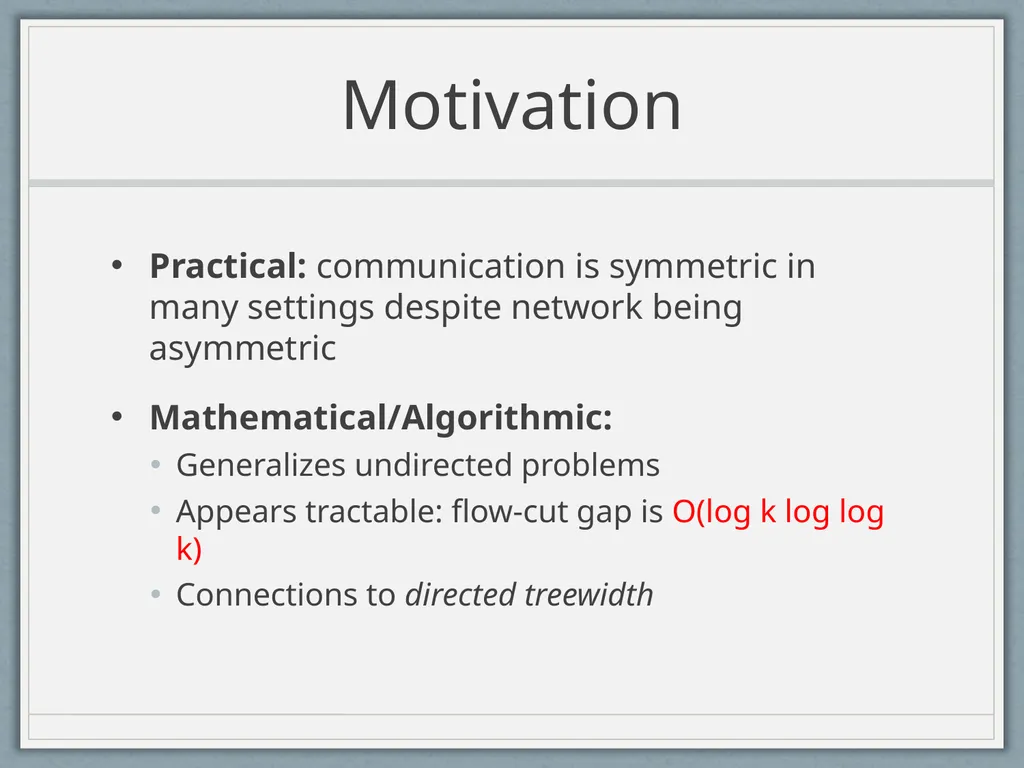
Motivation Practical: communication is symmetric in many settings despite network being asymmetric
Mathematical/Algorithmic:
Generalizes undirected problems
Appears tractable: flow-cut gap is O(log k log log k)
Connections to directed treewidth<br>
17
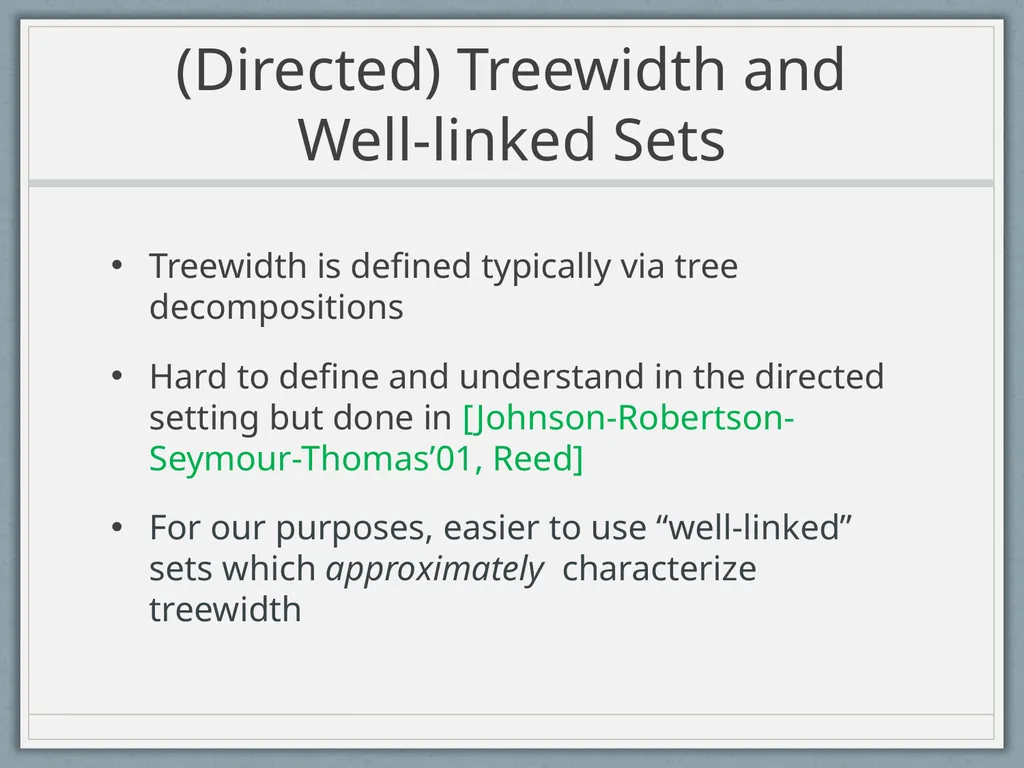
(Directed) Treewidth and Well-linked Sets Treewidth is defined typically via tree decompositions
Hard to define and understand in the directed setting but done in [Johnson-Robertson-Seymour-Thomas’01, Reed]
For our purposes, easier to use “well-linked” sets which approximately characterize treewidth<br>
18
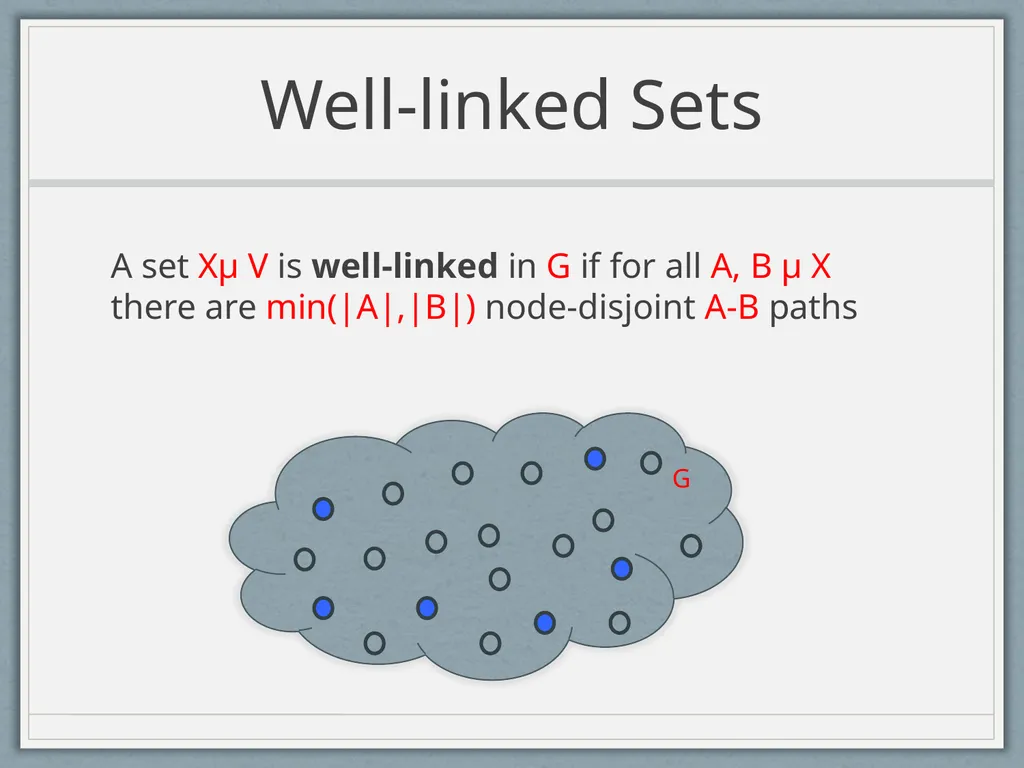
Well-linked Sets A set Xµ V is well-linked in G if for all A, B µ X there are min(|A|,|B|) node-disjoint A-B paths G<br>
19
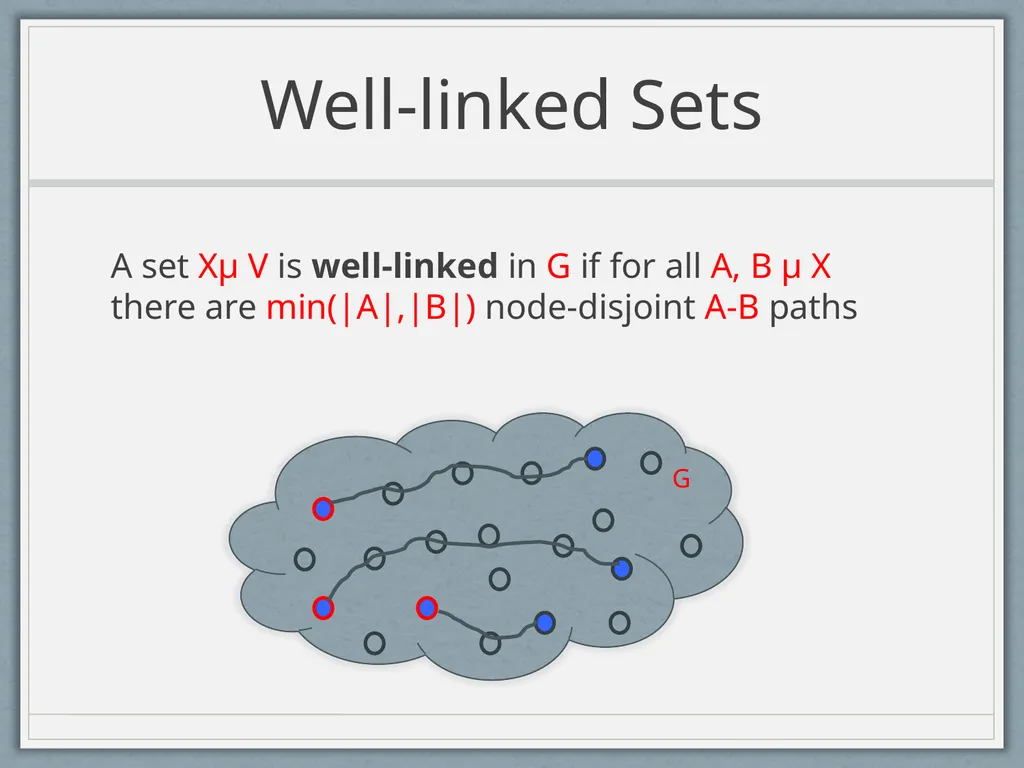
Well-linked Sets A set Xµ V is well-linked in G if for all A, B µ X there are min(|A|,|B|) node-disjoint A-B paths G<br>
20
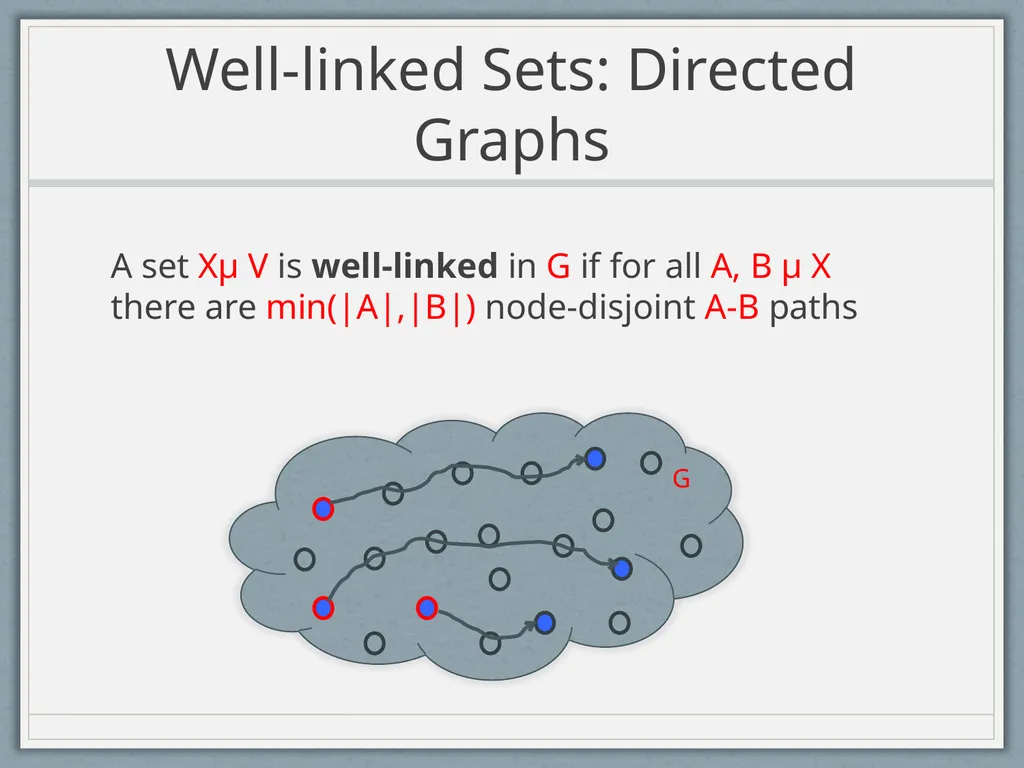
Well-linked Sets: Directed Graphs A set Xµ V is well-linked in G if for all A, B µ X there are min(|A|,|B|) node-disjoint A-B paths G<br>
21
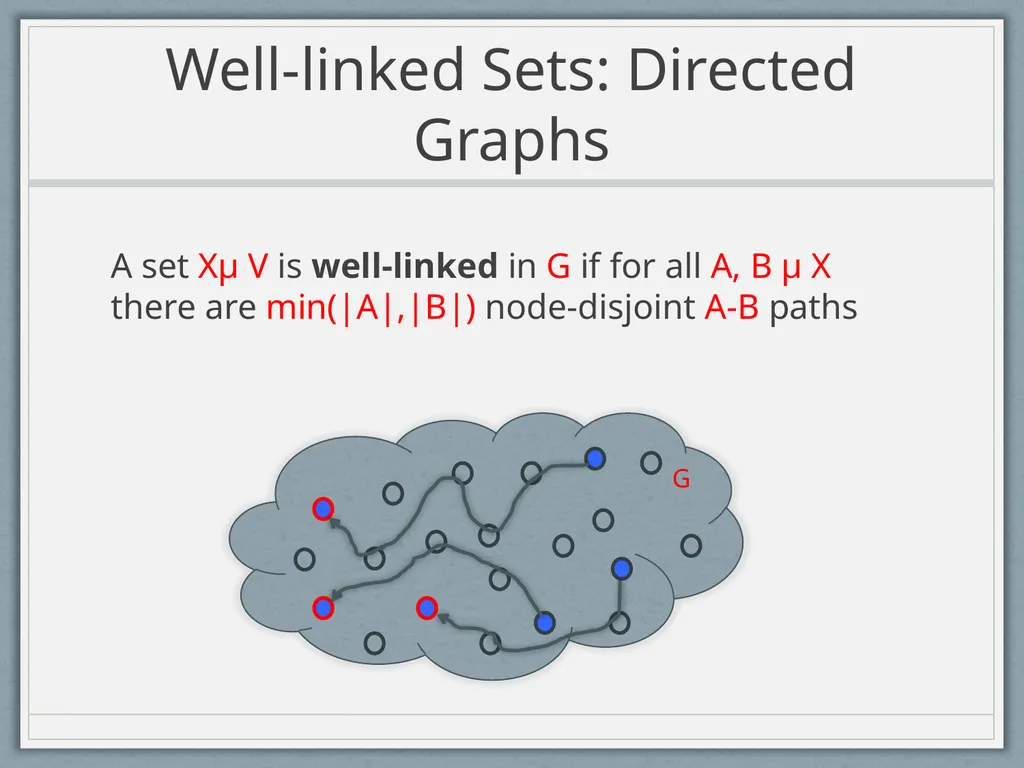
Well-linked Sets: Directed Graphs A set Xµ V is well-linked in G if for all A, B µ X there are min(|A|,|B|) node-disjoint A-B paths G<br>
22
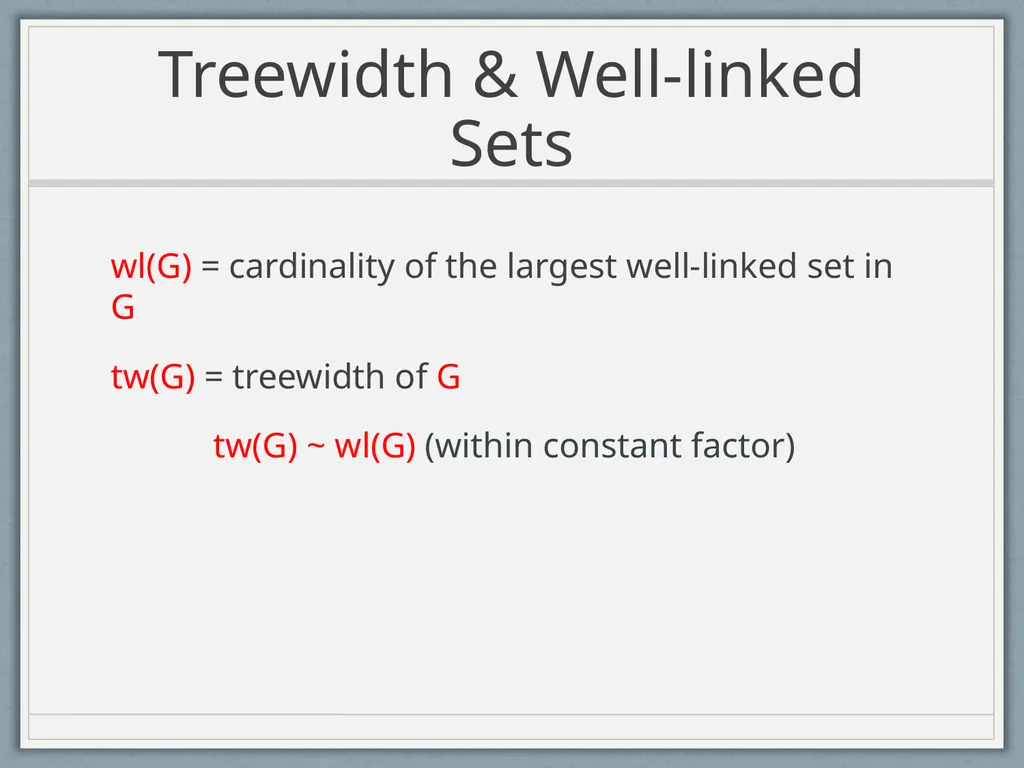
Treewidth & Well-linked Sets wl(G) = cardinality of the largest well-linked set in G
tw(G) = treewidth of G
tw(G) ~ wl(G) (within constant factor)<br>
23
Two Relaxations MNDP/MEDP with Congestion: Allow paths to use an edge/node c times for some small c.
All-or-Nothing Flow (MANF): Allow pairs to route one unit of flow along any # of paths<br>
24
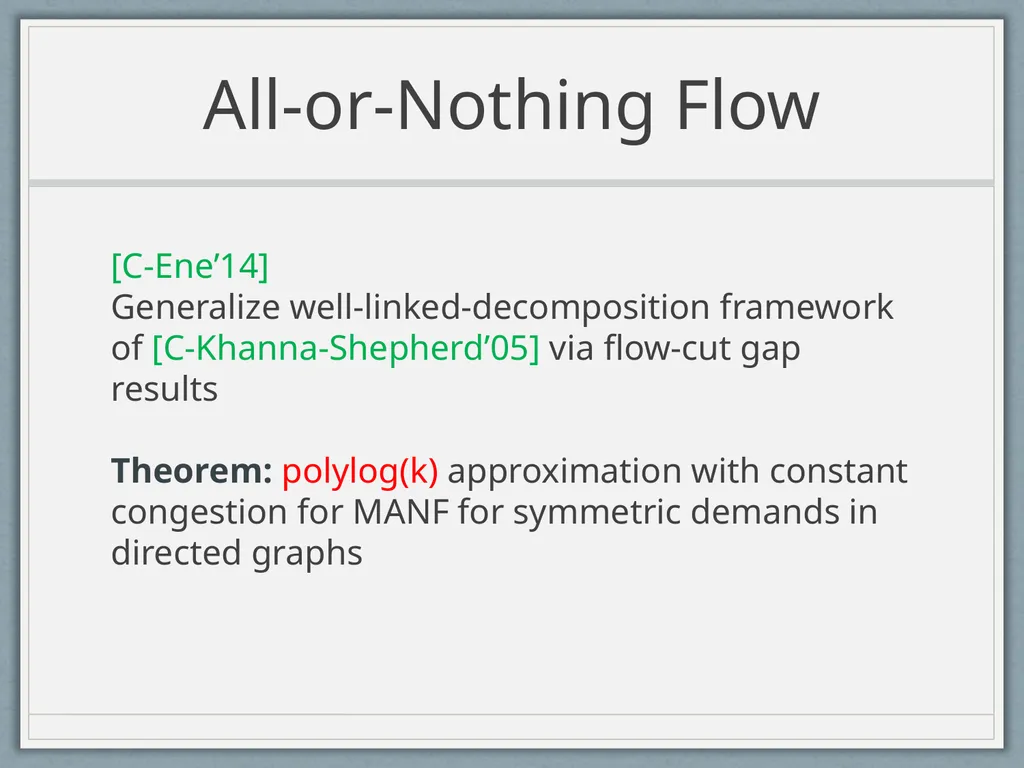
All-or-Nothing Flow [C-Ene’14]
Generalize well-linked-decomposition framework of [C-Khanna-Shepherd’05] via flow-cut gap results
Theorem: polylog(k) approximation with constant congestion for MANF for symmetric demands in directed graphs<br>
25
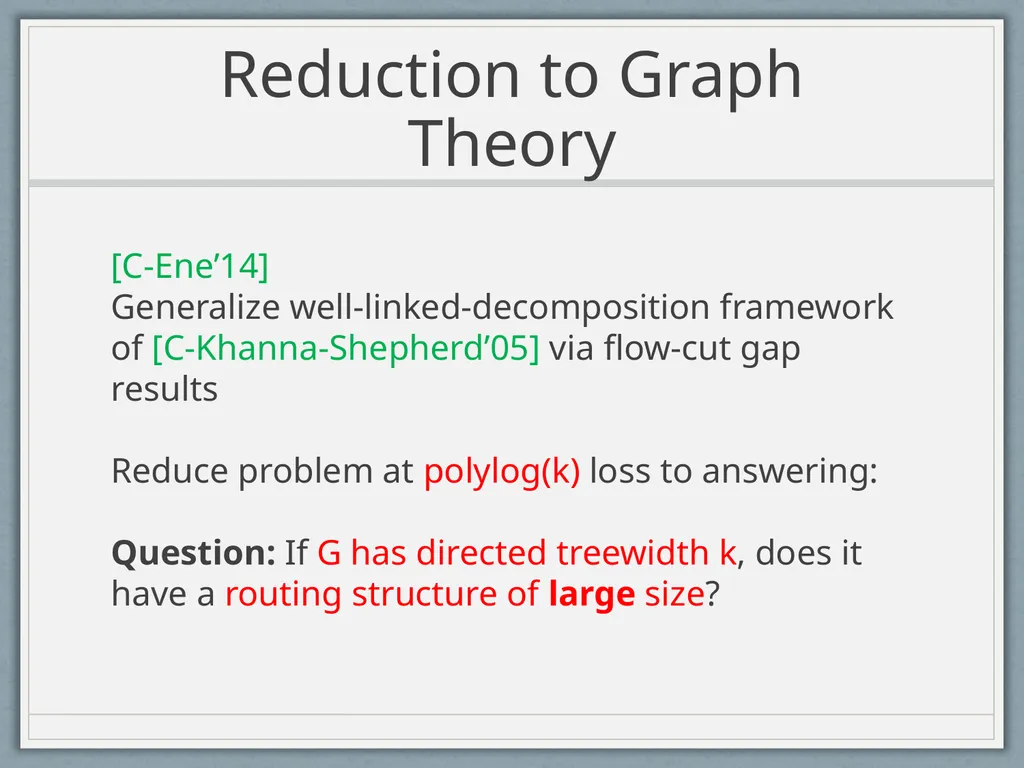
Reduction to Graph Theory [C-Ene’14]
Generalize well-linked-decomposition framework of [C-Khanna-Shepherd’05] via flow-cut gap results
Reduce problem at polylog(k) loss to answering:
Question: If G has directed treewidth k, does it have a routing structure of large size?<br>
26
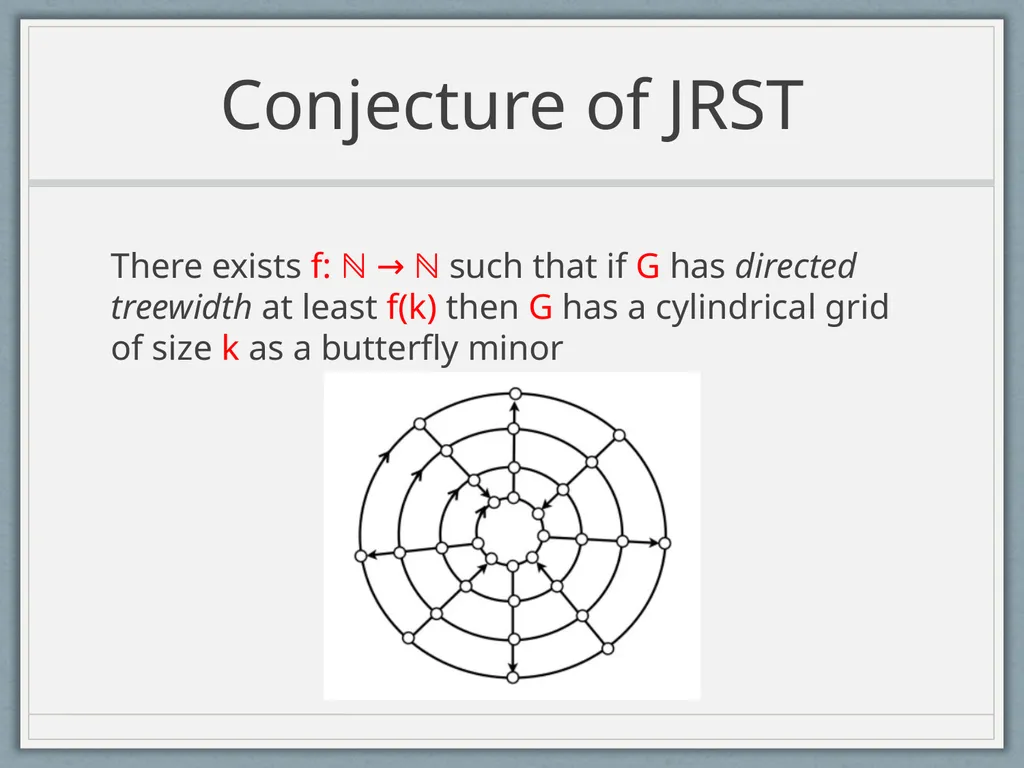
Conjecture of JRST There exists f: ℕ → ℕ such that if G has directed treewidth at least f(k) then G has a cylindrical grid of size k as a butterfly minor<br>
27
Proofs of Conjecture [JRST’01] unpublished, for planar graphs
[Kawarabayashi-Kreutzer’13] planar and minor-free graphs, some what different proof than [JRST’01]
[Kawarabayashi-Kreutzer’15] for general graphs
f(k) is very fast growing function<br>
28
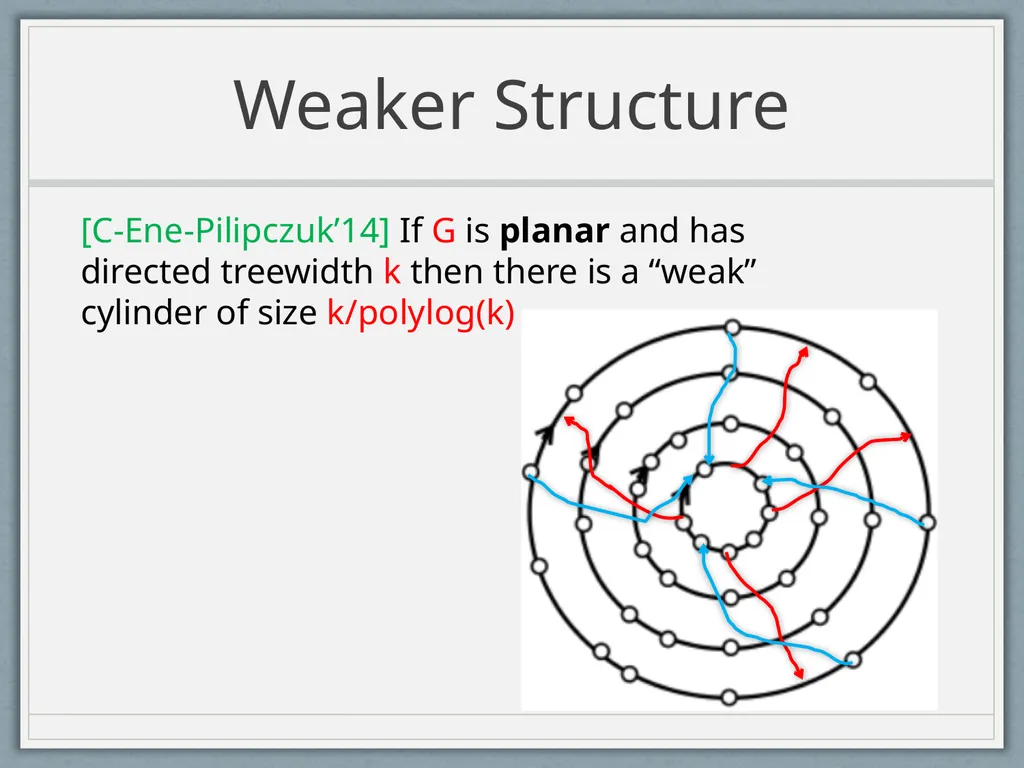
Weaker Structure [C-Ene-Pilipczuk’14] If G is planar and has directed treewidth k then there is a “weak” cylinder of size k/polylog(k)<br>
29
Proof Sketch Follow the scheme from [JRST’01]
Add some tools to improve bounds and obtain poly-time algorithm<br>
30
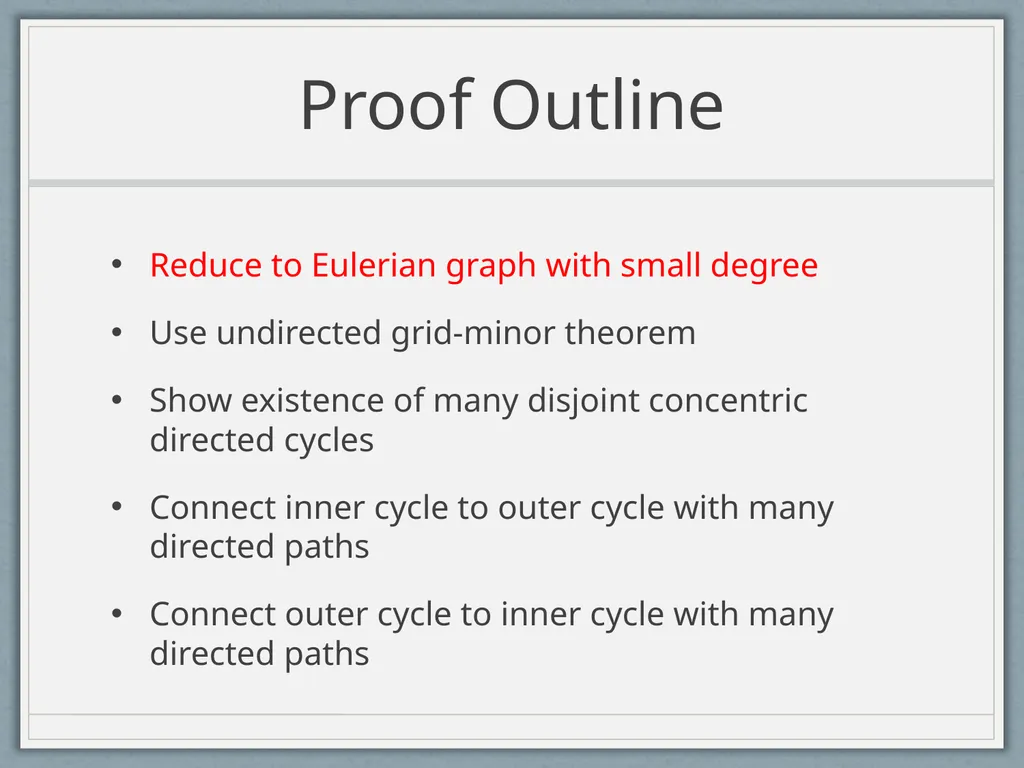
Proof Outline Reduce to Eulerian graph with small degree
Use undirected grid-minor theorem
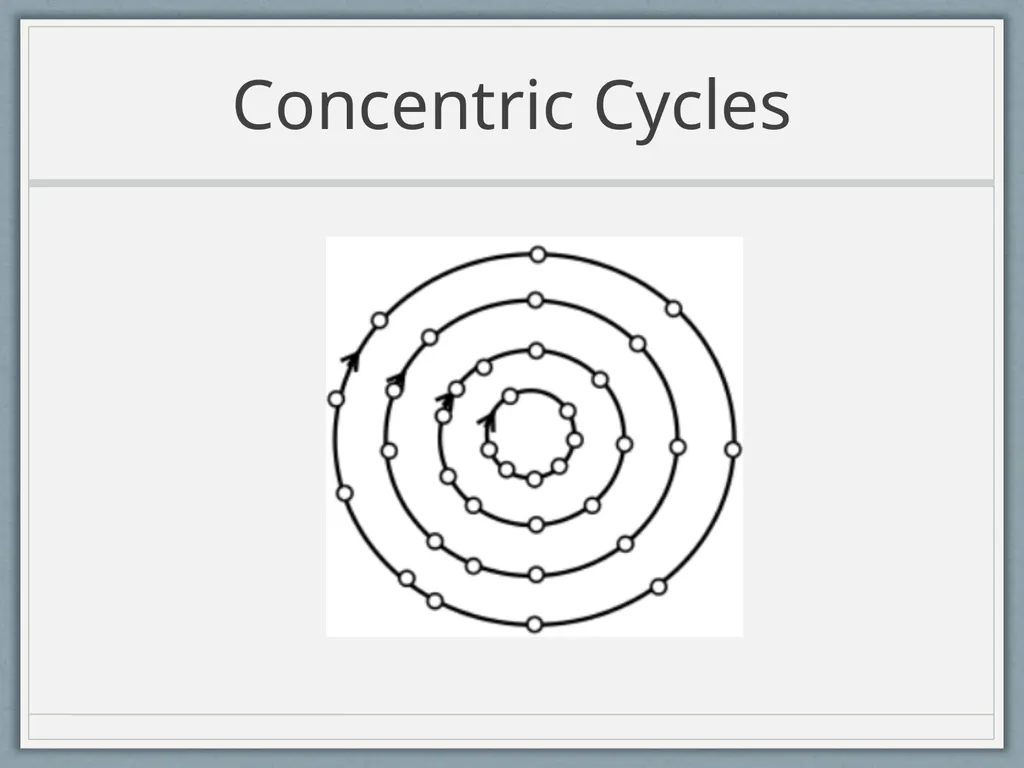
Show existence of many disjoint concentric directed cycles
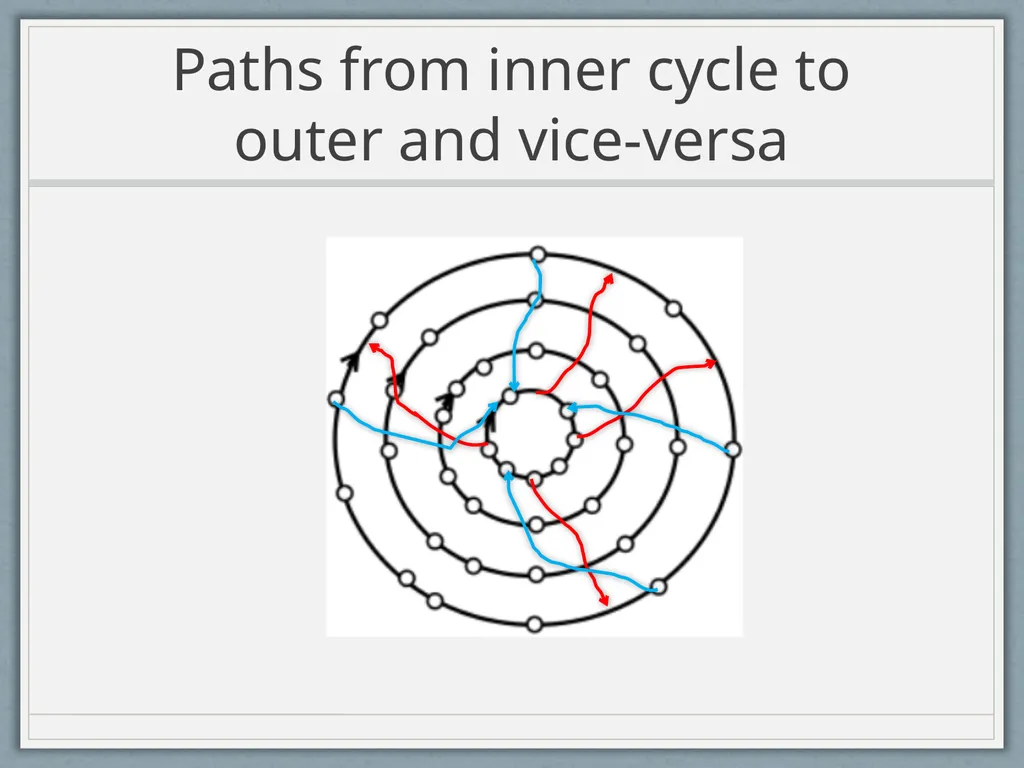
Connect inner cycle to outer cycle with many directed paths
Connect outer cycle to inner cycle with many directed paths<br>
31
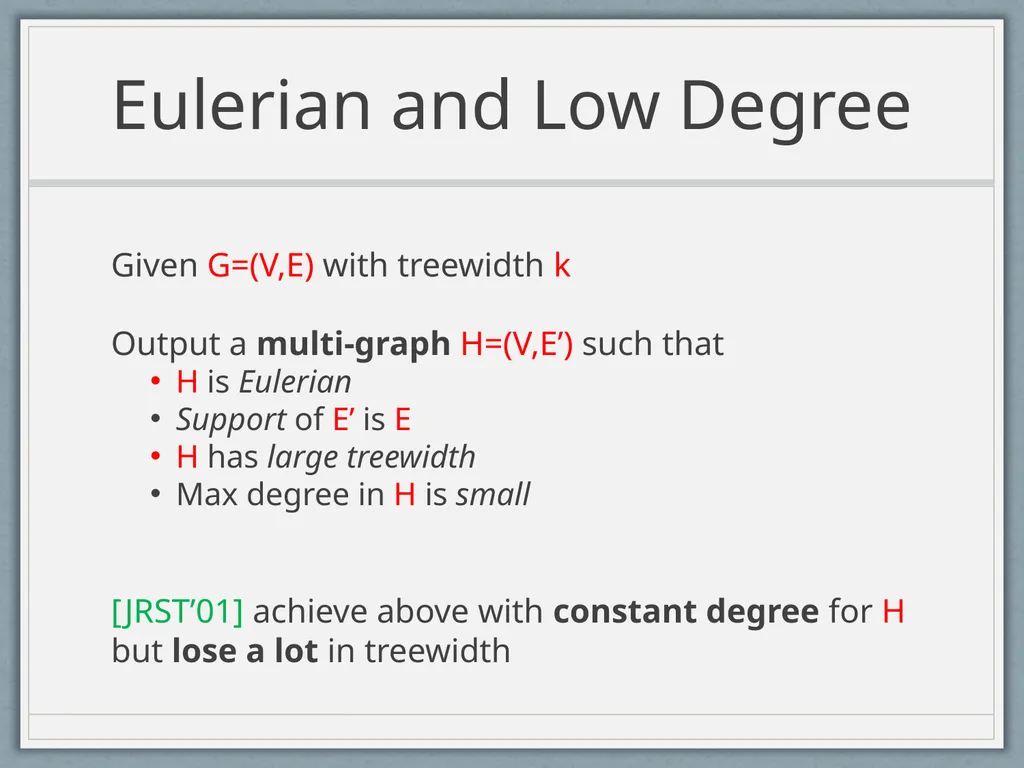
Eulerian and Low Degree Given G=(V,E) with treewidth k
Output a multi-graph H=(V,E’) such that
H is Eulerian
Support of E’ is E
H has large treewidth
Max degree in H is small
[JRST’01] achieve above with constant degree for H but lose a lot in treewidth<br>
32
Eulerian and Low Degree Given G=(V,E) with treewidth k
Output a multi-graph H=(V,E’) such that
H is Eulerian
Support of E’ is E
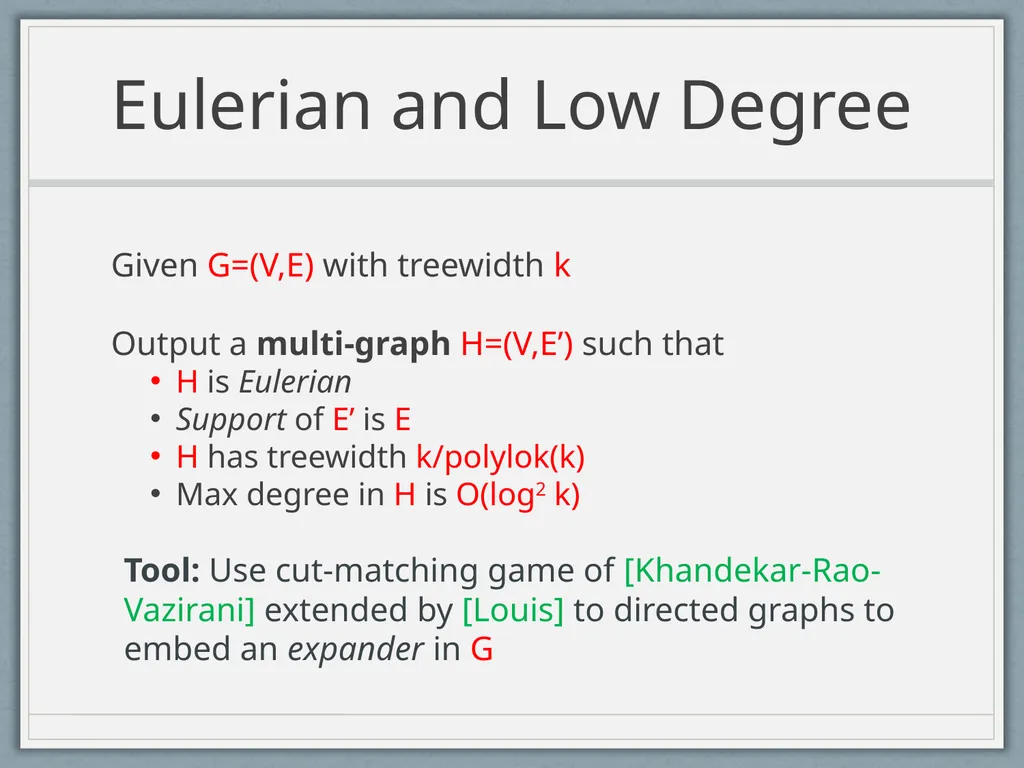
H has treewidth k/polylok(k)
Max degree in H is O(log2 k)
Tool: Use cut-matching game of [Khandekar-Rao-Vazirani] extended by [Louis] to directed graphs to embed an expander in G<br>
33
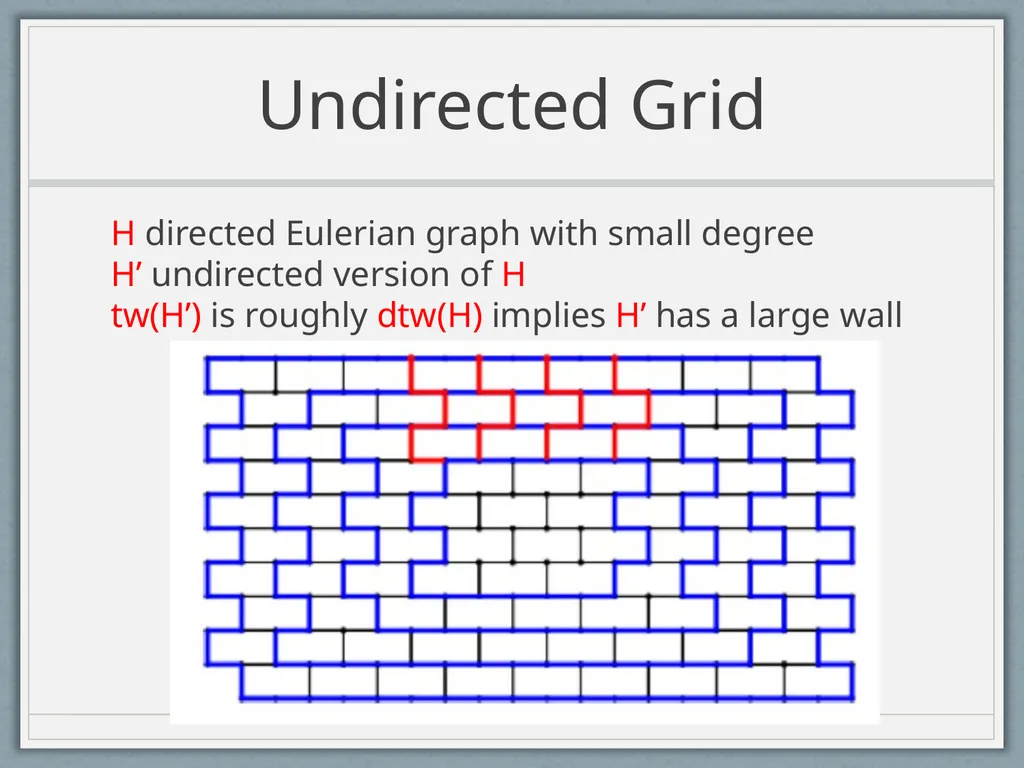
Undirected Grid H directed Eulerian graph with small degree
H’ undirected version of H
tw(H’) is roughly dtw(H) implies H’ has a large wall<br>
34
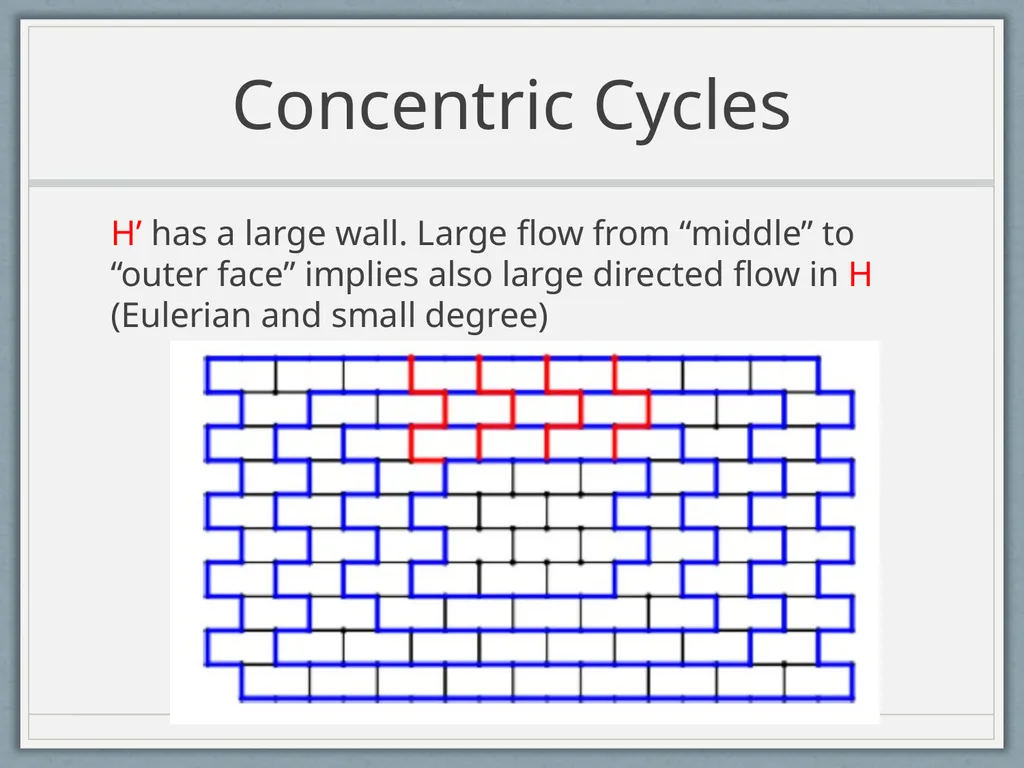
Concentric Cycles H’ has a large wall. Large flow from “middle” to “outer face” implies also large directed flow in H (Eulerian and small degree)<br>
36
Paths from inner cycle to outer and vice-versa<br>
37
Open Problems Generalize to graphs embeddable in bounded genus surfaces
General graphs?
Treewidth decomposition is a simpler step which is already challenging. Improve Erdos-Posa bounds from [Reed-Robertson-Seymour-Thomas]
For planar graphs can we get O(1) degree Eulerian graph that preserves treewidth to constant factor? Has applications to flow-cut gap and will improve weak cylinder size<br>