Safe Patient Handling Mobility Education Overview Friends of Strong Objectives Brief Overview of Safe Patient Handling (SPH) and why it is important Basic Body Mechanics Overview Pediatric Concerns Using a Wheelchair What Do I Do If? 2
"Safe Patient Handling & Mobility Education" is the property of its rightful owner. Permission is granted to
download and print the materials on this website for personal, non-commercial use only, and to display it
on your personal computer provided you do not modify the materials and that you retain all copyright
notices contained in the materials. By downloading content from our website, you accept the terms of this
agreement.
Objectives Brief Overview of Safe Patient Handling (SPH) and why it is important
Basic Body Mechanics Overview
Pediatric Concerns
Using a Wheelchair
What Do I Do If…? 2<br>
03
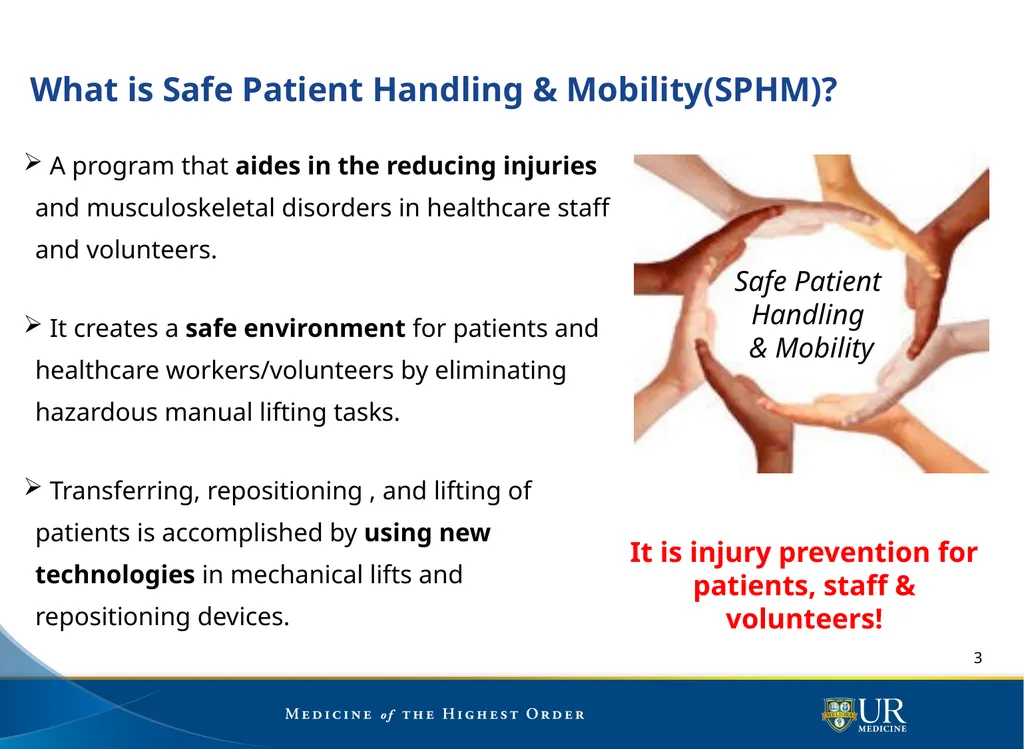
What is Safe Patient Handling & Mobility(SPHM)? A program that aides in the reducing injuries and musculoskeletal disorders in healthcare staff and volunteers.
It creates a safe environment for patients and healthcare workers/volunteers by eliminating hazardous manual lifting tasks.
Transferring, repositioning , and lifting of patients is accomplished by using new technologies in mechanical lifts and repositioning devices. 3 Safe Patient
Handling
& Mobility It is injury prevention for patients, staff & volunteers!<br>
04
Why care about SPHM? Using SPHM equipment to assist moving patients can decrease injuries to staff members, volunteers and patients.
NY State law requires that any patient who weighs over 35 lbs and cannot assist themselves should have a staff member using SPHM equipment assisting them.*
*Staff members have been properly trained on the use of SPHM equipment. 4<br>
05
Basic Body Mechanics Squat: bend your knees and use your legs to lift.
Avoid reaching across the bed (reduce bending).
Keep objects close to the body when lifting.
Pushing is better than pulling.
Raise the bed to your waist, but be sure NOT to leave the patient’s side without putting the bed back down to the lowest position.
If a patient is unable to assist (and more than 35 pounds), please ask a staff member (using SPH equipment) to help the patient. DO NOT attempt to help the patient on your own. 5<br>
06
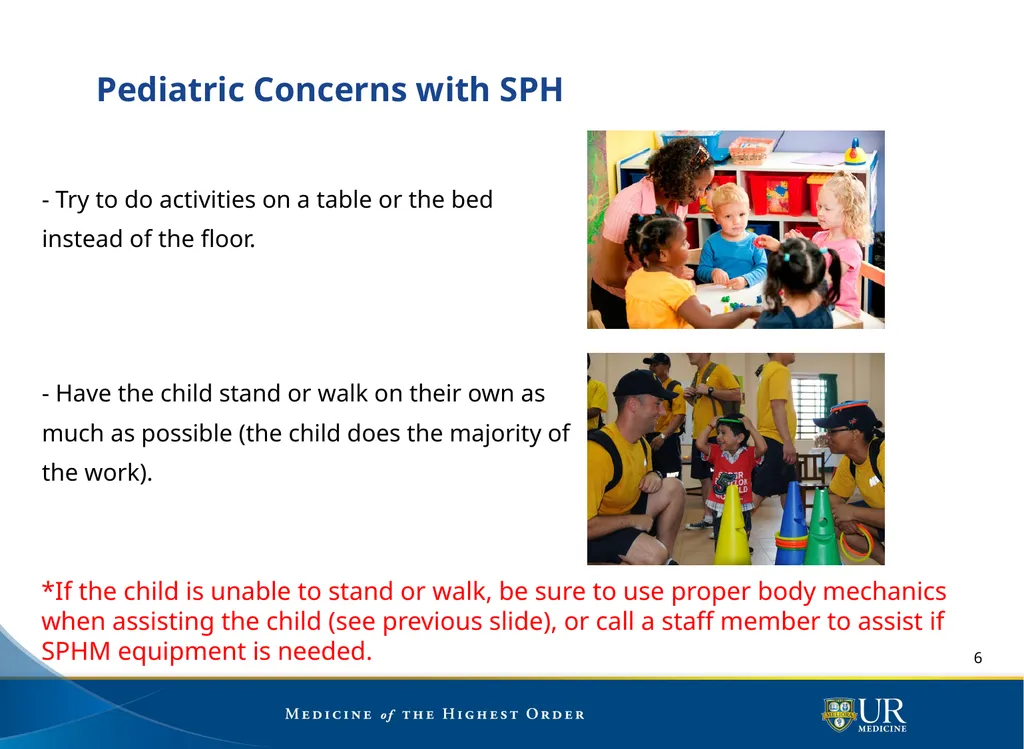
Pediatric Concerns with SPH - Try to do activities on a table or the bed instead of the floor.
- Have the child stand or walk on their own as much as possible (the child does the majority of the work). 6 *If the child is unable to stand or walk, be sure to use proper body mechanics when assisting the child (see previous slide), or call a staff member to assist if SPHM equipment is needed.<br>
07
Basic Wheelchair Safety Tips Brakes should be on at all times, unless the wheelchair is in motion.
The patient’s arms, hands, legs, and feet should be on the appropriate armrests/footrests (out of harm’s way) while transporting the patient.
Back down ramps and be aware of surroundings/oncoming traffic when turning corners.
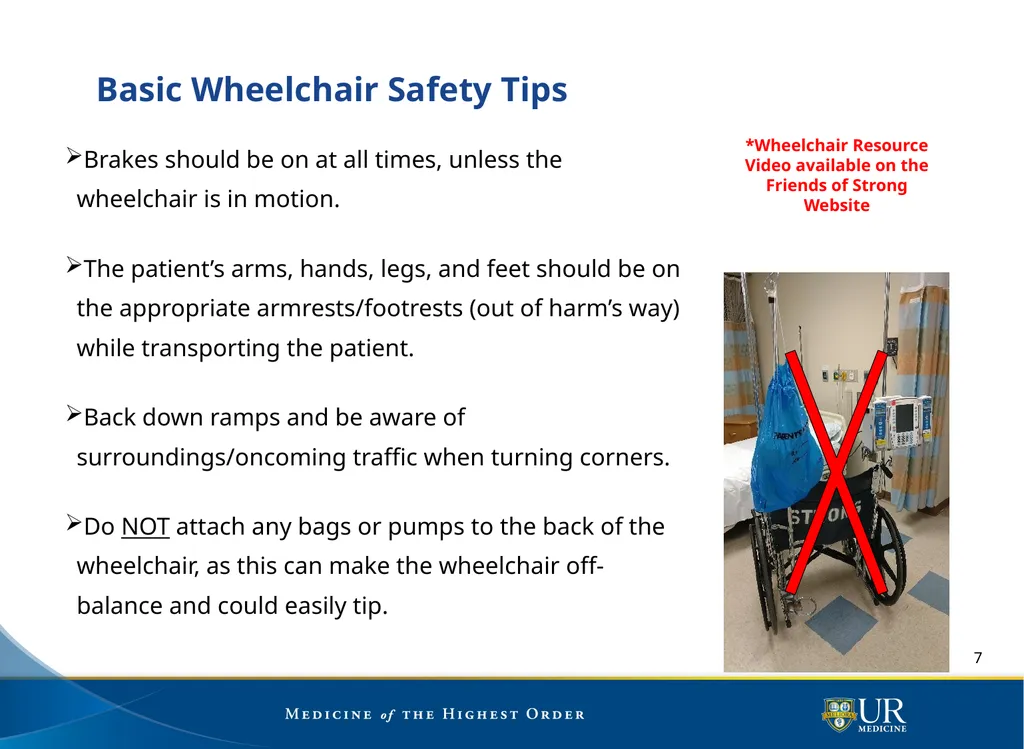
Do NOT attach any bags or pumps to the back of the wheelchair, as this can make the wheelchair off-balance and could easily tip. 7 *Wheelchair Resource Video available on the Friends of Strong Website<br>
08
What do I do if… … I get injured?
Report your injury to the supervisor on the floor AND your supervisor in the Friends of Strong (FOS) Office. Ask them to assist you in completing an Employee Incident Report (NOT an RL Solutions Report). If needed, have a staff member escort you to the emergency room.
… I’m asked to go beyond what I’m allowed to do?
Explain to the patient/staff member that you are not supposed to be doing. You are not allowed to do it, as it falls outside of your scope/responsibilities. You have not been properly trained to perform the task appropriately. If needed, contact the floor supervisor or FOS supervisor so they are aware of what is being asked of you. 8<br>