SAP Governance, Risk, and Compliance (GRC)10.1 and

Published  . 0 views
↓ Download
SAP Governance, Risk, and Compliance (GRC)10.1 and
1 / 1
SAP Governance, Risk, and Compliance (GRC)10.1 and - slide 1 of 31 SAP Governance, Risk, and Compliance (GRC)10.1 and - slide 2 of 31 SAP Governance, Risk, and Compliance (GRC)10.1 and - slide 3 of 31 SAP Governance, Risk, and Compliance (GRC)10.1 and - slide 4 of 31 SAP Governance, Risk, and Compliance (GRC)10.1 and - slide 5 of 31 SAP Governance, Risk, and Compliance (GRC)10.1 and - slide 6 of 31 SAP Governance, Risk, and Compliance (GRC)10.1 and - slide 7 of 31 SAP Governance, Risk, and Compliance (GRC)10.1 and - slide 8 of 31 SAP Governance, Risk, and Compliance (GRC)10.1 and - slide 9 of 31 SAP Governance, Risk, and Compliance (GRC)10.1 and - slide 10 of 31 SAP Governance, Risk, and Compliance (GRC)10.1 and - slide 11 of 31 SAP Governance, Risk, and Compliance (GRC)10.1 and - slide 12 of 31 SAP Governance, Risk, and Compliance (GRC)10.1 and - slide 13 of 31 SAP Governance, Risk, and Compliance (GRC)10.1 and - slide 14 of 31 SAP Governance, Risk, and Compliance (GRC)10.1 and - slide 15 of 31 SAP Governance, Risk, and Compliance (GRC)10.1 and - slide 16 of 31 SAP Governance, Risk, and Compliance (GRC)10.1 and - slide 17 of 31 SAP Governance, Risk, and Compliance (GRC)10.1 and - slide 18 of 31 SAP Governance, Risk, and Compliance (GRC)10.1 and - slide 19 of 31 SAP Governance, Risk, and Compliance (GRC)10.1 and - slide 20 of 31 SAP Governance, Risk, and Compliance (GRC)10.1 and - slide 21 of 31 SAP Governance, Risk, and Compliance (GRC)10.1 and - slide 22 of 31 SAP Governance, Risk, and Compliance (GRC)10.1 and - slide 23 of 31 SAP Governance, Risk, and Compliance (GRC)10.1 and - slide 24 of 31 SAP Governance, Risk, and Compliance (GRC)10.1 and - slide 25 of 31 SAP Governance, Risk, and Compliance (GRC)10.1 and - slide 26 of 31 SAP Governance, Risk, and Compliance (GRC)10.1 and - slide 27 of 31 SAP Governance, Risk, and Compliance (GRC)10.1 and - slide 28 of 31 SAP Governance, Risk, and Compliance (GRC)10.1 and - slide 29 of 31 SAP Governance, Risk, and Compliance (GRC)10.1 and - slide 30 of 31 SAP Governance, Risk, and Compliance (GRC)10.1 and - slide 31 of 31
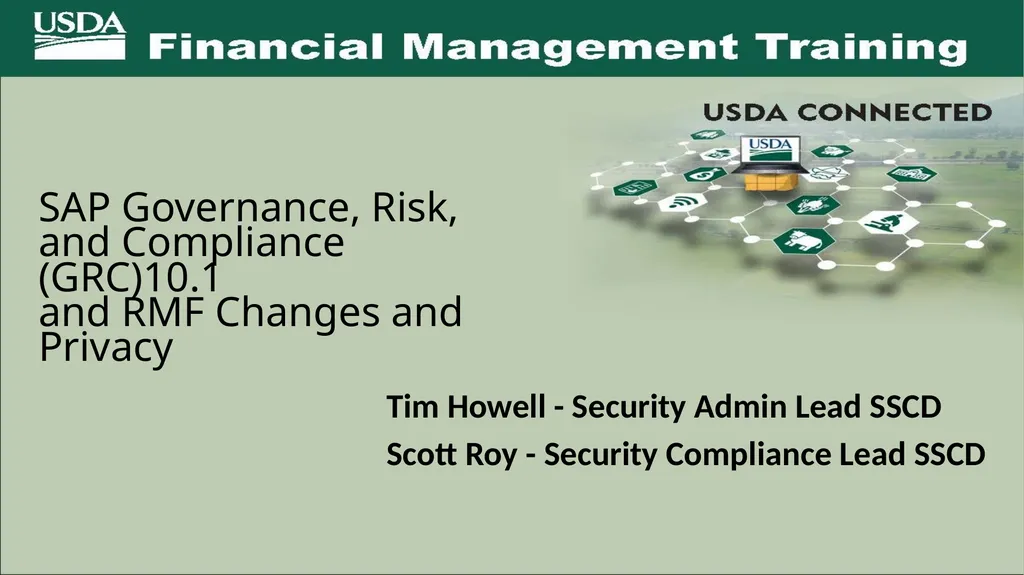
Description: SAP Governance, Risk, and Compliance (GRC)10.1 and RMF Changes and Privacy Tim Howell - Security Admin Lead SSCD Scott Roy - Security Compliance Lead SSCD GRC 10.1 New Features New processes Common Process issues Job Aids GRC 10.1 New

Related Topics

Download Presentation

"SAP Governance, Risk, and Compliance (GRC)10.1 and" is the property of its rightful owner. Permission is granted to download and print the materials on this website for personal, non-commercial use only, and to display it on your personal computer provided you do not modify the materials and that you retain all copyright notices contained in the materials. By downloading content from our website, you accept the terms of this agreement.

Presentation Transcript

slide1. SAP Governance, Risk, and Compliance (GRC)10.1 and RMF Changes and Privacy Tim Howell - Security Admin Lead SSCD
Scott Roy - Security Compliance Lead SSCD<br>
slide2. GRC 10.1 New Features
New processes
Common Process issues
Job Aids<br>
slide3. GRC 10.1 New Features Role import
Copy Request<br>
slide4. Role import Problem : Adding roles to an access request can be tedious and error prone.<br>
slide5. Role Import How does Role Import address this.
Allows for the mass upload of roles from an excel spreadsheet
This spreadsheet can be used multiple times<br>
slide6. Role Import<br>
slide7. GRC 10.1 New Features Role import
Copy Request<br>
slide8. Copy Request Problem : You have multiple similar requests that need to be replicated.<br>
slide9. Copy Request How does Copy Request address this.
It allows multiple parts of a previous request (User information, Roles, Request Details, etc…) to be copied into a new request.

* Draw back to using this method – You cannot change the request type of a copied request. ie: If the original request is a change request you will not be able create a new user request.<br>
slide10. Copy Request<br>
slide11. GRC 10.1 New Processes Update User Information via GRC request

User’s Name
Email
Address
Validity Dates
Etc….<br>
slide12. Update User Information Why
Not all users information was being updated in all systems.
Portal information must be updated manually by a Central Security Administrator.
It is difficult to track changes to user accounts during audits.<br>
slide13. Update User Information Use the “Existing Assignments” Button to select all of the systems the user has an account in.
Add all of the systems the user has an account in.
One role must be selected or else the request will not be processed.
If the user’s email, name, or company change this role will need to be the “Base Permission” Role. That way the Central Security Team can updated the Portal Account.
If the validity dates are changed select and agency role so that the Agency Security Admin can approve.<br>
slide14. Process Issues Transfers
A GRC Remove request must be entered to ensure all previous roles are removed.
Use the “Existing Assignments” button in the Access Request

Please contact Central Security if a user’s roles have not been removed.<br>
slide15. Process Issues Role approver Setup
2 Step Process

1. Create a GRC request adding the “NHB: GRC ARM End User Role Approve” Role
Z0000UCRLA:GR_AC_ROLE_APPRVR

2. Create a Service Now ticket with the new Role Owner’s information
Assign this ticket to the “SSCD_ISSP Security Admin GRC” group<br>
slide16. Process Issues Agency Security admin setup
2 Step Process

1. Create a GRC request adding the “GRC Agency Security Admin Approver” Role
Z**00UCASA:GR_AC_AGENCYSEC_APP

2. Create a Service Now ticket with the new ASA’s information
Assign this ticket to the “SSCD_ISSP Security Admin GRC” group<br>
slide17. Job Aids All of the new 10.1 Job Aids are located in FMMI Help.

02 - User Support by Material Type (e.g., User Procedures)
04 - Job Aids<br>
slide18. Risk Management Framework RMF Changes To comply with requirements set forth in the Federal Information Security Modernization Act of 2014 (FISMA) and guidance provided in the National Institute of Standards and Technology (NIST) Special Publication (SP) 800-37, Revision 1, Guide for Applying the Risk Management Framework to Federal Information Systems: A Security Life Cycle Approach, the USDA assesses the security of its systems annually.
The policy guidance for this is provided by USDA Departmental Regulation (DR) 3540-003 Security Assessment & Authorization Policy and the process is fully documented in the USDA Six Step Risk Management Framework (RMF) Process Guide, CPB-SOP-004 (USDA RMF Guide)<br>
slide19. FY19 Due Dates and New Requirements Any USDA system whose Authority to Operate (ATO) expires will have 20 days from the date of expiration to complete the ATO process and be re-authorized to avoid the possibility of being shut down, as directed by the memo “Systems Without a Proper Authority to Operate (ATO)”.
.USDA is required to report the status of all IT components funded by the Department; all components are required to be documented as part of a system; and all systems must be documented in CSAM.<br>
slide20. FY19 Due Dates and New Requirements (continued) No agency shall establish a connection to any system/entity outside of USDA without first fully documenting the connection and submitting a request through the Change Advisory Board (CAB).​
OCIO may not approve Acquisition Approval Requests (AARs) for any system that does not complete the required annual A&A testing. New activities may not be funded until security weaknesses (such as incomplete A&A activities or POA&Ms) are addressed.<br>
slide21. FY19 A&A Process and Requirements Any systems which handles USDA data must be recorded in CSAM and must have an accurate Office of Management and Budget (OMB) 300 unique investment identifier (UII) code. This includes external, contractor, cloud, and partner systems and services.
.Child systems are not to be documented in CSAM.
Each system SSP in CSAM is to be associated with only one Privacy Threshold Assessment (PTA) and, if required, only one Privacy Impact Assessment (PIA).<br>
slide22. FY19 A&A Process and Requirements Binding Operational Directive (BOD) 19-02 Vulnerability Remediation Requirement for Internet-Accessible Systems to all federal agencies came out on April 29, 2019. Timelines are 15 days (Critical) and 30 days for (High).
On June 5, 2019, Information Security Center published DR 3530-006, Scanning and Remediation of Configuration and Patch Vulnerabilities. This policy provides security practices to maintain an information technology inventory, and to identify and remediate patch and configuration vulnerabilities and weaknesses.<br>
slide23. Update: NIST 800-37 rev 2 Released in December 2018, Risk Management Framework for Information Systems and Organizations: A System Life Cycle Approach for Security and Privacy, https://csrc.nist.gov/publications/detail/sp/800-37/rev-2/final
Provide closer linkage and communication between the risk management processes and activities at the C-suite or governance level of the organization and the individuals, processes, and activities at the system and operational level of the organization.
•  Institutionalize critical risk management preparatory activities at all risk management levels to facilitate a more effective, efficient, and cost-effective execution of RMF.
•  Demonstrate how the NIST Cybersecurity Framework (NIST CSF) can be aligned with the RMF and implemented using established NIST risk management processes.<br>
slide24. Update: NIST 800-37 rev 2 Integrate privacy risk management processes into the RMF to better support the privacy protection needs for which privacy programs are responsible.
Promote the development of trustworthy secure software and systems by aligning life cycle-based systems engineering processes in NIST Special Publication 800-160, Volume 1, with the relevant tasks in the RMF.
Integrate security-related, supply chain risk management (SCRM) concepts into the RMF to address untrustworthy suppliers, insertion of counterfeits, tampering, unauthorized production, theft, insertion of malicious code, and poor manufacturing and development practices throughout the SDLC.
Allow for an organization-generated control selection approach to complement the traditional baseline control selection approach and support the use of the consolidated control catalog in NIST Special Publication 800-53, Revision 5.<br>
slide25. Privacy What is PII?    PII is information that can be used to uniquely identify an individual. The following data combined with an individual's name constitutes PII:
Name , such as full name, maiden name, mother‘s maiden name, or alias 
Personal identification number, such as social security number (SSN), passport number, driver‘s license number, taxpayer identification number, or financial account or credit card number 
Address information, such as street address or email address 
Personal characteristics, including photographic image (especially of face or other identifying characteristic), fingerprints, handwriting, or other biometric data (e.g., retina scan, voice signature, facial geometry)<br>
slide26. Privacy (Continued) NIST Guidance on PII,  "NIST 800-122, Guide to Protecting the Confidentiality of Personally Identifiable Information PII, https://nvlpubs.nist.gov/nistpubs/Legacy/SP/nistspecialpublication800-122.pdf
Department Memorandum, dated November 2018, additional helpful privacy information:
 "Minimum Safeguards for Protecting Personally Identifiable Information (PII)".   
Recent Privacy Policies
(Un-named) Privacy Policy and Compliance for Personally Identifiable Information (PII)
DR 3450-001Computer Matching Program Involving Personally Identifiable Information<br>
slide27. Privacy (Continued) Privacy controls are test as part of the USDA Six Step RMF Process: Privacy Controls Rev4:
AP - Authority and Purpose
AP-1 - Authority to Collect
AP-2 - Purpose Specification
AR - Accountability, Audit, and Risk Management
AR-1 - Governance and Privacy Program
AR-2 - Privacy Impact and Risk Assessment
AR-3 - Privacy Requirements for Contractors and Service Providers
AR-4 - Privacy Monitoring and Auditing
AR-5 - Privacy Awareness and Training
AR-6 - Privacy Reporting
AR-7 - Privacy Enhanced System Design and development
AR- 8 - Accounting Disclosures
DI - Data Quality and Integrity
DI-1 - Data Quality
DI-2 - Data Integrity and Data Integrity Board<br>
slide28. Privacy (Continued) DM - Data Minimalization and Retention
DM-1 - Minimization of Personally Identifiable Information
DM-2 - Data Retention and Disposal
DM-3 - Minimization of PII Used in testing, Training, and Research
IP - Individual Participation and Redress
IP-1 - Consent
IP-2 - Individual Access
IP-3 - Redress
IP-4 - Complaint Management
SE - Security
SE-1 - Inventory of Personally Identifiable Information
SE-2 - Privacy Incident Response<br>
slide29. Privacy (Continued) Privacy Controls Rev4 (continued)
TR - Transparency
TR-1 - Privacy Notice
TR-2 - System of Records Notices and Privacy Act Statements
TR-3 - Dissemination of Privacy Information
UL - Use Limitation
UL-1 - Internal Use
UL-2 - Information Sharing with Third Parties<br>
slide30. Privacy (Continued) Privacy Controls which are the most important
AR-2 Privacy Impact and Risk Assessment
AR-5 Privacy Awareness and Training
UL-2 Information Sharing with Third Parties
DM-2 Data Retention and Disposal
IP-1 Individual Participation and Redress
Recent incidents involving PII unencrypted SSN sent via email.     
 The department implemented Office 365 Data Loss Prevention (DLP) PII email scanning in June 2019. Procedures to encrypt and read encrypted emails were distributed.<br>
slide31. Privacy Training AgLearn PII Training for certain role-based or specialized users:
https://aglearn.usda.gov/plateau/user/deeplink.do?linkId=ITEM_DETAILS&componentID=USDA%2dPII&componentTypeID=Web+Based&revisionDate=1315517220000
AgLearn PII Lite for everyone including temporary employees, summer interns annually each fiscal year:  
a) https://aglearn.usda.gov/learning/user/deeplink_redirect.jsp?linkId=ITEM_DETAILS&componentID=USDA-PII-Lite&componentTypeID=Web+Based&revisionDate=1382536500000.   
b)  PII “Lite” Training is available via mobile external/public link  (Does not require eAuthentication):  http://aglearn.usda.gov/customcontent/OCIO/USDA-PII-Lite-Web/index.html.<br>