
Scholarship Chemistry ian.torrie@gmail.com What
CB
Published · 18 slides · 0 views

1 / 1
Description
Scholarship Chemistry ian.torriegmail.com What this presentation covers What is Scholarship and how is it different to NCEA? How can I encourage my students to enter? How can I help my students achieve success? What resources are there to
Related Topics
Share
Embed code
Download this presentation From Below
"Scholarship Chemistry ian.torrie@gmail.com What" is the property of its rightful owner. Permission is granted to download and print the materials on this website for personal, non-commercial use only, and to display it on your personal computer provided you do not modify the materials and that you retain all copyright notices contained in the materials. By downloading content from our website, you accept the terms of this agreement.
Presentation Transcript
01
Scholarship Chemistry ian.torrie@gmail.com<br>
02
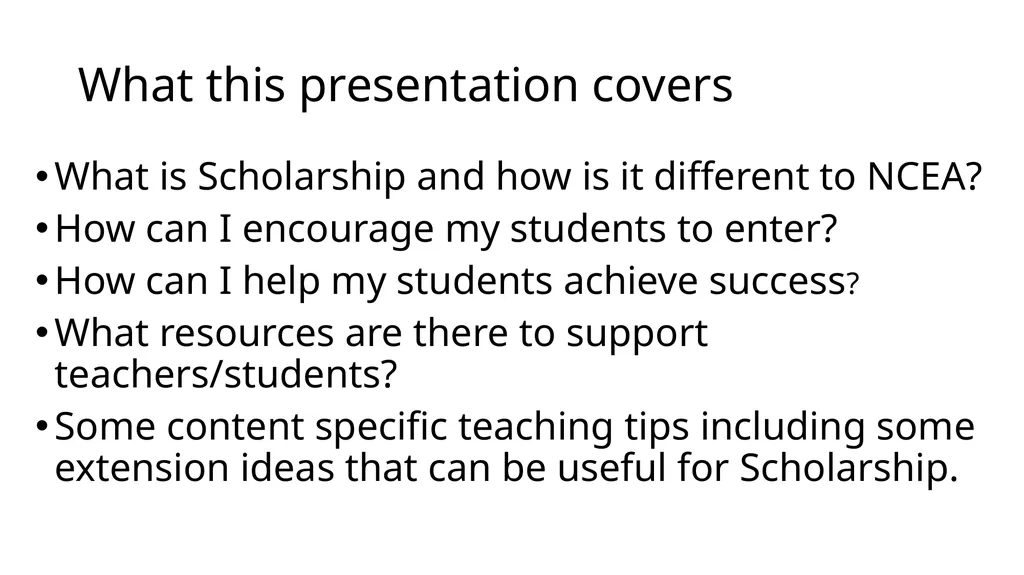
What this presentation covers What is Scholarship and how is it different to NCEA?
How can I encourage my students to enter?
How can I help my students achieve success?
What resources are there to support teachers/students?
Some content specific teaching tips including some extension ideas that can be useful for Scholarship.<br>
How can I encourage my students to enter?
How can I help my students achieve success?
What resources are there to support teachers/students?
Some content specific teaching tips including some extension ideas that can be useful for Scholarship.<br>
03
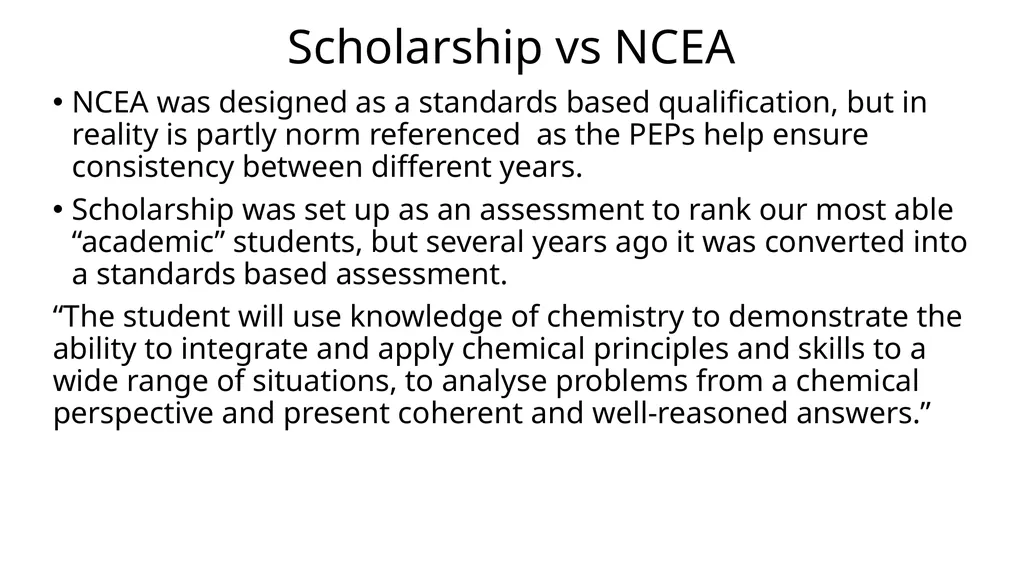
Scholarship vs NCEA NCEA was designed as a standards based qualification, but in reality is partly norm referenced as the PEPs help ensure consistency between different years.
Scholarship was set up as an assessment to rank our most able “academic” students, but several years ago it was converted into a standards based assessment.
“The student will use knowledge of chemistry to demonstrate the ability to integrate and apply chemical principles and skills to a wide range of situations, to analyse problems from a chemical perspective and present coherent and well-reasoned answers.”<br>
Scholarship was set up as an assessment to rank our most able “academic” students, but several years ago it was converted into a standards based assessment.
“The student will use knowledge of chemistry to demonstrate the ability to integrate and apply chemical principles and skills to a wide range of situations, to analyse problems from a chemical perspective and present coherent and well-reasoned answers.”<br>
04
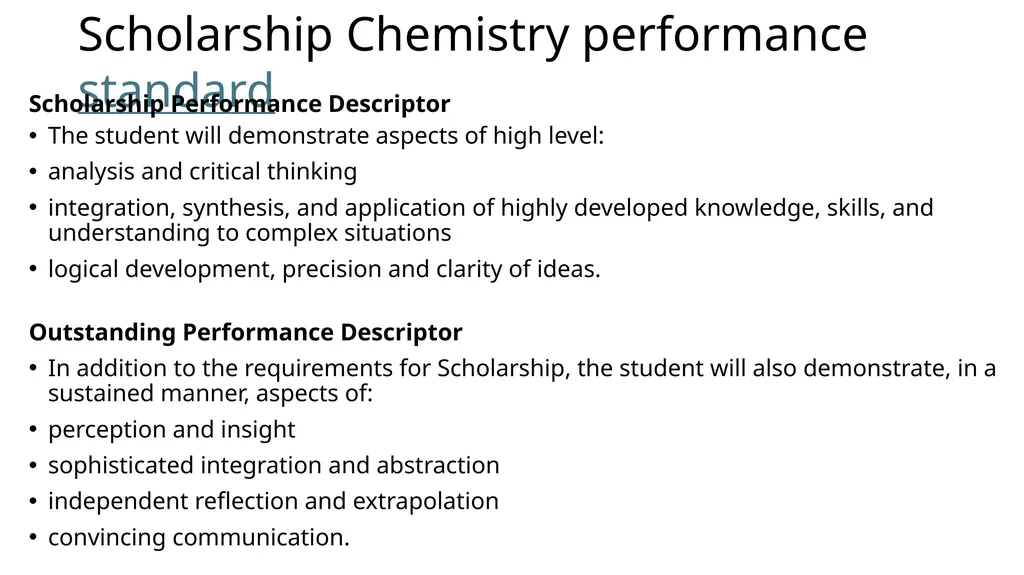
Scholarship Chemistry performance standard Scholarship Performance Descriptor
The student will demonstrate aspects of high level:
analysis and critical thinking
integration, synthesis, and application of highly developed knowledge, skills, and understanding to complex situations
logical development, precision and clarity of ideas.
Outstanding Performance Descriptor
In addition to the requirements for Scholarship, the student will also demonstrate, in a sustained manner, aspects of:
perception and insight
sophisticated integration and abstraction
independent reflection and extrapolation
convincing communication.<br>
The student will demonstrate aspects of high level:
analysis and critical thinking
integration, synthesis, and application of highly developed knowledge, skills, and understanding to complex situations
logical development, precision and clarity of ideas.
Outstanding Performance Descriptor
In addition to the requirements for Scholarship, the student will also demonstrate, in a sustained manner, aspects of:
perception and insight
sophisticated integration and abstraction
independent reflection and extrapolation
convincing communication.<br>
05
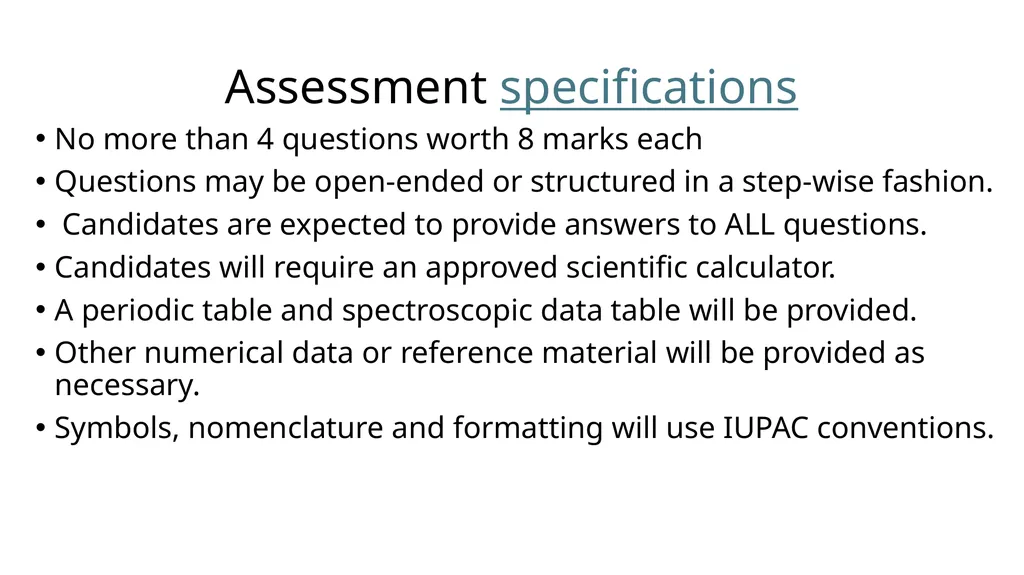
Assessment specifications No more than 4 questions worth 8 marks each
Questions may be open-ended or structured in a step-wise fashion.
Candidates are expected to provide answers to ALL questions.
Candidates will require an approved scientific calculator.
A periodic table and spectroscopic data table will be provided.
Other numerical data or reference material will be provided as necessary.
Symbols, nomenclature and formatting will use IUPAC conventions.<br>
Questions may be open-ended or structured in a step-wise fashion.
Candidates are expected to provide answers to ALL questions.
Candidates will require an approved scientific calculator.
A periodic table and spectroscopic data table will be provided.
Other numerical data or reference material will be provided as necessary.
Symbols, nomenclature and formatting will use IUPAC conventions.<br>
06
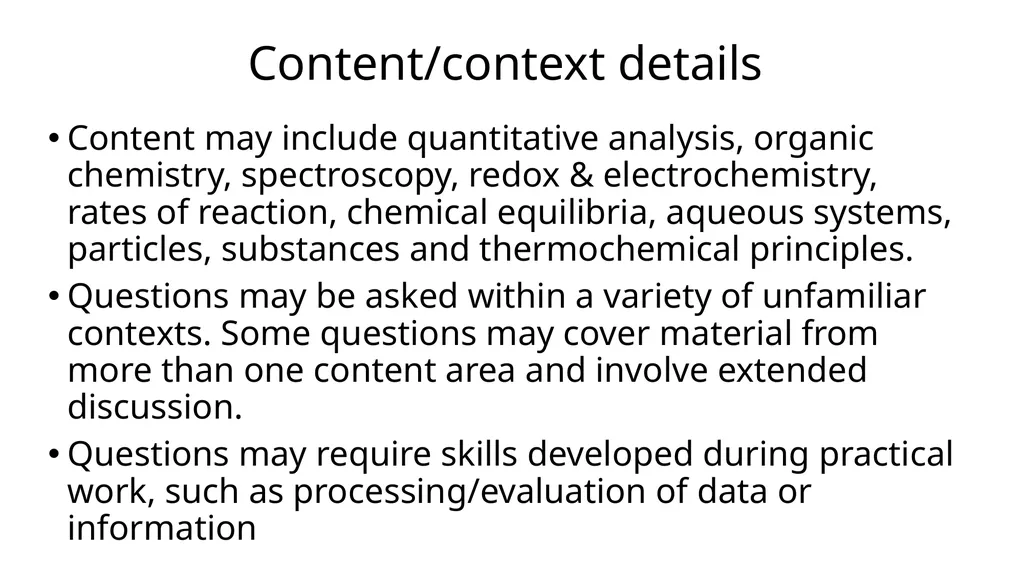
Content/context details Content may include quantitative analysis, organic chemistry, spectroscopy, redox & electrochemistry, rates of reaction, chemical equilibria, aqueous systems, particles, substances and thermochemical principles.
Questions may be asked within a variety of unfamiliar contexts. Some questions may cover material from more than one content area and involve extended discussion.
Questions may require skills developed during practical work, such as processing/evaluation of data or information<br>
Questions may be asked within a variety of unfamiliar contexts. Some questions may cover material from more than one content area and involve extended discussion.
Questions may require skills developed during practical work, such as processing/evaluation of data or information<br>
07
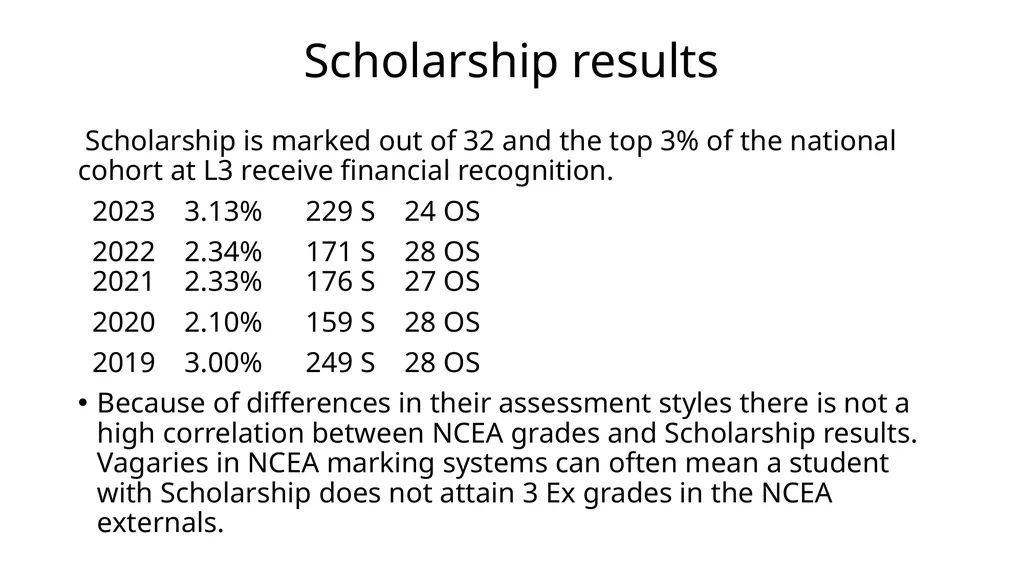
Scholarship results Scholarship is marked out of 32 and the top 3% of the national cohort at L3 receive financial recognition.
2023 3.13% 229 S 24 OS
2022 2.34% 171 S 28 OS 2021 2.33% 176 S 27 OS
2020 2.10% 159 S 28 OS
2019 3.00% 249 S 28 OS
Because of differences in their assessment styles there is not a high correlation between NCEA grades and Scholarship results. Vagaries in NCEA marking systems can often mean a student with Scholarship does not attain 3 Ex grades in the NCEA externals.<br>
2023 3.13% 229 S 24 OS
2022 2.34% 171 S 28 OS 2021 2.33% 176 S 27 OS
2020 2.10% 159 S 28 OS
2019 3.00% 249 S 28 OS
Because of differences in their assessment styles there is not a high correlation between NCEA grades and Scholarship results. Vagaries in NCEA marking systems can often mean a student with Scholarship does not attain 3 Ex grades in the NCEA externals.<br>
08
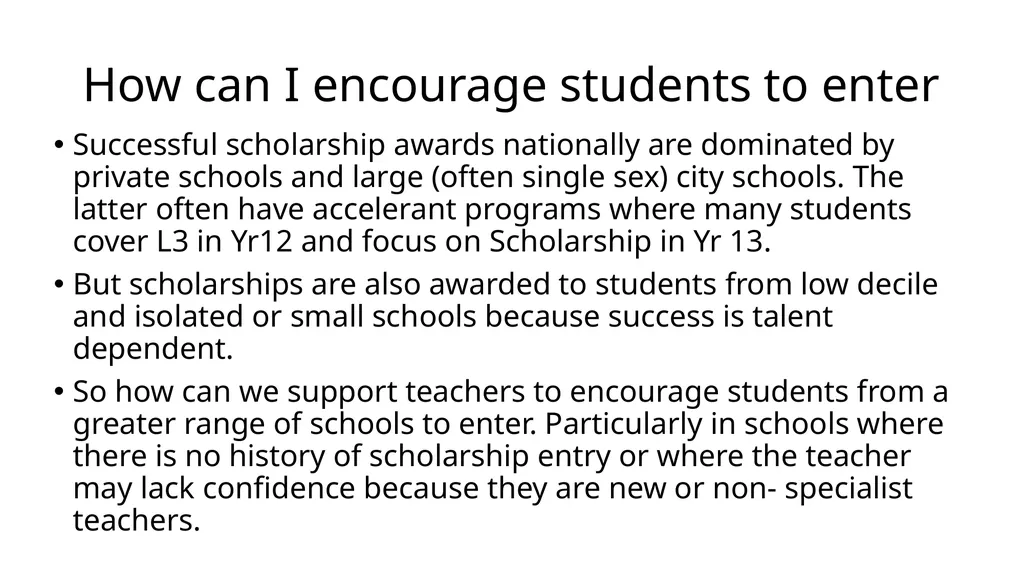
How can I encourage students to enter Successful scholarship awards nationally are dominated by private schools and large (often single sex) city schools. The latter often have accelerant programs where many students cover L3 in Yr12 and focus on Scholarship in Yr 13.
But scholarships are also awarded to students from low decile and isolated or small schools because success is talent dependent.
So how can we support teachers to encourage students from a greater range of schools to enter. Particularly in schools where there is no history of scholarship entry or where the teacher may lack confidence because they are new or non- specialist teachers.<br>
But scholarships are also awarded to students from low decile and isolated or small schools because success is talent dependent.
So how can we support teachers to encourage students from a greater range of schools to enter. Particularly in schools where there is no history of scholarship entry or where the teacher may lack confidence because they are new or non- specialist teachers.<br>
09
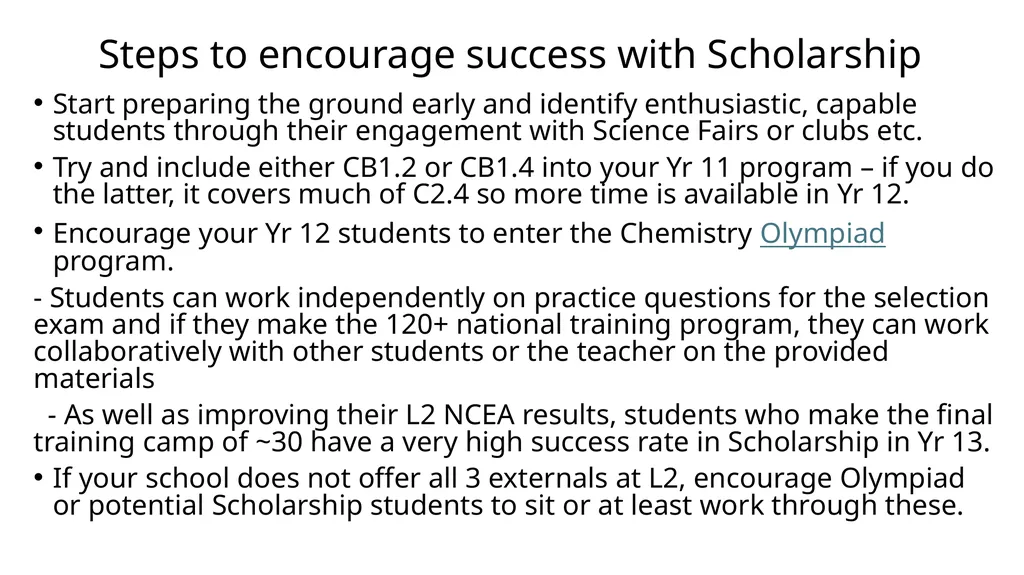
Steps to encourage success with Scholarship Start preparing the ground early and identify enthusiastic, capable students through their engagement with Science Fairs or clubs etc.
Try and include either CB1.2 or CB1.4 into your Yr 11 program – if you do the latter, it covers much of C2.4 so more time is available in Yr 12.
Encourage your Yr 12 students to enter the Chemistry Olympiad program.
- Students can work independently on practice questions for the selection exam and if they make the 120+ national training program, they can work collaboratively with other students or the teacher on the provided materials
- As well as improving their L2 NCEA results, students who make the final training camp of ~30 have a very high success rate in Scholarship in Yr 13.
If your school does not offer all 3 externals at L2, encourage Olympiad or potential Scholarship students to sit or at least work through these.<br>
Try and include either CB1.2 or CB1.4 into your Yr 11 program – if you do the latter, it covers much of C2.4 so more time is available in Yr 12.
Encourage your Yr 12 students to enter the Chemistry Olympiad program.
- Students can work independently on practice questions for the selection exam and if they make the 120+ national training program, they can work collaboratively with other students or the teacher on the provided materials
- As well as improving their L2 NCEA results, students who make the final training camp of ~30 have a very high success rate in Scholarship in Yr 13.
If your school does not offer all 3 externals at L2, encourage Olympiad or potential Scholarship students to sit or at least work through these.<br>
10
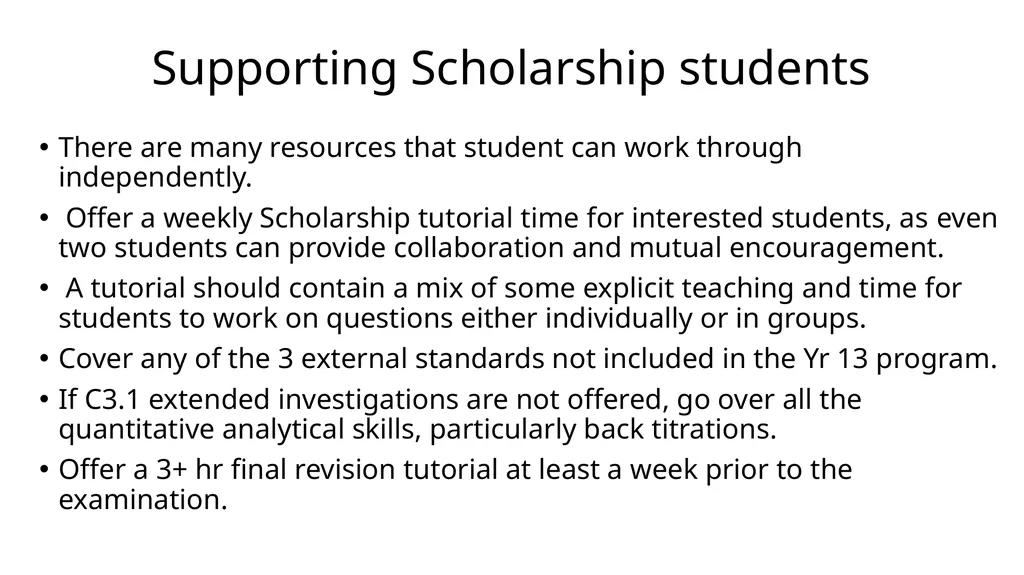
Supporting Scholarship students There are many resources that student can work through independently.
Offer a weekly Scholarship tutorial time for interested students, as even two students can provide collaboration and mutual encouragement.
A tutorial should contain a mix of some explicit teaching and time for students to work on questions either individually or in groups.
Cover any of the 3 external standards not included in the Yr 13 program.
If C3.1 extended investigations are not offered, go over all the quantitative analytical skills, particularly back titrations.
Offer a 3+ hr final revision tutorial at least a week prior to the examination.<br>
Offer a weekly Scholarship tutorial time for interested students, as even two students can provide collaboration and mutual encouragement.
A tutorial should contain a mix of some explicit teaching and time for students to work on questions either individually or in groups.
Cover any of the 3 external standards not included in the Yr 13 program.
If C3.1 extended investigations are not offered, go over all the quantitative analytical skills, particularly back titrations.
Offer a 3+ hr final revision tutorial at least a week prior to the examination.<br>
11
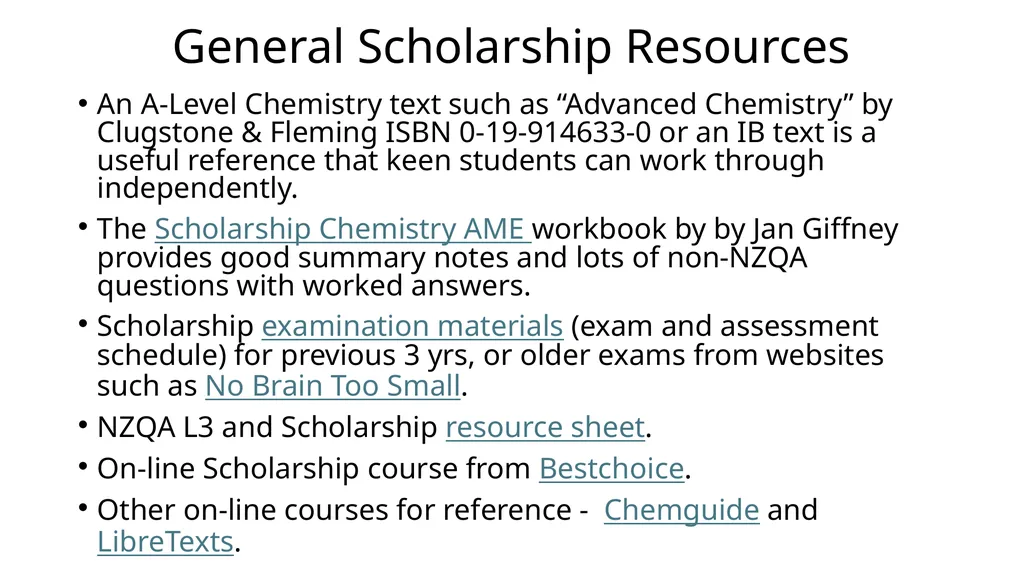
General Scholarship Resources An A-Level Chemistry text such as “Advanced Chemistry” by Clugstone & Fleming ISBN 0-19-914633-0 or an IB text is a useful reference that keen students can work through independently.
The Scholarship Chemistry AME workbook by by Jan Giffney provides good summary notes and lots of non-NZQA questions with worked answers.
Scholarship examination materials (exam and assessment schedule) for previous 3 yrs, or older exams from websites such as No Brain Too Small.
NZQA L3 and Scholarship resource sheet.
On-line Scholarship course from Bestchoice.
Other on-line courses for reference - Chemguide and LibreTexts.<br>
The Scholarship Chemistry AME workbook by by Jan Giffney provides good summary notes and lots of non-NZQA questions with worked answers.
Scholarship examination materials (exam and assessment schedule) for previous 3 yrs, or older exams from websites such as No Brain Too Small.
NZQA L3 and Scholarship resource sheet.
On-line Scholarship course from Bestchoice.
Other on-line courses for reference - Chemguide and LibreTexts.<br>
12
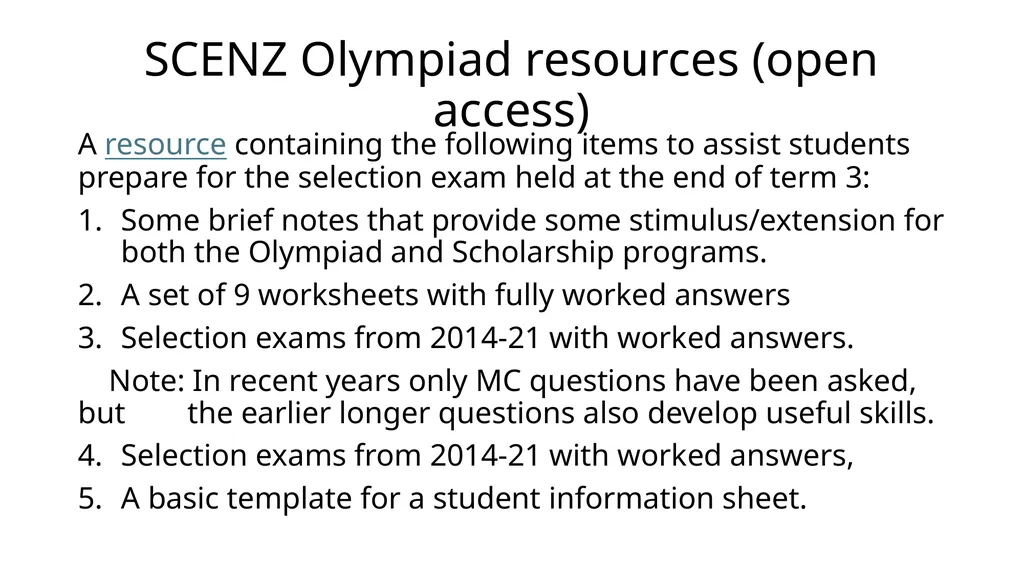
SCENZ Olympiad resources (open access) A resource containing the following items to assist students prepare for the selection exam held at the end of term 3:
Some brief notes that provide some stimulus/extension for both the Olympiad and Scholarship programs.
A set of 9 worksheets with fully worked answers
Selection exams from 2014-21 with worked answers.
Note: In recent years only MC questions have been asked, but the earlier longer questions also develop useful skills.
Selection exams from 2014-21 with worked answers,
A basic template for a student information sheet.<br>
Some brief notes that provide some stimulus/extension for both the Olympiad and Scholarship programs.
A set of 9 worksheets with fully worked answers
Selection exams from 2014-21 with worked answers.
Note: In recent years only MC questions have been asked, but the earlier longer questions also develop useful skills.
Selection exams from 2014-21 with worked answers,
A basic template for a student information sheet.<br>
13
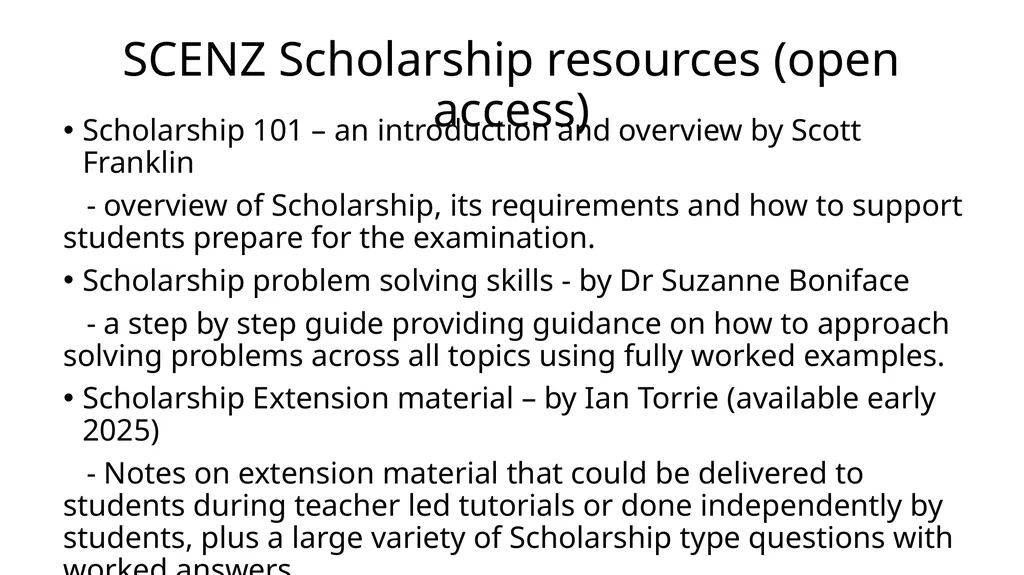
SCENZ Scholarship resources (open access) Scholarship 101 – an introduction and overview by Scott Franklin
- overview of Scholarship, its requirements and how to support students prepare for the examination.
Scholarship problem solving skills - by Dr Suzanne Boniface
- a step by step guide providing guidance on how to approach solving problems across all topics using fully worked examples.
Scholarship Extension material – by Ian Torrie (available early 2025)
- Notes on extension material that could be delivered to students during teacher led tutorials or done independently by students, plus a large variety of Scholarship type questions with worked answers.<br>
- overview of Scholarship, its requirements and how to support students prepare for the examination.
Scholarship problem solving skills - by Dr Suzanne Boniface
- a step by step guide providing guidance on how to approach solving problems across all topics using fully worked examples.
Scholarship Extension material – by Ian Torrie (available early 2025)
- Notes on extension material that could be delivered to students during teacher led tutorials or done independently by students, plus a large variety of Scholarship type questions with worked answers.<br>
14
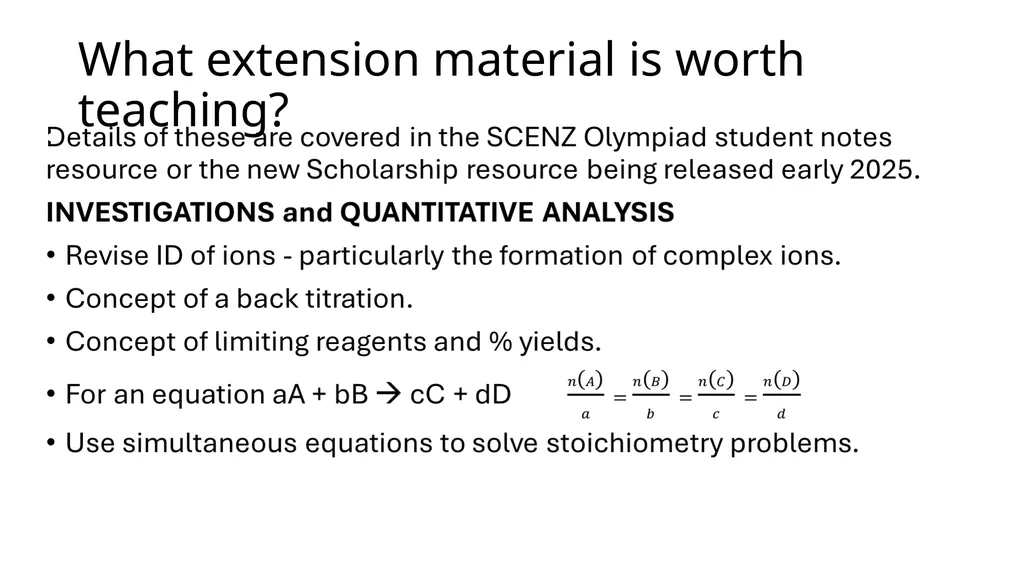
What extension material is worth teaching?<br>
15
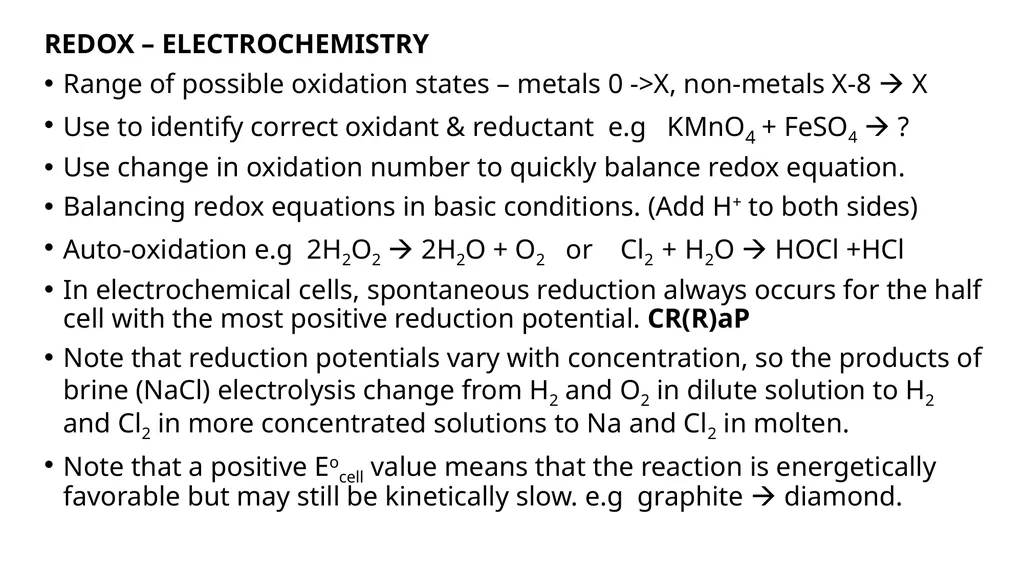
REDOX – ELECTROCHEMISTRY
Range of possible oxidation states – metals 0 ->X, non-metals X-8 X
Use to identify correct oxidant & reductant e.g KMnO4 + FeSO4 ?
Use change in oxidation number to quickly balance redox equation.
Balancing redox equations in basic conditions. (Add H+ to both sides)
Auto-oxidation e.g 2H2O2 2H2O + O2 or Cl2 + H2O HOCl +HCl
In electrochemical cells, spontaneous reduction always occurs for the half cell with the most positive reduction potential. CR(R)aP
Note that reduction potentials vary with concentration, so the products of brine (NaCl) electrolysis change from H2 and O2 in dilute solution to H2 and Cl2 in more concentrated solutions to Na and Cl2 in molten.
Note that a positive Eocell value means that the reaction is energetically favorable but may still be kinetically slow. e.g graphite diamond.<br>
Range of possible oxidation states – metals 0 ->X, non-metals X-8 X
Use to identify correct oxidant & reductant e.g KMnO4 + FeSO4 ?
Use change in oxidation number to quickly balance redox equation.
Balancing redox equations in basic conditions. (Add H+ to both sides)
Auto-oxidation e.g 2H2O2 2H2O + O2 or Cl2 + H2O HOCl +HCl
In electrochemical cells, spontaneous reduction always occurs for the half cell with the most positive reduction potential. CR(R)aP
Note that reduction potentials vary with concentration, so the products of brine (NaCl) electrolysis change from H2 and O2 in dilute solution to H2 and Cl2 in more concentrated solutions to Na and Cl2 in molten.
Note that a positive Eocell value means that the reaction is energetically favorable but may still be kinetically slow. e.g graphite diamond.<br>
16
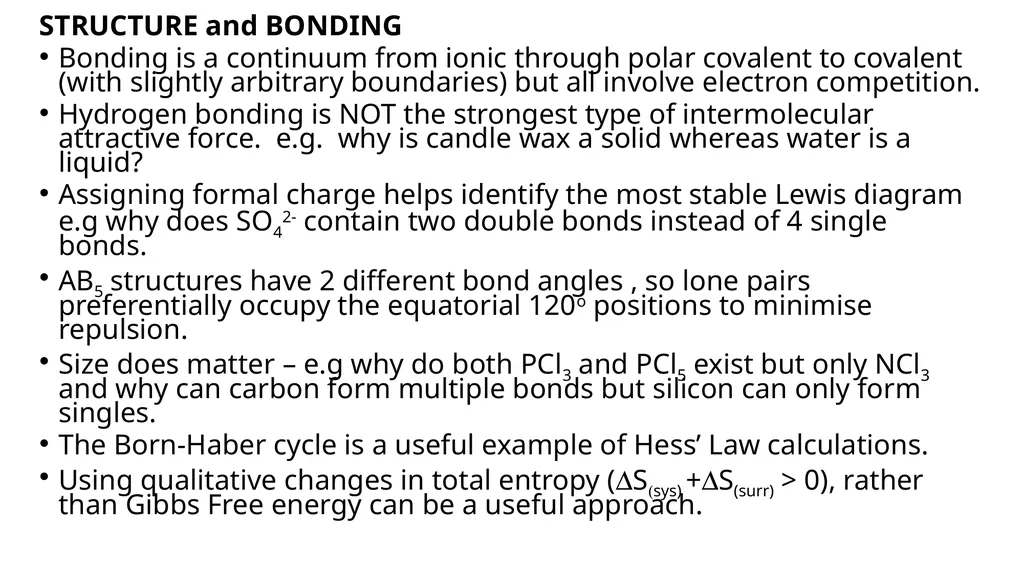
STRUCTURE and BONDING
Bonding is a continuum from ionic through polar covalent to covalent (with slightly arbitrary boundaries) but all involve electron competition.
Hydrogen bonding is NOT the strongest type of intermolecular attractive force. e.g. why is candle wax a solid whereas water is a liquid?
Assigning formal charge helps identify the most stable Lewis diagram e.g why does SO42- contain two double bonds instead of 4 single bonds.
AB5 structures have 2 different bond angles , so lone pairs preferentially occupy the equatorial 120o positions to minimise repulsion.
Size does matter – e.g why do both PCl3 and PCl5 exist but only NCl3 and why can carbon form multiple bonds but silicon can only form singles.
The Born-Haber cycle is a useful example of Hess’ Law calculations.
Using qualitative changes in total entropy (DS(sys) +DS(surr) > 0), rather than Gibbs Free energy can be a useful approach.<br>
Bonding is a continuum from ionic through polar covalent to covalent (with slightly arbitrary boundaries) but all involve electron competition.
Hydrogen bonding is NOT the strongest type of intermolecular attractive force. e.g. why is candle wax a solid whereas water is a liquid?
Assigning formal charge helps identify the most stable Lewis diagram e.g why does SO42- contain two double bonds instead of 4 single bonds.
AB5 structures have 2 different bond angles , so lone pairs preferentially occupy the equatorial 120o positions to minimise repulsion.
Size does matter – e.g why do both PCl3 and PCl5 exist but only NCl3 and why can carbon form multiple bonds but silicon can only form singles.
The Born-Haber cycle is a useful example of Hess’ Law calculations.
Using qualitative changes in total entropy (DS(sys) +DS(surr) > 0), rather than Gibbs Free energy can be a useful approach.<br>
17
SPECTROSCOPY
Revise the 10 step method to identify an organic structural formulae using given IR, NMR-12C and MS data.
ORGANIC
Identify possible structures from a molecular formula e.g C4H7Cl (12)
What type of molecule could have a molecular formula of C4H8O?
Use clues from molecular structure and isomerism to identify unknown
e.g. a chiral carbon would mean a primary alcohol must have a branched carbon chain or maybe secondary alcohol. No enantiomers despite branching indicates symmetry or 2 identical alkyl groups on branched carbon.
Use molecular formula to determine degrees of unsaturation (rings or double bonds , C=C or C=O). In going from one molecular formula to next determine what has been added or removed eg removal of 2H atoms for reduction of aldehyde or ketone to alcohol or removal of water with no change in number of C atoms is likely formation of cyclic ester.<br>
Revise the 10 step method to identify an organic structural formulae using given IR, NMR-12C and MS data.
ORGANIC
Identify possible structures from a molecular formula e.g C4H7Cl (12)
What type of molecule could have a molecular formula of C4H8O?
Use clues from molecular structure and isomerism to identify unknown
e.g. a chiral carbon would mean a primary alcohol must have a branched carbon chain or maybe secondary alcohol. No enantiomers despite branching indicates symmetry or 2 identical alkyl groups on branched carbon.
Use molecular formula to determine degrees of unsaturation (rings or double bonds , C=C or C=O). In going from one molecular formula to next determine what has been added or removed eg removal of 2H atoms for reduction of aldehyde or ketone to alcohol or removal of water with no change in number of C atoms is likely formation of cyclic ester.<br>
18
AQUEOUS SOLUTION EQUILIBRIA
Relative concentration of species in different solutions e.g CH3COONa
The stronger an acid, the weaker its conjugate base (as Ka x Kb = Kw), but this doesn’t mean that the conjugate of a strong acid is a weak base.
Le Chatelier’s is only a guiding principle which is based on the law of “invariant equilibrium constant” i.e. for a given reaction the equilibrium constant cannot change unless the temperature changes.
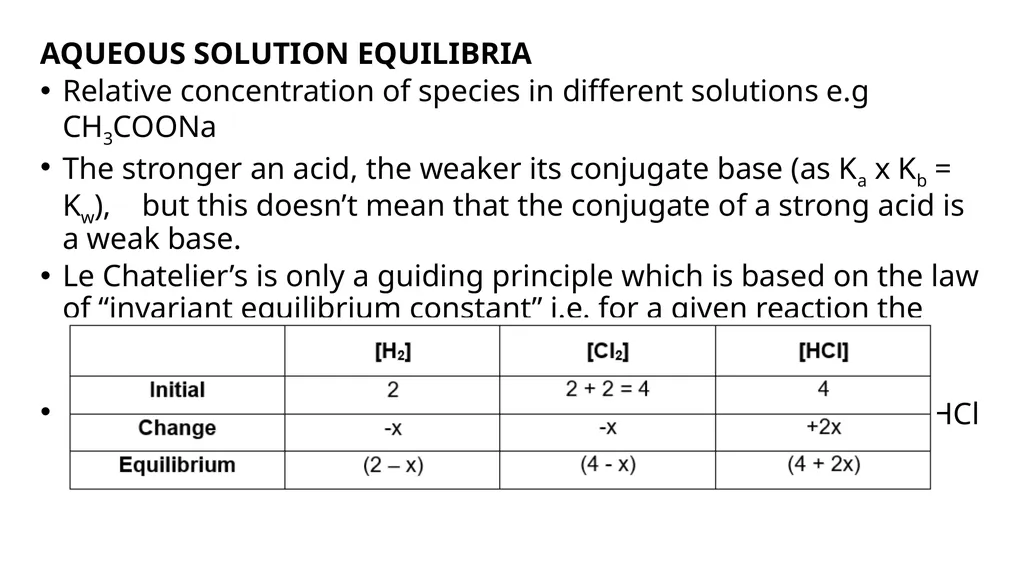
USE ICE tables for changes in equilibrium e.g. for H2 + Cl2 <-> 2HCl
Kc = 4.0 = (4 + 2x)2 / (2-x) x (4-x) so x = 0.4 and new (H2) = 1.6, (Cl2) = 3.6, (HCl) = 4.8<br>
Relative concentration of species in different solutions e.g CH3COONa
The stronger an acid, the weaker its conjugate base (as Ka x Kb = Kw), but this doesn’t mean that the conjugate of a strong acid is a weak base.
Le Chatelier’s is only a guiding principle which is based on the law of “invariant equilibrium constant” i.e. for a given reaction the equilibrium constant cannot change unless the temperature changes.
USE ICE tables for changes in equilibrium e.g. for H2 + Cl2 <-> 2HCl
Kc = 4.0 = (4 + 2x)2 / (2-x) x (4-x) so x = 0.4 and new (H2) = 1.6, (Cl2) = 3.6, (HCl) = 4.8<br>