Scientific Research and Research Methods By Assistant Professor Raouf Mahmood 1 Lecture Outline What is Scientific Research? Fundamental Principles of Scientific Research? Common ConceptionsMisconceptions About Scientific Research Basic
"Scientific Research and Research Methods By" is the property of its rightful owner. Permission is granted to
download and print the materials on this website for personal, non-commercial use only, and to display it
on your personal computer provided you do not modify the materials and that you retain all copyright
notices contained in the materials. By downloading content from our website, you accept the terms of this
agreement.
Presentation Transcript
01
Scientific Research and Research Methods By
Assistant Professor
Raouf Mahmood 1<br>
02
Lecture Outline What is Scientific Research?
Fundamental Principles of Scientific Research?
Common Conceptions/Misconceptions About Scientific Research
Basic Elements of the Scientific Methods
Scientific Method of Research: Four Steps:
Understanding of Methodology and Methods 2<br>
03
What is Scientific Research? Definition: Scientific research is the systematic investigation of scientific theories and hypotheses.
A process of hard mental based on interactions among theories methods, and findings.
Builds on understanding derived from the objective testing of models or theories.
Accumulation of scientific knowledge is laborious, plodding, circuitous, and indirect.
Scientific knowledge is developed and improved through critique contested findings, replication, and convergence.
Scientific knowledge is developed through sustained efforts.
Scientific inquiry must be guided by fundamental principles. 3<br>
04
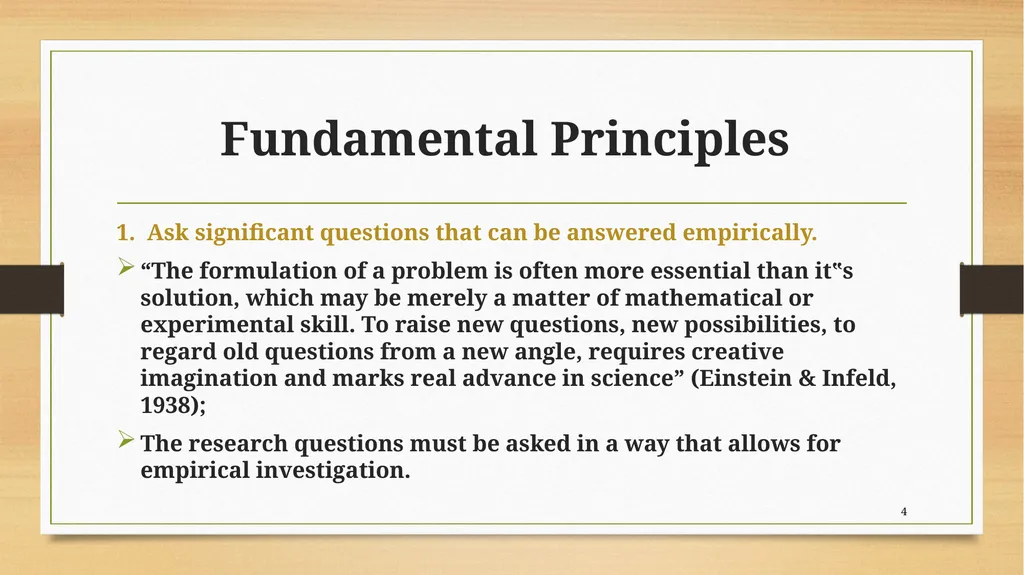
Fundamental Principles 1. Ask significant questions that can be answered empirically.
“The formulation of a problem is often more essential than it‟s solution, which may be merely a matter of mathematical or experimental skill. To raise new questions, new possibilities, to regard old questions from a new angle, requires creative imagination and marks real advance in science” (Einstein & Infeld, 1938);
The research questions must be asked in a way that allows for empirical investigation. 4<br>
05
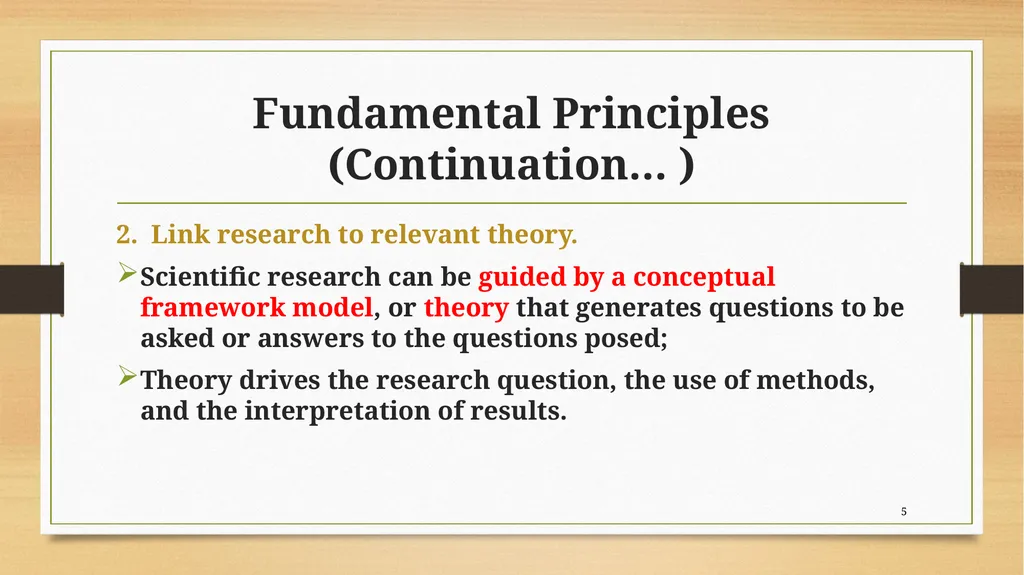
Fundamental Principles (Continuation… ) 2. Link research to relevant theory.
Scientific research can be guided by a conceptual framework model, or theory that generates questions to be asked or answers to the questions posed;
Theory drives the research question, the use of methods, and the interpretation of results. 5<br>
06
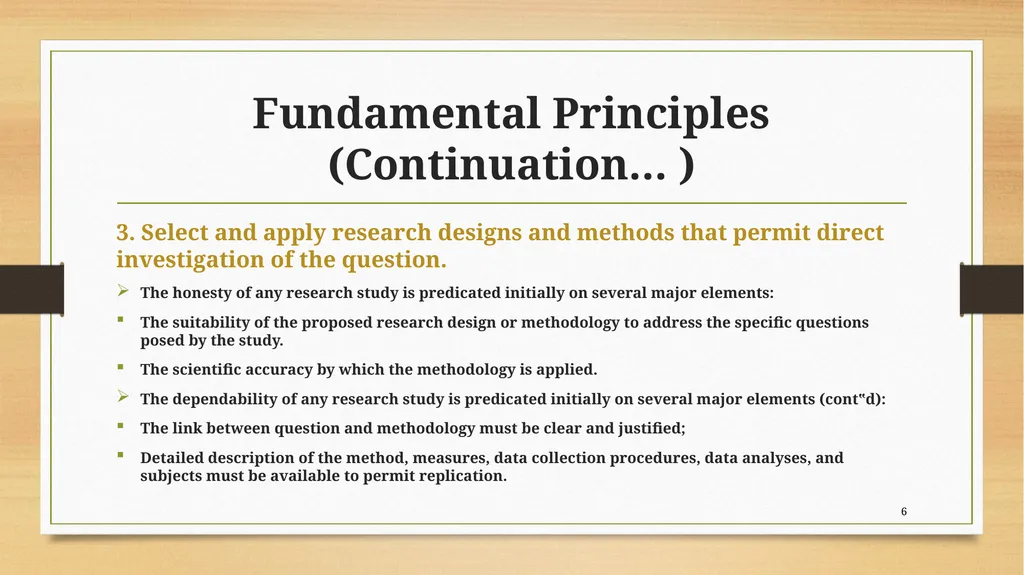
Fundamental Principles (Continuation… ) 3. Select and apply research designs and methods that permit direct investigation of the question.
The honesty of any research study is predicated initially on several major elements:
The suitability of the proposed research design or methodology to address the specific questions posed by the study.
The scientific accuracy by which the methodology is applied.
The dependability of any research study is predicated initially on several major elements (cont‟d):
The link between question and methodology must be clear and justified;
Detailed description of the method, measures, data collection procedures, data analyses, and subjects must be available to permit replication. 6<br>
07
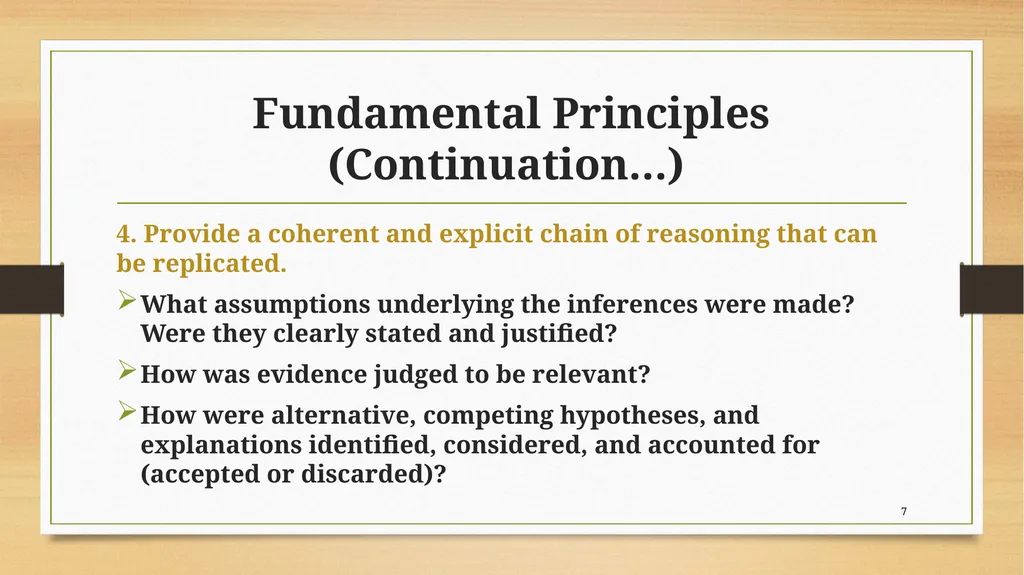
Fundamental Principles (Continuation…) 4. Provide a coherent and explicit chain of reasoning that can be replicated.
What assumptions underlying the inferences were made? Were they clearly stated and justified?
How was evidence judged to be relevant?
How were alternative, competing hypotheses, and explanations identified, considered, and accounted for (accepted or discarded)? 7<br>
08
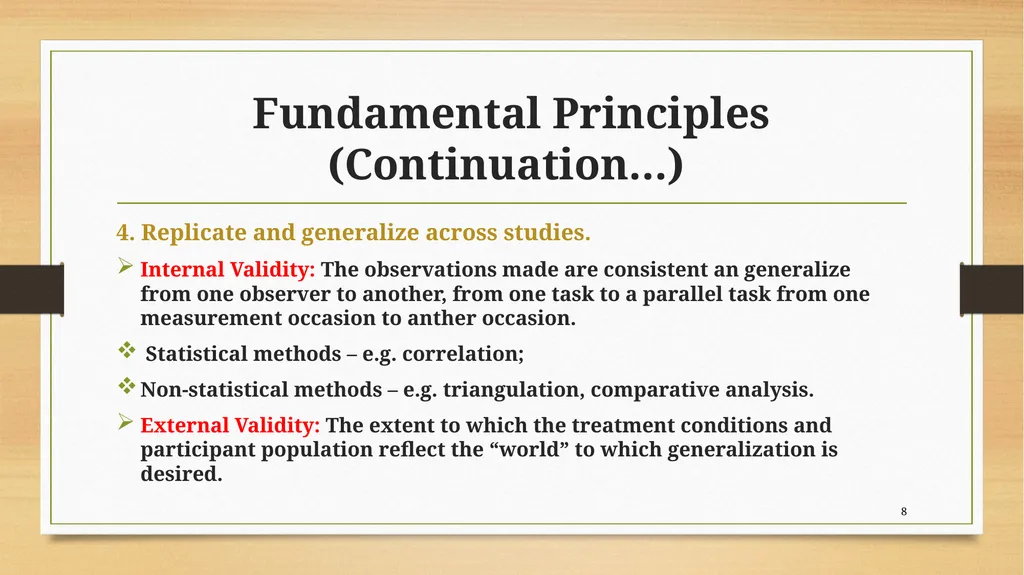
Fundamental Principles (Continuation…) 4. Replicate and generalize across studies.
Internal Validity: The observations made are consistent an generalize from one observer to another, from one task to a parallel task from one measurement occasion to anther occasion.
Statistical methods – e.g. correlation;
Non-statistical methods – e.g. triangulation, comparative analysis.
External Validity: The extent to which the treatment conditions and participant population reflect the “world” to which generalization is desired. 8<br>
09
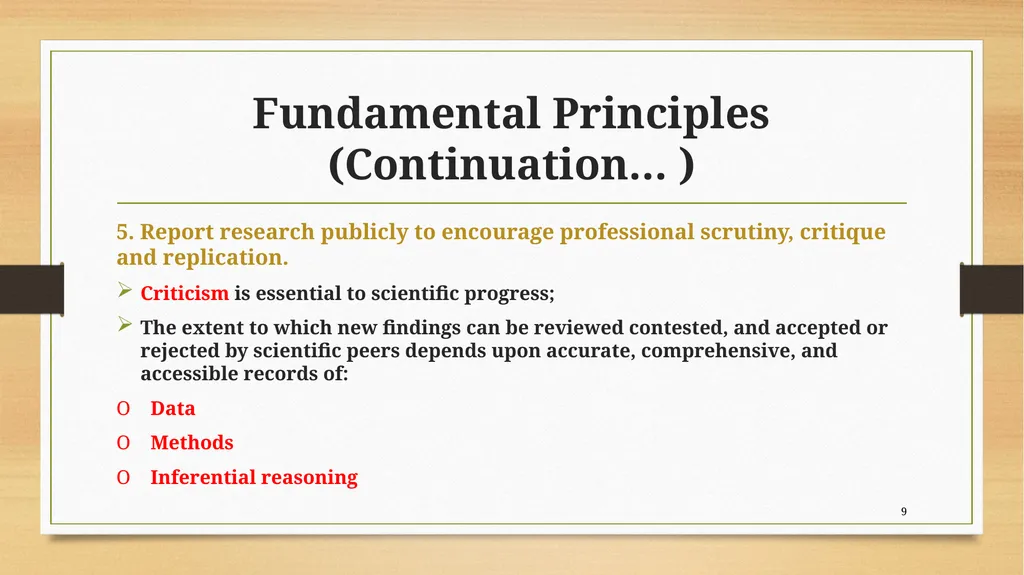
Fundamental Principles (Continuation… ) 5. Report research publicly to encourage professional scrutiny, critique and replication.
Criticism is essential to scientific progress;
The extent to which new findings can be reviewed contested, and accepted or rejected by scientific peers depends upon accurate, comprehensive, and accessible records of:
O Data
O Methods
O Inferential reasoning 9<br>
10
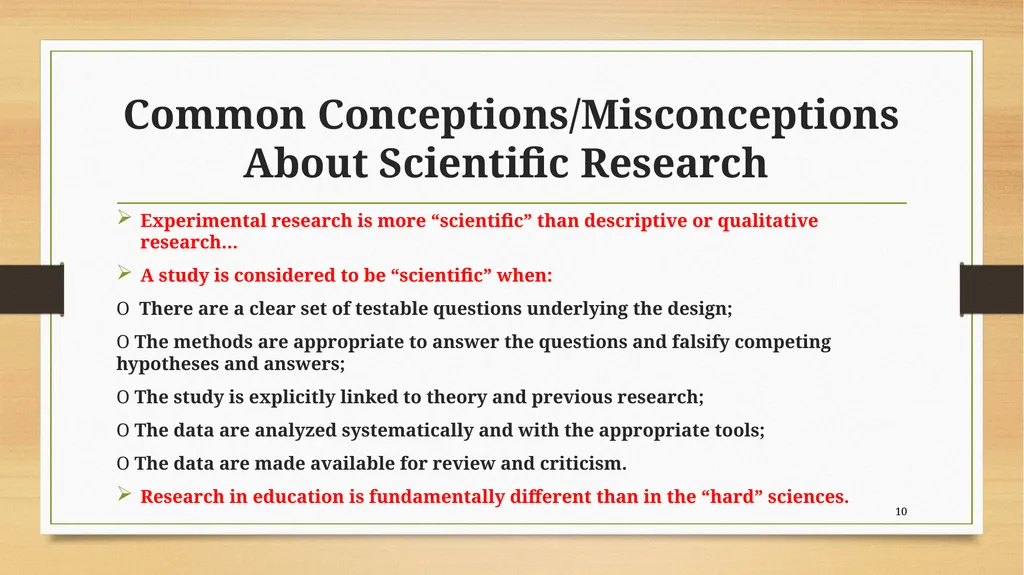
Common Conceptions/Misconceptions About Scientific Research Experimental research is more “scientific” than descriptive or qualitative research…
A study is considered to be “scientific” when:
O There are a clear set of testable questions underlying the design;
O The methods are appropriate to answer the questions and falsify competing hypotheses and answers;
O The study is explicitly linked to theory and previous research;
O The data are analyzed systematically and with the appropriate tools;
O The data are made available for review and criticism.
Research in education is fundamentally different than in the “hard” sciences. 10<br>
11
Thank you Asst. Prof. Dr. Raouf Mahmood Raouf 11<br>