
SDX: A Software-Defined Internet eXchange Jennifer
KL
Published · 47 slides · 0 views
1 / 1
Description
SDX: A Software-Defined Internet eXchange Jennifer Rexford Princeton University http:sdx.cs.princeton.edu Software Defined Networking Changing how we design manage networks Data centers, backbones, enterprises, But, so far, mostly
Related Topics
Share
Embed code
Download this presentation From Below
"SDX: A Software-Defined Internet eXchange Jennifer" is the property of its rightful owner. Permission is granted to download and print the materials on this website for personal, non-commercial use only, and to display it on your personal computer provided you do not modify the materials and that you retain all copyright notices contained in the materials. By downloading content from our website, you accept the terms of this agreement.
Presentation Transcript
01
SDX: A Software-Defined Internet eXchange Jennifer Rexford
Princeton University
http://sdx.cs.princeton.edu<br>
Princeton University
http://sdx.cs.princeton.edu<br>
02
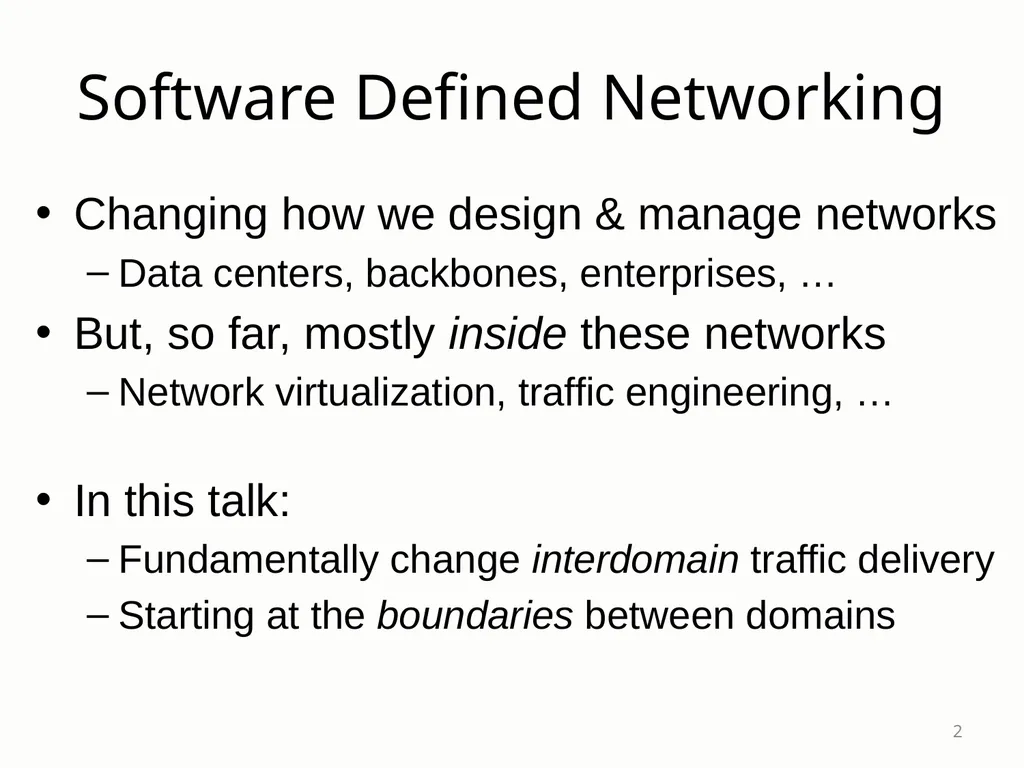
Software Defined Networking Changing how we design & manage networks
Data centers, backbones, enterprises, …
But, so far, mostly inside these networks
Network virtualization, traffic engineering, …
In this talk:
Fundamentally change interdomain traffic delivery
Starting at the boundaries between domains 2<br>
Data centers, backbones, enterprises, …
But, so far, mostly inside these networks
Network virtualization, traffic engineering, …
In this talk:
Fundamentally change interdomain traffic delivery
Starting at the boundaries between domains 2<br>
03
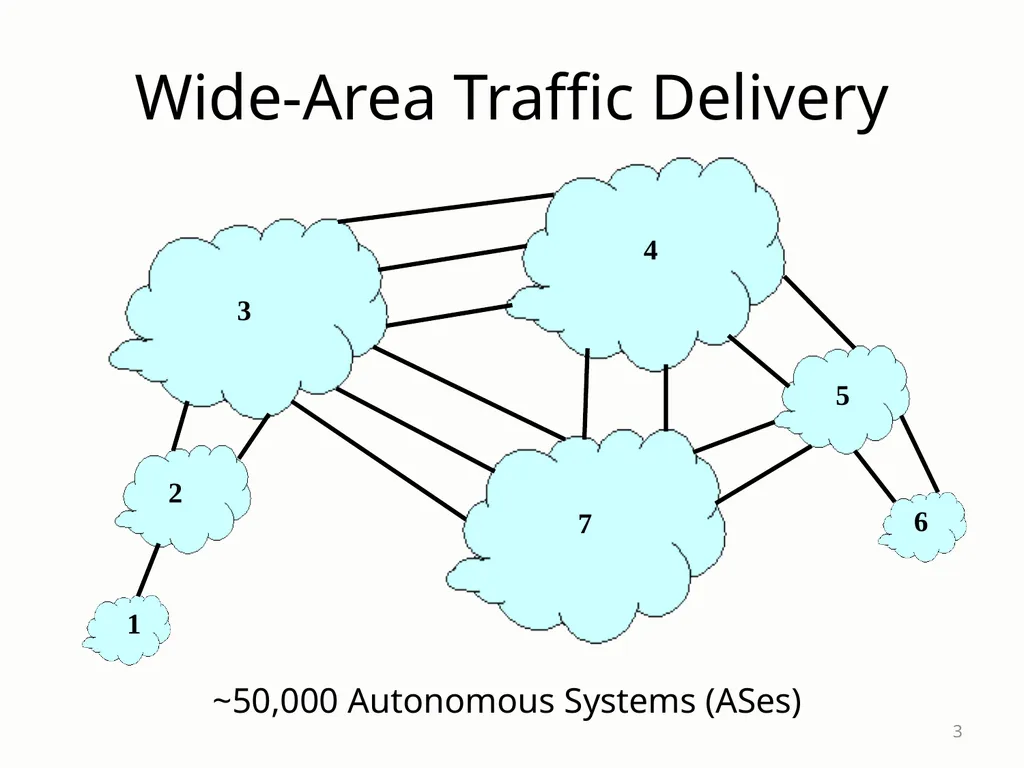
Wide-Area Traffic Delivery 3 1 2 3 4 5 6 7 ~50,000 Autonomous Systems (ASes)<br>
04
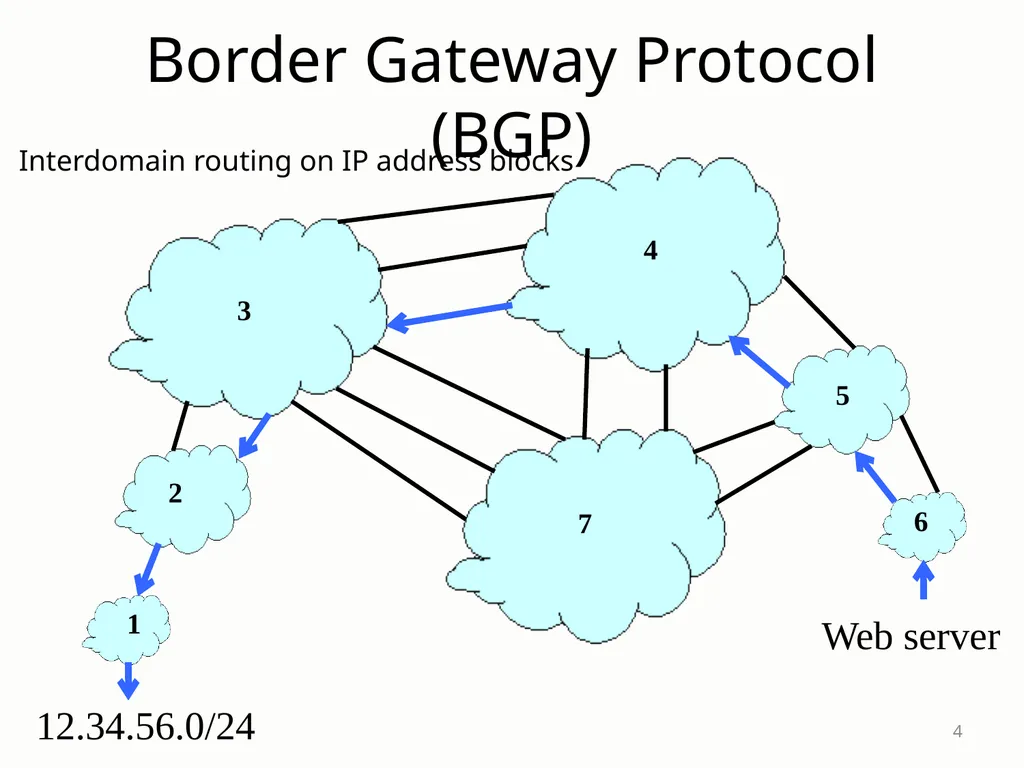
Border Gateway Protocol (BGP) 4 Interdomain routing on IP address blocks 1 2 3 4 5 6 7 12.34.56.0/24 Web server<br>
05
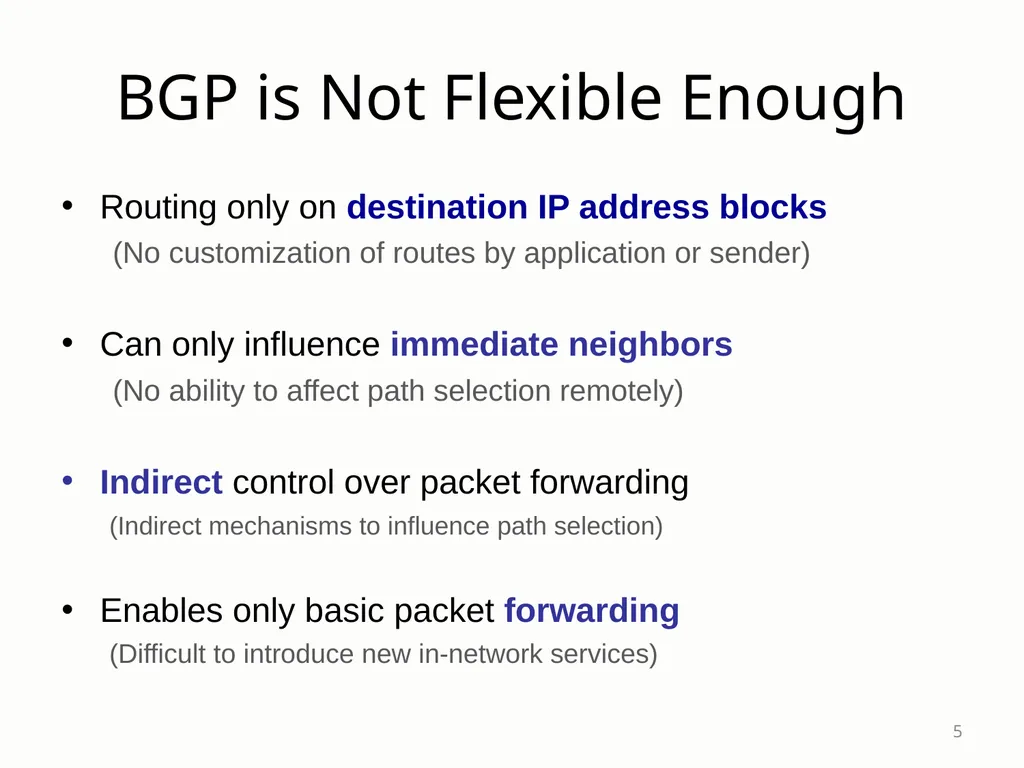
BGP is Not Flexible Enough Routing only on destination IP address blocks
(No customization of routes by application or sender)
Can only influence immediate neighbors
(No ability to affect path selection remotely)
Indirect control over packet forwarding (Indirect mechanisms to influence path selection)
Enables only basic packet forwarding (Difficult to introduce new in-network services) 5<br>
(No customization of routes by application or sender)
Can only influence immediate neighbors
(No ability to affect path selection remotely)
Indirect control over packet forwarding (Indirect mechanisms to influence path selection)
Enables only basic packet forwarding (Difficult to introduce new in-network services) 5<br>
06
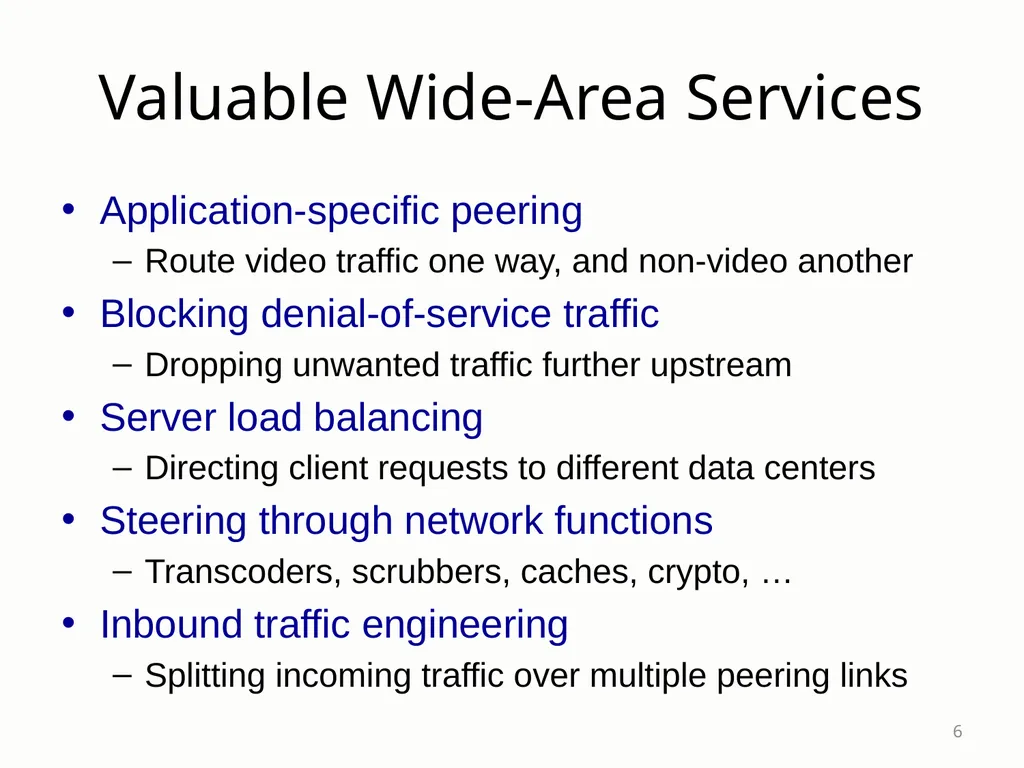
Valuable Wide-Area Services Application-specific peering
Route video traffic one way, and non-video another
Blocking denial-of-service traffic
Dropping unwanted traffic further upstream
Server load balancing
Directing client requests to different data centers
Steering through network functions
Transcoders, scrubbers, caches, crypto, …
Inbound traffic engineering
Splitting incoming traffic over multiple peering links 6<br>
Route video traffic one way, and non-video another
Blocking denial-of-service traffic
Dropping unwanted traffic further upstream
Server load balancing
Directing client requests to different data centers
Steering through network functions
Transcoders, scrubbers, caches, crypto, …
Inbound traffic engineering
Splitting incoming traffic over multiple peering links 6<br>
07
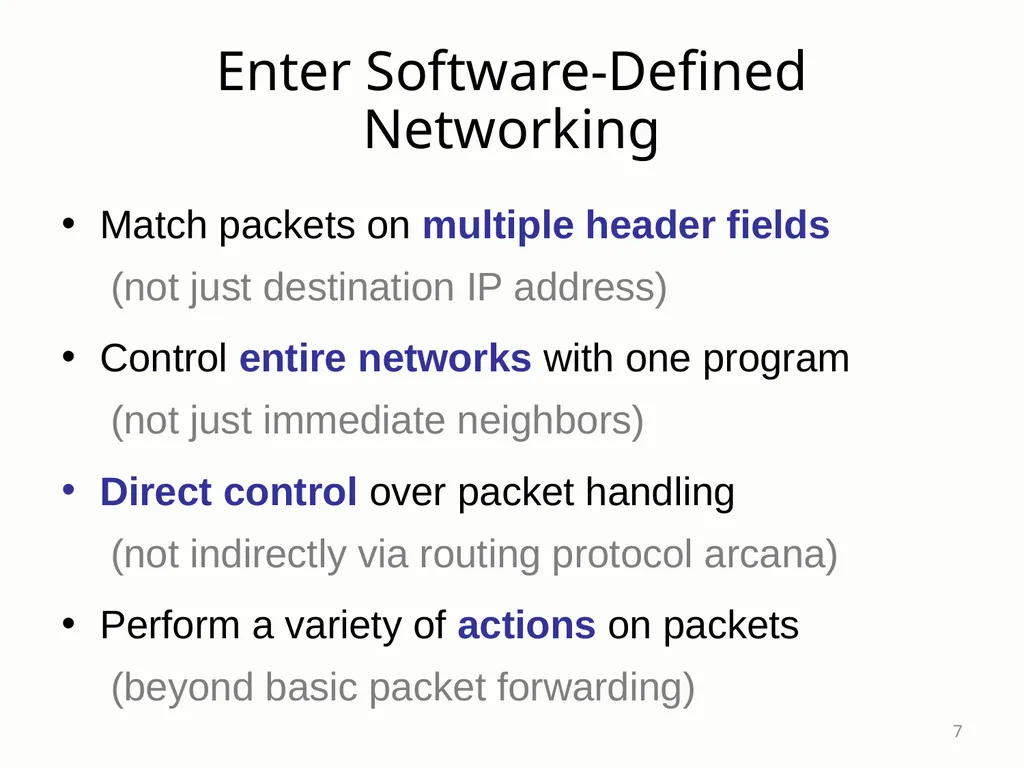
Enter Software-Defined Networking Match packets on multiple header fields
(not just destination IP address)
Control entire networks with one program (not just immediate neighbors)
Direct control over packet handling (not indirectly via routing protocol arcana)
Perform a variety of actions on packets (beyond basic packet forwarding) 7<br>
Control entire networks with one program (not just immediate neighbors)
Direct control over packet handling (not indirectly via routing protocol arcana)
Perform a variety of actions on packets (beyond basic packet forwarding) 7<br>
08
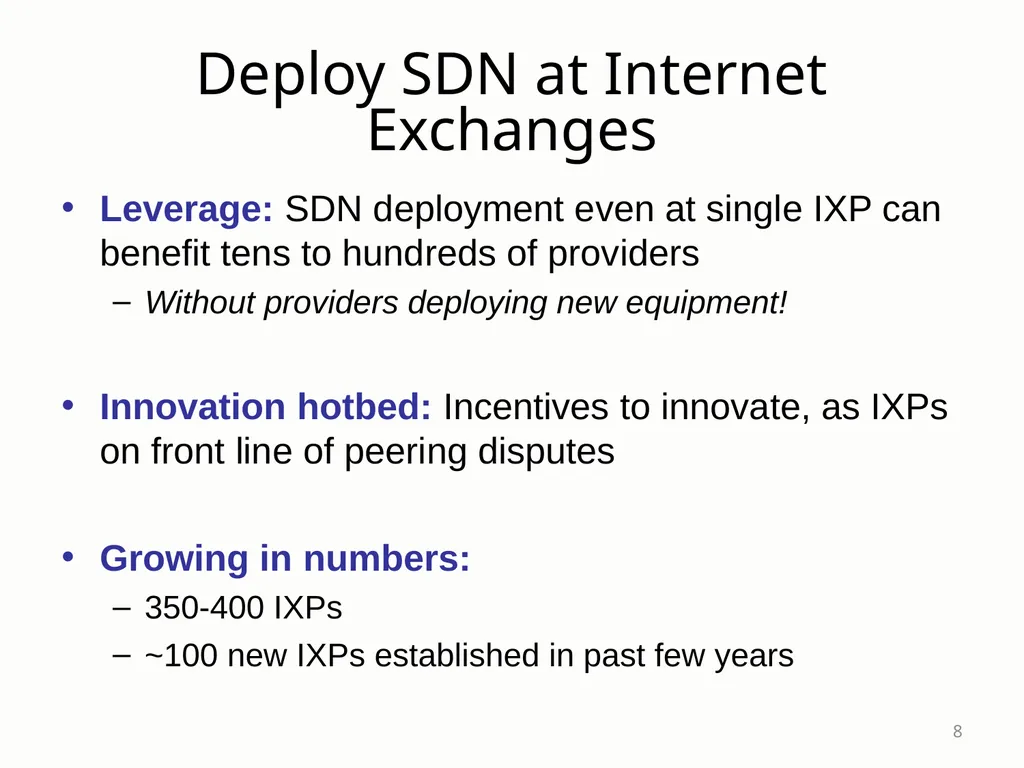
Deploy SDN at Internet Exchanges Leverage: SDN deployment even at single IXP can benefit tens to hundreds of providers
Without providers deploying new equipment!
Innovation hotbed: Incentives to innovate, as IXPs on front line of peering disputes
Growing in numbers:
350-400 IXPs
~100 new IXPs established in past few years 8<br>
Without providers deploying new equipment!
Innovation hotbed: Incentives to innovate, as IXPs on front line of peering disputes
Growing in numbers:
350-400 IXPs
~100 new IXPs established in past few years 8<br>
09
“SDX: Software-Defined eXchange” (SIGCOMM 2014)
Arpit Gupta, Nick Feamster, Laurent Vanbever, Muhammad Shahbaz, Sean Donovan, Brandon Schlinker, Scott Shenker, Russ Clark, Ethan Katz-Bassett 9 “An industrial-scale software defined Internet Exchange Point”
Arpit Gupta, Robert MacDavid, Rudiger Birkner, Marco Canini, Nick Feamster, Jennifer Rexford, Laurent Vanbever<br>
Arpit Gupta, Robert MacDavid, Rudiger Birkner, Marco Canini, Nick Feamster, Jennifer Rexford, Laurent Vanbever<br>
10
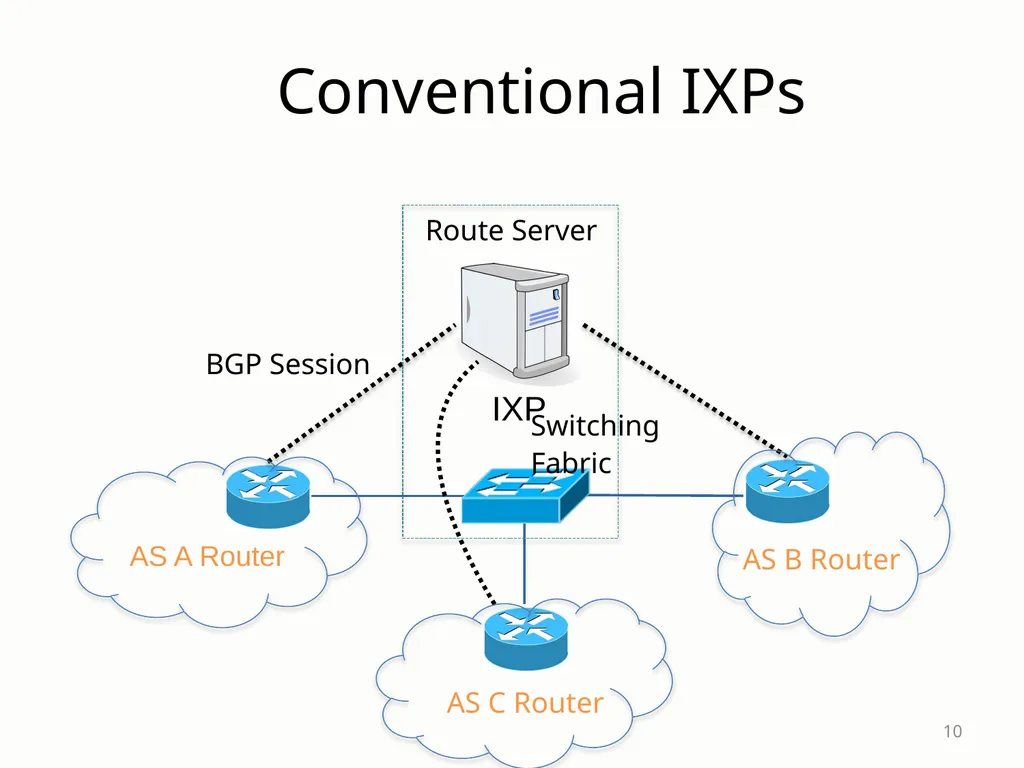
Conventional IXPs 10 AS A Router AS C Router AS B Router BGP Session Switching Fabric IXP Route Server<br>
11
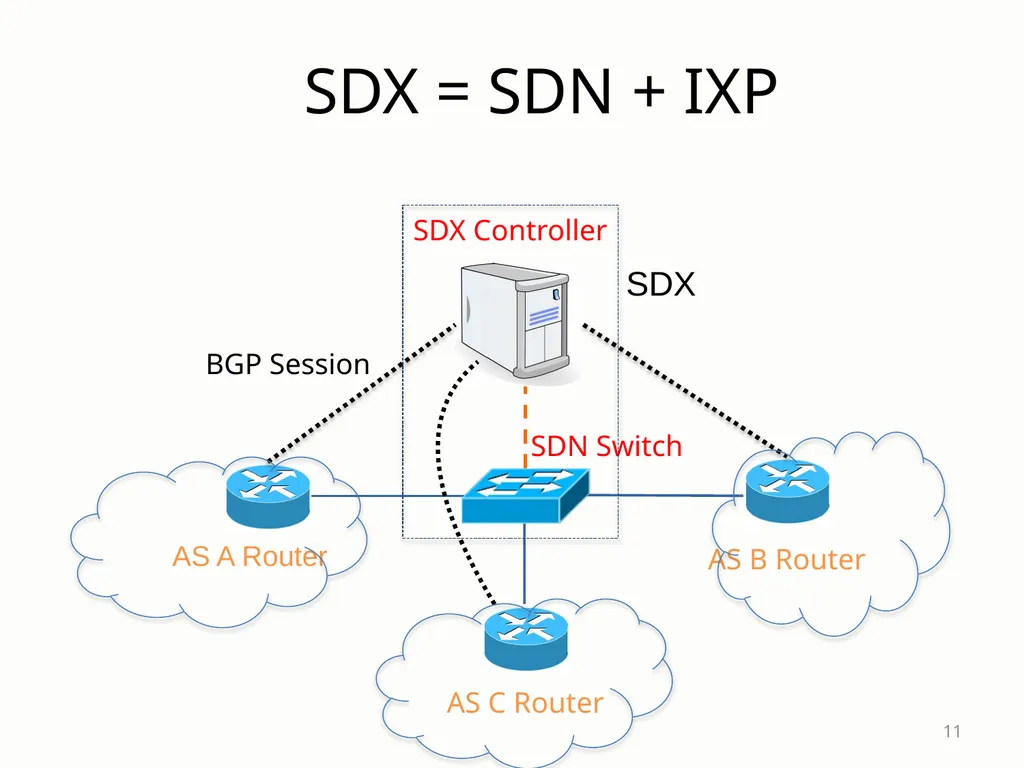
SDX = SDN + IXP 11 AS A Router AS C Router AS B Router BGP Session SDN Switch SDX Controller SDX<br>
12
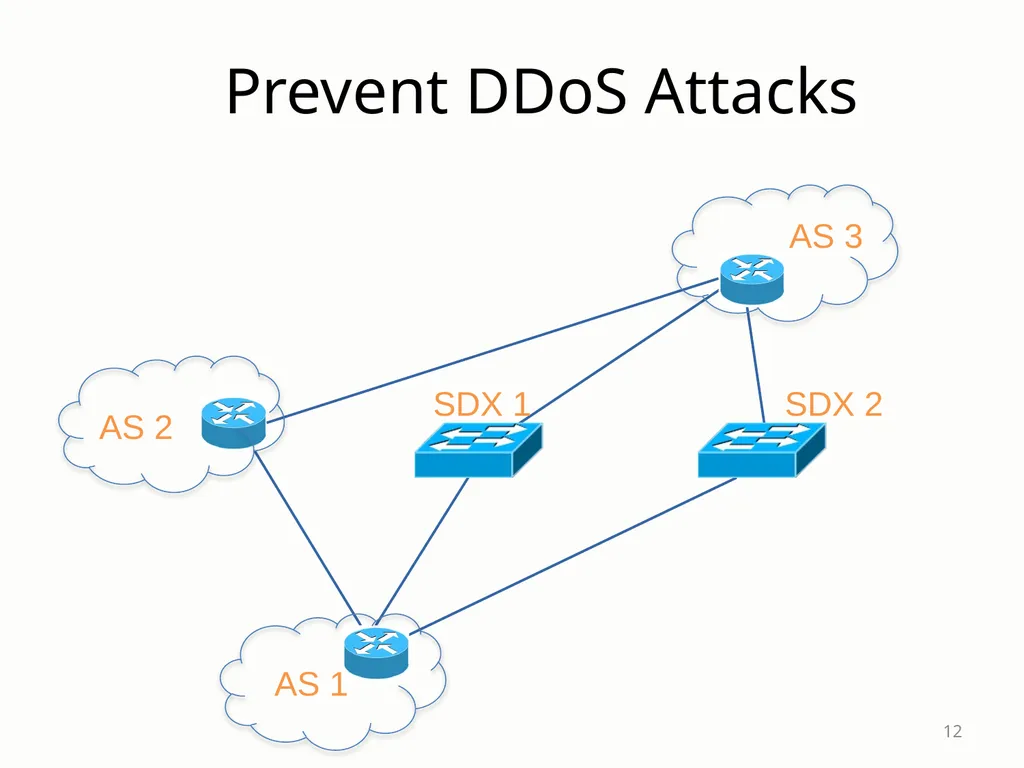
Prevent DDoS Attacks 12 AS 2 AS 1 AS 3 SDX 1 SDX 2<br>
13
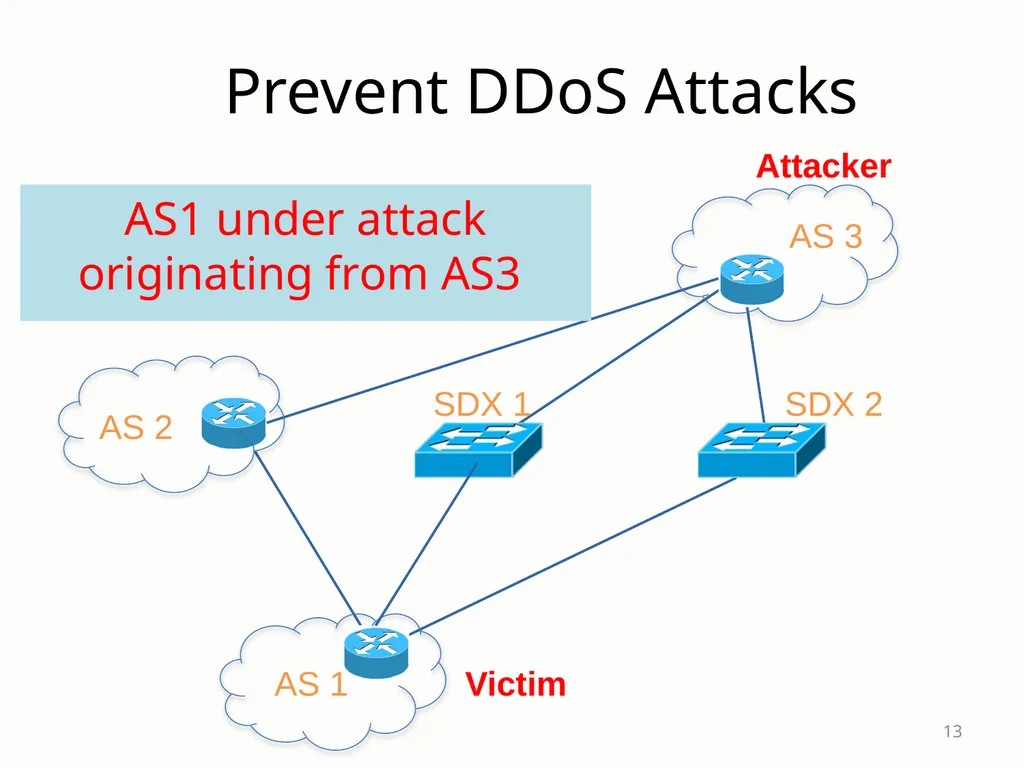
Prevent DDoS Attacks 13 AS 2 AS 1 AS 3 SDX 1 SDX 2 Attacker Victim AS1 under attack originating from AS3<br>
14
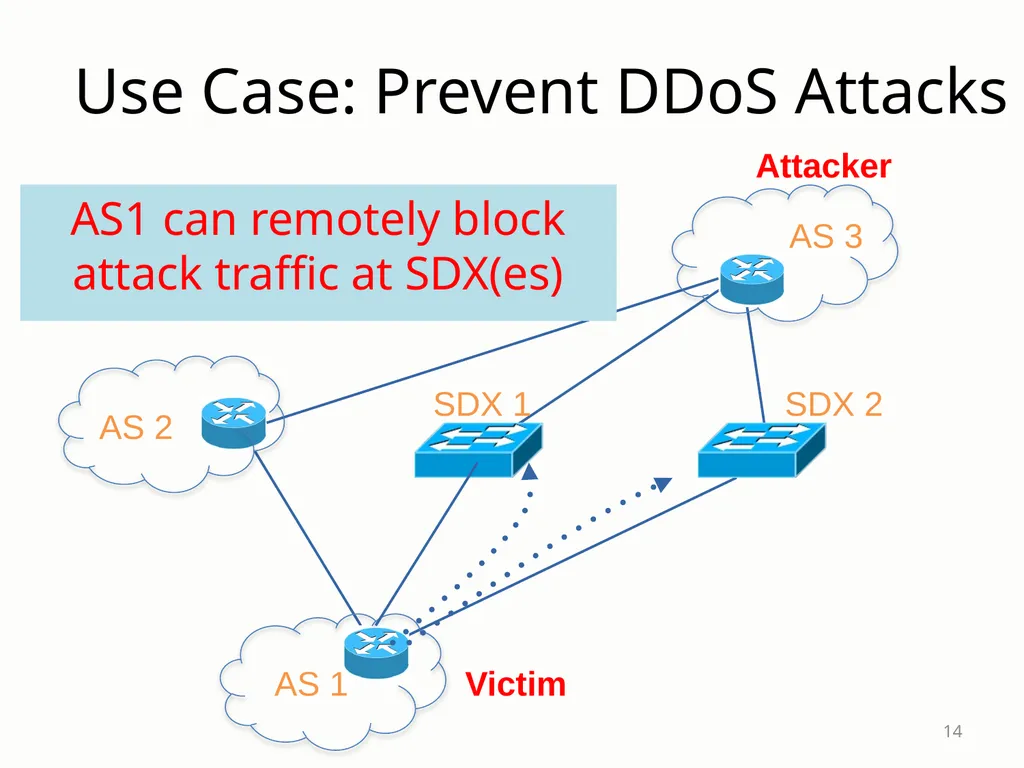
Use Case: Prevent DDoS Attacks 14 AS 2 AS 1 AS 3 SDX 1 SDX 2 Attacker Victim AS1 can remotely block attack traffic at SDX(es)<br>
15
SDX-based DDoS protection vs.
Traditional Defenses/Blackholing Remote influence
Physical connectivity to SDX not required
More specific
Drop rules based on multiple header fields, source address, destination address, port number …
Coordinated
Drop rules can be coordinated across multiple IXPs 15<br>
Physical connectivity to SDX not required
More specific
Drop rules based on multiple header fields, source address, destination address, port number …
Coordinated
Drop rules can be coordinated across multiple IXPs 15<br>
16
Inbound Traffic Engineering 16 AS A
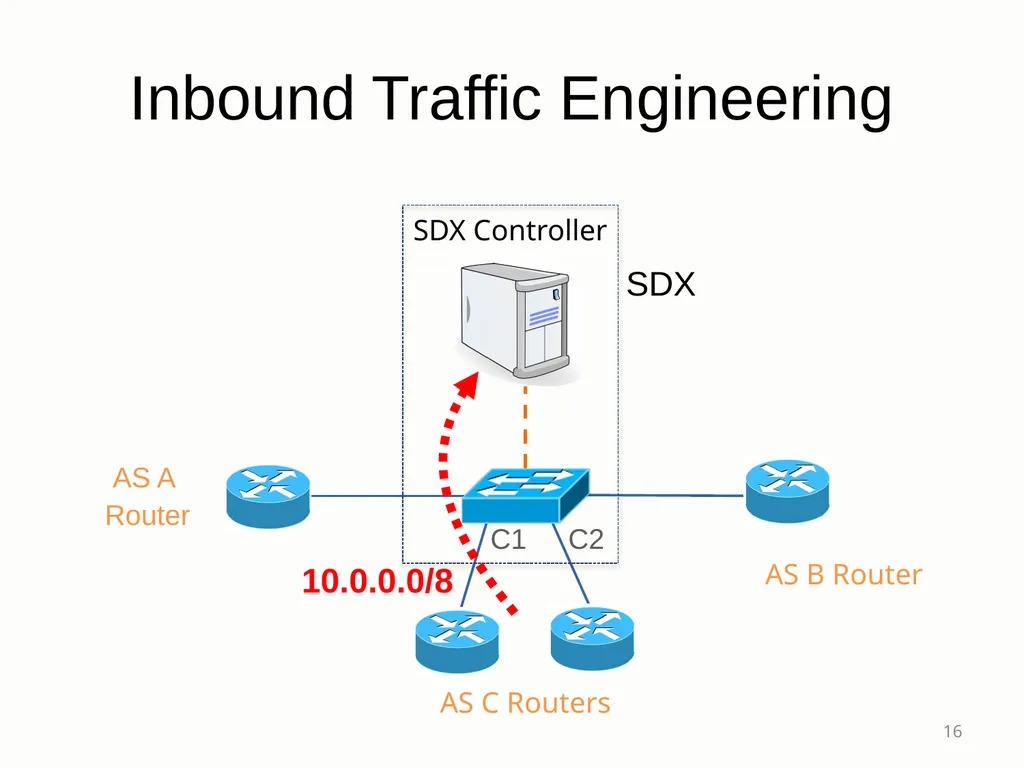
Router AS C Routers AS B Router SDX Controller SDX C1 C2 10.0.0.0/8<br>
17
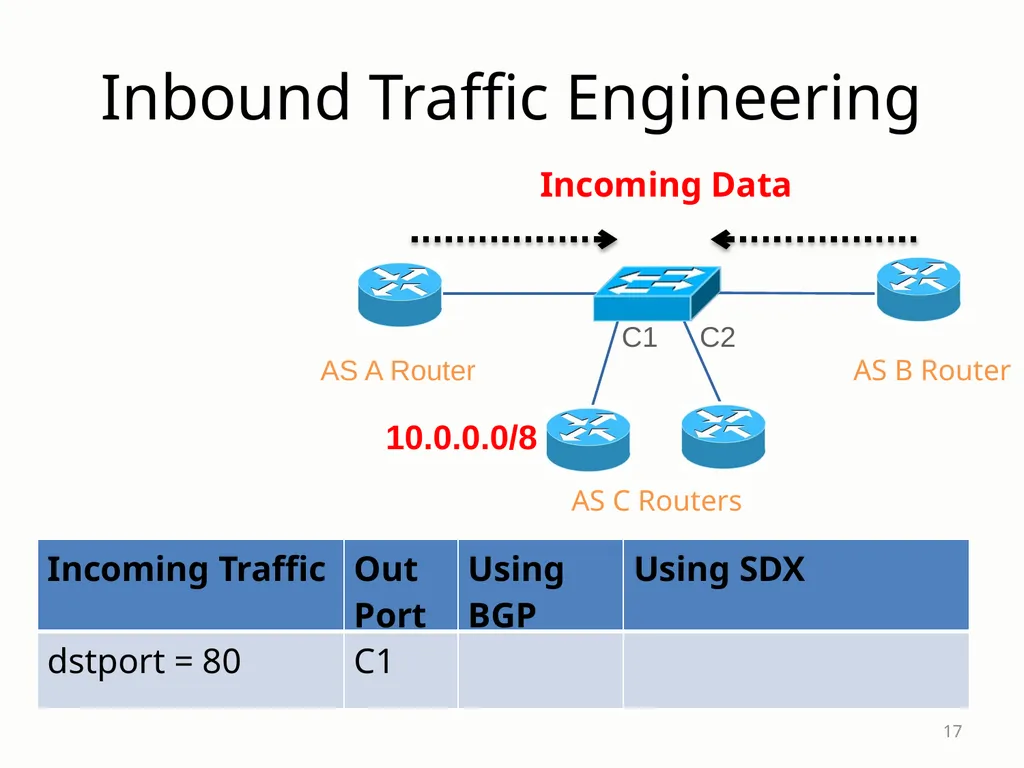
Inbound Traffic Engineering 17 AS A Router AS C Routers AS B Router C1 C2 Incoming Data 10.0.0.0/8<br>
18
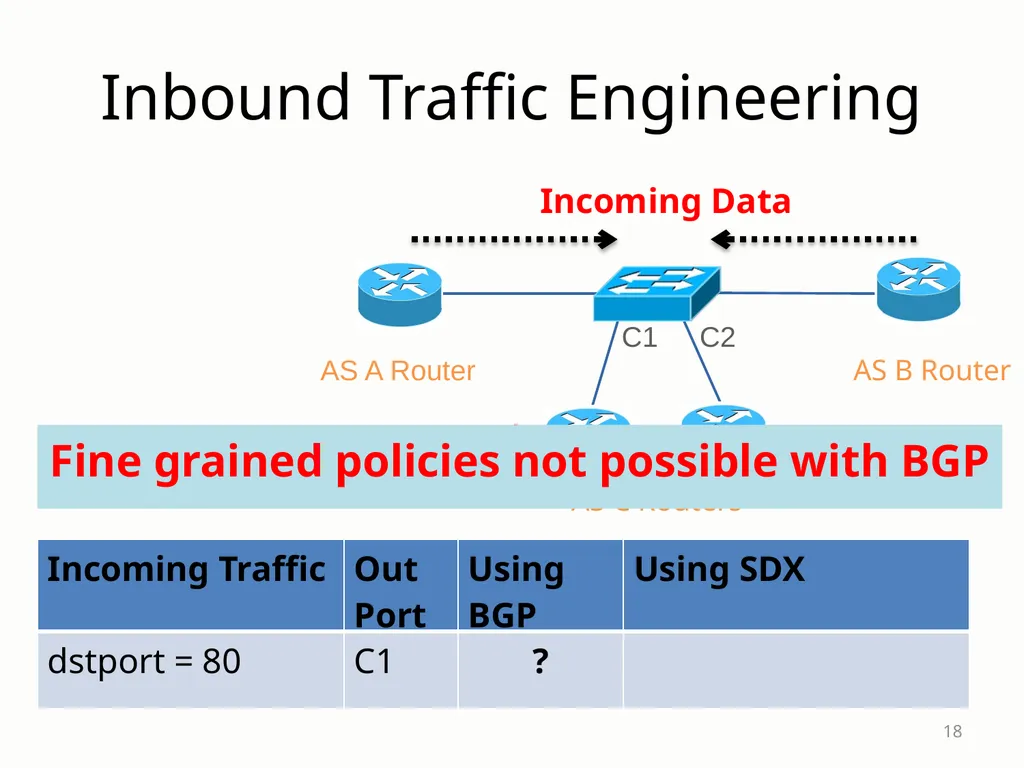
18 AS A Router AS C Routers AS B Router C1 C2 Incoming Data 10.0.0.0/8 Fine grained policies not possible with BGP Inbound Traffic Engineering<br>
19
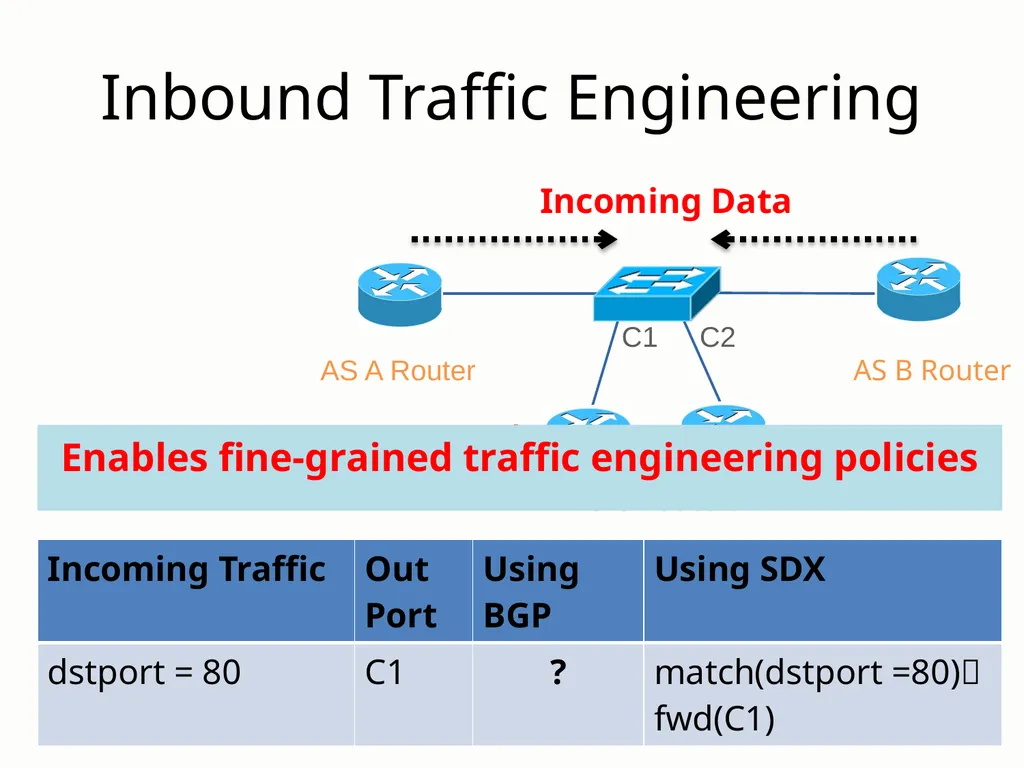
19 AS A Router AS C Routers AS B Router C1 C2 Incoming Data 10.0.0.0/8 Enables fine-grained traffic engineering policies Inbound Traffic Engineering<br>
20
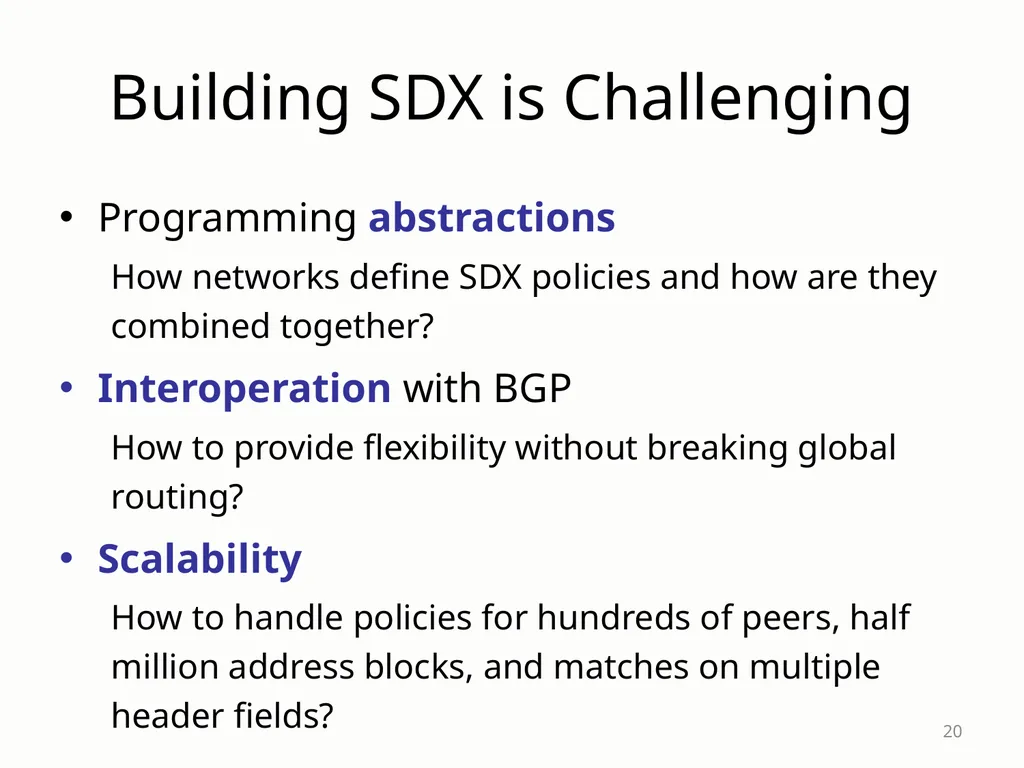
Building SDX is Challenging Programming abstractions
How networks define SDX policies and how are they combined together?
Interoperation with BGP
How to provide flexibility without breaking global routing?
Scalability
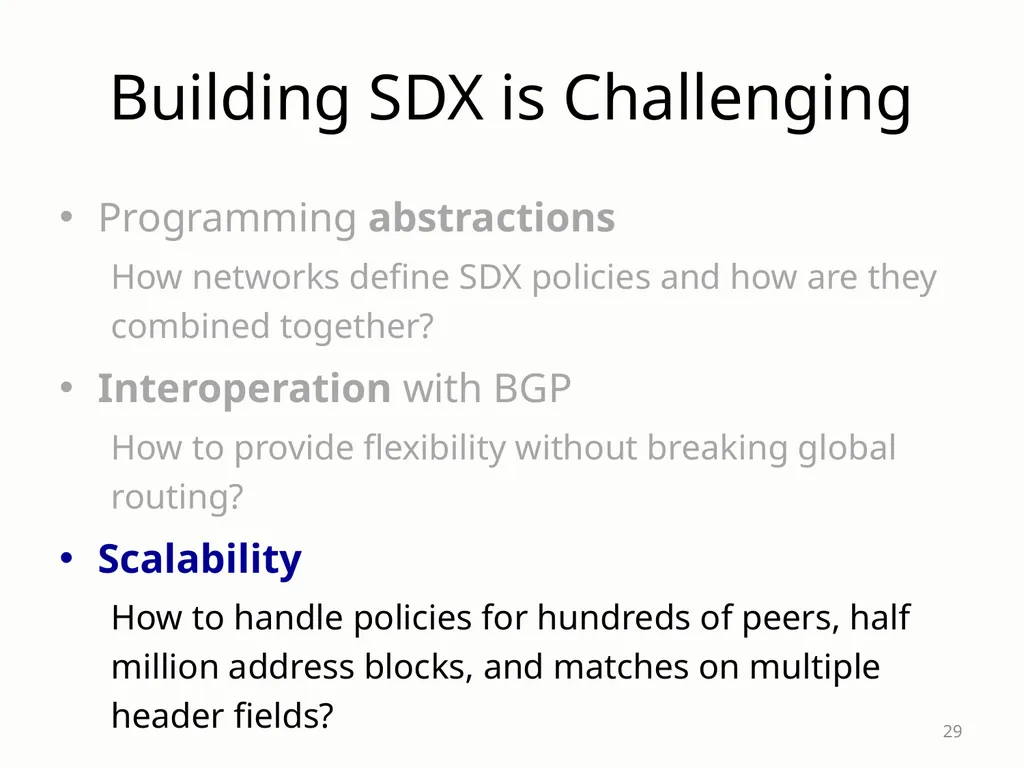
How to handle policies for hundreds of peers, half million address blocks, and matches on multiple header fields? 20<br>
How networks define SDX policies and how are they combined together?
Interoperation with BGP
How to provide flexibility without breaking global routing?
Scalability
How to handle policies for hundreds of peers, half million address blocks, and matches on multiple header fields? 20<br>
21
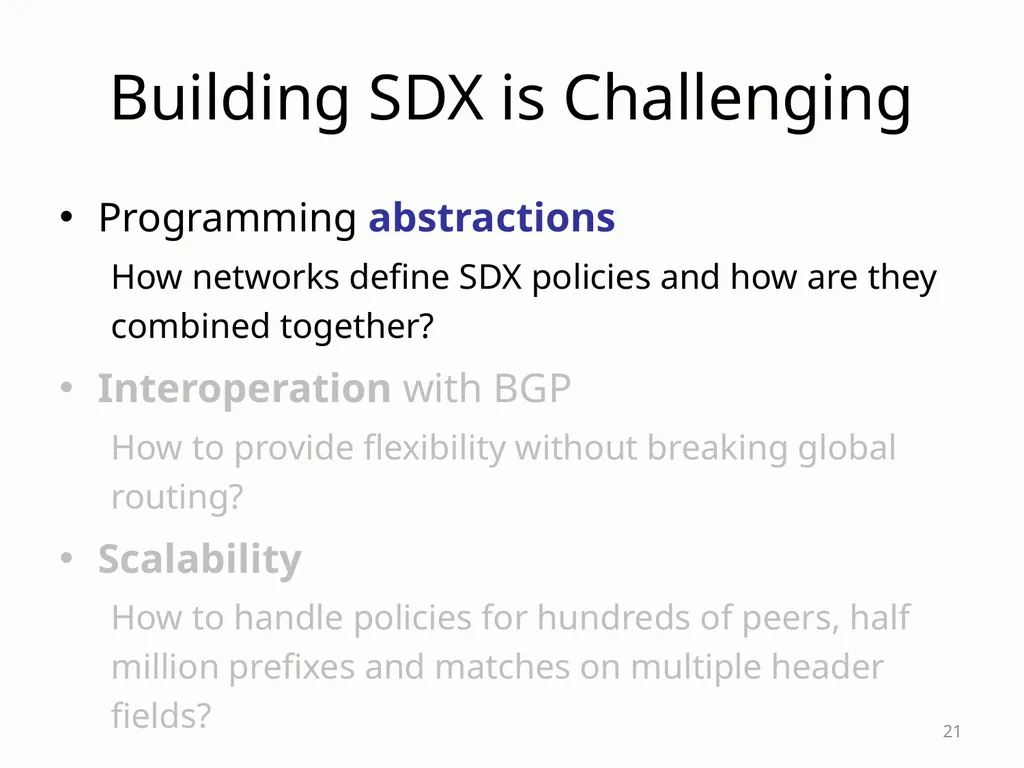
Building SDX is Challenging Programming abstractions
How networks define SDX policies and how are they combined together?
Interoperation with BGP
How to provide flexibility without breaking global routing?
Scalability
How to handle policies for hundreds of peers, half million prefixes and matches on multiple header fields? 21<br>
How networks define SDX policies and how are they combined together?
Interoperation with BGP
How to provide flexibility without breaking global routing?
Scalability
How to handle policies for hundreds of peers, half million prefixes and matches on multiple header fields? 21<br>
22
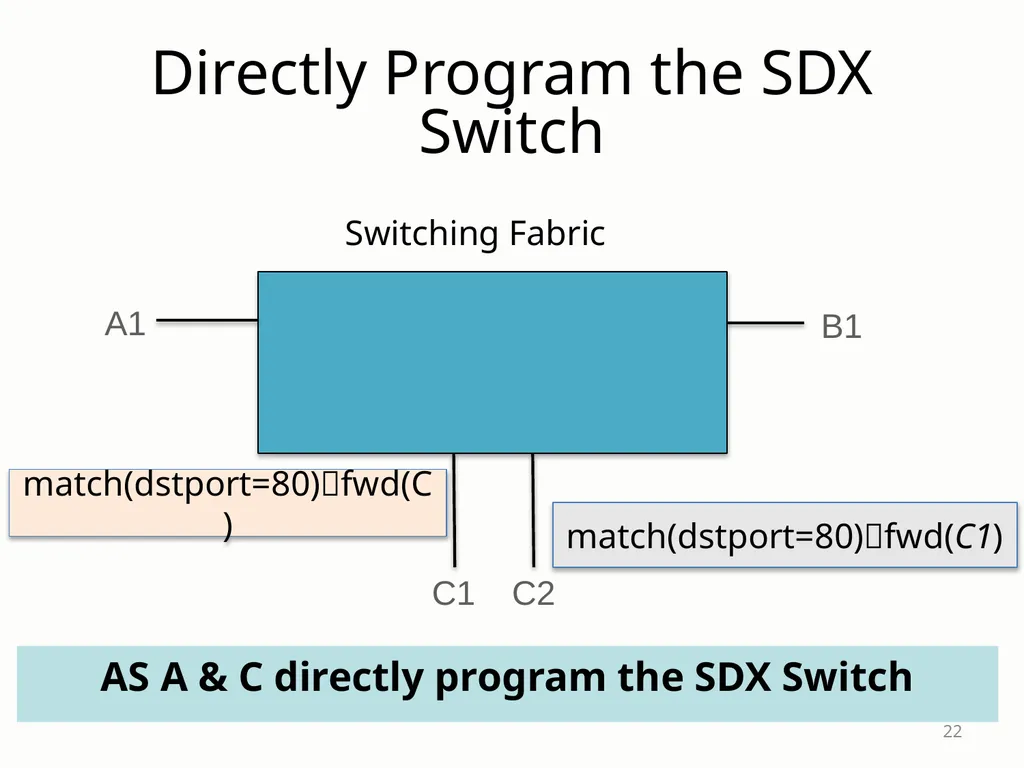
Directly Program the SDX Switch 22 B1 A1 C1 C2 match(dstport=80)fwd(C1) match(dstport=80)fwd(C) Switching Fabric AS A & C directly program the SDX Switch<br>
23
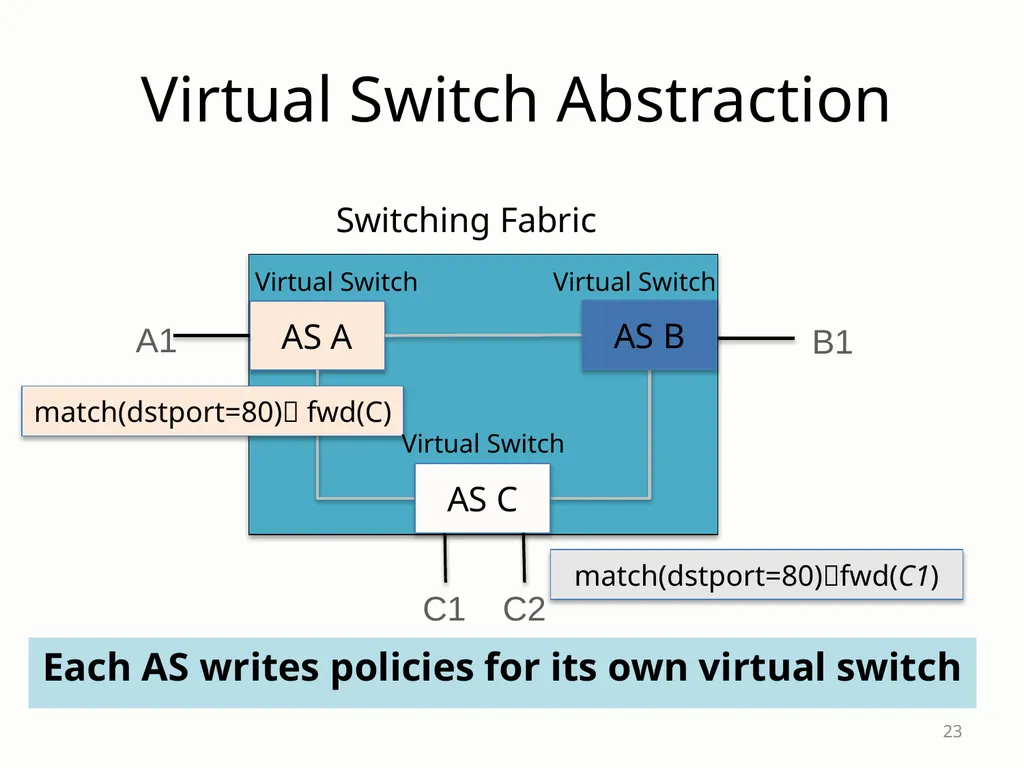
Virtual Switch Abstraction Each AS writes policies for its own virtual switch 23 AS A C1 C2 B1 A1 AS C AS B match(dstport=80) fwd(C) match(dstport=80)fwd(C1) Virtual Switch Virtual Switch Virtual Switch Switching Fabric<br>
24
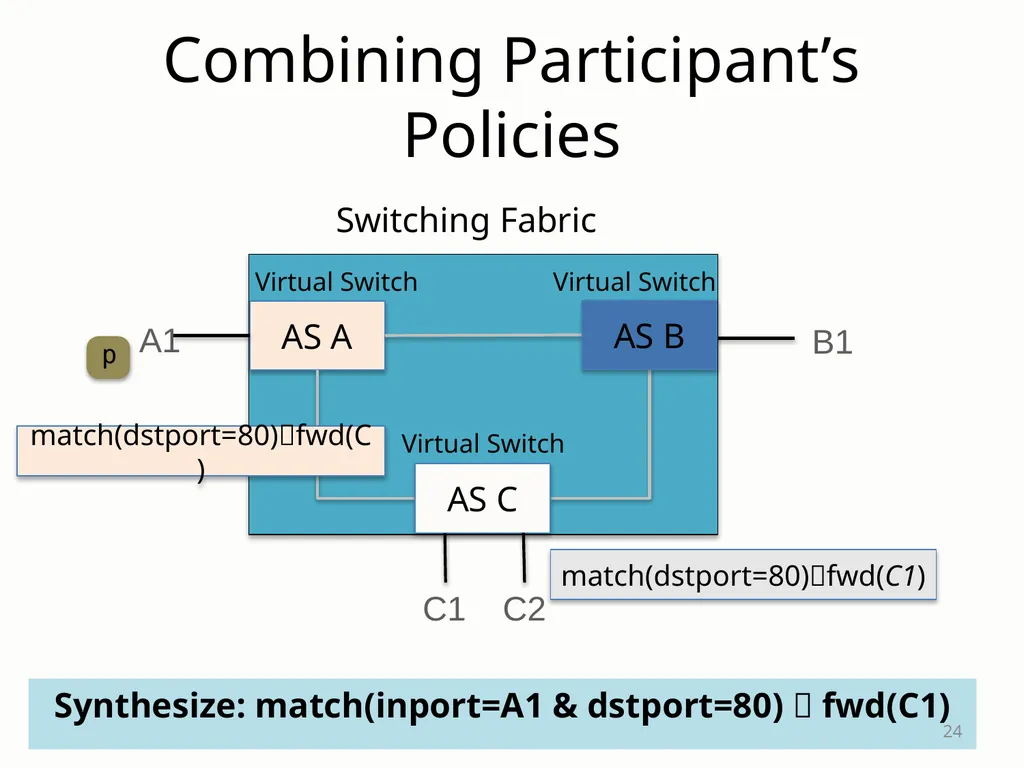
Synthesize: match(inport=A1 & dstport=80) fwd(C1) Combining Participant’s Policies 24 AS A C1 C2 B1 A1 AS C AS B match(dstport=80)fwd(C1) Virtual Switch Virtual Switch Virtual Switch Switching Fabric match(dstport=80)fwd(C)<br>
25
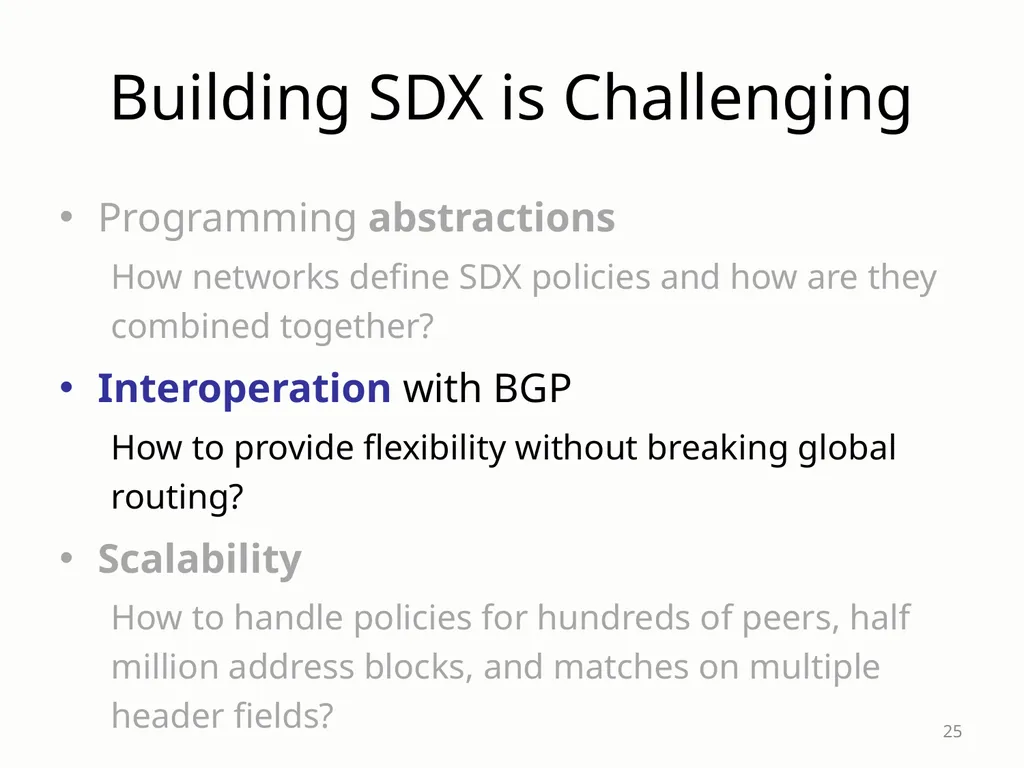
Building SDX is Challenging Programming abstractions
How networks define SDX policies and how are they combined together?
Interoperation with BGP
How to provide flexibility without breaking global routing?
Scalability
How to handle policies for hundreds of peers, half million address blocks, and matches on multiple header fields? 25<br>
How networks define SDX policies and how are they combined together?
Interoperation with BGP
How to provide flexibility without breaking global routing?
Scalability
How to handle policies for hundreds of peers, half million address blocks, and matches on multiple header fields? 25<br>
26
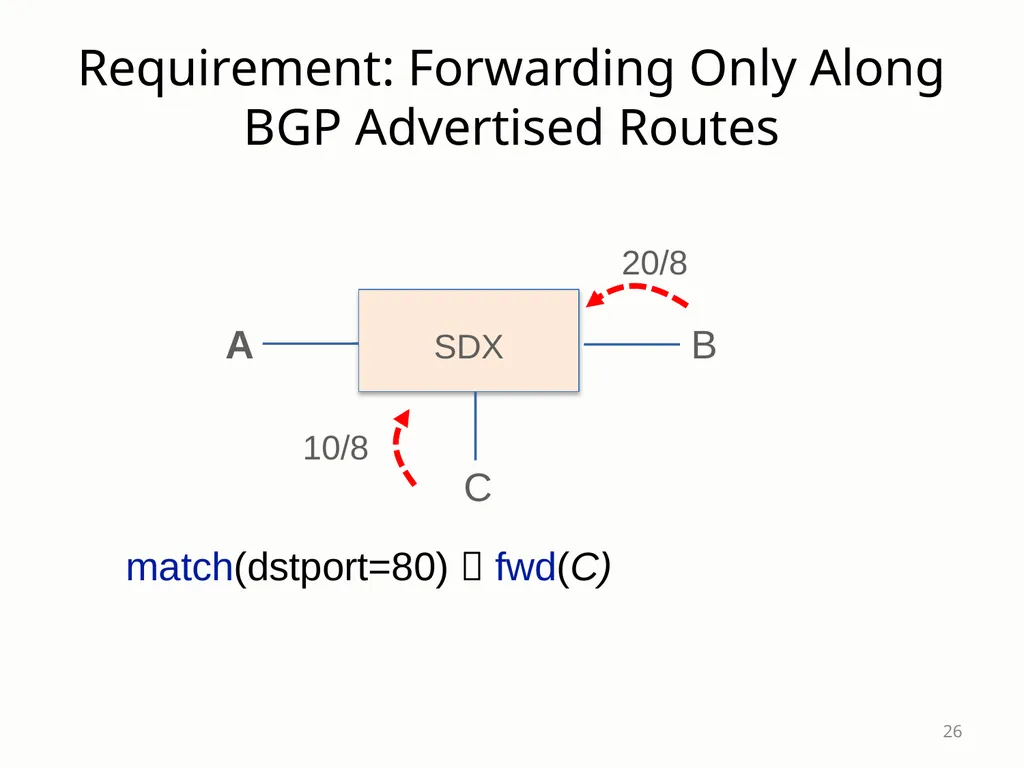
Requirement: Forwarding Only Along BGP Advertised Routes 26 A C B SDX 10/8 20/8 match(dstport=80) fwd(C)<br>
27
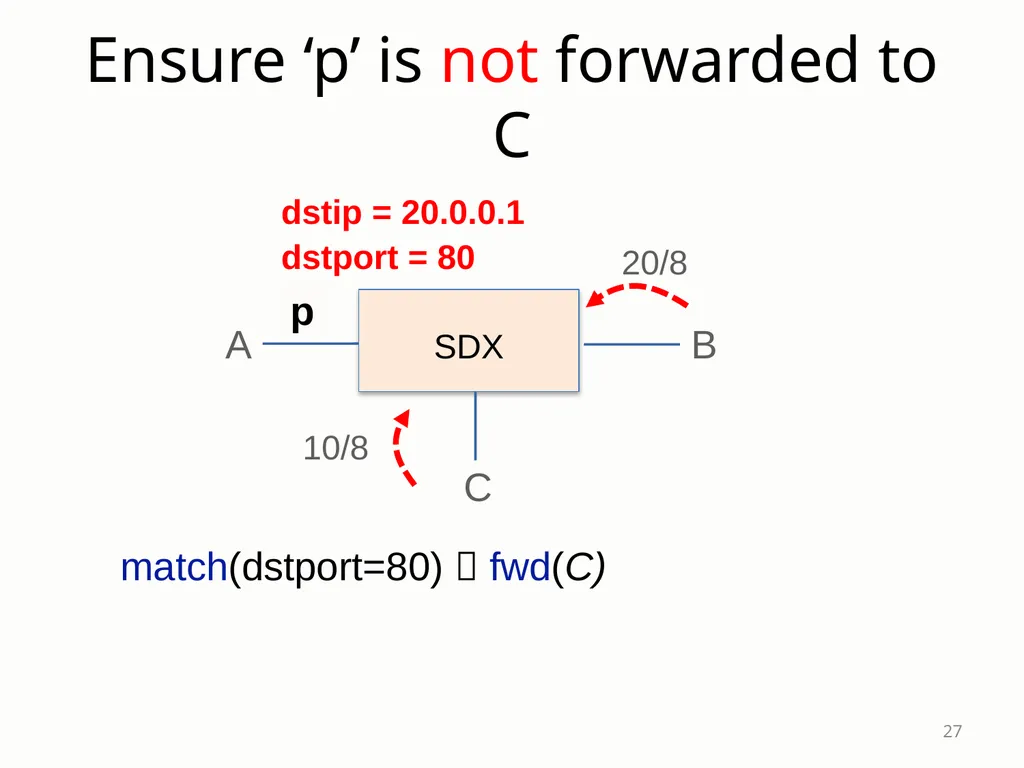
Ensure ‘p’ is not forwarded to C 27 match(dstport=80) fwd(C) A C B SDX 10/8 20/8 p dstip = 20.0.0.1
dstport = 80<br>
dstport = 80<br>
28
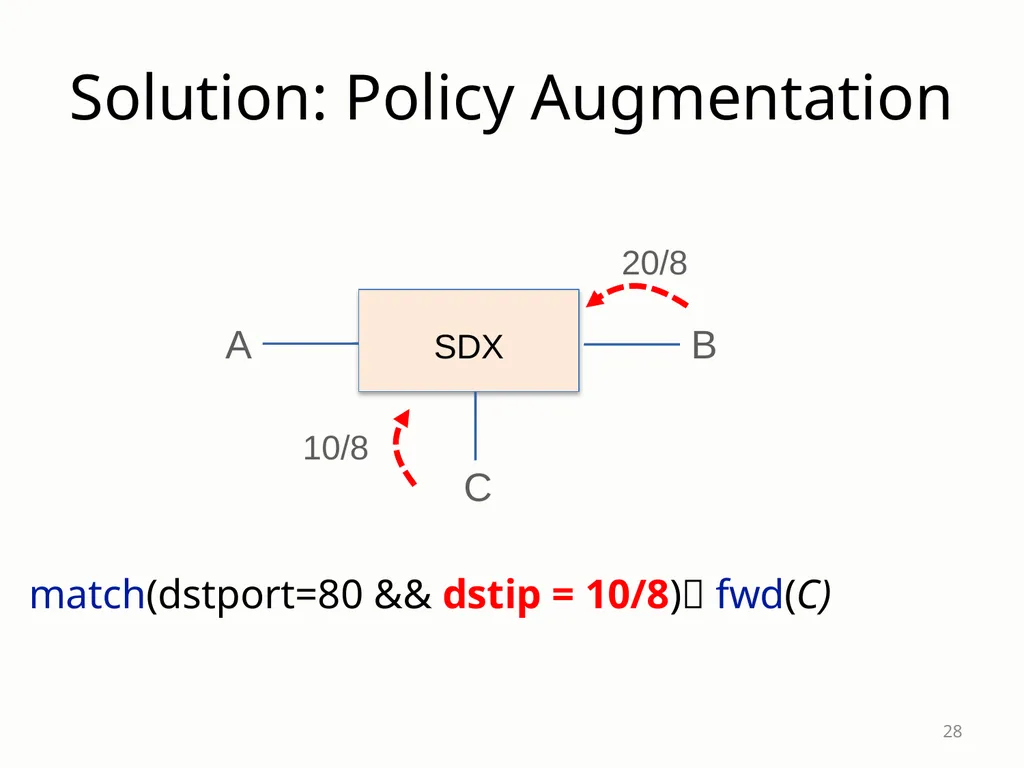
Solution: Policy Augmentation 28 A C B SDX 10/8 20/8 match(dstport=80 && dstip = 10/8) fwd(C)<br>
29
Building SDX is Challenging Programming abstractions
How networks define SDX policies and how are they combined together?
Interoperation with BGP
How to provide flexibility without breaking global routing?
Scalability
How to handle policies for hundreds of peers, half million address blocks, and matches on multiple header fields? 29<br>
How networks define SDX policies and how are they combined together?
Interoperation with BGP
How to provide flexibility without breaking global routing?
Scalability
How to handle policies for hundreds of peers, half million address blocks, and matches on multiple header fields? 29<br>
30
Scalability Challenges Reducing data-plane state:
Fit all forwarding rules in switch memory
(millions of flow rules possible)
Reducing control-plane computation:
Faster policy compilation
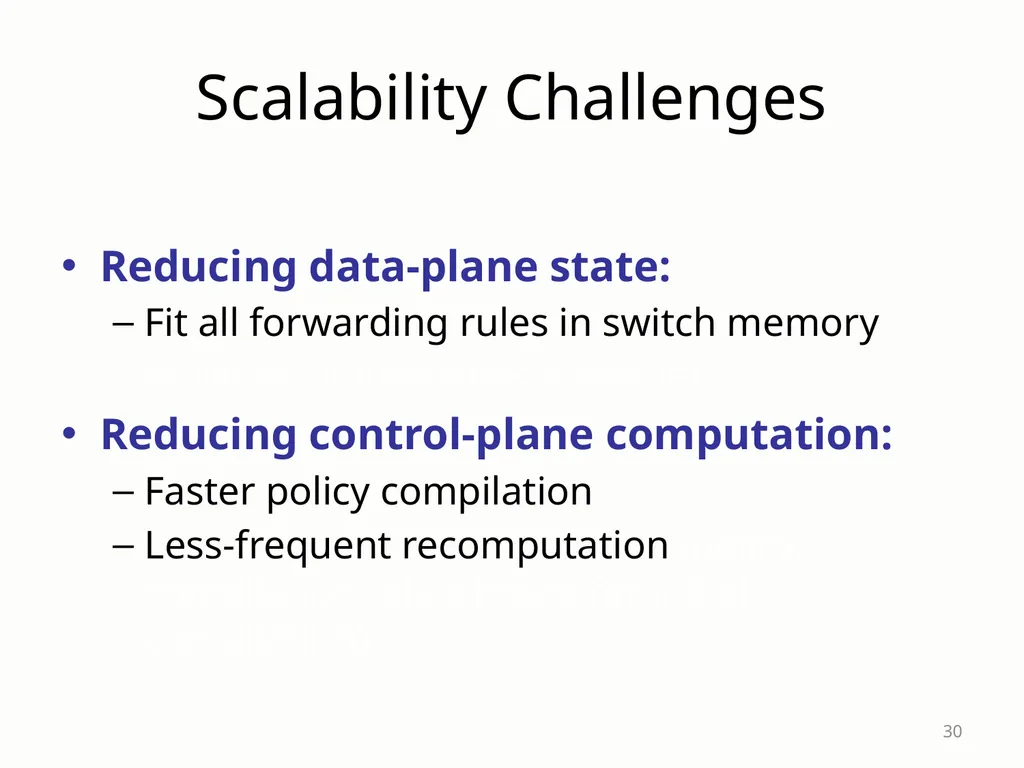
Less-frequent recomputation (policy compilation takes hours for initial compilation) 30<br>
Fit all forwarding rules in switch memory
(millions of flow rules possible)
Reducing control-plane computation:
Faster policy compilation
Less-frequent recomputation (policy compilation takes hours for initial compilation) 30<br>
31
Group Related Prefixes Huge number of IP prefixes
More than 500K IP prefixes
Exceeds the rule-table size of switches
Leverage participant border routers
Routers already store each IP prefix
Group (and tag) related prefixes
... so SDX can match on the tag
Work with existing routers
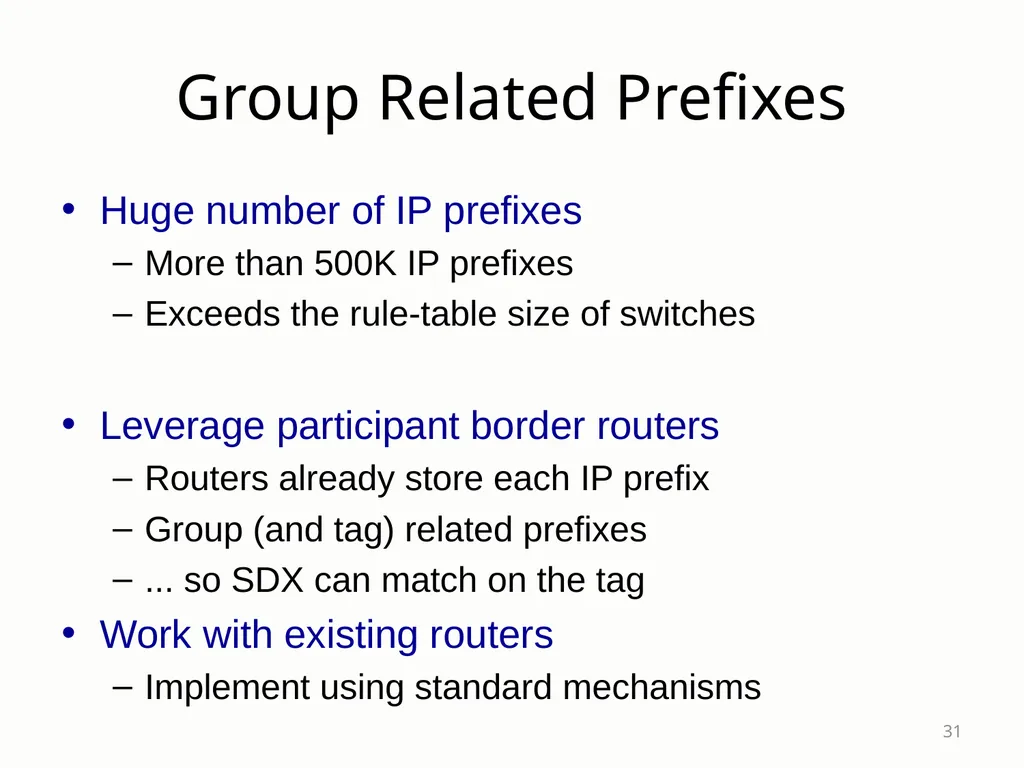
Implement using standard mechanisms 31<br>
More than 500K IP prefixes
Exceeds the rule-table size of switches
Leverage participant border routers
Routers already store each IP prefix
Group (and tag) related prefixes
... so SDX can match on the tag
Work with existing routers
Implement using standard mechanisms 31<br>
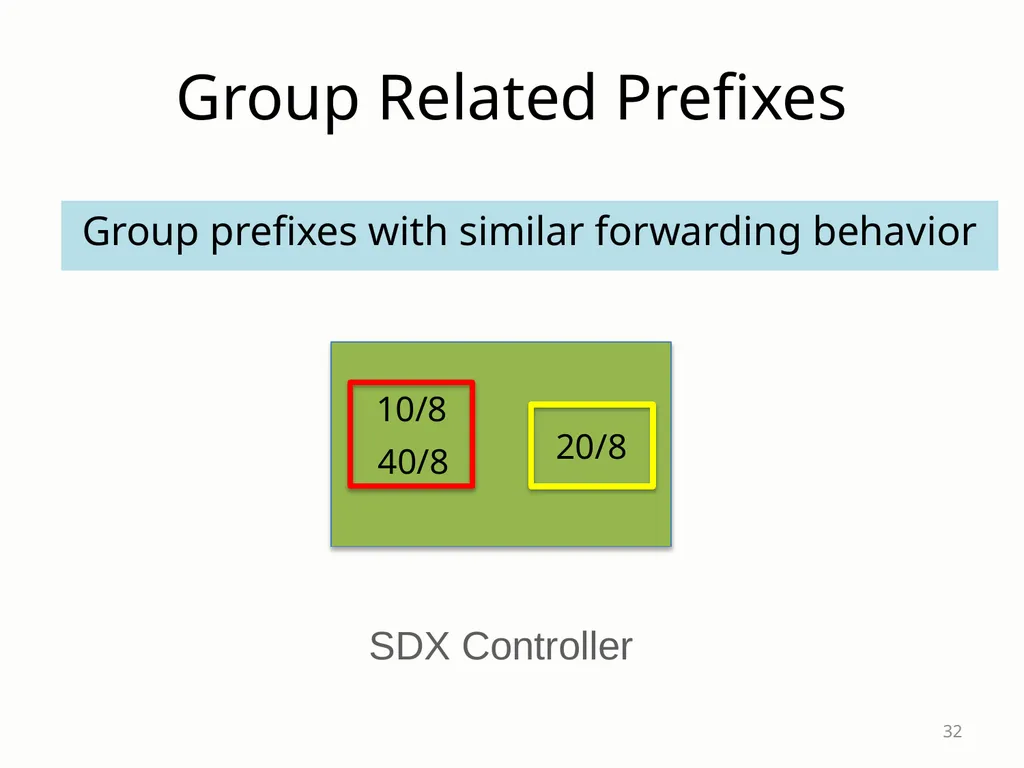
32
Group Related Prefixes 32 10/8 40/8 20/8 Group prefixes with similar forwarding behavior SDX Controller<br>
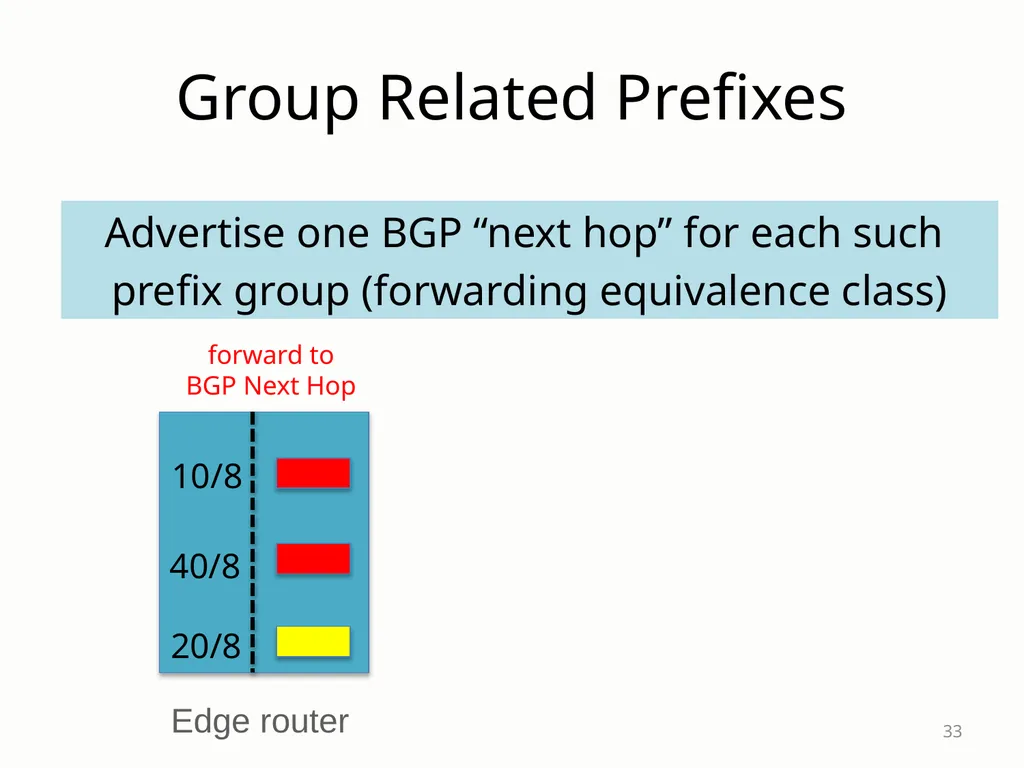
33
Group Related Prefixes 33 10/8 40/8 20/8 Advertise one BGP “next hop” for each such
prefix group (forwarding equivalence class) Edge router forward to
BGP Next Hop<br>
prefix group (forwarding equivalence class) Edge router forward to
BGP Next Hop<br>
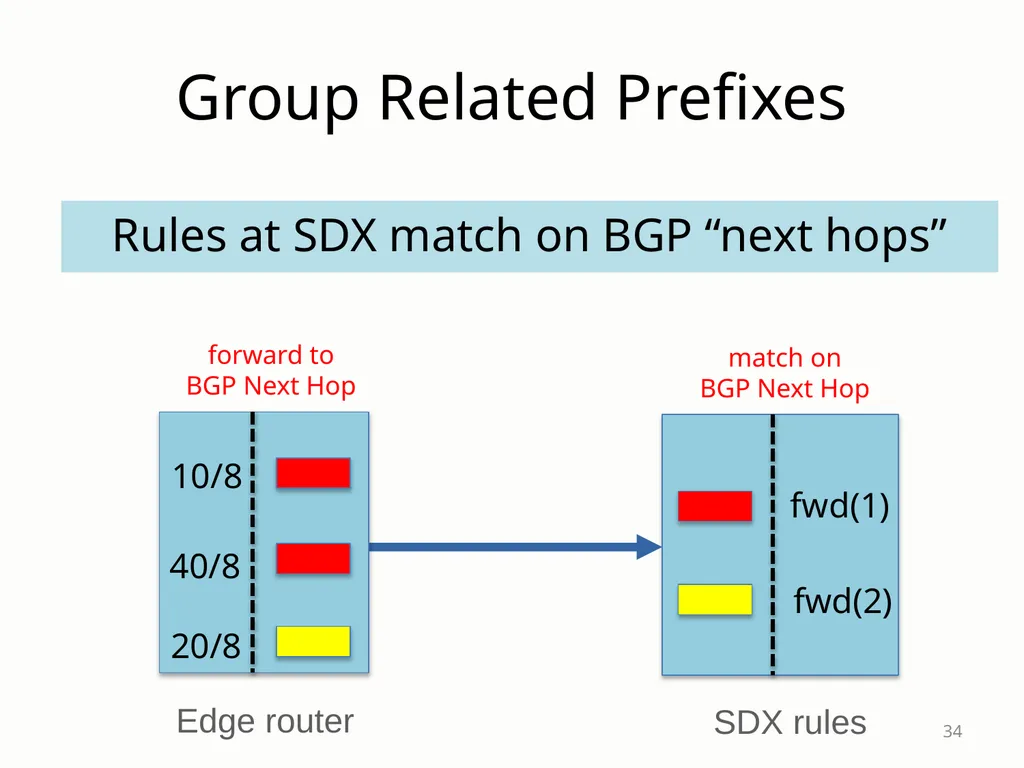
34
Group Related Prefixes 34 fwd(1) fwd(2) forward to
BGP Next Hop match on
BGP Next Hop Rules at SDX match on BGP “next hops” SDX rules 10/8 40/8 20/8 Edge router<br>
BGP Next Hop match on
BGP Next Hop Rules at SDX match on BGP “next hops” SDX rules 10/8 40/8 20/8 Edge router<br>
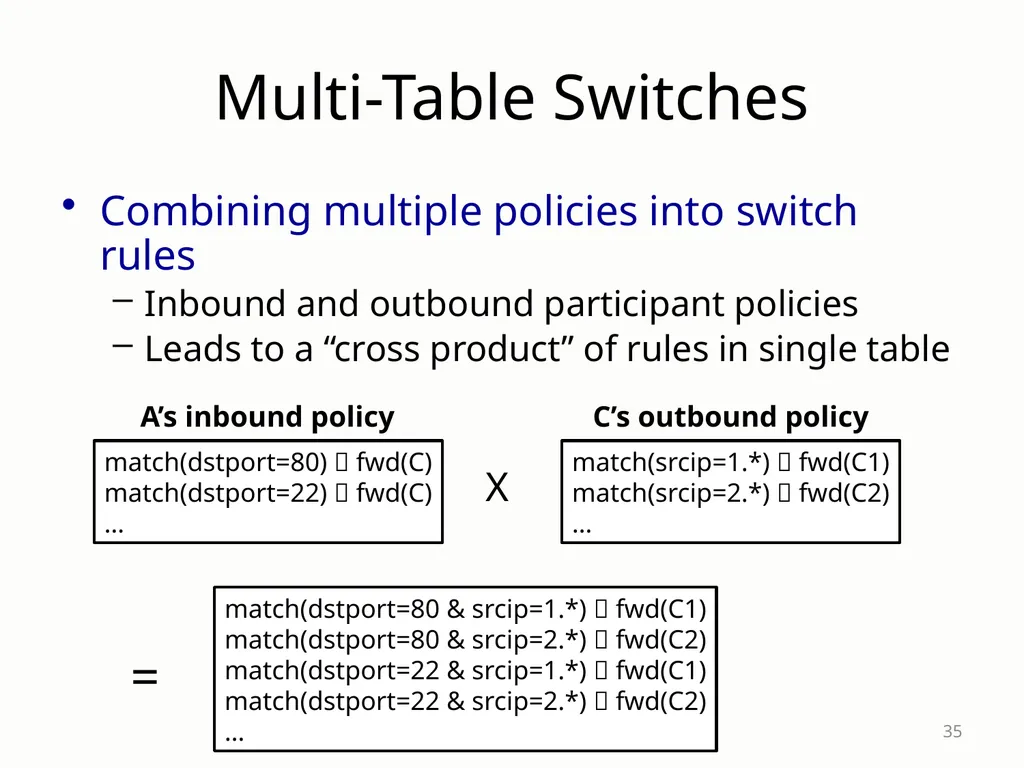
35
Multi-Table Switches Combining multiple policies into switch rules
Inbound and outbound participant policies
Leads to a “cross product” of rules in single table 35 match(dstport=80) fwd(C)
match(dstport=22) fwd(C)
… match(srcip=1.*) fwd(C1)
match(srcip=2.*) fwd(C2)
… A’s inbound policy C’s outbound policy X match(dstport=80 & srcip=1.*) fwd(C1)
match(dstport=80 & srcip=2.*) fwd(C2)
match(dstport=22 & srcip=1.*) fwd(C1)
match(dstport=22 & srcip=2.*) fwd(C2)
… =<br>
Inbound and outbound participant policies
Leads to a “cross product” of rules in single table 35 match(dstport=80) fwd(C)
match(dstport=22) fwd(C)
… match(srcip=1.*) fwd(C1)
match(srcip=2.*) fwd(C2)
… A’s inbound policy C’s outbound policy X match(dstport=80 & srcip=1.*) fwd(C1)
match(dstport=80 & srcip=2.*) fwd(C2)
match(dstport=22 & srcip=1.*) fwd(C1)
match(dstport=22 & srcip=2.*) fwd(C2)
… =<br>
36
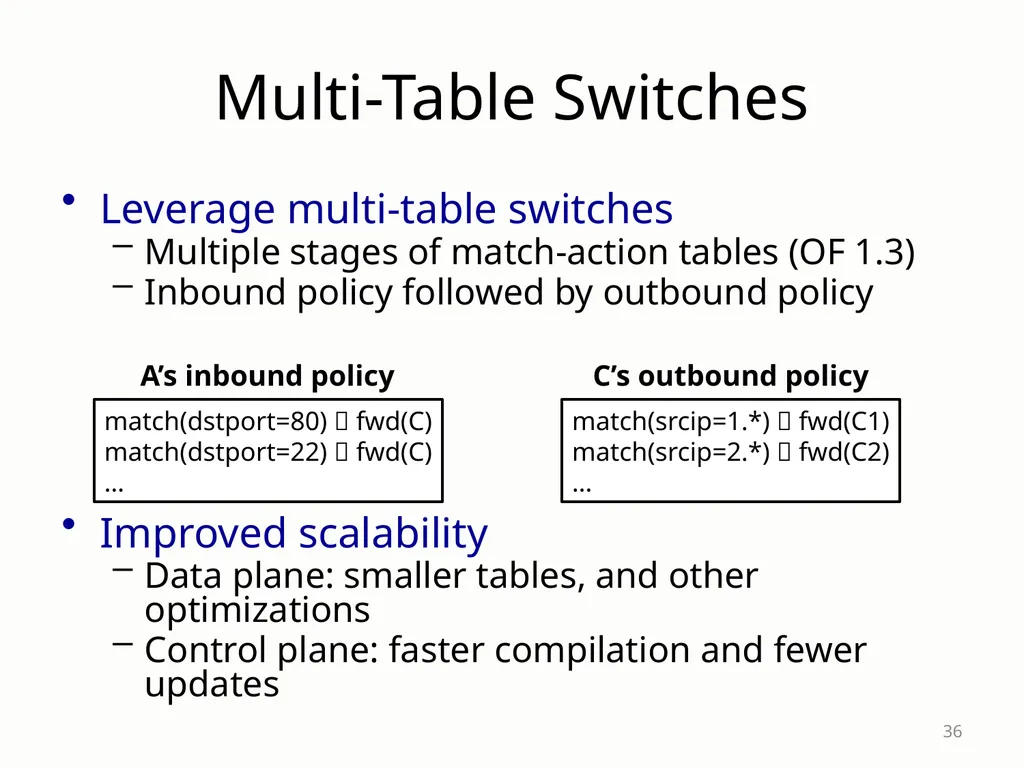
Multi-Table Switches Leverage multi-table switches
Multiple stages of match-action tables (OF 1.3)
Inbound policy followed by outbound policy
Improved scalability
Data plane: smaller tables, and other optimizations
Control plane: faster compilation and fewer updates 36 match(dstport=80) fwd(C)
match(dstport=22) fwd(C)
… match(srcip=1.*) fwd(C1)
match(srcip=2.*) fwd(C2)
… A’s inbound policy C’s outbound policy<br>
Multiple stages of match-action tables (OF 1.3)
Inbound policy followed by outbound policy
Improved scalability
Data plane: smaller tables, and other optimizations
Control plane: faster compilation and fewer updates 36 match(dstport=80) fwd(C)
match(dstport=22) fwd(C)
… match(srcip=1.*) fwd(C1)
match(srcip=2.*) fwd(C2)
… A’s inbound policy C’s outbound policy<br>
37
Decoupling BGP and SDN Frequent BGP routing changes
Dozens of BGP updates per second
Often quite bursty
Causes frequent SDX data-plane changes
Map an equivalence class to new output port
E.g., from neighbor B to neighbor C
Also triggers BGP updates to participants
But that’s okay… 37<br>
Dozens of BGP updates per second
Often quite bursty
Causes frequent SDX data-plane changes
Map an equivalence class to new output port
E.g., from neighbor B to neighbor C
Also triggers BGP updates to participants
But that’s okay… 37<br>
38
Decoupling BGP from SDN Leverage participants’ border routers more
Encode BGP reachability info in the “next hop”
Extended BGP “next hop” encoding
Old idea: encode the outbound participant
New idea: also encode the set of participants offering a BGP route for this IP prefix
Changing only the BGP announcements
No need to update the SDX data plane! 38<br>
Encode BGP reachability info in the “next hop”
Extended BGP “next hop” encoding
Old idea: encode the outbound participant
New idea: also encode the set of participants offering a BGP route for this IP prefix
Changing only the BGP announcements
No need to update the SDX data plane! 38<br>
39
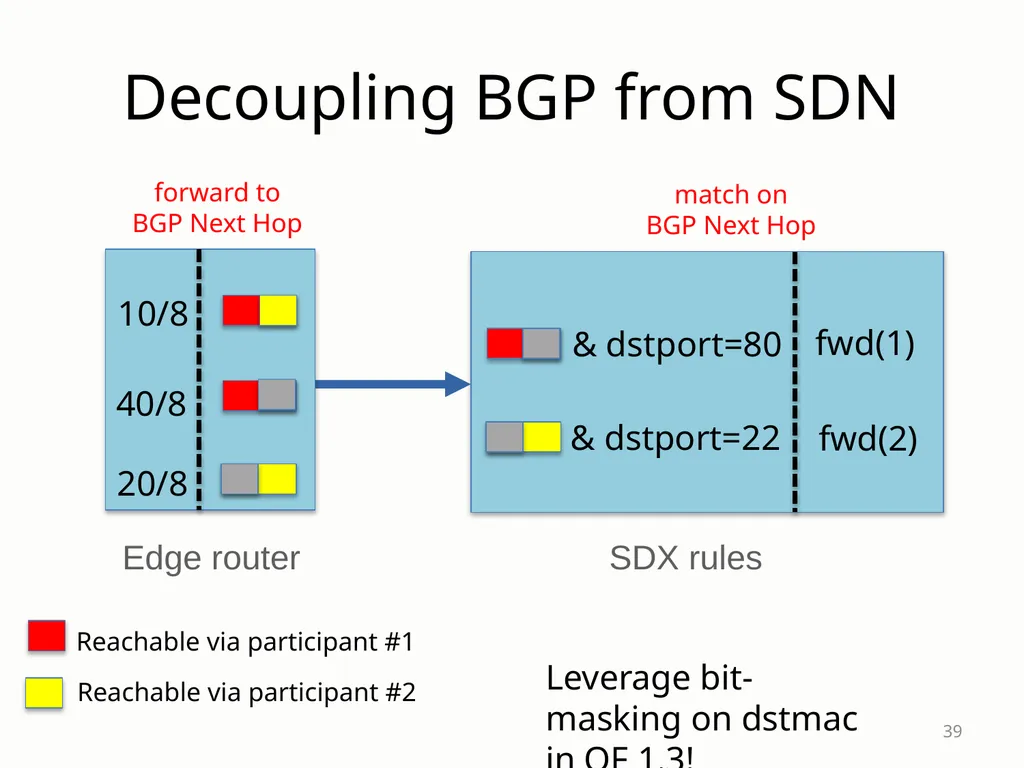
Decoupling BGP from SDN 39 fwd(1) fwd(2) forward to
BGP Next Hop match on
BGP Next Hop SDX rules 10/8 40/8 20/8 Edge router & dstport=80 & dstport=22 Reachable via participant #1 Reachable via participant #2 Leverage bit-masking on dstmac in OF 1.3!<br>
BGP Next Hop match on
BGP Next Hop SDX rules 10/8 40/8 20/8 Edge router & dstport=80 & dstport=22 Reachable via participant #1 Reachable via participant #2 Leverage bit-masking on dstmac in OF 1.3!<br>
40
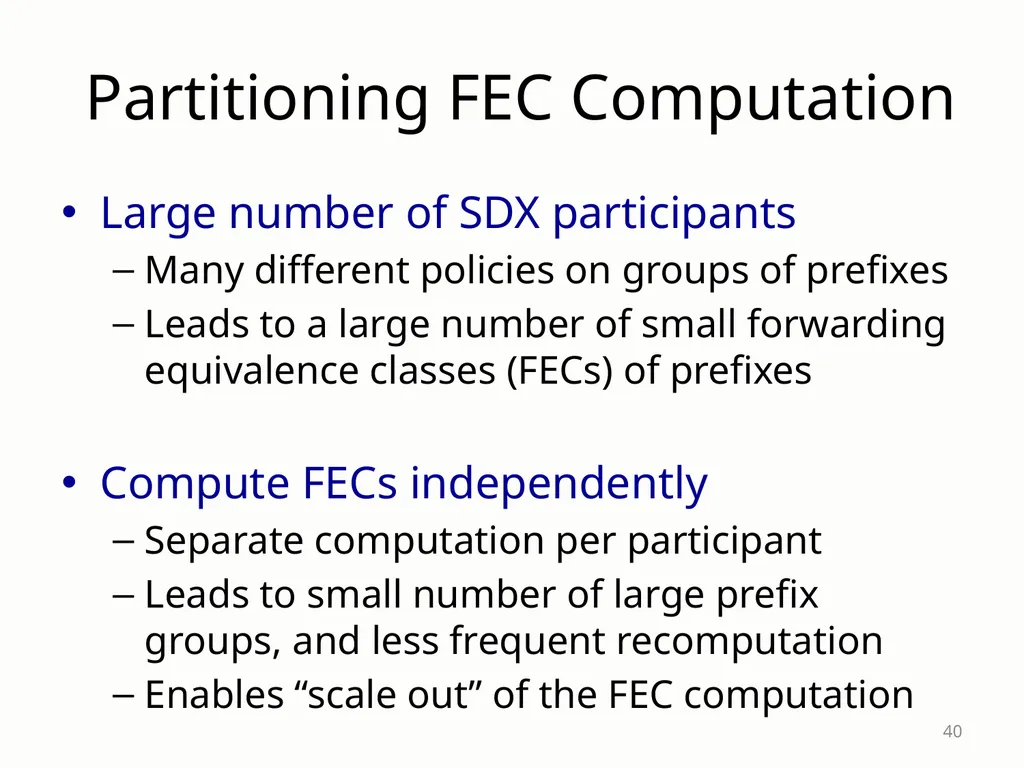
Partitioning FEC Computation Large number of SDX participants
Many different policies on groups of prefixes
Leads to a large number of small forwarding equivalence classes (FECs) of prefixes
Compute FECs independently
Separate computation per participant
Leads to small number of large prefix groups, and less frequent recomputation
Enables “scale out” of the FEC computation 40<br>
Many different policies on groups of prefixes
Leads to a large number of small forwarding equivalence classes (FECs) of prefixes
Compute FECs independently
Separate computation per participant
Leads to small number of large prefix groups, and less frequent recomputation
Enables “scale out” of the FEC computation 40<br>
41
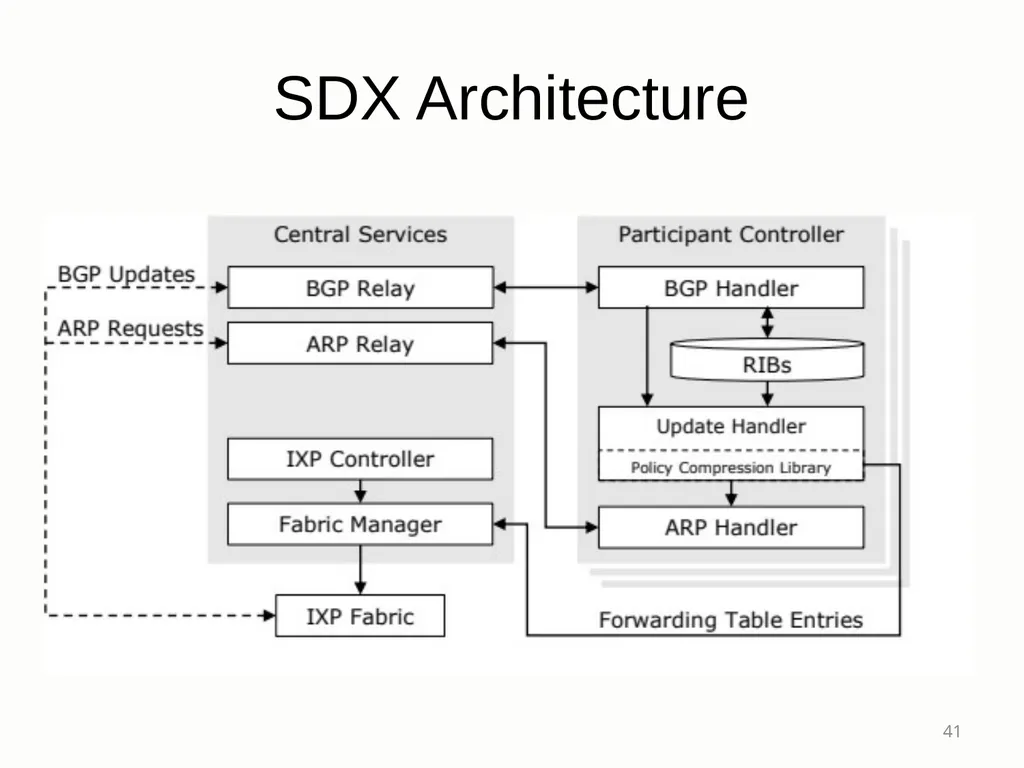
SDX Architecture 41<br>
42
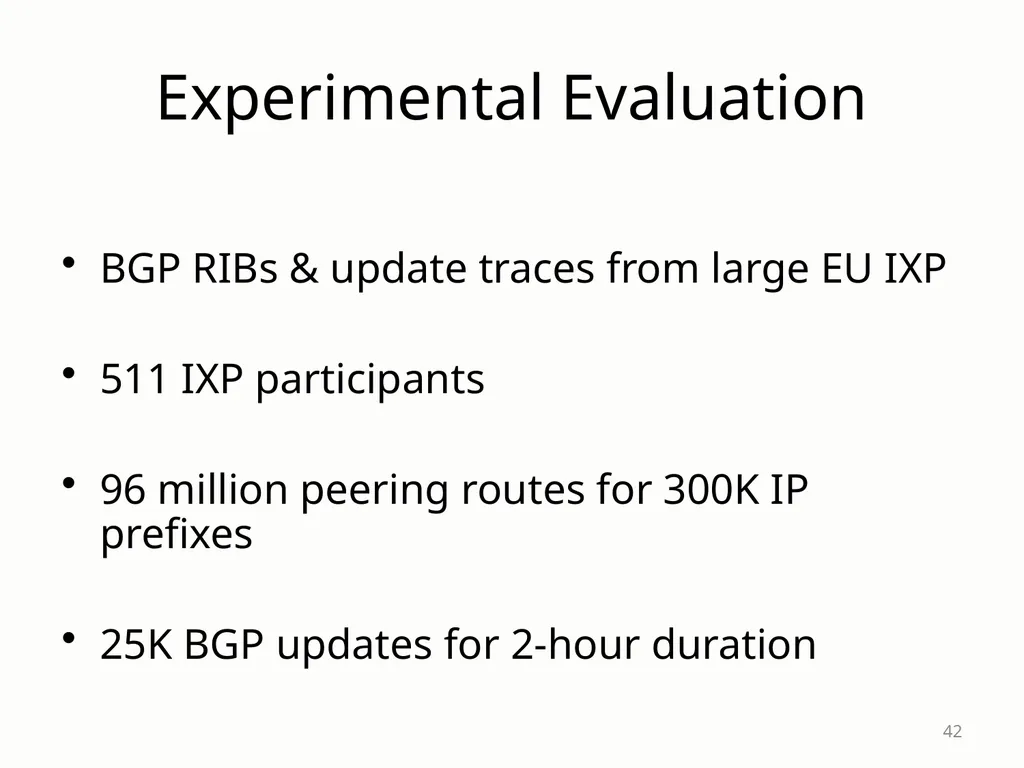
Experimental Evaluation BGP RIBs & update traces from large EU IXP
511 IXP participants
96 million peering routes for 300K IP prefixes
25K BGP updates for 2-hour duration 42<br>
511 IXP participants
96 million peering routes for 300K IP prefixes
25K BGP updates for 2-hour duration 42<br>
43
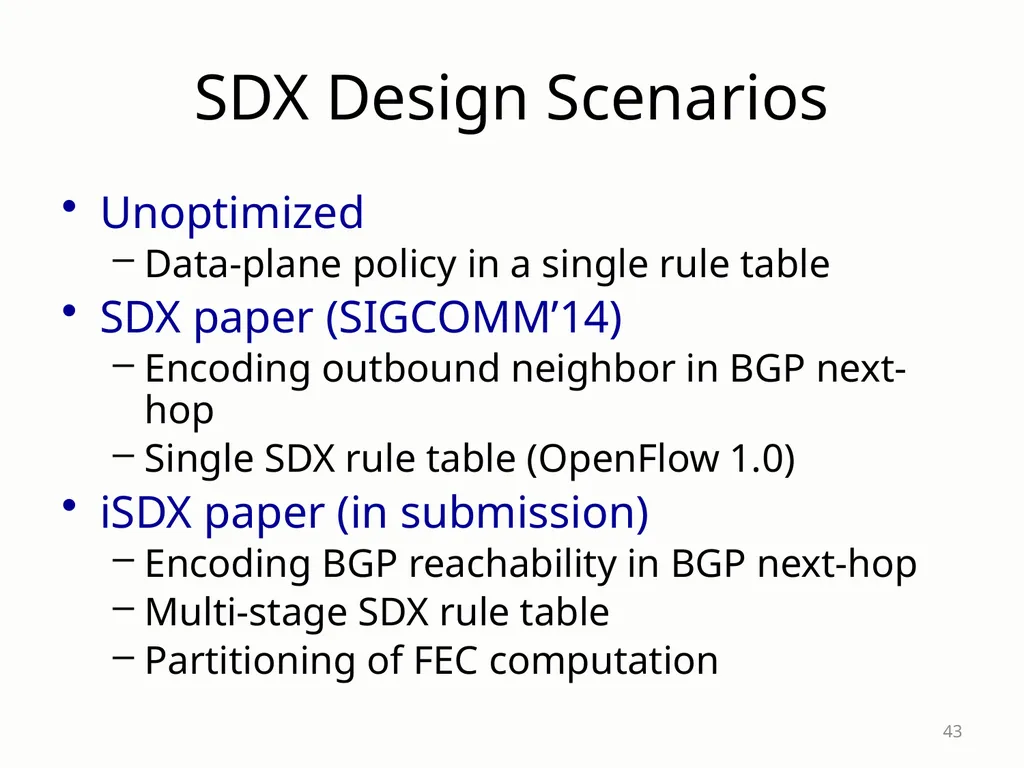
SDX Design Scenarios Unoptimized
Data-plane policy in a single rule table
SDX paper (SIGCOMM’14)
Encoding outbound neighbor in BGP next-hop
Single SDX rule table (OpenFlow 1.0)
iSDX paper (in submission)
Encoding BGP reachability in BGP next-hop
Multi-stage SDX rule table
Partitioning of FEC computation 43<br>
Data-plane policy in a single rule table
SDX paper (SIGCOMM’14)
Encoding outbound neighbor in BGP next-hop
Single SDX rule table (OpenFlow 1.0)
iSDX paper (in submission)
Encoding BGP reachability in BGP next-hop
Multi-stage SDX rule table
Partitioning of FEC computation 43<br>
44
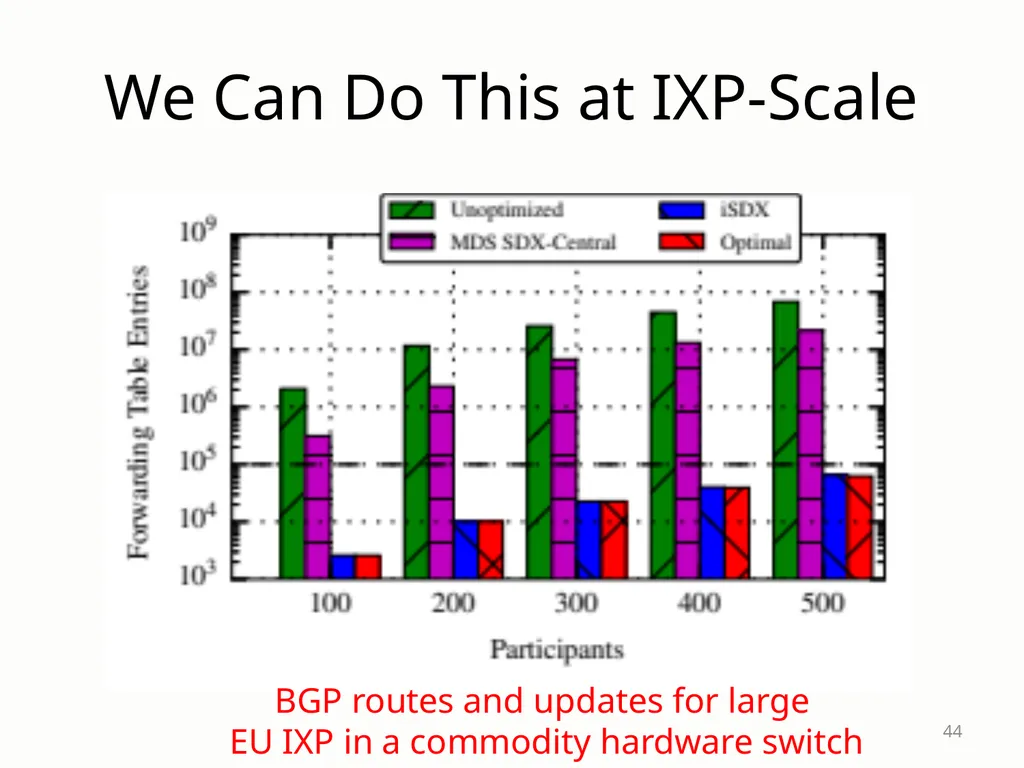
We Can Do This at IXP-Scale 44 BGP routes and updates for large
EU IXP in a commodity hardware switch<br>
45
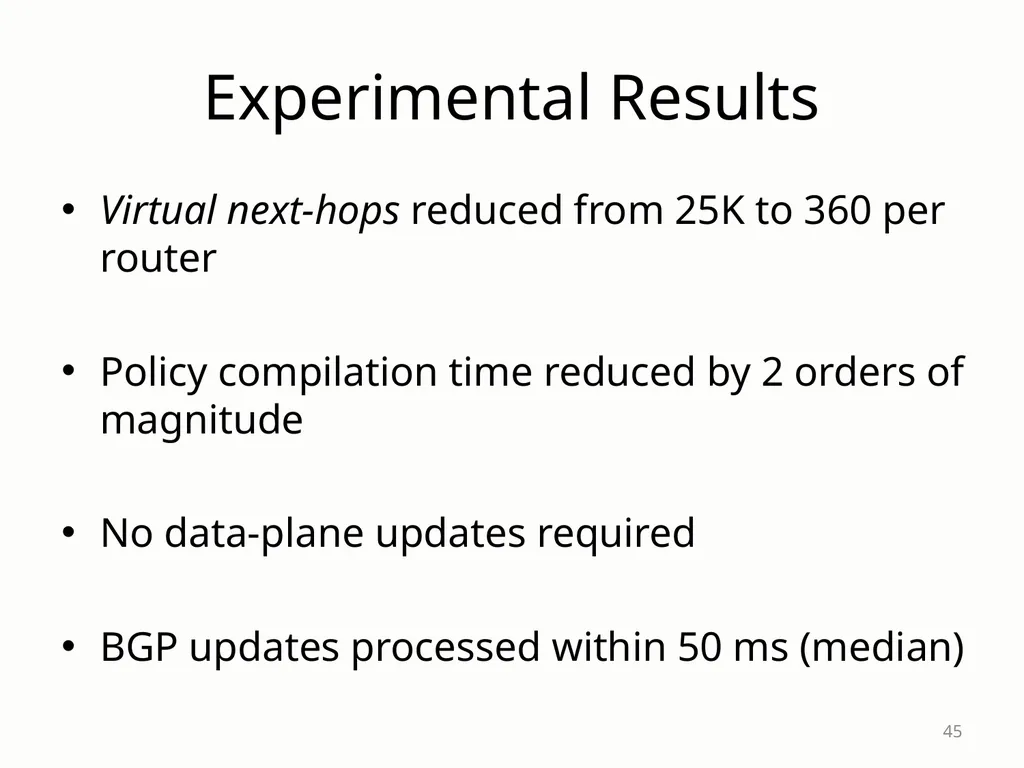
Experimental Results Virtual next-hops reduced from 25K to 360 per router
Policy compilation time reduced by 2 orders of magnitude
No data-plane updates required
BGP updates processed within 50 ms (median) 45<br>
Policy compilation time reduced by 2 orders of magnitude
No data-plane updates required
BGP updates processed within 50 ms (median) 45<br>
46
SDX Platform Running code
Github available from http://sdx.cs.princeton.edu
Used in Coursera course on SDN
SDX testbeds
Transit Portal for “in the wild” experiments
Mininet for controller experiments
Ongoing deployment efforts
Inter-agency exchange (NSA)
Large European IXP 46<br>
Github available from http://sdx.cs.princeton.edu
Used in Coursera course on SDN
SDX testbeds
Transit Portal for “in the wild” experiments
Mininet for controller experiments
Ongoing deployment efforts
Inter-agency exchange (NSA)
Large European IXP 46<br>
47
Conclusion The Internet is changing
New challenges for content delivery
Increasing importance of IXPs
SDN can let providers innovate
New capabilities and abstractions
Next steps
Operational deployments
Additional SDX applications
Distributed exchange points 47<br>
New challenges for content delivery
Increasing importance of IXPs
SDN can let providers innovate
New capabilities and abstractions
Next steps
Operational deployments
Additional SDX applications
Distributed exchange points 47<br>