
Sean Hefty OpenFabrics Interfaces Working Group



Description: Sean Hefty OpenFabrics Interfaces Working Group Co-Chair Intel November 2016 THE LATEST ON OPENFABRICS INTERFACES (OFI): THE NEW SCALABLE FABRIC SW LAYER FOR SUPERCOMPUTERS 3 3 Scalable Implementation Agnostic OFIWG: develop interfaces
Related Topics
Download Presentation
"Sean Hefty OpenFabrics Interfaces Working Group" is the property of its rightful owner. Permission is granted to download and print the materials on this website for personal, non-commercial use only, and to display it on your personal computer provided you do not modify the materials and that you retain all copyright notices contained in the materials. By downloading content from our website, you accept the terms of this agreement.
Presentation Transcript
slide2. Sean Hefty OpenFabrics Interfaces Working Group Co-Chair
Intel
November 2016 THE LATEST ON OPENFABRICS INTERFACES (OFI):
THE NEW SCALABLE FABRIC SW LAYER FOR SUPERCOMPUTERS<br>
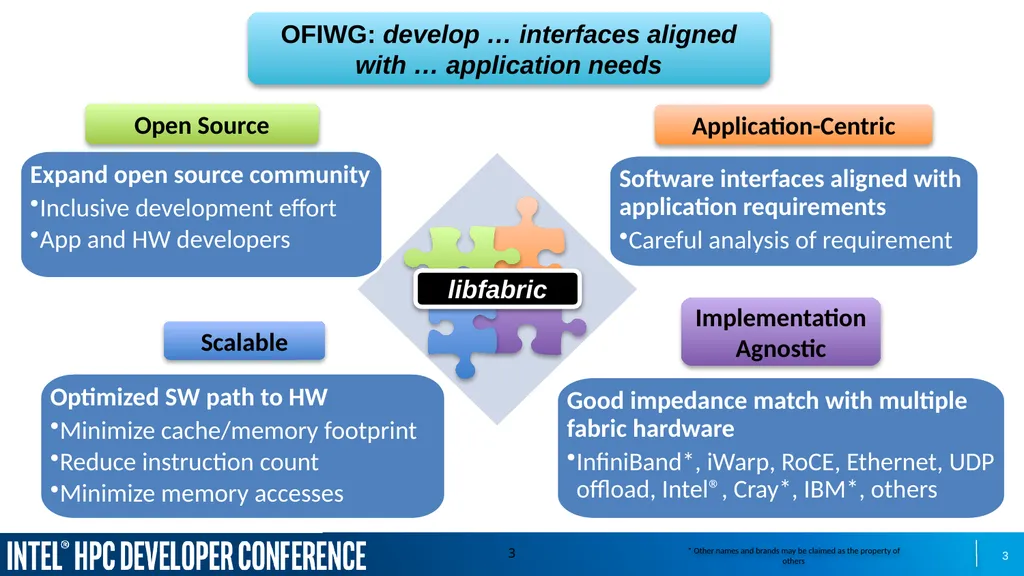
slide3. 3 3 Scalable Implementation Agnostic OFIWG: develop … interfaces aligned with … application needs Software interfaces aligned with application requirements
Careful analysis of requirement Expand open source community
Inclusive development effort
App and HW developers Good impedance match with multiple fabric hardware
InfiniBand*, iWarp, RoCE, Ethernet, UDP offload, Intel®, Cray*, IBM*, others Open Source Application-Centric libfabric * Other names and brands may be claimed as the property of others Optimized SW path to HW
Minimize cache/memory footprint
Reduce instruction count
Minimize memory accesses<br>
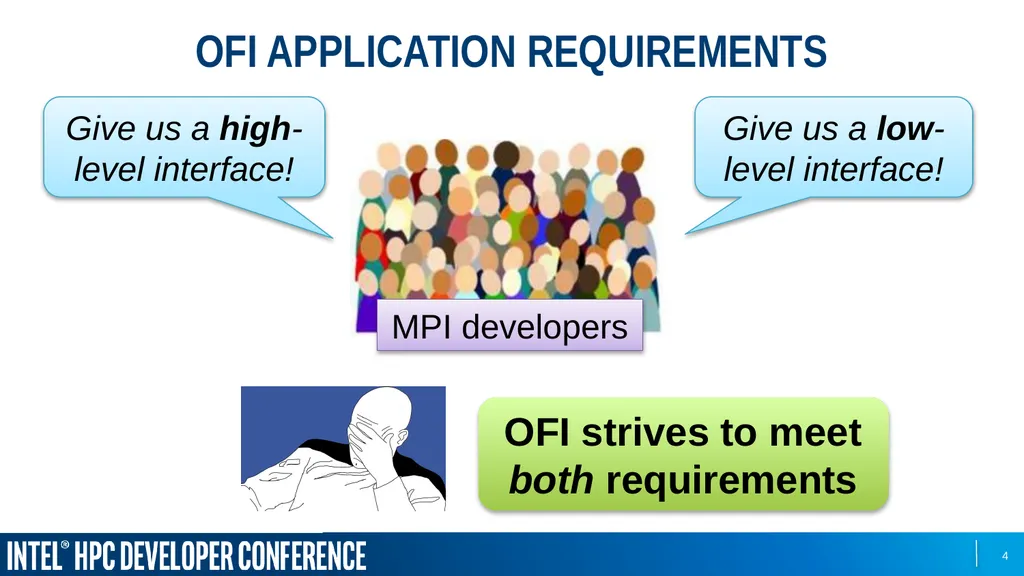
slide4. 4 OFI APPLICATION REQUIREMENTS Give us a high-level interface! Give us a low-level interface! MPI developers OFI strives to meet both requirements<br>
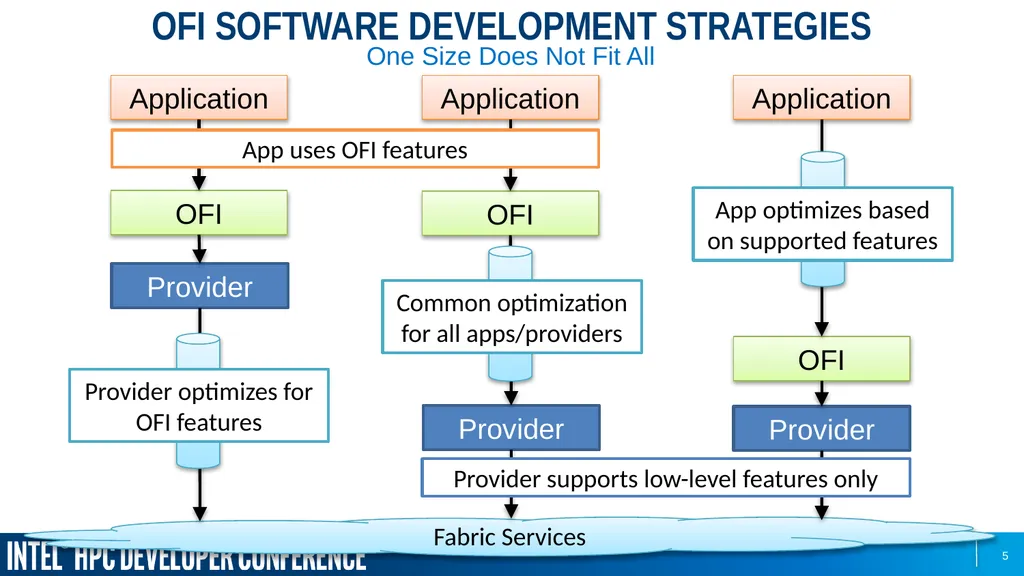
slide5. 5 Fabric Services Application OFI Provider Application OFI Provider Provider optimizes for OFI features Common optimization for all apps/providers App uses OFI features Application OFI Provider App optimizes based on supported features Provider supports low-level features only OFI SOFTWARE DEVELOPMENT STRATEGIES One Size Does Not Fit All<br>
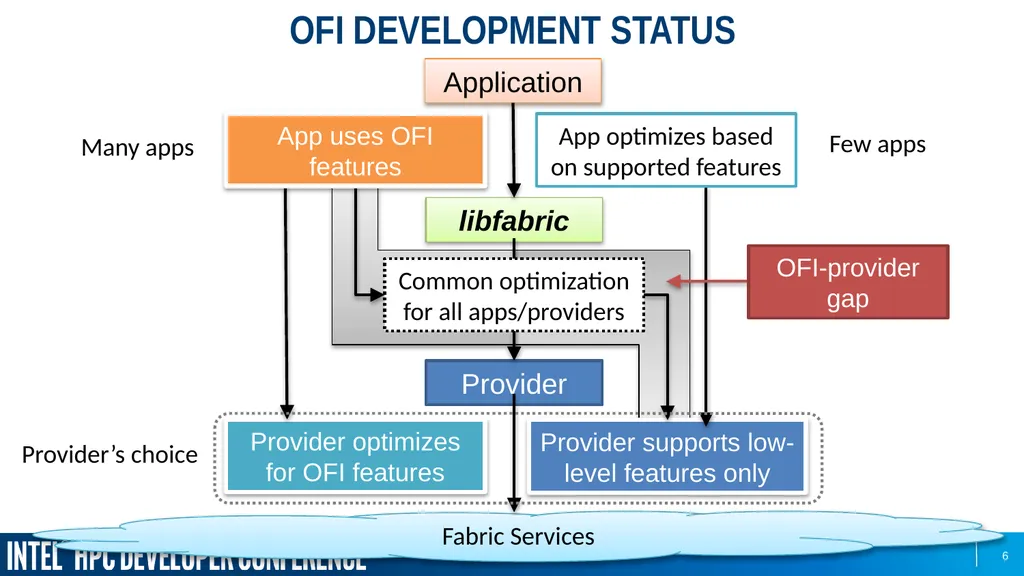
slide6. OFI DEVELOPMENT STATUS 6 Fabric Services Application libfabric Provider Provider optimizes for OFI features Common optimization for all apps/providers Provider supports low-level features only Many apps Few apps Provider’s choice App optimizes based on supported features App uses OFI features OFI-provider gap 6<br>
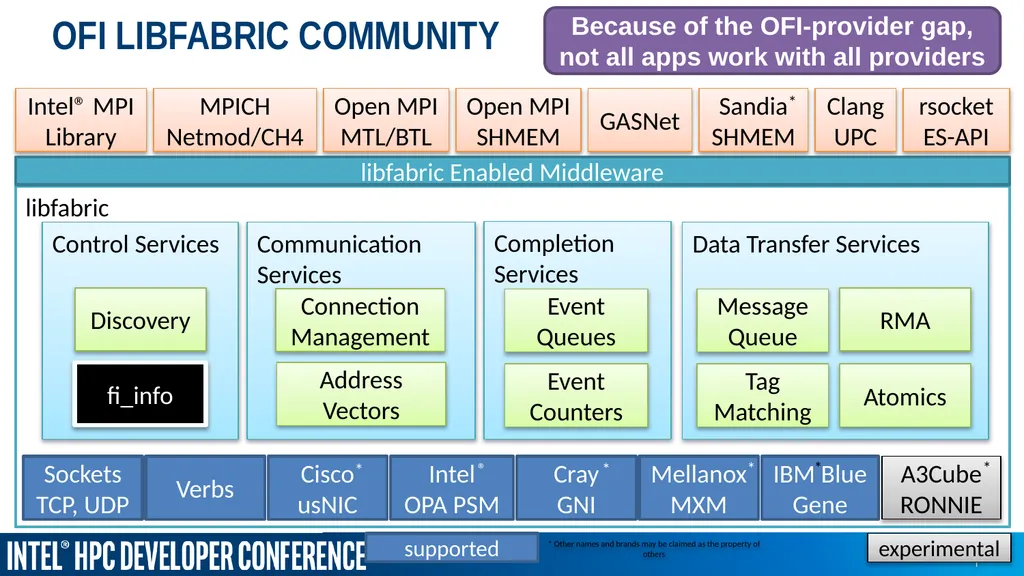
slide7. OFI LIBFABRIC COMMUNITY 7 * Other names and brands may be claimed as the property of others libfabric Intel® MPI Library MPICH Netmod/CH4 Open MPI
MTL/BTL Open MPI
SHMEM Sandia SHMEM GASNet Clang UPC rsocket
ES-API libfabric Enabled Middleware Control Services Communication Services Completion Services Data Transfer Services Discovery fi_info Connection Management Address Vectors Event Queues Event Counters Message Queue Tag Matching RMA Atomics Sockets
TCP, UDP Verbs Cisco usNIC Intel
OPA PSM Cray
GNI Mellanox MXM IBM Blue Gene A3Cube RONNIE * * * * * ® experimental supported * Because of the OFI-provider gap, not all apps work with all providers<br>
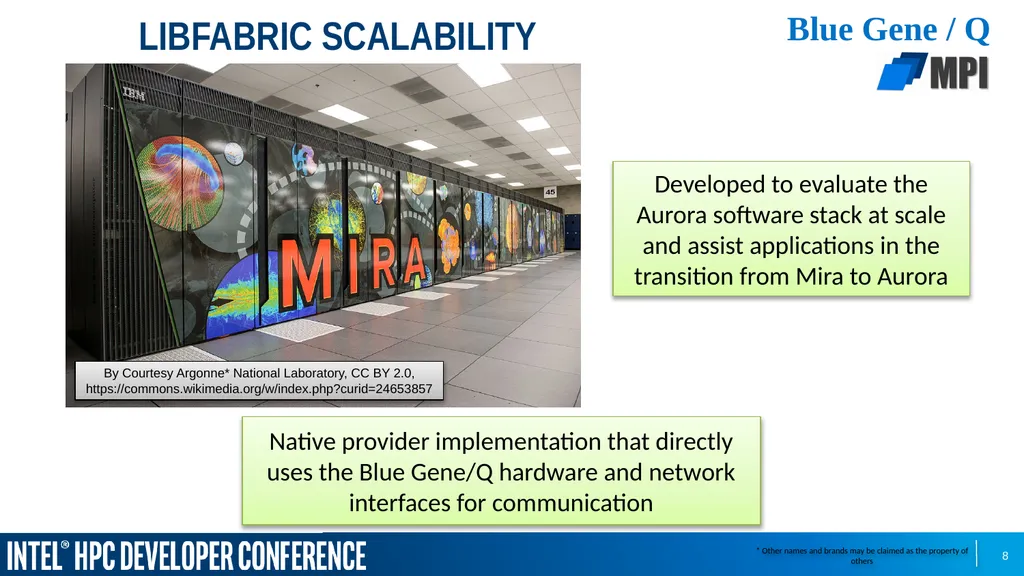
slide8. LIBFABRIC SCALABILITY 8 By Courtesy Argonne* National Laboratory, CC BY 2.0, https://commons.wikimedia.org/w/index.php?curid=24653857 Developed to evaluate the Aurora software stack at scale and assist applications in the transition from Mira to Aurora Native provider implementation that directly uses the Blue Gene/Q hardware and network interfaces for communication * Other names and brands may be claimed as the property of others Blue Gene / Q<br>
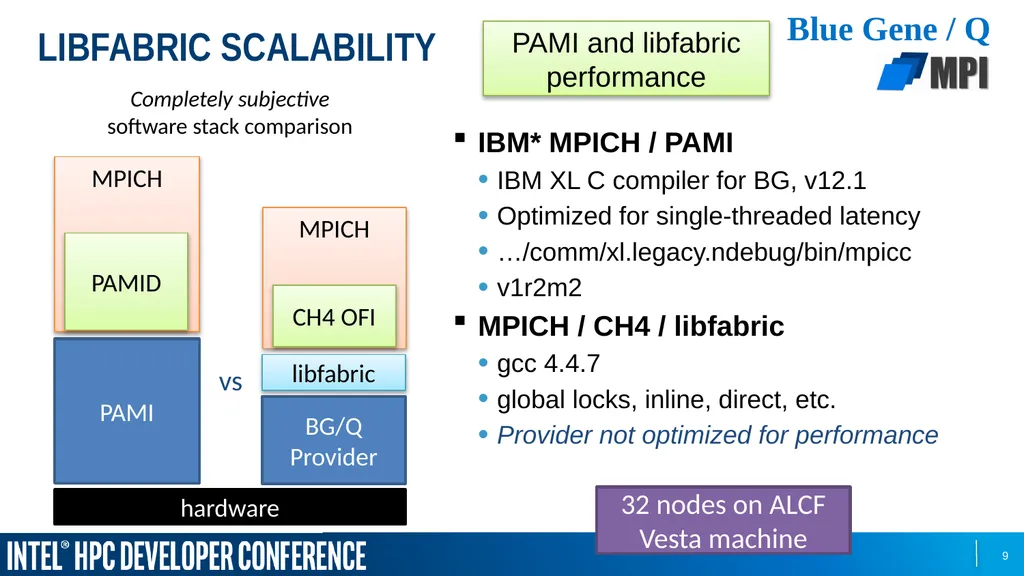
slide9. IBM* MPICH / PAMI
IBM XL C compiler for BG, v12.1
Optimized for single-threaded latency
…/comm/xl.legacy.ndebug/bin/mpicc
v1r2m2
MPICH / CH4 / libfabric
gcc 4.4.7
global locks, inline, direct, etc.
Provider not optimized for performance PAMI MPICH PAMID hardware BG/Q Provider libfabric MPICH CH4 OFI Completely subjective software stack comparison vs 32 nodes on ALCF Vesta machine PAMI and libfabric performance LIBFABRIC SCALABILITY 9 Blue Gene / Q<br>
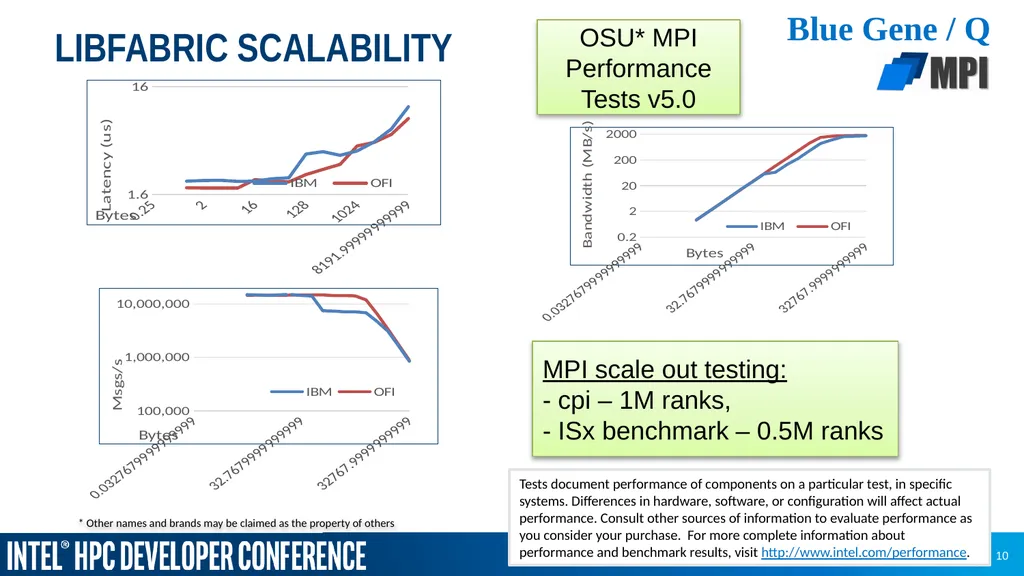
slide10. 10 OSU* MPI Performance Tests v5.0 MPI scale out testing:
- cpi – 1M ranks,
- ISx benchmark – 0.5M ranks Tests document performance of components on a particular test, in specific systems. Differences in hardware, software, or configuration will affect actual performance. Consult other sources of information to evaluate performance as you consider your purchase. For more complete information about performance and benchmark results, visit http://www.intel.com/performance. * Other names and brands may be claimed as the property of others LIBFABRIC SCALABILITY Blue Gene / Q<br>
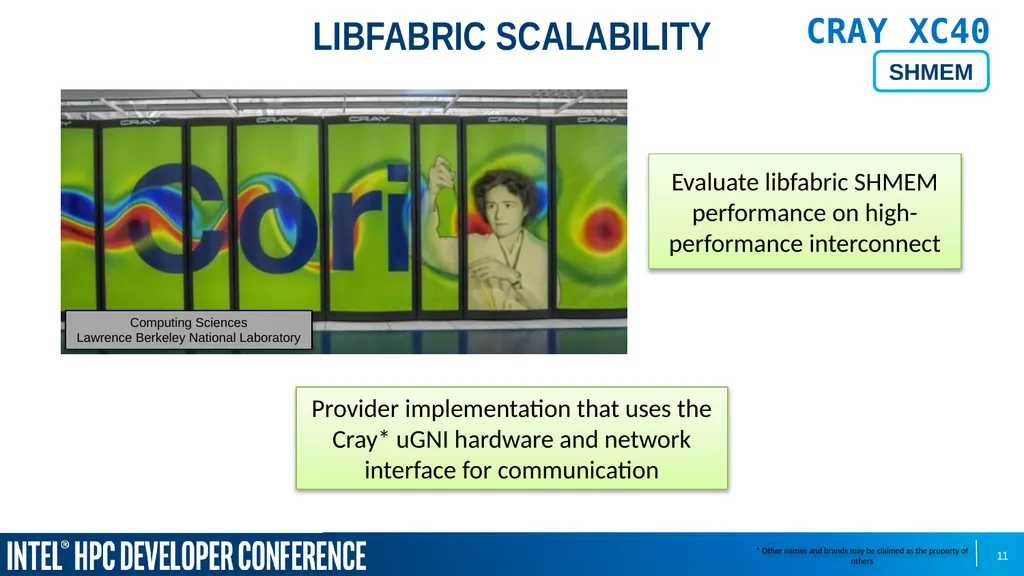
slide11. LIBFABRIC SCALABILITY 11 Evaluate libfabric SHMEM performance on high-performance interconnect Provider implementation that uses the Cray* uGNI hardware and network interface for communication * Other names and brands may be claimed as the property of others Computing Sciences Lawrence Berkeley National Laboratory SHMEM CRAY XC40<br>
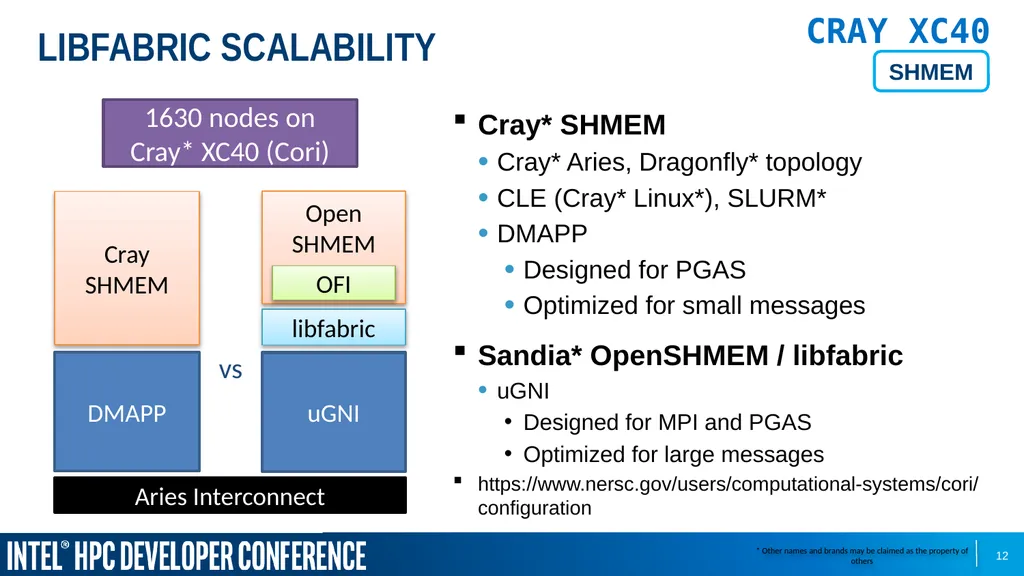
slide12. Cray* SHMEM
Cray* Aries, Dragonfly* topology
CLE (Cray* Linux*), SLURM*
DMAPP
Designed for PGAS
Optimized for small messages
Sandia* OpenSHMEM / libfabric
uGNI
Designed for MPI and PGAS
Optimized for large messages
https://www.nersc.gov/users/computational-systems/cori/configuration DMAPP Cray SHMEM Aries Interconnect uGNI libfabric Open SHMEM OFI vs 1630 nodes on Cray* XC40 (Cori) LIBFABRIC SCALABILITY 12 * Other names and brands may be claimed as the property of others SHMEM CRAY XC40<br>
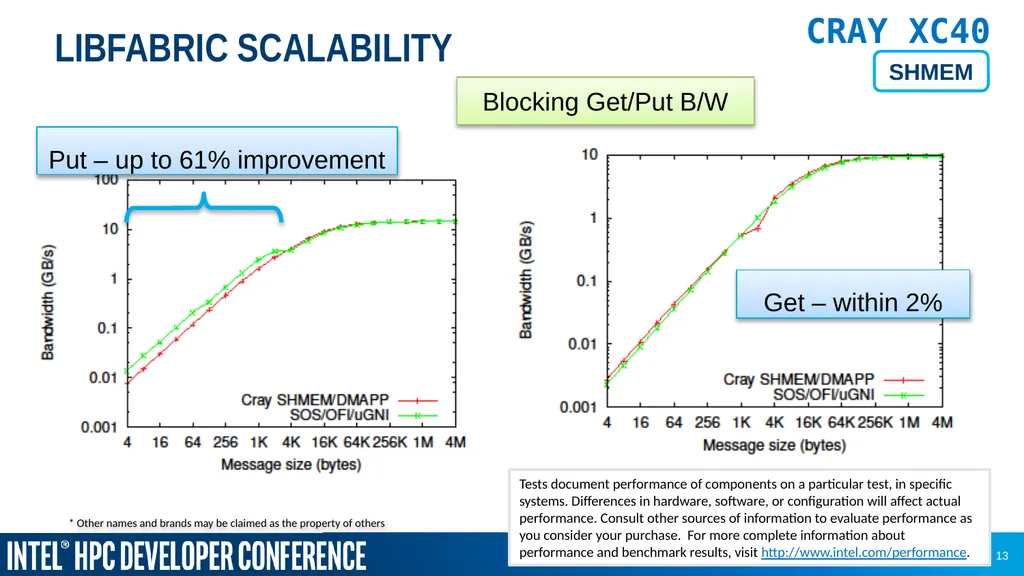
slide13. 13 Tests document performance of components on a particular test, in specific systems. Differences in hardware, software, or configuration will affect actual performance. Consult other sources of information to evaluate performance as you consider your purchase. For more complete information about performance and benchmark results, visit http://www.intel.com/performance. LIBFABRIC SCALABILITY * Other names and brands may be claimed as the property of others Put – up to 61% improvement Get – within 2% Blocking Get/Put B/W SHMEM CRAY XC40<br>
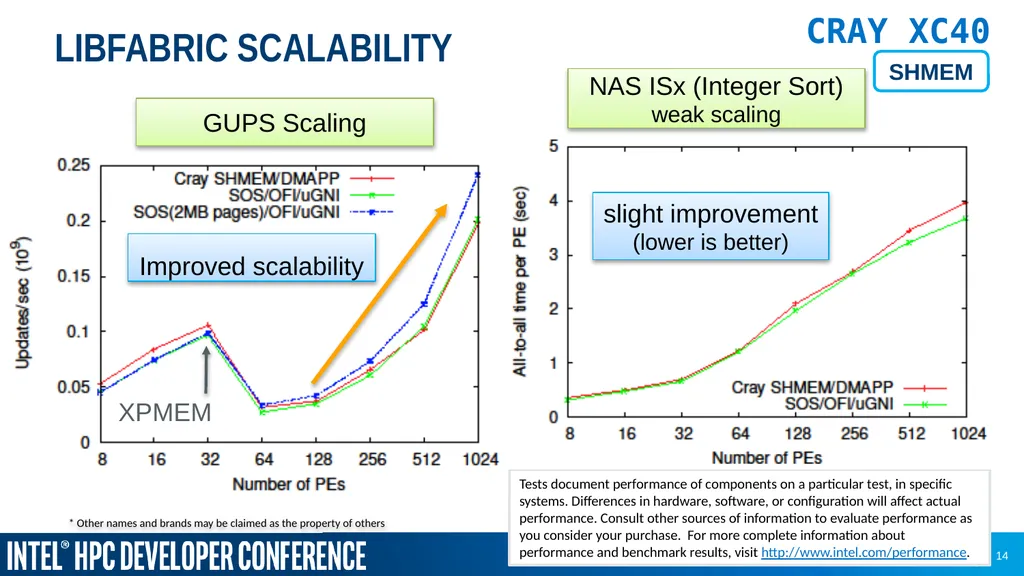
slide14. 14 Tests document performance of components on a particular test, in specific systems. Differences in hardware, software, or configuration will affect actual performance. Consult other sources of information to evaluate performance as you consider your purchase. For more complete information about performance and benchmark results, visit http://www.intel.com/performance. * Other names and brands may be claimed as the property of others XPMEM Improved scalability GUPS Scaling slight improvement
(lower is better) LIBFABRIC SCALABILITY NAS ISx (Integer Sort) weak scaling SHMEM CRAY XC40<br>
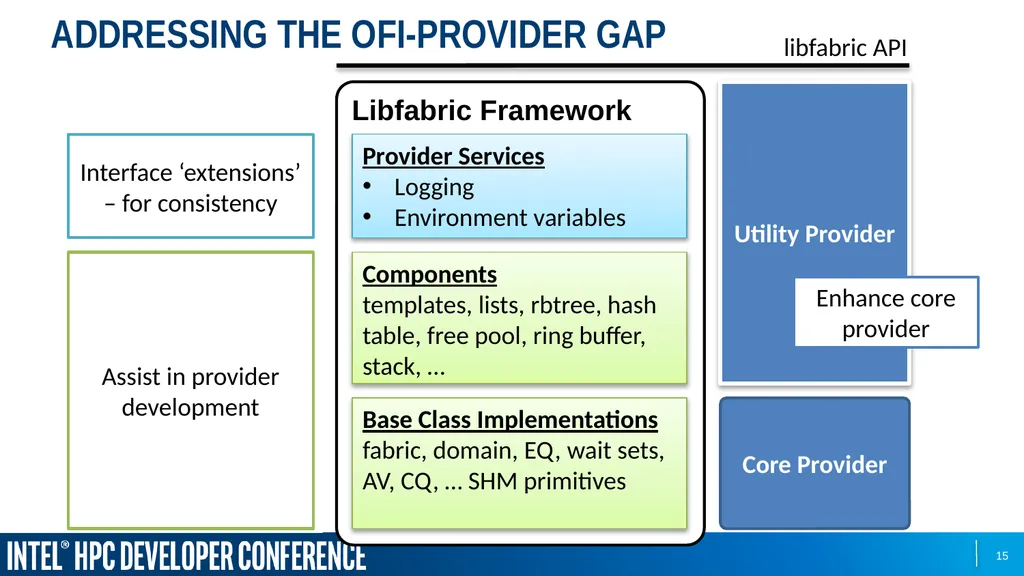
slide15. ADDRESSING THE OFI-PROVIDER GAP 15 Libfabric Framework libfabric API Components
templates, lists, rbtree, hash table, free pool, ring buffer, stack, … Base Class Implementations
fabric, domain, EQ, wait sets, AV, CQ, … SHM primitives Provider Services
Logging
Environment variables Utility Provider Core Provider Interface ‘extensions’ – for consistency Assist in provider development Enhance core provider<br>
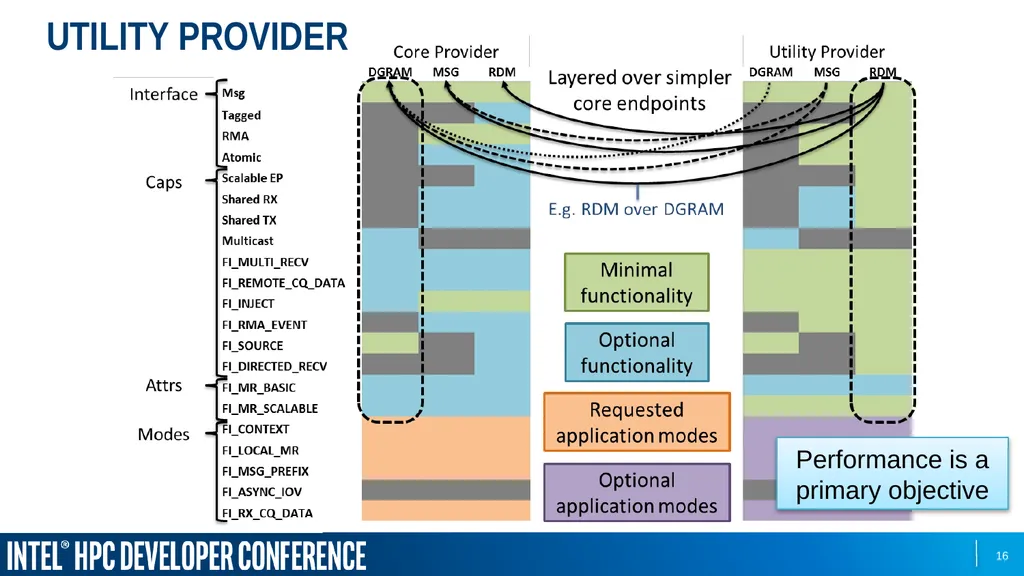
slide16. UTILITY PROVIDER 16 Performance is a primary objective<br>
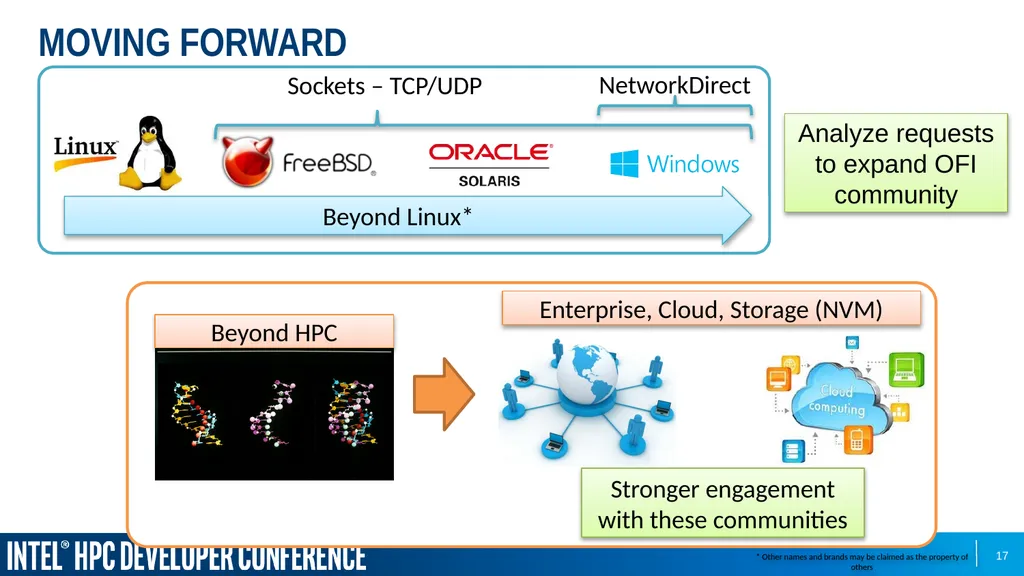
slide17. MOVING FORWARD 17 Beyond HPC Enterprise, Cloud, Storage (NVM) Stronger engagement with these communities Beyond Linux* Sockets – TCP/UDP NetworkDirect Analyze requests to expand OFI community * Other names and brands may be claimed as the property of others<br>
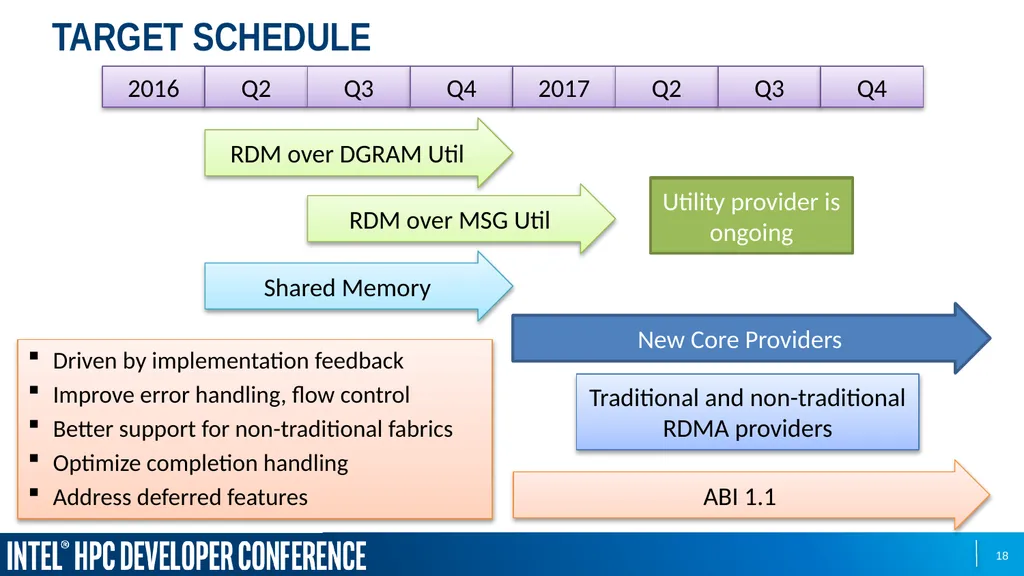
slide18. TARGET SCHEDULE 18 Driven by implementation feedback
Improve error handling, flow control
Better support for non-traditional fabrics
Optimize completion handling
Address deferred features 2016 Q2 Q3 Q4 2017 Q2 Q3 Q4 RDM over DGRAM Util RDM over MSG Util Shared Memory New Core Providers ABI 1.1 Utility provider is ongoing Traditional and non-traditional RDMA providers<br>
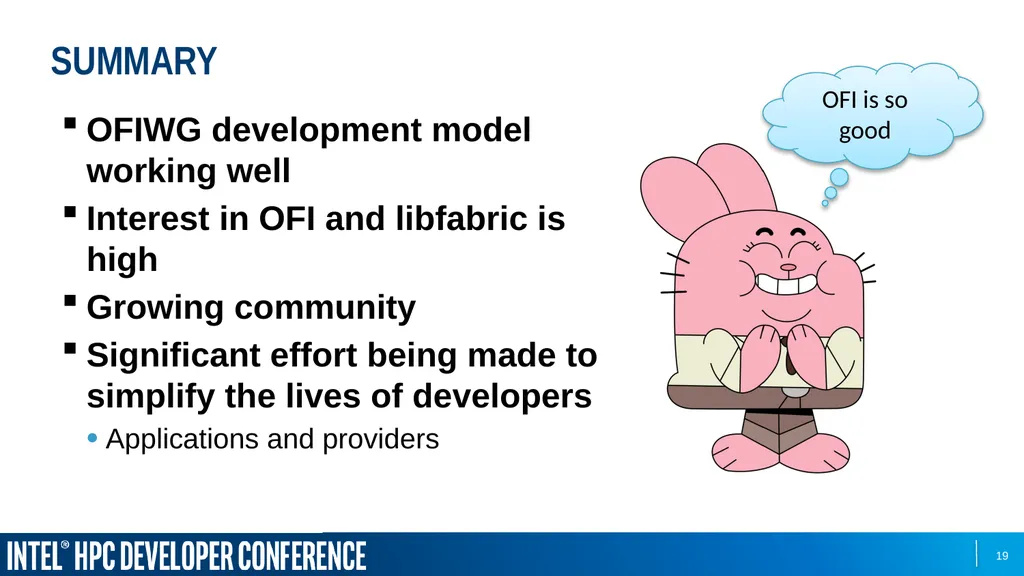
slide19. SUMMARY 19 OFIWG development model working well
Interest in OFI and libfabric is high
Growing community
Significant effort being made to simplify the lives of developers
Applications and providers OFI is so good<br>
slide20. LEGAL DISCLAIMER & OPTIMIZATION NOTICE 20 No license (express or implied, by estoppel or otherwise) to any intellectual property rights is granted by this document. Intel disclaims all express and implied warranties, including without limitation, the implied warranties of merchantability, fitness for a particular purpose, and non-infringement, as well as any warranty arising from course of performance, course of dealing, or usage in trade. This document contains information on products, services and/or processes in development. All information provided here is subject to change without notice. Contact your Intel representative to obtain the latest forecast, schedule, specifications and roadmaps. The products and services described may contain defects or errors known as errata which may cause deviations from published specifications. Current characterized errata are available on request.
Software and workloads used in performance tests may have been optimized for performance only on Intel microprocessors. Performance tests, such as SYSmark and MobileMark, are measured using specific computer systems, components, software, operations and functions. Any change to any of those factors may cause the results to vary. You should consult other information and performance tests to assist you in fully evaluating your contemplated purchases, including the performance of that product when combined with other products.
Copyright © 2016, Intel Corporation. All rights reserved. Intel, Pentium, Xeon, Xeon Phi, Core, VTune, Cilk, and the Intel logo are trademarks of Intel Corporation in the U.S. and other countries.
*Other names and brands may be claimed as the property of others<br>
slide21. Thank you for your time! Sean Hefty
sean.hefty@intel.com
www.intel.com/hpcdevcon<br>
Intel
November 2016 THE LATEST ON OPENFABRICS INTERFACES (OFI):
THE NEW SCALABLE FABRIC SW LAYER FOR SUPERCOMPUTERS<br>
slide3. 3 3 Scalable Implementation Agnostic OFIWG: develop … interfaces aligned with … application needs Software interfaces aligned with application requirements
Careful analysis of requirement Expand open source community
Inclusive development effort
App and HW developers Good impedance match with multiple fabric hardware
InfiniBand*, iWarp, RoCE, Ethernet, UDP offload, Intel®, Cray*, IBM*, others Open Source Application-Centric libfabric * Other names and brands may be claimed as the property of others Optimized SW path to HW
Minimize cache/memory footprint
Reduce instruction count
Minimize memory accesses<br>
slide4. 4 OFI APPLICATION REQUIREMENTS Give us a high-level interface! Give us a low-level interface! MPI developers OFI strives to meet both requirements<br>
slide5. 5 Fabric Services Application OFI Provider Application OFI Provider Provider optimizes for OFI features Common optimization for all apps/providers App uses OFI features Application OFI Provider App optimizes based on supported features Provider supports low-level features only OFI SOFTWARE DEVELOPMENT STRATEGIES One Size Does Not Fit All<br>
slide6. OFI DEVELOPMENT STATUS 6 Fabric Services Application libfabric Provider Provider optimizes for OFI features Common optimization for all apps/providers Provider supports low-level features only Many apps Few apps Provider’s choice App optimizes based on supported features App uses OFI features OFI-provider gap 6<br>
slide7. OFI LIBFABRIC COMMUNITY 7 * Other names and brands may be claimed as the property of others libfabric Intel® MPI Library MPICH Netmod/CH4 Open MPI
MTL/BTL Open MPI
SHMEM Sandia SHMEM GASNet Clang UPC rsocket
ES-API libfabric Enabled Middleware Control Services Communication Services Completion Services Data Transfer Services Discovery fi_info Connection Management Address Vectors Event Queues Event Counters Message Queue Tag Matching RMA Atomics Sockets
TCP, UDP Verbs Cisco usNIC Intel
OPA PSM Cray
GNI Mellanox MXM IBM Blue Gene A3Cube RONNIE * * * * * ® experimental supported * Because of the OFI-provider gap, not all apps work with all providers<br>
slide8. LIBFABRIC SCALABILITY 8 By Courtesy Argonne* National Laboratory, CC BY 2.0, https://commons.wikimedia.org/w/index.php?curid=24653857 Developed to evaluate the Aurora software stack at scale and assist applications in the transition from Mira to Aurora Native provider implementation that directly uses the Blue Gene/Q hardware and network interfaces for communication * Other names and brands may be claimed as the property of others Blue Gene / Q<br>
slide9. IBM* MPICH / PAMI
IBM XL C compiler for BG, v12.1
Optimized for single-threaded latency
…/comm/xl.legacy.ndebug/bin/mpicc
v1r2m2
MPICH / CH4 / libfabric
gcc 4.4.7
global locks, inline, direct, etc.
Provider not optimized for performance PAMI MPICH PAMID hardware BG/Q Provider libfabric MPICH CH4 OFI Completely subjective software stack comparison vs 32 nodes on ALCF Vesta machine PAMI and libfabric performance LIBFABRIC SCALABILITY 9 Blue Gene / Q<br>
slide10. 10 OSU* MPI Performance Tests v5.0 MPI scale out testing:
- cpi – 1M ranks,
- ISx benchmark – 0.5M ranks Tests document performance of components on a particular test, in specific systems. Differences in hardware, software, or configuration will affect actual performance. Consult other sources of information to evaluate performance as you consider your purchase. For more complete information about performance and benchmark results, visit http://www.intel.com/performance. * Other names and brands may be claimed as the property of others LIBFABRIC SCALABILITY Blue Gene / Q<br>
slide11. LIBFABRIC SCALABILITY 11 Evaluate libfabric SHMEM performance on high-performance interconnect Provider implementation that uses the Cray* uGNI hardware and network interface for communication * Other names and brands may be claimed as the property of others Computing Sciences Lawrence Berkeley National Laboratory SHMEM CRAY XC40<br>
slide12. Cray* SHMEM
Cray* Aries, Dragonfly* topology
CLE (Cray* Linux*), SLURM*
DMAPP
Designed for PGAS
Optimized for small messages
Sandia* OpenSHMEM / libfabric
uGNI
Designed for MPI and PGAS
Optimized for large messages
https://www.nersc.gov/users/computational-systems/cori/configuration DMAPP Cray SHMEM Aries Interconnect uGNI libfabric Open SHMEM OFI vs 1630 nodes on Cray* XC40 (Cori) LIBFABRIC SCALABILITY 12 * Other names and brands may be claimed as the property of others SHMEM CRAY XC40<br>
slide13. 13 Tests document performance of components on a particular test, in specific systems. Differences in hardware, software, or configuration will affect actual performance. Consult other sources of information to evaluate performance as you consider your purchase. For more complete information about performance and benchmark results, visit http://www.intel.com/performance. LIBFABRIC SCALABILITY * Other names and brands may be claimed as the property of others Put – up to 61% improvement Get – within 2% Blocking Get/Put B/W SHMEM CRAY XC40<br>
slide14. 14 Tests document performance of components on a particular test, in specific systems. Differences in hardware, software, or configuration will affect actual performance. Consult other sources of information to evaluate performance as you consider your purchase. For more complete information about performance and benchmark results, visit http://www.intel.com/performance. * Other names and brands may be claimed as the property of others XPMEM Improved scalability GUPS Scaling slight improvement
(lower is better) LIBFABRIC SCALABILITY NAS ISx (Integer Sort) weak scaling SHMEM CRAY XC40<br>
slide15. ADDRESSING THE OFI-PROVIDER GAP 15 Libfabric Framework libfabric API Components
templates, lists, rbtree, hash table, free pool, ring buffer, stack, … Base Class Implementations
fabric, domain, EQ, wait sets, AV, CQ, … SHM primitives Provider Services
Logging
Environment variables Utility Provider Core Provider Interface ‘extensions’ – for consistency Assist in provider development Enhance core provider<br>
slide16. UTILITY PROVIDER 16 Performance is a primary objective<br>
slide17. MOVING FORWARD 17 Beyond HPC Enterprise, Cloud, Storage (NVM) Stronger engagement with these communities Beyond Linux* Sockets – TCP/UDP NetworkDirect Analyze requests to expand OFI community * Other names and brands may be claimed as the property of others<br>
slide18. TARGET SCHEDULE 18 Driven by implementation feedback
Improve error handling, flow control
Better support for non-traditional fabrics
Optimize completion handling
Address deferred features 2016 Q2 Q3 Q4 2017 Q2 Q3 Q4 RDM over DGRAM Util RDM over MSG Util Shared Memory New Core Providers ABI 1.1 Utility provider is ongoing Traditional and non-traditional RDMA providers<br>
slide19. SUMMARY 19 OFIWG development model working well
Interest in OFI and libfabric is high
Growing community
Significant effort being made to simplify the lives of developers
Applications and providers OFI is so good<br>
slide20. LEGAL DISCLAIMER & OPTIMIZATION NOTICE 20 No license (express or implied, by estoppel or otherwise) to any intellectual property rights is granted by this document. Intel disclaims all express and implied warranties, including without limitation, the implied warranties of merchantability, fitness for a particular purpose, and non-infringement, as well as any warranty arising from course of performance, course of dealing, or usage in trade. This document contains information on products, services and/or processes in development. All information provided here is subject to change without notice. Contact your Intel representative to obtain the latest forecast, schedule, specifications and roadmaps. The products and services described may contain defects or errors known as errata which may cause deviations from published specifications. Current characterized errata are available on request.
Software and workloads used in performance tests may have been optimized for performance only on Intel microprocessors. Performance tests, such as SYSmark and MobileMark, are measured using specific computer systems, components, software, operations and functions. Any change to any of those factors may cause the results to vary. You should consult other information and performance tests to assist you in fully evaluating your contemplated purchases, including the performance of that product when combined with other products.
Copyright © 2016, Intel Corporation. All rights reserved. Intel, Pentium, Xeon, Xeon Phi, Core, VTune, Cilk, and the Intel logo are trademarks of Intel Corporation in the U.S. and other countries.
*Other names and brands may be claimed as the property of others<br>
slide21. Thank you for your time! Sean Hefty
sean.hefty@intel.com
www.intel.com/hpcdevcon<br>