
SECOND DIALOGUE AND SENSITIZATION MEETING WITH
TG
Published · 17 slides · 0 views
1 / 1


Description
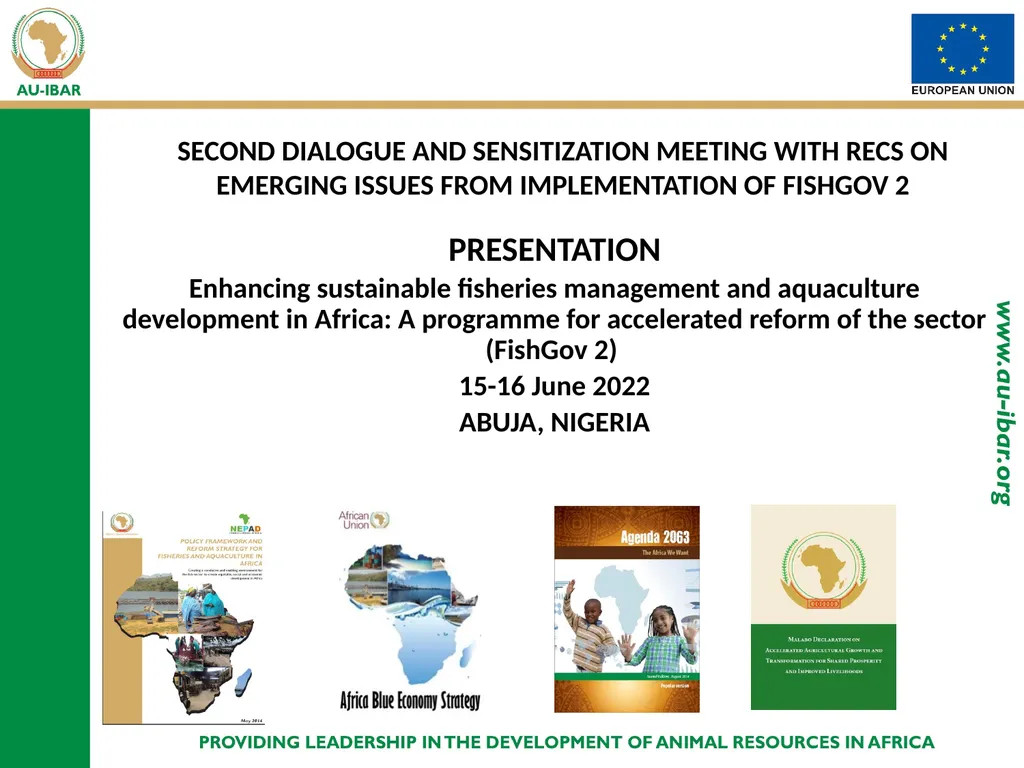
SECOND DIALOGUE AND SENSITIZATION MEETING WITH RECS ON EMERGING ISSUES FROM IMPLEMENTATION OF FISHGOV 2 PRESENTATION Enhancing sustainable fisheries management and aquaculture development in Africa: A programme for accelerated reform of the
Related Topics
Share
Embed code
Download this presentation From Below
"SECOND DIALOGUE AND SENSITIZATION MEETING WITH" is the property of its rightful owner. Permission is granted to download and print the materials on this website for personal, non-commercial use only, and to display it on your personal computer provided you do not modify the materials and that you retain all copyright notices contained in the materials. By downloading content from our website, you accept the terms of this agreement.
Presentation Transcript
01
SECOND DIALOGUE AND SENSITIZATION MEETING WITH RECS ON EMERGING ISSUES FROM IMPLEMENTATION OF FISHGOV 2 PRESENTATION
Enhancing sustainable fisheries management and aquaculture development in Africa: A programme for accelerated reform of the sector (FishGov 2)
15-16 June 2022
ABUJA, NIGERIA<br>
Enhancing sustainable fisheries management and aquaculture development in Africa: A programme for accelerated reform of the sector (FishGov 2)
15-16 June 2022
ABUJA, NIGERIA<br>
02
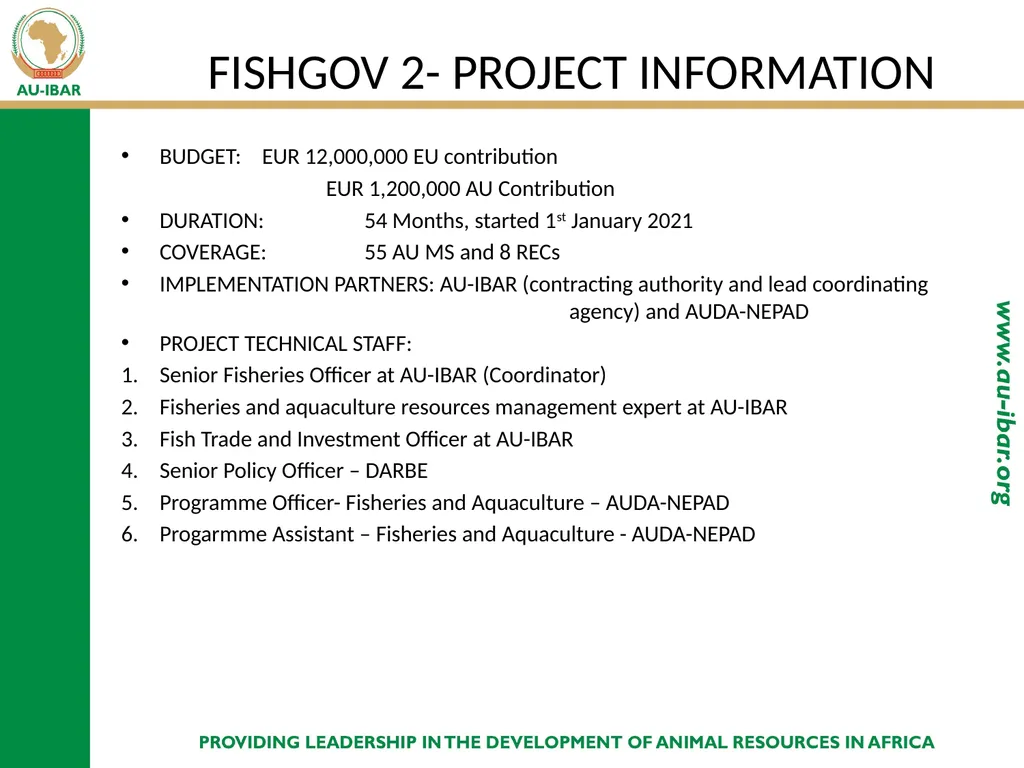
BUDGET: EUR 12,000,000 EU contribution
EUR 1,200,000 AU Contribution
DURATION: 54 Months, started 1st January 2021
COVERAGE: 55 AU MS and 8 RECs
IMPLEMENTATION PARTNERS: AU-IBAR (contracting authority and lead coordinating agency) and AUDA-NEPAD
PROJECT TECHNICAL STAFF:
Senior Fisheries Officer at AU-IBAR (Coordinator)
Fisheries and aquaculture resources management expert at AU-IBAR
Fish Trade and Investment Officer at AU-IBAR
Senior Policy Officer – DARBE
Programme Officer- Fisheries and Aquaculture – AUDA-NEPAD
Progarmme Assistant – Fisheries and Aquaculture - AUDA-NEPAD FISHGOV 2- PROJECT INFORMATION<br>
EUR 1,200,000 AU Contribution
DURATION: 54 Months, started 1st January 2021
COVERAGE: 55 AU MS and 8 RECs
IMPLEMENTATION PARTNERS: AU-IBAR (contracting authority and lead coordinating agency) and AUDA-NEPAD
PROJECT TECHNICAL STAFF:
Senior Fisheries Officer at AU-IBAR (Coordinator)
Fisheries and aquaculture resources management expert at AU-IBAR
Fish Trade and Investment Officer at AU-IBAR
Senior Policy Officer – DARBE
Programme Officer- Fisheries and Aquaculture – AUDA-NEPAD
Progarmme Assistant – Fisheries and Aquaculture - AUDA-NEPAD FISHGOV 2- PROJECT INFORMATION<br>
03
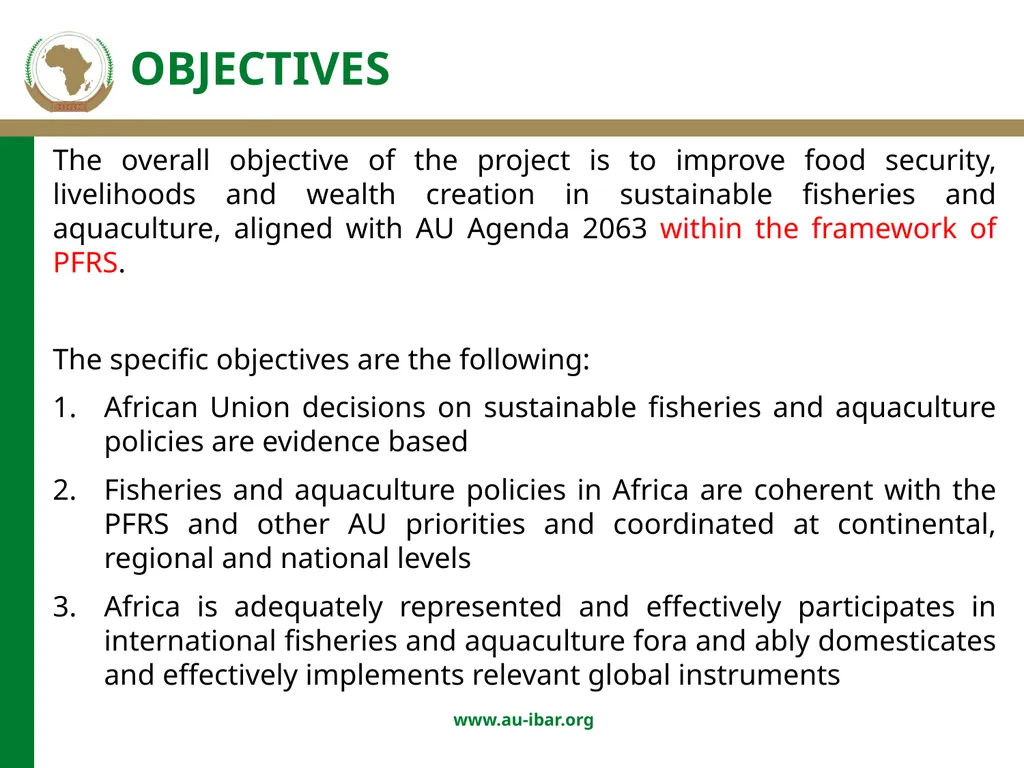
The overall objective of the project is to improve food security, livelihoods and wealth creation in sustainable fisheries and aquaculture, aligned with AU Agenda 2063 within the framework of PFRS.
The specific objectives are the following:
African Union decisions on sustainable fisheries and aquaculture policies are evidence based
Fisheries and aquaculture policies in Africa are coherent with the PFRS and other AU priorities and coordinated at continental, regional and national levels
Africa is adequately represented and effectively participates in international fisheries and aquaculture fora and ably domesticates and effectively implements relevant global instruments OBJECTIVES<br>
The specific objectives are the following:
African Union decisions on sustainable fisheries and aquaculture policies are evidence based
Fisheries and aquaculture policies in Africa are coherent with the PFRS and other AU priorities and coordinated at continental, regional and national levels
Africa is adequately represented and effectively participates in international fisheries and aquaculture fora and ably domesticates and effectively implements relevant global instruments OBJECTIVES<br>
04
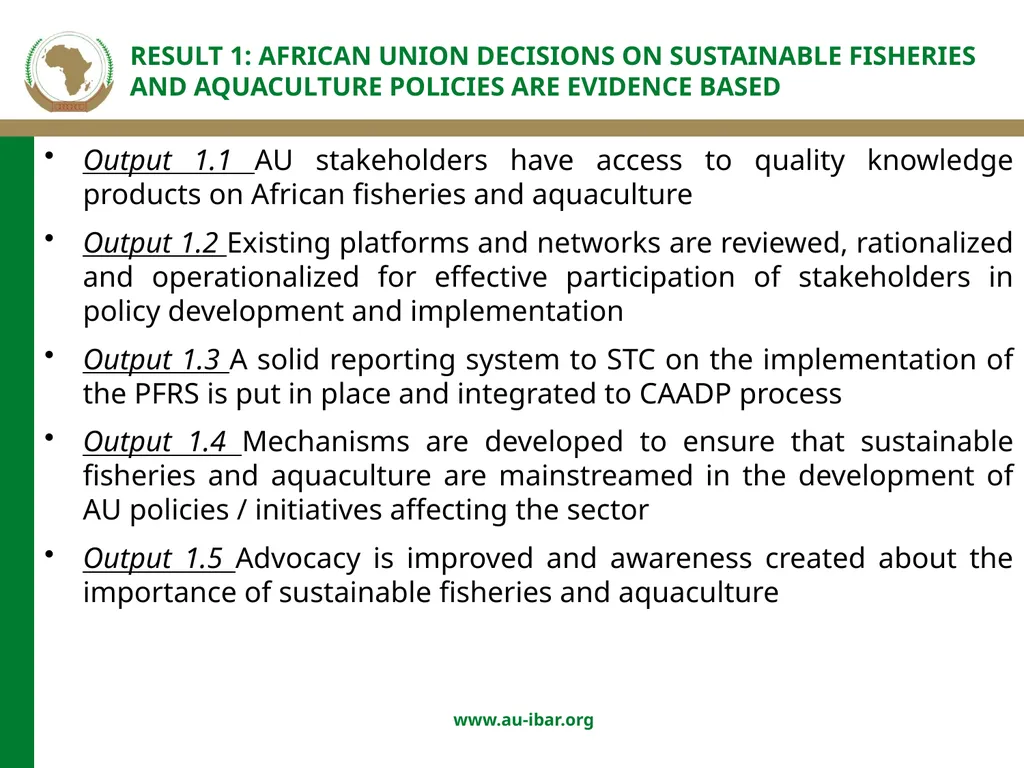
Output 1.1 AU stakeholders have access to quality knowledge products on African fisheries and aquaculture
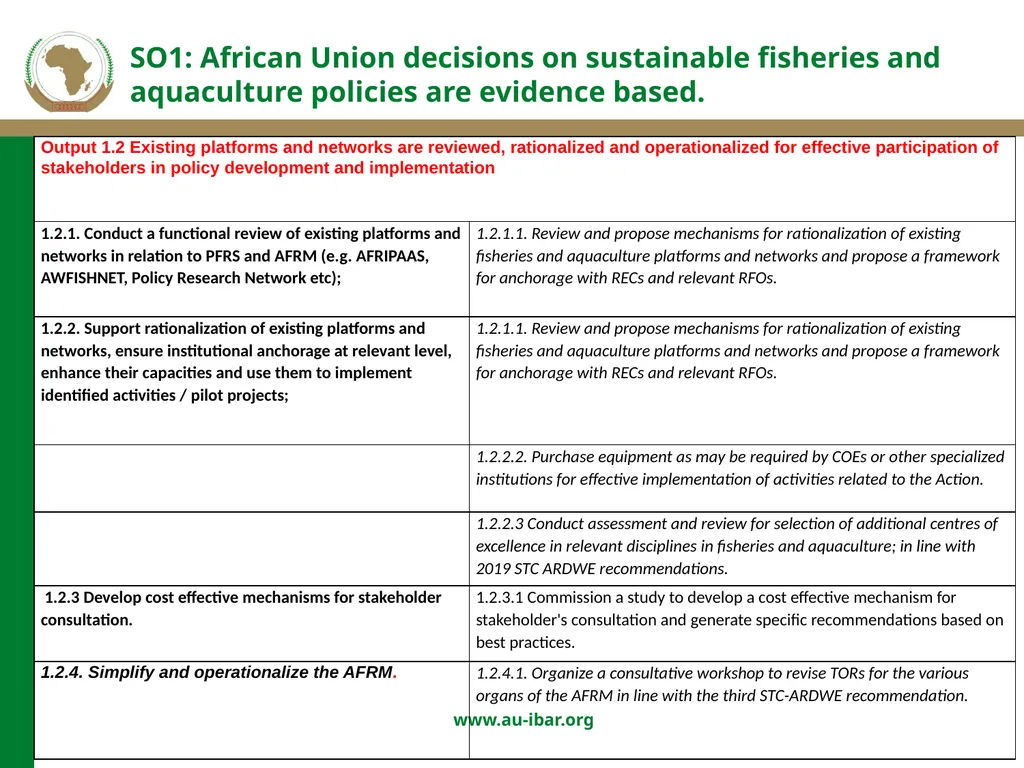
Output 1.2 Existing platforms and networks are reviewed, rationalized and operationalized for effective participation of stakeholders in policy development and implementation
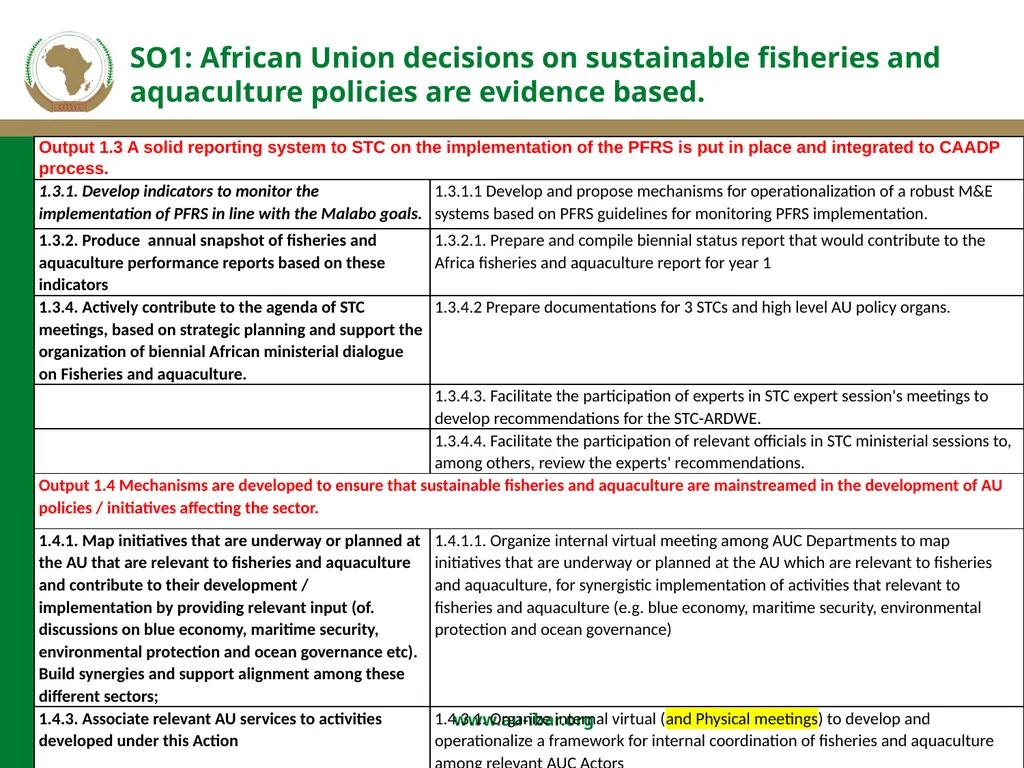
Output 1.3 A solid reporting system to STC on the implementation of the PFRS is put in place and integrated to CAADP process
Output 1.4 Mechanisms are developed to ensure that sustainable fisheries and aquaculture are mainstreamed in the development of AU policies / initiatives affecting the sector
Output 1.5 Advocacy is improved and awareness created about the importance of sustainable fisheries and aquaculture RESULT 1: AFRICAN UNION DECISIONS ON SUSTAINABLE FISHERIES AND AQUACULTURE POLICIES ARE EVIDENCE BASED<br>
Output 1.2 Existing platforms and networks are reviewed, rationalized and operationalized for effective participation of stakeholders in policy development and implementation
Output 1.3 A solid reporting system to STC on the implementation of the PFRS is put in place and integrated to CAADP process
Output 1.4 Mechanisms are developed to ensure that sustainable fisheries and aquaculture are mainstreamed in the development of AU policies / initiatives affecting the sector
Output 1.5 Advocacy is improved and awareness created about the importance of sustainable fisheries and aquaculture RESULT 1: AFRICAN UNION DECISIONS ON SUSTAINABLE FISHERIES AND AQUACULTURE POLICIES ARE EVIDENCE BASED<br>
05
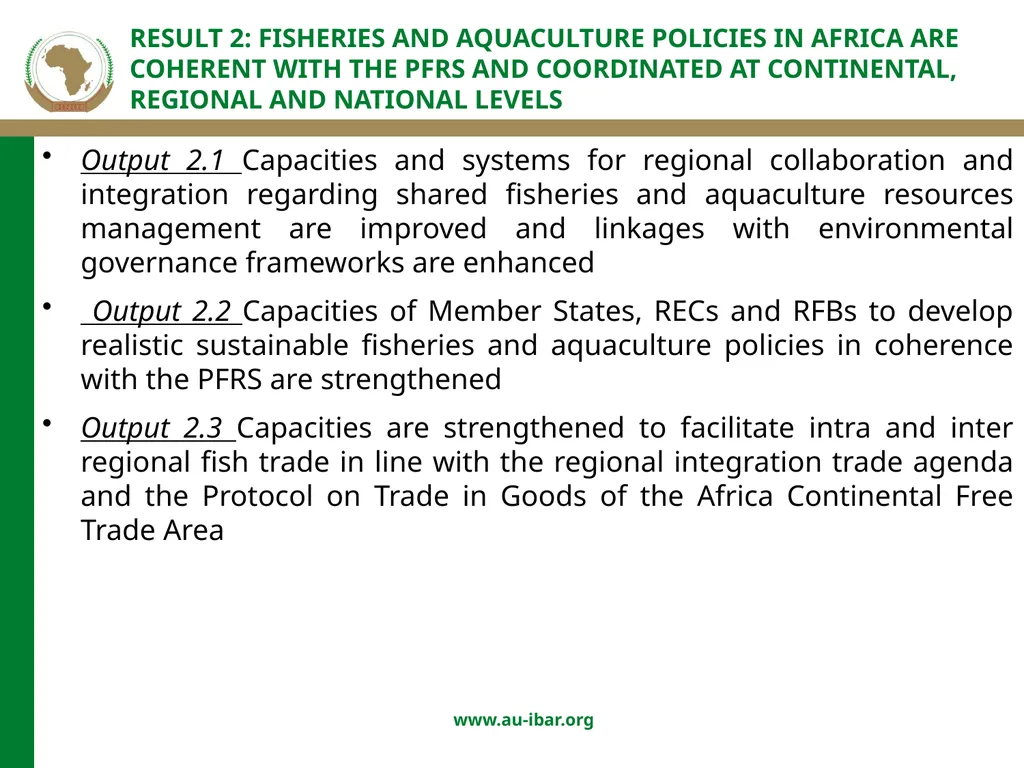
Output 2.1 Capacities and systems for regional collaboration and integration regarding shared fisheries and aquaculture resources management are improved and linkages with environmental governance frameworks are enhanced
Output 2.2 Capacities of Member States, RECs and RFBs to develop realistic sustainable fisheries and aquaculture policies in coherence with the PFRS are strengthened
Output 2.3 Capacities are strengthened to facilitate intra and inter regional fish trade in line with the regional integration trade agenda and the Protocol on Trade in Goods of the Africa Continental Free Trade Area RESULT 2: FISHERIES AND AQUACULTURE POLICIES IN AFRICA ARE COHERENT WITH THE PFRS AND COORDINATED AT CONTINENTAL, REGIONAL AND NATIONAL LEVELS<br>
Output 2.2 Capacities of Member States, RECs and RFBs to develop realistic sustainable fisheries and aquaculture policies in coherence with the PFRS are strengthened
Output 2.3 Capacities are strengthened to facilitate intra and inter regional fish trade in line with the regional integration trade agenda and the Protocol on Trade in Goods of the Africa Continental Free Trade Area RESULT 2: FISHERIES AND AQUACULTURE POLICIES IN AFRICA ARE COHERENT WITH THE PFRS AND COORDINATED AT CONTINENTAL, REGIONAL AND NATIONAL LEVELS<br>
06
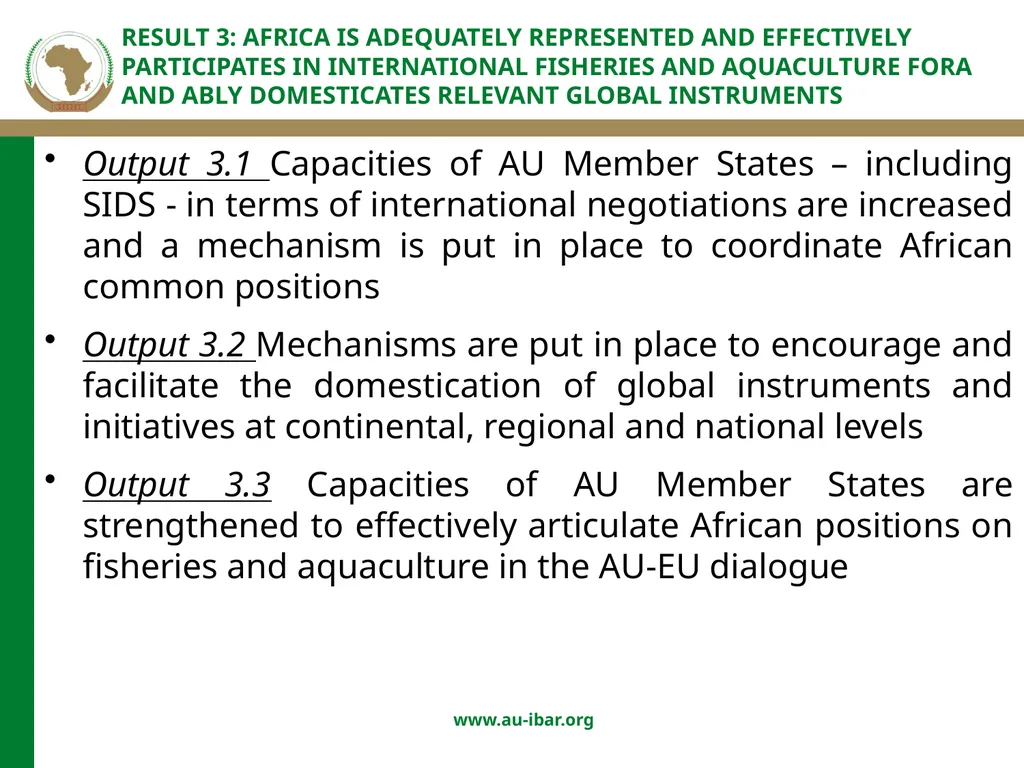
Output 3.1 Capacities of AU Member States – including SIDS - in terms of international negotiations are increased and a mechanism is put in place to coordinate African common positions
Output 3.2 Mechanisms are put in place to encourage and facilitate the domestication of global instruments and initiatives at continental, regional and national levels
Output 3.3 Capacities of AU Member States are strengthened to effectively articulate African positions on fisheries and aquaculture in the AU-EU dialogue RESULT 3: AFRICA IS ADEQUATELY REPRESENTED AND EFFECTIVELY PARTICIPATES IN INTERNATIONAL FISHERIES AND AQUACULTURE FORA AND ABLY DOMESTICATES RELEVANT GLOBAL INSTRUMENTS<br>
Output 3.2 Mechanisms are put in place to encourage and facilitate the domestication of global instruments and initiatives at continental, regional and national levels
Output 3.3 Capacities of AU Member States are strengthened to effectively articulate African positions on fisheries and aquaculture in the AU-EU dialogue RESULT 3: AFRICA IS ADEQUATELY REPRESENTED AND EFFECTIVELY PARTICIPATES IN INTERNATIONAL FISHERIES AND AQUACULTURE FORA AND ABLY DOMESTICATES RELEVANT GLOBAL INSTRUMENTS<br>
07
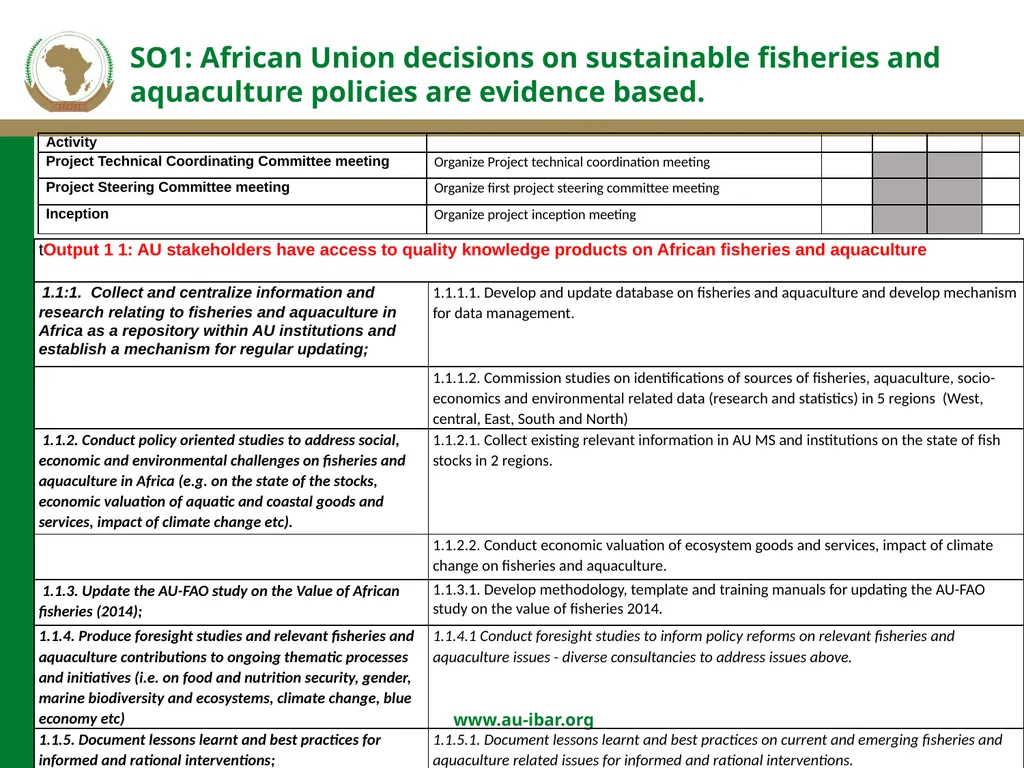
SO1: African Union decisions on sustainable fisheries and aquaculture policies are evidence based.<br>
08
SO1: African Union decisions on sustainable fisheries and aquaculture policies are evidence based.<br>
09
SO1: African Union decisions on sustainable fisheries and aquaculture policies are evidence based.<br>
10
SO2 Fisheries and aquaculture policies in Africa are coherent with the PFRS and coordinated at continental, regional and national levels in order to maintain healthy and resilient marine, coastal and freshwater ecosystems in the context of climate change.<br>
11
SO2 Fisheries and aquaculture policies in Africa are coherent with the PFRS and coordinated at continental, regional and national levels in order to maintain healthy and resilient marine, coastal and freshwater ecosystems in the context of climate change.<br>
12
SO3. Africa is adequately represented and effectively participates in international fisheries and aquaculture fora and ably domesticates relevant global instruments.<br>
13
SO2 Fisheries and aquaculture policies in Africa are coherent with the PFRS and coordinated at continental, regional and national levels in order to maintain healthy and resilient marine, coastal and freshwater ecosystems in the context of climate change.<br>
14
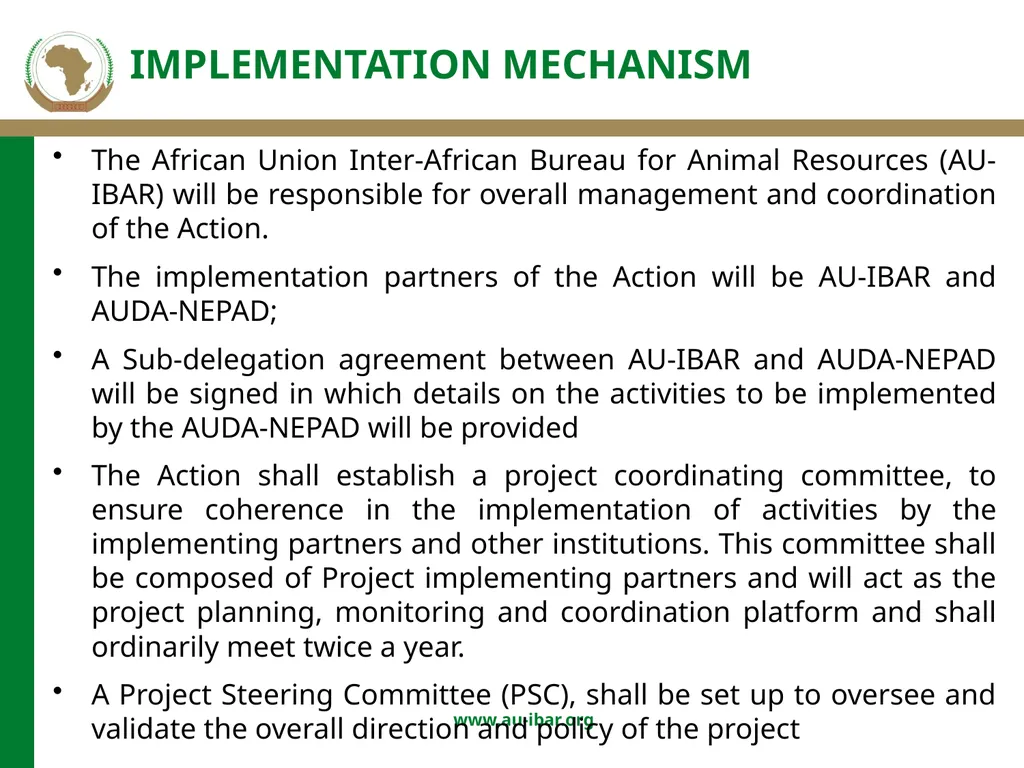
The African Union Inter-African Bureau for Animal Resources (AU-IBAR) will be responsible for overall management and coordination of the Action.
The implementation partners of the Action will be AU-IBAR and AUDA-NEPAD;
A Sub-delegation agreement between AU-IBAR and AUDA-NEPAD will be signed in which details on the activities to be implemented by the AUDA-NEPAD will be provided
The Action shall establish a project coordinating committee, to ensure coherence in the implementation of activities by the implementing partners and other institutions. This committee shall be composed of Project implementing partners and will act as the project planning, monitoring and coordination platform and shall ordinarily meet twice a year.
A Project Steering Committee (PSC), shall be set up to oversee and validate the overall direction and policy of the project IMPLEMENTATION MECHANISM<br>
The implementation partners of the Action will be AU-IBAR and AUDA-NEPAD;
A Sub-delegation agreement between AU-IBAR and AUDA-NEPAD will be signed in which details on the activities to be implemented by the AUDA-NEPAD will be provided
The Action shall establish a project coordinating committee, to ensure coherence in the implementation of activities by the implementing partners and other institutions. This committee shall be composed of Project implementing partners and will act as the project planning, monitoring and coordination platform and shall ordinarily meet twice a year.
A Project Steering Committee (PSC), shall be set up to oversee and validate the overall direction and policy of the project IMPLEMENTATION MECHANISM<br>
15
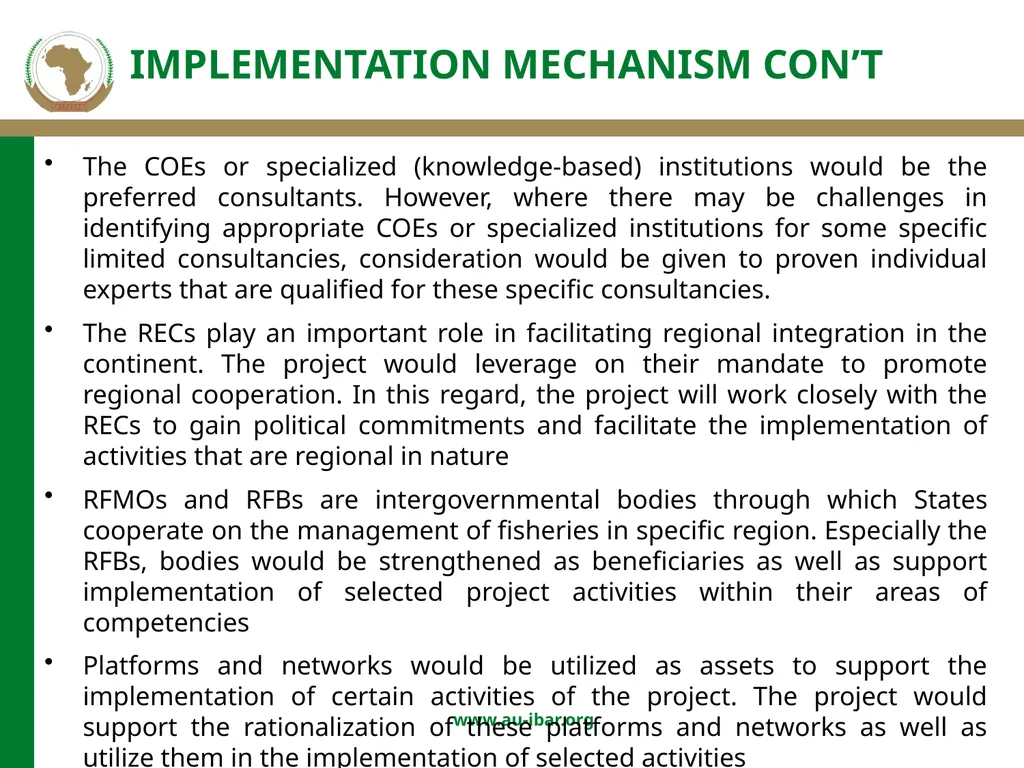
The COEs or specialized (knowledge-based) institutions would be the preferred consultants. However, where there may be challenges in identifying appropriate COEs or specialized institutions for some specific limited consultancies, consideration would be given to proven individual experts that are qualified for these specific consultancies.
The RECs play an important role in facilitating regional integration in the continent. The project would leverage on their mandate to promote regional cooperation. In this regard, the project will work closely with the RECs to gain political commitments and facilitate the implementation of activities that are regional in nature
RFMOs and RFBs are intergovernmental bodies through which States cooperate on the management of fisheries in specific region. Especially the RFBs, bodies would be strengthened as beneficiaries as well as support implementation of selected project activities within their areas of competencies
Platforms and networks would be utilized as assets to support the implementation of certain activities of the project. The project would support the rationalization of these platforms and networks as well as utilize them in the implementation of selected activities IMPLEMENTATION MECHANISM CON’T<br>
The RECs play an important role in facilitating regional integration in the continent. The project would leverage on their mandate to promote regional cooperation. In this regard, the project will work closely with the RECs to gain political commitments and facilitate the implementation of activities that are regional in nature
RFMOs and RFBs are intergovernmental bodies through which States cooperate on the management of fisheries in specific region. Especially the RFBs, bodies would be strengthened as beneficiaries as well as support implementation of selected project activities within their areas of competencies
Platforms and networks would be utilized as assets to support the implementation of certain activities of the project. The project would support the rationalization of these platforms and networks as well as utilize them in the implementation of selected activities IMPLEMENTATION MECHANISM CON’T<br>
16
The successful accomplishment of the project would result in evidence-based decision making with regards to fisheries and aquaculture by policy organs of the African Union. The source of high quality data would also be available to the stakeholders in the fisheries and aquaculture sector, including AU member states, RECs, RFBs etc for sustainable governance of the sector
Coordination and institutional collaboration would be enhanced and broadened between regional institutions to include RECS, RFBs, RSC and RFMOs, WBC. This would result in synergies in the governance of the sector especially at regional levels for sustainable management of shared fish stocks.
Improved governance of the fishery and aquaculture sectors would be ensured through fostering policy coherence, accountability as well as ratification and adoption of international best practices and global instruments by AU member states and RECs.
Sustainable exploitation of fish stocks and responsible aquaculture practices would improve through capacity building in fisheries management approaches or tools and aquaculture practices by provisions of policy briefs, advocacy notes, access to quality data and information and foresight studies.
Improved governance and management practices would impact on increased contribution of the sector to GDP, economic growth, food security and livelihoods and social welfare, food safety, including employment, in the long-time.
Participatory, inclusive approaches and transparency in the governance of the sector would be enhanced through active, effective and coordinated stakeholders (the NSAs platforms, AWFISHNET, MOSFA, ANAF, PRNFAA)
The visibility of the importance of the sector in national development, food security, and social cohesion would be increased and public sector support or allocation enhanced through establishment of the culture of engagement and consultation between the fisheries and aquaculture sector with other sectors such as finance, public health, trade, judiciary, foreign affairs ministries or departments at member states level. The increased public and private investments in the sector through increased visibility of the sector in national and regional investment plans
Increased recognition of African fisheries and aquaculture in global fora through effective coherent African voice
Enhanced partnership and coordination between African Union and European Union on sustainable fisheries and aquaculture development SUSTAINABILITY MECHANISMS<br>
Coordination and institutional collaboration would be enhanced and broadened between regional institutions to include RECS, RFBs, RSC and RFMOs, WBC. This would result in synergies in the governance of the sector especially at regional levels for sustainable management of shared fish stocks.
Improved governance of the fishery and aquaculture sectors would be ensured through fostering policy coherence, accountability as well as ratification and adoption of international best practices and global instruments by AU member states and RECs.
Sustainable exploitation of fish stocks and responsible aquaculture practices would improve through capacity building in fisheries management approaches or tools and aquaculture practices by provisions of policy briefs, advocacy notes, access to quality data and information and foresight studies.
Improved governance and management practices would impact on increased contribution of the sector to GDP, economic growth, food security and livelihoods and social welfare, food safety, including employment, in the long-time.
Participatory, inclusive approaches and transparency in the governance of the sector would be enhanced through active, effective and coordinated stakeholders (the NSAs platforms, AWFISHNET, MOSFA, ANAF, PRNFAA)
The visibility of the importance of the sector in national development, food security, and social cohesion would be increased and public sector support or allocation enhanced through establishment of the culture of engagement and consultation between the fisheries and aquaculture sector with other sectors such as finance, public health, trade, judiciary, foreign affairs ministries or departments at member states level. The increased public and private investments in the sector through increased visibility of the sector in national and regional investment plans
Increased recognition of African fisheries and aquaculture in global fora through effective coherent African voice
Enhanced partnership and coordination between African Union and European Union on sustainable fisheries and aquaculture development SUSTAINABILITY MECHANISMS<br>
17
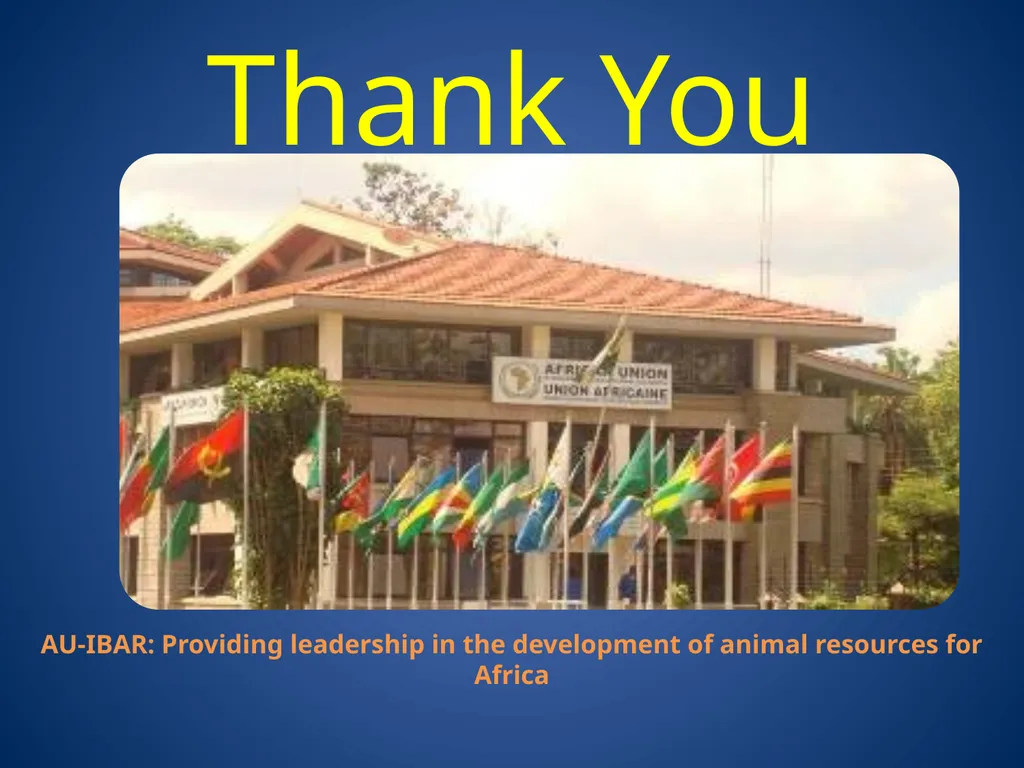
Thank You AU-IBAR: Providing leadership in the development of animal resources for Africa<br>