Secretariat of the Task Team on International
Description: Secretariat of the Task Team on International Trade Statistics United Nations Committee of Experts on Business and Trade Statistics Statistics Division, Department of Economic and Social Affairs Email: tradestatun.org
Related Topics
Download Presentation
"Secretariat of the Task Team on International" is the property of its rightful owner. Permission is granted to download and print the materials on this website for personal, non-commercial use only, and to display it on your personal computer provided you do not modify the materials and that you retain all copyright notices contained in the materials. By downloading content from our website, you accept the terms of this agreement.
Presentation Transcript
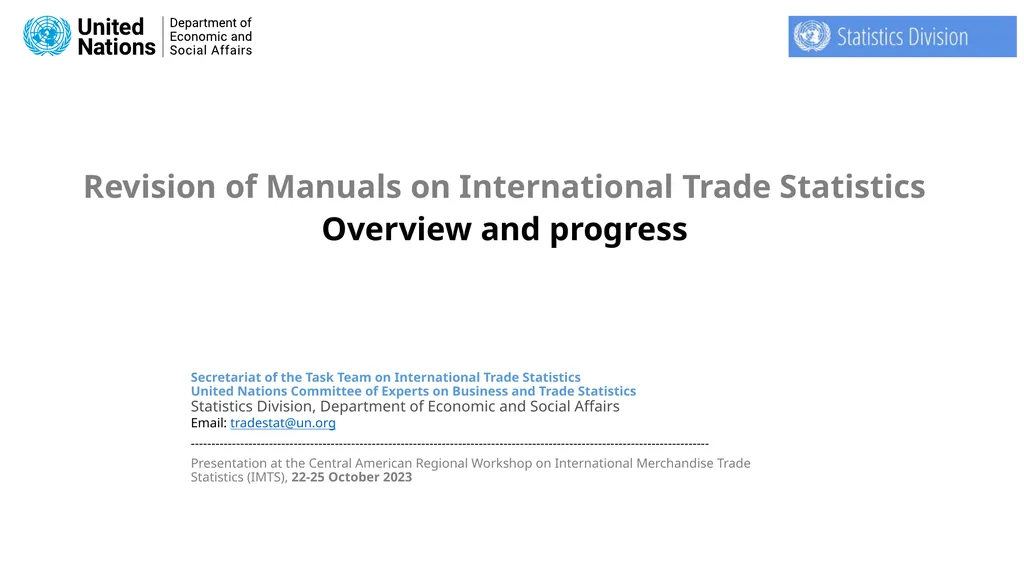
slide1. Secretariat of the Task Team on International Trade Statistics
United Nations Committee of Experts on Business and Trade Statistics
Statistics Division, Department of Economic and Social AffairsEmail: tradestat@un.org
------------------------------------------------------------------------------------------------------------------------------
Presentation at the Central American Regional Workshop on International Merchandise Trade Statistics (IMTS), 22-25 October 2023 Revision of Manuals on International Trade Statistics
Overview and progress<br>
slide2. Manuals on international trade statistics<br>
slide3. Background - 52nd Statistical Commission (2021)<br>
slide4. Task Team on International Trade StatisticsUN Committee of Experts on Business and Trade Statistics<br>
slide5. Mandates of the Task Team on International Trade Statistics (TT ITS) Revise trade statistics manual: IMTS 2010 and MSITS 2010 in collaboration with other stakeholders
Enhance the integration between trade and business statistics
Promote capacity building activities and collaborate on ongoing technical assistance projects
Coordinate the Integration of work program with other entities<br>
slide6. Working structure: Co-leaders: Portugal and Morocco<br>
slide7. Brief overview of activities (2022/2023) Revision of trade statistics manuals (IMTS and MSITS)
Took stock of revisions to SNA and BPM and reviewed their impacts
Drafting various guidance notes based on the list of defined research topics (through global consultation)
Prepared and consulted the outlines
Drafting the handbook on integrating business and trade statistics
Drafting the 2nd volume of Manual on Principal Indicators on Business and Trade Statistics
Contributing to Gender mainstreaming in Business and Trade Statistics with IAEG-GS
Development of the trade data tools<br>
slide8. Timelines
Research agenda
Topics in the 1st round global consultations (May 2023)
Outcomes of the 1st Global Consultation
Plan for the 2nd global consultations 8 Revision of trade statistics manuals (IMTS and MSITS) I.S.S.U.E.S and consensus, so far<br>
slide9. 9 2020 2023– Drafting IMTS 202X and MSITS 202X including country consultation on the new Timeline - General The timeline was discussed in the last UNCEBTS meeting
Committee requested to prioritize quality over the initial deadlines
The task team will continue reviewing the deadlines, considering the progress of the completion of GNs in the 2nd Global Consultation, the availability of the drafters/editors, and the completion of the final draft text from BPM and SNA revisions<br>
slide10. Research Agenda: Vertical and Horizontal integration<br>
slide11. Research Agenda: Vertical v.1 Scope of IMTS and SITS
v.2 Impact of the BPM updates
v.3 Bilateral trade asymmetry (goods and services)
v.4 Informal Cross Border Trade (Goods And Services)
v.5 Recording Principle – Change Of Ownership Instead Of Cross-Border For Selected Commodities (Goods)
v.6 Trade System – Improved Coverage By Implementing General Trade System Exclusively (Goods)
v.7 Valuation – Utilizing Invoice Value In Addition To CIF, FOB (Goods)
v.8 Price And Volume Measurement (Goods And Services)
v.9 Factoryless Goods Producers And Merchanting (Goods) v.10 Measurement Of Modes Of Supply (Services)
v.11 SITS Classifications EBOPS (Services)
v.12 Trade Flow, Nature Of Transactions And Customs Procedure Codes (Goods)
v.13 Valuation on specific transactions/products (Goods and Services)
v.14 Alternative data sources – high-frequency data sources (Goods and Services)
V.15 Upgrading SDMX-IMTS to Technical Specification version 3.0 (Goods)
v.16 Clarification on Cultural Products Resulting From Creative Industries (Goods and Services)
v.17 Revision of the Standard International Trade Classification (SITC) (Goods)
v.18 Indicators on Trade Statistics (Goods and Services) Guidance Notes in the first global consultation Dedicated handbook<br>
slide12. Research Agenda: Horizontal h.1 Digital Trade Including Conceptual Framework, Price And Volume Measurement (Goods And Services)
h.2 Global Value Chains (Goods And Services)
h.3 Linking Trade And Business Statistics (Goods And Services)
h.4 Impact Of Trade On Environment And Sustainability (Goods And Services)
h.5 Impact Of Trade On Well-Bering, Labor, Gender And Productivity (Goods And Services)
h.6 Foreign Affiliates Statistics (FATS) (Goods And Services)
h.7 Classification: BEC Rev.5, Business Functions (Goods And Services)
h.8 Impact Of ISIC And CPC Revisions (Goods And Services) Guidance Notes in the first global consultation Dedicated handbook<br>
slide13. So far … (as of October 2023) Conceptual issues
The first round of global consultations
Emerging proposals for updating the manuals
IMTS and MSITS: manual outlines Update of related standards
Macroeconomic frameworks
SNA (2025)
BPM (2025)
Classifications
ISIC (2023)
CPC (2024)
HS (2027)<br>
slide14. 14 Topics for 1st global consultations [Topic #1: Definition, scope and delineation of goods and services]
[Topic #2: Comprehensive review on the impact of BPM 6 updates]
[Topic #3: Definition and delineation of Informal Cross Border Trade (ICBT)]
[Topic #4: Valuation – utilizing invoice value in addition to CIF and FOB]
[Topic #5: Measurement of digital trade]
[Topic #6: Linking of trade and business statistics]
[Topic #7: Change of ownership in IMTS v. BOP]
[Topic #8: Clarification on cultural products resulting from creative industries]
[Topic #9: Impact of trade on wellbeing, labour, and productivity]
[Topic #10: Draft outlines for IMTS and MSITS]
[Topic #11: Draft outline for the Handbook on Integrating Business and Trade Statistics (HIBTS)]<br>
slide15. 15 [Topic #1: Definition, scope and delineation of goods and services] Seeks to clarify the distinction between services and goods regarding their delineation and recording in trade in goods or services
Proposes emphasizing the distinction between how products are defined and how they are recorded, expanding the MSITS 2010 definition of services to explicitly cover knowledge capturing products that are services, and providing additional examples to better operationalize the definition of services
Regarding goods printed/manufactured using an additive manufacturing process (e.g.,3-D printing) acquired from abroad
Also recommends that non-fungible tokens (NFTs) that are classified as either consumption or assets according to SNA/BPM GN DZ.10 would be recorded as services Furthermore, for consistency in classification of NFTs that convey no ownership rights as services
in the case that they transition to valuables, this Note recommends that the 2008 SNA para. 10.13 definition of valuables be generalized to define valuables as products rather than goods<br>
slide16. 16 [Topic #2: Comprehensive review on the impact of BPM 6 updates] Sub Task Team on GNV.2 coordinating with the whole Task Team on incorporating BPM updates into trade manuals
Ensure that all of the updates to BPM6 relevant to trade are incorporated into trade manuals
Output a table for the appendix(ices) of the trade manual(s) to identify all BPM6 updates that impact IMTS and/or MSITS<br>
slide17. 17 [Topic #3: Definition and delineation of Informal Cross Border Trade (ICBT)] Defines the informal cross‐border trade (ICBT) both in IMTS and MSITS that can be consistent with country best practices and the informal economy conceptual framework as described by the guidance note by the joint SNA/BPM updates (IE.1)
Proposed definition based on delineating transactions that are not covered by formal arrangements (in law or in practice). Working definition
Informal cross-border trade refers to imports and exports, by informal economic units, of legal goods and services, which do not comply with the regulatory framework and other procedures set by the
government, and often go unrecorded into official national statistics of the trading countries I.S.S.U.E. of illegal transactions e.g., smuggling<br>
slide18. 18 [Topic #4: Valuation – utilizing invoice value in addition to CIF and FOB] Using invoice values as the valuation methods for imports and exports is conceptually more consistent with the general conceptual principle of recording output at basic prices in National Accounts (G.1)
GNV.7 discusses the options for IMTS to record the invoice value in addition to CIF, FOB
CIF-FOB valuation implies a valuation at the point where the good crosses the border of the reporting country and is, therefore, in line with the cross-border principle applied in IMTS
While CIF-FOB, therefore, should remain the valuation method used for IMTS disseminations, this note proposes encouraging countries also to collect invoice values to facilitate the transition for BPM and SNA
Freight and insurance services
Importer v. exporter split
Record on transaction basis
Different valuation methods and their relevance for the different statistics be clarified in IMTS<br>
slide19. 19 [Topic #5: Measurement of digital trade] The Handbook on Measuring Digital Trade (IMF, OECD, UNCTAD and WTO, forthcoming) sets up the statistical definition of digital trade and establishes a conceptual framework for measurement
TT-ITS recommends the conceptual and measurement framework of digital trade be included in the updated MSITS and IMTS, with a short common chapter summarizing the most important concepts and presenting the reporting template for digital trade.<br>
slide20. 20 [Topic #6: Linking of trade and business statistic] Issues include concepts, data sources, and technical considerations for producing statistics from linking trade and business data (for goods and services)
GNH.3 highlights the relevance of Microdata linking (MDL) for producing new statistics by effectively using existing data sets without increasing the response burden on respondents
It recommends highlighting in trade manuals the importance of identifying the statistical unit (legal/enterprises/establishment) and the difficulties some countries may face.
The GN includes alternatives for countries with different statistical infrastructures (e.g., structural business statistics surveys) without an SBR and/or a unique identifier in place for linking trade and business statistics.
It also emphasizes the importance of indicators on quality<br>
slide21. 21 [Topic #7: Change of ownership in IMTS v. BOP] GNV.5 reviews and elaborates on the commodities under the principle of change of ownership based on countries' experiences
Keep cross-border physical movement as the basic recording principle in IMTS
Review the list of goods to be compiled based on change of ownership as an exception to the general cross-border principle
Encourage countries with a major involvement in global production chains to publish supplementary (non-mandatory) statistical products, including
disaggregated data, say by Statistical Procedure Codes or Nature of transactions
help users understand and quantify the conceptual differences between IMTS and SITS/BoP figures and finding the figures most relevant to their purposes.<br>
slide22. 22 [Topic #8: Clarification on cultural products resulting from creative industries] GNV.16 clarifies conceptual issues related to cultural products resulting from cultural and creative industries.
It recommends adding new categories on culture/creative trade to the travel in EBOPS.
The identification of handmade cultural goods could be achieved by countries by expanding their national customs classification at a further level of disaggregation.
Furthermore, GNV.16 gives practical guidance on compiling trade data for assessing international trade in cultural and creative goods and services<br>
slide23. 23 [Topic #9: Impact of trade on wellbeing, labour, and productivity] Important links with the 2030 Agenda
Engine for inclusive economic growth and poverty reduction;
Positive effects on productivity
Impacts economic, environmental, and social wellbeing through its distributional effects and health impacts related to prices and types of goods and services traded
Trade can also exacerbate existing inequalities, including income and other inequalities by sex and ethnicity.
GNH.5 proposes productivity related indicators; labour and wage related indicators; wellbeing and gender inequalities related indicators
Furthermore, the GN also considers clarifying definitions for the Volume 2 of the Manual on the Principal Indicators on Business and Trade Statistics: exporter, importer, trader, two-way trader, domestic enterprise, and multinational enterprise (MNE)
It is recommended that Volume 2 of the Manual on the Principal Indicators on Business and Trade Statistics mainstream data by sex, also by gender (where possible)<br>
slide24. 24 [Topic #10: Draft outlines for IMTS and MSITS] Modest changes except for
Better alignment between IMTS and MSITS
Introducing common titles and a few new chapters/sections for IMTS and MSITS
Upgrading a few sections to chapter level to enhance their prominence or relation with other sections/chapters:
https://unstats.un.org/wiki/download/attachments/160137218/Draft%20outline%20IMTS%20and%20MSITS.pdf?version=1&modificationDate=1682564687314&api=v2<br>
slide25. Outcomes of the 1st Global Consultation: Results of global consultations on topics regarding the revision of trade manuals.
There was a good response rates from all the regions.
Many responding countries agree with the proposals.
It was highlighted to thoroughly consider response details regarding specific topics of interest to specific regions and where significant responses express no opinion.
Examples that require thorough consideration include topics on the definition and delineation of ICBT, clarification on cultural products resulting from creative industries, and the impact of trade on wellbeing, labour, and productivity.
It may not have been clear that the global consultations on the GNs focused on conceptual issues because many respondents requested the inclusion of country practices
The country practices will be included in the forthcoming Compilers' Guide.<br>
slide26. Plan for the 2nd global consultations
Consolidated recommendations
Annotated manual outlines (IMTS, MSITS)
V3 –Bilateral trade asymmetry
V8 – Price and volume measurement
V9 – Factoryless goods producers and merchanting
V10 – Measurement of Modes of Supply
V11 – SITS Classifications EBOPS
V12 – Trade flow, nature of transaction and Customs Procedure Codes
V13 – Valuation on specific transactions/products (in progress)<br>
slide27. Plan for the 2nd global consultations
V14 – Alternative data sources – high-frequency data sources
V15 – Upgrading SDMX-IMTS to technical specifications version 3.0
H2 – Global Value Chains (existing handbook)
H4 – Impact of trade on environment and sustainability
H6 – Foreign Affiliates Statistics (no need for a GN – explanation)
H7 – Classification: BEC Rev.5, Business Functions
H8 – Impact on ISIC and CPC revisions (waiting for other inputs)<br>
slide28. 28 Thank you<br>
United Nations Committee of Experts on Business and Trade Statistics
Statistics Division, Department of Economic and Social AffairsEmail: tradestat@un.org
------------------------------------------------------------------------------------------------------------------------------
Presentation at the Central American Regional Workshop on International Merchandise Trade Statistics (IMTS), 22-25 October 2023 Revision of Manuals on International Trade Statistics
Overview and progress<br>
slide2. Manuals on international trade statistics<br>
slide3. Background - 52nd Statistical Commission (2021)<br>
slide4. Task Team on International Trade StatisticsUN Committee of Experts on Business and Trade Statistics<br>
slide5. Mandates of the Task Team on International Trade Statistics (TT ITS) Revise trade statistics manual: IMTS 2010 and MSITS 2010 in collaboration with other stakeholders
Enhance the integration between trade and business statistics
Promote capacity building activities and collaborate on ongoing technical assistance projects
Coordinate the Integration of work program with other entities<br>
slide6. Working structure: Co-leaders: Portugal and Morocco<br>
slide7. Brief overview of activities (2022/2023) Revision of trade statistics manuals (IMTS and MSITS)
Took stock of revisions to SNA and BPM and reviewed their impacts
Drafting various guidance notes based on the list of defined research topics (through global consultation)
Prepared and consulted the outlines
Drafting the handbook on integrating business and trade statistics
Drafting the 2nd volume of Manual on Principal Indicators on Business and Trade Statistics
Contributing to Gender mainstreaming in Business and Trade Statistics with IAEG-GS
Development of the trade data tools<br>
slide8. Timelines
Research agenda
Topics in the 1st round global consultations (May 2023)
Outcomes of the 1st Global Consultation
Plan for the 2nd global consultations 8 Revision of trade statistics manuals (IMTS and MSITS) I.S.S.U.E.S and consensus, so far<br>
slide9. 9 2020 2023– Drafting IMTS 202X and MSITS 202X including country consultation on the new Timeline - General The timeline was discussed in the last UNCEBTS meeting
Committee requested to prioritize quality over the initial deadlines
The task team will continue reviewing the deadlines, considering the progress of the completion of GNs in the 2nd Global Consultation, the availability of the drafters/editors, and the completion of the final draft text from BPM and SNA revisions<br>
slide10. Research Agenda: Vertical and Horizontal integration<br>
slide11. Research Agenda: Vertical v.1 Scope of IMTS and SITS
v.2 Impact of the BPM updates
v.3 Bilateral trade asymmetry (goods and services)
v.4 Informal Cross Border Trade (Goods And Services)
v.5 Recording Principle – Change Of Ownership Instead Of Cross-Border For Selected Commodities (Goods)
v.6 Trade System – Improved Coverage By Implementing General Trade System Exclusively (Goods)
v.7 Valuation – Utilizing Invoice Value In Addition To CIF, FOB (Goods)
v.8 Price And Volume Measurement (Goods And Services)
v.9 Factoryless Goods Producers And Merchanting (Goods) v.10 Measurement Of Modes Of Supply (Services)
v.11 SITS Classifications EBOPS (Services)
v.12 Trade Flow, Nature Of Transactions And Customs Procedure Codes (Goods)
v.13 Valuation on specific transactions/products (Goods and Services)
v.14 Alternative data sources – high-frequency data sources (Goods and Services)
V.15 Upgrading SDMX-IMTS to Technical Specification version 3.0 (Goods)
v.16 Clarification on Cultural Products Resulting From Creative Industries (Goods and Services)
v.17 Revision of the Standard International Trade Classification (SITC) (Goods)
v.18 Indicators on Trade Statistics (Goods and Services) Guidance Notes in the first global consultation Dedicated handbook<br>
slide12. Research Agenda: Horizontal h.1 Digital Trade Including Conceptual Framework, Price And Volume Measurement (Goods And Services)
h.2 Global Value Chains (Goods And Services)
h.3 Linking Trade And Business Statistics (Goods And Services)
h.4 Impact Of Trade On Environment And Sustainability (Goods And Services)
h.5 Impact Of Trade On Well-Bering, Labor, Gender And Productivity (Goods And Services)
h.6 Foreign Affiliates Statistics (FATS) (Goods And Services)
h.7 Classification: BEC Rev.5, Business Functions (Goods And Services)
h.8 Impact Of ISIC And CPC Revisions (Goods And Services) Guidance Notes in the first global consultation Dedicated handbook<br>
slide13. So far … (as of October 2023) Conceptual issues
The first round of global consultations
Emerging proposals for updating the manuals
IMTS and MSITS: manual outlines Update of related standards
Macroeconomic frameworks
SNA (2025)
BPM (2025)
Classifications
ISIC (2023)
CPC (2024)
HS (2027)<br>
slide14. 14 Topics for 1st global consultations [Topic #1: Definition, scope and delineation of goods and services]
[Topic #2: Comprehensive review on the impact of BPM 6 updates]
[Topic #3: Definition and delineation of Informal Cross Border Trade (ICBT)]
[Topic #4: Valuation – utilizing invoice value in addition to CIF and FOB]
[Topic #5: Measurement of digital trade]
[Topic #6: Linking of trade and business statistics]
[Topic #7: Change of ownership in IMTS v. BOP]
[Topic #8: Clarification on cultural products resulting from creative industries]
[Topic #9: Impact of trade on wellbeing, labour, and productivity]
[Topic #10: Draft outlines for IMTS and MSITS]
[Topic #11: Draft outline for the Handbook on Integrating Business and Trade Statistics (HIBTS)]<br>
slide15. 15 [Topic #1: Definition, scope and delineation of goods and services] Seeks to clarify the distinction between services and goods regarding their delineation and recording in trade in goods or services
Proposes emphasizing the distinction between how products are defined and how they are recorded, expanding the MSITS 2010 definition of services to explicitly cover knowledge capturing products that are services, and providing additional examples to better operationalize the definition of services
Regarding goods printed/manufactured using an additive manufacturing process (e.g.,3-D printing) acquired from abroad
Also recommends that non-fungible tokens (NFTs) that are classified as either consumption or assets according to SNA/BPM GN DZ.10 would be recorded as services Furthermore, for consistency in classification of NFTs that convey no ownership rights as services
in the case that they transition to valuables, this Note recommends that the 2008 SNA para. 10.13 definition of valuables be generalized to define valuables as products rather than goods<br>
slide16. 16 [Topic #2: Comprehensive review on the impact of BPM 6 updates] Sub Task Team on GNV.2 coordinating with the whole Task Team on incorporating BPM updates into trade manuals
Ensure that all of the updates to BPM6 relevant to trade are incorporated into trade manuals
Output a table for the appendix(ices) of the trade manual(s) to identify all BPM6 updates that impact IMTS and/or MSITS<br>
slide17. 17 [Topic #3: Definition and delineation of Informal Cross Border Trade (ICBT)] Defines the informal cross‐border trade (ICBT) both in IMTS and MSITS that can be consistent with country best practices and the informal economy conceptual framework as described by the guidance note by the joint SNA/BPM updates (IE.1)
Proposed definition based on delineating transactions that are not covered by formal arrangements (in law or in practice). Working definition
Informal cross-border trade refers to imports and exports, by informal economic units, of legal goods and services, which do not comply with the regulatory framework and other procedures set by the
government, and often go unrecorded into official national statistics of the trading countries I.S.S.U.E. of illegal transactions e.g., smuggling<br>
slide18. 18 [Topic #4: Valuation – utilizing invoice value in addition to CIF and FOB] Using invoice values as the valuation methods for imports and exports is conceptually more consistent with the general conceptual principle of recording output at basic prices in National Accounts (G.1)
GNV.7 discusses the options for IMTS to record the invoice value in addition to CIF, FOB
CIF-FOB valuation implies a valuation at the point where the good crosses the border of the reporting country and is, therefore, in line with the cross-border principle applied in IMTS
While CIF-FOB, therefore, should remain the valuation method used for IMTS disseminations, this note proposes encouraging countries also to collect invoice values to facilitate the transition for BPM and SNA
Freight and insurance services
Importer v. exporter split
Record on transaction basis
Different valuation methods and their relevance for the different statistics be clarified in IMTS<br>
slide19. 19 [Topic #5: Measurement of digital trade] The Handbook on Measuring Digital Trade (IMF, OECD, UNCTAD and WTO, forthcoming) sets up the statistical definition of digital trade and establishes a conceptual framework for measurement
TT-ITS recommends the conceptual and measurement framework of digital trade be included in the updated MSITS and IMTS, with a short common chapter summarizing the most important concepts and presenting the reporting template for digital trade.<br>
slide20. 20 [Topic #6: Linking of trade and business statistic] Issues include concepts, data sources, and technical considerations for producing statistics from linking trade and business data (for goods and services)
GNH.3 highlights the relevance of Microdata linking (MDL) for producing new statistics by effectively using existing data sets without increasing the response burden on respondents
It recommends highlighting in trade manuals the importance of identifying the statistical unit (legal/enterprises/establishment) and the difficulties some countries may face.
The GN includes alternatives for countries with different statistical infrastructures (e.g., structural business statistics surveys) without an SBR and/or a unique identifier in place for linking trade and business statistics.
It also emphasizes the importance of indicators on quality<br>
slide21. 21 [Topic #7: Change of ownership in IMTS v. BOP] GNV.5 reviews and elaborates on the commodities under the principle of change of ownership based on countries' experiences
Keep cross-border physical movement as the basic recording principle in IMTS
Review the list of goods to be compiled based on change of ownership as an exception to the general cross-border principle
Encourage countries with a major involvement in global production chains to publish supplementary (non-mandatory) statistical products, including
disaggregated data, say by Statistical Procedure Codes or Nature of transactions
help users understand and quantify the conceptual differences between IMTS and SITS/BoP figures and finding the figures most relevant to their purposes.<br>
slide22. 22 [Topic #8: Clarification on cultural products resulting from creative industries] GNV.16 clarifies conceptual issues related to cultural products resulting from cultural and creative industries.
It recommends adding new categories on culture/creative trade to the travel in EBOPS.
The identification of handmade cultural goods could be achieved by countries by expanding their national customs classification at a further level of disaggregation.
Furthermore, GNV.16 gives practical guidance on compiling trade data for assessing international trade in cultural and creative goods and services<br>
slide23. 23 [Topic #9: Impact of trade on wellbeing, labour, and productivity] Important links with the 2030 Agenda
Engine for inclusive economic growth and poverty reduction;
Positive effects on productivity
Impacts economic, environmental, and social wellbeing through its distributional effects and health impacts related to prices and types of goods and services traded
Trade can also exacerbate existing inequalities, including income and other inequalities by sex and ethnicity.
GNH.5 proposes productivity related indicators; labour and wage related indicators; wellbeing and gender inequalities related indicators
Furthermore, the GN also considers clarifying definitions for the Volume 2 of the Manual on the Principal Indicators on Business and Trade Statistics: exporter, importer, trader, two-way trader, domestic enterprise, and multinational enterprise (MNE)
It is recommended that Volume 2 of the Manual on the Principal Indicators on Business and Trade Statistics mainstream data by sex, also by gender (where possible)<br>
slide24. 24 [Topic #10: Draft outlines for IMTS and MSITS] Modest changes except for
Better alignment between IMTS and MSITS
Introducing common titles and a few new chapters/sections for IMTS and MSITS
Upgrading a few sections to chapter level to enhance their prominence or relation with other sections/chapters:
https://unstats.un.org/wiki/download/attachments/160137218/Draft%20outline%20IMTS%20and%20MSITS.pdf?version=1&modificationDate=1682564687314&api=v2<br>
slide25. Outcomes of the 1st Global Consultation: Results of global consultations on topics regarding the revision of trade manuals.
There was a good response rates from all the regions.
Many responding countries agree with the proposals.
It was highlighted to thoroughly consider response details regarding specific topics of interest to specific regions and where significant responses express no opinion.
Examples that require thorough consideration include topics on the definition and delineation of ICBT, clarification on cultural products resulting from creative industries, and the impact of trade on wellbeing, labour, and productivity.
It may not have been clear that the global consultations on the GNs focused on conceptual issues because many respondents requested the inclusion of country practices
The country practices will be included in the forthcoming Compilers' Guide.<br>
slide26. Plan for the 2nd global consultations
Consolidated recommendations
Annotated manual outlines (IMTS, MSITS)
V3 –Bilateral trade asymmetry
V8 – Price and volume measurement
V9 – Factoryless goods producers and merchanting
V10 – Measurement of Modes of Supply
V11 – SITS Classifications EBOPS
V12 – Trade flow, nature of transaction and Customs Procedure Codes
V13 – Valuation on specific transactions/products (in progress)<br>
slide27. Plan for the 2nd global consultations
V14 – Alternative data sources – high-frequency data sources
V15 – Upgrading SDMX-IMTS to technical specifications version 3.0
H2 – Global Value Chains (existing handbook)
H4 – Impact of trade on environment and sustainability
H6 – Foreign Affiliates Statistics (no need for a GN – explanation)
H7 – Classification: BEC Rev.5, Business Functions
H8 – Impact on ISIC and CPC revisions (waiting for other inputs)<br>
slide28. 28 Thank you<br>