Section I: Part D Wind/Boat Relationships -
Description: Section I: Part D WindBoat Relationships - Concepts 2014 Advantage Boating Sail Canada Basic Cruising Standard Lesson Outline 2 2014 Advantage Boating Sail Canada Basic Cruising Standard Lesson Objectives Introduction Basic wind
Related Topics
Download Presentation
"Section I: Part D Wind/Boat Relationships -" is the property of its rightful owner. Permission is granted to download and print the materials on this website for personal, non-commercial use only, and to display it on your personal computer provided you do not modify the materials and that you retain all copyright notices contained in the materials. By downloading content from our website, you accept the terms of this agreement.
Presentation Transcript
slide1. Section I: Part DWind/Boat Relationships - Concepts © 2014 Advantage Boating
Sail Canada Basic Cruising Standard<br>
slide2. Lesson Outline 2 © 2014 Advantage Boating
Sail Canada Basic Cruising Standard Lesson Objectives
Introduction
Basic wind relationships terminology
Summary
Quiz<br>
slide3. Lesson Objectives 3 By the end of this lesson you will be able to identify and name certain wind conditions with respect to the winds relationship to the boat.
Knowing how to describe the wind and its impact on the boat and the sails is critical to being able to sail effectively and safely.
The terminology presented in this lesson will be referred to throughout the program and on the water. © 2014 Advantage Boating
Sail Canada Basic Cruising Standard<br>
slide4. Introduction Since you’ve mastered the basic terminology of sailing, let’s begin our exploration of the vessel’s relationship with the wind.
In order to learn how to sail well, it is important to have an understanding of the wind, speed, direction and the effect it has on the sails.
In this lesson, you will learn key terms relating to basic wind relationships.
So let’s begin! 4 © 2014 Advantage Boating
Sail Canada Basic Cruising Standard<br>
slide5. Introduction to wind/boat relationships 5 To get started, let’s consider positions on and off the boat relative to the direction the wind is coming from.
Important: Wind direction is always stated in the direction from which it originates. For example, when the wind is blowing from the north, it is called a north wind. © 2014 Advantage Boating
Sail Canada Basic Cruising Standard<br>
slide6. Introduction to wind/boat relationships 6 Windward Leeward Direction wind comes FROM © 2014 Advantage Boating
Sail Canada Basic Cruising Standard<br>
slide7. Introduction to wind/boat relationships 7 Typically sailors refer to
Windward or also upwind or to weather
Leeward (pronounced Lew-ward) or downwind or lee
On the boat, windward is the side closest to the wind and leeward is the side away from the direction from which the wind is blowing.
These terms are used as reference points when sailing. So one might point out that there is an island to windward or direct someone on the boat to the leeward winch. © 2014 Advantage Boating
Sail Canada Basic Cruising Standard<br>
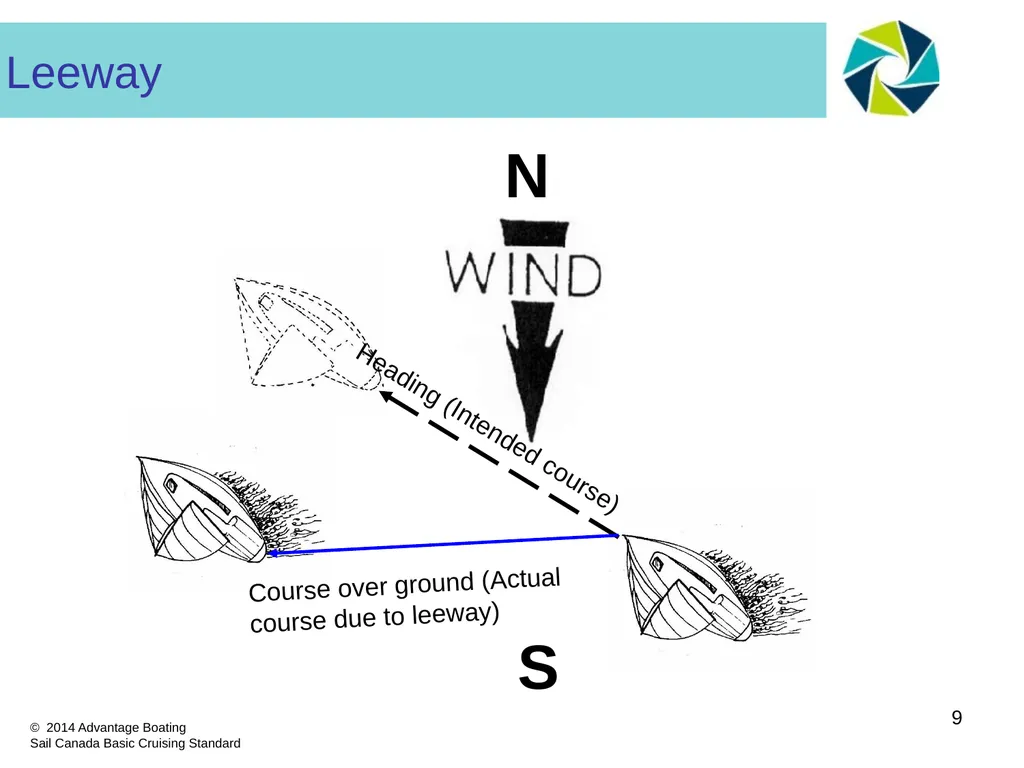
slide8. Leeway 8 When the wind applies force to the sails or the hull of the vessel there is a sideways force which over time causes the vessel to move sideways. This is referred to as leeway. © 2014 Advantage Boating
Sail Canada Basic Cruising Standard<br>
slide9. Leeway 9 N S Heading (Intended course) Course over ground (Actual course due to leeway) © 2014 Advantage Boating
Sail Canada Basic Cruising Standard<br>
slide10. Lee shore 10 Prudent sailors are constantly aware of a lee shore.
A lee shore is the shore leeward of the vessel and dangerous due to leeway
IMPORTANT!
A “lee shore” can be another boat, dock, or large buoy, not necessarily just land.
Being blown into a large steel buoy in a shipping channel or into the path of a large commercial vessel is as disastrous as being blown onto shore or a shoal. © 2014 Advantage Boating
Sail Canada Basic Cruising Standard<br>
slide11. Leeway and lee shore: key points! 11 If you are underway making leeway, going towards an island on the leeward side of the boat, this poses a very real danger of shipwreck.
As you get closer to land, large waves are often breaking which also push the boat (in concert with the leeway) onto the lee shore.
Going more slowly through the water will increase the amount of leeway your vessel will make. © 2014 Advantage Boating
Sail Canada Basic Cruising Standard<br>
slide12. Lee shore / leeway dangers 12 Danger of Shipwreck © 2014 Advantage Boating
Sail Canada Basic Cruising Standard<br>
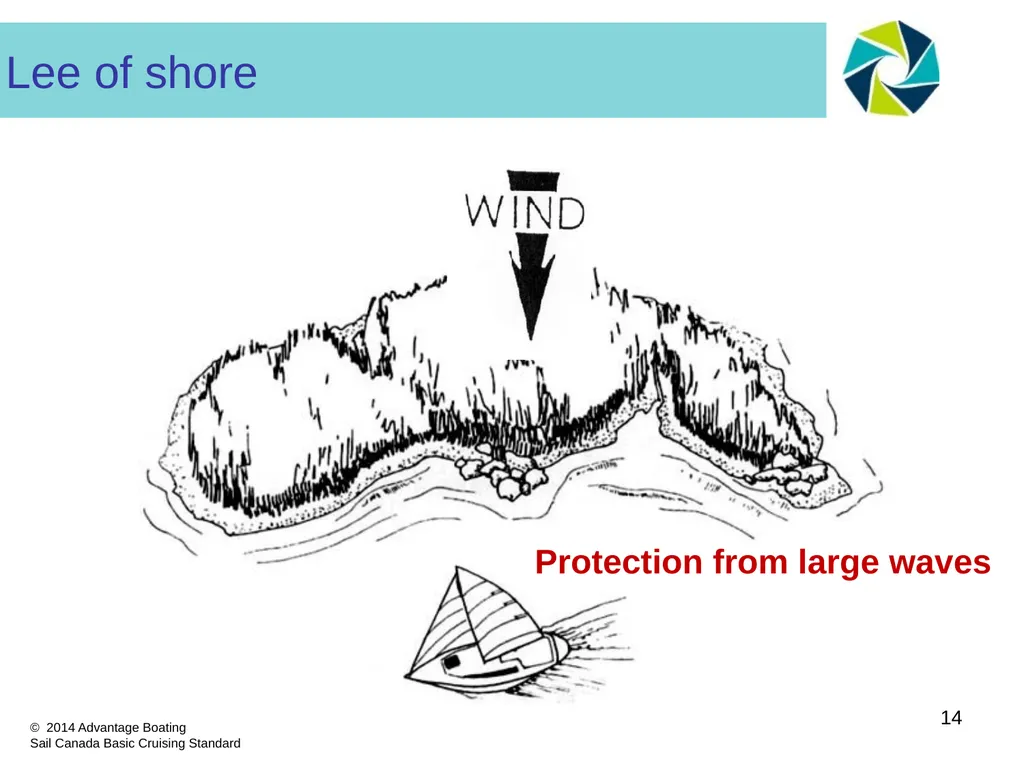
slide13. Lee of shore (weather shore) 13 This is the opposite of “lee shore.” When the vessel is in the lee of shore which affords protection from large waves. See illustration on the next slide.
Sometimes when you are in the lee of shore the wind is less as well - although it can come around or over the land and from a different direction.
Sometimes ‘in the lee of shore’ is referred to as the “weather shore”. © 2014 Advantage Boating
Sail Canada Basic Cruising Standard<br>
slide14. Lee of shore 14 Protection from large waves © 2014 Advantage Boating
Sail Canada Basic Cruising Standard<br>
slide15. Directional terminology 15 Now let’s talk about changing direction of the vessel in relationship to the wind!
If you turn the boat towards the direction the wind is blowing from (into the wind) you are “heading up”
If you turn the bow of the boat away from the direction the wind is from, you are “bearing off”
If you are “heading up” as much as possible and can still sail (make way), you are “close-hauled” © 2014 Advantage Boating
Sail Canada Basic Cruising Standard<br>
slide16. Heading up and bearing away 16 Heading Up
Boat turns closer to the wind Bearing Away
Boat turns away from the wind © 2014 Advantage Boating
Sail Canada Basic Cruising Standard<br>
slide17. In this lesson you learned about the wind and its relationship to the boat.
You developed an understanding of the language used to describe the wind and its impact on the boat and the sails.
You know the dangers of a lee shore.
You learned directional terminology. Lesson Summary 17 © 2014 Advantage Boating
Sail Canada Basic Cruising Standard<br>
slide18. Let’s practice our knowledge learned in this lesson! 18 Complete the following quiz to test your knowledge of wind relationships. © 2014 Advantage Boating
Sail Canada Basic Cruising Standard<br>
slide19. Quiz Define “heading up”
What are the dangers of the boat being lee shore?
Fill in the blanks: “Wind direction is always stated in the direction from which it originates. For example, when the wind is blowing _____ the north, it is called a ______ wind.
What is the term for the following condition? “When the wind applies force to the sails or the hull of the vessel there is a sideways force which causes the vessel to move sideways.” 19 © 2014 Advantage Boating
Sail Canada Basic Cruising Standard<br>
slide2. Lesson Outline 2 © 2014 Advantage Boating
Sail Canada Basic Cruising Standard Lesson Objectives
Introduction
Basic wind relationships terminology
Summary
Quiz<br>
slide3. Lesson Objectives 3 By the end of this lesson you will be able to identify and name certain wind conditions with respect to the winds relationship to the boat.
Knowing how to describe the wind and its impact on the boat and the sails is critical to being able to sail effectively and safely.
The terminology presented in this lesson will be referred to throughout the program and on the water. © 2014 Advantage Boating
Sail Canada Basic Cruising Standard<br>
slide4. Introduction Since you’ve mastered the basic terminology of sailing, let’s begin our exploration of the vessel’s relationship with the wind.
In order to learn how to sail well, it is important to have an understanding of the wind, speed, direction and the effect it has on the sails.
In this lesson, you will learn key terms relating to basic wind relationships.
So let’s begin! 4 © 2014 Advantage Boating
Sail Canada Basic Cruising Standard<br>
slide5. Introduction to wind/boat relationships 5 To get started, let’s consider positions on and off the boat relative to the direction the wind is coming from.
Important: Wind direction is always stated in the direction from which it originates. For example, when the wind is blowing from the north, it is called a north wind. © 2014 Advantage Boating
Sail Canada Basic Cruising Standard<br>
slide6. Introduction to wind/boat relationships 6 Windward Leeward Direction wind comes FROM © 2014 Advantage Boating
Sail Canada Basic Cruising Standard<br>
slide7. Introduction to wind/boat relationships 7 Typically sailors refer to
Windward or also upwind or to weather
Leeward (pronounced Lew-ward) or downwind or lee
On the boat, windward is the side closest to the wind and leeward is the side away from the direction from which the wind is blowing.
These terms are used as reference points when sailing. So one might point out that there is an island to windward or direct someone on the boat to the leeward winch. © 2014 Advantage Boating
Sail Canada Basic Cruising Standard<br>
slide8. Leeway 8 When the wind applies force to the sails or the hull of the vessel there is a sideways force which over time causes the vessel to move sideways. This is referred to as leeway. © 2014 Advantage Boating
Sail Canada Basic Cruising Standard<br>
slide9. Leeway 9 N S Heading (Intended course) Course over ground (Actual course due to leeway) © 2014 Advantage Boating
Sail Canada Basic Cruising Standard<br>
slide10. Lee shore 10 Prudent sailors are constantly aware of a lee shore.
A lee shore is the shore leeward of the vessel and dangerous due to leeway
IMPORTANT!
A “lee shore” can be another boat, dock, or large buoy, not necessarily just land.
Being blown into a large steel buoy in a shipping channel or into the path of a large commercial vessel is as disastrous as being blown onto shore or a shoal. © 2014 Advantage Boating
Sail Canada Basic Cruising Standard<br>
slide11. Leeway and lee shore: key points! 11 If you are underway making leeway, going towards an island on the leeward side of the boat, this poses a very real danger of shipwreck.
As you get closer to land, large waves are often breaking which also push the boat (in concert with the leeway) onto the lee shore.
Going more slowly through the water will increase the amount of leeway your vessel will make. © 2014 Advantage Boating
Sail Canada Basic Cruising Standard<br>
slide12. Lee shore / leeway dangers 12 Danger of Shipwreck © 2014 Advantage Boating
Sail Canada Basic Cruising Standard<br>
slide13. Lee of shore (weather shore) 13 This is the opposite of “lee shore.” When the vessel is in the lee of shore which affords protection from large waves. See illustration on the next slide.
Sometimes when you are in the lee of shore the wind is less as well - although it can come around or over the land and from a different direction.
Sometimes ‘in the lee of shore’ is referred to as the “weather shore”. © 2014 Advantage Boating
Sail Canada Basic Cruising Standard<br>
slide14. Lee of shore 14 Protection from large waves © 2014 Advantage Boating
Sail Canada Basic Cruising Standard<br>
slide15. Directional terminology 15 Now let’s talk about changing direction of the vessel in relationship to the wind!
If you turn the boat towards the direction the wind is blowing from (into the wind) you are “heading up”
If you turn the bow of the boat away from the direction the wind is from, you are “bearing off”
If you are “heading up” as much as possible and can still sail (make way), you are “close-hauled” © 2014 Advantage Boating
Sail Canada Basic Cruising Standard<br>
slide16. Heading up and bearing away 16 Heading Up
Boat turns closer to the wind Bearing Away
Boat turns away from the wind © 2014 Advantage Boating
Sail Canada Basic Cruising Standard<br>
slide17. In this lesson you learned about the wind and its relationship to the boat.
You developed an understanding of the language used to describe the wind and its impact on the boat and the sails.
You know the dangers of a lee shore.
You learned directional terminology. Lesson Summary 17 © 2014 Advantage Boating
Sail Canada Basic Cruising Standard<br>
slide18. Let’s practice our knowledge learned in this lesson! 18 Complete the following quiz to test your knowledge of wind relationships. © 2014 Advantage Boating
Sail Canada Basic Cruising Standard<br>
slide19. Quiz Define “heading up”
What are the dangers of the boat being lee shore?
Fill in the blanks: “Wind direction is always stated in the direction from which it originates. For example, when the wind is blowing _____ the north, it is called a ______ wind.
What is the term for the following condition? “When the wind applies force to the sails or the hull of the vessel there is a sideways force which causes the vessel to move sideways.” 19 © 2014 Advantage Boating
Sail Canada Basic Cruising Standard<br>