Sediment Transport Flowing water transports
Description: Sediment Transport Flowing water transports sediment as: Bedload particles roll, slide, or bounce along bottom Suspended load particles carried above bottom by fluid turbulence and grain collisions (dispersive pressure) What is the
Related Topics
Download Presentation
"Sediment Transport Flowing water transports" is the property of its rightful owner. Permission is granted to download and print the materials on this website for personal, non-commercial use only, and to display it on your personal computer provided you do not modify the materials and that you retain all copyright notices contained in the materials. By downloading content from our website, you accept the terms of this agreement.
Presentation Transcript
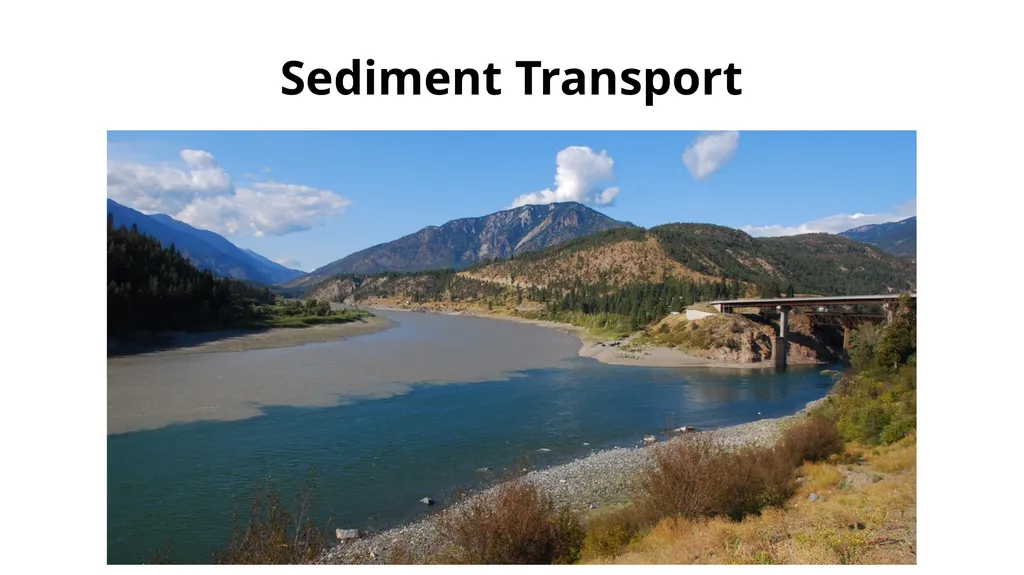
slide1. Sediment Transport<br>
slide2. Flowing water transports sediment as:
Bedload – particles roll, slide, or bounce along bottom
Suspended load – particles carried above bottom by fluid turbulence and grain collisions (“dispersive pressure”)<br>
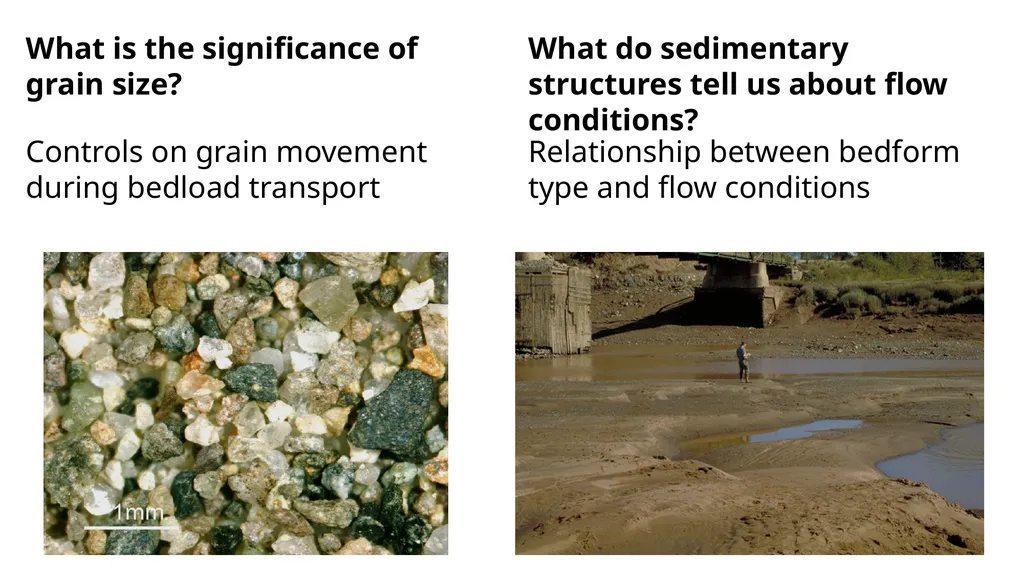
slide3. What is the significance of grain size? What do sedimentary structures tell us about flow conditions? Controls on grain movement during bedload transport Relationship between bedform type and flow conditions<br>
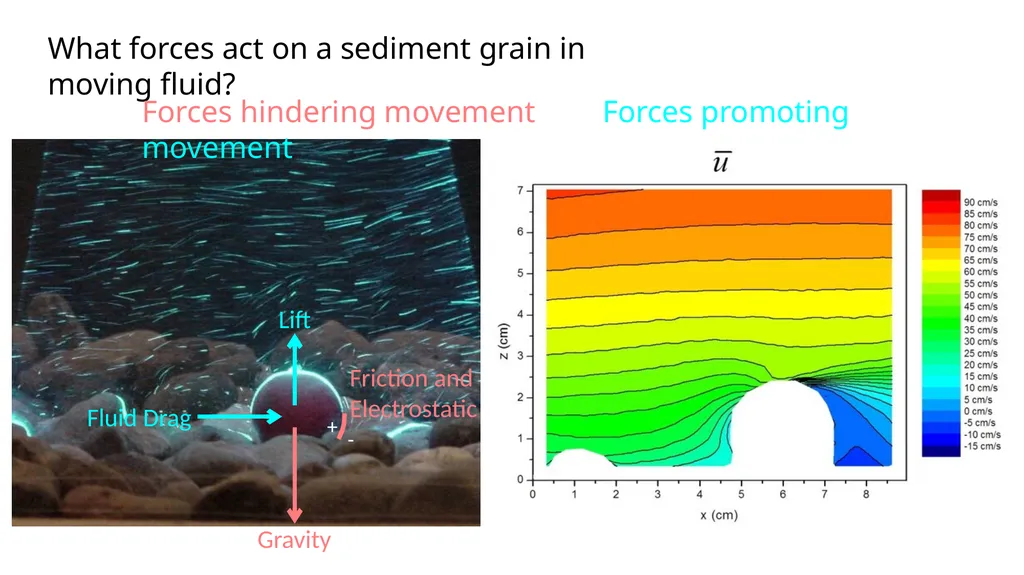
slide4. What forces act on a sediment grain in moving fluid? Gravity Forces hindering movement Forces promoting movement Fluid Drag Lift Friction and Electrostatic + -<br>
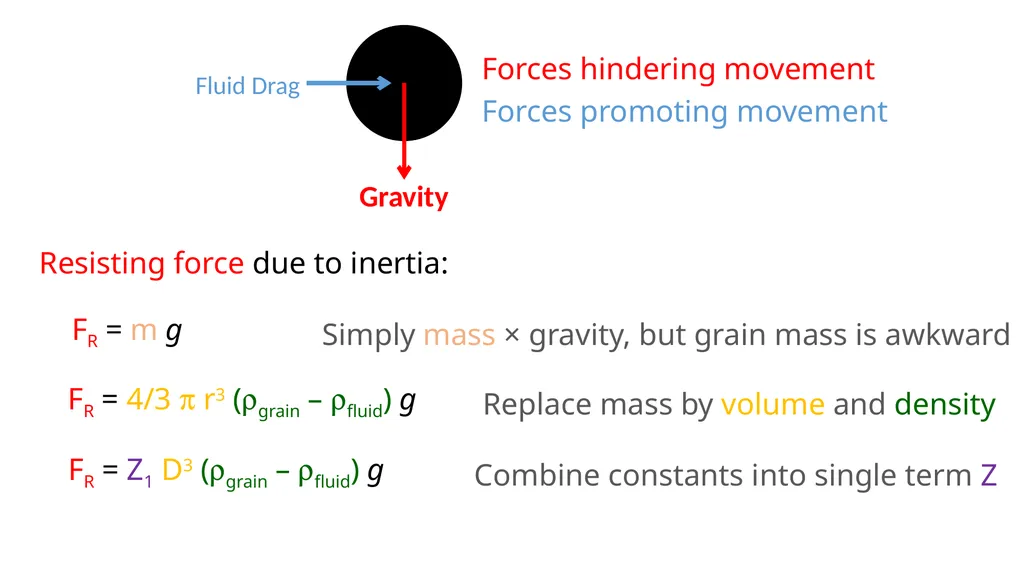
slide5. Gravity Forces hindering movement
Forces promoting movement Fluid Drag FR = m g Resisting force due to inertia: Simply mass × gravity, but grain mass is awkward FR = 4/3 p r3 (rgrain – rfluid) g Replace mass by volume and density FR = Z1 D3 (rgrain – rfluid) g Combine constants into single term Z<br>
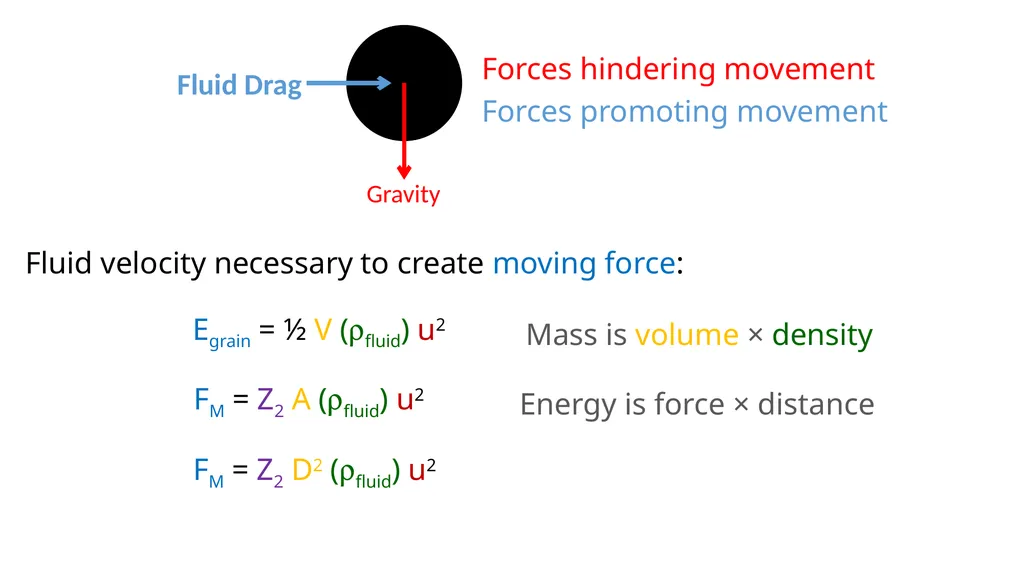
slide6. Egrain = ½ V (rfluid) u2 Mass is volume × density FM = Z2 A (rfluid) u2 Energy is force × distance FM = Z2 D2 (rfluid) u2 Gravity Forces hindering movement
Forces promoting movement Fluid Drag Fluid velocity necessary to create moving force:<br>
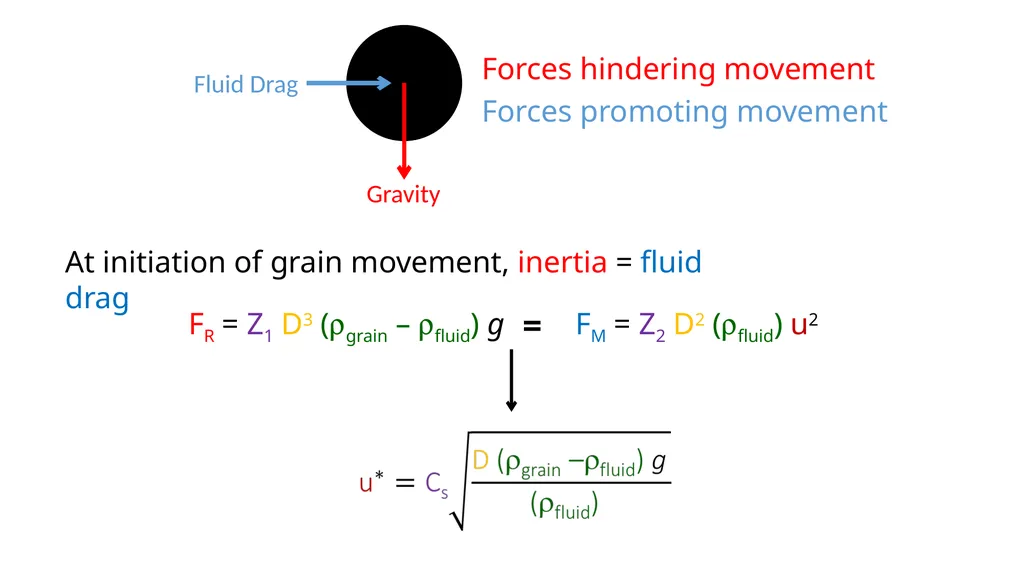
slide7. At initiation of grain movement, inertia = fluid drag FM = Z2 D2 (rfluid) u2 FR = Z1 D3 (rgrain – rfluid) g Gravity Forces hindering movement
Forces promoting movement Fluid Drag =<br>
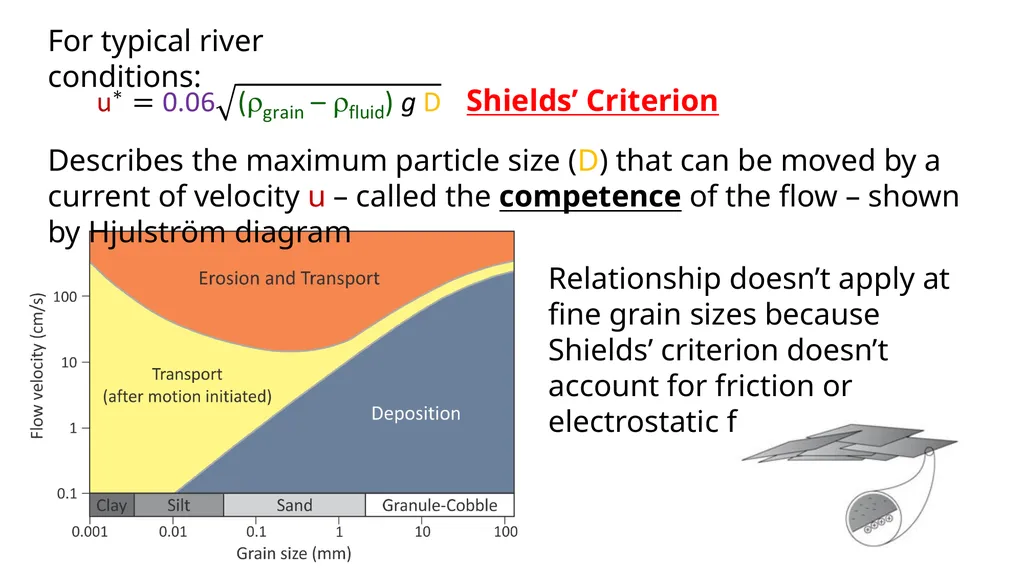
slide8. Relationship doesn’t apply at fine grain sizes because Shields’ criterion doesn’t account for friction or electrostatic forces Shields’ Criterion Describes the maximum particle size (D) that can be moved by a current of velocity u – called the competence of the flow – shown by Hjulström diagram For typical river conditions:<br>
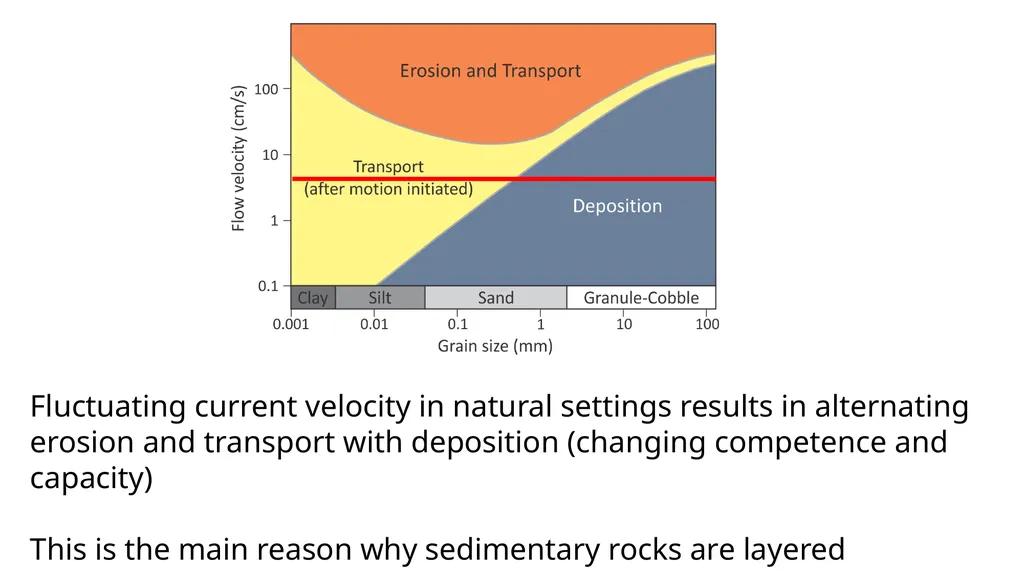
slide9. Fluctuating current velocity in natural settings results in alternating erosion and transport with deposition (changing competence and capacity)
This is the main reason why sedimentary rocks are layered<br>
slide2. Flowing water transports sediment as:
Bedload – particles roll, slide, or bounce along bottom
Suspended load – particles carried above bottom by fluid turbulence and grain collisions (“dispersive pressure”)<br>
slide3. What is the significance of grain size? What do sedimentary structures tell us about flow conditions? Controls on grain movement during bedload transport Relationship between bedform type and flow conditions<br>
slide4. What forces act on a sediment grain in moving fluid? Gravity Forces hindering movement Forces promoting movement Fluid Drag Lift Friction and Electrostatic + -<br>
slide5. Gravity Forces hindering movement
Forces promoting movement Fluid Drag FR = m g Resisting force due to inertia: Simply mass × gravity, but grain mass is awkward FR = 4/3 p r3 (rgrain – rfluid) g Replace mass by volume and density FR = Z1 D3 (rgrain – rfluid) g Combine constants into single term Z<br>
slide6. Egrain = ½ V (rfluid) u2 Mass is volume × density FM = Z2 A (rfluid) u2 Energy is force × distance FM = Z2 D2 (rfluid) u2 Gravity Forces hindering movement
Forces promoting movement Fluid Drag Fluid velocity necessary to create moving force:<br>
slide7. At initiation of grain movement, inertia = fluid drag FM = Z2 D2 (rfluid) u2 FR = Z1 D3 (rgrain – rfluid) g Gravity Forces hindering movement
Forces promoting movement Fluid Drag =<br>
slide8. Relationship doesn’t apply at fine grain sizes because Shields’ criterion doesn’t account for friction or electrostatic forces Shields’ Criterion Describes the maximum particle size (D) that can be moved by a current of velocity u – called the competence of the flow – shown by Hjulström diagram For typical river conditions:<br>
slide9. Fluctuating current velocity in natural settings results in alternating erosion and transport with deposition (changing competence and capacity)
This is the main reason why sedimentary rocks are layered<br>