
sefa’s Corporate Plan and APPs: (2021/22 –






Description: sefas Corporate Plan and APPs: (202122 202526) Portfolio Committee on Small Business Development 5 May 2021 Contents Strategic Overview Strategic Initiatives and Customer Value Proposition sefa-Seda Collaboration Corporate Plan
Related Topics
Download Presentation
"sefa’s Corporate Plan and APPs: (2021/22 –" is the property of its rightful owner. Permission is granted to download and print the materials on this website for personal, non-commercial use only, and to display it on your personal computer provided you do not modify the materials and that you retain all copyright notices contained in the materials. By downloading content from our website, you accept the terms of this agreement.
Presentation Transcript
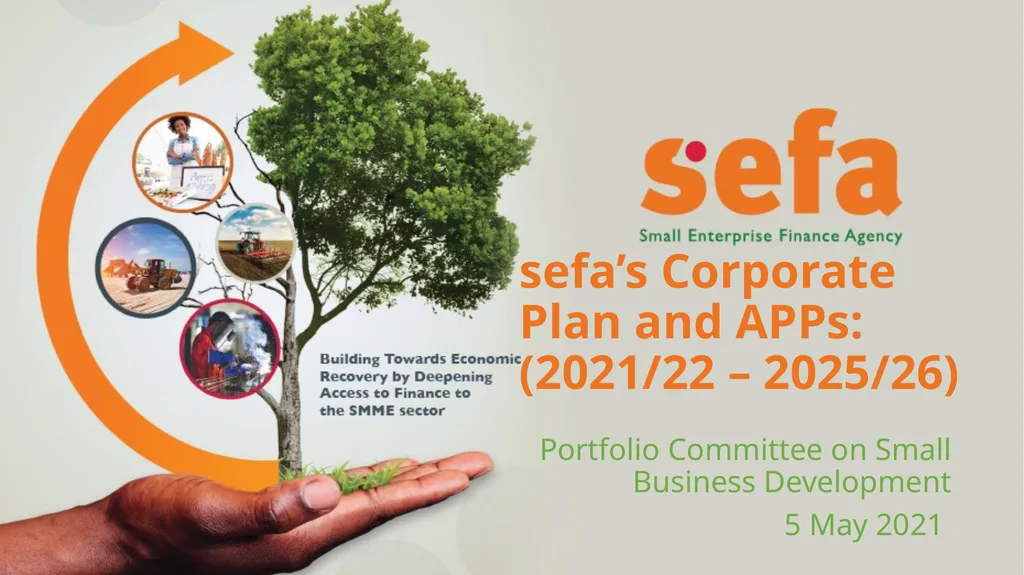
slide1. sefa’s Corporate Plan and APPs:
(2021/22 – 2025/26) Portfolio Committee on Small Business Development
5 May 2021<br>
slide2. Contents Strategic Overview
Strategic Initiatives and Customer Value Proposition
sefa-Seda Collaboration
Corporate Plan Programmes
Performance Against Pre-determined Objectives
Key Organisational Risks
Financial Projections 2<br>
slide3. Strategic Overview 3<br>
slide4. 4 Introduction sefa was incorporated on 1 April 2012 under Section 3(d) of the Industrial Development Act as a development finance institution with a mandate to provide financial support to SMMEs and Co-operatives.
sefa targets high-risk market segments that are not traditionally served by the commercial banking sector.
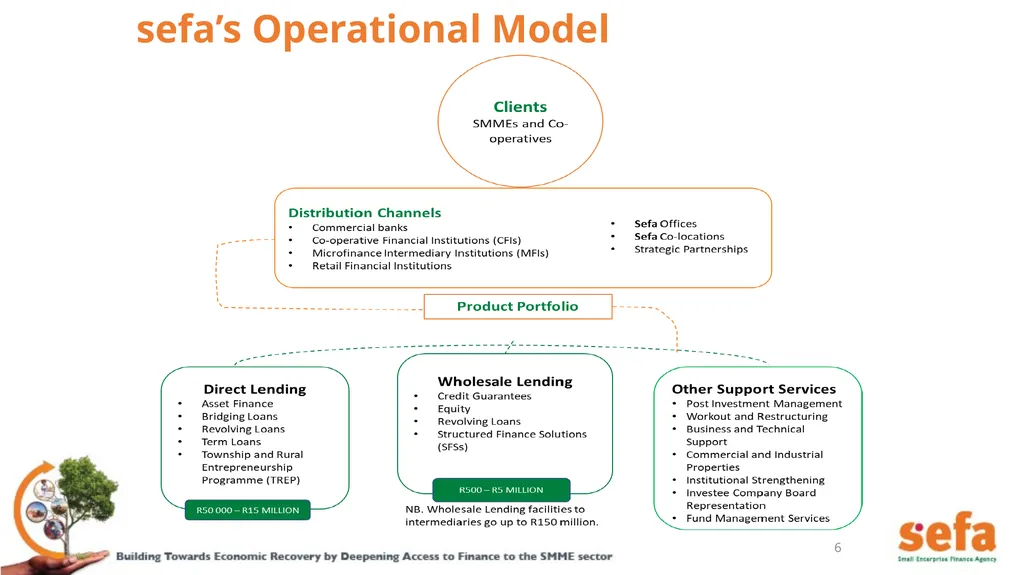
sefa’s operational model has been designed to address this market failure by providing finance directly to its target market through its regional branch network as well as indirectly through wholesale finance and credit guarantee products.
The 2021/22 Corporate Plan assumes a strategic posture that seeks to strike a balance between the delivery of its mandate, the pressing need to be financially sustainable and be responsive to:
the changes in the economic environment (COVID-19 and the sovereign credit downgrade),
priorities identified in the Medium Term Strategic Framework (2020 - 2024) of the sixth administration.
The development of the Corporate Plan and APP was a consultative process comprising of:
sefa EXCO (the assessment of the operating environment in identifying the organisational priorities)
Board Strategy Session (engagement on EXCO’s Strategy Proposals and high level performance scorecard)
Comment and inputs on the 1st draft Corporate Plan/APPs from EXCO and HoDs
Engagement with DSBD on their inputs on the draft Corporate Plan / APPs.<br>
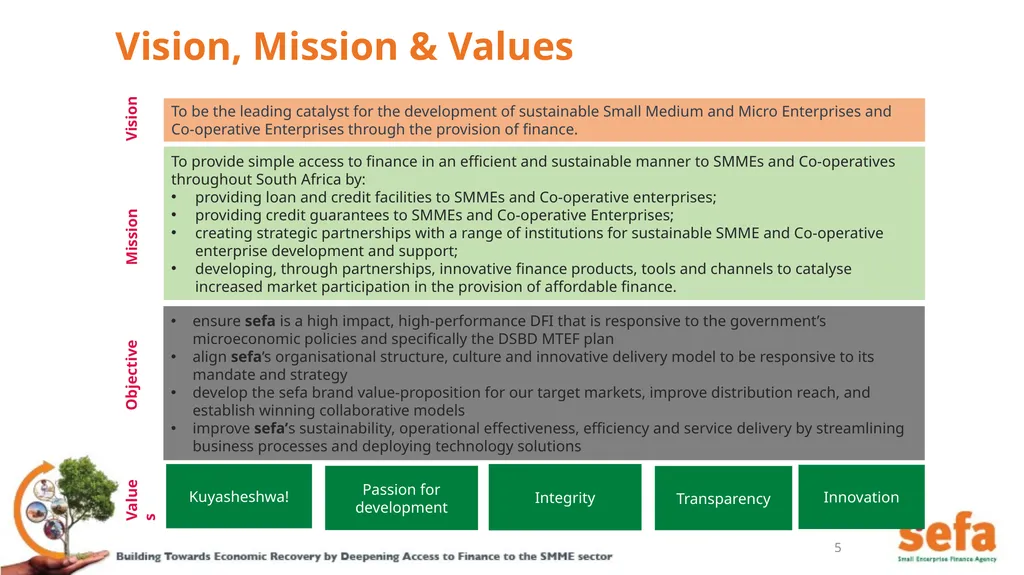
slide5. Vision, Mission & Values Values Vision To be the leading catalyst for the development of sustainable Small Medium and Micro Enterprises and Co-operative Enterprises through the provision of finance. Mission To provide simple access to finance in an efficient and sustainable manner to SMMEs and Co-operatives throughout South Africa by:
providing loan and credit facilities to SMMEs and Co-operative enterprises;
providing credit guarantees to SMMEs and Co-operative Enterprises;
creating strategic partnerships with a range of institutions for sustainable SMME and Co-operative enterprise development and support;
developing, through partnerships, innovative finance products, tools and channels to catalyse increased market participation in the provision of affordable finance. Objective ensure sefa is a high impact, high-performance DFI that is responsive to the government’s microeconomic policies and specifically the DSBD MTEF plan
align sefa’s organisational structure, culture and innovative delivery model to be responsive to its mandate and strategy
develop the sefa brand value-proposition for our target markets, improve distribution reach, and establish winning collaborative models
improve sefa’s sustainability, operational effectiveness, efficiency and service delivery by streamlining business processes and deploying technology solutions Kuyasheshwa! Passion for development Integrity Transparency Innovation 5<br>
slide6. 6 sefa’s Operational Model<br>
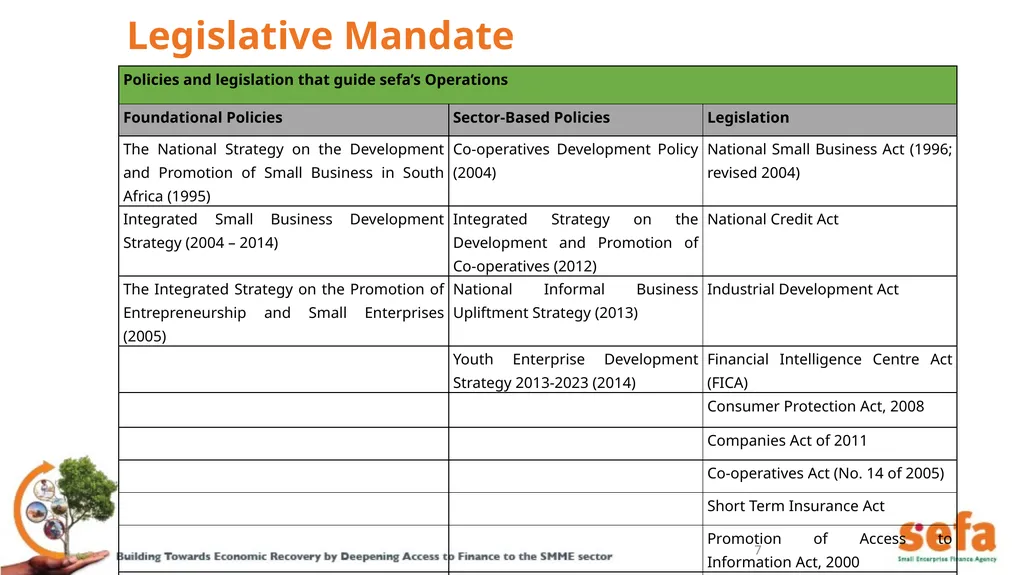
slide7. Legislative Mandate 7<br>
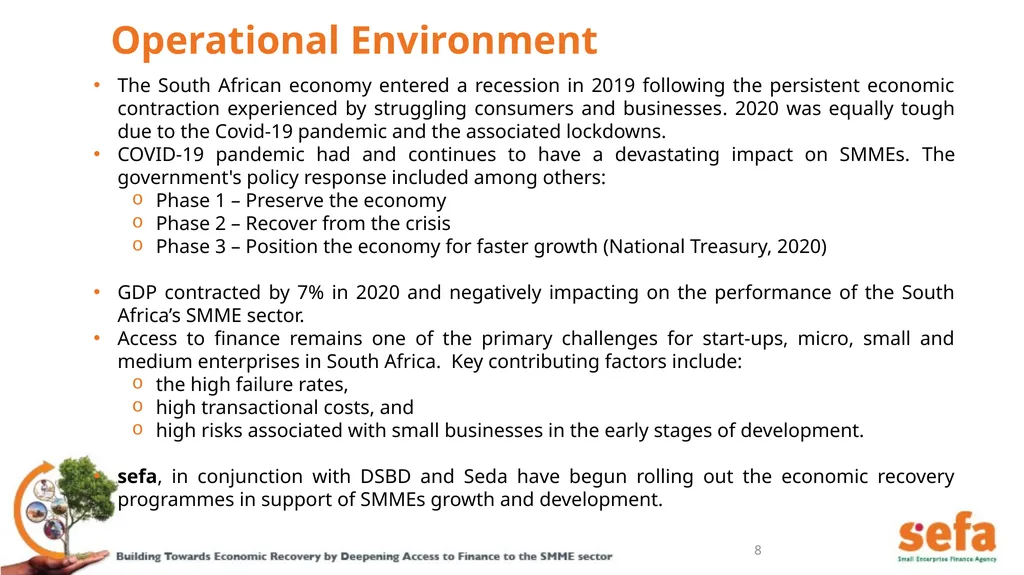
slide8. Operational Environment 8 The South African economy entered a recession in 2019 following the persistent economic contraction experienced by struggling consumers and businesses. 2020 was equally tough due to the Covid-19 pandemic and the associated lockdowns.
COVID-19 pandemic had and continues to have a devastating impact on SMMEs. The government's policy response included among others:
Phase 1 – Preserve the economy
Phase 2 – Recover from the crisis
Phase 3 – Position the economy for faster growth (National Treasury, 2020)
GDP contracted by 7% in 2020 and negatively impacting on the performance of the South Africa’s SMME sector.
Access to finance remains one of the primary challenges for start-ups, micro, small and medium enterprises in South Africa. Key contributing factors include:
the high failure rates,
high transactional costs, and
high risks associated with small businesses in the early stages of development.
sefa, in conjunction with DSBD and Seda have begun rolling out the economic recovery programmes in support of SMMEs growth and development.<br>
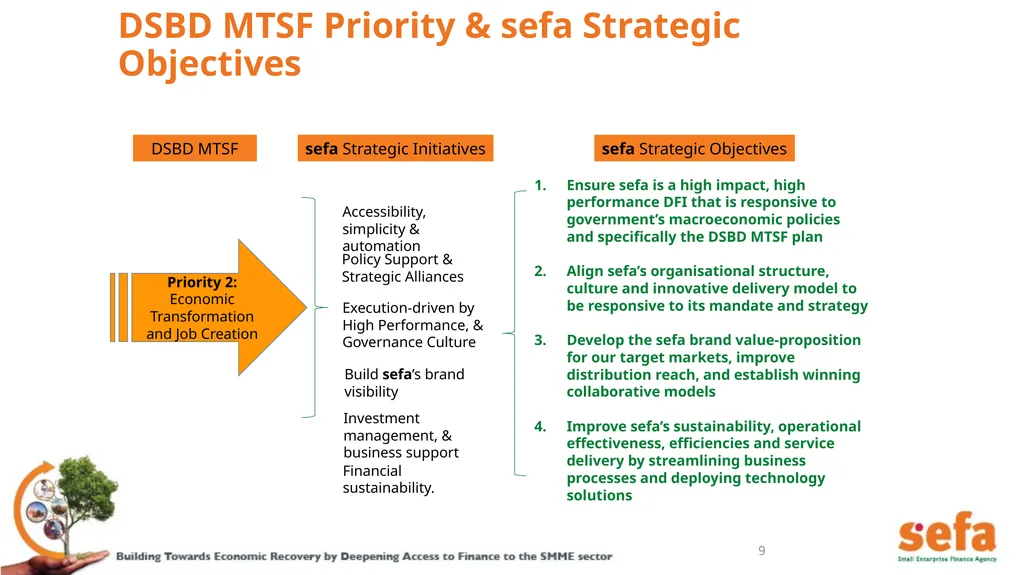
slide9. DSBD MTSF Priority & sefa Strategic Objectives 9 Priority 2:
Economic Transformation and Job Creation sefa Strategic Initiatives sefa Strategic Objectives Accessibility, simplicity & automation Ensure sefa is a high impact, high performance DFI that is responsive to government’s macroeconomic policies and specifically the DSBD MTSF plan
Align sefa’s organisational structure, culture and innovative delivery model to be responsive to its mandate and strategy
Develop the sefa brand value-proposition for our target markets, improve distribution reach, and establish winning collaborative models
Improve sefa’s sustainability, operational effectiveness, efficiencies and service delivery by streamlining business processes and deploying technology solutions DSBD MTSF Investment management, & business support Execution-driven by High Performance, & Governance Culture Policy Support & Strategic Alliances Build sefa’s brand visibility Financial sustainability.<br>
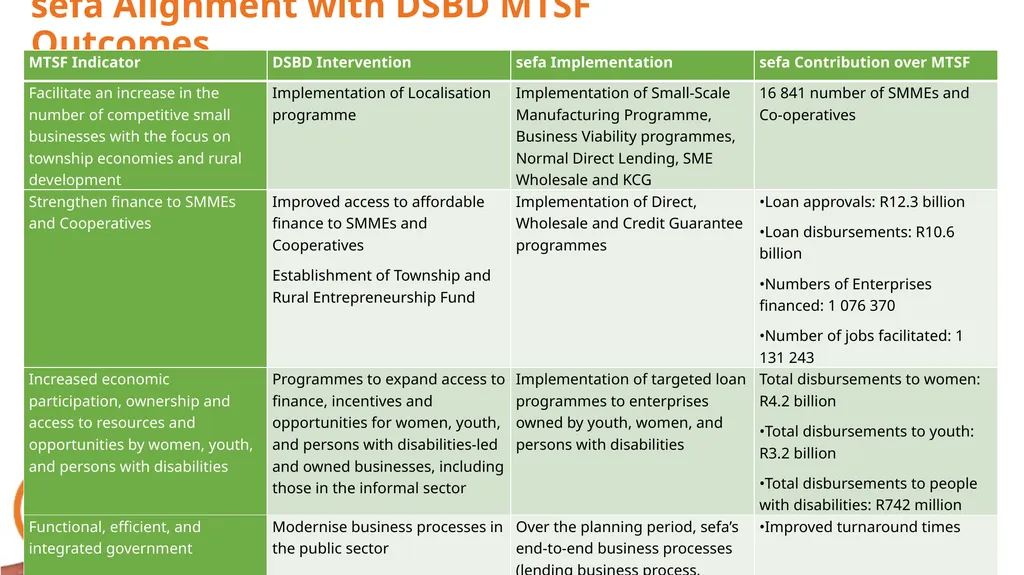
slide10. sefa Alignment with DSBD MTSF Outcomes 10<br>
slide11. Strategic Initiatives and Customer Value Proposition 11<br>
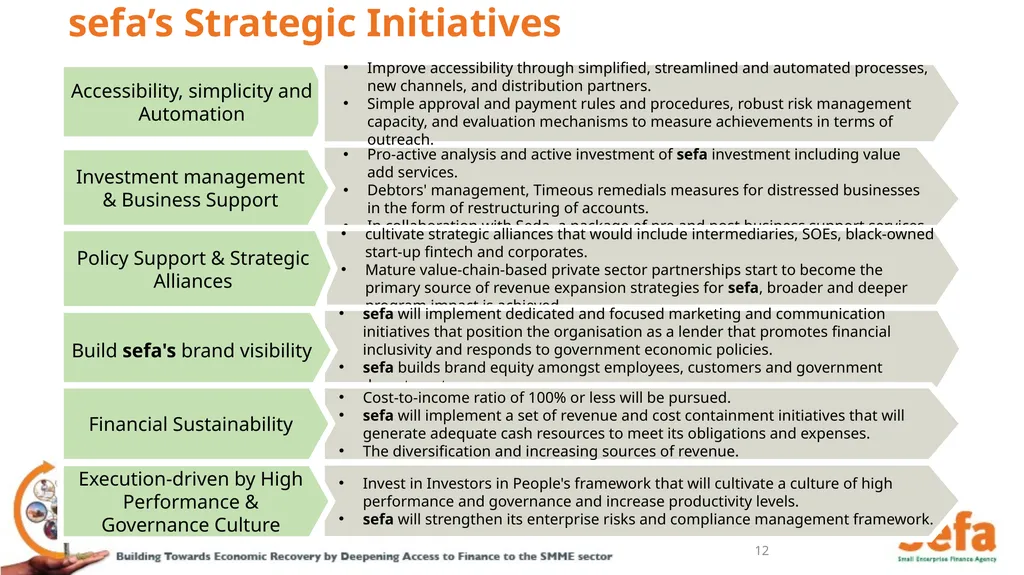
slide12. sefa’s Strategic Initiatives 12<br>
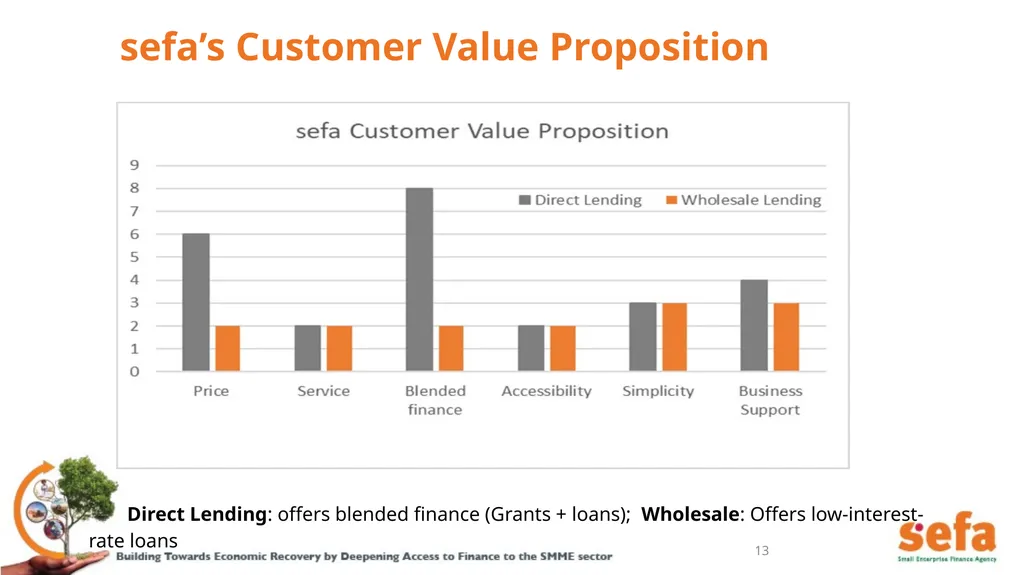
slide13. sefa’s Customer Value Proposition Direct Lending: offers blended finance (Grants + loans); Wholesale: Offers low-interest-rate loans 13<br>
slide14. sefa-Seda Collaboration 14<br>
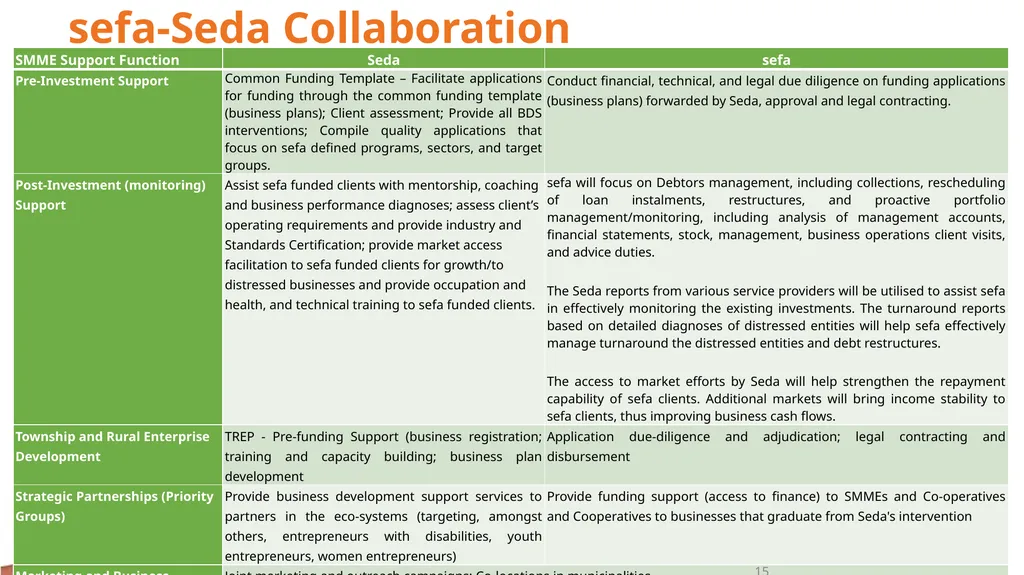
slide15. sefa-Seda Collaboration 15<br>
slide16. Corporate Plan Programmes 16<br>
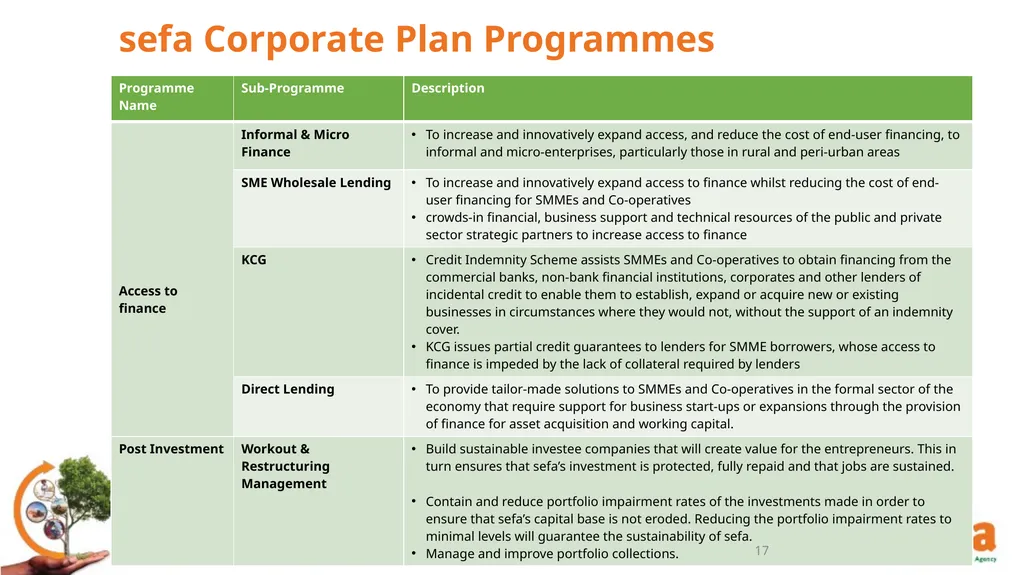
slide17. sefa Corporate Plan Programmes 17<br>
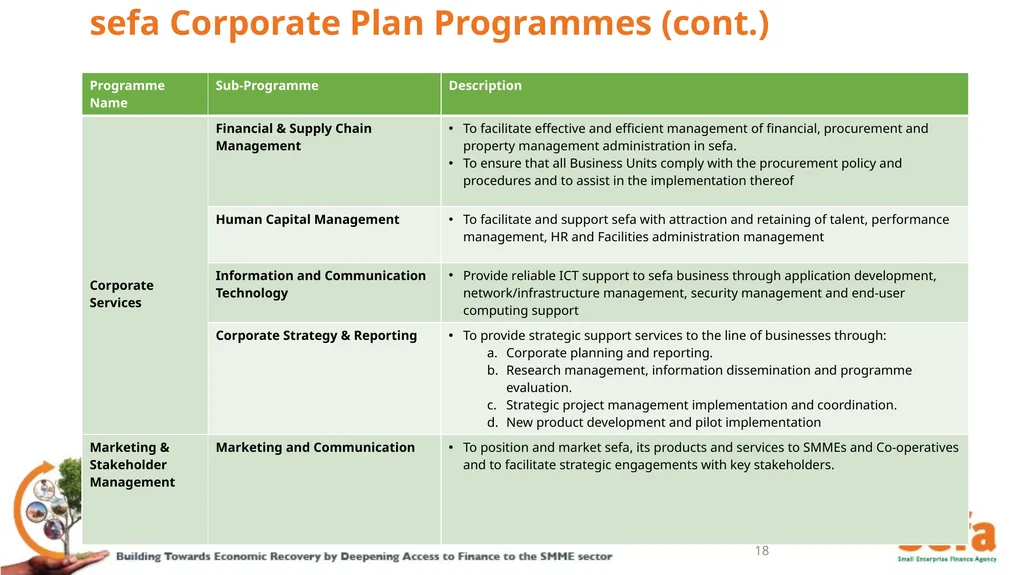
slide18. sefa Corporate Plan Programmes (cont.) 18<br>
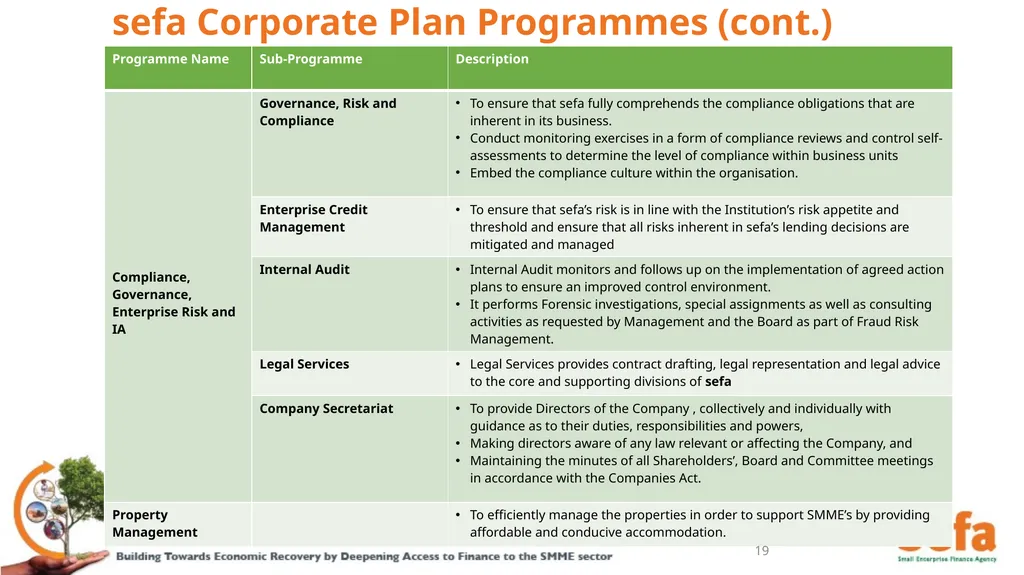
slide19. sefa Corporate Plan Programmes (cont.) 19<br>
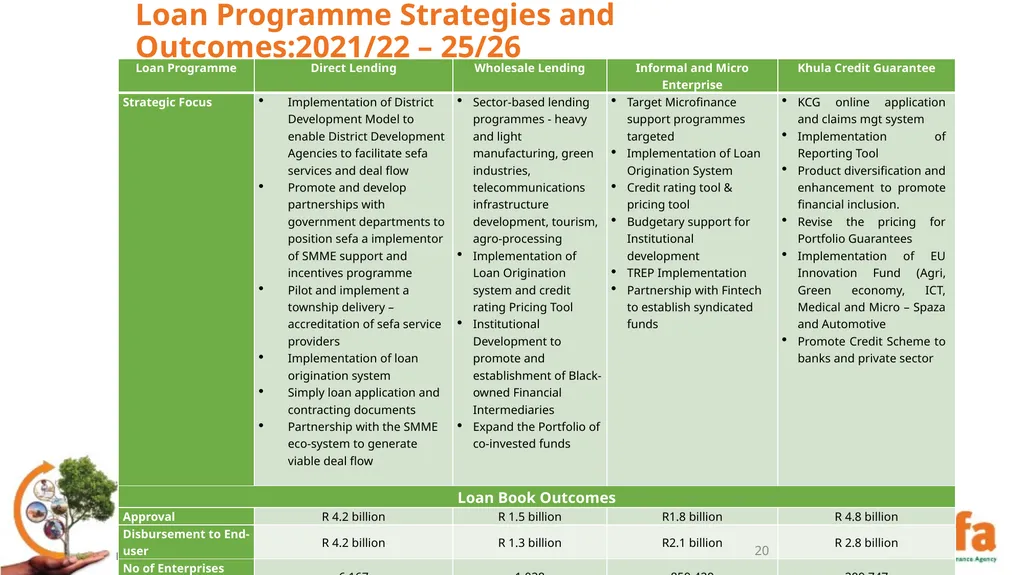
slide20. Loan Programme Strategies and Outcomes:2021/22 – 25/26 20<br>
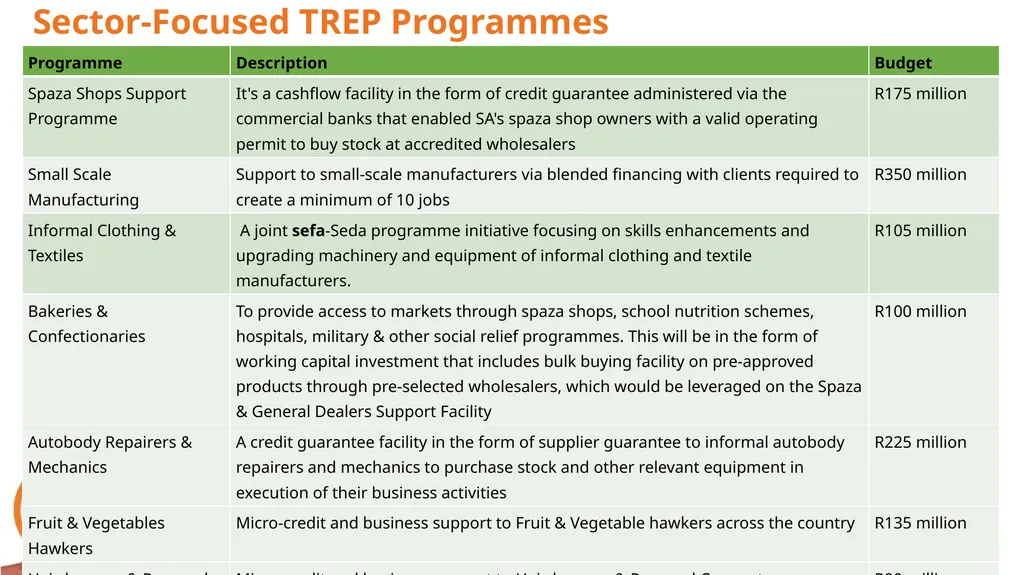
slide21. Sector-Focused TREP Programmes 21<br>
slide22. Performance Against Pre-determined Objectives 22<br>
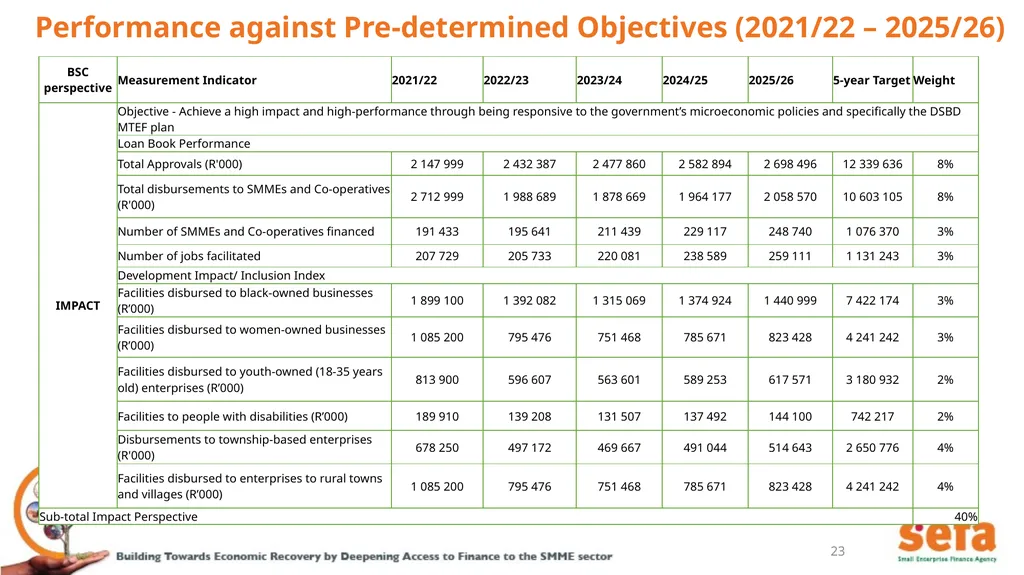
slide23. Performance against Pre-determined Objectives (2021/22 – 2025/26) 23<br>
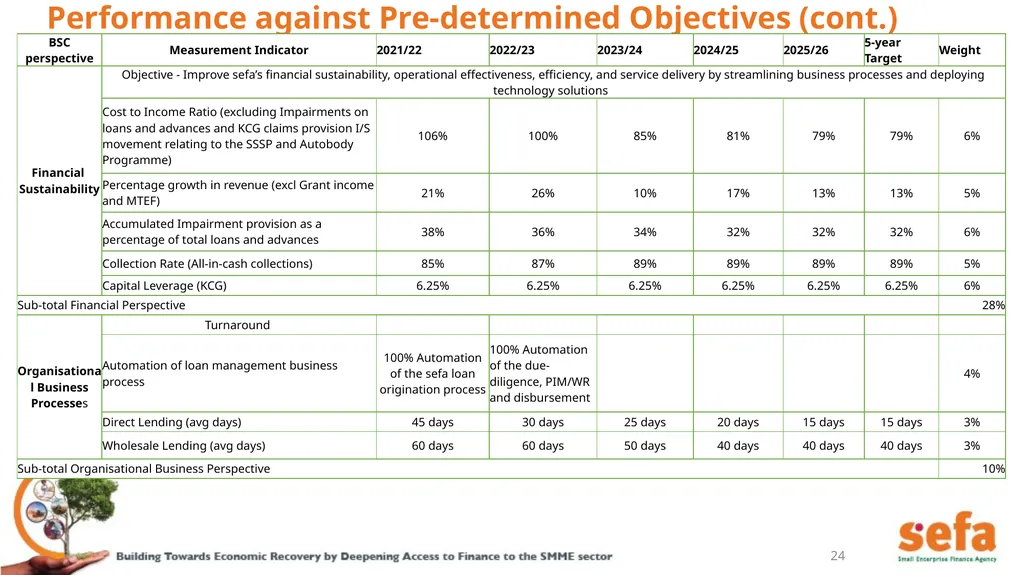
slide24. Performance against Pre-determined Objectives (cont.) 24<br>
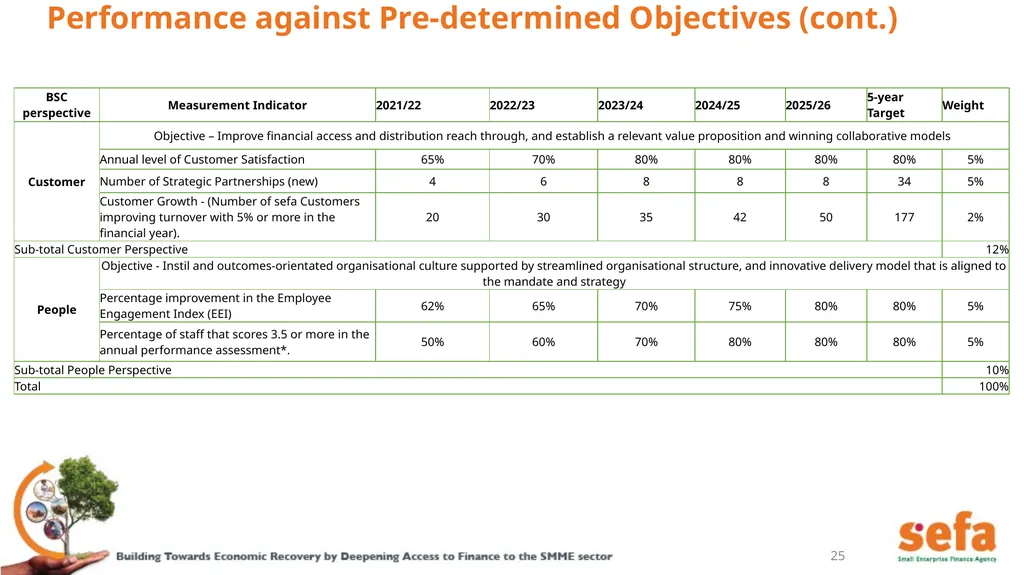
slide25. Performance against Pre-determined Objectives (cont.) 25<br>
slide26. Key Organisational Risks 26<br>
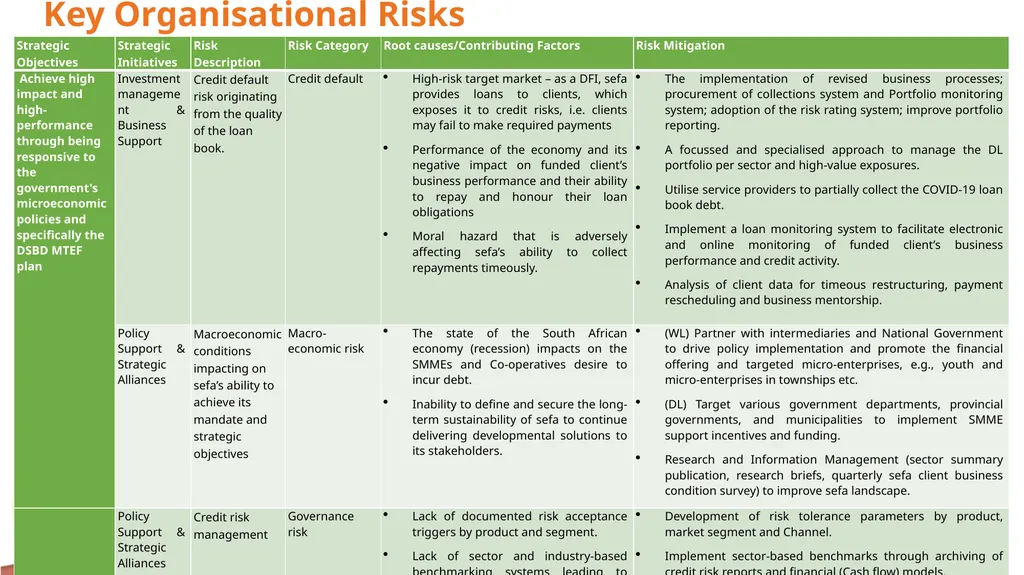
slide27. Key Organisational Risks 27<br>
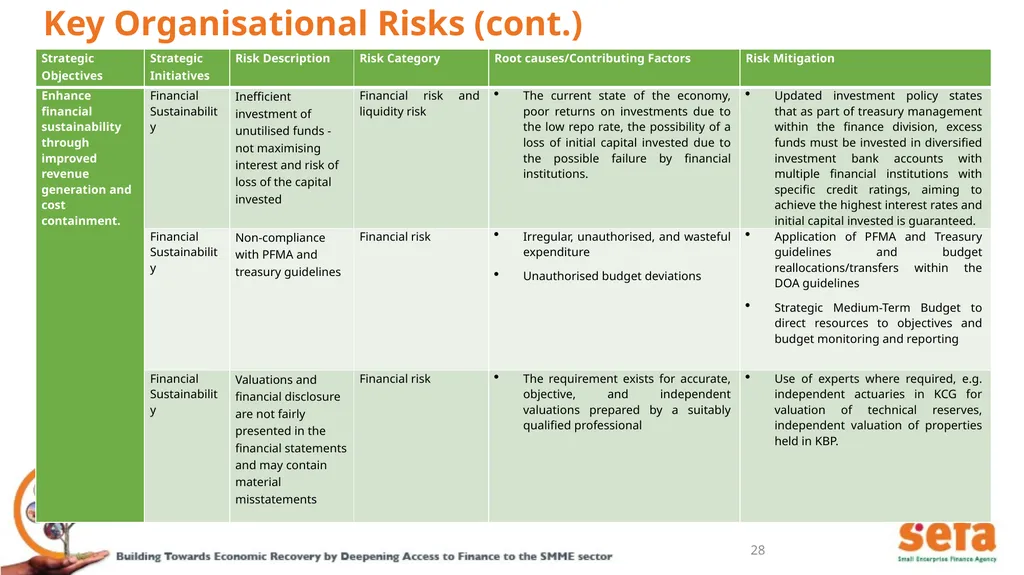
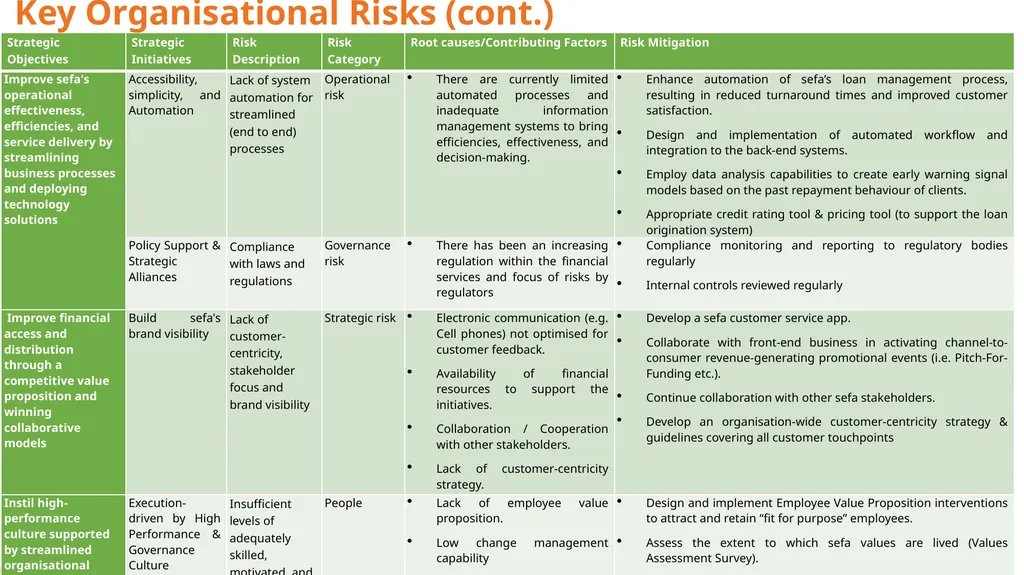
slide28. Key Organisational Risks (cont.) 28<br>
slide29. Key Organisational Risks (cont.) 29<br>
slide30. Financial Projections 30<br>
slide31. 2021 YTD 9 months ending December 2020 Financial Overview
2022 -2026 Preliminary Operating Budget & Plan 31<br>
slide32. Operating Budget Overview 2021 YTD 9 months ending December 2020 Financial Overview 32<br>
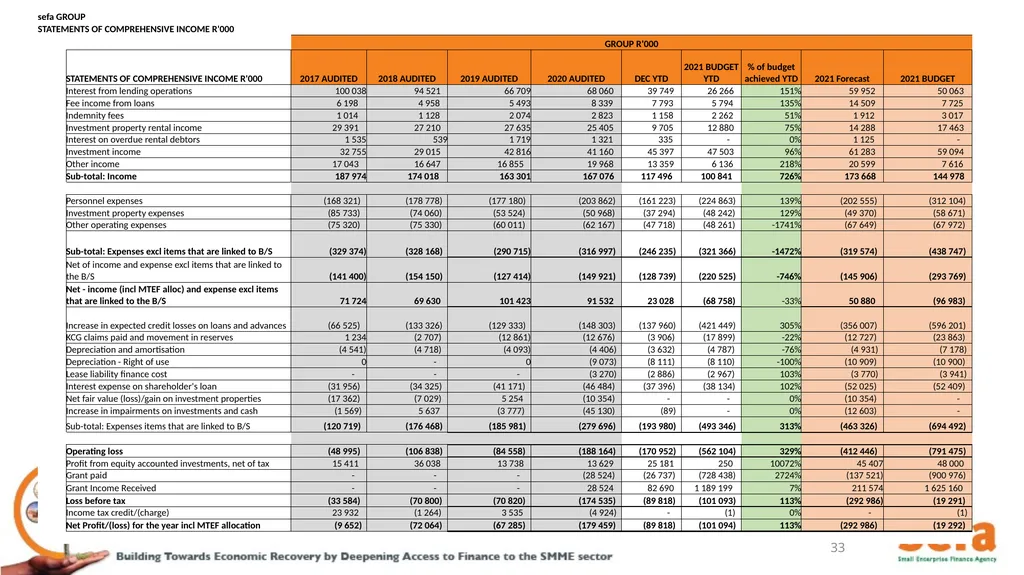
slide33. 33<br>
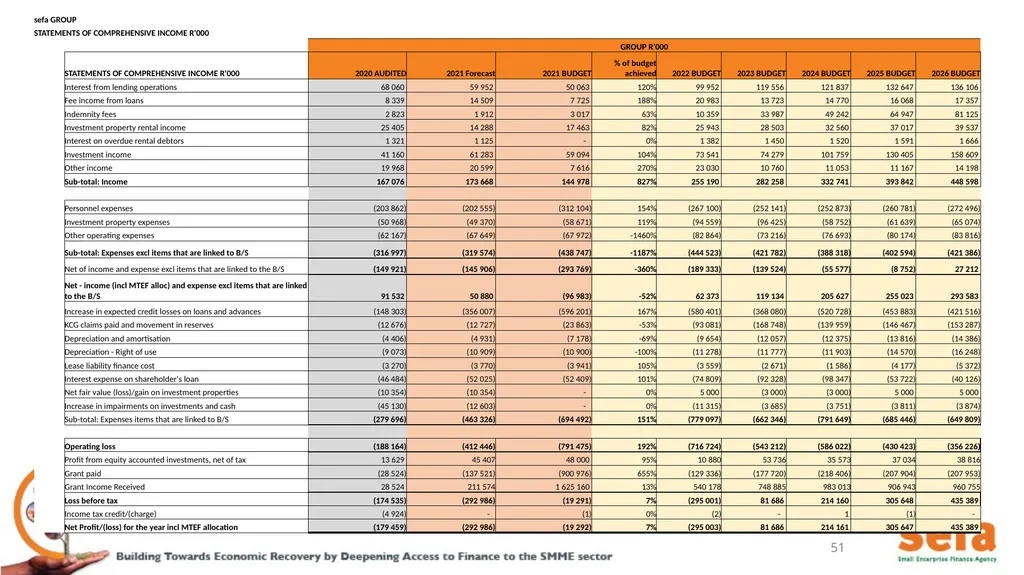
slide34. 2021 YTD 9 months ending December 2020 Financial Overview Commentary
Interest from lending operations:
Current year-to-date FY21, interest (R40m) (and R50m against budget) is lower than previous year (R68m) as a result of an interest moratorium that were applied in the first half of the current financial year.
2. Increase in expected credit losses on loans and advances:
Current impairment expenses (R138m) are lower than budgeted due to lower disbursements in the first half of the year than what was budgeted. [FY2020: R194m , FY2022: R589m]
3. Personnel Expenses:
During FY21 there has been a headcount freeze in place since Q2 and expect a R80.7m savings on forecasted YTD spend to budgeted spend.
Personnel expenses are lower in the current year-to-date (R161m) due to:
Lower salary increases implemented than originally budgeted (3% increase in actual),
vacancies not yet filled due to current head-count freeze
reversal of the incentive bonus accrual relating to FY20 (R18.3m).
However, Occupational health and safety costs increased significantly in FY21 (R1m increase from FY20). 34<br>
slide35. 2021 YTD 9 months ending December 2020 Financial Overview Commentary
4. Operating Expenses: Operating expenses are lower than budget due to savings in:
consulting fees(+R7.9m),
travel expenses (+R1.7m),
office re-location costs (+R0.6m),
repairs and maintenance (+R0.9m),
training expenses (+R2.3m) and lower technical reserves in KCG (+R14m). 35<br>
slide36. BUDGET PRINCIPLES & ASSUMPTIONS 36<br>
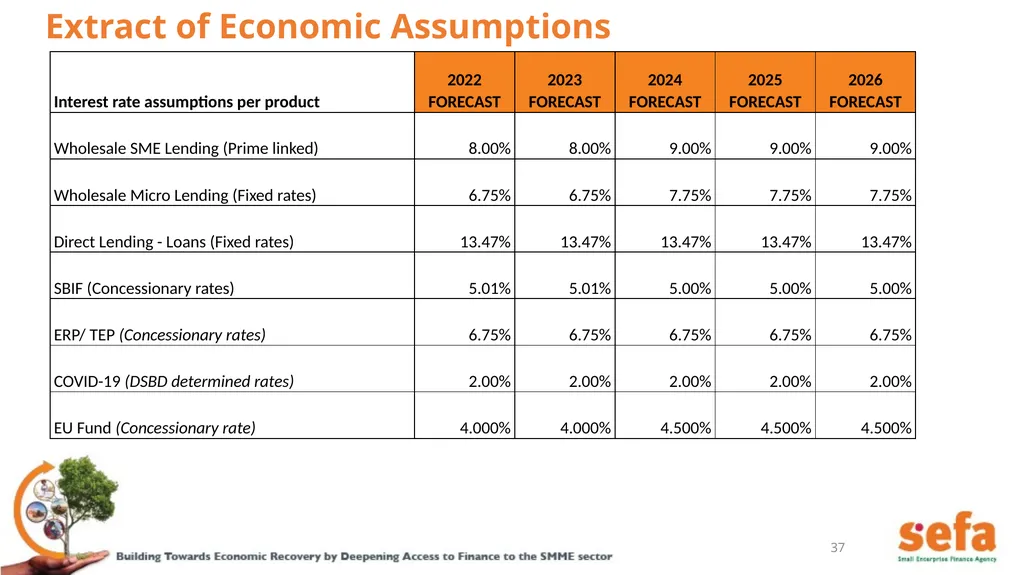
slide37. EXTRACT OF ECONOMIC ASSUMPTIONS Extract of Economic Assumptions 37<br>
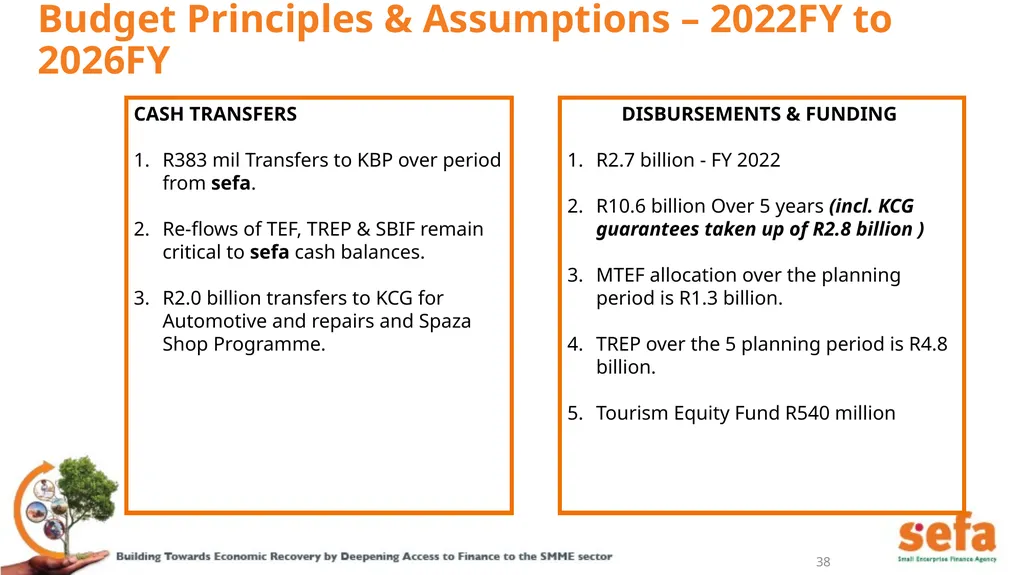
slide38. Budget Principles & Assumptions – 2022FY to 2026FY DISBURSEMENTS & FUNDING
R2.7 billion - FY 2022
R10.6 billion Over 5 years (incl. KCG guarantees taken up of R2.8 billion )
MTEF allocation over the planning period is R1.3 billion.
TREP over the 5 planning period is R4.8 billion.
Tourism Equity Fund R540 million CASH TRANSFERS
R383 mil Transfers to KBP over period from sefa.
Re-flows of TEF, TREP & SBIF remain critical to sefa cash balances.
R2.0 billion transfers to KCG for Automotive and repairs and Spaza Shop Programme. 38<br>
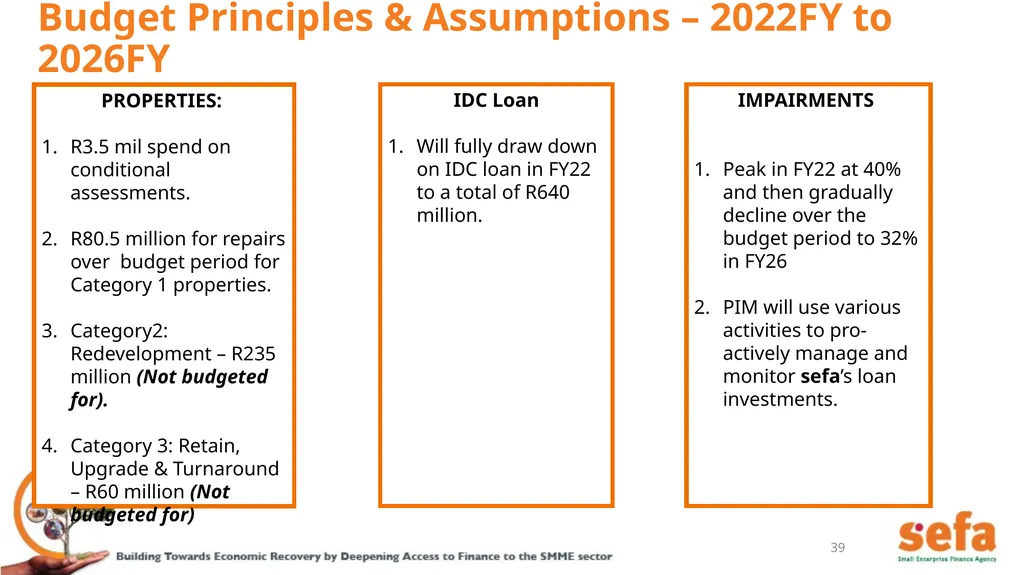
slide39. PROPERTIES:
R3.5 mil spend on conditional assessments.
R80.5 million for repairs over budget period for Category 1 properties.
Category2: Redevelopment – R235 million (Not budgeted for).
Category 3: Retain, Upgrade & Turnaround – R60 million (Not budgeted for) IDC Loan
Will fully draw down on IDC loan in FY22 to a total of R640 million. IMPAIRMENTS
Peak in FY22 at 40% and then gradually decline over the budget period to 32% in FY26
PIM will use various activities to pro-actively manage and monitor sefa’s loan investments. Budget Principles & Assumptions – 2022FY to 2026FY 39<br>
slide40. BUDGET OUTCOMES 40<br>
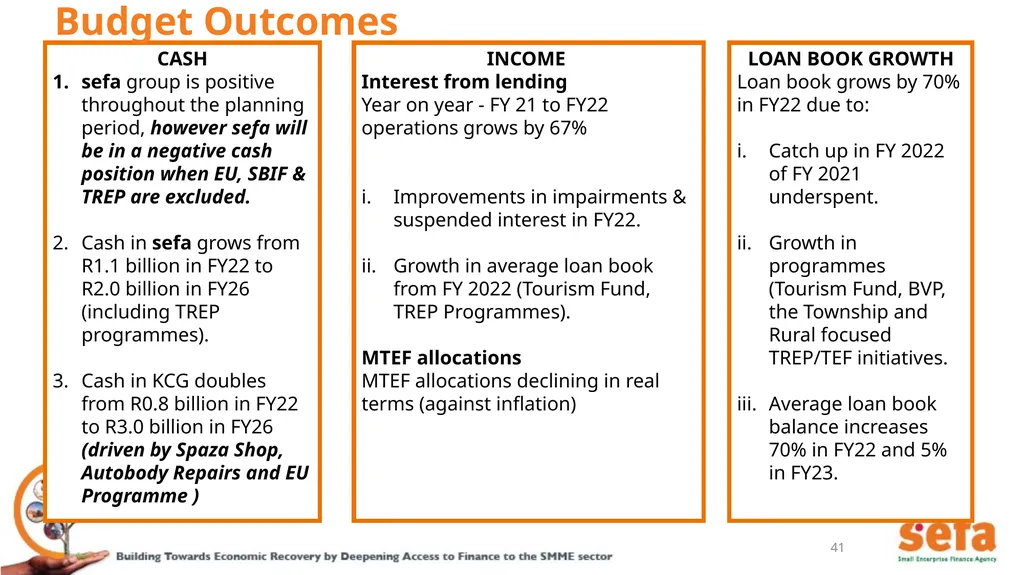
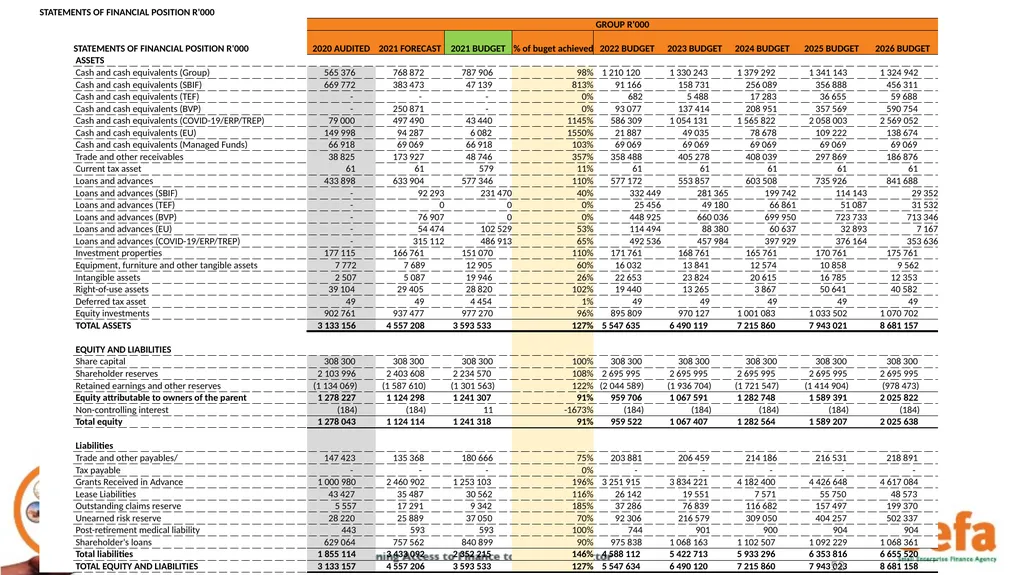
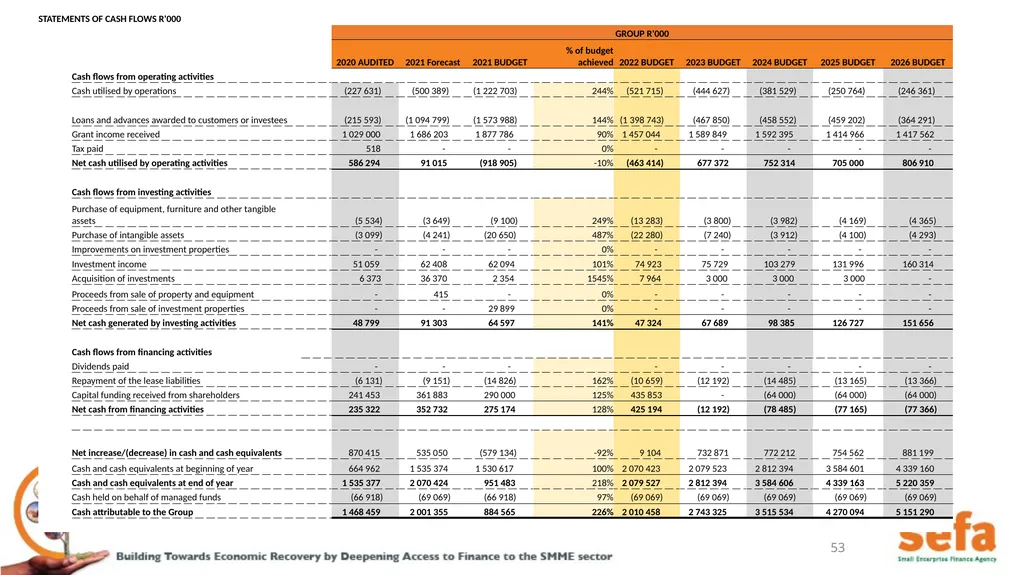
slide41. CASH
sefa group is positive throughout the planning period, however sefa will be in a negative cash position when EU, SBIF & TREP are excluded.
Cash in sefa grows from R1.1 billion in FY22 to R2.0 billion in FY26 (including TREP programmes).
Cash in KCG doubles from R0.8 billion in FY22 to R3.0 billion in FY26 (driven by Spaza Shop, Autobody Repairs and EU Programme ) INCOME
Interest from lending
Year on year - FY 21 to FY22 operations grows by 67%
Improvements in impairments & suspended interest in FY22.
Growth in average loan book from FY 2022 (Tourism Fund, TREP Programmes).
MTEF allocations
MTEF allocations declining in real terms (against inflation) LOAN BOOK GROWTH
Loan book grows by 70% in FY22 due to:
Catch up in FY 2022 of FY 2021 underspent.
Growth in programmes (Tourism Fund, BVP, the Township and Rural focused TREP/TEF initiatives.
Average loan book balance increases 70% in FY22 and 5% in FY23. Budget Outcomes 41<br>
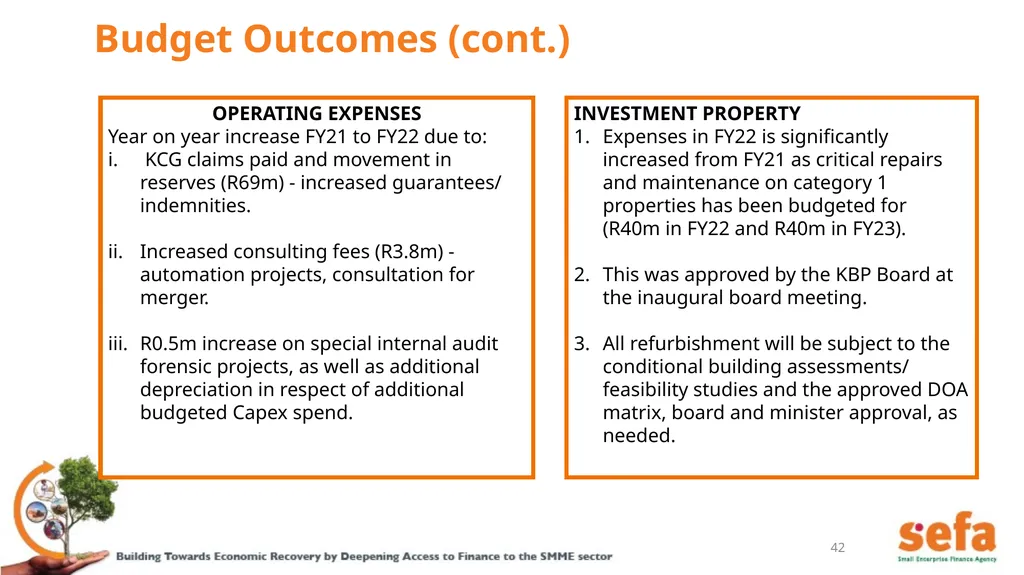
slide42. OPERATING EXPENSES
Year on year increase FY21 to FY22 due to:
KCG claims paid and movement in reserves (R69m) - increased guarantees/ indemnities.
Increased consulting fees (R3.8m) - automation projects, consultation for merger.
R0.5m increase on special internal audit forensic projects, as well as additional depreciation in respect of additional budgeted Capex spend. INVESTMENT PROPERTY
Expenses in FY22 is significantly increased from FY21 as critical repairs and maintenance on category 1 properties has been budgeted for (R40m in FY22 and R40m in FY23).
This was approved by the KBP Board at the inaugural board meeting.
All refurbishment will be subject to the conditional building assessments/ feasibility studies and the approved DOA matrix, board and minister approval, as needed. Budget Outcomes (cont.) 42<br>
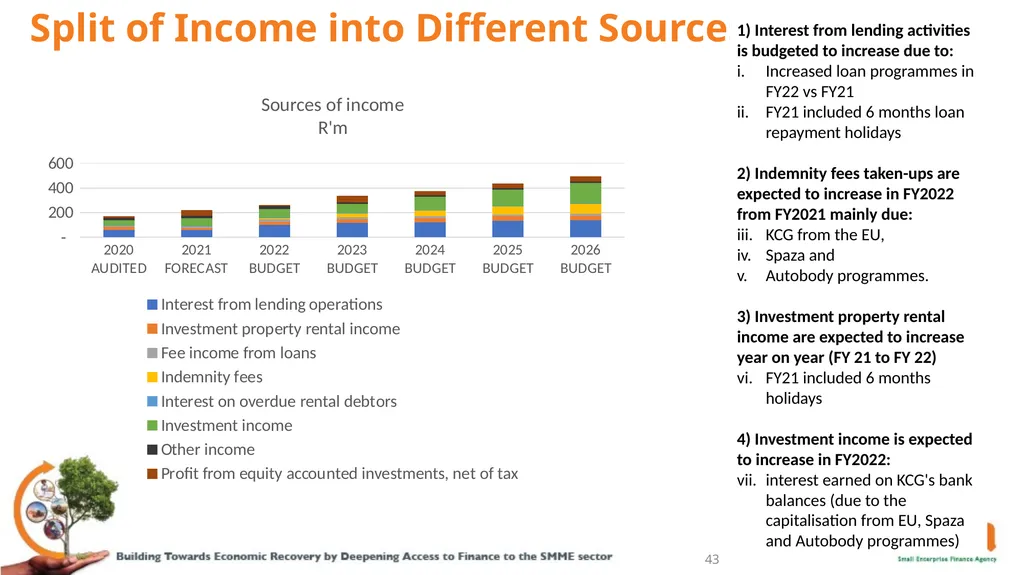
slide43. Split of Income into Different Sources 1) Interest from lending activities is budgeted to increase due to:
Increased loan programmes in FY22 vs FY21
FY21 included 6 months loan repayment holidays
2) Indemnity fees taken-ups are
expected to increase in FY2022 from FY2021 mainly due:
KCG from the EU,
Spaza and
Autobody programmes.
3) Investment property rental income are expected to increase year on year (FY 21 to FY 22)
FY21 included 6 months holidays
4) Investment income is expected to increase in FY2022:
interest earned on KCG's bank balances (due to the capitalisation from EU, Spaza and Autobody programmes) 43<br>
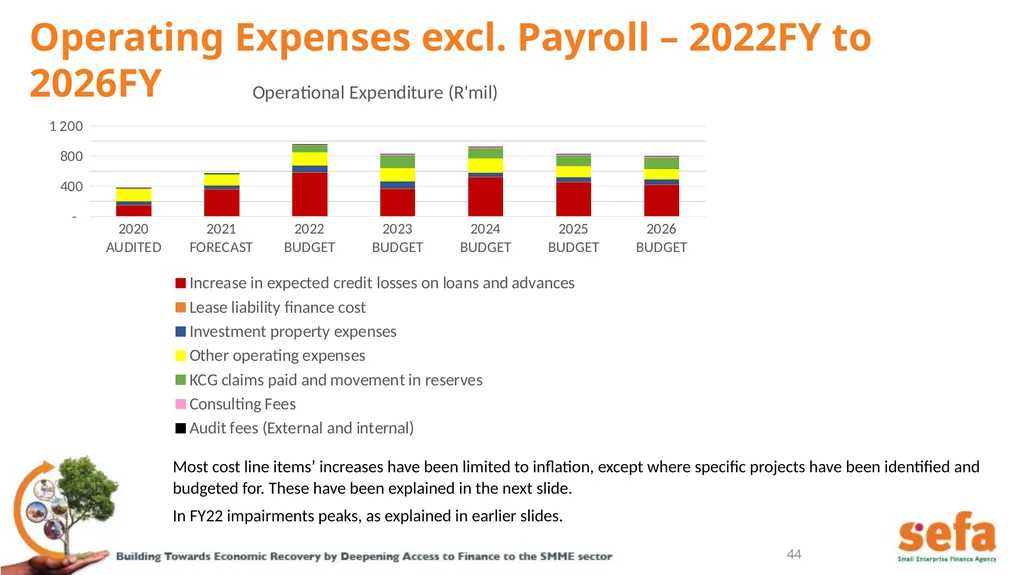
slide44. Operating Expenses excl. Payroll – 2022FY to 2026FY Most cost line items’ increases have been limited to inflation, except where specific projects have been identified and budgeted for. These have been explained in the next slide.
In FY22 impairments peaks, as explained in earlier slides. 44<br>
slide45. Cost-to-income Ratio – 2022FY to 2026FY sefa has chosen to use the cost-to-income ratio as a measure of operational efficiency. High Cost to Income ratio in FY 2022 driven by year-on-year increases:
Increased KCG indemnity fees (R54 million) – EU and Normal KCG(excl Spaza and Autobody programmes).
Increased Investment property expenses – R46 million
Increased Personnel Expenses R64 million 45<br>
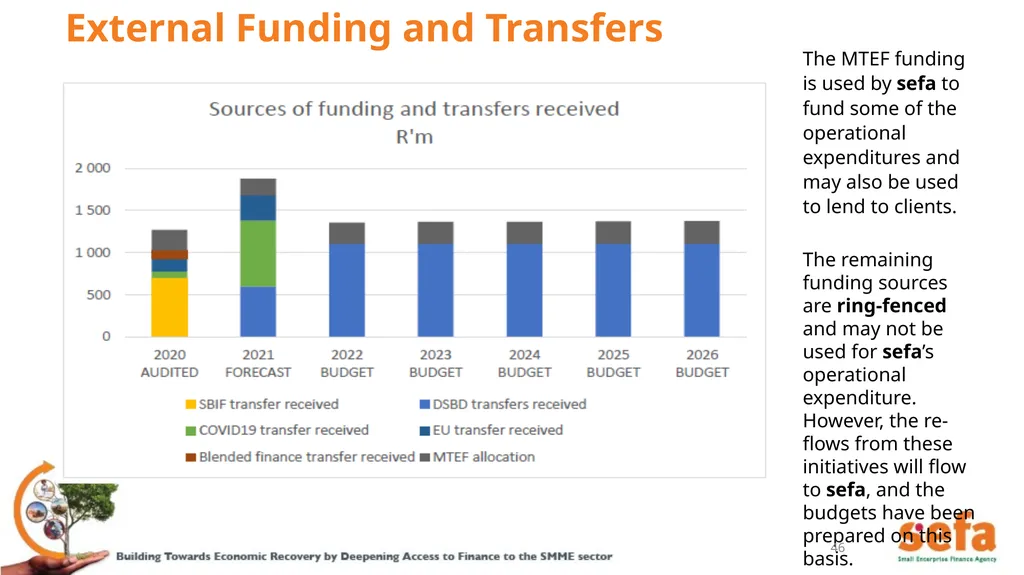
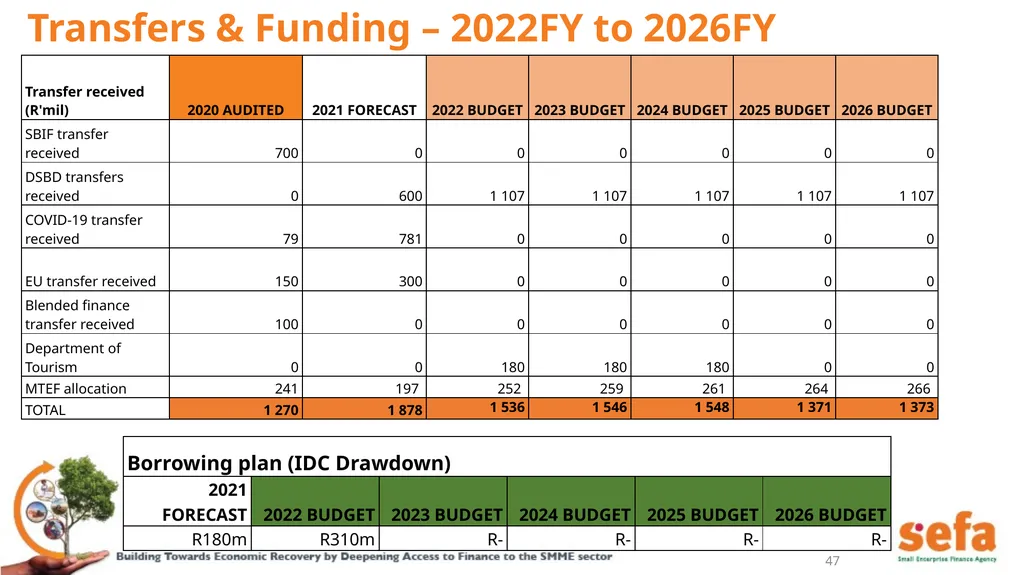
slide46. External Funding and Transfers The MTEF funding is used by sefa to fund some of the operational expenditures and may also be used to lend to clients.
The remaining funding sources are ring-fenced and may not be used for sefa’s operational expenditure. However, the re-flows from these initiatives will flow to sefa, and the budgets have been prepared on this basis. 46<br>
slide47. Transfers & Funding – 2022FY to 2026FY 47<br>
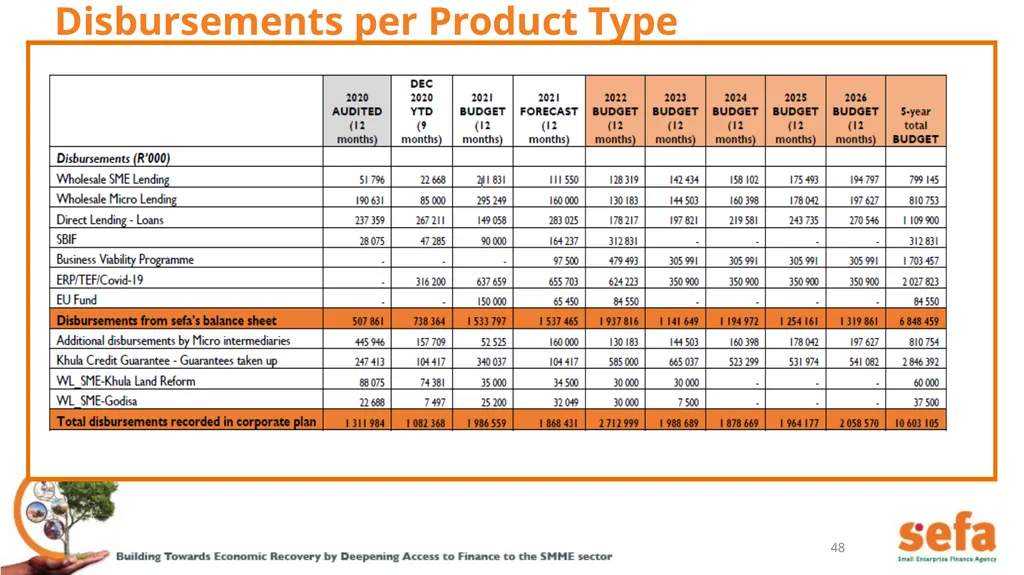
slide48. Disbursements per Product Type 48<br>
slide49. Impairments on New disbursements – 2022FY to 2026FY *No new disbursements after FY22
**No new disbursements after FY24 49<br>
slide50. FULL STATEMENTS 50<br>
slide51. Programmes 51<br>
slide52. Programmes 52<br>
slide53. Programmes 53<br>
slide54. Thank You<br>
5 May 2021<br>
slide2. Contents Strategic Overview
Strategic Initiatives and Customer Value Proposition
sefa-Seda Collaboration
Corporate Plan Programmes
Performance Against Pre-determined Objectives
Key Organisational Risks
Financial Projections 2<br>
slide3. Strategic Overview 3<br>
slide4. 4 Introduction sefa was incorporated on 1 April 2012 under Section 3(d) of the Industrial Development Act as a development finance institution with a mandate to provide financial support to SMMEs and Co-operatives.
sefa targets high-risk market segments that are not traditionally served by the commercial banking sector.
sefa’s operational model has been designed to address this market failure by providing finance directly to its target market through its regional branch network as well as indirectly through wholesale finance and credit guarantee products.
The 2021/22 Corporate Plan assumes a strategic posture that seeks to strike a balance between the delivery of its mandate, the pressing need to be financially sustainable and be responsive to:
the changes in the economic environment (COVID-19 and the sovereign credit downgrade),
priorities identified in the Medium Term Strategic Framework (2020 - 2024) of the sixth administration.
The development of the Corporate Plan and APP was a consultative process comprising of:
sefa EXCO (the assessment of the operating environment in identifying the organisational priorities)
Board Strategy Session (engagement on EXCO’s Strategy Proposals and high level performance scorecard)
Comment and inputs on the 1st draft Corporate Plan/APPs from EXCO and HoDs
Engagement with DSBD on their inputs on the draft Corporate Plan / APPs.<br>
slide5. Vision, Mission & Values Values Vision To be the leading catalyst for the development of sustainable Small Medium and Micro Enterprises and Co-operative Enterprises through the provision of finance. Mission To provide simple access to finance in an efficient and sustainable manner to SMMEs and Co-operatives throughout South Africa by:
providing loan and credit facilities to SMMEs and Co-operative enterprises;
providing credit guarantees to SMMEs and Co-operative Enterprises;
creating strategic partnerships with a range of institutions for sustainable SMME and Co-operative enterprise development and support;
developing, through partnerships, innovative finance products, tools and channels to catalyse increased market participation in the provision of affordable finance. Objective ensure sefa is a high impact, high-performance DFI that is responsive to the government’s microeconomic policies and specifically the DSBD MTEF plan
align sefa’s organisational structure, culture and innovative delivery model to be responsive to its mandate and strategy
develop the sefa brand value-proposition for our target markets, improve distribution reach, and establish winning collaborative models
improve sefa’s sustainability, operational effectiveness, efficiency and service delivery by streamlining business processes and deploying technology solutions Kuyasheshwa! Passion for development Integrity Transparency Innovation 5<br>
slide6. 6 sefa’s Operational Model<br>
slide7. Legislative Mandate 7<br>
slide8. Operational Environment 8 The South African economy entered a recession in 2019 following the persistent economic contraction experienced by struggling consumers and businesses. 2020 was equally tough due to the Covid-19 pandemic and the associated lockdowns.
COVID-19 pandemic had and continues to have a devastating impact on SMMEs. The government's policy response included among others:
Phase 1 – Preserve the economy
Phase 2 – Recover from the crisis
Phase 3 – Position the economy for faster growth (National Treasury, 2020)
GDP contracted by 7% in 2020 and negatively impacting on the performance of the South Africa’s SMME sector.
Access to finance remains one of the primary challenges for start-ups, micro, small and medium enterprises in South Africa. Key contributing factors include:
the high failure rates,
high transactional costs, and
high risks associated with small businesses in the early stages of development.
sefa, in conjunction with DSBD and Seda have begun rolling out the economic recovery programmes in support of SMMEs growth and development.<br>
slide9. DSBD MTSF Priority & sefa Strategic Objectives 9 Priority 2:
Economic Transformation and Job Creation sefa Strategic Initiatives sefa Strategic Objectives Accessibility, simplicity & automation Ensure sefa is a high impact, high performance DFI that is responsive to government’s macroeconomic policies and specifically the DSBD MTSF plan
Align sefa’s organisational structure, culture and innovative delivery model to be responsive to its mandate and strategy
Develop the sefa brand value-proposition for our target markets, improve distribution reach, and establish winning collaborative models
Improve sefa’s sustainability, operational effectiveness, efficiencies and service delivery by streamlining business processes and deploying technology solutions DSBD MTSF Investment management, & business support Execution-driven by High Performance, & Governance Culture Policy Support & Strategic Alliances Build sefa’s brand visibility Financial sustainability.<br>
slide10. sefa Alignment with DSBD MTSF Outcomes 10<br>
slide11. Strategic Initiatives and Customer Value Proposition 11<br>
slide12. sefa’s Strategic Initiatives 12<br>
slide13. sefa’s Customer Value Proposition Direct Lending: offers blended finance (Grants + loans); Wholesale: Offers low-interest-rate loans 13<br>
slide14. sefa-Seda Collaboration 14<br>
slide15. sefa-Seda Collaboration 15<br>
slide16. Corporate Plan Programmes 16<br>
slide17. sefa Corporate Plan Programmes 17<br>
slide18. sefa Corporate Plan Programmes (cont.) 18<br>
slide19. sefa Corporate Plan Programmes (cont.) 19<br>
slide20. Loan Programme Strategies and Outcomes:2021/22 – 25/26 20<br>
slide21. Sector-Focused TREP Programmes 21<br>
slide22. Performance Against Pre-determined Objectives 22<br>
slide23. Performance against Pre-determined Objectives (2021/22 – 2025/26) 23<br>
slide24. Performance against Pre-determined Objectives (cont.) 24<br>
slide25. Performance against Pre-determined Objectives (cont.) 25<br>
slide26. Key Organisational Risks 26<br>
slide27. Key Organisational Risks 27<br>
slide28. Key Organisational Risks (cont.) 28<br>
slide29. Key Organisational Risks (cont.) 29<br>
slide30. Financial Projections 30<br>
slide31. 2021 YTD 9 months ending December 2020 Financial Overview
2022 -2026 Preliminary Operating Budget & Plan 31<br>
slide32. Operating Budget Overview 2021 YTD 9 months ending December 2020 Financial Overview 32<br>
slide33. 33<br>
slide34. 2021 YTD 9 months ending December 2020 Financial Overview Commentary
Interest from lending operations:
Current year-to-date FY21, interest (R40m) (and R50m against budget) is lower than previous year (R68m) as a result of an interest moratorium that were applied in the first half of the current financial year.
2. Increase in expected credit losses on loans and advances:
Current impairment expenses (R138m) are lower than budgeted due to lower disbursements in the first half of the year than what was budgeted. [FY2020: R194m , FY2022: R589m]
3. Personnel Expenses:
During FY21 there has been a headcount freeze in place since Q2 and expect a R80.7m savings on forecasted YTD spend to budgeted spend.
Personnel expenses are lower in the current year-to-date (R161m) due to:
Lower salary increases implemented than originally budgeted (3% increase in actual),
vacancies not yet filled due to current head-count freeze
reversal of the incentive bonus accrual relating to FY20 (R18.3m).
However, Occupational health and safety costs increased significantly in FY21 (R1m increase from FY20). 34<br>
slide35. 2021 YTD 9 months ending December 2020 Financial Overview Commentary
4. Operating Expenses: Operating expenses are lower than budget due to savings in:
consulting fees(+R7.9m),
travel expenses (+R1.7m),
office re-location costs (+R0.6m),
repairs and maintenance (+R0.9m),
training expenses (+R2.3m) and lower technical reserves in KCG (+R14m). 35<br>
slide36. BUDGET PRINCIPLES & ASSUMPTIONS 36<br>
slide37. EXTRACT OF ECONOMIC ASSUMPTIONS Extract of Economic Assumptions 37<br>
slide38. Budget Principles & Assumptions – 2022FY to 2026FY DISBURSEMENTS & FUNDING
R2.7 billion - FY 2022
R10.6 billion Over 5 years (incl. KCG guarantees taken up of R2.8 billion )
MTEF allocation over the planning period is R1.3 billion.
TREP over the 5 planning period is R4.8 billion.
Tourism Equity Fund R540 million CASH TRANSFERS
R383 mil Transfers to KBP over period from sefa.
Re-flows of TEF, TREP & SBIF remain critical to sefa cash balances.
R2.0 billion transfers to KCG for Automotive and repairs and Spaza Shop Programme. 38<br>
slide39. PROPERTIES:
R3.5 mil spend on conditional assessments.
R80.5 million for repairs over budget period for Category 1 properties.
Category2: Redevelopment – R235 million (Not budgeted for).
Category 3: Retain, Upgrade & Turnaround – R60 million (Not budgeted for) IDC Loan
Will fully draw down on IDC loan in FY22 to a total of R640 million. IMPAIRMENTS
Peak in FY22 at 40% and then gradually decline over the budget period to 32% in FY26
PIM will use various activities to pro-actively manage and monitor sefa’s loan investments. Budget Principles & Assumptions – 2022FY to 2026FY 39<br>
slide40. BUDGET OUTCOMES 40<br>
slide41. CASH
sefa group is positive throughout the planning period, however sefa will be in a negative cash position when EU, SBIF & TREP are excluded.
Cash in sefa grows from R1.1 billion in FY22 to R2.0 billion in FY26 (including TREP programmes).
Cash in KCG doubles from R0.8 billion in FY22 to R3.0 billion in FY26 (driven by Spaza Shop, Autobody Repairs and EU Programme ) INCOME
Interest from lending
Year on year - FY 21 to FY22 operations grows by 67%
Improvements in impairments & suspended interest in FY22.
Growth in average loan book from FY 2022 (Tourism Fund, TREP Programmes).
MTEF allocations
MTEF allocations declining in real terms (against inflation) LOAN BOOK GROWTH
Loan book grows by 70% in FY22 due to:
Catch up in FY 2022 of FY 2021 underspent.
Growth in programmes (Tourism Fund, BVP, the Township and Rural focused TREP/TEF initiatives.
Average loan book balance increases 70% in FY22 and 5% in FY23. Budget Outcomes 41<br>
slide42. OPERATING EXPENSES
Year on year increase FY21 to FY22 due to:
KCG claims paid and movement in reserves (R69m) - increased guarantees/ indemnities.
Increased consulting fees (R3.8m) - automation projects, consultation for merger.
R0.5m increase on special internal audit forensic projects, as well as additional depreciation in respect of additional budgeted Capex spend. INVESTMENT PROPERTY
Expenses in FY22 is significantly increased from FY21 as critical repairs and maintenance on category 1 properties has been budgeted for (R40m in FY22 and R40m in FY23).
This was approved by the KBP Board at the inaugural board meeting.
All refurbishment will be subject to the conditional building assessments/ feasibility studies and the approved DOA matrix, board and minister approval, as needed. Budget Outcomes (cont.) 42<br>
slide43. Split of Income into Different Sources 1) Interest from lending activities is budgeted to increase due to:
Increased loan programmes in FY22 vs FY21
FY21 included 6 months loan repayment holidays
2) Indemnity fees taken-ups are
expected to increase in FY2022 from FY2021 mainly due:
KCG from the EU,
Spaza and
Autobody programmes.
3) Investment property rental income are expected to increase year on year (FY 21 to FY 22)
FY21 included 6 months holidays
4) Investment income is expected to increase in FY2022:
interest earned on KCG's bank balances (due to the capitalisation from EU, Spaza and Autobody programmes) 43<br>
slide44. Operating Expenses excl. Payroll – 2022FY to 2026FY Most cost line items’ increases have been limited to inflation, except where specific projects have been identified and budgeted for. These have been explained in the next slide.
In FY22 impairments peaks, as explained in earlier slides. 44<br>
slide45. Cost-to-income Ratio – 2022FY to 2026FY sefa has chosen to use the cost-to-income ratio as a measure of operational efficiency. High Cost to Income ratio in FY 2022 driven by year-on-year increases:
Increased KCG indemnity fees (R54 million) – EU and Normal KCG(excl Spaza and Autobody programmes).
Increased Investment property expenses – R46 million
Increased Personnel Expenses R64 million 45<br>
slide46. External Funding and Transfers The MTEF funding is used by sefa to fund some of the operational expenditures and may also be used to lend to clients.
The remaining funding sources are ring-fenced and may not be used for sefa’s operational expenditure. However, the re-flows from these initiatives will flow to sefa, and the budgets have been prepared on this basis. 46<br>
slide47. Transfers & Funding – 2022FY to 2026FY 47<br>
slide48. Disbursements per Product Type 48<br>
slide49. Impairments on New disbursements – 2022FY to 2026FY *No new disbursements after FY22
**No new disbursements after FY24 49<br>
slide50. FULL STATEMENTS 50<br>
slide51. Programmes 51<br>
slide52. Programmes 52<br>
slide53. Programmes 53<br>
slide54. Thank You<br>