
Self-Experimentation: History, Ethics, and Current
OM
Published · 21 slides · 0 views
1 / 1


Description
Self-Experimentation: History, Ethics, and Current Issues Tom Doyle, IU Center for Bioethics doyletiu.edu Why Worry About Self-Experimentation? Not So Long Ago In the early days of COVID-19, a group of scientists formed the Rapid
Related Topics
Share
Embed code
Download this presentation From Below
"Self-Experimentation: History, Ethics, and Current" is the property of its rightful owner. Permission is granted to download and print the materials on this website for personal, non-commercial use only, and to display it on your personal computer provided you do not modify the materials and that you retain all copyright notices contained in the materials. By downloading content from our website, you accept the terms of this agreement.
Presentation Transcript
01
Self-Experimentation: History, Ethics, and Current Issues Tom Doyle, IU Center for Bioethics
doylet@iu.edu<br>
doylet@iu.edu<br>
02
Why Worry About Self-Experimentation?<br>
03
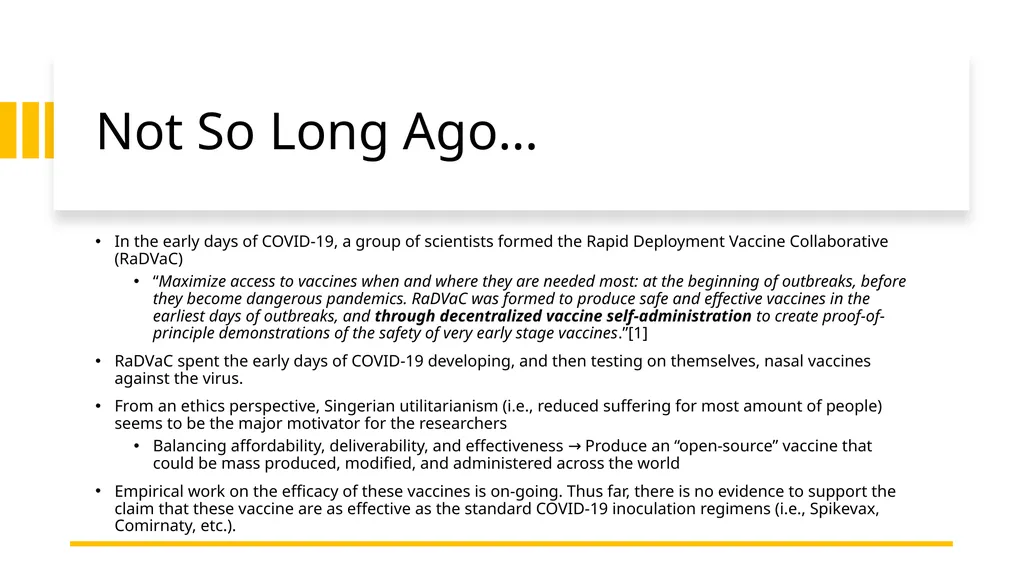
Not So Long Ago… In the early days of COVID-19, a group of scientists formed the Rapid Deployment Vaccine Collaborative (RaDVaC)
“Maximize access to vaccines when and where they are needed most: at the beginning of outbreaks, before they become dangerous pandemics. RaDVaC was formed to produce safe and effective vaccines in the earliest days of outbreaks, and through decentralized vaccine self-administration to create proof-of-principle demonstrations of the safety of very early stage vaccines.”[1]
RaDVaC spent the early days of COVID-19 developing, and then testing on themselves, nasal vaccines against the virus.
From an ethics perspective, Singerian utilitarianism (i.e., reduced suffering for most amount of people) seems to be the major motivator for the researchers
Balancing affordability, deliverability, and effectiveness → Produce an “open-source” vaccine that could be mass produced, modified, and administered across the world
Empirical work on the efficacy of these vaccines is on-going. Thus far, there is no evidence to support the claim that these vaccine are as effective as the standard COVID-19 inoculation regimens (i.e., Spikevax, Comirnaty, etc.).<br>
“Maximize access to vaccines when and where they are needed most: at the beginning of outbreaks, before they become dangerous pandemics. RaDVaC was formed to produce safe and effective vaccines in the earliest days of outbreaks, and through decentralized vaccine self-administration to create proof-of-principle demonstrations of the safety of very early stage vaccines.”[1]
RaDVaC spent the early days of COVID-19 developing, and then testing on themselves, nasal vaccines against the virus.
From an ethics perspective, Singerian utilitarianism (i.e., reduced suffering for most amount of people) seems to be the major motivator for the researchers
Balancing affordability, deliverability, and effectiveness → Produce an “open-source” vaccine that could be mass produced, modified, and administered across the world
Empirical work on the efficacy of these vaccines is on-going. Thus far, there is no evidence to support the claim that these vaccine are as effective as the standard COVID-19 inoculation regimens (i.e., Spikevax, Comirnaty, etc.).<br>
04
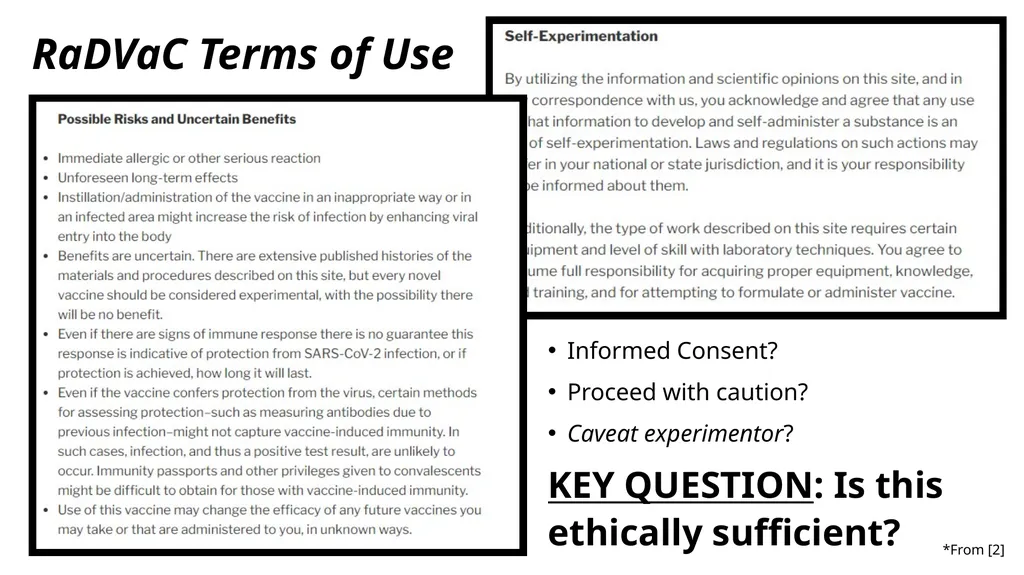
* * *From [2] Informed Consent?
Proceed with caution?
Caveat experimentor?
KEY QUESTION: Is this ethically sufficient? RaDVaC Terms of Use<br>
Proceed with caution?
Caveat experimentor?
KEY QUESTION: Is this ethically sufficient? RaDVaC Terms of Use<br>
05
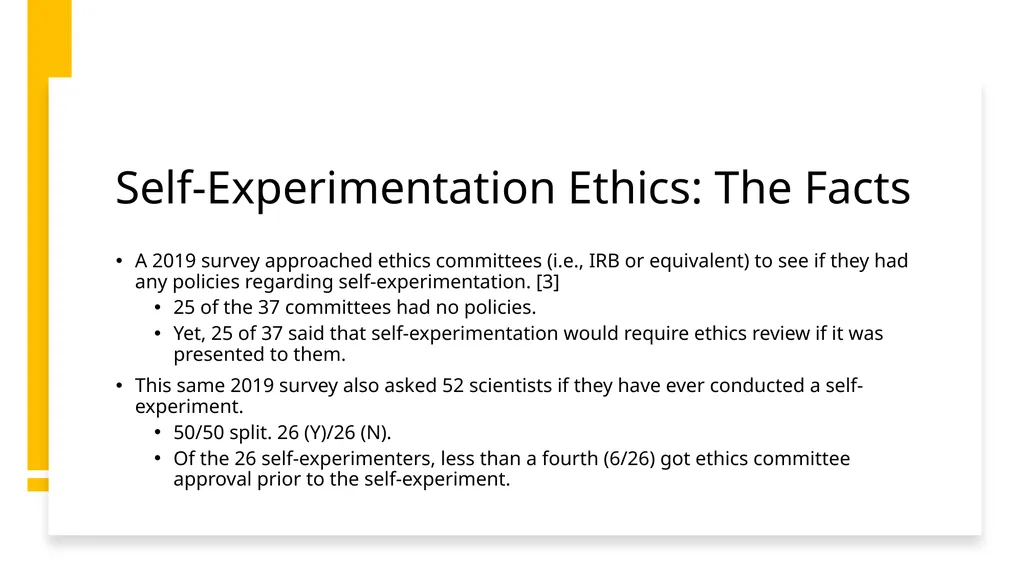
Self-Experimentation Ethics: The Facts A 2019 survey approached ethics committees (i.e., IRB or equivalent) to see if they had any policies regarding self-experimentation. [3]
25 of the 37 committees had no policies.
Yet, 25 of 37 said that self-experimentation would require ethics review if it was presented to them.
This same 2019 survey also asked 52 scientists if they have ever conducted a self-experiment.
50/50 split. 26 (Y)/26 (N).
Of the 26 self-experimenters, less than a fourth (6/26) got ethics committee approval prior to the self-experiment.<br>
25 of the 37 committees had no policies.
Yet, 25 of 37 said that self-experimentation would require ethics review if it was presented to them.
This same 2019 survey also asked 52 scientists if they have ever conducted a self-experiment.
50/50 split. 26 (Y)/26 (N).
Of the 26 self-experimenters, less than a fourth (6/26) got ethics committee approval prior to the self-experiment.<br>
06
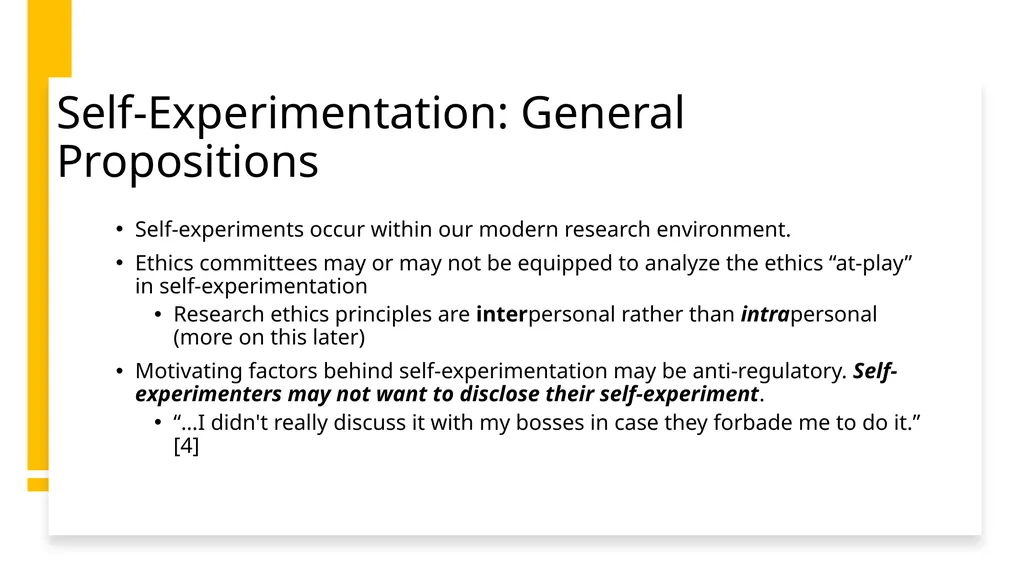
Self-Experimentation: General Propositions Self-experiments occur within our modern research environment.
Ethics committees may or may not be equipped to analyze the ethics “at-play” in self-experimentation
Research ethics principles are interpersonal rather than intrapersonal (more on this later)
Motivating factors behind self-experimentation may be anti-regulatory. Self-experimenters may not want to disclose their self-experiment.
“…I didn't really discuss it with my bosses in case they forbade me to do it.” [4]<br>
Ethics committees may or may not be equipped to analyze the ethics “at-play” in self-experimentation
Research ethics principles are interpersonal rather than intrapersonal (more on this later)
Motivating factors behind self-experimentation may be anti-regulatory. Self-experimenters may not want to disclose their self-experiment.
“…I didn't really discuss it with my bosses in case they forbade me to do it.” [4]<br>
07
Can history be our teacher?<br>
08
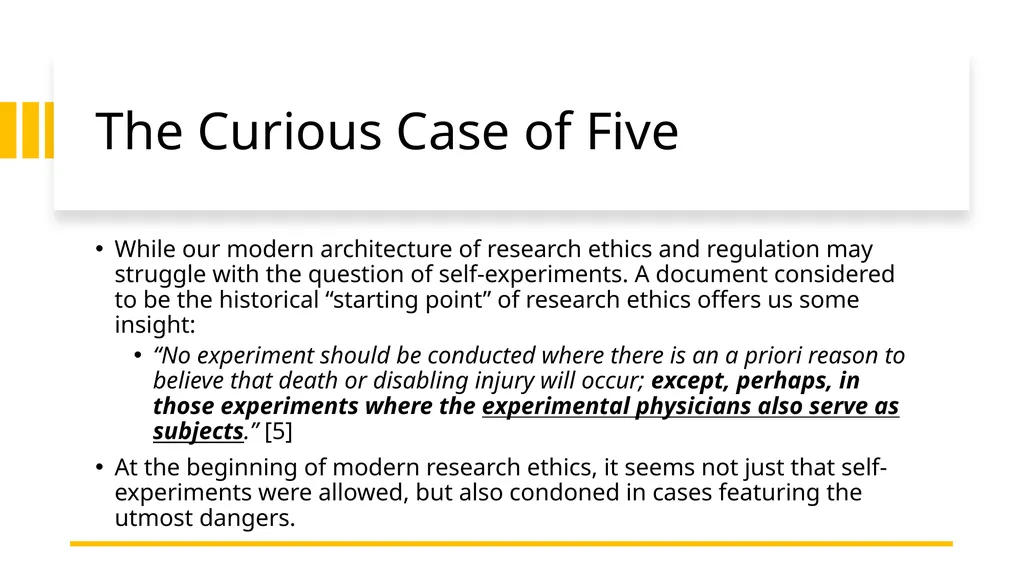
The Curious Case of Five While our modern architecture of research ethics and regulation may struggle with the question of self-experiments. A document considered to be the historical “starting point” of research ethics offers us some insight:
“No experiment should be conducted where there is an a priori reason to believe that death or disabling injury will occur; except, perhaps, in those experiments where the experimental physicians also serve as subjects.” [5]
At the beginning of modern research ethics, it seems not just that self-experiments were allowed, but also condoned in cases featuring the utmost dangers.<br>
“No experiment should be conducted where there is an a priori reason to believe that death or disabling injury will occur; except, perhaps, in those experiments where the experimental physicians also serve as subjects.” [5]
At the beginning of modern research ethics, it seems not just that self-experiments were allowed, but also condoned in cases featuring the utmost dangers.<br>
09
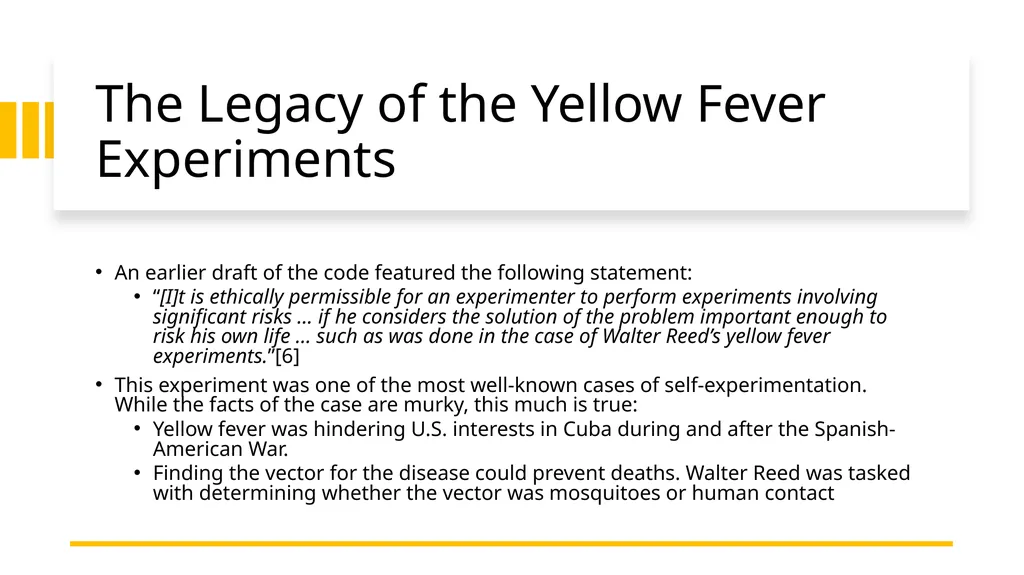
The Legacy of the Yellow Fever Experiments An earlier draft of the code featured the following statement:
“[I]t is ethically permissible for an experimenter to perform experiments involving significant risks … if he considers the solution of the problem important enough to risk his own life … such as was done in the case of Walter Reed’s yellow fever experiments.”[6]
This experiment was one of the most well-known cases of self-experimentation. While the facts of the case are murky, this much is true:
Yellow fever was hindering U.S. interests in Cuba during and after the Spanish-American War.
Finding the vector for the disease could prevent deaths. Walter Reed was tasked with determining whether the vector was mosquitoes or human contact<br>
“[I]t is ethically permissible for an experimenter to perform experiments involving significant risks … if he considers the solution of the problem important enough to risk his own life … such as was done in the case of Walter Reed’s yellow fever experiments.”[6]
This experiment was one of the most well-known cases of self-experimentation. While the facts of the case are murky, this much is true:
Yellow fever was hindering U.S. interests in Cuba during and after the Spanish-American War.
Finding the vector for the disease could prevent deaths. Walter Reed was tasked with determining whether the vector was mosquitoes or human contact<br>
10
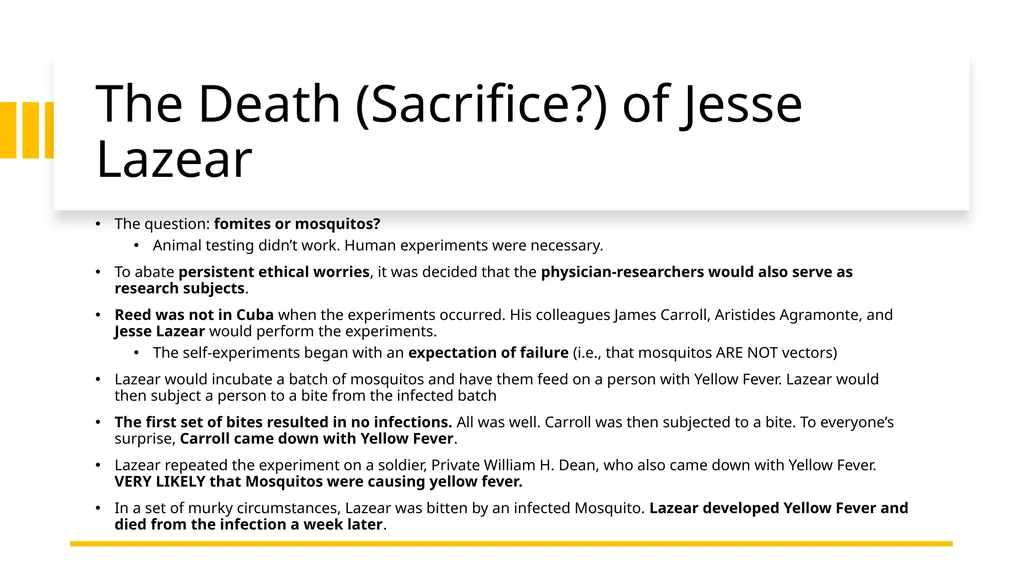
The Death (Sacrifice?) of Jesse Lazear The question: fomites or mosquitos?
Animal testing didn’t work. Human experiments were necessary.
To abate persistent ethical worries, it was decided that the physician-researchers would also serve as research subjects.
Reed was not in Cuba when the experiments occurred. His colleagues James Carroll, Aristides Agramonte, and Jesse Lazear would perform the experiments.
The self-experiments began with an expectation of failure (i.e., that mosquitos ARE NOT vectors)
Lazear would incubate a batch of mosquitos and have them feed on a person with Yellow Fever. Lazear would then subject a person to a bite from the infected batch
The first set of bites resulted in no infections. All was well. Carroll was then subjected to a bite. To everyone’s surprise, Carroll came down with Yellow Fever.
Lazear repeated the experiment on a soldier, Private William H. Dean, who also came down with Yellow Fever. VERY LIKELY that Mosquitos were causing yellow fever.
In a set of murky circumstances, Lazear was bitten by an infected Mosquito. Lazear developed Yellow Fever and died from the infection a week later.<br>
Animal testing didn’t work. Human experiments were necessary.
To abate persistent ethical worries, it was decided that the physician-researchers would also serve as research subjects.
Reed was not in Cuba when the experiments occurred. His colleagues James Carroll, Aristides Agramonte, and Jesse Lazear would perform the experiments.
The self-experiments began with an expectation of failure (i.e., that mosquitos ARE NOT vectors)
Lazear would incubate a batch of mosquitos and have them feed on a person with Yellow Fever. Lazear would then subject a person to a bite from the infected batch
The first set of bites resulted in no infections. All was well. Carroll was then subjected to a bite. To everyone’s surprise, Carroll came down with Yellow Fever.
Lazear repeated the experiment on a soldier, Private William H. Dean, who also came down with Yellow Fever. VERY LIKELY that Mosquitos were causing yellow fever.
In a set of murky circumstances, Lazear was bitten by an infected Mosquito. Lazear developed Yellow Fever and died from the infection a week later.<br>
11
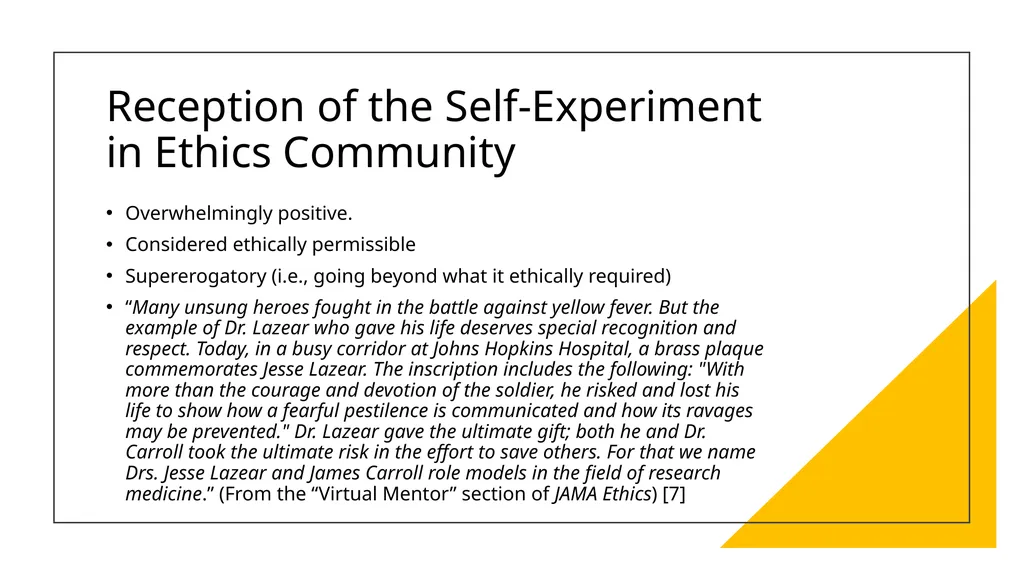
Reception of the Self-Experiment in Ethics Community Overwhelmingly positive.
Considered ethically permissible
Supererogatory (i.e., going beyond what it ethically required)
“Many unsung heroes fought in the battle against yellow fever. But the example of Dr. Lazear who gave his life deserves special recognition and respect. Today, in a busy corridor at Johns Hopkins Hospital, a brass plaque commemorates Jesse Lazear. The inscription includes the following: "With more than the courage and devotion of the soldier, he risked and lost his life to show how a fearful pestilence is communicated and how its ravages may be prevented." Dr. Lazear gave the ultimate gift; both he and Dr. Carroll took the ultimate risk in the effort to save others. For that we name Drs. Jesse Lazear and James Carroll role models in the field of research medicine.” (From the “Virtual Mentor” section of JAMA Ethics) [7]<br>
Considered ethically permissible
Supererogatory (i.e., going beyond what it ethically required)
“Many unsung heroes fought in the battle against yellow fever. But the example of Dr. Lazear who gave his life deserves special recognition and respect. Today, in a busy corridor at Johns Hopkins Hospital, a brass plaque commemorates Jesse Lazear. The inscription includes the following: "With more than the courage and devotion of the soldier, he risked and lost his life to show how a fearful pestilence is communicated and how its ravages may be prevented." Dr. Lazear gave the ultimate gift; both he and Dr. Carroll took the ultimate risk in the effort to save others. For that we name Drs. Jesse Lazear and James Carroll role models in the field of research medicine.” (From the “Virtual Mentor” section of JAMA Ethics) [7]<br>
12
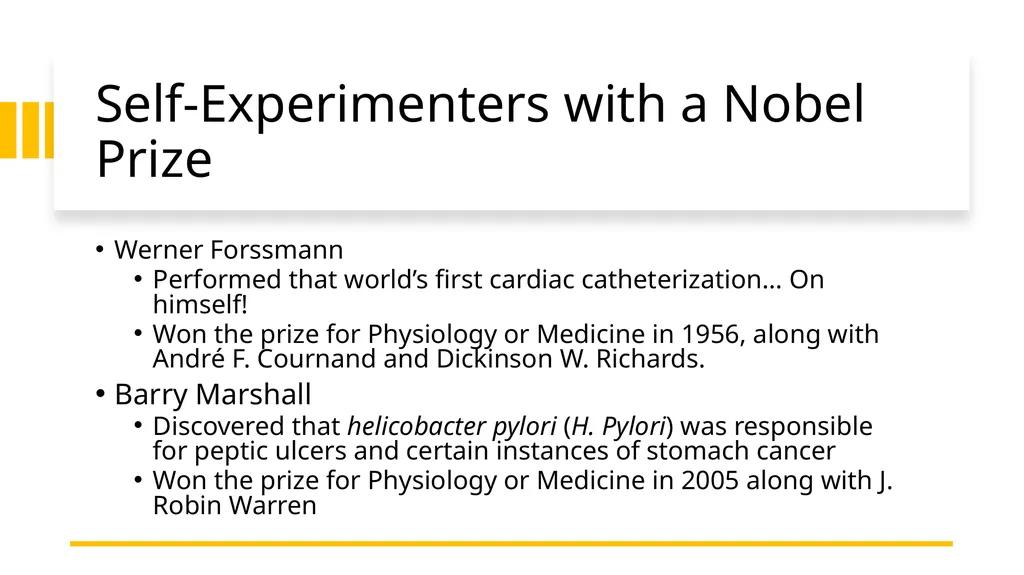
Self-Experimenters with a Nobel Prize Werner Forssmann
Performed that world’s first cardiac catheterization… On himself!
Won the prize for Physiology or Medicine in 1956, along with André F. Cournand and Dickinson W. Richards.
Barry Marshall
Discovered that helicobacter pylori (H. Pylori) was responsible for peptic ulcers and certain instances of stomach cancer
Won the prize for Physiology or Medicine in 2005 along with J. Robin Warren<br>
Performed that world’s first cardiac catheterization… On himself!
Won the prize for Physiology or Medicine in 1956, along with André F. Cournand and Dickinson W. Richards.
Barry Marshall
Discovered that helicobacter pylori (H. Pylori) was responsible for peptic ulcers and certain instances of stomach cancer
Won the prize for Physiology or Medicine in 2005 along with J. Robin Warren<br>
13
The historical take away Self-experimentation is a praiseworthy endeavor that represents one’s devotion to science and the common good.
In the most dangerous experiments, self-experimenters should “go first”.
Self-experimentation may be a necessary part of medical progress, as some experiments that further medical understanding are too dangerous to expose another person to.<br>
In the most dangerous experiments, self-experimenters should “go first”.
Self-experimentation may be a necessary part of medical progress, as some experiments that further medical understanding are too dangerous to expose another person to.<br>
14
A Reason To Pause?<br>
15
Principles to the rescue? As indicated earlier, the principles of research ethics do not map onto self-experimentation (besides that one-off in the Nuremberg Code…)
The principles of research ethics resulted from atrocities committed against another.
Declaration of Helsinki is a formalization of the Nuremberg Code
Belmont Report was written in response to Tuskegee
Informed consent
Who better to consent and be informed than the person who designed the experiment?
Assessment of risk and benefits
A self-experimenter certainly would want a favorable risk-benefits ratio. Or they at least accept that risks are very great and are willing to make that sacrifice.
Selection of Subjects
There is only one subject—themselves. Questions of vulnerable populations subside.<br>
The principles of research ethics resulted from atrocities committed against another.
Declaration of Helsinki is a formalization of the Nuremberg Code
Belmont Report was written in response to Tuskegee
Informed consent
Who better to consent and be informed than the person who designed the experiment?
Assessment of risk and benefits
A self-experimenter certainly would want a favorable risk-benefits ratio. Or they at least accept that risks are very great and are willing to make that sacrifice.
Selection of Subjects
There is only one subject—themselves. Questions of vulnerable populations subside.<br>
16
Respect for persons? Human dignity in research
Foundational to research ethics is the notion that human beings have an inalienable and inherent value (i.e., dignity)
Violating or betraying a person’s dignity is unethical
Using a person as a means (i.e., something with value not yet realized) rather than as an ends (i.e., something with inherent value)
Some self-experiments may betray a sense of self-dignity
I need some subject to do this dangerous experiment on. Might as well be me!
Treating oneself as a means rather than as an ends.
I feel morally/ethically uncomfortable doing this to another person. So, I’ll do it to myself instead…
Indicates that you are not worthy of the moral or ethical consideration you would extend to others.<br>
Foundational to research ethics is the notion that human beings have an inalienable and inherent value (i.e., dignity)
Violating or betraying a person’s dignity is unethical
Using a person as a means (i.e., something with value not yet realized) rather than as an ends (i.e., something with inherent value)
Some self-experiments may betray a sense of self-dignity
I need some subject to do this dangerous experiment on. Might as well be me!
Treating oneself as a means rather than as an ends.
I feel morally/ethically uncomfortable doing this to another person. So, I’ll do it to myself instead…
Indicates that you are not worthy of the moral or ethical consideration you would extend to others.<br>
17
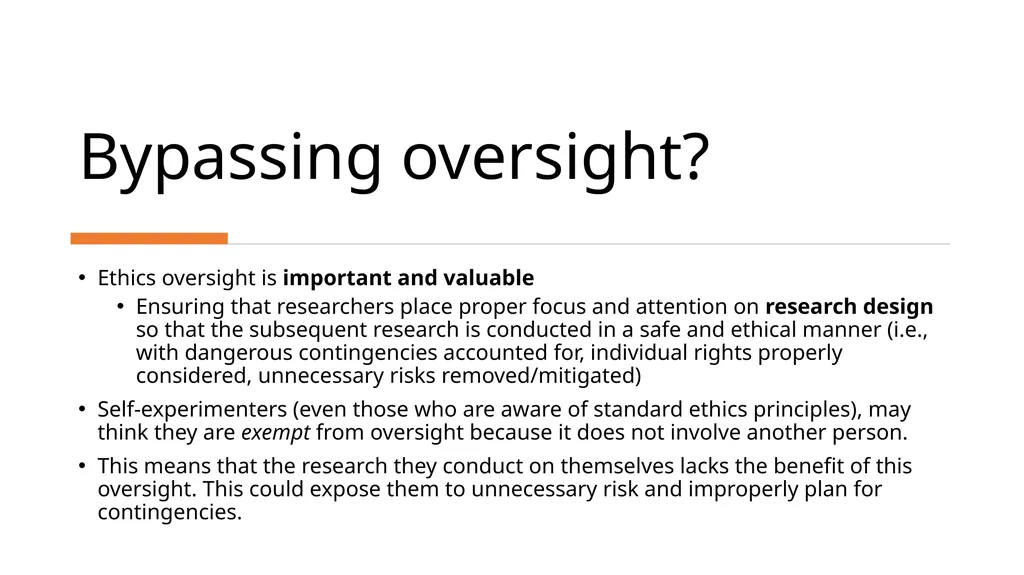
Bypassing oversight? Ethics oversight is important and valuable
Ensuring that researchers place proper focus and attention on research design so that the subsequent research is conducted in a safe and ethical manner (i.e., with dangerous contingencies accounted for, individual rights properly considered, unnecessary risks removed/mitigated)
Self-experimenters (even those who are aware of standard ethics principles), may think they are exempt from oversight because it does not involve another person.
This means that the research they conduct on themselves lacks the benefit of this oversight. This could expose them to unnecessary risk and improperly plan for contingencies.<br>
Ensuring that researchers place proper focus and attention on research design so that the subsequent research is conducted in a safe and ethical manner (i.e., with dangerous contingencies accounted for, individual rights properly considered, unnecessary risks removed/mitigated)
Self-experimenters (even those who are aware of standard ethics principles), may think they are exempt from oversight because it does not involve another person.
This means that the research they conduct on themselves lacks the benefit of this oversight. This could expose them to unnecessary risk and improperly plan for contingencies.<br>
18
What’s Next?<br>
19
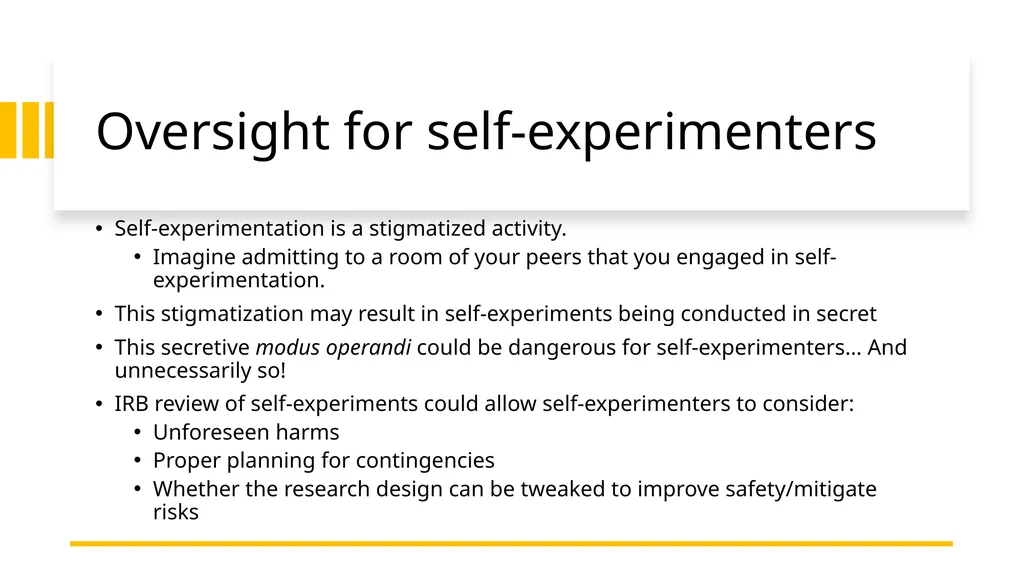
Oversight for self-experimenters Self-experimentation is a stigmatized activity.
Imagine admitting to a room of your peers that you engaged in self-experimentation.
This stigmatization may result in self-experiments being conducted in secret
This secretive modus operandi could be dangerous for self-experimenters… And unnecessarily so!
IRB review of self-experiments could allow self-experimenters to consider:
Unforeseen harms
Proper planning for contingencies
Whether the research design can be tweaked to improve safety/mitigate risks<br>
Imagine admitting to a room of your peers that you engaged in self-experimentation.
This stigmatization may result in self-experiments being conducted in secret
This secretive modus operandi could be dangerous for self-experimenters… And unnecessarily so!
IRB review of self-experiments could allow self-experimenters to consider:
Unforeseen harms
Proper planning for contingencies
Whether the research design can be tweaked to improve safety/mitigate risks<br>
20
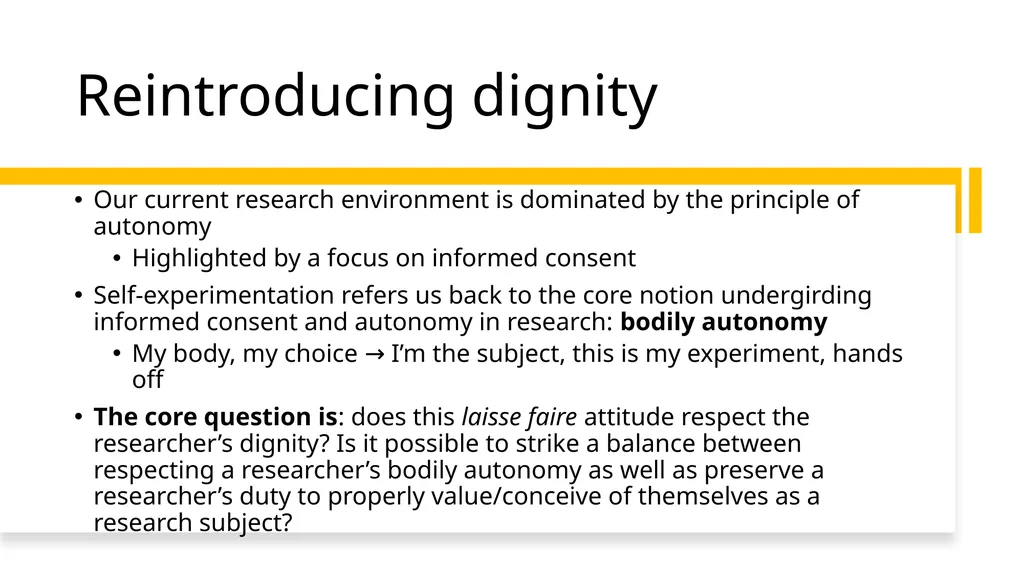
Reintroducing dignity Our current research environment is dominated by the principle of autonomy
Highlighted by a focus on informed consent
Self-experimentation refers us back to the core notion undergirding informed consent and autonomy in research: bodily autonomy
My body, my choice → I’m the subject, this is my experiment, hands off
The core question is: does this laisse faire attitude respect the researcher’s dignity? Is it possible to strike a balance between respecting a researcher’s bodily autonomy as well as preserve a researcher’s duty to properly value/conceive of themselves as a research subject?<br>
Highlighted by a focus on informed consent
Self-experimentation refers us back to the core notion undergirding informed consent and autonomy in research: bodily autonomy
My body, my choice → I’m the subject, this is my experiment, hands off
The core question is: does this laisse faire attitude respect the researcher’s dignity? Is it possible to strike a balance between respecting a researcher’s bodily autonomy as well as preserve a researcher’s duty to properly value/conceive of themselves as a research subject?<br>
21
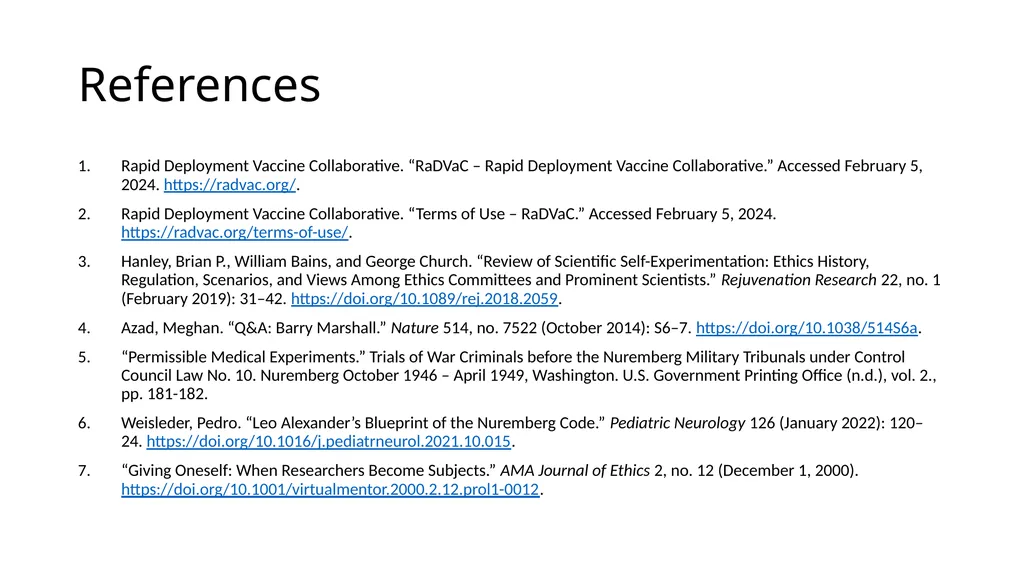
References Rapid Deployment Vaccine Collaborative. “RaDVaC – Rapid Deployment Vaccine Collaborative.” Accessed February 5, 2024. https://radvac.org/.
Rapid Deployment Vaccine Collaborative. “Terms of Use – RaDVaC.” Accessed February 5, 2024. https://radvac.org/terms-of-use/.
Hanley, Brian P., William Bains, and George Church. “Review of Scientific Self-Experimentation: Ethics History, Regulation, Scenarios, and Views Among Ethics Committees and Prominent Scientists.” Rejuvenation Research 22, no. 1 (February 2019): 31–42. https://doi.org/10.1089/rej.2018.2059.
Azad, Meghan. “Q&A: Barry Marshall.” Nature 514, no. 7522 (October 2014): S6–7. https://doi.org/10.1038/514S6a.
“Permissible Medical Experiments.” Trials of War Criminals before the Nuremberg Military Tribunals under Control Council Law No. 10. Nuremberg October 1946 – April 1949, Washington. U.S. Government Printing Office (n.d.), vol. 2., pp. 181-182.
Weisleder, Pedro. “Leo Alexander’s Blueprint of the Nuremberg Code.” Pediatric Neurology 126 (January 2022): 120–24. https://doi.org/10.1016/j.pediatrneurol.2021.10.015.
“Giving Oneself: When Researchers Become Subjects.” AMA Journal of Ethics 2, no. 12 (December 1, 2000). https://doi.org/10.1001/virtualmentor.2000.2.12.prol1-0012.<br>
Rapid Deployment Vaccine Collaborative. “Terms of Use – RaDVaC.” Accessed February 5, 2024. https://radvac.org/terms-of-use/.
Hanley, Brian P., William Bains, and George Church. “Review of Scientific Self-Experimentation: Ethics History, Regulation, Scenarios, and Views Among Ethics Committees and Prominent Scientists.” Rejuvenation Research 22, no. 1 (February 2019): 31–42. https://doi.org/10.1089/rej.2018.2059.
Azad, Meghan. “Q&A: Barry Marshall.” Nature 514, no. 7522 (October 2014): S6–7. https://doi.org/10.1038/514S6a.
“Permissible Medical Experiments.” Trials of War Criminals before the Nuremberg Military Tribunals under Control Council Law No. 10. Nuremberg October 1946 – April 1949, Washington. U.S. Government Printing Office (n.d.), vol. 2., pp. 181-182.
Weisleder, Pedro. “Leo Alexander’s Blueprint of the Nuremberg Code.” Pediatric Neurology 126 (January 2022): 120–24. https://doi.org/10.1016/j.pediatrneurol.2021.10.015.
“Giving Oneself: When Researchers Become Subjects.” AMA Journal of Ethics 2, no. 12 (December 1, 2000). https://doi.org/10.1001/virtualmentor.2000.2.12.prol1-0012.<br>