Self-Regulation and Concentration How to help our students April 6, 2017 The Marshmallow Test Self-regulation : a deep, internal mechanism that enables children as well as adults to engage in mindful, intentional, and thoughtful behaviors
"Self-Regulation and Concentration How to help our" is the property of its rightful owner. Permission is granted to
download and print the materials on this website for personal, non-commercial use only, and to display it
on your personal computer provided you do not modify the materials and that you retain all copyright
notices contained in the materials. By downloading content from our website, you accept the terms of this
agreement.
Presentation Transcript
01
Self-Regulation and Concentration How to help our students
April 6, 2017<br>
02
The Marshmallow Test<br>
03
Self-regulation : a deep, internal mechanism that enables children as well as adults to engage in mindful, intentional, and thoughtful behaviors<br>
04
Self regulation includes both: 1. The ability to control one’s impulses and to stop doing something. 2. The capacity to do
something (even if one doesn’t want to do it) because it is needed.<br>
05
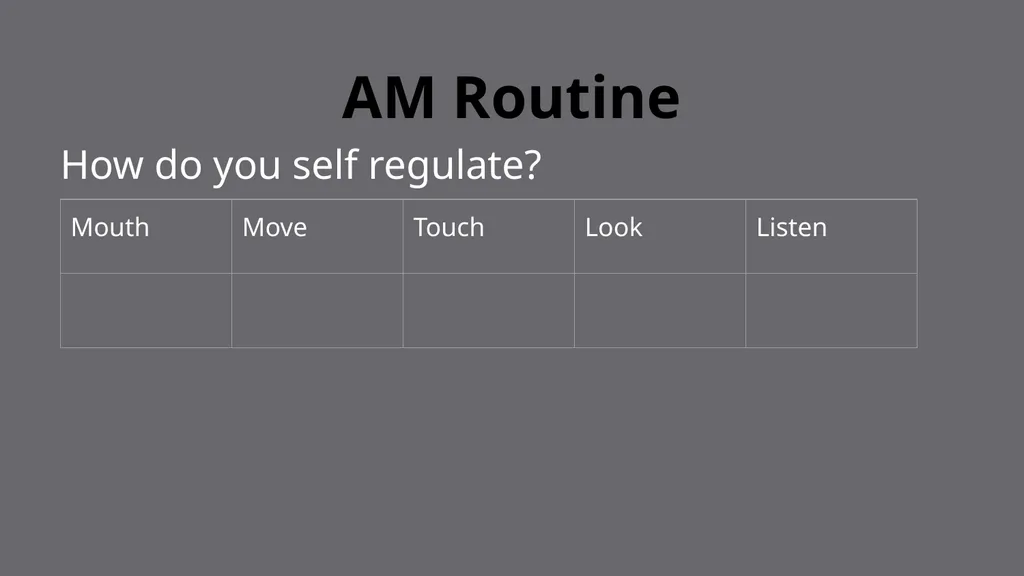
AM Routine How do you self regulate?<br>
06
The Brain’s role Developing brains utilize their brain’s executive function to build self regulation. When this part of the brain is exercised, self regulation develops. When self regulation develops, so does a child’s ability to focus, stay on task, or shift quickly between activities.<br>
07
Center on the Developing Child at Harvard University<br>
08
So, why do some people self regulate and others struggle? Some people are born with a stronger sense of self regulation.
Some people’s temperaments are more inclined toward appearing self regulated.
Some people will always struggle and need to find ways to cope in their world.<br>
09
The Good News: You can help your child develop his or her sense of self regulation and focused attention at every age!<br>
10
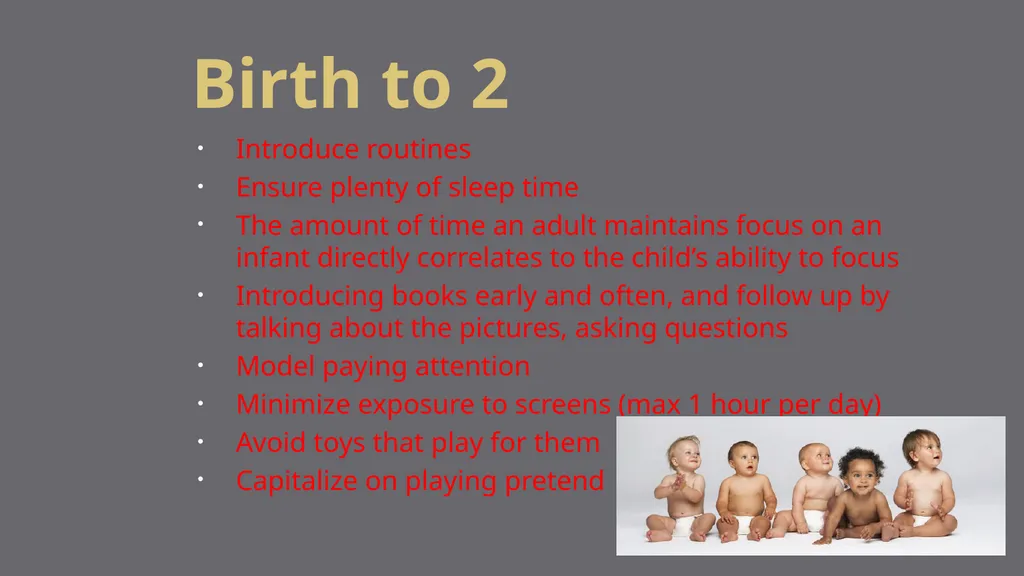
Birth to 2 Introduce routines
Ensure plenty of sleep time
The amount of time an adult maintains focus on an infant directly correlates to the child’s ability to focus
Introducing books early and often, and follow up by talking about the pictures, asking questions
Model paying attention
Minimize exposure to screens (max 1 hour per day)
Avoid toys that play for them
Capitalize on playing pretend<br>
11
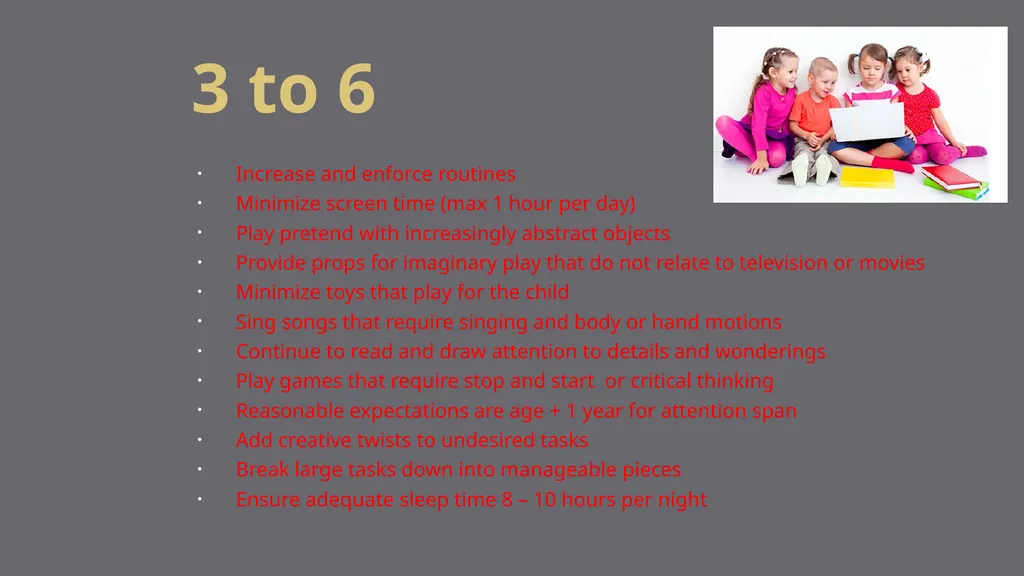
3 to 6 Increase and enforce routines
Minimize screen time (max 1 hour per day)
Play pretend with increasingly abstract objects
Provide props for imaginary play that do not relate to television or movies
Minimize toys that play for the child
Sing songs that require singing and body or hand motions
Continue to read and draw attention to details and wonderings
Play games that require stop and start or critical thinking
Reasonable expectations are age + 1 year for attention span
Add creative twists to undesired tasks
Break large tasks down into manageable pieces
Ensure adequate sleep time 8 – 10 hours per night<br>
12
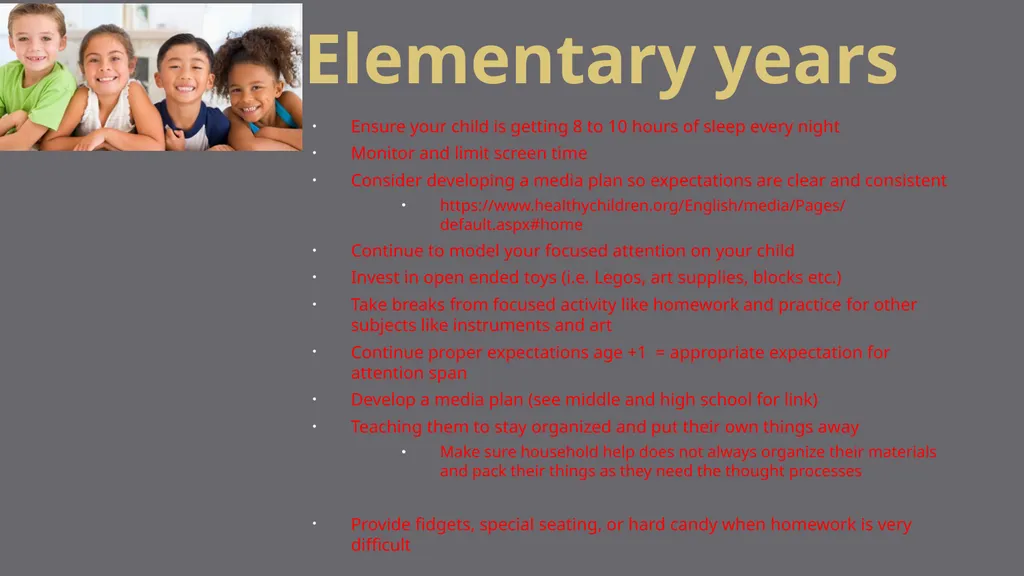
Elementary years Ensure your child is getting 8 to 10 hours of sleep every night
Monitor and limit screen time
Consider developing a media plan so expectations are clear and consistent
https://www.healthychildren.org/English/media/Pages/default.aspx#home
Continue to model your focused attention on your child
Invest in open ended toys (i.e. Legos, art supplies, blocks etc.)
Take breaks from focused activity like homework and practice for other subjects like instruments and art
Continue proper expectations age +1 = appropriate expectation for attention span
Develop a media plan (see middle and high school for link)
Teaching them to stay organized and put their own things away
Make sure household help does not always organize their materials and pack their things as they need the thought processes
Provide fidgets, special seating, or hard candy when homework is very difficult<br>
13
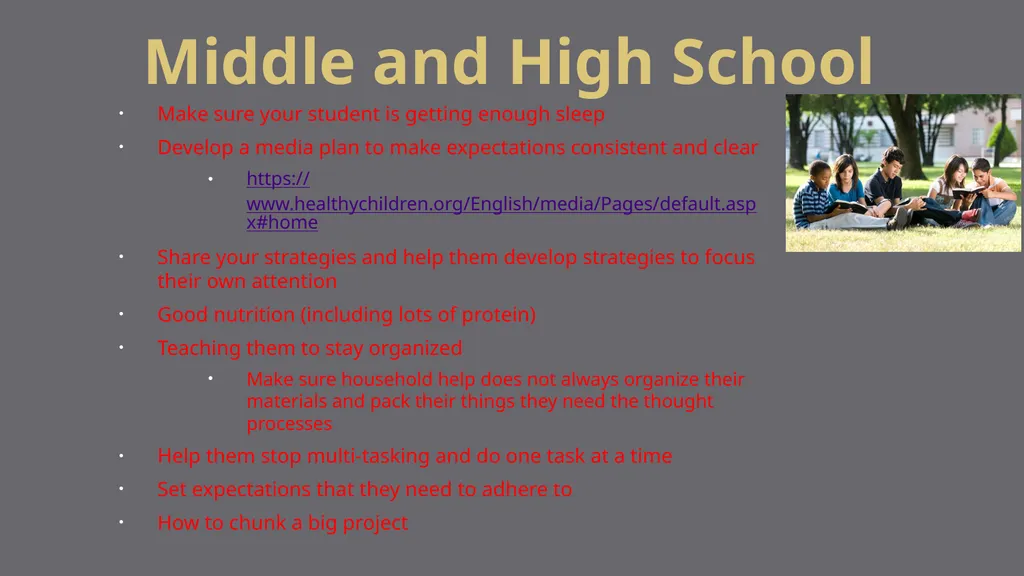
Middle and High School Make sure your student is getting enough sleep
Develop a media plan to make expectations consistent and clear
https://www.healthychildren.org/English/media/Pages/default.aspx#home
Share your strategies and help them develop strategies to focus their own attention
Good nutrition (including lots of protein)
Teaching them to stay organized
Make sure household help does not always organize their materials and pack their things they need the thought processes
Help them stop multi-tasking and do one task at a time
Set expectations that they need to adhere to
How to chunk a big project<br>
14
If you have a student who is struggling extensively with focusing their attention…<br>
15
How does your engine run? Sensory - motor preference checklist
Sensorimotor methods to change engine levels
Changing how alert you feel A-46<br>
16
Games to Improve Concentration Concentration
LiteBrite
Simon
Chess
Martial Arts
Operation
Raps, songs
Yoga
Meditation
Mazes
Rush Hour
Sudoku<br>
17
Remaining Consistent -reinforce appropriate behaviours and ignore mild
inappropriate behaviours
− use “when–then” contingencies such as “when you finish picking up your Lego, then you can start your video.” This strategy will help children see the connection between their behaviours and consequences<br>
18
Discussion Questions When do you feel your child needs the most self-regulation help?
What is the routine?
When are the highs and lows?<br>
19
Library Books (aka: Social Storybooks) Blurting - My Mouth is a Volcano by Julia Cook
Body Awareness – Personal Space Camp by Julia Cook
Anger Management – When Sophie Was Angry, Really, Really Angry by Molly Bang
Anger Management – Sometimes I’m a Bombaloo by Rachel Vail
Anger Management – Hands are Not for Hitting by Martine Agassi and Marieka Heinlen
Talk to Malin Halliday in the library if you have a particular issue and she may be able to guide you to an appropriate social story.<br>
20
External mediators Using visuals can help your student guide their own routine and behaviors and take away your necessity for constant reminders.
Timers also help add fun and expectations
Involve your student in deciding which mediators to use Using weighted materials can actually help children focus especially when they are angry or anxious
Keeping materials available at a child’s level helps them apply what they need when they need it<br>
21
Make and take Build a routine for your student
Make a mediator to help with a certain skill
Walk through the process of making a media plan<br>
22
Sources used for this presentation http://developingchild.harvard.edu
http://pediatrics.aappublications.org/content/138/5/e20162591
https://www.healthychildren.org/English/media/Pages/default.aspx#home Presentation by Jodie Hopkins and
Sylvie Pinsonnault<br>