
Semantic Networks, Frames, Scripts and Rules Dr
Description: Semantic Networks, Frames, Scripts and Rules Dr Nicholas Gibbins 324037 nmgecs.soton.ac.uk Semantic Networks Network Knowledge Representation Traditional knowledge representation is formal logic Network knowledge representation
Related Topics
Download Presentation
"Semantic Networks, Frames, Scripts and Rules Dr" is the property of its rightful owner. Permission is granted to download and print the materials on this website for personal, non-commercial use only, and to display it on your personal computer provided you do not modify the materials and that you retain all copyright notices contained in the materials. By downloading content from our website, you accept the terms of this agreement.
Presentation Transcript
slide1. Semantic Networks, Frames, Scripts and Rules Dr Nicholas Gibbins
32/4037
nmg@ecs.soton.ac.uk<br>
slide2. Semantic Networks<br>
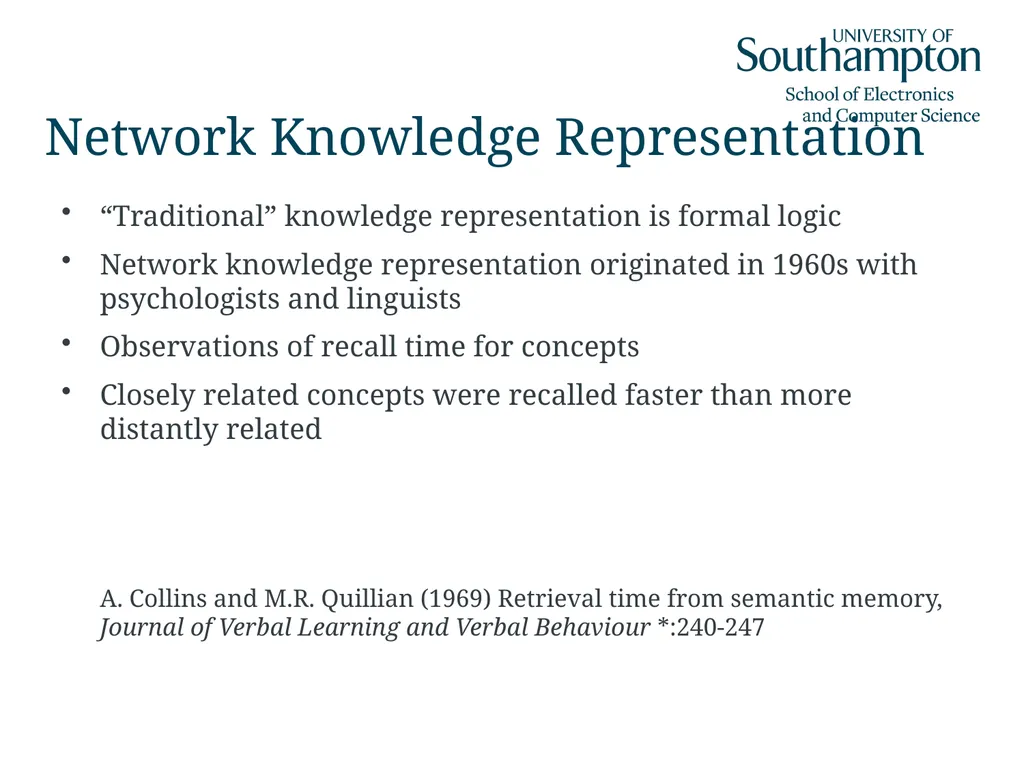
slide3. Network Knowledge Representation “Traditional” knowledge representation is formal logic
Network knowledge representation originated in 1960s with psychologists and linguists
Observations of recall time for concepts
Closely related concepts were recalled faster than more distantly related
A. Collins and M.R. Quillian (1969) Retrieval time from semantic memory, Journal of Verbal Learning and Verbal Behaviour *:240-247<br>
slide4. Semantic Networks A semantic network is a structure for representing knowledge as a pattern of interconnected nodes and arcs
Nodes in the net represent concepts of entities, attributes, events, values
Arcs in the network represent relationships that hold between the concepts<br>
slide5. Semantic Networks Semantic networks can show inheritance
Relationship types – is-a, has-a
Semantic Nets - visual representation of relationships
Can be combined with other representation methods<br>
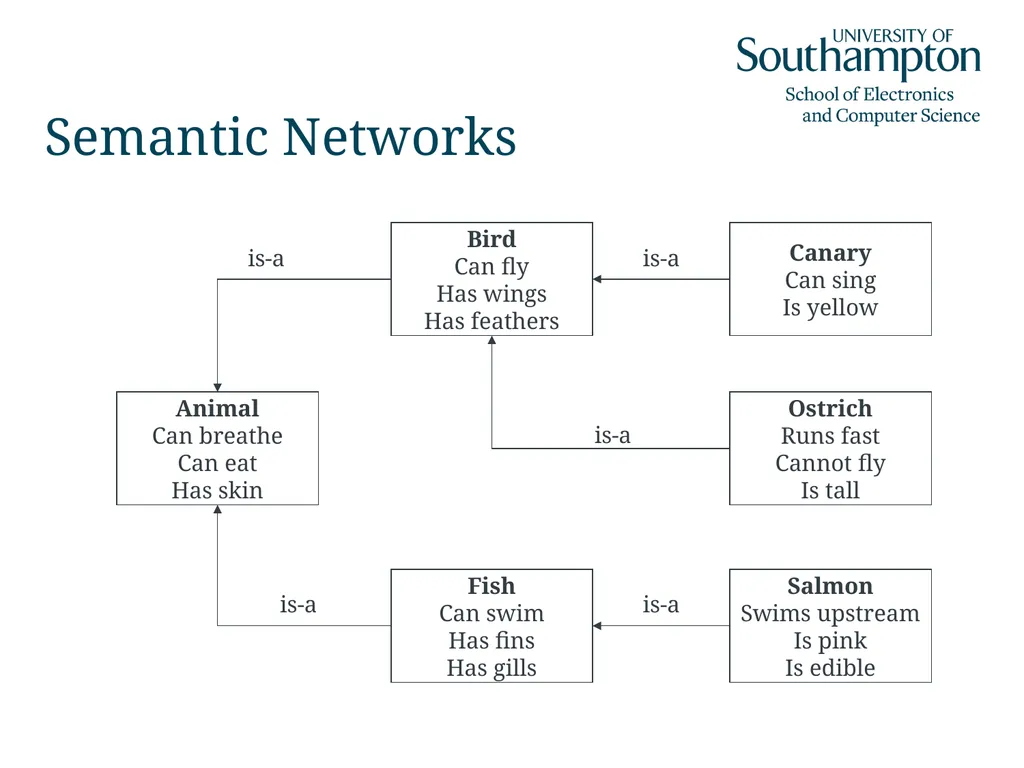
slide6. Semantic Networks Animal
Can breathe
Can eat
Has skin Bird
Can fly
Has wings
Has feathers Canary
Can sing
Is yellow Ostrich
Runs fast
Cannot fly
Is tall Fish
Can swim
Has fins
Has gills Salmon
Swims upstream
Is pink
Is edible is-a is-a is-a is-a is-a<br>
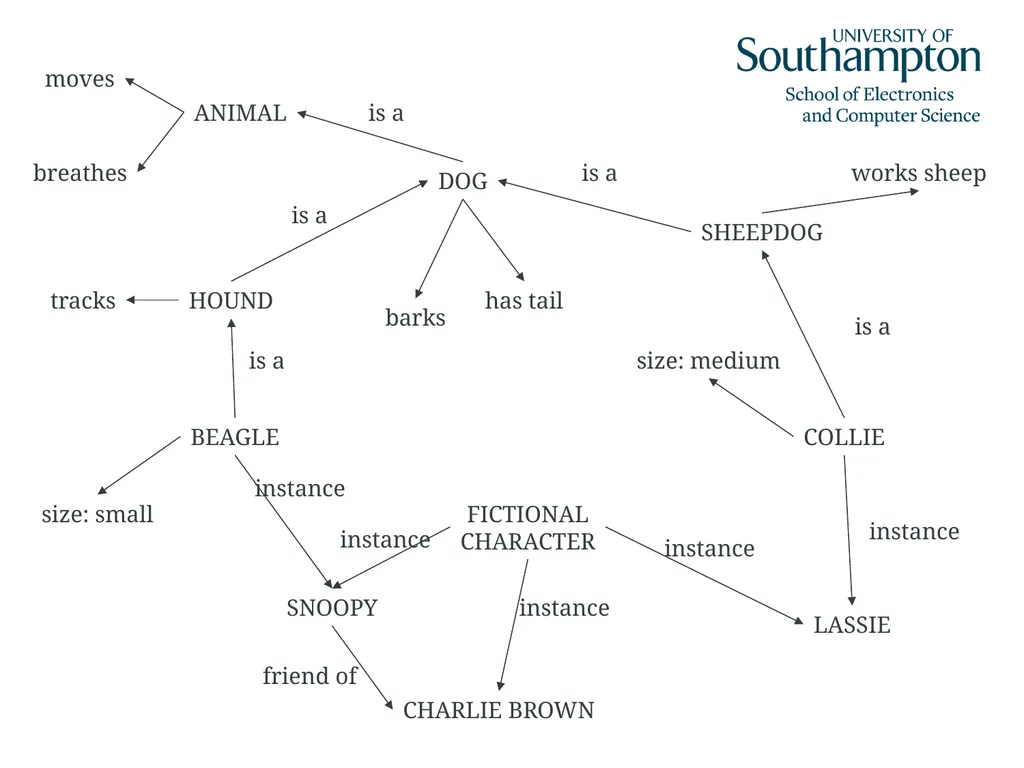
slide7. DOG ANIMAL HOUND BEAGLE SNOOPY COLLIE LASSIE SHEEPDOG is a is a is a is a barks is a instance instance CHARLIE BROWN FICTIONAL CHARACTER instance instance instance has tail moves breathes size: medium size: small works sheep tracks friend of<br>
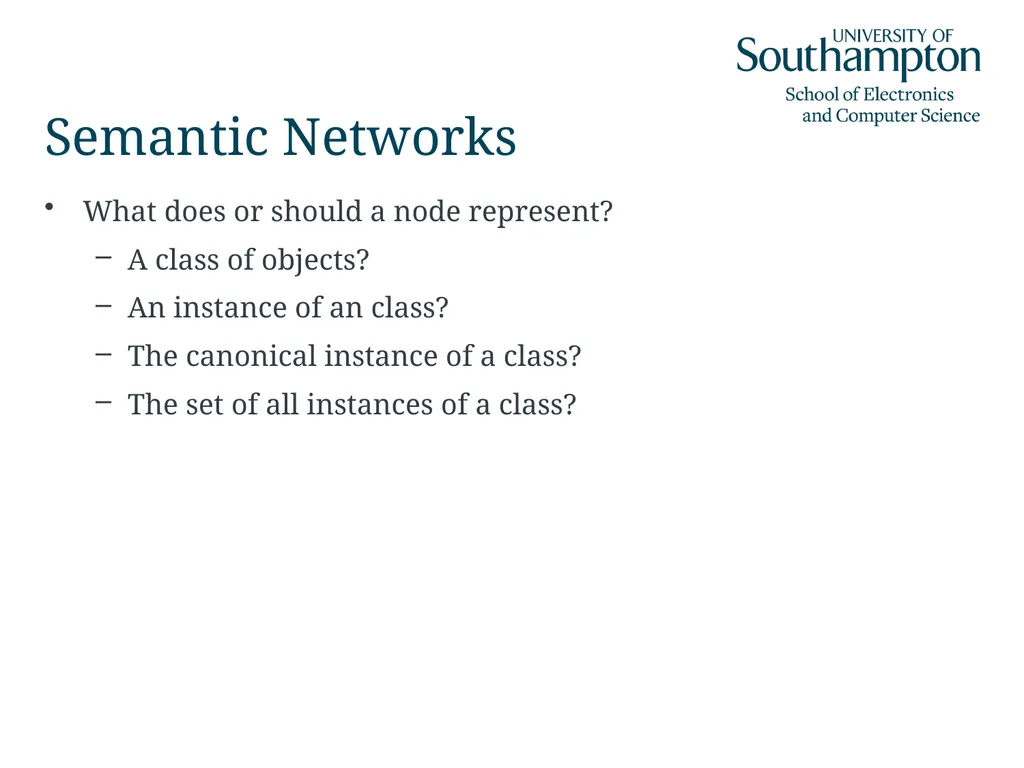
slide8. Semantic Networks What does or should a node represent?
A class of objects?
An instance of an class?
The canonical instance of a class?
The set of all instances of a class?<br>
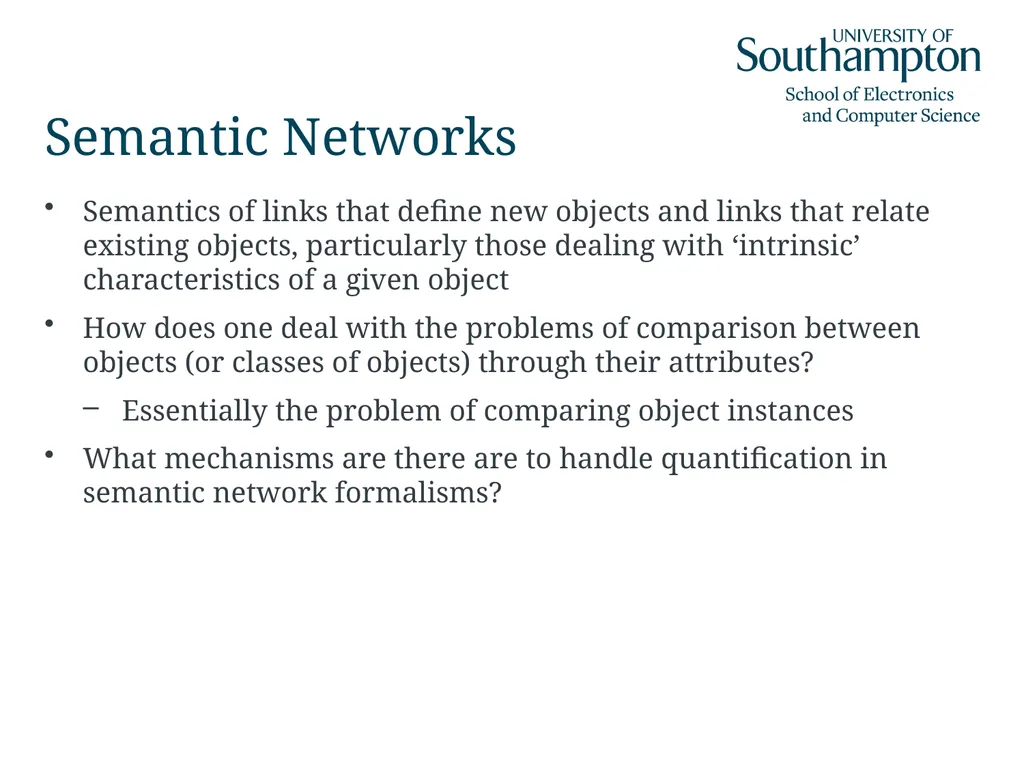
slide9. Semantic Networks Semantics of links that define new objects and links that relate existing objects, particularly those dealing with ‘intrinsic’ characteristics of a given object
How does one deal with the problems of comparison between objects (or classes of objects) through their attributes?
Essentially the problem of comparing object instances
What mechanisms are there are to handle quantification in semantic network formalisms?<br>
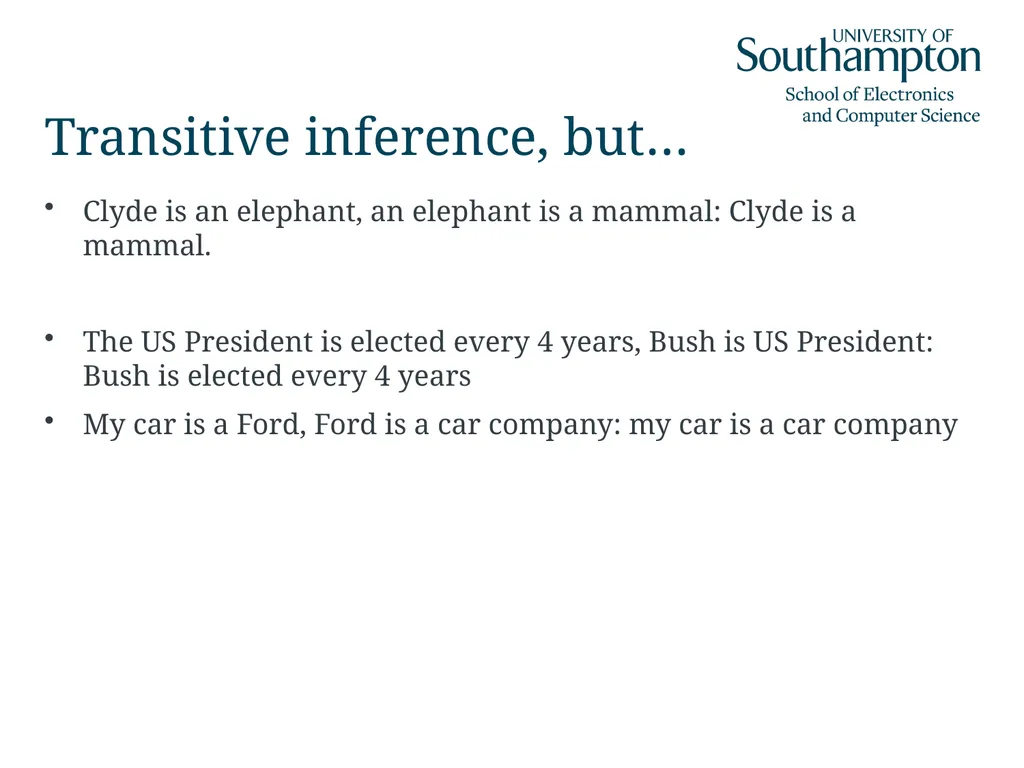
slide10. Transitive inference, but… Clyde is an elephant, an elephant is a mammal: Clyde is a mammal.
The US President is elected every 4 years, Bush is US President: Bush is elected every 4 years
My car is a Ford, Ford is a car company: my car is a car company<br>
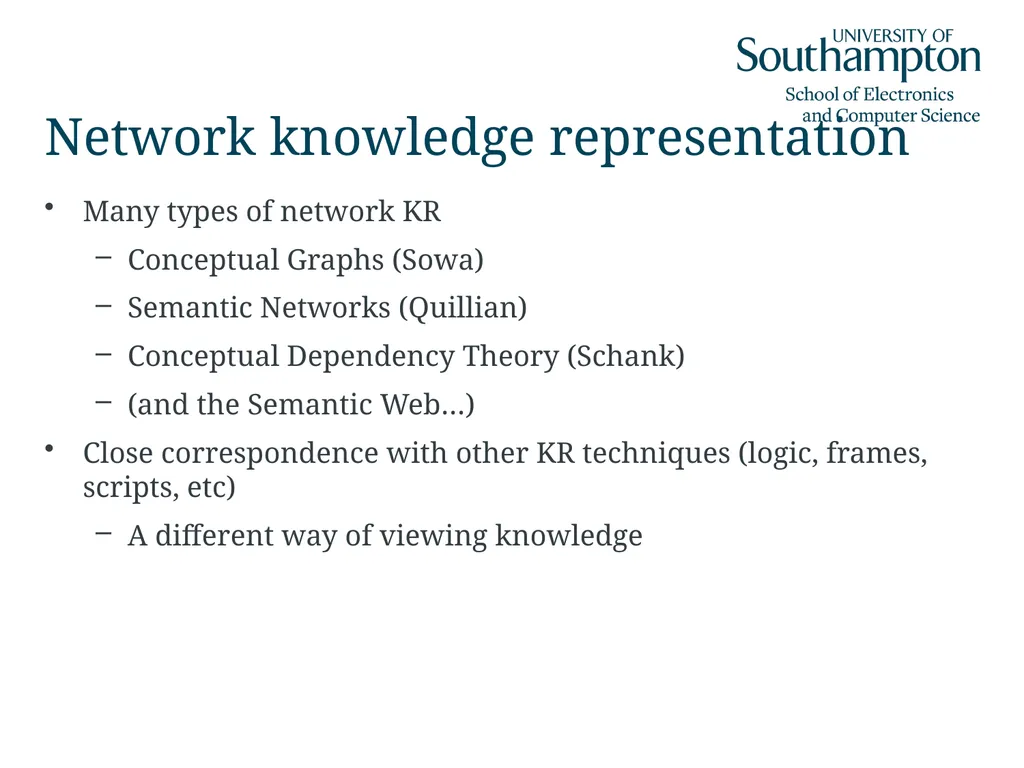
slide11. Network knowledge representation Many types of network KR
Conceptual Graphs (Sowa)
Semantic Networks (Quillian)
Conceptual Dependency Theory (Schank)
(and the Semantic Web…)
Close correspondence with other KR techniques (logic, frames, scripts, etc)
A different way of viewing knowledge<br>
slide12. Frames<br>
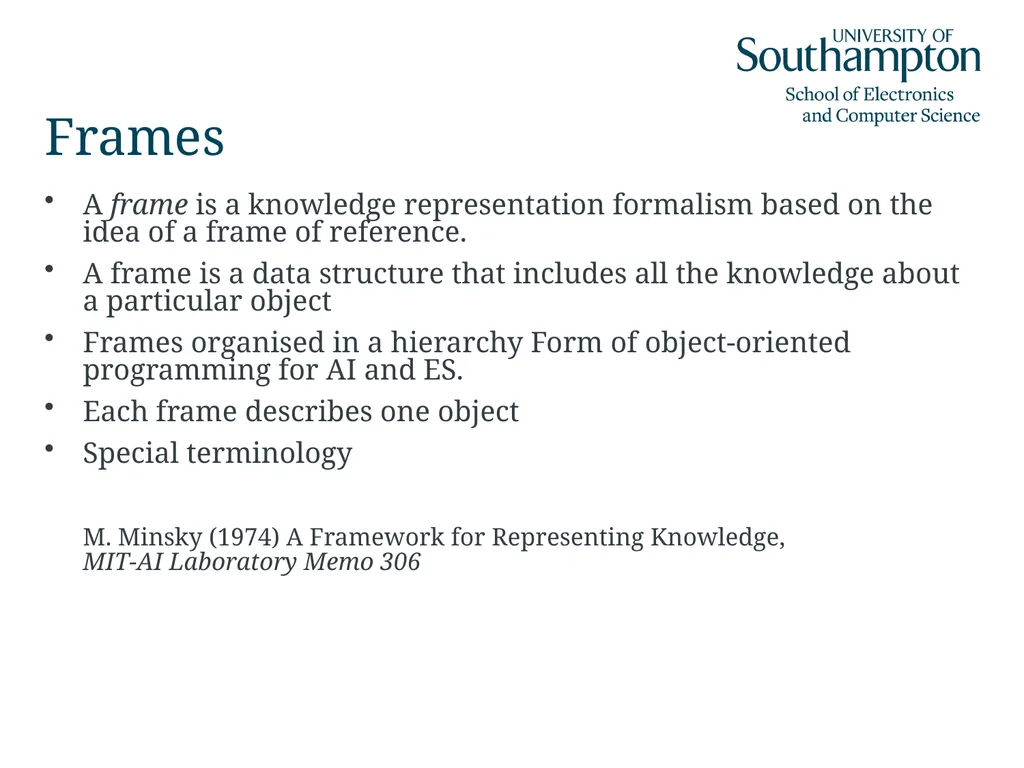
slide13. Frames A frame is a knowledge representation formalism based on the idea of a frame of reference.
A frame is a data structure that includes all the knowledge about a particular object
Frames organised in a hierarchy Form of object-oriented programming for AI and ES.
Each frame describes one object
Special terminology
M. Minsky (1974) A Framework for Representing Knowledge, MIT-AI Laboratory Memo 306<br>
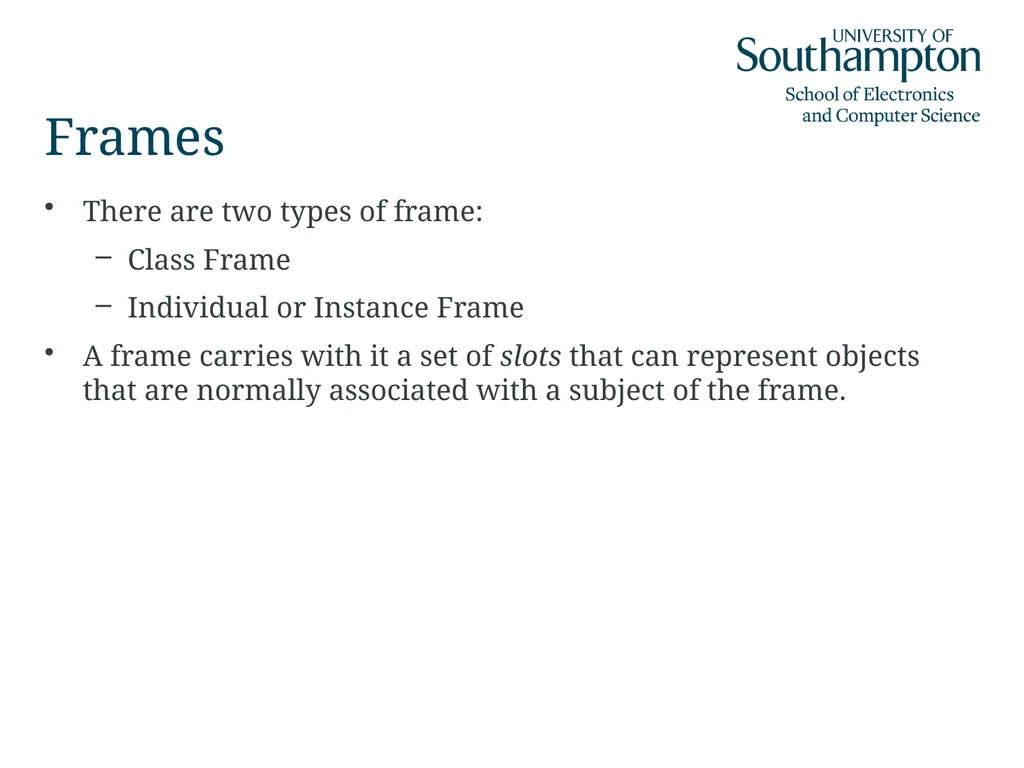
slide14. Frames There are two types of frame:
Class Frame
Individual or Instance Frame
A frame carries with it a set of slots that can represent objects that are normally associated with a subject of the frame.<br>
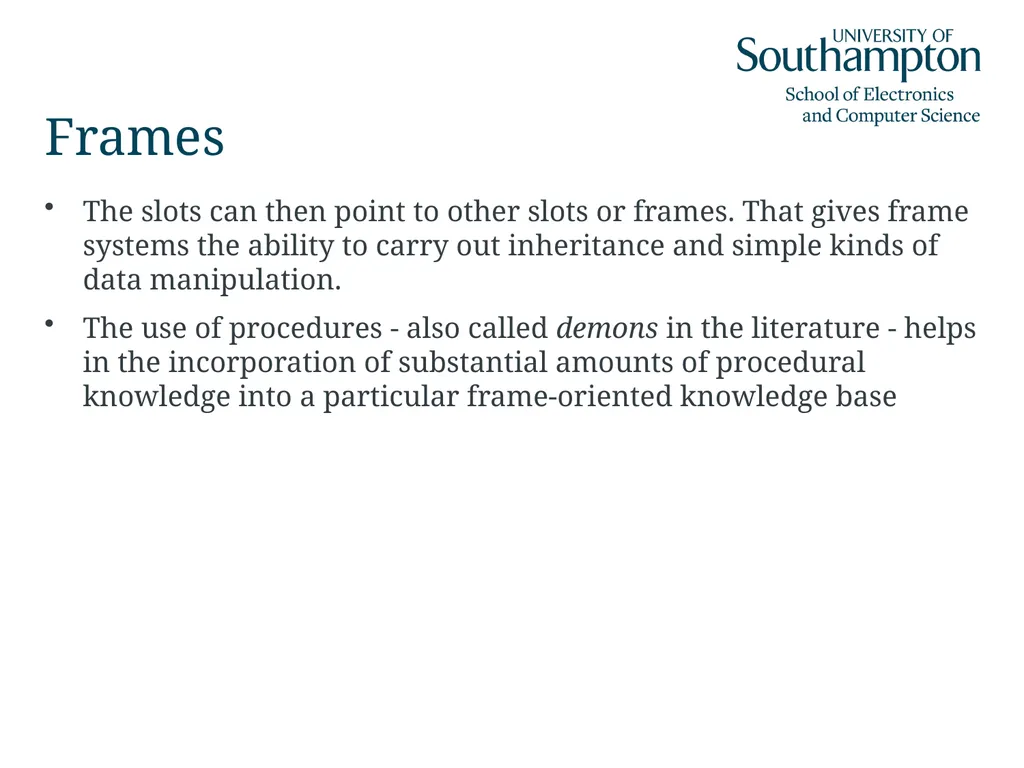
slide15. Frames The slots can then point to other slots or frames. That gives frame systems the ability to carry out inheritance and simple kinds of data manipulation.
The use of procedures - also called demons in the literature - helps in the incorporation of substantial amounts of procedural knowledge into a particular frame-oriented knowledge base<br>
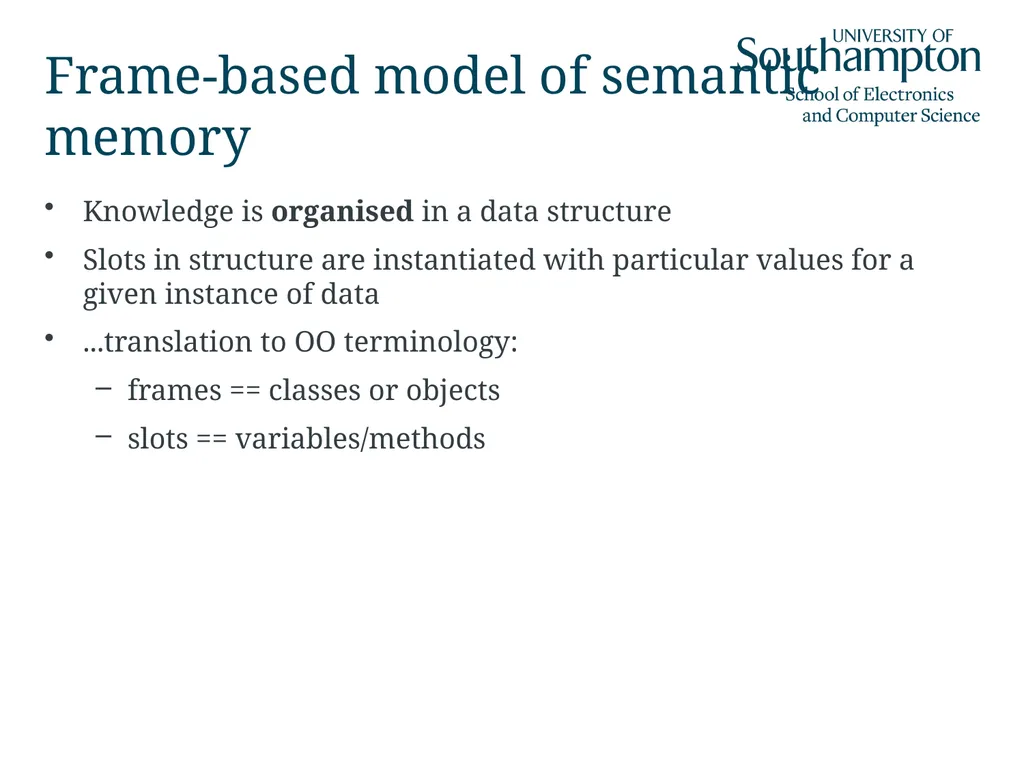
slide16. Frame-based model of semantic memory Knowledge is organised in a data structure
Slots in structure are instantiated with particular values for a given instance of data
...translation to OO terminology:
frames == classes or objects
slots == variables/methods<br>
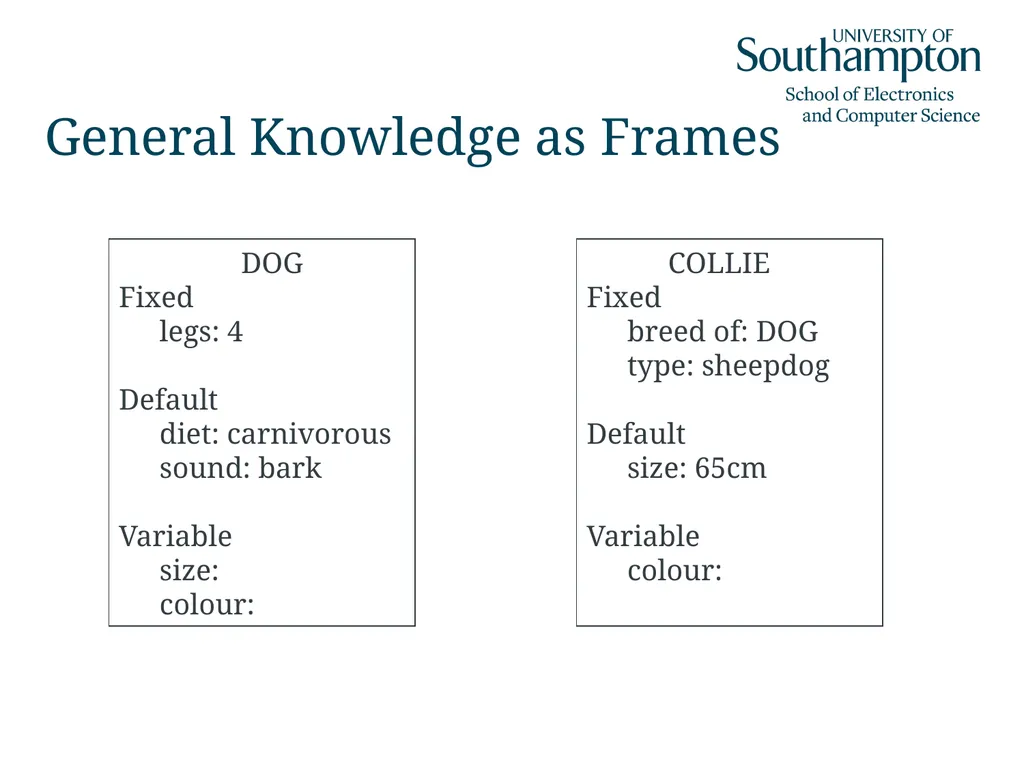
slide17. General Knowledge as Frames DOG
Fixed
legs: 4
Default
diet: carnivorous
sound: bark
Variable
size:
colour: COLLIE
Fixed
breed of: DOG
type: sheepdog
Default
size: 65cm
Variable
colour:<br>
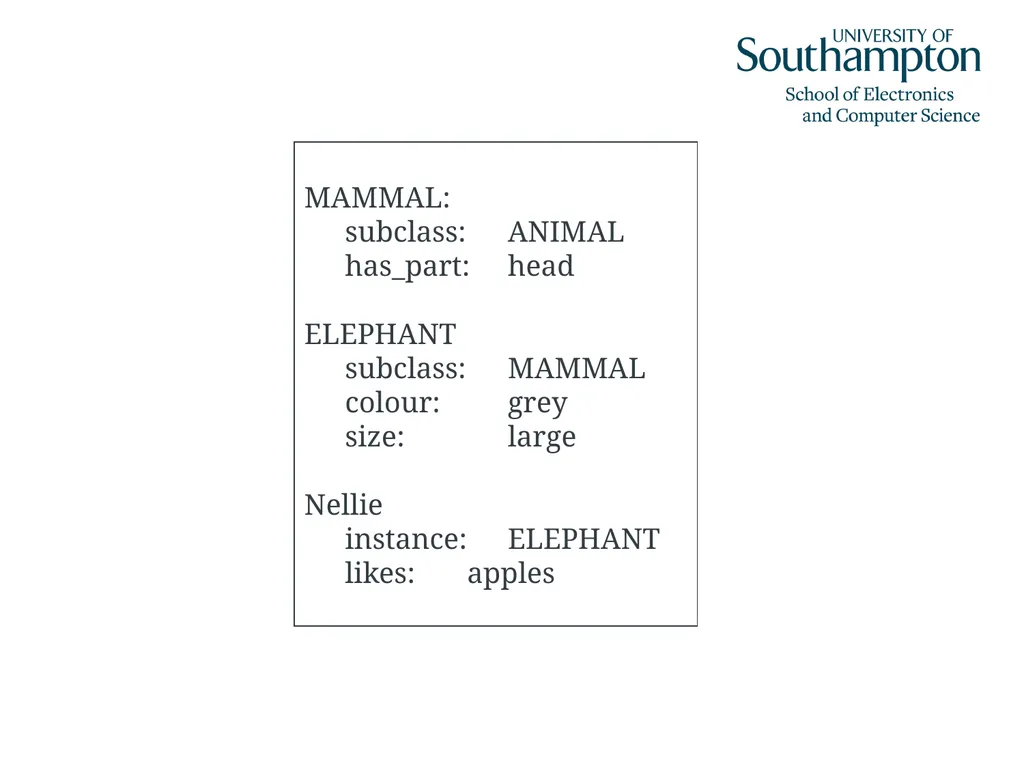
slide18. MAMMAL:
subclass: ANIMAL
has_part: head
ELEPHANT
subclass: MAMMAL
colour: grey
size: large
Nellie
instance: ELEPHANT
likes: apples<br>
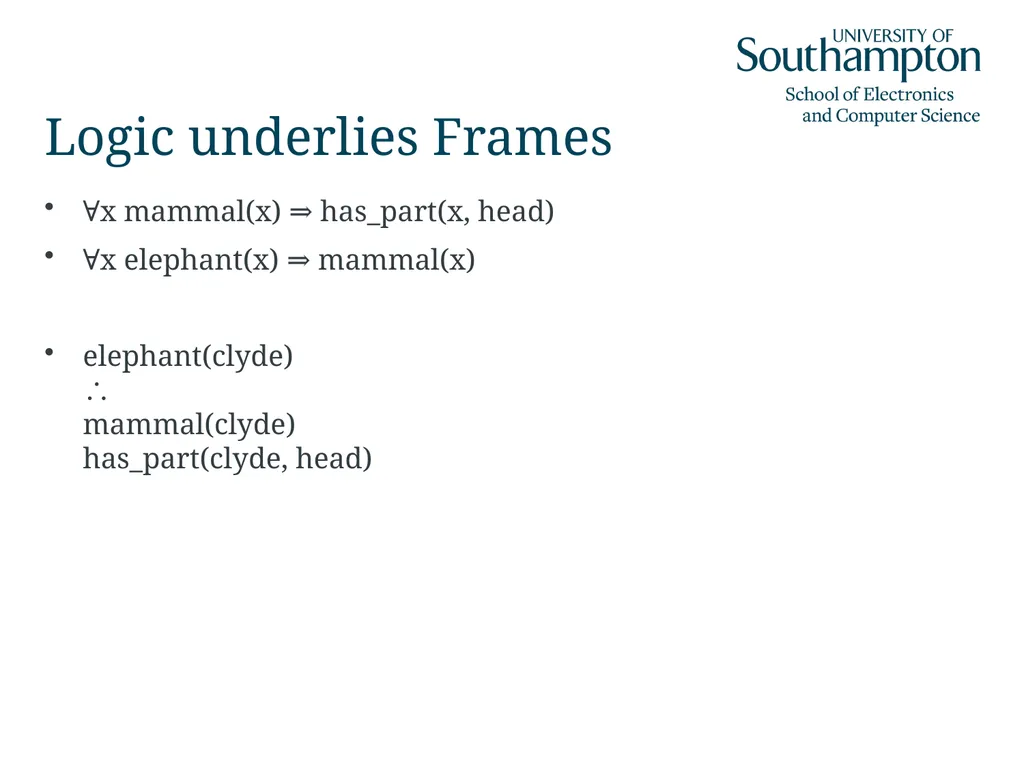
slide19. Logic underlies Frames ∀x mammal(x) ⇒ has_part(x, head)
∀x elephant(x) ⇒ mammal(x)
elephant(clyde) ∴ mammal(clyde) has_part(clyde, head)<br>
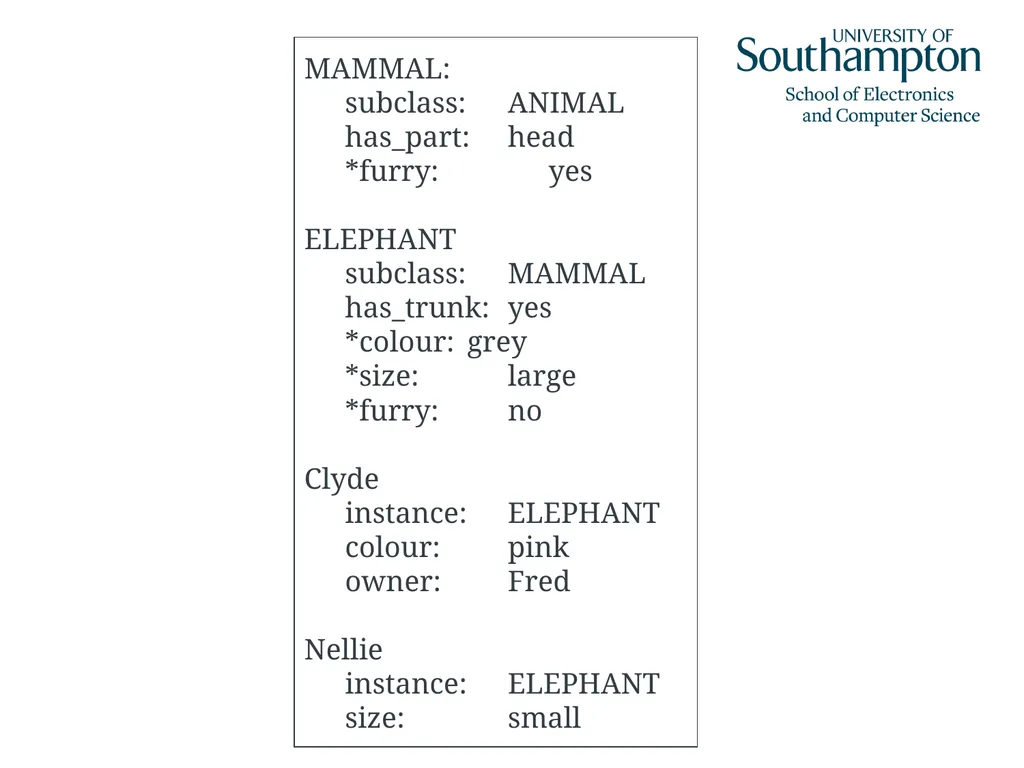
slide20. MAMMAL:
subclass: ANIMAL
has_part: head
*furry: yes
ELEPHANT
subclass: MAMMAL
has_trunk: yes
*colour: grey
*size: large
*furry: no
Clyde
instance: ELEPHANT
colour: pink
owner: Fred
Nellie
instance: ELEPHANT
size: small<br>
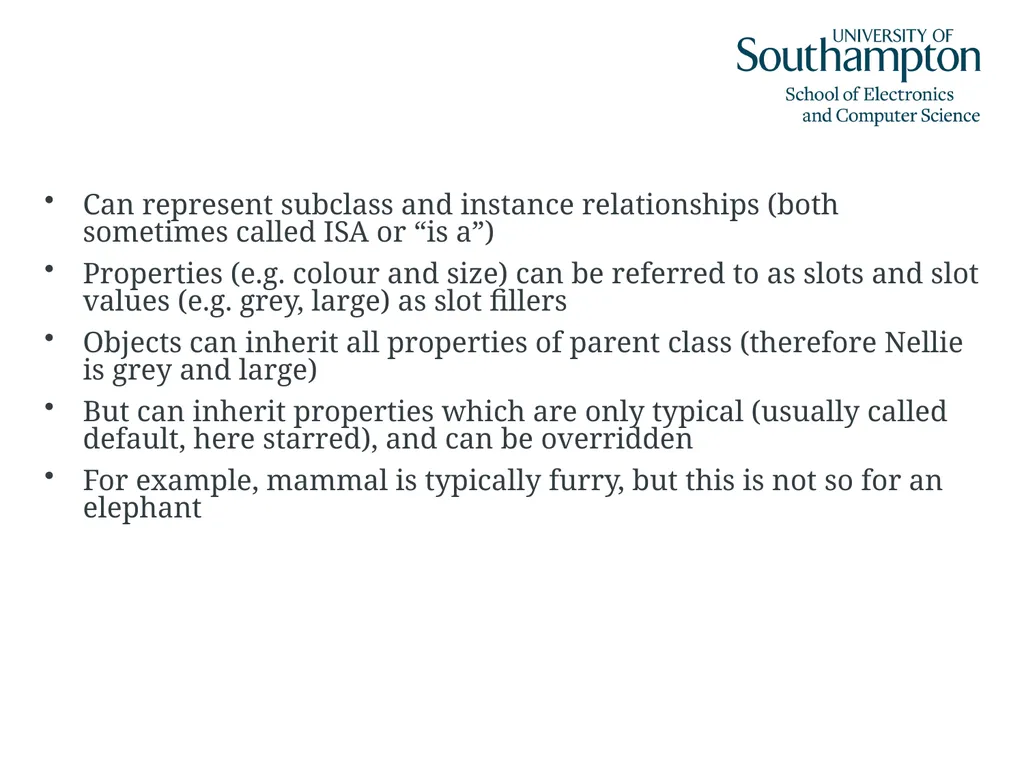
slide21. Can represent subclass and instance relationships (both sometimes called ISA or “is a”)
Properties (e.g. colour and size) can be referred to as slots and slot values (e.g. grey, large) as slot fillers
Objects can inherit all properties of parent class (therefore Nellie is grey and large)
But can inherit properties which are only typical (usually called default, here starred), and can be overridden
For example, mammal is typically furry, but this is not so for an elephant<br>
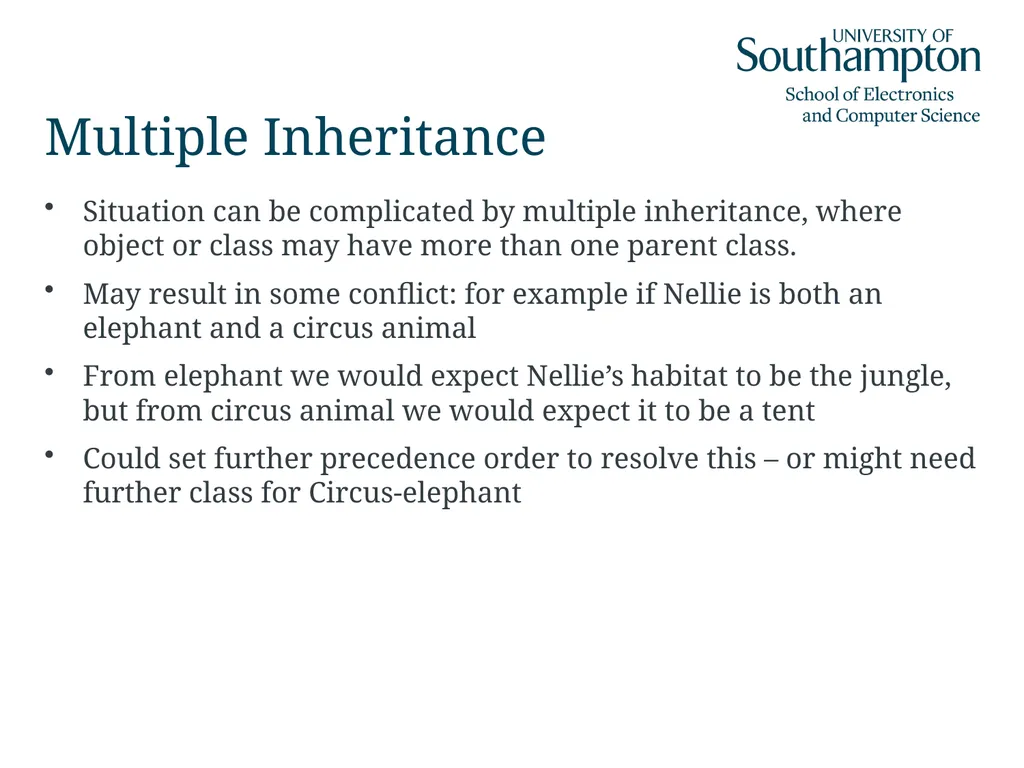
slide22. Multiple Inheritance Situation can be complicated by multiple inheritance, where object or class may have more than one parent class.
May result in some conflict: for example if Nellie is both an elephant and a circus animal
From elephant we would expect Nellie’s habitat to be the jungle, but from circus animal we would expect it to be a tent
Could set further precedence order to resolve this – or might need further class for Circus-elephant<br>
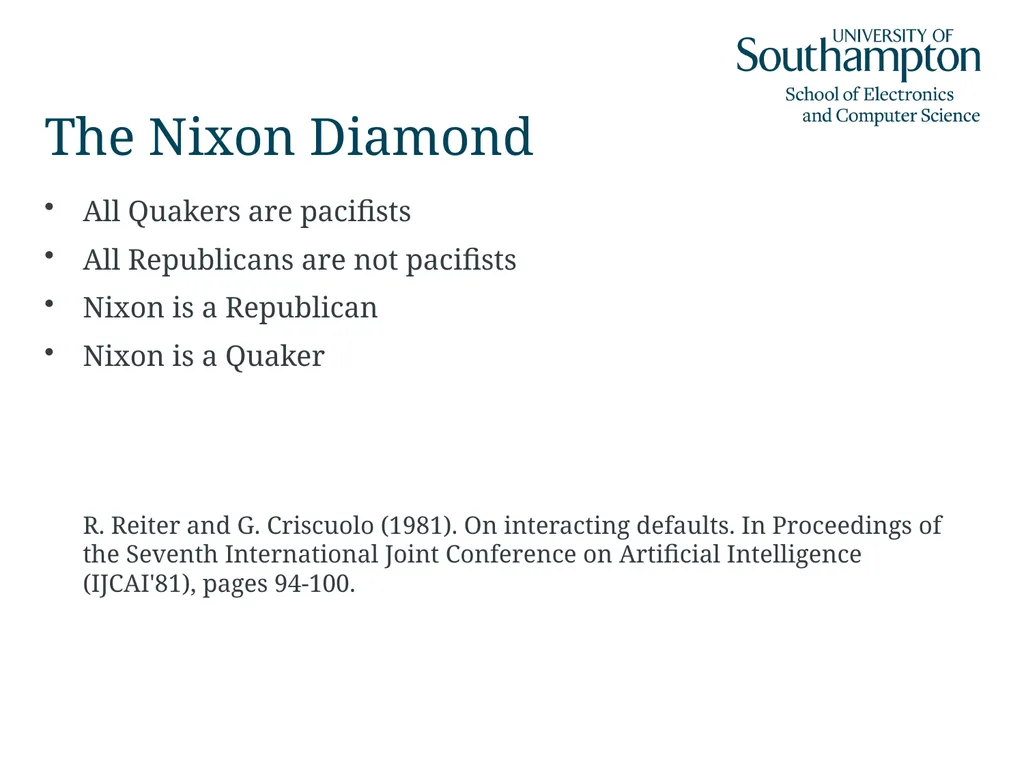
slide23. The Nixon Diamond All Quakers are pacifists
All Republicans are not pacifists
Nixon is a Republican
Nixon is a Quaker
R. Reiter and G. Criscuolo (1981). On interacting defaults. In Proceedings of the Seventh International Joint Conference on Artificial Intelligence (IJCAI'81), pages 94-100.<br>
slide24. Prototypical Situations Many situations are prototypical
Prototypical situations share a common set of attributes
We can use the powerful inheritance capabilities of the frames representation to help represent these situations<br>
slide25. Provide a concise, structural representation of knowledge in a natural manner
Frame encompasses complex objects, entire situations or a management problem as a single entity
Frame knowledge is partitioned into slots
Slot can describe declarative knowledge or procedural knowledge
Hierarchy of Frames: Inheritance<br>
slide26. Capabilities of Frames Ability to clearly document information about a domain model; for example, a plant's machines and their associated attributes
Related ability to constrain allowable values of an attribute
Modularity of information, permitting ease of system expansion and maintenance
More readable and consistent syntax for referencing domain objects in the rules<br>
slide27. Capabilities of Frames Platform for building graphic interface with object graphics
Mechanism to restrict the scope of facts considered during forward or backward chaining
Access to a mechanism that supports the inheritance of information down a class hierarchy
Used as underlying model in standards for accessing KBs (Open Knowledge Base Connectivity - OKBC)<br>
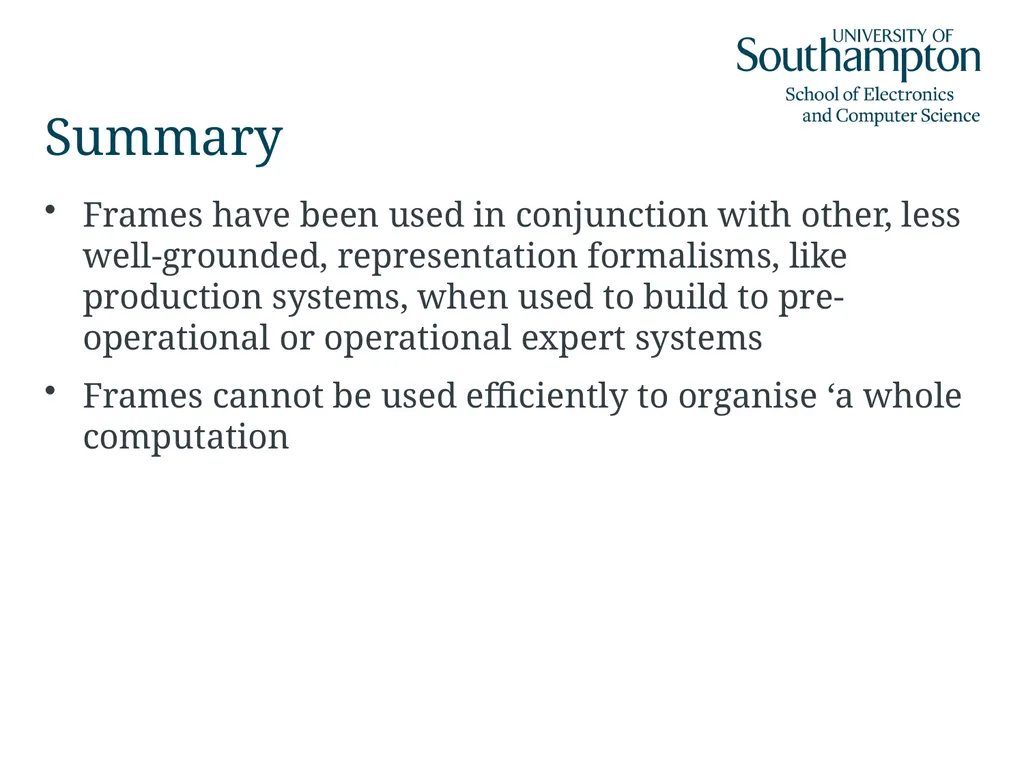
slide28. Summary Frames have been used in conjunction with other, less well-grounded, representation formalisms, like production systems, when used to build to pre-operational or operational expert systems
Frames cannot be used efficiently to organise ‘a whole computation<br>
slide29. Scripts<br>
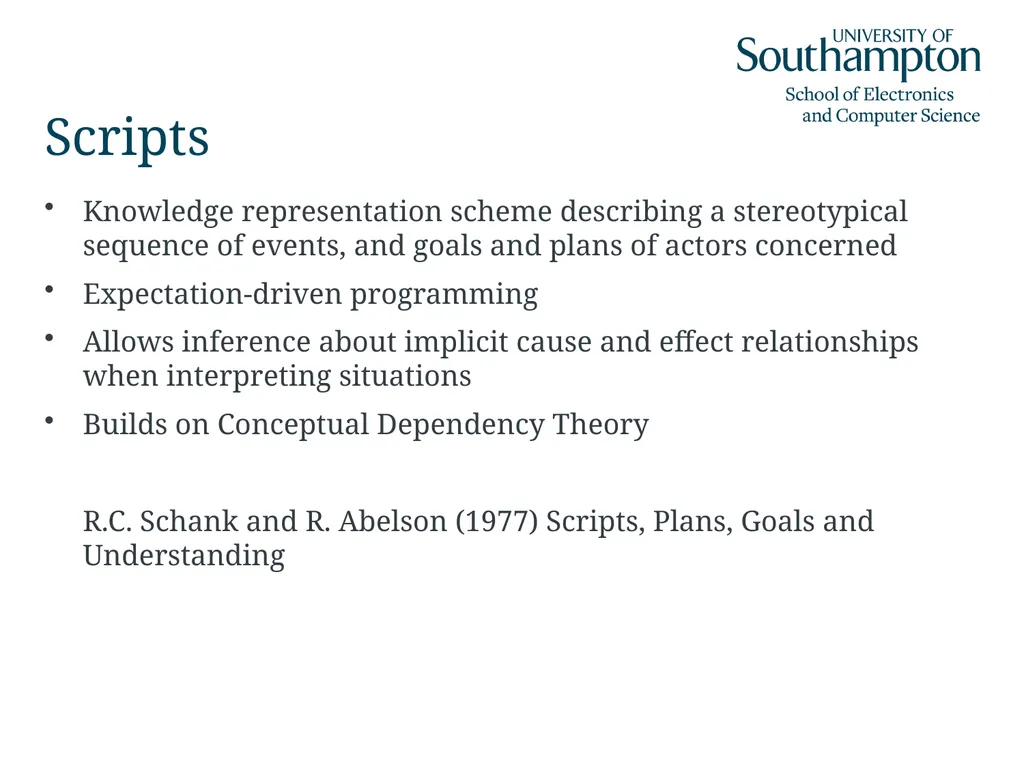
slide30. Scripts Knowledge representation scheme describing a stereotypical sequence of events, and goals and plans of actors concerned
Expectation-driven programming
Allows inference about implicit cause and effect relationships when interpreting situations
Builds on Conceptual Dependency Theory
R.C. Schank and R. Abelson (1977) Scripts, Plans, Goals and Understanding<br>
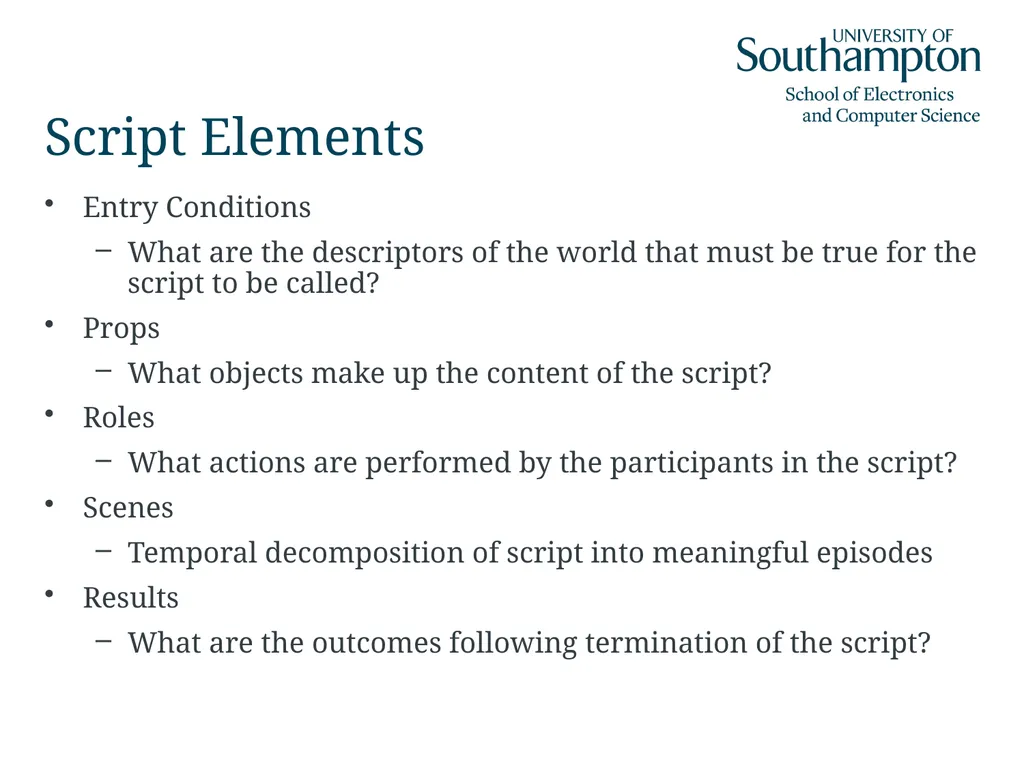
slide31. Script Elements Entry Conditions
What are the descriptors of the world that must be true for the script to be called?
Props
What objects make up the content of the script?
Roles
What actions are performed by the participants in the script?
Scenes
Temporal decomposition of script into meaningful episodes
Results
What are the outcomes following termination of the script?<br>
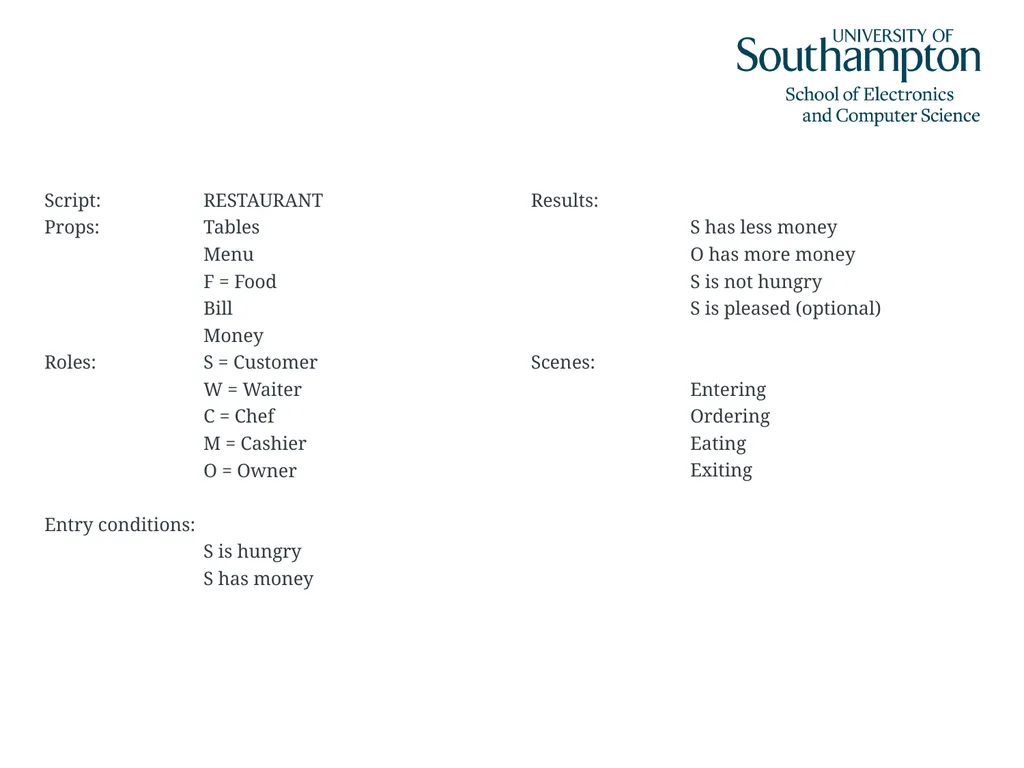
slide32. Script: RESTAURANT
Props: Tables
Menu
F = Food
Bill
Money
Roles: S = Customer
W = Waiter
C = Chef
M = Cashier
O = Owner
Entry conditions:
S is hungry
S has money Results:
S has less money
O has more money
S is not hungry
S is pleased (optional)
Scenes:
Entering
Ordering
Eating
Exiting<br>
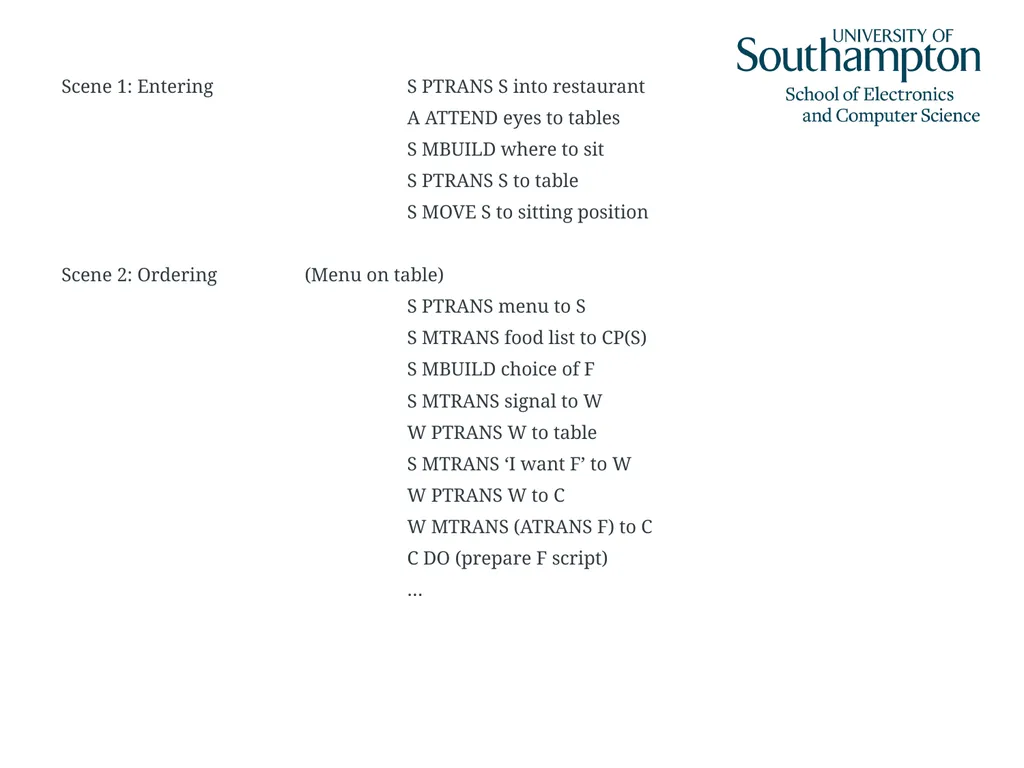
slide33. Scene 1: Entering S PTRANS S into restaurant
A ATTEND eyes to tables
S MBUILD where to sit
S PTRANS S to table
S MOVE S to sitting position
Scene 2: Ordering (Menu on table)
S PTRANS menu to S
S MTRANS food list to CP(S)
S MBUILD choice of F
S MTRANS signal to W
W PTRANS W to table
S MTRANS ‘I want F’ to W
W PTRANS W to C
W MTRANS (ATRANS F) to C
C DO (prepare F script)
…<br>
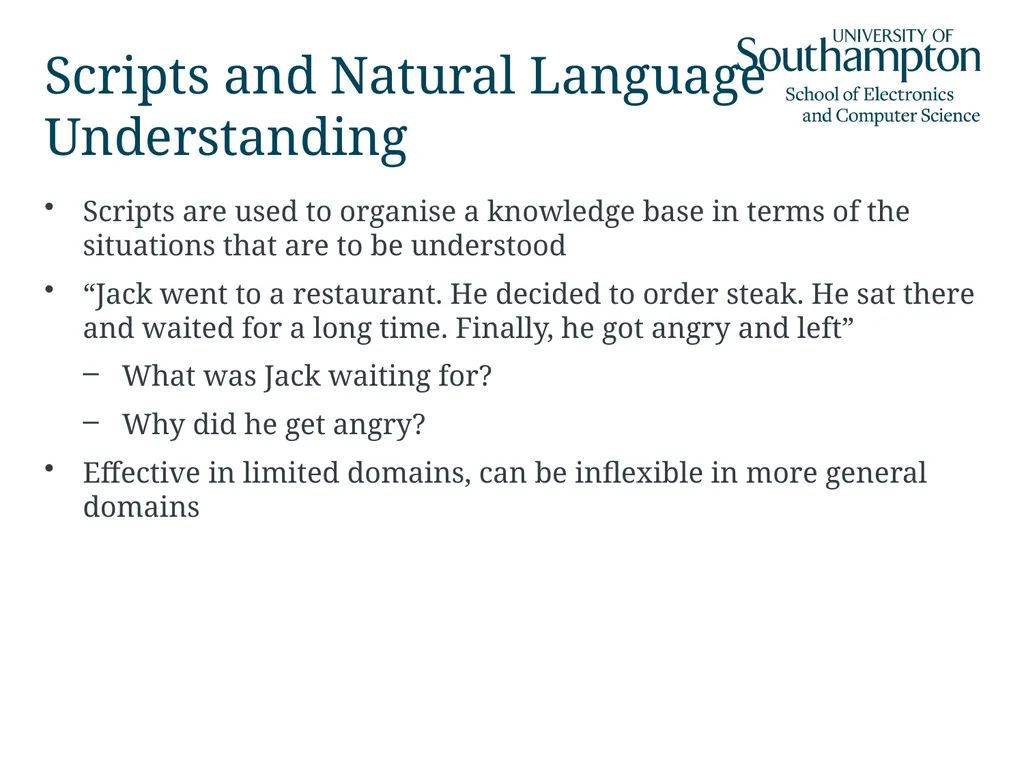
slide34. Scripts and Natural Language Understanding Scripts are used to organise a knowledge base in terms of the situations that are to be understood
“Jack went to a restaurant. He decided to order steak. He sat there and waited for a long time. Finally, he got angry and left”
What was Jack waiting for?
Why did he get angry?
Effective in limited domains, can be inflexible in more general domains<br>
slide35. Production Rules<br>
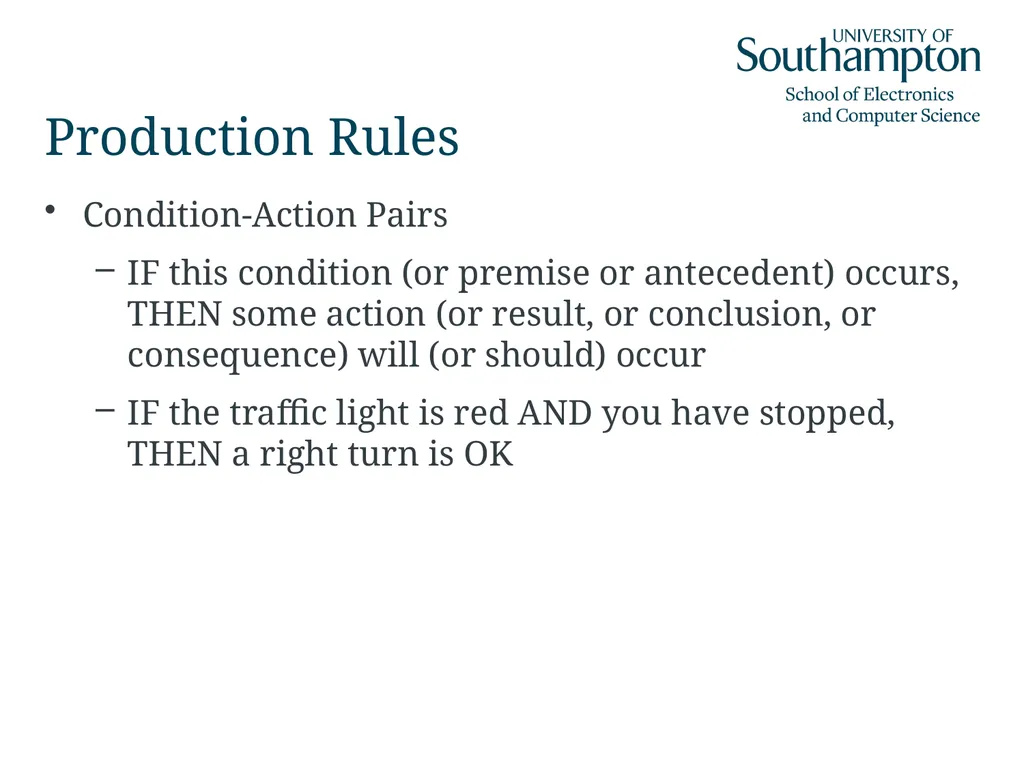
slide36. Production Rules Condition-Action Pairs
IF this condition (or premise or antecedent) occurs, THEN some action (or result, or conclusion, or consequence) will (or should) occur
IF the traffic light is red AND you have stopped, THEN a right turn is OK<br>
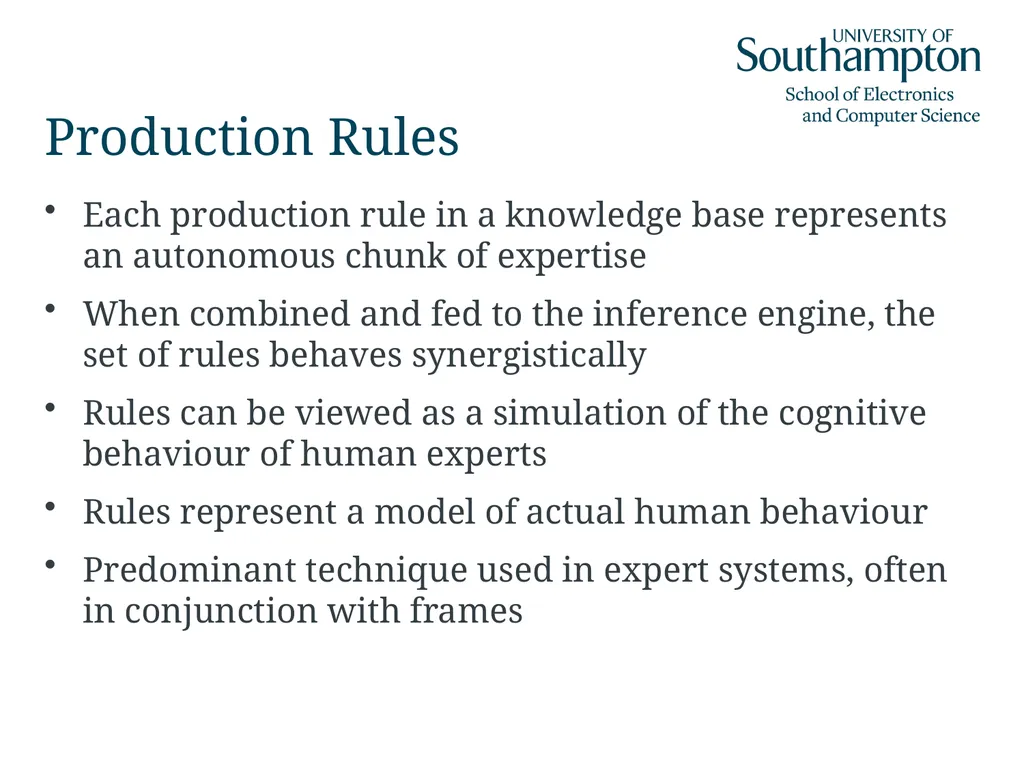
slide37. Production Rules Each production rule in a knowledge base represents an autonomous chunk of expertise
When combined and fed to the inference engine, the set of rules behaves synergistically
Rules can be viewed as a simulation of the cognitive behaviour of human experts
Rules represent a model of actual human behaviour
Predominant technique used in expert systems, often in conjunction with frames<br>
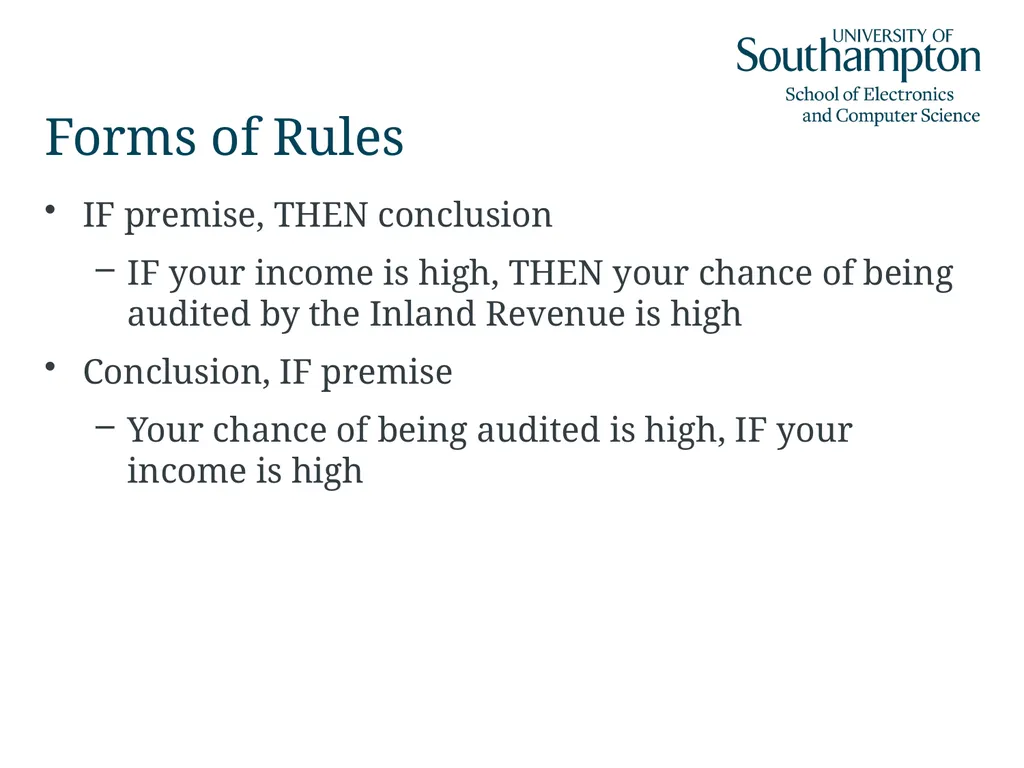
slide38. Forms of Rules IF premise, THEN conclusion
IF your income is high, THEN your chance of being audited by the Inland Revenue is high
Conclusion, IF premise
Your chance of being audited is high, IF your income is high<br>
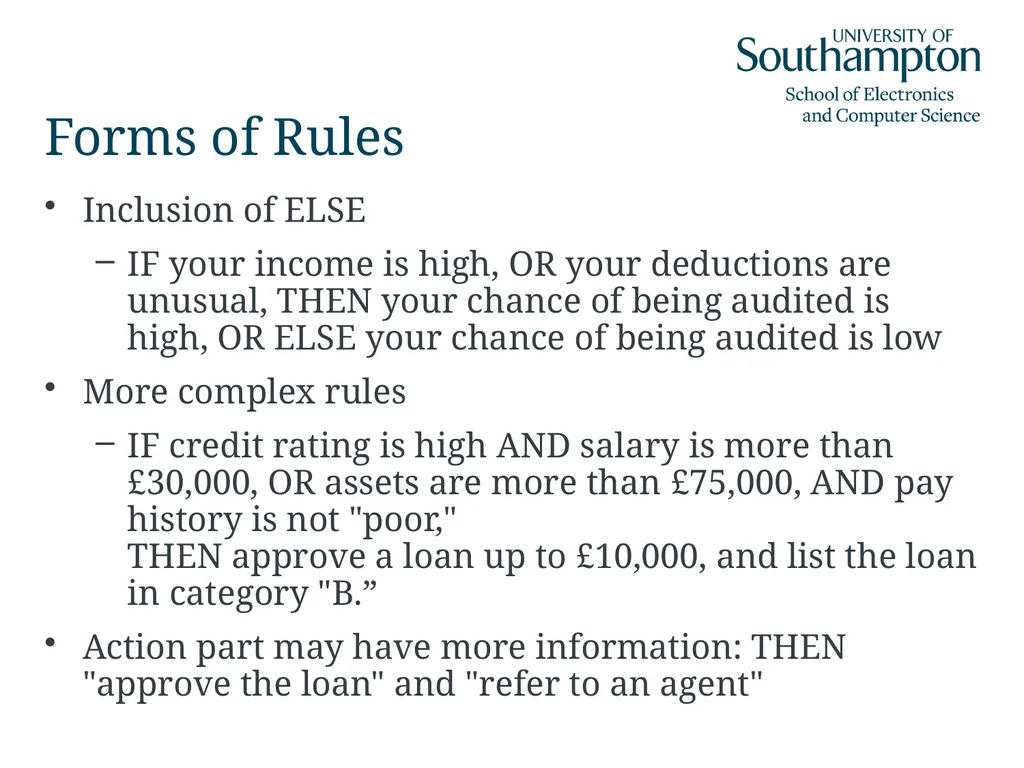
slide39. Forms of Rules Inclusion of ELSE
IF your income is high, OR your deductions are unusual, THEN your chance of being audited is high, OR ELSE your chance of being audited is low
More complex rules
IF credit rating is high AND salary is more than £30,000, OR assets are more than £75,000, AND pay history is not "poor," THEN approve a loan up to £10,000, and list the loan in category "B.”
Action part may have more information: THEN "approve the loan" and "refer to an agent"<br>
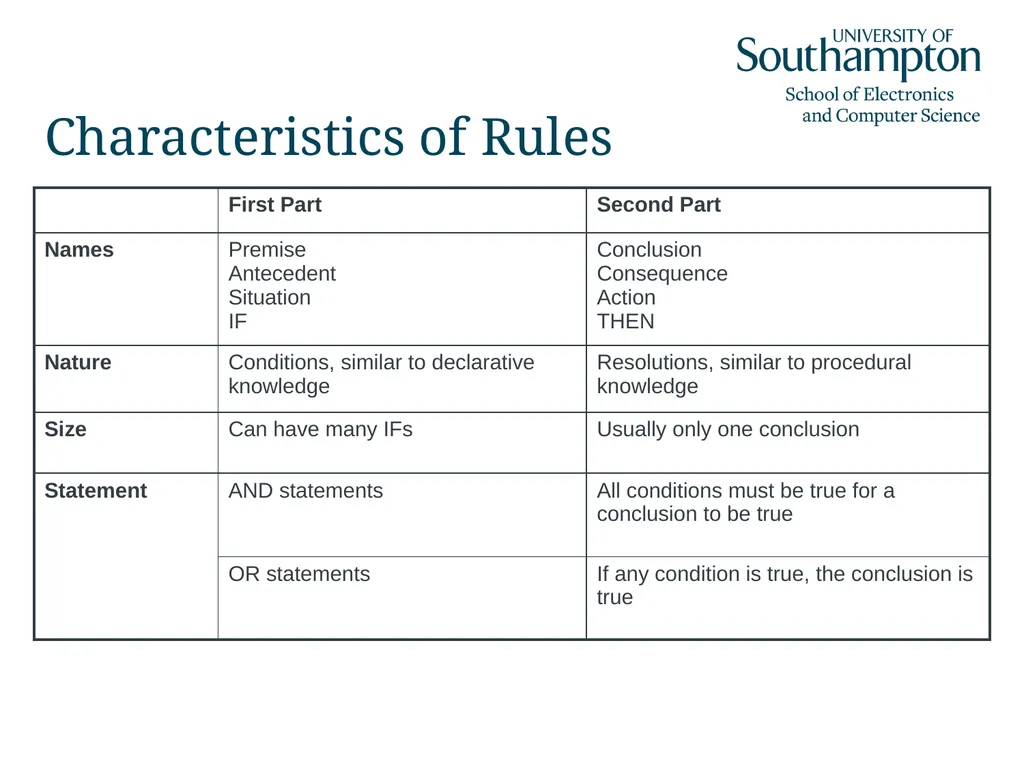
slide40. Characteristics of Rules<br>
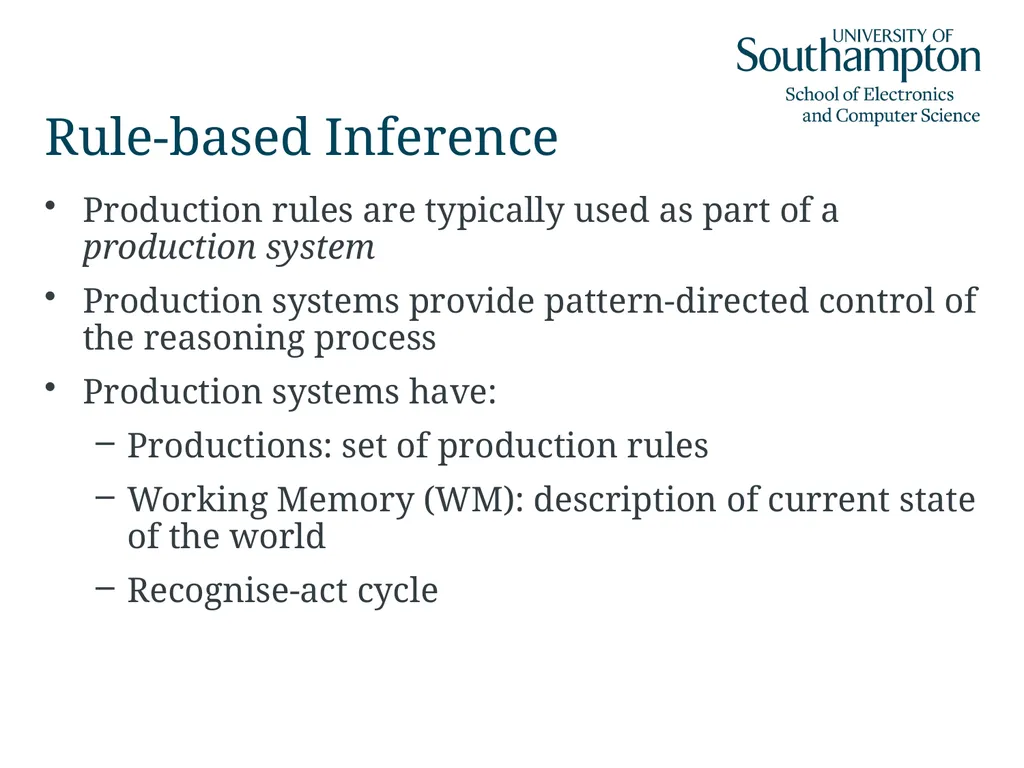
slide41. Rule-based Inference Production rules are typically used as part of a production system
Production systems provide pattern-directed control of the reasoning process
Production systems have:
Productions: set of production rules
Working Memory (WM): description of current state of the world
Recognise-act cycle<br>
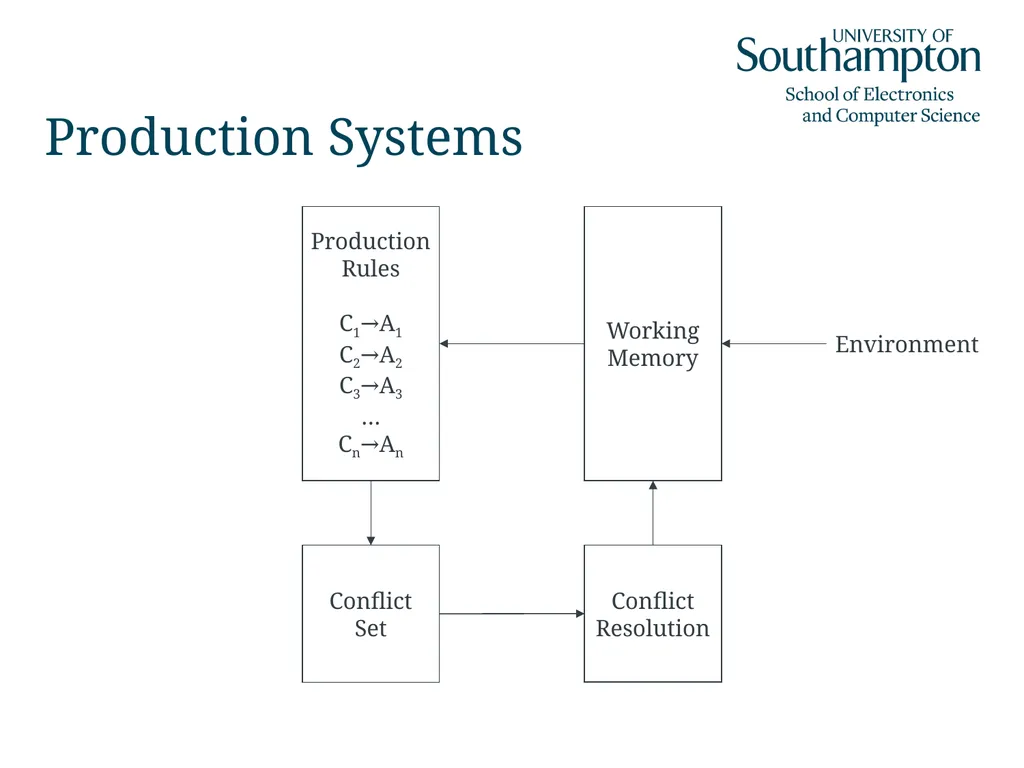
slide42. Production Systems Production
Rules
C1→A1
C2→A2
C3→A3
…
Cn→An Working Memory Conflict
Resolution Conflict
Set Environment<br>
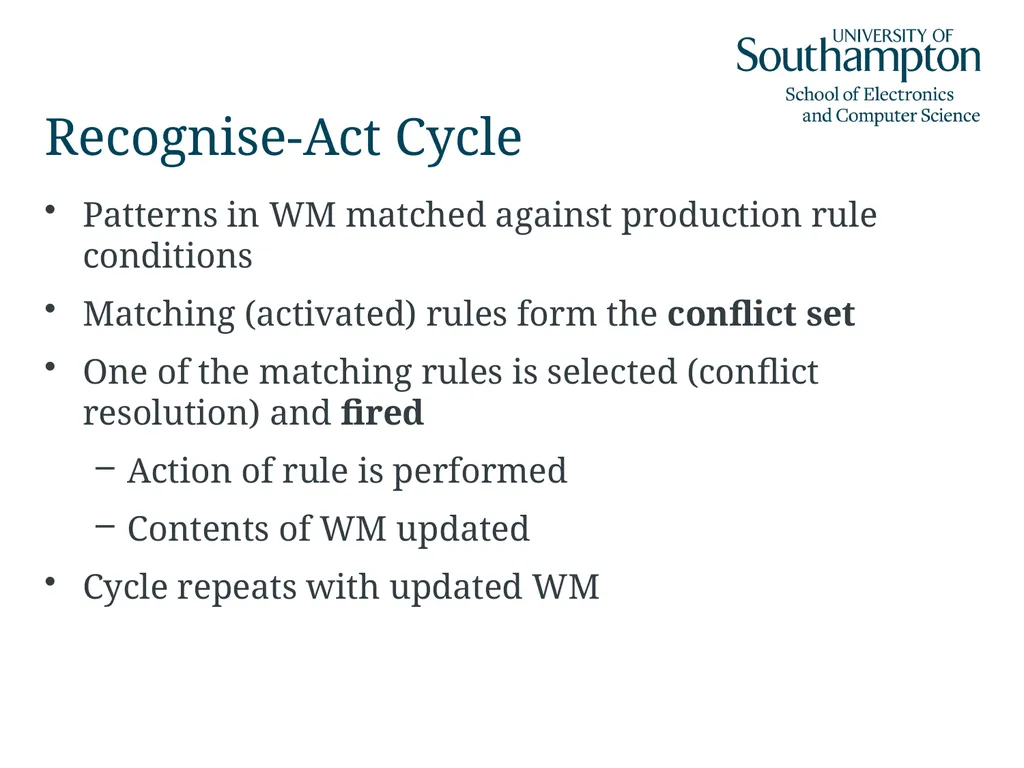
slide43. Recognise-Act Cycle Patterns in WM matched against production rule conditions
Matching (activated) rules form the conflict set
One of the matching rules is selected (conflict resolution) and fired
Action of rule is performed
Contents of WM updated
Cycle repeats with updated WM<br>
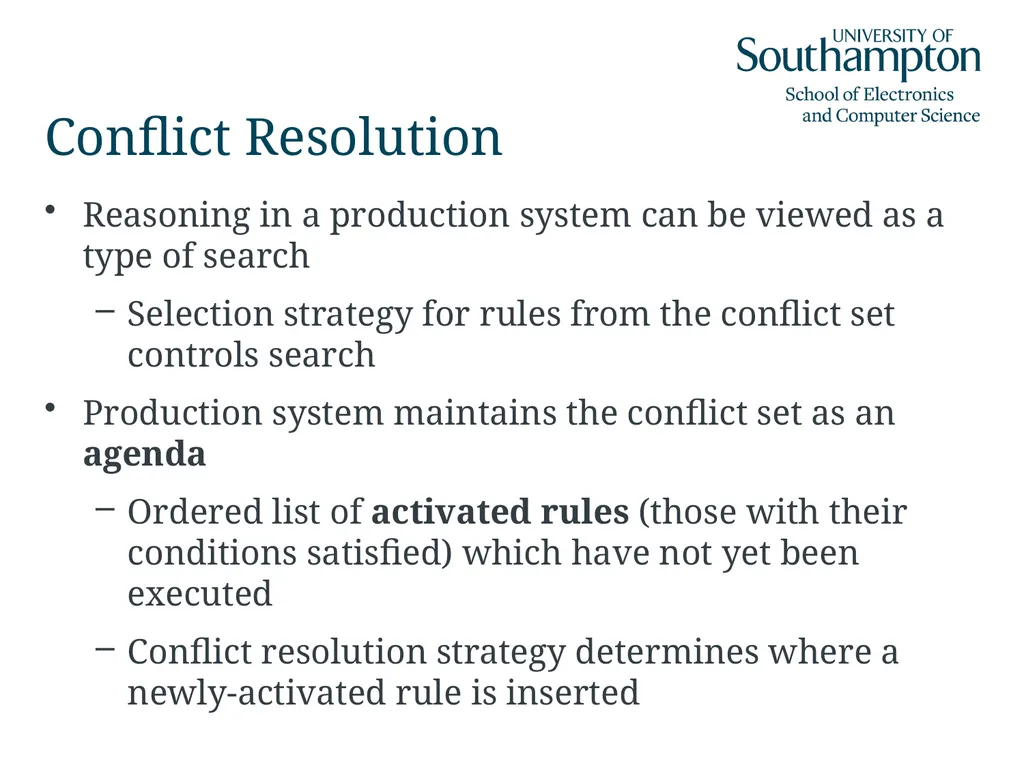
slide44. Conflict Resolution Reasoning in a production system can be viewed as a type of search
Selection strategy for rules from the conflict set controls search
Production system maintains the conflict set as an agenda
Ordered list of activated rules (those with their conditions satisfied) which have not yet been executed
Conflict resolution strategy determines where a newly-activated rule is inserted<br>
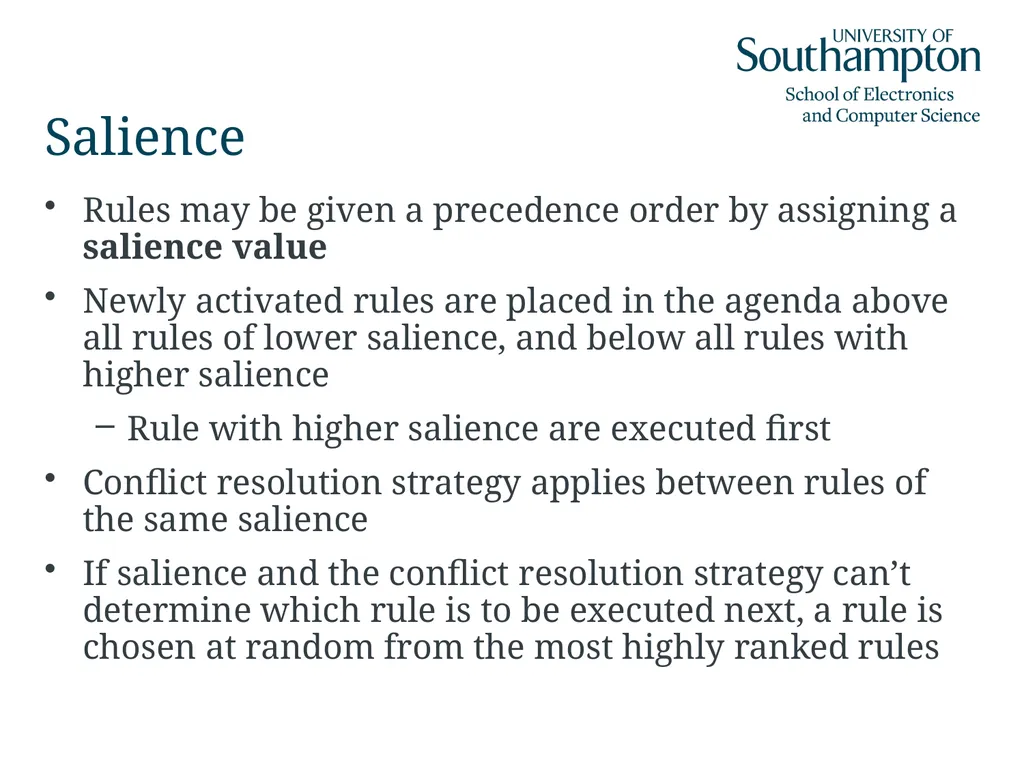
slide45. Salience Rules may be given a precedence order by assigning a salience value
Newly activated rules are placed in the agenda above all rules of lower salience, and below all rules with higher salience
Rule with higher salience are executed first
Conflict resolution strategy applies between rules of the same salience
If salience and the conflict resolution strategy can’t determine which rule is to be executed next, a rule is chosen at random from the most highly ranked rules<br>
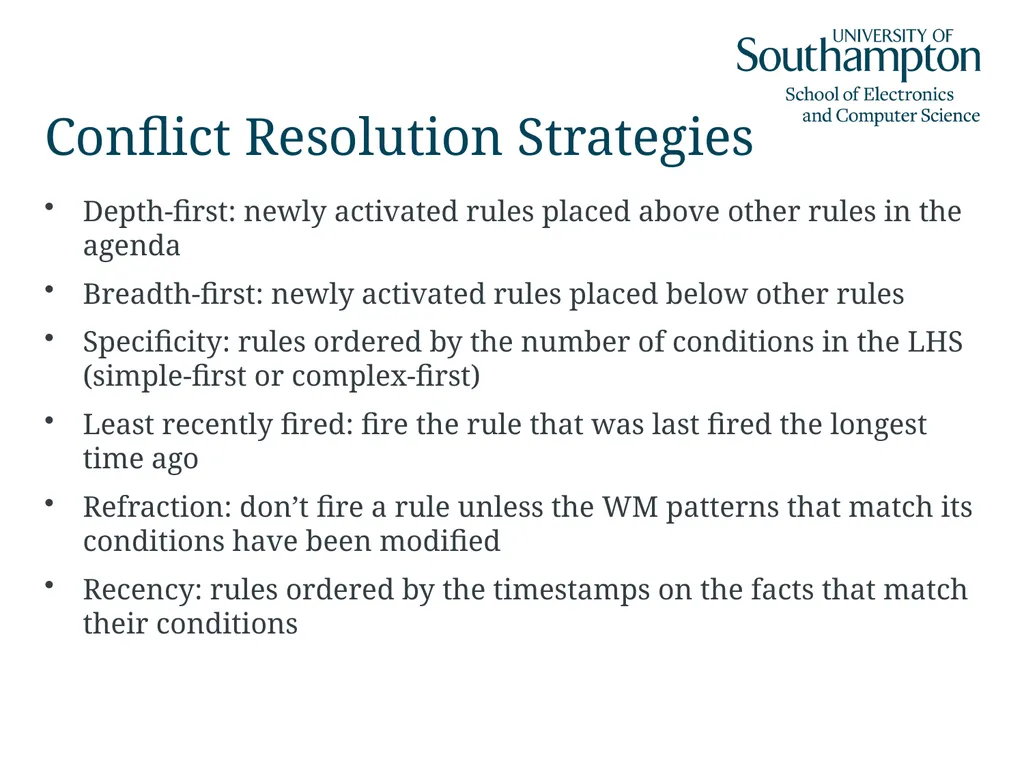
slide46. Conflict Resolution Strategies Depth-first: newly activated rules placed above other rules in the agenda
Breadth-first: newly activated rules placed below other rules
Specificity: rules ordered by the number of conditions in the LHS (simple-first or complex-first)
Least recently fired: fire the rule that was last fired the longest time ago
Refraction: don’t fire a rule unless the WM patterns that match its conditions have been modified
Recency: rules ordered by the timestamps on the facts that match their conditions<br>
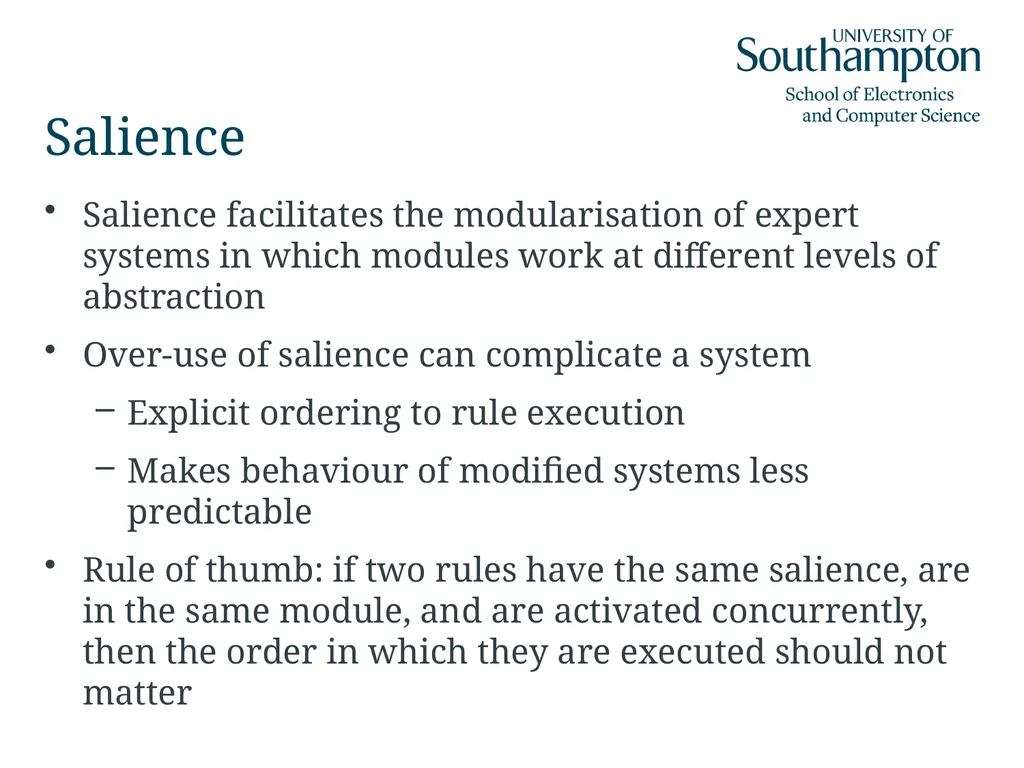
slide47. Salience Salience facilitates the modularisation of expert systems in which modules work at different levels of abstraction
Over-use of salience can complicate a system
Explicit ordering to rule execution
Makes behaviour of modified systems less predictable
Rule of thumb: if two rules have the same salience, are in the same module, and are activated concurrently, then the order in which they are executed should not matter<br>
slide48. Common Types of Rules Knowledge rules, or declarative rules, state all the facts and relationships about a problem
Inference rules, or procedural rules, advise on how to solve a problem, given that certain facts are known
Inference rules contain rules about rules (metarules)
Knowledge rules are stored in the knowledge base
Inference rules become part of the inference engine<br>
slide49. Major Advantages of Rules Easy to understand (natural form of knowledge)
Easy to derive inference and explanations
Easy to modify and maintain
Easy to combine with uncertainty
Rules are frequently independent<br>
slide50. Major Limitations of Rules Complex knowledge requires many rules
Builders like rules (hammer syndrome)
Search limitations in systems with many rules<br>
slide2. Semantic Networks<br>
slide3. Network Knowledge Representation “Traditional” knowledge representation is formal logic
Network knowledge representation originated in 1960s with psychologists and linguists
Observations of recall time for concepts
Closely related concepts were recalled faster than more distantly related
A. Collins and M.R. Quillian (1969) Retrieval time from semantic memory, Journal of Verbal Learning and Verbal Behaviour *:240-247<br>
slide4. Semantic Networks A semantic network is a structure for representing knowledge as a pattern of interconnected nodes and arcs
Nodes in the net represent concepts of entities, attributes, events, values
Arcs in the network represent relationships that hold between the concepts<br>
slide5. Semantic Networks Semantic networks can show inheritance
Relationship types – is-a, has-a
Semantic Nets - visual representation of relationships
Can be combined with other representation methods<br>
slide6. Semantic Networks Animal
Can breathe
Can eat
Has skin Bird
Can fly
Has wings
Has feathers Canary
Can sing
Is yellow Ostrich
Runs fast
Cannot fly
Is tall Fish
Can swim
Has fins
Has gills Salmon
Swims upstream
Is pink
Is edible is-a is-a is-a is-a is-a<br>
slide7. DOG ANIMAL HOUND BEAGLE SNOOPY COLLIE LASSIE SHEEPDOG is a is a is a is a barks is a instance instance CHARLIE BROWN FICTIONAL CHARACTER instance instance instance has tail moves breathes size: medium size: small works sheep tracks friend of<br>
slide8. Semantic Networks What does or should a node represent?
A class of objects?
An instance of an class?
The canonical instance of a class?
The set of all instances of a class?<br>
slide9. Semantic Networks Semantics of links that define new objects and links that relate existing objects, particularly those dealing with ‘intrinsic’ characteristics of a given object
How does one deal with the problems of comparison between objects (or classes of objects) through their attributes?
Essentially the problem of comparing object instances
What mechanisms are there are to handle quantification in semantic network formalisms?<br>
slide10. Transitive inference, but… Clyde is an elephant, an elephant is a mammal: Clyde is a mammal.
The US President is elected every 4 years, Bush is US President: Bush is elected every 4 years
My car is a Ford, Ford is a car company: my car is a car company<br>
slide11. Network knowledge representation Many types of network KR
Conceptual Graphs (Sowa)
Semantic Networks (Quillian)
Conceptual Dependency Theory (Schank)
(and the Semantic Web…)
Close correspondence with other KR techniques (logic, frames, scripts, etc)
A different way of viewing knowledge<br>
slide12. Frames<br>
slide13. Frames A frame is a knowledge representation formalism based on the idea of a frame of reference.
A frame is a data structure that includes all the knowledge about a particular object
Frames organised in a hierarchy Form of object-oriented programming for AI and ES.
Each frame describes one object
Special terminology
M. Minsky (1974) A Framework for Representing Knowledge, MIT-AI Laboratory Memo 306<br>
slide14. Frames There are two types of frame:
Class Frame
Individual or Instance Frame
A frame carries with it a set of slots that can represent objects that are normally associated with a subject of the frame.<br>
slide15. Frames The slots can then point to other slots or frames. That gives frame systems the ability to carry out inheritance and simple kinds of data manipulation.
The use of procedures - also called demons in the literature - helps in the incorporation of substantial amounts of procedural knowledge into a particular frame-oriented knowledge base<br>
slide16. Frame-based model of semantic memory Knowledge is organised in a data structure
Slots in structure are instantiated with particular values for a given instance of data
...translation to OO terminology:
frames == classes or objects
slots == variables/methods<br>
slide17. General Knowledge as Frames DOG
Fixed
legs: 4
Default
diet: carnivorous
sound: bark
Variable
size:
colour: COLLIE
Fixed
breed of: DOG
type: sheepdog
Default
size: 65cm
Variable
colour:<br>
slide18. MAMMAL:
subclass: ANIMAL
has_part: head
ELEPHANT
subclass: MAMMAL
colour: grey
size: large
Nellie
instance: ELEPHANT
likes: apples<br>
slide19. Logic underlies Frames ∀x mammal(x) ⇒ has_part(x, head)
∀x elephant(x) ⇒ mammal(x)
elephant(clyde) ∴ mammal(clyde) has_part(clyde, head)<br>
slide20. MAMMAL:
subclass: ANIMAL
has_part: head
*furry: yes
ELEPHANT
subclass: MAMMAL
has_trunk: yes
*colour: grey
*size: large
*furry: no
Clyde
instance: ELEPHANT
colour: pink
owner: Fred
Nellie
instance: ELEPHANT
size: small<br>
slide21. Can represent subclass and instance relationships (both sometimes called ISA or “is a”)
Properties (e.g. colour and size) can be referred to as slots and slot values (e.g. grey, large) as slot fillers
Objects can inherit all properties of parent class (therefore Nellie is grey and large)
But can inherit properties which are only typical (usually called default, here starred), and can be overridden
For example, mammal is typically furry, but this is not so for an elephant<br>
slide22. Multiple Inheritance Situation can be complicated by multiple inheritance, where object or class may have more than one parent class.
May result in some conflict: for example if Nellie is both an elephant and a circus animal
From elephant we would expect Nellie’s habitat to be the jungle, but from circus animal we would expect it to be a tent
Could set further precedence order to resolve this – or might need further class for Circus-elephant<br>
slide23. The Nixon Diamond All Quakers are pacifists
All Republicans are not pacifists
Nixon is a Republican
Nixon is a Quaker
R. Reiter and G. Criscuolo (1981). On interacting defaults. In Proceedings of the Seventh International Joint Conference on Artificial Intelligence (IJCAI'81), pages 94-100.<br>
slide24. Prototypical Situations Many situations are prototypical
Prototypical situations share a common set of attributes
We can use the powerful inheritance capabilities of the frames representation to help represent these situations<br>
slide25. Provide a concise, structural representation of knowledge in a natural manner
Frame encompasses complex objects, entire situations or a management problem as a single entity
Frame knowledge is partitioned into slots
Slot can describe declarative knowledge or procedural knowledge
Hierarchy of Frames: Inheritance<br>
slide26. Capabilities of Frames Ability to clearly document information about a domain model; for example, a plant's machines and their associated attributes
Related ability to constrain allowable values of an attribute
Modularity of information, permitting ease of system expansion and maintenance
More readable and consistent syntax for referencing domain objects in the rules<br>
slide27. Capabilities of Frames Platform for building graphic interface with object graphics
Mechanism to restrict the scope of facts considered during forward or backward chaining
Access to a mechanism that supports the inheritance of information down a class hierarchy
Used as underlying model in standards for accessing KBs (Open Knowledge Base Connectivity - OKBC)<br>
slide28. Summary Frames have been used in conjunction with other, less well-grounded, representation formalisms, like production systems, when used to build to pre-operational or operational expert systems
Frames cannot be used efficiently to organise ‘a whole computation<br>
slide29. Scripts<br>
slide30. Scripts Knowledge representation scheme describing a stereotypical sequence of events, and goals and plans of actors concerned
Expectation-driven programming
Allows inference about implicit cause and effect relationships when interpreting situations
Builds on Conceptual Dependency Theory
R.C. Schank and R. Abelson (1977) Scripts, Plans, Goals and Understanding<br>
slide31. Script Elements Entry Conditions
What are the descriptors of the world that must be true for the script to be called?
Props
What objects make up the content of the script?
Roles
What actions are performed by the participants in the script?
Scenes
Temporal decomposition of script into meaningful episodes
Results
What are the outcomes following termination of the script?<br>
slide32. Script: RESTAURANT
Props: Tables
Menu
F = Food
Bill
Money
Roles: S = Customer
W = Waiter
C = Chef
M = Cashier
O = Owner
Entry conditions:
S is hungry
S has money Results:
S has less money
O has more money
S is not hungry
S is pleased (optional)
Scenes:
Entering
Ordering
Eating
Exiting<br>
slide33. Scene 1: Entering S PTRANS S into restaurant
A ATTEND eyes to tables
S MBUILD where to sit
S PTRANS S to table
S MOVE S to sitting position
Scene 2: Ordering (Menu on table)
S PTRANS menu to S
S MTRANS food list to CP(S)
S MBUILD choice of F
S MTRANS signal to W
W PTRANS W to table
S MTRANS ‘I want F’ to W
W PTRANS W to C
W MTRANS (ATRANS F) to C
C DO (prepare F script)
…<br>
slide34. Scripts and Natural Language Understanding Scripts are used to organise a knowledge base in terms of the situations that are to be understood
“Jack went to a restaurant. He decided to order steak. He sat there and waited for a long time. Finally, he got angry and left”
What was Jack waiting for?
Why did he get angry?
Effective in limited domains, can be inflexible in more general domains<br>
slide35. Production Rules<br>
slide36. Production Rules Condition-Action Pairs
IF this condition (or premise or antecedent) occurs, THEN some action (or result, or conclusion, or consequence) will (or should) occur
IF the traffic light is red AND you have stopped, THEN a right turn is OK<br>
slide37. Production Rules Each production rule in a knowledge base represents an autonomous chunk of expertise
When combined and fed to the inference engine, the set of rules behaves synergistically
Rules can be viewed as a simulation of the cognitive behaviour of human experts
Rules represent a model of actual human behaviour
Predominant technique used in expert systems, often in conjunction with frames<br>
slide38. Forms of Rules IF premise, THEN conclusion
IF your income is high, THEN your chance of being audited by the Inland Revenue is high
Conclusion, IF premise
Your chance of being audited is high, IF your income is high<br>
slide39. Forms of Rules Inclusion of ELSE
IF your income is high, OR your deductions are unusual, THEN your chance of being audited is high, OR ELSE your chance of being audited is low
More complex rules
IF credit rating is high AND salary is more than £30,000, OR assets are more than £75,000, AND pay history is not "poor," THEN approve a loan up to £10,000, and list the loan in category "B.”
Action part may have more information: THEN "approve the loan" and "refer to an agent"<br>
slide40. Characteristics of Rules<br>
slide41. Rule-based Inference Production rules are typically used as part of a production system
Production systems provide pattern-directed control of the reasoning process
Production systems have:
Productions: set of production rules
Working Memory (WM): description of current state of the world
Recognise-act cycle<br>
slide42. Production Systems Production
Rules
C1→A1
C2→A2
C3→A3
…
Cn→An Working Memory Conflict
Resolution Conflict
Set Environment<br>
slide43. Recognise-Act Cycle Patterns in WM matched against production rule conditions
Matching (activated) rules form the conflict set
One of the matching rules is selected (conflict resolution) and fired
Action of rule is performed
Contents of WM updated
Cycle repeats with updated WM<br>
slide44. Conflict Resolution Reasoning in a production system can be viewed as a type of search
Selection strategy for rules from the conflict set controls search
Production system maintains the conflict set as an agenda
Ordered list of activated rules (those with their conditions satisfied) which have not yet been executed
Conflict resolution strategy determines where a newly-activated rule is inserted<br>
slide45. Salience Rules may be given a precedence order by assigning a salience value
Newly activated rules are placed in the agenda above all rules of lower salience, and below all rules with higher salience
Rule with higher salience are executed first
Conflict resolution strategy applies between rules of the same salience
If salience and the conflict resolution strategy can’t determine which rule is to be executed next, a rule is chosen at random from the most highly ranked rules<br>
slide46. Conflict Resolution Strategies Depth-first: newly activated rules placed above other rules in the agenda
Breadth-first: newly activated rules placed below other rules
Specificity: rules ordered by the number of conditions in the LHS (simple-first or complex-first)
Least recently fired: fire the rule that was last fired the longest time ago
Refraction: don’t fire a rule unless the WM patterns that match its conditions have been modified
Recency: rules ordered by the timestamps on the facts that match their conditions<br>
slide47. Salience Salience facilitates the modularisation of expert systems in which modules work at different levels of abstraction
Over-use of salience can complicate a system
Explicit ordering to rule execution
Makes behaviour of modified systems less predictable
Rule of thumb: if two rules have the same salience, are in the same module, and are activated concurrently, then the order in which they are executed should not matter<br>
slide48. Common Types of Rules Knowledge rules, or declarative rules, state all the facts and relationships about a problem
Inference rules, or procedural rules, advise on how to solve a problem, given that certain facts are known
Inference rules contain rules about rules (metarules)
Knowledge rules are stored in the knowledge base
Inference rules become part of the inference engine<br>
slide49. Major Advantages of Rules Easy to understand (natural form of knowledge)
Easy to derive inference and explanations
Easy to modify and maintain
Easy to combine with uncertainty
Rules are frequently independent<br>
slide50. Major Limitations of Rules Complex knowledge requires many rules
Builders like rules (hammer syndrome)
Search limitations in systems with many rules<br>