
Semantics by Dr. Salah Al-Bahadily Semantics is
LV
Published · 16 slides · 0 views

1 / 1

Description
Semantics by Dr. Salah Al-Bahadily Semantics is the study of the meaning of words, phrases and sentences. In semantic analysis, there is always an attempt to focus on what the words conventionally mean, rather than on what an individual
Related Topics
Share
Embed code
Download this presentation From Below
"Semantics by Dr. Salah Al-Bahadily Semantics is" is the property of its rightful owner. Permission is granted to download and print the materials on this website for personal, non-commercial use only, and to display it on your personal computer provided you do not modify the materials and that you retain all copyright notices contained in the materials. By downloading content from our website, you accept the terms of this agreement.
Presentation Transcript
01
Semantics by
Dr. Salah Al-Bahadily<br>
02
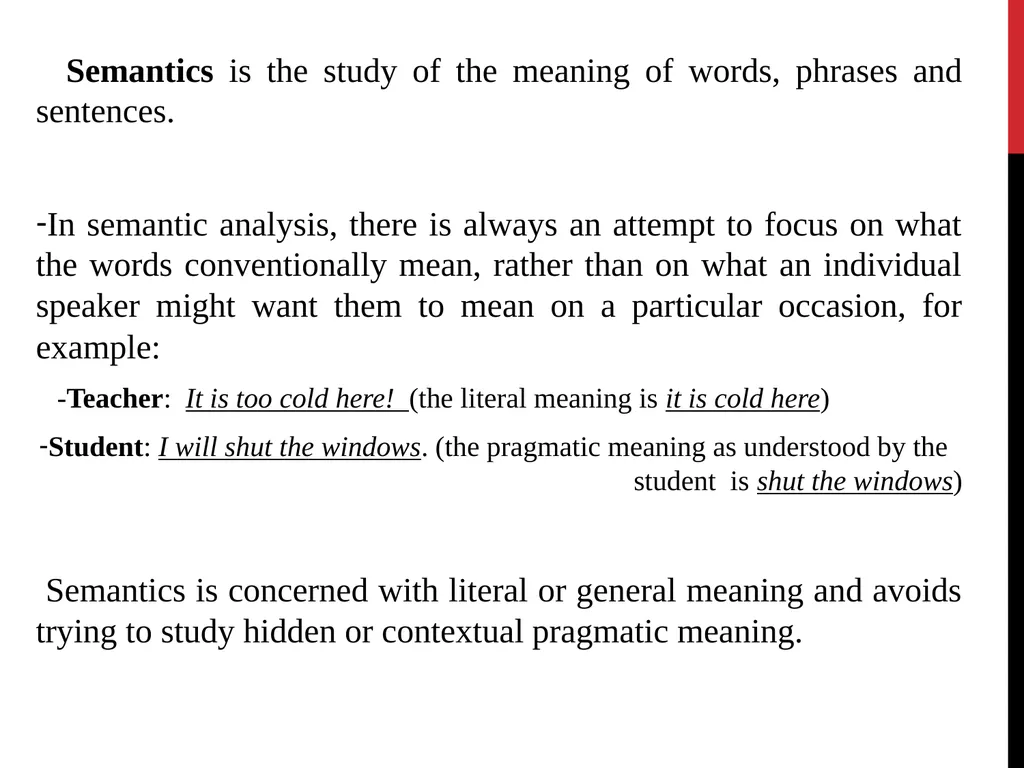
Semantics is the study of the meaning of words, phrases and sentences.
In semantic analysis, there is always an attempt to focus on what the words conventionally mean, rather than on what an individual speaker might want them to mean on a particular occasion, for example:
-Teacher: It is too cold here! (the literal meaning is it is cold here)
Student: I will shut the windows. (the pragmatic meaning as understood by the student is shut the windows)
Semantics is concerned with literal or general meaning and avoids trying to study hidden or contextual pragmatic meaning.<br>
In semantic analysis, there is always an attempt to focus on what the words conventionally mean, rather than on what an individual speaker might want them to mean on a particular occasion, for example:
-Teacher: It is too cold here! (the literal meaning is it is cold here)
Student: I will shut the windows. (the pragmatic meaning as understood by the student is shut the windows)
Semantics is concerned with literal or general meaning and avoids trying to study hidden or contextual pragmatic meaning.<br>
03
Meaning
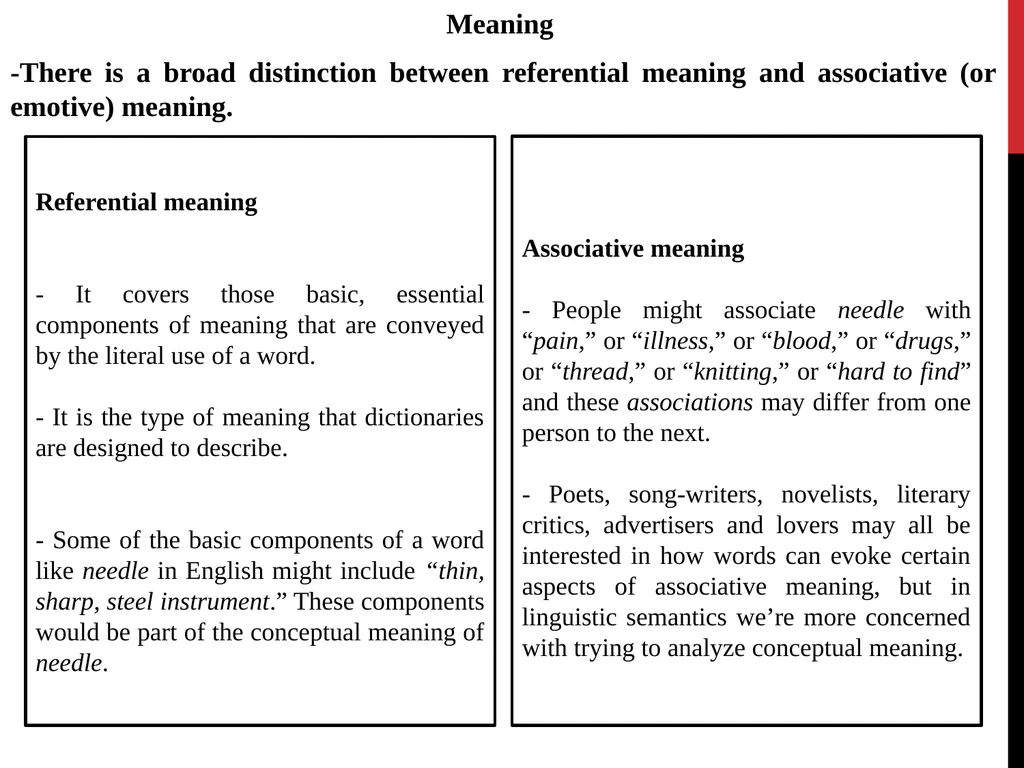
-There is a broad distinction between referential meaning and associative (or emotive) meaning. Referential meaning
- It covers those basic, essential components of meaning that are conveyed by the literal use of a word.
- It is the type of meaning that dictionaries are designed to describe.
- Some of the basic components of a word like needle in English might include “thin, sharp, steel instrument.” These components would be part of the conceptual meaning of needle. Associative meaning
- People might associate needle with “pain,” or “illness,” or “blood,” or “drugs,” or “thread,” or “knitting,” or “hard to find” and these associations may differ from one person to the next.
- Poets, song-writers, novelists, literary critics, advertisers and lovers may all be interested in how words can evoke certain aspects of associative meaning, but in linguistic semantics we’re more concerned with trying to analyze conceptual meaning.<br>
-There is a broad distinction between referential meaning and associative (or emotive) meaning. Referential meaning
- It covers those basic, essential components of meaning that are conveyed by the literal use of a word.
- It is the type of meaning that dictionaries are designed to describe.
- Some of the basic components of a word like needle in English might include “thin, sharp, steel instrument.” These components would be part of the conceptual meaning of needle. Associative meaning
- People might associate needle with “pain,” or “illness,” or “blood,” or “drugs,” or “thread,” or “knitting,” or “hard to find” and these associations may differ from one person to the next.
- Poets, song-writers, novelists, literary critics, advertisers and lovers may all be interested in how words can evoke certain aspects of associative meaning, but in linguistic semantics we’re more concerned with trying to analyze conceptual meaning.<br>
04
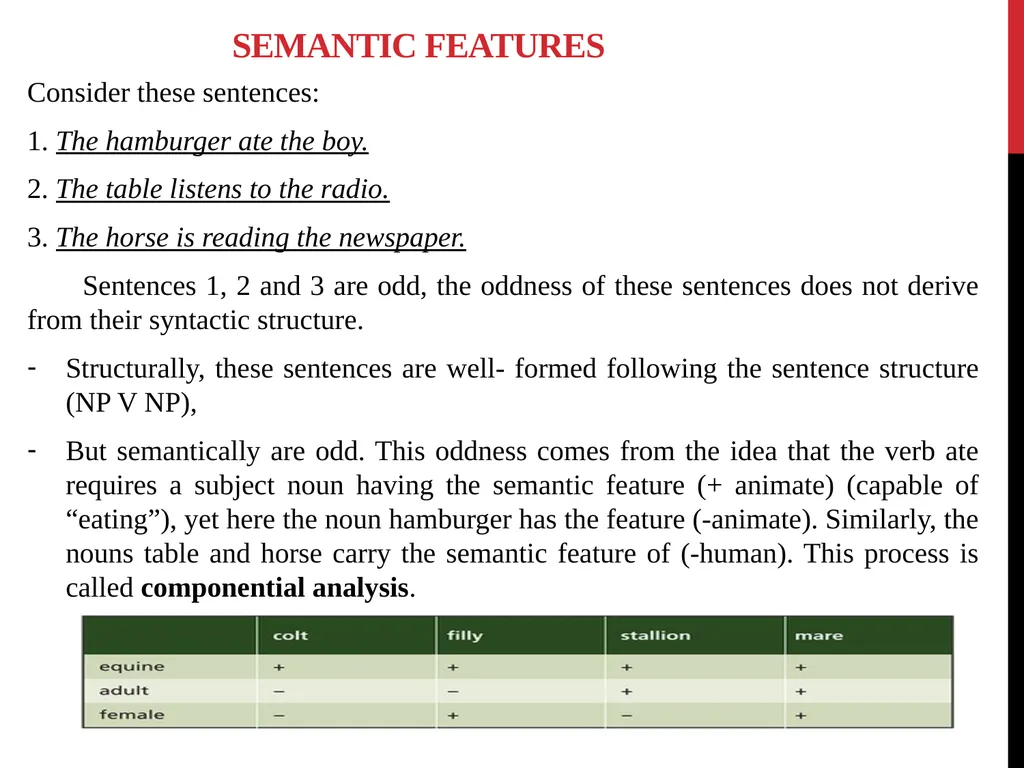
Semantic features Consider these sentences:
1. The hamburger ate the boy.
2. The table listens to the radio.
3. The horse is reading the newspaper.
Sentences 1, 2 and 3 are odd, the oddness of these sentences does not derive from their syntactic structure.
Structurally, these sentences are well- formed following the sentence structure (NP V NP),
But semantically are odd. This oddness comes from the idea that the verb ate requires a subject noun having the semantic feature (+ animate) (capable of “eating”), yet here the noun hamburger has the feature (-animate). Similarly, the nouns table and horse carry the semantic feature of (-human). This process is called componential analysis.<br>
1. The hamburger ate the boy.
2. The table listens to the radio.
3. The horse is reading the newspaper.
Sentences 1, 2 and 3 are odd, the oddness of these sentences does not derive from their syntactic structure.
Structurally, these sentences are well- formed following the sentence structure (NP V NP),
But semantically are odd. This oddness comes from the idea that the verb ate requires a subject noun having the semantic feature (+ animate) (capable of “eating”), yet here the noun hamburger has the feature (-animate). Similarly, the nouns table and horse carry the semantic feature of (-human). This process is called componential analysis.<br>
05
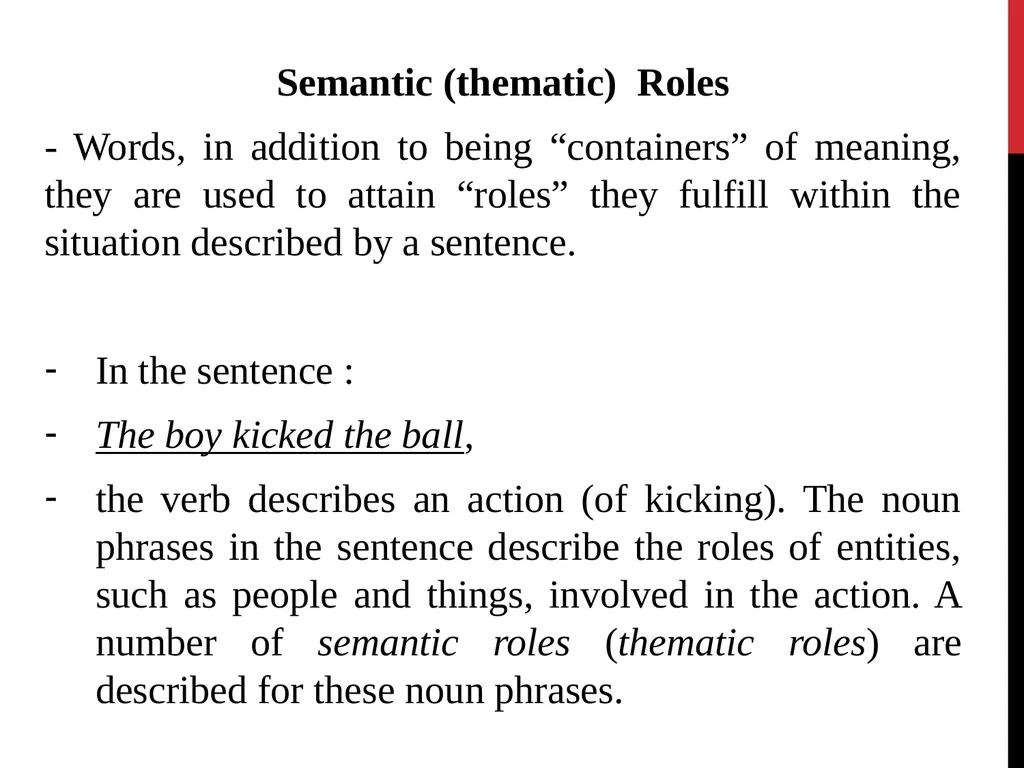
Semantic (thematic) Roles
- Words, in addition to being “containers” of meaning, they are used to attain “roles” they fulfill within the situation described by a sentence.
In the sentence :
The boy kicked the ball,
the verb describes an action (of kicking). The noun phrases in the sentence describe the roles of entities, such as people and things, involved in the action. A number of semantic roles (thematic roles) are described for these noun phrases.<br>
- Words, in addition to being “containers” of meaning, they are used to attain “roles” they fulfill within the situation described by a sentence.
In the sentence :
The boy kicked the ball,
the verb describes an action (of kicking). The noun phrases in the sentence describe the roles of entities, such as people and things, involved in the action. A number of semantic roles (thematic roles) are described for these noun phrases.<br>
06
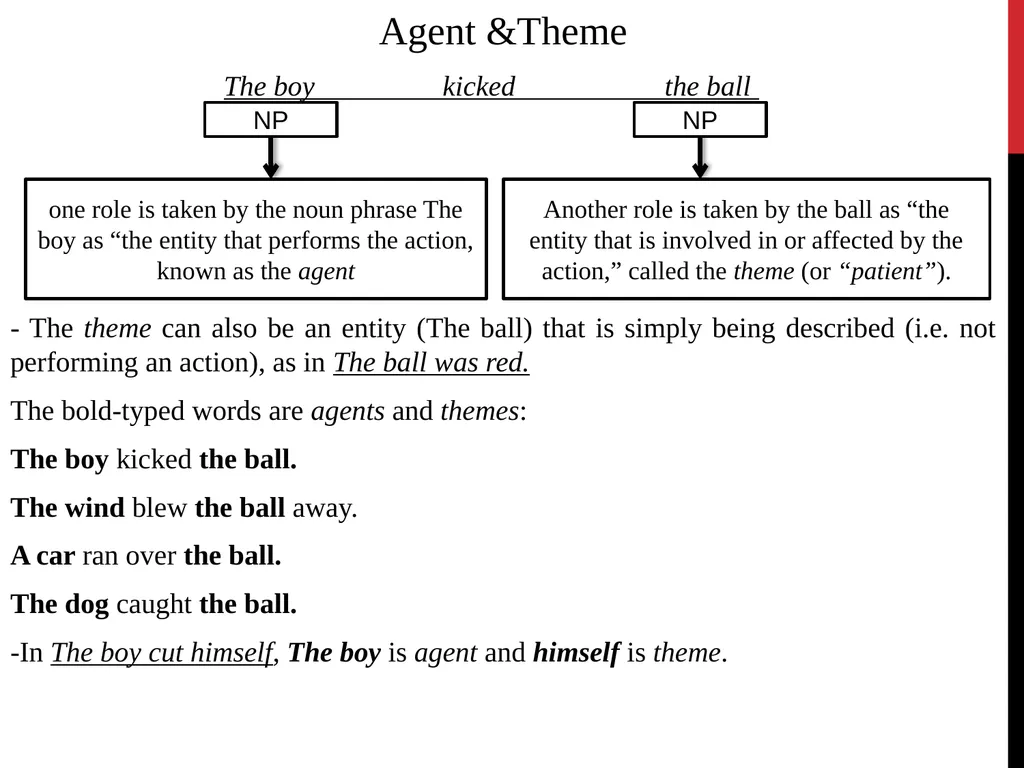
Agent &Theme
The boy kicked the ball
- The theme can also be an entity (The ball) that is simply being described (i.e. not performing an action), as in The ball was red.
The bold-typed words are agents and themes:
The boy kicked the ball.
The wind blew the ball away.
A car ran over the ball.
The dog caught the ball.
-In The boy cut himself, The boy is agent and himself is theme. NP NP one role is taken by the noun phrase The boy as “the entity that performs the action, known as the agent Another role is taken by the ball as “the entity that is involved in or affected by the action,” called the theme (or “patient”).<br>
The boy kicked the ball
- The theme can also be an entity (The ball) that is simply being described (i.e. not performing an action), as in The ball was red.
The bold-typed words are agents and themes:
The boy kicked the ball.
The wind blew the ball away.
A car ran over the ball.
The dog caught the ball.
-In The boy cut himself, The boy is agent and himself is theme. NP NP one role is taken by the noun phrase The boy as “the entity that performs the action, known as the agent Another role is taken by the ball as “the entity that is involved in or affected by the action,” called the theme (or “patient”).<br>
07
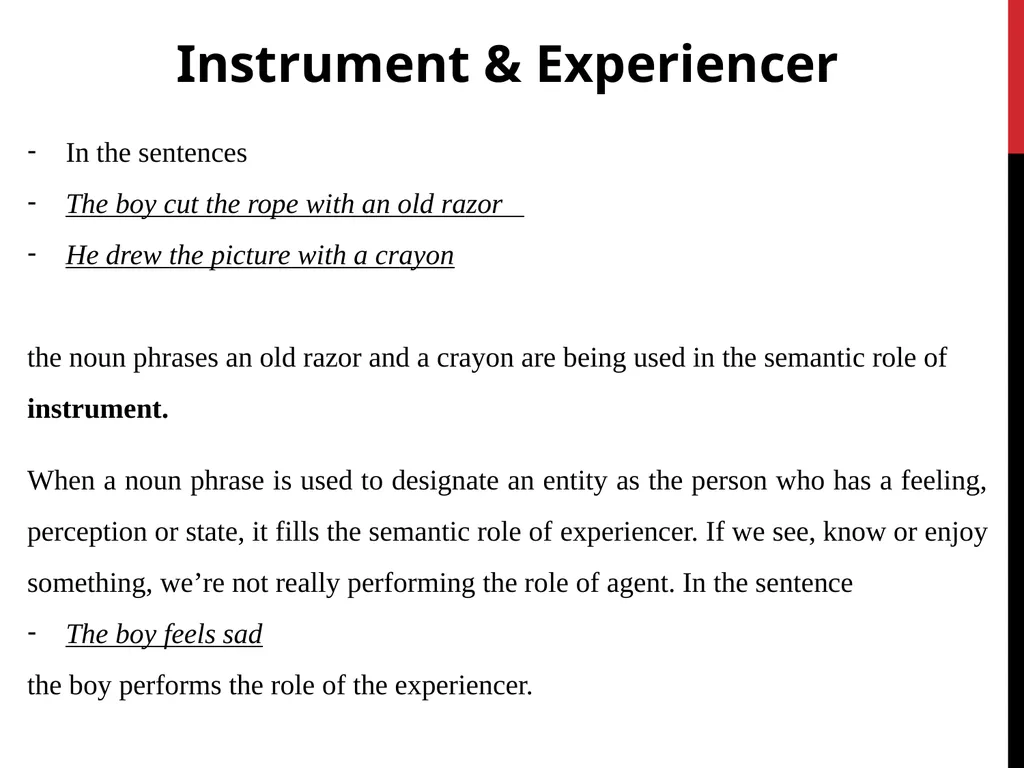
Instrument & Experiencer
In the sentences
The boy cut the rope with an old razor
He drew the picture with a crayon
the noun phrases an old razor and a crayon are being used in the semantic role of instrument.
When a noun phrase is used to designate an entity as the person who has a feeling, perception or state, it fills the semantic role of experiencer. If we see, know or enjoy something, we’re not really performing the role of agent. In the sentence
The boy feels sad
the boy performs the role of the experiencer.<br>
In the sentences
The boy cut the rope with an old razor
He drew the picture with a crayon
the noun phrases an old razor and a crayon are being used in the semantic role of instrument.
When a noun phrase is used to designate an entity as the person who has a feeling, perception or state, it fills the semantic role of experiencer. If we see, know or enjoy something, we’re not really performing the role of agent. In the sentence
The boy feels sad
the boy performs the role of the experiencer.<br>
08
Location, Source & Goal
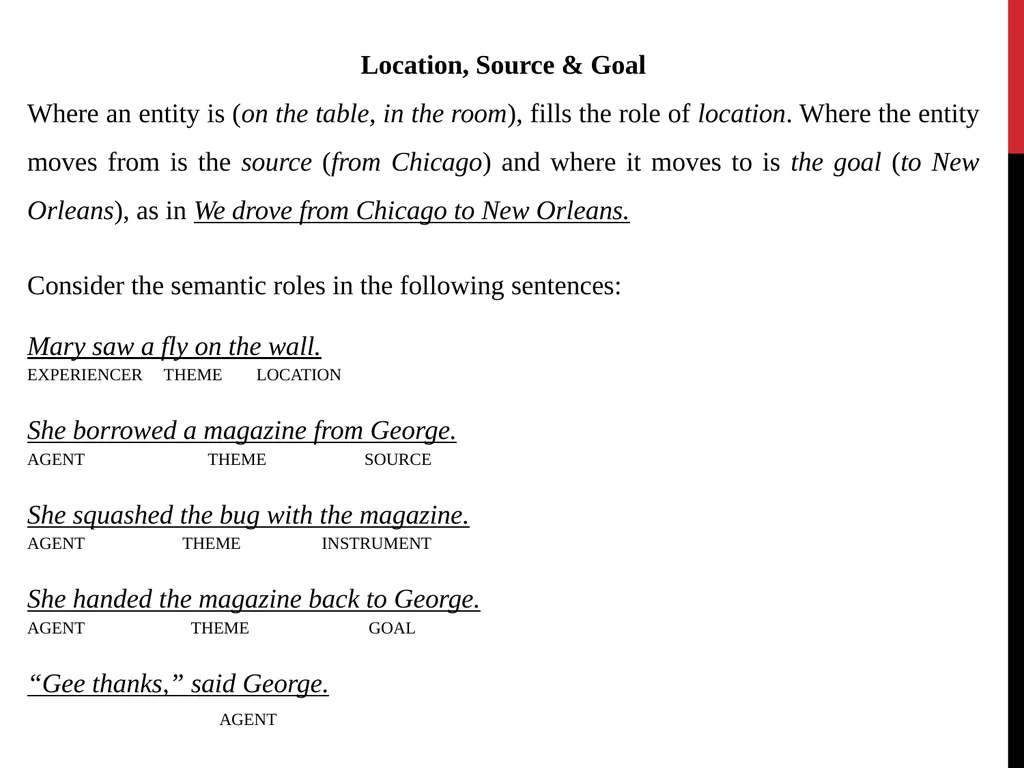
Where an entity is (on the table, in the room), fills the role of location. Where the entity moves from is the source (from Chicago) and where it moves to is the goal (to New Orleans), as in We drove from Chicago to New Orleans.
Consider the semantic roles in the following sentences:
Mary saw a fly on the wall.
EXPERIENCER THEME LOCATION
She borrowed a magazine from George.
AGENT THEME SOURCE
She squashed the bug with the magazine.
AGENT THEME INSTRUMENT
She handed the magazine back to George.
AGENT THEME GOAL
“Gee thanks,” said George.
AGENT<br>
Where an entity is (on the table, in the room), fills the role of location. Where the entity moves from is the source (from Chicago) and where it moves to is the goal (to New Orleans), as in We drove from Chicago to New Orleans.
Consider the semantic roles in the following sentences:
Mary saw a fly on the wall.
EXPERIENCER THEME LOCATION
She borrowed a magazine from George.
AGENT THEME SOURCE
She squashed the bug with the magazine.
AGENT THEME INSTRUMENT
She handed the magazine back to George.
AGENT THEME GOAL
“Gee thanks,” said George.
AGENT<br>
09
Lexical Relations
Words can also have “relationships” with each other, such as sameness of meaning (synonymy: conceal/hide), oppositeness of meaning (antonymy: shallow/deep) inclusion (hyponymy: daffodil/flower).
Synonymy
-Two or more words with very closely related meanings are called synonyms. They can often, though not always, be substituted for each other in sentences, (e.g. What is his answer/reply). Examples are: almost/nearly, big/large, broad/wide, buy/purchase, cab/taxi, car/automobile, couch/sofa, freedom/ liberty.
- However, there is no total sameness of meaning, there are many occasions when one word is appropriate in a sentence, but its synonym would be odd. Sandy had only one answer/*reply correct on the test.<br>
Words can also have “relationships” with each other, such as sameness of meaning (synonymy: conceal/hide), oppositeness of meaning (antonymy: shallow/deep) inclusion (hyponymy: daffodil/flower).
Synonymy
-Two or more words with very closely related meanings are called synonyms. They can often, though not always, be substituted for each other in sentences, (e.g. What is his answer/reply). Examples are: almost/nearly, big/large, broad/wide, buy/purchase, cab/taxi, car/automobile, couch/sofa, freedom/ liberty.
- However, there is no total sameness of meaning, there are many occasions when one word is appropriate in a sentence, but its synonym would be odd. Sandy had only one answer/*reply correct on the test.<br>
10
Antonymy
-Two forms with opposite meanings are called antonyms, e.g. alive/dead, big/small, fast/slow, happy/sad, hot/cold, long/short, male/ female, married/single, old/new, rich/poor, true/false.
- Reversives refers to antonyms in which one member of an antonymous pair cannot be described as the negative of the other, e.g. undress doesn’t mean not dress. It actually means “do the reverse of dress.” Examples are: enter/exit, pack/unpack, lengthen/shorten, raise/lower, tie/untie.<br>
-Two forms with opposite meanings are called antonyms, e.g. alive/dead, big/small, fast/slow, happy/sad, hot/cold, long/short, male/ female, married/single, old/new, rich/poor, true/false.
- Reversives refers to antonyms in which one member of an antonymous pair cannot be described as the negative of the other, e.g. undress doesn’t mean not dress. It actually means “do the reverse of dress.” Examples are: enter/exit, pack/unpack, lengthen/shorten, raise/lower, tie/untie.<br>
11
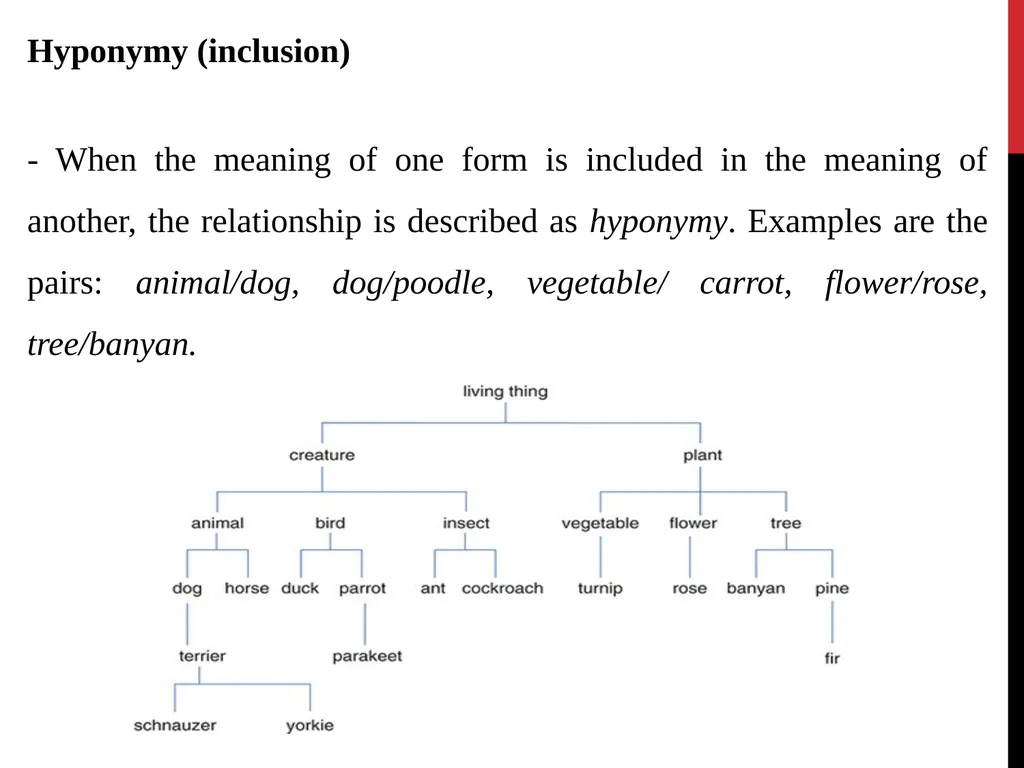
Hyponymy (inclusion)
- When the meaning of one form is included in the meaning of another, the relationship is described as hyponymy. Examples are the pairs: animal/dog, dog/poodle, vegetable/ carrot, flower/rose, tree/banyan.<br>
- When the meaning of one form is included in the meaning of another, the relationship is described as hyponymy. Examples are the pairs: animal/dog, dog/poodle, vegetable/ carrot, flower/rose, tree/banyan.<br>
12
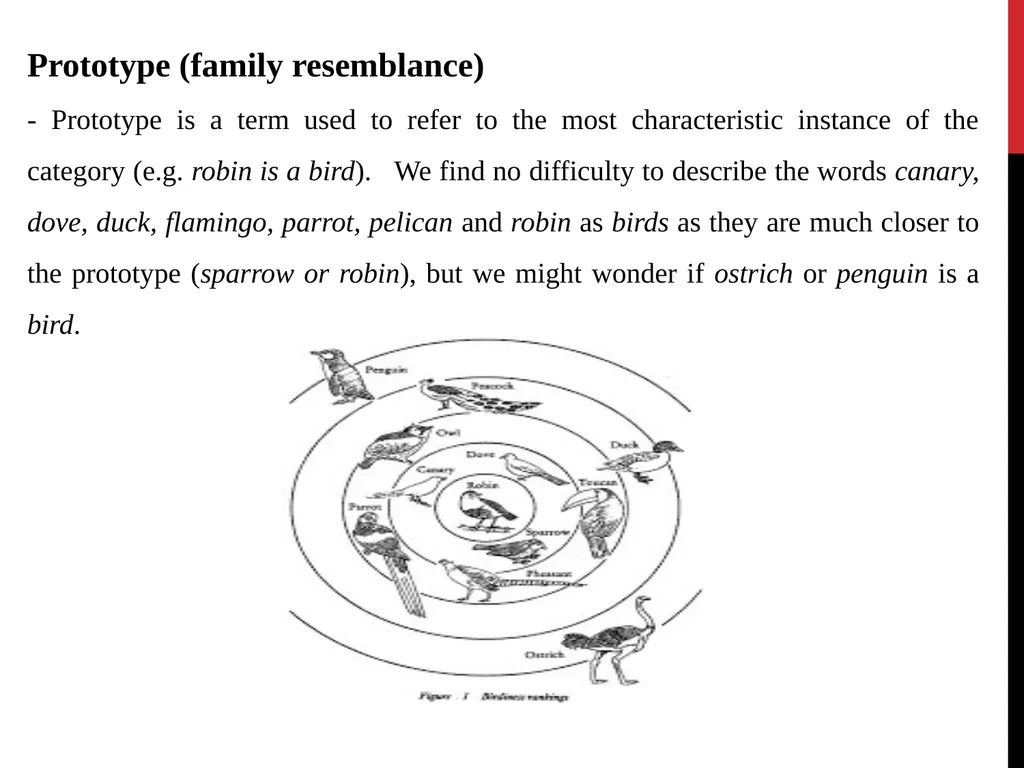
Prototype (family resemblance)
- Prototype is a term used to refer to the most characteristic instance of the category (e.g. robin is a bird). We find no difficulty to describe the words canary, dove, duck, flamingo, parrot, pelican and robin as birds as they are much closer to the prototype (sparrow or robin), but we might wonder if ostrich or penguin is a bird.<br>
- Prototype is a term used to refer to the most characteristic instance of the category (e.g. robin is a bird). We find no difficulty to describe the words canary, dove, duck, flamingo, parrot, pelican and robin as birds as they are much closer to the prototype (sparrow or robin), but we might wonder if ostrich or penguin is a bird.<br>
13
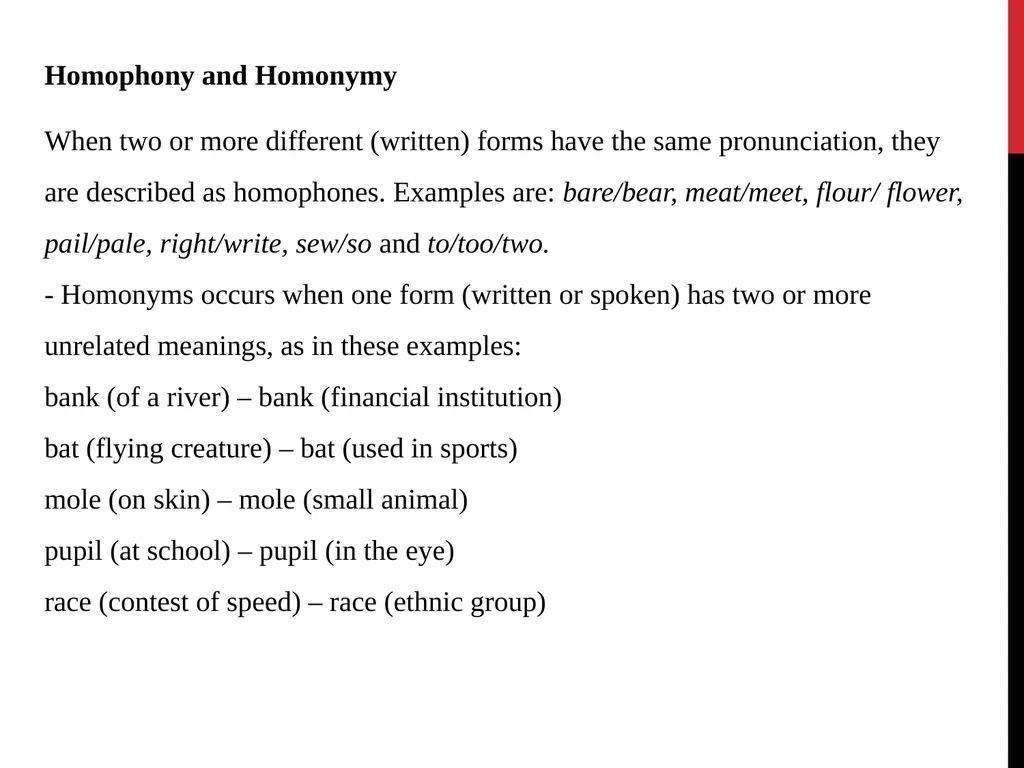
Homophony and Homonymy
When two or more different (written) forms have the same pronunciation, they are described as homophones. Examples are: bare/bear, meat/meet, flour/ flower, pail/pale, right/write, sew/so and to/too/two.
- Homonyms occurs when one form (written or spoken) has two or more unrelated meanings, as in these examples:
bank (of a river) – bank (financial institution)
bat (flying creature) – bat (used in sports)
mole (on skin) – mole (small animal)
pupil (at school) – pupil (in the eye)
race (contest of speed) – race (ethnic group)<br>
When two or more different (written) forms have the same pronunciation, they are described as homophones. Examples are: bare/bear, meat/meet, flour/ flower, pail/pale, right/write, sew/so and to/too/two.
- Homonyms occurs when one form (written or spoken) has two or more unrelated meanings, as in these examples:
bank (of a river) – bank (financial institution)
bat (flying creature) – bat (used in sports)
mole (on skin) – mole (small animal)
pupil (at school) – pupil (in the eye)
race (contest of speed) – race (ethnic group)<br>
14
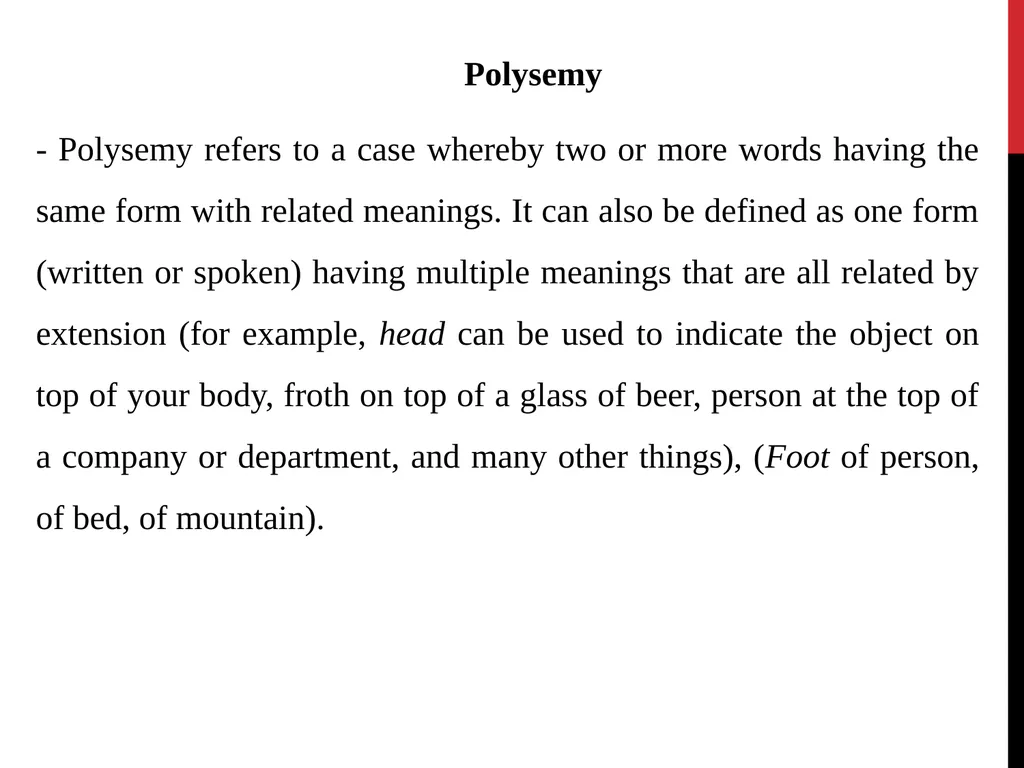
Polysemy
- Polysemy refers to a case whereby two or more words having the same form with related meanings. It can also be defined as one form (written or spoken) having multiple meanings that are all related by extension (for example, head can be used to indicate the object on top of your body, froth on top of a glass of beer, person at the top of a company or department, and many other things), (Foot of person, of bed, of mountain).<br>
- Polysemy refers to a case whereby two or more words having the same form with related meanings. It can also be defined as one form (written or spoken) having multiple meanings that are all related by extension (for example, head can be used to indicate the object on top of your body, froth on top of a glass of beer, person at the top of a company or department, and many other things), (Foot of person, of bed, of mountain).<br>
15
Metonymy
- Metonymy refers to a relationship between words, based simply on a close connection in everyday experience, a container–contents relation: (bottle/water, can/juice), a whole–part relation (car/wheels, house/roof) or a representative–symbol relationship (king/crown, the President/the White House).<br>
- Metonymy refers to a relationship between words, based simply on a close connection in everyday experience, a container–contents relation: (bottle/water, can/juice), a whole–part relation (car/wheels, house/roof) or a representative–symbol relationship (king/crown, the President/the White House).<br>
16
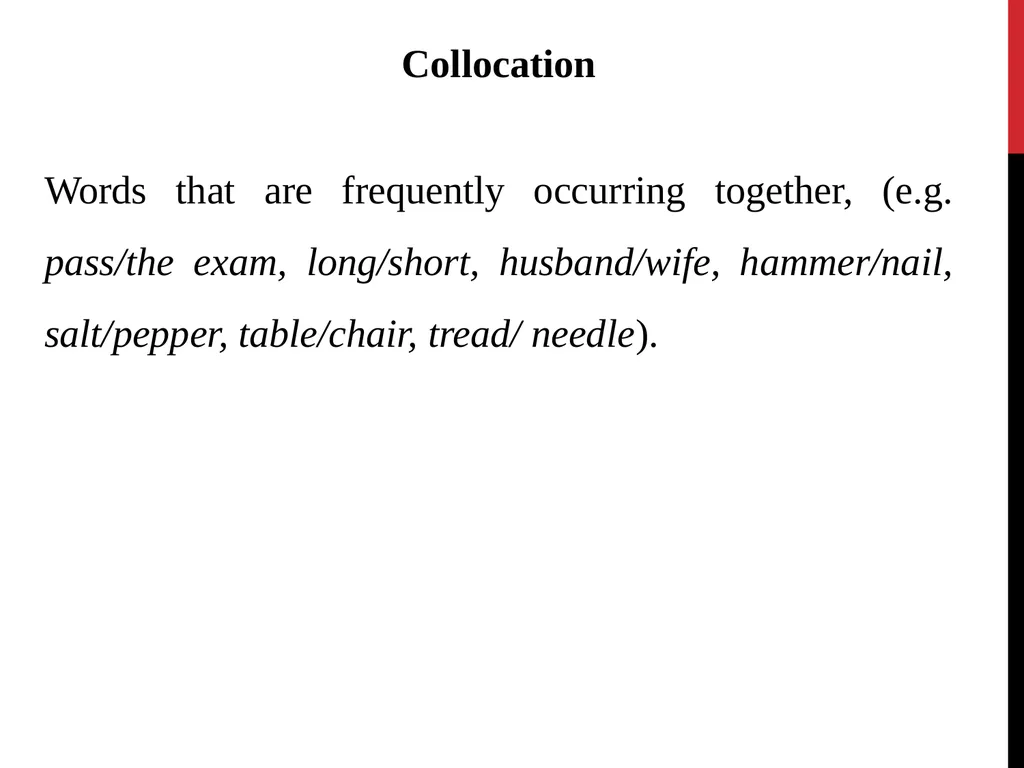
Collocation
Words that are frequently occurring together, (e.g. pass/the exam, long/short, husband/wife, hammer/nail, salt/pepper, table/chair, tread/ needle).<br>
Words that are frequently occurring together, (e.g. pass/the exam, long/short, husband/wife, hammer/nail, salt/pepper, table/chair, tread/ needle).<br>