
SEND Information Report 2025 - 2026 “inclusive
Description: SEND Information Report 2025 - 2026 inclusive teaching supported effectively Well-trained staff support pupils sensitively to achieve well high expectations for all learners Learning is fun! every teacher is a teacher of SEN
Related Topics
Download Presentation
"SEND Information Report 2025 - 2026 “inclusive" is the property of its rightful owner. Permission is granted to download and print the materials on this website for personal, non-commercial use only, and to display it on your personal computer provided you do not modify the materials and that you retain all copyright notices contained in the materials. By downloading content from our website, you accept the terms of this agreement.
Presentation Transcript
slide1. SEND Information Report 2025 - 2026 “inclusive teaching” “supported effectively” “Well-trained staff support pupils sensitively to achieve well” “high expectations for all learners” “Learning is fun!” “every teacher is a teacher of SEN”<br>
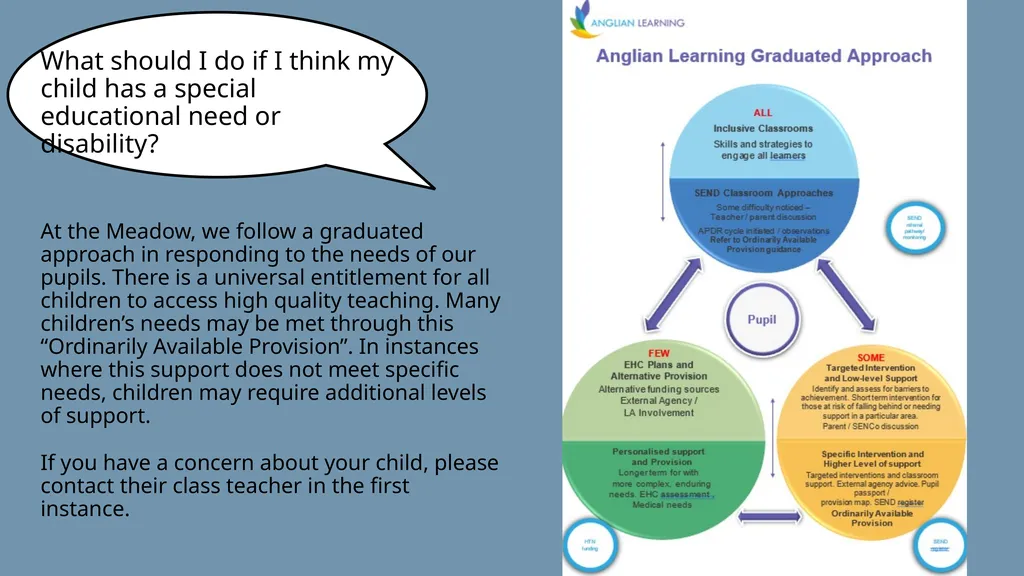
slide2. What should I do if I think my child has a special educational need or disability? At the Meadow, we follow a graduated approach in responding to the needs of our pupils. There is a universal entitlement for all children to access high quality teaching. Many children’s needs may be met through this “Ordinarily Available Provision”. In instances where this support does not meet specific needs, children may require additional levels of support.
If you have a concern about your child, please contact their class teacher in the first instance.<br>
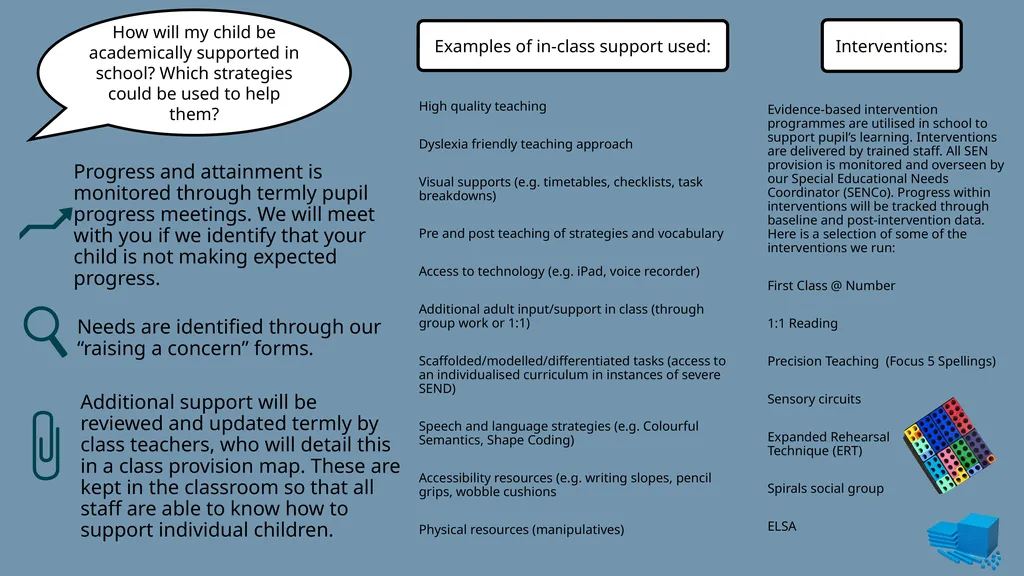
slide3. How will my child be academically supported in school? Which strategies could be used to help them? Progress and attainment is monitored through termly pupil progress meetings. We will meet with you if we identify that your child is not making expected progress. Needs are identified through our “raising a concern” forms. Additional support will be reviewed and updated termly by class teachers, who will detail this in a class provision map. These are kept in the classroom so that all staff are able to know how to support individual children. Examples of in-class support used: High quality teaching
Dyslexia friendly teaching approach
Visual supports (e.g. timetables, checklists, task breakdowns)
Pre and post teaching of strategies and vocabulary
Access to technology (e.g. iPad, voice recorder)
Additional adult input/support in class (through group work or 1:1)
Scaffolded/modelled/differentiated tasks (access to an individualised curriculum in instances of severe SEND)
Speech and language strategies (e.g. Colourful Semantics, Shape Coding)
Accessibility resources (e.g. writing slopes, pencil grips, wobble cushions
Physical resources (manipulatives) Interventions: Evidence-based intervention programmes are utilised in school to support pupil’s learning. Interventions are delivered by trained staff. All SEN provision is monitored and overseen by our Special Educational Needs Coordinator (SENCo). Progress within interventions will be tracked through baseline and post-intervention data. Here is a selection of some of the interventions we run:
First Class @ Number
1:1 Reading
Precision Teaching (Focus 5 Spellings)
Sensory circuits
Expanded Rehearsal Technique (ERT)
Spirals social group
ELSA<br>
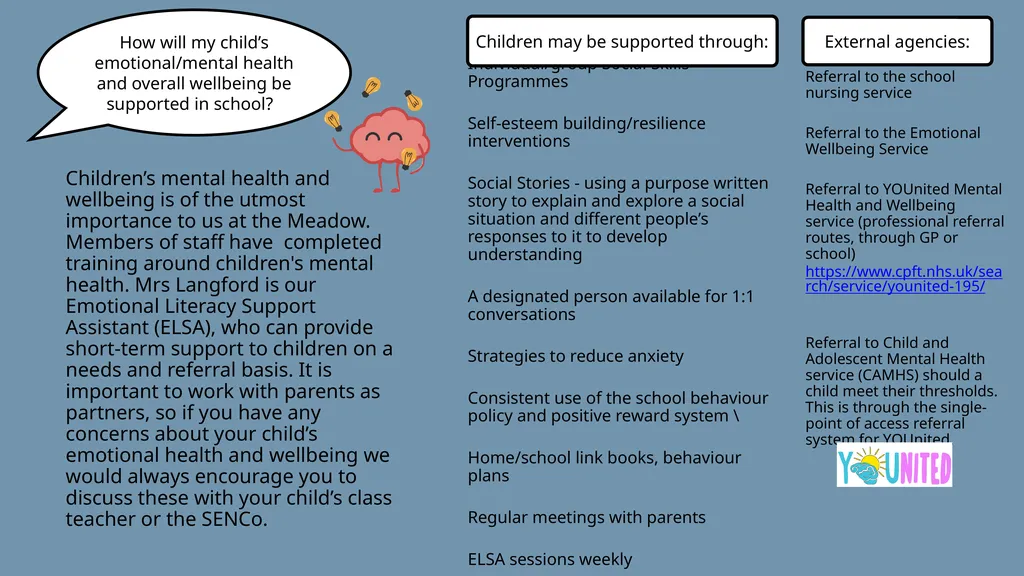
slide4. How will my child’s emotional/mental health and overall wellbeing be supported in school? Children’s mental health and wellbeing is of the utmost importance to us at the Meadow. Members of staff have completed training around children's mental health. Mrs Langford is our Emotional Literacy Support Assistant (ELSA), who can provide short-term support to children on a needs and referral basis. It is important to work with parents as partners, so if you have any concerns about your child’s emotional health and wellbeing we would always encourage you to discuss these with your child’s class teacher or the SENCo. Individual/group Social Skills Programmes
Self-esteem building/resilience interventions
Social Stories - using a purpose written story to explain and explore a social situation and different people’s responses to it to develop understanding
A designated person available for 1:1 conversations
Strategies to reduce anxiety
Consistent use of the school behaviour policy and positive reward system \
Home/school link books, behaviour plans
Regular meetings with parents
ELSA sessions weekly Children may be supported through: External agencies: Referral to the school nursing service
Referral to the Emotional Wellbeing Service
Referral to YOUnited Mental Health and Wellbeing service (professional referral routes, through GP or school) https://www.cpft.nhs.uk/search/service/younited-195/
Referral to Child and Adolescent Mental Health service (CAMHS) should a child meet their thresholds. This is through the single-point of access referral system for YOUnited.<br>
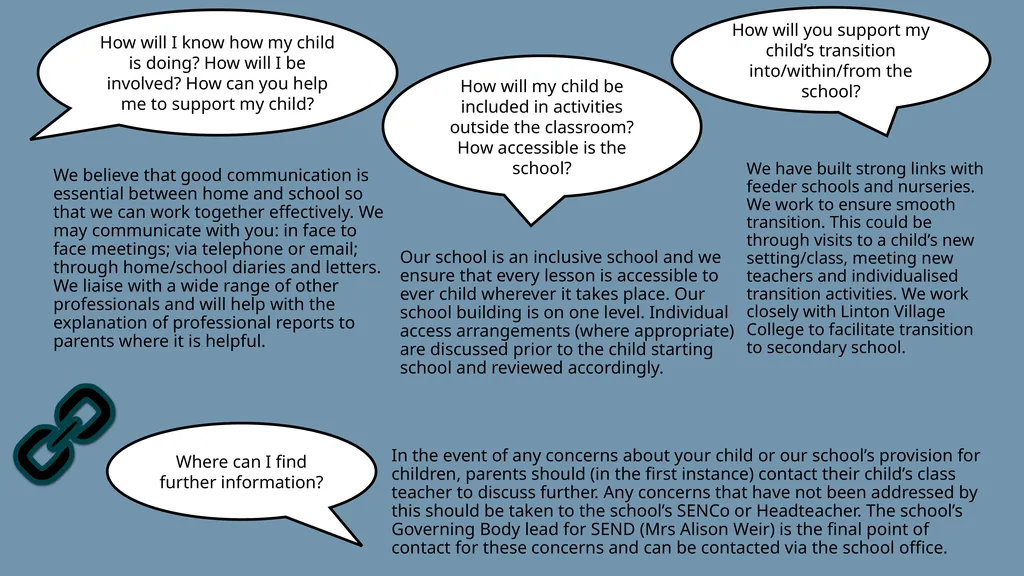
slide5. How will I know how my child is doing? How will I be involved? How can you help me to support my child? We believe that good communication is essential between home and school so that we can work together effectively. We may communicate with you: in face to face meetings; via telephone or email; through home/school diaries and letters. We liaise with a wide range of other professionals and will help with the explanation of professional reports to parents where it is helpful. How will my child be included in activities outside the classroom? How accessible is the school? Our school is an inclusive school and we ensure that every lesson is accessible to ever child wherever it takes place. Our school building is on one level. Individual access arrangements (where appropriate) are discussed prior to the child starting school and reviewed accordingly. How will you support my child’s transition into/within/from the school? We have built strong links with feeder schools and nurseries. We work to ensure smooth transition. This could be through visits to a child’s new setting/class, meeting new teachers and individualised transition activities. We work closely with Linton Village College to facilitate transition to secondary school. Where can I find further information? In the event of any concerns about your child or our school’s provision for children, parents should (in the first instance) contact their child’s class teacher to discuss further. Any concerns that have not been addressed by this should be taken to the school’s SENCo or Headteacher. The school’s Governing Body lead for SEND (Mrs Alison Weir) is the final point of contact for these concerns and can be contacted via the school office.<br>
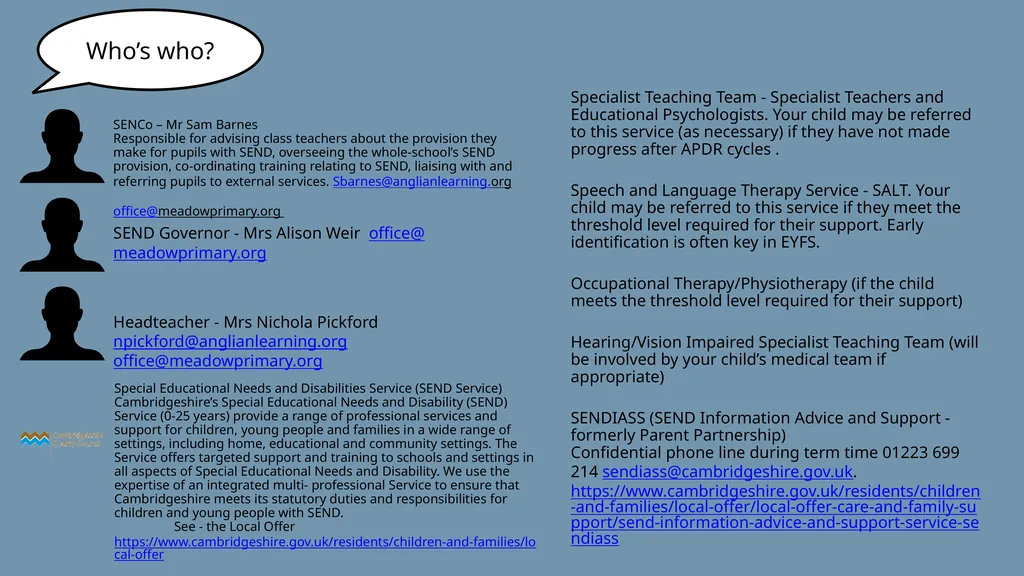
slide6. Who’s who? SENCo – Mr Sam Barnes Responsible for advising class teachers about the provision they make for pupils with SEND, overseeing the whole-school’s SEND provision, co-ordinating training relating to SEND, liaising with and referring pupils to external services. Sbarnes@anglianlearning.org office@meadowprimary.org SEND Governor - Mrs Alison Weir office@meadowprimary.org Headteacher - Mrs Nichola Pickford npickford@anglianlearning.org office@meadowprimary.org Special Educational Needs and Disabilities Service (SEND Service) Cambridgeshire’s Special Educational Needs and Disability (SEND) Service (0-25 years) provide a range of professional services and support for children, young people and families in a wide range of settings, including home, educational and community settings. The Service offers targeted support and training to schools and settings in all aspects of Special Educational Needs and Disability. We use the expertise of an integrated multi- professional Service to ensure that Cambridgeshire meets its statutory duties and responsibilities for children and young people with SEND. See - the Local Offer https://www.cambridgeshire.gov.uk/residents/children-and-families/local-offer Specialist Teaching Team - Specialist Teachers and Educational Psychologists. Your child may be referred to this service (as necessary) if they have not made progress after APDR cycles .
Speech and Language Therapy Service - SALT. Your child may be referred to this service if they meet the threshold level required for their support. Early identification is often key in EYFS.
Occupational Therapy/Physiotherapy (if the child meets the threshold level required for their support)
Hearing/Vision Impaired Specialist Teaching Team (will be involved by your child’s medical team if appropriate)
SENDIASS (SEND Information Advice and Support - formerly Parent Partnership) Confidential phone line during term time 01223 699 214 sendiass@cambridgeshire.gov.uk. https://www.cambridgeshire.gov.uk/residents/children-and-families/local-offer/local-offer-care-and-family-support/send-information-advice-and-support-service-sendiass<br>
slide2. What should I do if I think my child has a special educational need or disability? At the Meadow, we follow a graduated approach in responding to the needs of our pupils. There is a universal entitlement for all children to access high quality teaching. Many children’s needs may be met through this “Ordinarily Available Provision”. In instances where this support does not meet specific needs, children may require additional levels of support.
If you have a concern about your child, please contact their class teacher in the first instance.<br>
slide3. How will my child be academically supported in school? Which strategies could be used to help them? Progress and attainment is monitored through termly pupil progress meetings. We will meet with you if we identify that your child is not making expected progress. Needs are identified through our “raising a concern” forms. Additional support will be reviewed and updated termly by class teachers, who will detail this in a class provision map. These are kept in the classroom so that all staff are able to know how to support individual children. Examples of in-class support used: High quality teaching
Dyslexia friendly teaching approach
Visual supports (e.g. timetables, checklists, task breakdowns)
Pre and post teaching of strategies and vocabulary
Access to technology (e.g. iPad, voice recorder)
Additional adult input/support in class (through group work or 1:1)
Scaffolded/modelled/differentiated tasks (access to an individualised curriculum in instances of severe SEND)
Speech and language strategies (e.g. Colourful Semantics, Shape Coding)
Accessibility resources (e.g. writing slopes, pencil grips, wobble cushions
Physical resources (manipulatives) Interventions: Evidence-based intervention programmes are utilised in school to support pupil’s learning. Interventions are delivered by trained staff. All SEN provision is monitored and overseen by our Special Educational Needs Coordinator (SENCo). Progress within interventions will be tracked through baseline and post-intervention data. Here is a selection of some of the interventions we run:
First Class @ Number
1:1 Reading
Precision Teaching (Focus 5 Spellings)
Sensory circuits
Expanded Rehearsal Technique (ERT)
Spirals social group
ELSA<br>
slide4. How will my child’s emotional/mental health and overall wellbeing be supported in school? Children’s mental health and wellbeing is of the utmost importance to us at the Meadow. Members of staff have completed training around children's mental health. Mrs Langford is our Emotional Literacy Support Assistant (ELSA), who can provide short-term support to children on a needs and referral basis. It is important to work with parents as partners, so if you have any concerns about your child’s emotional health and wellbeing we would always encourage you to discuss these with your child’s class teacher or the SENCo. Individual/group Social Skills Programmes
Self-esteem building/resilience interventions
Social Stories - using a purpose written story to explain and explore a social situation and different people’s responses to it to develop understanding
A designated person available for 1:1 conversations
Strategies to reduce anxiety
Consistent use of the school behaviour policy and positive reward system \
Home/school link books, behaviour plans
Regular meetings with parents
ELSA sessions weekly Children may be supported through: External agencies: Referral to the school nursing service
Referral to the Emotional Wellbeing Service
Referral to YOUnited Mental Health and Wellbeing service (professional referral routes, through GP or school) https://www.cpft.nhs.uk/search/service/younited-195/
Referral to Child and Adolescent Mental Health service (CAMHS) should a child meet their thresholds. This is through the single-point of access referral system for YOUnited.<br>
slide5. How will I know how my child is doing? How will I be involved? How can you help me to support my child? We believe that good communication is essential between home and school so that we can work together effectively. We may communicate with you: in face to face meetings; via telephone or email; through home/school diaries and letters. We liaise with a wide range of other professionals and will help with the explanation of professional reports to parents where it is helpful. How will my child be included in activities outside the classroom? How accessible is the school? Our school is an inclusive school and we ensure that every lesson is accessible to ever child wherever it takes place. Our school building is on one level. Individual access arrangements (where appropriate) are discussed prior to the child starting school and reviewed accordingly. How will you support my child’s transition into/within/from the school? We have built strong links with feeder schools and nurseries. We work to ensure smooth transition. This could be through visits to a child’s new setting/class, meeting new teachers and individualised transition activities. We work closely with Linton Village College to facilitate transition to secondary school. Where can I find further information? In the event of any concerns about your child or our school’s provision for children, parents should (in the first instance) contact their child’s class teacher to discuss further. Any concerns that have not been addressed by this should be taken to the school’s SENCo or Headteacher. The school’s Governing Body lead for SEND (Mrs Alison Weir) is the final point of contact for these concerns and can be contacted via the school office.<br>
slide6. Who’s who? SENCo – Mr Sam Barnes Responsible for advising class teachers about the provision they make for pupils with SEND, overseeing the whole-school’s SEND provision, co-ordinating training relating to SEND, liaising with and referring pupils to external services. Sbarnes@anglianlearning.org office@meadowprimary.org SEND Governor - Mrs Alison Weir office@meadowprimary.org Headteacher - Mrs Nichola Pickford npickford@anglianlearning.org office@meadowprimary.org Special Educational Needs and Disabilities Service (SEND Service) Cambridgeshire’s Special Educational Needs and Disability (SEND) Service (0-25 years) provide a range of professional services and support for children, young people and families in a wide range of settings, including home, educational and community settings. The Service offers targeted support and training to schools and settings in all aspects of Special Educational Needs and Disability. We use the expertise of an integrated multi- professional Service to ensure that Cambridgeshire meets its statutory duties and responsibilities for children and young people with SEND. See - the Local Offer https://www.cambridgeshire.gov.uk/residents/children-and-families/local-offer Specialist Teaching Team - Specialist Teachers and Educational Psychologists. Your child may be referred to this service (as necessary) if they have not made progress after APDR cycles .
Speech and Language Therapy Service - SALT. Your child may be referred to this service if they meet the threshold level required for their support. Early identification is often key in EYFS.
Occupational Therapy/Physiotherapy (if the child meets the threshold level required for their support)
Hearing/Vision Impaired Specialist Teaching Team (will be involved by your child’s medical team if appropriate)
SENDIASS (SEND Information Advice and Support - formerly Parent Partnership) Confidential phone line during term time 01223 699 214 sendiass@cambridgeshire.gov.uk. https://www.cambridgeshire.gov.uk/residents/children-and-families/local-offer/local-offer-care-and-family-support/send-information-advice-and-support-service-sendiass<br>