
Seniors Against scams Speaker | Date Improving the
KB
Published · 26 slides · 0 views

1 / 1
Description
Seniors Against scams Speaker Date Improving the lives of 40 million older adults by 2030 How Much Do You Know About Scams? Introduction Icebreaker Take the quiz in your handbook to see how you stand against scams. Objectives How Much Do
Related Topics
Share
Embed code
Download this presentation From Below
"Seniors Against scams Speaker | Date Improving the" is the property of its rightful owner. Permission is granted to download and print the materials on this website for personal, non-commercial use only, and to display it on your personal computer provided you do not modify the materials and that you retain all copyright notices contained in the materials. By downloading content from our website, you accept the terms of this agreement.
Presentation Transcript
01
Seniors Against scams Speaker | Date Improving the lives of 40 million older adults by 2030<br>
02
How Much Do You Know About Scams?
Introduction Icebreaker
Take the quiz in your handbook to see
how you stand against scams.<br>
Take the quiz in your handbook to see
how you stand against scams.<br>
03
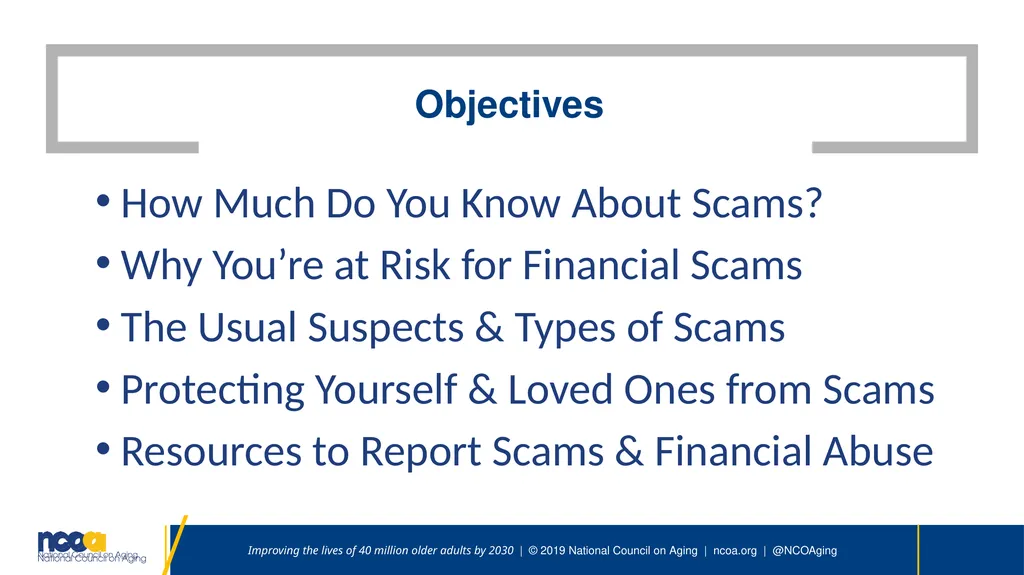
Objectives How Much Do You Know About Scams?
Why You’re at Risk for Financial Scams
The Usual Suspects & Types of Scams
Protecting Yourself & Loved Ones from Scams
Resources to Report Scams & Financial Abuse<br>
Why You’re at Risk for Financial Scams
The Usual Suspects & Types of Scams
Protecting Yourself & Loved Ones from Scams
Resources to Report Scams & Financial Abuse<br>
04
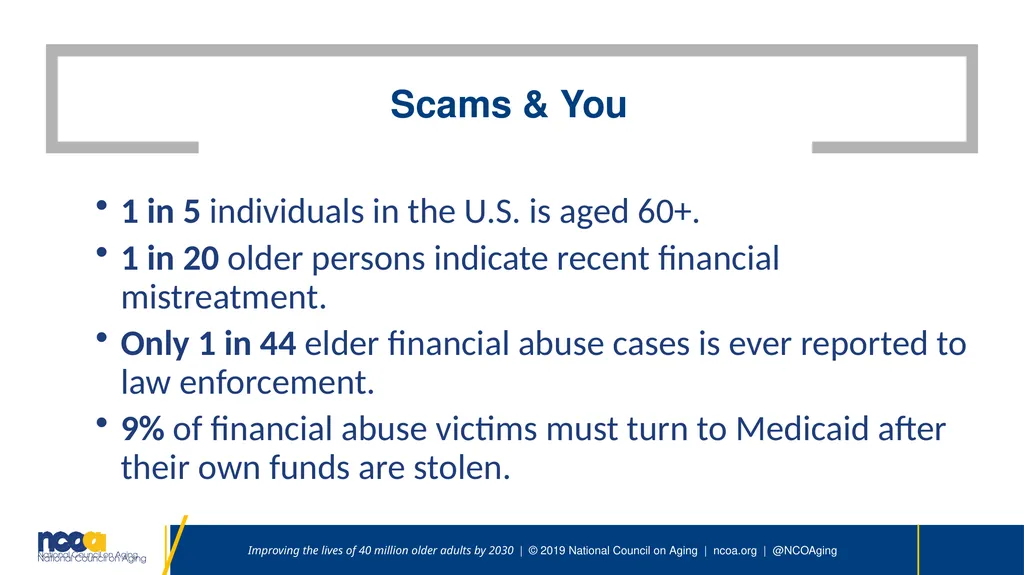
Scams & You 1 in 5 individuals in the U.S. is aged 60+.
1 in 20 older persons indicate recent financial mistreatment.
Only 1 in 44 elder financial abuse cases is ever reported to law enforcement.
9% of financial abuse victims must turn to Medicaid after their own funds are stolen.<br>
1 in 20 older persons indicate recent financial mistreatment.
Only 1 in 44 elder financial abuse cases is ever reported to law enforcement.
9% of financial abuse victims must turn to Medicaid after their own funds are stolen.<br>
05
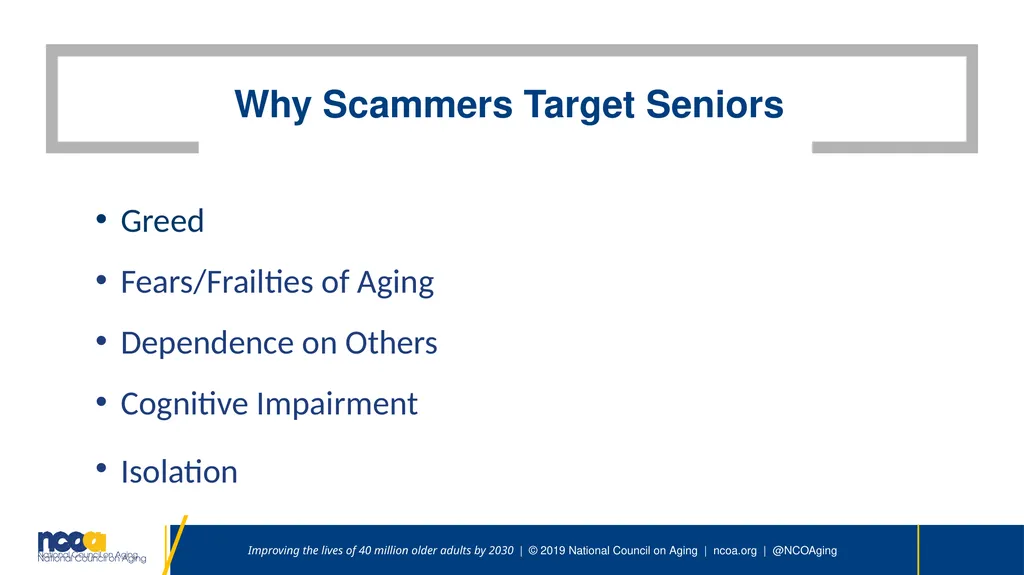
Why Scammers Target Seniors Greed
Fears/Frailties of Aging
Dependence on Others
Cognitive Impairment
Isolation<br>
Fears/Frailties of Aging
Dependence on Others
Cognitive Impairment
Isolation<br>
06
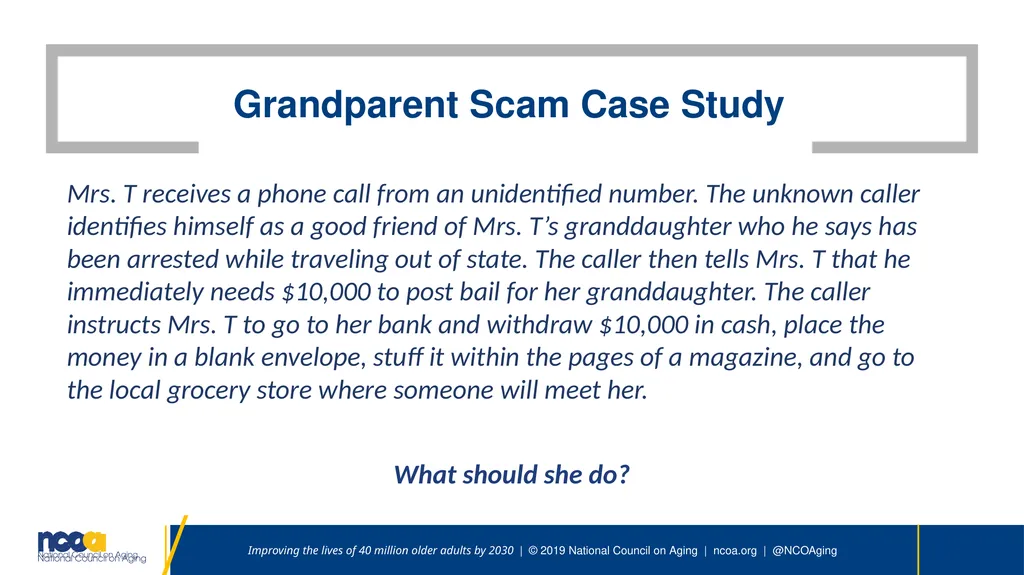
Grandparent Scam Case Study Mrs. T receives a phone call from an unidentified number. The unknown caller identifies himself as a good friend of Mrs. T’s granddaughter who he says has been arrested while traveling out of state. The caller then tells Mrs. T that he immediately needs $10,000 to post bail for her granddaughter. The caller instructs Mrs. T to go to her bank and withdraw $10,000 in cash, place the money in a blank envelope, stuff it within the pages of a magazine, and go to the local grocery store where someone will meet her.
What should she do?<br>
What should she do?<br>
07
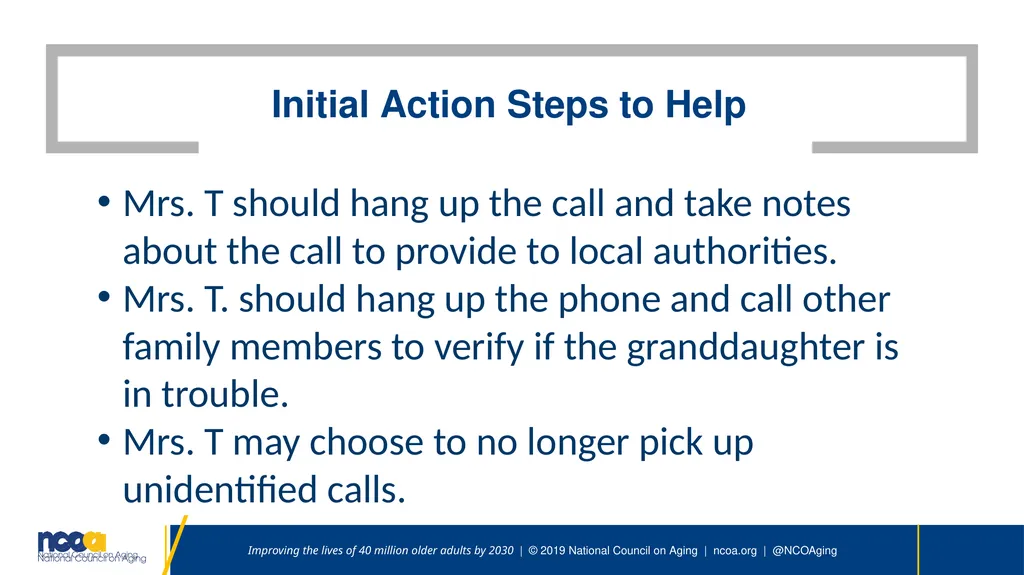
Initial Action Steps to Help Mrs. T should hang up the call and take notes about the call to provide to local authorities.
Mrs. T. should hang up the phone and call other family members to verify if the granddaughter is in trouble.
Mrs. T may choose to no longer pick up unidentified calls.<br>
Mrs. T. should hang up the phone and call other family members to verify if the granddaughter is in trouble.
Mrs. T may choose to no longer pick up unidentified calls.<br>
08
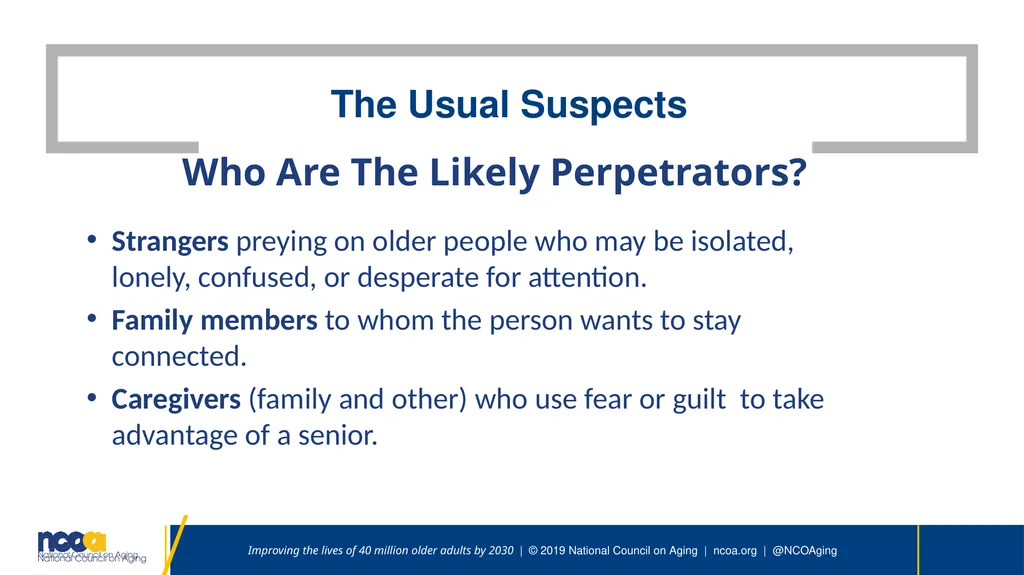
The Usual Suspects Who Are The Likely Perpetrators? Strangers preying on older people who may be isolated, lonely, confused, or desperate for attention.
Family members to whom the person wants to stay connected.
Caregivers (family and other) who use fear or guilt to take advantage of a senior.<br>
Family members to whom the person wants to stay connected.
Caregivers (family and other) who use fear or guilt to take advantage of a senior.<br>
09
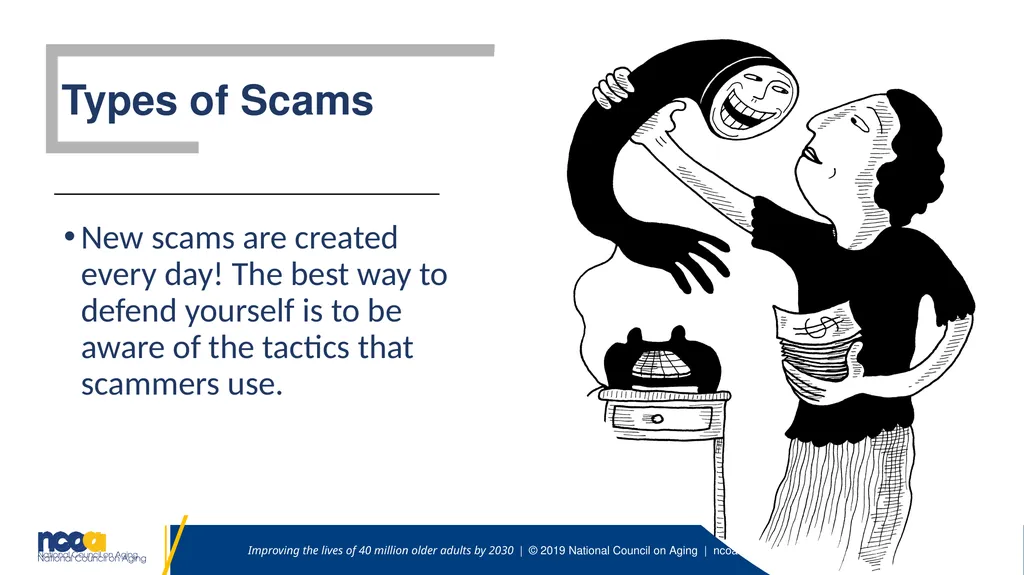
Types of Scams New scams are created every day! The best way to defend yourself is to be aware of the tactics that scammers use.<br>
10
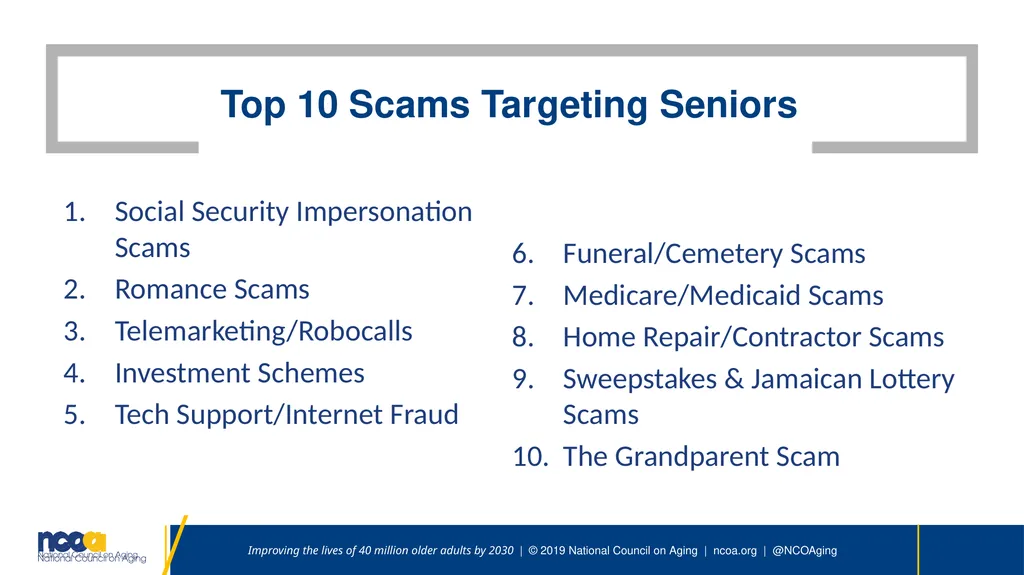
Top 10 Scams Targeting Seniors Social Security Impersonation Scams
Romance Scams
Telemarketing/Robocalls
Investment Schemes
Tech Support/Internet Fraud
Funeral/Cemetery Scams
Medicare/Medicaid Scams
Home Repair/Contractor Scams
Sweepstakes & Jamaican Lottery Scams
The Grandparent Scam<br>
Romance Scams
Telemarketing/Robocalls
Investment Schemes
Tech Support/Internet Fraud
Funeral/Cemetery Scams
Medicare/Medicaid Scams
Home Repair/Contractor Scams
Sweepstakes & Jamaican Lottery Scams
The Grandparent Scam<br>
11
Tips for Avoiding Scams<br>
12
Tips for Avoiding Tech Support/Internet Fraud Never give out your password security information to a third party who is calling you unsolicited.
If you have concerns about a slow running computer, errors or antivirus updating, simply contact the tech support number on your software package.
Sometimes there are local computer tech companies in your area.
Contact the Better Business Bureau (BBB) for a few trusted tech support business names and get a few quotes.<br>
If you have concerns about a slow running computer, errors or antivirus updating, simply contact the tech support number on your software package.
Sometimes there are local computer tech companies in your area.
Contact the Better Business Bureau (BBB) for a few trusted tech support business names and get a few quotes.<br>
13
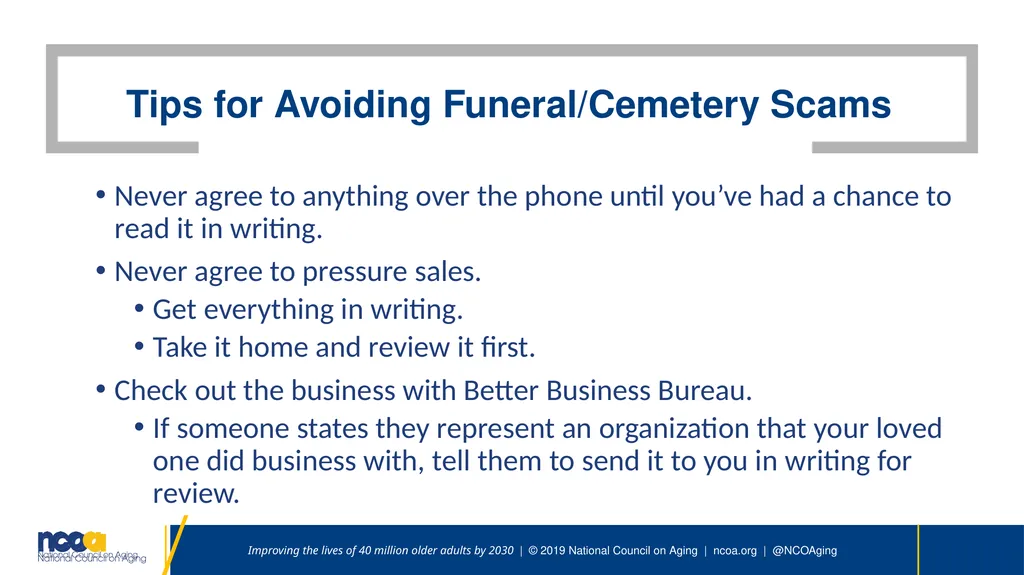
Tips for Avoiding Funeral/Cemetery Scams Never agree to anything over the phone until you’ve had a chance to read it in writing.
Never agree to pressure sales.
Get everything in writing.
Take it home and review it first.
Check out the business with Better Business Bureau.
If someone states they represent an organization that your loved one did business with, tell them to send it to you in writing for review.<br>
Never agree to pressure sales.
Get everything in writing.
Take it home and review it first.
Check out the business with Better Business Bureau.
If someone states they represent an organization that your loved one did business with, tell them to send it to you in writing for review.<br>
14
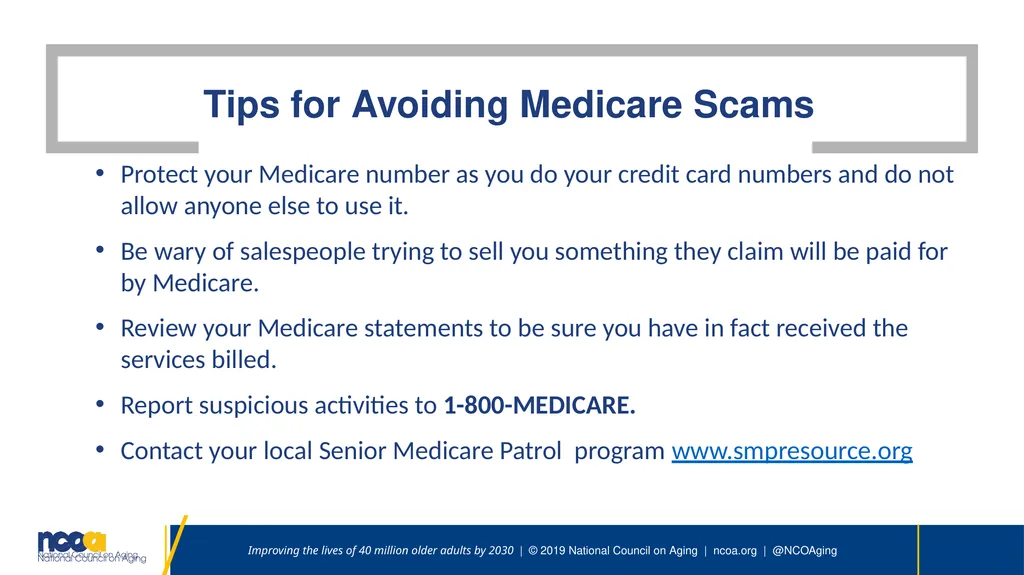
Tips for Avoiding Medicare Scams Protect your Medicare number as you do your credit card numbers and do not allow anyone else to use it.
Be wary of salespeople trying to sell you something they claim will be paid for by Medicare.
Review your Medicare statements to be sure you have in fact received the services billed.
Report suspicious activities to 1-800-MEDICARE.
Contact your local Senior Medicare Patrol program www.smpresource.org<br>
Be wary of salespeople trying to sell you something they claim will be paid for by Medicare.
Review your Medicare statements to be sure you have in fact received the services billed.
Report suspicious activities to 1-800-MEDICARE.
Contact your local Senior Medicare Patrol program www.smpresource.org<br>
15
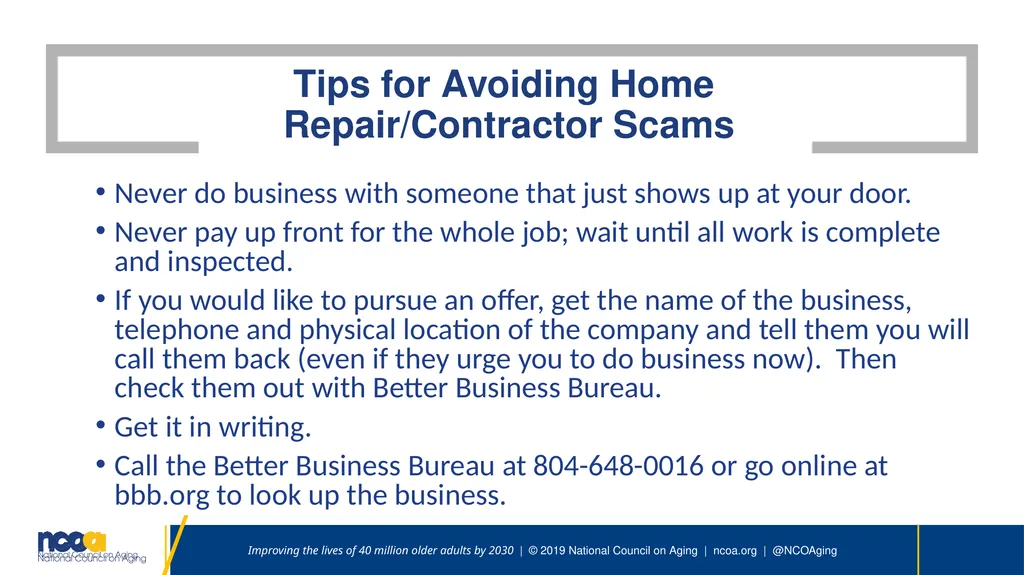
Tips for Avoiding Home
Repair/Contractor Scams Never do business with someone that just shows up at your door.
Never pay up front for the whole job; wait until all work is complete and inspected.
If you would like to pursue an offer, get the name of the business, telephone and physical location of the company and tell them you will call them back (even if they urge you to do business now). Then check them out with Better Business Bureau.
Get it in writing.
Call the Better Business Bureau at 804-648-0016 or go online at bbb.org to look up the business.<br>
Never pay up front for the whole job; wait until all work is complete and inspected.
If you would like to pursue an offer, get the name of the business, telephone and physical location of the company and tell them you will call them back (even if they urge you to do business now). Then check them out with Better Business Bureau.
Get it in writing.
Call the Better Business Bureau at 804-648-0016 or go online at bbb.org to look up the business.<br>
16
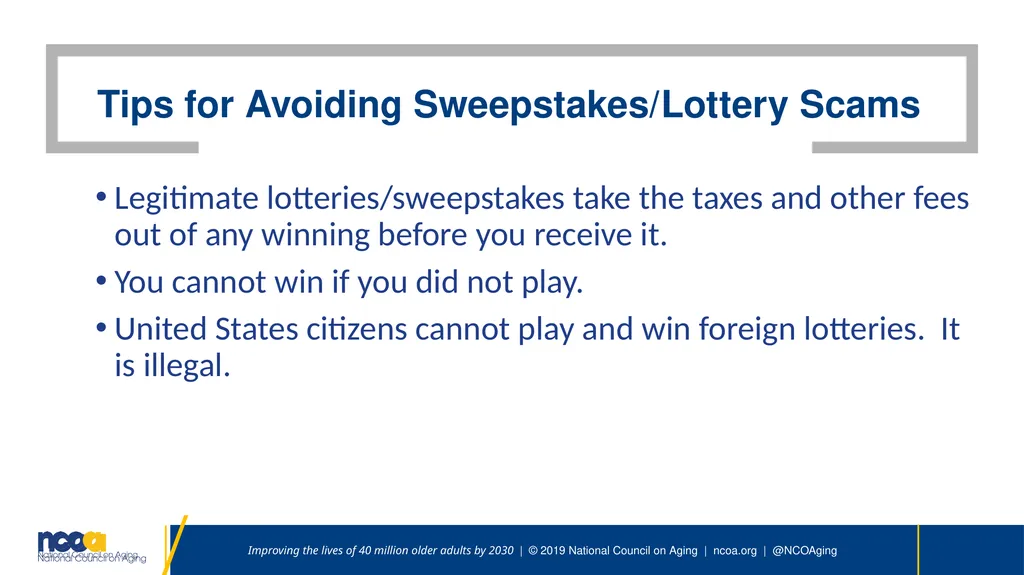
Tips for Avoiding Sweepstakes/Lottery Scams Legitimate lotteries/sweepstakes take the taxes and other fees out of any winning before you receive it.
You cannot win if you did not play.
United States citizens cannot play and win foreign lotteries. It is illegal.<br>
You cannot win if you did not play.
United States citizens cannot play and win foreign lotteries. It is illegal.<br>
17
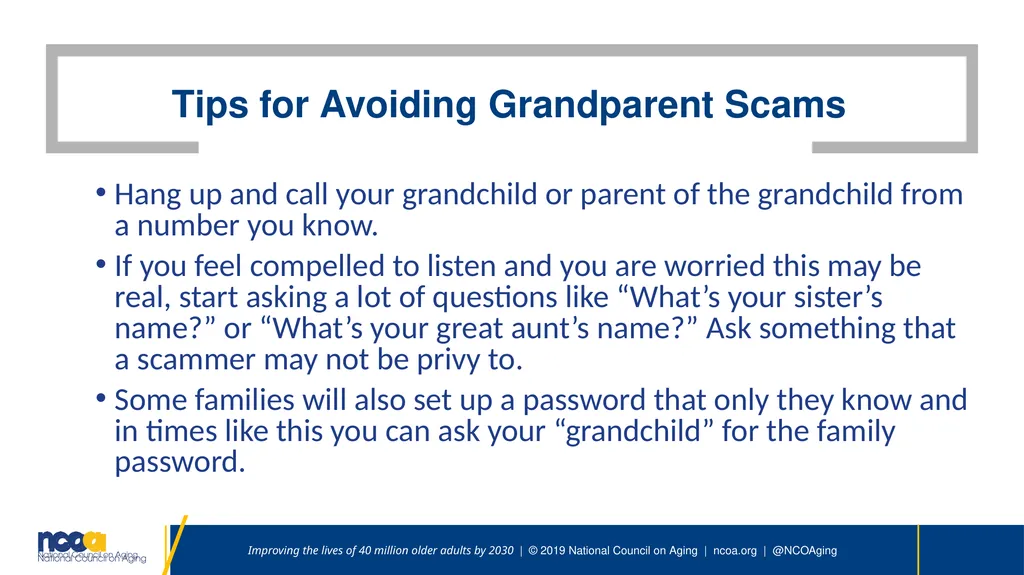
Tips for Avoiding Grandparent Scams Hang up and call your grandchild or parent of the grandchild from a number you know.
If you feel compelled to listen and you are worried this may be real, start asking a lot of questions like “What’s your sister’s name?” or “What’s your great aunt’s name?” Ask something that a scammer may not be privy to.
Some families will also set up a password that only they know and in times like this you can ask your “grandchild” for the family password.<br>
If you feel compelled to listen and you are worried this may be real, start asking a lot of questions like “What’s your sister’s name?” or “What’s your great aunt’s name?” Ask something that a scammer may not be privy to.
Some families will also set up a password that only they know and in times like this you can ask your “grandchild” for the family password.<br>
18
Protecting Yourself & Your Loved Ones<br>
19
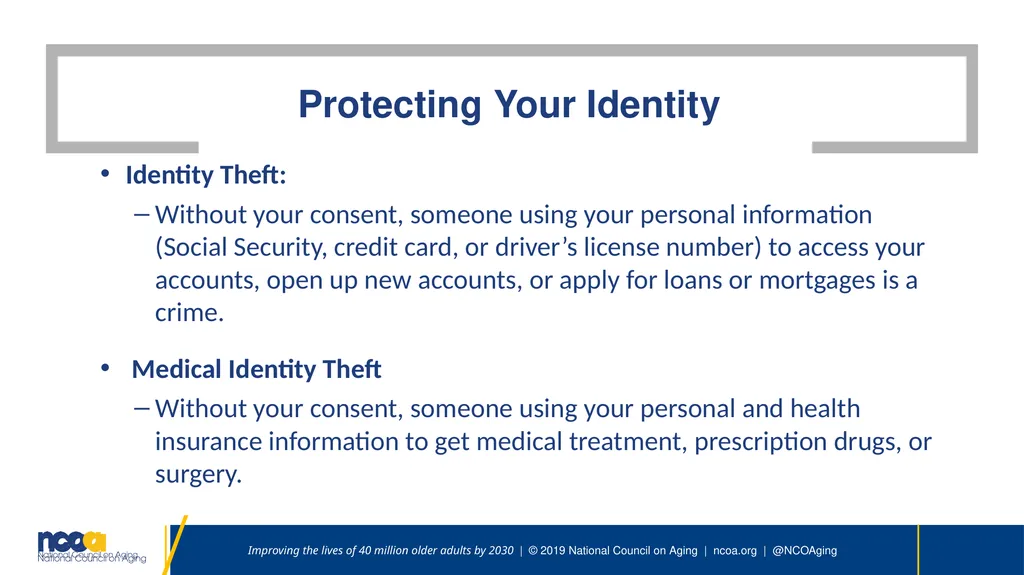
Protecting Your Identity Identity Theft:
Without your consent, someone using your personal information (Social Security, credit card, or driver’s license number) to access your accounts, open up new accounts, or apply for loans or mortgages is a crime.
Medical Identity Theft
Without your consent, someone using your personal and health insurance information to get medical treatment, prescription drugs, or surgery.<br>
Without your consent, someone using your personal information (Social Security, credit card, or driver’s license number) to access your accounts, open up new accounts, or apply for loans or mortgages is a crime.
Medical Identity Theft
Without your consent, someone using your personal and health insurance information to get medical treatment, prescription drugs, or surgery.<br>
20
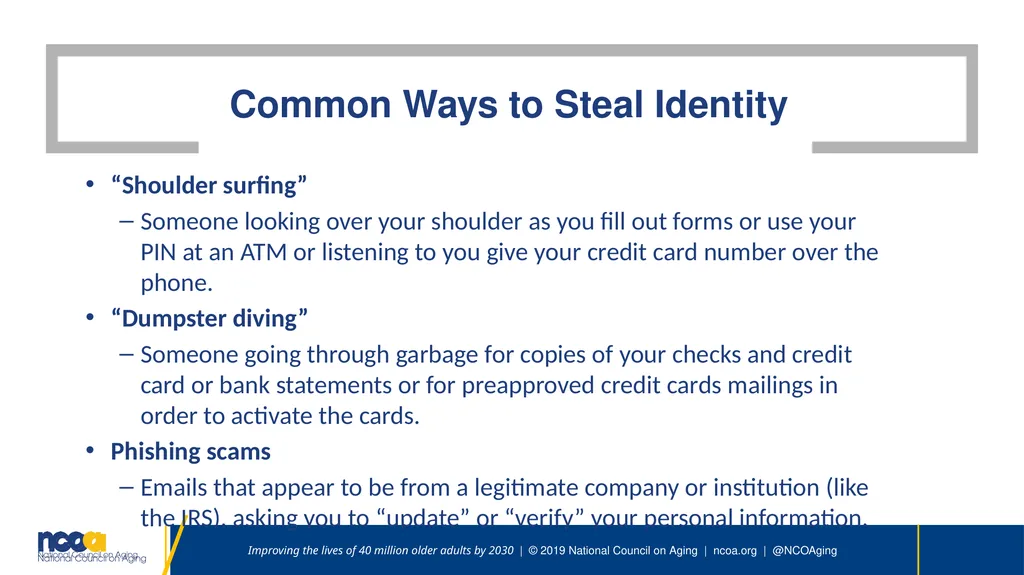
Common Ways to Steal Identity “Shoulder surfing”
Someone looking over your shoulder as you fill out forms or use your PIN at an ATM or listening to you give your credit card number over the phone.
“Dumpster diving”
Someone going through garbage for copies of your checks and credit card or bank statements or for preapproved credit cards mailings in order to activate the cards.
Phishing scams
Emails that appear to be from a legitimate company or institution (like the IRS), asking you to “update” or “verify” your personal information.<br>
Someone looking over your shoulder as you fill out forms or use your PIN at an ATM or listening to you give your credit card number over the phone.
“Dumpster diving”
Someone going through garbage for copies of your checks and credit card or bank statements or for preapproved credit cards mailings in order to activate the cards.
Phishing scams
Emails that appear to be from a legitimate company or institution (like the IRS), asking you to “update” or “verify” your personal information.<br>
21
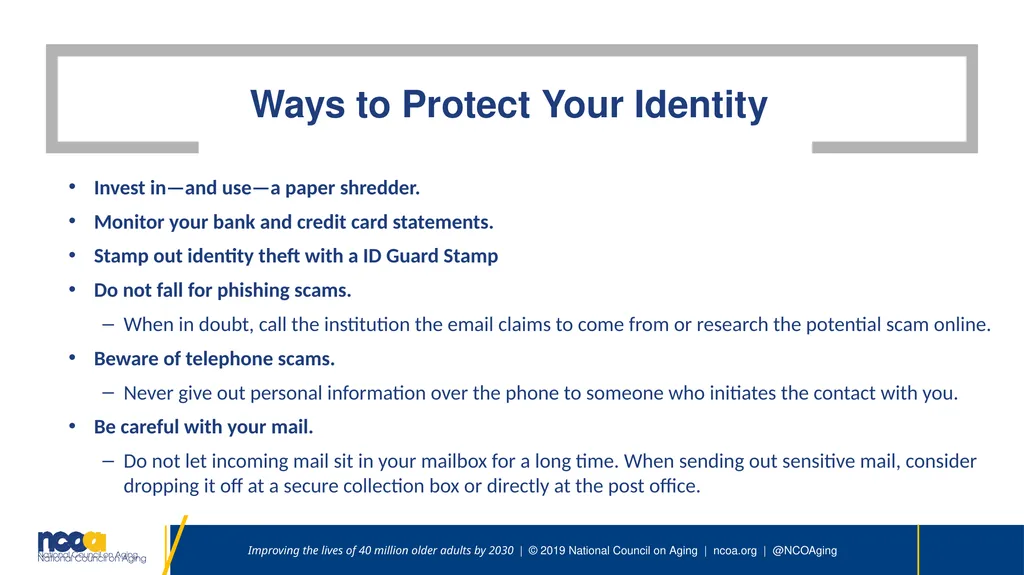
Ways to Protect Your Identity Invest in—and use—a paper shredder.
Monitor your bank and credit card statements.
Stamp out identity theft with a ID Guard Stamp
Do not fall for phishing scams.
When in doubt, call the institution the email claims to come from or research the potential scam online.
Beware of telephone scams.
Never give out personal information over the phone to someone who initiates the contact with you.
Be careful with your mail.
Do not let incoming mail sit in your mailbox for a long time. When sending out sensitive mail, consider dropping it off at a secure collection box or directly at the post office.<br>
Monitor your bank and credit card statements.
Stamp out identity theft with a ID Guard Stamp
Do not fall for phishing scams.
When in doubt, call the institution the email claims to come from or research the potential scam online.
Beware of telephone scams.
Never give out personal information over the phone to someone who initiates the contact with you.
Be careful with your mail.
Do not let incoming mail sit in your mailbox for a long time. When sending out sensitive mail, consider dropping it off at a secure collection box or directly at the post office.<br>
22
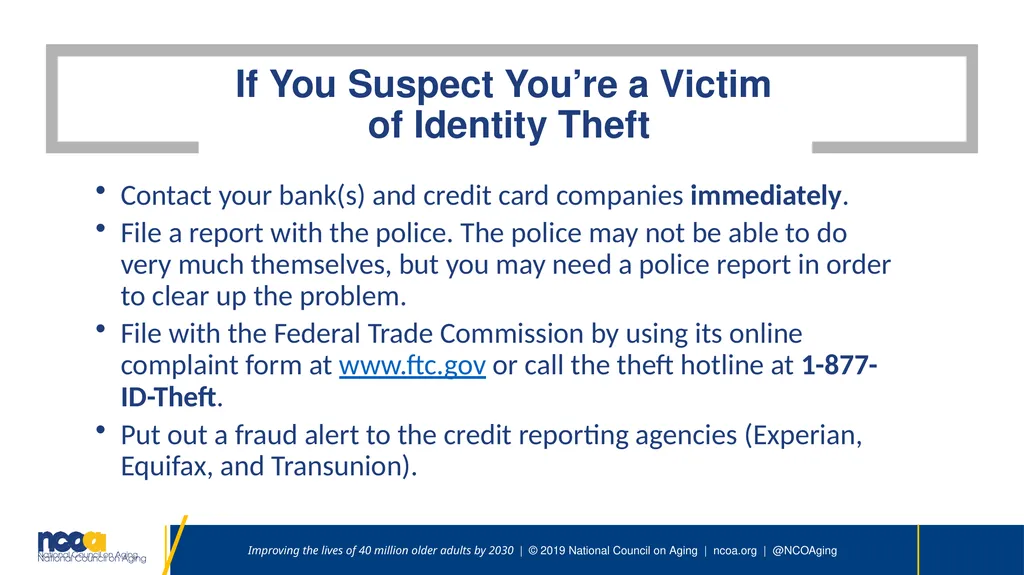
If You Suspect You’re a Victim
of Identity Theft Contact your bank(s) and credit card companies immediately.
File a report with the police. The police may not be able to do very much themselves, but you may need a police report in order to clear up the problem.
File with the Federal Trade Commission by using its online complaint form at www.ftc.gov or call the theft hotline at 1-877-ID-Theft.
Put out a fraud alert to the credit reporting agencies (Experian, Equifax, and Transunion).<br>
File a report with the police. The police may not be able to do very much themselves, but you may need a police report in order to clear up the problem.
File with the Federal Trade Commission by using its online complaint form at www.ftc.gov or call the theft hotline at 1-877-ID-Theft.
Put out a fraud alert to the credit reporting agencies (Experian, Equifax, and Transunion).<br>
23
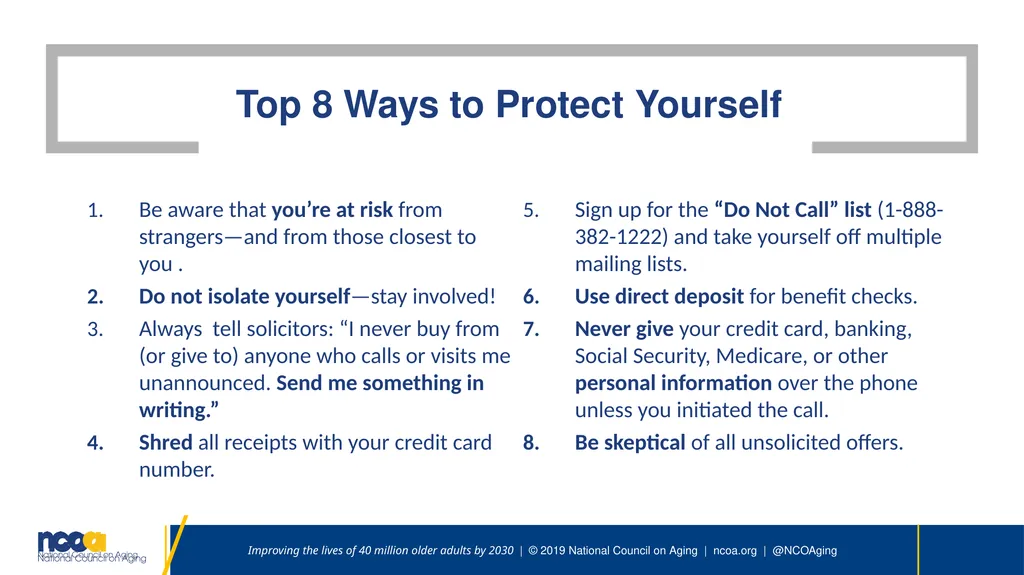
Top 8 Ways to Protect Yourself Be aware that you’re at risk from strangers—and from those closest to you .
Do not isolate yourself—stay involved!
Always tell solicitors: “I never buy from (or give to) anyone who calls or visits me unannounced. Send me something in writing.”
Shred all receipts with your credit card number.
Sign up for the “Do Not Call” list (1-888-382-1222) and take yourself off multiple mailing lists.
Use direct deposit for benefit checks.
Never give your credit card, banking, Social Security, Medicare, or other personal information over the phone unless you initiated the call.
Be skeptical of all unsolicited offers.<br>
Do not isolate yourself—stay involved!
Always tell solicitors: “I never buy from (or give to) anyone who calls or visits me unannounced. Send me something in writing.”
Shred all receipts with your credit card number.
Sign up for the “Do Not Call” list (1-888-382-1222) and take yourself off multiple mailing lists.
Use direct deposit for benefit checks.
Never give your credit card, banking, Social Security, Medicare, or other personal information over the phone unless you initiated the call.
Be skeptical of all unsolicited offers.<br>
24
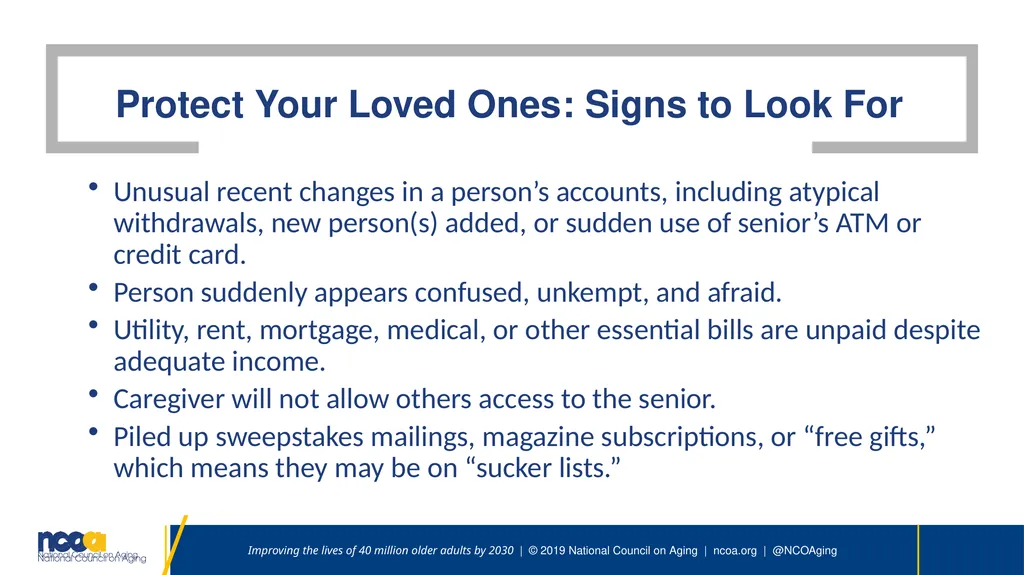
Protect Your Loved Ones: Signs to Look For Unusual recent changes in a person’s accounts, including atypical withdrawals, new person(s) added, or sudden use of senior’s ATM or credit card.
Person suddenly appears confused, unkempt, and afraid.
Utility, rent, mortgage, medical, or other essential bills are unpaid despite adequate income.
Caregiver will not allow others access to the senior.
Piled up sweepstakes mailings, magazine subscriptions, or “free gifts,” which means they may be on “sucker lists.”<br>
Person suddenly appears confused, unkempt, and afraid.
Utility, rent, mortgage, medical, or other essential bills are unpaid despite adequate income.
Caregiver will not allow others access to the senior.
Piled up sweepstakes mailings, magazine subscriptions, or “free gifts,” which means they may be on “sucker lists.”<br>
25
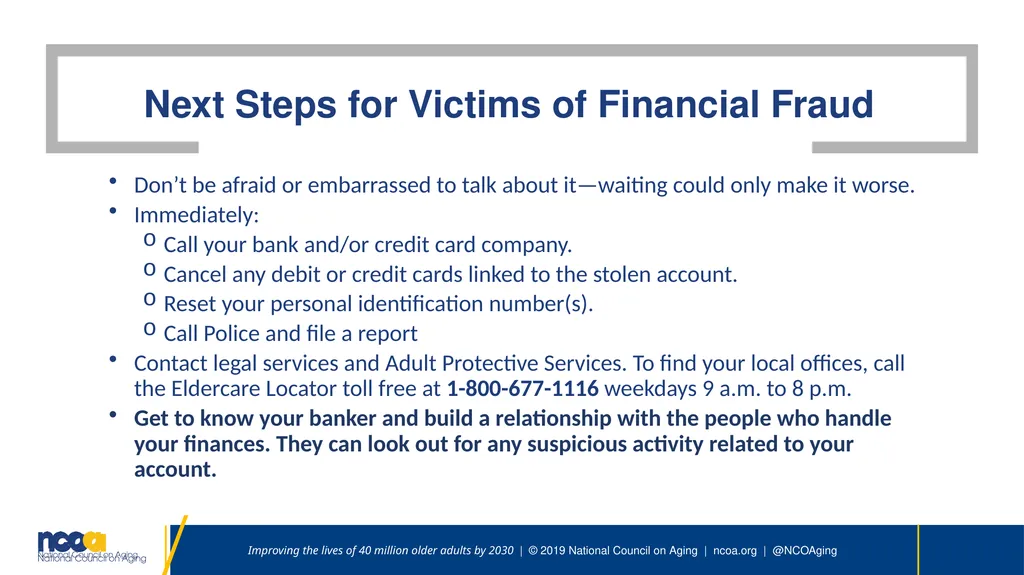
Next Steps for Victims of Financial Fraud Don’t be afraid or embarrassed to talk about it—waiting could only make it worse.
Immediately:
Call your bank and/or credit card company.
Cancel any debit or credit cards linked to the stolen account.
Reset your personal identification number(s).
Call Police and file a report
Contact legal services and Adult Protective Services. To find your local offices, call the Eldercare Locator toll free at 1-800-677-1116 weekdays 9 a.m. to 8 p.m.
Get to know your banker and build a relationship with the people who handle your finances. They can look out for any suspicious activity related to your account.<br>
Immediately:
Call your bank and/or credit card company.
Cancel any debit or credit cards linked to the stolen account.
Reset your personal identification number(s).
Call Police and file a report
Contact legal services and Adult Protective Services. To find your local offices, call the Eldercare Locator toll free at 1-800-677-1116 weekdays 9 a.m. to 8 p.m.
Get to know your banker and build a relationship with the people who handle your finances. They can look out for any suspicious activity related to your account.<br>
26
Thank You!<br>